

Biomining and Bioleaching
SARDAR HUSSAIN
Asst.Prof In Biotechnology,
GSc.CTA.
sardar1109@gmail.com
Biomining and Bioleaching ?
Mining companies have become increasingly aware of the
potential of microbiological approaches for recovering base
and precious metals from low-grade ores, and for
bioremediating acid mine drainage and mine trailings.
There are two strategies:
Biomining and Biosorption where microorganisms are used
to recover metals in solution (e.g acid mine drainage) by
precipitation of the metal, or complexing or absorption
with cellualr molecules. Pyrometallurgy then enables
recovery of these metals with the microbial biomass
contributing as fuel.
 Bioleaching where microorganisms are used to facilitate
the mining of metals from their ores by facilitating their
solution. Either use low grade ores (re-work mine
trailings) or to avoid the extraction of large amounts of
ores to the surface……
The need for Biomining and
Bioleaching
 Biomining will become more important as high-
grade surface mineral deposits are worked out and
become less viable, and mining companies will be
forced to find other mineral sources.
 These will include the working of low-grade ore
deposits, mine tailings, mine dumps, and
worked-out mines. The extraction of metals using
mechanical and chemical methods is difficult and
expensive but biological methods are more cost-
effective, use little energy, can function well at low
concentration of metals, do not usually produce
harmful emissions and reduce the pollution of
metal-containing wastes.
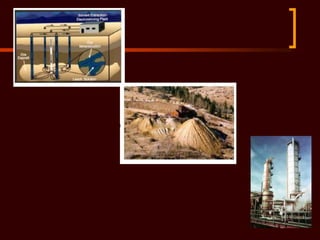
Bioleaching approaches
In situ bioleaching. The leaching solution containing Thiobacillus
ferrooxidans is pumped into the mine where it is injected into
the ore. The leachate is recovered from lower down the mine,
pumped to the surface where the metal is recovered.
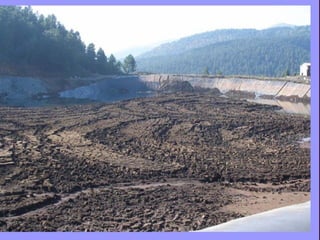
Mine tailings or dumps. A dump on a slope with a depth of 7-20
m of crushed ore or tailings is sprayed with water acidified with
sulphuric acid to ensure that the pH is between 1.5 and 3, -
encourage the growth of Thiobacillus spp. The metals are
collected by precipitation from the leachate.
Bioreactors used are the highly aerated stirred-tank designs
where finely ground ore is treated. Often nutrients are added
and the bioreactor operated in a continuous manner. The
leaching can take days rather than the weeks required with at
temperatures of 40-50°C, although the ore loading is appox.
20%. Ores such as chalcopyrite (CuFeS2) and energite
(Cu3AsS4) require temperatures as high as 75-8 0°C for
leaching which cannot be generated in dumps and therefore
can only be carried out in bioreactors
Bioleaching Microbiology
 Iron pyrites and copper sulphide could be oxidized
by Thiobacillus spp. and the first patent was filed
(Zimmerley et al., 1958). The ability of micro-
organisms to solubilize metals from
insoluble metals is known as
'bioleaching‘
 Successful commercial metal-leaching processes
include the extraction of gold, copper, and
uranium (Suzuki, 2001).
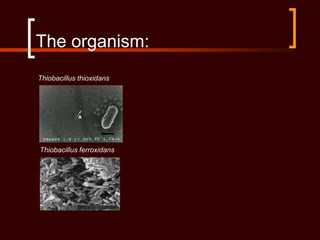
The organism:
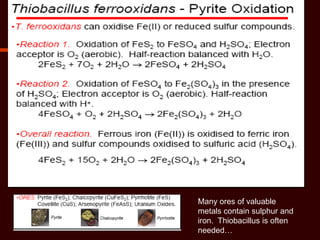
Thiobacillus thioxidans
Thiobacillus ferroxidans
Bioleaching microorganisms
 The most important mineral-decomposing micro-
organisms are the iron- and sulphur-oxidizing
chemolithotrophs
 Chemolithothrophs obtain energy from inorganic
chemicals, use carbon dioxide as their carbon
sources, and are represented by hydrogen-,
sulphur-, and iron-reducing Bacteria and
Archaea.
 The most important metal-leaching
microorganisms use ferrous iron and reduced
sulphur compounds as electron donors and fix
carbon dioxide.
 Many of these microorganisms produce sulphuric
acid (acidophiles).
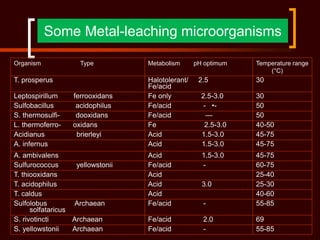
Some Metal-leaching microorganisms
Organism Type Metabolism pH optimum Temperature range
(°C)
T. prosperus Halotolerant/ 2.5
Fe/acid
30
Leptospirillum ferrooxidans Fe only 2.5-3.0 30
Sulfobacillus acidophilus Fe/acid - •- 50
S. thermosulfi- dooxidans Fe/acid — 50
L. thermoferro- oxidans Fe 2.5-3.0 40-50
Acidianus brierleyi Acid 1.5-3.0 45-75
A. infernus Acid 1.5-3.0 45-75
A. ambivalens Acid 1.5-3.0 45-75
Sulfurococcus yellowstonii Fe/acid - 60-75
T. thiooxidans Acid 25-40
T. acidophilus Acid 3.0 25-30
T. caldus Acid 40-60
Sulfolobus Archaean
solfataricus
Fe/acid - 55-85
S. rivotincti Archaean Fe/acid 2.0 69
S. yellowstonii Archaean Fe/acid - 55-85
Bioleaching technology
 It has been shown that micro-organisms can
extract cobalt, nickel, cadmium, antimony,
zinc, lead, gallium, indium, manganese,
copper, and tin from sulphur-based ores.
 The basis of microbial extraction is that the
metal sulphides, the principal component in
many ores, are not soluble but when
oxidized to sulphate become soluble so that
the metal salt can be extracted.
Many ores of valuable
metals contain sulphur and
iron. Thiobacillus is often
needed…
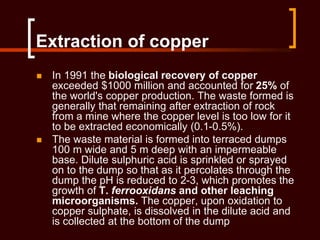
Extraction of copper
 In 1991 the biological recovery of copper
exceeded $1000 million and accounted for 25% of
the world's copper production. The waste formed is
generally that remaining after extraction of rock
from a mine where the copper level is too low for it
to be extracted economically (0.1-0.5%).
 The waste material is formed into terraced dumps
100 m wide and 5 m deep with an impermeable
base. Dilute sulphuric acid is sprinkled or sprayed
on to the dump so that as it percolates through the
dump the pH is reduced to 2-3, which promotes the
growth of T. ferrooxidans and other leaching
microorganisms. The copper, upon oxidation to
copper sulphate, is dissolved in the dilute acid and
is collected at the bottom of the dump
Extraction of uranium
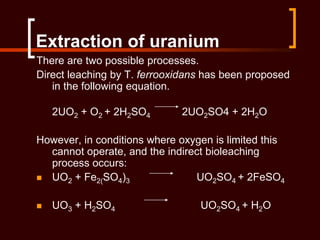
There are two possible processes.
Direct leaching by T. ferrooxidans has been proposed
in the following equation.
2UO2 + O2 + 2H2SO4 2UO2SO4 + 2H2O
However, in conditions where oxygen is limited this
cannot operate, and the indirect bioleaching
process occurs:
 UO2 + Fe2(SO4)3 UO2SO4 + 2FeSO4
 UO3 + H2SO4 UO2SO4 + H2O
Extraction of gold
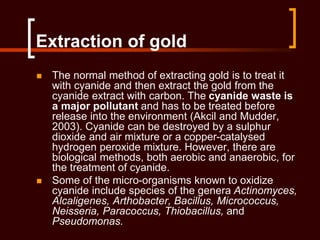
 The normal method of extracting gold is to treat it
with cyanide and then extract the gold from the
cyanide extract with carbon. The cyanide waste is
a major pollutant and has to be treated before
release into the environment (Akcil and Mudder,
2003). Cyanide can be destroyed by a sulphur
dioxide and air mixture or a copper-catalysed
hydrogen peroxide mixture. However, there are
biological methods, both aerobic and anaerobic, for
the treatment of cyanide.
 Some of the micro-organisms known to oxidize
cyanide include species of the genera Actinomyces,
Alcaligenes, Arthobacter, Bacillus, Micrococcus,
Neisseria, Paracoccus, Thiobacillus, and
Pseudomonas.
Lost gold…
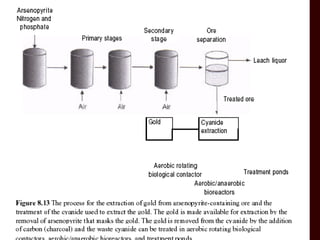
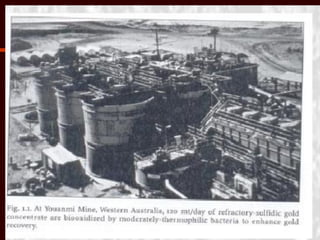
 Some ores are resistant to cyanide
treatment as the gold is enmeshed in pyrite
(FeS2) and arsenopyrite (FeAsS) and only
50% of the gold can be extracted. The
leaching is carried out in a sequence of
bioreactors with the first step bioleaching the
FeS2 and FeAsS so that the gold can
subsequently b eextracted.
 The processes includes aerobic rotating
biological contactors, bioreactors, and
stimulated ponds
The future of Bioleaching
 Isolate new bacterial strains from extreme environments,
such as mine-drainage sites, hot springs, and waste
sites, and use these to seed bioleaching processes.
 Improve isolates by conventional mutation and selection
or by genetic engineering. One possibility would be to
introduce arsenic resistance into some bioleaching
organisms, which could then be used in gold
bioleaching.
 Heterotrophic leaching is a solution for wastes and ores
of high pH (5.5) where many of the acidophiles would
not grow. Fungi likeTrichoderma horzianum have been
shown to solubilize MnO2, Fe2O3, Zn, and calcium
phosphate minerals.
 The population dynamics within the bioleaching dumps
and the relative importance of various organisms and
mechanisms needs to be understood.
Biomining /bioleaching

Biomining /bioleaching

  • 1.
    Biomining and Bioleaching SARDARHUSSAIN Asst.Prof In Biotechnology, GSc.CTA. sardar1109@gmail.com
  • 2.
    Biomining and Bioleaching? Mining companies have become increasingly aware of the potential of microbiological approaches for recovering base and precious metals from low-grade ores, and for bioremediating acid mine drainage and mine trailings. There are two strategies: Biomining and Biosorption where microorganisms are used to recover metals in solution (e.g acid mine drainage) by precipitation of the metal, or complexing or absorption with cellualr molecules. Pyrometallurgy then enables recovery of these metals with the microbial biomass contributing as fuel.  Bioleaching where microorganisms are used to facilitate the mining of metals from their ores by facilitating their solution. Either use low grade ores (re-work mine trailings) or to avoid the extraction of large amounts of ores to the surface……
  • 3.
    The need forBiomining and Bioleaching  Biomining will become more important as high- grade surface mineral deposits are worked out and become less viable, and mining companies will be forced to find other mineral sources.  These will include the working of low-grade ore deposits, mine tailings, mine dumps, and worked-out mines. The extraction of metals using mechanical and chemical methods is difficult and expensive but biological methods are more cost- effective, use little energy, can function well at low concentration of metals, do not usually produce harmful emissions and reduce the pollution of metal-containing wastes.
  • 7.
    Bioleaching approaches In situbioleaching. The leaching solution containing Thiobacillus ferrooxidans is pumped into the mine where it is injected into the ore. The leachate is recovered from lower down the mine, pumped to the surface where the metal is recovered. Mine tailings or dumps. A dump on a slope with a depth of 7-20 m of crushed ore or tailings is sprayed with water acidified with sulphuric acid to ensure that the pH is between 1.5 and 3, - encourage the growth of Thiobacillus spp. The metals are collected by precipitation from the leachate. Bioreactors used are the highly aerated stirred-tank designs where finely ground ore is treated. Often nutrients are added and the bioreactor operated in a continuous manner. The leaching can take days rather than the weeks required with at temperatures of 40-50°C, although the ore loading is appox. 20%. Ores such as chalcopyrite (CuFeS2) and energite (Cu3AsS4) require temperatures as high as 75-8 0°C for leaching which cannot be generated in dumps and therefore can only be carried out in bioreactors
  • 9.
    Bioleaching Microbiology  Ironpyrites and copper sulphide could be oxidized by Thiobacillus spp. and the first patent was filed (Zimmerley et al., 1958). The ability of micro- organisms to solubilize metals from insoluble metals is known as 'bioleaching‘  Successful commercial metal-leaching processes include the extraction of gold, copper, and uranium (Suzuki, 2001).
  • 10.
  • 11.
    Bioleaching microorganisms  Themost important mineral-decomposing micro- organisms are the iron- and sulphur-oxidizing chemolithotrophs  Chemolithothrophs obtain energy from inorganic chemicals, use carbon dioxide as their carbon sources, and are represented by hydrogen-, sulphur-, and iron-reducing Bacteria and Archaea.  The most important metal-leaching microorganisms use ferrous iron and reduced sulphur compounds as electron donors and fix carbon dioxide.  Many of these microorganisms produce sulphuric acid (acidophiles).
  • 12.
    Some Metal-leaching microorganisms OrganismType Metabolism pH optimum Temperature range (°C) T. prosperus Halotolerant/ 2.5 Fe/acid 30 Leptospirillum ferrooxidans Fe only 2.5-3.0 30 Sulfobacillus acidophilus Fe/acid - •- 50 S. thermosulfi- dooxidans Fe/acid — 50 L. thermoferro- oxidans Fe 2.5-3.0 40-50 Acidianus brierleyi Acid 1.5-3.0 45-75 A. infernus Acid 1.5-3.0 45-75 A. ambivalens Acid 1.5-3.0 45-75 Sulfurococcus yellowstonii Fe/acid - 60-75 T. thiooxidans Acid 25-40 T. acidophilus Acid 3.0 25-30 T. caldus Acid 40-60 Sulfolobus Archaean solfataricus Fe/acid - 55-85 S. rivotincti Archaean Fe/acid 2.0 69 S. yellowstonii Archaean Fe/acid - 55-85
  • 13.
    Bioleaching technology  Ithas been shown that micro-organisms can extract cobalt, nickel, cadmium, antimony, zinc, lead, gallium, indium, manganese, copper, and tin from sulphur-based ores.  The basis of microbial extraction is that the metal sulphides, the principal component in many ores, are not soluble but when oxidized to sulphate become soluble so that the metal salt can be extracted.
  • 14.
    Many ores ofvaluable metals contain sulphur and iron. Thiobacillus is often needed…
  • 15.
    Extraction of copper In 1991 the biological recovery of copper exceeded $1000 million and accounted for 25% of the world's copper production. The waste formed is generally that remaining after extraction of rock from a mine where the copper level is too low for it to be extracted economically (0.1-0.5%).  The waste material is formed into terraced dumps 100 m wide and 5 m deep with an impermeable base. Dilute sulphuric acid is sprinkled or sprayed on to the dump so that as it percolates through the dump the pH is reduced to 2-3, which promotes the growth of T. ferrooxidans and other leaching microorganisms. The copper, upon oxidation to copper sulphate, is dissolved in the dilute acid and is collected at the bottom of the dump
  • 16.
    Extraction of uranium Thereare two possible processes. Direct leaching by T. ferrooxidans has been proposed in the following equation. 2UO2 + O2 + 2H2SO4 2UO2SO4 + 2H2O However, in conditions where oxygen is limited this cannot operate, and the indirect bioleaching process occurs:  UO2 + Fe2(SO4)3 UO2SO4 + 2FeSO4  UO3 + H2SO4 UO2SO4 + H2O
  • 17.
    Extraction of gold The normal method of extracting gold is to treat it with cyanide and then extract the gold from the cyanide extract with carbon. The cyanide waste is a major pollutant and has to be treated before release into the environment (Akcil and Mudder, 2003). Cyanide can be destroyed by a sulphur dioxide and air mixture or a copper-catalysed hydrogen peroxide mixture. However, there are biological methods, both aerobic and anaerobic, for the treatment of cyanide.  Some of the micro-organisms known to oxidize cyanide include species of the genera Actinomyces, Alcaligenes, Arthobacter, Bacillus, Micrococcus, Neisseria, Paracoccus, Thiobacillus, and Pseudomonas.
  • 18.
    Lost gold…  Someores are resistant to cyanide treatment as the gold is enmeshed in pyrite (FeS2) and arsenopyrite (FeAsS) and only 50% of the gold can be extracted. The leaching is carried out in a sequence of bioreactors with the first step bioleaching the FeS2 and FeAsS so that the gold can subsequently b eextracted.  The processes includes aerobic rotating biological contactors, bioreactors, and stimulated ponds
  • 21.
    The future ofBioleaching  Isolate new bacterial strains from extreme environments, such as mine-drainage sites, hot springs, and waste sites, and use these to seed bioleaching processes.  Improve isolates by conventional mutation and selection or by genetic engineering. One possibility would be to introduce arsenic resistance into some bioleaching organisms, which could then be used in gold bioleaching.  Heterotrophic leaching is a solution for wastes and ores of high pH (5.5) where many of the acidophiles would not grow. Fungi likeTrichoderma horzianum have been shown to solubilize MnO2, Fe2O3, Zn, and calcium phosphate minerals.  The population dynamics within the bioleaching dumps and the relative importance of various organisms and mechanisms needs to be understood.