KUVEMPU UNIVERSITY
Seminar On
“BIOLEACHING”
SUBMITTED BY
PAVAN R
PS204729
2nd M.sc 4th semester
Department of microbiology
UNDER THE GUIDANCE OF
Dr. B.THIPPESWAMY
Professor
Department of microbiology
2021-22
CONTENT
1. INTRODUCTION
2. MICROORGANISM USED IN BIOLEACHING
3. CHEMISTRY OF BIOLEACHING
4. TYPES OF BIOLEACHING
5. EXAMPLES
6. BIOLEACHING OF COPPER
7. BIOLEACHING OF GOLD
8. BIOLEACHING OF URANIUM
9. FACTORS AFFECTING BIOLEACHING
10.ADVANTAGES OF BIOLEACHING
11.DISADVANTAGES BIOLEACHING
12.SUMMARY
13.CONCLUSION
14.REFERENCES
INTRODUCTION
Bioleaching is also called as biomining and microbial leaching.
Bioleaching is the simple and effective technology for metal extraction from
low grade ores and mineral concentrate by the use of micro organisms.
It is mainly used to recover certain metals from sulfide ores.
Started around the late 1940s in South Africa.
Bioleaching is used to recover copper, zinc, lead, arsenic, gold and cobalt.
Widely used in many countries such as Australia, Canada, China, Indonesia
and united states.
MICRORGANISM USED IN BIOLEACHING:-
Most commonly used organism in microbial leaching are
Thiobacillus thiooxidans
Thiobacillus terrooxidans.
Penicillium simplicissimum
Aspergillus niger
A number of others may also be used including:
Thiobacillus concretivorus , pseudomonas fluorescens ,
P. achromobacter, and several thermophilic bacteria including
thiobacillus thermophilica..
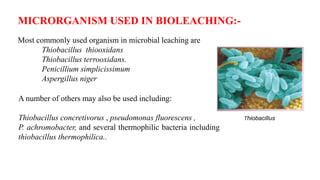
Thiobacillus
The reaction mechanisms are of two types,
1. Direct bacterial leaching
2. Indirect bacterial leaching
1.DIRECT BACTERIAL LEACHING:
A physical contact exists between bacteria and ores and oxidation of minerals takes
place through enzymatically catalysed steps.
In this bioleaching , bacteria directly oxidize minerals and solubilize metals.
E.g.: pyrite is oxidised to ferric sulphate.
2FeS2 +702 2FeS04 + 2H2S04
CHEMISTRY OF BIOLEACHING
.
2. INDIRECT BACTERIAL LEACHING:
In this type of bioleaching, bacteria produces the strong oxidizing agent such as ferric
ion and sulfuric acid on oxidation of soluble iron or soluble sulfur respectively.
For indirect bioleaching , acidic environment is absolutely essential in order to keep
ferric iron and other metals in solution.
Acidic environment maintained by oxidation of iron, sulfur, metal sulfides or by
dissolution of carbonate ions.
Ex; bioleaching of uranium
U02+ Fe(S04)3 U02S04+2FeS04
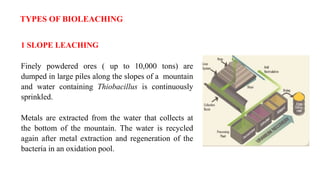
1 SLOPE LEACHING
Finely powdered ores ( up to 10,000 tons) are
dumped in large piles along the slopes of a mountain
and water containing Thiobacillus is continuously
sprinkled.
Metals are extracted from the water that collects at
the bottom of the mountain. The water is recycled
again after metal extraction and regeneration of the
bacteria in an oxidation pool.
TYPES OF BIOLEACHING
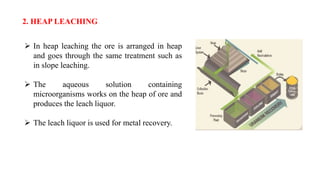
2. HEAP LEACHING
 In heap leaching the ore is arranged in heap
and goes through the same treatment such as
in slope leaching.
 The aqueous solution containing
microorganisms works on the heap of ore and
produces the leach liquor.
 The leach liquor is used for metal recovery.
.
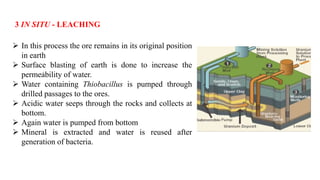
 In this process the ore remains in its original position
in earth
 Surface blasting of earth is done to increase the
permeability of water.
 Water containing Thiobacillus is pumped through
drilled passages to the ores.
 Acidic water seeps through the rocks and collects at
bottom.
 Again water is pumped from bottom
 Mineral is extracted and water is reused after
generation of bacteria.
3 IN SITU - LEACHING
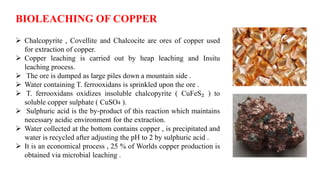
 Chalcopyrite , Covellite and Chalcocite are ores of copper used
for extraction of copper.
 Copper leaching is carried out by heap leaching and Insitu
leaching process.
 The ore is dumped as large piles down a mountain side .
 Water containing T. ferrooxidans is sprinkled upon the ore .
 T. ferrooxidans oxidizes insoluble chalcopyrite ( CuFeS₂ ) to
soluble copper sulphate ( CuSO4 ).
 Sulphuric acid is the by-product of this reaction which maintains
necessary acidic environment for the extraction.
 Water collected at the bottom contains copper , is precipitated and
water is recycled after adjusting the pH to 2 by sulphuric acid .
 It is an economical process , 25 % of Worlds copper production is
obtained via microbial leaching .
BIOLEACHING OF COPPER
 Gold ores: calaverite (AuTez), sylvanite (Ag. Au) Te2, petzite
(AggAuTe2)
 From low-grade sulfidic ores, gold cannot be extracted.
 Gold ores need to be pretreated by roasting or by pressure
oxidation to free the gold prior to cyanide leaching.
 These pretreatment is costly. After this, 70-95% of the gold in
the ore can be recovered by cyanide leaching process.
 Sodium cyanide leaching process converts gold to a soluble
cyanide complex.
4Au + 8NaCN + 2H20 + 02 --> 4Na[Au(CN)2] +4NaoH
2Na[Au(CN)2 +zn -> Na2 [Zn(CN)4] + 2AU
 Bioleaching occurs in reactors or heap leaching process using
Thiobacillus ferrooxidans.
 After leaching ,it converts the porous ore of exposed gold for
cyanide leaching.
BIOLEACHING OF GOLD
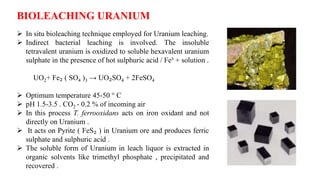
 In situ bioleaching technique employed for Uranium leaching.
 Indirect bacterial leaching is involved. The insoluble
tetravalent uranium is oxidized to soluble hexavalent uranium
sulphate in the presence of hot sulphuric acid / Fe³ + solution .
UO2+ Fe₂ ( SO4 )3 → UO₂SO4 + 2FeSO4
 Optimum temperature 45-50 ° C
 pH 1.5-3.5 . CO2 - 0.2 % of incoming air
 In this process T. ferrooxidans acts on iron oxidant and not
directly on Uranium .
 It acts on Pyrite ( FeS₂ ) in Uranium ore and produces ferric
sulphate and sulphuric acid .
 The soluble form of Uranium in leach liquor is extracted in
organic solvents like trimethyl phosphate , precipitated and
recovered .
BIOLEACHING URANIUM
FACTOR AFFECTING BIOLEACHING
1.pH AND TEMPERATURE : Affects leaching rate, microbial growth.
2. POPULATION DENSITY : high population density tends to increases the
leaching rate.
3. METAL TOLERANCE : high metal concentration may be toxic to microbes.
4.SURFACE AREA : rate of oxidation by the bacteria increases with reduction in
size of the ore and vice versa.
 Simple process.
 Inexpensive technique.
 Cheaper than chemical extraction.
 Environmental friendly process.
 Ideal for low grade sulfide ores.
 No need of high pressure and temperature.
ADVANTAGES
 The bacterial leaching process is very slow .
 Have a very low yield of minerals.
 Time consuming (take 6-24 months or longer)
 Requires large open area for treatment.
 High risk of contamination.
DISADVANTAGES
SUMMARY
Bioleaching is the process by which metals are dissolved from ore bearing
rocks using microorganisms.
Started around the late 1940s in South Africa.
The role of bacteria in bioleaching was found in 1947.
Bioleaching is used today in commercial operations to process ores of
copper, nickel, cobalt, uranium, gold.
Bioleaching process are now increasingly used as an alternative and
supplementary method because of the depletion oh high grade ore reservoir,
increased energy costs and environmental preservation.
CONCLUSION
Bioleaching is the broad term that describes the extraction of specific metals
from their ores through biological means usually microorganism. It is an
alternative to more traditional physical- chemical methods of mineral
processing. The application of bioleaching processes predates by centuries the
understanding of the role of microorganism in metal extraction. However the
modern era of bioleaching began with the discovery of the bacterium
Thiobacillus ferrooxidans.
REFERENCES
1. Alan scragg. Environmental Microbiology. 1999. 2nd Edition. Published by
Pearson Education Limited : 191-197
2. Wulf crueger, A Textbook of Industrial Microbiology, 3rd Edition, Published by
Scientific International Private Limited : 327-331
bioleaching

bioleaching

  • 1.
    KUVEMPU UNIVERSITY Seminar On “BIOLEACHING” SUBMITTEDBY PAVAN R PS204729 2nd M.sc 4th semester Department of microbiology UNDER THE GUIDANCE OF Dr. B.THIPPESWAMY Professor Department of microbiology 2021-22
  • 2.
    CONTENT 1. INTRODUCTION 2. MICROORGANISMUSED IN BIOLEACHING 3. CHEMISTRY OF BIOLEACHING 4. TYPES OF BIOLEACHING 5. EXAMPLES 6. BIOLEACHING OF COPPER 7. BIOLEACHING OF GOLD 8. BIOLEACHING OF URANIUM 9. FACTORS AFFECTING BIOLEACHING 10.ADVANTAGES OF BIOLEACHING 11.DISADVANTAGES BIOLEACHING 12.SUMMARY 13.CONCLUSION 14.REFERENCES
  • 3.
    INTRODUCTION Bioleaching is alsocalled as biomining and microbial leaching. Bioleaching is the simple and effective technology for metal extraction from low grade ores and mineral concentrate by the use of micro organisms. It is mainly used to recover certain metals from sulfide ores. Started around the late 1940s in South Africa. Bioleaching is used to recover copper, zinc, lead, arsenic, gold and cobalt. Widely used in many countries such as Australia, Canada, China, Indonesia and united states.
  • 4.
    MICRORGANISM USED INBIOLEACHING:- Most commonly used organism in microbial leaching are Thiobacillus thiooxidans Thiobacillus terrooxidans. Penicillium simplicissimum Aspergillus niger A number of others may also be used including: Thiobacillus concretivorus , pseudomonas fluorescens , P. achromobacter, and several thermophilic bacteria including thiobacillus thermophilica.. Thiobacillus
  • 5.
    The reaction mechanismsare of two types, 1. Direct bacterial leaching 2. Indirect bacterial leaching 1.DIRECT BACTERIAL LEACHING: A physical contact exists between bacteria and ores and oxidation of minerals takes place through enzymatically catalysed steps. In this bioleaching , bacteria directly oxidize minerals and solubilize metals. E.g.: pyrite is oxidised to ferric sulphate. 2FeS2 +702 2FeS04 + 2H2S04 CHEMISTRY OF BIOLEACHING
  • 6.
    . 2. INDIRECT BACTERIALLEACHING: In this type of bioleaching, bacteria produces the strong oxidizing agent such as ferric ion and sulfuric acid on oxidation of soluble iron or soluble sulfur respectively. For indirect bioleaching , acidic environment is absolutely essential in order to keep ferric iron and other metals in solution. Acidic environment maintained by oxidation of iron, sulfur, metal sulfides or by dissolution of carbonate ions. Ex; bioleaching of uranium U02+ Fe(S04)3 U02S04+2FeS04
  • 7.
    1 SLOPE LEACHING Finelypowdered ores ( up to 10,000 tons) are dumped in large piles along the slopes of a mountain and water containing Thiobacillus is continuously sprinkled. Metals are extracted from the water that collects at the bottom of the mountain. The water is recycled again after metal extraction and regeneration of the bacteria in an oxidation pool. TYPES OF BIOLEACHING
  • 8.
    2. HEAP LEACHING In heap leaching the ore is arranged in heap and goes through the same treatment such as in slope leaching.  The aqueous solution containing microorganisms works on the heap of ore and produces the leach liquor.  The leach liquor is used for metal recovery.
  • 9.
    .  In thisprocess the ore remains in its original position in earth  Surface blasting of earth is done to increase the permeability of water.  Water containing Thiobacillus is pumped through drilled passages to the ores.  Acidic water seeps through the rocks and collects at bottom.  Again water is pumped from bottom  Mineral is extracted and water is reused after generation of bacteria. 3 IN SITU - LEACHING
  • 10.
     Chalcopyrite ,Covellite and Chalcocite are ores of copper used for extraction of copper.  Copper leaching is carried out by heap leaching and Insitu leaching process.  The ore is dumped as large piles down a mountain side .  Water containing T. ferrooxidans is sprinkled upon the ore .  T. ferrooxidans oxidizes insoluble chalcopyrite ( CuFeS₂ ) to soluble copper sulphate ( CuSO4 ).  Sulphuric acid is the by-product of this reaction which maintains necessary acidic environment for the extraction.  Water collected at the bottom contains copper , is precipitated and water is recycled after adjusting the pH to 2 by sulphuric acid .  It is an economical process , 25 % of Worlds copper production is obtained via microbial leaching . BIOLEACHING OF COPPER
  • 11.
     Gold ores:calaverite (AuTez), sylvanite (Ag. Au) Te2, petzite (AggAuTe2)  From low-grade sulfidic ores, gold cannot be extracted.  Gold ores need to be pretreated by roasting or by pressure oxidation to free the gold prior to cyanide leaching.  These pretreatment is costly. After this, 70-95% of the gold in the ore can be recovered by cyanide leaching process.  Sodium cyanide leaching process converts gold to a soluble cyanide complex. 4Au + 8NaCN + 2H20 + 02 --> 4Na[Au(CN)2] +4NaoH 2Na[Au(CN)2 +zn -> Na2 [Zn(CN)4] + 2AU  Bioleaching occurs in reactors or heap leaching process using Thiobacillus ferrooxidans.  After leaching ,it converts the porous ore of exposed gold for cyanide leaching. BIOLEACHING OF GOLD
  • 12.
     In situbioleaching technique employed for Uranium leaching.  Indirect bacterial leaching is involved. The insoluble tetravalent uranium is oxidized to soluble hexavalent uranium sulphate in the presence of hot sulphuric acid / Fe³ + solution . UO2+ Fe₂ ( SO4 )3 → UO₂SO4 + 2FeSO4  Optimum temperature 45-50 ° C  pH 1.5-3.5 . CO2 - 0.2 % of incoming air  In this process T. ferrooxidans acts on iron oxidant and not directly on Uranium .  It acts on Pyrite ( FeS₂ ) in Uranium ore and produces ferric sulphate and sulphuric acid .  The soluble form of Uranium in leach liquor is extracted in organic solvents like trimethyl phosphate , precipitated and recovered . BIOLEACHING URANIUM
  • 13.
    FACTOR AFFECTING BIOLEACHING 1.pHAND TEMPERATURE : Affects leaching rate, microbial growth. 2. POPULATION DENSITY : high population density tends to increases the leaching rate. 3. METAL TOLERANCE : high metal concentration may be toxic to microbes. 4.SURFACE AREA : rate of oxidation by the bacteria increases with reduction in size of the ore and vice versa.
  • 14.
     Simple process. Inexpensive technique.  Cheaper than chemical extraction.  Environmental friendly process.  Ideal for low grade sulfide ores.  No need of high pressure and temperature. ADVANTAGES
  • 15.
     The bacterialleaching process is very slow .  Have a very low yield of minerals.  Time consuming (take 6-24 months or longer)  Requires large open area for treatment.  High risk of contamination. DISADVANTAGES
  • 16.
    SUMMARY Bioleaching is theprocess by which metals are dissolved from ore bearing rocks using microorganisms. Started around the late 1940s in South Africa. The role of bacteria in bioleaching was found in 1947. Bioleaching is used today in commercial operations to process ores of copper, nickel, cobalt, uranium, gold. Bioleaching process are now increasingly used as an alternative and supplementary method because of the depletion oh high grade ore reservoir, increased energy costs and environmental preservation.
  • 17.
    CONCLUSION Bioleaching is thebroad term that describes the extraction of specific metals from their ores through biological means usually microorganism. It is an alternative to more traditional physical- chemical methods of mineral processing. The application of bioleaching processes predates by centuries the understanding of the role of microorganism in metal extraction. However the modern era of bioleaching began with the discovery of the bacterium Thiobacillus ferrooxidans.
  • 18.
    REFERENCES 1. Alan scragg.Environmental Microbiology. 1999. 2nd Edition. Published by Pearson Education Limited : 191-197 2. Wulf crueger, A Textbook of Industrial Microbiology, 3rd Edition, Published by Scientific International Private Limited : 327-331