Bioleaching
Dr.S.Maneemegalai
Assistant Professor & Head
Department of Biochemistry
Bharathidasan University
Constituent College for Women
Orathanadu – 614 625
Thanjavur Dt
 Bioleaching is also called as
Biomining and Microbial leaching.
 Biomining is the process of extracting
or dissolving metals from ores (ore
bearing rocks) with the help of
microorganisms.
 Metals are extracted from large
quantity of low grade ores generally
discarded as waste using
Microorganisms
 Important Microorganisms commonly used
 Thiobacillus thiooxidans
 Thiobacillus ferrooxidans
 Other microorganisms
 Thiobacillus prosperus
 Thiobacillus cuprinus
 Leptospirillum ferrooxidans
 Sulfobacillus thermosulfidooxidans
 Members Genus Bacillus
 Fungi: Members of Genera Aspergillum,
Penicillium
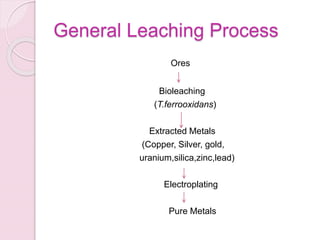
General Leaching Process
Ores
Bioleaching
(T.ferrooxidans)
Extracted Metals
(Copper, Silver, gold,
uranium,silica,zinc,lead)
Electroplating
Pure Metals
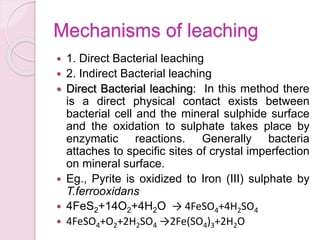
Mechanisms of leaching
 1. Direct Bacterial leaching
 2. Indirect Bacterial leaching
 Direct Bacterial leaching: In this method there
is a direct physical contact exists between
bacterial cell and the mineral sulphide surface
and the oxidation to sulphate takes place by
enzymatic reactions. Generally bacteria
attaches to specific sites of crystal imperfection
on mineral surface.
 Eg., Pyrite is oxidized to Iron (III) sulphate by
T.ferrooxidans
 4FeS2+14O2+4H2O → 4FeSO4+4H2SO4
 4FeSO4+O2+2H2SO4 →2Fe(SO4)3+2H2O
 Non metal iron sulphides like Covellite
(CuS), Chalcocite (Cu2S), Cobaltite (CoS),
Molybdenite (MoS2), Galena (PbS),
Sphalerite (ZnS) can also be oxidized by
T.ferrooxidans
 MeS+2O2 → MeSO4
 MeS – Metal sulphides
Indirect leaching
In indirect bioleaching bacteria is not in direct contact
with minerals but generate a lixiviant which chemically
oxidizes the sulphide mineral. In acid solution this lixiviant
is ferric iron.
MeS + Fe(SO4)3 →MeSO4 + 2FeSO4 + S°
The ferrous iron arising in the reaction is reoxidized to
ferric iron and sulphur produced is oxidised to sulphuric
acid by T. ferrooxidans, for this reaction the pH should be
in the range of 2-3 (acidic pH). In this indirect leaching the
bacteria have only catalytic function.
2S° +3O2+2H2O → 2H2SO4
 Extraction of Uranium from ores is
example for Indirect leaching.
 Where insoluble tetravalent Uranium is
oxidized to water soluble hexavalent
Uranium by T.ferrooxidans enzymatically
and use some of the energy of this
reaction for the assimilation of CO2.
 UIVO2 + Fe2(SO4)3 → UVIO2SO4 + 2FeSO4
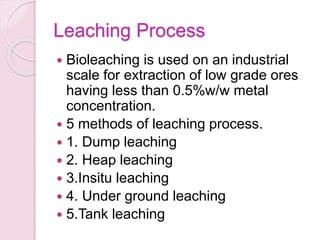
Leaching Process
 Bioleaching is used on an industrial
scale for extraction of low grade ores
having less than 0.5%w/w metal
concentration.
 5 methods of leaching process.
 1. Dump leaching
 2. Heap leaching
 3.Insitu leaching
 4. Under ground leaching
 5.Tank leaching
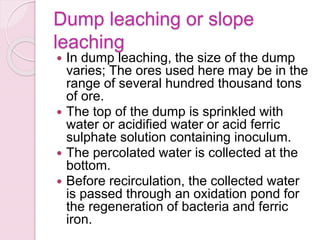
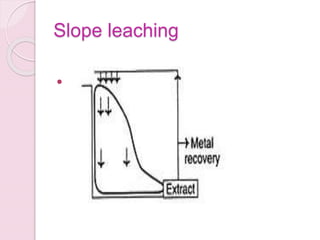
Dump leaching or slope
leaching
 In dump leaching, the size of the dump
varies; The ores used here may be in the
range of several hundred thousand tons
of ore.
 The top of the dump is sprinkled with
water or acidified water or acid ferric
sulphate solution containing inoculum.
 The percolated water is collected at the
bottom.
 Before recirculation, the collected water
is passed through an oxidation pond for
the regeneration of bacteria and ferric
iron.
Slope leaching

Heap leaching
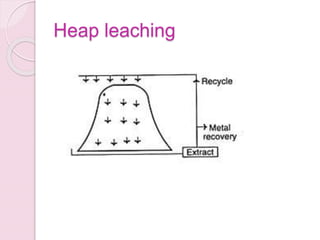
 12000 tons of finely ground ores are
used.
 Here water is allowed to trickle
through the heap and the seepage
water is collected at the bottom.
 To supply sufficient amount of oxygen
at the deeper portions of the heap,
pipes are placed in strategic positions
within the heaps during its
construction.
Heap leaching
Insitu leaching
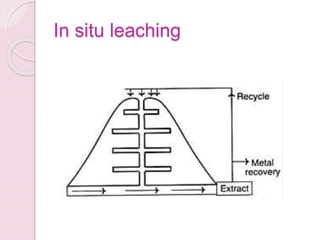
Low grade ores or ore deposits that cannot be
mined by conventional methods are done by
insitu leaching.
Surface blasting of rocks is carried out for easy
passage of water.
Solutions containing appropriate bacteria are
injected into the bore holes.
After sufficient time of reaction, the water is
pumped out from the neighbouring wells.
In situ leaching
Underground leaching
 It is carriedout in abondoned mines.
 Unmined ores in side tunnels are
sprinkled or washed under pressure.
 The water collects in deeper galleries
are then pumped to a processing plant
at the surface.
Tank leaching
 It is more expensive than other
methods.
 The rate of metal extraction is much
higher
 Eg., more than 80% of the total zinc
was extracted from zinc sulphide
concentrate.
Factors required for
bioleaching
 Nutrients: Chemolitho autotrophic
bacteria are used. It requires inorganic
compounds for microbial growth along
with iron and sulphur compounds.
 O2 and CO2: Sufficient supply of O2 is
required. No need for additional CO2.
 pH: Optimum pH 2.0 – 2.5
 Temperature: 28 – 30°C
 For thermophilic bacteria higher
temperature (50 - 80°C ) can be used.
 Mineral substrate: The rate of leaching
depends on the total surface area of
the substrate.
 Decrease in particle size increases
surface area, so higher yield of metal
can be obtained.
 Particle size of about 42µm is optimum.
 Heavy metals: Leaching process will
increase metal concentration.
 Thiobacilli have high tolerance to
heavy metals. Tolerant organisms to
metals should be selected.
Bioleaching of Copper
 Chalcopyrite, Covellite and Chalcocite are
ores of copper used for extraction of copper.
 Copper leaching is carried out by heap
leaching and Insitu leaching process
 The ore is dumped as large piles down a
mountain side.
 Water containing T. ferrooxidans is sprinkled
upon the ore.
 T. ferro oxidans oxidizes insoluble
chalcopyrite (CuFeS2) to soluble copper
sulphate (CuSO4).
 Sulphuric acid is the byproduct of this
reaction maintains necessary acidic
environment for the extraction.
 Water collected at the bottom contains
copper, is precipitated and water is
recycled after adjusting the pH to 2 by
sulphuric acid.
 It is an economical process. 5% of
Worlds copper production is obtained
via microbial leaching.
Uranium leaching
 In situ bioleaching technique is employed
for Uranium leaching.
 Indirect bacterial leaching is
involved.The insoluble tetravalent
uranium is oxidized to soluble hexavalent
uraniumsulphate in the presence of hot
sulphuric acid/ Fe3+ solution.
 UO2 +Fe2(SO4)3→UO2SO4 +2FeSO4
 Optimum temperature 45-50°C
 pH 1.5-3.5
 CO2 – 0.2% of incoming air
 In this process, T.ferrooxidans acts on
iron oxidant and not directly on
Uranium.
 It acts on Pyrite (FeS2) in Uranium ore
and produces ferric sulphate and
sulphuric acid.
 The soluble form of Uranium in leach
liquor is extracted in organic solvents
like trimethyl phosphate, precipitated
and recovered.
Gold and Silver leaching
 Heap leaching technology is used.
 Refractory sulphidic gold ore pyrite and
arsenopyrite are used.
 In ores, gold is finely disseminated in the
sulphide matrix.
 Biooxidation of sulphide matrix is carried
out by T.ferrooxidans followed by
extraction of gold by cyanide extraction
method.
 Silver is readily solubilized during
microbial leaching of iron sulphide.
Nickel leaching
 Ore is Pentlandite (Fe,Ni)9S8
 Mixed cultures of T.ferrooxidans, T.
thiooxidans and L.ferrooxidans used
for leaching nickel in a complex
sulphide concentrate.
Silica leaching
 Ores - Magnesite, bauxite, dolomite
and basalt.
 Bacillus licheniformis is involved in the
bioleaching of silica.
 Other microorganisms are Bacillus
circulans , Bacillus mucilaginosus and
Bacillus edaphics
 Silica is leached by adsorption on
bacterial cell surface.
Advantages of Bioleaching
 Simple process and cost effective.
 Recovers metals from low grade ores
 Used to concentrate metals from
wastes and dilute mixtures
 Used to produce expensive metals
 Environment friendly
 Ideal for developing countries.
References
http://opensourceecology.org/w/images/4/43/Biomining_-Carmen_Tailings-
Com.pdf
Biomining: A Green Technology to Mine Valuable Metals Biomining Laboratory
Department of Chemistry/ Biochemistry Laurentian University Sudbury, ON
Canada Investigators: Dr. V. Appanna Joseph Lemire B.Sc., PhD Candidate
Raven Hnatiuk Research Assistant
Klaus Bosecker, 1997. Bioleaching : Metal solubilization by microorganisms.
FEMS Microbiology Reviews, 20, 591-594.
http://shodhganga.inflibnet.ac.in/bitstream/10603/116341/6/06_chapter%201.pd
f
http://www.biologydiscussion.com/biotechnology/metal-biotechnology/methods-
of-metal-recovery-by-microorganisms-2-methods/10446
https://www.911metallurgist.com/blog/gold-silver-leaching-cyanidation
R.C.Dubey, 2002, A textbook of Biotechnology; S.Chand & Company Ltd, New
Delhi

Bioleaching

  • 1.
    Bioleaching Dr.S.Maneemegalai Assistant Professor &Head Department of Biochemistry Bharathidasan University Constituent College for Women Orathanadu – 614 625 Thanjavur Dt
  • 2.
     Bioleaching isalso called as Biomining and Microbial leaching.  Biomining is the process of extracting or dissolving metals from ores (ore bearing rocks) with the help of microorganisms.  Metals are extracted from large quantity of low grade ores generally discarded as waste using
  • 3.
    Microorganisms  Important Microorganismscommonly used  Thiobacillus thiooxidans  Thiobacillus ferrooxidans  Other microorganisms  Thiobacillus prosperus  Thiobacillus cuprinus  Leptospirillum ferrooxidans  Sulfobacillus thermosulfidooxidans  Members Genus Bacillus  Fungi: Members of Genera Aspergillum, Penicillium
  • 4.
    General Leaching Process Ores Bioleaching (T.ferrooxidans) ExtractedMetals (Copper, Silver, gold, uranium,silica,zinc,lead) Electroplating Pure Metals
  • 5.
    Mechanisms of leaching 1. Direct Bacterial leaching  2. Indirect Bacterial leaching  Direct Bacterial leaching: In this method there is a direct physical contact exists between bacterial cell and the mineral sulphide surface and the oxidation to sulphate takes place by enzymatic reactions. Generally bacteria attaches to specific sites of crystal imperfection on mineral surface.  Eg., Pyrite is oxidized to Iron (III) sulphate by T.ferrooxidans  4FeS2+14O2+4H2O → 4FeSO4+4H2SO4  4FeSO4+O2+2H2SO4 →2Fe(SO4)3+2H2O
  • 6.
     Non metaliron sulphides like Covellite (CuS), Chalcocite (Cu2S), Cobaltite (CoS), Molybdenite (MoS2), Galena (PbS), Sphalerite (ZnS) can also be oxidized by T.ferrooxidans  MeS+2O2 → MeSO4  MeS – Metal sulphides
  • 7.
    Indirect leaching In indirectbioleaching bacteria is not in direct contact with minerals but generate a lixiviant which chemically oxidizes the sulphide mineral. In acid solution this lixiviant is ferric iron. MeS + Fe(SO4)3 →MeSO4 + 2FeSO4 + S° The ferrous iron arising in the reaction is reoxidized to ferric iron and sulphur produced is oxidised to sulphuric acid by T. ferrooxidans, for this reaction the pH should be in the range of 2-3 (acidic pH). In this indirect leaching the bacteria have only catalytic function. 2S° +3O2+2H2O → 2H2SO4
  • 8.
     Extraction ofUranium from ores is example for Indirect leaching.  Where insoluble tetravalent Uranium is oxidized to water soluble hexavalent Uranium by T.ferrooxidans enzymatically and use some of the energy of this reaction for the assimilation of CO2.  UIVO2 + Fe2(SO4)3 → UVIO2SO4 + 2FeSO4
  • 9.
    Leaching Process  Bioleachingis used on an industrial scale for extraction of low grade ores having less than 0.5%w/w metal concentration.  5 methods of leaching process.  1. Dump leaching  2. Heap leaching  3.Insitu leaching  4. Under ground leaching  5.Tank leaching
  • 10.
    Dump leaching orslope leaching  In dump leaching, the size of the dump varies; The ores used here may be in the range of several hundred thousand tons of ore.  The top of the dump is sprinkled with water or acidified water or acid ferric sulphate solution containing inoculum.  The percolated water is collected at the bottom.  Before recirculation, the collected water is passed through an oxidation pond for the regeneration of bacteria and ferric iron.
  • 11.
  • 12.
    Heap leaching  12000tons of finely ground ores are used.  Here water is allowed to trickle through the heap and the seepage water is collected at the bottom.  To supply sufficient amount of oxygen at the deeper portions of the heap, pipes are placed in strategic positions within the heaps during its construction.
  • 13.
  • 14.
    Insitu leaching Low gradeores or ore deposits that cannot be mined by conventional methods are done by insitu leaching. Surface blasting of rocks is carried out for easy passage of water. Solutions containing appropriate bacteria are injected into the bore holes. After sufficient time of reaction, the water is pumped out from the neighbouring wells.
  • 15.
  • 16.
    Underground leaching  Itis carriedout in abondoned mines.  Unmined ores in side tunnels are sprinkled or washed under pressure.  The water collects in deeper galleries are then pumped to a processing plant at the surface.
  • 17.
    Tank leaching  Itis more expensive than other methods.  The rate of metal extraction is much higher  Eg., more than 80% of the total zinc was extracted from zinc sulphide concentrate.
  • 18.
    Factors required for bioleaching Nutrients: Chemolitho autotrophic bacteria are used. It requires inorganic compounds for microbial growth along with iron and sulphur compounds.  O2 and CO2: Sufficient supply of O2 is required. No need for additional CO2.  pH: Optimum pH 2.0 – 2.5
  • 19.
     Temperature: 28– 30°C  For thermophilic bacteria higher temperature (50 - 80°C ) can be used.  Mineral substrate: The rate of leaching depends on the total surface area of the substrate.  Decrease in particle size increases surface area, so higher yield of metal can be obtained.  Particle size of about 42µm is optimum.
  • 20.
     Heavy metals:Leaching process will increase metal concentration.  Thiobacilli have high tolerance to heavy metals. Tolerant organisms to metals should be selected.
  • 21.
    Bioleaching of Copper Chalcopyrite, Covellite and Chalcocite are ores of copper used for extraction of copper.  Copper leaching is carried out by heap leaching and Insitu leaching process  The ore is dumped as large piles down a mountain side.  Water containing T. ferrooxidans is sprinkled upon the ore.  T. ferro oxidans oxidizes insoluble chalcopyrite (CuFeS2) to soluble copper sulphate (CuSO4).  Sulphuric acid is the byproduct of this reaction maintains necessary acidic environment for the extraction.
  • 22.
     Water collectedat the bottom contains copper, is precipitated and water is recycled after adjusting the pH to 2 by sulphuric acid.  It is an economical process. 5% of Worlds copper production is obtained via microbial leaching.
  • 23.
    Uranium leaching  Insitu bioleaching technique is employed for Uranium leaching.  Indirect bacterial leaching is involved.The insoluble tetravalent uranium is oxidized to soluble hexavalent uraniumsulphate in the presence of hot sulphuric acid/ Fe3+ solution.  UO2 +Fe2(SO4)3→UO2SO4 +2FeSO4  Optimum temperature 45-50°C  pH 1.5-3.5  CO2 – 0.2% of incoming air
  • 24.
     In thisprocess, T.ferrooxidans acts on iron oxidant and not directly on Uranium.  It acts on Pyrite (FeS2) in Uranium ore and produces ferric sulphate and sulphuric acid.  The soluble form of Uranium in leach liquor is extracted in organic solvents like trimethyl phosphate, precipitated and recovered.
  • 25.
    Gold and Silverleaching  Heap leaching technology is used.  Refractory sulphidic gold ore pyrite and arsenopyrite are used.  In ores, gold is finely disseminated in the sulphide matrix.  Biooxidation of sulphide matrix is carried out by T.ferrooxidans followed by extraction of gold by cyanide extraction method.  Silver is readily solubilized during microbial leaching of iron sulphide.
  • 26.
    Nickel leaching  Oreis Pentlandite (Fe,Ni)9S8  Mixed cultures of T.ferrooxidans, T. thiooxidans and L.ferrooxidans used for leaching nickel in a complex sulphide concentrate.
  • 27.
    Silica leaching  Ores- Magnesite, bauxite, dolomite and basalt.  Bacillus licheniformis is involved in the bioleaching of silica.  Other microorganisms are Bacillus circulans , Bacillus mucilaginosus and Bacillus edaphics  Silica is leached by adsorption on bacterial cell surface.
  • 28.
    Advantages of Bioleaching Simple process and cost effective.  Recovers metals from low grade ores  Used to concentrate metals from wastes and dilute mixtures  Used to produce expensive metals  Environment friendly  Ideal for developing countries.
  • 29.
    References http://opensourceecology.org/w/images/4/43/Biomining_-Carmen_Tailings- Com.pdf Biomining: A GreenTechnology to Mine Valuable Metals Biomining Laboratory Department of Chemistry/ Biochemistry Laurentian University Sudbury, ON Canada Investigators: Dr. V. Appanna Joseph Lemire B.Sc., PhD Candidate Raven Hnatiuk Research Assistant Klaus Bosecker, 1997. Bioleaching : Metal solubilization by microorganisms. FEMS Microbiology Reviews, 20, 591-594. http://shodhganga.inflibnet.ac.in/bitstream/10603/116341/6/06_chapter%201.pd f http://www.biologydiscussion.com/biotechnology/metal-biotechnology/methods- of-metal-recovery-by-microorganisms-2-methods/10446 https://www.911metallurgist.com/blog/gold-silver-leaching-cyanidation R.C.Dubey, 2002, A textbook of Biotechnology; S.Chand & Company Ltd, New Delhi