BIOGEOCHEMICAL CYCLES Jonathan S. Rubio
Objectives Differentiate the biogeochemical processes Identify the processes involve in different biogeochemical cycles Determine the disturbance that will disrupt the natural cycle
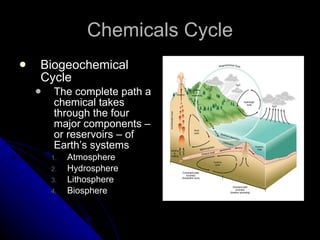
Chemicals Cycle Biogeochemical Cycle The complete path a chemical takes through the four major components – or reservoirs – of Earth’s systems Atmosphere Hydrosphere Lithosphere Biosphere
D. T. Krohne,  General Ecology
Chemical Reactions Ch emical reaction: The process in which new chemicals are formed from elements and compounds through chemical change All chemical reactions will follow the  -Law of Conservation of Mass and Energy -Law of Entropy
Biogeochemical Cycles and Life: Limiting Factors Macronutrients Elements required in large amounts by all life about 96% Include the “big six” elements that form the fundamental building blocks of life: carbon oxygen   sulfur hydrogen phosphorus nitrogen Micronutrients Elements required either in  small amounts by all life or moderate amounts by some forms of life and not all by others Trace elements  -Al, B, Cr, Co, Cu, F, Mn, Mo, Se, Si, Sn, Va, Zn -  some organisms (0.1%) Principal of Limiting factor When chemical elements are not available at the right time, in the right amount, and in the right concentration relative to each other
The Geologic Cycle The Geologic Cycle: The processes responsible for formation and change of Earth materials Best described as a group of cycles: Tectonic Hydrologic Rock
Tectonic Cycle Tectonic cycle: Involves creation and destruction of the solid outer layer of Earth, the lithosphere Plate tectonics: The slow movement of these large segments of Earth’s outermost rock shell  Boundaries between plates are geologically active areas
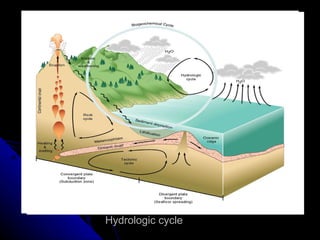
The Hydrologic Cycle The Hydrologic Cycle: The transfer of water from the oceans to the atmosphere to the land and back to the oceans. Includes: Evaporation Condensation Precipitation Runoff from streams, rivers, and sub-surface groundwater storage
Hydrologic cycle
The Rock Cycle The rock cycle: Numerous processes that produce rocks and soils Depends on other cycles: tectonic cycle for energy  Hydrologic cycle for water  Rock is classified as  Igneous Sedimentary Metamorphic
The Rock Cycle
The Carbon-Oxygen Cycle Carbon is the element that anchors all organic substances The carbon cycle: Carbon combines with and is chemically and biologically linked with the cycles of oxygen and hydrogen that form the major compounds of life Processes that reduce CO 2 :  Photosynthesis and Diffusion to the bodies of water Processes that add CO 2:  Respiration, Combustion, Burning, decomposition
The Carbon Oxygen Cycle
Fig 5.15 © 2005 John Wiley and Sons Publishers Respiration C 6 H 12 O 6  +  6 O 2  6 CO 2  +  6 H 2 O +energy
Modified from D. T. Krohne,  General Ecology 15%/year CO 2  & CH 4
The Nitrogen Cycle The nitrogen cycle: Cycle responsible for moving important nitrogen components through the biosphere and other Earth systems Extremely important because nitrogen is required by all living things Nitrogen fixation: The process of converting inorganic, molecular nitrogen in the atmosphere to ammonia or nitrate Denitrification: The process of releasing fixed nitrogen back to molecular nitrogen
The Nitrogen Cycle
Modified from D. T. Krohne,  General Ecology 50% fertilizer (Bacteria)
Biological Nitrogen Fixers Cyanobacteria –  blue-green algae Free living soil bacteria Mycorrhizae Symbiotic bacteria living in root nodules
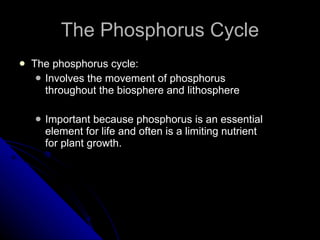
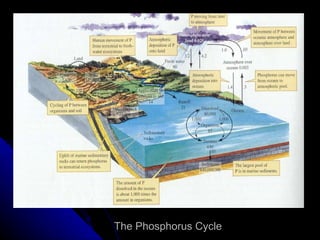
The Phosphorus Cycle The phosphorus cycle: Involves the movement of phosphorus throughout the biosphere and lithosphere Important because phosphorus is an essential element for life and often is a limiting nutrient for plant growth.
The Phosphorus Cycle
D. T. Krohne,  General Ecology  D. T. Krohne,  General Ecology Modified from D. T. Krohne,  General Ecology Gaseous phase
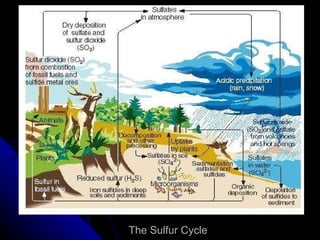
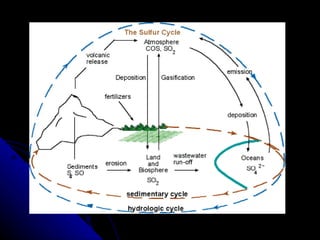
Sulfur Cycle Process involved in the transport of sulfur: a.  Acid Precipitation b.  Volcanic sulfide c.  Sulfur fixation d.  Combustion e.  Decomposition f.  Sedimentation
The Sulfur Cycle
 
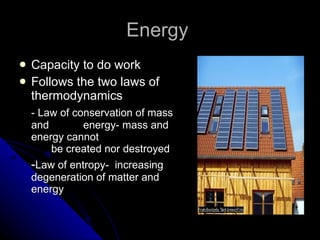
Energy  Capacity to do work Follows the two laws of thermodynamics - Law of conservation of mass  and  energy- mass and  energy cannot    be created nor destroyed - Law of entropy-  increasing  degeneration of matter and  energy
Energy Types According to the nature 1. potential energy- due to gravity or distortion of shape 2. kinetic energy- due to movement 3. Rest or Mass energy- due to matter moving twice the speed of light.
Energy types cont… Based on source or origin 1. non-renewable energy 2. renewable energy 3. inexhaustible energy
Energy Flow Only 2% of the sun’s energy is used by the plants and the rest is immediately converted to heat Approximately 10% of the energy can transfer to next higher trophic level.
Food chain-process of eating and being eaten types of food chain 1. Grazing food chain 2. detritus food chains Food web- interlinks of several food chains
Student Activity Identify one interruption in each biogeochemical cycles and give the cause and mitigation: Hydrologic cycle Rock cycle Phosphorus Cycle C-O cycle Sulfur Cycle Nitrogen Cycle

Biogeochemical

  • 1.
  • 2.
    Objectives Differentiate thebiogeochemical processes Identify the processes involve in different biogeochemical cycles Determine the disturbance that will disrupt the natural cycle
  • 3.
    Chemicals Cycle BiogeochemicalCycle The complete path a chemical takes through the four major components – or reservoirs – of Earth’s systems Atmosphere Hydrosphere Lithosphere Biosphere
  • 4.
    D. T. Krohne, General Ecology
  • 5.
    Chemical Reactions Chemical reaction: The process in which new chemicals are formed from elements and compounds through chemical change All chemical reactions will follow the -Law of Conservation of Mass and Energy -Law of Entropy
  • 6.
    Biogeochemical Cycles andLife: Limiting Factors Macronutrients Elements required in large amounts by all life about 96% Include the “big six” elements that form the fundamental building blocks of life: carbon oxygen sulfur hydrogen phosphorus nitrogen Micronutrients Elements required either in small amounts by all life or moderate amounts by some forms of life and not all by others Trace elements -Al, B, Cr, Co, Cu, F, Mn, Mo, Se, Si, Sn, Va, Zn - some organisms (0.1%) Principal of Limiting factor When chemical elements are not available at the right time, in the right amount, and in the right concentration relative to each other
  • 7.
    The Geologic CycleThe Geologic Cycle: The processes responsible for formation and change of Earth materials Best described as a group of cycles: Tectonic Hydrologic Rock
  • 8.
    Tectonic Cycle Tectoniccycle: Involves creation and destruction of the solid outer layer of Earth, the lithosphere Plate tectonics: The slow movement of these large segments of Earth’s outermost rock shell Boundaries between plates are geologically active areas
  • 9.
    The Hydrologic CycleThe Hydrologic Cycle: The transfer of water from the oceans to the atmosphere to the land and back to the oceans. Includes: Evaporation Condensation Precipitation Runoff from streams, rivers, and sub-surface groundwater storage
  • 10.
  • 11.
    The Rock CycleThe rock cycle: Numerous processes that produce rocks and soils Depends on other cycles: tectonic cycle for energy Hydrologic cycle for water Rock is classified as Igneous Sedimentary Metamorphic
  • 12.
  • 13.
    The Carbon-Oxygen CycleCarbon is the element that anchors all organic substances The carbon cycle: Carbon combines with and is chemically and biologically linked with the cycles of oxygen and hydrogen that form the major compounds of life Processes that reduce CO 2 : Photosynthesis and Diffusion to the bodies of water Processes that add CO 2: Respiration, Combustion, Burning, decomposition
  • 14.
  • 15.
    Fig 5.15 ©2005 John Wiley and Sons Publishers Respiration C 6 H 12 O 6 + 6 O 2 6 CO 2 + 6 H 2 O +energy
  • 16.
    Modified from D.T. Krohne, General Ecology 15%/year CO 2 & CH 4
  • 17.
    The Nitrogen CycleThe nitrogen cycle: Cycle responsible for moving important nitrogen components through the biosphere and other Earth systems Extremely important because nitrogen is required by all living things Nitrogen fixation: The process of converting inorganic, molecular nitrogen in the atmosphere to ammonia or nitrate Denitrification: The process of releasing fixed nitrogen back to molecular nitrogen
  • 18.
  • 19.
    Modified from D.T. Krohne, General Ecology 50% fertilizer (Bacteria)
  • 20.
    Biological Nitrogen FixersCyanobacteria – blue-green algae Free living soil bacteria Mycorrhizae Symbiotic bacteria living in root nodules
  • 21.
    The Phosphorus CycleThe phosphorus cycle: Involves the movement of phosphorus throughout the biosphere and lithosphere Important because phosphorus is an essential element for life and often is a limiting nutrient for plant growth.
  • 22.
  • 23.
    D. T. Krohne, General Ecology D. T. Krohne, General Ecology Modified from D. T. Krohne, General Ecology Gaseous phase
  • 24.
    Sulfur Cycle Processinvolved in the transport of sulfur: a. Acid Precipitation b. Volcanic sulfide c. Sulfur fixation d. Combustion e. Decomposition f. Sedimentation
  • 25.
  • 26.
  • 27.
    Energy Capacityto do work Follows the two laws of thermodynamics - Law of conservation of mass and energy- mass and energy cannot be created nor destroyed - Law of entropy- increasing degeneration of matter and energy
  • 28.
    Energy Types Accordingto the nature 1. potential energy- due to gravity or distortion of shape 2. kinetic energy- due to movement 3. Rest or Mass energy- due to matter moving twice the speed of light.
  • 29.
    Energy types cont…Based on source or origin 1. non-renewable energy 2. renewable energy 3. inexhaustible energy
  • 30.
    Energy Flow Only2% of the sun’s energy is used by the plants and the rest is immediately converted to heat Approximately 10% of the energy can transfer to next higher trophic level.
  • 31.
    Food chain-process ofeating and being eaten types of food chain 1. Grazing food chain 2. detritus food chains Food web- interlinks of several food chains
  • 32.
    Student Activity Identifyone interruption in each biogeochemical cycles and give the cause and mitigation: Hydrologic cycle Rock cycle Phosphorus Cycle C-O cycle Sulfur Cycle Nitrogen Cycle

Editor's Notes

  • #16 Idealized diagram illustrating photosynthesis for a green plan (tree) and generalized reaction.
  • #21 There are two general types of nitrogen fixers Cyanobacteria – primary producers, e.g., blue/green algae – fix their own carbohydrates Bacteria that require a source of carbohydrates Get it from dead organic matter in soil Get it directly from plants in a symbiotic relationship - mychorhizae