
BACTERIAL MORPHOLOGY
Chapter 3A
CLASSIFICATION OF BACTERIA BASED ON SHAPE
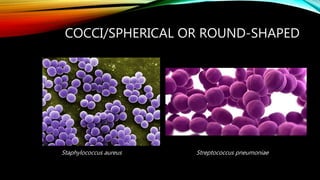
COCCI/SPHERICAL OR ROUND-SHAPED
Staphylococcus aureus Streptococcus pneumoniae
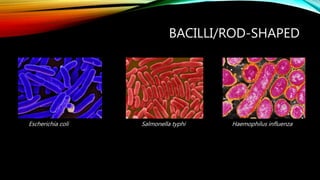
BACILLI/ROD-SHAPED
Escherichia coli Salmonella typhi Haemophilus influenza
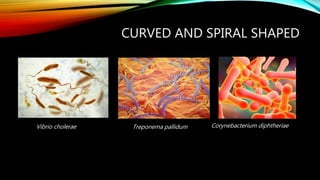
CURVED AND SPIRAL SHAPED
Vibrio cholerae Treponema pallidum Corynebacterium diphtheriae
ENVELOPE STRUCTURES
Glycocalyx
Outermost covering of some bacteria
A gelatinous substance located external to the cell wall
Composed of polysaccharide or polypeptide, or both
It is called capsule when strongly attached to the cell wall, called
slime layer if it is loosely attached
Aiding in the evasion of bacteria in phagocytosis, anti-body
response from the immune system and serve to protect the
organism from dehydration
ENVELOPE STRUCTURES
Cell Wall
Provides rigid support and shape to bacteria, it protects the bacteria from
osmotic damage and play a special role in cell division
Sometimes called the murein sacculus
Principal component is peptidoglycan called murein or mucopeptide
Multi-layered in gram-positive bacteria and single-layered in
gram-negative bacteria
SPECIAL COMPONENTS OF
GRAM-POSITIVE CELL WALLS
1. Teichoic acids
Comprise major surface antigens of gram-positive organisms and can
elicit antibody response
In some gram-positive organisms as Staphylococcus aureus, it function
for the attachment of the organism to the host cell
2. Polysaccharides
Include neutral sugars such as mannose, arabinose, rhamnose and
glucosamine and some acidic sugars as glucuronic acid and mannuronic
acid
SPECIAL COMPONENTS OF
GRAM-NEGATIVE CELL WALLS
1. Outer membrane
A bi-layered structure where inner-leaflet is composed of a lipopolysaccharide (LPS), special
protein channel for small or low-molecular-weight hydrophilic substances Lipid A-complex
glycolipid responsible for endotoxin activity, located in the outer leaflet of the outer
membrane
The inner core is a polysaccharide made-up of repeated units, also called
O antigen, which is unique for every species of bacteria
2. Lipoprotein
Functions to anchor the outer membrane to the peptidoglycan layer and stabilizes the outer
membrane
3. Periplasmic space
A fluid-filled space between the outer membrane and the inner plasma membrane
Contains enzymes for breakdown of large non-transportable molecules into transportable
ones and enzymes that serve to detoxify and inactivate antibiotics
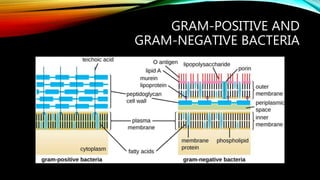
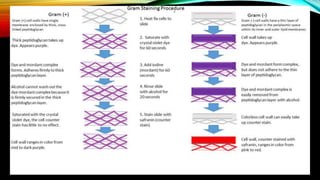
GRAM-POSITIVE AND
GRAM-NEGATIVE BACTERIA
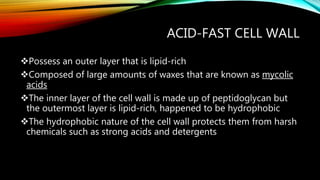
ACID-FAST CELL WALL
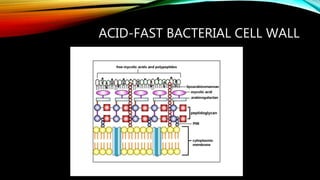
Possess an outer layer that is lipid-rich
Composed of large amounts of waxes that are known as mycolic
acids
The inner layer of the cell wall is made up of peptidoglycan but
the outermost layer is lipid-rich, happened to be hydrophobic
The hydrophobic nature of the cell wall protects them from harsh
chemicals such as strong acids and detergents
ACID-FAST BACTERIAL CELL WALL
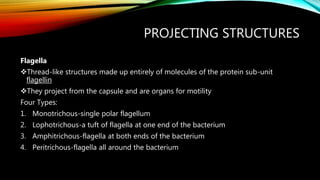
PROJECTING STRUCTURES
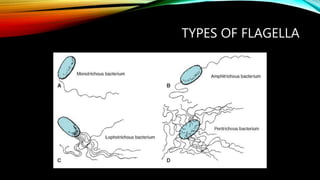
Flagella
Thread-like structures made up entirely of molecules of the protein sub-unit
flagellin
They project from the capsule and are organs for motility
Four Types:
1. Monotrichous-single polar flagellum
2. Lophotrichous-a tuft of flagella at one end of the bacterium
3. Amphitrichous-flagella at both ends of the bacterium
4. Peritrichous-flagella all around the bacterium
TYPES OF FLAGELLA
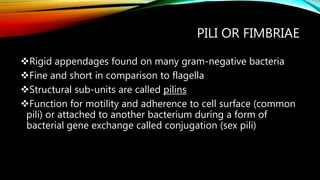
PILI OR FIMBRIAE
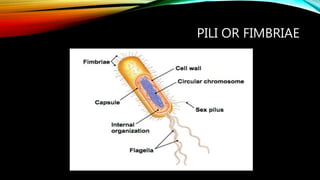
Rigid appendages found on many gram-negative bacteria
Fine and short in comparison to flagella
Structural sub-units are called pilins
Function for motility and adherence to cell surface (common
pili) or attached to another bacterium during a form of
bacterial gene exchange called conjugation (sex pili)
PILI OR FIMBRIAE
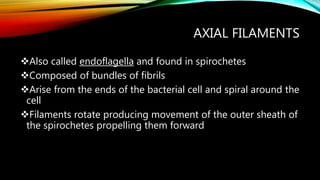
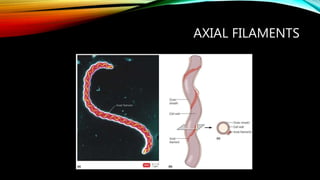
AXIAL FILAMENTS
Also called endoflagella and found in spirochetes
Composed of bundles of fibrils
Arise from the ends of the bacterial cell and spiral around the
cell
Filaments rotate producing movement of the outer sheath of
the spirochetes propelling them forward
AXIAL FILAMENTS
CYTOPLASMIC MEMBRANE
Cell membrane is located beneath the cell wall, sometimes called
cell sac
Selectively permeable allowing transport of selected solutes
In aerobic organisms, it is the site of ETC and serves as the site of
ATP production, therefore serves the function of the mitochondria,
which are not found in prokaryotic cells
Contains the enzymes needed for the biosynthesis of DNA , cell wall
components and membrane lipids
INTERNAL STRUCTURES
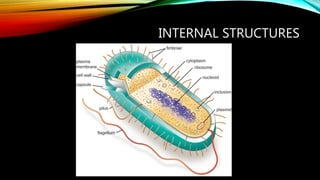
Nucleoid
Not true nucleus where the genetic material is packaged in this structure
Bacteria possess a single, circular, double-stranded DNA
Mesosome
Function for cell division, also involved in the secretion of substances produced by
bacteria
Ribosomes
Bacterial ribosome is smaller (70S) and function for protein synthesis
Granules or Inclusion Bodies
Serve for storage of food and energy (e.g. metachromatic granules of C. diphtheriae
and much granules of M. tuberculosis)
INTERNAL STRUCTURES
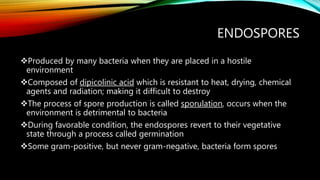
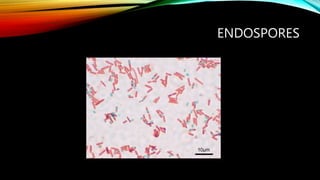
ENDOSPORES
Produced by many bacteria when they are placed in a hostile
environment
Composed of dipicolinic acid which is resistant to heat, drying, chemical
agents and radiation; making it difficult to destroy
The process of spore production is called sporulation, occurs when the
environment is detrimental to bacteria
During favorable condition, the endospores revert to their vegetative
state through a process called germination
Some gram-positive, but never gram-negative, bacteria form spores
ENDOSPORES
REFERENCE BOOK:
F. A., Bartolome, E. P., Quiles (2020) Microbiology and Parasitology: A textbook and
Laboratory Manual for Health Sciences. 2nd Edition. p.51-58.

Chapter 3 Bacterial Morphology

  • 1.
  • 2.
  • 3.
    COCCI/SPHERICAL OR ROUND-SHAPED Staphylococcusaureus Streptococcus pneumoniae
  • 4.
  • 5.
    CURVED AND SPIRALSHAPED Vibrio cholerae Treponema pallidum Corynebacterium diphtheriae
  • 6.
    ENVELOPE STRUCTURES Glycocalyx Outermost coveringof some bacteria A gelatinous substance located external to the cell wall Composed of polysaccharide or polypeptide, or both It is called capsule when strongly attached to the cell wall, called slime layer if it is loosely attached Aiding in the evasion of bacteria in phagocytosis, anti-body response from the immune system and serve to protect the organism from dehydration
  • 7.
    ENVELOPE STRUCTURES Cell Wall Providesrigid support and shape to bacteria, it protects the bacteria from osmotic damage and play a special role in cell division Sometimes called the murein sacculus Principal component is peptidoglycan called murein or mucopeptide Multi-layered in gram-positive bacteria and single-layered in gram-negative bacteria
  • 8.
    SPECIAL COMPONENTS OF GRAM-POSITIVECELL WALLS 1. Teichoic acids Comprise major surface antigens of gram-positive organisms and can elicit antibody response In some gram-positive organisms as Staphylococcus aureus, it function for the attachment of the organism to the host cell 2. Polysaccharides Include neutral sugars such as mannose, arabinose, rhamnose and glucosamine and some acidic sugars as glucuronic acid and mannuronic acid
  • 9.
    SPECIAL COMPONENTS OF GRAM-NEGATIVECELL WALLS 1. Outer membrane A bi-layered structure where inner-leaflet is composed of a lipopolysaccharide (LPS), special protein channel for small or low-molecular-weight hydrophilic substances Lipid A-complex glycolipid responsible for endotoxin activity, located in the outer leaflet of the outer membrane The inner core is a polysaccharide made-up of repeated units, also called O antigen, which is unique for every species of bacteria 2. Lipoprotein Functions to anchor the outer membrane to the peptidoglycan layer and stabilizes the outer membrane 3. Periplasmic space A fluid-filled space between the outer membrane and the inner plasma membrane Contains enzymes for breakdown of large non-transportable molecules into transportable ones and enzymes that serve to detoxify and inactivate antibiotics
  • 10.
  • 12.
    ACID-FAST CELL WALL Possessan outer layer that is lipid-rich Composed of large amounts of waxes that are known as mycolic acids The inner layer of the cell wall is made up of peptidoglycan but the outermost layer is lipid-rich, happened to be hydrophobic The hydrophobic nature of the cell wall protects them from harsh chemicals such as strong acids and detergents
  • 13.
  • 14.
    PROJECTING STRUCTURES Flagella Thread-like structuresmade up entirely of molecules of the protein sub-unit flagellin They project from the capsule and are organs for motility Four Types: 1. Monotrichous-single polar flagellum 2. Lophotrichous-a tuft of flagella at one end of the bacterium 3. Amphitrichous-flagella at both ends of the bacterium 4. Peritrichous-flagella all around the bacterium
  • 15.
  • 16.
    PILI OR FIMBRIAE Rigidappendages found on many gram-negative bacteria Fine and short in comparison to flagella Structural sub-units are called pilins Function for motility and adherence to cell surface (common pili) or attached to another bacterium during a form of bacterial gene exchange called conjugation (sex pili)
  • 17.
  • 18.
    AXIAL FILAMENTS Also calledendoflagella and found in spirochetes Composed of bundles of fibrils Arise from the ends of the bacterial cell and spiral around the cell Filaments rotate producing movement of the outer sheath of the spirochetes propelling them forward
  • 19.
  • 20.
    CYTOPLASMIC MEMBRANE Cell membraneis located beneath the cell wall, sometimes called cell sac Selectively permeable allowing transport of selected solutes In aerobic organisms, it is the site of ETC and serves as the site of ATP production, therefore serves the function of the mitochondria, which are not found in prokaryotic cells Contains the enzymes needed for the biosynthesis of DNA , cell wall components and membrane lipids
  • 21.
    INTERNAL STRUCTURES Nucleoid Not truenucleus where the genetic material is packaged in this structure Bacteria possess a single, circular, double-stranded DNA Mesosome Function for cell division, also involved in the secretion of substances produced by bacteria Ribosomes Bacterial ribosome is smaller (70S) and function for protein synthesis Granules or Inclusion Bodies Serve for storage of food and energy (e.g. metachromatic granules of C. diphtheriae and much granules of M. tuberculosis)
  • 22.
  • 23.
    ENDOSPORES Produced by manybacteria when they are placed in a hostile environment Composed of dipicolinic acid which is resistant to heat, drying, chemical agents and radiation; making it difficult to destroy The process of spore production is called sporulation, occurs when the environment is detrimental to bacteria During favorable condition, the endospores revert to their vegetative state through a process called germination Some gram-positive, but never gram-negative, bacteria form spores
  • 24.
  • 25.
    REFERENCE BOOK: F. A.,Bartolome, E. P., Quiles (2020) Microbiology and Parasitology: A textbook and Laboratory Manual for Health Sciences. 2nd Edition. p.51-58.