SUBMITTED BY
SREYA K J
MSc BIOTECHNOLOGY
BIOGEOCHEMICAL CYCLES
Sun- continuous stream of energy
Most common elements in living organisms are C, N, O, P & S
Microorganisms interact with each other,transfer nutrients
Nutrient cycling-exchange of C,N,S,Fe & Mn
Biogeochemical involves both biological & chemical processes
Nutrients are transferred and exchanged ,by oxidation-
reduction reactions
All biogeochemical cycles are linked
MAJOR BIOGEOCHEMICAL CYCLES:
CARBON CYCLE
NITROGEN CYCLE
PHOSPHORUS CYCLE
SULFUR CYCLE
OXYGEN CYCLE
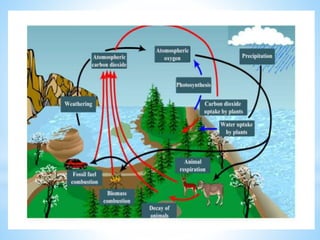
CARBON CYCLE
*
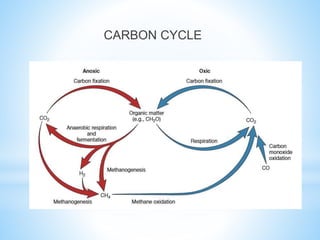
*Inorganic C-containing molecules organic molecules
used by orgnsms release of inorganic C molecules back
to atmosphere
*Reduced forms-CH4 and organic matter
*Oxidized forms-CO,CO2
*Producers – photosynthetic production of carbohydrates and O2
using CO2 and H2O
*Half the C on earth is fixed by cyanobacteria,prochlorococcus
and synechococcus, and diatoms
*Also fixed by chemolithoautotrophic microbes
*Consumers-C containing molecules are incorporated into
body,respiration,release of CO2 and H2O
*Inorganic[CO2] and organic C reduced to CH4 anaerobically,CH4 is
produced by archaea in anoxic habitats
*Decomposers-organic molecules are used as food, it's respiration
release CO2 and H2O
*Most C substrates can be degraded easily with or without O2 except
hydrocarbons and lignin
*Oxic condition-oxidized products such as nitrate, sulfate and CO2
*Anoxic-reduced end products such as ammonium ion ,sulfide and
CH4
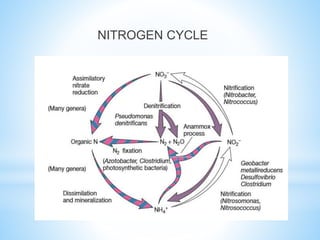
NITROGEN CYCLE
*Cycling of N atoms between abiotic and biotic components and
among organisms
*N is essential in formation of proteins and nucleic acids
*N2 ~ 80% of earth’s atmosphere
*N atoms are tightly bound, plants and producers must get it as
nitrate(NO3-) or ammonia(NH3)
*N fixation is uniquely prokaryotic process; apart fixation during
lightning
*Nitrogen fixing bacteria-covert N2 into NH3
• Free-living N2-fixing bacteria
• Symbiotic N2-fixing bacteria
*Microbes such as Azotobacter and the cyanobacterium
Trichodesmium fix nitrogen aerobically,free-living
anaerobes Clostridium fix anaerobically
*Symbiotic N fixing- Rhizobium, α-proteobacteria and β-
proteobacteria
*Product of N2 fixation ammonia(NH3),incorporated into
organic matter as an amine
*Producers and consumers-plants,synthesis of proteins and
nucleic acid.Herbivores & carnivores-breakdown proteins
& nucleicacids to smaller blocks
*Decomposers
• Ammonia is released
• Nitrifying bacteria-convert ammonia to nitrite,which can be
converted by other bacteria to nitrate
• Plants use ammonia & nitrate
• Denitrifying bacteria-anaerobic conversion of nitrate to
nitrogen gas
*Ammonia nitrate ,called nitrification, 2 step process-
ammonium nitrite nitrate
*Nitrosomonas and Nitrosococcus in the 1st step ,Nitrobacter
and related bacteria in the 2nd step
*Nitrate can be reduced & incorporated into organic
compounds, assimilatory nitrate reduction
*Some microbes(eg,Pseudomonas denitrificans)-dissimilatory
reduction, nitrate N2 gas, denitrification
*Anammox reaction-chemolithotrophs use ammonium ion and
nitrite,which is reduced to N2 gas
PHOSPHORUS CYCLE
• Phosphorus – nucleic acid & cell membrane ,bones & teeth
• P cycle has no gaseous component
• Most of the processes are geological processes of erosion &
deposition
• P is present in low concentrations, locked in Earth’s crust
• P is solely derived from weathering of P-containing rocks
• Released by erosion of rock & are dissolved in water
• In soil- inorganic & organic forms
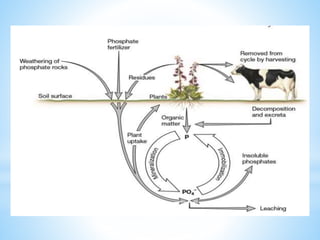
*Organic phosphorus-biomass & humus, recycled by microbial
activity
*Inorganic phosphorus- negatively charged, complexes with
cations such as iron,aluminium, and calcium
*These compounds are relatively insoluble, dissolution is pH
dependent- available to plants & microbes between pH 6 and
7
*These organisms rapidly convert phosphate organic
form available to animals
*Animals obtain P when they consume plants & animals
*Organism dies, excretes P back to soil
*P compounds that are dissolved in water get precipitated as
mineral deposits in oceans
decomposers
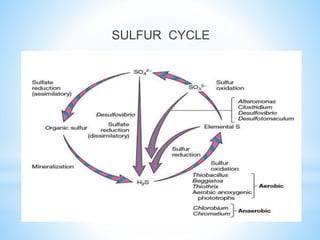
SULFUR CYCLE
*Much of the Earth’s sulfur is stored underground in rocks and
minerals, including sulfate salts buried deep under ocean sediments
*Sulfur enters the atmosphere from several natural sources
*H2S is released from active volcanoes & from organic matter
*S02 also comes from volcanoes
*Particles of sulfate (SO4 2-) salts enter the atmosphere from sea
spray and dust storms
*Sulfide elemental sulfur and sulfate
*Plant roots absorb sulfate ions & incorporate the S as an essential
component of many proteins
*When sulfate diffuses into reduced habitats,it provides an
opportunity for different groups of microorganisms (eg
Desulfovibrio) to carry out sulfate reduction
• Dissimilatory sulfate reduction results in sulfide accumulation in the
environment
• Assimilatory sulfate reductiion- the reduction of sulfate for use in
aminoacid & protein biosynthesis
*Sulfate an be reduced to sulfide by a wide variety of
microorganisms ,including Alteromonas & Clostridium
*Certain marine algae produce large amounts of volatile
dimethyl sulfide(DMS)
*Human activities –large amounts of sulfur dioxide into
atmosphere
*Once in atmosphere ,SO2 is converted to droplets of
sulfuric acid & particles of sulfate ,which return to the Earth
as acid deposition
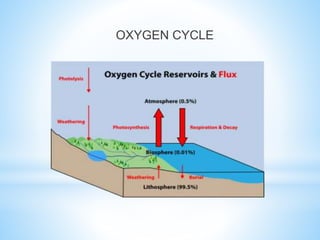
OXYGEN CYCLE
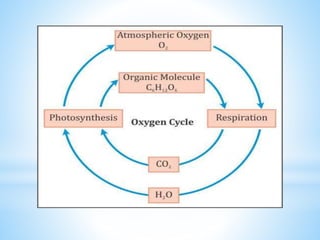
*Oxygen cycle is the biogeochemical cycle of oxygen within
its three main reservoirs-
1. atmosphere(air)
2. total content of biological matter within the biosphere
3. Earth’s crust
The steps involved in the oxygen cycle are;
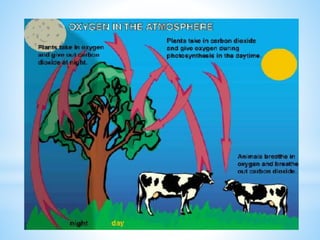
1.Photosynthesis-
During the day, plants take energy from the Sun ,CO2 from the
air, and H2O from the soil to make their food-glucose.O2 is
released into air as a by-product
During the night, plants take in O2 and releaseCO2,to maintain
their metabolism
2.Respiration –
O2 released by plants is used by humans ,animals ,and other
organisms for respiration and release CO2 into the air
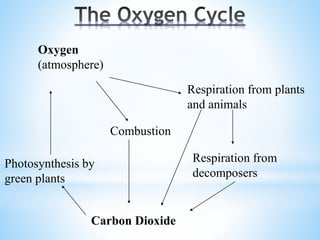
Oxygen
(atmosphere)
Respiration from plants
and animals
Respiration from
decomposers
Combustion
Carbon Dioxide
Photosynthesis by
green plants
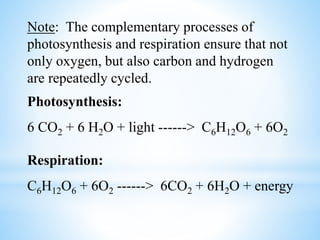
Note: The complementary processes of
photosynthesis and respiration ensure that not
only oxygen, but also carbon and hydrogen
are repeatedly cycled.
Photosynthesis:
6 CO2 + 6 H2O + light ------> C6H12O6 + 6O2
Respiration:
C6H12O6 + 6O2 ------> 6CO2 + 6H2O + energy
Biogeochemical cycles

Biogeochemical cycles

  • 1.
    SUBMITTED BY SREYA KJ MSc BIOTECHNOLOGY
  • 2.
    BIOGEOCHEMICAL CYCLES Sun- continuousstream of energy Most common elements in living organisms are C, N, O, P & S Microorganisms interact with each other,transfer nutrients Nutrient cycling-exchange of C,N,S,Fe & Mn Biogeochemical involves both biological & chemical processes Nutrients are transferred and exchanged ,by oxidation- reduction reactions All biogeochemical cycles are linked
  • 3.
    MAJOR BIOGEOCHEMICAL CYCLES: CARBONCYCLE NITROGEN CYCLE PHOSPHORUS CYCLE SULFUR CYCLE OXYGEN CYCLE
  • 4.
  • 5.
    * *Inorganic C-containing moleculesorganic molecules used by orgnsms release of inorganic C molecules back to atmosphere *Reduced forms-CH4 and organic matter *Oxidized forms-CO,CO2 *Producers – photosynthetic production of carbohydrates and O2 using CO2 and H2O *Half the C on earth is fixed by cyanobacteria,prochlorococcus and synechococcus, and diatoms *Also fixed by chemolithoautotrophic microbes
  • 6.
    *Consumers-C containing moleculesare incorporated into body,respiration,release of CO2 and H2O *Inorganic[CO2] and organic C reduced to CH4 anaerobically,CH4 is produced by archaea in anoxic habitats *Decomposers-organic molecules are used as food, it's respiration release CO2 and H2O *Most C substrates can be degraded easily with or without O2 except hydrocarbons and lignin *Oxic condition-oxidized products such as nitrate, sulfate and CO2 *Anoxic-reduced end products such as ammonium ion ,sulfide and CH4
  • 7.
  • 8.
    *Cycling of Natoms between abiotic and biotic components and among organisms *N is essential in formation of proteins and nucleic acids *N2 ~ 80% of earth’s atmosphere *N atoms are tightly bound, plants and producers must get it as nitrate(NO3-) or ammonia(NH3) *N fixation is uniquely prokaryotic process; apart fixation during lightning *Nitrogen fixing bacteria-covert N2 into NH3 • Free-living N2-fixing bacteria • Symbiotic N2-fixing bacteria
  • 9.
    *Microbes such asAzotobacter and the cyanobacterium Trichodesmium fix nitrogen aerobically,free-living anaerobes Clostridium fix anaerobically *Symbiotic N fixing- Rhizobium, α-proteobacteria and β- proteobacteria *Product of N2 fixation ammonia(NH3),incorporated into organic matter as an amine
  • 10.
    *Producers and consumers-plants,synthesisof proteins and nucleic acid.Herbivores & carnivores-breakdown proteins & nucleicacids to smaller blocks *Decomposers • Ammonia is released • Nitrifying bacteria-convert ammonia to nitrite,which can be converted by other bacteria to nitrate • Plants use ammonia & nitrate • Denitrifying bacteria-anaerobic conversion of nitrate to nitrogen gas
  • 11.
    *Ammonia nitrate ,callednitrification, 2 step process- ammonium nitrite nitrate *Nitrosomonas and Nitrosococcus in the 1st step ,Nitrobacter and related bacteria in the 2nd step *Nitrate can be reduced & incorporated into organic compounds, assimilatory nitrate reduction *Some microbes(eg,Pseudomonas denitrificans)-dissimilatory reduction, nitrate N2 gas, denitrification *Anammox reaction-chemolithotrophs use ammonium ion and nitrite,which is reduced to N2 gas
  • 12.
    PHOSPHORUS CYCLE • Phosphorus– nucleic acid & cell membrane ,bones & teeth • P cycle has no gaseous component • Most of the processes are geological processes of erosion & deposition • P is present in low concentrations, locked in Earth’s crust • P is solely derived from weathering of P-containing rocks • Released by erosion of rock & are dissolved in water • In soil- inorganic & organic forms
  • 14.
    *Organic phosphorus-biomass &humus, recycled by microbial activity *Inorganic phosphorus- negatively charged, complexes with cations such as iron,aluminium, and calcium *These compounds are relatively insoluble, dissolution is pH dependent- available to plants & microbes between pH 6 and 7 *These organisms rapidly convert phosphate organic form available to animals *Animals obtain P when they consume plants & animals *Organism dies, excretes P back to soil *P compounds that are dissolved in water get precipitated as mineral deposits in oceans decomposers
  • 15.
  • 16.
    *Much of theEarth’s sulfur is stored underground in rocks and minerals, including sulfate salts buried deep under ocean sediments *Sulfur enters the atmosphere from several natural sources *H2S is released from active volcanoes & from organic matter *S02 also comes from volcanoes *Particles of sulfate (SO4 2-) salts enter the atmosphere from sea spray and dust storms *Sulfide elemental sulfur and sulfate
  • 17.
    *Plant roots absorbsulfate ions & incorporate the S as an essential component of many proteins *When sulfate diffuses into reduced habitats,it provides an opportunity for different groups of microorganisms (eg Desulfovibrio) to carry out sulfate reduction • Dissimilatory sulfate reduction results in sulfide accumulation in the environment • Assimilatory sulfate reductiion- the reduction of sulfate for use in aminoacid & protein biosynthesis *Sulfate an be reduced to sulfide by a wide variety of microorganisms ,including Alteromonas & Clostridium
  • 18.
    *Certain marine algaeproduce large amounts of volatile dimethyl sulfide(DMS) *Human activities –large amounts of sulfur dioxide into atmosphere *Once in atmosphere ,SO2 is converted to droplets of sulfuric acid & particles of sulfate ,which return to the Earth as acid deposition
  • 19.
  • 20.
    *Oxygen cycle isthe biogeochemical cycle of oxygen within its three main reservoirs- 1. atmosphere(air) 2. total content of biological matter within the biosphere 3. Earth’s crust
  • 21.
    The steps involvedin the oxygen cycle are; 1.Photosynthesis- During the day, plants take energy from the Sun ,CO2 from the air, and H2O from the soil to make their food-glucose.O2 is released into air as a by-product During the night, plants take in O2 and releaseCO2,to maintain their metabolism 2.Respiration – O2 released by plants is used by humans ,animals ,and other organisms for respiration and release CO2 into the air
  • 22.
    Oxygen (atmosphere) Respiration from plants andanimals Respiration from decomposers Combustion Carbon Dioxide Photosynthesis by green plants
  • 24.
    Note: The complementaryprocesses of photosynthesis and respiration ensure that not only oxygen, but also carbon and hydrogen are repeatedly cycled. Photosynthesis: 6 CO2 + 6 H2O + light ------> C6H12O6 + 6O2 Respiration: C6H12O6 + 6O2 ------> 6CO2 + 6H2O + energy