ENZYMES
CONTENTS
Chemistry
Classification
CHEMISTRY
STRUCTURE OF ENZYMES
 The active site of an enzyme is the region that binds
substrates, co-factors and prosthetic groups and contains
residue that helps to hold the substrate.
 Active sites generally occupy less than 5% of the total surface
area of enzyme.
 Active site has a specific shape due to tertiary structure of
protein.
 A change in the shape of protein affects the shape of active
site and function of the enzyme.
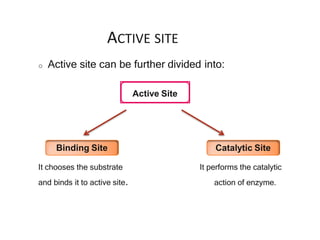
ACTIVE SITE
It chooses the substrate
and binds it to active site.
It performs the catalytic
action of enzyme.
o Active site can be further divided into:
Active Site
Binding Site Catalytic Site
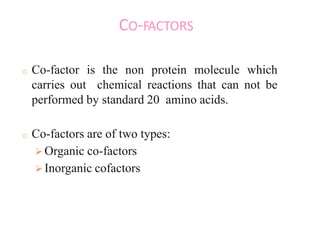
CO-FACTORS
o Co-factor is the non protein molecule which
carries out chemical reactions that can not be
performed by standard 20 amino acids.
o Co-factors are of two types:
 Organic co-factors
 Inorganic cofactors
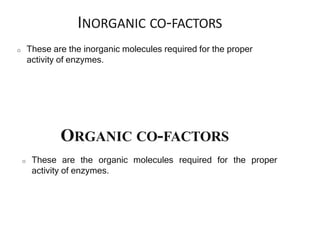
INORGANIC CO-FACTORS
o These are the inorganic molecules required for the proper
activity of enzymes.
ORGANIC CO-FACTORS
o These are the organic molecules required for the proper
activity of enzymes.
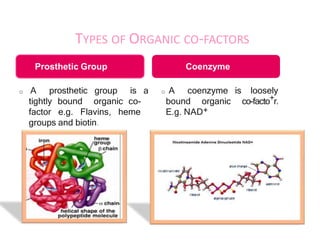
TYPES OF ORGANIC CO-FACTORS
Prosthetic Group Coenzyme
o A prosthetic group is a o A coenzyme is loosely
tightly bound organic co- bound organic co-facto+r.
factor e.g. Flavins, heme E.g. NAD+
groups and biotin.
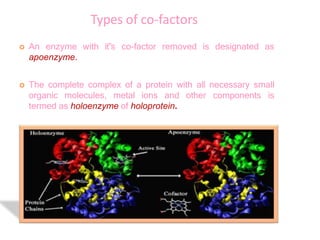
 An enzyme with it‟s co-factor removed is designated as
apoenzyme.
 The complete complex of a protein with all necessary small
organic molecules, metal ions and other components is
termed as holoenzyme of holoprotein.
Types of co-factors
SUBSTRATE
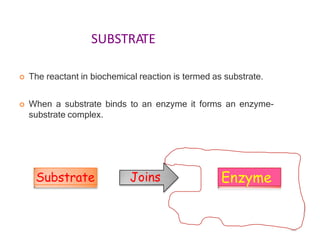
 The reactant in biochemical reaction is termed as substrate.
 When a substrate binds to an enzyme it forms an enzyme-
substrate complex.
Enzyme
Joins
Substrate
CLASS
• Enzymes are sometimes considered under two
broad categories :
(a) Intracellular enzymes –
• They are functional within cells where they
are synthesized.
(b) Extracellular enzymes –
• These enzymes are active outside the cell;
all the digestive enzymes belong to this group.
NOMENCLATURE OF ENZYMES
o An enzyme is named according to the name of the substrate it
catalyses.
o Some enzymes were named before a systematic way of
naming enzyme was formed.
Example: pepsin, trypsin and rennin
o By adding suffix -ase at the end of the name of the
substrate, enzymes are named.
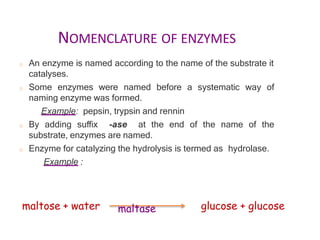
o Enzyme for catalyzing the hydrolysis is termed as hydrolase.
Example :
maltose + water glucose + glucose
maltase
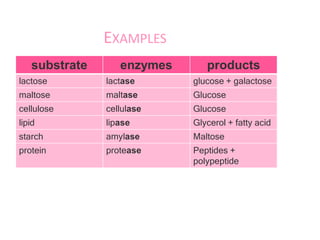
EXAMPLES
substrate enzymes products
lactose lactase glucose + galactose
maltose maltase Glucose
cellulose cellulase Glucose
lipid lipase Glycerol + fatty acid
starch amylase Maltose
protein protease Peptides +
polypeptide
CLASSIFICATION
• The International Union of Biochemistry (IUB)
appointed an Enzyme Commission in 1961.
• Since 1964, the IUB system of enzyme
classification has been in force.
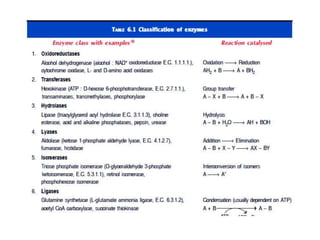
• Enzymes are divided into six major classes (in
that order).
• Each class on its own represents the general type
of reaction brought about by the enzymes of that
class
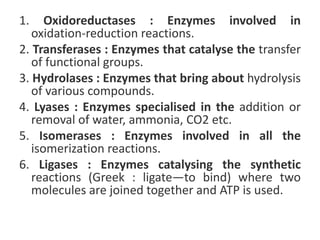
1. Oxidoreductases : Enzymes involved in
oxidation-reduction reactions.
2. Transferases : Enzymes that catalyse the transfer
of functional groups.
3. Hydrolases : Enzymes that bring about hydrolysis
of various compounds.
4. Lyases : Enzymes specialised in the addition or
removal of water, ammonia, CO2 etc.
5. Isomerases : Enzymes involved in all the
isomerization reactions.
6. Ligases : Enzymes catalysing the synthetic
reactions (Greek : ligate—to bind) where two
molecules are joined together and ATP is used.
[The word OTHLIL (first letter in each class) may be memorised
to remember the six classes of enzymes in the correct order].
• Each class in turn is subdivided into many sub-
classes which are further divided.
• A four digit Enzyme Commission (E.C.) number is
assigned to each enzyme representing the class
(first digit), sub-class (second digit), sub-sub class
(third digit) and the individual enzyme (fourth
digit).
• Each enzyme is given a specific name indicating
the substrate, coenzyme (if any) and the type of
the reaction catalysed by the enzyme.

Biochemistry Unit 5

  • 1.
  • 2.
  • 3.
  • 4.
    STRUCTURE OF ENZYMES The active site of an enzyme is the region that binds substrates, co-factors and prosthetic groups and contains residue that helps to hold the substrate.  Active sites generally occupy less than 5% of the total surface area of enzyme.  Active site has a specific shape due to tertiary structure of protein.  A change in the shape of protein affects the shape of active site and function of the enzyme.
  • 5.
    ACTIVE SITE It choosesthe substrate and binds it to active site. It performs the catalytic action of enzyme. o Active site can be further divided into: Active Site Binding Site Catalytic Site
  • 6.
    CO-FACTORS o Co-factor isthe non protein molecule which carries out chemical reactions that can not be performed by standard 20 amino acids. o Co-factors are of two types:  Organic co-factors  Inorganic cofactors
  • 7.
    INORGANIC CO-FACTORS o Theseare the inorganic molecules required for the proper activity of enzymes. ORGANIC CO-FACTORS o These are the organic molecules required for the proper activity of enzymes.
  • 8.
    TYPES OF ORGANICCO-FACTORS Prosthetic Group Coenzyme o A prosthetic group is a o A coenzyme is loosely tightly bound organic co- bound organic co-facto+r. factor e.g. Flavins, heme E.g. NAD+ groups and biotin.
  • 9.
     An enzymewith it‟s co-factor removed is designated as apoenzyme.  The complete complex of a protein with all necessary small organic molecules, metal ions and other components is termed as holoenzyme of holoprotein. Types of co-factors
  • 10.
    SUBSTRATE  The reactantin biochemical reaction is termed as substrate.  When a substrate binds to an enzyme it forms an enzyme- substrate complex. Enzyme Joins Substrate
  • 11.
    CLASS • Enzymes aresometimes considered under two broad categories : (a) Intracellular enzymes – • They are functional within cells where they are synthesized. (b) Extracellular enzymes – • These enzymes are active outside the cell; all the digestive enzymes belong to this group.
  • 12.
    NOMENCLATURE OF ENZYMES oAn enzyme is named according to the name of the substrate it catalyses. o Some enzymes were named before a systematic way of naming enzyme was formed. Example: pepsin, trypsin and rennin o By adding suffix -ase at the end of the name of the substrate, enzymes are named. o Enzyme for catalyzing the hydrolysis is termed as hydrolase. Example : maltose + water glucose + glucose maltase
  • 13.
    EXAMPLES substrate enzymes products lactoselactase glucose + galactose maltose maltase Glucose cellulose cellulase Glucose lipid lipase Glycerol + fatty acid starch amylase Maltose protein protease Peptides + polypeptide
  • 14.
    CLASSIFICATION • The InternationalUnion of Biochemistry (IUB) appointed an Enzyme Commission in 1961. • Since 1964, the IUB system of enzyme classification has been in force. • Enzymes are divided into six major classes (in that order). • Each class on its own represents the general type of reaction brought about by the enzymes of that class
  • 16.
    1. Oxidoreductases :Enzymes involved in oxidation-reduction reactions. 2. Transferases : Enzymes that catalyse the transfer of functional groups. 3. Hydrolases : Enzymes that bring about hydrolysis of various compounds. 4. Lyases : Enzymes specialised in the addition or removal of water, ammonia, CO2 etc. 5. Isomerases : Enzymes involved in all the isomerization reactions. 6. Ligases : Enzymes catalysing the synthetic reactions (Greek : ligate—to bind) where two molecules are joined together and ATP is used.
  • 17.
    [The word OTHLIL(first letter in each class) may be memorised to remember the six classes of enzymes in the correct order]. • Each class in turn is subdivided into many sub- classes which are further divided. • A four digit Enzyme Commission (E.C.) number is assigned to each enzyme representing the class (first digit), sub-class (second digit), sub-sub class (third digit) and the individual enzyme (fourth digit). • Each enzyme is given a specific name indicating the substrate, coenzyme (if any) and the type of the reaction catalysed by the enzyme.