List the characteristics of protists.

They are the earliest eukaryotes  showed
 up a billion years before the others
Age  2.1 billion years
There are 60,000 living species
Exist as unicellular, colonial, and
 multicellular
Aerobic, cilia & flagella, asexual or sexual
Bottom line: a VERY diverse group 
Explain what is meant by the statement that
the Kingdom Protista is a polyphyletic group.


 Polyphyletic = ancestry from several possible
  sources or directions
 Example:
  Protists are  animal-like
                  plant-like
                  fungus-like 
List five candidate kingdoms of protists
    and describe a major feature of each.
•   Archaezoa  lack mitochondria
•   Euglenozoa  are both autotrophic and
    heterotrophic flagellates
•   Alveolata  have subsurface cavities (alveoli)
•   Stramenopila  diatoms, golden brown algae,
    and water molds
•   Rhodophyta  red algae; lack flagella 
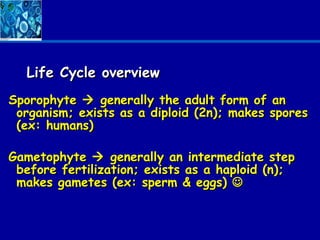
Life Cycle overview
Sporophyte  generally the adult form of an
 organism; exists as a diploid (2n); makes spores
 (ex: humans)

Gametophyte  generally an intermediate step
 before fertilization; exists as a haploid (n);
 makes gametes (ex: sperm & eggs) 
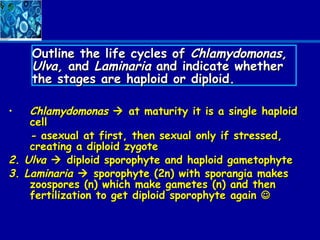
Outline the life cycles of Chlamydomonas,
    Ulva, and Laminaria and indicate whether
    the stages are haploid or diploid.

•   Chlamydomonas  at maturity it is a single haploid
    cell
    - asexual at first, then sexual only if stressed,
    creating a diploid zygote
2. Ulva  diploid sporophyte and haploid gametophyte
3. Laminaria  sporophyte (2n) with sporangia makes
    zoospores (n) which make gametes (n) and then
    fertilization to get diploid sporophyte again 
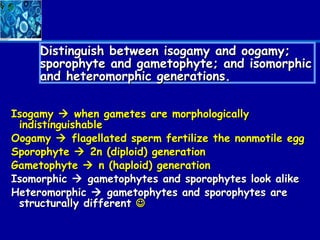
Distinguish between isogamy and oogamy;
     sporophyte and gametophyte; and isomorphic
     and heteromorphic generations.

Isogamy  when gametes are morphologically
 indistinguishable
Oogamy  flagellated sperm fertilize the nonmotile egg
Sporophyte  2n (diploid) generation
Gametophyte  n (haploid) generation
Isomorphic  gametophytes and sporophytes look alike
Heteromorphic  gametophytes and sporophytes are
 structurally different 
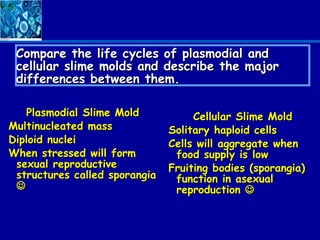
Compare the life cycles of plasmodial and
 cellular slime molds and describe the major
 differences between them.

   Plasmodial Slime Mold            Cellular Slime Mold
Multinucleated mass            Solitary haploid cells
Diploid nuclei                 Cells will aggregate when
When stressed will form         food supply is low
 sexual reproductive           Fruiting bodies (sporangia)
 structures called sporangia    function in asexual
                               reproduction 
Provide evidence that the oomycetes are
  not closely related to true fungi.

Have coenocytic (multinucleated) hyphae
 (branching filaments) that are analogous to
 fungal hyphae
Cell walls are made of cellulose rather than
 the chitin in true fungi
Have biflagellated cells  fungi lack
 flagellated cells 
Give examples of oomycetes and describe their
economic importance.


•   Water molds  grow on injured tissue but
    also will grow on the skin and gills of fish
•   White rusts
•   Downy mildews
    - both of these are parasitic on terrestrial
    plants – act as pathogens 
 “sea lettuce”
 attached to rocks in the middle to low
   intertidal zone
 live primarily in marine environments

 Multicellular green algae
MITOSIS
                              MEIOSIS

                          E


                                   MITOSIS

                GAMETES

Fertilization
-Involves alternation of generations

-Ulva species are isomorphic


-They alternate between gametophytic and
sporophytic life stages with similar morphologies
-gametophytes are haploid and the sporophytes
are diploid
-sporophytes produce quadriflagellate
haploid spores through meiosis

-gametophytes produce biflagellate
haploid gametes through mitosis

Bio ulva

  • 1.
    List the characteristicsof protists. They are the earliest eukaryotes  showed up a billion years before the others Age  2.1 billion years There are 60,000 living species Exist as unicellular, colonial, and multicellular Aerobic, cilia & flagella, asexual or sexual Bottom line: a VERY diverse group 
  • 2.
    Explain what ismeant by the statement that the Kingdom Protista is a polyphyletic group. Polyphyletic = ancestry from several possible sources or directions Example: Protists are  animal-like plant-like fungus-like 
  • 3.
    List five candidatekingdoms of protists and describe a major feature of each. • Archaezoa  lack mitochondria • Euglenozoa  are both autotrophic and heterotrophic flagellates • Alveolata  have subsurface cavities (alveoli) • Stramenopila  diatoms, golden brown algae, and water molds • Rhodophyta  red algae; lack flagella 
  • 4.
    Life Cycle overview Sporophyte generally the adult form of an organism; exists as a diploid (2n); makes spores (ex: humans) Gametophyte  generally an intermediate step before fertilization; exists as a haploid (n); makes gametes (ex: sperm & eggs) 
  • 5.
    Outline the lifecycles of Chlamydomonas, Ulva, and Laminaria and indicate whether the stages are haploid or diploid. • Chlamydomonas  at maturity it is a single haploid cell - asexual at first, then sexual only if stressed, creating a diploid zygote 2. Ulva  diploid sporophyte and haploid gametophyte 3. Laminaria  sporophyte (2n) with sporangia makes zoospores (n) which make gametes (n) and then fertilization to get diploid sporophyte again 
  • 6.
    Distinguish between isogamyand oogamy; sporophyte and gametophyte; and isomorphic and heteromorphic generations. Isogamy  when gametes are morphologically indistinguishable Oogamy  flagellated sperm fertilize the nonmotile egg Sporophyte  2n (diploid) generation Gametophyte  n (haploid) generation Isomorphic  gametophytes and sporophytes look alike Heteromorphic  gametophytes and sporophytes are structurally different 
  • 7.
    Compare the lifecycles of plasmodial and cellular slime molds and describe the major differences between them. Plasmodial Slime Mold Cellular Slime Mold Multinucleated mass Solitary haploid cells Diploid nuclei Cells will aggregate when When stressed will form food supply is low sexual reproductive Fruiting bodies (sporangia) structures called sporangia function in asexual  reproduction 
  • 8.
    Provide evidence thatthe oomycetes are not closely related to true fungi. Have coenocytic (multinucleated) hyphae (branching filaments) that are analogous to fungal hyphae Cell walls are made of cellulose rather than the chitin in true fungi Have biflagellated cells  fungi lack flagellated cells 
  • 9.
    Give examples ofoomycetes and describe their economic importance. • Water molds  grow on injured tissue but also will grow on the skin and gills of fish • White rusts • Downy mildews - both of these are parasitic on terrestrial plants – act as pathogens 
  • 10.
     “sea lettuce” attached to rocks in the middle to low intertidal zone  live primarily in marine environments  Multicellular green algae
  • 11.
    MITOSIS MEIOSIS E MITOSIS GAMETES Fertilization
  • 12.
    -Involves alternation ofgenerations -Ulva species are isomorphic -They alternate between gametophytic and sporophytic life stages with similar morphologies -gametophytes are haploid and the sporophytes are diploid
  • 13.
    -sporophytes produce quadriflagellate haploidspores through meiosis -gametophytes produce biflagellate haploid gametes through mitosis