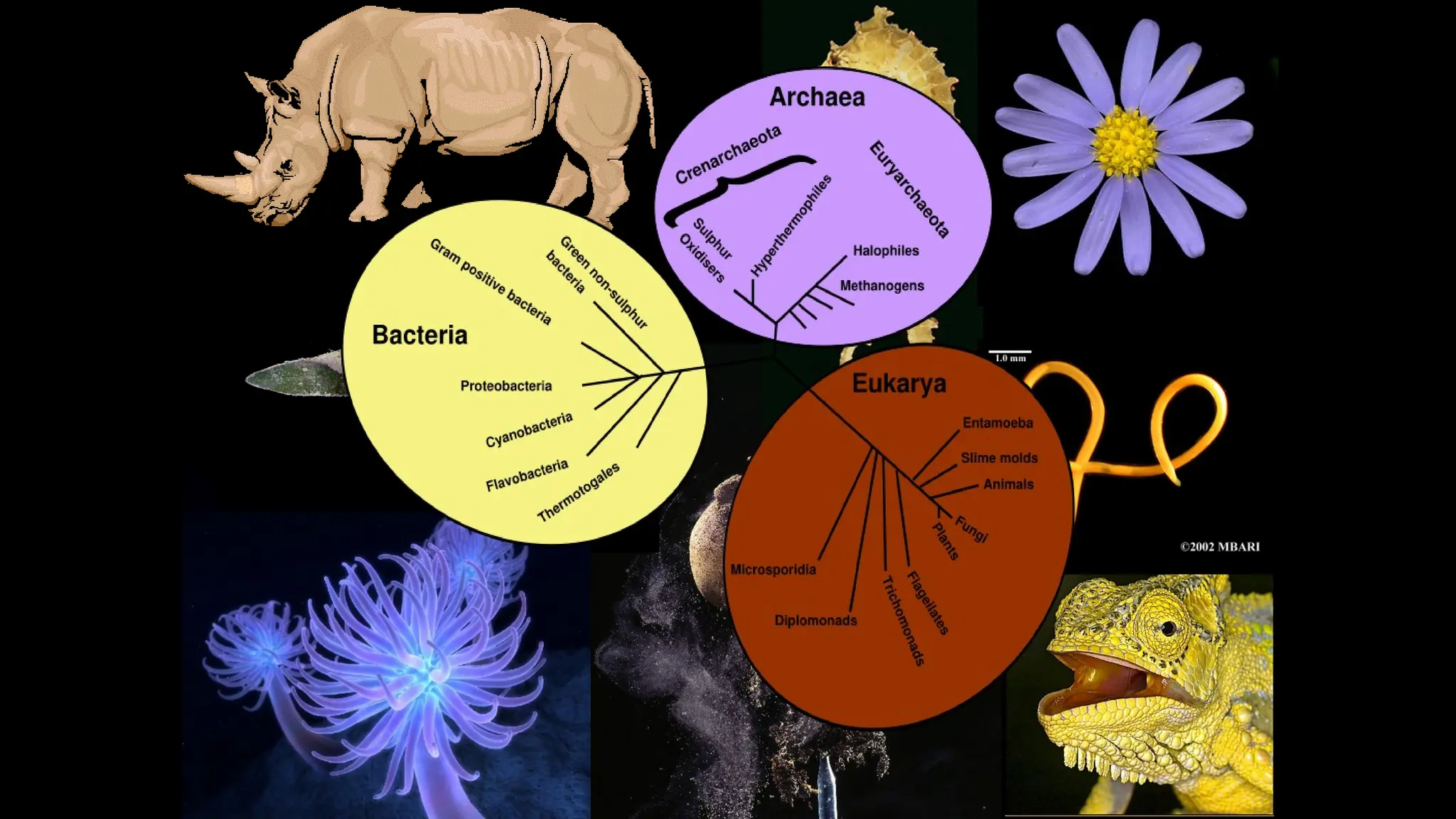
BIOLOGY 144
Biodiversity and Ecology:
PLANT DIVERSITY
Prof. Leanne Dreyer
BIOLOGY 144
1. Phylogenetic trees
PLANT DIVERSITY
Organizing diversity
How do phylogenetic trees work????
Organizing diversity
• read phylogenies like family trees
• “root” = ancestor
• “tips” = descendents
• from root to tips = moving through time
Organization of diversity
• branching = single evolutionary lineage splitting into two lineages (speciation)
• phylogeny = pattern of shared ancestry
• each lineage has some history that is shared with other lineages, and some history
that is unique
• in the same way each lineage has shared and unique ancestors
Organizing diversity
• clade = a group which includes a common (shared) ancestor and all the
descendants of that ancestor (living or dead), but ONLY descendants of
that ancestor = monophyletic group
• a clade can be recognized as the group you would get if you cut the tree
anywhere with a single line
• clades are imbedded within one another hierarchically
Organizing diversity
Evolutionary history and classification
• Evolutionary history of life ≠ ladder
• Phylogenies are often misinterpreted as meaning some organisms are more
advanced than others
Organizing diversity
lemurs
monkeys
chimps
humans
speciation event: 1 evolutionary lineage splits into two lineages (eg. one
becomes mosses, the other becomes ferns, pines and roses)
Organizing diversity
• After each speciation event it does not matter which branch is left or right –
the two trees below are identical
.
Organizing diversity
• To build a tree biologists gather data about characteristics of the group they
are interested in
• Characters = inherited, genetically controlled and comparable between
organisms (homologous)
• Typical characters: morphology, genetics (DNA sequence), physiology and
behavioral
• Similarities resulting from shared common ancestry
• By using shared derived characters organisms can be hierarchically divided
into smaller and smaller groups
• Look for similarities between organisms
Organizing diversity
Building phylogenetic trees
• e.g. amphibians, turtles, lizards,
snakes, crocs, birds and mammals
all have four limbs (or once had)
• this shared derived trait is no good
for determining relationships within
the clade, because all members
share the trait
• need other characters to determine
relationships within the clade
Organizing diversity
BIOLOGY 144
2. Evolutionary origin of plants
PLANT DIVERSITY
Protista
eukarya
bacteria archaea
p
r
o
t
i
s
t
a
p
l
a
n
t
a
e
f
u
n
g
i
a
n
i
m
a
l
i
a
p
r
o
t
i
s
t
a
p
r
o
t
i
s
t
a
p
r
o
t
i
s
t
a
6 kingdom
classification
system
• Protista remarkably diverse: unicellular, colonial and
multi-cellular groups
• 200 000 (distantly related) organisms lumped into a
poorly-defined Kingdom
• Grouped together on the basis of 1 shared negative
trait:
They are eukaryotes that are NOT fungi, animals or
plants
• Highly variable in terms of all other traits
• (NO shared derived traits)
Kingdom Protista
Ryk Protista
• DNA techniques:
– better general biological classification
– relationships within Protista
• Protista NOT monopyletic
• grouped together for convenience rather than on
scientific merit – do not reflect phylogenetic
relationships
• 60 protist lineages still not placed in the tree of life
• but we can currently recognize 6 main
phylogenetic groups with the kingdom
Still many questions:
• How many protist lineages are there really?
• How do we classify them?
• What did the protist ancester of plants, animals and fungi look like?
• Are protists = several different kingdoms of equivalent rank as plants, animals and fungi?
• Are protists actually members of different kingdoms?
• Currently 6 main protist lineages - ca.
60 protist lineages of uncertain
placement
• All photosynthetic protists informally
called algae
• Huge, diverse group – we will discuss
some groups in detail in search of origin
(root) of land plants
• Protist lineage Archaeplastida includes
Rhodophyta (red algae), and the
Viridiplantae (green algae + land plants)
Archaeplastida
• Archaeplastid chloroplasts surrounded by
two membranes
• Implies shared origin where chloroplasts
originated directly from endosymbiotic
cyanobacteria
• In all other algae chloroplasts are surrounded by 3/4 membranes
General life cycle
• sexual reproduction entails the
alternation between haploid and diploid
phases
• if both phases are multicellular, it can be
referred to as the alternation of
generations (e.g. landplants)
• made possible by fertilization and
meiotic divisions
• 3 different general life cycles among the
algae (and protists in general)…..
• Tipe 1 corresponds to life cycle of
plants (common among algae)
• Multicellular diploid phase
(sporophyte) develop sporangia in
which spores are formed through
meiosis
• Haploid spores divide through mitosis
to form mature, multicellular
gametophytes
• Gametophyte produces gametes
through mitosis in gametangia, 2
gametes fuse through fertilization and
a new sporophyte is formed
• Sporic meiosis in a haplodiplontic
life cycle – alternation of generations
• Type 2 corresponds with the life-
cycle of animals
• Rare among the algae (eg.
Sargassum)
• Certain cells of the multicellular
diploid produce gametes by meiosis
(not spores!)
• Gametes represent the haploid
phase, and immediately fuse again
to form a diploid zygote
• Gametic meiosis since meiosis
directly gives rise to gametes
• Diplontic life cycle
• Type 3 corresponds with the life-cycle
of Fungi
• Zygote represents the only diploid cell
• Haploid phase is dominant,
irrespective of whether the organism
is uni- or multi-cellular
• Haploid phase forms when the zygote
undergoes meiosis
• Zygotic meiosis, because zygote
forms spores
• Haplontic life cycle
• algae gametes display more morphological
variation than any other group
• gametes of all algal groups can swim with the
aid of flagella (except Rhodophyta -
oogamous)
• Isogametes: all gametes identical, male and
female gametes cannot be recognized, but are
of genetically different crossing lines (arbitrarily
called + and –); organism isogamous
• Anisogametes: gametes differ in size, but
both still have flagella; smaller gamete is male
and larger one female; organism
anisogamous
• Oogametes: one large, immobile female
gamete and one smaller, mobile male gamete,
organism oogamous

Bio 144 Plant diversity - Lecture 1.pptx

  • 1.
    BIOLOGY 144 Biodiversity andEcology: PLANT DIVERSITY Prof. Leanne Dreyer
  • 2.
    BIOLOGY 144 1. Phylogenetictrees PLANT DIVERSITY
  • 5.
  • 6.
    How do phylogenetictrees work???? Organizing diversity
  • 7.
    • read phylogenieslike family trees • “root” = ancestor • “tips” = descendents • from root to tips = moving through time Organization of diversity • branching = single evolutionary lineage splitting into two lineages (speciation) • phylogeny = pattern of shared ancestry
  • 8.
    • each lineagehas some history that is shared with other lineages, and some history that is unique • in the same way each lineage has shared and unique ancestors Organizing diversity
  • 9.
    • clade =a group which includes a common (shared) ancestor and all the descendants of that ancestor (living or dead), but ONLY descendants of that ancestor = monophyletic group • a clade can be recognized as the group you would get if you cut the tree anywhere with a single line • clades are imbedded within one another hierarchically Organizing diversity
  • 10.
  • 11.
    • Evolutionary historyof life ≠ ladder • Phylogenies are often misinterpreted as meaning some organisms are more advanced than others Organizing diversity lemurs monkeys chimps humans
  • 12.
    speciation event: 1evolutionary lineage splits into two lineages (eg. one becomes mosses, the other becomes ferns, pines and roses) Organizing diversity
  • 13.
    • After eachspeciation event it does not matter which branch is left or right – the two trees below are identical . Organizing diversity
  • 14.
    • To builda tree biologists gather data about characteristics of the group they are interested in • Characters = inherited, genetically controlled and comparable between organisms (homologous) • Typical characters: morphology, genetics (DNA sequence), physiology and behavioral • Similarities resulting from shared common ancestry • By using shared derived characters organisms can be hierarchically divided into smaller and smaller groups • Look for similarities between organisms Organizing diversity Building phylogenetic trees
  • 15.
    • e.g. amphibians,turtles, lizards, snakes, crocs, birds and mammals all have four limbs (or once had) • this shared derived trait is no good for determining relationships within the clade, because all members share the trait • need other characters to determine relationships within the clade Organizing diversity
  • 16.
    BIOLOGY 144 2. Evolutionaryorigin of plants PLANT DIVERSITY
  • 17.
  • 18.
  • 19.
    • Protista remarkablydiverse: unicellular, colonial and multi-cellular groups • 200 000 (distantly related) organisms lumped into a poorly-defined Kingdom • Grouped together on the basis of 1 shared negative trait: They are eukaryotes that are NOT fungi, animals or plants • Highly variable in terms of all other traits • (NO shared derived traits) Kingdom Protista
  • 20.
    Ryk Protista • DNAtechniques: – better general biological classification – relationships within Protista • Protista NOT monopyletic • grouped together for convenience rather than on scientific merit – do not reflect phylogenetic relationships • 60 protist lineages still not placed in the tree of life • but we can currently recognize 6 main phylogenetic groups with the kingdom
  • 21.
    Still many questions: •How many protist lineages are there really? • How do we classify them? • What did the protist ancester of plants, animals and fungi look like? • Are protists = several different kingdoms of equivalent rank as plants, animals and fungi? • Are protists actually members of different kingdoms?
  • 22.
    • Currently 6main protist lineages - ca. 60 protist lineages of uncertain placement • All photosynthetic protists informally called algae • Huge, diverse group – we will discuss some groups in detail in search of origin (root) of land plants • Protist lineage Archaeplastida includes Rhodophyta (red algae), and the Viridiplantae (green algae + land plants)
  • 23.
  • 24.
    • Archaeplastid chloroplastssurrounded by two membranes • Implies shared origin where chloroplasts originated directly from endosymbiotic cyanobacteria • In all other algae chloroplasts are surrounded by 3/4 membranes
  • 25.
    General life cycle •sexual reproduction entails the alternation between haploid and diploid phases • if both phases are multicellular, it can be referred to as the alternation of generations (e.g. landplants) • made possible by fertilization and meiotic divisions • 3 different general life cycles among the algae (and protists in general)…..
  • 26.
    • Tipe 1corresponds to life cycle of plants (common among algae) • Multicellular diploid phase (sporophyte) develop sporangia in which spores are formed through meiosis • Haploid spores divide through mitosis to form mature, multicellular gametophytes • Gametophyte produces gametes through mitosis in gametangia, 2 gametes fuse through fertilization and a new sporophyte is formed • Sporic meiosis in a haplodiplontic life cycle – alternation of generations
  • 27.
    • Type 2corresponds with the life- cycle of animals • Rare among the algae (eg. Sargassum) • Certain cells of the multicellular diploid produce gametes by meiosis (not spores!) • Gametes represent the haploid phase, and immediately fuse again to form a diploid zygote • Gametic meiosis since meiosis directly gives rise to gametes • Diplontic life cycle
  • 28.
    • Type 3corresponds with the life-cycle of Fungi • Zygote represents the only diploid cell • Haploid phase is dominant, irrespective of whether the organism is uni- or multi-cellular • Haploid phase forms when the zygote undergoes meiosis • Zygotic meiosis, because zygote forms spores • Haplontic life cycle
  • 29.
    • algae gametesdisplay more morphological variation than any other group • gametes of all algal groups can swim with the aid of flagella (except Rhodophyta - oogamous) • Isogametes: all gametes identical, male and female gametes cannot be recognized, but are of genetically different crossing lines (arbitrarily called + and –); organism isogamous • Anisogametes: gametes differ in size, but both still have flagella; smaller gamete is male and larger one female; organism anisogamous • Oogametes: one large, immobile female gamete and one smaller, mobile male gamete, organism oogamous