
BIM
CHALLENGES AND POTENTIAL
01
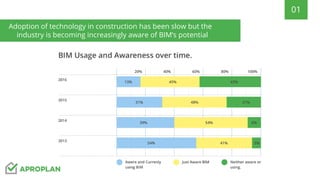
Adoption of technology in construction has been slow but the
industry is becoming increasingly aware of BIM’s potential
02
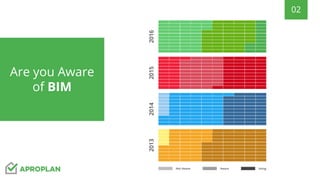
Are you Aware
of BIM
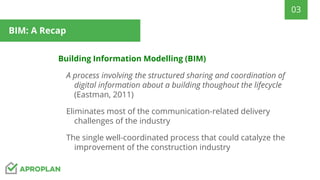
Building Information Modelling (BIM)
A process involving the structured sharing and coordination of
digital information about a building thoughout the lifecycle
(Eastman, 2011)
Eliminates most of the communication-related delivery
challenges of the industry
The single well-coordinated process that could catalyze the
improvement of the construction industry
03
BIM: A Recap
04
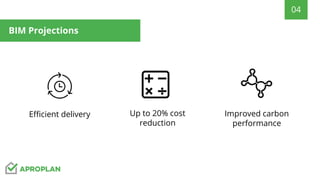
BIM Projections
Up to 20% cost
reduction
Improved carbon
performance
Efficient delivery
05
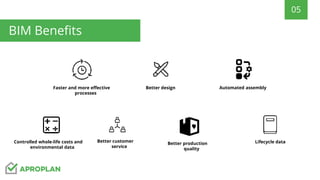
BIM Benefits
Faster and more effective
processes
Better design
Better customer
service
Controlled whole-life costs and
environmental data
Lifecycle data
Automated assembly
Better production
quality
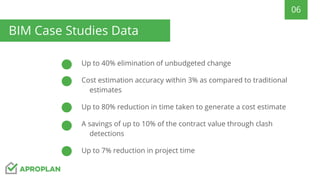
Up to 40% elimination of unbudgeted change
Cost estimation accuracy within 3% as compared to traditional
estimates
Up to 80% reduction in time taken to generate a cost estimate
A savings of up to 10% of the contract value through clash
detections
Up to 7% reduction in project time
06
BIM Case Studies Data
07
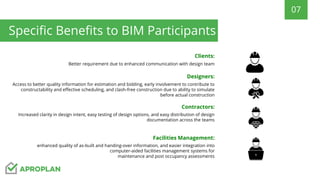
Specific Benefits to BIM Participants
Clients:
Better requirement due to enhanced communication with design team
Contractors:
Increased clarity in design intent, easy testing of design options, and easy distribution of design
documentation across the teams
Designers:
Access to better quality information for estimation and bidding, early involvement to contribute to
constructability and effective scheduling, and clash-free construction due to ability to simulate
before actual construction
Facilities Management:
enhanced quality of as-built and handing-over information, and easier integration into
computer-aided facilities management systems for
maintenance and post occupancy assessments
08
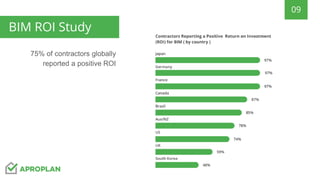
75% of contractors globally
reported a positive ROI
09
BIM ROI Study
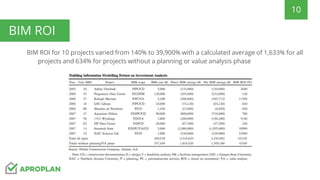
BIM ROI for 10 projects varied from 140% to 39,900% with a calculated average of 1,633% for all
projects and 634% for projects without a planning or value analysis phase
10
BIM ROI
11
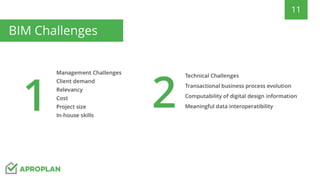
BIM Challenges
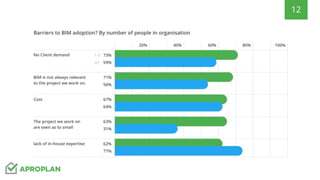
12
13
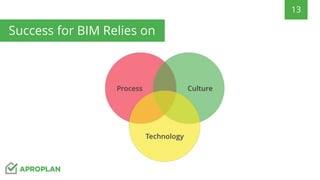
Success for BIM Relies on
THANK YOU
Thomas Goubau
CEO
www.aproplan.com www.facebook.com/
AproPLAN
www.twitter.com/
AproPLAN
www.linkedin.com/
in/thomasgoubau/

Bim challenges and potential

  • 1.
  • 2.
    01 Adoption of technologyin construction has been slow but the industry is becoming increasingly aware of BIM’s potential
  • 3.
  • 4.
    Building Information Modelling(BIM) A process involving the structured sharing and coordination of digital information about a building thoughout the lifecycle (Eastman, 2011) Eliminates most of the communication-related delivery challenges of the industry The single well-coordinated process that could catalyze the improvement of the construction industry 03 BIM: A Recap
  • 5.
    04 BIM Projections Up to20% cost reduction Improved carbon performance Efficient delivery
  • 6.
    05 BIM Benefits Faster andmore effective processes Better design Better customer service Controlled whole-life costs and environmental data Lifecycle data Automated assembly Better production quality
  • 7.
    Up to 40%elimination of unbudgeted change Cost estimation accuracy within 3% as compared to traditional estimates Up to 80% reduction in time taken to generate a cost estimate A savings of up to 10% of the contract value through clash detections Up to 7% reduction in project time 06 BIM Case Studies Data
  • 8.
    07 Specific Benefits toBIM Participants Clients: Better requirement due to enhanced communication with design team Contractors: Increased clarity in design intent, easy testing of design options, and easy distribution of design documentation across the teams Designers: Access to better quality information for estimation and bidding, early involvement to contribute to constructability and effective scheduling, and clash-free construction due to ability to simulate before actual construction Facilities Management: enhanced quality of as-built and handing-over information, and easier integration into computer-aided facilities management systems for maintenance and post occupancy assessments
  • 9.
  • 10.
    75% of contractorsglobally reported a positive ROI 09 BIM ROI Study
  • 11.
    BIM ROI for10 projects varied from 140% to 39,900% with a calculated average of 1,633% for all projects and 634% for projects without a planning or value analysis phase 10 BIM ROI
  • 12.
  • 13.
  • 14.
  • 15.
    THANK YOU Thomas Goubau CEO www.aproplan.comwww.facebook.com/ AproPLAN www.twitter.com/ AproPLAN www.linkedin.com/ in/thomasgoubau/