Building
Information
Modeling (BIM)
TRANSFORMING CONSTRUCTION AND
INFRASTRUCTURE DEVELOPMENT
TABLE OF CONTENT
 Introduction to BIM
 Key Features of BIM
 Levels of BIM
 Benefits of BIM
 Applications of BIM
 Challenges in BIM Implementation
 Future of BIM
Introduction to BIM
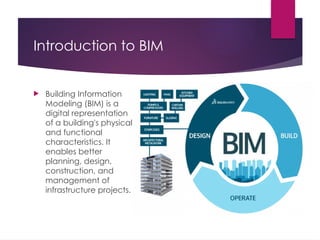
 Building Information
Modeling (BIM) is a
digital representation
of a building's physical
and functional
characteristics. It
enables better
planning, design,
construction, and
management of
infrastructure projects.
Key Features of BIM
 3D Modeling for
accurate visualization
 Real-time
collaboration among
stakeholders
 Data-driven decision-
making
 Clash detection to
avoid design conflicts
 Lifecycle
management from
design to demolition
•Early detection of problems: Conflicting elements in a building’s
design are identified during the modeling phase, preventing costly
changes during construction.
•Improvement in scheduling: Project elements can be sequenced
more efficiently using intelligent modeling, enabling the possibility
for more systematic scheduling.
•Construction automation: Tasks that can be easily automated
are identified by the software, leaving workers to focus on
specialized tasks.
•Enhanced construction processes: Workflows are automatically
generated by BIM software and any changes made during
construction automatically update the process for everyone on
site.
•Increased worker safety: Workers have direct access to specific
information about each task, leading to increased awareness of
risk and focus.
Advantages of BIM in construction
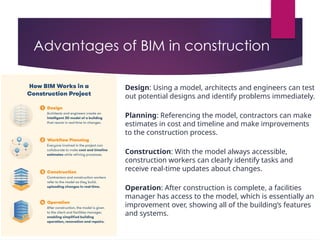
Design: Using a model, architects and engineers can test
out potential designs and identify problems immediately.
Planning: Referencing the model, contractors can make
estimates in cost and timeline and make improvements
to the construction process.
Construction: With the model always accessible,
construction workers can clearly identify tasks and
receive real-time updates about changes.
Operation: After construction is complete, a facilities
manager has access to the model, which is essentially an
improvement over, showing all of the building’s features
and systems.
Levels of BIM
 Level 0: No collaboration, basic CAD drawings
 Level 1: 2D drafting with limited 3D models
 Level 2: Collaborative BIM with shared models
 Level 3: Fully integrated BIM with cloud collaboration
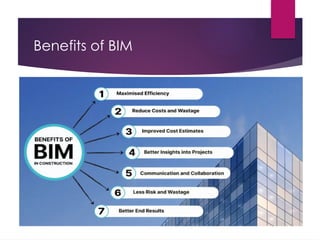
Benefits of BIM
Applications of BIM
 Architecture and structural engineering
 Infrastructure and transportation projects
 Facility management and maintenance
 Urban planning and smart cities
 Construction project management
Challenges in BIM
Implementation
 High initial investment
 Need for specialized training
 Resistance to change in traditional workflows
 Data security and interoperability concerns
 Integration with existing construction processes
Future of BIM
 AI and machine learning integration
 Cloud-based BIM for real-time collaboration
 Augmented reality (AR) and virtual reality (VR) applications
 Digital twins for real-time building monitoring
 Greater adoption in smart city planning

Building Information Modelling (BIM)....

  • 1.
  • 2.
    TABLE OF CONTENT Introduction to BIM  Key Features of BIM  Levels of BIM  Benefits of BIM  Applications of BIM  Challenges in BIM Implementation  Future of BIM
  • 3.
    Introduction to BIM Building Information Modeling (BIM) is a digital representation of a building's physical and functional characteristics. It enables better planning, design, construction, and management of infrastructure projects.
  • 4.
    Key Features ofBIM  3D Modeling for accurate visualization  Real-time collaboration among stakeholders  Data-driven decision- making  Clash detection to avoid design conflicts  Lifecycle management from design to demolition •Early detection of problems: Conflicting elements in a building’s design are identified during the modeling phase, preventing costly changes during construction. •Improvement in scheduling: Project elements can be sequenced more efficiently using intelligent modeling, enabling the possibility for more systematic scheduling. •Construction automation: Tasks that can be easily automated are identified by the software, leaving workers to focus on specialized tasks. •Enhanced construction processes: Workflows are automatically generated by BIM software and any changes made during construction automatically update the process for everyone on site. •Increased worker safety: Workers have direct access to specific information about each task, leading to increased awareness of risk and focus.
  • 5.
    Advantages of BIMin construction Design: Using a model, architects and engineers can test out potential designs and identify problems immediately. Planning: Referencing the model, contractors can make estimates in cost and timeline and make improvements to the construction process. Construction: With the model always accessible, construction workers can clearly identify tasks and receive real-time updates about changes. Operation: After construction is complete, a facilities manager has access to the model, which is essentially an improvement over, showing all of the building’s features and systems.
  • 6.
    Levels of BIM Level 0: No collaboration, basic CAD drawings  Level 1: 2D drafting with limited 3D models  Level 2: Collaborative BIM with shared models  Level 3: Fully integrated BIM with cloud collaboration
  • 7.
  • 8.
    Applications of BIM Architecture and structural engineering  Infrastructure and transportation projects  Facility management and maintenance  Urban planning and smart cities  Construction project management
  • 9.
    Challenges in BIM Implementation High initial investment  Need for specialized training  Resistance to change in traditional workflows  Data security and interoperability concerns  Integration with existing construction processes
  • 10.
    Future of BIM AI and machine learning integration  Cloud-based BIM for real-time collaboration  Augmented reality (AR) and virtual reality (VR) applications  Digital twins for real-time building monitoring  Greater adoption in smart city planning