BILIARY
APPARATUS
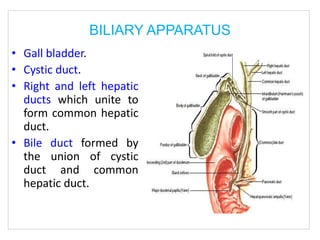
BILIARY APPARATUS
• Gall bladder.
• Cystic duct.
• Right and left hepatic
ducts which unite to
form common hepatic
duct.
• Bile duct formed by
the union of cystic
duct and common
hepatic duct.
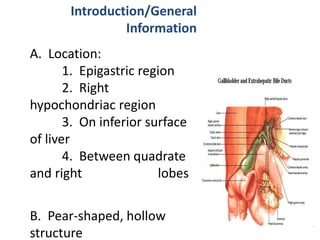
Introduction/General
Information
A. Location:
1. Epigastric region
2. Right
hypochondriac region
3. On inferior surface
of liver
4. Between quadrate
and right lobes
B. Pear-shaped, hollow
structure
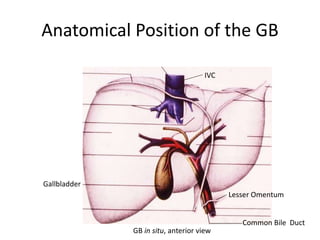
Anatomical Position of the GB
Gallbladder
IVC
Lesser Omentum
Common Bile Duct
GB in situ, anterior view
Gall Bladder
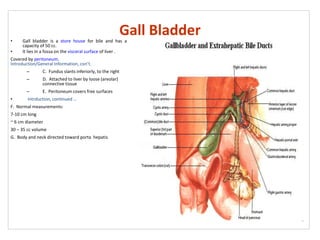
• Gall bladder is a store house for bile and has a
capacity of 50 cc.
• It lies in a fossa on the visceral surface of liver .
Covered by peritoneum.
Introduction/General Information, con’t.
– C. Fundus slants inferiorly, to the right
– D. Attached to liver by loose (areolar)
connective tissue
– E. Peritoneum covers free surfaces
• Intrduction, continued …
F. Normal measurements:
7-10 cm long
~ 6 cm diameter
30 – 35 cc volume
G. Body and neck directed toward porta hepatis
Parts of Gall Bladder
• Fundus is the blind end which projects beyond the
lower margin of the liver
• Body is the upward continuation of fundus
• Neck is the narrow part of gall bladder
• Cystic duct is the S shaped continuation of the neck
Cystic and Hepatic Ducts
• Cystic duct joins the common hepatic duct to form
the common bile duct.
Detailed anatomy, continued …
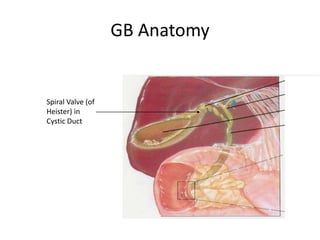
E. Neck of gallbladder
1. continuous with cystic duct
2. characterized by a spiral valve (of
Heister)
3. makes catheterization difficult
GB Anatomy
Spiral Valve (of
Heister) in
Cystic Duct
Detailed anatomy, continued …
F. Hartmann’s Pouch
1. Infundibulum of gallbladder
2. Lies between body and neck of
gallbladder
3. A normal variation
4. May obscure cystic duct
5. If very large, may see cystic duct arising
from pouch
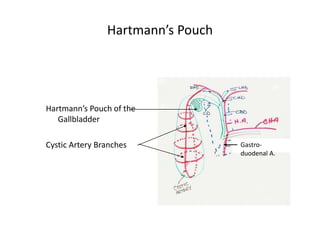
Hartmann’s Pouch
Hartmann’s Pouch of the
Gallbladder
Cystic Artery Branches Gastro-
duodenal A.
Detailed anatomy, continued …
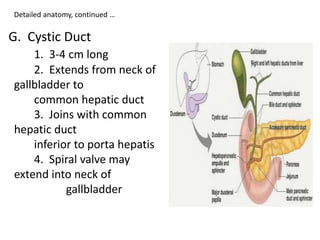
G. Cystic Duct
1. 3-4 cm long
2. Extends from neck of
gallbladder to
common hepatic duct
3. Joins with common
hepatic duct
inferior to porta hepatis
4. Spiral valve may
extend into neck of
gallbladder
Common Bile Duct
• Common bile duct is 9 cm long and has three parts.
• Supraduodenal part in the free border of lesser
omentum with hepatic artery to its left and portal
vein behind.
Common Bile Duct
• Retro duodenal part behind the first part of
duodenum.
• Pancreatic part lying in between the pancreas and
the 2nd part of duodenum.
Blood Supply
• Arterial supply is by cystic artery, a branch of the
right hepatic artery.
• Venous drainage is into the portal vein.
Lymphatic Drainage
• Lymphatics drain into cystic nodes, hepatic nodes
and coeliac nodes.
Nerve Supply
• Parasympathetic supply is by pre-ganglionic fibers
from the vagus nerve.
• Sympathetic innervation is by post-ganglionic fibers
from the coeliac plexus.
Surface Marking
• Fundus of the gall bladder - Angle between the right
costal margin and lateral border of rectus
abdominis muscle.
III. Gallbladder Diseases
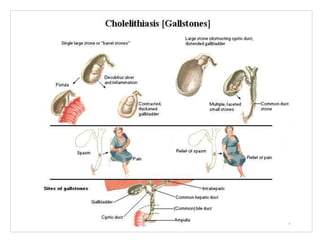
A. Cholelithiasis & Cholecystitis
1. Cholecystitis = inflammation of GB
2. Cholelithisis = Stone(s) in GB
Clinical Anatomy
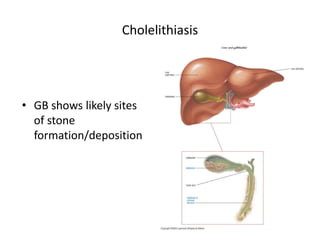
Cholelithiasis
• GB shows likely sites
of stone
formation/deposition
THANKS

BILIARY APPARATUS 2024.pptx human anatomy

  • 1.
  • 2.
    BILIARY APPARATUS • Gallbladder. • Cystic duct. • Right and left hepatic ducts which unite to form common hepatic duct. • Bile duct formed by the union of cystic duct and common hepatic duct.
  • 3.
    Introduction/General Information A. Location: 1. Epigastricregion 2. Right hypochondriac region 3. On inferior surface of liver 4. Between quadrate and right lobes B. Pear-shaped, hollow structure
  • 4.
    Anatomical Position ofthe GB Gallbladder IVC Lesser Omentum Common Bile Duct GB in situ, anterior view
  • 5.
    Gall Bladder • Gallbladder is a store house for bile and has a capacity of 50 cc. • It lies in a fossa on the visceral surface of liver . Covered by peritoneum. Introduction/General Information, con’t. – C. Fundus slants inferiorly, to the right – D. Attached to liver by loose (areolar) connective tissue – E. Peritoneum covers free surfaces • Intrduction, continued … F. Normal measurements: 7-10 cm long ~ 6 cm diameter 30 – 35 cc volume G. Body and neck directed toward porta hepatis
  • 6.
    Parts of GallBladder • Fundus is the blind end which projects beyond the lower margin of the liver • Body is the upward continuation of fundus • Neck is the narrow part of gall bladder • Cystic duct is the S shaped continuation of the neck
  • 7.
    Cystic and HepaticDucts • Cystic duct joins the common hepatic duct to form the common bile duct.
  • 8.
    Detailed anatomy, continued… E. Neck of gallbladder 1. continuous with cystic duct 2. characterized by a spiral valve (of Heister) 3. makes catheterization difficult
  • 9.
    GB Anatomy Spiral Valve(of Heister) in Cystic Duct
  • 10.
    Detailed anatomy, continued… F. Hartmann’s Pouch 1. Infundibulum of gallbladder 2. Lies between body and neck of gallbladder 3. A normal variation 4. May obscure cystic duct 5. If very large, may see cystic duct arising from pouch
  • 11.
    Hartmann’s Pouch Hartmann’s Pouchof the Gallbladder Cystic Artery Branches Gastro- duodenal A.
  • 12.
    Detailed anatomy, continued… G. Cystic Duct 1. 3-4 cm long 2. Extends from neck of gallbladder to common hepatic duct 3. Joins with common hepatic duct inferior to porta hepatis 4. Spiral valve may extend into neck of gallbladder
  • 13.
    Common Bile Duct •Common bile duct is 9 cm long and has three parts. • Supraduodenal part in the free border of lesser omentum with hepatic artery to its left and portal vein behind.
  • 14.
    Common Bile Duct •Retro duodenal part behind the first part of duodenum. • Pancreatic part lying in between the pancreas and the 2nd part of duodenum.
  • 15.
    Blood Supply • Arterialsupply is by cystic artery, a branch of the right hepatic artery. • Venous drainage is into the portal vein.
  • 16.
    Lymphatic Drainage • Lymphaticsdrain into cystic nodes, hepatic nodes and coeliac nodes.
  • 17.
    Nerve Supply • Parasympatheticsupply is by pre-ganglionic fibers from the vagus nerve. • Sympathetic innervation is by post-ganglionic fibers from the coeliac plexus.
  • 18.
    Surface Marking • Fundusof the gall bladder - Angle between the right costal margin and lateral border of rectus abdominis muscle.
  • 19.
    III. Gallbladder Diseases A.Cholelithiasis & Cholecystitis 1. Cholecystitis = inflammation of GB 2. Cholelithisis = Stone(s) in GB Clinical Anatomy
  • 20.
    Cholelithiasis • GB showslikely sites of stone formation/deposition
  • 22.