Higher Human Cell Biology
Human Cell Types
Introduction
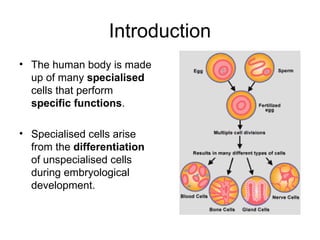
• The human body is made
up of many specialised
cells that perform
specific functions.
• Specialised cells arise
from the differentiation
of unspecialised cells
during embryological
development.
Stem cells…what do you know
already?
Use the questions below to help you complete a KWL chart to show the following
information:
K what you know already
W what you want to learn about stem cells during this unit
L complete this at the end of the unit to summarise what you have learned
Some questions to think about…
•What is a cell?
•What varieties of cell exist?
•What is a tissue? Give some examples.
•What is an organ? Give some examples.
•What is a system? Give some examples.
•What is a stem cell?
•What are some different types of stem cells?
•What is the purpose of stem cell research?
•What are some ways that stem cells have been successfully used in medicine?
•What are some of the issues in stem cell research?
•What are some of the misconceptions that people have about stem cell research?
What are stem cells?
Stem cells are unspecialised cells that have the ability to
reproduce and differentiate into a diverse range of
specialised cells.
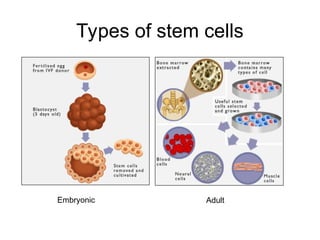
Types of stem cells
Embryonic Adult
Embryonic stem cells
• Embryonic stem cells
are derived from an
embryo about 4–5
days old (bastocyst).
• These cells have the
ability to differentiate
into all of the cell
types that make up an
organism.
Adult (tissue) stem cells
• Adult or tissue stem cells are found
in small numbers in the tissues and
organs of adults and children,
including the brain, bone marrow,
skeletal muscle and skin.
• These cells give rise to a much
more limited range of cell types
and will tend to develop into cell
types that are closely related to the
tissue in which they are found.
• These cells replenish
differentiated cells that need
replaced in the tissues in which
they are found.
Other types of stem cells
• Stem cells can also
be taken from the
umbilical cord of new
babies.
• Like adult stem cells,
these cells can
differentiate into a
limited range of
specialised cells.
Induced pluripotent stem cells
Induced pluripotent stem cells are adult cells that
have been genetically reprogrammed to an
embryonic stem cell-like state.
Somatic cells
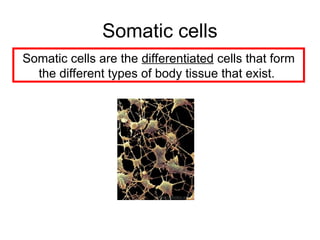
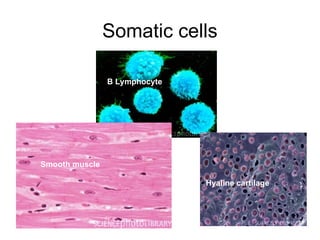
Somatic cells are the differentiated cells that form
the different types of body tissue that exist.
Somatic cells
B Lymphocyte
Hyaline cartilage
Smooth muscle
Somatic cells
Ciliated epithelial cell
Red blood cell
platelets
neutrophil
Somatic cells
Cardiac muscle
Nerve cells
Squamous epithelial
cells
T lymphocyte
Germline cells
Germline cells include the gametes and the cells that
produce the gametes.
Division of germline cells
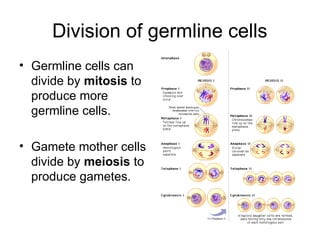
• Germline cells can
divide by mitosis to
produce more
germline cells.
• Gamete mother cells
divide by meiosis to
produce gametes.
THANK YOU

Human Cell Types Human Cell Types Human.

  • 1.
    Higher Human CellBiology Human Cell Types
  • 2.
    Introduction • The humanbody is made up of many specialised cells that perform specific functions. • Specialised cells arise from the differentiation of unspecialised cells during embryological development.
  • 3.
    Stem cells…what doyou know already? Use the questions below to help you complete a KWL chart to show the following information: K what you know already W what you want to learn about stem cells during this unit L complete this at the end of the unit to summarise what you have learned Some questions to think about… •What is a cell? •What varieties of cell exist? •What is a tissue? Give some examples. •What is an organ? Give some examples. •What is a system? Give some examples. •What is a stem cell? •What are some different types of stem cells? •What is the purpose of stem cell research? •What are some ways that stem cells have been successfully used in medicine? •What are some of the issues in stem cell research? •What are some of the misconceptions that people have about stem cell research?
  • 4.
    What are stemcells? Stem cells are unspecialised cells that have the ability to reproduce and differentiate into a diverse range of specialised cells.
  • 5.
    Types of stemcells Embryonic Adult
  • 6.
    Embryonic stem cells •Embryonic stem cells are derived from an embryo about 4–5 days old (bastocyst). • These cells have the ability to differentiate into all of the cell types that make up an organism.
  • 7.
    Adult (tissue) stemcells • Adult or tissue stem cells are found in small numbers in the tissues and organs of adults and children, including the brain, bone marrow, skeletal muscle and skin. • These cells give rise to a much more limited range of cell types and will tend to develop into cell types that are closely related to the tissue in which they are found. • These cells replenish differentiated cells that need replaced in the tissues in which they are found.
  • 8.
    Other types ofstem cells • Stem cells can also be taken from the umbilical cord of new babies. • Like adult stem cells, these cells can differentiate into a limited range of specialised cells.
  • 9.
    Induced pluripotent stemcells Induced pluripotent stem cells are adult cells that have been genetically reprogrammed to an embryonic stem cell-like state.
  • 10.
    Somatic cells Somatic cellsare the differentiated cells that form the different types of body tissue that exist.
  • 11.
    Somatic cells B Lymphocyte Hyalinecartilage Smooth muscle
  • 12.
    Somatic cells Ciliated epithelialcell Red blood cell platelets neutrophil
  • 13.
    Somatic cells Cardiac muscle Nervecells Squamous epithelial cells T lymphocyte
  • 14.
    Germline cells Germline cellsinclude the gametes and the cells that produce the gametes.
  • 15.
    Division of germlinecells • Germline cells can divide by mitosis to produce more germline cells. • Gamete mother cells divide by meiosis to produce gametes.
  • 16.

Editor's Notes

  • #2 Differentiation also occurs in later developmental stages tissue repair etc in mature adults
  • #4 Why relatively? It is either unspecialised or not
  • #10 Please see comments in Teacher notes regarding protein expression