DUOPOLY
MUHAMMED SUHAIB M
Head of the Department,
Department of Economics,
KR’s Sree Narayana College, Thozhuvanoor
Duopoly
• Duopoly is a special type of Oligopoly, where only two Producers/Sellers
exist in one market.
• There exists Non-collusive oligopoly, means Sellers are completely
independent.
• The pricing and output of one firm will affect the another and may set a
chain reaction.
• Cournot and Edgeworth ignored mutual dependence but Chamberlin
recognised the mutual dependence.
Cournot’s Duopoly Model
• This is the earliest duopoly model, Developed by French
Economist AUGUSTIN COURNOT in 1838.
• He considered only two firms and they are owing Mineral well.
• Each firm act on the assumption that its competition will not
change its output and decides its own output so as to maximise
his profit.
Major Assumptions
• They are two independent sellers.
• They produce and sell homogeneous products.
• The number of buyers is large.
• Each producer know the market demand for the product.
• Cost of production is assumed to be zero.
• Both firms have identical cost and identical demand.
Major Assumptions
• Each firm decides their own quantity of output and ignores the role of
rival.
• Consider the supply curve of the rival is constant.
• Entry of a new firm is blocked.
• Both firms are aiming maximum profit.
• Neither of them will fixes the price for its product, but each accepts
the market demand price at which the product can be sold.
Price and Output under Duopoly
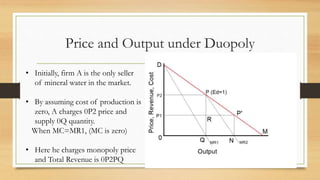
• Initially, firm A is the only seller
of mineral water in the market.
• By assuming cost of production is
zero, A charges 0P2 price and
supply 0Q quantity.
When MC=MR1, (MC is zero)
• Here he charges monopoly price
and Total Revenue is 0P2PQ
Price and Output under Duopoly
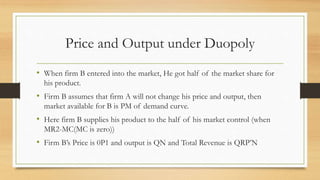
• When firm B entered into the market, He got half of the market share for
his product.
• Firm B assumes that firm A will not change his price and output, then
market available for B is PM of demand curve.
• Here firm B supplies his product to the half of his market control (when
MR2-MC(MC is zero))
• Firm B’s Price is 0P1 and output is QN and Total Revenue is QRP’N
Price and Output under Duopoly
• Here both firm A&B are supplying half of the market share they have.
• Firm B supplies only ¼ of the total market demand, (which is ½ x ½ = ¼ ).
• The low price of firm B will compel firm A to reduce the Price, the firm A will
restructure his Price and Output.
• When firm A assumes that firm will continue its production at ¼ of market
demand, the total market share available for firm B is ¾ , which is (1- ¼ = ¾ ).
• To maximise his profit (firm A), he will supply half of the total market share
available for him, (which is ½ x ¾ = 3/8 )
Price and Output under Duopoly
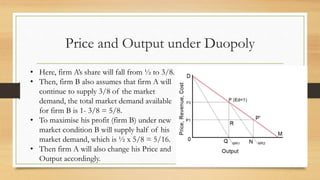
• Here, firm A’s share will fall from ½ to 3/8.
• Then, firm B also assumes that firm A will
continue to supply 3/8 of the market
demand, the total market demand available
for firm B is 1- 3/8 = 5/8.
• To maximise his profit (firm B) under new
market condition B will supply half of his
market demand, which is ½ x 5/8 = 5/16.
• Then firm A will also change his Price and
Output accordingly.
Price and Output under Duopoly
• This process of action and reaction continues in successive periods, means
firm A will loss his market share and firm B will gain till both firms get equal
share in the market.
• At the end of this process both firms will have 1/3 share of market demand.
• The final price will be greater than the competitive price and less than the
monopoly price.
• In case of industry or market 1/3 portion of demand will be unsupplied.
• In general, if there are ‘n’ firms in the industry, each will provide 1/n+1 of
the market and the industry output will be n/n+1
Criticism
• The model does not say how long the adjustment period will be.
• The costless production is unrealistic.
• This is closed model because it does not allow entry of firms.
• This is a no-learning by doing model .
• He assumed the supply of rival is fixed but here supply is repeatedly
changing.
Cournot's Duopoly model

Cournot's Duopoly model

  • 1.
    DUOPOLY MUHAMMED SUHAIB M Headof the Department, Department of Economics, KR’s Sree Narayana College, Thozhuvanoor
  • 2.
    Duopoly • Duopoly isa special type of Oligopoly, where only two Producers/Sellers exist in one market. • There exists Non-collusive oligopoly, means Sellers are completely independent. • The pricing and output of one firm will affect the another and may set a chain reaction. • Cournot and Edgeworth ignored mutual dependence but Chamberlin recognised the mutual dependence.
  • 3.
    Cournot’s Duopoly Model •This is the earliest duopoly model, Developed by French Economist AUGUSTIN COURNOT in 1838. • He considered only two firms and they are owing Mineral well. • Each firm act on the assumption that its competition will not change its output and decides its own output so as to maximise his profit.
  • 4.
    Major Assumptions • Theyare two independent sellers. • They produce and sell homogeneous products. • The number of buyers is large. • Each producer know the market demand for the product. • Cost of production is assumed to be zero. • Both firms have identical cost and identical demand.
  • 5.
    Major Assumptions • Eachfirm decides their own quantity of output and ignores the role of rival. • Consider the supply curve of the rival is constant. • Entry of a new firm is blocked. • Both firms are aiming maximum profit. • Neither of them will fixes the price for its product, but each accepts the market demand price at which the product can be sold.
  • 6.
    Price and Outputunder Duopoly • Initially, firm A is the only seller of mineral water in the market. • By assuming cost of production is zero, A charges 0P2 price and supply 0Q quantity. When MC=MR1, (MC is zero) • Here he charges monopoly price and Total Revenue is 0P2PQ
  • 7.
    Price and Outputunder Duopoly • When firm B entered into the market, He got half of the market share for his product. • Firm B assumes that firm A will not change his price and output, then market available for B is PM of demand curve. • Here firm B supplies his product to the half of his market control (when MR2-MC(MC is zero)) • Firm B’s Price is 0P1 and output is QN and Total Revenue is QRP’N
  • 8.
    Price and Outputunder Duopoly • Here both firm A&B are supplying half of the market share they have. • Firm B supplies only ¼ of the total market demand, (which is ½ x ½ = ¼ ). • The low price of firm B will compel firm A to reduce the Price, the firm A will restructure his Price and Output. • When firm A assumes that firm will continue its production at ¼ of market demand, the total market share available for firm B is ¾ , which is (1- ¼ = ¾ ). • To maximise his profit (firm A), he will supply half of the total market share available for him, (which is ½ x ¾ = 3/8 )
  • 9.
    Price and Outputunder Duopoly • Here, firm A’s share will fall from ½ to 3/8. • Then, firm B also assumes that firm A will continue to supply 3/8 of the market demand, the total market demand available for firm B is 1- 3/8 = 5/8. • To maximise his profit (firm B) under new market condition B will supply half of his market demand, which is ½ x 5/8 = 5/16. • Then firm A will also change his Price and Output accordingly.
  • 10.
    Price and Outputunder Duopoly • This process of action and reaction continues in successive periods, means firm A will loss his market share and firm B will gain till both firms get equal share in the market. • At the end of this process both firms will have 1/3 share of market demand. • The final price will be greater than the competitive price and less than the monopoly price. • In case of industry or market 1/3 portion of demand will be unsupplied. • In general, if there are ‘n’ firms in the industry, each will provide 1/n+1 of the market and the industry output will be n/n+1
  • 11.
    Criticism • The modeldoes not say how long the adjustment period will be. • The costless production is unrealistic. • This is closed model because it does not allow entry of firms. • This is a no-learning by doing model . • He assumed the supply of rival is fixed but here supply is repeatedly changing.