Monopoly
Ashin S Anish
1st MA Economics
Monopoly
• The single seller makes a
product that has no “good”
substitute.
• Other firms may be able to
produce the good or
service but choose not to
enter the market or are
barred from it.
Normal profits
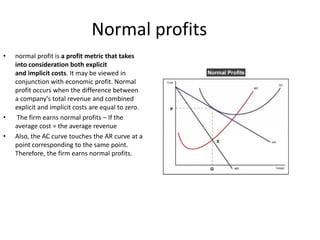
• normal profit is a profit metric that takes
into consideration both explicit
and implicit costs. It may be viewed in
conjunction with economic profit. Normal
profit occurs when the difference between
a company's total revenue and combined
explicit and implicit costs are equal to zero.
• The firm earns normal profits – If the
average cost = the average revenue
• Also, the AC curve touches the AR curve at a
point corresponding to the same point.
Therefore, the firm earns normal profits.
super-normal profits
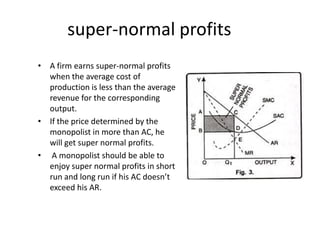
• A firm earns super-normal profits
when the average cost of
production is less than the average
revenue for the corresponding
output.
• If the price determined by the
monopolist in more than AC, he
will get super normal profits.
• A monopolist should be able to
enjoy super normal profits in short
run and long run if his AC doesn’t
exceed his AR.
super-normal profits
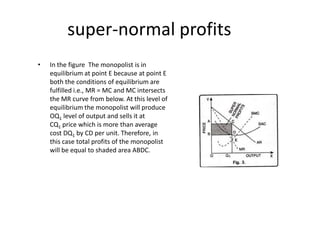
• In the figure The monopolist is in
equilibrium at point E because at point E
both the conditions of equilibrium are
fulfilled i.e., MR = MC and MC intersects
the MR curve from below. At this level of
equilibrium the monopolist will produce
OQ1 level of output and sells it at
CQ1 price which is more than average
cost DQ1 by CD per unit. Therefore, in
this case total profits of the monopolist
will be equal to shaded area ABDC.
Implications of the Monopolist’s Profit
Maximum
• Price will exceed the competitive price.
• Quantity will be less than the competitive quantity.
• The monopolist sells the output at a price greater than marginal costs
but the monopoly price can be above or below average total costs.
Thus, the monopolist need not always make a profit. In the long run,
of course, unprofitable monopolists will either stop production or
raise the price further above marginal cost until it covers average
total costs.
• The monopolist will always try to operate on the elastic portion of the
demand curve because when the elasticity of demand is greater than
-1 (inelastic, between 0 and 1 in absolute value), marginal revenue is
negative and, necessarily, less than marginal cost.
• Since there is no entry to consider monopolists can have persistent
long run economic profit.
Price Discriminating Monopolists
• A monopolist might be able to charge different prices
for different units sold and enhance its profits.
– charge different people different prices
– charge the same person different prices for different units
• price discrimination
– charging different prices for different units with no cost
basis
– charging the same price for different units when there are
cost differences
Requirements for Price Discrimination
• Some amount of monopoly power.
• An ability to prevent resale.
• Detailed information about who is buying
what unit and what demanders are willing to
pay.
First Degree Price Discrimination
• The monopolist charges the demand price for each unit
sold.
• In this case the market demand curve becomes the
monopolist’s marginal revenue curve.
• The monopolist sets MR=MC to get XFDPD.
• The monopolist charges a different price for each unit
according to the demand curve.
• Performance: XFDPD is Pareto Efficient and all the net social
surplus goes to the monopolist as producer surplus.
Consumer surplus = $0!
First Degree Price Discrimination
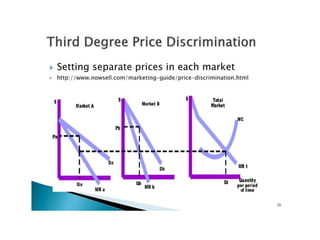
In this type of price discrimination the monopolist
segments market and then charge a different
price in each market to exploit the observation
that at the simple monopoly price the own price
elasticity of demand differs across the defined
segmented markets.
Dumping is a common example.
Third Degree Price
Discrimination
monopoly (1).pdf
monopoly (1).pdf

monopoly (1).pdf

  • 1.
  • 2.
    Monopoly • The singleseller makes a product that has no “good” substitute. • Other firms may be able to produce the good or service but choose not to enter the market or are barred from it.
  • 3.
    Normal profits • normalprofit is a profit metric that takes into consideration both explicit and implicit costs. It may be viewed in conjunction with economic profit. Normal profit occurs when the difference between a company's total revenue and combined explicit and implicit costs are equal to zero. • The firm earns normal profits – If the average cost = the average revenue • Also, the AC curve touches the AR curve at a point corresponding to the same point. Therefore, the firm earns normal profits.
  • 4.
    super-normal profits • Afirm earns super-normal profits when the average cost of production is less than the average revenue for the corresponding output. • If the price determined by the monopolist in more than AC, he will get super normal profits. • A monopolist should be able to enjoy super normal profits in short run and long run if his AC doesn’t exceed his AR.
  • 5.
    super-normal profits • Inthe figure The monopolist is in equilibrium at point E because at point E both the conditions of equilibrium are fulfilled i.e., MR = MC and MC intersects the MR curve from below. At this level of equilibrium the monopolist will produce OQ1 level of output and sells it at CQ1 price which is more than average cost DQ1 by CD per unit. Therefore, in this case total profits of the monopolist will be equal to shaded area ABDC.
  • 6.
    Implications of theMonopolist’s Profit Maximum • Price will exceed the competitive price. • Quantity will be less than the competitive quantity. • The monopolist sells the output at a price greater than marginal costs but the monopoly price can be above or below average total costs. Thus, the monopolist need not always make a profit. In the long run, of course, unprofitable monopolists will either stop production or raise the price further above marginal cost until it covers average total costs. • The monopolist will always try to operate on the elastic portion of the demand curve because when the elasticity of demand is greater than -1 (inelastic, between 0 and 1 in absolute value), marginal revenue is negative and, necessarily, less than marginal cost. • Since there is no entry to consider monopolists can have persistent long run economic profit.
  • 7.
    Price Discriminating Monopolists •A monopolist might be able to charge different prices for different units sold and enhance its profits. – charge different people different prices – charge the same person different prices for different units • price discrimination – charging different prices for different units with no cost basis – charging the same price for different units when there are cost differences
  • 8.
    Requirements for PriceDiscrimination • Some amount of monopoly power. • An ability to prevent resale. • Detailed information about who is buying what unit and what demanders are willing to pay.
  • 9.
    First Degree PriceDiscrimination • The monopolist charges the demand price for each unit sold. • In this case the market demand curve becomes the monopolist’s marginal revenue curve. • The monopolist sets MR=MC to get XFDPD. • The monopolist charges a different price for each unit according to the demand curve. • Performance: XFDPD is Pareto Efficient and all the net social surplus goes to the monopolist as producer surplus. Consumer surplus = $0!
  • 10.
    First Degree PriceDiscrimination
  • 11.
    In this typeof price discrimination the monopolist segments market and then charge a different price in each market to exploit the observation that at the simple monopoly price the own price elasticity of demand differs across the defined segmented markets. Dumping is a common example. Third Degree Price Discrimination