Bias & Confounding
ashishsinghparihar@klepharm.edu
Common Types of Variables
• Categorical variable: variables than can be put into categories. For
example, the category “Toothpaste Brands” might contain the variables
Colgate and Aqua fresh.
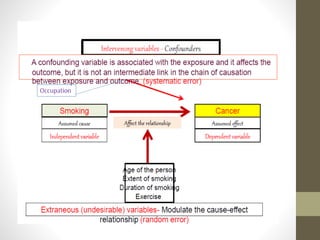
• Confounding variable: extra variables that have a hidden effect on your
experimental results.
• Continuous variable: a variable with infinite number of values, like “time”
or “weight”.
• Control variable: a factor in an experiment which must be held constant.
For example, in an experiment to determine whether light makes plants
grow faster, you would have to control for soil quality and water.
• Dependent variable: the outcome of an experiment. As you change the
independent variable, you watch what happens to the dependent
variable.
• Discrete variable: a variable that can only take on a certain number of
values. For example, “number of cars in a parking lot” is discrete because
a car park can only hold so many cars.
• Independent variable: a variable that is not affected by anything that you,
the researcher, does. Usually plotted on the x-axis.
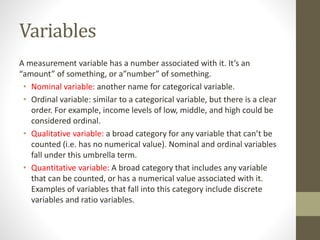
Variables
A measurement variable has a number associated with it. It’s an
“amount” of something, or a”number” of something.
• Nominal variable: another name for categorical variable.
• Ordinal variable: similar to a categorical variable, but there is a clear
order. For example, income levels of low, middle, and high could be
considered ordinal.
• Qualitative variable: a broad category for any variable that can’t be
counted (i.e. has no numerical value). Nominal and ordinal variables
fall under this umbrella term.
• Quantitative variable: A broad category that includes any variable
that can be counted, or has a numerical value associated with it.
Examples of variables that fall into this category include discrete
variables and ratio variables.
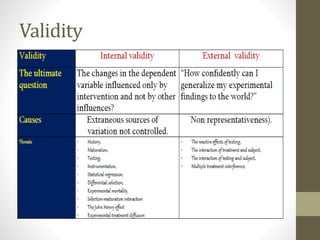
Validity
Bias in observational designs
• Bias in research denotes deviation from the truth. (when there
is systematic difference between the results from study and
the truth).
• All observational studies and badly done randomized
controlled trials have built-in bias.
The most often used classification of bias includes:
I. Selection bias,
II. Information bias,
III. Confounding.
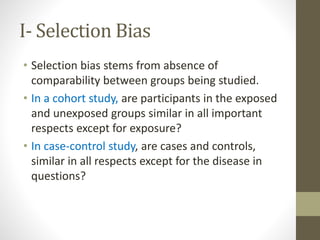
I- Selection Bias
• Selection bias stems from absence of
comparability between groups being studied.
• In a cohort study, are participants in the exposed
and unexposed groups similar in all important
respects except for exposure?
• In case-control study, are cases and controls,
similar in all respects except for the disease in
questions?
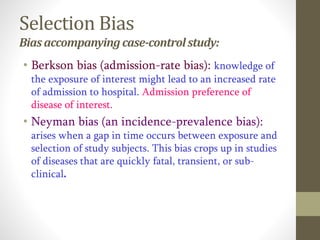
Selection Bias
Biasaccompanyingcase-controlstudy:
• Berkson bias (admission-rate bias): knowledge of
the exposure of interest might lead to an increased rate
of admission to hospital. Admission preference of
disease of interest.
• Neyman bias (an incidence-prevalence bias):
arises when a gap in time occurs between exposure and
selection of study subjects. This bias crops up in studies
of diseases that are quickly fatal, transient, or sub-
clinical.
Cont.
• Non-respondent bias: In observational studies, non-
respondents are different from respondents. Smokers
are less likely to return questionnaires than are
nonsmokers or pipe and cigar smokers.
II- Information Bias
Hastheinformationbeen gatheredin thesameway?
• Also known as observation, classification or measurement
bias, results from incorrect determination of exposure or
outcome or both.
• Information should be gathered in the same way in any
comparative study.
Sources:
• Differentials in information gathering: (bedside for cases
while using telephone for control).
• Diagnostic suspicion bias: (intensive search for HIV in drug
addicts).
• Family history bias: Medical information flows differently to
affected and non-affected family members (rheumatoid
arthritis).
Information Bias
• Recall bias: cases are motivated to search their
memories in order to identify the cause of their illness
than the healthy people.
• Observer bias: one observer consistently under or over
reports a particular variable. Meticulous observation of
those who are exposed than the non-exposed.
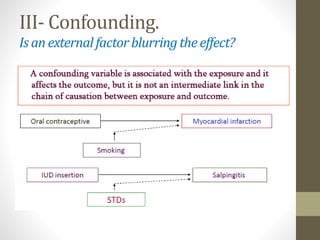
III- Confounding.
Is an externalfactor blurringthe effect?
Confounding.
 Restriction (exclusion or specification): Enrollment
with restricted selection criteria, including nonsmokers.
Matching: A pair wise matching (for every case who
smokes, a control who smokes is found).
 Stratification: Used after completion of the study.
Results can be stratified by the levels of the confounding
factor.
Multivariate analysis techniques: logistic regression,
proportional hazard regression, and others.

Bias and confounding

  • 1.
  • 2.
    Common Types ofVariables • Categorical variable: variables than can be put into categories. For example, the category “Toothpaste Brands” might contain the variables Colgate and Aqua fresh. • Confounding variable: extra variables that have a hidden effect on your experimental results. • Continuous variable: a variable with infinite number of values, like “time” or “weight”. • Control variable: a factor in an experiment which must be held constant. For example, in an experiment to determine whether light makes plants grow faster, you would have to control for soil quality and water. • Dependent variable: the outcome of an experiment. As you change the independent variable, you watch what happens to the dependent variable. • Discrete variable: a variable that can only take on a certain number of values. For example, “number of cars in a parking lot” is discrete because a car park can only hold so many cars. • Independent variable: a variable that is not affected by anything that you, the researcher, does. Usually plotted on the x-axis.
  • 3.
    Variables A measurement variablehas a number associated with it. It’s an “amount” of something, or a”number” of something. • Nominal variable: another name for categorical variable. • Ordinal variable: similar to a categorical variable, but there is a clear order. For example, income levels of low, middle, and high could be considered ordinal. • Qualitative variable: a broad category for any variable that can’t be counted (i.e. has no numerical value). Nominal and ordinal variables fall under this umbrella term. • Quantitative variable: A broad category that includes any variable that can be counted, or has a numerical value associated with it. Examples of variables that fall into this category include discrete variables and ratio variables.
  • 4.
  • 6.
    Bias in observationaldesigns • Bias in research denotes deviation from the truth. (when there is systematic difference between the results from study and the truth). • All observational studies and badly done randomized controlled trials have built-in bias. The most often used classification of bias includes: I. Selection bias, II. Information bias, III. Confounding.
  • 7.
    I- Selection Bias •Selection bias stems from absence of comparability between groups being studied. • In a cohort study, are participants in the exposed and unexposed groups similar in all important respects except for exposure? • In case-control study, are cases and controls, similar in all respects except for the disease in questions?
  • 8.
    Selection Bias Biasaccompanyingcase-controlstudy: • Berksonbias (admission-rate bias): knowledge of the exposure of interest might lead to an increased rate of admission to hospital. Admission preference of disease of interest. • Neyman bias (an incidence-prevalence bias): arises when a gap in time occurs between exposure and selection of study subjects. This bias crops up in studies of diseases that are quickly fatal, transient, or sub- clinical.
  • 9.
    Cont. • Non-respondent bias:In observational studies, non- respondents are different from respondents. Smokers are less likely to return questionnaires than are nonsmokers or pipe and cigar smokers.
  • 10.
    II- Information Bias Hastheinformationbeengatheredin thesameway? • Also known as observation, classification or measurement bias, results from incorrect determination of exposure or outcome or both. • Information should be gathered in the same way in any comparative study. Sources: • Differentials in information gathering: (bedside for cases while using telephone for control). • Diagnostic suspicion bias: (intensive search for HIV in drug addicts). • Family history bias: Medical information flows differently to affected and non-affected family members (rheumatoid arthritis).
  • 11.
    Information Bias • Recallbias: cases are motivated to search their memories in order to identify the cause of their illness than the healthy people. • Observer bias: one observer consistently under or over reports a particular variable. Meticulous observation of those who are exposed than the non-exposed.
  • 12.
    III- Confounding. Is anexternalfactor blurringthe effect?
  • 13.
    Confounding.  Restriction (exclusionor specification): Enrollment with restricted selection criteria, including nonsmokers. Matching: A pair wise matching (for every case who smokes, a control who smokes is found).  Stratification: Used after completion of the study. Results can be stratified by the levels of the confounding factor. Multivariate analysis techniques: logistic regression, proportional hazard regression, and others.