








Drugs Induced Birth
Defect
Presenter:
Ashish Singh Parihar
THE NATURE OF BIRTH DEFECTS
AND THEIR RELATION TO DRUG
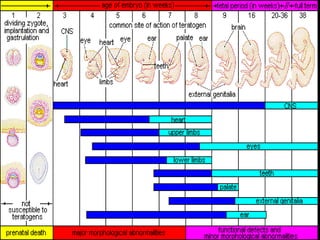
• Birth defects are part of the human condition
having been observed through out history.
• Major birth defects, typically defined as those
that are life threatening , require major surgery ,
or present a significant ability, affect appx. 3-4%
of live born infants.
• 40-90% women consume 1 drug during
pregnancy
• Antibiotics: Tetracycline
• Anticoagulants : warfarin induce hypoplasia
• NASIDS induced embryonic implantation
disturbance
• Alcohol induced fetal alcohol syndrome
• Antifungal
• Antiviral
• Vitamin A: higher dose can cause embrolithality
CLINICAL PROBLEMS TO BE
ADDRESSED BY EPIDEMIOLOGY
RESEARCH:
• teratogenesis is a critical aspect of a drugs
benefit/risk profile, and such information obviously
should be available to prescribers and consumers.
• teratogenesis raises uniquely imp. And clinical
issues.
• First , the fetus is the “ innocent bystander with respect to
its mother therapy.
• Second ,teratogenesis is not a concern limited to women
who are pregnant when drug treatment is initiated ; it
must also be a concern among women who might become
pregnant after a drug is prescribed .
DRUGS KNOWN TO BE
TERATOGENIC:
• 3 approaches applied to the few drugs known to be
teratogenic .
1. in rare instances , such as was the case for thalidomide in
most countries , the drug was prohibited from the
general market.
2. For most known teratogens , such phenytion and
valporic acid , the absolute risk to the fetus is modestly
elevated and the drug is felt to fill and imp. Clinical need.
3. The third approach involves a formal program of
physician and patient education combined , in some
cases , with restricted access to the drug. The education
component is intended to assure that physicians and
their patients are informed about drug teratogenicity
and the importance of avoiding the pregnancy.
METHODOLOGIC PROBLEMS TO
ADDRESSED BY EPIDEMIOLOGY
RESEARCH:
• serious birth defects occur in apprx, 3-4% of live
born infants , we can’t consider birth defects as a
single , homogeneous outcome.
• In fact , physical birth defects include a wide
range of malformations that vary in many ways,
including their gestational timing , embryologic
tissue of origin , and mechanism of development.
SAMPLE SIZE
CONSIDERATIONS:
• The fact that epidemiology studies must consider
rates of specific birth defects has a dramatic
effect on sample size requirements, both for
estimating risk and for providing assurances of
safety.
• With respect to risk in a population of women
taking a given drug , cohort study with sample
size of a few hundred exposed pregnancies might
be sufficient to identify a doubling of 3-4%
overall rate of birth defects.
EXPOSURE
• 2 exposure:
1. Non prescribed drugs: effects of non
prescribed drugs on the fetus are largely
unstudied
2. Recall bias: case control, Recall bias is also
substantially increased when women are asked
about use according to various indications and
it is further increased when drugs are asked by
specific names.
CURRENTLY AVAILABLE
SOLUTIONS:
• Cohort and case study designs are the favored
approaches used to generate and test hypotheses
regarding drugs and birth defects.
• The overall rarity of birth defects, and particularly
specific defects, argues for the use of the case–
control design when exposure prevalence is
sufficiently high.
• Such studies may be conducted on an ad hoc basis
or within the context of case–control surveillance.
Cohorts
• Three types of cohorts relevant to the
pharmacoepidemiologic study of birth defects
1. studies designed to follow large populations
exposed to various agents,
2. use of data sets created for other purposes,
3. follow-up studies of selected exposures.
This approach involves following a population of
pregnant women with collection of data on
exposures, outcomes, and covariates.
Case Reports
• Review of well-documented case reports can
provide useful insight into the spectrum, severity,
and natural history of an adverse drug effect, as
well as its reversibility, predictability, and
preventability.
• Understanding these factors should be a critical
component of any decision to design or
implement an research program.
• Phase IV and ad hoc Post marketing
Epidemiologic Studies
Drug induced birth defect

Drug induced birth defect

  • 1.
  • 2.
    THE NATURE OFBIRTH DEFECTS AND THEIR RELATION TO DRUG • Birth defects are part of the human condition having been observed through out history. • Major birth defects, typically defined as those that are life threatening , require major surgery , or present a significant ability, affect appx. 3-4% of live born infants. • 40-90% women consume 1 drug during pregnancy
  • 3.
    • Antibiotics: Tetracycline •Anticoagulants : warfarin induce hypoplasia • NASIDS induced embryonic implantation disturbance • Alcohol induced fetal alcohol syndrome • Antifungal • Antiviral • Vitamin A: higher dose can cause embrolithality
  • 5.
    CLINICAL PROBLEMS TOBE ADDRESSED BY EPIDEMIOLOGY RESEARCH: • teratogenesis is a critical aspect of a drugs benefit/risk profile, and such information obviously should be available to prescribers and consumers. • teratogenesis raises uniquely imp. And clinical issues. • First , the fetus is the “ innocent bystander with respect to its mother therapy. • Second ,teratogenesis is not a concern limited to women who are pregnant when drug treatment is initiated ; it must also be a concern among women who might become pregnant after a drug is prescribed .
  • 6.
    DRUGS KNOWN TOBE TERATOGENIC: • 3 approaches applied to the few drugs known to be teratogenic . 1. in rare instances , such as was the case for thalidomide in most countries , the drug was prohibited from the general market. 2. For most known teratogens , such phenytion and valporic acid , the absolute risk to the fetus is modestly elevated and the drug is felt to fill and imp. Clinical need. 3. The third approach involves a formal program of physician and patient education combined , in some cases , with restricted access to the drug. The education component is intended to assure that physicians and their patients are informed about drug teratogenicity and the importance of avoiding the pregnancy.
  • 7.
    METHODOLOGIC PROBLEMS TO ADDRESSEDBY EPIDEMIOLOGY RESEARCH: • serious birth defects occur in apprx, 3-4% of live born infants , we can’t consider birth defects as a single , homogeneous outcome. • In fact , physical birth defects include a wide range of malformations that vary in many ways, including their gestational timing , embryologic tissue of origin , and mechanism of development.
  • 8.
    SAMPLE SIZE CONSIDERATIONS: • Thefact that epidemiology studies must consider rates of specific birth defects has a dramatic effect on sample size requirements, both for estimating risk and for providing assurances of safety. • With respect to risk in a population of women taking a given drug , cohort study with sample size of a few hundred exposed pregnancies might be sufficient to identify a doubling of 3-4% overall rate of birth defects.
  • 9.
    EXPOSURE • 2 exposure: 1.Non prescribed drugs: effects of non prescribed drugs on the fetus are largely unstudied 2. Recall bias: case control, Recall bias is also substantially increased when women are asked about use according to various indications and it is further increased when drugs are asked by specific names.
  • 10.
    CURRENTLY AVAILABLE SOLUTIONS: • Cohortand case study designs are the favored approaches used to generate and test hypotheses regarding drugs and birth defects. • The overall rarity of birth defects, and particularly specific defects, argues for the use of the case– control design when exposure prevalence is sufficiently high. • Such studies may be conducted on an ad hoc basis or within the context of case–control surveillance.
  • 11.
    Cohorts • Three typesof cohorts relevant to the pharmacoepidemiologic study of birth defects 1. studies designed to follow large populations exposed to various agents, 2. use of data sets created for other purposes, 3. follow-up studies of selected exposures. This approach involves following a population of pregnant women with collection of data on exposures, outcomes, and covariates.
  • 12.
    Case Reports • Reviewof well-documented case reports can provide useful insight into the spectrum, severity, and natural history of an adverse drug effect, as well as its reversibility, predictability, and preventability. • Understanding these factors should be a critical component of any decision to design or implement an research program. • Phase IV and ad hoc Post marketing Epidemiologic Studies