INTRODUCTION
• The 13th principle in the International Council for
Harmonisation (ICH) E6 guideline states that systems
and procedures that assure the quality of every aspect of
the trial should be implemented.
• Implementing and maintaining quality assurance and
quality control systems is an important component of
quality management in research (ICH 2016).
• Auditing and monitoring of a study are part of this
quality assurance/control process
To ensure the protection of human research subjects and
data integrity.
DEFINITIONS
• Audit: "A systematic and independent
examination of trial-related activities and
documents to determine whether the
evaluated trial-related activities were
conducted, and the data were recorded,
analyzed, and accurately reported according
to the protocol, sponsor's standard
operating procedures (SOPs), Good Clinical
Practice (GCP), and the applicable
regulatory requirement(s)."
• Inspection: "The act by a regulatory
authority(ies) of conducting an official
review of documents, facilities, records, and
any other resources that are deemed by the
authority(ies) to be related to the clinical
trial and that may be located at the site of
the trial, at the sponsor's and/or contract
research organization's (CROs) facilities, or
at other establishments deemed appropriate
by the regulatory authority(ies)."
DEFINITIONS
• Monitoring: "The act of overseeing the
progress of a clinical trial, and of ensuring it
is conducted, recorded, and reported in
accordance with the protocol, standard
operating procedures (SOPs), GCP, and the
applicable regulatory requirement(s)."
DEFINITIONS
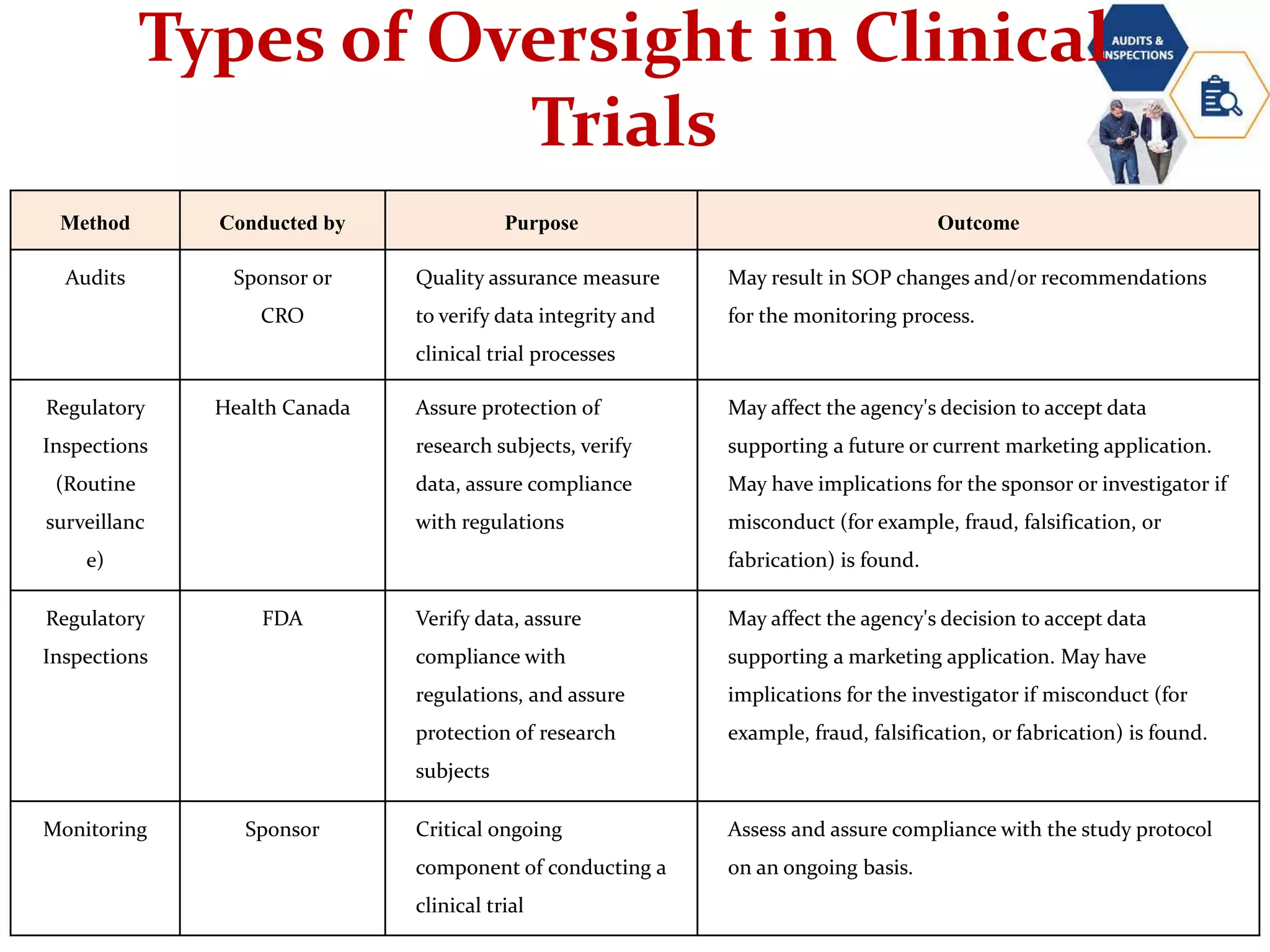
Types of Oversight in Clinical
Trials
Method Conducted by Purpose Outcome
Audits Sponsor or
CRO
Quality assurance measure
to verify data integrity and
clinical trial processes
May result in SOP changes and/or recommendations
for the monitoring process.
Regulatory
Inspections
(Routine
surveillanc
e)
Health Canada Assure protection of
research subjects, verify
data, assure compliance
with regulations
May affect the agency's decision to accept data
supporting a future or current marketing application.
May have implications for the sponsor or investigator if
misconduct (for example, fraud, falsification, or
fabrication) is found.
Regulatory
Inspections
FDA Verify data, assure
compliance with
regulations, and assure
protection of research
subjects
May affect the agency's decision to accept data
supporting a marketing application. May have
implications for the investigator if misconduct (for
example, fraud, falsification, or fabrication) is found.
Monitoring Sponsor Critical ongoing
component of conducting a
clinical trial
Assess and assure compliance with the study protocol
on an ongoing basis.
Audits and Inspections
• Regulatory agencies conduct audits and
inspections of clinical trials.
• They can be on a routine or as-needed basis.
• Inspectors will review all study records,
using ICH E6 as guides.
• During an inspection, sites must ensure
that all applicable Essential Documents are
available for review plus any extra
documents required by the sponsor, if
applicable.
• After the audit and/or inspection, agencies will
notify sites if any non-compliance has been
identified.
• The sponsor should take prompt action to secure
compliance when non-compliance with the
protocol, standard operating procedures, GCP
and/or regulatory requirements is found. If the
identified non-compliance may affect subject safety
or reliability of data, the sponsor should perform a
root cause analysis and implement corrective and
preventative actions.
• If the non-compliance is serious and continuing, the
sponsor may even terminate the trial at the site or
remove the investigator from the trial (ICH 2016).
Sponsor Audits
• ICH (2016) E6 Section 5.19 discusses sponsor
audits.
• The purpose of a sponsor's audit, which is
independent of and separate from the clinical
study monitoring function, should be
• to evaluate (as part of the sponsor's quality
assurance efforts) trial conduct and
compliance with the protocol, SOPs, GCP, and
the applicable regulatory requirements.
Part of quality assurance, sponsor audits are
conducted to:
• Demonstrate quality oversight
• Identify improvement opportunities by
focusing on root causes
• Identify potential areas of (regulatory) risks
Audit objectives include:
• Protection of human research subjects
• Ensuring data quality and integrity
• Compliance with regulations and ICH E6
Monitoring
• ICH (2016) E6 Section 5.18 states that the sponsor
should develop a systematic, prioritized, risk-based
approach to monitoring clinical trials.
• The sponsor should document its rationale for
– choosing a monitoring strategy,
– whether it is on-site,
– centralized (also called remote), or
– a combination to improve effectiveness and efficiency.
• Risk-based monitoring (RBM) is a combination of
monitoring strategies and it is a risk-adaptive approach
to monitoring utilizing technology to ensure subject
protection and data validity.
• A monitoring plan should be developed for each trial
and should be tailored to the specific human subject
protection and data integrity risks.
The Sponsor's Role
• Regulatory agencies have different requirements
for the role of the sponsor in clinical trials
• requires sponsors to conduct clinical trials
according to ICH E6
• However, the FDA regulations do not have that
requirement, but do require sponsors to monitor
the conduct of clinical trials performed under an
IND application or IDE application.
According to ICH E6, the purposes of trial
monitoring are to verify that
• The rights and well-being of human research
subjects are protected.
• The reported trial data are accurate, complete, and
verifiable from source documents.
• The conduct of the trial is in compliance with the
currently approved protocol/amendment(s), with
GCP, and with the applicable regulatory
requirement(s).
Monitoring Visits
• Monitoring of a clinical trial is an ongoing
process throughout the lifetime of the trial.
• As such, different types of monitoring visits
are performed in order to meet the
requirements of the sponsor at different
stages of the study lifecycle.
• Monitoring may be conducted on-site,
centralized, or a combination of both.
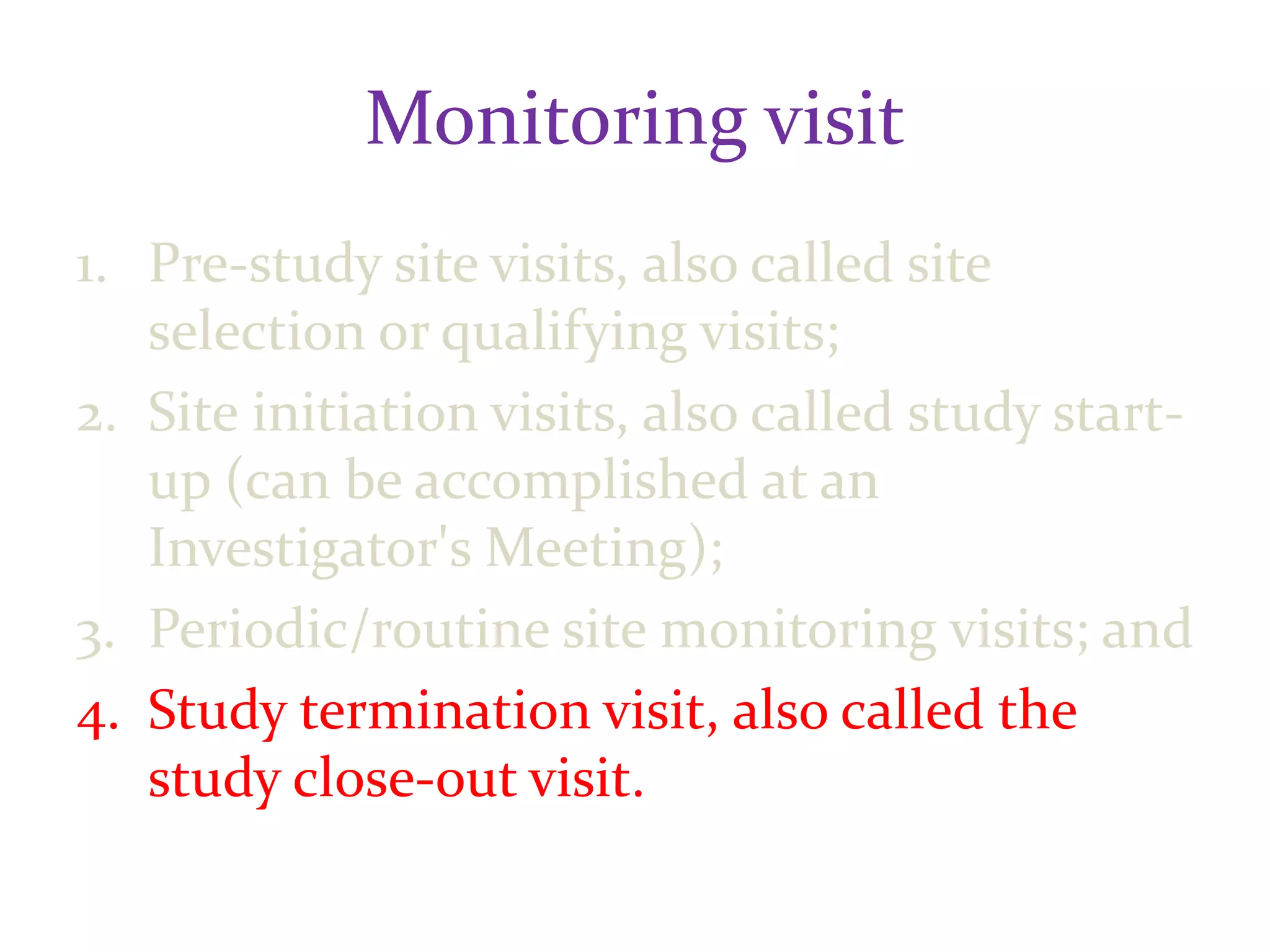
In general, four types of monitoring visits are
conducted:
1. Pre-study site visits, also called site
selection or qualifying visits;
2. Site initiation visits, also called study start-
up (can be accomplished at an
Investigator's Meeting);
3. Periodic/routine site monitoring visits; and
4. Study termination visit, also called the
study close-out visit.
Monitoring visits
1. Pre-study site visits, also called site
selection or qualifying visits;
2. Site initiation visits, also called study start-
up (can be accomplished at an
Investigator's Meeting);
3. Periodic/routine site monitoring visits; and
4. Study termination visit, also called the
study close-out visit.
Monitoring visits
The Pre study/Qualification Site
Visit
• Pre study/qualification visits are performed by the
sponsor in order to determine which sites will be
chosen to participate in the study.
• These visits usually involve sending the study
monitor out to visit the research team at the site and
to review their facilities.
The objectives of the visit are to:
– Assess an investigator's interest in conducting the study
– Evaluate the facility and the staff, determining whether
they have the capacity and expertise to successfully
conduct the trial; and
– Determine whether they will be able to meet
recruitment goals.
• After providing a brief overview of the
study, the monitor will often speak with
individual team members and take a tour of
the facilities.
• The site investigator should ensure that the
monitor has access to the appropriate
facilities during their visit (for example,
examination areas, pharmacy storage,
wards).
• At the conclusion of the visit, the monitor will
create a report and provide it to the sponsor.
• This report will outline their findings, and may
also include the monitor's recommendation
regarding whether or not the site should
participate in the study.
• The final decision is made by the sponsor, who
then communicates its decision to the site via
the monitor.
Monitoring visit
1. Pre-study site visits, also called site
selection or qualifying visits;
2. Site initiation visits, also called study start-
up (can be accomplished at an
Investigator's Meeting);
3. Periodic/routine site monitoring visits; and
4. Study termination visit, also called the
study close-out visit.
Site initiation visits (SIV)
After selecting an investigator and site, the sponsor
proceeds with study initiation.
• Site initiation can be done during a site visit (on-site or
remote), at an Investigators' Meeting, or both.
• The primary objective of a site initiation visit is to train
the investigator and study team to conduct the trial
according to protocol requirements.
• Often, site initiation is the final step needed for the
sponsor to activate the site –
– the investigator should ensure that all research staff are
present for this visit.
Training of study staff during SIV
• Training can include information about study-
– specific procedures,
– a detailed review of the study protocol,
– instruction on completion of case report forms (CRFs),
– informing the site about drug/device accountability procedures,
and
– discussion of the regulatory requirements of the investigator.
• A review may be conducted of any regulatory documents
generated to date, such as CVs, U.S. Form FDA 1572, where
applicable.
• If the study drug/device has arrived on site, the monitor may
conduct an inventory of the product to ensure it is intact and
the product received matches the shipping invoice.
1. Pre-study site visits, also called site
selection or qualifying visits;
2. Site initiation visits, also called study start-
up (can be accomplished at an
Investigator's Meeting);
3. Periodic/routine site monitoring visits;
4. Study termination visit, also called the
study close-out visit.
Monitoring visit
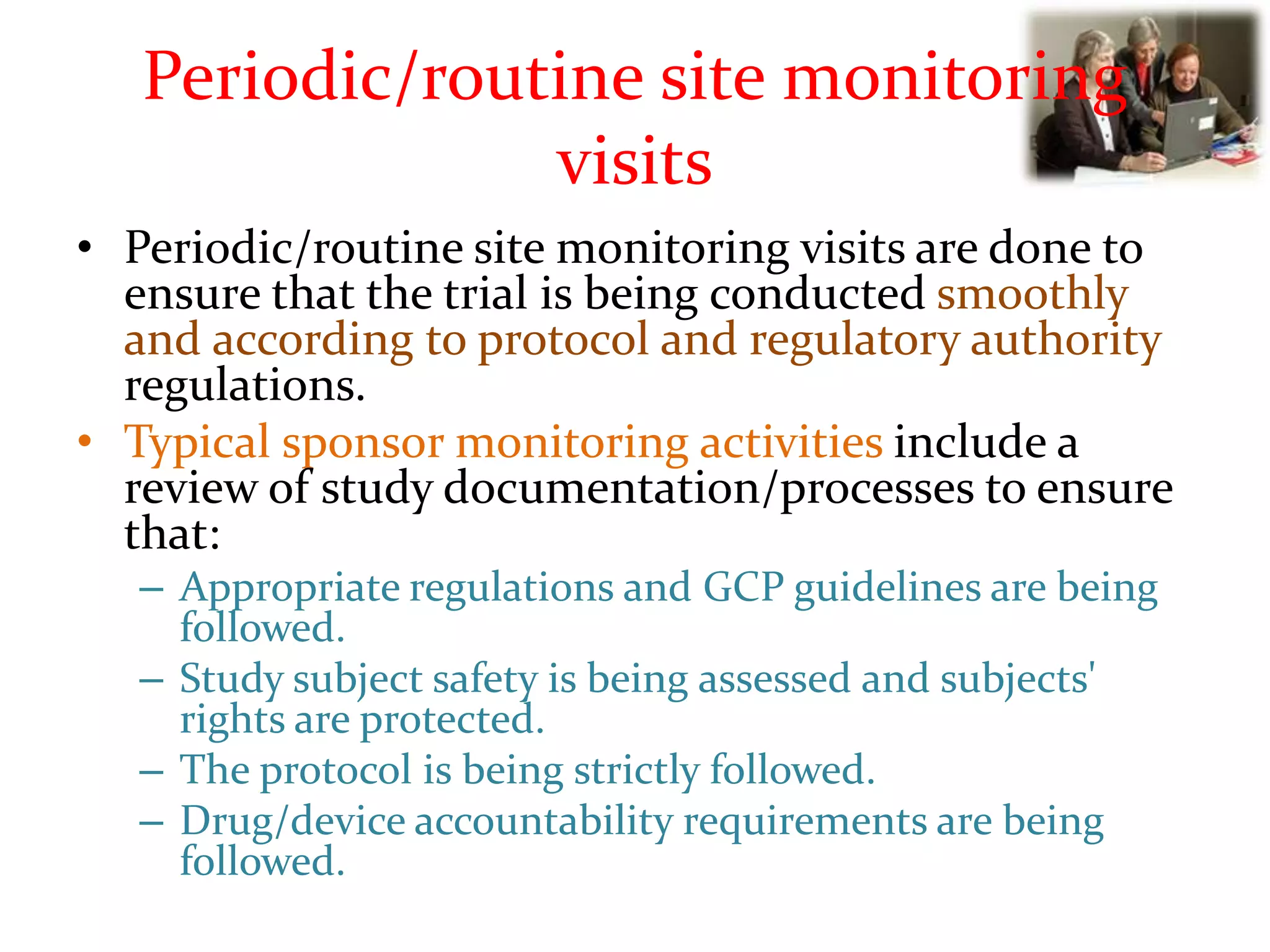
Periodic/routine site monitoring
visits
• Periodic/routine site monitoring visits are done to
ensure that the trial is being conducted smoothly
and according to protocol and regulatory authority
regulations.
• Typical sponsor monitoring activities include a
review of study documentation/processes to ensure
that:
– Appropriate regulations and GCP guidelines are being
followed.
– Study subject safety is being assessed and subjects'
rights are protected.
– The protocol is being strictly followed.
– Drug/device accountability requirements are being
followed.
• CRF data are being entered accurately (verifying against source records, such
as medical records, clinic notes, laboratory results).
• Each research subject has signed the informed consent form (ICF) before
screening.
• Protocol deviations/violations are identified, recorded, and discussed.
• Subject accrual rate is adequate.
• Subjects are compliant with study requirements (that is, taking the study drug
as per protocol).
• Changes in study personnel are documented and verification that replacement
personnel are qualified and well-trained.
• Facilities remain adequate.
• Research Ethics Board (REB) / Institutional Review Board (IRB) /
Independent Ethics Committee (IEC) requirements are being met.
• Serious Adverse Events (SAEs) are being captured and reported appropriately.
• The monitor, with the investigator and site staff, should
identify the best way to address concerns and resolve
any study-related findings.
• The monitor should meet with the investigator briefly to
discuss the findings of the visit, if possible. Any
discrepancies identified should be resolved by the study
team in a timely manner.
Helpful Tip
Depending on what is outlined in the Study Monitoring
Plan, periodic/routine monitoring visits may also be
performed remotely. A combination of both on-site and
remote monitoring is becoming more widely used, as this
combination allows for a more flexible monitoring schedule
between the sponsor and the site. It is important to discuss
the monitoring plan beforehand.
1. Pre-study site visits, also called site
selection or qualifying visits;
2. Site initiation visits, also called study start-
up (can be accomplished at an
Investigator's Meeting);
3. Periodic/routine site monitoring visits; and
4. Study termination visit, also called the
study close-out visit.
Monitoring visit
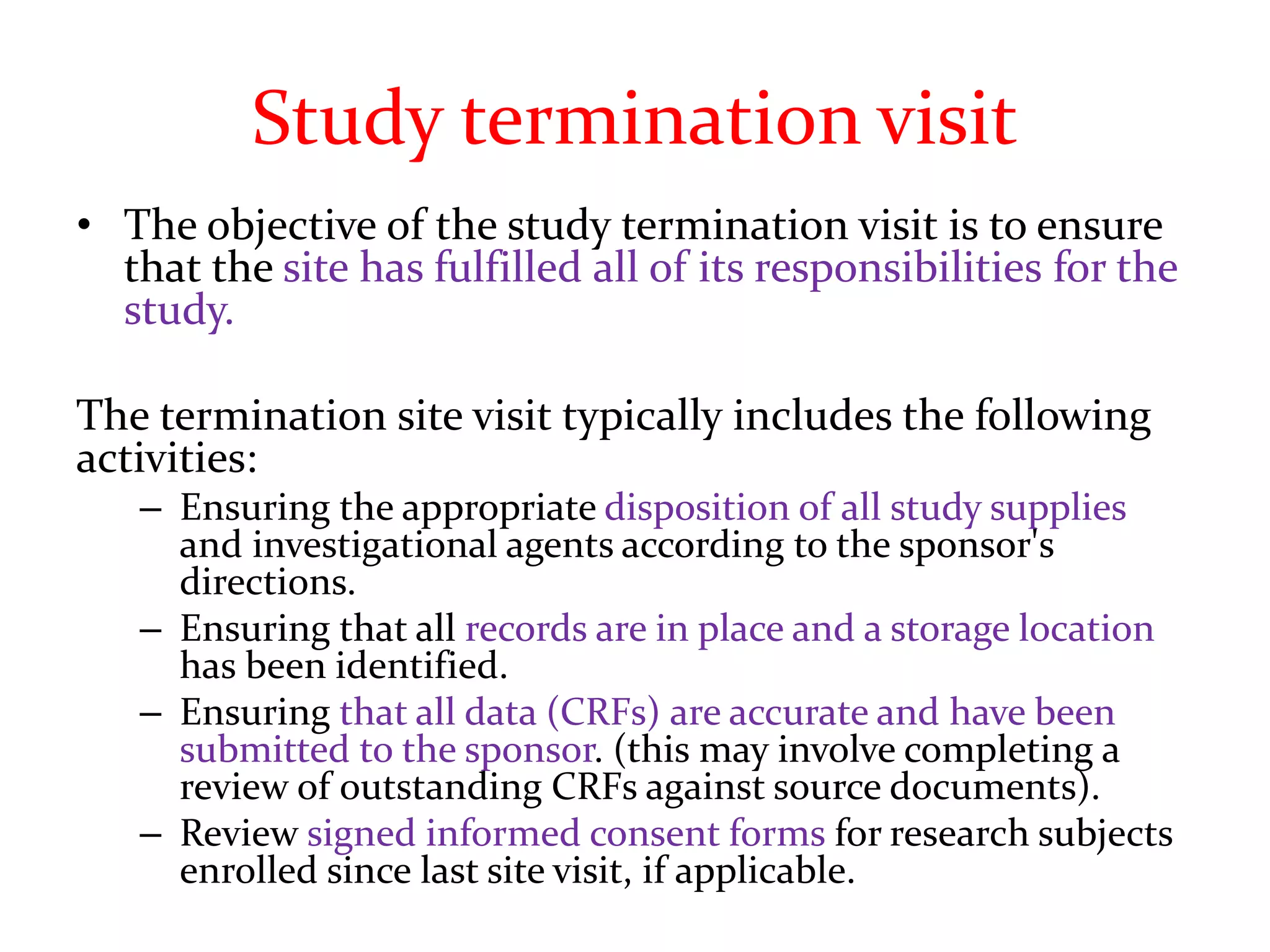
Study termination visit
• The objective of the study termination visit is to ensure
that the site has fulfilled all of its responsibilities for the
study.
The termination site visit typically includes the following
activities:
– Ensuring the appropriate disposition of all study supplies
and investigational agents according to the sponsor's
directions.
– Ensuring that all records are in place and a storage location
has been identified.
– Ensuring that all data (CRFs) are accurate and have been
submitted to the sponsor. (this may involve completing a
review of outstanding CRFs against source documents).
– Review signed informed consent forms for research subjects
enrolled since last site visit, if applicable.
Monitoring Report
• A monitoring report includes a summary of
the monitoring activities including
– what was reviewed at or from the site and
– any significant findings/facts,
– deviations and deficiencies,
– conclusions and any actions taken or requiring
action.
• These reports are provided to the sponsor in a
timely manner and should provide detailed
documentation to ensure compliance with the
monitoring plan.
Monitoring Plan
• The scope and content of a monitoring
plan, as determined by the sponsor or
sponsor-investigator, should be tailored to
the specific human subject protections and
data integrity risks of the protocol.
• The monitoring plan is based on the risk
assessment to facilitate compliance and
ensure subject protection and data integrity
and should include:
• Monitoring strategy
• Monitoring responsibilities of all parties involved
• Monitoring methods being used (on-site, remote or
combination of methods), including rationale for their
use
• Defining what are the critical data and processes to be
monitored, especially those processes that are not
routine clinical practices that may require additional
training
• The monitoring plan should be updated throughout the
study as new risks are identified or when the protocol is
amended.
Summary
• Audit/inspection programs and monitoring
activities are part of quality systems that
help to ensure that a study is GCP
compliant and adherent to applicable
regulations and institutional requirements.
Having these quality systems in place leads
to high quality clinical trials, which are
crucial in today's competitive research
environment.
References
• Health Canada (English). 2017. "Food and
Drug Regulations (C.R.C., c. 870)." Accessed
October 5, 2017.
• International Council on Harmonisation of
Technical Requirements for Registration of
Pharmaceuticals for Human Use (ICH). 2016.
• Office for Human Research Protections
(OHRP). 2015. "Office for Human Research
Protections (OHRP)." Accessed February 19.
Audit, inspection and monitoring in clinical trial by Ashish singh parihar

Audit, inspection and monitoring in clinical trial by Ashish singh parihar

  • 2.
    INTRODUCTION • The 13thprinciple in the International Council for Harmonisation (ICH) E6 guideline states that systems and procedures that assure the quality of every aspect of the trial should be implemented. • Implementing and maintaining quality assurance and quality control systems is an important component of quality management in research (ICH 2016). • Auditing and monitoring of a study are part of this quality assurance/control process To ensure the protection of human research subjects and data integrity.
  • 3.
    DEFINITIONS • Audit: "Asystematic and independent examination of trial-related activities and documents to determine whether the evaluated trial-related activities were conducted, and the data were recorded, analyzed, and accurately reported according to the protocol, sponsor's standard operating procedures (SOPs), Good Clinical Practice (GCP), and the applicable regulatory requirement(s)."
  • 4.
    • Inspection: "Theact by a regulatory authority(ies) of conducting an official review of documents, facilities, records, and any other resources that are deemed by the authority(ies) to be related to the clinical trial and that may be located at the site of the trial, at the sponsor's and/or contract research organization's (CROs) facilities, or at other establishments deemed appropriate by the regulatory authority(ies)." DEFINITIONS
  • 5.
    • Monitoring: "Theact of overseeing the progress of a clinical trial, and of ensuring it is conducted, recorded, and reported in accordance with the protocol, standard operating procedures (SOPs), GCP, and the applicable regulatory requirement(s)." DEFINITIONS
  • 6.
    Types of Oversightin Clinical Trials Method Conducted by Purpose Outcome Audits Sponsor or CRO Quality assurance measure to verify data integrity and clinical trial processes May result in SOP changes and/or recommendations for the monitoring process. Regulatory Inspections (Routine surveillanc e) Health Canada Assure protection of research subjects, verify data, assure compliance with regulations May affect the agency's decision to accept data supporting a future or current marketing application. May have implications for the sponsor or investigator if misconduct (for example, fraud, falsification, or fabrication) is found. Regulatory Inspections FDA Verify data, assure compliance with regulations, and assure protection of research subjects May affect the agency's decision to accept data supporting a marketing application. May have implications for the investigator if misconduct (for example, fraud, falsification, or fabrication) is found. Monitoring Sponsor Critical ongoing component of conducting a clinical trial Assess and assure compliance with the study protocol on an ongoing basis.
  • 7.
    Audits and Inspections •Regulatory agencies conduct audits and inspections of clinical trials. • They can be on a routine or as-needed basis. • Inspectors will review all study records, using ICH E6 as guides. • During an inspection, sites must ensure that all applicable Essential Documents are available for review plus any extra documents required by the sponsor, if applicable.
  • 8.
    • After theaudit and/or inspection, agencies will notify sites if any non-compliance has been identified. • The sponsor should take prompt action to secure compliance when non-compliance with the protocol, standard operating procedures, GCP and/or regulatory requirements is found. If the identified non-compliance may affect subject safety or reliability of data, the sponsor should perform a root cause analysis and implement corrective and preventative actions. • If the non-compliance is serious and continuing, the sponsor may even terminate the trial at the site or remove the investigator from the trial (ICH 2016).
  • 9.
    Sponsor Audits • ICH(2016) E6 Section 5.19 discusses sponsor audits. • The purpose of a sponsor's audit, which is independent of and separate from the clinical study monitoring function, should be • to evaluate (as part of the sponsor's quality assurance efforts) trial conduct and compliance with the protocol, SOPs, GCP, and the applicable regulatory requirements.
  • 10.
    Part of qualityassurance, sponsor audits are conducted to: • Demonstrate quality oversight • Identify improvement opportunities by focusing on root causes • Identify potential areas of (regulatory) risks Audit objectives include: • Protection of human research subjects • Ensuring data quality and integrity • Compliance with regulations and ICH E6
  • 11.
    Monitoring • ICH (2016)E6 Section 5.18 states that the sponsor should develop a systematic, prioritized, risk-based approach to monitoring clinical trials. • The sponsor should document its rationale for – choosing a monitoring strategy, – whether it is on-site, – centralized (also called remote), or – a combination to improve effectiveness and efficiency. • Risk-based monitoring (RBM) is a combination of monitoring strategies and it is a risk-adaptive approach to monitoring utilizing technology to ensure subject protection and data validity. • A monitoring plan should be developed for each trial and should be tailored to the specific human subject protection and data integrity risks.
  • 12.
    The Sponsor's Role •Regulatory agencies have different requirements for the role of the sponsor in clinical trials • requires sponsors to conduct clinical trials according to ICH E6 • However, the FDA regulations do not have that requirement, but do require sponsors to monitor the conduct of clinical trials performed under an IND application or IDE application.
  • 13.
    According to ICHE6, the purposes of trial monitoring are to verify that • The rights and well-being of human research subjects are protected. • The reported trial data are accurate, complete, and verifiable from source documents. • The conduct of the trial is in compliance with the currently approved protocol/amendment(s), with GCP, and with the applicable regulatory requirement(s).
  • 14.
    Monitoring Visits • Monitoringof a clinical trial is an ongoing process throughout the lifetime of the trial. • As such, different types of monitoring visits are performed in order to meet the requirements of the sponsor at different stages of the study lifecycle. • Monitoring may be conducted on-site, centralized, or a combination of both.
  • 15.
    In general, fourtypes of monitoring visits are conducted: 1. Pre-study site visits, also called site selection or qualifying visits; 2. Site initiation visits, also called study start- up (can be accomplished at an Investigator's Meeting); 3. Periodic/routine site monitoring visits; and 4. Study termination visit, also called the study close-out visit. Monitoring visits
  • 16.
    1. Pre-study sitevisits, also called site selection or qualifying visits; 2. Site initiation visits, also called study start- up (can be accomplished at an Investigator's Meeting); 3. Periodic/routine site monitoring visits; and 4. Study termination visit, also called the study close-out visit. Monitoring visits
  • 17.
    The Pre study/QualificationSite Visit • Pre study/qualification visits are performed by the sponsor in order to determine which sites will be chosen to participate in the study. • These visits usually involve sending the study monitor out to visit the research team at the site and to review their facilities. The objectives of the visit are to: – Assess an investigator's interest in conducting the study – Evaluate the facility and the staff, determining whether they have the capacity and expertise to successfully conduct the trial; and – Determine whether they will be able to meet recruitment goals.
  • 18.
    • After providinga brief overview of the study, the monitor will often speak with individual team members and take a tour of the facilities. • The site investigator should ensure that the monitor has access to the appropriate facilities during their visit (for example, examination areas, pharmacy storage, wards).
  • 19.
    • At theconclusion of the visit, the monitor will create a report and provide it to the sponsor. • This report will outline their findings, and may also include the monitor's recommendation regarding whether or not the site should participate in the study. • The final decision is made by the sponsor, who then communicates its decision to the site via the monitor.
  • 20.
    Monitoring visit 1. Pre-studysite visits, also called site selection or qualifying visits; 2. Site initiation visits, also called study start- up (can be accomplished at an Investigator's Meeting); 3. Periodic/routine site monitoring visits; and 4. Study termination visit, also called the study close-out visit.
  • 21.
    Site initiation visits(SIV) After selecting an investigator and site, the sponsor proceeds with study initiation. • Site initiation can be done during a site visit (on-site or remote), at an Investigators' Meeting, or both. • The primary objective of a site initiation visit is to train the investigator and study team to conduct the trial according to protocol requirements. • Often, site initiation is the final step needed for the sponsor to activate the site – – the investigator should ensure that all research staff are present for this visit.
  • 22.
    Training of studystaff during SIV • Training can include information about study- – specific procedures, – a detailed review of the study protocol, – instruction on completion of case report forms (CRFs), – informing the site about drug/device accountability procedures, and – discussion of the regulatory requirements of the investigator. • A review may be conducted of any regulatory documents generated to date, such as CVs, U.S. Form FDA 1572, where applicable. • If the study drug/device has arrived on site, the monitor may conduct an inventory of the product to ensure it is intact and the product received matches the shipping invoice.
  • 23.
    1. Pre-study sitevisits, also called site selection or qualifying visits; 2. Site initiation visits, also called study start- up (can be accomplished at an Investigator's Meeting); 3. Periodic/routine site monitoring visits; 4. Study termination visit, also called the study close-out visit. Monitoring visit
  • 24.
    Periodic/routine site monitoring visits •Periodic/routine site monitoring visits are done to ensure that the trial is being conducted smoothly and according to protocol and regulatory authority regulations. • Typical sponsor monitoring activities include a review of study documentation/processes to ensure that: – Appropriate regulations and GCP guidelines are being followed. – Study subject safety is being assessed and subjects' rights are protected. – The protocol is being strictly followed. – Drug/device accountability requirements are being followed.
  • 25.
    • CRF dataare being entered accurately (verifying against source records, such as medical records, clinic notes, laboratory results). • Each research subject has signed the informed consent form (ICF) before screening. • Protocol deviations/violations are identified, recorded, and discussed. • Subject accrual rate is adequate. • Subjects are compliant with study requirements (that is, taking the study drug as per protocol). • Changes in study personnel are documented and verification that replacement personnel are qualified and well-trained. • Facilities remain adequate. • Research Ethics Board (REB) / Institutional Review Board (IRB) / Independent Ethics Committee (IEC) requirements are being met. • Serious Adverse Events (SAEs) are being captured and reported appropriately.
  • 26.
    • The monitor,with the investigator and site staff, should identify the best way to address concerns and resolve any study-related findings. • The monitor should meet with the investigator briefly to discuss the findings of the visit, if possible. Any discrepancies identified should be resolved by the study team in a timely manner. Helpful Tip Depending on what is outlined in the Study Monitoring Plan, periodic/routine monitoring visits may also be performed remotely. A combination of both on-site and remote monitoring is becoming more widely used, as this combination allows for a more flexible monitoring schedule between the sponsor and the site. It is important to discuss the monitoring plan beforehand.
  • 27.
    1. Pre-study sitevisits, also called site selection or qualifying visits; 2. Site initiation visits, also called study start- up (can be accomplished at an Investigator's Meeting); 3. Periodic/routine site monitoring visits; and 4. Study termination visit, also called the study close-out visit. Monitoring visit
  • 28.
    Study termination visit •The objective of the study termination visit is to ensure that the site has fulfilled all of its responsibilities for the study. The termination site visit typically includes the following activities: – Ensuring the appropriate disposition of all study supplies and investigational agents according to the sponsor's directions. – Ensuring that all records are in place and a storage location has been identified. – Ensuring that all data (CRFs) are accurate and have been submitted to the sponsor. (this may involve completing a review of outstanding CRFs against source documents). – Review signed informed consent forms for research subjects enrolled since last site visit, if applicable.
  • 29.
    Monitoring Report • Amonitoring report includes a summary of the monitoring activities including – what was reviewed at or from the site and – any significant findings/facts, – deviations and deficiencies, – conclusions and any actions taken or requiring action. • These reports are provided to the sponsor in a timely manner and should provide detailed documentation to ensure compliance with the monitoring plan.
  • 30.
    Monitoring Plan • Thescope and content of a monitoring plan, as determined by the sponsor or sponsor-investigator, should be tailored to the specific human subject protections and data integrity risks of the protocol. • The monitoring plan is based on the risk assessment to facilitate compliance and ensure subject protection and data integrity and should include:
  • 31.
    • Monitoring strategy •Monitoring responsibilities of all parties involved • Monitoring methods being used (on-site, remote or combination of methods), including rationale for their use • Defining what are the critical data and processes to be monitored, especially those processes that are not routine clinical practices that may require additional training • The monitoring plan should be updated throughout the study as new risks are identified or when the protocol is amended.
  • 32.
    Summary • Audit/inspection programsand monitoring activities are part of quality systems that help to ensure that a study is GCP compliant and adherent to applicable regulations and institutional requirements. Having these quality systems in place leads to high quality clinical trials, which are crucial in today's competitive research environment.
  • 33.
    References • Health Canada(English). 2017. "Food and Drug Regulations (C.R.C., c. 870)." Accessed October 5, 2017. • International Council on Harmonisation of Technical Requirements for Registration of Pharmaceuticals for Human Use (ICH). 2016. • Office for Human Research Protections (OHRP). 2015. "Office for Human Research Protections (OHRP)." Accessed February 19.