SARVESH KUMAR V. ATAL
2016
Meta-analysis
“If only we knew what we know…”
-Caria O’ Dell and Jack Grayson
“Anything you can do, I can do meta“
“Meta-Analysis, Shmeta-Analysis.”
-Shapiro 1994
What is a meta-analysis?
 An analysis of analyses: A set of methods to systematically and
reproducibly search, sample and (statistically) synthesize evidence
from studies.
What is a meta-analysis?
“To do science is to search for repeated patterns, not simply to accumulate
facts.”
-Robert McAuthur
“Meta-analysis has become an important tool in ecology for generalizing
trends across studies and revealing overall patterns, even when single
studies are too small or cover too narrow a range of conditions to detect an
effect”
-Stein et al. 2014
Why should we do meta-analyses?
1. Repetition: Many studies address the same or very similar issues and some collect similar
data to look at different things.
• Meta-analyses can quantitatively combine information from many studies that examine
the same question
2. Meta-analyses increases statistical power and reduce the rates of type II errors (but could
potentially increase type I errors relative – publication bias)
3. Can elucidate general patterns and associations that are not readily visible from one study
The Transylvania Effect:
Some studies showed abnormal human behavior and
psychiatric hospital admissions increased during full
moons
Aspirin and heart attacks
• 1984, 1994, 2000
Stein et al. 2014
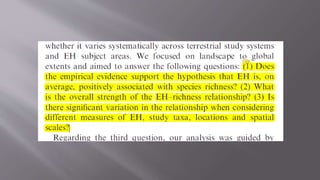
“Environmental heterogeneity as a universal driver
of species richness across taxa, biomes and spatial
scales”
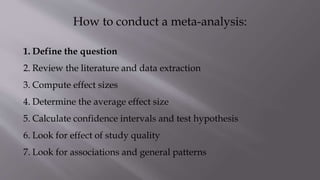
How to conduct a meta-analysis:
1. Define the question
2. Review the literature and data extraction
3. Compute effect sizes
4. Determine the average effect size
5. Calculate confidence intervals and test hypothesis
6. Look for effect of study quality
7. Look for associations and general patterns
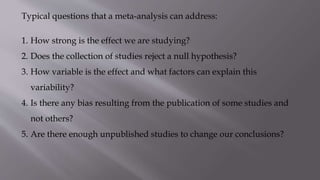
Typical questions that a meta-analysis can address:
1. How strong is the effect we are studying?
2. Does the collection of studies reject a null hypothesis?
3. How variable is the effect and what factors can explain this
variability?
4. Is there any bias resulting from the publication of some studies and
not others?
5. Are there enough unpublished studies to change our conclusions?
Size matters: How broad is your question?
• Homogeneous vs Heterogeneous studies/data sets?
-Specific tests exist to determine what data you have and which
model you should use (woolf test)
• Fixed vs Random effect models
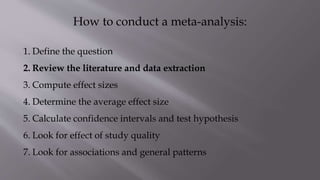
How to conduct a meta-analysis:
1. Define the question
2. Review the literature and data extraction
3. Compute effect sizes
4. Determine the average effect size
5. Calculate confidence intervals and test hypothesis
6. Look for effect of study quality
7. Look for associations and general patterns
Include all relevant studies without bias.
 Most difficult part of a meta-analysis
• Data can be hard to obtain
• Leads to what is called publication bias a.k.a
the “file-drawer problem”
• Data inequality
• a priori standards
• Weighted studies
• Depends on question
How to conduct a meta-analysis:
1. Define the question
2. Review the literature and data extraction
3. Compute effect sizes
4. Determine the average effect size
5. Calculate confidence intervals and test hypothesis
6. Look for effect of study quality
7. Look for associations and general patterns
Effect Size
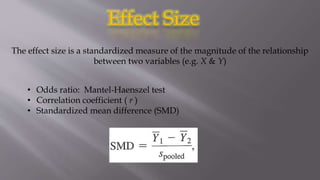
The effect size is a standardized measure of the magnitude of the relationship
between two variables (e.g. X & Y)
• Odds ratio: Mantel-Haenszel test
• Correlation coefficient ( r )
• Standardized mean difference (SMD)
How to conduct a meta-analysis:
1. Define the question
2. Review the literature and data extraction
3. Compute effect sizes
4. Determine the average effect size
5. Calculate confidence intervals and test hypothesis
6. Look for effect of study quality
7. Look for associations and general patterns
• Weigh studies by quality/sample size and
calculate the weighted average
• Calculate confidence intervals and test the
hypothesis for your models
• Depends on type of model and effect size
• It is crucial that these results are interpreted in
the context of the studies used to calculate
them
How to conduct a meta-analysis:
1. Define the question
2. Review the literature and data extraction
3. Compute effect sizes
4. Determine the average effect size
5. Calculate confidence intervals and test hypothesis
6. Look for effect of study quality
7. Look for associations and general patterns
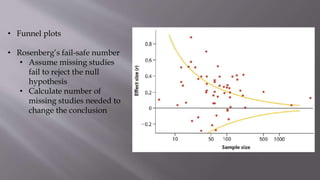
• Funnel plots
• Rosenberg’s fail-safe number
• Assume missing studies
fail to reject the null
hypothesis
• Calculate number of
missing studies needed to
change the conclusion
How to conduct a meta-analysis:
1. Define the question
2. Review the literature and data extraction
3. Compute effect sizes
4. Determine the average effect size
5. Calculate confidence intervals and test hypothesis
6. Look for effect of study quality
7. Look for associations and general patterns
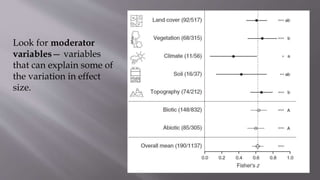
Look for moderator
variables— variables
that can explain some of
the variation in effect
size.
How to make your paper meta-accessible?
1. Always give estimates of the sizes of the effects and provide their
standard errors
2. Give the values of your test statistics and the number of degrees of
freedom
3. Make the data accessible
• Publish raw data in the paper, supplemental information, or on
an online archive such as datadryad.org
Thanks for listening!
Questions?
References
1. Stein, A., Gerstner, K., & Kreft, H. (2014). Environmental
heterogeneity as a universal driver of species richness across taxa,
biomes and spatial scales. Ecology letters, 17(7), 866-880.
2. Whitlock, M. C., & Schluter, D. (2009). The analysis of biological data
(p. 700). Greenwood Village, Colorado: Roberts and Company
Publishers.
3. https://www.zoology.ubc.ca/~bio501/R/lectures/
Meta analysis ppt

Meta analysis ppt

  • 1.
    SARVESH KUMAR V.ATAL 2016 Meta-analysis
  • 2.
    “If only weknew what we know…” -Caria O’ Dell and Jack Grayson “Anything you can do, I can do meta“ “Meta-Analysis, Shmeta-Analysis.” -Shapiro 1994 What is a meta-analysis?
  • 3.
     An analysisof analyses: A set of methods to systematically and reproducibly search, sample and (statistically) synthesize evidence from studies. What is a meta-analysis?
  • 4.
    “To do scienceis to search for repeated patterns, not simply to accumulate facts.” -Robert McAuthur “Meta-analysis has become an important tool in ecology for generalizing trends across studies and revealing overall patterns, even when single studies are too small or cover too narrow a range of conditions to detect an effect” -Stein et al. 2014
  • 5.
    Why should wedo meta-analyses? 1. Repetition: Many studies address the same or very similar issues and some collect similar data to look at different things. • Meta-analyses can quantitatively combine information from many studies that examine the same question 2. Meta-analyses increases statistical power and reduce the rates of type II errors (but could potentially increase type I errors relative – publication bias) 3. Can elucidate general patterns and associations that are not readily visible from one study
  • 6.
    The Transylvania Effect: Somestudies showed abnormal human behavior and psychiatric hospital admissions increased during full moons Aspirin and heart attacks • 1984, 1994, 2000 Stein et al. 2014 “Environmental heterogeneity as a universal driver of species richness across taxa, biomes and spatial scales”
  • 7.
    How to conducta meta-analysis: 1. Define the question 2. Review the literature and data extraction 3. Compute effect sizes 4. Determine the average effect size 5. Calculate confidence intervals and test hypothesis 6. Look for effect of study quality 7. Look for associations and general patterns
  • 8.
    Typical questions thata meta-analysis can address: 1. How strong is the effect we are studying? 2. Does the collection of studies reject a null hypothesis? 3. How variable is the effect and what factors can explain this variability? 4. Is there any bias resulting from the publication of some studies and not others? 5. Are there enough unpublished studies to change our conclusions?
  • 10.
    Size matters: Howbroad is your question? • Homogeneous vs Heterogeneous studies/data sets? -Specific tests exist to determine what data you have and which model you should use (woolf test) • Fixed vs Random effect models
  • 11.
    How to conducta meta-analysis: 1. Define the question 2. Review the literature and data extraction 3. Compute effect sizes 4. Determine the average effect size 5. Calculate confidence intervals and test hypothesis 6. Look for effect of study quality 7. Look for associations and general patterns
  • 12.
    Include all relevantstudies without bias.  Most difficult part of a meta-analysis • Data can be hard to obtain • Leads to what is called publication bias a.k.a the “file-drawer problem” • Data inequality • a priori standards • Weighted studies • Depends on question
  • 13.
    How to conducta meta-analysis: 1. Define the question 2. Review the literature and data extraction 3. Compute effect sizes 4. Determine the average effect size 5. Calculate confidence intervals and test hypothesis 6. Look for effect of study quality 7. Look for associations and general patterns
  • 14.
    Effect Size The effectsize is a standardized measure of the magnitude of the relationship between two variables (e.g. X & Y) • Odds ratio: Mantel-Haenszel test • Correlation coefficient ( r ) • Standardized mean difference (SMD)
  • 15.
    How to conducta meta-analysis: 1. Define the question 2. Review the literature and data extraction 3. Compute effect sizes 4. Determine the average effect size 5. Calculate confidence intervals and test hypothesis 6. Look for effect of study quality 7. Look for associations and general patterns
  • 16.
    • Weigh studiesby quality/sample size and calculate the weighted average • Calculate confidence intervals and test the hypothesis for your models • Depends on type of model and effect size • It is crucial that these results are interpreted in the context of the studies used to calculate them
  • 17.
    How to conducta meta-analysis: 1. Define the question 2. Review the literature and data extraction 3. Compute effect sizes 4. Determine the average effect size 5. Calculate confidence intervals and test hypothesis 6. Look for effect of study quality 7. Look for associations and general patterns
  • 18.
    • Funnel plots •Rosenberg’s fail-safe number • Assume missing studies fail to reject the null hypothesis • Calculate number of missing studies needed to change the conclusion
  • 19.
    How to conducta meta-analysis: 1. Define the question 2. Review the literature and data extraction 3. Compute effect sizes 4. Determine the average effect size 5. Calculate confidence intervals and test hypothesis 6. Look for effect of study quality 7. Look for associations and general patterns
  • 20.
    Look for moderator variables—variables that can explain some of the variation in effect size.
  • 21.
    How to makeyour paper meta-accessible? 1. Always give estimates of the sizes of the effects and provide their standard errors 2. Give the values of your test statistics and the number of degrees of freedom 3. Make the data accessible • Publish raw data in the paper, supplemental information, or on an online archive such as datadryad.org
  • 22.
  • 23.
    References 1. Stein, A.,Gerstner, K., & Kreft, H. (2014). Environmental heterogeneity as a universal driver of species richness across taxa, biomes and spatial scales. Ecology letters, 17(7), 866-880. 2. Whitlock, M. C., & Schluter, D. (2009). The analysis of biological data (p. 700). Greenwood Village, Colorado: Roberts and Company Publishers. 3. https://www.zoology.ubc.ca/~bio501/R/lectures/

Editor's Notes

  • #3 I think here we should talk a little bit about reviews and vote counting vs metas and how meta’s are relatively new, probably because of how much easier it is to obtain access to and assimilate mutiple studies and large data sets because of the internet
  • #7 Some examples of why we conduct meta-analyses
  • #13 libraries don’t subscribe to all journals, masters & phd theses, private companies, government agencies, not published at all Finally, some studies will inevitably be better than others -better techniques, greater resources, higher sample sizes Used standardized methods to weight studies individually or set a priori standards for study/data inclusion – highly dependent on the question being asked. A difficult task indeed
  • #14 Because we are combining data from multiple studies, how do we integrate numerical and categorical data?
  • #15 Demonstration – odds ratio Tutorial – Correlation coefficient
  • #17 we weighted effect size estimates by their inverse variances, such that studies with higher sample sizes were given more weight
  • #19 Missing studies required to no long reject the null
  • #22 How frequently do you read a paper and all you get is a non-specific p-value (“oh yeah, p was tots < 0.05, don’t worry about it”)