BIASES IN EPIDEMIOLODY
DR NAVEEN SHYAM SUNDAR
DEPARTMENT OF COMMUNITY MEDICINE,
SNPH,MGIMS , SEVAGRAM
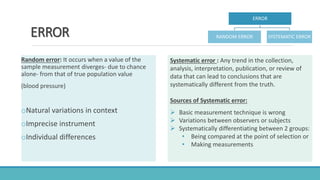
ERROR
Random error: It occurs when a value of the
sample measurement diverges- due to chance
alone- from that of true population value
(blood pressure)
oNatural variations in context
oImprecise instrument
oIndividual differences
Systematic error : Any trend in the collection,
analysis, interpretation, publication, or review of
data that can lead to conclusions that are
systematically different from the truth.
Sources of Systematic error:
 Basic measurement technique is wrong
 Variations between observers or subjects
 Systematically differentiating between 2 groups:
• Being compared at the point of selection or
• Making measurements
ERROR
RANDOM ERROR SYSTEMATIC ERROR
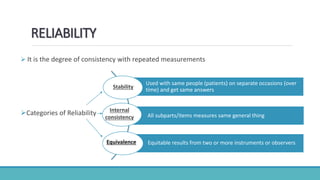
RELIABILITY
 It is the degree of consistency with repeated measurements
Categories of Reliability
Used with same people (patients) on separate occasions (over
time) and get same answers
All subparts/items measures same general thing
Equitable results from two or more instruments or observers
Stability
Internal
consistency
Equivalence
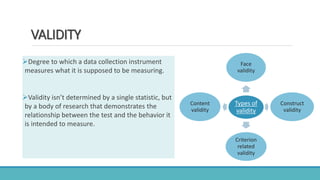
VALIDITY
Degree to which a data collection instrument
measures what it is supposed to be measuring.
Validity isn’t determined by a single statistic, but
by a body of research that demonstrates the
relationship between the test and the behavior it
is intended to measure.
Types of
validity
Face
validity
Construct
validity
Criterion
related
validity
Content
validity
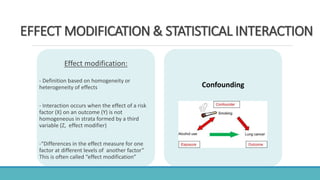
EFFECT MODIFICATION & STATISTICAL INTERACTION
Effect modification:
- Definition based on homogeneity or
heterogeneity of effects
- Interaction occurs when the effect of a risk
factor (X) on an outcome (Y) is not
homogeneous in strata formed by a third
variable (Z, effect modifier)
-“Differences in the effect measure for one
factor at different levels of another factor”
This is often called “effect modification”
Confounding
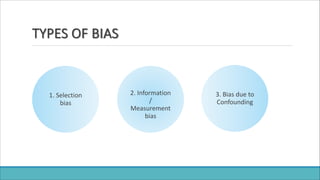
TYPES OF BIAS
1. Selection
bias
3. Bias due to
Confounding
2. Information
/
Measurement
bias
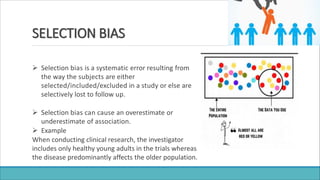
SELECTION BIAS
 Selection bias is a systematic error resulting from
the way the subjects are either
selected/included/excluded in a study or else are
selectively lost to follow up.
 Selection bias can cause an overestimate or
underestimate of association.
 Example
When conducting clinical research, the investigator
includes only healthy young adults in the trials whereas
the disease predominantly affects the older population.
Types of Selection Biases
Sampling Bias
Survivorship Bias
Exclusion Bias
Volunteer or Self-selection Bias
Attrition Bias
Recall Bias
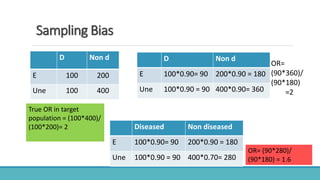
Sampling Bias
D Non d
E 100 200
Une 100 400
True OR in target
population = (100*400)/
(100*200)= 2
D Non d
E 100*0.90= 90 200*0.90 = 180
Une 100*0.90 = 90 400*0.90= 360
OR=
(90*360)/
(90*180)
=2
Diseased Non diseased
E 100*0.90= 90 200*0.90 = 180
Une 100*0.90 = 90 400*0.70= 280
OR= (90*280)/
(90*180) = 1.6
SELF-SELECTION BIAS
 Common source of selection bias.
 Volunteers induced bias.
 Individuals who volunteer for study, possess different characteristics than average
general population
 Example: A case control study explored an association of family history of heart
disease and presence of heart disease in subjects. Volunteers were recruited.
Subjects may be more likely to participate if they have a family history.
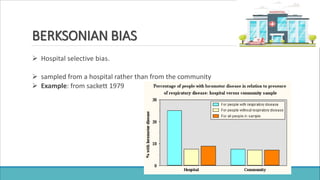
BERKSONIAN BIAS
 Hospital selective bias.
 sampled from a hospital rather than from the community
 Example: from sackett 1979
INCIDENCE –PREVALENCE BIAS
 Survivorship bias, Neyman’s Bias
 Estimate the risk of disease on basis of data collected at a given point in a series
of survivors rather than on data gathered during a certain time period in a group
of incident cases.
 Case-control and cross-sectional study
 Example:If, when studying cardiac arrest, one only collects data on arrival to the
emergency department, you would miss all the patients who were declared dead
on scene, who may be systematically different from those who make it to hospital.
HEALTHY WORKER EFFECT
 Form of selection bias
 General population is often used in occupational studies of mortality, since data is
readily available, and they are mostly unexposed
 Example: A comparison between health status of military and civilian population
may show a better health status of soldiers because during initial medical
examination during which unfit persons are excluded
 Example : study of factory workers , not involving those on leave
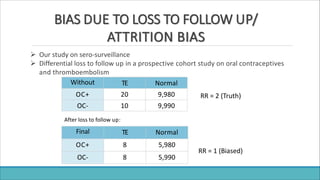
Without TE Normal
OC+ 20 9,980
OC- 10 9,990
Final TE Normal
OC+ 8 5,980
OC- 8 5,990
BIAS DUE TO LOSS TO FOLLOW UP/
ATTRITION BIAS
 Our study on sero-surveillance
 Differential loss to follow up in a prospective cohort study on oral contraceptives
and thromboembolism
RR = 2 (Truth)
RR = 1 (Biased)
After loss to follow up:
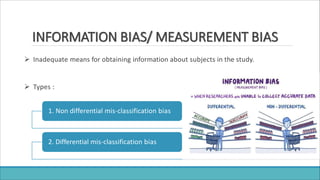
INFORMATION BIAS/ MEASUREMENT BIAS
 Inadequate means for obtaining information about subjects in the study.
 Types :
1. Non differential mis-classification bias
2. Differential mis-classification bias
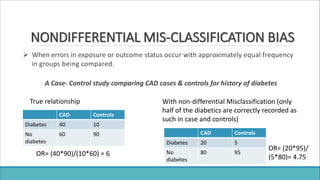
NONDIFFERENTIAL MIS-CLASSIFICATION BIAS
 When errors in exposure or outcome status occur with approximately equal frequency
in groups being compared.
A Case- Control study comparing CAD cases & controls for history of diabetes
CAD Controls
Diabetes 40 10
No
diabetes
60 90
OR= (40*90)/(10*60) = 6
CAD Controls
Diabetes 20 5
No
diabetes
80 95
OR= (20*95)/
(5*80)= 4.75
With non-differential Misclassification (only
half of the diabetics are correctly recorded as
such in case and controls)
True relationship
DIFFERENTIAL MIS-CLASSIFICATION BIAS
 When errors in classification of exposure or outcome are more frequent in one group
1. Differences in accurately remembering exposures (unequal).
Example: Mothers of children with birth defects will remember drugs taken
during pregnancy
2. Interviewer or recorder bias.
Example: Interviewer has better subconscious about hypothesis
3. More accurate information in one of the groups.
Example: Case-control study with cases from one facility and controls from another
with differences in record keeping
RECALL BIAS
 People with disease may remember exposures differently (more or less accurately) than
those without disease
 T
o minimize:
1. Better decrease the time to recall.
2. Use questionnaires that are constructed to maximize accuracy and completeness.
3. For socially sensitive questions, such as alcohol and drug use, use self-administered
questionnaire instead of an interviewer.
4. If possible, assess past exposures from pre-existing records.
INTERVIEWER BIAS
 Systematic differences in asking, recording, or interpreting information.
 Minimized by:
1. Blinding the interviewers if possible.
2. Using standarized questionnaires consisting of closed ended, eay to understand
questions.
3. Training all interviewer to adhere to the question and answer format strictly.
4. Obtaining data or verifying data by examining pre existing records (eg: Medical records or
employment records)
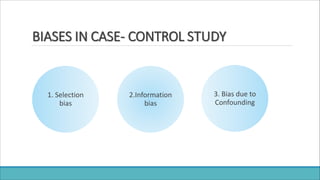
BIASES IN CASE- CONTROL STUDY
1. Selection
bias
3. Bias due to
Confounding
2.Information
bias
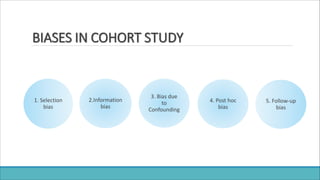
BIASES IN COHORT STUDY
1. Selection
bias
3. Bias due
to
Confounding
2.Information
bias
4. Post hoc
bias
5. Follow-up
bias
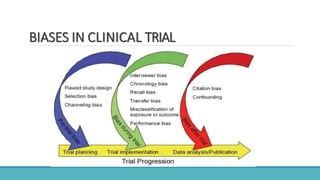
BIASES IN CLINICAL TRIAL
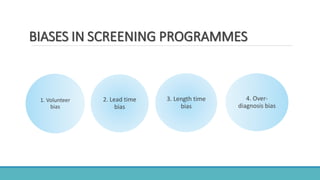
1. Volunteer
bias
3. Length time
bias
2. Lead time
bias
4. Over-
diagnosis bias
BIASES IN SCREENING PROGRAMMES
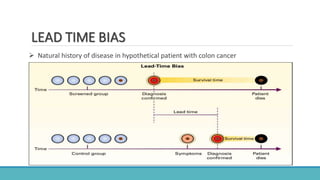
 Natural history of disease in hypothetical patient with colon cancer
LEAD TIME BIAS
LENGTH TIME BIAS
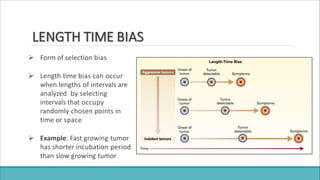
 Form of selection bias
 Length time bias can occur
when lengths of intervals are
analyzed by selecting
intervals that occupy
randomly chosen points in
time or space
 Example: Fast growing tumor
has shorter incubation period
than slow growing tumor
OVERDIAGNOSIS BIAS
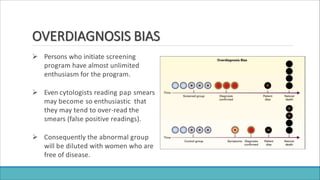
 Persons who initiate screening
program have almost unlimited
enthusiasm for the program.
 Even cytologists reading pap smears
may become so enthusiastic that
they may tend to over-read the
smears (false positive readings).
 Consequently the abnormal group
will be diluted with women who are
free of disease.
HOW TO CONTROL SELECTION BIAS
 Sampling the cases and controls in the same way
 Matching
 Randomization
 Using a population based sample
HOW TO CONTROL MEASUREMENT BIAS
 Development of explicit, objective criteria for measuring environmental characteristics and
health outcomes.
 Careful consistent data collection- for example, through use of standardized instruments;
objectives, closed ended questionnaires; valid instruments.
 Careful consistent use of data instruments- for example, through use of standardized training
and instruction manuals, blinding to the extent possible.
 Development and application of quality control/ quality assurance procedures.
 Data cleaning and coding.
 Analysis and adjustment, if necessary, to take account of measurement bias.
Control of cofounding
During design of epidemiological study:
o randomization
o Restriction
o matching
During analysis of study:
oStratification
oStatistical modeling or multivariate analysis
Example…
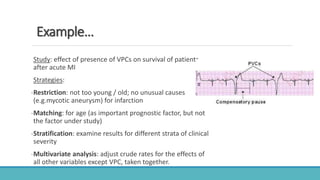
Study: effect of presence of VPCs on survival of patients
after acute MI
Strategies:
-Restriction: not too young / old; no unusual causes
(e.g.mycotic aneurysm) for infarction
-Matching: for age (as important prognostic factor, but not
the factor under study)
-Stratification: examine results for different strata of clinical
severity
-Multivariate analysis: adjust crude rates for the effects of
all other variables except VPC, taken together.
Alphabetical list of biases, indicating their type
and the design where they can occur

BIASES IN EPIDEMOLODY-1.pptx

  • 1.
    BIASES IN EPIDEMIOLODY DRNAVEEN SHYAM SUNDAR DEPARTMENT OF COMMUNITY MEDICINE, SNPH,MGIMS , SEVAGRAM
  • 2.
    ERROR Random error: Itoccurs when a value of the sample measurement diverges- due to chance alone- from that of true population value (blood pressure) oNatural variations in context oImprecise instrument oIndividual differences Systematic error : Any trend in the collection, analysis, interpretation, publication, or review of data that can lead to conclusions that are systematically different from the truth. Sources of Systematic error:  Basic measurement technique is wrong  Variations between observers or subjects  Systematically differentiating between 2 groups: • Being compared at the point of selection or • Making measurements ERROR RANDOM ERROR SYSTEMATIC ERROR
  • 3.
    RELIABILITY  It isthe degree of consistency with repeated measurements Categories of Reliability Used with same people (patients) on separate occasions (over time) and get same answers All subparts/items measures same general thing Equitable results from two or more instruments or observers Stability Internal consistency Equivalence
  • 4.
    VALIDITY Degree to whicha data collection instrument measures what it is supposed to be measuring. Validity isn’t determined by a single statistic, but by a body of research that demonstrates the relationship between the test and the behavior it is intended to measure. Types of validity Face validity Construct validity Criterion related validity Content validity
  • 5.
    EFFECT MODIFICATION &STATISTICAL INTERACTION Effect modification: - Definition based on homogeneity or heterogeneity of effects - Interaction occurs when the effect of a risk factor (X) on an outcome (Y) is not homogeneous in strata formed by a third variable (Z, effect modifier) -“Differences in the effect measure for one factor at different levels of another factor” This is often called “effect modification” Confounding
  • 7.
    TYPES OF BIAS 1.Selection bias 3. Bias due to Confounding 2. Information / Measurement bias
  • 8.
    SELECTION BIAS  Selectionbias is a systematic error resulting from the way the subjects are either selected/included/excluded in a study or else are selectively lost to follow up.  Selection bias can cause an overestimate or underestimate of association.  Example When conducting clinical research, the investigator includes only healthy young adults in the trials whereas the disease predominantly affects the older population.
  • 9.
    Types of SelectionBiases Sampling Bias Survivorship Bias Exclusion Bias Volunteer or Self-selection Bias Attrition Bias Recall Bias
  • 10.
    Sampling Bias D Nond E 100 200 Une 100 400 True OR in target population = (100*400)/ (100*200)= 2 D Non d E 100*0.90= 90 200*0.90 = 180 Une 100*0.90 = 90 400*0.90= 360 OR= (90*360)/ (90*180) =2 Diseased Non diseased E 100*0.90= 90 200*0.90 = 180 Une 100*0.90 = 90 400*0.70= 280 OR= (90*280)/ (90*180) = 1.6
  • 11.
    SELF-SELECTION BIAS  Commonsource of selection bias.  Volunteers induced bias.  Individuals who volunteer for study, possess different characteristics than average general population  Example: A case control study explored an association of family history of heart disease and presence of heart disease in subjects. Volunteers were recruited. Subjects may be more likely to participate if they have a family history.
  • 12.
    BERKSONIAN BIAS  Hospitalselective bias.  sampled from a hospital rather than from the community  Example: from sackett 1979
  • 13.
    INCIDENCE –PREVALENCE BIAS Survivorship bias, Neyman’s Bias  Estimate the risk of disease on basis of data collected at a given point in a series of survivors rather than on data gathered during a certain time period in a group of incident cases.  Case-control and cross-sectional study  Example:If, when studying cardiac arrest, one only collects data on arrival to the emergency department, you would miss all the patients who were declared dead on scene, who may be systematically different from those who make it to hospital.
  • 14.
    HEALTHY WORKER EFFECT Form of selection bias  General population is often used in occupational studies of mortality, since data is readily available, and they are mostly unexposed  Example: A comparison between health status of military and civilian population may show a better health status of soldiers because during initial medical examination during which unfit persons are excluded  Example : study of factory workers , not involving those on leave
  • 15.
    Without TE Normal OC+20 9,980 OC- 10 9,990 Final TE Normal OC+ 8 5,980 OC- 8 5,990 BIAS DUE TO LOSS TO FOLLOW UP/ ATTRITION BIAS  Our study on sero-surveillance  Differential loss to follow up in a prospective cohort study on oral contraceptives and thromboembolism RR = 2 (Truth) RR = 1 (Biased) After loss to follow up:
  • 16.
    INFORMATION BIAS/ MEASUREMENTBIAS  Inadequate means for obtaining information about subjects in the study.  Types : 1. Non differential mis-classification bias 2. Differential mis-classification bias
  • 17.
    NONDIFFERENTIAL MIS-CLASSIFICATION BIAS When errors in exposure or outcome status occur with approximately equal frequency in groups being compared. A Case- Control study comparing CAD cases & controls for history of diabetes CAD Controls Diabetes 40 10 No diabetes 60 90 OR= (40*90)/(10*60) = 6 CAD Controls Diabetes 20 5 No diabetes 80 95 OR= (20*95)/ (5*80)= 4.75 With non-differential Misclassification (only half of the diabetics are correctly recorded as such in case and controls) True relationship
  • 18.
    DIFFERENTIAL MIS-CLASSIFICATION BIAS When errors in classification of exposure or outcome are more frequent in one group 1. Differences in accurately remembering exposures (unequal). Example: Mothers of children with birth defects will remember drugs taken during pregnancy 2. Interviewer or recorder bias. Example: Interviewer has better subconscious about hypothesis 3. More accurate information in one of the groups. Example: Case-control study with cases from one facility and controls from another with differences in record keeping
  • 19.
    RECALL BIAS  Peoplewith disease may remember exposures differently (more or less accurately) than those without disease  T o minimize: 1. Better decrease the time to recall. 2. Use questionnaires that are constructed to maximize accuracy and completeness. 3. For socially sensitive questions, such as alcohol and drug use, use self-administered questionnaire instead of an interviewer. 4. If possible, assess past exposures from pre-existing records.
  • 20.
    INTERVIEWER BIAS  Systematicdifferences in asking, recording, or interpreting information.  Minimized by: 1. Blinding the interviewers if possible. 2. Using standarized questionnaires consisting of closed ended, eay to understand questions. 3. Training all interviewer to adhere to the question and answer format strictly. 4. Obtaining data or verifying data by examining pre existing records (eg: Medical records or employment records)
  • 21.
    BIASES IN CASE-CONTROL STUDY 1. Selection bias 3. Bias due to Confounding 2.Information bias
  • 22.
    BIASES IN COHORTSTUDY 1. Selection bias 3. Bias due to Confounding 2.Information bias 4. Post hoc bias 5. Follow-up bias
  • 23.
  • 24.
    1. Volunteer bias 3. Lengthtime bias 2. Lead time bias 4. Over- diagnosis bias BIASES IN SCREENING PROGRAMMES
  • 25.
     Natural historyof disease in hypothetical patient with colon cancer LEAD TIME BIAS
  • 26.
    LENGTH TIME BIAS Form of selection bias  Length time bias can occur when lengths of intervals are analyzed by selecting intervals that occupy randomly chosen points in time or space  Example: Fast growing tumor has shorter incubation period than slow growing tumor
  • 27.
    OVERDIAGNOSIS BIAS  Personswho initiate screening program have almost unlimited enthusiasm for the program.  Even cytologists reading pap smears may become so enthusiastic that they may tend to over-read the smears (false positive readings).  Consequently the abnormal group will be diluted with women who are free of disease.
  • 28.
    HOW TO CONTROLSELECTION BIAS  Sampling the cases and controls in the same way  Matching  Randomization  Using a population based sample
  • 29.
    HOW TO CONTROLMEASUREMENT BIAS  Development of explicit, objective criteria for measuring environmental characteristics and health outcomes.  Careful consistent data collection- for example, through use of standardized instruments; objectives, closed ended questionnaires; valid instruments.  Careful consistent use of data instruments- for example, through use of standardized training and instruction manuals, blinding to the extent possible.  Development and application of quality control/ quality assurance procedures.  Data cleaning and coding.  Analysis and adjustment, if necessary, to take account of measurement bias.
  • 30.
    Control of cofounding Duringdesign of epidemiological study: o randomization o Restriction o matching During analysis of study: oStratification oStatistical modeling or multivariate analysis
  • 31.
    Example… Study: effect ofpresence of VPCs on survival of patients after acute MI Strategies: -Restriction: not too young / old; no unusual causes (e.g.mycotic aneurysm) for infarction -Matching: for age (as important prognostic factor, but not the factor under study) -Stratification: examine results for different strata of clinical severity -Multivariate analysis: adjust crude rates for the effects of all other variables except VPC, taken together.
  • 32.
    Alphabetical list ofbiases, indicating their type and the design where they can occur