
Objectives
   Explore credentials, theoretical sources,
    and historical perspective of Betty
    Neuman

   Review concepts/definitions and concept
    map

   Critique theory

   Examine the Neuman Systems Model’s
    acceptance by the nursing community

   Demonstrate NSM’s use through case
Background Credentials
   Born: 1924
   Ohio
   1947: RN from Peoples Hospital School of
    Nursing Akron, OH.
     Received     double honors
   Moved to California
     Variety   of Nursing Roles
       Hospital  nurse, School Nurse, Industrial Nurse and
       clinical instructor at University of Southern California

                                                     (Aligood & Toomey, 2010
Background Credentials
   1957- Bachelors degree in public health &
    psychology - honors
   1966- Masters degree in mental health &
    public health consultation - UCLA
   1985- Doctoral Degree in clinical psychology -
    Pacific Western University.
   1998- Honorary doctorate - Grand Valley State
    University, Allendale, MI.


                                          (Aligood & Toomey, 2010
Theory Development


   Neuman System Model (NSM)
    developed in 1970 and published in
    1972
     Firstpublished as “Model for teaching
     total person approach to patient
     problems” in Nursing Research.


                                      (Aligood & Toomey, 2010
Theoretical Sources


   General System Theory
    Reflects  the nature of living
     organisms as open systems in
     interaction with each other and
     with environment


                                 (Aligood & Toomey, 2010
Theoretical Sources


   Gestalt Theory
    Describes homeostasis as the
     process by which an organism
     maintains equilibrium, and
     consequently its health, under
     varying conditions.

                                 (Aligood & Toomey, 2010
Theoretical Sources

   Marx
     Philosophy“suggests properties of parts
     are determined partly by the larger
     wholes within a dynamically organized
     systems.”
   de Chardin
     Philosophy   of the wholeness of life

                                         (Aligood & Toomey, 2010
Theoretical Sources

   Selye’s                  Caplan
    definition of              Adapted levels
    stress:                    of prevention
     Any tension               Primary
     producing stimuli
                                Secondary
     that causes a
     response                   Tertiary

     Canbe positive or
     negative.
                                            (Aligood & Toomey, 2010
Historical Perspective
   Time of great historical development in
    nursing
   1970’s- Nursing Research concluded a
    lack in conceptual connection and
    theoretical frameworks.
     Leading    to two major findings:
    1.   Standardization of nursing curricula
    2.   Doctoral education for nurses should be in
         nursing.
                                                (Aligood & Toomey, 2010
Conceptual Model


“A conceptual model provides a
distinct frame of reference for its
adherents…that tells them how to
observe and interpret the
phenomena of interest to the
discipline.”


                                      (Aligood & Toomey, 2010
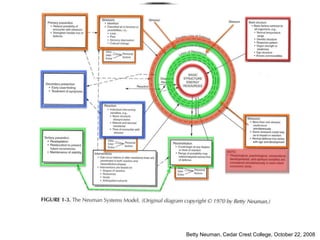
Betty Neuman, Cedar Crest College, October 22, 2008
Major Concepts and Definitions

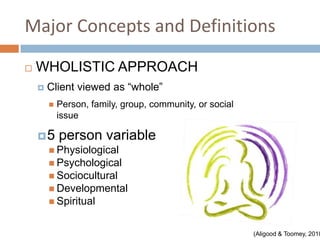
   WHOLISTIC APPROACH
       Client viewed as “whole”
           Person, family, group, community, or social
            issue

    5      person variable
         Physiological
         Psychological
         Sociocultural
         Developmental
         Spiritual


                                                          (Aligood & Toomey, 2010
Major Concepts and Definitions
   OPEN SYSTEM
     Function    or Process
       Client
             as a system exchanges energy, information and
       matter with the environment as it uses available
       energy resources to move toward stability and
       wholeness
     Input   or Output
       Matter,
             energy, and information that are exchanged
       between the client and the environment
     Feedback
       System  output in the form of matter, energy, and
       information for corrective action to change, enhance or
       stabilize the system
                                                  (Aligood & Toomey, 2010
Major Concepts and Definitions
  Negentropy
    Defined by   Neuman as a process of energy conservation
     utilization that assists system profession toward stability or
     wellness
  Stability
    Dynamic and   desired state of balance
    Copes with stressors to maintain an optimal level of health
     and integrity


                                                      (Aligood & Toomey, 2010
Major Concepts and Definitions

   ENVIRONMENT
     Created    Environment
   CLIENT SYSTEM
     Basic    Client Structure
      Composed   of a central core surrounded by concentric
       rings

     Lines    of Resistance

                                                 (Aligood & Toomey, 2010
Major Concepts and Definitions
  Normal     Lines of Defense
    Model’s   outer solid circle
         Represents stability for the individual or system
         Maintained over time and serves to assess deviations
          from client’s usual wellness
  Flexible   Lines of Defense
    Model’s   outer broken ring
         Can be altered over time; Protective buffer for preventing
          stressors from breaking through usual wellness state
         According to Neuman, “When the flexible line of defense
          expands, it provides greater short-term protection against
          stressor invasion; when it contracts, it provides less
          protection.” (Alligood and Tomey, 2010)


                                                        (Aligood & Toomey, 2010
Major Concepts and Definitions
   HEALTH
     Wellness

     Illness

   STRESSORS
     Tension  producting stimuli that have the potential
      to disrupt system stability
   DEGREE OF REACTION
     Represents   system instability that occurs when
      stressors invade normal line of defense

                                                (Aligood & Toomey, 2010
Major Concepts and Definitions
   PREVENTION AS INTERVENTION
     Purposeful   actions to help client maintain system
      stability
     Levels of Prevention: Primary, Secondary,
      Tertiary
       Primary:    Used when stressor is suspected or
        identified; Degree of risk in known
       Secondary: Involves interventions or treatment
        initiated after symptoms occurred
       Tertiary: Occurs after active treatment; maintenance

   RECONSTITUTION
     Occurs   after treatment for stressor reaction
                                                  (Aligood & Toomey, 2010
Empirical Evidence


   Neuman took the lead to hypothesize
    her theory along with other theories to
    create the model
   Evaluated the use of model by using
    graduate nursing students at UCLA


                                     (Aligood & Toomey, 2010
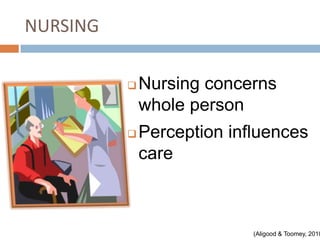
NURSING

             Nursing concerns
              whole person
             Perception influences
              care


                            (Aligood & Toomey, 2010
PERSON
   Open system, reciprocal to environment
   Client system always changing
   Physiological, psychological, sociocultural,
    developmental and spiritual all interrelated


                                          (Aligood & Toomey, 2010
HEALTH


   Stability of system
    important
   Wellness model
   Stability is associated with
    total system needs being
    met


                                   (Aligood & Toomey, 2010
ENVIRONMENT

   Seen as internal and external influences
   Stressors can threaten stability
   Three environments
     Internal=allinteraction in client
     External=all factors outside client

     Created=unconscious, coping


                                            (Aligood & Toomey, 2010
THEORETICAL ASSERTIONS

        Nurse and client interact
        Nurse concerned with variables that
         affect response to stressors
              Copes by flexing environment
             Either changes himself to
            stressors or adjusts stressors to
            himself


                                     (Aligood & Toomey, 2010
SIMPLICITY


   Complex yet logical
   Some concepts overlap
   Usable in variety of
    practice settings


                            (Aligood & Toomey, 2010
GENERALITY
   Comprehensive and adaptable
   Broad scope, useful in applying theory to all
    healthcare settings
   Wholistic approach, client participation
    works well in today’s
    views of prevention and
    interdisciplinary care


                                                (Aligood & Toomey, 2010
EMPIRICAL PRECISION


      Extensive use in nursing research
      Continues to be tested and refined


                                       (Aligood & Toomey, 2010
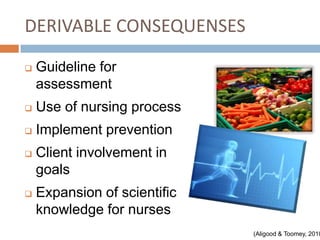
DERIVABLE CONSEQUENSES

   Guideline for
    assessment
   Use of nursing process
   Implement prevention
   Client involvement in
    goals
   Expansion of scientific
    knowledge for nurses
                              (Aligood & Toomey, 2010
Practice
   Approach
     Goal-Directed

     Unified

     Wholistic


   Multidisciplinary
     Prevent fragmentation   of care
     Flexible


                                        (Aligood & Toomey, 2010
Practice
   Multidisciplinary
     Stressors

     Client   system


   Guidelines
     Nursing

     Allied   services


                          (Aligood & Toomey, 2010
Practice

•   Neuman Nursing Process Format
     –   Nursing diagnosis
         •   Data base  variance from wellness
     –   Nursing goals
         •   Negotiation btw client and caregiver  desired changes
     –   Nursing outcomes
         •   Prevention-as-intervention
         •   Evaluation


•   when used by other disciplines, nursing is
    changed accordingly

                                                            (Aligood & Toomey, 2010
Practice
•   Hospitals
•   Nursing homes
•   Rehab centers
•   Community-based services
•   Multiple countries
    –   Holland, Malaysia
•   Individuals & communities
•   Acute care & clinic

                                (Aligood & Toomey, 2010
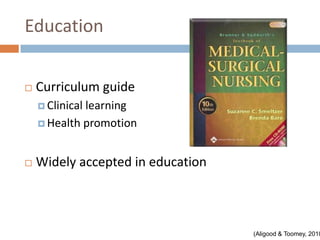
Education


   Curriculum guide
     Clinical
             learning
     Health promotion


   Widely accepted in education


                                   (Aligood & Toomey, 2010
Research
   Used as framework in nearly 100 studies
    between 1989 – 1993 (per 3rd edition)
   Qualitative and Quantitative
   Multiple cultures
   Pragmatic
   Extension to middle range theory


                                        (Aligood & Toomey, 2010
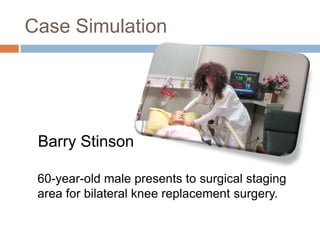
Case Simulation


 Barry Stinson

 60-year-old male presents to surgical staging
 area for bilateral knee replacement surgery.
Case Simulation


   http://www.youtube.com/watch?v=WEY9pxxcx
    SQ
References
   Alligood, M.R. & Tomey, A.M. (2010). Nursing
         Theorists and Their Work 7th Edition. Maryland
         Heights, Missouri: Mosby Inc.
   Photo and diagram courtesy of Neuman Systems
    Model Inc. www.neumansystemsmodel.org Last
    updated 2011

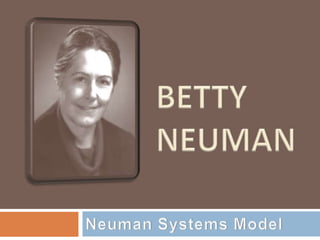
Betty Neuman 2

  • 2.
    Objectives  Explore credentials, theoretical sources, and historical perspective of Betty Neuman  Review concepts/definitions and concept map  Critique theory  Examine the Neuman Systems Model’s acceptance by the nursing community  Demonstrate NSM’s use through case
  • 4.
    Background Credentials  Born: 1924  Ohio  1947: RN from Peoples Hospital School of Nursing Akron, OH.  Received double honors  Moved to California  Variety of Nursing Roles  Hospital nurse, School Nurse, Industrial Nurse and clinical instructor at University of Southern California (Aligood & Toomey, 2010
  • 5.
    Background Credentials  1957- Bachelors degree in public health & psychology - honors  1966- Masters degree in mental health & public health consultation - UCLA  1985- Doctoral Degree in clinical psychology - Pacific Western University.  1998- Honorary doctorate - Grand Valley State University, Allendale, MI. (Aligood & Toomey, 2010
  • 6.
    Theory Development  Neuman System Model (NSM) developed in 1970 and published in 1972  Firstpublished as “Model for teaching total person approach to patient problems” in Nursing Research. (Aligood & Toomey, 2010
  • 7.
    Theoretical Sources  General System Theory Reflects the nature of living organisms as open systems in interaction with each other and with environment (Aligood & Toomey, 2010
  • 8.
    Theoretical Sources  Gestalt Theory Describes homeostasis as the process by which an organism maintains equilibrium, and consequently its health, under varying conditions. (Aligood & Toomey, 2010
  • 9.
    Theoretical Sources  Marx  Philosophy“suggests properties of parts are determined partly by the larger wholes within a dynamically organized systems.”  de Chardin  Philosophy of the wholeness of life (Aligood & Toomey, 2010
  • 10.
    Theoretical Sources  Selye’s  Caplan definition of  Adapted levels stress: of prevention  Any tension  Primary producing stimuli  Secondary that causes a response  Tertiary  Canbe positive or negative. (Aligood & Toomey, 2010
  • 11.
    Historical Perspective  Time of great historical development in nursing  1970’s- Nursing Research concluded a lack in conceptual connection and theoretical frameworks.  Leading to two major findings: 1. Standardization of nursing curricula 2. Doctoral education for nurses should be in nursing. (Aligood & Toomey, 2010
  • 12.
    Conceptual Model “A conceptualmodel provides a distinct frame of reference for its adherents…that tells them how to observe and interpret the phenomena of interest to the discipline.” (Aligood & Toomey, 2010
  • 14.
    Betty Neuman, CedarCrest College, October 22, 2008
  • 15.
    Major Concepts andDefinitions  WHOLISTIC APPROACH  Client viewed as “whole”  Person, family, group, community, or social issue 5 person variable  Physiological  Psychological  Sociocultural  Developmental  Spiritual (Aligood & Toomey, 2010
  • 16.
    Major Concepts andDefinitions  OPEN SYSTEM  Function or Process  Client as a system exchanges energy, information and matter with the environment as it uses available energy resources to move toward stability and wholeness  Input or Output  Matter, energy, and information that are exchanged between the client and the environment  Feedback  System output in the form of matter, energy, and information for corrective action to change, enhance or stabilize the system (Aligood & Toomey, 2010
  • 17.
    Major Concepts andDefinitions  Negentropy  Defined by Neuman as a process of energy conservation utilization that assists system profession toward stability or wellness  Stability  Dynamic and desired state of balance  Copes with stressors to maintain an optimal level of health and integrity (Aligood & Toomey, 2010
  • 18.
    Major Concepts andDefinitions  ENVIRONMENT  Created Environment  CLIENT SYSTEM  Basic Client Structure  Composed of a central core surrounded by concentric rings  Lines of Resistance (Aligood & Toomey, 2010
  • 19.
    Major Concepts andDefinitions  Normal Lines of Defense  Model’s outer solid circle  Represents stability for the individual or system  Maintained over time and serves to assess deviations from client’s usual wellness  Flexible Lines of Defense  Model’s outer broken ring  Can be altered over time; Protective buffer for preventing stressors from breaking through usual wellness state  According to Neuman, “When the flexible line of defense expands, it provides greater short-term protection against stressor invasion; when it contracts, it provides less protection.” (Alligood and Tomey, 2010) (Aligood & Toomey, 2010
  • 20.
    Major Concepts andDefinitions  HEALTH  Wellness  Illness  STRESSORS  Tension producting stimuli that have the potential to disrupt system stability  DEGREE OF REACTION  Represents system instability that occurs when stressors invade normal line of defense (Aligood & Toomey, 2010
  • 21.
    Major Concepts andDefinitions  PREVENTION AS INTERVENTION  Purposeful actions to help client maintain system stability  Levels of Prevention: Primary, Secondary, Tertiary  Primary: Used when stressor is suspected or identified; Degree of risk in known  Secondary: Involves interventions or treatment initiated after symptoms occurred  Tertiary: Occurs after active treatment; maintenance  RECONSTITUTION  Occurs after treatment for stressor reaction (Aligood & Toomey, 2010
  • 22.
    Empirical Evidence  Neuman took the lead to hypothesize her theory along with other theories to create the model  Evaluated the use of model by using graduate nursing students at UCLA (Aligood & Toomey, 2010
  • 24.
    NURSING  Nursing concerns whole person  Perception influences care (Aligood & Toomey, 2010
  • 25.
    PERSON  Open system, reciprocal to environment  Client system always changing  Physiological, psychological, sociocultural, developmental and spiritual all interrelated (Aligood & Toomey, 2010
  • 26.
    HEALTH  Stability of system important  Wellness model  Stability is associated with total system needs being met (Aligood & Toomey, 2010
  • 27.
    ENVIRONMENT  Seen as internal and external influences  Stressors can threaten stability  Three environments  Internal=allinteraction in client  External=all factors outside client  Created=unconscious, coping (Aligood & Toomey, 2010
  • 28.
    THEORETICAL ASSERTIONS  Nurse and client interact  Nurse concerned with variables that affect response to stressors  Copes by flexing environment  Either changes himself to stressors or adjusts stressors to himself (Aligood & Toomey, 2010
  • 29.
    SIMPLICITY  Complex yet logical  Some concepts overlap  Usable in variety of practice settings (Aligood & Toomey, 2010
  • 30.
    GENERALITY  Comprehensive and adaptable  Broad scope, useful in applying theory to all healthcare settings  Wholistic approach, client participation works well in today’s views of prevention and interdisciplinary care (Aligood & Toomey, 2010
  • 31.
    EMPIRICAL PRECISION  Extensive use in nursing research  Continues to be tested and refined (Aligood & Toomey, 2010
  • 32.
    DERIVABLE CONSEQUENSES  Guideline for assessment  Use of nursing process  Implement prevention  Client involvement in goals  Expansion of scientific knowledge for nurses (Aligood & Toomey, 2010
  • 34.
    Practice  Approach  Goal-Directed  Unified  Wholistic  Multidisciplinary  Prevent fragmentation of care  Flexible (Aligood & Toomey, 2010
  • 35.
    Practice  Multidisciplinary  Stressors  Client system  Guidelines  Nursing  Allied services (Aligood & Toomey, 2010
  • 36.
    Practice • Neuman Nursing Process Format – Nursing diagnosis • Data base  variance from wellness – Nursing goals • Negotiation btw client and caregiver  desired changes – Nursing outcomes • Prevention-as-intervention • Evaluation • when used by other disciplines, nursing is changed accordingly (Aligood & Toomey, 2010
  • 37.
    Practice • Hospitals • Nursing homes • Rehab centers • Community-based services • Multiple countries – Holland, Malaysia • Individuals & communities • Acute care & clinic (Aligood & Toomey, 2010
  • 38.
    Education  Curriculum guide  Clinical learning  Health promotion  Widely accepted in education (Aligood & Toomey, 2010
  • 39.
    Research  Used as framework in nearly 100 studies between 1989 – 1993 (per 3rd edition)  Qualitative and Quantitative  Multiple cultures  Pragmatic  Extension to middle range theory (Aligood & Toomey, 2010
  • 40.
    Case Simulation BarryStinson 60-year-old male presents to surgical staging area for bilateral knee replacement surgery.
  • 41.
    Case Simulation  http://www.youtube.com/watch?v=WEY9pxxcx SQ
  • 42.
    References  Alligood, M.R. & Tomey, A.M. (2010). Nursing Theorists and Their Work 7th Edition. Maryland Heights, Missouri: Mosby Inc.  Photo and diagram courtesy of Neuman Systems Model Inc. www.neumansystemsmodel.org Last updated 2011