Oxidation of fatty acids
V.ARUNA
Objectives
• Importance of fatty acid
oxidation
• Pathway-
• Products formed
• regulation
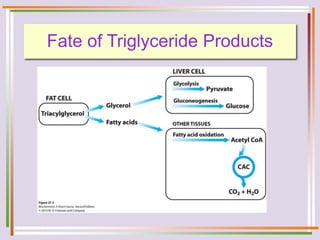
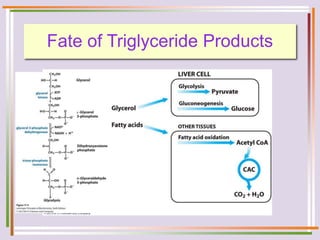
Fate of Triglyceride Products
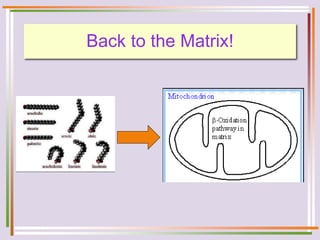
Back to the Matrix!
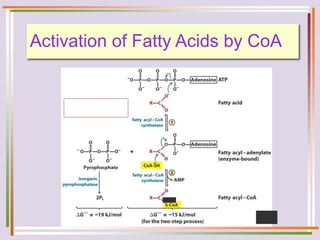
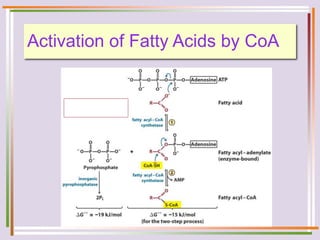
Activation of Fatty Acids by CoA
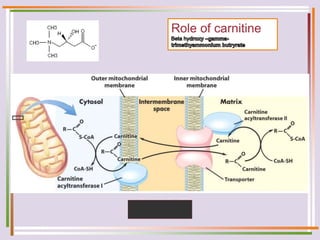
Role of carnitine
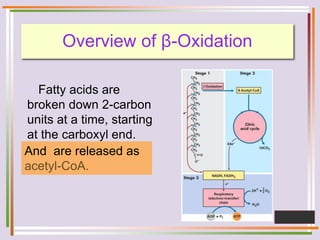
Overview of β-Oxidation
Fatty acids are
broken down 2-carbon
units at a time, starting
at the carboxyl end.
And are released as
acetyl-CoA.
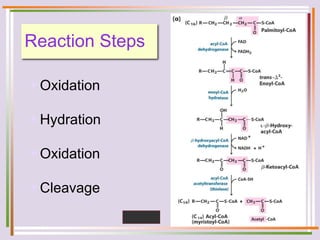
Reaction Steps
Oxidation
Hydration
Oxidation
Cleavage
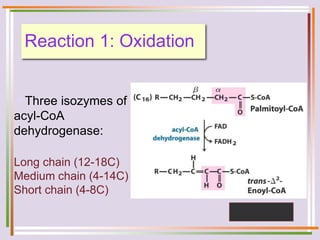
Reaction 1: Oxidation
Three isozymes of
acyl-CoA
dehydrogenase:
Long chain (12-18C)
Medium chain (4-14C)
Short chain (4-8C)
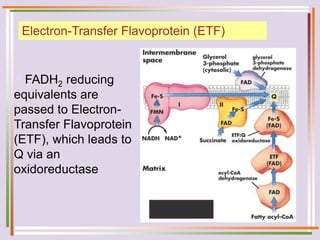
Electron-Transfer Flavoprotein (ETF)
FADH2 reducing
equivalents are
passed to Electron-
Transfer Flavoprotein
(ETF), which leads to
Q via an
oxidoreductase
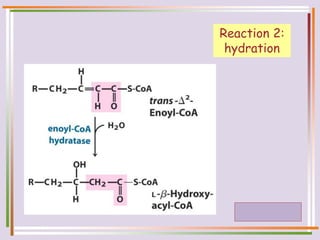
Reaction 2:
hydration
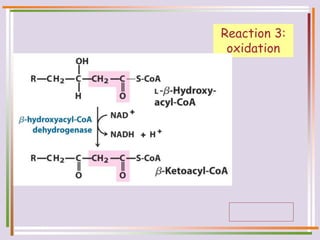
Reaction 3:
oxidation
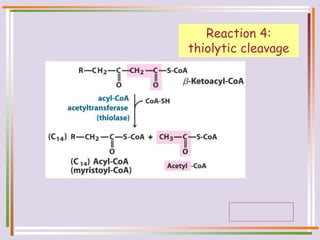
Reaction 4:
thiolytic cleavage
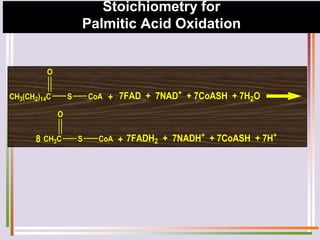
Stoichiometry for
Palmitic Acid Oxidation
O
CH3(CH2)14C S CoA + 7FAD + 7NAD+
+ 7CoASH + 7H2O
O
CH3C S CoA
8 7FADH2 + 7NADH+
+ 7CoASH + 7H+
+
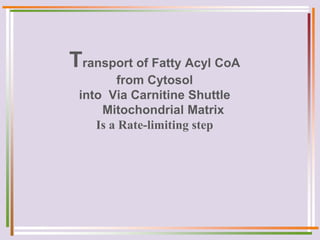
Transport of Fatty Acyl CoA
from Cytosol
into Via Carnitine Shuttle
Mitochondrial Matrix
Is a Rate-limiting step
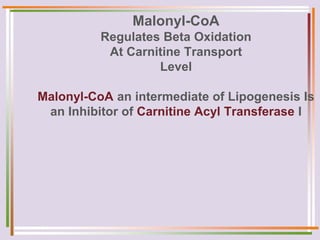
Malonyl-CoA
Regulates Beta Oxidation
At Carnitine Transport
Level
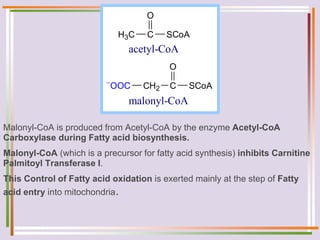
Malonyl-CoA an intermediate of Lipogenesis Is
an Inhibitor of Carnitine Acyl Transferase I
Malonyl-CoA is produced from Acetyl-CoA by the enzyme Acetyl-CoA
Carboxylase during Fatty acid biosynthesis.
Malonyl-CoA (which is a precursor for fatty acid synthesis) inhibits Carnitine
Palmitoyl Transferase I.
This Control of Fatty acid oxidation is exerted mainly at the step of Fatty
acid entry into mitochondria.
H3C C SCoA
O
CH2 C SCoA
O

OOC
acetyl-CoA
malonyl-CoA
Deficiencies of Carnitine
OR
Carnitine Transferase
OR
Translocase Activity
Are
Related to Disease State
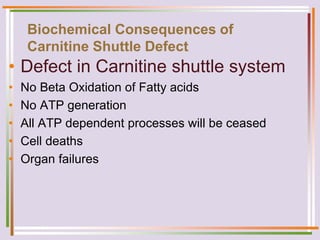
Biochemical Consequences of
Carnitine Shuttle Defect
• Defect in Carnitine shuttle system
• No Beta Oxidation of Fatty acids
• No ATP generation
• All ATP dependent processes will be ceased
• Cell deaths
• Organ failures
Carnitine Shuttle Defects
• Affects normal function of Muscles,
Kidney, and Heart.
• Symptoms include Muscle cramping, during exercise, severe
weakness and death.
• Muscle weakness occurs since they are related with Fatty acid
oxidation for long term energy source.
Sudden Infant Death
Syndrome
(SIDS)
SIDS
• SIDS is a congenital rare disorder with an
incidence of 1 in 10,000 births.
• Biochemical Defect: Due to congenital defect of
Enzyme Acyl-CoA Dehydrogenase a regulatory
enzyme of β Oxidation of Fatty acid.
• Biochemical Consequences Of SIDS
• Deficiency of Acyl-CoA Dehydrogenase
• Blocks β Oxidation of Fatty acid.
• Stops liberation and supply of energy in
form of ATPs in fasting condition
• Leads to unexpected death of an infant.
Symptoms in defective Beta Oxidation of
Fatty acids include:
 Hypoglycemia
 Low Ketone body production during fasting
 Fatty Liver
 Heart and/or Skeletal muscle defects
 Complications of pregnancy
 Sudden infant death (SID).
• Hereditary deficiency of Medium Chain Acyl-CoA
Dehydrogenase (MCAD)
• Most common genetic disease relating to fatty
acid catabolism, has been linked to SIDS.
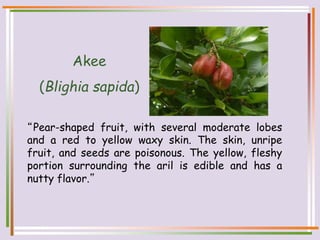
“Pear-shaped fruit, with several moderate lobes
and a red to yellow waxy skin. The skin, unripe
fruit, and seeds are poisonous. The yellow, fleshy
portion surrounding the aril is edible and has a
nutty flavor.”
Akee
(Blighia sapida)
• Ackee fruit is rich in Hypoglycin –A
• Hypoglycin is an inhibitor of regulatory enzyme
of β Oxidation Proper –Acyl-CoA
Dehydrogenase.
• Questions:
• what is beta oxidation.
• Write the steps in beta oxidation and its
importance.
• What are the products formed –beta
oxidation.
• Regulation.
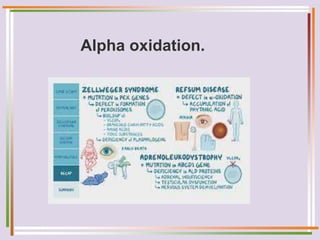
Alpha oxidation.
Mechanism Of Alpha
Oxidation Of Phytonic
Acid
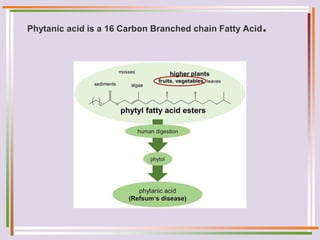
Phytanic acid is a 16 Carbon Branched chain Fatty Acid.
Why Phytanic Acid
Does Not Initiate With
Beta Oxidation Process?
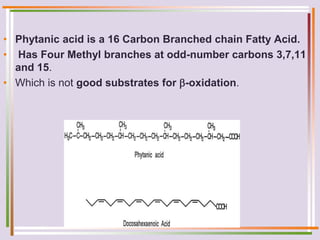
• Phytanic acid is a 16 Carbon Branched chain Fatty Acid.
• Has Four Methyl branches at odd-number carbons 3,7,11
and 15.
• Which is not good substrates for -oxidation.
• Branched chain Phytanic acid contains
Methyl (CH3) group at β Carbon atom.
• Hence it cannot get oxidized initially
via β oxidation pathway
Predominantly Alpha Oxidation
Of Phytanic Acid
Takes Place in
Endoplasmic Reticulum
of Brain Cells
Also In Peroxisomes
• Branched chain Phytanic acid contains
Methyl (CH3) group at β Carbon atom.
• Hence it cannot get oxidized initially
via β oxidation pathway
• Thus initially Phytanic acid
follows α Oxidation
• Modify Phytanic acid to
Pristanic acid and
• Further present it for Beta
Oxidation process.
Occurrence Of Alpha
Oxidation Of Phytanic
Acid
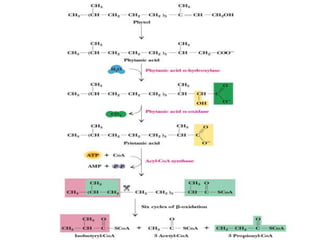
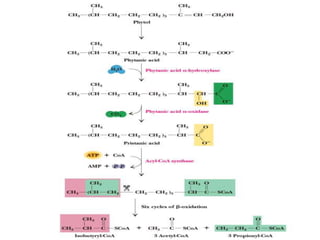
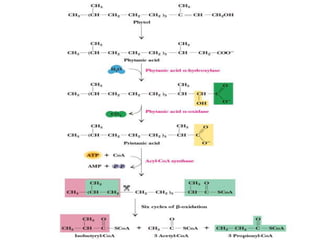
• Phytanic acid 3,7,11,15-Tetramethyl Hexadecanoic
acid
• Alpha oxidation removes Methyl groups at beta
carbon.
• Later making Fatty acid ready for beta oxidation
process.
• During α Oxidation there occurs:
• Hydroxylation at α Carbon in presence of Enzyme
Hydroxylase or Monoxygenase .
• This reaction is Vitamin C dependent forming α
Hydroxy Acyl-CoA.
• α Hydroxy Acyl-CoA is then oxidized to α Keto Acyl-
CoA.
• Ketonic group at α Carbon atom is decarboxylated
• Yielding CO2 molecule and a Fatty acid with one
Carbon atom less.
• Phytanic acid on alpha oxidation is converted
to Pristanic acid
• Which is further metabolized via beta
oxidation process to generate Propionyl-CoA.
Products of Phytanic Acid Oxidation
• Alpha oxidation of Phytanic acid Generates
– Acetyl-CoA
– Propionyl-CoA
–Isobutryl-CoA
Disorders Associated
With
Defective α Oxidation
Of Phytanic Acid
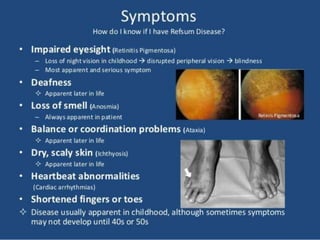
Refsums Disease
• Refsums disease is a rare but severe
neurological disorder.
• Caused due to defect in α Oxidation of Phytanic
acid
• Deficiency of Enzyme Phytanic acid α Oxidase/
Phytanol-CoA Dioxygenase leads to Refsum's
disease.
• Autosomal Recessive
• Biochemical Consequence Of Refsums
disease Is:
• No Oxidation of Phytanic acid
• Accumulation of Phytanic acid in Brain
cells and Other Tissues
• Dysfunction of Brain
• Manifesting Neurological disorder
• Management Of Refsums disease is :
• Avoid eating diet containing Phytol
/Phytanic acid.
.
Omega Oxidation Of Fatty
Acids
• Omega Oxidation of Fatty acid
• Oxidation of Omega Carbon atom (CH3)
of a Fatty acid.
When Does Omega
Oxidation
Of Fatty Acid Occurs?
• Omega Oxidation takes place
when there is defect in β
Oxidation of fatty acid.
• SO.. WHAT HAPPENS?
• During ω Oxidation of Fatty acid
• ω Carbon atom (CH3) of a Fatty acid is
transformed to -COOH
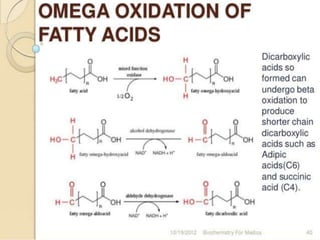
• Omega oxidation forms
Dicarboxylic acid
• Which further undergo
oxidation
• Form more short
Dicarboxylic acids Adipic
acid and Succinic acid
• Which are more polar and
excreted out in Urine.
ω-Oxidation of Fatty acids
Occur in
Endoplasmic Reticulum
of Liver Cells
Mechanism Of ω Oxidation
•ω Oxidation of Fatty acid
is a minor alternative
oxidative Pathway.
• Omega Oxidation of a Fatty acid
takes place with:
–Hydroxylation Reaction
–Oxidation Reaction
• During ω Oxidation of Fatty acid
• ω Carbon atom (CH3) of a Fatty acid is
transformed to -COOH
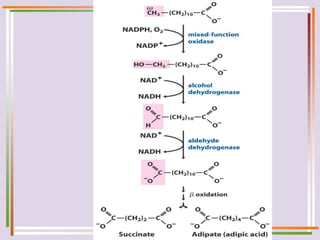
• In ω Oxidation of Fatty acid there occurs
Hydroxylation at ω Carbon atom
• Converting into Primary terminal Alcohol
(-CH2OH) group.
• This reaction is catalyzed by NADPH+H+
dependent Cytochrome P450 system
• Next primary terminal Alcohol group is
oxidized to form -COOH group .
• Further Dicarboxylic acid
generated through Omega
Oxidation undergoes beta
oxidation
• To produce short chain
Dicarboxylic acids as Adipic
acid and Succinic acid
• Which are polar and excreted
out through Urine.
Significance Of Omega Oxidation
• Omega Oxidation transforms a
non polar Fatty acid to polar
Dicarboxylic fatty acid.
• Omega Oxidation of fatty acid
facilitates excretion of
accumulated fatty acids due to
defective normal β Oxidation in
cells.
Peroxisomal Oxidation
Of
Fatty Acids
OXIDATION OF FATTY ACIDS IN PEROXISOMES
 Peroxisomes – Cell organelles
containing Enzymes Peroxidase and
Catalase
 These Enzymes catalyzes dismutation
of Hydrogen peroxide into water and
molecular oxygen
-Oxidation of very long-chain fatty
acids(>C22) occurs within Peroxisomes
initially
 Later undergoes Mitochondrial β
Oxidation .
• Carnitine is involved in transfer of
Very long Chain Fatty acids
(VLCFAS >C22) into and out of
Peroxisomes.
• Peroxisomal Fatty acid oxidation is induced
by a high Fat diet with VLCFAs.
• To shortens VLCFAs into LCFAs
• Which are further degraded by Beta
oxidation process.
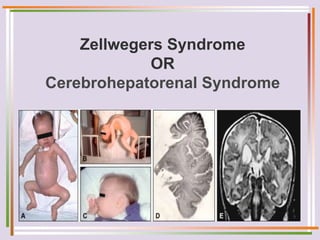
Zellwegers Syndrome
OR
Cerebrohepatorenal Syndrome
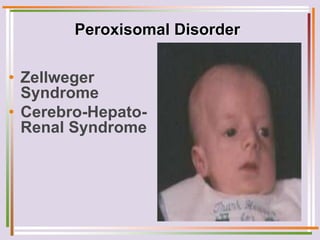
Peroxisomal Disorder
• Zellweger
Syndrome
• Cerebro-Hepato-
Renal Syndrome
Biochemical Causes
• Rare genetic autosomal
recessive disorder.
• Characterized by absence
of functional Peroxisomes.
• Gene mutations in PEX Genes
leads to Zellwegers Syndrome.
 Accumulation of large
abnormal amounts of VLCFAs
in Peroxisomes of tissues.
 No normal function of
Peroxisomes.
Biochemical Alterations
• No oxidation of very long
chain Fatty acids and
branched chain fatty acids in
Peroxisomes
• Progressive degeneration of
Brain/Liver/Kidney, with death ~6
month after onset.
Signs and Symptoms
• Defect in normal function of multiple organ
system.
• Impaired neuronal migration, positioning and
brain development.
• Hypomyelination affecting nerve impulse
transmission.
• Hepatomegaly
• Renal Cysts
• Typical Dysmorphic facies.
Diagnosis
• Detection of Increased levels
of Serum Very Long Chain
Fatty Acids- VLCFAs
Oxidation Of Unsaturated
Fatty Acids
• PUFAs having double bonds in their
structure are unstable.
• Double bonds are hydrolyzed and
metabolized faster than saturated
bonds.
• Thus dietary intake of PUFA get readily
metabolized
• Which reduces risk of Atherosclerosis.
Mechanism Of Oxidation Of
Unsaturated Fatty Acids
• Initial and later Oxidation of PUFA -
• Similar steps of β Oxidation in parts, of
saturated bonds.
• Double bonds of PUFAs are cleaved by
action of Extra Enzymes:
– Isomerase (Enoyl CoA Isomerase)
(For odd numbered double bonds
MUFAs)
–Reductase (2,4 Dienoyl CoA
Reductase)
(For even numbered double bonds
PUFAS)
–Epimerase
(Converts D-Isomer to L-Isomer)
• Enoyl CoA Isomerase handles
odd numbered double bonds in
MUFAs.
• 2,4 Dienoyl CoA Reductase
handles even numbered double
bonds in PUFAs.
• Usually natural unsaturated fatty
acids have cis double bonds.
• Which is transformed to trans
double bonds by the action of an
Isomerase .
• As next enzyme to act is Enoyl
Hydratase ,which acts only on
trans double bonds.
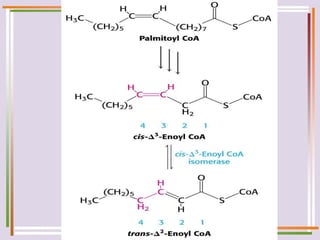
• Enoyl-CoA Isomerase converts
Cis unsaturated Fatty acids to
Trans-  2 Enoyl-CoA
• Now β-oxidation can continue with
hydration of trans- 2-Enoyl-CoA by
Enoyl CoA Hydratase
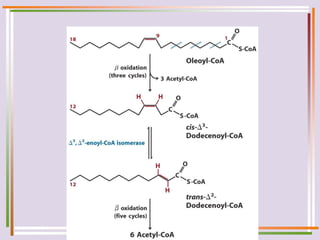
• Oxidation Of
Monounsaturated Fatty
Acids
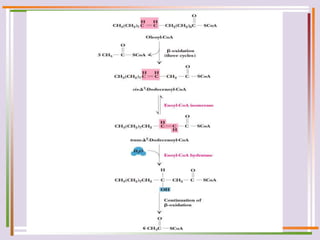
• Oleic acid, Palmitoleic acid
• Normal -oxidation for three cycles
• Cis-3 Acyl-CoA cannot be utilized by
Acyl-CoA dehydrogenase
• Enoyl-CoA Isomerase converts this to
trans- 2 Acyl CoA
 -oxidation continues from this point
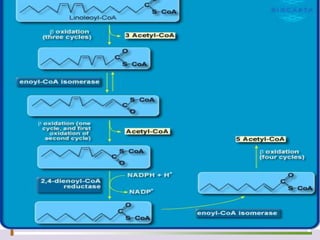
• Oxidation Of Polyunsaturated
Fatty Acids
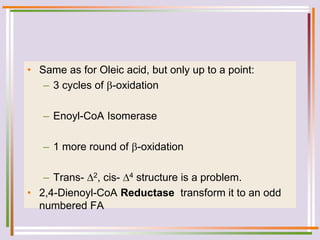
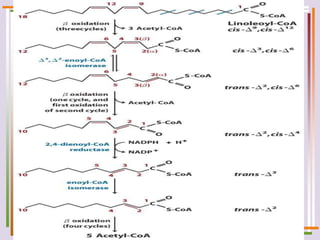
• Same as for Oleic acid, but only up to a point:
– 3 cycles of -oxidation
– Enoyl-CoA Isomerase
– 1 more round of -oxidation
– Trans- 2, cis- 4 structure is a problem.
• 2,4-Dienoyl-CoA Reductase transform it to an odd
numbered FA
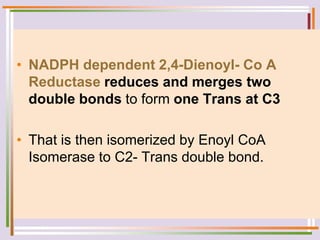
• NADPH dependent 2,4-Dienoyl- Co A
Reductase reduces and merges two
double bonds to form one Trans at C3
• That is then isomerized by Enoyl CoA
Isomerase to C2- Trans double bond.
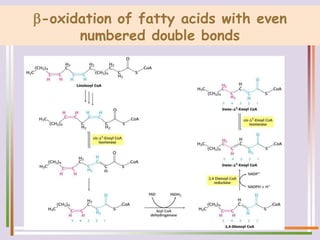
-oxidation of fatty acids with even
numbered double bonds
• The Oxidation of PUFAs provide less
energy than saturated Fatty acids as
they are less reduced compounds.
• At double bonds the Isomerase act and
convert it into Trans –Enoyl CoA.
• This bypasses the Acyl-CoA
Dehydrogenase –FAD linked beta
oxidation reaction.
• 1.5 ATP less per double bond.
FATTY ACIDS OXIDATION IS
OVER
• SO.. WE FINISHED
WITH OXIDATION OF
FATTY ACIDS..
• WE HAVE TO RECALL
THE
IMPORTNCE ONCE
AGAIN DURING
EXAMS…?
• Thank you

fatty-oxidation-MBBS.ppt

  • 1.
    Oxidation of fattyacids V.ARUNA
  • 2.
    Objectives • Importance offatty acid oxidation • Pathway- • Products formed • regulation
  • 3.
  • 4.
  • 5.
    Back to theMatrix!
  • 6.
    Activation of FattyAcids by CoA
  • 7.
    Activation of FattyAcids by CoA
  • 8.
  • 9.
    Overview of β-Oxidation Fattyacids are broken down 2-carbon units at a time, starting at the carboxyl end. And are released as acetyl-CoA.
  • 11.
  • 12.
    Reaction 1: Oxidation Threeisozymes of acyl-CoA dehydrogenase: Long chain (12-18C) Medium chain (4-14C) Short chain (4-8C)
  • 13.
    Electron-Transfer Flavoprotein (ETF) FADH2reducing equivalents are passed to Electron- Transfer Flavoprotein (ETF), which leads to Q via an oxidoreductase
  • 14.
  • 15.
  • 16.
  • 17.
    Stoichiometry for Palmitic AcidOxidation O CH3(CH2)14C S CoA + 7FAD + 7NAD+ + 7CoASH + 7H2O O CH3C S CoA 8 7FADH2 + 7NADH+ + 7CoASH + 7H+ +
  • 19.
    Transport of FattyAcyl CoA from Cytosol into Via Carnitine Shuttle Mitochondrial Matrix Is a Rate-limiting step
  • 20.
    Malonyl-CoA Regulates Beta Oxidation AtCarnitine Transport Level Malonyl-CoA an intermediate of Lipogenesis Is an Inhibitor of Carnitine Acyl Transferase I
  • 21.
    Malonyl-CoA is producedfrom Acetyl-CoA by the enzyme Acetyl-CoA Carboxylase during Fatty acid biosynthesis. Malonyl-CoA (which is a precursor for fatty acid synthesis) inhibits Carnitine Palmitoyl Transferase I. This Control of Fatty acid oxidation is exerted mainly at the step of Fatty acid entry into mitochondria. H3C C SCoA O CH2 C SCoA O  OOC acetyl-CoA malonyl-CoA
  • 22.
    Deficiencies of Carnitine OR CarnitineTransferase OR Translocase Activity Are Related to Disease State
  • 23.
    Biochemical Consequences of CarnitineShuttle Defect • Defect in Carnitine shuttle system • No Beta Oxidation of Fatty acids • No ATP generation • All ATP dependent processes will be ceased • Cell deaths • Organ failures
  • 24.
    Carnitine Shuttle Defects •Affects normal function of Muscles, Kidney, and Heart.
  • 25.
    • Symptoms includeMuscle cramping, during exercise, severe weakness and death. • Muscle weakness occurs since they are related with Fatty acid oxidation for long term energy source.
  • 26.
  • 28.
    SIDS • SIDS isa congenital rare disorder with an incidence of 1 in 10,000 births. • Biochemical Defect: Due to congenital defect of Enzyme Acyl-CoA Dehydrogenase a regulatory enzyme of β Oxidation of Fatty acid.
  • 29.
    • Biochemical ConsequencesOf SIDS • Deficiency of Acyl-CoA Dehydrogenase • Blocks β Oxidation of Fatty acid. • Stops liberation and supply of energy in form of ATPs in fasting condition • Leads to unexpected death of an infant.
  • 30.
    Symptoms in defectiveBeta Oxidation of Fatty acids include:  Hypoglycemia  Low Ketone body production during fasting  Fatty Liver  Heart and/or Skeletal muscle defects  Complications of pregnancy  Sudden infant death (SID).
  • 31.
    • Hereditary deficiencyof Medium Chain Acyl-CoA Dehydrogenase (MCAD) • Most common genetic disease relating to fatty acid catabolism, has been linked to SIDS.
  • 32.
    “Pear-shaped fruit, withseveral moderate lobes and a red to yellow waxy skin. The skin, unripe fruit, and seeds are poisonous. The yellow, fleshy portion surrounding the aril is edible and has a nutty flavor.” Akee (Blighia sapida)
  • 33.
    • Ackee fruitis rich in Hypoglycin –A • Hypoglycin is an inhibitor of regulatory enzyme of β Oxidation Proper –Acyl-CoA Dehydrogenase.
  • 34.
    • Questions: • whatis beta oxidation. • Write the steps in beta oxidation and its importance. • What are the products formed –beta oxidation. • Regulation.
  • 36.
  • 37.
  • 38.
    Phytanic acid isa 16 Carbon Branched chain Fatty Acid.
  • 39.
    Why Phytanic Acid DoesNot Initiate With Beta Oxidation Process?
  • 40.
    • Phytanic acidis a 16 Carbon Branched chain Fatty Acid. • Has Four Methyl branches at odd-number carbons 3,7,11 and 15. • Which is not good substrates for -oxidation.
  • 41.
    • Branched chainPhytanic acid contains Methyl (CH3) group at β Carbon atom. • Hence it cannot get oxidized initially via β oxidation pathway
  • 42.
    Predominantly Alpha Oxidation OfPhytanic Acid Takes Place in Endoplasmic Reticulum of Brain Cells Also In Peroxisomes
  • 43.
    • Branched chainPhytanic acid contains Methyl (CH3) group at β Carbon atom. • Hence it cannot get oxidized initially via β oxidation pathway
  • 45.
    • Thus initiallyPhytanic acid follows α Oxidation • Modify Phytanic acid to Pristanic acid and • Further present it for Beta Oxidation process.
  • 46.
  • 48.
    • Phytanic acid3,7,11,15-Tetramethyl Hexadecanoic acid • Alpha oxidation removes Methyl groups at beta carbon. • Later making Fatty acid ready for beta oxidation process.
  • 50.
    • During αOxidation there occurs: • Hydroxylation at α Carbon in presence of Enzyme Hydroxylase or Monoxygenase . • This reaction is Vitamin C dependent forming α Hydroxy Acyl-CoA.
  • 51.
    • α HydroxyAcyl-CoA is then oxidized to α Keto Acyl- CoA. • Ketonic group at α Carbon atom is decarboxylated • Yielding CO2 molecule and a Fatty acid with one Carbon atom less.
  • 52.
    • Phytanic acidon alpha oxidation is converted to Pristanic acid • Which is further metabolized via beta oxidation process to generate Propionyl-CoA.
  • 53.
    Products of PhytanicAcid Oxidation • Alpha oxidation of Phytanic acid Generates – Acetyl-CoA – Propionyl-CoA –Isobutryl-CoA
  • 54.
    Disorders Associated With Defective αOxidation Of Phytanic Acid
  • 55.
  • 56.
    • Refsums diseaseis a rare but severe neurological disorder. • Caused due to defect in α Oxidation of Phytanic acid
  • 57.
    • Deficiency ofEnzyme Phytanic acid α Oxidase/ Phytanol-CoA Dioxygenase leads to Refsum's disease. • Autosomal Recessive
  • 58.
    • Biochemical ConsequenceOf Refsums disease Is: • No Oxidation of Phytanic acid • Accumulation of Phytanic acid in Brain cells and Other Tissues • Dysfunction of Brain • Manifesting Neurological disorder
  • 60.
    • Management OfRefsums disease is : • Avoid eating diet containing Phytol /Phytanic acid.
  • 61.
  • 62.
    Omega Oxidation OfFatty Acids
  • 63.
    • Omega Oxidationof Fatty acid • Oxidation of Omega Carbon atom (CH3) of a Fatty acid.
  • 64.
    When Does Omega Oxidation OfFatty Acid Occurs?
  • 65.
    • Omega Oxidationtakes place when there is defect in β Oxidation of fatty acid.
  • 66.
    • SO.. WHATHAPPENS? • During ω Oxidation of Fatty acid • ω Carbon atom (CH3) of a Fatty acid is transformed to -COOH
  • 67.
    • Omega oxidationforms Dicarboxylic acid • Which further undergo oxidation • Form more short Dicarboxylic acids Adipic acid and Succinic acid • Which are more polar and excreted out in Urine.
  • 68.
    ω-Oxidation of Fattyacids Occur in Endoplasmic Reticulum of Liver Cells
  • 69.
    Mechanism Of ωOxidation •ω Oxidation of Fatty acid is a minor alternative oxidative Pathway.
  • 70.
    • Omega Oxidationof a Fatty acid takes place with: –Hydroxylation Reaction –Oxidation Reaction
  • 73.
    • During ωOxidation of Fatty acid • ω Carbon atom (CH3) of a Fatty acid is transformed to -COOH
  • 74.
    • In ωOxidation of Fatty acid there occurs Hydroxylation at ω Carbon atom • Converting into Primary terminal Alcohol (-CH2OH) group. • This reaction is catalyzed by NADPH+H+ dependent Cytochrome P450 system • Next primary terminal Alcohol group is oxidized to form -COOH group .
  • 75.
    • Further Dicarboxylicacid generated through Omega Oxidation undergoes beta oxidation • To produce short chain Dicarboxylic acids as Adipic acid and Succinic acid • Which are polar and excreted out through Urine.
  • 76.
    Significance Of OmegaOxidation • Omega Oxidation transforms a non polar Fatty acid to polar Dicarboxylic fatty acid. • Omega Oxidation of fatty acid facilitates excretion of accumulated fatty acids due to defective normal β Oxidation in cells.
  • 78.
  • 79.
    OXIDATION OF FATTYACIDS IN PEROXISOMES  Peroxisomes – Cell organelles containing Enzymes Peroxidase and Catalase  These Enzymes catalyzes dismutation of Hydrogen peroxide into water and molecular oxygen
  • 80.
    -Oxidation of verylong-chain fatty acids(>C22) occurs within Peroxisomes initially  Later undergoes Mitochondrial β Oxidation .
  • 81.
    • Carnitine isinvolved in transfer of Very long Chain Fatty acids (VLCFAS >C22) into and out of Peroxisomes.
  • 82.
    • Peroxisomal Fattyacid oxidation is induced by a high Fat diet with VLCFAs. • To shortens VLCFAs into LCFAs • Which are further degraded by Beta oxidation process.
  • 84.
  • 85.
  • 86.
  • 87.
    • Rare geneticautosomal recessive disorder. • Characterized by absence of functional Peroxisomes.
  • 88.
    • Gene mutationsin PEX Genes leads to Zellwegers Syndrome.  Accumulation of large abnormal amounts of VLCFAs in Peroxisomes of tissues.  No normal function of Peroxisomes.
  • 89.
    Biochemical Alterations • Nooxidation of very long chain Fatty acids and branched chain fatty acids in Peroxisomes
  • 90.
    • Progressive degenerationof Brain/Liver/Kidney, with death ~6 month after onset.
  • 91.
    Signs and Symptoms •Defect in normal function of multiple organ system. • Impaired neuronal migration, positioning and brain development. • Hypomyelination affecting nerve impulse transmission. • Hepatomegaly • Renal Cysts • Typical Dysmorphic facies.
  • 92.
    Diagnosis • Detection ofIncreased levels of Serum Very Long Chain Fatty Acids- VLCFAs
  • 95.
  • 96.
    • PUFAs havingdouble bonds in their structure are unstable. • Double bonds are hydrolyzed and metabolized faster than saturated bonds. • Thus dietary intake of PUFA get readily metabolized • Which reduces risk of Atherosclerosis.
  • 98.
    Mechanism Of OxidationOf Unsaturated Fatty Acids
  • 99.
    • Initial andlater Oxidation of PUFA - • Similar steps of β Oxidation in parts, of saturated bonds.
  • 100.
    • Double bondsof PUFAs are cleaved by action of Extra Enzymes: – Isomerase (Enoyl CoA Isomerase) (For odd numbered double bonds MUFAs) –Reductase (2,4 Dienoyl CoA Reductase) (For even numbered double bonds PUFAS) –Epimerase (Converts D-Isomer to L-Isomer)
  • 101.
    • Enoyl CoAIsomerase handles odd numbered double bonds in MUFAs. • 2,4 Dienoyl CoA Reductase handles even numbered double bonds in PUFAs.
  • 102.
    • Usually naturalunsaturated fatty acids have cis double bonds. • Which is transformed to trans double bonds by the action of an Isomerase . • As next enzyme to act is Enoyl Hydratase ,which acts only on trans double bonds.
  • 103.
    • Enoyl-CoA Isomeraseconverts Cis unsaturated Fatty acids to Trans-  2 Enoyl-CoA • Now β-oxidation can continue with hydration of trans- 2-Enoyl-CoA by Enoyl CoA Hydratase
  • 105.
  • 106.
    • Oleic acid,Palmitoleic acid • Normal -oxidation for three cycles • Cis-3 Acyl-CoA cannot be utilized by Acyl-CoA dehydrogenase • Enoyl-CoA Isomerase converts this to trans- 2 Acyl CoA  -oxidation continues from this point
  • 109.
    • Oxidation OfPolyunsaturated Fatty Acids
  • 110.
    • Same asfor Oleic acid, but only up to a point: – 3 cycles of -oxidation – Enoyl-CoA Isomerase – 1 more round of -oxidation – Trans- 2, cis- 4 structure is a problem. • 2,4-Dienoyl-CoA Reductase transform it to an odd numbered FA
  • 111.
    • NADPH dependent2,4-Dienoyl- Co A Reductase reduces and merges two double bonds to form one Trans at C3 • That is then isomerized by Enoyl CoA Isomerase to C2- Trans double bond.
  • 116.
    -oxidation of fattyacids with even numbered double bonds
  • 117.
    • The Oxidationof PUFAs provide less energy than saturated Fatty acids as they are less reduced compounds. • At double bonds the Isomerase act and convert it into Trans –Enoyl CoA. • This bypasses the Acyl-CoA Dehydrogenase –FAD linked beta oxidation reaction. • 1.5 ATP less per double bond.
  • 118.
    FATTY ACIDS OXIDATIONIS OVER • SO.. WE FINISHED WITH OXIDATION OF FATTY ACIDS.. • WE HAVE TO RECALL THE IMPORTNCE ONCE AGAIN DURING EXAMS…?
  • 119.