Definition
• Beta-Oxidation may be defined as the oxidation of
fatty acids on the beta-carbon atom.
• This results in the sequential removal of a two
carbon fragment, acetyl CoA.
• Three stages
• Activation of fatty acids occurring in the cytosol
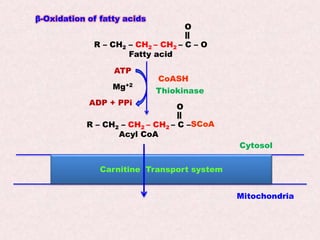
• Transport of fatty acids into mitochondria
• Beta-Oxidation proper in the mitochondrial matrix
• Fatty acids are oxidized by most of the tissues in
the body.
• Brain, erythrocytes and adrenal medulla cannot
utilize fatty acids for energy requirement.
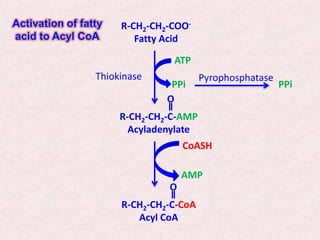
• Fatty acids are activated to acyl CoA by thiokinases or acyl
CoA synthetases
• The reaction occurs in two steps and requires ATP,
coenzyme A and Mg2+
• Fatty acid reacts with ATP to form acyladenylate which then
combines with coenzyme A to produce acyl CoA.
• Two high energy phosphates are utilized, since ATP is
converted to pyrophosphate (PPi).
• The enzyme inorganic pyrophosphafase hydrolyses PPi to
phosphate.
• The immediate elimination of PPi makes this reaction totally
irreversible.
R-CH2-CH2-COO-
Fatty Acid
R-CH2-CH2-C-AMP
Acyladenylate
R-CH2-CH2-C-CoA
Acyl CoA
O
O
ATP
PPi
Thiokinase
PPi
Pyrophosphatase
CoASH
AMP
• The inner mitochondrial membrane is impermeable
to fatty acids.
• A specialized carnitine carrier system (carnitine
shuttle) operates to transport activated fatty acids
from cytosol to the mitochondria.
• This occurs in four steps
1. Acyl group of acyl CoA is transferred to carnitine (β-
hydroxy γ-trimethyl aminobutyrate)
catalyzed by carnitine acyltransferasIe (CAT)
(present on the outer surface of inner mitochondrial
membrane).
2. The acyl-carnitine is transported across the
membrane to mitochondrial matrix by a specific
carrier protein.
3. Carnitine acyl transferase ll (found on the inner
surface of inner mitochondrial membrane) converts
acyl-carnitine to acyl CoA.
4. The carnitine released returns to cytosol for reuse.
Carrier
Protein
Acyl CoA Carnitine
CoASH Acyl Carnitine Acyl Carnitine
Carnitine
CoASH
Acyl CoA
CAT-I CAT-II
Cytosol Mitochondrial Matrix
Inner
Mitochondrial
membrane
• Each cycle of β -oxidation, liberating a two
carbon unit-acetyl CoA, occurs in a sequence of
four reactions
1. Oxidation
2. Hydration
3. Oxidation
4. Cleavage
1.Oxidation
• Acyl CoA undergoes dehydrogenation by an
FAD-dependent flavoenzyme, acyl CoA
dehydrogenase.
• A double bond is formed between α and β
carbons (i.e., 2 and 3 carbons)
2.Hydration:
• Enoyl CoA hydratase brings
• about the hydration of the double bond to form β -
hydroxyacyl CoA.
3.Oxidation
• β-Hydroxyacyl CoA dehydrogenase
catalyses the second oxidation and generates
NADH.
• The product formed is β-ketoacyl CoA.
4.Cleavage
• The final reaction in β -oxidation is the liberation
of a 2 carbon fragment, acetyl CoA from acyl
CoA.
• This occurs by a thiolytic cleavage catalysed by
β-ketoacyl CoA thiolase (or thiolase).
• The new acyl CoA, containing two carbons
less than the original, reenters the β-
oxidation cycle.
• The process continues till the fatty acid is
completely oxidized.
R – CH2 – CH2 – CH2 – C – O
Fatty acid
O
R – CH2 – CH2 – CH2 – C –
Acyl CoA
O
Thiokinase
ATP
ADP + PPi
Mg+2
SCoA
Carnitine Transport system
Cytosol
Mitochondria
CoASH
β-Oxidation of fatty acids
R – CH2 – CH2 – CH2 – C – SCoA
Acyl CoA
O
FAD
FADH2
1.5ATP ----- ETC
Acyl CoA
Dehydrogenase
R – CH2 – CH CH – C – SCoA
Trans-enoyl CoA
O
R – CH2 – CH – CH2 – C – SCoA
β - Hydroxyacyl CoA
O
OH
Enoyl CoA
Hydratase
H2O
SIDS
R – CH2 – CH – CH2 – C – SCoA
β - Hydroxyacyl CoA
O
OH
NAD
NADH + H+
2.5ATP ----- ETC
β-Hydroxy Acyl CoA
Dehydrogenase
R – CH2 – C – CH2 – C – SCoA
β - Ketoacyl CoA
O
O
Thiolase
R – CH2 – C – SCoA
Acyl CoA
O
CH3 – C – SCoA
Acetyl CoA
O
TCA
Cycle
Acyl CoA
Oxidation of palmitoyl CoA
• Palmitoyl CoA + 7 CoASH + 7 FAD +
7 NAD+ + 7 H2O 8 Acetyl CoA + 7
FADH2 + 7 NADH + 7H+
• Palmitoyl CoA undergoes 7 cycles of β -oxidation
to yield 8 acetyl CoA.
• Acetyl CoA can enter citric acid cycle and get
completely oxidized to CO2 and H2O.
Energetics of β -oxidation
Mechanism ATP yield
I. β- 0xidation 7 cycles
7 FADH2 [Oxidized by electron transport Chain (ETC) each
FADH2 gives 2 ATP ]
7 NADH (Oxidized by ETC, each NADH
Liberate 3A TP)
10.5
17.5
II. From 8 Acetyl CoA
Oxidized by citric acid cycle, each acetyl CoA
provides 12 A TP
80
Total energy from one molecule of palmitoyl CoA
Energy utilized for activation
(Formation of palmitoyl Co A)
108
-2
Net yield of oxidation of one molecule of palmitate =106
Sudden infant death syndrome (SIDS)
• Unexpected death of healthy infants, usually overnight
• Due to deficiency of medium chain acyl CoA
dehydrogenase.
• Glucose is the principal source of energy, soon after
eating or feeding babies.
• After a few hours, the glucose level and its utilization
decrease and the rate of fatty acid oxidation must
simultaneously increase to meet the energy needs.
• The sudden death in infants is due to a blockade in β -
oxidation caused by a deficiency in medium chain acyl
CoA dehydrogenase (MCAD)
Jamaican vomiting sickness
• This disease is characterized by severe
hypoglycemia, vomiting, convulsions, coma and
death.
• lt is caused by eating unriped ackee fruit which
contains an unusual toxic amino acid,
hypoglycin A.
• This inhibits the enzyme acyl CoA
dehydrogenase and thus β -oxidation of fatty
acids is blocked, leading to various
complications
• Abnormalities in transport of fatty acids into
mitochondria & defects in oxidation leads to
deficient energy production by oxidation of long
chain fatty acids.
• Features:
• Hypoketotic hypoglycemia, hyperammonemia,
skeletal muscle weakness & liver diseases.
• Acyl carnitine accumulates when the
transferases or translocase is deficient.
• Dietary supplementation of carnitine improve the
condition.
• Oxidation of odd chain fatty acids is similar to
that of even chain fatty acids.
• At the end 3 carbon unit, propionyl CoA is
produced.
• Propionyl CoA is converted into succinyl CoA.
• Succinyl CoA is an intermediate in TCA cycle
• So, propionyl CoA is gluconeogenic.
• Propionyl CoA is carboxylated to D-methyl
malonyl CoA by a biotin dependent carboxylase.
• Biotin is B7 vitamin & ATP is utilized in this step.
• Recemase:
• Recemase acts upon D-methyl malonyl CoA to
give L-methyl malonyl CoA.
• This reaction is essential for the entry of this
compound into metabolic reactions of body.
• Mutase:
• Mutase catalyzes the conversion of L-methyl
malonyl CoA (a branched chain compound) to
succinyl CoA (a straight chain compound).
• Mutase is an vitamin B12 dependent enzyme.
• Succinyl CoA enters the TCA cycle, & converted
into oxaloacetate, it is used for gluconeogenesis.
• Propionyl CoA is also derived from metabolism
of valine & isoleucine.
CH3
I
CH2
I
CO-S-CoA
Propionyl CoA
CH3
I
H - C- COO-
I
CO-S-CoA
D-methyl malonyl CoA
CH3
I
-OOC – C - H
I
CO-S-CoA
L - methyl malonyl CoA
COO-
I
CH2
I
CH2
I
CO-S-CoA
Succinyl CoA
Propionyl CoA
carboxylase
ATP ADP + Pi
CO2
Methyl malonyl
CoA recemase
Methyl malonyl
CoA mutase
Vitamin B12
TCA
Biotin
• Propionyl CoA carboxylase deficiency:
• Characterized by propionic acidemia,
ketoacidosis & developmental abnormalities.
• Methyl malonic aciduria:
• Two types of methyl malonic acidemias
• Due to deficiency of vitamin B12
• Due to defect in the enzyme methyl malonyl CoA
mutase or recemase.
• Accumulation of methyl malonic acid in the body.
• Methyl malonic acid is excreted into urine.
• Symptoms:
• Severe metabolic acidosis, damages the central
nervous system & growth retardation.
• Fetal in early life.
• Treatment:
• Some patients respond to treatment with
pharmacological doses of B12.
• Oxidation of fatty acids on α-carbon atom is known
as α-oxidation.
• In this, removal of one carbon unit from the
carboxyl end.
• Energy is not produced.
• No need of fatty acid activation & coenzyme A
• Hydroxylation occurs at α-carbon atom.
• It is then oxidized to α-keto acid.
• This, keto acid undergoes decarboxylation,
yielding a molecule of CO2 & FA with one carbon
atom less.
• Occurs in endoplasmic reticulum.
• Some FA undergo α - oxidation in peroxisomes.
• α- oxidation is mainly used for fatty acids that
have a methyl group at the beta-carbon, which
blocks beta- oxidation.
• Major dietary methylated fatty acid is phytanic
acid.
• It is derived from phytol present in chlorophyll,
milk & animal fats.
Refsum’s disease
• Due to deficiency of the enzyme α-hydroxylase (phytanic
acid oxidase)
• α – oxidation does not occur.
• Phytanic acid does not converted into compound that
can be degraded by beta –oxidation.
• Phytanic acid accumulates in tissues.
• Symptoms:
• Severe neurological symptoms, polyneuropathy, retinitis
pigmentosa, nerve deafness & cerebellar ataxia.
• Restricted dietary intake of phytanic acid (including milk-
is a good source of phytanic acid)
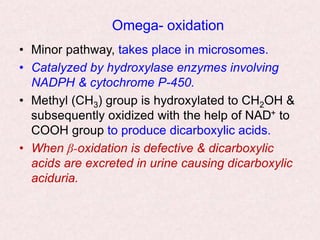
Omega- oxidation
• Minor pathway, takes place in microsomes.
• Catalyzed by hydroxylase enzymes involving
NADPH & cytochrome P-450.
• Methyl (CH3) group is hydroxylated to CH2OH &
subsequently oxidized with the help of NAD+ to
COOH group to produce dicarboxylic acids.
• When β-oxidation is defective & dicarboxylic
acids are excreted in urine causing dicarboxylic
aciduria.
Beta oxidation210621.pptx

Beta oxidation210621.pptx

  • 1.
    Definition • Beta-Oxidation maybe defined as the oxidation of fatty acids on the beta-carbon atom. • This results in the sequential removal of a two carbon fragment, acetyl CoA.
  • 2.
    • Three stages •Activation of fatty acids occurring in the cytosol • Transport of fatty acids into mitochondria • Beta-Oxidation proper in the mitochondrial matrix • Fatty acids are oxidized by most of the tissues in the body. • Brain, erythrocytes and adrenal medulla cannot utilize fatty acids for energy requirement.
  • 3.
    • Fatty acidsare activated to acyl CoA by thiokinases or acyl CoA synthetases • The reaction occurs in two steps and requires ATP, coenzyme A and Mg2+ • Fatty acid reacts with ATP to form acyladenylate which then combines with coenzyme A to produce acyl CoA. • Two high energy phosphates are utilized, since ATP is converted to pyrophosphate (PPi). • The enzyme inorganic pyrophosphafase hydrolyses PPi to phosphate. • The immediate elimination of PPi makes this reaction totally irreversible.
  • 4.
  • 5.
    • The innermitochondrial membrane is impermeable to fatty acids. • A specialized carnitine carrier system (carnitine shuttle) operates to transport activated fatty acids from cytosol to the mitochondria. • This occurs in four steps 1. Acyl group of acyl CoA is transferred to carnitine (β- hydroxy γ-trimethyl aminobutyrate)
  • 6.
    catalyzed by carnitineacyltransferasIe (CAT) (present on the outer surface of inner mitochondrial membrane). 2. The acyl-carnitine is transported across the membrane to mitochondrial matrix by a specific carrier protein. 3. Carnitine acyl transferase ll (found on the inner surface of inner mitochondrial membrane) converts acyl-carnitine to acyl CoA. 4. The carnitine released returns to cytosol for reuse.
  • 7.
    Carrier Protein Acyl CoA Carnitine CoASHAcyl Carnitine Acyl Carnitine Carnitine CoASH Acyl CoA CAT-I CAT-II Cytosol Mitochondrial Matrix Inner Mitochondrial membrane
  • 8.
    • Each cycleof β -oxidation, liberating a two carbon unit-acetyl CoA, occurs in a sequence of four reactions 1. Oxidation 2. Hydration 3. Oxidation 4. Cleavage
  • 9.
    1.Oxidation • Acyl CoAundergoes dehydrogenation by an FAD-dependent flavoenzyme, acyl CoA dehydrogenase. • A double bond is formed between α and β carbons (i.e., 2 and 3 carbons) 2.Hydration: • Enoyl CoA hydratase brings • about the hydration of the double bond to form β - hydroxyacyl CoA.
  • 10.
    3.Oxidation • β-Hydroxyacyl CoAdehydrogenase catalyses the second oxidation and generates NADH. • The product formed is β-ketoacyl CoA. 4.Cleavage • The final reaction in β -oxidation is the liberation of a 2 carbon fragment, acetyl CoA from acyl CoA. • This occurs by a thiolytic cleavage catalysed by β-ketoacyl CoA thiolase (or thiolase).
  • 11.
    • The newacyl CoA, containing two carbons less than the original, reenters the β- oxidation cycle. • The process continues till the fatty acid is completely oxidized.
  • 12.
    R – CH2– CH2 – CH2 – C – O Fatty acid O R – CH2 – CH2 – CH2 – C – Acyl CoA O Thiokinase ATP ADP + PPi Mg+2 SCoA Carnitine Transport system Cytosol Mitochondria CoASH β-Oxidation of fatty acids
  • 13.
    R – CH2– CH2 – CH2 – C – SCoA Acyl CoA O FAD FADH2 1.5ATP ----- ETC Acyl CoA Dehydrogenase R – CH2 – CH CH – C – SCoA Trans-enoyl CoA O R – CH2 – CH – CH2 – C – SCoA β - Hydroxyacyl CoA O OH Enoyl CoA Hydratase H2O SIDS
  • 14.
    R – CH2– CH – CH2 – C – SCoA β - Hydroxyacyl CoA O OH NAD NADH + H+ 2.5ATP ----- ETC β-Hydroxy Acyl CoA Dehydrogenase R – CH2 – C – CH2 – C – SCoA β - Ketoacyl CoA O O Thiolase R – CH2 – C – SCoA Acyl CoA O CH3 – C – SCoA Acetyl CoA O TCA Cycle Acyl CoA
  • 15.
    Oxidation of palmitoylCoA • Palmitoyl CoA + 7 CoASH + 7 FAD + 7 NAD+ + 7 H2O 8 Acetyl CoA + 7 FADH2 + 7 NADH + 7H+ • Palmitoyl CoA undergoes 7 cycles of β -oxidation to yield 8 acetyl CoA. • Acetyl CoA can enter citric acid cycle and get completely oxidized to CO2 and H2O.
  • 16.
    Energetics of β-oxidation Mechanism ATP yield I. β- 0xidation 7 cycles 7 FADH2 [Oxidized by electron transport Chain (ETC) each FADH2 gives 2 ATP ] 7 NADH (Oxidized by ETC, each NADH Liberate 3A TP) 10.5 17.5 II. From 8 Acetyl CoA Oxidized by citric acid cycle, each acetyl CoA provides 12 A TP 80 Total energy from one molecule of palmitoyl CoA Energy utilized for activation (Formation of palmitoyl Co A) 108 -2 Net yield of oxidation of one molecule of palmitate =106
  • 17.
    Sudden infant deathsyndrome (SIDS) • Unexpected death of healthy infants, usually overnight • Due to deficiency of medium chain acyl CoA dehydrogenase. • Glucose is the principal source of energy, soon after eating or feeding babies. • After a few hours, the glucose level and its utilization decrease and the rate of fatty acid oxidation must simultaneously increase to meet the energy needs. • The sudden death in infants is due to a blockade in β - oxidation caused by a deficiency in medium chain acyl CoA dehydrogenase (MCAD)
  • 18.
    Jamaican vomiting sickness •This disease is characterized by severe hypoglycemia, vomiting, convulsions, coma and death. • lt is caused by eating unriped ackee fruit which contains an unusual toxic amino acid, hypoglycin A. • This inhibits the enzyme acyl CoA dehydrogenase and thus β -oxidation of fatty acids is blocked, leading to various complications
  • 19.
    • Abnormalities intransport of fatty acids into mitochondria & defects in oxidation leads to deficient energy production by oxidation of long chain fatty acids. • Features: • Hypoketotic hypoglycemia, hyperammonemia, skeletal muscle weakness & liver diseases. • Acyl carnitine accumulates when the transferases or translocase is deficient. • Dietary supplementation of carnitine improve the condition.
  • 20.
    • Oxidation ofodd chain fatty acids is similar to that of even chain fatty acids. • At the end 3 carbon unit, propionyl CoA is produced. • Propionyl CoA is converted into succinyl CoA. • Succinyl CoA is an intermediate in TCA cycle • So, propionyl CoA is gluconeogenic.
  • 21.
    • Propionyl CoAis carboxylated to D-methyl malonyl CoA by a biotin dependent carboxylase. • Biotin is B7 vitamin & ATP is utilized in this step. • Recemase: • Recemase acts upon D-methyl malonyl CoA to give L-methyl malonyl CoA. • This reaction is essential for the entry of this compound into metabolic reactions of body.
  • 22.
    • Mutase: • Mutasecatalyzes the conversion of L-methyl malonyl CoA (a branched chain compound) to succinyl CoA (a straight chain compound). • Mutase is an vitamin B12 dependent enzyme. • Succinyl CoA enters the TCA cycle, & converted into oxaloacetate, it is used for gluconeogenesis. • Propionyl CoA is also derived from metabolism of valine & isoleucine.
  • 23.
    CH3 I CH2 I CO-S-CoA Propionyl CoA CH3 I H -C- COO- I CO-S-CoA D-methyl malonyl CoA CH3 I -OOC – C - H I CO-S-CoA L - methyl malonyl CoA COO- I CH2 I CH2 I CO-S-CoA Succinyl CoA Propionyl CoA carboxylase ATP ADP + Pi CO2 Methyl malonyl CoA recemase Methyl malonyl CoA mutase Vitamin B12 TCA Biotin
  • 24.
    • Propionyl CoAcarboxylase deficiency: • Characterized by propionic acidemia, ketoacidosis & developmental abnormalities. • Methyl malonic aciduria: • Two types of methyl malonic acidemias • Due to deficiency of vitamin B12 • Due to defect in the enzyme methyl malonyl CoA mutase or recemase. • Accumulation of methyl malonic acid in the body.
  • 25.
    • Methyl malonicacid is excreted into urine. • Symptoms: • Severe metabolic acidosis, damages the central nervous system & growth retardation. • Fetal in early life. • Treatment: • Some patients respond to treatment with pharmacological doses of B12.
  • 26.
    • Oxidation offatty acids on α-carbon atom is known as α-oxidation. • In this, removal of one carbon unit from the carboxyl end. • Energy is not produced. • No need of fatty acid activation & coenzyme A • Hydroxylation occurs at α-carbon atom. • It is then oxidized to α-keto acid. • This, keto acid undergoes decarboxylation, yielding a molecule of CO2 & FA with one carbon atom less.
  • 27.
    • Occurs inendoplasmic reticulum. • Some FA undergo α - oxidation in peroxisomes. • α- oxidation is mainly used for fatty acids that have a methyl group at the beta-carbon, which blocks beta- oxidation. • Major dietary methylated fatty acid is phytanic acid. • It is derived from phytol present in chlorophyll, milk & animal fats.
  • 28.
    Refsum’s disease • Dueto deficiency of the enzyme α-hydroxylase (phytanic acid oxidase) • α – oxidation does not occur. • Phytanic acid does not converted into compound that can be degraded by beta –oxidation. • Phytanic acid accumulates in tissues. • Symptoms: • Severe neurological symptoms, polyneuropathy, retinitis pigmentosa, nerve deafness & cerebellar ataxia. • Restricted dietary intake of phytanic acid (including milk- is a good source of phytanic acid)
  • 29.
    Omega- oxidation • Minorpathway, takes place in microsomes. • Catalyzed by hydroxylase enzymes involving NADPH & cytochrome P-450. • Methyl (CH3) group is hydroxylated to CH2OH & subsequently oxidized with the help of NAD+ to COOH group to produce dicarboxylic acids. • When β-oxidation is defective & dicarboxylic acids are excreted in urine causing dicarboxylic aciduria.