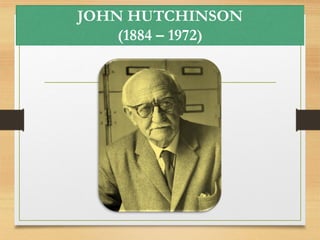
• John Hutchinsonwas a British botanist associated
with Royal Botanic Gardens, Kew, England.
• He developed and proposed his system based on
Bentham and Hooker and also on Bessey.
• His phylogenetic system first appeared as “The
Families of Flowering Plants” in two volumes.
JOHN HUTCHINSON
(1884 – 1972)
4.
HUTCHINSON’S SYSTEM OF
CLASSIFICATION
•The first volume contains Dicotyledons (published in
1926) and second volume contains Monocotyledons
(published in 1934). He made several revisions in
different years.
• The final revision of “The Families of Flowering
Plants” was made just before his death on 2nd
September 1972 and the 3rd i.e., the final edition, was
published in 1973.
5.
The following principleswere adopted by
Hutchinson to classify the flowering plants:
• 1. Evolution takes place in both upward and
downward direction.
• 2. During evolution all organs do not evolve at the
same time.
• 3. Generally, evolution has been consistent.
• 4. Trees and shrubs are more primitive than herbs in
a group like genus or family.
6.
• 5. Treesand shrubs are primitive than climbers.
• 6. Perennials are older than annuals and biennials.
• 7. Terrestrial angiosperms are primitive than aquatic
angiosperms.
• 8. Dicotyledonous plants are primitive than
monocotyledonous plants.
• 9. Spiral arrangement of vegetative and floral members
are primitive than cyclic arrangements.
7.
• 10. Normally,simple leaves are more primitive than
compound leaves.
• 11. Bisexual plants are primitive than unisexual plants
and monoecious plants are primitive than dioecious
plants.
• 12. Solitary flowers are primitive than flowers on
inflorescence.
• 13. Types of aestivation gradually evolved from
contorted to imbricate to valvate.
• 14. Polymerous flowers precede oligomerous flowers.
• 15. Polypetalous flowers are more primitive than
gamopetalous flowers.
8.
• 16. Flowerswith petals are more primitive than
apetalous flowers.
• 17. Actinomorphic flowers are more primitive than
zygomorphic flowers.
• 18. Hypogyny is considered as more primitive from
which perigyny and epigyny gradually evolved.
• 19. Apocarpous pistil is more primitive than syncarpous
pistil.
• 20. Polycarpy is more primitive than gynoecium with
few carpels.
9.
• 21. Flowerswith many stamens are primitive
than flowers with few stamens.
• 22. Flowers with separate anthers are
primitive than flowers with fused anthers
and/filaments.
• 23. Endospermic seeds with small embryo is
primitive than non-endospermic one with a
large embryo.
• 24. Single fruits are primitive than aggregate
fruits.
10.
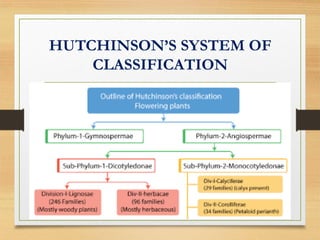
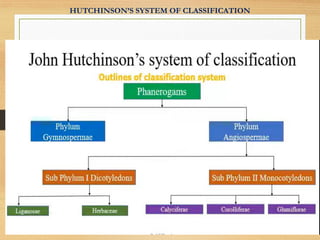
• He dividedthe Phylum Angiospermae into two
Subphyla Dicotyledones and Monocotyledones.
• The Dicotyledones are further divided into two
divisions — Lignosae (arboreal) and Herbaceae
(herbaceous).
• The Lignosae includes, fundamentally, the woody
representatives derived from Magnoliales and
Herbaceae includes most of the predominantly herba-
ceous families derived from Ranales. The subphylum
Monocotyledones are divided into three divisions —
Calyciferae, Corolliferae and Glumiflorae.
11.
• 1. Thedivision Lignosae was further divided into 54
orders beginning with Magnoliales and ending in
Verbenales.
• 2. The division Herbaceae was divided into 28 orders
beginning with Ranales and ending in Lamiales.
• 3. The division Calyciferae was divided into 12 orders
beginning with Butamales and ending in Zingiberales.
• 4. The division Corolliferae was divided into 14 orders
beginning with Liliales and ending in Orchidales.
• 5. The division Glumiflorae was divided into 3 orders
beginning with Juncales and ending in Graminales.
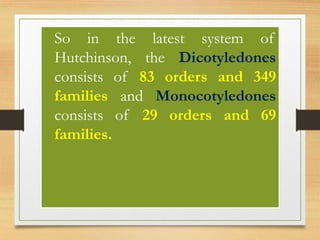
• So inthe latest system of
Hutchinson, the Dicotyledones
consists of 83 orders and 349
families and Monocotyledones
consists of 29 orders and 69
families.
15.
MERITS
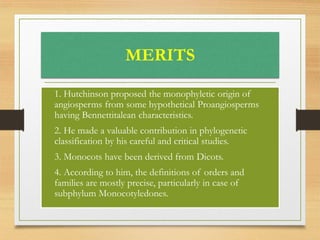
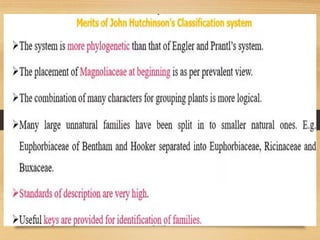
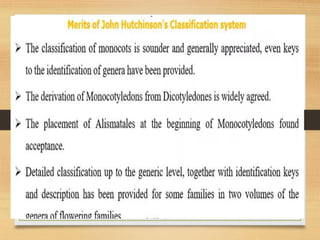
• 1. Hutchinsonproposed the monophyletic origin of
angiosperms from some hypothetical Proangiosperms
having Bennettitalean characteristics.
• 2. He made a valuable contribution in phylogenetic
classification by his careful and critical studies.
• 3. Monocots have been derived from Dicots.
• 4. According to him, the definitions of orders and
families are mostly precise, particularly in case of
subphylum Monocotyledones.
18.
DEMERITS
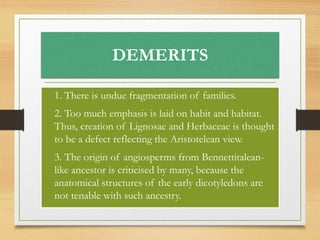
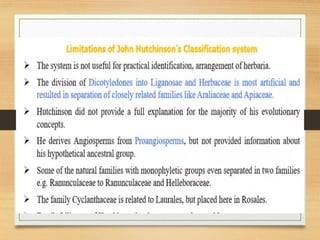
• 1. Thereis undue fragmentation of families.
• 2. Too much emphasis is laid on habit and habitat.
Thus, creation of Lignosae and Herbaceae is thought
to be a defect reflecting the Aristotelean view.
• 3. The origin of angiosperms from Bennettitalean-
like ancestor is criticised by many, because the
anatomical structures of the early dicotyledons are
not tenable with such ancestry.
20.
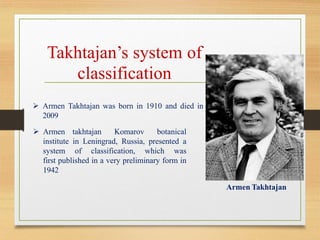
➢ Armen Takhtajanwas born in 1910 and died in
2009
Armen Takhtajan
Takhtajan’s system of
classification
➢ Armen takhtajan Komarov botanical
institute in Leningrad, Russia, presented a
system of classification, which was
first published in a very preliminary form in
1942
21.
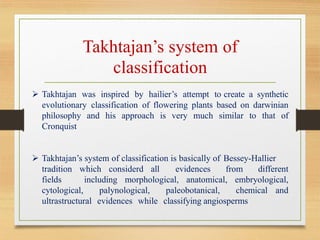
➢ Takhtajan wasinspired by hailier’s attempt to create a synthetic
evolutionary classification of flowering plants based on darwinian
philosophy and his approach is very much similar to that of
Cronquist
➢ Takhtajan’s system of classification is basically of Bessey-Hallier
tradition which considerd all evidences from different
fields including morphological, anatomical, embryological,
cytological, palynological, paleobotanical, chemical and
ultrastructural evidences while classifying angiosperms
Takhtajan’s system of
classification
22.
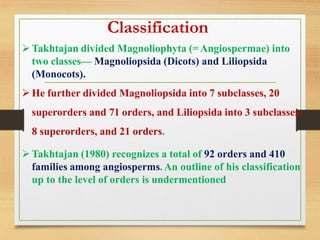
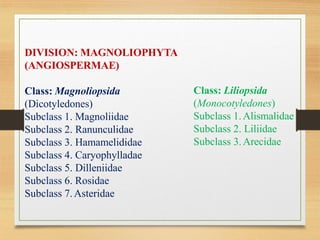
➢Takhtajan divided Magnoliophyta(=Angiospermae) into
two classes— Magnoliopsida (Dicots) and Liliopsida
(Monocots).
➢He further divided Magnoliopsida into 7 subclasses, 20
superorders and 71 orders, and Liliopsida into 3 subclasses,
8 superorders, and 21 orders.
➢Takhtajan (1980) recognizes a total of 92 orders and 410
families among angiosperms. An outline of his classification
up to the level of orders is undermentioned
Classification
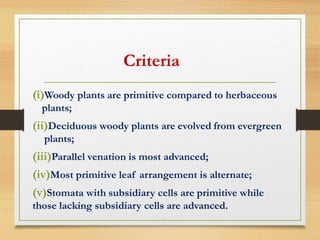
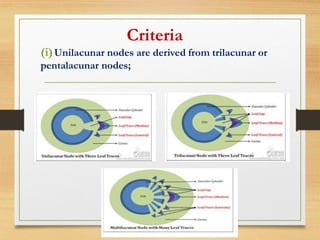
(i)Woody plants areprimitive compared to herbaceous
plants;
(ii)Deciduous woody plants are evolved from evergreen
plants;
(iii)Parallel venation is most advanced;
(iv)Most primitive leaf arrangement is alternate;
(v)Stomata with subsidiary cells are primitive while
those lacking subsidiary cells are advanced.
Criteria
(vii)Xylem fibres evolvedfrom tracheids to libriform
fibres, through fibre tracheids
(viii)Flowers with an indefinite or a variable number of
their floral parts are primitive
(ix)Cymose inflorescence is primitive while racemose
is derived
(x) Pollen grains with their exine lacking any external
sculpturing are primitive while those having various
types of sculptures are advanced
Criteria
27.
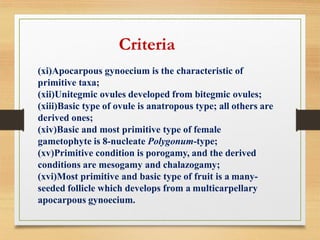
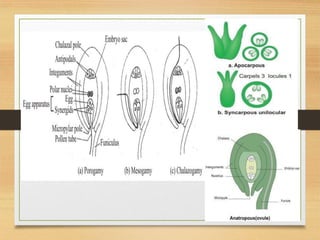
(xi)Apocarpous gynoecium isthe characteristic of
primitive taxa;
(xii)Unitegmic ovules developed from bitegmic ovules;
(xiii)Basic type of ovule is anatropous type; all others are
derived ones;
(xiv)Basic and most primitive type of female
gametophyte is 8-nucleate Polygonum-type;
(xv)Primitive condition is porogamy, and the derived
conditions are mesogamy and chalazogamy;
(xvi)Most primitive and basic type of fruit is a many-
seeded follicle which develops from a multicarpellary
apocarpous gynoecium.
Criteria
29.
Merits of theSystem of Takhtajan
1.Dicots (Magnoliopsida) are discussed prior to monocots
(Liliopsida).
2.Dicots begin with the Magnoliales which are universally
considered to be the most primitive living angiosperms.
3.In this system the families are small homogeneous units
made up of closely related genera.
4.Division of Dicots into two traditional groups of Engler and
Prantl, i.e.
Archichlamydae and Metachlamydae, has been abolished in
this system.
5.Alismatales, which are considered to be the most
primitive living monocots these days, are the starting point
of monocots in this system.
30.
Demerit of theSystem of Takhtajan
One strong demerit is the extremely narrowly
defined taxa in this system that has resulted in the
unwarranted splitting of the related groups.