CLASSIFICATION SYSTEM
Presented by
Dr. Upakar Rai
Department of Botany
St. Joeph’s College, Darjeeling WB
CLASSIFICATION SYSTEM
Arrangement of plants into groups based upon similarity and differences
Groups assembled in larger inclusive group sharing some commonality
Based on artificial character, overall similarities on morphology and phenetic
relationship
BENTHAM AND HOOKER’S SYSTEM OF CLASSIFICATION
 Genera Plantarum – 3 volumes (1860 – 1883)
 Contains descriptions of 202 families and 7567 genera
 Based on refinement of AP deCandole and Lindley
 Grouping done based on natural affinities actually studied on specimen on
field
 Followed throughout the herbaria of world (Colonial countries)
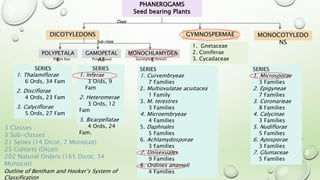
PHANEROGAMS
Seed bearing Plants
DICOTYLEDONS GYMNOSPERMAE MONOCOTYLEDO
NS
POLYPETALA
E
GAMOPETAL
AE
MONOCHLAMYDEA
E
SERIES
1. Thalamiflorae
6 Ords, 34 Fam
2. Disciflorae
4 Ords, 23 Fam
3. Calyciflorae
5 Ords, 27 Fam
SERIES
1. Inferae
3 Ords, 9
Fam
2. Heteromerae
3 Ords, 12
Fam
3. Bicarpellatae
4 Ords, 24
Fam.
SERIES
1. Curvembryeae
7 Families
2. Multiovulatae acuitacea
1 Family
3. M. terestres
3 Families
4. Microembryeae
4 Families
5. Daphnales
5 Families
6. Achlamydosporae
3 Families
7. Unisexuales
9 Families
8. Ordines anamoli
4 Families
1. Gnetaceae
2. Coniferae
3. Cycadaceae
SERIES
1. Microsporae
3 Families
2. Epigyneae
7 Families
3. Coronarieae
8 Families
4. Calycinae
3 Families
5. Nudiflorae
5 Families
6. Aposporae
3 Families
7. Glumaceae
5 Families
Sub-class
Class
Petals free Petals fused Incomplete flowers
Outline of Bentham and Hooker’s System of
Classification
3 Classes
3 Sub-classes
21 Series (14 Dicot; 7 Monocot)
25 Cohorts (Dicot)
202 Natural Orders (165 Dicot; 34
Monocot)
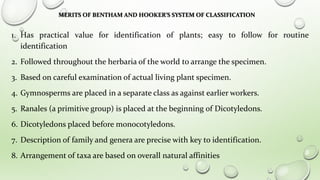
MERITS OF BENTHAM AND HOOKER’S SYSTEM OF CLASSIFICATION
1. Has practical value for identification of plants; easy to follow for routine
identification
2. Followed throughout the herbaria of the world to arrange the specimen.
3. Based on careful examination of actual living plant specimen.
4. Gymnosperms are placed in a separate class as against earlier workers.
5. Ranales (a primitive group) is placed at the beginning of Dicotyledons.
6. Dicotyledons placed before monocotyledons.
7. Description of family and genera are precise with key to identification.
8. Arrangement of taxa are based on overall natural affinities
DEMERITS OF BENTHAM AND HOOKER’S SYSTEM OF CLASSIFICATION
1. The system does not incorporate phylogeny
2. Gymnospermae is placed between Dicotyledons and Monocotyledons
3. Monochlamydeae is an unnatural assemblage.
4. Unisexualis is a loose assemblage of diverse families.
5. 4 Families relation not certain and placed in Ordine Anamoli.
6. Large families like Urticaceae, Euphorbiaceae and Saxifragaceae have been split
into smaller and more natural grouping by subsequent authors.
7. Orchidaceae placed in microsporae is placed towards the beginning of
monocotyledons.
8. Series Inferae is placed before other two series having superior ovary.
ENGLER AND PRANTL SYSTEM OF CLASSIFICATION
 Heinrich Gustave Adolf Engler and Karl A.E. Von Prantl proposed 1st Phylogenetic
system after ‘Origin of Species’
 Classification is based on Eichler’s system of classification
 Information from anatomy, embryology, geography in addition to morphology
 Die-Naturelichen Pflanzenfamilien 23 Vol. 1887-1915
 Includes all plant groups – Algae, Bryophytes higher plants
 Classified and described down to genus level
 Taxonomic groups are arranged in linear sequence from simplest to complex characters
 It soon replaced the Bentham and Hooker’s system in European and American herbaria
Distinctive features of Engler and Prantl’s System
 Families arranged in ascending order based on increasing complexities
 Abolition of Monochlamydeae
 Monocotyledons placed before Dicotyledon
 Natural orders replaced by Family
 Series and Cohorts replaced by Orders
 Detailed description of all plant grpoups
Engler and Prantl’s Classification
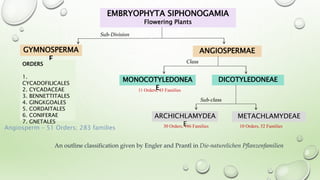
 All plant divided into 13 divisions; 13th Division dealt with Flowering plants
(Embryophyta Siphonogama)
 Divided into 2 sub-division - Gymnospermae and Angiospermae
 Angiosperms (51 orders; 283 families) divided into 2 Classes (Monocotyledons
and Dicotyledons
 Dicotyledons divided into 2 sub-classes Archichlamydeae and Metachlamydeae
EMBRYOPHYTA SIPHONOGAMIA
Flowering Plants
DICOTYLEDONEAE
GYMNOSPERMA
E
MONOCOTYLEDONEA
E
ARCHICHLAMYDEA
E
METACHLAMYDEAE
ORDERS
1.
CYCADOFILICALES
2. CYCADACEAE
3. BENNETTITALES
4. GINGKGOALES
5. CORDAITALES
6. CONIFERAE
7. GNETALES
Sub-class
Sub-Division
30 Orders, 186 Families 10 Orders, 52 Families
ANGIOSPERMAE
Class
11 Orders, 45 Families
An outline classification given by Engler and Prantl in Die-naturelichen Pflanzenfamilien
Angiosperm – 51 Orders; 283 families
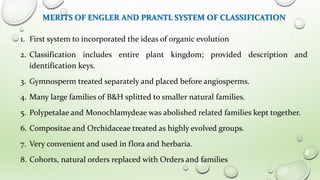
MERITS OF ENGLER AND PRANTL SYSTEM OF CLASSIFICATION
1. First system to incorporated the ideas of organic evolution
2. Classification includes entire plant kingdom; provided description and
identification keys.
3. Gymnosperm treated separately and placed before angiosperms.
4. Many large families of B&H splitted to smaller natural families.
5. Polypetalae and Monochlamydeae was abolished related families kept together.
6. Compositae and Orchidaceae treated as highly evolved groups.
7. Very convenient and used in flora and herbaria.
8. Cohorts, natural orders replaced with Orders and families
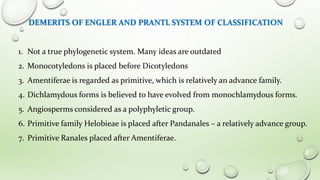
DEMERITS OF ENGLER AND PRANTL SYSTEM OF CLASSIFICATION
1. Not a true phylogenetic system. Many ideas are outdated
2. Monocotyledons is placed before Dicotyledons
3. Amentiferae is regarded as primitive, which is relatively an advance family.
4. Dichlamydous forms is believed to have evolved from monochlamydous forms.
5. Angiosperms considered as a polyphyletic group.
6. Primitive family Helobieae is placed after Pandanales – a relatively advance group.
7. Primitive Ranales placed after Amentiferae.
Contribution of other Botanist
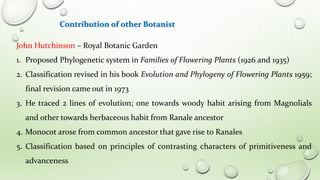
John Hutchinson – Royal Botanic Garden
1. Proposed Phylogenetic system in Families of Flowering Plants (1926 and 1935)
2. Classification revised in his book Evolution and Phylogeny of Flowering Plants 1959;
final revision came out in 1973
3. He traced 2 lines of evolution; one towards woody habit arising from Magnolials
and other towards herbaceous habit from Ranale ancestor
4. Monocot arose from common ancestor that gave rise to Ranales
5. Classification based on principles of contrasting characters of primitiveness and
advanceness
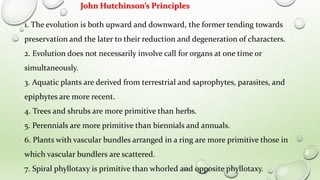
1. The evolution is both upward and downward, the former tending towards
preservation and the later to their reduction and degeneration of characters.
2. Evolution does not necessarily involve call for organs at one time or
simultaneously.
3. Aquatic plants are derived from terrestrial and saprophytes, parasites, and
epiphytes are more recent.
4. Trees and shrubs are more primitive than herbs.
5. Perennials are more primitive than biennials and annuals.
6. Plants with vascular bundles arranged in a ring are more primitive those in
which vascular bundlers are scattered.
7. Spiral phyllotaxy is primitive than whorled and opposite phyllotaxy.
John Hutchinson’s Principles
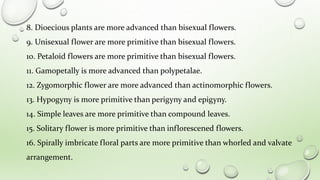
8. Dioecious plants are more advanced than bisexual flowers.
9. Unisexual flower are more primitive than bisexual flowers.
10. Petaloid flowers are more primitive than bisexual flowers.
11. Gamopetally is more advanced than polypetalae.
12. Zygomorphic flower are more advanced than actinomorphic flowers.
13. Hypogyny is more primitive than perigyny and epigyny.
14. Simple leaves are more primitive than compound leaves.
15. Solitary flower is more primitive than inflorescened flowers.
16. Spirally imbricate floral parts are more primitive than whorled and valvate
arrangement.
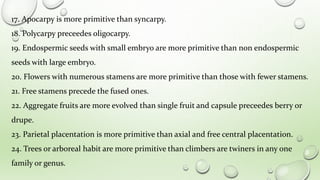
17. Apocarpy is more primitive than syncarpy.
18. Polycarpy preceedes oligocarpy.
19. Endospermic seeds with small embryo are more primitive than non endospermic
seeds with large embryo.
20. Flowers with numerous stamens are more primitive than those with fewer stamens.
21. Free stamens precede the fused ones.
22. Aggregate fruits are more evolved than single fruit and capsule preceedes berry or
drupe.
23. Parietal placentation is more primitive than axial and free central placentation.
24. Trees or arboreal habit are more primitive than climbers are twiners in any one
family or genus.
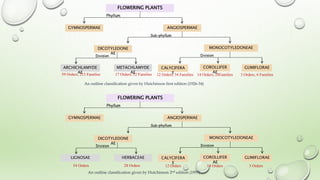
An outline classification given by Hutchinson 2nd edition (1959)
FLOWERING PLANTS
DICOTYLEDONE
AE
GYMNOSPERMAE
MONOCOTYLEDONEAE
LIGNOSAE HERBACEAE
Division
Phyllum
54 Orders 28 Orders
ANGIOSPERMAE
Sub-phyllum
GUMIFLORAE
CALYCIFERA
E
COROLLIFER
AE
Division
3 Orders
14 Orders
12 Orders
FLOWERING PLANTS
DICOTYLEDONE
AE
GYMNOSPERMAE
MONOCOTYLEDONEAE
ARCHICHLAMYDE
AE
METACHLAMYDE
AE
Division
Phyllum
ANGIOSPERMAE
Sub-phyllum
An outline classification given by Hutchinson first edition (1926-34)
GUMIFLORAE
CALYCIFERA
E
COROLLIFER
AE
Division
59 Orders, 213 Families 17 Orders, 52 Families 3 Orders, 6 Families
14 Orders, 28Families
12 Orders, 34 Families
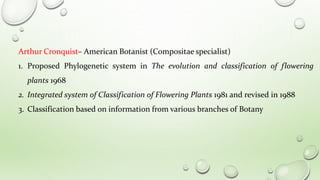
Arthur Cronquist– American Botanist (Compositae specialist)
1. Proposed Phylogenetic system in The evolution and classification of flowering
plants 1968
2. Integrated system of Classification of Flowering Plants 1981 and revised in 1988
3. Classification based on information from various branches of Botany
MAGNOLIOPHYTA
Flowering Plants
MAGNOLIOPSIDA
(Dicotyledons)
LILIOPSIDA
(Monocotyledons
)
SUBCLASS
1. MAGNOLIIDAE
8 Orders, 39
Families
2. HAMAMELIDAE
11 Orders, 24
Families
3. CARYOPHYLLIDAE
3 Orders, 14
Families
4. DILLENIIDAE
13 Orders, 78
Families
5. ROSIDAE
18 Orders, 114
Families
6. ASTERIDAE
11 Orders, 49
Families
SUB-CLASS
1. ALISMATIDAE
4 Orders, 16
Families
2. ARECIDAE
4 Orders, 6 Families
3. COMMELINIDAE
7 Orders, 16
Families
4. ZINGIBERIDAE
2 Orders, 9 Families
5. LILIDAE
2 Orders 19
Families
Class
Outline of Arthur Cronquist System of plant
classification (1988)
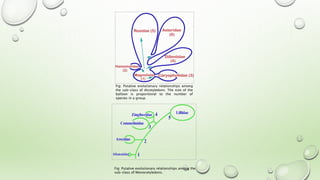
Fig: Putative evolutionary relationships among
the sub-class of dicotyledons. The size of the
balloon is proportional to the number of
species in a group.
Fig: Putative evolutionary relationships among the
sub-class of Monocotyledons.
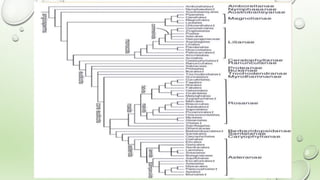
Angiosperm Phylogeny Group (APG-III)
 Informal international group of systematic botanists
 Collaborative classification system that tries to establish a consensus on taxonomy
of flowering plants based upon phylogenetic studies (molecular studies)
 Strongly believed in monophyletic origin of angiosperms
 Prior classification is based on morphology and biochemistry
 Typically produced by individual or small group (resulted into large no of
classification
 Different countries favoured different classification system – no consensus
 Major herbaria are adopting APG system for arranging their collection
 In the 1990s major developments of DNA sequencing technology and computing
power ushered into new era of classification
 In 1993, Mark Chase and his co-workers analyzed 5000 plants for genes involved in
photosynthesis
 An informal group of botanists took an initiative to analyze the plant genetic
material (chloroplast DNA and ribosomal 18s DNA) under the Angiosperm
Phylogeny Group (APG) with an intention to provide widely accepted and more
stable point of reference of angiosperm classification in 1998 – APG I
 Since then 3 revisions APG II (2003), APG III (2009), and APG IV (2016) have been
published.
New era in the classification system
Principle of APG
 The Linnean system of orders and families should be retained
 Groups should be monophyletic (the existing system do not have this property)
 A broad approach is taken to defining the limits of group (single family and genus
in a group is avoided)
 Above the level of families and orders, name ‘clades’ are used
 APG III was published in 2009 (3rd version), mostly based on molecular data
 The system consists of 59 orders (including 14 new orders) and 415 families (42
fewer than previous system)
 Designation of Alternative “Bracketed families” was abandoned in APG III because
of it unpopularity
 54 of 55 BF and 18 families of APG II were dropped out
 10 families (against 39 in APG II) are not placed in any order in APG III
 20 families which did not find place in APG II were accepted and realignment of
few families was done in APG III
APG III Classification (2009)
1. The system shows monophyletic origin
2. The system includes multiple data from morphology, anatomy, embryology,
biochemistry and molecular data
3. Groups name upto orders have been assigned
4. Traditional divisions of angiosperms into monocotyledons and dicotyledons has
not been taken into account. Many monocots are put in between primitive
angiosperms and eudicots, thereby solving the problems of paraphyly among
monocots and dicots
5. The No. of cladograms in the classification shows general affinities between various
groups
Merits of the classification
6. Primitive families are placed at the beginning of the angiosperms
7. The merger of Budlejaceae and Myotoraceae and Scrophulariaceae have been
supported from morphological and molecular evidences given by Bermer et al. (2001)
and Olmstead (2001)
8. Multigene analysis and morphological data are the basis on which Winteraceae and
Cancellaceae are kept under the same order
9. Monophyletic concept is reflected in Malvaceae where families like Tiliaceae,
Sterculiaceae and Bombacaceae are included in former. This inclusion is supported by
molecular as well as morpholocical data
10. The concept of braceted families in earlier APG has been removed in APG III
1. This classification is applicable only up to families
2. The fate of some unplaced families and few replaced genera is still uncertain
3. Botanical nomenclature has not been assigned to new groups
Demerits of the classification

Classification systems of Angiosperms.pptx

  • 1.
    CLASSIFICATION SYSTEM Presented by Dr.Upakar Rai Department of Botany St. Joeph’s College, Darjeeling WB
  • 2.
    CLASSIFICATION SYSTEM Arrangement ofplants into groups based upon similarity and differences Groups assembled in larger inclusive group sharing some commonality Based on artificial character, overall similarities on morphology and phenetic relationship
  • 3.
    BENTHAM AND HOOKER’SSYSTEM OF CLASSIFICATION  Genera Plantarum – 3 volumes (1860 – 1883)  Contains descriptions of 202 families and 7567 genera  Based on refinement of AP deCandole and Lindley  Grouping done based on natural affinities actually studied on specimen on field  Followed throughout the herbaria of world (Colonial countries)
  • 4.
    PHANEROGAMS Seed bearing Plants DICOTYLEDONSGYMNOSPERMAE MONOCOTYLEDO NS POLYPETALA E GAMOPETAL AE MONOCHLAMYDEA E SERIES 1. Thalamiflorae 6 Ords, 34 Fam 2. Disciflorae 4 Ords, 23 Fam 3. Calyciflorae 5 Ords, 27 Fam SERIES 1. Inferae 3 Ords, 9 Fam 2. Heteromerae 3 Ords, 12 Fam 3. Bicarpellatae 4 Ords, 24 Fam. SERIES 1. Curvembryeae 7 Families 2. Multiovulatae acuitacea 1 Family 3. M. terestres 3 Families 4. Microembryeae 4 Families 5. Daphnales 5 Families 6. Achlamydosporae 3 Families 7. Unisexuales 9 Families 8. Ordines anamoli 4 Families 1. Gnetaceae 2. Coniferae 3. Cycadaceae SERIES 1. Microsporae 3 Families 2. Epigyneae 7 Families 3. Coronarieae 8 Families 4. Calycinae 3 Families 5. Nudiflorae 5 Families 6. Aposporae 3 Families 7. Glumaceae 5 Families Sub-class Class Petals free Petals fused Incomplete flowers Outline of Bentham and Hooker’s System of Classification 3 Classes 3 Sub-classes 21 Series (14 Dicot; 7 Monocot) 25 Cohorts (Dicot) 202 Natural Orders (165 Dicot; 34 Monocot)
  • 5.
    MERITS OF BENTHAMAND HOOKER’S SYSTEM OF CLASSIFICATION 1. Has practical value for identification of plants; easy to follow for routine identification 2. Followed throughout the herbaria of the world to arrange the specimen. 3. Based on careful examination of actual living plant specimen. 4. Gymnosperms are placed in a separate class as against earlier workers. 5. Ranales (a primitive group) is placed at the beginning of Dicotyledons. 6. Dicotyledons placed before monocotyledons. 7. Description of family and genera are precise with key to identification. 8. Arrangement of taxa are based on overall natural affinities
  • 6.
    DEMERITS OF BENTHAMAND HOOKER’S SYSTEM OF CLASSIFICATION 1. The system does not incorporate phylogeny 2. Gymnospermae is placed between Dicotyledons and Monocotyledons 3. Monochlamydeae is an unnatural assemblage. 4. Unisexualis is a loose assemblage of diverse families. 5. 4 Families relation not certain and placed in Ordine Anamoli. 6. Large families like Urticaceae, Euphorbiaceae and Saxifragaceae have been split into smaller and more natural grouping by subsequent authors. 7. Orchidaceae placed in microsporae is placed towards the beginning of monocotyledons. 8. Series Inferae is placed before other two series having superior ovary.
  • 7.
    ENGLER AND PRANTLSYSTEM OF CLASSIFICATION  Heinrich Gustave Adolf Engler and Karl A.E. Von Prantl proposed 1st Phylogenetic system after ‘Origin of Species’  Classification is based on Eichler’s system of classification  Information from anatomy, embryology, geography in addition to morphology  Die-Naturelichen Pflanzenfamilien 23 Vol. 1887-1915  Includes all plant groups – Algae, Bryophytes higher plants  Classified and described down to genus level  Taxonomic groups are arranged in linear sequence from simplest to complex characters  It soon replaced the Bentham and Hooker’s system in European and American herbaria
  • 8.
    Distinctive features ofEngler and Prantl’s System  Families arranged in ascending order based on increasing complexities  Abolition of Monochlamydeae  Monocotyledons placed before Dicotyledon  Natural orders replaced by Family  Series and Cohorts replaced by Orders  Detailed description of all plant grpoups
  • 9.
    Engler and Prantl’sClassification  All plant divided into 13 divisions; 13th Division dealt with Flowering plants (Embryophyta Siphonogama)  Divided into 2 sub-division - Gymnospermae and Angiospermae  Angiosperms (51 orders; 283 families) divided into 2 Classes (Monocotyledons and Dicotyledons  Dicotyledons divided into 2 sub-classes Archichlamydeae and Metachlamydeae
  • 10.
    EMBRYOPHYTA SIPHONOGAMIA Flowering Plants DICOTYLEDONEAE GYMNOSPERMA E MONOCOTYLEDONEA E ARCHICHLAMYDEA E METACHLAMYDEAE ORDERS 1. CYCADOFILICALES 2.CYCADACEAE 3. BENNETTITALES 4. GINGKGOALES 5. CORDAITALES 6. CONIFERAE 7. GNETALES Sub-class Sub-Division 30 Orders, 186 Families 10 Orders, 52 Families ANGIOSPERMAE Class 11 Orders, 45 Families An outline classification given by Engler and Prantl in Die-naturelichen Pflanzenfamilien Angiosperm – 51 Orders; 283 families
  • 11.
    MERITS OF ENGLERAND PRANTL SYSTEM OF CLASSIFICATION 1. First system to incorporated the ideas of organic evolution 2. Classification includes entire plant kingdom; provided description and identification keys. 3. Gymnosperm treated separately and placed before angiosperms. 4. Many large families of B&H splitted to smaller natural families. 5. Polypetalae and Monochlamydeae was abolished related families kept together. 6. Compositae and Orchidaceae treated as highly evolved groups. 7. Very convenient and used in flora and herbaria. 8. Cohorts, natural orders replaced with Orders and families
  • 12.
    DEMERITS OF ENGLERAND PRANTL SYSTEM OF CLASSIFICATION 1. Not a true phylogenetic system. Many ideas are outdated 2. Monocotyledons is placed before Dicotyledons 3. Amentiferae is regarded as primitive, which is relatively an advance family. 4. Dichlamydous forms is believed to have evolved from monochlamydous forms. 5. Angiosperms considered as a polyphyletic group. 6. Primitive family Helobieae is placed after Pandanales – a relatively advance group. 7. Primitive Ranales placed after Amentiferae.
  • 13.
    Contribution of otherBotanist John Hutchinson – Royal Botanic Garden 1. Proposed Phylogenetic system in Families of Flowering Plants (1926 and 1935) 2. Classification revised in his book Evolution and Phylogeny of Flowering Plants 1959; final revision came out in 1973 3. He traced 2 lines of evolution; one towards woody habit arising from Magnolials and other towards herbaceous habit from Ranale ancestor 4. Monocot arose from common ancestor that gave rise to Ranales 5. Classification based on principles of contrasting characters of primitiveness and advanceness
  • 14.
    1. The evolutionis both upward and downward, the former tending towards preservation and the later to their reduction and degeneration of characters. 2. Evolution does not necessarily involve call for organs at one time or simultaneously. 3. Aquatic plants are derived from terrestrial and saprophytes, parasites, and epiphytes are more recent. 4. Trees and shrubs are more primitive than herbs. 5. Perennials are more primitive than biennials and annuals. 6. Plants with vascular bundles arranged in a ring are more primitive those in which vascular bundlers are scattered. 7. Spiral phyllotaxy is primitive than whorled and opposite phyllotaxy. John Hutchinson’s Principles
  • 15.
    8. Dioecious plantsare more advanced than bisexual flowers. 9. Unisexual flower are more primitive than bisexual flowers. 10. Petaloid flowers are more primitive than bisexual flowers. 11. Gamopetally is more advanced than polypetalae. 12. Zygomorphic flower are more advanced than actinomorphic flowers. 13. Hypogyny is more primitive than perigyny and epigyny. 14. Simple leaves are more primitive than compound leaves. 15. Solitary flower is more primitive than inflorescened flowers. 16. Spirally imbricate floral parts are more primitive than whorled and valvate arrangement.
  • 16.
    17. Apocarpy ismore primitive than syncarpy. 18. Polycarpy preceedes oligocarpy. 19. Endospermic seeds with small embryo are more primitive than non endospermic seeds with large embryo. 20. Flowers with numerous stamens are more primitive than those with fewer stamens. 21. Free stamens precede the fused ones. 22. Aggregate fruits are more evolved than single fruit and capsule preceedes berry or drupe. 23. Parietal placentation is more primitive than axial and free central placentation. 24. Trees or arboreal habit are more primitive than climbers are twiners in any one family or genus.
  • 17.
    An outline classificationgiven by Hutchinson 2nd edition (1959) FLOWERING PLANTS DICOTYLEDONE AE GYMNOSPERMAE MONOCOTYLEDONEAE LIGNOSAE HERBACEAE Division Phyllum 54 Orders 28 Orders ANGIOSPERMAE Sub-phyllum GUMIFLORAE CALYCIFERA E COROLLIFER AE Division 3 Orders 14 Orders 12 Orders FLOWERING PLANTS DICOTYLEDONE AE GYMNOSPERMAE MONOCOTYLEDONEAE ARCHICHLAMYDE AE METACHLAMYDE AE Division Phyllum ANGIOSPERMAE Sub-phyllum An outline classification given by Hutchinson first edition (1926-34) GUMIFLORAE CALYCIFERA E COROLLIFER AE Division 59 Orders, 213 Families 17 Orders, 52 Families 3 Orders, 6 Families 14 Orders, 28Families 12 Orders, 34 Families
  • 18.
    Arthur Cronquist– AmericanBotanist (Compositae specialist) 1. Proposed Phylogenetic system in The evolution and classification of flowering plants 1968 2. Integrated system of Classification of Flowering Plants 1981 and revised in 1988 3. Classification based on information from various branches of Botany
  • 19.
    MAGNOLIOPHYTA Flowering Plants MAGNOLIOPSIDA (Dicotyledons) LILIOPSIDA (Monocotyledons ) SUBCLASS 1. MAGNOLIIDAE 8Orders, 39 Families 2. HAMAMELIDAE 11 Orders, 24 Families 3. CARYOPHYLLIDAE 3 Orders, 14 Families 4. DILLENIIDAE 13 Orders, 78 Families 5. ROSIDAE 18 Orders, 114 Families 6. ASTERIDAE 11 Orders, 49 Families SUB-CLASS 1. ALISMATIDAE 4 Orders, 16 Families 2. ARECIDAE 4 Orders, 6 Families 3. COMMELINIDAE 7 Orders, 16 Families 4. ZINGIBERIDAE 2 Orders, 9 Families 5. LILIDAE 2 Orders 19 Families Class Outline of Arthur Cronquist System of plant classification (1988)
  • 20.
    Fig: Putative evolutionaryrelationships among the sub-class of dicotyledons. The size of the balloon is proportional to the number of species in a group. Fig: Putative evolutionary relationships among the sub-class of Monocotyledons.
  • 21.
    Angiosperm Phylogeny Group(APG-III)  Informal international group of systematic botanists  Collaborative classification system that tries to establish a consensus on taxonomy of flowering plants based upon phylogenetic studies (molecular studies)  Strongly believed in monophyletic origin of angiosperms  Prior classification is based on morphology and biochemistry  Typically produced by individual or small group (resulted into large no of classification  Different countries favoured different classification system – no consensus  Major herbaria are adopting APG system for arranging their collection
  • 22.
     In the1990s major developments of DNA sequencing technology and computing power ushered into new era of classification  In 1993, Mark Chase and his co-workers analyzed 5000 plants for genes involved in photosynthesis  An informal group of botanists took an initiative to analyze the plant genetic material (chloroplast DNA and ribosomal 18s DNA) under the Angiosperm Phylogeny Group (APG) with an intention to provide widely accepted and more stable point of reference of angiosperm classification in 1998 – APG I  Since then 3 revisions APG II (2003), APG III (2009), and APG IV (2016) have been published. New era in the classification system
  • 23.
    Principle of APG The Linnean system of orders and families should be retained  Groups should be monophyletic (the existing system do not have this property)  A broad approach is taken to defining the limits of group (single family and genus in a group is avoided)  Above the level of families and orders, name ‘clades’ are used
  • 24.
     APG IIIwas published in 2009 (3rd version), mostly based on molecular data  The system consists of 59 orders (including 14 new orders) and 415 families (42 fewer than previous system)  Designation of Alternative “Bracketed families” was abandoned in APG III because of it unpopularity  54 of 55 BF and 18 families of APG II were dropped out  10 families (against 39 in APG II) are not placed in any order in APG III  20 families which did not find place in APG II were accepted and realignment of few families was done in APG III APG III Classification (2009)
  • 26.
    1. The systemshows monophyletic origin 2. The system includes multiple data from morphology, anatomy, embryology, biochemistry and molecular data 3. Groups name upto orders have been assigned 4. Traditional divisions of angiosperms into monocotyledons and dicotyledons has not been taken into account. Many monocots are put in between primitive angiosperms and eudicots, thereby solving the problems of paraphyly among monocots and dicots 5. The No. of cladograms in the classification shows general affinities between various groups Merits of the classification
  • 27.
    6. Primitive familiesare placed at the beginning of the angiosperms 7. The merger of Budlejaceae and Myotoraceae and Scrophulariaceae have been supported from morphological and molecular evidences given by Bermer et al. (2001) and Olmstead (2001) 8. Multigene analysis and morphological data are the basis on which Winteraceae and Cancellaceae are kept under the same order 9. Monophyletic concept is reflected in Malvaceae where families like Tiliaceae, Sterculiaceae and Bombacaceae are included in former. This inclusion is supported by molecular as well as morpholocical data 10. The concept of braceted families in earlier APG has been removed in APG III
  • 28.
    1. This classificationis applicable only up to families 2. The fate of some unplaced families and few replaced genera is still uncertain 3. Botanical nomenclature has not been assigned to new groups Demerits of the classification