INTRODUCTION
• Classification denotesthe arrangement of a single plant
or group of plants an distinct category following a
system of nomenclature, and in accordance with a
particular and well established plan.
• Some of the earlier systems of classification of
angiosperms were artificial systems, since they used
only certain superficial characteristics as the basis.
• With more and more detailed study on the
morphological, physiological and reproductive aspects
of angiosperms, the artificial systems of classifications
were replaced by the natural systems of classification.
3.
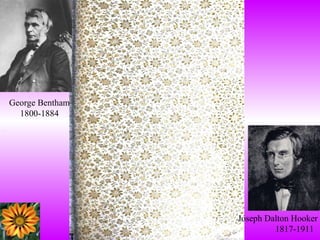
• George Benthamand Joseph Dalton Hooker - Two English
taxonomists who were closely associated with the Royal
Botanical Garden at Kew, England have given a detailed
classification of plant kingdom, particularly the
angiosperms.
• They gave an outstanding system of classification of
phanerogams in their Genera Plantarum which was
published in three volumes between the years 1862 to
1883. It is a natural system of classification.
• They described 97,205 species of flowering plants grouped
into 202 orders (now recognised as families).
• The system has the advantage of being the first great
natural system of classification, which is very easy to
follow.
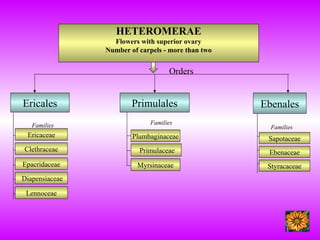
HETEROMERAE
Flowers with superiorovary
Number of carpels - more than two
Ebenales
Families
Sapotaceae
Ebenaceae
Styracaceae
Primulales
Families
Plumbaginaceae
Primulaceae
Myrsinaceae
Ericales
Families
Ericaceae
Clethraceae
Epacridaceae
Diapensiaceae
Lennoceae
Orders
DRAWBACKS
• Gymnosperms wereplaced between Dicots and
Monocots.
• Many important floral characters were neglected.
• It is not a phylogenetic scheme.
• Some of the closely related families have been
separated and placed under different cohotrs and a
number of unrelated families put together.
• Some advanced families like Orchidaceae have been
regarded as primitive by placing in the beginning.


 Most read
 Most read