2
Group 01
Shiza Liaqat
Shafaq Mahmood
Muhammad Ayyoub
Rameen Tehreem
Rida Fatima
Adeeba Noshair
Aleena Naeem
Muhammad Qaism
Natural system of
classification
Plant classification
Plant classification is the arrangement or placement of plants into plant groups in
an orderly sequence according to phenetic and phylogenetic relationships that
are more artificial.
Species is the basic unit of classification indeed more than 50 different systems
of classification for been proposed to date .Of these only few are dominant and
different parts of the world .however no system completely in reflecting the
phylogenetic relationship of the taxa concered .
All these classification based on the criteria they have into any one of the
following systems :
 Artificial system of classification
 Natural system of classification
 Phylogenetic system of classification
Natural system of
classification
 In natural system all the important morphological characters of the plants
are taken into the account to judge their natural resemblance and
relationships .
 The plants are thus classified according to their natural relationships .in this
system plants are first grouped into large higher categories and then these
categories are further divided and sub divided until the basic category called
the species is reached .
 It is based on the morphology ,cytology, molecular biology and genetics .
 The natural system of classification is a biological classification based upon
morphological and anatomical relationships and affinities.
Artifical system of
classification
 These are the first category and primitive types of classification based on
the Aristotelian approach.
 In the artificial system of classification the plants have been classified
based on the presence or absence of single and few arbitrarily selected and
easily observable characters .Owing to this in several cases closely related
plants species are placed in different groups and unrelated plants are kept
together.
 Artificial systems of classification were based on morphological characters
such as habit, habitat, colour, number and shape of leaves.
 They were mainly based on vegetative characters or on the androecium
structure.
Natural system of
classification
Artifical system of
classification
 It is based on only one or a few
characters .
 The characters are liable to change
with change in the environment .
 It accepts an analogy for grouping.
 It is based on morphological or
reproductive triats.Other traits are not
used.
 It is based on large number of
characters
 The characters are stable.
 It avoids analogy.
 It is based on morphology ,
anatomy,embryology ,molecular
biology and genetics.
Natural system of
classification
Artifical system of
classification
 The artificial system does not
study homology .
 On the basis of their habitat
or number and position of
their stamen and style.
 The natural system brings
out homology.
 Its explains natural and
some phylogenetic
relationships .
Phylogenetic system of
classification
 These are the modern and recent system of classification. The
arrangement of plants or plant groups are mainly are mainly
classified the evolutionary relationship of plants.
 These classification are based on several characters of the plants
such as morphological anatomical ecological and biochemical
characters taken into account .
 A phylogenetic system of classification reflects possible evolutionary
relationships based on ancestry and descent.
Natural system of
classification
Phylogenetic system of
classification
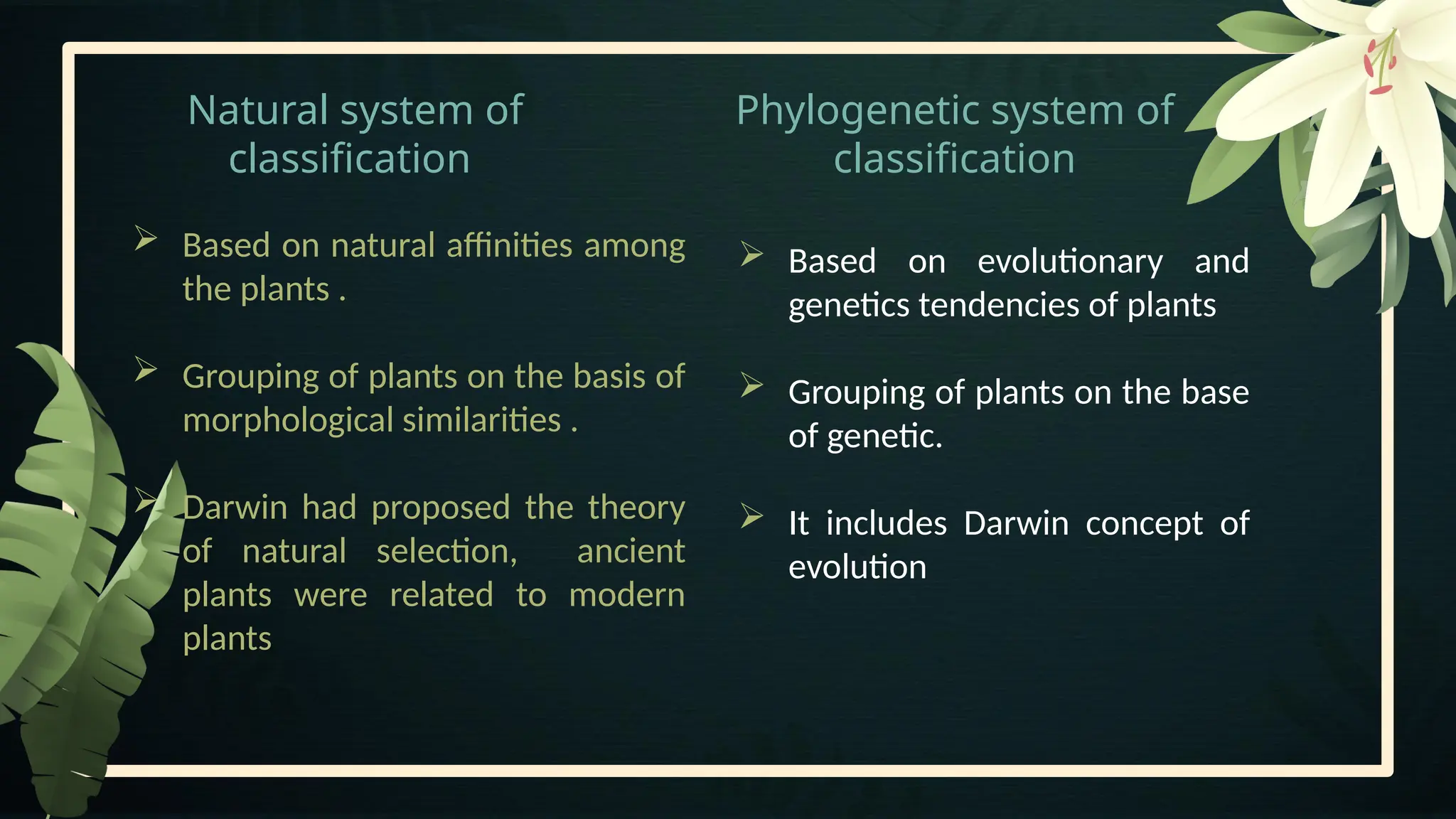
 Based on evolutionary and
genetics tendencies of plants
 Grouping of plants on the base
of genetic.
 It includes Darwin concept of
evolution
 Based on natural affinities among
the plants .
 Grouping of plants on the basis of
morphological similarities .
 Darwin had proposed the theory
of natural selection, ancient
plants were related to modern
plants
Natural system of
classification
Phylogenetic system of
classification
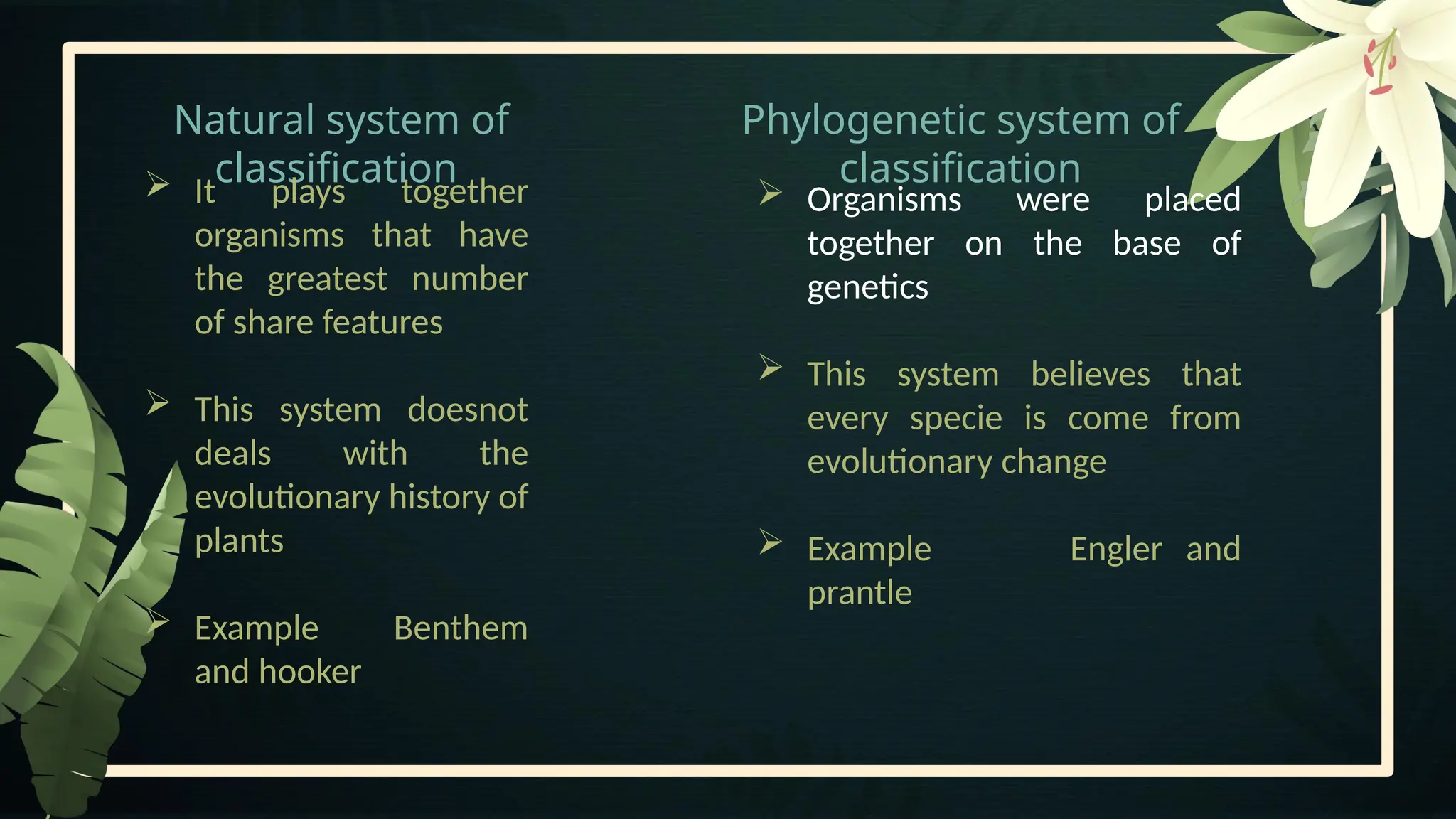
 Organisms were placed
together on the base of
genetics
 This system believes that
every specie is come from
evolutionary change
 Example Engler and
prantle
 It plays together
organisms that have
the greatest number
of share features
 This system doesnot
deals with the
evolutionary history of
plants
 Example Benthem
and hooker
Principles of Natural Classification
Phylogenetic
Relationships
The natural system of
classification is based
on the evolutionary
relationships between
plants, as determined
by their shared
morphological,
anatomical, and
genetic characteristics
Hierarchical
Structure
The natural system
organizes plants into
a hierarchical
taxonomic structure,
with increasingly
broad categories
(e.g., kingdom,
phylum, class, order,
family, genus,
species)
Adaptations and
Diversity
The natural system also
takes into account
the diverse
adaptations and
specialized features
that have evolved in
different plant
lineages
Plants are grouped
together based on
their common
ancestry and descent
from a shared
ancestral species.
that reflect the degree
of relatedness
between different
plant groups.
providing a
framework for
understanding
the remarkable
diversity of the
plant kingdom.
Importance of
Natural
Classification
15
Understanding Plant
Evolution
The natural system of classification provides valuable
insights into the evolutionary history and
relationships of plants. By grouping plants based on
their shared characteristics, botanists can trace the
development and divergence of plant species over
time, revealing the complex web of life that has
shaped the plant kingdom.
16
Improved Plant
Identification
The natural system of classification allows for more
accurate and efficient identification of plant species.
By considering the overall similarities and
differences between plants, rather than relying
solely on a few superficial traits, botanists can more
confidently determine the identity and relationships
of various plant specimens.
17
Practical Applications
The natural system of classification has numerous practical
applications, including in agriculture, horticulture, and
conservation efforts. By understanding the inherent
relationships between plants, researchers and professionals
can make more informed decisions about plant cultivation,
resource management, and the preservation of threatened
species.
Contribution of differernt scientist in natural
classification
Bauhin 154 1_1631 M.Adonsol 1727-180
Published families des plants
Rejected artificial system of
classification
Recognized as grand father of
numerical taxonomy
All chracters of all plant
organs were considered
Published historia plantrum
in which 5000 plants
were described
Recognized crucifers
(brassicas) and labiates
(family lamiassi).
A.P de condole 1778-
1841
Alphones de condole
1806
Proposed and describe
every specie of seed
plants
Published theory elementaire
de la batonique
Explain all the basic principle of
classification
Major book prodromus
systematis naturalis regni
vegetabilis explain vascular
tissue character.
Gorge Bentham and joseph hooker
George Bentham and Joseph Dalton Hooker who significantly advanced
botanical taxonomy in the 19th century. Bentham, an English botanist, and
Hooker, a close friend of Charles Darwin, collaborated on several botanical
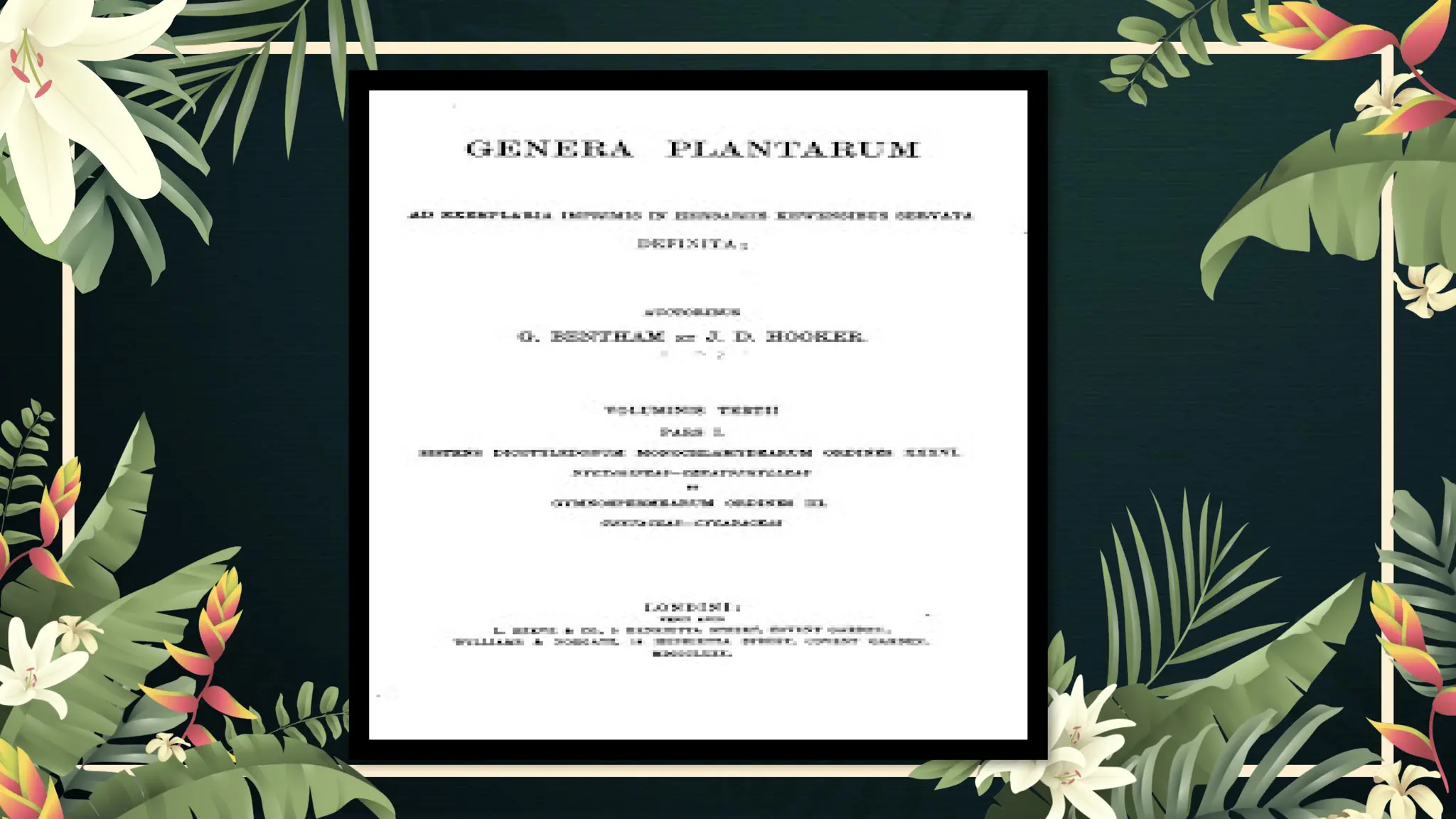
works. They are best known for their "Genera Plantarum," a comprehensive
work on the classification of plants, and their natural system of classification,
which aimed to group plants based on evolutionary relationships rather than
merely on superficial similarities. Their contributions laid the foundation for
modern botanical taxonomy and greatly influenced the understanding of plant
evolution and diversity.
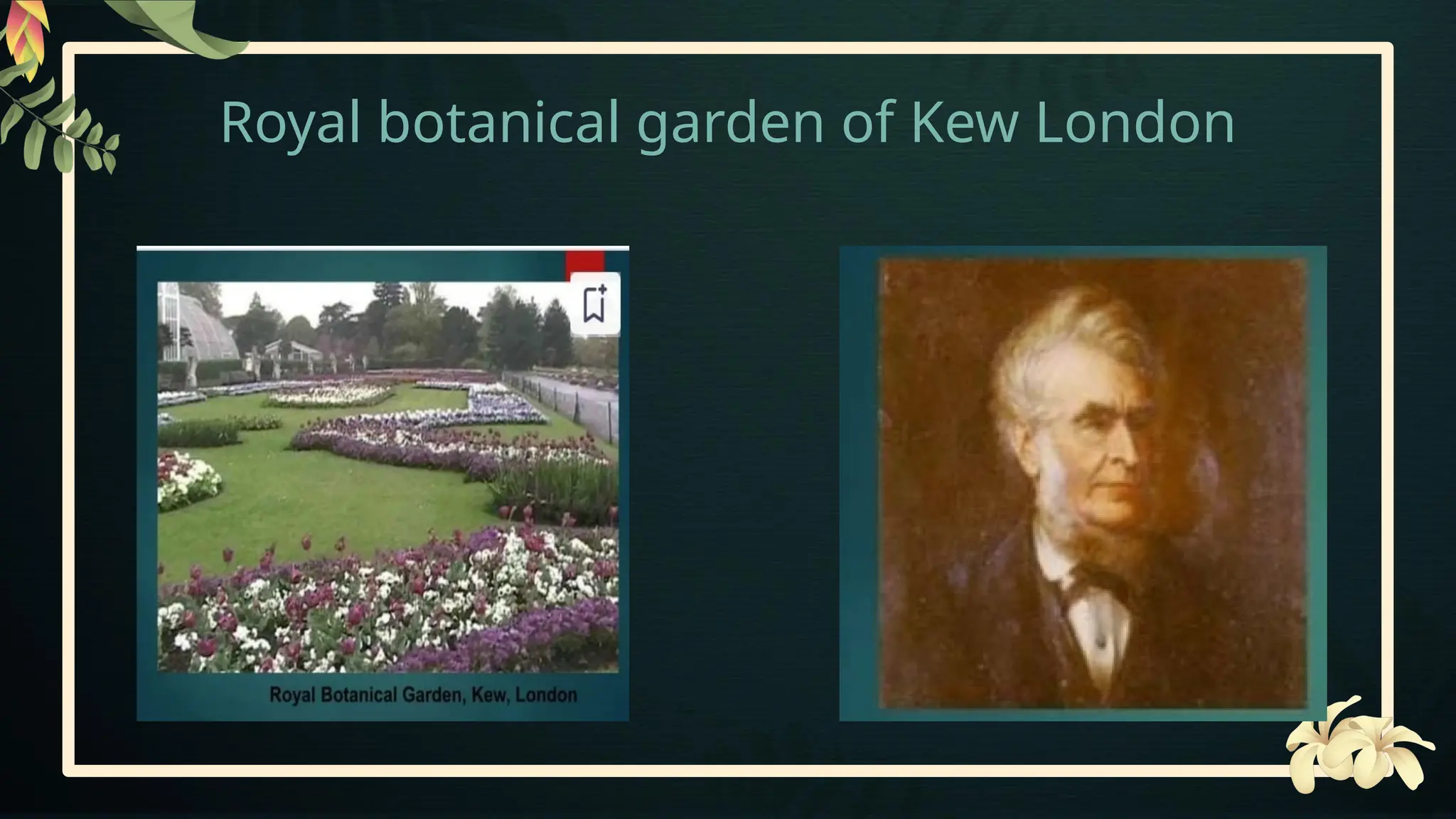
Royal botanical garden of Kew London
Working
● Their system grouped plants primarily based on the structure of their
reproductive organs, such as flowers and seeds, as well as other key
characteristics like habit, vegetative structure, and geographical distribution.
This approach laid the foundation for modern phylogenetic classification
systems, emphasizing evolutionary relationships and reflecting the
principles of natural selection.
Classes
Classificatio
n
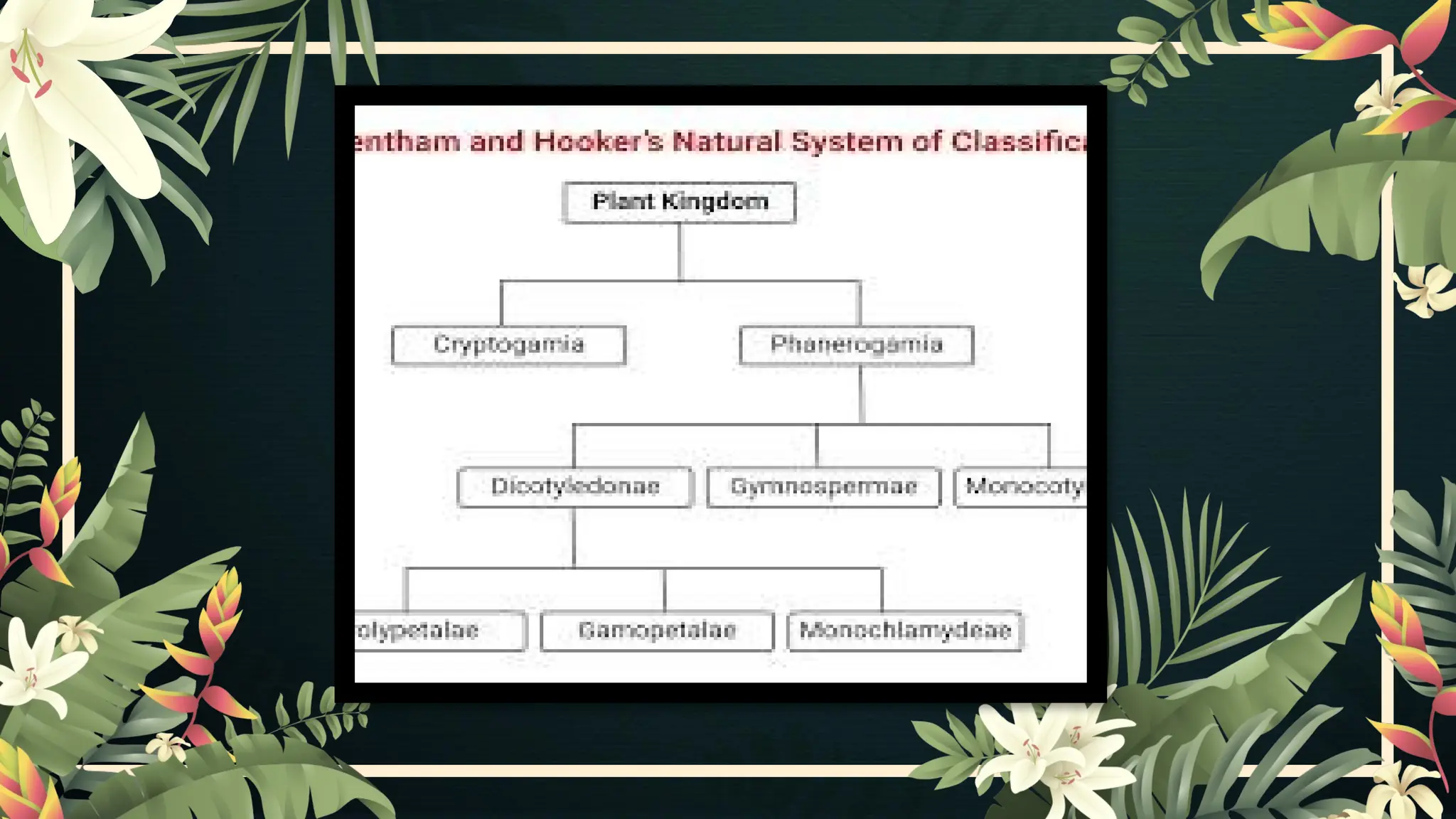
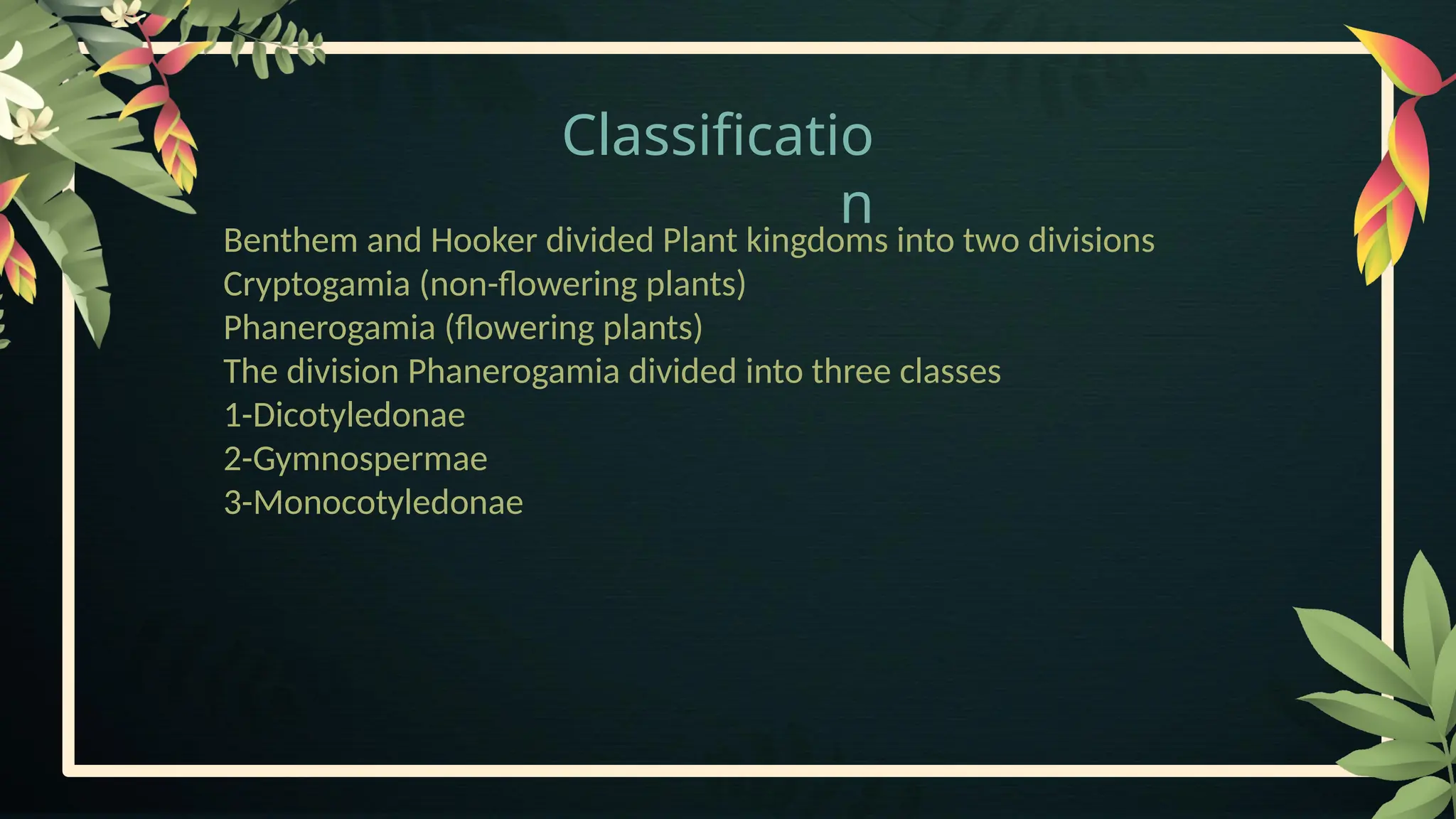
Benthem and Hooker divided Plant kingdoms into two divisions
Cryptogamia (non-flowering plants)
Phanerogamia (flowering plants)
The division Phanerogamia divided into three classes
1-Dicotyledonae
2-Gymnospermae
3-Monocotyledonae
27
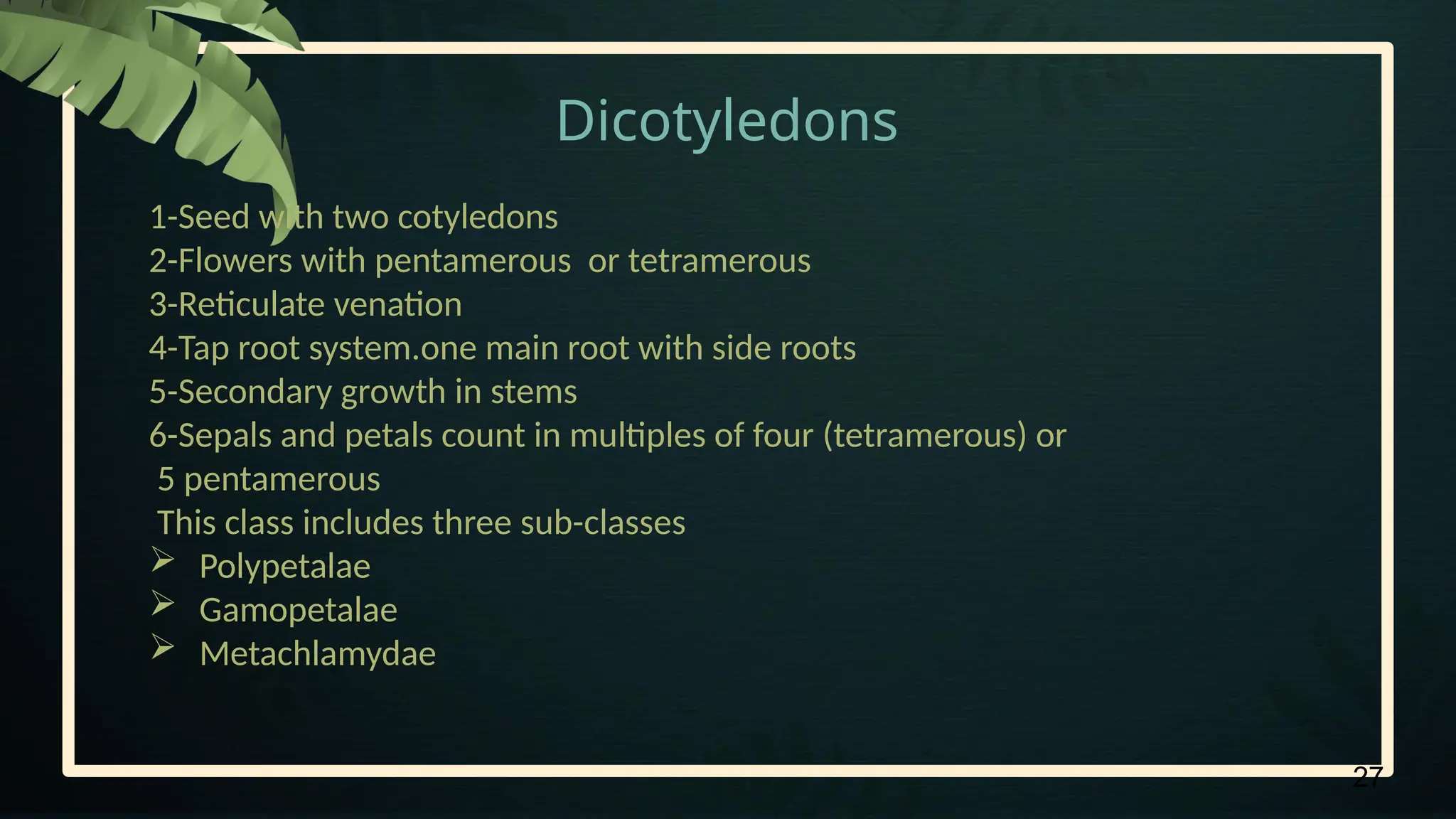
Dicotyledons
1-Seed with two cotyledons
2-Flowers with pentamerous or tetramerous
3-Reticulate venation
4-Tap root system.one main root with side roots
5-Secondary growth in stems
6-Sepals and petals count in multiples of four (tetramerous) or
5 pentamerous
This class includes three sub-classes
 Polypetalae
 Gamopetalae
 Metachlamydae
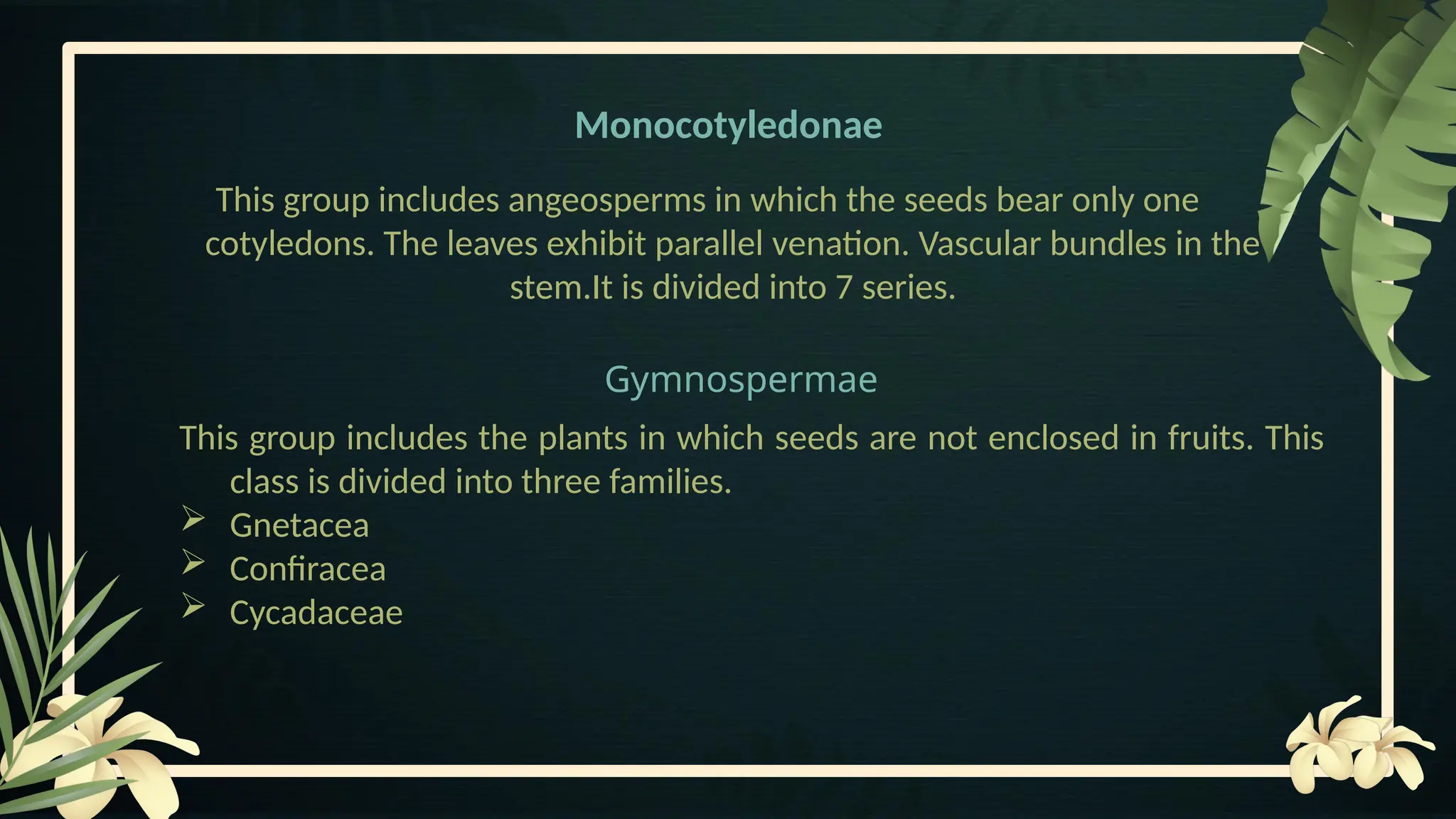
Monocotyledonae
Gymnospermae
This group includes the plants in which seeds are not enclosed in fruits. This
class is divided into three families.
 Gnetacea
 Confiracea
 Cycadaceae
This group includes angeosperms in which the seeds bear only one
cotyledons. The leaves exhibit parallel venation. Vascular bundles in the
stem.It is divided into 7 series.
Subclasses
Polypetalou
s
In polypetalous dicots,
the petals of the
flower are
completely separate
from one another,
forming distinct,
individual structures.
Examples include
roses, peonies, and
buttercups.
Gamopetalous
Monopetlao
us
Monopetlalous dicots
have a single,
fused petal that
forms the entire
corolla (the whorl
of petals).
Examples include
snapdragons,
foxgloves, and
trumpet vines.
Gamopetalous dicots
have petals that are
fused together,
forming a single,
unified structure.
Examples include
tomatoes, petunias,
and morning
glories.
Merits
 Benthum and hooker observed a wide number of species 97,205species
and classified them into 202 families
 This classification system is the most natural system based on examination
of species
 The description of plants is accurate and reliable.
 This classification system shows affinity to the modern concept of
evolution .For instance Rhynia ( order of Ranales) is the first order in the
modern classification system.Ranales is the most primitive angiosperm.
 The occurrence of Monocotyledon after dicotyledon aligns with the modern
classification system.
 This system of classification is used as a key to identify plants in the key
herbarium.
Demerits
Some demerits of Bentham and hooker classification are
 Orchidanae is an advanced family but it was given a primitive
position.
 Arrangement of monocot is unnatural.
 Closely related families have been separated.
 Unrelated families are placed near to each other.
 Several important floral characters were neglected.
 Gymnosperm placement is incorrect.
 Dicots were placed before monocots.
 Phylogenetic importance of naked seeds was neglected .
Advantages and Limitations of
Natural Classification
Advantages
The natural system of classification
offers a more scientifically valid
and comprehensive
understanding of plant
relationships, supports
evolutionary research, and
facilitates practical applications
in fields like agriculture and
conservation.
Limitations
Challenges in natural classification
include the ongoing discovery of
new species, the complex and
sometimes ambiguous
relationships between plant
groups, and the need for
continuous revision and updating
as our understanding of plant
evolution advances.
Conclusio
n
In conclusion, the natural system of classification of plants represents a
significant advancement in our understanding of botanical diversity.
Developed to reflect evolutionary relationships, this system organizes
plants based on their morphological, anatomical, and reproductive
characteristics, thereby revealing insights into their shared ancestry. By
grouping plants according to their natural affinities rather than arbitrary
criteria, such as utility or habitat, this classification system provides a
framework for studying plant evolution, diversity, and ecological
interactions.
Amazon Rainforest Deforestation Awarenesses

Amazon Rainforest Deforestation Awarenesses

  • 2.
    2 Group 01 Shiza Liaqat ShafaqMahmood Muhammad Ayyoub Rameen Tehreem Rida Fatima Adeeba Noshair Aleena Naeem Muhammad Qaism
  • 3.
  • 4.
    Plant classification Plant classificationis the arrangement or placement of plants into plant groups in an orderly sequence according to phenetic and phylogenetic relationships that are more artificial. Species is the basic unit of classification indeed more than 50 different systems of classification for been proposed to date .Of these only few are dominant and different parts of the world .however no system completely in reflecting the phylogenetic relationship of the taxa concered . All these classification based on the criteria they have into any one of the following systems :  Artificial system of classification  Natural system of classification  Phylogenetic system of classification
  • 5.
    Natural system of classification In natural system all the important morphological characters of the plants are taken into the account to judge their natural resemblance and relationships .  The plants are thus classified according to their natural relationships .in this system plants are first grouped into large higher categories and then these categories are further divided and sub divided until the basic category called the species is reached .  It is based on the morphology ,cytology, molecular biology and genetics .  The natural system of classification is a biological classification based upon morphological and anatomical relationships and affinities.
  • 6.
    Artifical system of classification These are the first category and primitive types of classification based on the Aristotelian approach.  In the artificial system of classification the plants have been classified based on the presence or absence of single and few arbitrarily selected and easily observable characters .Owing to this in several cases closely related plants species are placed in different groups and unrelated plants are kept together.  Artificial systems of classification were based on morphological characters such as habit, habitat, colour, number and shape of leaves.  They were mainly based on vegetative characters or on the androecium structure.
  • 7.
    Natural system of classification Artificalsystem of classification  It is based on only one or a few characters .  The characters are liable to change with change in the environment .  It accepts an analogy for grouping.  It is based on morphological or reproductive triats.Other traits are not used.  It is based on large number of characters  The characters are stable.  It avoids analogy.  It is based on morphology , anatomy,embryology ,molecular biology and genetics.
  • 8.
    Natural system of classification Artificalsystem of classification  The artificial system does not study homology .  On the basis of their habitat or number and position of their stamen and style.  The natural system brings out homology.  Its explains natural and some phylogenetic relationships .
  • 9.
    Phylogenetic system of classification These are the modern and recent system of classification. The arrangement of plants or plant groups are mainly are mainly classified the evolutionary relationship of plants.  These classification are based on several characters of the plants such as morphological anatomical ecological and biochemical characters taken into account .  A phylogenetic system of classification reflects possible evolutionary relationships based on ancestry and descent.
  • 10.
    Natural system of classification Phylogeneticsystem of classification  Based on evolutionary and genetics tendencies of plants  Grouping of plants on the base of genetic.  It includes Darwin concept of evolution  Based on natural affinities among the plants .  Grouping of plants on the basis of morphological similarities .  Darwin had proposed the theory of natural selection, ancient plants were related to modern plants
  • 11.
    Natural system of classification Phylogeneticsystem of classification  Organisms were placed together on the base of genetics  This system believes that every specie is come from evolutionary change  Example Engler and prantle  It plays together organisms that have the greatest number of share features  This system doesnot deals with the evolutionary history of plants  Example Benthem and hooker
  • 12.
    Principles of NaturalClassification Phylogenetic Relationships The natural system of classification is based on the evolutionary relationships between plants, as determined by their shared morphological, anatomical, and genetic characteristics Hierarchical Structure The natural system organizes plants into a hierarchical taxonomic structure, with increasingly broad categories (e.g., kingdom, phylum, class, order, family, genus, species) Adaptations and Diversity The natural system also takes into account the diverse adaptations and specialized features that have evolved in different plant lineages
  • 13.
    Plants are grouped togetherbased on their common ancestry and descent from a shared ancestral species. that reflect the degree of relatedness between different plant groups. providing a framework for understanding the remarkable diversity of the plant kingdom.
  • 14.
  • 15.
    15 Understanding Plant Evolution The naturalsystem of classification provides valuable insights into the evolutionary history and relationships of plants. By grouping plants based on their shared characteristics, botanists can trace the development and divergence of plant species over time, revealing the complex web of life that has shaped the plant kingdom.
  • 16.
    16 Improved Plant Identification The naturalsystem of classification allows for more accurate and efficient identification of plant species. By considering the overall similarities and differences between plants, rather than relying solely on a few superficial traits, botanists can more confidently determine the identity and relationships of various plant specimens.
  • 17.
    17 Practical Applications The naturalsystem of classification has numerous practical applications, including in agriculture, horticulture, and conservation efforts. By understanding the inherent relationships between plants, researchers and professionals can make more informed decisions about plant cultivation, resource management, and the preservation of threatened species.
  • 18.
    Contribution of differerntscientist in natural classification Bauhin 154 1_1631 M.Adonsol 1727-180 Published families des plants Rejected artificial system of classification Recognized as grand father of numerical taxonomy All chracters of all plant organs were considered Published historia plantrum in which 5000 plants were described Recognized crucifers (brassicas) and labiates (family lamiassi).
  • 19.
    A.P de condole1778- 1841 Alphones de condole 1806 Proposed and describe every specie of seed plants Published theory elementaire de la batonique Explain all the basic principle of classification Major book prodromus systematis naturalis regni vegetabilis explain vascular tissue character.
  • 20.
    Gorge Bentham andjoseph hooker George Bentham and Joseph Dalton Hooker who significantly advanced botanical taxonomy in the 19th century. Bentham, an English botanist, and Hooker, a close friend of Charles Darwin, collaborated on several botanical works. They are best known for their "Genera Plantarum," a comprehensive work on the classification of plants, and their natural system of classification, which aimed to group plants based on evolutionary relationships rather than merely on superficial similarities. Their contributions laid the foundation for modern botanical taxonomy and greatly influenced the understanding of plant evolution and diversity.
  • 21.
  • 22.
    Working ● Their systemgrouped plants primarily based on the structure of their reproductive organs, such as flowers and seeds, as well as other key characteristics like habit, vegetative structure, and geographical distribution. This approach laid the foundation for modern phylogenetic classification systems, emphasizing evolutionary relationships and reflecting the principles of natural selection.
  • 25.
  • 26.
    Classificatio n Benthem and Hookerdivided Plant kingdoms into two divisions Cryptogamia (non-flowering plants) Phanerogamia (flowering plants) The division Phanerogamia divided into three classes 1-Dicotyledonae 2-Gymnospermae 3-Monocotyledonae
  • 27.
    27 Dicotyledons 1-Seed with twocotyledons 2-Flowers with pentamerous or tetramerous 3-Reticulate venation 4-Tap root system.one main root with side roots 5-Secondary growth in stems 6-Sepals and petals count in multiples of four (tetramerous) or 5 pentamerous This class includes three sub-classes  Polypetalae  Gamopetalae  Metachlamydae
  • 28.
    Monocotyledonae Gymnospermae This group includesthe plants in which seeds are not enclosed in fruits. This class is divided into three families.  Gnetacea  Confiracea  Cycadaceae This group includes angeosperms in which the seeds bear only one cotyledons. The leaves exhibit parallel venation. Vascular bundles in the stem.It is divided into 7 series.
  • 29.
  • 30.
    Polypetalou s In polypetalous dicots, thepetals of the flower are completely separate from one another, forming distinct, individual structures. Examples include roses, peonies, and buttercups. Gamopetalous Monopetlao us Monopetlalous dicots have a single, fused petal that forms the entire corolla (the whorl of petals). Examples include snapdragons, foxgloves, and trumpet vines. Gamopetalous dicots have petals that are fused together, forming a single, unified structure. Examples include tomatoes, petunias, and morning glories.
  • 31.
    Merits  Benthum andhooker observed a wide number of species 97,205species and classified them into 202 families  This classification system is the most natural system based on examination of species  The description of plants is accurate and reliable.  This classification system shows affinity to the modern concept of evolution .For instance Rhynia ( order of Ranales) is the first order in the modern classification system.Ranales is the most primitive angiosperm.  The occurrence of Monocotyledon after dicotyledon aligns with the modern classification system.  This system of classification is used as a key to identify plants in the key herbarium.
  • 32.
    Demerits Some demerits ofBentham and hooker classification are  Orchidanae is an advanced family but it was given a primitive position.  Arrangement of monocot is unnatural.  Closely related families have been separated.  Unrelated families are placed near to each other.  Several important floral characters were neglected.  Gymnosperm placement is incorrect.  Dicots were placed before monocots.  Phylogenetic importance of naked seeds was neglected .
  • 33.
    Advantages and Limitationsof Natural Classification
  • 34.
    Advantages The natural systemof classification offers a more scientifically valid and comprehensive understanding of plant relationships, supports evolutionary research, and facilitates practical applications in fields like agriculture and conservation. Limitations Challenges in natural classification include the ongoing discovery of new species, the complex and sometimes ambiguous relationships between plant groups, and the need for continuous revision and updating as our understanding of plant evolution advances.
  • 35.
    Conclusio n In conclusion, thenatural system of classification of plants represents a significant advancement in our understanding of botanical diversity. Developed to reflect evolutionary relationships, this system organizes plants based on their morphological, anatomical, and reproductive characteristics, thereby revealing insights into their shared ancestry. By grouping plants according to their natural affinities rather than arbitrary criteria, such as utility or habitat, this classification system provides a framework for studying plant evolution, diversity, and ecological interactions.