CONTENTS
 PURPOSE
 CLASSIFICATION
 PRINCIPLE
 BLOCK DIAGRAM
 INDICATOR
PURPOSE
 It measures instantaneous altitude of the aircraft
above the ground
CLASSIFICATION
According to the method of time measurement,
altimeters can be classified to three types.
i) Pulse type radio altimeter
ii) Conventional FMCW altimeter
iii) Constant difference frequency FMCW altimeter
BASIC PRINCIPLE
Aircraft altitude is measured using the basic principle
of radio ranging i.e. measuring the elapsed time between
transmission of the e.m wave and its reception after
reflection from the ground. The altitude is given by half the
product of the elapsed time and the speed of light.
2H= C*T
Where H = Altitude of the aircraft
T = time taken for round trip travel
C = speed of light
+
CONVENTIONAL FMCW
PRINCIPLE OF OPERATION
In a simple continuous wave transmitter/
receiver the time between transmission and
reception can not be measured as there is no
reference mark to note the time of transmission and
reception.
CONVENTIONAL FMCW
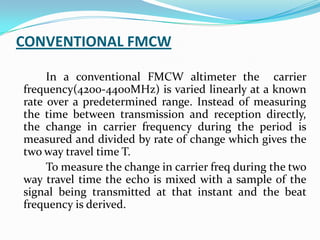
In a conventional FMCW altimeter the carrier
frequency(4200-4400MHz) is varied linearly at a known
rate over a predetermined range. Instead of measuring
the time between transmission and reception directly,
the change in carrier frequency during the period is
measured and divided by rate of change which gives the
two way travel time T.
To measure the change in carrier freq during the two
way travel time the echo is mixed with a sample of the
signal being transmitted at that instant and the beat
frequency is derived.
CONVENTIONAL FMCW
The beat freq is proportional to the a/c altitude.
CONVENTIONAL FMCW
Transmitted Received
Radiatedfrequencyfc
TimeT
fh Δf
1/fm
CONVENTIONAL FMCW
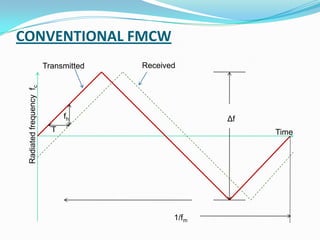
fc = frequency of carrier wave
fh = Beat frequency
fm = frequency of triangular modulating wave
Δf = maximum
deviation of carrier
frequency
amp
t
1/fm
CONVENTIONAL FMCW
 Beat frequency = rate of change of carrier frequency x
T
where T = The round trip travel time
of the transmitted wave
Transmitted
Radiatedfrequencyfc
TimeT
fh Δf
1/fm
Received
CONVENTIONAL FMCW
Rate of change of carrier frequency =
Total change ÷ time taken for the change
Radiatedfrequencyfc
TimeT
fh Δf
1/fm
ReceivedTransmitted
Rate of change of carrier frequency
= ∆f/2 ÷ 1/4fm
= ∆f/2 x 4fm
= 2 ∆f fm
CONVENTIONAL FMCWRadiatedfrequencyfc
TimeT
fh Δf
1/fm
ReceivedTransmitted
CONVENTIONAL FMCW
Beat frequency fh = 2 ∆f fm * T
= 2 ∆f fm * 2H/C (where T= 2H/C)
= 4 ∆f fm H/C
H = fh C / 4 ∆f fm
CONVENTIONAL FMCW
Here the term 4 ∆f fm /C is a constant value for a given
conventional FMCW.
So beat frequency fh ∞ H
CONVENTIONAL FMCW
Transmitted
Radiatedfrequencyfc
Time
T
fh Δf
1/fm
Received
Beatfrequency(ft-fr)
fh
Time
CONVENTIONAL FMCW ALTIMETER
Transmitter
Mixer Amplifier Limiter Counter Indicator
Modulator
CONSTANT DIFFERENCE FREQUENCY FMCW
Transmitter
Indicator
Reference
frequency
Mixer Amplifier
Discriminato
r
Loop control
Modulator
Frequency
Gain
PULSE TYPE RADIO ALTIMETER
PRINCIPLE OF OPERATION
The system is based on the principle of echo
range timing i.e. the time taken by a radio pulse to
travel out & back is a direct measurement of the
distance(Altitude) as the velocity of an e.m wave is
constant.
PULSE ALTIMETER
Receiver
Track/search
Ramp
Generator
Comparator
Range
circuit
STC
Track gate
Generator
Search
Generator
Rate
Circuit
Reference
Current
AGC
PRF
Generator
Transmitter
Output
VR
A
B
Track loop

Radio altimeter