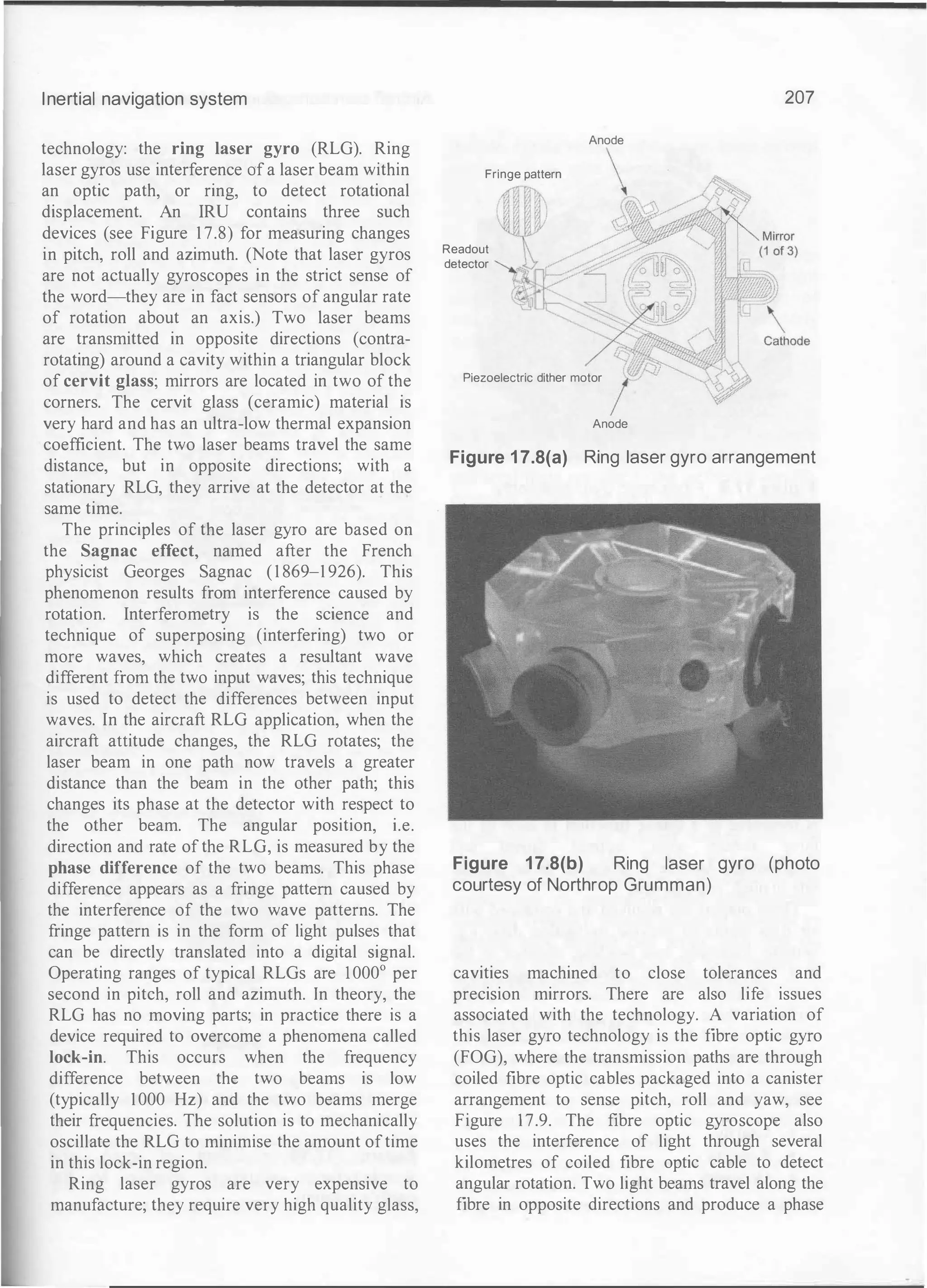
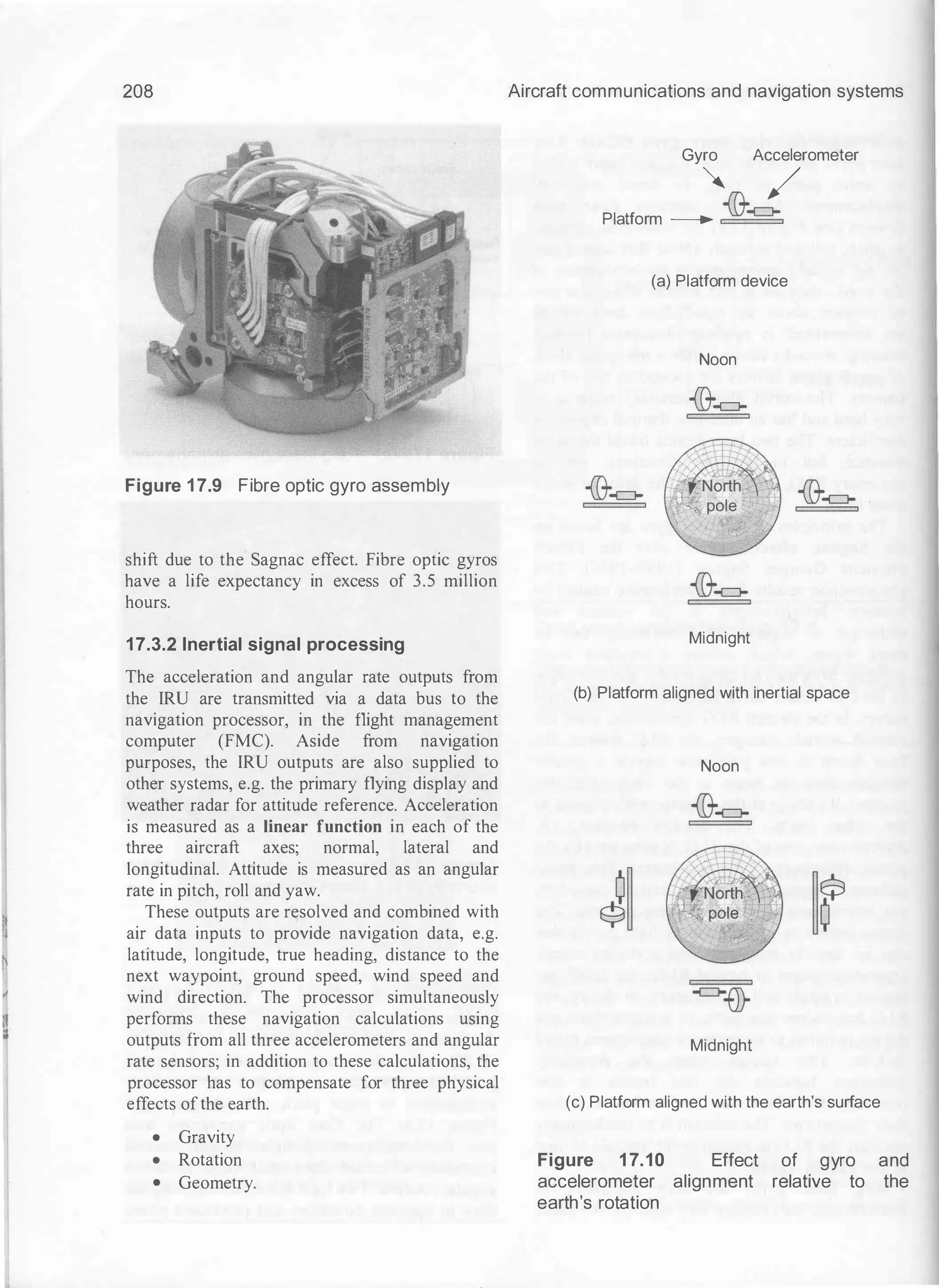
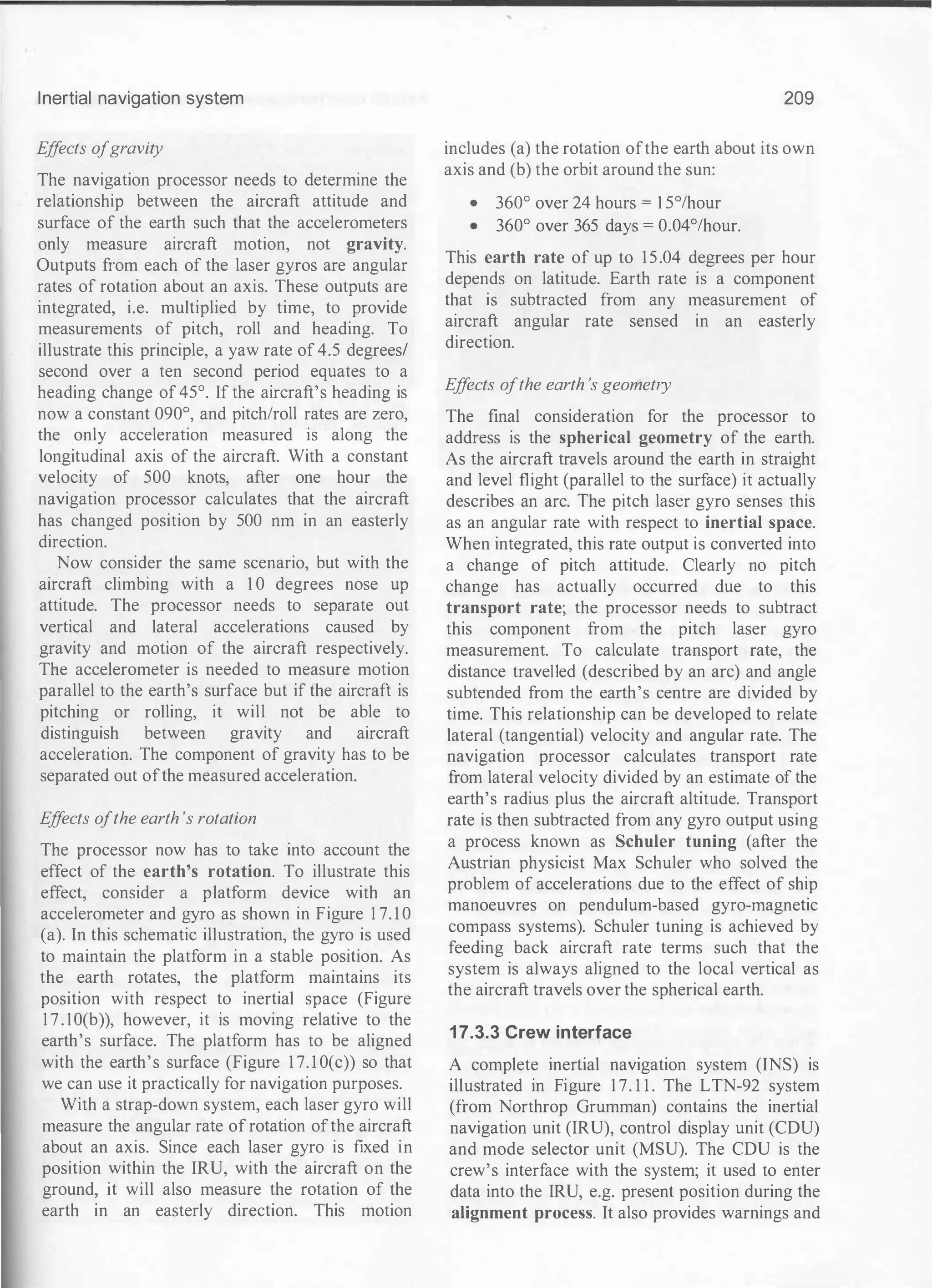
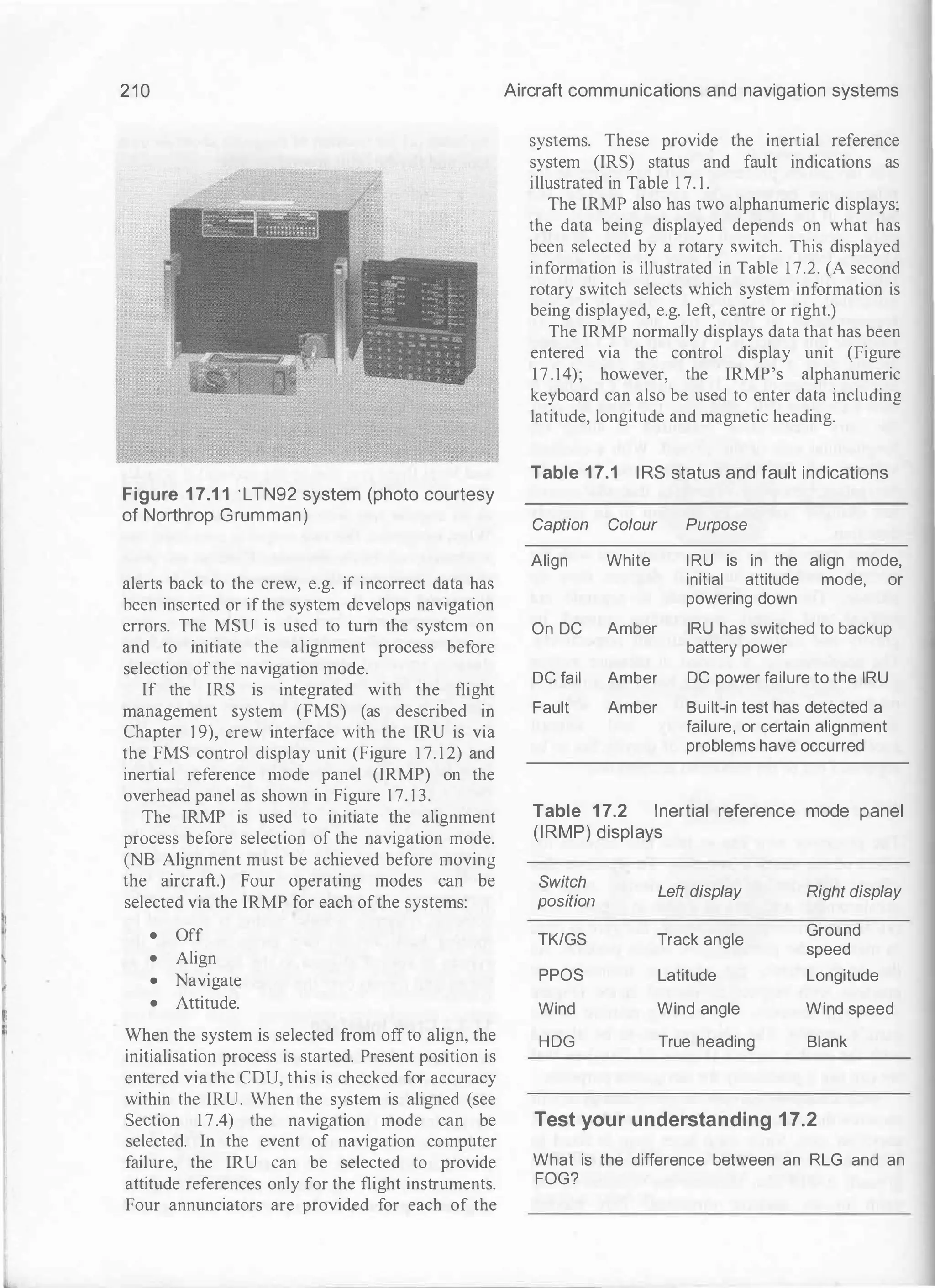
Contents
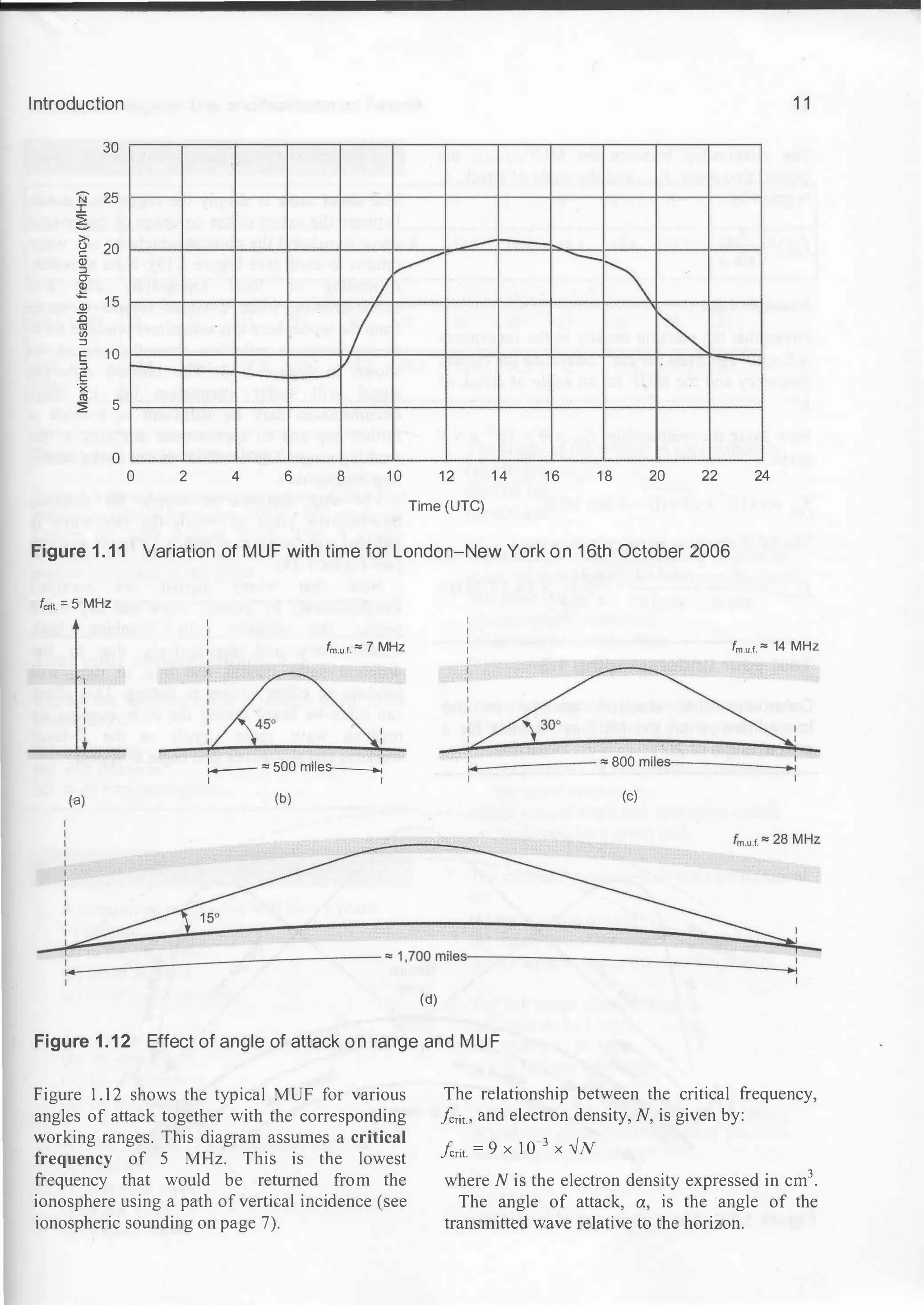
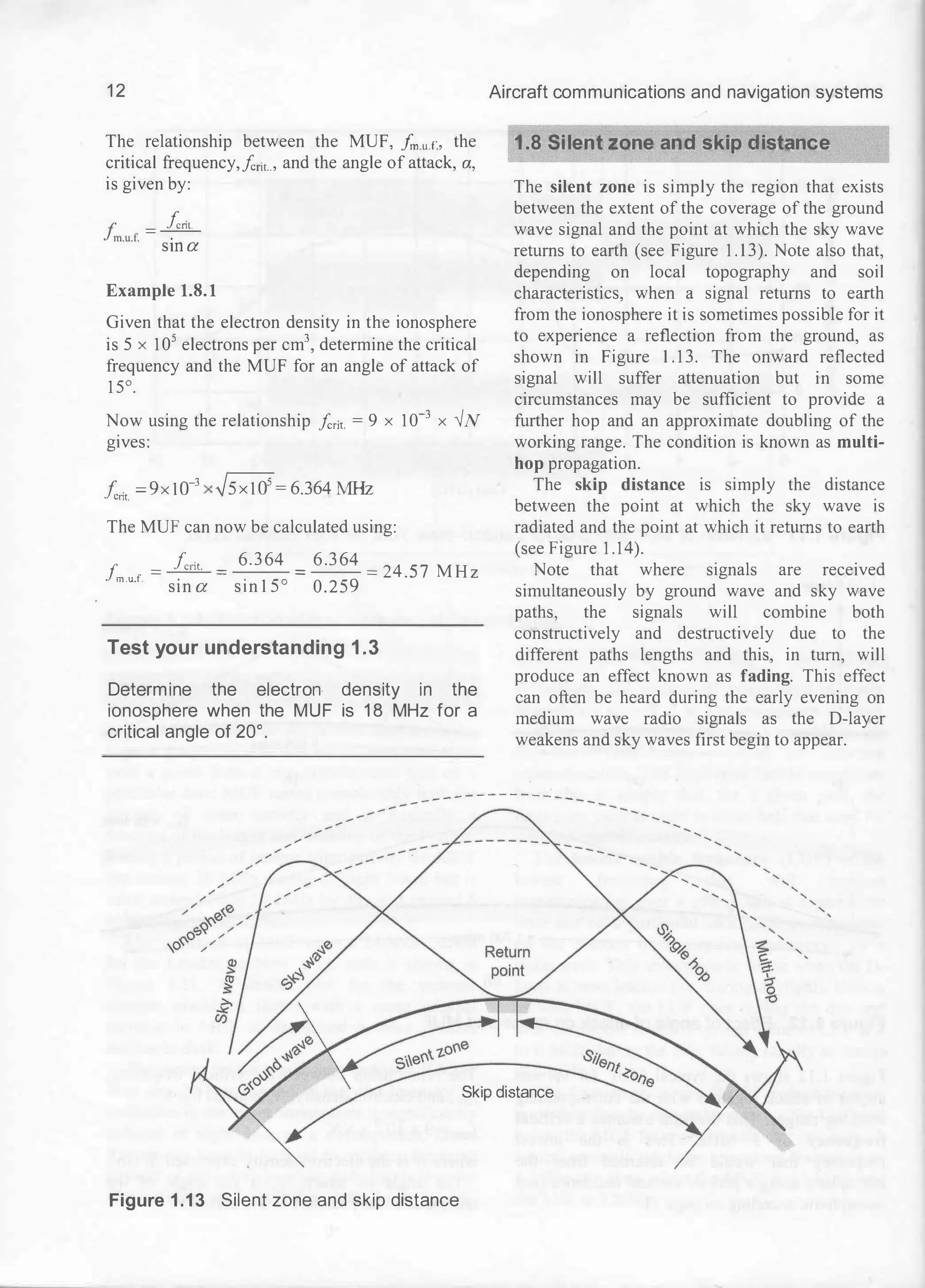
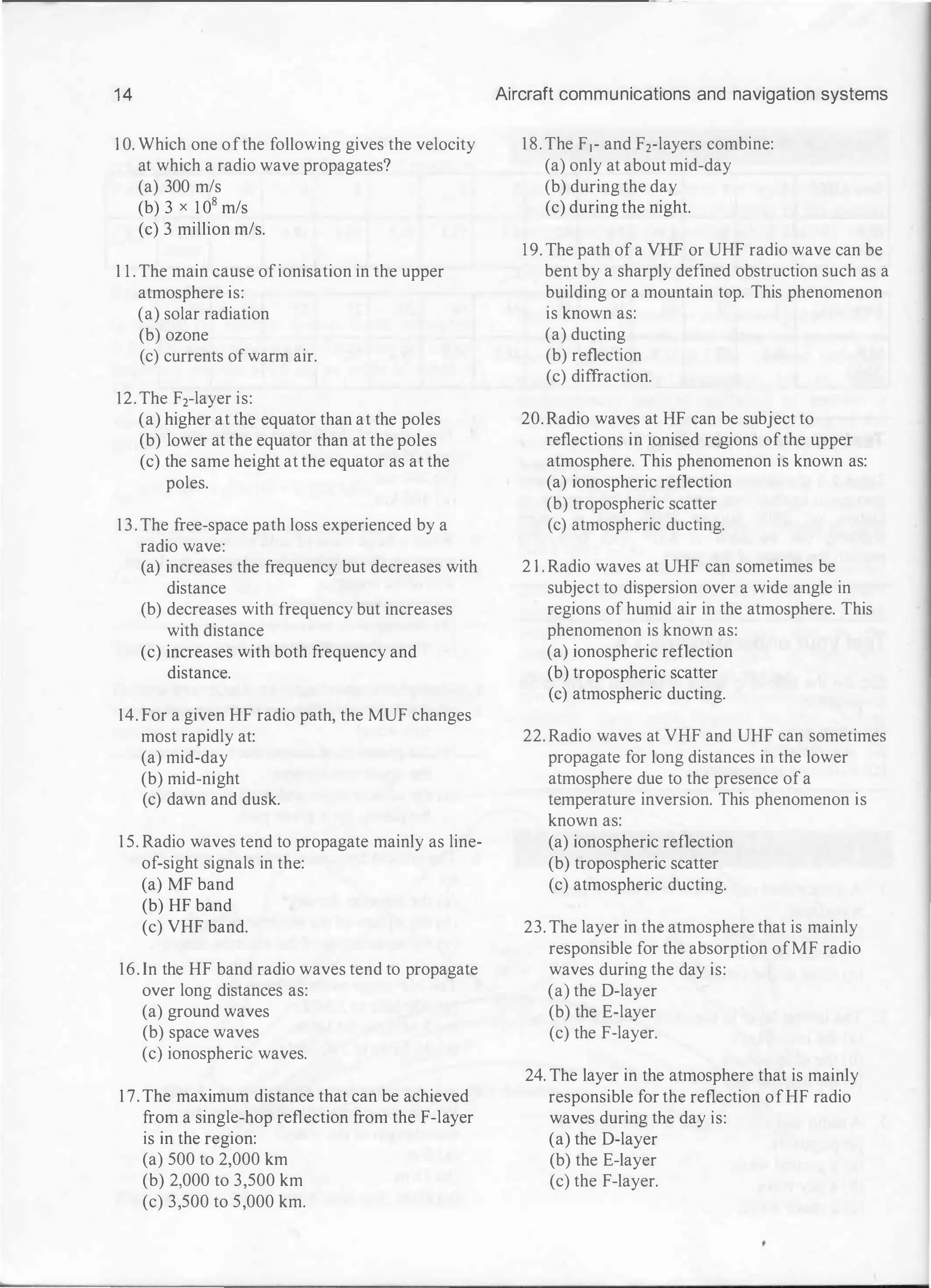
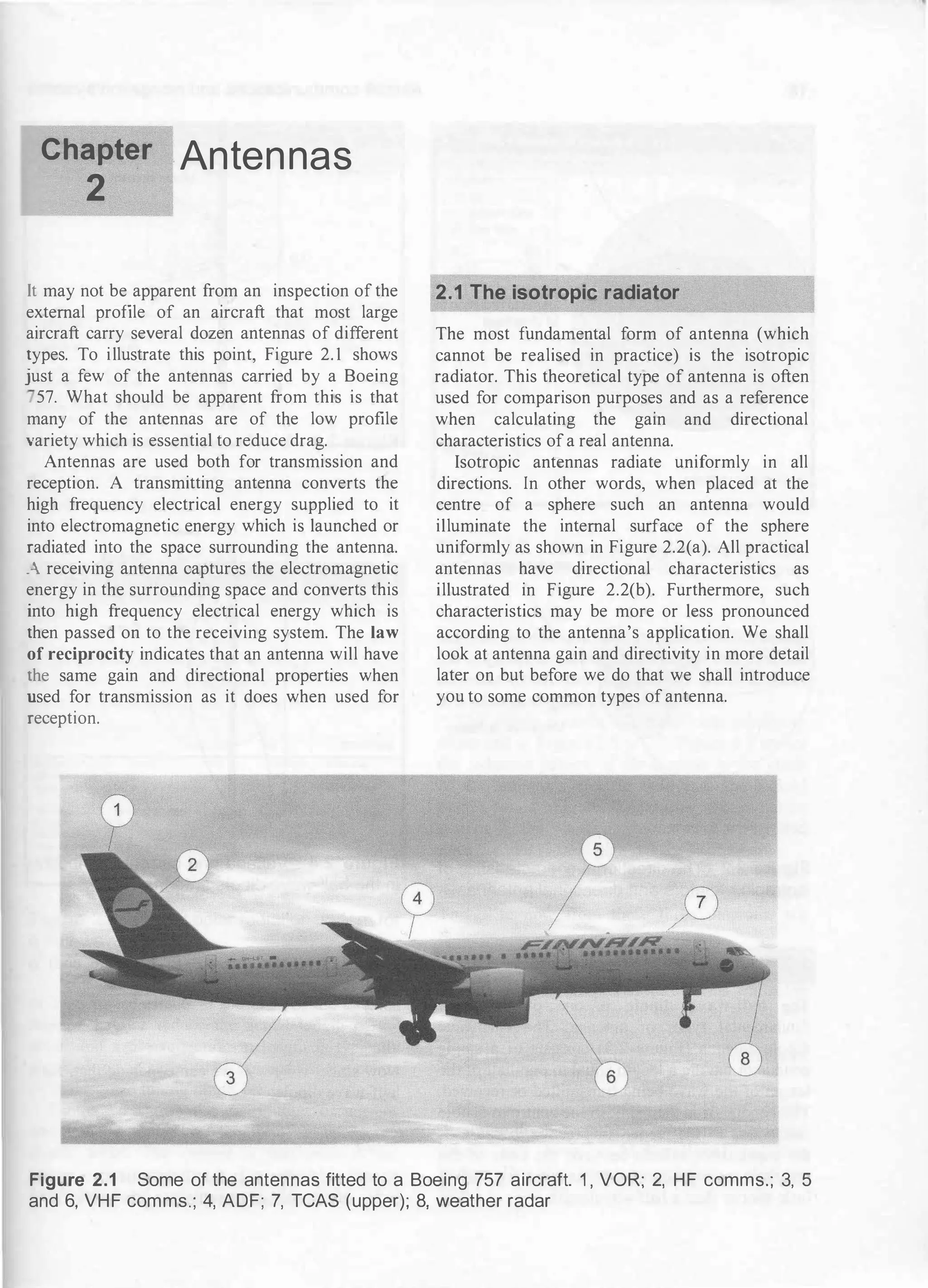
Preface xi
Acknowledgements xiv
Online resources xiv
Chapter 1 Introduction 1
1.1 The radio frequency spectrum 1
1.2 Electromag netic waves 3
1.3 Frequency and wavelength 4
1.4 The atmosphere 4
1.5 Radio wave propag ation 5
1.6 The ionosphere 7
1.7 MUF and LUF 10
1.8 Silent zone and skip distance 12
1.9 Multiple choice questions 13
Chapter 2 Antennas 15
2.1 The isotropic radiator 15
2.2 The half-wave dipole 16
2.3 Impedance and radiation resistance 18
2.4 Radiated power and efficiency 19
2.5 Antennag ain 19
2.6 The Yag i beam antenna 20
2.7 Directional characteristics 22
2.8 Other practical antennas 24
2.9 Feeders 28
2.10 Connectors 32
2.11 Standing wave ratio 33
2.12 Waveg uide 38
2.13 Multiple choice questions 39
Chapter 3 Transmitters and receivers 41
3.1 A simple radio system 41
3.2 Modulation and demodulation 42
3.3 AM transmitters 43
3.4 FM transmitters 44
3.5 Tuned radio frequency receivers 45
3.6 Superhet receivers 46
3.7 Selectivity 47
3.8 Ima
g e channel rejection 50
3.9 Automaticg ain control 51
3.10 Double superhet receivers 51
3.11 Dig ital frequency sy
n thesis 53
3.12 A desig n example 55
3.13 Multiple choice questions 59
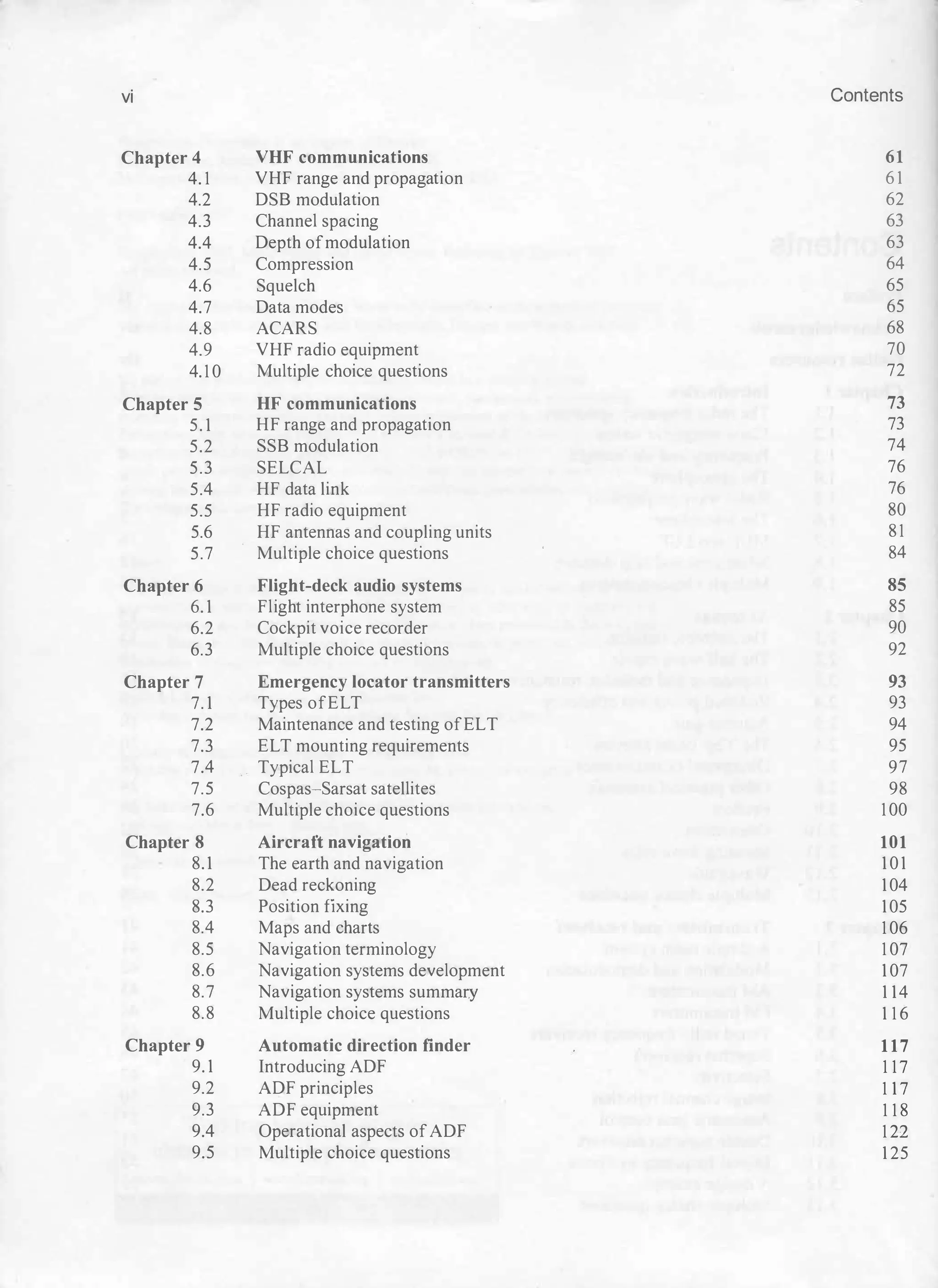
vi Contents
Chapter 4 VHF communications 61
4.1 VHF rang e and propag ation 61
4.2 DSB modulation 62
4.3 Channel spacin
g 63
4.4 Depth ofmodulation 63
4.5 Compression 64
4.6 Squelch 65
4.7 Data modes 65
4.8 ACARS 68
4.9 VHF radio equipment 70
4.10 Multiple choice questions 72
Chapter 5 HF communications 73
5.1 HF ran
g e and propa
g ation 73
5.2 SSB modulation 74
5.3 SELCAL 76
5.4 HF data link 76
5.5 HF radio equipment 80
5.6 HF antennas and coupling units 81
5.7 Multiple choice questions 84
Chapter 6 Flight-deck audio systems 85
6.1 Flig ht interphone system 85
6.2 Cockpit voice recorder 90
6.3 Multiple choice questions 92
Chapter 7 Emergency locator transmitters 93
7.1 Types ofELT 93
7.2 Maintenance and testing ofELT 94
7.3 ELT mounting requirements 95
7.4 Typical ELT 97
7.5 Cospas-Sarsat satellites 98
7.6 Multiple choice questions 100
Chapter 8 Aircraft navigation 101
8.1 The earth and navig ation 101
8.2 Dead reckonin
g 104
8.3 Position fixing 105
8.4 Maps and charts 106
8.5 Navig ation terminolog y 107
8.6 Navig ation systems development 107
8.7 Navig ation systems summar
y 114
8.8 Multiple choice questions 116
Chapter 9 Automatic direction finder 117
9.1 Introducing ADF 117
9.2 ADF principles 117
9.3 ADF equipment 118
9.4 Operational aspects ofADF 122
9.5 Multiple choice questions 125
Contents vii
Chapter 10 VHF omnidirectional range 127
10.1 VOR principles 127
10.2 Airborne equipment 131
10.3 Operational aspects ofVOR 136
10.4 Multiple choice questions 139
Chapter 11 Distance measuring equipment 141
11.1 Radar principles 141
11.2 DME overview 142
11.3 DME operation 143
11.4 Equipment overview 143
11.5 En route navig ation using radio navig ation aids 145
11.6 Multiple choice questions 149
Chapter 12 Instrument landing system 151
12.1 ILS overview 151
12.2 ILS g round equipment 151
12.3 ILS airborne equipment 155
12.4 Low rang e radio altimeter 159
12.5 ILS approach 160
12.6 Autoland 160
12.7 Operational aspects ofthe ILS 161
12.8 Multiple choice questions 162
Chapter 13 Microwave landing system 163
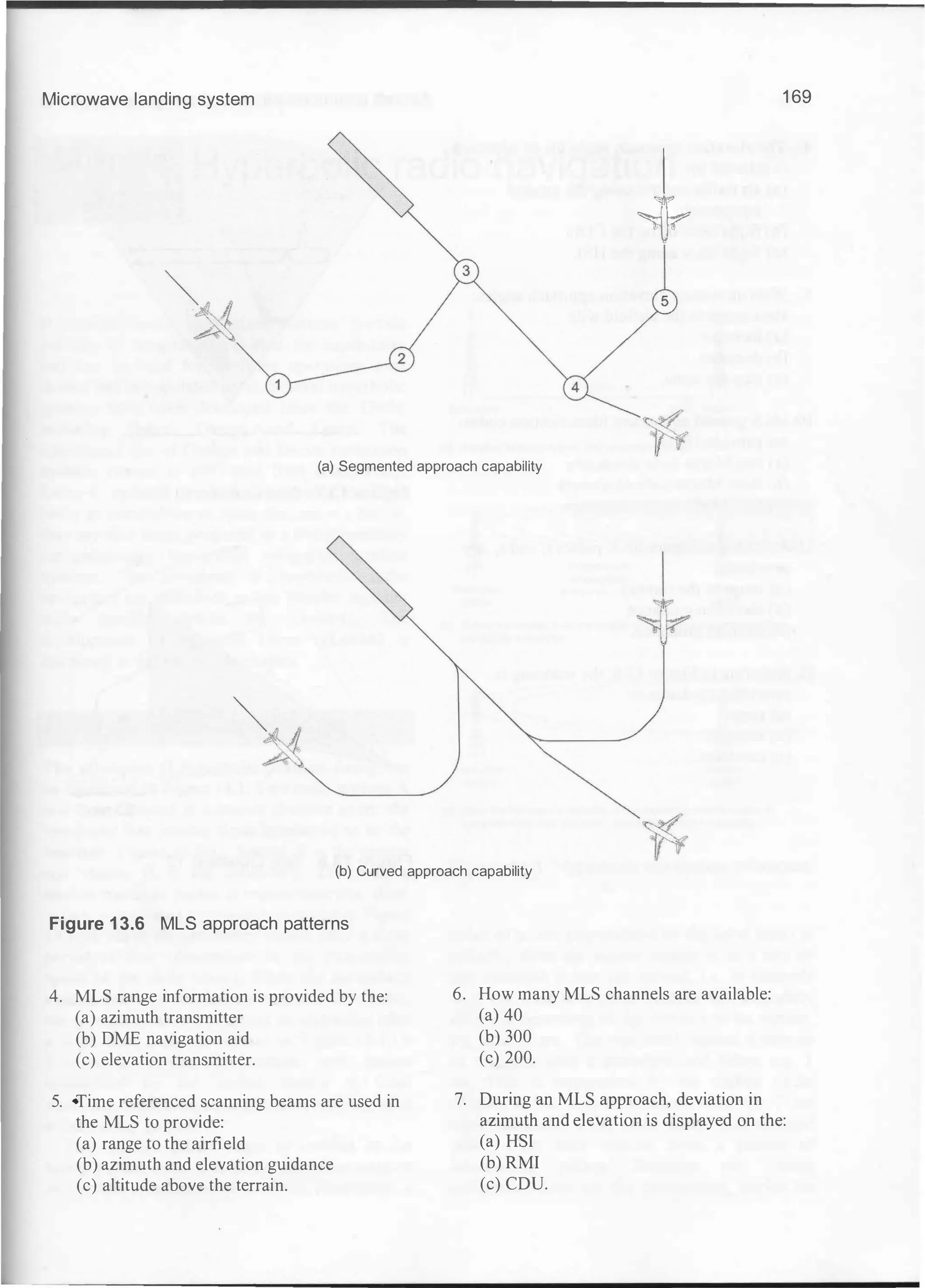
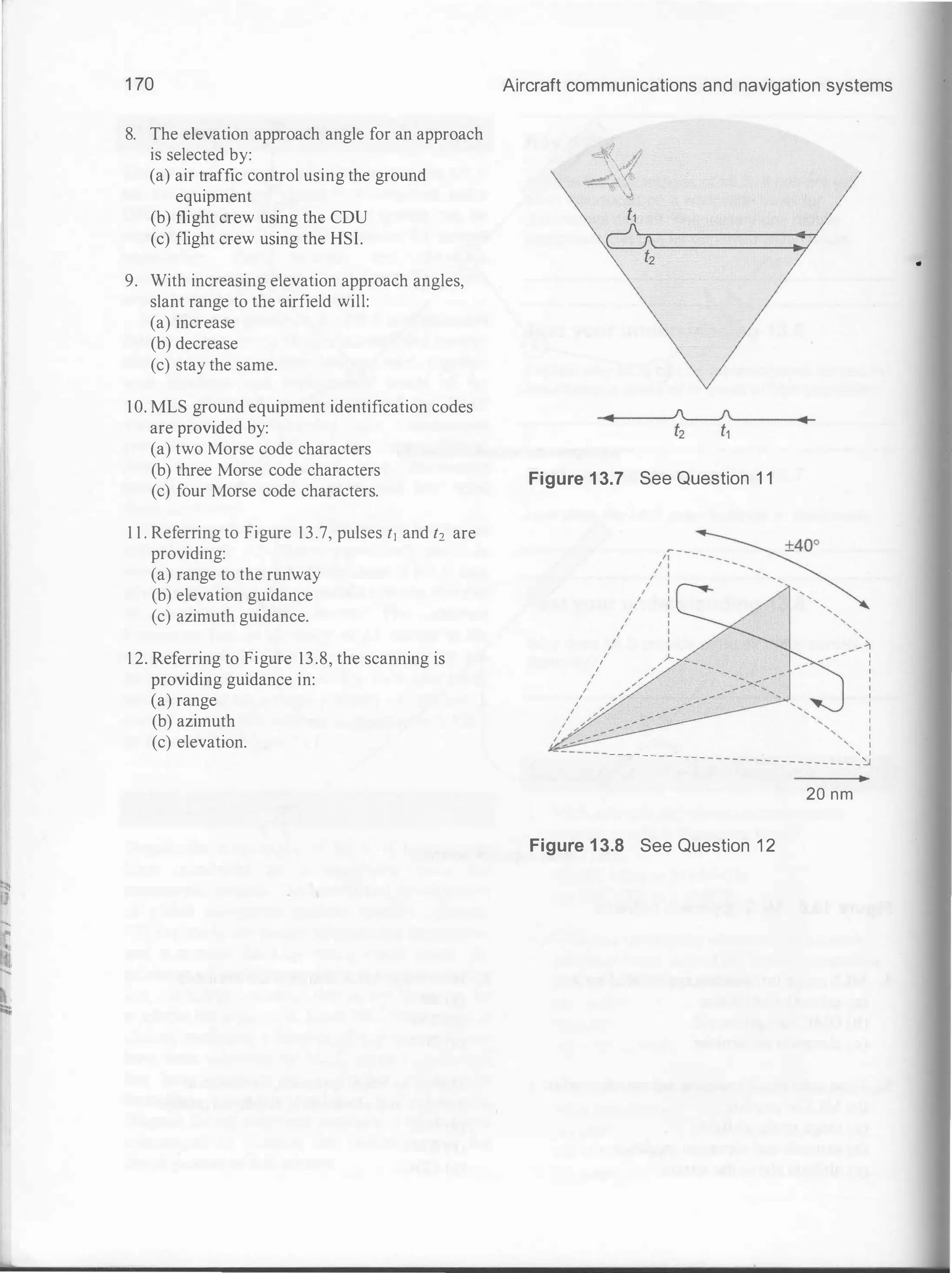
13.1 ML S overview 163
13.2 MLS principles 163
13.3 Aircraft equipment 166
13.4 Ground equipment 168
13.5 MLS summary 168
13.6 Multiple choice questions 168
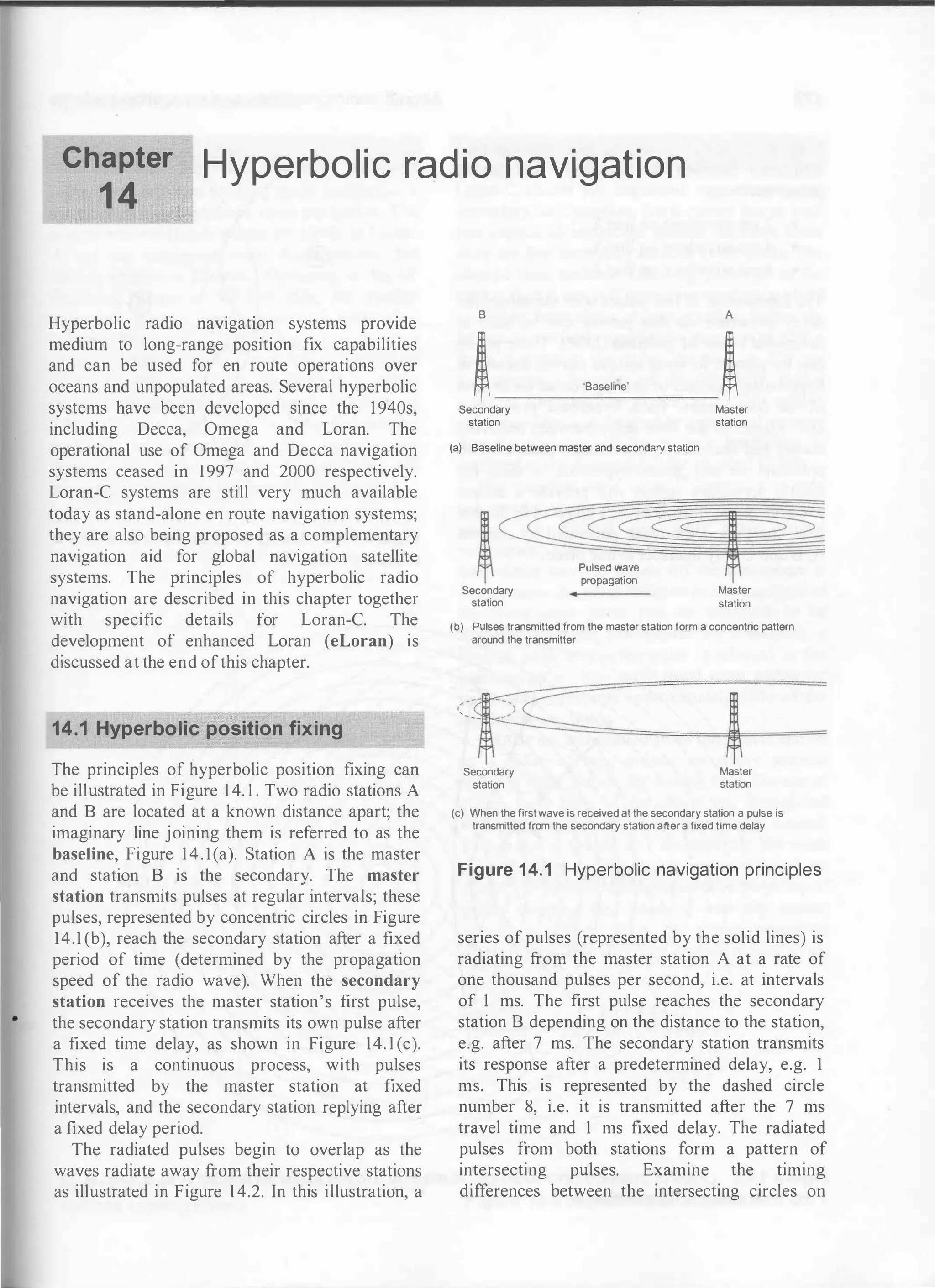
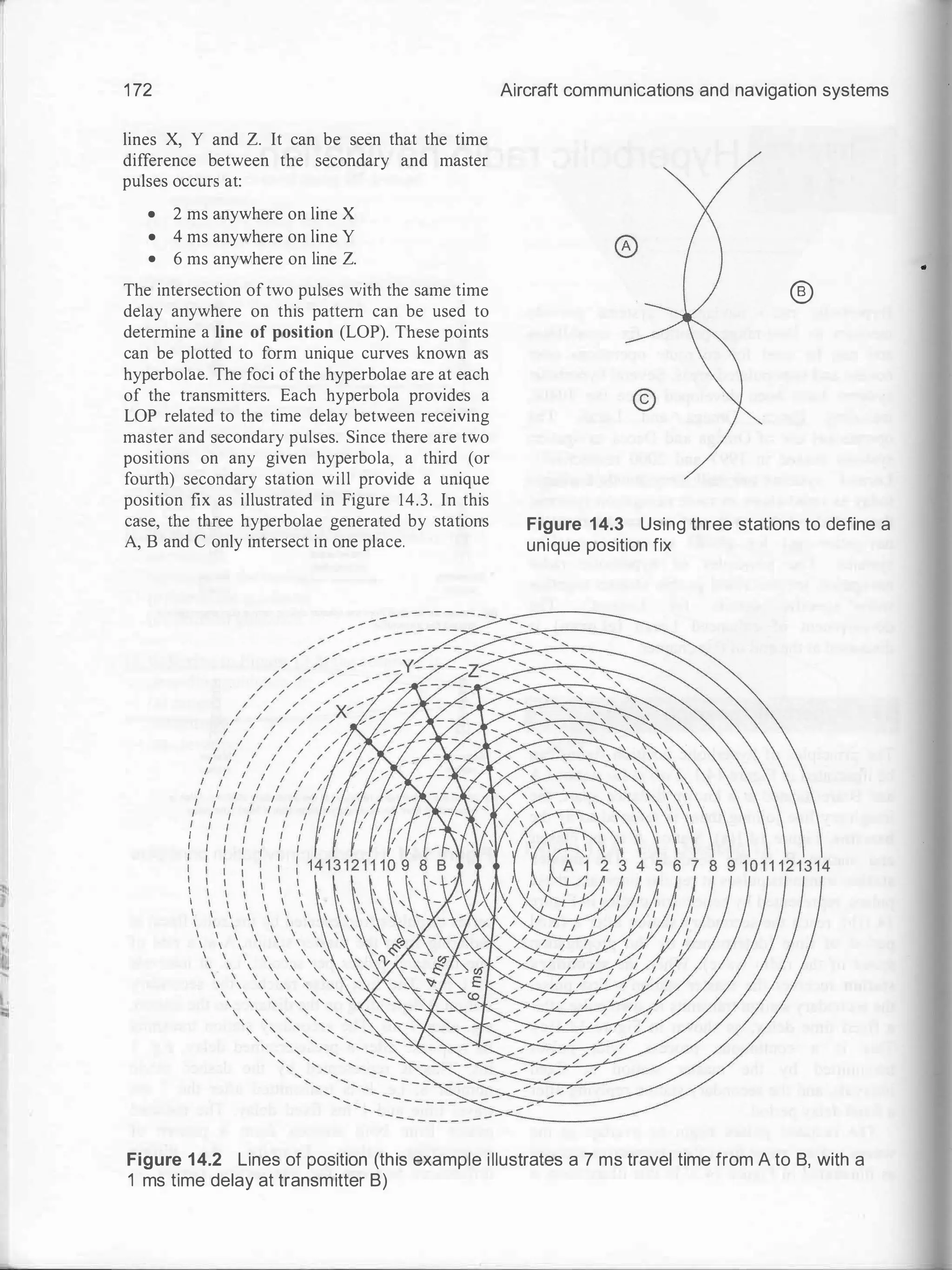
Chapter 14 Hyperbolic radio navigation 171
14.1 Hyperbolic position fixing 171
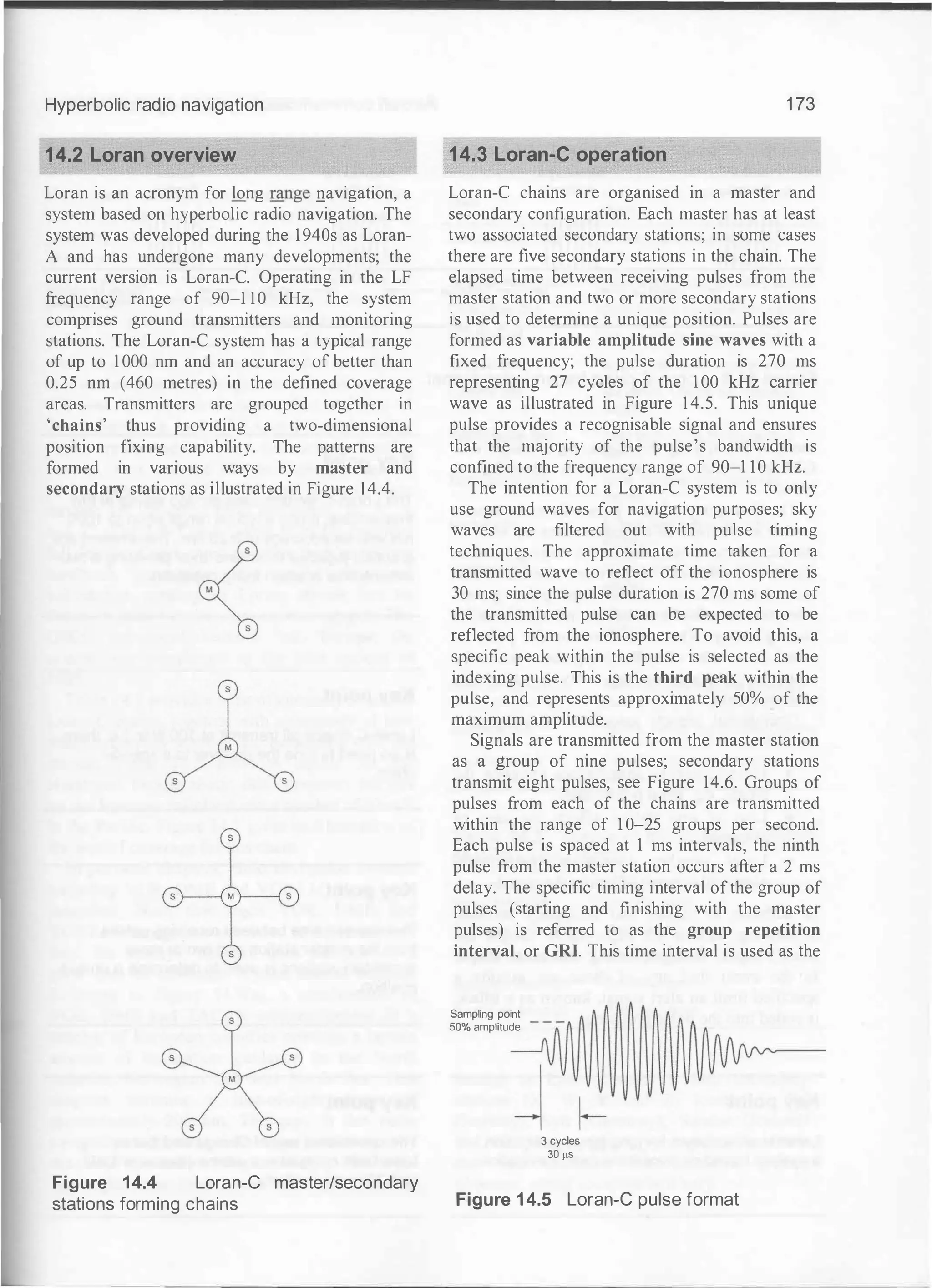
14.2 Loran overview 173
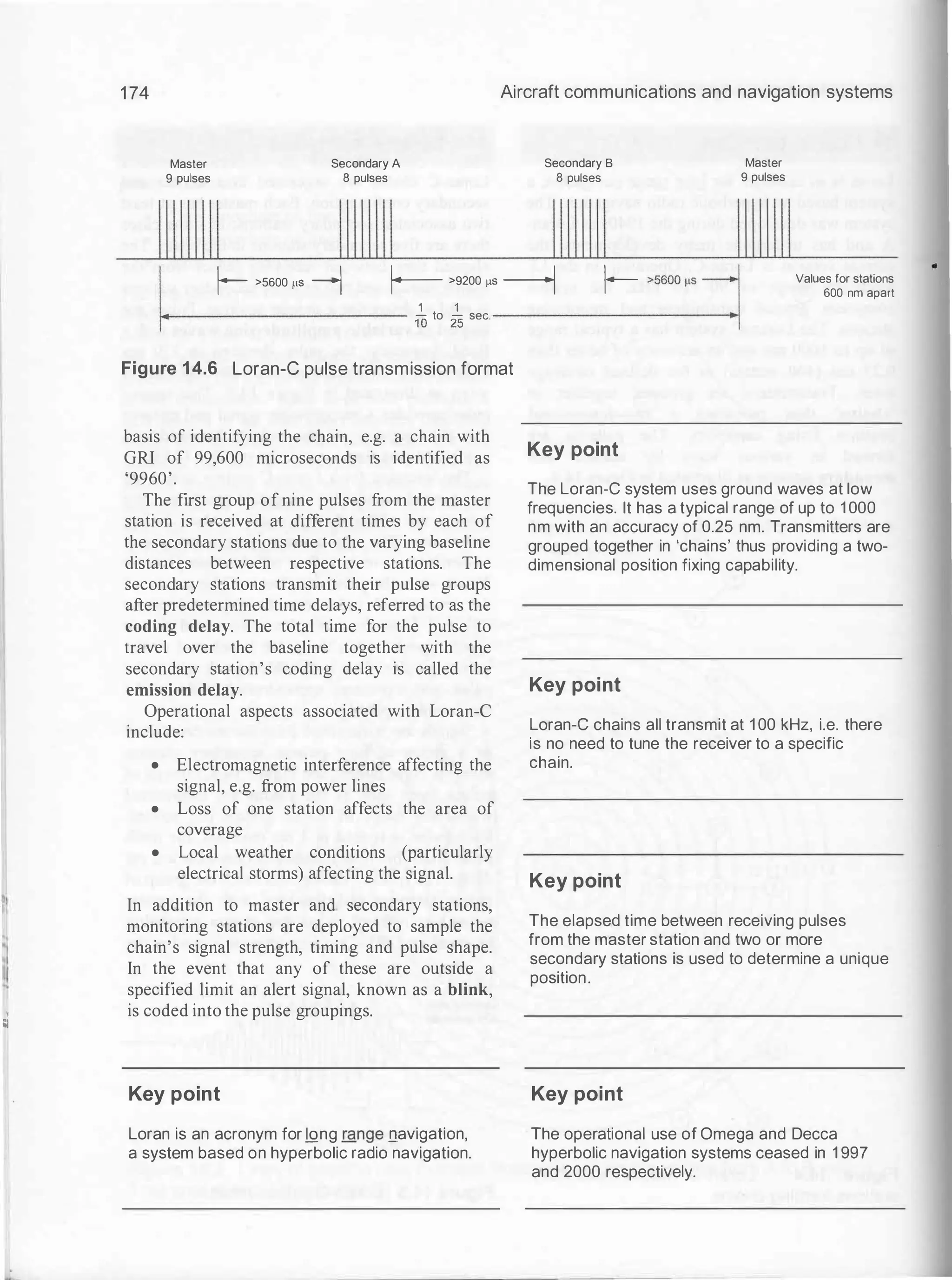
14.3 Loran-C operation 173
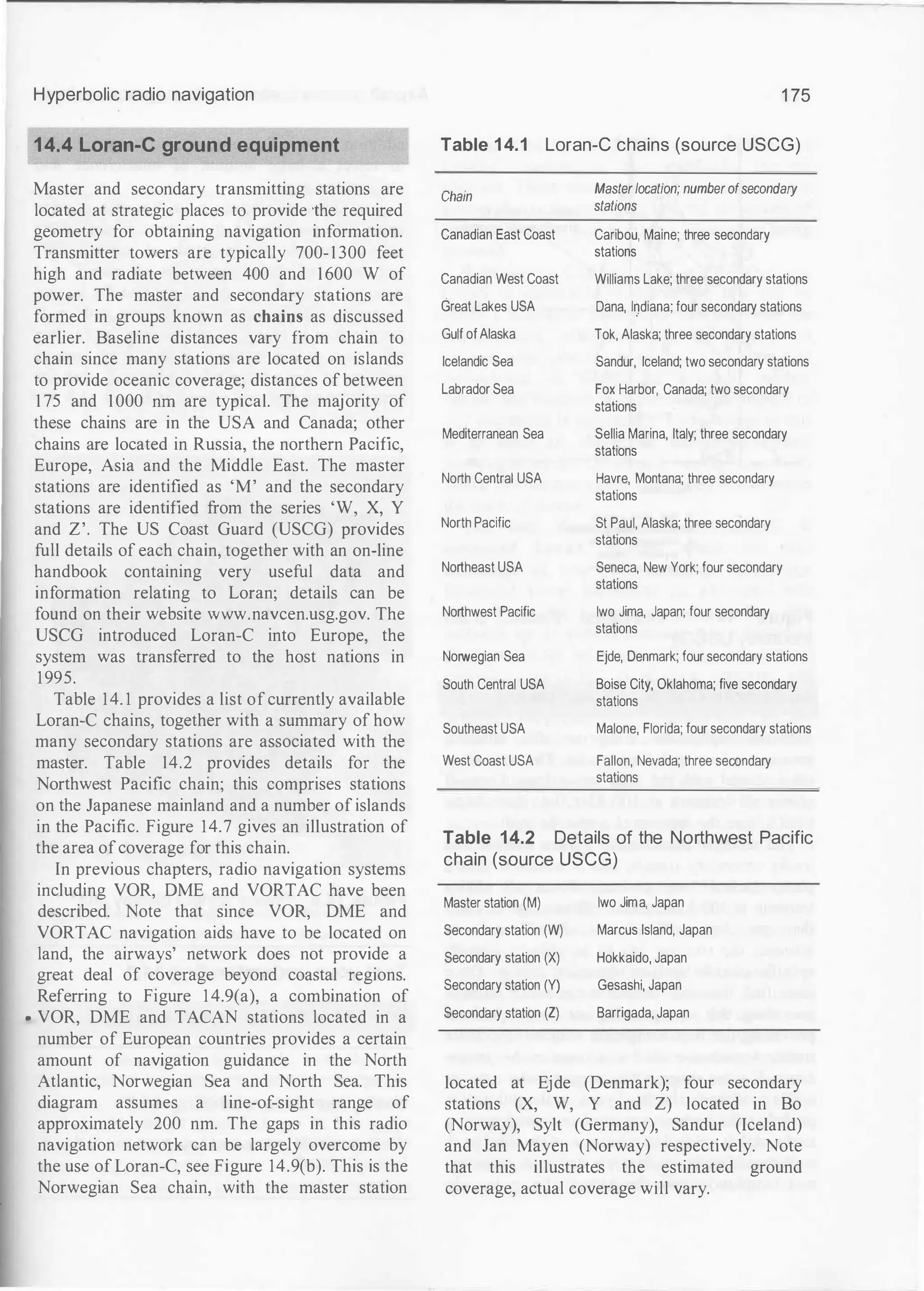
14.4 Loran-eg round equipment 175
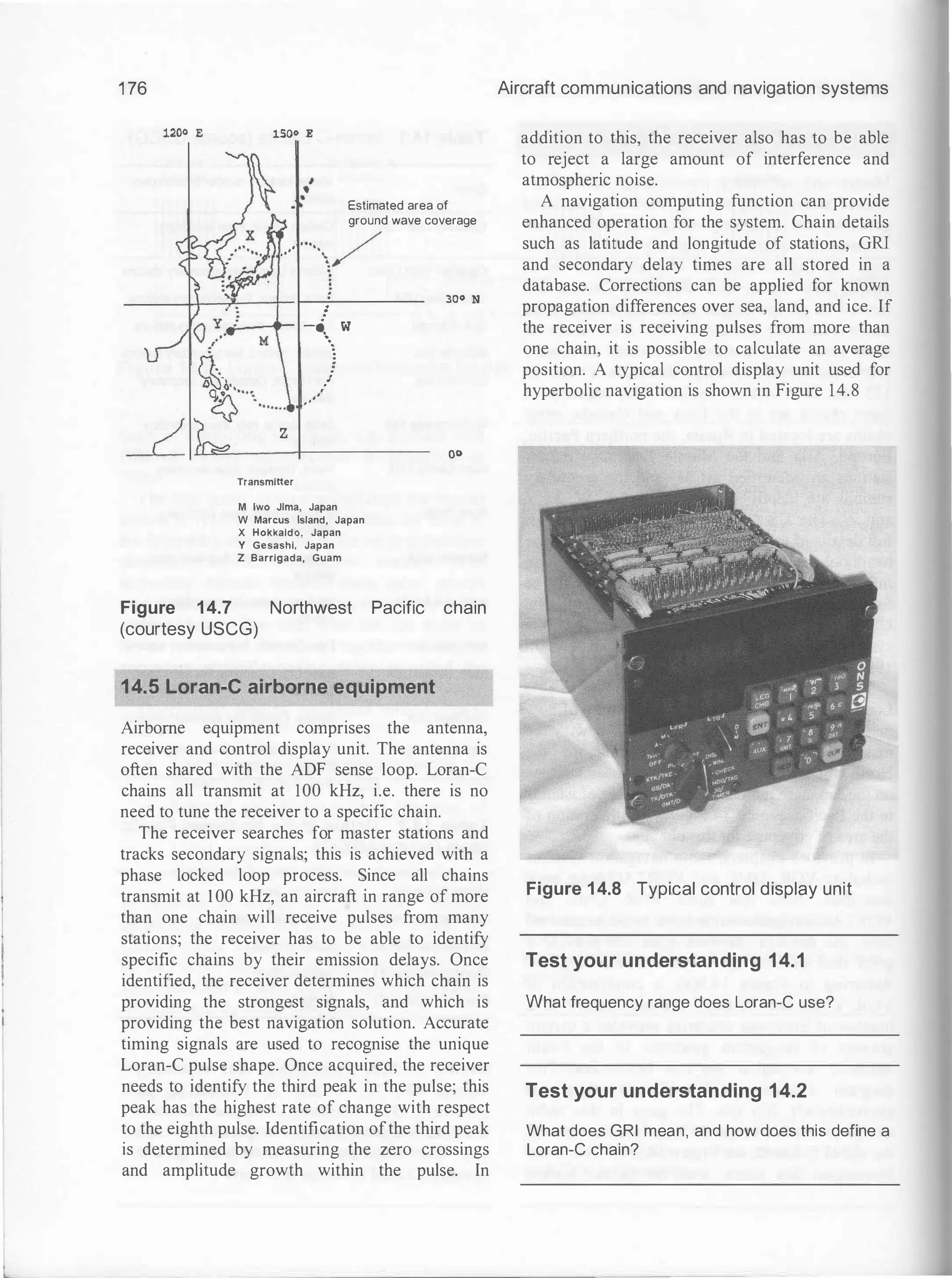
14.5 Loran-e airborne equipment 176
14.6 Enhanced Loran (eLoran) 177
14.7 Multiple choice questions 178
Chapter 15 Doppler navigation 179
15.1 The Doppler effect 179
15.2 Doppler navig ation principles 179
15.3 Airborne equipment overview 183
15.4 Typical Doppler installations 184
15.5 Doppler summary 184
15.6 Other Doppler applications 185
15.7 Multiple choice questions 186
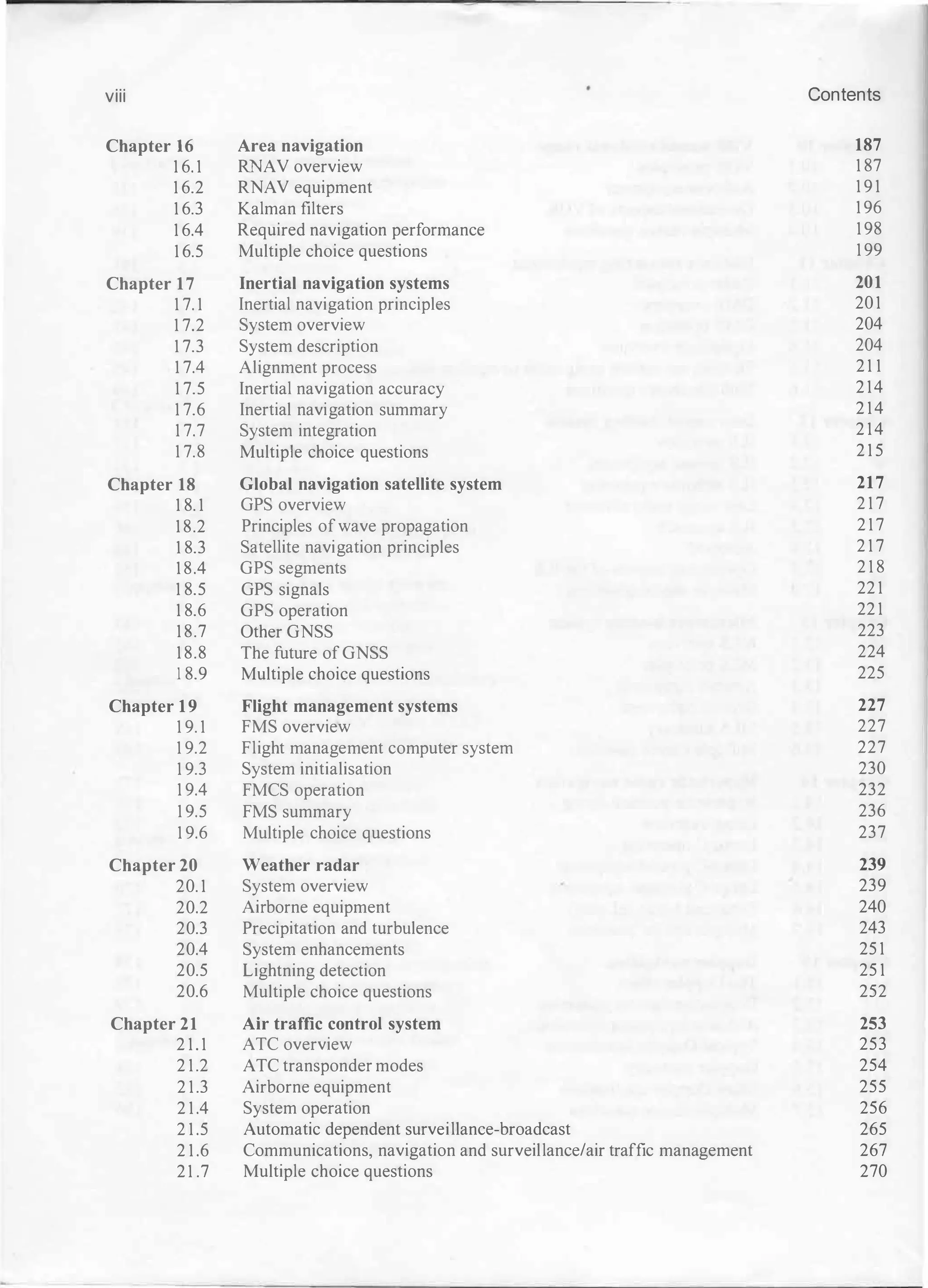
viii
Chapter 16
16.1
16.2
16.3
16.4
16.5
Chapter 17
17.1
17.2
17.3
17.4
17.5
17.6
17.7
17.8
Chapter 18
18.1
18.2
18.3
18.4
18.5
18.6
18.7
18.8
18.9
Chapter 19
19.1
19.2
19.3
19.4
19.5
19.6
Chapter 20
20.1
20.2
20.3
20.4
20.5
20.6
Chapter 21
21.1
21.2
21.3
21.4
21.5
21.6
21.7
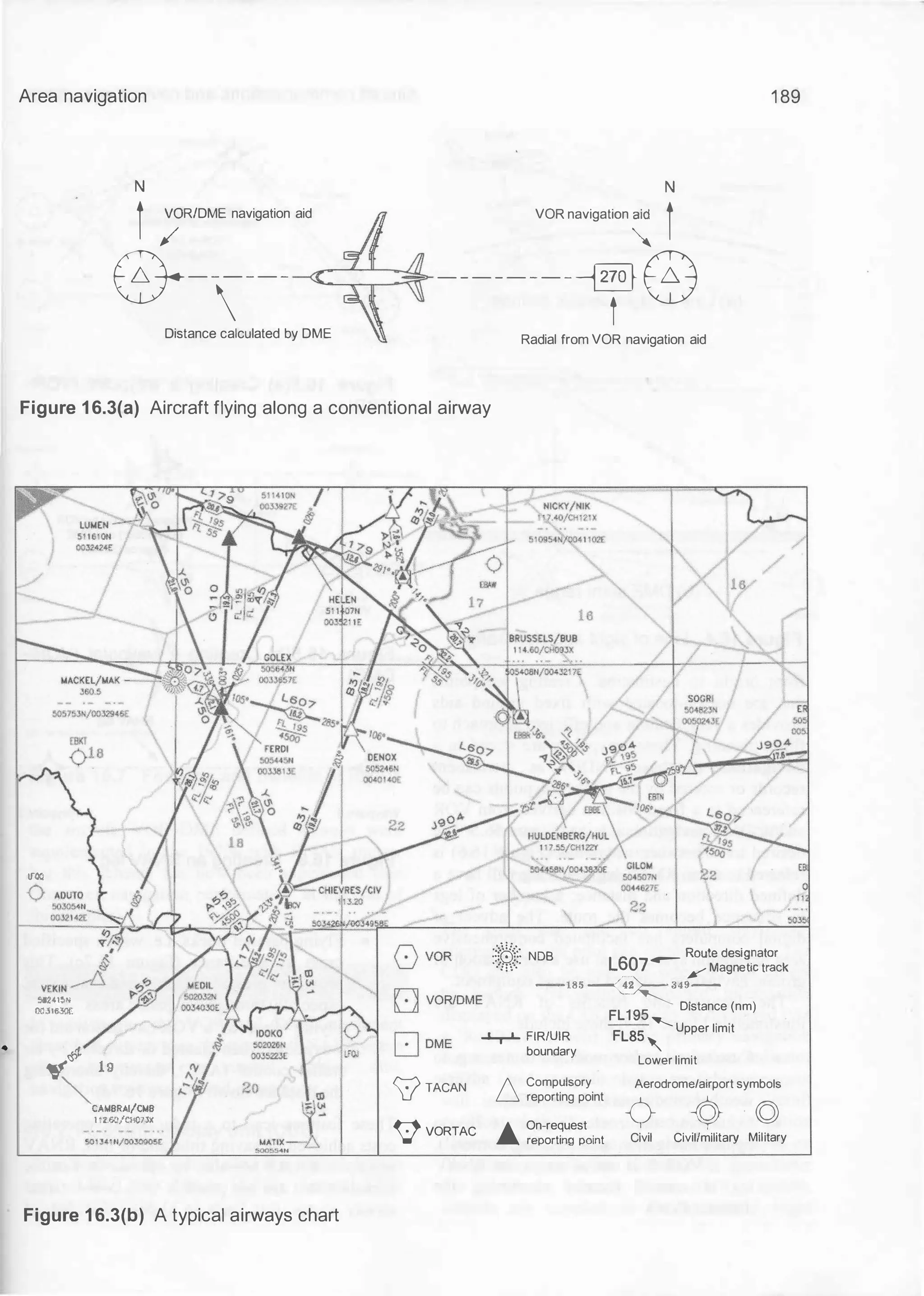
Area navigation
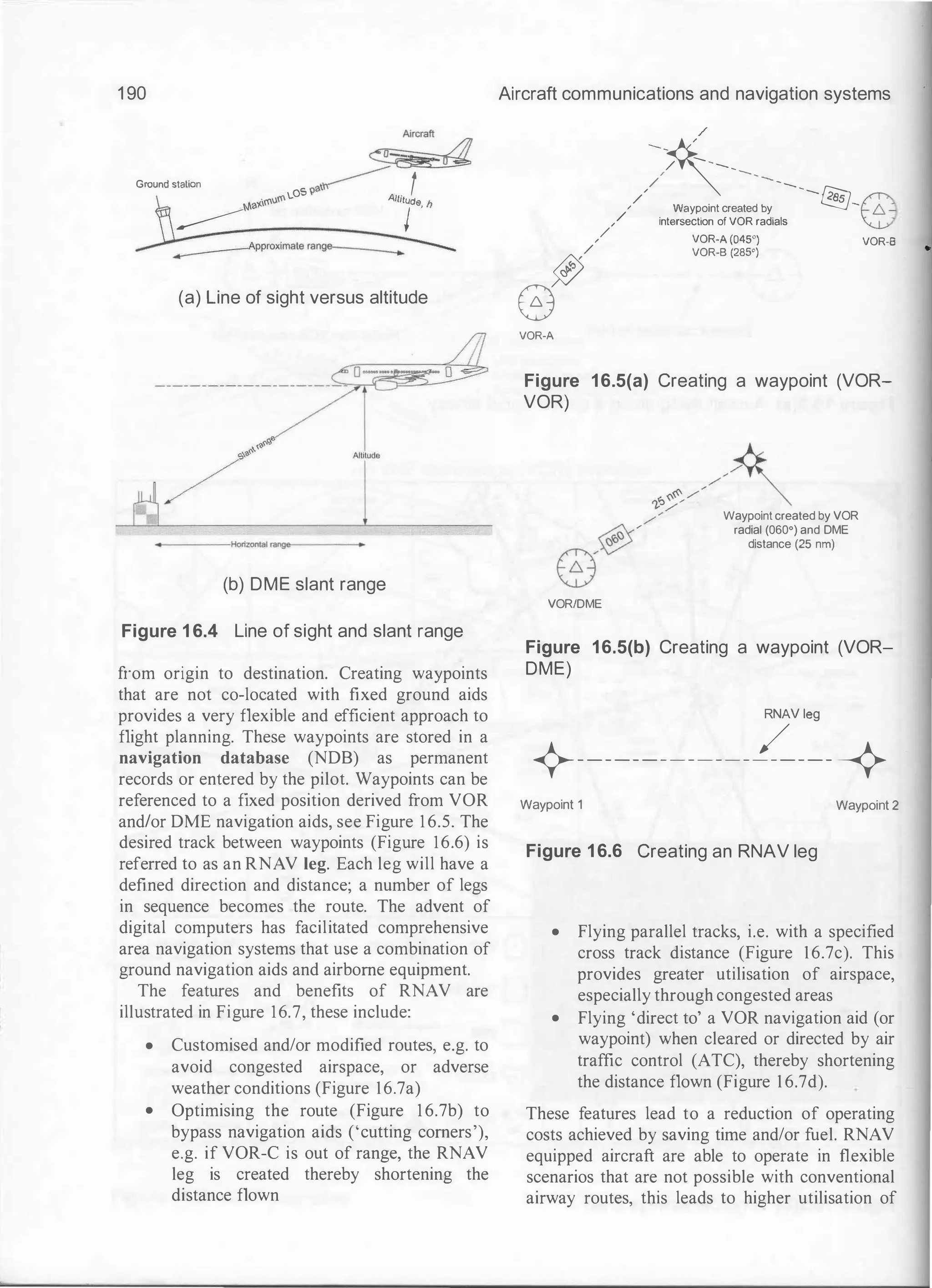
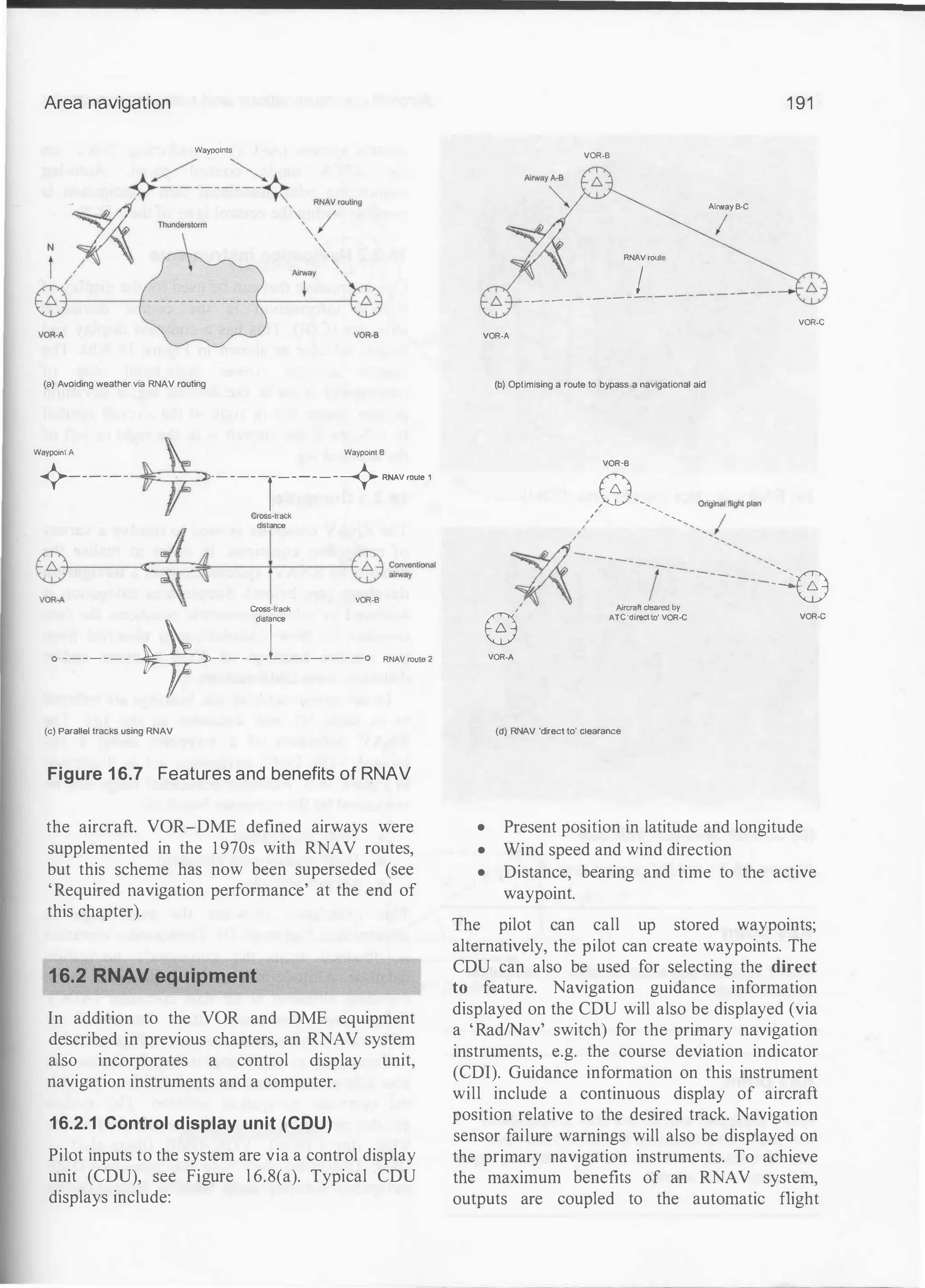
RN AV overview
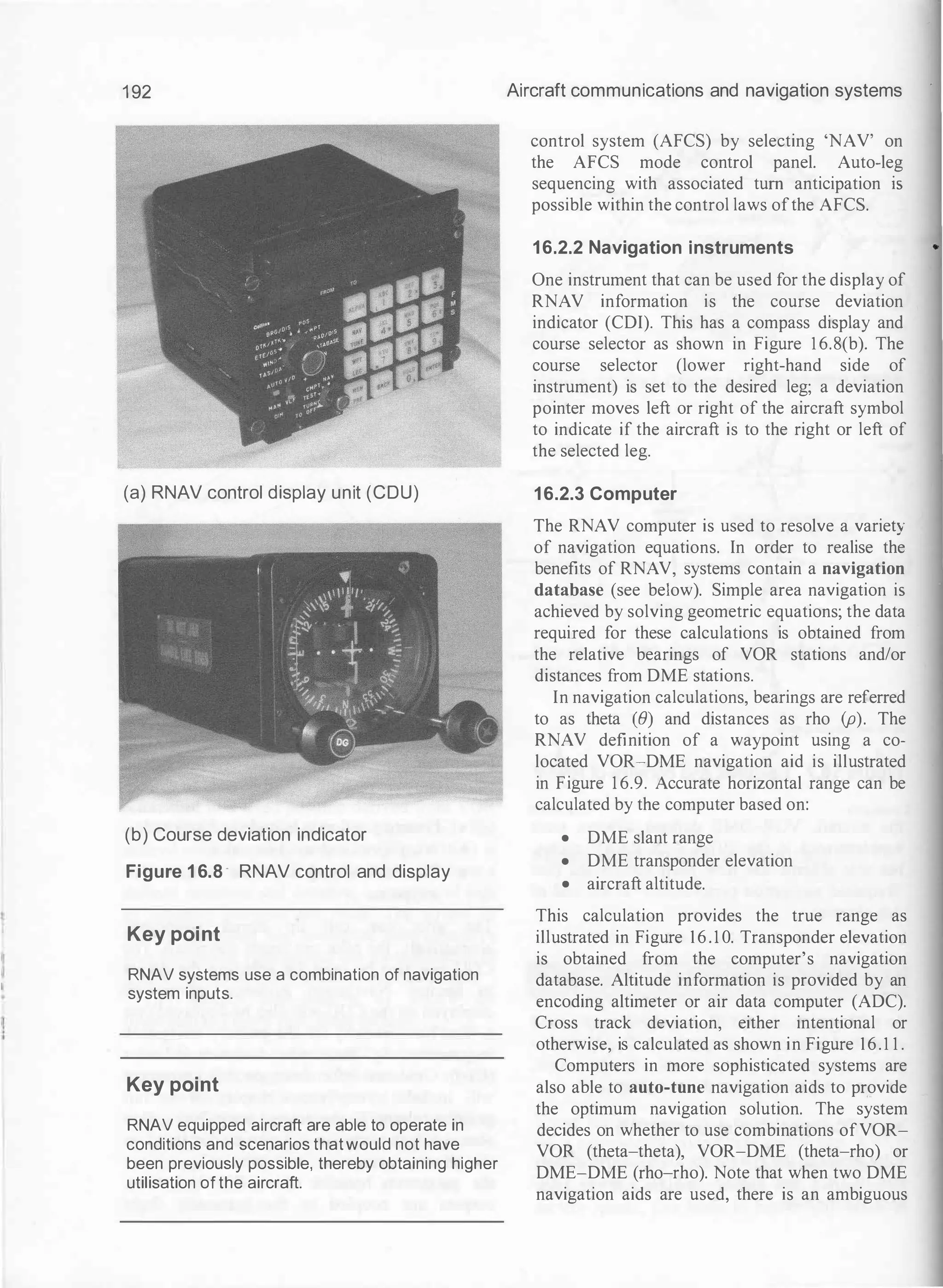
RNAV equipment
Kalman filters
Required navig ation performance
Multiple choice questions
Inertial navigation systems
Inertial navig ation principles
System overview
System description
Alig nment process
Inertial navig ation accuracy
Inertial navig ation summary
System integ ration
Multipl e choice questions
Global navigation satellite system
GPS overview
Principles ofwave propag ation
Satellite navig ation principles
GPS seg ments
GPS sig nals
GPS operation
Other GNSS
The future of GNSS
Multiple choice questions
Flight management systems
FMS overview
Flig ht manag ement computer system
System initialisation
FMCS operation
FMS summary
Multiple choice questions
Weather radar
System overview
Airborne equipment
Precipitation and turbulence
System enhancements
Lig htning detection
Multiple choice questions
Air traffic control system
ATC overview
ATC transponder modes
Airborne equipment
System operation
Automatic dependent surveillance-broadcast
Communications, navig ation and surveillance/air traffic mana
g ement
Multiple choice questions
Contents
187
187
191
196
198
199
201
201
204
204
211
214
214
214
215
217
217
217
217
218
221
221
223
224
225
227
227
227
230
232
236
237
239
239
240
243
251
251
252
253
253
254
255
256
265
267
270
Contents
Chapter 22
22.1
22.2
22.3
22.4
22.5
Appendices
1
2
3
4
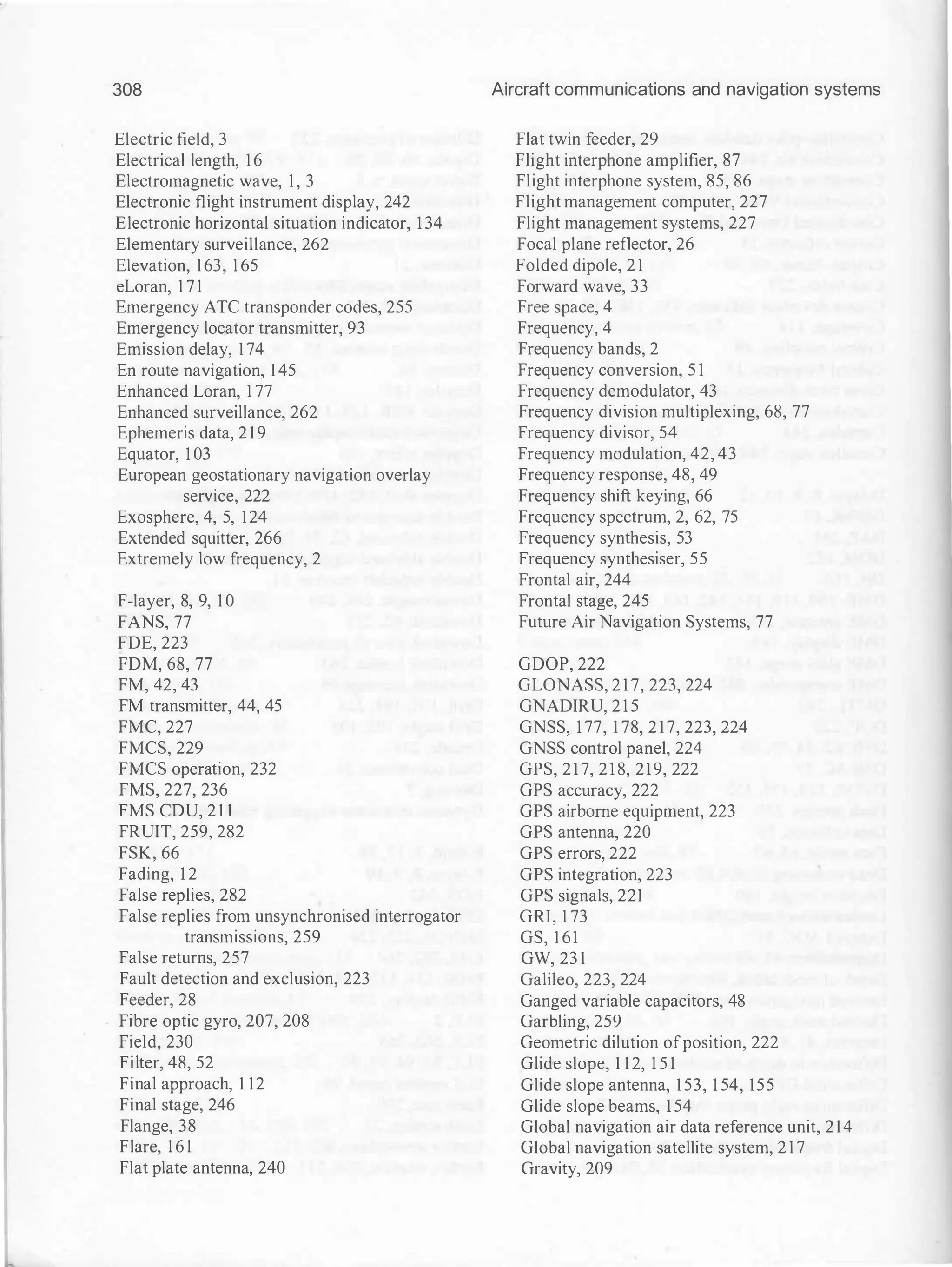
Index
Traffic alert and collision avoidance system
Airborne collision avoidance systems
TCAS overview
TCAS equipment
System operation
Multiple choice questions
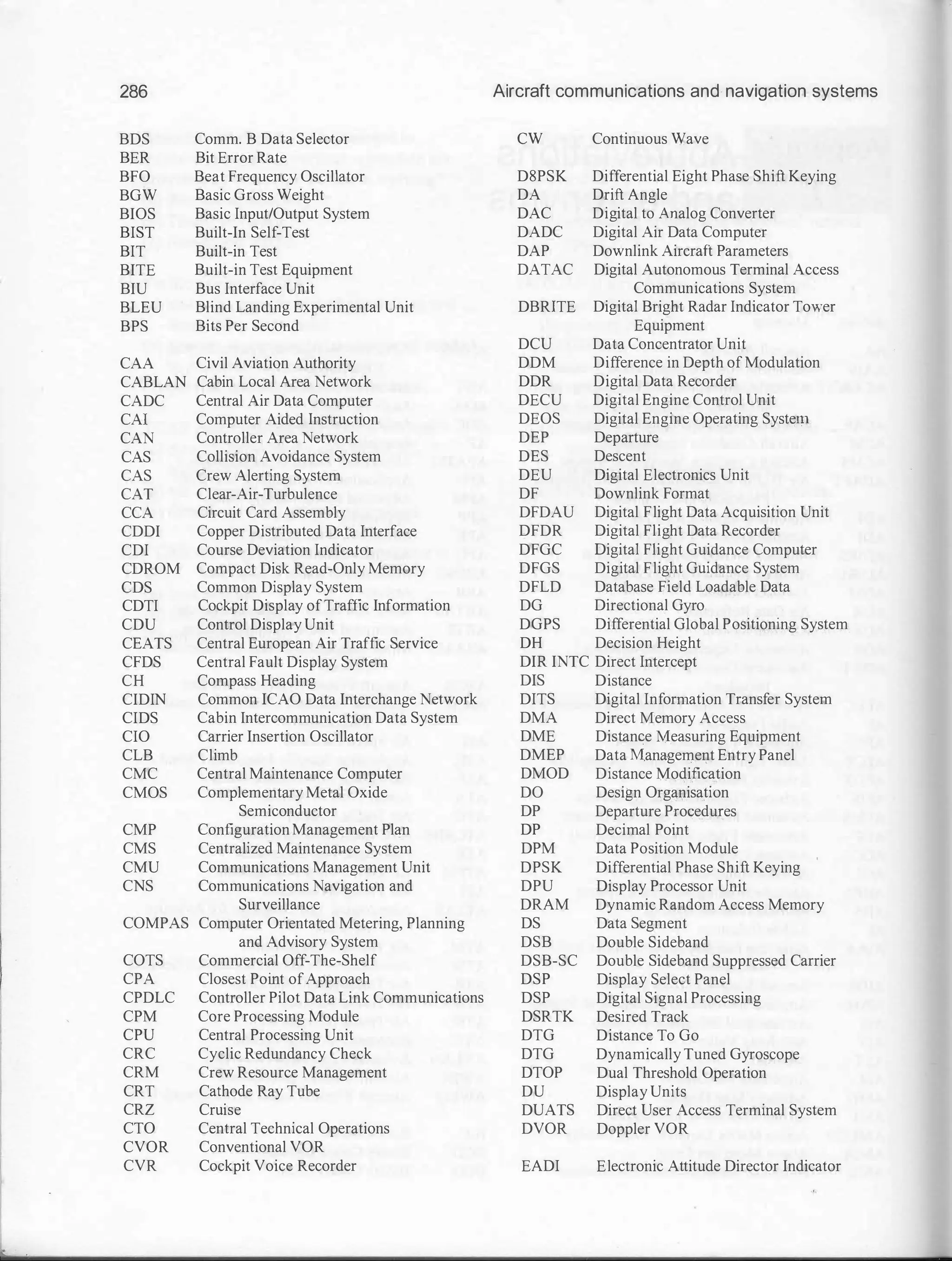
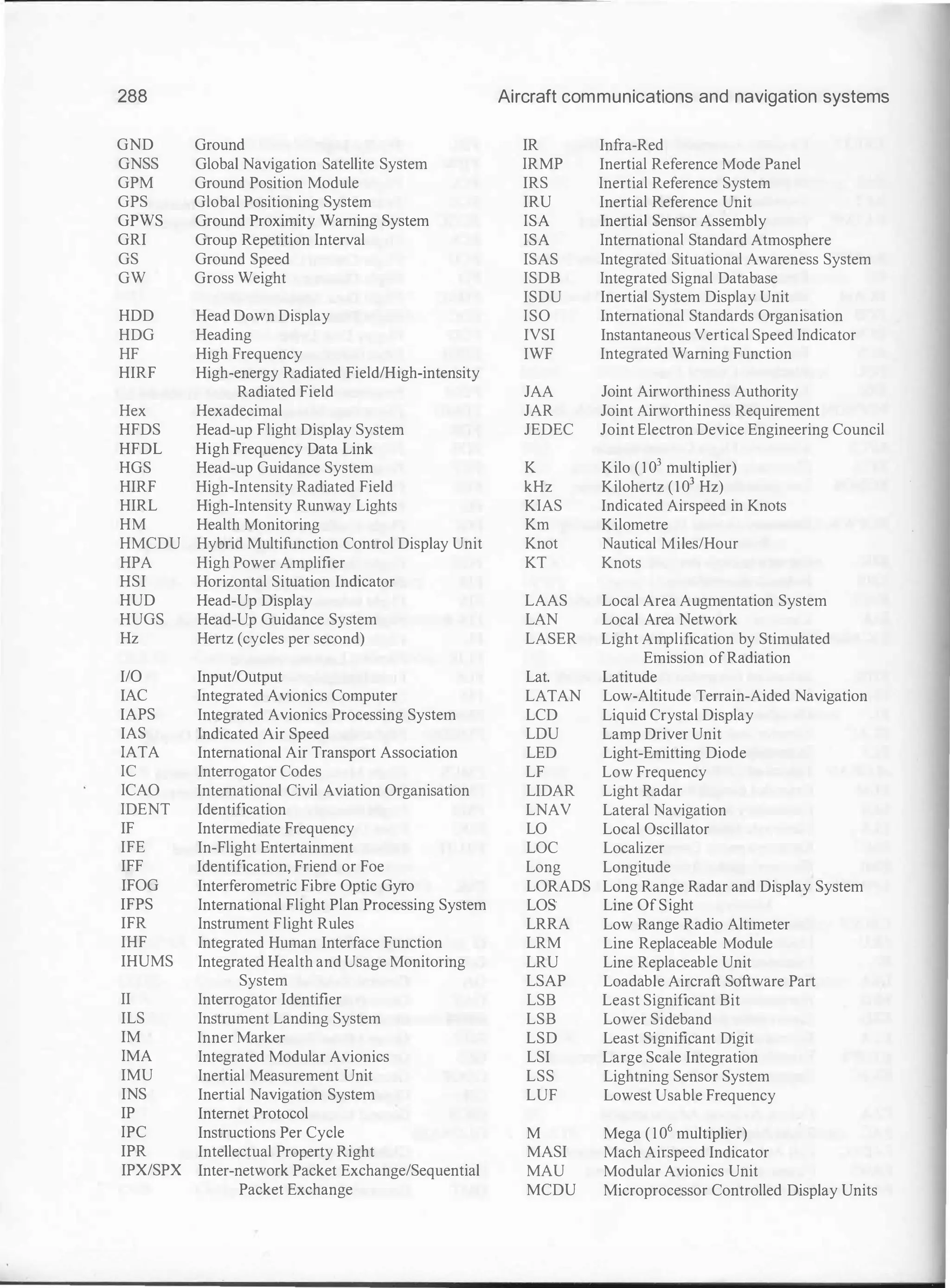
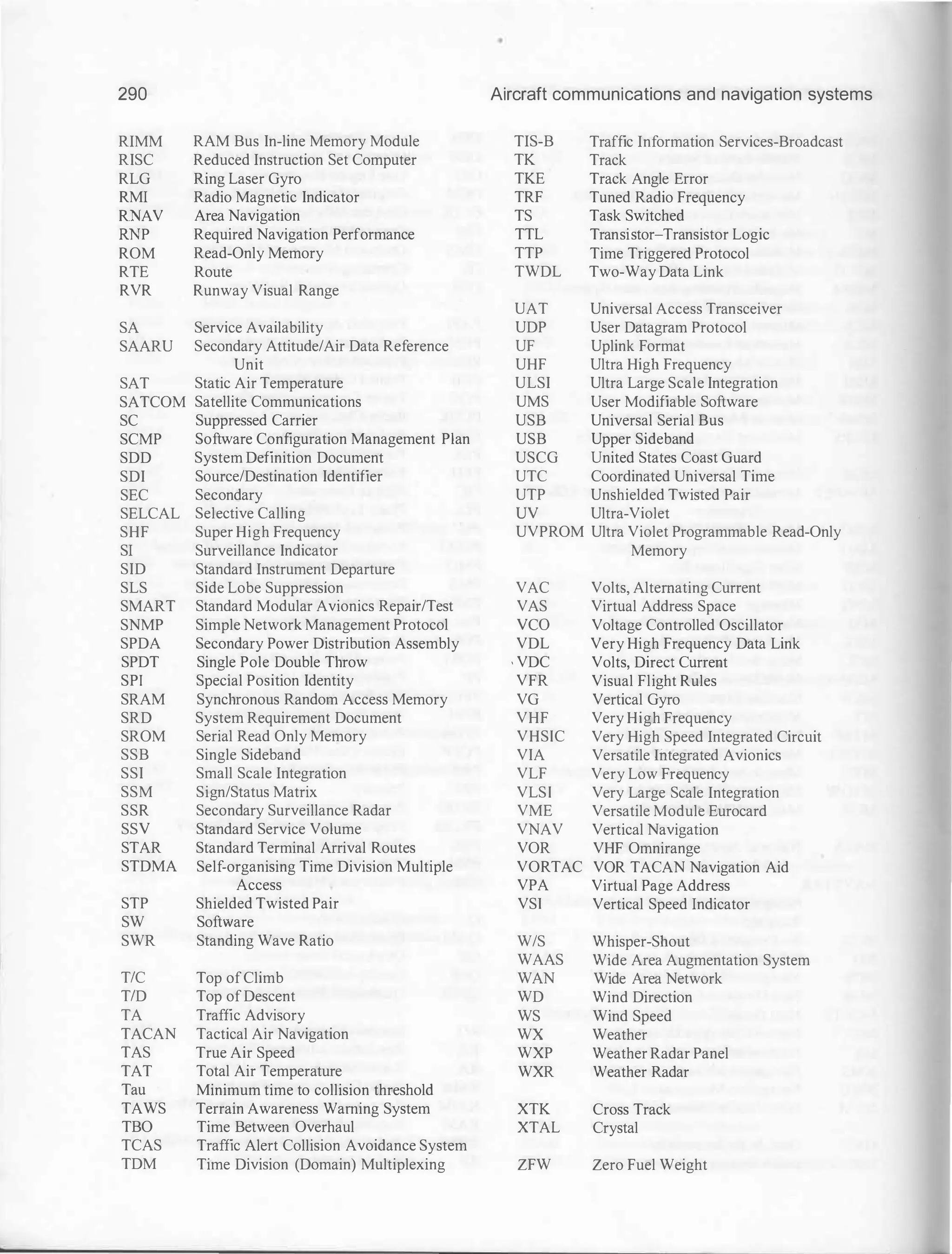
Abbreviations and acronyms
Revision papers
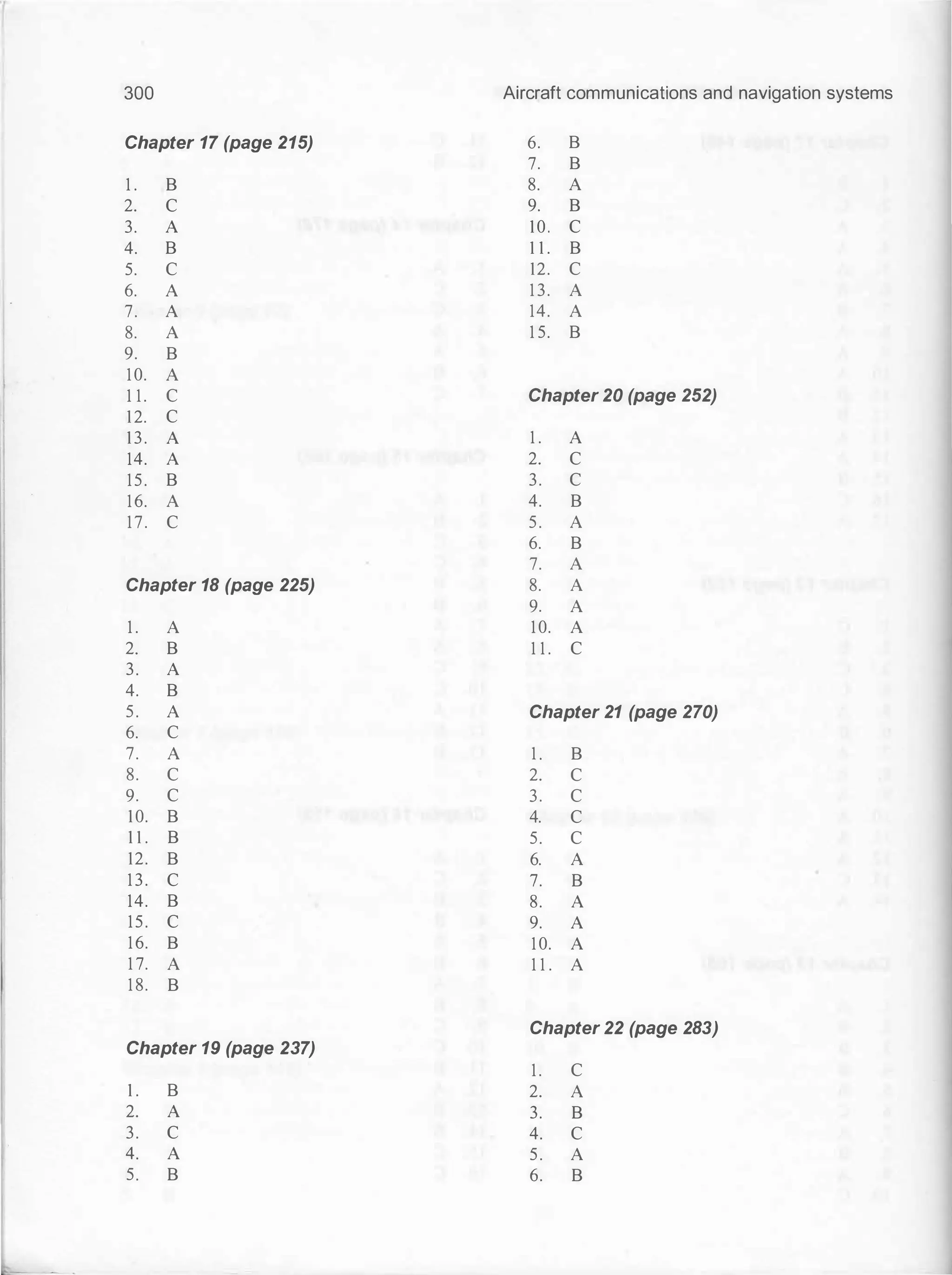
Answers
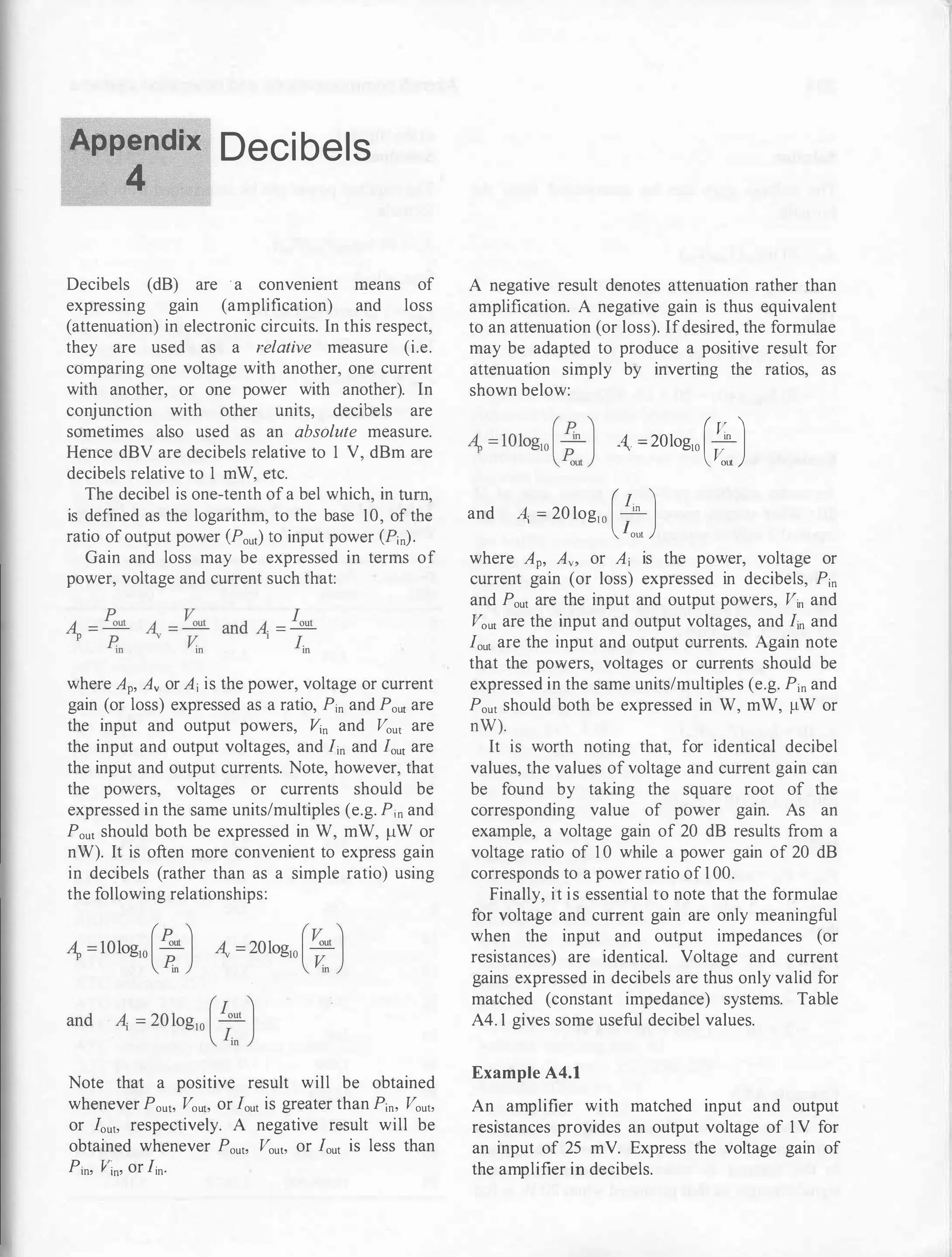
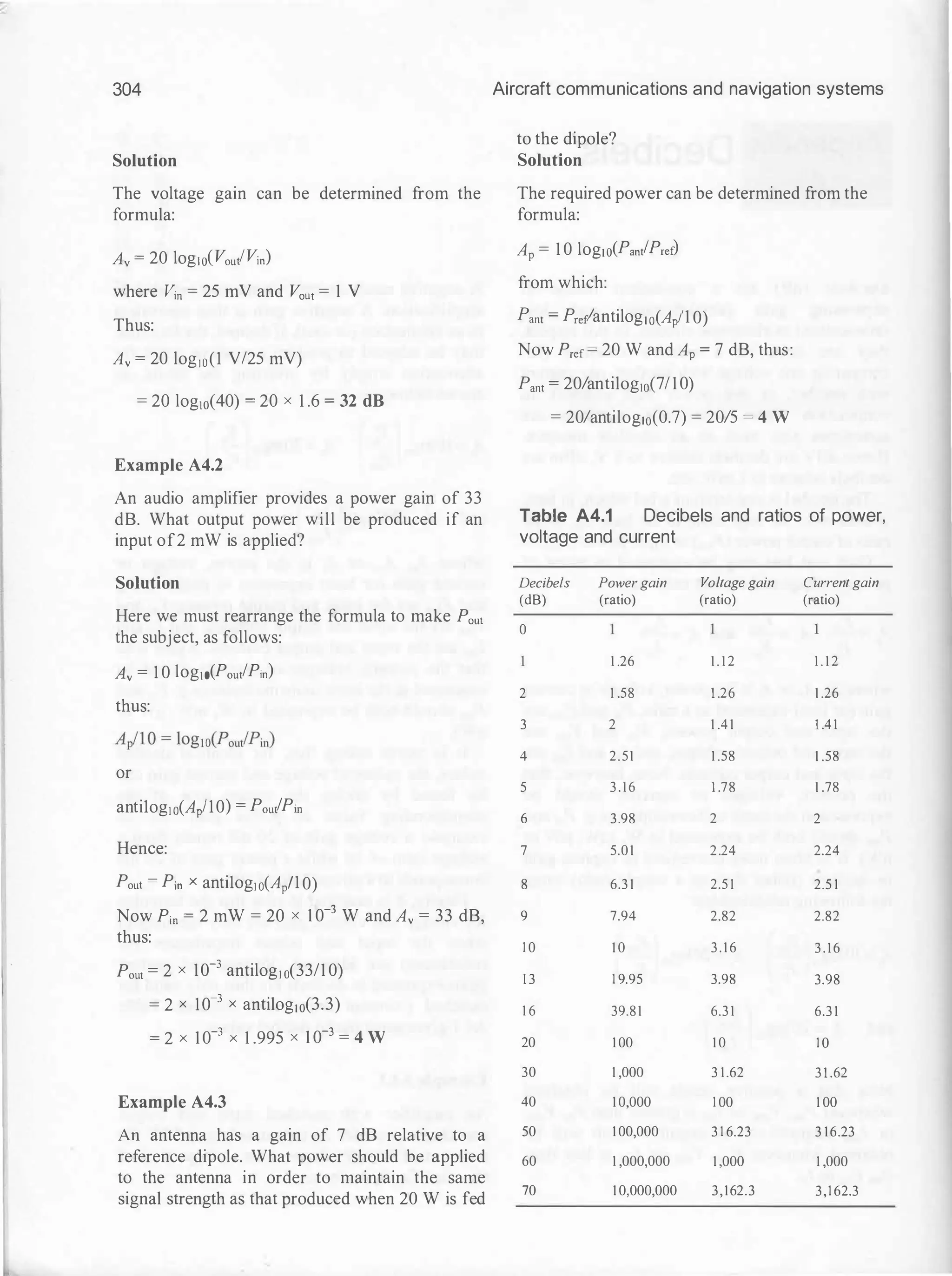
Decibels
ix
271
271
272
275
277
283
285
285
291
297
303
305
Preface
The books in this series have been designed for
both independent and tutor assisted studies. They
are particularly useful to the 'self-starter' and to
lhose wishing to update or upgrade their aircraft
maintenance licence. The series also provides a
useful source of reference for those taking ab
initio training programmes in EASA Part 147 and
FAR 147 approved organisations as well as those
rollowing related programmes in further and
higher education institutions.
This book is designed to cover the essential
imowledge base required by certifying mechanics,
:.echnicians and engineers engaged in engineering
:naintenance activities on commercial aircraft. In
dition, this book should appeal to members of
:.... armed forces and others attending training and
�cational establishments engaged in aircraft
"'T1 intenance and related aeronautical engineering
--ogrammes (including BTEC Natiodal and
:'gher National units as well as City and Guilds
- }NQ courses).
The book provides an introduction to the
ciples, operation and maintenance of aircraft
unications and navigation systems. The aim
- been to make the subject material accessible
.; presented in a form that can be readily
-imitated. The book provides syllabus coverage
; -· e communications and navigation section of
-' e 13 (ATA 23/34). The book assumes a
-�;: understanding of aircraft flight controls as
as an appreciation of electricity and
-- onics (broadly equivalent to Modules 3 and
- =-- e EASA Part-66 syllabus).
important to realise that this book is not
- :-ed to replace aircraft maintenance manuals.
it attempt to provide the level of detail
-ed by those engaged in the maintenance of
:.:� aircraft types. Instead it has been
;-=d. to convey the essential underpinning
xge required by all aircraft maintenance
·;ner 1 sets the scene by providing an
·on of electromagnetic wave propagation
.., radio frequency spectrum. The chapter
also describes the various mechanisms by which
radio waves propagate together with a detailed
description of the behaviour of the ionosphere
and its effect on radio signals.
Antennas are introduced in Chapter 2. This
chapter explains the principles of isotropic and
directional radiating elements and introduces a
number of important concepts including radiation
resistance, ante1ma impedance, radiated power,
gain and efficiency. Several practical forms of
antenna are described including dipoles, Yagi
beam antennas, qua1ter wave (Marconi) antennas,
comer reflectors, hom and parabolic dish
radiators. Chapter 2 also provides an introduction
to feeders (including coaxial cable and open-wire
types), connectors and standing wave ratio
(SWR). The chapter concludes with a brief
introduction to waveguide systems.
Radio transmitters and receivers are the subject
of Chapter 3. This chapter provides readers with
an introduction to the operating principles of AM
and FM transmitters as well as tuned radio
frequency (TRF) and supersonic-heterodyne
(superhet) receivers. Selectivity, image channel
rejection and automatic gain control (AGC) are
important requirements of a modem radio
receiver and these topics are introduced before
moving on to describe more complex receiving
equipment. Modem aircraft radio equipment is
increasingly based on the use of digital frequency
synthesis and the basic principles of phase-locked
loops and digital synthesisers are described and
explained.
Very high frequency (VHF) radio has long
been the primary means of communication
between aircraft and the ground. Chapter 4
describes the principles of VHF communications
(both voice and data). The chapter also provides
an introduction to the aircraft communication
addressing and reporting system (ACARS).
High frequency (HF) radio provides aircraft
with an effective means of communicating over
long distance oceanic and trans-polar routes. In
addition, global data communication has recently
xii
been made possible using strategically located HF
data link (HFDL) ground stations. Chapter 5
describes the principles of HF radio
communication as well as the equipment and
technology used.
As well as communication with ground
stations, modem passenger aircraft require
facilities for local communication within the
aircraft. Chapter 6 describes flight-deck audio
systems including the interphone system and all­
important cockpit voice recorder (CVR) which
captures audio signals so that they can be later
analysed in the event of a serious malfunction of
the aircraft or of any of its systems.
The detection and location of the site of an air
crash is vitally important to the search and rescue
(SAR) teams and also to potential survivors.
Chapter 7 describes the construction and
operation of emergency locator transmitters
(ELT) fitted to modern passenger aircraft. The
chapter also provides a brief introduction to
satellite-based location techniques.
Chapter 8 introduces the subject of aircraft
navigation; this sets the scene for the remaining
chapters of the book. Navigation is the science of
conducting journeys over land and/or sea. This
chapter reviews some basic features of the earth's
geometry as it relates to navigation, and
introduces some basic aircraft navigation
terminology, e.g. latitude, longitude, dead
reckoning etc. The chapter concludes by
reviewing a range of navigation systems used on
modern transport and military aircraft. Many
aircraft navigation systems utilise radio frequency
methods to determine a position fix; this links
very well into the previous chapters of the book
describing fundamental principles of radio
transmitters, receivers and antennas.
Radio waves have directional characteristics as
described in the early chapters of the book. This
is the basis of the automatic direction finder
(ADF); one of earliest forms of radio navigation
that is still in use today. ADF is a short�medium
range (200 nm) navigation system providing
directional information. C::hapter 9 looks at the
historical background to radio navigation,
reviews some typical ADF hardware that is fitted
to modern commercial transport aircraft, and
concludes with some practical aspects associated
with the operational use of ADF.
Preface
During the late 1940s, it was evident to the
aviation world that an accurate and reliable short­
range navigation system was needed. Since radio
communication systems based on very high
frequency (VHF) were being successfully
deployed, a decision was made to develop a radio
navigation system based on VHF. This system
became the VHF omnidirectional range (VOR)
system, and is described in Chapter 10. This
system is in widespread use throughout the world
today. VOR is the basis of the current network of
'airways' that are used in navigation charts.
Chapter 11 develops this theme with a system
for measuring distance to a navigation aid. The
advent of radar in the 1940s led to the
development of a number of navigation aids
including distance measuring equipment (DME).
This is a short/medium-range navigation system,
often used in conjunction with the VOR system to
provide accurate navigation fixes. The system is
based on secondary radar principles.
ADF, VOR and DME navigation aids are
installed at airfields to assist with approaches to
those airfields. These navigation aids cannot
however be used for precision approaches and
landings. The standard approach and landing
system installed at airfields around the world is
the instrument landing system (ILS). Chapter 12
describes how the ILS can be used for approach
through to autoland. The ILS uses a combination
of VHF and UHF radio waves and has been in
operation since 1946.
Chapter 13 continues with the theme of guided
approaches to an airfield. There are a number of
shortcomings with ILS; in 1978 the microwave
landing system (MLS) was adopted as the long­
term replacement. The system is based on the
principle of time referenced scanning beams and
provides precision navigation guidance for
approach and landing. MLS provides three­
dimensional approach guidance, i.e. azimuth,
elevation and range. The system provides
multiple approach angles for both azimuth and
elevation guidance. Despite the advantages of
MLS, it has not yet been introduced on a
worldwide basis for commercial aircraft. Military
operators of MLS often use mobile equipment
that can be deployed within hours.
Long-range radio navigation systems are
described in Chapter 14. These systems are based
Preface
on hyperbolic navigation; they were introduced in
the 1940s to provide en route operations over
oceans and unpopulated areas. Several hyperbolic
systems have been developed since, including
Decca, Omega and Loran. The operational use of
Omega and Decca navigation systems ceased in
1997 and 2000 respectively. Loran systems are
still available for use today as stand-alone
systems; they are also being proposed as a
complementary navigation aid for global
navigation satellite systems.
Chapter 15 looks at a unique form of dead
reckoning navigation system based on radar and a
scientific principle called Doppler shift. This
system requires no external inputs or references
from ground stations. Doppler navigation systems
were developed in the mid-1940s and introduced
in the mid-1950s as a primary navigation system.
Being self-contained, the system can be used for
long distance navigation and by helicopters
during hover manoeuvres.
The advent of computers, in particular the
increasing capabilities of integrated circuits using
digital techniques, bas led to a number of
advances in aircraft navigation. One example of
this is the area navigation system (RNAV); this is
described in Chapter 16. Area navigation is a
means of combining, or filtering, inputs from one
or more navigation sensors and defming positions
that are not necessarily co-located with ground­
based navigation aids.
A major advance in aircraft navigation came
lith the introduction of the inertial navigation
�·stem (INS); this is the subject of Chapter 17.
The inertial navigation system is an autonomous
dead reckoning system, i.e. it requires no external
mputs or references from ground stations. The
:stem was developed in the 1950s for use by the
�S military and subsequently the space
rogrammes. Inertial navigation systems (INS)
ere introduced into commercial aircraft service
uring the early 1970s. The system is able to
wmpute navigation data such as present position,
distance to waypoint, heading, ground speed,
ind speed, wind direction etc. The system does
-m need radio navigation inputs and it does not
:.ransmit radio frequencies. Being self-contained,
:he system can be used for long distance
� vigation over oceans and undeveloped areas of
· e globe.
xiii
Navigation by reference to the stars and planets
has been employed since ancient times; aircraft
navigators have utilised periscopes to take
celestial fixes for long distance navigation. An
artificial constellation of navigation aids was
initiated in 1973 and referred to as Navstar
(navigation system with timing and ranging). This
global positioning system (GPS) was developed
for use by the US military; it is now widely
available for use in many applications including
aircraft navigation. Chapter 18 looks at GPS and
other global navigation satellite systems that are
in use, or planned for future deployment.
The term 'navigation' can be applied in both
the lateral and vertical senses for aircraft
applications. Vertical navigation is concerned
with optimising the performance of the aircraft to
reduce operating costs; this is the subject of
Chapter 19. During the 1980s, lateral navigation
and performance management functions were
combined into a single system known as the flight
management system (FMS). Various tasks
previously routinely performed by the crew can
now be automated with the intention of reducing
crew workload.
Chapter 20 reviews how the planned journey
from A to B could be affected by adverse weather
conditions. Radar was introduced onto passenger
aircraft during the 1950s to allow pilots to
identify weather conditions and subsequently re­
route around these conditions for the safety and
comfort of passengers. A secondary use of
weather radar is the terrain-mapping mode that
allows the pilot to identify features of the ground,
e.g. rivers, coastlines and mountains.
Increasing traffic density, in particular around
airports, means that we need a method of air
traffic control (ATC) to manage the flow of
traffic and maintain safe separation of aircraft.
The ATC system is based on secondary
surveillance radar (SSR). Ground controllers use
the system to address individual aircraft. An
emerging ATC technology is ADS-B, this is also
covered in Chapter 21.
With ever increasing air traffic congestion, and
the subsequent demands on air traffic control
(ATC) resources, the risk of a mid-air collision
increases. The need for improved traffic flow led
to the introduction of the traffic alert and collision
avoidance system (TCAS); this is the subject of
xiv
Chapter 22. TCAS is an automatic surveillance
system that helps aircrews and ATC to maintain
safe separation of aircraft. TCAS is an airborne
system based on secondary radar that interrogates
and replies directly with aircraft via a high­
integrity data link. The system is functionally
independent of ground stations, and alerts the
crew if another aircraft comes within a
predetermined time to a potential collision.
The book concludes with four useful
appendices, including a comprehensive list of
abbreviations and acronyms used with aircraft
communications and navigation systems.
The review questions at the end of each chapter
are typical of these used in CAA and other
examinations. Fmther examination practice can
be gained from the four revision papers given in
Appendix 2. Other features that will be
particularly useful if you are an independent
learner are the 'key points' and 'test your
understanding' questions interspersed throughout
the text.
Acknowledgements
The authors would like to thank the following
persons ' and organisations for permission to
reproduce photographs and data in this book:
Lees Avionics and Wycombe Air Centre for
product/cockpit images; Trevor Diamond for the
ADF, VOR and DME photographs; CMC
Electronics for data and photographs of Doppler
and MLS hardware; the International Loran
Association (ILA) and US Coast Guard for
information and data on both the existing Loran­
e infrastructure and their insight into future
developments; Kearfott (Guidance & Navigation
Corporation) and Northrop Grumman
Corporation for pennission to reproduce data on
their inertial navigation systems and sensors;
ARINC for information relating to TCAS; ADS­
B Technologies, LLC for their permission to
reproduce data on automatic dependent
surveillance-broadcast. Finally, thanks also go to
Alex Hollingsworth, Lucy Potter and Jonathan
Simpson at Elsevier for their patience,
encouragement and support.
Preface
Online resources
Additional supporting material (including video
clips, sound bites and image galleries) for this
book are available at www.66web.co.uk or
www.key2study.com/66web
Chapter
1
Introduction
Maxwell first suggested the existence of
electromagnetic waves in 1864. Later, Heinrich.
Rudolf Hertz used an arrangement of rudimentary
resonators to demonstrate the existence of
electromagnetic waves. Hertz's apparatus was
extremely simple and comprised two resonant
loops, one for transmitting and the other for
receiving. Each loop acted both as a tuned circuit
and as a resonant antenna (or 'aerial').
Hertz's transmitting loop was excited by means
of an induction coil and battery. Some of the
energy radiated by the transmitting loop was
intercepted by the receiving loop and the received
energy was conveyed to a spark gap where it
could be released as an arc. The energy radiated
by the transmitting loop was in the form of an
electromagnetic wave-a wave that has both
electric and magnetic field components and that
travels at the speed of light.
In 1894, Marconi demonstrated the commercial
potential of the phenomenon that Maxwell
predicted and Hertz actually used in his
apparatus. It was also Marconi that made radio a
reality by pioneering the development of
telegraphy without wires (i.e. 'wireless').
Marconi was able to demonstrate very effectively
that information could be exchanged between
distant locations without the need for a 'land­
line'.
Marconi's system of wireless telegraphy
proved to be invaluable for manttme
communications (ship to ship and ship to shore)
and was to be instrumental in saving many lives.
The military applications of radio were first
exploited during the First World War (1914 to
1918) and, during that period, radio was first used
in aircraft.
This first chapter has been designed to set the
scene and to provide you with an introduction to
the principles of radio communication systems.
The various topics are developed more fully in
the later chapters but the information provided
here is designed to provide you with a starting
point for the theory that follows.
1.1 The radio frequency spectrum
Radio frequency signals are generally understood
to occupy a frequency range that extends from a
few tens of kilohertz (kHz) to several hundred
gigahertz (GHz). The lowest part of the radio
frequency range that is of practical use (below 30
kHz) ts only suitable for narrow-band
communication. At this frequency, signals
propagate as ground waves (following the
curvature of the earth) over very long distances.
At the other extreme, the highest frequency range
that is of practical importance extends above 30
GHz. At these microwave frequencies,
considerable bandwidths are available (sufficient
to transmit many television channels using point­
to-point links or to permit very high definition
radar systems) and signals tend to propagate
strictly along line-of-sight paths.
At other frequencies signals may propagate by
various means including reflection from ionised
layers in the ionosphere. At frequencies between
3 MHz and 30 MHz ionospheric propagation
regularly permits intercontinental broadcasting
and communications.
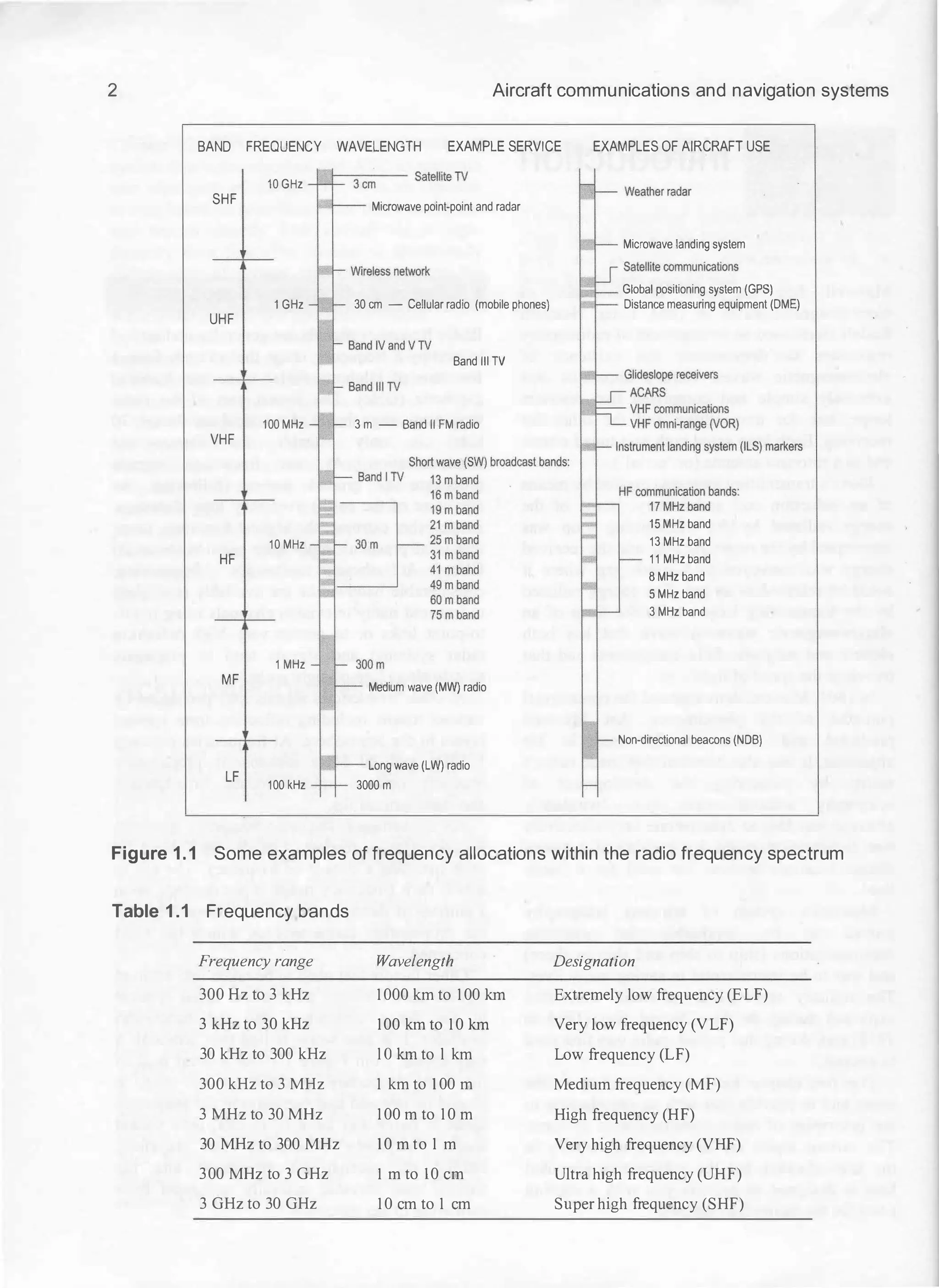
For convenience, the radio frequency spectrum
is divided into a number of bands (see Table 1. 1),
each spanning a decade of frequency. The use to
which each frequency range is put depends upon
a number of factors, paramount amongst which is
the propagation characteristics within the band
concerned.
Other factors that need to be taken into account
include the efficiency of practical aerial systems
in the range concerned and the bandwidth
available. It is also worth noting that, although it
may appear from Figure 1.1 that a great deal of
the radio frequency spectrum is not used, it
should be stressed that competition for frequency
space is fierce and there is, in fact, little vacant
space! Frequency allocations are, therefore,
ratified by international agreement and the
various user services carefully safeguard their
own areas of the spectrum.
2 Aircraft communications and navigation systems
BAND FREQUENCY WAVELENGTH EXAMPLE SERVICE EXAMPLES OF AIRCRAFT USE
10GHz
SHF
1GHz
UHF
100MHz
VHF
10MHz
HF
1MHz
MF
LF
100kHz
Microwave point-point and radar
30em - Cellular radio (mobile phones)
Band Ill TV
3m - Band II FM radio
Medium wave (MW) radio
Long wave (LW) radio
3000m
Microwave landing system
Global positioning system (GPS)
Distance measuring equipment (DME)
15 MHzband
13MHzband
11MHzband
8 MHzband
5 MHzband
3MHzband
Non-directional beacons (NOB)
Figure 1 . 1 Some examples of frequency allocations within the radio frequency spectrum
Table 1 .1 Frequency bands
Frequency range Wavelength Designation
300 Hz to 3 kHz 1 000 km to 1 00 Jan Extremely low frequency (ELF)
3 kHz to 30 kHz 100 km to 1 0 Jan Very low frequency (VLF)
30 kHz to 300 kHz lOlanto l km Low frequency (LF)
300 kHz to 3 MHz 1 km to 1 00 m Medium frequency (MF)
3 MHz to 30 MHz 1 00 m to 1 0 m High frequency (HF)
30 MHz to 300 MHz 1 0 m to 1 m Very high frequency (VHF)
300 MHz to 3 GHz I m to 1
0 em Ultra high frequency (UHF)
3 GHz to 30 GHz 1 0 em to 1 em Super high frequency (SHF)
Introduction
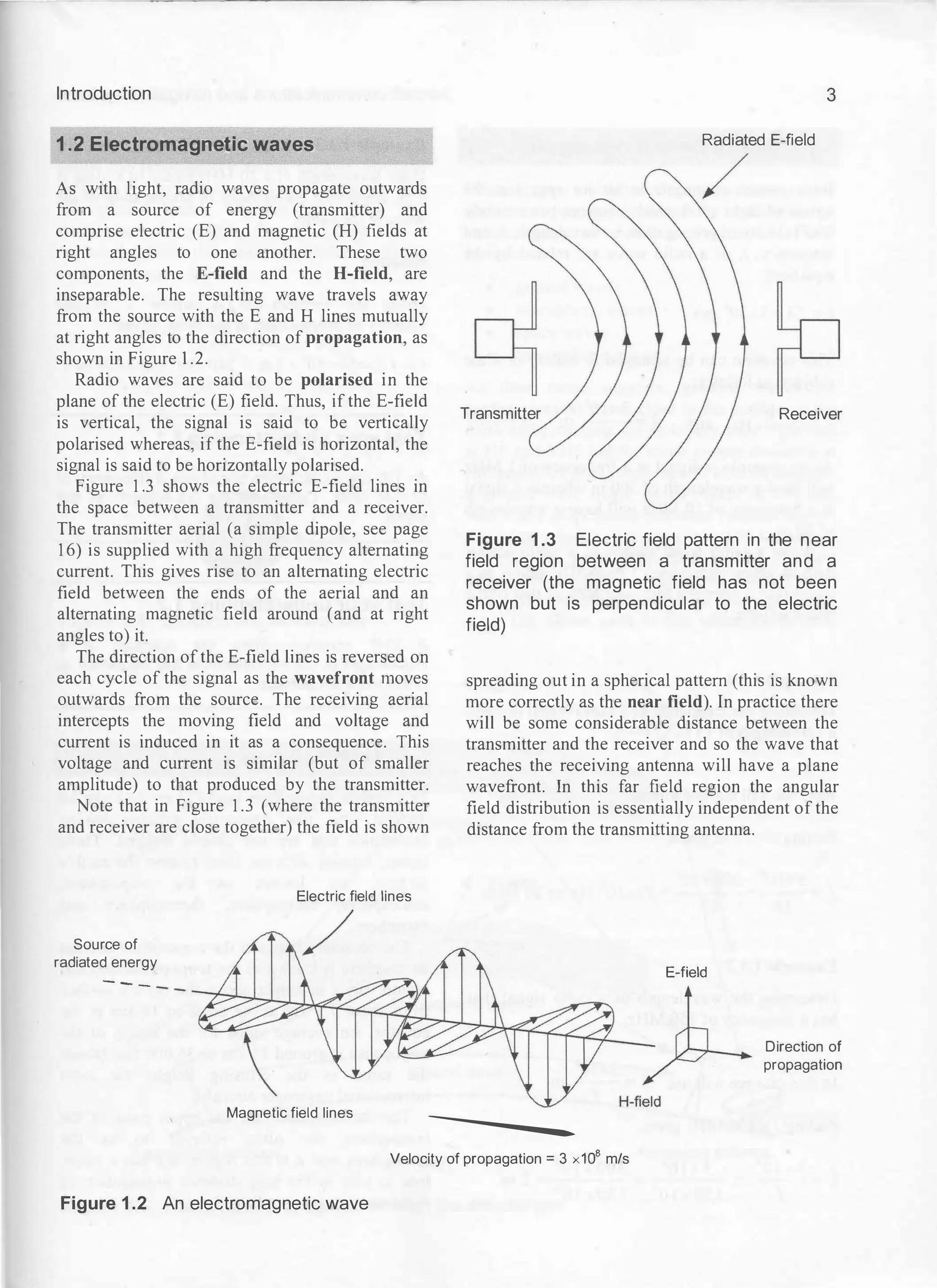
1.2 Electromagnetic waves
As with light, radio waves propagate outwards
from a source of energy (transmitter) and
comprise electric (E) and magnetic (H) fields at
right angles to one another. These two
components, the E-field and the H-field, are
inseparable. The resulting wave travels away
from the source with the E and H lines mutually
at right angles to the direction of propagation, as
shown in Figure 1.2.
Radio waves are said to be polarised in the
plane of the electric (E) field. Thus, if the E-field
is vertical, the signal is said to be vertically
polarised whereas, if the E-field is horizontal, the
signal is said to be horizontally polarised.
Figure 1.3 shows the electric E-field lines in
the space between a transmitter and a receiver.
The transmitter aerial (a simple dipole, see page
16) is supplied with a high frequency alternating
current. This gives rise to an alternating electric
field between the ends of the aerial and an
alternating magnetic field around (and at right
angles to) it.
The direction of the E-field lines is reversed on
each cycle of the signal as the wavefront moves
outwards from the source. The receiving aerial
intercepts the moving field and voltage and
current is induced in it as a consequence. This
voltage and current is similar (but of smaller
amplitude) to that produced by the transmitter.
Note that in Figure 1.3 (where the transmitter
and receiver are close together) the field is shown
Source of
radiated energy
---
Electric field lines
3
Radiated E-field
Transmitter Receiver
Figure 1 .3 Electric field pattern in the near
field region between a transmitter and a
receiver (the magnetic field has not been
shown but is perpendicular to the electric
field)
spreading out in a spherical pattern (this is known
more correctly as the near field). In practice there
will be some considerable distance between the
transmitter and the receiver and so the wave that
reaches the receiving antenna will have a plane
wavefront. In this far field region the angular
field distribution is essentially independent of the
distance from the transmitting antenna.
E-field
Direction of
propagation
Magnetic field lines
----
Velocity of propagation= 3 x10⁸ m/s
Figure 1 .2 An electromagnetic wave
4
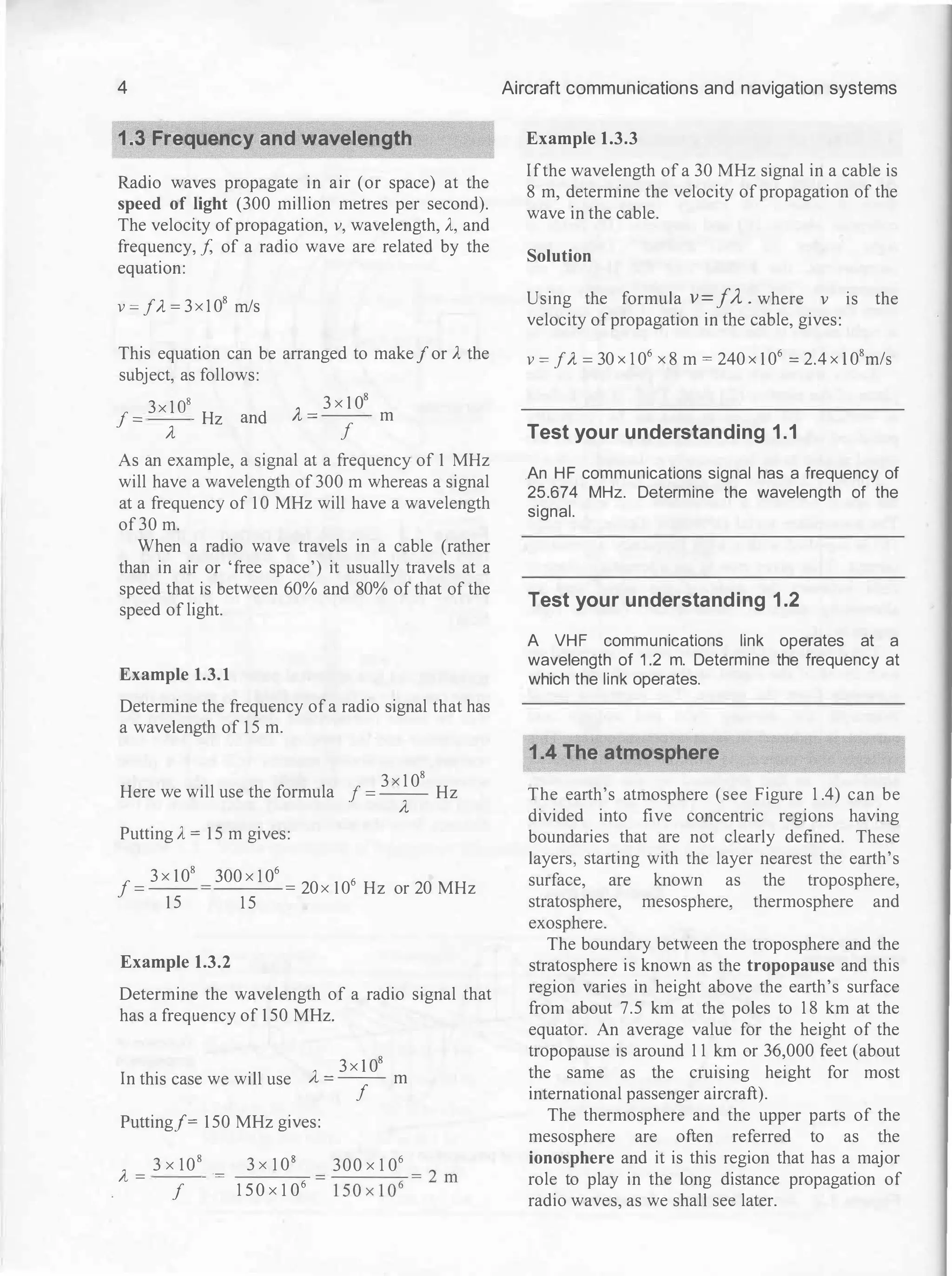
1.3 Frequency and Wavelength
Radio waves propagate in air (or space) at the
speed of light (300 million metres per second).
The velocity of propagation, v, wavelength, A, and
frequency, f, of a radio wave are related by the
equation:
v=f..1=3x1 08 m/s
This equation can be arranged to makefor A the
subject, as follows:
f =
3x1 os Hz and
A,= 3x1 08
m
A, f
As an example, a signal at a frequency of 1 MHz
will have a wavelength of 300 m whereas a signal
at a frequency of 1 0 MHz will have a wavelength
of30 m.
When a radio wave travels in a cable (rather
than in air or 'free space') it usually travels at a
speed that is between 60% and 80% of that of the
speed of light.
Example 1.3.1
Determine the frequency of a radio signal that has
a wavelength of 15 m.
Here we will use the formula J =
3x1 08
Hz
A,
Putting A = 1 5 m gives:
f =
3x10⁸
1 5
300xl 06
=20x106 Hz or 20 MHz
1 5
Example 1.3.2
Determine the wavelength of a radio signal that
has a frequency of 1 50 MHz.
In this case we will use A- =
3x1 08
m
f
Putting/= 1 50 MHz gives:
A=
3x108 = 3xl 08
f
1 5 0xl 06
300x1 06
----,-=2 m
1 50xl06
Aircraft communications and navigation systems
Example 1.3.3
If the wavelength of a 30 MHz signal in a cable is
8 m, determine the velocity of propagation of the
wave in the cable.
Solution
Using the formula v =fA . where v is the
velocity of propagation in the cable, gives:
V = jA =
30 X 1 06 X 8 m
=
240 X 1 06 = 2.4 X 10⁸ m/s
Test your understanding 1.1
.An HF communications signal has a frequency of
25.674 MHz. Determine the wavelength of the
signal.
Test your understanding 1.2
A VHF communications link operates at a
wavelength of 1 .2 m. Determine the frequency at
which the link operates.
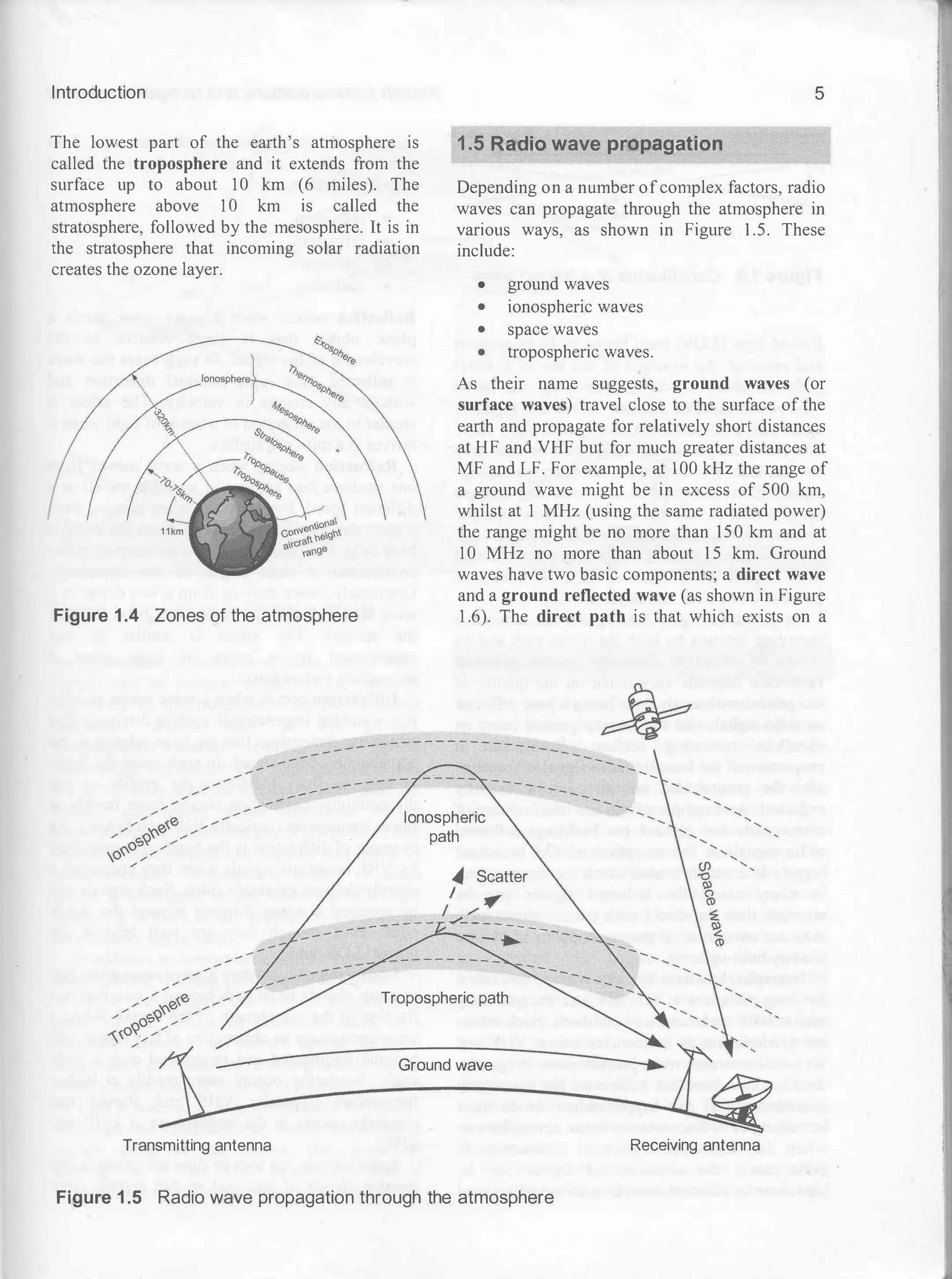
1.4 The atmosphere
The earth's atmosphere (see Figure 1 .4) can be
divided into five concentric regions having
boundaries that are not clearly defined. These
layers, starting with the layer nearest the earth's
surface, are known as the troposphere,
stratosphere, mesosphere, thermosphere and
exosphere.
The boundary between the troposphere and the
stratosphere is known as the tropopause and this
region varies in height above the earth's surface
from about 7.5 km at the poles to 1 8 km at the
equator. An average value for the height of the
tropopause is around 1 1 km or 36,000 feet (about
the same as the cruising height for most
international passenger aircraft).
The thermosphere and the upper parts of the
mesosphere are often referred to as the
ionosphere and it is this region that has a major
role to play in the long distance propagation of
radio waves, as we shall see later.
Introduction
The lowest part of the earth's atmosphere is
called the troposphere and it extends from the
surface up to about 10 km (6 miles). The
atmosphere above 10 km is called the
stratosphere, followed by the mesosphere. It is in
the stratosphere that incoming solar radiation
creates the ozone layer.
Figure 1 .4 Zones of the atmosphere
5
r1.5 Radio wav� propagation
Depending on a number of complex factors, radio
waves can propagate through the atmosphere in
various ways, as shown in Figure 1 .5. These
include:
• ground waves
•
•
•
ionospheric waves
space waves
tropospheric waves.
As their name suggests, ground waves (or
surface waves) travel close to the surface of the
earth and propagate for relatively short distances
at HF and VHF but for much greater distances at
MF and LF. For example, at 100 kHz the range of
a ground wave might be in excess of 500 km,
whilst at 1 MHz (using the same radiated power)
the range might be no more than 150 km and at
10 MHz no more than about 1 5 km. Ground
waves have two basic components; a direct wave
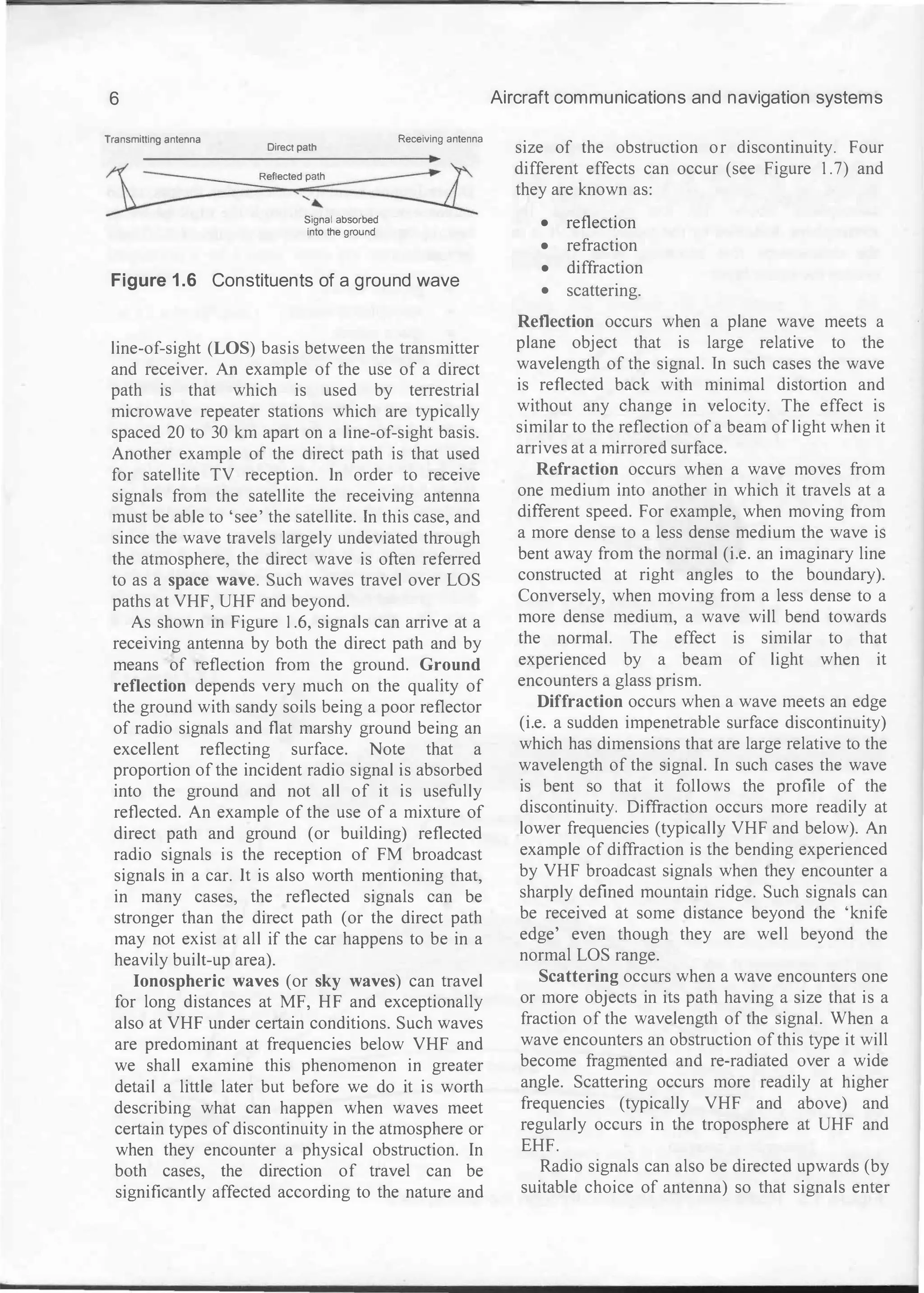
and a ground reflected wave (as shown in Figure
1.6). The direct path is that which exists on a
- - ---------
---
---
Transmitting antenna
---
---
-- -
- --- -
Ionospheric
path
---
� Scatter
I
I ,.,-
_ _ _ _ _
___ �---------
-- ......
Tropospheric path
Ground wave
Figure 1 .5 Radio wave propagation through the atmosphere
--
---
Receiving antenna
6
Transmitting antenna
Direct path
Reflected path
......
Signal absorbed
into the ground
Receiving antenna
Figure 1 .6 Constituents of a ground wave
line-of-sight (LOS) basis between the transmitter
and receiver. An example of the use of a direct
path is that which is used by terrestrial
microwave repeater stations which are typically
spaced 20 to 30 km apart on a line-of-sight basis.
Another example of the direct path is that used
for satellite TV reception. In order to receive
signals from the satellite the receiving antenna
must be able to 'see' the satellite. In this case, and
since the wave travels largely undeviated through
the atmosphere, the direct wave is often referred
to as a space wave. Such waves travel over LOS
paths at VHF, UHF and beyond.
As shown in Figure 1.6, signals can arrive at a
receiving antenna by both the direct path and by
means of reflection from the ground. Ground
reflection depends very much on the quality of
the ground with sandy soils being a poor reflector
of radio signals and flat marshy ground being an
excellent reflecting surface. Note that a
proportion of the incident radio signal is absorbed
into the ground and not all of it is usefully
reflected. An example of the use of a mixture of
direct path and ground (or building) reflected
radio signals is the reception of FM broadcast
signals in a car. It is also worth mentioning that,
in many cases, the reflected signals can be
stronger than the direct path (or the direct path
may not exist at all if the car happens to be in a
heavily built-up area).
Ionospheric waves (or sky waves) can travel
for long distances at MF, HF and exceptionally
also at VHF under certain conditions. Such waves
are predominant at frequencies below VHF and
we shall examine this phenomenon in greater
detail a little later but before we do it is worth
describing what can happen when waves meet
certain types of discontinuity in the atmosphere or
when they encounter a physical obstruction. In
both cases, the direction of travel can be
significantly affected according to the nature and
Aircraft communications and navigation systems
size of the obstruction or discontinuity. Four
different effects can occur (see Figure I.7) and
they are known as:
• reflection
• refraction
• diffraction
• scattering.
Reflection occurs when a plane wave meets a
plane object that is large relative to the
wavelength of the signal. In such cases the wave
is reflected back with minimal distortion and
without any change in velocity. The effect is
similar to the reflection of a beam of light when it
arrives at a mirrored surface.
Refraction occurs when a wave moves from
one medium into another in which it travels at a
different speed. For example, when moving from
a more dense to a less dense medium the wave is
bent away from the normal (i.e. an imaginary line
constructed at right angles to the boundary).
Conversely, when moving from a less dense to a
more dense medium, a wave will bend towards
the normal. The effect is similar to that
experienced by a beam of light when it
encounters a glass prism.
Diffraction occurs when a wave meets an edge
(i.e. a sudden impenetrable surface discontinuity)
which has dimensions that are large relative to the
wavelength of the signal. In such cases the wave
is bent so that it follows the profile of the
discontinuity. Diffraction occurs more readily at
lower frequencies (typically VHF and below). An
example of diffraction is the bending experienced
by VHF broadcast signals when they encounter a
sharply defined mountain ridge. Such signals can
be received at some distance beyond the 'knife
edge' even though they are well beyond the
normal LOS range.
Scattering occurs when a wave encounters one
or more objects in its path having a size that is a
fraction of the wavelength of the signal. When a
wave encounters an obstruction of this type it will
become fragmented and re-radiated over a wide
angle. Scattering occurs more readily at higher
frequencies (typically VHF and above) and
regularly occurs in the troposphere at UHF and
EHF.
Radio signals can also be directed upwards (by
suitable choice of antenna) so that signals enter
-
-- -
-
- - --
-o--- -
-� -
-
�
-
.
-
Introduction 7
SATCOM� Ionosphere
11 Scattered ray
/_ ......
,-.._
" Troposphere
Eage
diffracted ray
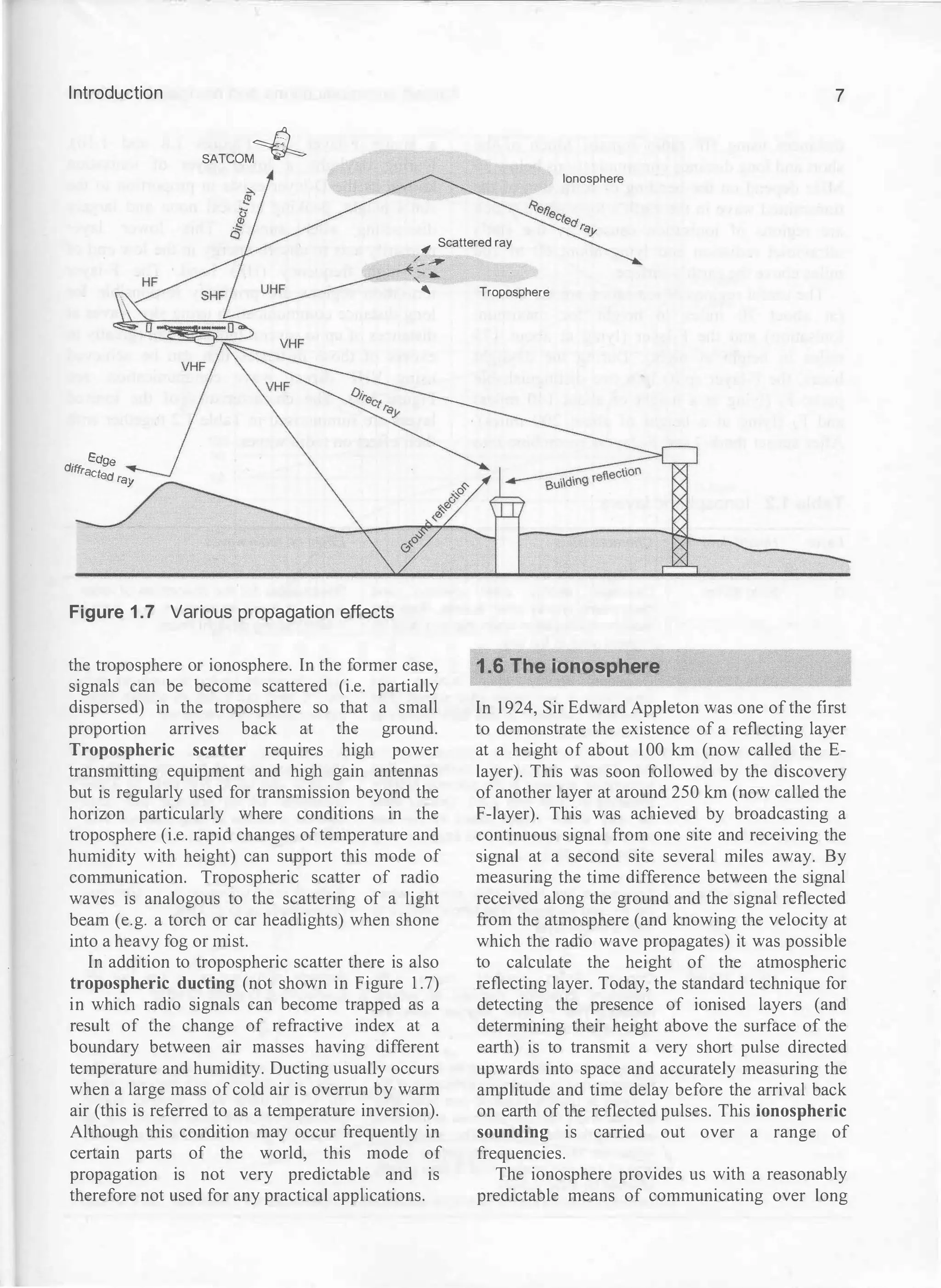
Figure 1 .7 Various propagation effects
the troposphere or ionosphere. In the former case,
signals can be become scattered (i.e. partially
dispersed) in the troposphere so that a small
proportion arrives back at the ground.
Tropospheric scatter requires high power
transmitting equipment and high gain antennas
but is regularly used for transmission beyond the
horizon particularly where conditions in the
troposphere (i.e. rapid changes of temperature and
humidity with height) can support this mode of
communication. Tropospheric scatter of radio
waves is analogous to the scattering of a light
beam (e.g. a torch or car headlights) when shone
into a heavy fog or mist.
In addition to tropospheric scatter there is also
tropospheric ducting (not shown in Figure 1 .7)
in which radio signals can become trapped as a
result of the change of refractive index at a
boundary between air masses having different
temperature and humidity. Ducting usually occurs
when a large mass of cold air is overrun by warm
air (this is referred to as a temperature inversion).
Although this condition may occur frequently in
certain parts of the world, this mode of
propagation is not very predictable and is
therefore not used for any practical applications.
1.6 The ionosphere
In 1924, Sir Edward Appleton was one of the first
to demonstrate the existence of a reflecting layer
at a height of about 1 00 km (now called the E­
layer). This was soon followed by the discovery
of another layer at around 250 km (now called the
F-layer). This was achieved by broadcasting a
continuous signal from one site and receiving the
signal at a second site several miles away. By
measuring the time difference between the signal
received along the ground and the signal reflected
from the atmosphere (and knowing the velocity at
which the radio wave propagates) it was possible
to calculate the height of the atmospheric
reflecting layer. Today, the standard technique for
detecting the presence of ionised layers (and
determining their height above the surface of the
earth) is to transmit a very short pulse directed
upwards into space and accurately measuring the
amplitude and time delay before the arrival back
on earth of the reflected pulses. This ionospheric
sounding is carried out over a range of
frequencies.
The ionosphere provides us with a reasonably
predictable means of communicating over long
8 Aircraft communications and navigation systems
distances using HF radio signals. Much of the
short and long distance communications below 30
MHz depend on the bending or refraction of the
transmitted wave in the earth's ionosphere which
are regions of ionisation caused by the sun's
ultraviolet radiation and lying about 60 to 200
miles above the emth's surface.
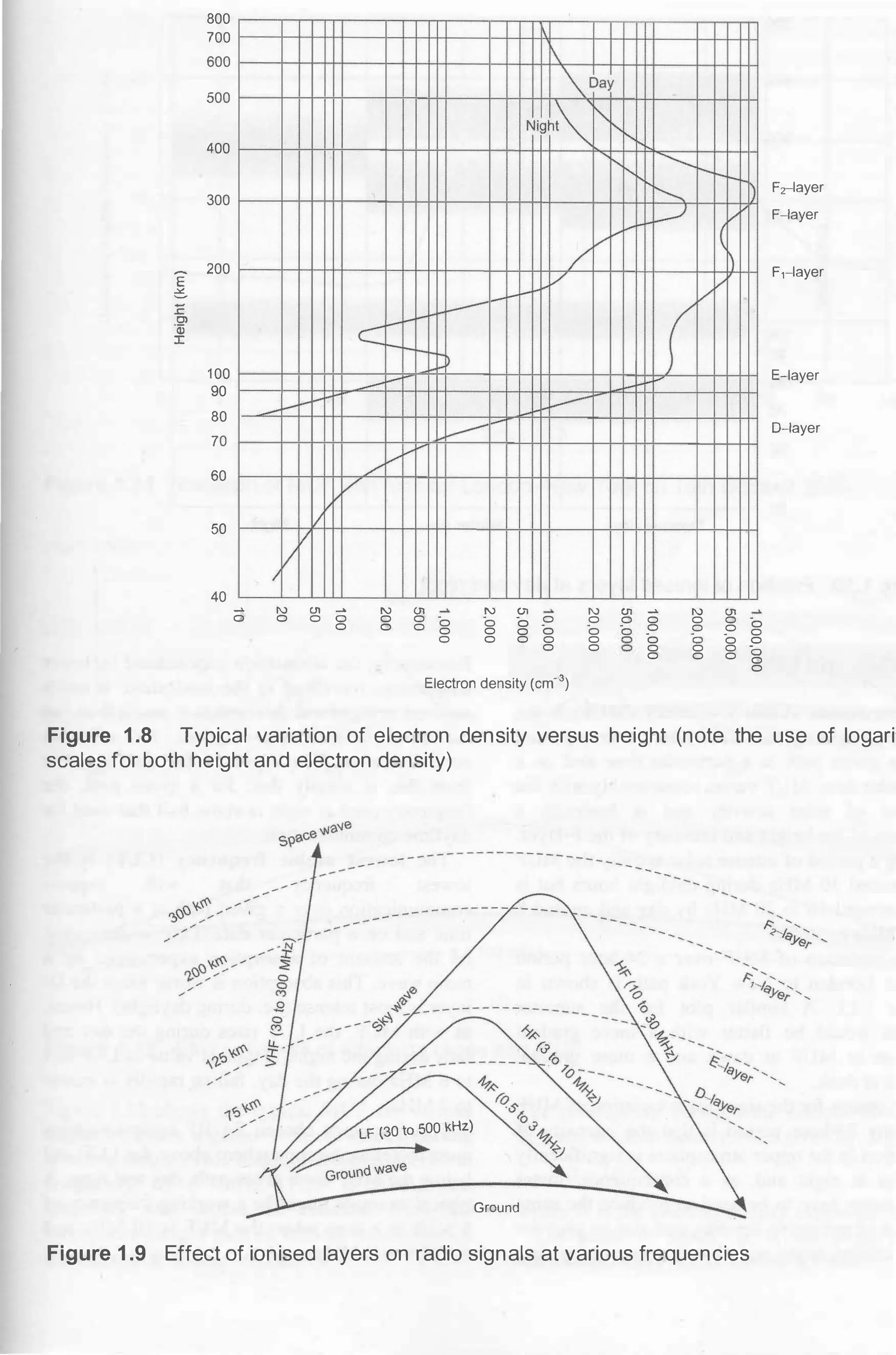
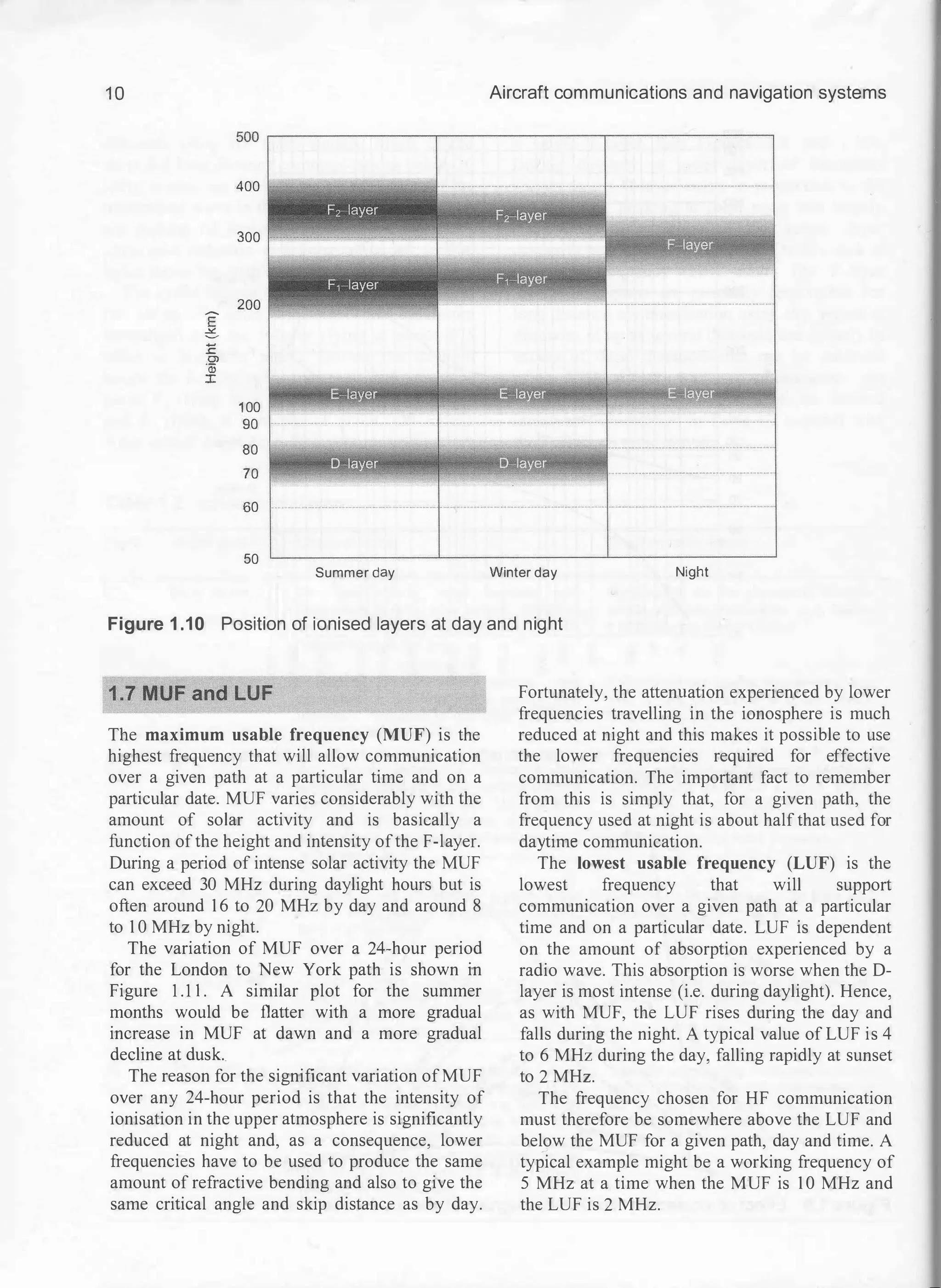
a single F-layer (see Figures 1 .8 and 1 . 10).
During daylight, a lower layer of ionisation
known as the D-layer exists in proportion to the
sun's height, peaking at local noon and largely
dissipating after sunset. This lower layer
primarily acts to absorb energy in the low end of
the high frequency (HF) band. The F-layer
ionisation regions are primarily responsible for
long distance communication using sky waves at
distances of up to several thousand km (greatly in
excess of those distances that can be achieved
using VHF direct wave communication, see
Figure 1 .9). The characteristics of the ionised
layers are summarised in Table 1 .2 together with
their effect on radio waves.
The useful regions of ionisation are the E-layer
(at about 70 miles in height for maximum
ionisation) and the F-layer (lying at about 1 75
miles in height at night). During the daylight
hours, the F-layer splits into two distinguishable
parts: F1 (lying at a height of about 140 miles)
and F2 (lying at a height of about 200 miles).
After sunset the F1- and Frlayers recombine into
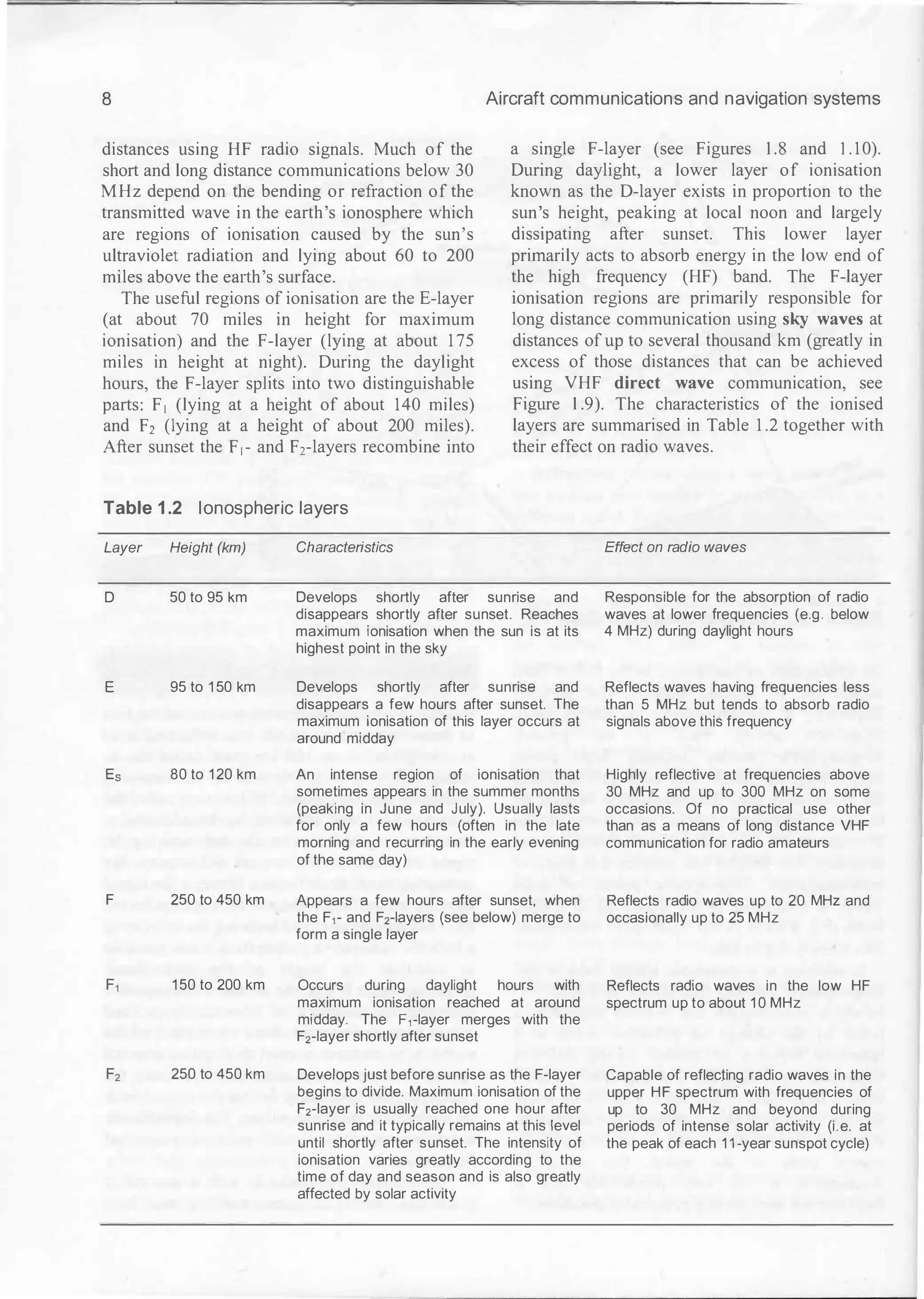
Table 1 .2 Ionospheric layers
Layer
D
E
Es
F
Height (km)
50 to 95 km
95 to 1 50 km
80 to 120 km
250 to 450 km
150 to 200 km
250 to 450 km
Characteristics
Develops shortly after sunrise and
disappears shortly after sunset. Reaches
maximum ionisation when the sun is at its
highest point in the sky
Develops shortly after sunrise and
disappears a few hours after sunset. The
maximum ionisation of this layer occurs at
around midday
An intense region of ionisation that
sometimes appears in the summer months
(peaking in June and July}. Usually lasts
for only a few hours (often ih the late
morning and recurring in the early evening
of the same day)
Appears a few hours after sunset, when
the F1- and F2-layers (see below) merge to
form a single layer
Occurs during daylight hours with
maximum ionisation reached at around
midday. The F1-layer merges with the
F2-layer shortly after sunset
Develops just before sunrise as the F-layer
begins to divide. Maximum ionisation of the
F2-layer is usually reached one hour after
sunrise and it typically remains at this level
until shortly after sunset. The intensity of
ionisation varies greatly according to the
time of day and season and is also greatly
affected by solar activity
Effect on radio waves
Responsible for the absorption of radio
waves at lower frequencies (e.g. below
4 MHz) during daylight hours
Reflects waves ·having frequencies less
than 5 MHz but tends to absorb radio
signals above this frequency
Highly reflective at frequencies above
30 MHz and up to 300 MHz on some
occasions. Of no practical use other
than as a means of long distance VHF
communication for radio amateurs
Reflects radio waves up to 20 MHz and
occasionally up to 25 MHz
Reflects radio waves in the low HF
spectrum up to about 1 0 MHz
Capable of reflecting radio waves in the
upper HF spectrum with frequencies of
up to 30 MHz and beyond during
periods of intense solar activity (i.e. at
the peak of each 11-year sunspot cycle)
800
700
600
500
400
300
E'
200
e.
E
0>
.Qi
I
c�
100
90 __..r-
80 _.-1-
70
60
.,.......v
v
50
v
I
40
� .., U1
0
N U1
0 0 0 0 0
0 0 0
T
 I
'ba
�
Nigh�I'-
/v
v
r----1-
[....---
�---�-
N U1 ..,
0 0 0 0 0
0 0 0 0 0
0 0 0 0 0
0 0
Electron density (cm-3)
'-r--
-.........._
__J
(
U1 � ..,
0 0 0
0 0 0
0 0 ·a
0 0 0
0 0
I(
U1
0 0
0 0
0 0
0 0
0 0
0
F,.-layer
F-layer
F1-layer
E-layer
D-layer
Figure 1 .8 Typical variation of electron density versus height (note the use of logari
scales for both height and electron density)
---
LF (30 to 500 kHZ)
�
Ground
Figure 1 .9 Effect of ionised layers on radio signals at various frequencies
1 0
E'
,:;:..
:E
Ol
·a;
:c
400
300
200
100
90
80
70
60
50
Aircraft communications and navigation systems
Summer day Winter day Night
Figure 1 .10 Position of ionised layers at day and night
The maximum usable frequency (MUF) is the
highest frequency that will allow communication
over a given path at a particular time and on a
particular date. MUF varies considerably with the
amount of solar activity and is basically a
function of the height and intensity ofthe F-layer.
During a period of intense solar activity the MUF
can exceed 30 MHz during daylight hours but is
often around 1 6 to 20 MHz by day and around 8
to 1 0 MHz by night.
The variation of MUF over a 24-hour period
for the London to New York path is shown in
Figure 1.11. A similar plot for the summer
months would be flatter with a more gradual
increase in MUF at dawn and a more gradual
decline at dusk._
The reason for the significant variation ofMUF
over any 24-hour period is that the intensity of
ionisation in the upper atmosphere is significantly
reduced at night and, as a consequence, lower
frequencies have to be used to produce the same
amount of refractive bending and also to give the
same critical angle and skip distance as by day.
Fortunately, the attenuation experienced by lower
frequencies travelling in the ionosphere is much
reduced at night and this makes it possible to use
the lower frequencies required for effective
communication. The important fact to remember
from this is simply that, for a given path, the
frequency used at night is about half that used for
daytime communication.
The lowest usable frequency (LUF) is the
lowest frequency that will support
communication over a given path at a particular
time and on a particular date. LUF is dependent
on the amount of absorption experienced by a
radio wave. This absorption is worse when the D­
layer is most intense (i.e. during daylight). Hence,
as with MUF, the LUF rises during the day and
falls during the night. A typical value of LUF is 4
to 6 MHz during the day, falling rapidly at sunset
to 2 MHz.
The frequency chosen for HF communication
must therefore be somewhere above the LUF and
below the MUF for a given path, day and time. A
typical example might be a working frequency of
5 MHz at a time when the MUF is 1 0 MHz and
the LUF is 2 MHz.
Introduction 1 1
30
'N 25
I
6
>-
(.)
20
c
Q)
::J � ......_
1
o-
& 15
Q)
15
ro
1/)
::J
E 10
::J
I
I �
v -
E
·;;:
ro
5
::'2
0
0 2 4 6 8 10 12 14 16 1 8 20 22 24
Time (UTC)
Figure 1 . 1 1 Variation of MUF with time for London-New York o n 1 6th October 2006
fcnt. = 5 MHZ
(a)
I
I
I
I
I
fm.u.t. "' 7 MHz
I
!�:
f I
:---- "' 500 miles-----.:
I I
(b)
(d)
I
I
: fm.u.f. "' 14 MHz
I
i�:
-= ·--
:-.------ "' 800 miles.-----��
(c)
Figure 1.12 Effect of angle of attack on range and MUF
Figure 1.12 shows the typical MUF for various
angles of attack together with the corresponding
working ranges. This diagram assumes a critical
frequency of 5 MHz. This is the lowest
frequency that would be returned from the
ionosphere using a path of vertical incidence (see
ionospheric sounding on page 7).
The relationship between the critical frequency,
fcrit, and electron density, N, is given by:
fcrit = 9 X 10⁻³ X .VN
where N is the electron density expressed in cm3.
The angle .of attack, a, is the angle of the
transmitted wave relative to the horizon.
1 2
The relationship between the MUF, fm.u.r., the
critical frequency,fcrir.., and the angle of attack, a,
is given by:
+ = fcrit
Jm.u.f. .
s m a
Example 1.8.1
Given that the electron density in the ionosphere
is 5 x 10⁵ electrons per cm3, determine the critical
frequency and the MUF for an angle of attack of
15°.
Now using the relationship fcrit = 9 x 10⁻³ x -/N
gives:
fent =9X 10-J X �5 X 1 05 = 6.
364 MHz
The MUF can now be calculated using:
J. = fcrit =
6.364 =
6.
364 = 24.5 7 MHz
m.u.f.
sin a sin 1 5° 0.259
Test your understanding 1.3
Determine the electron density in the
ionosphere when the MUF is 1 8 MHz for a
critical angle of 20°.
Aircraft communications and navigation systems
1.8 Silent zone and skip distance
The silent zone is simply the region that exists
between the extent of the coverage of the ground
wave signal and the point at which the sky wave
returns to earth (see Figure 1. 1
3). Note also that,
depending on local topography and soil
characteristics, when a signal returns to earth
from the ionosphere it is sometimes possible for it
to experience a reflection from the ground, as
shown in Figure 1.1
3. The onward reflected
signal will suffer attenuation but in some
circumstances may be sufficient to provide a
further hop and an approximate doubling of the
working range. The condition is known as multi­
hop propagation.
The skip distance is simply the distance
between the point at which the sky wave is
radiated and the point at which it returns to earth
(see Figure 1.14).
Note that where signals are received
simultaneously by ground wave and sky wave
paths, the signals will combine both
constructively and destructively due to the
different paths lengths and this, in turn, will
produce an effect known as fading. This effect
can often be heard during the early evening on
medium wave radio signals as the D-layer
weakens and sky waves first begin to appear.
- - -
- - - - - - - - - - -
Figure 1 .1 3 Silent zone and skip distance
Skip distance
Introduction
Table 1 .3 See Test your understanding 1 .4
Time (UTC) 0 1 2 3 4
MUF 9.7 9.0 8.4 7.9 7.5
(MHz)
I
Time (UTC) 1 3 14 15 1 6 17
MUF 18.1 18.1 1 7.9 17.7 1 7.2
MHz)
Test your understanding 1.4
5
9.6
18
1 6.5
Table 1 .3 shows corresponding values oftime and
maximum usable frequency (MUF) for London to
isbon on 28th August 2006. Plot a graph
showing the variation of MUF with time and
explain the shape of the graph.
Test your understanding 1.5
Explain the following terms in relation to HF radio
propagation:
a) silent zone
b) skip distance
c) multi-hop propagation.
1.9 Multiple choice questions
l . A transmitted radio wave will have a plane
wavefront:
(a) in the near field
(b) in the far field
(c) close to the antenna.
2. The lowest layer in the earth's atmosphere is:
(a) the ionosphere
(b) the stratosphere
(c) the troposphere.
3. A radio wave at 1 15 kHz is most likely to
propagate as:
(a) a ground wave
(b) a sky wave
(c) a space wave.
1 3
6 7 8 9 1 0 1 1 1 2
12.3 14.1 1 5.4 16.4 1 7.1 1 7.6 1 7.9
1 9 20 21 22 23 24
1 5.6 14.2 12.7 1 1 .5 10.6 9.7
4. The height ofthe E-layer is approximately:
(a) 1 00 km
(b) 200 km
(c) 400 km.
5. When a large mass ofcold air is overrun by
warm air the temperature inversion produced
will often result in:
(a) ionospheric reflection
(b) stratospheric refraction
(c) tropospheric ducting.
6. Ionospheric sounding is used to determine:
(a) the maximum distance that a ground wave
will travel
(b) the presence oftemperature inversions in
the upper atmosphere
(c) the critical angle and maximum usable
frequency for a given path.
7. The critical frequency is directly proportional
to:
(a) the electron density
(b) the square ofthe electron density
(c) the square root ofthe electron density.
8. The MF range extends from:
(a) 300 kHz to 3 MHz
(b) 3 MHz to 30 MHz
(c) 30 MHz to 300 MHz.
9. A radio wave has a frequency of 1 5 MHz.
Which one ofthe following gives the
wavelength ofthe wave?
(a) 2 m
(b) 15 m
(c) 20 m.
14
1 0. Which one ofthe following gives the velocity
at which a radio wave propagates?
(a) 300 m/s
(b) 3 x 1 0
8
m/s
(c) 3 million m/s.
1 1 . The main cause ofionisation in the upper
atmosphere is:
(a) solar radiation
(b) ozone
(c) currents ofwarm air.
12. The F2-layer is:
(a) higher at the equator than at the poles
(b) lower at the equator than at the poles
(c) the same height at the equator as at the
poles.
13. The free-space path loss experienced by a
radio wave:
(a) increases the frequency but decreases with
distance
(b) decreases with frequency but increases
with distance
(c) increases with both frequency and
distance.
14. For a given HF radio path, the MUF changes
most rapidly at:
(a) mid-day
(b) mid-night
(c) dawn and dusk.
1 5. Radio waves tend to propagate mainly as line­
of-sight signals in the:
(a) MF band
(b) HF band
(c) VHF band.
16. In the HF band radio waves tend to propagate
over long distances as:
(a) ground waves
(b) space waves
(c) ionospheric waves.
1 7. The maximum distance that can be achieved
from a single-hop reflection from the F-layer
is in the region:
(a) 500 to 2,000 km
(b) 2,000 to 3,500 km
(c) 3,500 to 5,000 km.
Aircraft communications and navigation systems
1 8. The F1- and F2-layers combine:
(a) only at about mid-day
(b) during the day
(c) during the night.
19. The path of a VHF or UHF radio wave can be
bent by a sharply defined obstruction such as a
building or a mountain top. This phenomenon
is known as:
(a) ducting
(b) reflection
(c) diffraction.
20. Radio waves at HF can be subject to
reflections in ionised regions ofthe upper
atmosphere. This phenomenon is known as:
(a) ionospheric reflection
(b) tropospheric scatter
(c) atmospheric ducting.
2 1 . Radio waves at UHF can sometimes be
subject to dispersion over a wide angle in
regions of humid air in the atmosphere. This
phenomenon is known as:
(a) ionospheric reflection
(b) tropospheric scatter
(c) atmospheric ducting.
22. Radio waves at VHF and UHF can sometimes
propagate for long distances in the lower
atmosphere due to the presence ofa
temperature inversion. This phenomenon is
known as:
(a) ionospheric reflection
(b) tropospheric scatter
(c) atmospheric ducting.
23. The layer in the atmosphere that is mainly
responsible for the absorption ofMF radio
waves during the day is:
(a) the D-layer
(b) the E-layer
(c) the F-layer.
24. The layer in the atmosphere that is mainly
responsible for the reflection ofHF radio
waves during the day is:
(a) the D-layer
(b) the E-layer
(c) the F-layer.
Chapter Anten nas
2
It may not be apparent from an inspection of the
external profile of an aircraft that most large
aircraft carry several dozen antennas of different
types. To illustrate this point, Figure 2. 1 shows
just a few of the antennas carried by a Boeing
57. What should be apparent from this is that
many of the antennas are of the low profile
variety which is essential to reduce drag.
Antennas are used both for transmission and
reception. A transmitting antenna converts the
high frequency electrical energy supplied to it
into electromagnetic energy which is launched or
radiated into the space surrounding the antenna.
. receiving antenna captures the electromagnetic
energy in the surrounding space and converts this
into high frequency electrical energy which is
then passed on to the receiving system. The law
of reciprocity indicates that an antenna will have
the same gain and directional properties when
used for transmission as it does when used for
reception.
2.1 The isotropic radiator
The most fundamental form of antenna (which
cannot be realised in practice) is the isotropic
radiator. This theoretical type of antenna is often
used for comparison purposes and as a reference
when calculating the gain and directional
characteristics of a real antenna.
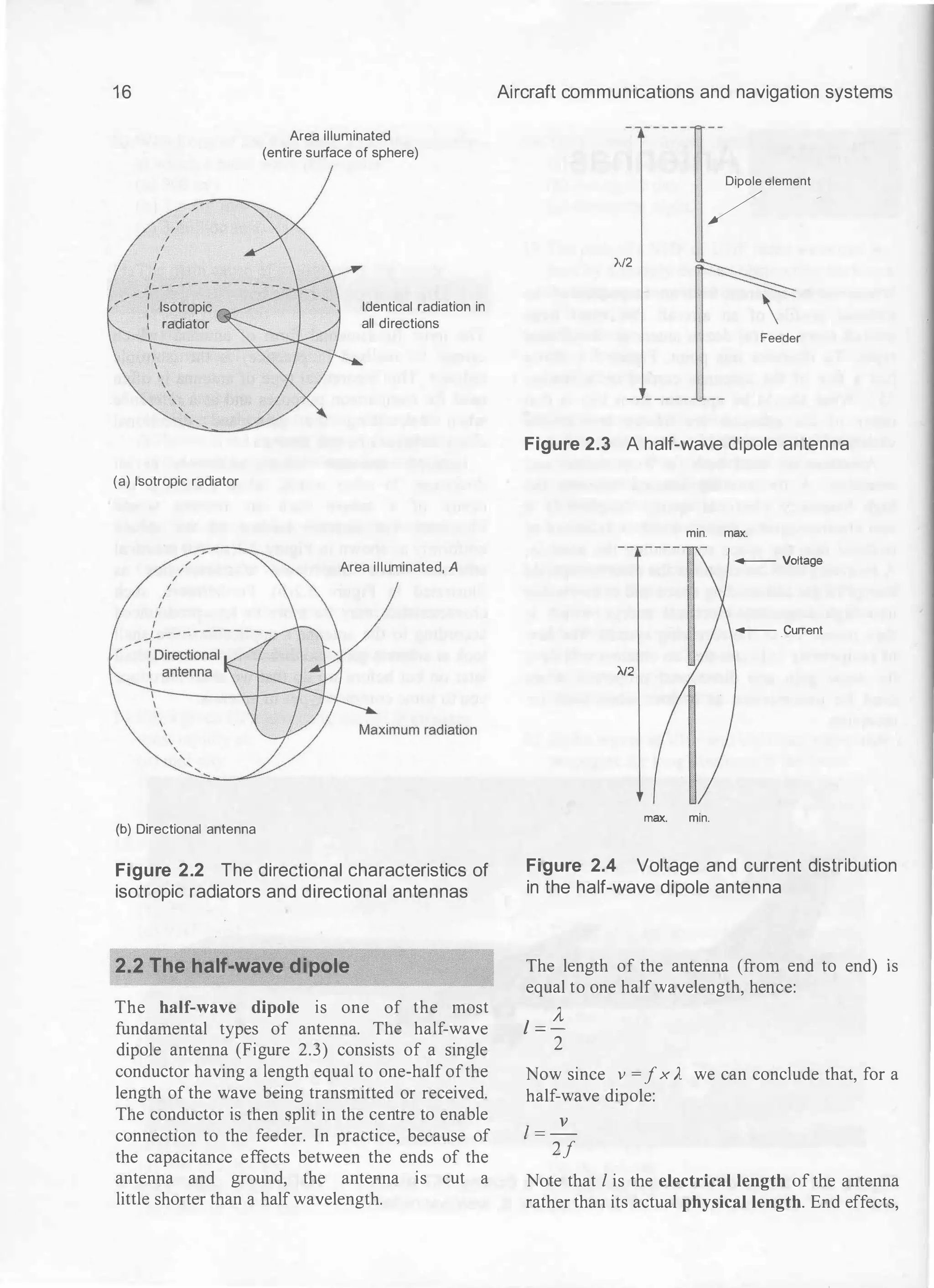
Isotropic antennas radiate uniformly in all
directions. In other words, when placed at the
centre of a sphere such an antenna would
illuminate the internal surface of the sphere
uniformly as shown in Figure 2.2(a). All practical
antennas have directional characteristics as
illustrated in Figure 2.2(b). Furthermore, such
characteristics may be more or less pronounced
according to the antenna's application. We shall
look at antenna gain and directivity in more detail
later on but before we do that we shall introduce
you to some common types of antenna.
Figure 2.1 Some of the antennas fitted to a Boeing 757 aircraft. 1 , VOR; 2, HF comms.; 3, 5
and 6, VHF comms.; 4, ADF; 7, TCAS (upper); 8, weather radar
16
I
I
I
I
I
I
/
/
/
Area illuminated
(entire surface of sphere)
,-�--------------
/
1 Isotropic
: radiator
(a) Isotropic radiator
(b) Directional antenna
Identical radiation in
all directions
Area illuminated, A
Figure 2.2 The directional characteristics of
isotropic radiators and directional antennas
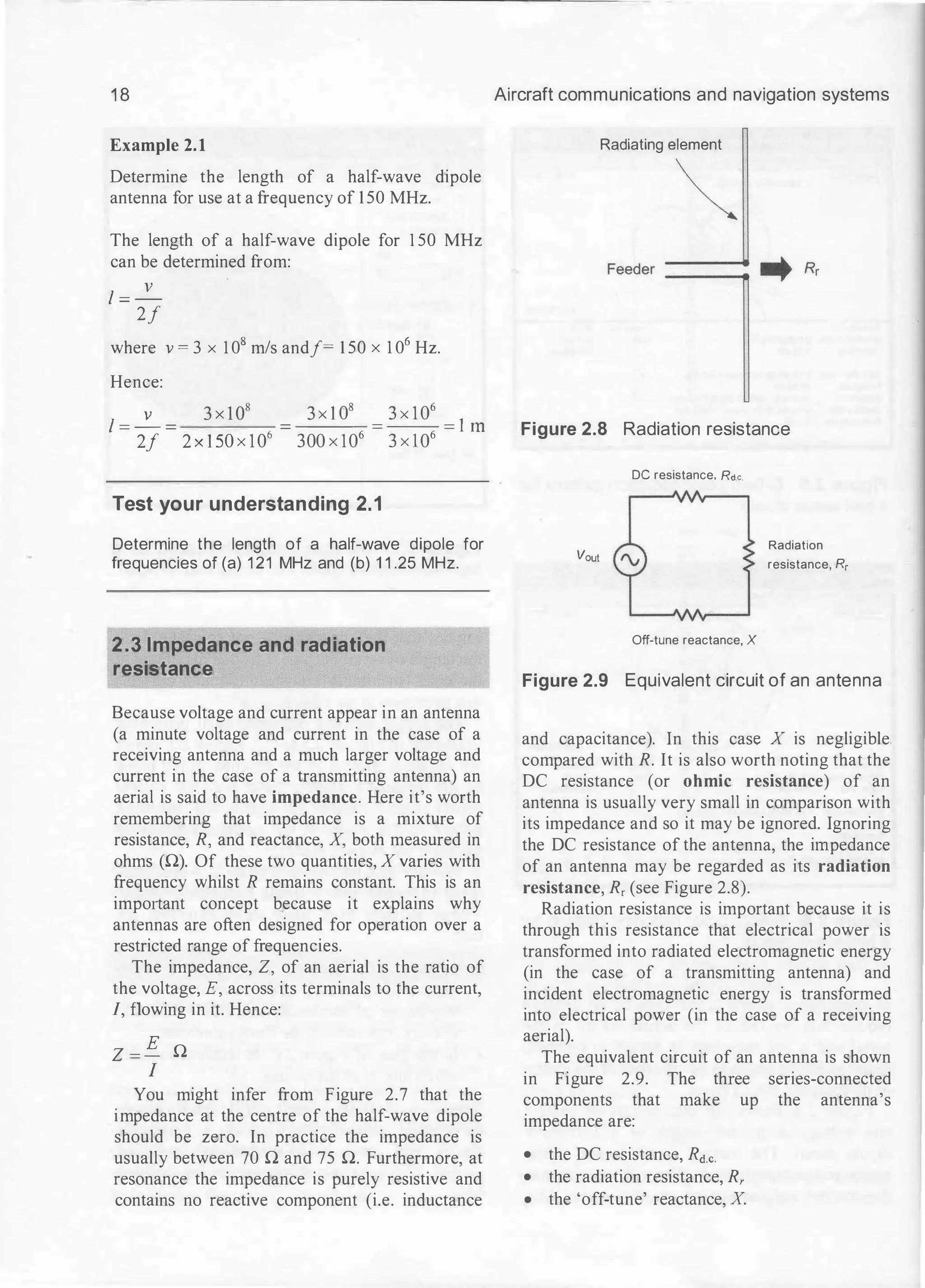
2.2 The half-wave dipole
The half-wave dipole is one of the most
fundamental types of antenna. The half-wave
dipole antenna (Figure 2.3) consists of a single
conductor having a length equal to one-half ofthe
length of the wave being transmitted or received.
The conductor is then split in the centre to enable
connection to the feeder. In practice, because of
the capacitance effects between the ends of the
antenna and ground, the antenna is cut a
little shorter than a half wavelength.
Aircraft communications and navigation systems
Dipole element
/
/../2
Feeder
Figure 2.3 A half-wave dipole antenna
'A/2
min.
max. min.
max.
- voltage
- .current
Figure 2.4 Voltage and current distribution
in the half-wave dipole antenna
The length of the ante�a (from end to end) IS
equal to one halfwavelength, hence:
I =
).,
2
Now since v = fx A. we can conclude that, for a
half-wave dipole:
l = _}!___
2f
Note that l is the electrical length of the antenna
rather than its actual physical length. End effects,
Antennas
,. 20 Plol: Orpole in free space
�LQJL8J
� Edit V
&ew
Total Field
.......-.Ah Piol
3eve!IOO Angle 0.0 deg. Goin
Olier Rng 2.16 dBI
Slce Max Goin 2.16 dEll @ Az Angle = 0.0 deg.
�-. 99.99 d8
Beomwidth 77 4 deg.; -3d8 @ 321 .3, 38.7 deg.
Stdelobo Goln 2.16 dBI @ Az Angle = 1 80.0 deg.
�tOrtJSidelobe o.o dB
EZNEC Demo
299.793 111Hz
0.0 deg.
2.16 cfli
0.0 dBmax
Figure 2.5 E-field polar radiation pattern for
a half-wave dipole
,. 20 Plot. Cardioid r;;]LQJL8J
=.e Edit View
Total Aeld
o.=mih Piol
3e'<SXln Angle 0.0 deg.
Juer Ring 1 64 dBi
Slce Max Goin 1 .64 dEll @ Az Angle = 185.0 deg.
�.m.eocl< 0.02 d8
Seomwldlh ?
ScelobeGoln 1 .64 dBi @ Az Angle = 354.0 deg.
='O!'tJSidelobo 0.0 dB
EZNEC Demo
299.793 111Hz
315.0deg.
1 42 dBi
-022 d8max
Figure 2.6 H-field polar radiation pattern for
a half-wave dipole
or capacitance effects at the ends of the antenna
::equire that we reduce the actual length of the
erial and a 5% reduction in length is typically
:equired for an aerial to be resonant at the centre
of its designed tuning range.
Figure 2.4 shows the distribution of current
and voltage along the length of a half-wave
dipole aerial. The current is maximum at the
;::entre and zero at the ends. The voltage is zero at
:he centre and maximum at the ends. This
1 7
Iii 3D Plot: Dipole in free space c;J(g]�
File Edit View Options Reset
rHighlight-- .--
-
-
-
-
-
-
-
-
-=
E
=
z
N
""
E
""'
C
.,.
Oe
_
m
_
o
--1
(' Off
(' 8zimuth Slice
(o' E]ev Slice Y
,,·0 360
_ill_-..cl
0
SliceAzimuth
1 180
0
J ·180
II Cursor Elev
l___ - -
P' _2how 2D Plot
Figure 2.7 30 polar radiation pattern for a
half-wave dipole (note the 'doughnut' shape)
implies that the impedance is not constant along
the length ofaerial but varies from a maximum at
the ends (maximum voltage, minimum current)
to a minimum at the centre.
The dipole antenna has directional properties
illustrated in Figures 2.5 to 2.7. Figure 2.5 shows
the radiation pattern of the antenna in the plane
of the antenna's electric field (i.e. the E-field
plane) whilst Figure 2.6 shows the radiation
pattern in the plane of the antenna's magnetic
field (i.e. the H-field plane).
The 3D plot shown in Figure 2.7 combines
these two plots into a single 'doughnut' shape.
Things to note from these three diagrams are
that:
• in the case of Figure 2.5 minimum radiation
occurs along the axis ofthe antenna whi1st the
two zones of maximum radiation are at 90°
(i.e. are 'normal to') the dipole elements
• in the case of Figure 2.6 the antenna radiates
uniformly in all directions.
Hence, a vertical dipole will have omni­
directional characteristics whilst a horizontal
dipole will have a bi-directional radiation
pattern. This is an important point as we shall see
later.
1 8
Example 2.1
Determine the length of a half-wave dipole
antenna for use at a frequency of 150 MHz.
The length of a half-wave dipole for 1 50 MHz
can be determined from:
l = _!___
2f
where v = 3 x 1 08 m/s andf= 1 50 x 1 06 Hz.
Hence:
l = _!___
2f 2 x 1 50 x 1 06
3 X 1 08
= 3 X 1 06
= 1 ill
300 x 106 3 x l06
Test your understanding 2.1
Determine the length of a half-wave dipole for
frequencies of (a) 1 21 MHz and (b) 1 1 .25 MHz.
2.3 Impedance and radiation
resistance
Because voltage and current appear in an antenna
(a minute voltage and current in the case of a
receiving antenna and a much larger voltage and
current in the case of a transmitting antenna) an
aerial is said to have impedance. Here it's worth
remembering that impedance is a mixture of
resistance, R, and reactance, X, both measured in
ohms (0). Of these two quantities, X varies with
frequency whilst R remains constant. This is an
important concept because it explains why
antennas are often designed for operation over a
restricted range of frequencies.
The impedance, Z, of an aerial is the ratio of
the voltage, E, across its terminals to the current,
I, flowing in it. Hence:
Z = E 0
I
You might infer from Figure 2.7 that the
impedance at the centre of the half-wave dipole
should be zero. In practice the impedance is
usually between 70 0 and 75 0. Furthermore, at
resonance the impedance is purely resistive and
contains no reactive component (i.e. inductance
Aircraft communications and navigation systems
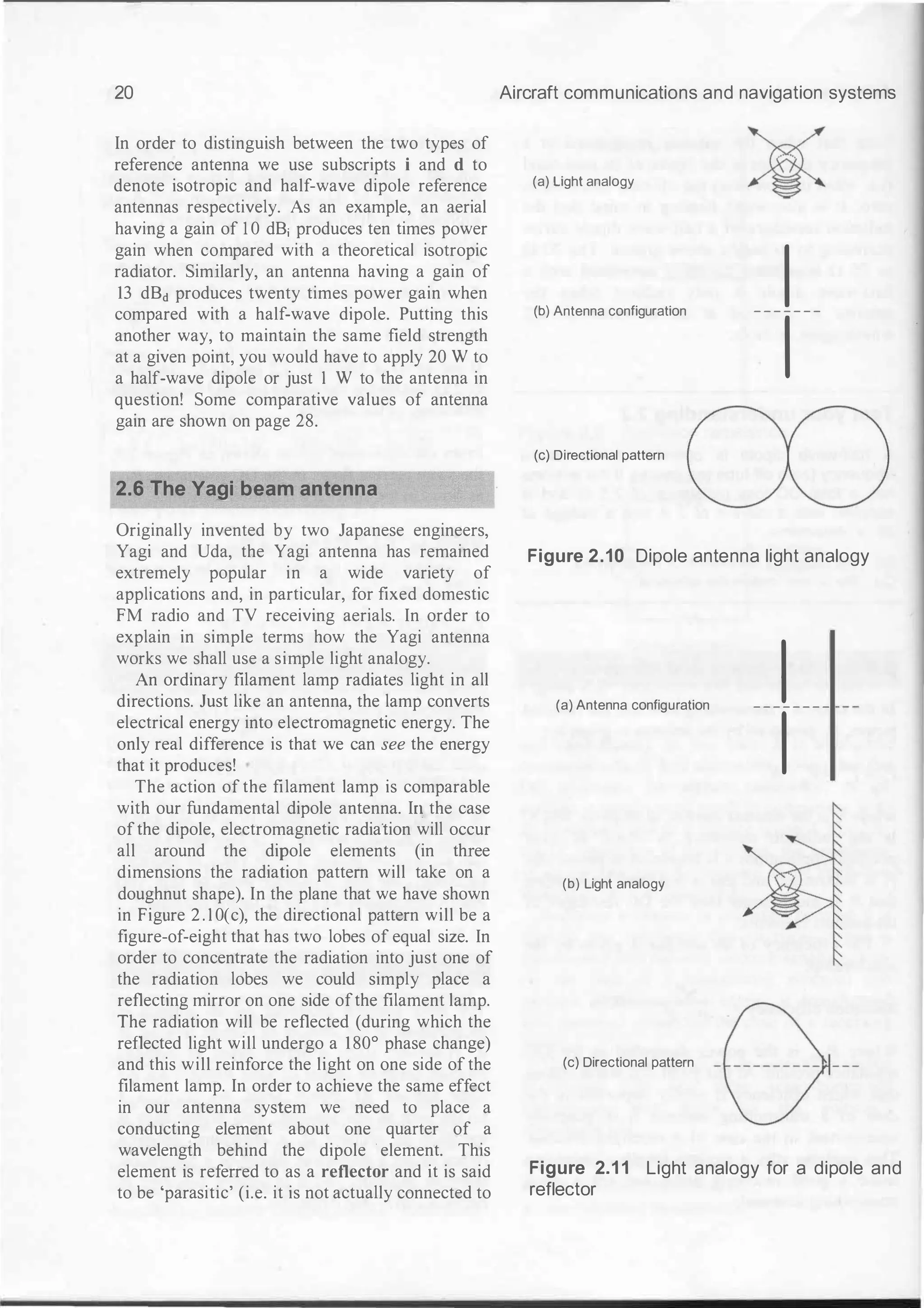
Radiating element
�
Figure 2.8 Radiation resistance
DC resistance. Rd.c.
Vout
Off-tune reactance, X
Radiation
resistance, R,
Figure 2.9 Equivalent circuit of an antenna
and capacitance). In this case X is negligible.
compared with R. It is also worth noting that the
DC resistance (or ohmic resistance) of an
antenna is usually very small in comparison with
its impedance and so it may be ignored. Ignoring
the DC resistance of the antenna, the impedance
of an antenna may be regarded as its radiation
resistance, R, (see Figure 2.8).
Radiation resistance is important because it is
through this resistance that electrical power is
transformed into radiated electromagnetic energy
(in the case of a transmitting antenna) and
incident electromagnetic energy is transformed
into electrical power (in the case of a receiving
aerial).
The equivalent circuit of an antenna is shown
in Figure 2.9. The three series-connected
components that make up the antenna's
impedance are:
• the DC resistance, Rd.c.
• the radiation resistance, R,
• the 'off-tune' reactance, X.
Antennas
_ ·ote that when the antenna is operated at a
- equency that lies in the centre of its pass-band
.e. when it is on-tune) the off-tune reactance is
zero. It is also worth bearing in mind that the
:-adiation resistance of a half-wave dipole varies
cording to its height above ground. The 70 n
·
75 n impedance normally associated with a
lf-wave dipole is only realized when the
=ntenna is mounted at an elevation of 0.2
avelengths, or more.
Test your understanding 2.2
half-wave dipole is operated at its centre
.,_equency (zero off-tune reactance). If the antenna
:as a total DC loss resistance of 2.5 n and is
s pplied with a current of 2 A and a voltage of
�5 V, determine:
a) the radiation resistance of the antenna
) the power loss in the antenna.
2.4 Radiated power and efficiency
the case of a transmitting antenna, the radiated
wer, P,, produced by the antenna is given by:
here I. is the antenna current, in amperes, and R,
- the radiation resistance in ohms. In most
ractical applications it is important to ensure that
P_ is maximised and this is achieved by ensuring
.nat R, is much larger than the DC resistance of
· e antenna elements.
The efficiency of an antenna is given by the
relationship:
K.adiation efficiency =
� x l OO%
� + �oss
nere P1oss is the power dissipated in the DC
:-e istance present. At this point it is worth stating
at whilst efficiency is vitally important in the
ca e of a transmitting antenna it is generally
.mimportant in the case of a receiving antenna.
:-his explains why a random length of wire can
make a good receiving aerial but not a good
rransmitting antenna!
1 9
Example 2.2
An HF transmitting antenna has a radiation
resistance of 1 2 n. If a current of 0.5 A is
supplied to it, determine the radiated power.
Now:
P, = J/ x R, = (0.5)2 x 1 2 = 0.25 x 1 2 = 4 W
Example 2.3
If the aerial in Example 2.2 has a DC resistance
of2 n, determine the power loss and the radiation
efficiency ofthe antenna.
From the equivalent circuit shown in Figure 2.9,
the same current flows in the DC resistance, Rct.c.,
as flows in the antenna's radiation resistance, R,.
Hence I. = 0.5 A and Rct.c. = 2 W
Since �oss = fa2 X Rd.c.
Ploss = {0.5)2 X 2 = 0.25 X 2 = 0.5 W
The radiation efficiency is given by:
Radiation efficiency =
_
_
P
_,_
r- x 1 00%
� + �oss
4 4
= -- X 1 00% = - X 1 00% =
89%
4 + 0.5 4.5
In this example, more than 1 0% of the power
output is actually wasted! It is also worth noting
that in order to ensure a high value of radiation
efficiency, the loss resistance must be kept very
low in comparison with the radiation resistance.
2.5 Antenna gain
The field strength produced by an antenna is
proportional to the amount of current flowing in
it. However, since different types of antenna
produce different values of field strength for the
same applied RF power level, we attribute a
power gain to the antenna. This power gain is
specified in relation to a reference antenna
(often either a half-wave dipole or a theoretical
isotropic radiator) and it is usually specified in
decibels (dB)-see Appendix 2.
20
In order to distinguish between the two types of
reference antenna we use subscripts i and d to
denote isotropic and half-wave dipole reference
antennas respectively. As an example, an aerial
having a gain of 1 0 dB; produces ten times power
gain when compared with a theoretical isotropic
radiator. Similarly, an antenna having a gain of
13 dBd produces twenty times power gain when
compared with a half-wave dipole. Putting this
another way, to maintain the same field strength
at a given point, you would have to apply 20 W to
a half-wave dipole or just 1 W to the antenna in
question! Some comparative values of antenna
gain are shown on page 28.
2.6 The Vagi beam antenna
Originally invented by two Japanese engineers,
Yagi and Uda, the Yagi antenna has remained
extremely popular in a wide variety of
applications and, in particular, for fixed domestic
FM radio and TV receiving aerials. In order to
explain in simple terms how the Yagi antenna
works we shall use a simple light analogy.
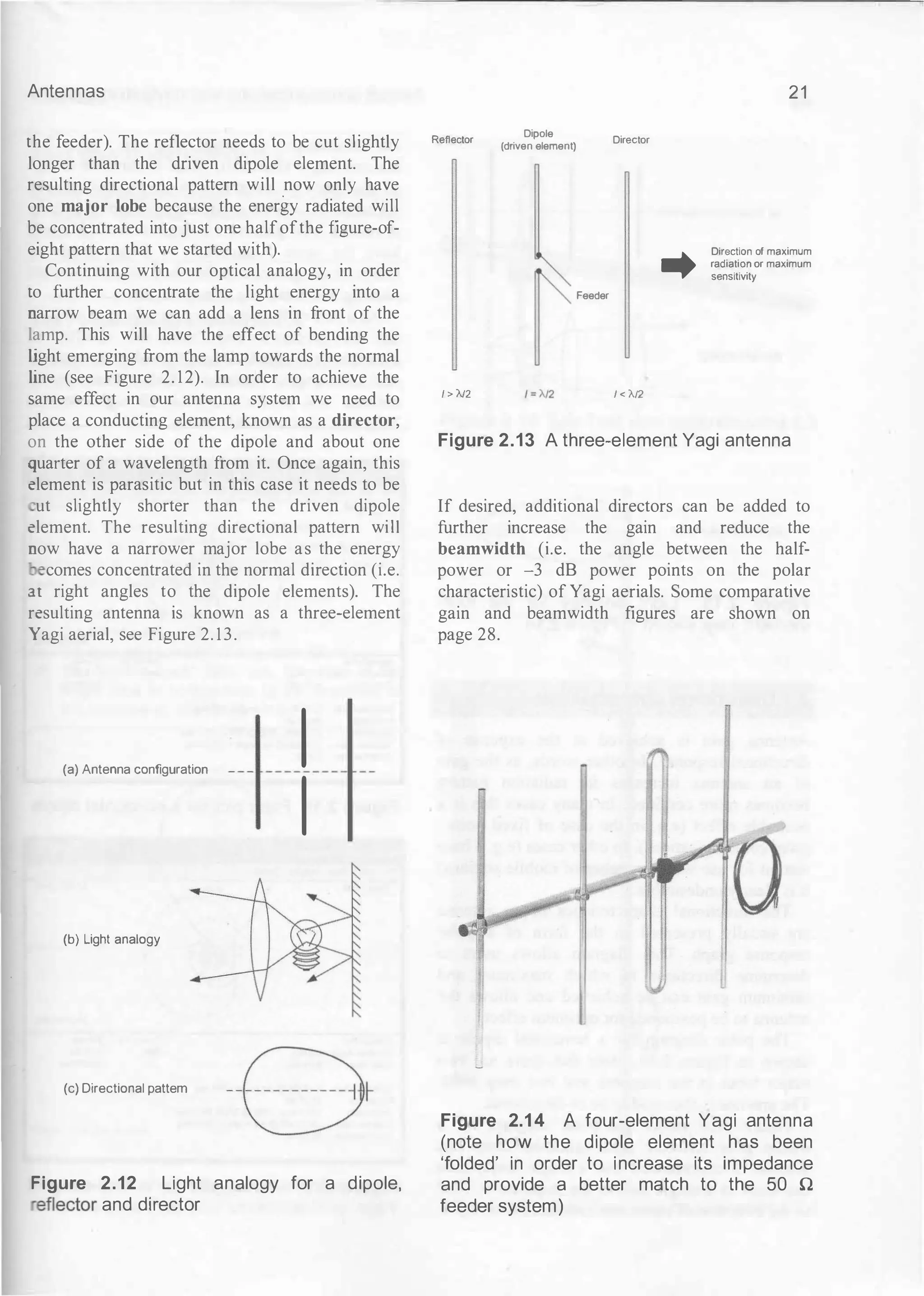
An ordinary filament lamp radiates light in all
directions. Just like an antenna, the lamp converts
electrical energy into electromagnetic energy. The
only real difference is that we can see the energy
that it produces!
The action of the filament lamp is comparable
with our fundamental dipole antenna. Ill; the case
ofthe dipole, electromagnetic radiation will occur
all around the dipole elements (in three
dimensions the radiation pattern will take on a
doughnut shape). In the plane that we have shown
in Figure 2 . 1 0(c), the directional pattern will be a
figure-of-eight that has two lobes of equal size. In
order to concentrate the radiation into just one of
the radiation lobes we could simply place a
reflecting mirror on one side ofthe filament lamp.
The radiation will be reflected (during which the
reflected light will undergo a 180° phase change)
and this will reinforce the light on one side of the
filament lamp. In order to achieve the same effect
in our antenna system we need to place a
conducting element about one quarter of a
wavelength behind the dipole · element. This
element is referred to as a reflector and it is said
to be 'parasitic' (i.e. it is not actually connected to
Aircraft communications and navigation systems
(a) Light analogy
(b) Antenna configuration
I
- - - - - - -
1
(c) Directional pattern
Figure 2.10 Dipole antenna light analogy
(a) Antenna configuration I
- - - - - - - -
1
(b) Light analogy
(c) Directional pattern
Figure 2.1 1 Light analogy for a dipole and
reflector
Antennas
the feeder). The reflector needs to be cut slightly
longer than the driven dipole element. The
resulting directional pattern will now only have
one major lobe because the energy radiated will
be concentrated into just one halfofthe figure-of­
eight pattern that we started with).
Continuing with our optical analogy, in order
to further concentrate the light energy into a
narrow beam we can add a lens in front of the
lamp. This will have the effect of bending the
light emerging from the lamp towards the normal
line (see Figure 2. 12). In order to achieve the
same effect in our antenna system we need to
place a conducting element, known as a director,
on the other side of the dipole and about one
quatter of a wavelength from it. Once again, this
element is parasitic but in this case it needs to be
ut slightly shorter than the driven dipole
element. The resulting directional pattern wi11
now have a narrower major lobe as the energy
comes concentrated in the normal direction (i.e.
at right angles to the dipole elements). The
resulting antenna is known as a three-element
Yagi aerial, see Figure 2. 13.
(a) Antenna configuration
I
---------
1
(b) Light analogy
(c) Directional pattem
Figure 2.12 Light analogy for a dipole,
reflector and director
Reflector
/ > A/2
Dipole
(driven element)
Feeder
Director
..
/ < A/2
21
Direction of maximum
radiation or maximum
sensitivity
Figure 2.13 A three-element Yagi antenna
If desired, additional directors can be added to
further increase the gain and reduce the
beamwidth (i.e. the angle between the half­
power or -3 dB power points on the polar
characteristic) of Yagi aerials. Some comparative
gain and beamwidth figures are shown on
page 28.
Figure 2.1 4 A four-element Yagi antenna
(note how the dipole element has been
'folded' in order to increase its impedance
and provide a better match to the 50 0
feeder system)
22
{b) Light analogy
{c) Directional pattern
·�·
Figure 2.15 Light analogy for the four­
element Vagi shown in Figure 2.1 4
2 .7 Directional characteristics
Antenna gain is achieved at the expense of
directional response. In other words, as the gain
of an antenna increases its radiation pattern
becomes more confined. In many cases this is a
desirable effect (e.g. in the case of fixed point­
point communications). In other cases (e.g. a base
station for use with a number of mobile stations)
it is clearly undesirable.
The directional characteristics of an antenna
are usually presented in the form of a polar
response graph. This diagram allows users to
determine directions in which maximum and
minimum gain can be achieved and allows the
antenna to be positioned for optimum effect.
The polar diagram for a horizontal dipole is
shown in Figure 2. 1 6. Note that there are two
major lobes in the response and two deep nulls.
The antenna is thus said to be bi-directional.
Figure 2. 1 7 shows the polar diagram for a
dipole plus reflector. The radiation from this
antenna is concentrated into a single major lobe
and there is a single null in the response at 1 80°
to the direction of maximum radiation.
Aircraft communications and navigation systems
An alternative to improving the gain but
maintaining a reasonably wide beamwidth is that
of stacking two antennas one above another (see
Figure 2.20). Such an arrangement will usually
provide a 3 dB gain over a single antenna but will
have the same beamwidth. A disadvantage of
stacked arrangements is that they require accurate
phasing and matching arrangements.
As a rule of thumb, an increase in gain of 3 dB
can be produced each time the number of
elements is doubled. Thus a two-element antenna
will offer a gain of about 3 dBd, a four-element
antenna will produce 6 dBd, an eight-element
Yagi will realise 9 dBd, and so on.
"' 20 Plot: Dipole in free space
GJLQ]�
File Edit View
• Total Field
Azimuth Plot
Elevation Angle 0.0 deg.
Outer Ring 2.16 dBI
Slice Max Gain 2.16 dBi @ Az Angle = 0.0 deg.
Front/Side 99.99 d8
Beomwidth 77.4 deg; -3dB @ 321.3, 38.7 deg.
Sidelobe Gain 2.1 6 d8i @ Az Angle = 180D deg.
Fronii.Sidolobe 0.0 dB
Gain
EZNEC Demo
299.793 MHz
0.0 deg.
2.16 oBi
0.0 dBme.x
Figure 2.1 6 Polar plot for a horizontal dipole
"' 20 Plot. Cardioid
GJ(QJ�
File Edi
t View
� Total Field
Azim..th Piot
Elevotioo Angie 0.0 deg.
OuterRilg 8.19 dBi
Slice Mox ooin 8.1 9 d8i @ Az Angle = O.O deg.
Frori.eock 3521 d8
Beamwfdth 1 78.4 deg.; -3dB @ 270.8, 89.2 deg.
Sidelobe Gain -27.02 dBi @ Az Angle = 1 60.0 deg.
FrontiSidelobe 35.21 dB
EZNEC Demo
299.793 h4Hz
0.0 deg.
8.19 d8i
0.0 d8mox
Figure 2.17 Polar plot for a two-element
Vagi
Antennas
Test your understanding 2.3
Identify the antenna shown in Figure 2.19. Sketch
a typical horizontal radiation pattern for this
antenna.
Test your understanding 2.4
Identify the antenna shown in Figure 2.20. Sketch
a typical horizontal radiation pattern for this
antenna.
Test your understanding 2.5
Figure 2.1 8 shows the polar response of a Yagi
oeam antenna (the gain has been specified
relative to a standard reference dipole). Use the
oolar plot to determine:
a) the gain of the antenna
b) the beamwidth of the antenna
c) the size and position of any 'side lobes'
d) the 'front-to-back' ratio (i.e. the size of the
major lobe in comparison to the response of
the antenna at 1 80° to it).
o•
5ca1!: 1 dB per division 1so•
Figure 2.18 Polar diagram for a Vagi beam
antenna (see Test your understanding 2.5)
23
Figure 2.19 See Test your understanding 2.3
Figure 2.20 See Test your understanding 2.4
24
2.8 Other practical antennas
Many practical forms of antenna are used in
aircraft and aviation-related applications. The
following are some of the most common types
(several other antennas will be introduced in later
chapters).
2.8.1 Vertical quarter-wave antennas
One of the most simple antennas to construct is
the quarter-wave antenna (also known as a
Marconi antenna). Such antennas produce an
omnidirectional radiation pattern in the horizontal
plane and radiate vertically polarised signals.
Practical quarter-wave antennas can be produced
for the high-HF and VHF bands but their length is
prohibitive for use on the low-HF and LF bands.
In order to produce a reasonably flat radiation
pattern (and prevent maximum radiation being
directed upwards into space) it is essential to
incorporate an effective ground plane. At VHF,
this can be achieved using just four quarter-wave
radial elements at 90° to the vertical radiating
element (see Figure 2.2 1 ). All four radials are
grounded at the feed-point to the outer screen of
the coaxial feeder cable.
A slight improvement on the arrangement in
Figure 2.2 1 can be achieved by sloping the radial
elements at about 45° (see Figure 2.22). This
arrangement produces a flatter radiation pattern.
At HF rather than VHF, the ground plane can
be the earth itself. However, to reduce the earth
resistance and increase the efficiency of the
antenna, it is usually necessary to incorporate
some buried earth radials (see Figure 2.23). These
radial wires simply consist of quarter-wave
lengths of insulated stranded copper wire
grounded to the outer screen ofthe coaxial feeder
at the antenna feed point.
2.8.2 Vertical half-wave antennas
An alternative to the use of a quarter-wave
radiating element is that of a half-wave element.
This type of antenna must be voltage f
ed (rather
than current f
ed as is the case with the quarter­
wave antenna). A voltage-fed antenna requires
the use of a resonant transformer connected
Aircraft communications and navigation systems
Radiating element
� 'IJ4
'IJ4
)
50 n coaxial feeder
Figure 2.21 Quarter wave vertical antenna
Radiating element
� M4
50 n coaxial feeder
Figure 2.22 Quarter wave vertical antenna
with sloping radials
between the low-impedance coaxial feeder and
the end of the antenna. Such an arrangement is
prone to losses since it requires high-quality, low­
loss components. It may also require careful
adjustment for optimum results and thus a
quarter-wave or three-quarter wave antenna is
usually preferred.
2.8.3 5/8th wave vertical antennas
5/8th wave vertical antennas provide a compact
solution to the need for an omnidirectional VHF/
Antennas
Radiating element
),}4
Buried earth radials
Figure 2.23 Quarter-wave vertical antenna
with sloping radials
Radiating element 5/J8
�
50 n coaxial feeder
Figure 2.24 5/8th wave vertical antenna with
_ oping radials
:..m antenna offering some gain over a basic
_wuter-wave antenna. In fact, a 5/8th wave
ertical antenna behaves electrically as a three­
after wave antenna (i.e. it is current fed from
· e bottom and there is a voltage maximum at the
: p). In order to match the antenna, an inductive
_ ading coil is incorporated at the feed-point. A
-:"Pica! 5/8th wave vertical antenna with sloping
..::ound plane is shown in Figure 2.24.
25
2.8.4 Corner reflectors
An alternative to the Yagi antenna (described
earlier) is that of a comer reflecting arrangement
like that shown in Figure 2.25. The two reflecting
surfaces (which may be solid or perforated to
reduce wind resistance) are inclined at an angle of
about 90°. This type of aerial is compact in
comparison with a Yagi and also relatively
unobtrusive.
Figure 2.25 High-gain corner reflector
antenna with dipole feed
2.8.5 Parabolic reflectors
The need for very high gain coupled with
directional response at UHF or microwave
frequencies is often satisfied by the use of a
parabolic reflector in conjunction with a radiating
element positioned at the feed-point of the dish
(see Figure 2.26). In order to be efficient, the
diameter of a parabolic reflecting surface must be
large in comparison with the wavelength of the
signal. The gain of such an antenna depends on
various factors but is directly proportional to the
ratio ofdiameter to wavelength.
The principle of the parabolic reflector antenna
is shown in Figure 2.27. Signals arriving from a
distant transmitter will be reflected so that they
pass through the focal point of the parabolic
surface (as shown). With a conventional parabolic
surface, the focal point lies directly on the axis
directly in front of the reflecting surface. Placing
a radiating element (together with its supporting
structure) at the focal point may thus have the
26
Parabolic
reflecting surface
Feed
arrangement
Figure 2.26 Parabolic reflector antenna
c
·o
a.
c
.!!!
"'
'0
E
Focal .g
point c
�
>
ro
;:
Q)
c
ro
0::
Aircraft communications and navigation systems
dish. This feed arrangement is often used for
focal plane reflector antennas where the outer
edge of the dish is in the same plane as the half­
wave dipole plus reflector feed. ·
An alternative arrangement using a waveguide
and small hom radiator (see page 27) is shown in
Figure 2.29. The horn aerial offers some modest
gain (usually 6 to 1 0 dB, or so) and this can be
instrumental in increasing the overall gain of the
arrangement. Such antennas are generally not
focal plane types and the hom feed will usually
require support above the parabolic surface.
Waveguide
Reflecting
surface
Reflector
I I/
Half-wave
dipole
Figure 2.28 Parabolic reflector with half-wave
dipole and reflector feed
Figure 2.27 Principle of the parabolic reflector
undesirable effect of partially obscuring the
parabolic surface! In order to overcome this
problem the surface may be modified so that the
focus is offset from the central axis.
It is important to realise that the reflecting
surface of a parabolic reflector antenna is only
part of the story. Equally important (and crucial
to the effectiveness of the antenna) is the method
of feeding the parabolic surface. What's required
here is a means of illuminating or capturing
signals from the entire parabolic surface.
Figure 2.28 shows a typical feed arrangement
based on a waveguide (see page 38), half-wave
dipole and a reflector. The dipole and reflector
has a beamwidth of around 90° and this is ideal
for illuminating the parabolic surface. The dipole
and reflector is placed at the focal point of the
Reflecting
surface
Horn
/radiator
Waveguide
feed
Figure 2.29 Parabolic reflector with horn and
waveguide
Antennas
Figure 2.30 Parabolic reflector antenna with
dipole and reflector feed
Figure 2.31 High-gain earth station antenna
,,�th parabolic reflector and horn feed
Test your understanding 2.6
dentify an antenna type suitable for use in the
'allowing applications. Give reasons for your
answers:
a) an SHF satellite earth station
b) a low-frequency non-directional beacon
c) an airfield communication system
d) a long-range HF communication system
e) a microwave link between two fixed points.
27
2.8.6 Horn antennas
Like parabolic reflector antennas, hom antennas
are commonly used at microwave frequencies.
Hom aerials may be used alone or as a means of
illuminating a parabolic (or other) reflecting
surface. Hom antennas are ideal for use with
waveguide feeds; the transition from waveguide
(see page 38) to the free space aperture being
accomplished over several wavelengths as the
waveguide is gradually flared out in both planes.
During the transition from waveguide to free
space, the impedance changes gradually. The gain
of a horn aerial is directly related to the ratio of
its aperture (i.e. the size of the horn's opening)
and the wavelength. However, as the gain
increases, the beamwidth becomes reduced.
Front view
Waveguide feed
Side view
Figure 2.32 A horn antenna
28
Table 2.1 Typical characteristics of some
common antennas
Application
Vertical half-wave dipole
Gain
(dBa)
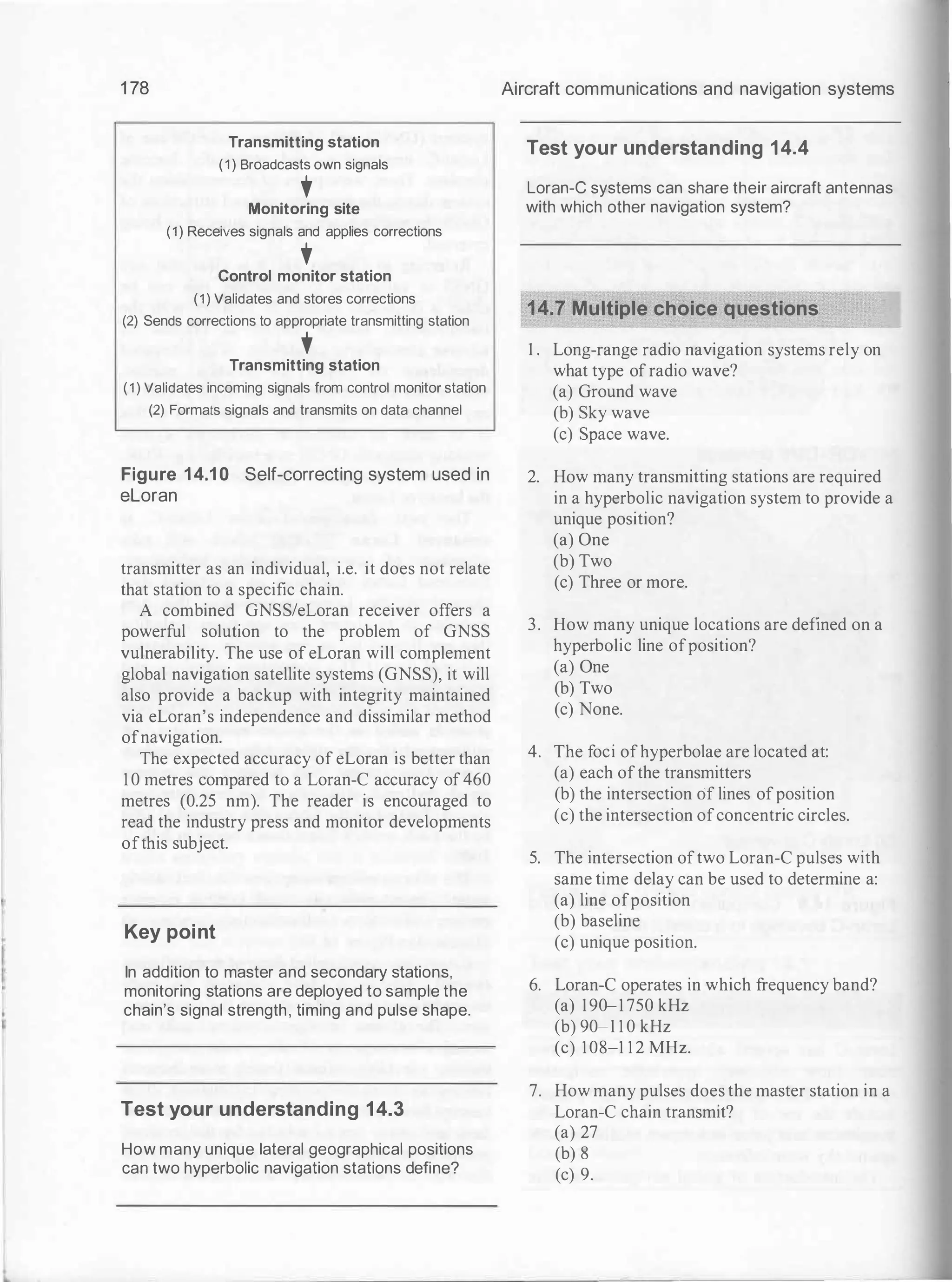
0
Vertical quarter-wave with 0
ground plane
Four-element Yagi 6
UHF comer reflector 9
Two stacked vertical half- 3
wave dipoles
5/8th wave vertical with 2
ground plane
Small hom antenna for use 1 0
at 1 0 GHz
3 m diameter parabolic 40
antenna for tracking space
vehicles at UHF
Test your understanding 2.7
Beamwidth
(degrees)
360
360
43
27
360
360
20
4
Identify the antenna shown in Figure 2.33. Sketch
a typical horizontal radiation pattern for this
antenna.
Figure 2.33 See Test your understanding 2.7
Aircraft communications and navigation systems
The purpose of the feeder line is to convey the
power produced by a source to a load which may
be some distance away. In the case of a receiver,
the source is the receiving antenna whilst the load
is the input impedance of the first RF amplifier
stage. In the case of a transmitting system, the
source is the output stage of the transmitter and
the load is the impedance of the transmitting
antenna. Ideally, a feeder would have no losses
(i.e. no power would be wasted in it) and it would
present a perfect match between the impedance of
the source to that of the load. In practice, this is
seldom the case. This section explains the basic
principles and describes the construction of most
common types offeeder.
2.9.1 Characteristic impedance
The impedance of a feeder (known as its
characteristic impedance) is the impedance that
would be seen looking into an infinite length of
the feeder at the working frequency. The
characteristic impedance, Z0, is a function of the
inductance, L, and capacitance, C, 9f the feeder
and may be approximately represented by:
L and C are referred to as the primary constants
of a feeder. In this respect, L is the loop
inductance per unit length whilst C is the shunt
capacitance per unit length (see Figure 2.34).
In practice, a small amount of DC resistance
will be present in the feeder but this is usually
negligible. For the twin open wire shown in
Figure 2.2 1 (a), the inductance, L, and
capacitance, C, of the line depend on the spacing
between the wires and the diameter of the two
conductors. For the coaxial cable shown in Figure
2.21 (b) the characteristic impedance depends
upon the ratio of the diameters of the inner and
outer conductors.
Example 2.4
A cable has a loop inductance of 20 nH and a
capacitance of 1 00 pF. Determine the
characteristic impedance ofthe cable.
Antennas 29
L' L' L'
(a) Loop inductance (line short-circuit at the far end)
0 c· I c· I
0>----I....----.I_
--I-.--o
c·
�I.___...o
(b) Loop capacitance (line open-circuit at the far end)
Figure 2.34 Loop inductance and loop capacitance
s
(a) Open wire feeder
(b) Coaxial cable
Figure 2.35 Dimensions of flat twin feeder
and coaxial cables
In this case, L = 20 nH = 20 x 1 0-9 H and C =
1 00 pF = 1 00 X 10-12 F.
Using Zo =�0 gives:
z -
o -
180X 1o-9 = ,)I.8X
103 = .J1800 = 42 Q
100x10-12
2.9.2 Coaxial cables
Because they are screened, coaxial cables are
used almost exclusively in aircraft applications.
The coaxial cable shown in Figure 2.35(b) has a
centre conductor (either solid or stranded wire)
and an outer conductor that completely shields
the inner conductor. The two conductors are
concentric and separated by an insulating
dielectric that is usually air or some form of
polythene. The impedance of such a cable is
given by:
Z0 =138log10 (�J0
where Z0 is the characteristic impedance (in
ohms), D is the inside diameter of the outside
30
conductor (in mm), and d is the outside diameter
ofthe inside conductor (in mm).
Example 2.5
A coaxial cable has an inside conductor diameter
of 2 mm and an outside conductor diameter of 10
mm. Determine the characteristic impedance of
the cable.
In this case, d = 2 mm and D =10 mm.
Using Z0 =
138log10 (�)Q gives:
2.9.3 Two-wire open feeder
The characteristic impedance of the two-wire
open feeder shown in Figure 2.35(a) is given by:
Z0 = 276log10 (�JQ
where Z0 is the characteristic impedance (in
ohms), s is the spacing between the wire centres
(in mm), and r is the radius ofthe wire (in mm).
Flat twin ribbon cable is a close relative ofthe
two-wire open line (the difference between these
two being simply that the former is insulated and
the two conductors are separated by a rib of the
same insulating material).
When determining the characteristic impedance
ofribbon feeder, the formula given above must be
modified to allow for the dielectric constant ofthe
insulating material. In practice, however, the
difference may be quite small.
Test your understanding 2.8
1 . A coaxial cable has an inductance of 30 nH/m
and a capacitance of 1 20 pF/m. Determine the
characteristic impedance of the cable.
2. The open wire feeder used with a high-power
land-based HF radio transmitter uses wire
having a diameter of 2.5 mm and a spacing of
1 5 mm. Determine the characteristic
impedance of the feeder.
Aircraft communications and navigation systems
tJ() IJ a
Low impedance High impedance
(a) Open wire feeder
Low impedance High impedance
(b) Coaxial cable
Figure 2.36 Effect of dimensions on the
characteristic impedance of open wire feeder
and coaxial cable
2.9.4 Attenuation
The attenuation of a feeder is directly
proportional to the DC resistance of the feeder
and inversely proportional to the impedance of
the line. Obviously, the lower the resistance of
the feeder, the smaller will be the power losses.
The attenuation is given by:
A=0.143� dB
Zo
where A is the attenuation in dB (per metre), R is
the resistance in ohms (per metre) and Z is the
characteristic impedance (in ohms).
Whilst the attenuation of a feeder remains
reasonably constant throughout its specified
frequency range, it is usually subject to a
progressive increase beyond the upper frequency
limit (see Figure 2.38). It is important when
choosing a feeder or cable for a particular
application to ensure that the operating frequency
is within that specified by the manufacturer. As
an example, RG1 78B/U coaxial cable has a loss
that increases with frequency from 0. 1 8 dB at 10
Antennas
Figure 2.37 Construction of a high-quality
coaxial cable (50 n impedance)
. !Hz, to 0.44 dB at 1 00 MHz, 0.95 dB at 400
. 1Hz, and 1 .4 dB at 1 GHz.
2.9.5 Primary constants
The two types of feeder that we have already
described differ in that one type (the coaxial
feeder) is unbalanced whilst the other (the two-
:ire transmission line) is balanced. In order to
!Ully understand the behaviour of a feeder,
�-hether balanced or unbalanced, it is necessary to
consider its equivalent circuit in terms of four
conventional component values; resistance,
mductance, capacitance and conductance, as
·hown in Figure 2.39. These four parameters are
known as primary constants and they are
;;ummarised in Table 2.2.
Table 2.2 The primary constants of a feeder
Constant Symbol Units
Resistance R Ohms (0)
illductance L Henries (H)
Capacitance c Farads (F)
Conductance G Siemens (S)
31
ill
1 .0
:E.
�
Q)
E
�
Q)
a.
"'
"'
0
0.5
..J
1 MHz 10MHz 100MHz 1GHz
Frequency (log. scale)
Figure 2.38 Attenuation of a typical coaxial
cable feeder
Note that, in a 'loss-free' feeder, R and G are both
very small and can be ignored (i.e. R = 0 and G =
0) but with a real feeder both R and G are present.
R
2
R
4
R
4
L
2
(a) Unbalanced feeder
.b.
4
L
4
(b) Balanced feeder
L
2
.b.
4
L
4
B.
2
B.
4
R
4
Figure 2.39 Equivalent circuit of balanced
and unbalanced feeders
32
2.9.6 Velocity factor
The velocity of a wave in a feeder is not the same
as the velocity of the wave in free space. The
ratio of the two (velocity in the feeder compared
with the velocity in free space) is known as the
velocity factor. Obviously, velocity factor must
always be less than 1 , and in typical feeders it
varies from 0.6 to 0.97 (see Table 2.3).
Table 2.3 Velocity factor for various types of
feeder
Type o
ff
eeder
Two-wire open line (wire with
air dielectric)
Parallel tubing (air dielectric)
Coaxial line (air dielectric)
Velocityfactor
0.975
0.95
0.85
Coaxial line (solid plastic 0.66
dielectric)
Two-wire line (wire with plastic 0.68 to 0.82
dielectric)
Twisted-pair line (rubber
dielectric)
2.10 Connectors
0.56 to 0.65
Connectors provide a means of linking coaxial
cables to transmitting/receiving equipment and
antennas. Connectors should be reliable, easy to
mate, and sealed to prevent the ingress of
moisture and other fluids. They should also be
designed to minimise contact resistance and,
ideally, they should exhibit a constant impedance
which accurately matches that of the system in
which they are used (normally 50 n for aircraft
applications).
Coaxial connectors are available in various
format (see Figure 2.40). Of these, the BNC- and
N-type connectors are low-loss constant
impedance types.
The need for constant impedance connectors
(e.g. BNC and N-type connectors) rather than
cheaper non-constant impedance connectors (e.g.
PL-259) becomes increasingly critical as the
frequency increases. As a general rule, constant
Aircraft communications and navigation systems
Figure 2.40 Coaxial connectors (from left to
right: PL-259, BNC, and N-type)
B mm
H
�
(b) �
(c)
(d)
(e)
Figure 2.41 Method of fitting a BNC-type
connector to a coaxial cable
impedance connectors should be used for
applications at frequencies of above 200 MHz.
Below this frequency, the loss associated with
using non-constant impedance connectors is not
usually significant.
Figure 2.4 1 shows the method of fitting a
typical BNC connector to a coaxial cable. Fitting
requires careful preparation of the coaxial cable.
The outer braided screen is fanned out, as shown
in Figure 2.4 l (b) and Figure 2.4 l (c) and clamped
in place whereas the inner conductor is usually
soldered to the centre contact, as shown in Figure
2.4 l (d).
Antennas
�atching a source (such as a transmitter) to a
load (such as an aerial) is an important
consideration because it allows the maximum
transfer of power from one to the other. Ideally,
a feeder should present a perfect match between
the impedance of the source and the impedance
of the load. Unfortunately this is seldom the
case and all too often there is some degree of
mismatch present. This section explains the
consequences of mismatching a source to a load
and describes how the effect of a mismatch can
be quantified in terms of standing wave ratio
' SWR).
Where the impedance ofthe transmission line
or feeder perfectly matches that ofthe aerial, all
of the energy delivered by the line will be
transferred to the load (i.e. the aerial). Under
these conditions, no energy will be reflected
back to the source.
If the match between source and load is
imperfect, a proportion ofthe energy arriving at
the load will be reflected back to the source.
The result ofthis is that a standing wave pattern
of voltage and current will appear along the
:eeder (see Fig. 2.42).
The standing wave shown in Figure 2.42
occurs ' when the wave travelling from the
source to the load (i.e. the forward wave)
interacts with the wave travelling from the load
to the source (the reflected wave). It is
:mportant to note that both the forward and
reflected waves are moving but in opposite
directions. The standing wave, on the other
hand, is stationary.
As indicated in Figure 2.42 when a standing
wave is present, at certain points along the
eeder the voltage will be a maximum whilst at
others it will take a minimum value. The current
distribution along the feeder will have a similar
pattern (note, however, that the voltage maxima
will coincide with the current minima, and vice
versa).
Four possible scenarios are shown in Figure
_.43. In Figure 2.43(a) the feeder is perfectly
matched to the load. Only the forward wave is
present and there is no standing wave. This is
me ideal case in which all of the energy
generated by the source is absorbed by the load.
33
Forward wave
¢
¢
Source Load
Reflected wave
(a) Forward and reflected waves travelling along the line
Voltage
~
Distance
(b) Voltage standing wave produced
Figure 2.42 Forward and reflected waves
when a load is mismatched
In Figure 2.43(b) the load is short-circuit. This
represents one of the two worst-case scenarios as
the voltage varies from zero to a very high
positive value. In this condition, all of the
generated power is reflected back to the source.
In Figure 2.43(c) the load is open-circuit. This
represents the other worst-case scenario. Here
again, the voltage varies from zero to a high
positive value and, once again, all ' of the
generated power is reflected back to the source.
In Figure 2.43(d) the feeder is terminated by an
impedance that is different from the feeder's
characteristic impedance but is neither a short­
circuit nor an open-circuit. This condition lies
somewhere between the extreme and perfectly
matched cases.
The standing wave ratio (SWR) of a feeder or
transmission line is an indicator of the
effectiveness ofthe impedance match between the
transmission line and the antenna. The SWR is
the ratio ofthe maximum to the minimum current
along the length of the transmission line, or the
ratio of the maximum to the minimum voltage.
When the line is absolutely matched the SWR is
unity. In other words, we get unity SWR when
there is no variation in voltage or current along
the transmission line.
34 Aircraft communications and navigation systems
Voltage
0
2 4 4
Distance from termination
(a) Correctly terminated feeder
Voltage
/
I
I
0 1.. 1.. 31.. 5 1..
1 .5 1..
4 2 4 4
Distance from termination
{b) Feeder terminated by a short-circuit
Voltage
'


_ _

0 1.. 1.. 31.. 5 1..
1 .5 1..
4 2 4 4
Distance from termination
(c) Feeder terminated by an open-circuit
Voltage
-
2 4 4
Distance from termination
{d) Feeder terminated by an impedance that is not equal to the characteristic impedance
Figure 2.43 Effect of different types of mismatch
Antennas
The greater the number representing SWR, the
larger is the mismatch. Also, I 2R losses increase
with increasing SWR.
For apurely resistive load:
SWR = � (when Z, > Z0)
Za-
and
SWR = � (when Z, < Z0)
z,
where Zo is the characteristic impedance of the
transmission line (in ohms) and Z, is the
impedance of the load (also in ohms). Note that,
since SWR is a ratio, it has no units.
SWR is optimum (i.e. unity) when Z, is equal
to Z0. It is unimportant as to which of these terms
is in the numerator. Since SWR cannot be less
than 1, it makes sense to put whichever is the
larger ofthe two numbers in the numerator.
The average values of RF current and voltage
become larger as the SWR increases. This, in
turn, results in increased power loss in the series
loss resistance and leakage conductance
respectively.
For values of SWR of between 1 and 2 this
additional feeder loss is not usually significant
and is typically less than 0.5 dB. However, when
the SWR exceeds 2.5 or 3, the additional loss
becomes increasingly significant and steps should
be taken to reduce it to a more acceptable value.
2.1 1 .1 SWR measurement
Standing wave ratio is easily measured using an
instrument known as an SWR bridge, SWR
meter, or a combined SWR/power meter (see
Figure 2.44). Despite the different forms of this
instrument the operating principle involves
sensing the forward and reflected power and
displaying the difference between them.
Figure 2.45 shows the scale calibration for the
SWR meter circuit shown in Figure 2.46. The
instrument comprises a short length of
transmission line with two inductively and
capacitively coupled secondary lines. Each of
these secondary lines is terminated with a
matched resistive load and each has a signal
35
Figure 2.44 A combined RF power and
SWR meter
J
Figure 2.45 A typical SWR meter scale
(showing SWR and % reflected power)
detector. Secondary line, L l (and associated
components, Dl and R l ) is arranged so that it
senses the forward wave whilst secondary line,
L2 (and associated components, D2 and R2) is
connected so that it senses the reflected wave.
In use, RF power is applied to the system, the
meter is switched to indicate the forward power,
and VRl is adjusted for full-scale deflection.
Next, the meter is switched to indicate the
reflected power and the SWR is read directly
from the meter scale. More complex instruments
use cross-point meter movements where the two
pointers simultaneously indicate forward and
reflected power and the point at which they
intersect (read from a third scale) gives the value
of SWR present.
The point at which the SWR in a system is
measured is important. To obtain the most
36
01
OA91
Aircraft communications and navigation systems
FB1
.------. A
C1 4n7
SK1 Input Short length of 50 n transmission line
l
L1
�:
::i::::::::::::::::::::::::::i::
SK2 Output
R2
1 50
C2 4n7
�
02
OA91
FB2 Fwd. Ref. FB4 FB3
A ---t-------<:::A
FB = ferrite bead inductor
Figure 2.46 A typical SWR meter
meaningful indication ofthe SWR of an aerial the
SWR should ideally be measured at the far end of
the feeder (i.e. at the point at which the feeder is
connected to the aerial). The measured SWR will
actually be lower at the other end of the feeder
(i.e. at the point at which the feeder is connected
to the transmitter). The reason for this apparent
anomaly is simply that the loss present in the
feeder serves to improve the apparent SWR seen
by the transmitter. The more lossy the feeder the
better the SWR!
M1
1 00J.!
Sudden deterioration of antenna performance and
an equally sudden increase in SWR usually points
either to mechanical failure of the elements or to
electrical failure of the feed-point connection,
feeder or RF connectors. Gradual deterioration,
on the other hand, is usually associated with
corrosion or ingress of fluids into the antenna
structure, feeder or antenna termination.
The SWR of virtually all practical aerial/feeder
arrangements is liable to some considerable
variation with frequency. For this reason, it is
Antennas
advisable to make measurements at the extreme
limits of the frequency range as well as at the
centre frequency. In the case of a typical
transmitting aerial, the SWR can vary from 2:1 at
the band edges to 1 .2 : 1 at the centre. Wideband
aerials, particularly those designed primarily for
receiving applications, often exhibit significantly
higher values of SWR. This makes them unsuited
to transmitting applications.
2.1 1 .2 A design example
In order to pursue this a little further it's worth
taking an example with some measured values to
confirm that the SWR of a half-wave dipole (see
page 1 6) really does change in the way that we
have predicted. This example further underlines
the importance of SWR and the need to have an
accurate means of measuring it.
Assume that we are dealing with a simple half­
wave dipole aerial that is designed with the
following parameters:
Centre frequency:
Feed-line impedance:
Dipole length:
Element diameter:
Bandwidth:
Q-factor:
250 MHz
75 ohm
0.564 metres
5 mm
5 1 MHz
4.9
The calculated resistance of this aerial varies
from about 52 Q at 235 MHz to 72 Q at 265
MHz. Over the same frequency range its
reactance varies from about -37 n (a capacitive
reactance) to +38 n (an inductive reactance). As
predicted, zero reactance at the feed point occurs
at a frequency of 250 MHz for the dipole length
in question. This relationship is shown in Figure
2.47.
Measurements of SWR show a minimum value
ofabout 1 .23 occurring at about 25 1 MHz and an
expected gradual rise either side of this value (see
Fig 2.48). This graph shows that the transmitting
bandwidth is actually around 33 MHz (extending
from 237 MHz to around 270 MHz) for an SWR
of 2: 1 instead of the intended 5 1 MHz. Clearly
this could be a problem in an application where a
transmitter is to be operated with a maximum
SWR of2: 1
The bandwidth limitation of a system
(comprising transmitter, feeder and aerial) is
37
40 100
'E
.s:::_
�
R 0::
20 50 �
'E
c
.l!l
.s:::_ Vl
� ·c;;
Q)
X 0::
.,.. 0 0
()
c
�
"'
Q)
0::
-20
X
-40
237 243 249 255 261
Frequency (MHz)
Figure 2.47 Variation of resistance and
reactance for the 250 MHz half-wave dipole
antenna
237 243 249 255 261
Frequency (MHz)
Figure 2.48 Variation of SWR for the
250 MHz half-wave dipole antenna
usually attributable to the inability of a
transmitter to operate into a load that has any
appreciable amount of reactance present rather
than to an inability of the aerial to radiate
effectively. Most aerials will radiate happily at
frequencies that are some distance away from
their resonant frequency-the problem is more
one of actually getting the power that the
transmitter is capable of delivering into them!
38
2.12 Waveguide
Conventional coaxial cables are ideal for coupling
RF equipment at LF, HF and VHF. However, at
microwave frequencies (above 3 GHz, or so), this
type of feeder can have significant losses and is
also restricted in terms of the peak RF power
(voltage and current) that it can handle. Because
of this, waveguide feeders are used to replace
coaxial cables for SHF and EHF applications,
such as weather radar.
A waveguide consists of a rigid or flexible
metal tube (usually of rectangular cross-section)
in which an electromagnetic wave is launched.
The wave travels with very low loss inside the
waveguide with its magnetic field component (the
H-field) aligning with the broad dimension of the
waveguide and the electric field component (the
E-field) aligning with the narrow dimension of
the waveguide (see Figure 2.49).
(a) Waveguide (broad dimension) showing H-field
rnu ttttt rnu ttttt
(b) Waveguide (narrow dimension) showing E-field
Figure 2.49 E- and H-fields in a rectangular
waveguide
Aircraft communications and navigation system:
A simple waveguide system is shown in Figure
2.50. The SHF signal is applied to a quarter
wavelength coaxial probe. The wave launched ir.
the guide is reflected from the plane blanked-off
end ofthe waveguide and travels through sections
of waveguide to the load (in this case a hom
antenna, see page 27). An example ofthe use of a
waveguide is shown in Figure 2.5 1 . In thi_
application a flexible waveguide is used to feed
the weather radar antenna mounted in the nose of
a large passenger aircraft. The antenna comprise:
a flat steerable plate with a large number of
radiating slots (each equivalent to a half-wave
dipole fed in phase).
Figure 2.51 Aircraft weather radar with
steerable microwave antenna and waveguide
Coupling flanges Horn antenna
Coaxial to waveguide / �_ /
r;==
t
===
ransi
===
tion �
====== = = = �
Direction of wave
propagation
lO
Coaxial input
Figure 2.50 A simple waveguide system comprising launcher, waveguide and horn antenna
Antennas
Resistance, R Reactance, X
50 .---��--�----.-------.-�----.---�--.-------e 50
SWR SWR
3 40 !----�+-----t--;----;c:::-"'""""'-,--'---'---+-+--,--'-----l-+-+--'--------l 40 3
2.5 30
2 20
]_
0
1 17.5 120 122.5 125
Frequency (MHz)
127.5 1 30
0
1 32.5
Figure 2.52 See Test your knowledge 2.9
Test your understanding 2.9
l=igure 2.52 shows the frequency response of a
ertical quarter-wave antenna used for local VHF
communications. Use the graph to determine the
<allowing:
a) The frequency at which the SWR is minimum
'b) The 2:1 SWR bandwidth of the antenna
c) The reactance of the antenna at 1 20 MHz
d) The resistance of the antenna at 1 20 MHz
e) The frequency at which the reactance of the
antenna is a minimum
2.13 Multiple choice questions
1 . An isotropic radiator will radiate:
(a) only in one direction
(b) in two main directions
(c) uniformly in all directions.
2. Another name for a quarter-wave vertical
antenna is:
(a) a Yagi antenna
(b) a dipole antenna
(c) a Marconi antenna.
39
f) The frequency at which the resistance of the
antenna is 50 n.
3. A full-wave dipole fed at the centre must be:
(a) current fed
Test your understanding 2.10
Explain what is meant by standing wave ratio
SWR) and why this is important in determining
"he performance of an antenna/feeder
combination.
(b) voltage fed
(c) impedance fed.
4. The radiation efficiency ofan antenna:
(a) increases with antenna loss resistance
(b) decreases with antenna loss resistance
(c) is unaffected by antenna loss resistance.
40
S. A vertical quarter-wave antenna will have a
polar diagram in the horizontal plane which is:
(a) unidirectional
(b) omnidirectional
(c) bi-directional.
6. Which one ofthe following gives the
approximate length of a half-wave dipole for
use at 300 MHz?
(a) SO em
(b) l m
(c) 2 m.
7. A standing wave ratio of 1 : 1 indicates:
(a) that there will be no reflected power
(b) that the reflected power wiII be the same
as the forward power
(c) that only half ofthe transmitted power will
actually be radiated.
8. Which one ofthe following gives the 2: 1
SWR bandwidth ofthe antenna whose
frequency response is shown in Figure 2.S3?
(a) 270 kHz
(b) S20 kHz
(c) 1 1 . 1 MHz.
9. Which one ofthe following antenna types
would be most suitable for a fixed long
distance HF communications link?
(a) a comer reflector
(b) two stacked vertical dipoles
(c) a three-element horizontal Yagi.
I 0. What type ofantenna is shown in Figure 2.S4?
(a) a folded dipole
(h) a Yagi
(c) a comer reflector.
1 1 . When two antennas are vertically stacked the
combination will have:
(a) increased gain and decreased beamwidth
(b) decreased gain and increased beamwidth
(c) increased gain and unchanged beamwidth.
1 2. The characteristic impedance ofa coaxial
cable depends on:
(a) the ratio of inductance to capacitance
(b) the ratio ofresistance to inductance
(c) the product ofthe resistance and reactance
(either capacitive or inductive).
Aircraft communications and navigation systems
3.0
0
� 2.5
<1>
>
"'
:;: 2.0
Ol
c
'5
c
1.5
"'
iii
/
""' v
/
""' /
1'--. /
""-....
v
v
1'--
10.7 10.8 10.9 1 1 .0 1 1.1 11.2 11.3 11.4 11.5
Frequency (MHz)
Figure 2.53 See Question 8
Figure 2.54 See Question 1 0
1 3 . The attenuation of an RF signal in a coaxial
cable:
(a) increases with frequency
(b) decreases with frequency
(c) stays the same regardless of frequency.
1 4. Ifa transmission line is perfectly matched to
an aerial load it will:
(a) have no impedance
(b) be able to carry an infinite current
(c) appear to be infinitely long.
1 S. The characteristic impedance of an RF coaxial
cable is:
(a) usually between so and 7S n
(b) either 300 or 600 n
(c) greater than 600 n.
1 6. The beamwidth ofan antenna is measured:
(a) between the SO% power points
(b) between the 70% power points
(c) between the 90% power points.
Chapter
3
Transmitters
and receivers
Transmitters and receivers are used extensively in
aircraft communication and navigation systems.
In conjunction with one ore more antennas, they
are responsible for implementing the vital link
between the aircraft, ground stations, other
aircraft and satellites. This chapter provides a
general introduction to the basic principles and
operation of transmitters and receivers. These
themes are further developed in Chapters 4 and 5.
3.1 A simple radio system
Figure 3. 1 shows a simple radio communication
system comprising a transmitter and receiver
for use with continuous wave (CW) signals.
Communication is achieved by simply switching
(or 'keying') the radio frequency signal on and
off. Keying can be achieved by interrupting the
supply to the power amplifier stage or even the
oscillator stage; however, it is normally applied
within the driver stage that operates at a more
modest power level. Keying the oscillator stage
usually results in impaired frequency stability. On
the other hand, attempting to interrupt the
100 kHz
Oscillator
Power
amplifier
Antenna
kHz
ave
Antenna
appreciable currents and/or voltages that appear
in the power amplifier stage can also prove to be
somewhat problematic.
The simplest form of CW receiver consists of
nothing more than a radio frequency amplifier
(which provides gain and selectivity) followed by
a detector and an audio amplifier. The detector
stage mixes a locally
.
generated radio frequency
signal produced by the beat frequency oscillator
(BFO) with the incoming signal to produce a
signal that lies within the audio frequency range
(typically between 300 Hz and3.4 kHz).
As an example, assume that the incoming
signal is at a frequency of 1 00 kHz and that the
BFO is producing a signal at 99 kHz. A signal at
the difference between these two frequencies
( 1 kHz) will appear at the output of the detector
stage. This will then be amplified within the
audio stage before being fed to the loudspeaker.
Example 3.1.1
A radio wave has a frequency of 1 62.5 kHz. If a
beat frequency of 1 .25 kHz is to be obtained,
determine the two possible BFO frequencies.
100 kHz 1 kHz
Morse key
RF amplifier Detector AF amplifier
- 99 kHz
Beat
frequency
oscillator
Loudspeaker
Figure 3.1 A simple radio communication system
'
"i
42 Aircraft communications and navigation systems
The BFO can be above or below the incoming _j�M��n� ��� nfln���M_jnn_
signal frequency by an amount that is equal to the -�ijijijijijijijijijv�ijijijijijijijijijv
beat frequency (i.e. the audible signal that results
from the 'beating' of the two frequencies and - • - e
which appears at the output of the detector stage).
Hence, ]sFO =!RF±]AF
from which:
}sFO = (162.5 ± 1 .25) kHz = 1 60.75 or 1 63.25 kHz
Test your understanding 3.1
An audio frequency signal of 850 Hz is produced
when a BFO is set to 455.5 kHz. What is the input
signal frequency to the detector?
3.1 .1 Morse code
Transmitters and receivers for CW operation are
extremely simple but nevertheless they can be
extremely efficient. This makes them particularly
useful for disaster and emergency communication
or for any situation that requires optimum use of
low power equipment. Signals are transmitted
using the code invented by Samuel Morse (see
Figures 3 .2 and 3.3).
A · - N - ·
B - · · · 0 - - -
c - · - · p · - - ·
D - · · Q - - · -
E • R · - ·
F · · - · s • • •
G - - · T -
H • • • • u · · -
I • • v · · · -
J · - - - w · - -
K - · - X - · · -
L · - · · y - · - -
M - - z - - · ·
1 · - - - - 6 - · · · ·
2 · · - - - 7 - - · · ·
3 · · · - - 8 - - - · ·
4 · · · · - 9 - - - - ·
5 • • • • • 0 - - - - -
Figure 3.2 Morse code
c
Figure 3.3 Morse code signal for the letter C
3.2 Modulation and demodulation
In order to convey information using a radio
frequency carrier, the signal information must be
superimposed or 'modulated' onto the carrier.
Modulation is the name given to the process of
changing a particular property of the carrier wave
in sympathy with the instantaneous voltage (or
current) signal.
The most commonly used methods of
modulation are amplitude modulation (AM) and
frequency modulation (FM). In the former case,
the carrier amplitude (its peak voltage) varies
according to the voltage, at any instant, of the
modulating signal. In the latter case, the carrier
frequency is varied in accordance with the
voltage, at any instant, ofthe modulating signal.
Figure 3.4 shows the effect of amplih1de and
frequency modulating a sinusoidal carrier (note
that the modulating signal is in this case also
sinusoidal). In practice; many more cycles of the
RF carrier would occur in the time-span of one
cycle of the modulating signal. The process of
modulating a carrier is undertaken by a
modulator circuit, as shown in Figure 3.5. The
input and output waveforms for amplitude and
frequency modulator circuits are shown in Figure
3.6.
Demodulation is the reverse of modulation
and is the means by which the signal information
is recovered from the modulated carrier.
Demodulation is achieved by means of a
demodulator (sometimes also called a detector).
The output of a demodulator consists of a
reconstructed version of the original signal
information present at the input of the modulator
stage within the transmitter. The input and output
waveforms for amplitude and frequency
Transmitters and receivers
(a) Radio frequency carrier
{b) Audio frequency modulating signal
(c) Amplitude modulated carrier (AM)
(d) Frequency modulated carrier (FM)
Figure 3.4 Modulated waveforms
Carrier wave
input
Amplitude
modulator
�
a) Amplitude modulation
Carrier wave
input
:>) Frequency modulation
Modulating
signal input
Frequency
modulator
�
Modulating
signal input
Modulated carrier
wave output
Modulated carrier
wave output
Figure 3.5 Action of a modulator
Modulated carrier
wave input
Amplitude
demodulator
(a) Amplitude demodulation
Modulated carrier
wave output
Frequency
demodulator
(b) Frequency demodulation
43
Modulating signal
ouput
Modulating signal
ouput
Figure 3.6 Action of a demodulator
modulator circuits are shown in Figure 3.6. We
shall see how this works a little later.
3.3 AM transmitters
Figure 3.7 shows the block schematic of a simple
AM transmitter. An accurate and stable RF
oscillator generates the radio frequency carrier
signal. The output of this stage is then amplified
and passed to a modulated RF power amplifier
stage. The inclusion of an amplifier between the
RF oscillator and the modulated stage also helps
to improve frequency stability.
The low-level signal from the microphone is
amplified using an AF amplifier before it is
passed to an AF power amplifier. The output of
the power amplifier is then fed as the supply to
the modulated RF power amplifier stage.
Increasing and reducing the supply to this stage is
instrumental in increasing and reducing the
amplitude of its RF output signal.
The modulated RF signal is then passed
through an antenna coupling unit. This unit
matches the antenna to the RF power amplifier
and also helps to reduce the level of any
unwanted harmonic components that may be
present. The AM transmitter shown in Figure 3. 7
uses high-level modulation in which the
modulating signal is applied to the final RF
power amplifier stage.
44
Microphone AF amplifier
RF oscillator RF amplifier
1
�
Aircraft communications and navigation systems
AF power
amplifier
RF power
amplifier
Antenna
Ground
Figure 3.7 An AM transmitter using high-level modulation
Microphone AF amplifier
RF oscillator
Modulated RF
power
amplifier
Antenna
Ground
Figure 3.8 An AM transmitter using low-level modulation
An alternative to high-level modulation of the
carrier wave is shown in Figure 3.8. In this
arrangement the modulation is applied to a low­
power RF amplifier stage and the amplitude
modulated signal is then further amplified by the
final RF power amplifier stage. In order to
prevent distortion of the modulated waveform
this final stage must operate in linear mode (the
output waveform must be a faithful replica of the
input waveform). Low-level modulation avoids
the need for an AF power amplifier.
3.4 FM transmitters
Figure 3.9 shows the block schematic of a simple
FM transmitter. Once again, an accurate and
stable RF oscillator generates the radio frequencY
carrier signal. As with the AM transmitter, the
output of this stage is amplified and passed to an
RF power amplifier stage. Here again, the
inclusion of an amplifier between the RF
oscillator and the RF power stage helps to
improve frequency stability.
Transmitters and receivers 45
RF oscillator
RF amplifier
RF power
amplifier
AF amplifier
Figure 3.8 An FM transmitter
The low-level signal from the microphone is
amplified using an AF amplifier before it is
passed to a variable reactance element (see
Chapter 4) within the RF oscillator tuned circuit.
The application of the AF signal to the variable
reactance element causes the frequency of the RF
oscillator to increase and decrease in sympathy
?.itb the AF signal.
As with the AM transmitter, the final RF signal
from the power amplifier is passed through an
:mtenna coupling unit that matches the antenna to
:he RF power amplifier and also helps to reduce
ate level of any unwanted harmonic components
that may be present. Further information on
�nsmitters will be found in Chapters 4 and 5.
3.5 Tuned radio frequency receivers
Tuned radio frequency (TRF) receivers provide a
means of receiving local signals using fairly
:ninimal circuitry. The simplified block schematic
. ofa TRF receiver is shown in Figure 3.9.
Antenna
The signal from the antenna is applied to an RF
amplifier stage. This stage provides a moderate
amount of gain at the signal frequency. It also
provides selectivity by incorporating one or more
tuned circuits at the signal frequency. This helps
the receiver to reject signals that may be present
on adjacent channels.
The output of the RF amplifier stage is applied
to the demodulator. This stage recovers the audio
frequency signal from the modulated RF signal.
The demodulator stage may also incorporate a
tuned circuit to further improve the selectivity of
the receiver.
The output of the demodulator stage is fed to
the input of the AF amplifier stage. This stage
increases the level of the audio signal from the
demodulator so that it is sufficient to drive a
loudspeaker.
TRF receivers have a number of limitations
with regard to sensitivity and selectivity and this
makes this type of radio receiver generally
unsuitable for use in commercial radio
equipment.
RF amplifier 1----.---1 Demodulator 1---+-� AF amplifier
Figure 3.9 A TRF receiver
Loudspeaker
46
3.6 Superhet receivers
Superhet receivers provide both improved
sensitivity (the ability to receive weak signals)
and improved selectivity (the ability to
discriminate signals on adjacent channels) when
compared with TRF receivers. Superhet receivers
are based on the supersonic-heterodyne
principle where the wanted input signal is
converted to a fixed intermediate frequency (IF)
at which the majority ofthe gain and selectivity is
applied. The intermediate frequency chosen is
generally 455 kHz or 1 .6 MHz for AM receivers
and 10.7 MHz for communications and FM
receivers. The simplified block schematic of a
simple superhet receiver is shown in Figure 3. I I .
The signal from the antenna is applied to an
RF amplifier stage. As with the TRF receiver,
this stage provides a moderate amount of gain at
the signal frequency. The stage also provides
selectivity by incorporating one or more tuned
circuits at the signal frequency.
The output of the RF amplifier stage is applied
to the mixer stage. This stage combines the RF
signal with the signal derived from the local
oscillator (LO) stage in order to produce a signal
at the intermediate frequency (IF). It is worth
noting that the output signal produced by the
mixer actually contains a number of signal
components, including the sum and difference of
the signal and local oscillator frequencies as well
as the original signals plus harmonic components.
The wanted signal (i.e. that which corresponds to
the IF) is passed (usually by some form of filter­
see page 48) to the IF amplifier stage. This stage
provides amplification as well as a high degree of
selectivity.
The output of the IF amplifier stage is fed to
the demodulator stage. As with the TRF receiver,
this stage is used to recover the audio frequency
signal from the modulated RF signal.
Finally, the AF signal from the demodulator
stage is fed to the AF amplifier. As before, this
stage increases the level of the audio signal from
the demodulator so that it is sufficient to drive a
loudspeaker.
In order to cope with a wide variation in signal
amplitude, superhet receivers invariably
incorporate some form of automatic gain
control (AGC). In most circuits the DC level
Aircraft communications and navigation systems
from the AM demodulator (see page 5 1 ) is used
to control the gain of the IF and RF amplifier
stages. As the signal level increases, the DC level
from the demodulator stage increases and this is
used to reduce the gain of both the RF and IF
amplifiers.
The superhet receiver's intermediate frequency
JiF is the difference between the signal frequency,
f
RF, and the local oscillator frequency, f
w. The
desired local oscillator frequency can be
calculated from the relationship:
f
w =
fRF ±frF
Note that in most cases (and in order to simplify
tuning arrangements) the local oscillator operates
above the signal frequency, i.e.Ao = !
RF +!IF So,
for example, a superhet receiver with a 1 .6 MHz
IF tuned to receive a signal at 5.5 MHz will
operate with an LO at (5.5 + 1 .6) = 7. 1 MHz.
Figure 3.10 shows the relationship between the
frequencies entering and leaving a mixer stage.
Mixer
Figure 3.10 Action of a mixer stage in a
superhet receiver
Example 3�2
A VHF Band II FM receiver with a 1 0.7 MHz IF
covers the signal frequency range 88 MHz to 1 08
MHz. Over what frequency range should the local
oscillator be tuned?
Using f
w =
!RF + JiF when !RF = 88 MHz gives
f
w = 88 MHz + 1 0.7 MHz = 98.7 MHz
Using f
w = !
RF +/rF whenf
RF = 108 MHz gives
f
w = 108 MHz + 10.7 MHz = 1 1 8.7 MHz.
Transmitters and receivers 47
Antenna
IF amplifier Demodulator AF amplifier
Local
oscillator
Figure 3.1 1 A superhet receiver
3.7 Selectivity
Radio receivers use tuned circuits in order to
discriminate between incoming signals at
different frequencies. Figure 3.12 shows two
asic configurations for a tuned circuit; series and
parallel. The impedance-frequency characteristics
of these circuits are shown in Figure 3.13. It is
important to note that the impedance ofthe series
:uned circuit falls to a very low value at the
resonant frequency whilst that for a parallel tuned
circuit increases to a very high value at
L c
(a) Series tuned circuit
L
c
(b) Parallel tuned circuit
Figure 3.1 2 Series and parallel tuned circuits
Loudspeaker
AGC
resonance. For this reason, series tuned circuits
are sometimes known as acceptor circuits.
Parallel tuned circuits, on the other hand, are
sometimes referred to as rejector circuits.
Impedance
Frequency
(a) Series tuned circuit
Impedance
fo Frequency
(b) Parallel tuned circuit
Figure 3.1 3 Frequency response of the
tuned circuits shown in Figure 3.12
48
The frequency response (voltage plotted against
frequency) of a parallel tuned circuit is shown in
Figure 3. 14. This characteristic shows how the
signal developed across the circuit reaches a
maximum at the resonant frequency ifo). The
range of frequencies accepted by the circuit is
normally defined in relation to the half-power
(-3dB power) points. These points correspond to
70.7% ofthe maximum voltage and the frequency
range between these points is referred to as the
bandwidth ofthe tuned circuit.
Voltage
Vmax.
0.707 Vmax.
I
I
1--.----,
Bandwidth
f, Frequency
Figure 3.14 Frequency response for a
parallel tuned circuit
A perennial problem with the design of the TRF
receivers that we met earlier is the lack of
selectivity due to the relatively wide bandwidth of
the RF tuned circuits. An RF tuned circuit will
normally exhibit a quality factor (Q-factor) of
about 1 00. The relationship between bandwidth,
!1
/, Q-factor, Q, and resonant frequency, ..fo, for a
tuned circuit is given by:
t1J = fo
Q
As an example, consider a tuned circuit which has
a resonant frequency of I 0 MHz and a Q-factor of
100. Its bandwidth will be:
N = J;, =
10 MHz =
I00 kHz
Q 1 00
Aircraft communications and navigation systems
Clearly many strong signals will appear within
this range and a significant number of them may
be stronger than the wanted signal. With only a
single tuned circuit at the signal frequency, the
receiver will simply be unable to differentiate
between the wanted and unwanted signals.
Selectivity can be improved by adding
additional tuned circuits at the signal frequency.
Unfortunately, the use of multiple tuned circuits
brings with it the problem of maintaining accurate
tuning of each circuit throughout the tuning range
of the receiver. Multiple 'ganged' variable
capacitors (or accurately matched variable
capacitance diodes) are required.
A band-pass filter can be constructed using
two parallel tuned circuits coupled inductively (or
capacitively), as shown in Figure 3.15. The
frequency response of this type of filter depends
upon the degree of coupling between the two
tuned circuits. Optimum results are obtained with
a critical value of coupling (see Figure 3. 1 6). Too
great a degree of coupling results in a 'double­
humped' response whilst too little coupling
results in a single peak in the response curve
accompanied by a significant loss in signal.
Critical coupling produces a relatively 'flat' pass­
band characteristic accompanied by a reasonably
steep fall-off either side ofthe pass-band.
Band-pass filters are often found in the IF
stages of superhet receivers where they are used
to define and improve the receiver's selectivity.
Where necessary, a higher degree of selectivity
and adjacent channel rejection can be achieved
by using a multi-element ceramic, mechanical, or
crystal filter. A typical 455 kHz crystal filter (for
use with an HF receiver) is shown in Figure 3. 1 8.
This filter provides a bandwidth of 9 kHz and a
very high degree of attenuation at the two
adjacent channels on either side of the pass­
band.
C1
TOT C2
Input
Figure 3.1 5 A typical band-pass filter
Transmitters and receivers
- Over-coupled
Frequency
Figure 3.1 6 Response of coupled tuned
circuits
Test your understanding 3.2
Sketch the block schematic of a superhet receiver
and state the function of each of the blocks.
Test your understanding 3.3
-n HF communications receiver has an
'ltermediate frequency of 455 kHz. What
· equency must the local oscillator operate at
vhen the receiver is tuned to 5.675 MHz?
Test your understanding 3.4
tuned circuit IF filter is to operate with a centre
,_equency of 1 0.7 MHz and a bandwidth of 1 50
·:.Hz. What Q-factor is required?
Test your understanding 3.5
ne ability of a receiver to reject signals on
adjacent channels is determined by the selectivity
::;-' its I F stages. Explain why this is.
49
Figure 3.1 7 Band-pass coupled tuned
circuits in the RF stages of a VHF receiver
Attenuation (dB)
0
-10
-20
-30
-40
-50
-60
-70
430 440 450 460 470
Frequency (kHz)
Figure 3.18 Mechanical IF filter response
I
�I
���
50
Test your understanding 3.6
Sketch the frequency response of two coupled
tuned circuits. In relation to your answer, explain
what is meant by:
(a) overcoupling
(b) undercoupling
(c) critical coupling.
3.8 Image channel rejection
Earlier we showed that a superhet receiver's
intermediate frequency, fw, is the difference
between the signal frequency, /RF, and the local
oscillator frequency, fL0. We also derived the
following formula for determining the frequency
ofthe local oscillator signal:
f
w =/RF ±fiF
The formula can be rearranged to make /
RF the
subject, as follows:
!
Rr =f
w ±fw
In other words, there are two potential radio
frequency signals that can mix with the local
oscillator signal in order to provide the required
IF. One of these is the wanted signal (i.e. the
signal present on the channel to which the
receiver is tuned) whilst the other is referred to as
the image channel.
Being able to reject any signals that may just
happen to be present on the image channel of a
superhet receiver is an important requirement of
any superhet receiver. This can be achieved by
making the RF tuned circuits as selective as
possible (so that the image channel lies well
outside their pass-band). The problem of rejecting
the image channel is, however, made easier by
selecting a relatively high value of intermediate
frequency (note that, in terms of frequency, the
image channel is spaced at twice the IF away
from the wanted signal).
Figure 3 . 1 9 shows the relationship that exists
between the wanted signal, local oscillator signal,
and the image channel for receivers with (a) a 455
kHz IF and (b) a 1 .6 MHz IF. A typical response
curve for the RF tuned circuits of the receiver
(assuming a typical Q-factor) has been
Aircraft communications and navigation systems
/
/
21.0
/
/
/
/
/
I
/
I
I
I
21.5
I
I
I
I
I
I
I
I
/
I
'
 RF tuned circuit
 response
 /


'
Wanted Local Image
signal oscillator channel
'
'
'
'
'
455 kHz 455 kHz
22.0 22.5 23.0
Frequency (MHz)
(a) 455 kHz IF
I
I
I
I
I
" RF tuned circuit
I I
1 1 response
/  /
I I
I I
I I
Wanted Local Image
/ signal oscillator channel
1 .6 MHz 1 .6 MHz
19.0 20.0 21.0 22.0 23.0 24.0 25.0
Frequency (MHz)
(b) 1.6 MHz IF
Figure 3.19 Image channel rejection
superimposed onto both of the graphs (the same
response curve has been used in both cases but
the frequency scale has been changed for the two
different intermediate frequencies). From Figure
3.19 is should be clear that whilst the image
channel for the 455 kHz IF falls inside the RF
tuned circuit response, that for the 1 .6 MHz IF
falls well outside the curve.
Test your understanding 3.7
An FM receiver tuned to 1 1 8.6 MHz has an IF of
1 0.7 MHz. Determine the frequency of the image
channel given that the local oscillator operates
above the signal frequency.
Transmitters and receivers
3.9 Automatic gain control
The signal levels derived from the antennas fitted
to an aircraft can vary from as little as 1 f.lV to
more than 1 ,000 f.LV. Unfortunately, this presents
us with a problem when signals are to be
amplified. The low-level signals benefit from the
maximum amount of gain present in a system
whilst the larger signals require correspondingly
less gain in order to avoid non-linearity and
consequent distortion of the signals and
modulation. AM, CW and SSB receivers
therefore usually incorporate some means of
automatic gain control (AGC) that progressively
reduces the signal gain as the amplitude of the
input signal increases (see Figure 3.20).
-.F output
voltage
/
/
/
No AGC
/
/
/:.
Delayed AGC
Normai AGC
RF input
voltage
Figure 3.20 AGC action
..n simple receivers, the AGC voltage (a DC
oltage dependent on signal amplitude) is derived
irectly from the signal detector and is fed
irectly to the bias circuitry of the IF stages (see
igure 3.1 1 ). In more sophisticated equipment,
e AGC voltage is amplified before being
:q>plied to the IF and RF stages. There is, in fact,
need to reduce the signal gain for small RF
signals. Hence, in more sophisticated equipment,
- e AGC circuits may be designed to provide a
delay' so that there is no gain reduction until a
redetermined threshold voltage is exceeded. In
:eceivers that feature delayed AGC there is no
gain reduction until a certain threshold voltage is
_ hieved. Beyond this, there is a progressive
:eduction in gain (see Figure 3 .20).
51
3.10 Double superhet receivers
The basic superhet receiver shown in Figure 3. 1 1
has an intermediate frequency (IF) of usually
either 455 kHz, 1 .6 MHz or 1 0.7 MHz. In order
to achieve an acceptable degree of image channel
rejection (recall that the image channel is spaced
by twice the IF away from the wanted frequency)
a 455 kHz IF will generally be satisfactory for the
reception of frequencies up to about 5 MHz,
whilst an IF of 1 .6 MHz (or greater) is often used
at frequencies above this. At VHF, intermediate
frequencies of 1 0.7 MHz (or higher) are often
used.
Unfortunately, the disadvantage of using a high
IF ( 1 .6 MHz or 1 0.7 MHz) is simply that the
bandwidth of conventional tuned circuits is too
wide to provide a satisfactory degree of
selectivity and thus elaborate (and expensive) IF
filters are required.
To avoid this problem and enjoy the best of
both worlds, many high-performance receivers
make use of two separate intermediate
frequencies; the first IF provides a high degree of
image channel rejection whilst the second IF
provides a high degree of selectivity. Such
receivers are said to use dual conversion.
A typical double superhet receiver is shown in
Figure 3.2 1 . The incoming signal frequency
(26 MHz in the example) is converted to a first IF
at 10.695 MHz by mixing the RF signal with a
first local oscillator signal at 36.695 MHz (note
that 36.695 MHz - 26 MHz = 1 0.695 MHz). The
first IF signal is then filtered and amplified before
it is passed to the second mixer stage.
The input of the second mixer ( 10.695 MHz) is
then mixed with the second local oscillator signal
at 1 0.240 MHz. This produces the second IF at
455 kHz (note that 1 0.695 MHz - 1 0.240 MHz =
455 kHz). The second IF signal is then filtered
and amplified. It is worth noting that the bulk of
the gain is usually achieved in the second IF
stages and there will normally be several stages of
amplification at this frequency.
In order to tune the receiver, the first local
oscillator is either made variable (using
conventional tuned circuits) or is synthesised
using digital phase-locked loop techniques (see
page 53). The second local oscillator is almost
invariably crystal controlled in order to ensure
good stability and an accurate relationship
"''
'�'I
52 Aircraft communications and navigation systems
Antenna
1
26 MHz
RF
26 MHz
First First local
amplifier mixer

oscillator
10.695 MHz
36.695 MHZ
First IF
AGC
amplifier
10.695 MHz
Loudspeaker
455 kHz 455 kHz AF
AF
r-m
Second Second IF Detector/
mixer amplifier demodulator amplifier
10.240 MHz
Second local
oscillator
Figure 3.21 A double conversion superhet receiver
between the two intermediate frequencies.
Typical IF bandwidths in the receiver shown in
Figure 3.21 are 75 kHz at the first IF and a mere 6
kHz in the second IF.
The first IF filter (not shown in Figure 3.2 1 ) is
connected in the signal path between the first and
second mixer. Where a stage of amplification is
provided at the first IF, the filter precedes the
amplifier stage. The requirements of the filter are
not stringent since the ultimate selectivity of the
receiver is def
med by the second IF filter which
operates at the much lower frequency of455 kHz.
There are, however, some good reasons for
using a filter which offers a high degree of
rejection of the unwanted second mixer image
response which occurs at 9.785 MHz. If this
image is present at the input of the second mixer,
it will mix with the second mixer injection at
1 0.240 MHz to produce a second IF component
of 455 kHz, as shown in Figure 3 .22. The
function of the first IF filter is thus best described
as roofing; bandwidth is a less important
Second oscillator injection
Image
I
I
First IF
I
455 kHz 455 kHz
I
I
I
I
9.785 10.240 1 0.695
Frequency (MHz)
Figure 3.22 Second oscillator signal
Test your understanding 3.8
Explain why AGC is necessary in an HF
communications receiver and how it is applied.
Transmitters and receivers
3.11 Digital frequency synthesis
The signals used within high-specification radio
frequency equipment (both receivers and
transmitters) must be both accurate and stable.
Where operation is restricted to a single
frequency or a limited number ofchannels, quartz
crystals may be used to determine the frequency
of operation. However, when a large number of
frequencies must be covered, it is necessary to
employ digital frequency generating techniques in
which a single quartz crystal oscillator is used in
conjunction with LSI circuitry to generate a range
of discrete frequencies. These frequencies usually
have a constant channel spacing (typically 3 kHz,
8.33 kHz, 9 kHz, 1 2.5 kHz, 25 kHz, etc.).
Frequencies are usually selected by means of a
rotary switch, push-buttons or a keypad but can
also be stored in semiconductor memories.
Digital phase locked loop (PLL) circuitry was
first used in military communications equipment
in the mid-1 960s and resulted from the need to
generate a very large number of highly accurate
and stable frequencies m a multi-channel
frequency synthesiser. In this particular
application cost was not a primary consideration
and highly complex circuit arrangements could be
employed involving large numbers of discrete
components and integrated circuits.
Phase locked loop techniques did not arrive in
mass-produced equipment until the early 1 970s.
Voltage
controlled
oscillator
53
By comparison with today's equipment such
arrangements were crude, employing as many as
nine or ten i.e. devices. Complex as they were,
these PLL circuits were more cost-effective than
their comparable multi-crystal mixing synthesiser
counterparts. With the advent of large scale
integration in the late 1 970s, the frequency
generating unit in most radio equipment could be
reduced to one, or perhaps two, LSI devices
together with a handful of additional discrete
components. The cost-effectiveness of this
approach is now beyond question and it is
unlikely that, at least in the most basic equipment,
much further refinement will be made. In the area
of more complex receivers and transceivers,
however, we are now witnessing a further
revolution in the design of synthesised radio
equipment with the introduction of dedicated
microcomputer controllers which permit keypad
programmed channel selection and scanning with
pause, search, and lock-out facilities.
The most basic form of PLL consists of a phase
detector, filter, DC amplifier and voltage
controlled oscillator (VCO), as shown in Figure
3.23. The VCO is designed so that its free­
running frequency is at, or near, the reference
frequency. The phase detector senses any error
between the VCO and reference frequencies. The
output of the phase detector is fed, via a suitable
filter and amplifier, to the DC control voltage
input of the VCO. If there is any discrepancy
Output
Buffer/amplifier
Reference
oscillator
Low-pass
filter
Figure 3.23 A simple phase locked loop
Phase
detector
54
between the VCO output and the reference
frequency, an error voltage is produced and this is
used to correct the VCO frequency. The VCO
thus remains locked to the reference frequency. If
the reference frequency changes, so does the
VCO. The bandwidth ofthe system is determined
by the time constants of the loop filter. In
practice, if the VCO and reference frequencies are
very far apart, the PLL may be unable to lock.
The frequency range over which the circuit can
achieve lock is known as the capture range. It
should be noted that a PLL takes a finite time to
achieve a locked condition and that the VCO
locks to the mean value of the reference
frequency.
The basic form of PLL shown in Figure 3.23 is
limited in that the reference frequency is the same
as that of the VCO and no provision is
incorporated for changing it, other than by
varying the frequency of the reference oscillator
itself. In practice, it is nom1al for the phase
detector to operate at a much lower frequency
than that of the VCO output and thus a frequency
divider is incorporated in the VCO feedback path
(see Figure 3.24). The frequency presented to the
phase detector will thus be fo/n, where n is the
divisor.
Voltage
controlled
oscillator
Aircraft communications and navigation systems
When the loop is locked (i.e. when no phase error
exists) we can infer that:
her = J;, or fo =
n her
n
A similar divider arrangement can also be used at
the reference input to the phase detector, as
shown in Figure 3.25. The frequency appearing at
the reference input to the phase detector will be
frerlm and the loop will be locked when:
her =
fo
or I' =
!!__ I'
Jo Jref
m n m
Thus iffrer, n and m were respectively 1 00 kHz,
2,000 and 1 0, the output frequency,fout. would be:
(2,000/1 0) x 100 kHz = 20 MHz
If the value of n can be made to change by
replacing the fixed divider with a programmable
divider, different output frequencies can be
generated. If, for example, n was variable from
2,000 to 2, 1 00 in steps of 1 , thenfout would range
from 20 MHz to 21 MHz in 1 0 kHz steps. Figure
3.26 shows the basic arrangement of a PLL which
incorporates a programmable divider driven from
the equipment's digital frequency controller
(usually a microprocessor).
Output
Buffer/amplifier
Reference
oscillator
Low-pass
filter
[�l
Variable
divider
(divide-by-n)
Buffer/amplifier
Phase
detector
Figure 3.24 A phase locked loop with frequency divider
Transmitters and receivers
Reference
oscillator
Voltage
controlled
oscillator
Reference
Frequency
control
Buffer/amplifier
Variable
Buffer/amplifier
Phase
detector
Output
Frequency
control
55
Figure 3.25 A complete digital frequency synthesiser
In practice, problems can sometimes arise in
high-frequency synthesisers where the
programmable frequency divider, or divide-by-n
counter, has a restricted upper frequency limit. In
such cases it will be necessary to mix the high­
frequency VCO output with a stable locally
generated signal derived from a crystal oscillator.
The mixer output (a relatively low difference
frequency) will then be within the range of the
programmable divider.
3.12 A design example
Ne shall bring this chapter to a conclusion by
roviding a design example of a complete HF
�ommunications receiver. This receiver was
developed by the author for monitoring trans­
:tlantic HF communications in the 5.5 MHz
aircraft band. The circuit caters for the reception
of AM, CW (Morse code) and SSB signals (see
2bapter 5). To aid stability, the CIO/BFO
- equency is controlled by means of a ceramic
resonator. The RF performance is greatly
�anced by the use of dual gate MOSFET
devices in the RF amplifier, mixer, and product
detector stages and junction gate FETs in the
local oscillator stage. These devices offer high
gain with excellent strong-signal handling
capability. They also permit simple and effective
coupling between stages without the need for
complex impedance matching.
The receiver is tunable over the frequency
range 5.0 MHz to 6.0 MHz. Used in conjunction
with a simple antenna, it offer.s reception of
aircraft signals at distances in excess of 1 ,000 km.
The receiver is based on the single superhet
principle operating with an intermediate
frequency of 455 kHz. This frequency is low
enough to ensure reasonable selectivity with just
two stages of IF amplification and with the aid of
a low-cost 455 kHz filter. Adequate image
rejection is provided by two high-Q ganged RF
tuned circuits.
The design uses conventional discrete
component circuitry in all stages with the
exception of the audio amplifier/output stage and
voltage regulator. This approach ensures that the
receiver is simple and straightforward to align
and does not suffer from the limitations
5.5 MHz 5.5 MHz
Antenna RF amplifier
input (TR1 )
Mixer
(TR2)
455 kHz First IF
amplifier
(TR3)
455 kHz Second IF
amplifier
(TR4)
5.955 MHz
DC bias
Buffer
(TRB)
5.955 MHz
Local
oscillator
(TR7)
Figure 3.26 Superhet receiver design example
AGC
amplifier
(TR10)
Signal meter
1----..----l driver
(TR9)
Signal meter
+5V
+9V
BFO/CIO
(TR6)
455 kHz
Product
detector
(TR5)
Envelope
detector
(D3)
+5V
regulator
(IC2)
AF
amplifier
(IC1)
Diode switch
(D7 to D9)
Loudspeaker
DC input
Transmitters and receivers
associated with several of the popular integrated
circuit IF stages.
The block diagram of the receiver is shown in
Figure 3.26. The vast majority of the receiver's
gain and selectivity is associated with the two IF
stages, TR3 and TR4. These two stages provide
over 40 dB of voltage gain and the three IF tuned
circuits and filter are instrumental in reducing the
IF bandwidth to about 3.4 kHz for SSB reception.
The RF stage (TRl) provides a modest amount of
RF gain (about 20 dB at the maximum RF gain
setting) together with a significant amount of

image channel rejection.
57
The local oscillator stage (TR7) provides the
necessary local oscillator signal which tunes from
5.455 MHz to 6.455 MHz. The local oscillator
signal is isolated from the mixer stage and the LO
output by means ofthe buffer stage, TR8.
The receiver incorporates two detector stages,
one for AM and one for CW and SSB. The AM
detector makes use of a simple diode envelope
detector (D3) whilst the CW/SSB detector is
based on a product detector (TR5). This stage
offers excellent performance with both weak and
strong CW and SSB signals. The 455 kHz carrier
insertion is provided by means of the BFO/CIO
,---------- +9V
SK3
Antenna
Lo-Z
R3
100k
R6
270
Figure 3.27 RF stages of the superhet receiver
RFT2
R7
100k
TR2
3N21 1
From B
(local oscillator)
,-------------�---------��------
+9V
From B
(455 kHz IF Input)
To C (AGC amplifier)
----• To D (AM detector filter)
..,.-----..-• To E (product detector)
03
OA91
SK4
455 kHz IF
R17 output
47
'------------+-------------+ From F (AGC bias)
Figure 3.28 IF stages of the superhet receiver
58 Aircraft communications and navigation systems
VC1c
SOp
( TUNING )
C39
100n
C40
47p
SK6
LO output
Figure 3.29 Local oscillator and buffer stages of the superhet receiver
R27
270
,------ +9V
AM S1b
C30 C31
0
r----1>---.....---o---o- +9V
From E
(455 kHz IF)
R26
1k
TR5
3N211
C24
33p
------Jf---
�
--'
g
"-'-
1++
-'
R23
100k
C25
33p
100n 1__j 47u
T RFC1
1mH
R31
SSB/C<y
( MODE )
--�----�--4-------�--�------�----------*---*---*---�>---1-------- 0V
Figure 3.30 Product detector and BFO/CIO stages of the superhet receiver
R19 � 16
4k7 AM
S1a X u
r+
From D
(AM detector) :r:nSSB/
��
C14 C15 CW
470p 820p
From G
(SSB/CW detector)
Figure 3.31 AF stages of the superhet receiver
IC1
LM386N
C20
100n
R22
15
SK5
Ext. speaker
LS
B ohm
Transmitters and receivers 59
r----------.------ +9V
From e
tF output)
R38
2k2
RV3
100k
M1
1 00u �
RV4 R40
22k 100k
(a) Signal meter and AGC amplifier
To X
(AF amplifier)
010 �011
OA91 OA91
C4S
R46
C47
100n �100n
S5
I ( N.L. ON
l
(c) Noise limiter
To F
(AGC bias)
S4a
( -12dB ON ) 54b
---
-
---'
AA-
�
-- -
(b) RF input attenuator
To X
(AF amplifier)
C48
+
1
Q
C49 L1
1u 40mH
S6j ( FILT. ON
(d) Audio filter
To RFT1
via 01/02
Figure 3.32 Signal meter, AGC, RF input attenuator, noise limiter and audio filter stages
07
1N4001
SK7
: lnl DC
OV 3 _L 9.6V
09 08 n-o ; ...;
1N4001 1N4001 "* �
Figure 3.33 Power supply
R42
1k
06
LEO �
stage (TRl l ). Amplified AGC is provided by
means.ofTR9 and TRI O.
A conventional integrated circuit audio
amplifier stage (IC l ) provides the audio gain
necessary to drive a small loudspeaker. A 5 V
regulator (IC2) .is used to provide a stabilised
low-voltage DC rail for the local oscillator and
buffer stages. Diode switching is used to provide
automatic changeover for the external DC or AC
supplies. This circuitry also provides charging
current for the internal nickel-cadmium (NiCd)
battery pack.
3.13 Multiple choice questions
1 . A receiver in which selected signals ofany
frequency are converted to a single frequency
is called a:
(a) wideband TRF
(b) multi-channel receiver
(c) superhet receiver.
2. Delayed AGC:
(a) maintains receiver sensitivity for very
small signals
(b) increases receiver sensitivity for very large
signals
(c) has no effect on receiver sensitivity.
60 Aircraft digital electronic and computer systems
3. A receiver with a high IF will successfully 10. The response oftwo coupled tuned circuits
reject: appears to be 'double-humped'. This is a
(a) the image frequency result of:
(b) the adjacent frequency (a) undercoupling
(c) the local oscillator frequency. (b) overcoupling
(c) critical coupling.
4. An IF amplifier consists of several stages.
These are normally coupled using: 1 1 . A disadvantage of low-level amplitude
(a) resistor/capacitor coupling modulation is the need for:
(b) pure resistor coupling (a) a high-power audio amplifier
(c) transformer coupling. (b) a high-power RF amplifier
(c) a linear RF power amplifier.
5. SSB filters have a typical bandwidth of:
(a) less than 300 Hz 1 2. The function ofan antenna coupling unit in a
(b) 3 kHz to 6 kHz transmitter is:
(c) more than 1 0 kHz. (a) to provide a good match between the RF
power amplifier and the antenna
6. The output signal ofa diode detector (b) to increase the harmonic content ofthe
comprises the modulated waveform, a small radiated signal
ripple and a DC component. The DC (c) the reduce the antenna SWR to zero.
component is:
(a) independent ofthe carrier strength 13. In order to improve the stability ofa local
(b) proportional to the carrier strength oscillator stage:
(c) inversely proportional to the carrier (a) a separate buffer stage should be used
strength. (b) the output signal should be filtered
(c) an IF filter should be used.
7. What is the principal function ofthe RF stage
in a superhet receiver? 14. A dual conversion superhet receiver uses:
(a) To improve the sensitivity ofthe receiver (a) a low first IF and a high second IF
(b) To reduce second channel interference (b) a high first IF and a low second IF
(c) To reduce adjacent channel interference. (c) the same frequency for both first and
second IF.
8. A receiver having an IF of 1 .6 MHz is tuned
to a frequency of 1 2.8 MHz. Which ofthe 1 5. The majority ofthe gain in a superhet receiver
following signals could cause image channel is provided by:
:ll interference? (a) the RF amplifier stage
I
(a) 1 1 .2 MHz (b) the IF amplifier stage
(b) 1 4.5 MHz (c) the AF amplifier stage.
1••,
(c) 1 6.0 MHz.
::11
1 6. Image channel rejection in a superhet receiver
;:;
9. In an FM transmitter, the modulating signal is is improved by:
applied to: (a) using an IF filter
(a) the final RF amplifier stage (b) using a low IF
(b) the antenna coupling unit (c) using a high IF.
(c) the RF oscillator stage.
Chapter VH F
....____
4
__ communications
Very high frequency (VHF) radio has long been
the primary means of communication between
aircraft and the ground. The system operates in
the frequency range extending from 1 1 8 MHz to
137 MHz and supports both voice and data
communication (the latter becoming increasingly
important). This chapter describes the equipment
used and the different modes in which it operates.
VHF communication is used for various
purposes including air traffic control (ATC),
approach and departure information, transmission
of meteorological information, ground handling
of aircraft, company communications, and also
for the Aircraft Communications and Reporting
System (ACARS).
4.1 VHF range and propagation
In the VHF range (30 MHz to 300 MHz) radio
waves usually propagate as direct line-of-sight
LOS) waves (see Chapter 1). Sky wave
propagation still occurs at the bottom end of the
VHF range (up to about 50 MHz depending upon
solar activity) but at the frequencies used for
aircraft communication, reflection from the
ionosphere is exceptionally rare.
Communication by strict line-of-sight (LOS)
paths, augmented on occasions by diffraction and
reflection, imposes a limit on the working range
.that can be obtained. It should also be evident that
the range will be dependent on the height of an
aircraft above the ground; the greater this is the
further the range will be.
The maximum line-of-sight (LOS) distance
see Figure 4. 1 ) between an aircraft and a ground
station, in nautical miles (nm), is given by the
relationship:
d =
u.Jh
where h is the aircraft's altitude in feet above
ground (assumed to be flat terrain).
Figure 4.1 VHF line-of-sight range
Example 4.1
Determine the maximum line-of-sight distance
when an aircraft is flying at a height of (a) 2,500
feet, and (b) 25,000 feet.
In (a), h = 2,500 hence:
d = 1 .1vf2,500 = 1 . 1 x 5 0 = 5 5 n m
In (b), h = 25,000 hence:
d = l . l.j25,000 = 1 . 1 x 1 5 8 = 1 74 nm
The actual range obtained depends not only on
the LOS distance but also on several other
factors, including aircraft position, transmitter
power, and receiver sensitivity. However, the
LOS distance usually provides a good
approximation of the range that can be obtained
between an aircraft and a ground station (see
Table 4. 1 ). The situation is slightly more complex
when communication is from one aircraft to
another; however, in such cases summing the two
LOS distances will normally provide a guide as to
the maximum range that can be expected.
Test your understanding 4.1
Determine the altitude of an aircraft that would
provide a line-of-sight distance to a ground station
located at a distance of 1 25 nm.
111
'I
I
62
Table 4.1 Theoretical LOS range
Altitude (f
eet) Approx. LOS range (nm)
1 00
1 ,000
1 0
32
5,000 70
1 0,000 1 00
20,000 141
4.2 DSB modulation
Amplitude modulation 1s used for voice
communications as well as several of the VHF
data link (VDL) modes. The system uses double
sideband (DSB) modulation and, because this
has implications for the bandwidth of modulated
signals, it is worth spending a little time
explaining how this works before we look at how
the available space is divided into channels.
Figure 4.2 shows the frequency spectrum of an
RF carrier wave at 1 24.575 MHz amplitude
modulated by a single pure sinusoidal tone with a
frequency of 1 kHz. Note how the amplitude
modulated waveform comprises three separate
components:
• an RF carrier at 1 24.575 MHz
• a lower side frequency (LSF) component at
1 24.574 MHz
• an upper side frequency (USF) component at
1 24.576 MHz.
Note how the LSF and USF are spaced away
from the RF carrier by a frequency that is equal to
that of the modulating signal (in this case 1 kHz).
Note also from Figure 4.2 that the bandwidth
(i.e. the range of frequencies occupied by the
modulated signal) is twice the frequency of the
modulating signal (i.e. 2 kHz).
Figure 4.3 shows an RF carrier modulated by a
speech signal rather than a single sinusoidal tone.
The baseband signal (i.e. the voice signal itself)
typically occupies a frequency range extending
from around 300 Hz to 3.4 kHz. Indeed, to
improve intelligibility and reduce extraneous
noise, the frequency response of the microphone
and speech amplifier is invariable designed to
Aircraft communications and navigation systems
Amplitude
Radiofrequencycarrier
Lowersidefrequency Uppersidefrequency
(LSF) (USF)
124.574 MHz 124.576 MHz
124.575 MHz
Frequency
Figure 4.2 Frequency spectrum of an RF
carrier using DSB modulation and a pure
sinusoidal modulating signal
1 Radio frequency carrier
I
I
I
I
I Audiofrequency
: modulating signal
i b Lower sideband Upper sideband
L:_j________ (LSB) (USB)
360Hz 3.4
1
kHz f
c-
1
3.4kHz )
I
� fc + 3.� kHz 1
j I
, - 300 Hz
I
, 1
, + ::J
ooHz
L-7kHz approx.
Figure 4.3 Frequency spectrum of a
baseband voice signal (left) and the resulting
DSB AM RF carrier (note that the bandwidth
of the RF signal is approximately twice that
of the highest modulating signal frequency)
select this particular range of frequencies and
reject any audio signals that lie outside it. From
Figure 4.3 it should be noted that the bandwidth
of the RF signal is approximately 7 kHz (i.e.
twice that ofthe highest modulating signal).
Test your understanding 4.2
Determine the RF signal frequency components
present in a DSB amplitude modulated carrier
wave at 1 1 8.975 MHz when the modulating signal
comprises pure tones at 2 kHz and 5 kHz.
VHF communications
4.3 Channel spacing
VHF aircraft communications take place in a
number of allocated channels. These channels
were originally spaced at 200 kHz intervals
throughout the VHF aircraft band. However, a
relentless increase in air traffic coupled with the
increasing use of avionic systems for data link
communication has placed increasing demands on
the available frequency spectrum. In response to
this demand, the spacing between adjacent
channels in the band 1 1 8 MHz to 1 37 MHz has
been successively reduced so as to increase the
number of channels available for VHF
communication (see Table 4.2).
Figure 4.4 shows the channel spacing for the
earlier 25 kHz and current European 8.33 kHz
VHF systems. Note how the 8.33 kHz system of
channel spacing allows three DSB AM signals to
occupy the space that was previously occupied by
a single signal.
The disadvantage of narrow channel spacing is
that the guard band of unused spectrum that
previously existed with the 25 kHz system is
completely absent and that receivers must be
designed so that they have a very high degree of
adjacent channel rejection (see page 48). Steps
must also be taken to ensure that the bandwidth of
the transmitted signal does not exceed the 7 kHz,
or so, bandwidth required for effective voice
communication. The penalty for not restricting
the bandwidth is that signals from one channel
may 'spill over' into the adjacent channels,
causing interference and degrading com­
munication (see Figure 4.7).
Table 4.2 Increase in the number of
available VHF channels
Date Frequenc
y range
Channel Number o
f
spacing channels
1 947 1 1 8 MHz to 132 MHz 200 kHz 70
1 958 1 1 8 MHz to 1 32 MHz 1 00 kHz 140
1959 1 1 8 MHz to 136 MHz 1 00 kHz 1 80
1964 1 1 8 MHz to 1 36 MHz 50 kHz 360
1972 1 1 8 M Hz to 136 MHz 25 kHz 720
1 979 1 1 8 MHz to 137 MHz 25 kHz 760
1995 1 1 8 MHz to 137 MHz 8.33 kHz 2280
63
-1---------25 kHz------*'
LSB USB
(a) 25 kHz channel spacing
LSB USB LSB USB
-- -- +--8.33 kHz�+--8.33 kHz •I• 8.33 kHz---t- -- -
(b) 8.33 kHzchannel spacing
Figure 4.4 25 kHz and 8.33 kHz channel
spacing
Test your understanding 4.3
How many channels at a spacing of 1 2.5 kHz can
occupy the band extending from 1 1 8 MHz to
1 25 MHz?
Test your understanding 4.4
A total of 1 520 data channels are to be
accommodated in a band extending from
316 MHz to 335 MHz. What channel spacing must
be used and what range of frequencies can the
baseband signal have?
4.4 Depth of modulation
The depth of modulation of an RF carrier wave is
usually expressed in terms of percentage
modulation, as shown in Figure 4.6. Note that
the level of modulation can vary between 0%
(corresponding to a completely unmodulated
carrier) to 100% (corresponding to a fully
modulated carrier).
In practice, the intelligibility of a signal (i.e.
the ability to recover information from a weak
signal that may be adversely affected by noise
64
and other disturbances) increases as · the
percentage modulation increases and hence there
is a need to ensure that a transmitted signal is
fully modulated but without the attendant risk of
over-modulation (see Fig. 4.6). The result of
over-modulation is excessive bandwidth, or
'splatter', causing adjacent channel interference,
as shown in Fig. 4.7.
(a) O%
(b) 20%
(c) 50%
(d) 100%
Figure 4.5 Different modulation depths
Carrier completely cut-off
Figure 4.6 Over-modulation
Aircraft communications and navigation systems
DSB signal with excessive bandwidth
due to overmodulation
Figure 4.7 Adjacent channel interference
caused by overmodulation
4.5 Compression
In order to improve the intelligibility of VHF
voice cmmnunications, the speech amplifier stage
of an aircraft VHF radio is invariably fitted with a
compressor stage. This stage provides high gain
for low amplitude signals and reduced gain for
high amplitude signals. The result is an increase
in the average modulation depth (see Figure 4.8).
Figure 4.9 shows typical speech amplifier
characteristics with and without compression.
Note that most aircraft VHF radio equipment
provides adjustment both for the level of
modulation and for the amount of compression
that is applied (see Figure 4.1 0).
No compression
3 dB compression
6 dB compression
Figure 4.8 Modulated RF carrier showing
different amounts of compression applied to
the modulating signal
VHF communications
Average modulation depth
1 00%
50%
0%
Speech level
Figure 4.9 Effect of compression on
average modulation depth
Figure 4.1 0 VHF radio adjustment points
4.6 Squelch
Aircraft VHF receivers invariably incorporate a
system of muting the receiver audio stages in the
absence of an incoming signal. This system is
designed to eliminate the annoying and
distracting background noise that is present when
no signals are being received. Such systems are
referred to as squelch and the threshold at which
this operates is adjusted (see Figure 4. 1 0) so that
the squelch 'opens' for a weak signal but 'closes'
when no signal is present.
Two quite different squelch systems are used
but the most common (and easy to implement)
system responds to the amplitude of the received
carrier and is known as carrier operated
squelch. The voltage used to inhibit the receiver
audio can be derived from the receiver's AGC
system and fed to the squelch gate (Figure 4. 1 1 ).
65
The alternative (and somewhat superior) squelch
system involves sensing the noise present at the
output of the receiver's detector stage and using
this to develop a control signal which is
dependent on the signal-to-noise ratio of the
received signal rather than its amplitude. This
latter technique, which not only offers better
sensitivity but is also less prone to triggering
from general background noise and off-channel
signals, is often found in FM receivers and is
referred to as noise operated squelch.
�4·! Data modes
Modern aircraft VHF communications equipment
supports both data communication as well as
voice communication. The system used for the
aircraft data link is known as Aircraft
Communications Addressing and Reporting
System (ACARS). Currently, aircraft are
equipped with three VHF radios, two of which
are used for ATC voice communications and one
is used for the ACARS data link (also referred to
as airline operational control communications).
A data link terminal on board the aircraft (see
Figure 4. 1 2) generates downlink messages and
processes uplink messages received via the VHF
data link. The downlink and uplink ACARS
messages are encoded as plain ASCII text. In the
Unites States, the ACARS ground stations are
operated by ARINC whilst in Europe, Asia and
Latin America, the equivalent service is provided
by SITA.
Initially each VHF ACARS provider was
allocated a single VHF channel. However, as the
use of VHF data links (VDL) has grown, the
number of channels used in the vicinity of the
busiest airports has increased to as many as four
and these are often operating at full capacity.
Unfortunately, due to the pressure for
additional voice channels, it has not been possible
to assign a number of additional VHF channels
for ACARS data link operation. As a result,
several new data modes have recently been
introduced that support higher data rates and
make more efficient use of each 25 kHz channel
currently assigned for data link purposes.
In addition, the FAA is developing a system
that will permit the integration of ATC voice and
66 Aircraft communications and navigation systems
Noise
''•''I I I I
Squelch gate
�
- IF amplifier r--- Demodulator - �o- r------ AF amplifier
I
I
r Loudspeaker
AGC
o v
t
I Squelch
amplifier
(a) No signal present (squelch gate open)
-
"
1
IF amplifier - Demodulator 1-----
AGC
DC level
I
Squelch gate
--4rJ
-<>---o-
I--- AF amplifier
I
I
r Loudspeaker
t
Squelch
amplifier
(b) Signal present (squelch gate closed)
Figure 4.1 1 Action of the squelch system
data communications. This system uses digitally
encoded audio rather than conventional analogue
voice signals.
When operating in VDL Mode 0, the required
data link protocols are implemented in the
ACARS management unit (see Figure 4. 1 1 ).
Data is transferred from the VHF radio to the
management unit at a rate of 2400 bits per second
(bps) by means of frequency shift keying (FSK).
The FSK audio signal consists of two sinusoidal
tones, one at a 1 .2 kHz and one at 2.4 kHz
depending on whether the polarity of the
information bit being transmitted is the same as
that of the previous bit or is different. Note that
the phase of the tones varies linearly and that
there is no phase change on the transition between
the two tones.
This type of modulation (in which the
frequency spacing between the two audio tones is
exactly half the data rate) is highly efficient in
terms of bandwidth and is thus referred to as
minimum shift keying (MSK). When data is
transmitted, the MSK signal is used to modulate
the amplitude of the VHF carrier (in much the
same was as the voice signal). The resultant
transmitted signal is then a double side-band
(DSB) AM signal whose amplitude is modulated
at 2400 bps. The RF carrier is then said to use
DSB AM MSK modulation.
VHF carrier frequency selection and transmit/
VHF communications 67
Table 4.3 Summary of voice and data modes
.lode Modulation
C
hannel
Access method Data rate T
ype o
ftra
ffic
Radio
spacing inter
f
ace
Voice DSB AM 25/8.33 kHz PTT
Data (Mode 0)
DSB AM
25 kHz CSMA
MSK
Data (Mode A)
DSB AM
25 kHz CSMA
MSK
Data (Mode 2) DSPSK 25 kHz CSMA
receive control is provided by the ACARS
management unit working in conjunction with an
ARINC 429 interface to the VHF radio (Figure
.1. 12). The channel access protocol employed is
mown as carrier sense multiple access
CSMA). It consists of listening for activity on
rhe channel (i.e. transmissions from other users)
3.lld transmitting only when the channel is free.
Operation in VDL Mode A is similar to Mode
0 except uplink and downlink ACARS data
packets are transferred between the VHF radio
and the ACARS management unit via a transmit/
receive pair of 1 00 kbps ARINC 429 digital
interfaces rather than the analogue audio interface
used by Mode 0. The digital data is then used by
rhe VHF radio to modulate the RF carrier at a rate
of 2400 bps using the same DSB AM MSK
modulation scheme used by VDL Mode 0.
Another difference between VDL Mode 0 and
'DL Mode A is that, when-using the latter, the
VHF radio controls when to access the channel to
transmit data using the same CSMA protocol
employed by the management unit in VDL Mode
0. However, the selection of the frequency to be
used is still controlled by the CMU or ATSU by
means of commands issued via the same ARINC
.f29 interface used for data transfer. Note that, as
far as the VHF data link ground stations are
concerned, there is no difference in the air/ground
VDL Mode 0 or VDL Mode A transmissions.
Operation in VDL Mode 2 is based on an
improved .set of data transfer protocols and, as a
result, it provides a significant increase in data
capacity. VDL Mode 2 has been designed to
provide for the future migration of VDL to the
Not applicable Voice Analogue
2,400 bps ACARS Analogue
2,400 bps ACARS ARINC 429
3 1 ,500 bps
ACARS and
ARINC 429
ATN
aeronautical telecommunications network (ATN).
This network will permit more efficient and
seamless delivery of data messages and data files
between aircraft and the ground computer
systems used by airlines and air traffic control
facilities.
ATN will be supported by a number of air/
ground networks and ground/ground networks.
The air/ground and ground/ground networks will
be interconnected by means of ATN routers that
implement the required protocols and will operate
in much the same way as the Internet with which
you are probably already familiar.
VDL Mode 2 employs a data rate of 3 1 ,500
bits per second over the air/ground link using a
single 25 kHz channel. The increased utilization
ofthe 25 kHz channel is achieved by employing a
system of modulation that is more efficient in
terms of its use of bandwidth. This system is
known as differential eight phase shift keying
(D8PSK). In this system, an audio carrier signal
is modulated be means of shift in phase that can
take one of eight possible phases; 0°, 45°, 90°,
1 35°, 180°, 225°, 270° or 3 1 5°. These phase
changes correspond to three bits of digital data as
follows: 000, 001 , 01 1 , 010, 1 1 0, 1 1 1, 1 0 1 , or
100. The D8PSK modulator uses the bits in the
data message, in groups ofthree, to determine the
carrier phase change at a rate of 10.5 kHz.
Consequently, the bit rate will be three times this
value, or 3 1 .5 kbps. D8PSK modulation of the
phase of the VHF carrier is accomplished using a
quadrature modulator. Note that, in D8PSK
modulation, groups ofthree bits are often referred
to as D8PSK symbols.
68
VDL Mode 3 offers an alternative to the
European solution of reducing the channel
spacing to 8.33 kHz. VDL Mode 3 takes a 25 kHz
frequency assignment and divides it into 120 ms
frames with four 30 ms time slots (each of which
constitutes a different channel). Thus Mode 3
employs time division multiplexing (TDM)
rather than frequency division multiplexing
(FDM) used in the European system. Note that
VDL Mode 3 is the only planned VDL mode that
is designed to support voice and data traffic on
the samefrequency.
VHF antenna
I
VHF DSB AM
.
Microphone
VHF control
Data
VHF
(with PTT)
unit transceiver
Speaker or
headphones
MSK audio/
D8PSK data
AGARS
Data AGARS Data
control unit
management Printer
unit
Data
Flight
management
computer
Figure 4.13 VHF radio data management
4.8 ACARS
ACARS (Aircraft Communication Addressing
and Reporting System) is a digital data link
system transmitted in the VHF range ( 1 1 8 MHz
to 1 36 MHz). ACARS provides a means by
which aircraft operators can exchange data with
an aircraft without human intervention. This
makes it possible for an airline to communicate
with the aircraft in their fleet in much the same
way as it is possible to exchange data using a
land-based digital network. ACARS uses an
aircraft's unique identifier and the system has
Aircraft communications and navigation systems
some features that are similar to those currently
used for electronic mail.
The ACARS system was originally specified in
the ARINC 597 standard but has been revised as
ARINC 724B. A significant feature of ACARS is
the ability to provide real-time data on the ground
relating to aircraft performance; this has made it
possible to identify and plan aircraft maintenance
activities.
ACARS communications are automatically
directed through a series of ground-based ARINC
(Aeronautical Radio Inc.) computers to the
relevant aircraft operator. The system helps to
reduce the need for mundane HF and VHF voice
messages and provides a system which can be
logged and tracked. Typical ACARS messages
are used to convey routine information such as:
• passenger loads
• departure reports
• arrival reports
• fuel data
• engine performance data.
This information can be requested by the
company and retrieved from the aircraft at
periodic intervals or on demand. Prior to ACARS
this type of information would have been
transferred via VHF voice.
ACARS uses a variety of hardware and
software components including those that are
installed on the ground and those that are present
ACARS mode : E A i r c r a f t reg : N2 7 0 1 5
Me s s age l abe l : H 1 Bl ock id : 3
Msg no : C 3 6C
F l i gh t i d : C00 0 0 4
Mess age content : -
# C FBBY ATT I TUDE INDICATOR
MSG 2 8 2 0 1 2 1 A 0 0 5 1 0 6 SE P 0 6 CL H PL
DB FUEL QUANTITY PROCES SOR UN I T
M S G 3 1 8 0 1 4 1 A 0 0 2 4 0 6 S E P 0 6 T A I 2 3
PL
DB D I S PLAY S - 2 IN LEFT AIMS
MSG 2 3 9 4 2 0 1 A 0 0 0 5 0 6 S EP 0 6 ES H PL
MSG 2 7 1 7 0 1 8
Figure 4.14 Example of a downlink AGARS
message sent from a Boeing 777 aircraft
VHF communications
in the aircraft. The aircraft ACARS components
include a management unit (see Figure 4. 12)
which deals with the reception and transmission
of messages via the VHF radio transceiver, and
the control unit which provides the crew
interface and consists of a display screen and
printer. The ACARS ground network comprises
the ARlNC ACARS remote transmitting/
receiving stations and a network of computers
and switching systems. The ACARS command,
control and management subsystem consists of
the ground-based airline operations and
associated functions including operations control,
maintenance and crew scheduling.
There are two types of ACARS messages;
downlink messages that originate from the
aircraft and uplink messages that originate from
ground stations (see Figures 4. 14 to 4. 17).
Frequencies used for the transmission and
reception of ACARS messages are in the band
extending from 129 MHz to 137 MHz (VHF) as
shown in Table 4.4. Note that different channels
are used in different parts of the world. A typical
ACARS message (see Figure 4. 14) consists of:
• mode identifier (e.g. 2)
• aircraft identifier (e.g. G-DBCC)
• message label (e.g. SU-a weather request)
• block identifier (e.g. 4)
• message number (e.g. M55A)
• flight number (e.g. BD0 1NZ)
• message content (see Figure 4. 1 4).
Table 4.4 AGARS channels
Frequency ACARS service
129. 1 25 MHz USA and Canada (additional)
130.025 MHz USA and Canada (secondary)
150.450 MHz USA and Canada (additional)
1 3 l . l25 MHz USA (additional)
1 3 1 .475 MHz Japan (primary)
1 3 1 .525 MHz Europe (secondary)
1 3 1 .550 MHz USA, Canada, Australia (primary)
1 3 1 .725 MHz Europe (primary)
1 36.900 MHz Europe (additional)
ACARS mode : 2
Ai rcraft reg : G- DBCC
Me s s age l abe l : 5 U
B l o c k id : 4
Msg no : M55A
Fligh t i d : BD0 1NZ
Me s s age content : -
0 1 WXRQ 0 1NZ / 0 5 EGLL/EBBR . G- DBCC
/TYP 4 / S TA EBBR/ STA EBO S / STA EBCI
69
Figure 4.14 Example of an AGARS message
(see text)
ACARS mode : 2 Aircraft reg : N 7 8 8 UA
Me s s age label : RA Block i d : L
Msg . no : QUHD
F l i ght i d : QWDUA-
Me s s age content : -
W E I GHT MAN I FEST
UA9 3 0 S FOLHR
SFO
Z FW 3 8 3 4 8 5
TOG 5 5 9 4 8 5
MAC 4 0 . 1
TRIM 0 2 . 8
P SGRS 2 8 5
Figure 4.15 Example of aircraft transmitted
data (in this case, a weight manifest)
ACARS mode : X Aircraft reg : N1 9 9XX
Me s s age label : H1 Block i d : 7
Msg no : F O O M
Fl ight i d : GS O O O O
Me s s age content : -
# CFBER FAULT/WRG [ SWPA2 ]
I NTERFACE
TCAS FAI L ADVI SORY
TERRAIN 1 FAI L ADV I SORY
TERRAIN 1 - 2 FAI L ADV I S ORY
THROTTLE QUADRANT 1 - 2 FAIL ADV I SORY
2 2 - 1 0 2 2 1 0 0 9ATA1 OC= 1
TQA FAULT [ ATA 1 ]
INTERFACE
2 2 - 1 0 2 2 1 0 0 9ATA
Figure 4.16 Example of a failure advisory
message transmitted from an aircraft
70 Aircraft communications and navigation systems
ACARS mode : R Ai r c raft reg : G-EUPR
Me s s age l abe l : 1 0 B l o c k i d : 8
Msg no : M0 6A
F l i ght i d : BA0 1 8 Z
Me s s age content : -
FTXO l . ABZKOBA
BA1 3 0 4
WE NEED ENG I NEERING TO DO PDC ON
NUMBER 2 I DG
CHEERS
ETL 0 7 4 0 GMT
Figure 4.17 Example of a plain text message
sent via ACARS
Test your understanding 4.5
Explain the need for (a) speech compression and
(b) squelch in an aircraft VHF radio.
Test your understanding 4.6
Explain, with the aid of a block diagram, how data
transfer is possible using an aircraft VHF radio.
Test your understanding 4.7
Explain the difference between MSK and DBPSK
modulation. Why is the latter superior?
4.9 VHF radio equipment
The typical specification of a modern aircraft
VHF data radio is shown in Table 4.5. This radio
can be used with analogue voice as well as data in
Modes 0, A and 2 (see page 65). Figures 4. 1 8 to
4.20 show typical equipment and control
locations in a passenger aircraft whilst Figures
4.2 1 to 4.24 show internal and external views of a
typical VHF radio. Finally, Figure 4.25 shows a
typical VHF quarter-wave blade antenna fitted to
an Airbus A380 aircraft.
Figure 4.18 Three VHF radios (on the
extreme left) installed in the aircraft's avionic
equipment bay
Figure 4.19 VHF communications frequency
selection panel (immediately above the ILS
panel)
Figure 4.20 ACARS control panel
(immediately to the right of the VHF
communications frequency selection panel)
VHF communications
Figure 4.21 Aircraft VHF radio removed from
its rack mounting
Table 4.5 Aircraft VHF radio specifications
Parameter
Frequency range
Channel spacing
Operating modes
Specification
1 18.00 MHz to 136.99 167 MHz
8.33 kHz or 2S kHz
Analogue voice (AR!NC 7 1 6);
Analogue data 2400 bps AM MSK
ACARS (external modem);
ARINC 750 Mode A analogue data
2400 bps AM MSK ACARS;
Mode 2 data 3 1 .S kbps D8PSK
ensitivity 2 f!V for 6 dB (S+N)/N
Selectivity 6 dB max. attenuation at ± 1 6 kHz
25 kHz channels) 60 dB min. attenuation at ±34 kHz
Selectivity 6 dB max. attenuation at ± S.S kHz
8.33 kHz channels) 60 dB min. attenuation at ±14.7 kHz
Audio power output Adjustable from less than SO >tW to
so m into 600 n ± 20%
RF output power 2S W min. DSB AM operation
1 8 W min. D8PSK operation
Frequency stability ±O.OOS%
!adulation level 0.2S V RMS input at I kHz will
modulate the transmitter at least 90%
Speech processing Greater than 20 dB of compression
lean time Greater than 40.000 hours
ketween failure
71
Figure 4.22 Digital frequency synthesiser
stages of the VHF radio. The quartz crystal
controlled reference oscillator is at the
bottom left corner and the frequency divider
chain runs from left to right with the screened
VCO at the top
Figure 4.23 Screened receiver pre-amplifier
and transmitter power amplifier stages (top)
Figure 4.24 RF power amplifier stages with
the screening removed. There are three
linear power stages and one driver (left)
72
Figure 4.25 The forward quarter-wave VHF
blade antenna on the Airbus A380 (see page
1 5 for the VHF antenna locations on a
Boeing 757)
4.10 Multiple choice questions
1 . The angle between successive phase changes
of a D8PSK signal is:
(a) 45°
(b) 90°
(a) 1 80°.
2. The method of modulation currently
employed for aircraft VHF voice
communication is:
(a) MSK
(b) D8PSK
(c) DSB AM.
3. The channel spacing currently used in Europe
for aircraft VHF voice communication is:
(a) 8.33 kHz and 25 kHz
(b) 12.5 kHz and 25 kHz
(c) 25 kHz and 50 kHz.
4. Which one ofthe following gives the
approximate LOS range for an aircraft at an
altitude of 1 5,000 feet?
(a) 74 nrn
(b) 96 nm
(c) 1 35 nm.
Aircraft communications and navigation systems
5. The function ofthe compressor stage in an
aircraft VHF radio is:
(a) to reduce the average level of modulation
(b) to increase the average level of modulation
(c) to produce 100% modulation at all times.
6. The function ofthe squelch stage in an
aircraft VHF radio is:
(a) to eliminate noise when no signal is
received
(b) to increase the sensitivity ofthe receiver
for weak signals
(c) to remove unwanted adjacent channel
interference.
7. Large passenger aircraft normally carry:
(a) two VHF radios
(b) three VHF radios
(c) four VHF radios.
8. The typical bandwidth ofa DSB AM voice
signal is:
(a) 3.4 kHz
(b) 7 kHz
(c) 25 kHz.
9. The disadvantage of narrow channel spacing
is:
(a) the need for increased receiver sensitivity
(b) the possibility ofadjacent channel
interference
(c) large amounts ofwasted space between
channels.
10. The standard for ACARS is defined in:
(a) ARINC 429
(b) ARINC 573
(c) ARINC 724.
1 1 . The frequency band currently used in Europe
for aircraft VHF voice communication is:
(a) 88 MHz to 1 08 MHz
(b) 108 MHz to 134 MHz
(c) 1 1 8 MHz to 137 MHz.
12. The typical output power ofan aircraft VHF
radio using voice mode is:
(a) 25 W
(b) 1 50 w
(c) 300 W.
Chapter
5
H F
communications
High frequency (HF) radio provides aircraft with
an effective means of communication over long
distance oceanic and trans-polar routes. In
addition, global data communication has recently
been made possible using strategically located HF
data link (HFDL) ground stations. These provide
access to ARINC and SITA airline networks. HF
communication is thus no longer restricted to
·oice and is undergoing a resurgence of interest
due to the need to find a means of long distance
data communication that will augment existing
VHF and SATCOM data links.
An aircraft HF radio system operates on spot
frequencies within the HF spectrum. Unlike
aircraft VHF radio, the spectrum is not divided
mto a large number of contiguous channels but
aircraft allocations are interspersed with many
other services, including short wave broadcasting,
fixed point-to-point, marine and land-mobile,
=overnment and amateur services. This chapter
describes the equipment used and the different
modes in which it operates.
5.1 HF range and propagation
rn the HF range (3 MHz to 30 MHz) radio waves
propagate over long distances due to reflection
from the ionised layers in the upper atmosphere.
Due to variations in height and intensities of the
ionised regions, different frequencies must be
ed at different times of day and night and for
different paths. There is also some seasonal
'·anatiOn (particularly between winter and
summer). Propagation may also be disturbed and
enhanced during periods of intense solar activity.
The upshot of this is that HF propagation has
.::onsiderable vagaries and is far less predictable
:han propagation at VHF.
Frequencies chosen for a particular radio path
;e usually set roughly mid-way between the
}'" ,
Q � /
� /
�
- .
� -
<::::>
'
,
'
...
·;
Figure 5.1 VHF
North Atlantic area
I
I
f.
I
I
...
...
e
-----------;----- .
.

_
_
_
1
_
. -
�
"'"
40'
aircraft coverage in
,,.
...
'
2<1'
the
lowest usable frequency (LUF) and the maximum
usable frequency (MUF). The daytime LUF is
usually between 4 to 6 MHz during the day,
falling rapidly after sunset to around 2 MHz. The
MUF is dependent on the season and sunspot
cycle but is often between 8 MHz and 20 MHz.
Hence a typical daytime frequency for aircraft
communication might be 8 MHz whilst this might
be as low as 3 MHz during the night. Typical
ranges are in the region of 500 km to 2500 km
and this effectively fills in the gap in VHF
coverage (see Figure 5.1).
As an example of the need to change
frequencies during a 24-hour period, Figure 5.2
1
Jl
�:
74 Aircraft communications and navigation systems
1 7,946 kHz
I I
{) 1 3,306 kHz
c I I
!g 8906 kHz
cr
[!! 5598 kHz
LL
3016 kHz
I I
Hour ooI01 I021031041051061071081091 1 01 1 1 11 211 31 141 1511 61 171 1811 9120121 122123
(a) Santa Maria service (NAT-A)
D = service available
MUF (MHz)
20
1 5
1 0
5
o +-.-.--.-.-.-.-.-.-.-.--.-.-.-.-.-.-.--.-.-.-.-.-.-.
00 01 02 03 04 05 06 07 08 09 1 0 1 1 1 2 1 3 1 4 15 16 17 1 8 1 9 20 21 22 23 24
(b) Variation of MUF (Madrid-New York)
Figure 5.2 Santa Maria oceanic service (NAT-A) showing operational frequencies and times
together with typical variation of MUF for a path from Madrid to New York
shows how the service provided by the Santa
Maria HF oceanic service makes use of different
parts of the HF spectrum at different times of the
day and night. Note the correlation between the
service availability chart shown in Figure 5.2(a)
and the typical variation in maximum usable
frequency (MUF) for the radio path between
Madrid and New York.
The following HF bands are allocated to the
aeronautical service:
• 2850 to 3 1 55 kHz
• 3400 to 3500 kHz
• 4650 to 4750 kHz
• 5480 to 5730 kHz
• 6525 to 6765 kHz
• 88 1 5 to 9040 kHz
• 10,005 to 10,100 kHz
• 1 1 , 1 75 to 1 1 ,400 kHz
• 13,200 to 13,360 kHz
• 1 5,010 to 15,100 kHz
• 17,900 to 1 8,030 kHz
• 2 1,870 to 22,000 kHz
• 23,200 to 23,350 kHz.
5.2 SSB modulation
Unfortunately, the spectrum available for aircraft
communications at HF is extremely limited. As a
result, steps are taken to restrict the bandwidth of
transmitted signals, for both voice and data.
Double sideband (DSB) amplitude modulation
requires a bandwidth of at least 7 kHz but this can
be reduced by transmitting only one of the two
sidebands. Note that either the upper sideband
(USB) or the lower sideband (LSB) can be used
because they both contain the same modulating
signal information. In addition, it is possible to
reduce (or 'suppress') the carrier as this, in itself,
does not convey any information.
In order to demodulate a signal transmitted
without a carrier it is necessary to reinsert the
carrier at the receiving end (this is done in the
demodulator stage where a beat frequency
oscillator or carrier insertion oscillator replaces
the missing carrier signal at the final intermediate
frequency-see Figure 5.9). The absence of the
carrier means that less power is wasted in the
transmitter which consequently operates at
significantly higher efficiency.
HF communications
Radio frequency carrier
Lower sideband
(LSB)
Upper sideband
(USB)
f
, -
1
3.4 kHz )
I � fc + 3 � kHz
I f
, - 300 Hz
f
,
f, + 300 Hz I
L-7kHz approx.-l
(a) Double sideband (DSB) full-carrier AM
Lower sideband
(LSB)
Upper sideband
(USB)
f
, -
1
3.4 kHz )
I
� f
, + 3.
1
4 kHz
I f, - 300 Hz
f
,
f, + 300 Hz I
L-7kHz approx.-l
(b) Double sideband suppressed-carrier (DSB-SC)
Lower sideband
(LSB)
�
--
--
--
--
�
-- - - - - - - - -
(
, -
1
3.4 kHz )
If
,
J
f
, - 300 Hz
3.5 kHz approx. -
(c) Single sideband suppressed-carrier (SSB-SC)
Upper sideband
(USB)
- - - - - - - - - --!
'-!-
--
--
--
--
!---
1 � f, + 3 � kHz
f, + 300 Hz
L
f
,
- 3.5 kHz approx.
(d) Single sideband suppressed-carrier (SSB-SC)
Figure 5.3 Frequency spectrum of an RF
carrier using DSB and SSB modulation
75
Figure 5.3 shows the frequency spectrum of an
RF signal using different types of amplitude
modulation, with and without a carrier.
In Figure 5.3(a) the mode of transmi�sion is
conventional double sideband (DSB) amplitude
modulation with full-carrier. This form of
modulation is used for VHF aircraft
communications and was described earlier in
Chapter 4.
Figure 5.3(b) shows the effect of suppressing
the carrier. This type of modulation is known as
double sideband suppressed-carrier (DSB-SC).
In practical DSB-SC systems the level of the
carrier is typically reduced by 30 dB, or more.
The DSB-SC signal has the same overall
bandwidth as the DSB full-carrier signal but the
reduction in carrier results in improved efficiency
as well as reduced susceptibility to heterodyne
interference.
Figure 5.3(c) shows the effect of removing
both the carrier and the upper sideband. The
resulting signal is referred to as single sideband
(SSB), in this case using only the lower sideband
(LSB). Note how the overall bandwidth has been
reduced to only around 3.5 kHz, i.e. half that of
the comparable DSB AM signal shown in Figure
5.3(a).
Finally, Figure 5.3(d) shows the effect of
removing the carrier and the lower sideband.
Once again, the resulting signal is referred to as
single sideband (SSB), but in this case we are
using only the upper sideband (USB). Here
again, the overall bandwidth has been reduced to
around 3.5 kHz. Note that aircraft HF
communication requires the use of the upper
sideband (USB). DSB AM may also be available
but is now very rarely used due to the superior
performance offered by SSB.
Test your understanding 5.1
1 . Explain why HF radio is used on trans-oceanic
routes.
2. Explain why different frequencies are used for
HF aircraft communications during the day and
at night.
3. State TWO advantages of using SSB
modulation for aircraft HF communications.
•
I
I
76
5.3 SELCAL
Selective calling (SELCAL) reduces the burden
on the flight crew by alerting them to the need to
respond to incoming messages. SELCAL is
available at HF and VHF but the system is more
used on HF. This is partly due to the intermittent
nature of voice communications on long oceanic
routes and partly due to the fact that squelch
systems are more difficult to operate when using
SSB because there is no transmitted carrier to
indicate that a signal is present on the channel.
The aircraft SELCAL system is defined in
Annex 10 to the Convention on International
Civil Aviation (ICAO), Volume 1 , 4th edition of
1 985 (amended 1 987). The system involves the
transmission of a short burst ofaudio tones.
Each transmitted code compnses two
consecutive tone pulses, with each pulse
containing two simultaneously transmitted tones.
The pulses are of l second duration separated by
an interval of about 0.2 seconds. To ensure proper
operation of the SELCAL decoder, the frequency
of the transmitted tones must be held to an
accuracy ofbetter than ± 0. 1 5%.
SELCAL codes are uniquely allocated to
particular aircraft by Air Traffic Control (ATC).
As an example, a typical transmitted SELCAL
code might consist of a 1 second burst of
3 1 2.6 Hz and 977.2 Hz followed by a pause of
about 0.2 seconds and a further 1 second burst of
tone comprising 346.7 Hz and 977.2 Hz. Table
5. 1 indicates that the corresponding transmitted
SELCAL code is 'AM-BM' and only the aircraft
with this code would then be alerted to the need
to respond to an incoming message.
The RF signal transmitted by the ground radio
station should contain (within 3 dB) equal
amounts of the two modulating tones and the
combination of tones should result in a
modulation envelope having a nominal
modulation percentage as high as possible (and in
no case less than 60%).
The transmitted tones are made up from
combinations of the tones listed in Table 5. 1 .
Note that the tones have been chosen so that they
are not harmonically related (thus avoiding
possible confusion within the SELCAL decoder
when harmonics of the original tone frequencies
might be present in the demodulated waveform).
Aircraft communications and navigation systems
Table 5.1 SELCAL tone frequencies
Character Frequency
A 3 1 2.6 Hz
B 346.7 Hz
c 384.6 Hz
D 426.6 Hz
E 473.2 Hz
F 524.8 Hz
G 582.1 Hz
H 645.7 Hz
J 7 1 6. 1 Hz
K 794.3 Hz
L 881.0 Hz
M 977.2 Hz
p 1 083.9 Hz
Q 1 202.3 Hz
R 1 333.5 Hz
s 1 479.1 Hz
5.4 HF data link
ARINC's global high frequency data link
(HFDL) coverage provides a highly cost-effective
data link capability for carriers on remote oceanic
routes, as well as the polar routes at high latitudes
where SATCOM coverage is unavailable. HFDL
is lower in cost than SATCOM and many carriers
are using HFDL instead of satellite services, or as
a backup system. HFDL is still the only data link
technology that works over the North Pole,
providing continuous, uninterrupted data link
coverage on the popular polar routes between
North America and eastern Europe and Asia.
The demand for HFDL has grown steadily
since ARINC launched the service in 1 998, and
today HFDL avionics are offered as original
equipment by all the major airframe
manufacturers. HFDL offers a cost-effective
solution for global data link service. The demand
for HFDL service is currently growing by more
HF communications
- -
On the ground Take-off and departure
Voice communications: VHF
Data communications: VOL
From the aircraft
Fuel data
Crew information
Link test
etc.
To the aircraft
Weight and balance data
Airport information
Flight plan
Meteorological data
PDC/ATIS
Ground handling
etc.
Voice communications: VHF
Data communications: VOL
From the aircraft
Engine data
etc.
To the aircraft
Flight plan update
Weather reports
Traffic updates
etc.
�
a - a
En route
Within LOS
Voice communications: VHF
Data communications: VOL
oursideLOS
Voice communications: HF
Data communications: HFDL
and SATCOM
From the aircraft
Position reports
ETNDelay information
Weather reports
Engine information
Maintenance reports
etc.
To the aircraft
Flight plan update
Weather reports
Oceanic clearances
etc.
- -
77
Arrival and landing On the ground
I
Voice communications: VHF Voice communications: VHF
Data communications: VDL Data communications: VDL
From the aircraft
Gate requests
Provision requests
ETA
Engine information
Maintenance reports
etc.
To the aircraft
Gate assignment
Passengers and crew data
ATIS
etc.
From the aircraft
Fuel information
Crew information
Fault data from CMC
etc.
To the aircraft
Taxi information
Ground handling
etc.
Figure 5.4 Aircraft operational control at various 'out-off-on-in' (0001) stages
rhan several hundred aircraft per year.
Advantages ofHFDL can be summarised as:
• wide coverage due to the extremely long
range ofHF signals
• simultaneous coverage on several bands
and frequencies (currently 60)
• multiple ground stations (currently 14) at
strategic locations around the globe
• relatively simple avionics using well-tried
technology
• rapid network acquisition
• exceptional network availability.
Disadvantages ofHFDL are:
• very low data rates (making the system
unsuitable for high-speed wideband
communications).
As a result of the above, the vast majority of
HFDL messages are related to airline
operational control (AOC) (see Fig.ure 5.4) but
HFDL is also expected to play an important part
in future air navigation systems (FANS) where
it will provide a further means of data linking
with an aircraft, supplementing VDL, GPS, and
SATCOM systems. Note that SATCOM can
support much faster data rates but it can also be
susceptible to interruptions and may not available
at high latitudes.
HFDL uses phase shift keying (PSK) at data
rates of 300, 600, 1 200 and 1 800 bps. The rate
used is dependent on the prevailing propagation
conditions. HFDL is based on frequency division
multiplexing (FDM) for access to ground station
frequencies and time division multiplexing
(TDM) within individual communication
channels. Figure 5.5 shows how the frequency
spectrum of a typical HFDL signal at 300 bps
compares with an HF voice signal.
1.00
0.90
O.BO
0.70
0.60
0.50
0.40
0.30
0.20
0.101
0.00
A: Peak frequency=1152.1 Hz
0.00 0.50 1.00 1.50 2.00 2.50 3.00 3.50 4.00 4.50 5.00
1.00
0.60
0.50
0.40
0.30
0.20
0.10
NORMALIZED AMPLITUDE SPECTRUM kHz
A: Peak Frequency:::1442.B Hz
Figure 5.5 Frequency spectra of voice
(upper trace) and HFDL signals (lower trace)
78 Aircraft communications and navigation systems
Preamble 3 0 0 bps 1 . 8 sec Interleaver FREQ ERR 5 . 3 9 8 1 1 6 Hz Errors 0
[ MPDU AIR CRC PASS ]
N r LPDUs = 1 Ground station I D SHANNON - I RELAND SYNCHED
Aircraft ID LOG-ON
Slots Requested medium = 0 Low = 0
Max Bit rate 1 8 0 0 bps U ( R) = 0 UR ( R ) vect 0
[ LPDU LOG ON DLS REQUES T ] I CAO AID OA1 2 3C
[ H FNPDU FREQUENCY DATA ]
1 4 : 4 5 : 2 4 UTC Fl ight ID = AB3 7 8 4 LAT 3 9 3 7 1 0 N LON 0 2 1 2 0
0 7 8 7 F F 0 0 0 4 0 0 1 4 8 5 9 2 B F 3 C 1 2 OA FF D5 . . . . . . . . . . . . . . .
4 1 4 2 3 3 3 7 3 8 3 4 C8 C2 31 B F FF C2 67 88 8 C A B 3 7 8 4 . . 1
0 0 0 0 0 0 0 0 0 0 0 0 0 0 0 0 0 0 0 0 0 0 0 0 0 0 0 0 0 0 • 0 . . . . .. 0 . . .. . . . .
0 0 0 0 0 0 0 0 0 0 0 0 0 0 0 0 0 0 0 0 0 0 0 0 0 0 0 0 0 0 • • • • 0 • • • • • • • • • •
0 0 0 0 0 0 0 0 0 0 0 0 0 0
w
. . .g
Preambl e 3 0 0 bps 1 . 8 sec Interleaver FREQ ERR - 1 8 . 8 6 8 4 8 3 Hz Errors 1 9
[MPDU AIR CRC PAS S ]
N r LPDUs = 1 Ground stat ion I D SHANNON - I RELAND SYNCHED
Aircraft ID LOG-ON
Slots Reque sted medium = 0 Low = 0
Max B i t rate 1 2 0 0 bps U ( R ) = 0 UR ( R ) vect 0
[ LPDU LOG ON DLS REQUE S T ] I CAO AID 4A8 0 0 2
[ H FNPDU FREQUENCY DATA]
1 4 : 4 5 : 3 0 UTC Fl ight ID = S U0 1 0 6 LAT 54 42 1 6
0 7 8 7 F F 0 0 0 3 0 0 1 4 8 0 lE BF 0 2 8 0 4A FF D5
N LON 2 5 5 0 42 E
. . . . . . . . . . . .J . .
5 3 5 5 3 0 3 1 3 0 3 6 6A 6E F2 60 1 2 C 5 6 7 3 3 FB s U 0 1 0 6 j n . . . . g 3 .
0 0 0 0 00 0 0 0 0 0 0 0 0 0 0 00 00 0 0 00 00 00 0 0
0 0 0 0 0 0 0 0 0 0 0 0 0 0 0 0 0 0 0 0 0 0 0 0 0 0 0 0 0 0
0 0 0 0 0 0 0 0 0 0 0 0 0 0
Preamble 3 0 0 b p s 1 . 8 sec Interleaver 'FREQ ERR 1 5 . 0 5 9 2 4 7 H z Errors 2
[ MPDU AIR CRC PAS S ]
N r LPDUs = 1 Ground station I D SHANNON - I RELAND SYNCHED
Aircraft ID AF
S l ots Requested medium = 0 Low = 0
Max B i t rate 1 2 0 0 bps U ( R ) = 0 UR ( R ) vect 0
[ LPDU UNNUMBERED DATA]
[ H FNPDU PERFORMANCE ]
1 4 : 4 5 : 3 0 UTC Flight I D LH8 4 0 9 LAT 4 6 4 2 3 4 N LON 2 1 2 2 5 5
0 7 8 7 AF 0 0 0 3 0 0 3 1 4 D l D O D F F D l 4 C 4 8 3 8 . . . . . . 1 M . . . . L
3 4 3 0 3 9 7 3 1 3 8 2 3 4 O F C 5 67 0 1 3 6 0 3 0 2 0 2 4 0 9 s . . 4 . .g
0 0 B 6 0 0 0 0 0 0 0 0 0 0 0 0 0 0 0 0 0 3 0 0 0 0 0 0 0 0 • • • • • • • • • • • • • • 0
0 2 0 0 0 0 0 0 0 0 0 0 0 1 0 0 0 0 0 0 0 1 0 1 D3 EA 00 • • 0 • • • • • • • • • • • •
0 0 0 0 0 0 0 0 0 0 0 0 0 0
E
H 8
. 6
Preamble 300 bps 1 . 8 sec Interle aver FREQ ERR 8 . 3 5 5 8 4 5 H z E rrors 0
[ MPDU AIR CRC PAS S )
N r LPDUs = 1 Ground station I D SHANNON - I RELAND SYNCHED
Aircraft ID AD
S lots Requested medium = 0 Low = 0
Max Bit rate 1 2 0 0 bps U ( R ) = 0 UR ( R ) vect 0
[ LPDU UNNUMBERED DATA ]
[ H FNPDU PERFORMANCE )
1 4 : 4 3 : 3 0 UTC F l ight I D L H 8 3 9 3 LAT 5 2 3 7 2 7 N LON
0 7 8 7 AD 0 0 0 3 0 0 3 1 C 5 OB OD FF D 1 4 C 4 8 3 8 . . . . . . 1
1 6 4 6 4 1
. . . . . L H
3 3 3 9 3 3 BF 5 6 62 EE O B 89 67 0 1 SA 07 0 1 B 8 3 9 3 . v b . . . g
0 0 7 E 0 0 0 0 0 0 0 0 0 0 0 0 0 0 0 6 O F 0 0 0 0 0 0 0 0 • • • • • • • • • • • • 0 0 .
2E 0 0 0 0 0 0 0 0 0 0 05 0 0 0 0 0 0 0 5 0 7 0 8 2 7 0 0 • • • • 0 • • • • • • • 0 • •
0 0 0 0 0 0 0 0 0 0 0 0 0 0
Figure 5.6 Examples of aircraft communication using HFDL
E
8
. . .
HF communications 79
�igure 5.7 Ground station and aircraft locations for the HFDL communications in Figure 5.6
- - ­
"' ..... ..
--
---
�=igure 5.8 Radio path for LH8409
- - ,
L" gure 5.6 shows typical HFDL messages sent
..,.om the four aircraft shown in Figure 5.7 to the
Shannon HFDL ground station using the same
• mmunications channel. The radio path from
e of the aircraft (LH8409) is illustrated ih
'"1gure 5.8. The first two of the messages shown
Figure 5.6 are log-on requests and the
aximum bit rate is specified in the header. In
each log-on request, the aircraft is identified by
its unique 24-bit ICAO address. Once logged on,
the aircraft is allocated an 8-bit address code (AF
hex in the case of the third message and AD hex·
in the case of the fourth message). Each aircraft
also transmits its current location data (longitude
and latitude).
The system used for HFDL data exchange is
specified in ARINC 635. Each ground station
transmits a frame called a 'squitter' every 32
seconds. The squitter frame informs aircraft of
the system status, provides a timing reference and
provides protocol control. Each ground station
has a time offset for its squitters. This allows
aircraft to jump between ground stations finding
the best one before logging on. When passing
traffic, dedicated TDM time slots are used. This
prevents two aircraft transmitting at the same
time causing data coUisions.
80 Aircraft communications and navigation systems
5.5 HF radio equipment
The block schematic of a simple HF transmitter/
receiver is shown in Figure 5.9. Note that, whilst
this equipment uses a single intermediate
frequency (IF), in practice most modem aircraft
HF radios are much more complex and use two or
three intermediate frequencies.
On transmit mode, the DSB suppressed carrier
(Figure 5.2b) is produced by means of a
balanced modulator stage. The balanced
modulator rejects the carrier and its output just
comprises the upper and lower sidebands. The
DSB signal is then passed through a multiple­
stage crystal or mechanical filter. This filter has a
very narrow pass-band (typically 3.4 kHz) at the
intermediate frequency (IF) and this rejects the
unwanted sideband. The resulting SSB signal is
then mixed with a signal from the digital
frequency synthesiser to produce a signal on the
wanted channel. The output from the mixer is
then further amplified before being passed to the
output stage. Note that, to avoid distortion, all of
the stages must operate in linear mode.
Microphone
(]--
Microphone
f-.-
Balanced
f-.- Filter
amplifier modulator
ntenna 1
L
t 1
Antenna
TransmiU
Carrier
1-+--- receive
coupler oscillator
switching
A
t
RF
1---- Mixer
preamplifier
Transmit/receive +
control -
Reference
oscillator
Figure 5.9 A simple SSB transmitter/receiver
When used on receive mode, the incoming signal
frequency is mixed with the output from the
digital frequency synthesiser in order to produce
the intermediate frequency signal. Unwanted
adjacent channel signals are removed by means of
another multiple-stage crystal or mechanical filter
which has a pass-band similar to that used in the
transmitter. The IF signal is then amplified before
being passed to the demodulator.
The (missing) carrier is reinserted in the
demodulator stage. The carrier signal is derived
from an accurate crystal controlled carrier
oscillator which operates at the IF frequency. The
recovered audio signal from the demodulator is
then passed to the audio amplifier where it is
amplified to an appropriate level for passing to a
loudspeaker.
The typical specification for an aircraft HF
radio is shown in Table 5.2. One or two radios of
this type are usually fitted to a large commercial
aircraft (note that at least one HF radio is a
requirement for any aircraft following a trans­
oceanic route). Figure 5.10 shows the flight deck
location ofthe HF radio controller.
f-.- Mixer f-.- f-.-
Power
I--
Driver
amplifier
!
r-oo
I-- f-.-
Audio
Demodulator
amplifier
Loudspeaker
+
t
1-+- Filter t--- IF amplifier
1-+- Digital frequency synthesiser
t u
Frequency control
rlF communications
Table 5.2 Aircraft HF radio specifications
Parameter
>requency range
�uning steps
)perating modes
'cnsitivity
lectivity
dio output
-ELCAL output
Specification
2.0000 MH.z to 29.9999 Ml-!z
l OO Hz
SSB SC analogue voice (AR!NC 7 1 9)
and analogue data (ARINC 753 and
ARINC 635) at up to ! 800 bps;
DSB AM (full carrier)
I J.IV for 1 0 dB (S+N)/N SSB;
4 J.IV for 1 0 dB (S+N)/N AM
6 dB max. attenuation at +2.5 kHz
60 dB min. attenuation at +3.4 kHz
50 mW into 600 0
50 mW into 600 0
·:.F output power 200 W pep min. SSB;
50 W min. DSB AM
requency stability ±20 Hz
.1dio response 350 Hz to 2500 Hz at -6 dB
ean time Greater than 50,000 hours
-etween faiIure
Figure 5.10 HF radio control unit
Test your understanding 5.2
Explain how HF data link (HFDL) differs from
VHF data link (VOL). Under what
circumstances is HFDL used and what
advantages does it offer?
Explain briefly how an aircraft logs on to the
HFDL system. How are data collisions
avoided?
81
5.6 HF antennas and coupling units
External wire antennas were frequently used on
early aircraft. Such antennas would usually run
from the fuselage to the top of the vertical
stabiliser and they were sufficiently long to
permit resonant operation on one or more of the
aeronautical HF bands. Unfortunately this type of
antenna is unreliable and generally unsuitable for
use with a modern high-speed passenger aircraft.
The use of a large probe antenna is unattractive
due to its susceptibility to static discharge and
lightning strike. Hence an alternative solution in
which the HF antenna is protected within the
airframe is highly desirable. Early experiments
(see Figure 5. 1 3) showed that the vertical
stabiliser (tail fin) would be a suitable location
Figure 5.1 1 HF antenna location
Figure 5.12 View from the top of the
vertical stabiliser (leading edge panel
removed)
82
· '"
·•·
.. "'
·�
!::!..
'1:..
l� '
..
. . �
··�
...,._
.
...,.. .,..... �··�·
�
-
:��--
..,,
...... · .. -: ..--!.. -... ,..
Figure 5.1 3 Original sketches for a tail­
mounted antenna from work carried out by
E. H. Tooley in 1 944
and is now invariably used to bouse the HF
antenna and its associated coupling unit on most
large transport aircraft-see Figures 5. 1 1 and
5 . 1 2.
Due to the restriction in available space (which
mitigates against the use of a resonant antenna
such as a quarter-wave Marconi antenna-see
page 24) the HF antenna is based on a notch
which uses part of the airframe in order to radiate
effectively. The notch itself has a very high-Q
factor and its resistance and reactance varies very
widely over the operating frequency range (i.e.
3 MHz to 24 MHz). The typical variation of
standing wave ratio (SWR-see page 33)
against frequency for an HF notch antenna is
shown in Figure 5. 14. For comparison, the
variation of SWR with frequency for a typical
quarter-wave VHF blade antenna is shown in
Figure 5. 1 5 .
From Figures 5 . 1 4 and 5 . 1 5 it should be
obvious that the HF antenna, whilst well matched
at 2 1 MHz, would be severely mismatched to a
Aircraft communications and navigation systems
1 6.0
0
:;::;
8.0
�
Ql
>
"'
:s: 4.0
Ol
c
'6
c
2.0
.!!!
UJ
1 .0
3 6


/
'""'.......
I'-(___/ 
9 1 2 1 5 1 8 21 24 27
Frequency (MHz)
Figure 5.14 Variation of SWR with frequency
for an HF notch antenna (note the
logarithmic scale used for SWR)
0
-�
Ql
>
"'
3
Ol
c
'6
c
.!!!
UJ
3.0
�
��.........
� v
t-- __......
2.5
2.0
1 .5
1 .0
1 00 1 05 1 1 0 1 1 5 1 20 1 25 1 30 1 35 140
Frequency (MHz)
Figure 5.1 5 Variation of SWR with frequency
for a VHF quarter-wave blade antenna (note
the linear scale used for SWR)
1 6.0
0
� 8.0
Ql
>
"'
3 4.0
Ol
c
/
-........ v
v
-�-- ---
1 .0
'6
c
2.0
.!!!
UJ
3 6 9 1 2 1 5 1 8 21 24 27
Frequency (MHz)
Figure 5.1 6 Variation of SWR with frequency
for an HF notch antenna fitted with an
antenna coupling/tuning unit
conventional 50 Q feeder/transmitter at most
other HF frequencies. Because of this, and
because the notch antenna is usually voltage fed,
it is necessary to use an HF coupling/tuning unit
HF communications
RF
HF radio SWR detector
50 ohm
Tune/interlock Conlrol logic,
'----+-----1 servo motor and
relay drivers
I
I
I
I
I
_ _ _
I
I
_ _ _ _ _
I
C1 1 C2 1 C31 C41
I I I I
- - - - - - - -' I I I
- - - - - - - - - -' I I
I I
- - - - - - - - - - - - J I
I
HF notch
antenna
Bonded
connection
to airframe
83
Figure 5.17 Typical feedback control system used in an HF antenna coupler
between the HF radio feeder and the notch
antenna. This unit is mounted in close proximity
to the antenna, usually close to the top of the
vertical stabiliser (see Figure 5 . 1 2). Figure 5 . 1 6
bows the effect of using a coupling/tuning unit
on the SWR-frequency characteristic of the same
notch antenna that was used in Figure 5 . 1 4. Note
how the SWR has been reduced to less than 2:1
for most (ifnot all) ofthe HF range.
The tuning adjustment of HF antenna coupler
is entirely automatic and only requires a brief
ignal from the transmitter to retune to a new HF
frequency. The HF antenna coupler unit
incorporates an SWR bridge (see page 35) and a
feedback control system (see Figure 5. 1 7) to
adjust a roller coater inductor (Ll ) and high­
 Oltage vacuum variable capacitor (C 1 ) together
with a number of switched high-voltage
capacitors (C l to C4). The internal arrangement
of a typical HF antenna coupler is shown in
Figures 5. 1 8 and 5. 1 9. The connections required
between the HF antenna coupler, HF radio and
ontrol unit are shown in Figure 5.20.
Voltages present in the vicinity of the HF
antenna (as well as the field radiated by it) can be
extremely dangerous. It is therefore essential to
avoid contact with the antenna and to maintain a
afe working distance from it (at least 5 metres)
whenever the HF radio system is 'live'.
Test your understanding 5.3
Explain the function of an HF antenna coupler.
What safety precautions need to be observed
when accessing this unit?
Figure 5.18 Interior view of an HF antenna
coupler showing the roller coaster inductor
(top) and vacuum variable capacitor
(bottom). The high-voltage antenna
connector is shown in the extreme right
Figure 5.19 SWR bridge circuit incorporated
in the HF antenna coupler. The output from
the SWR bridge provides the error signal
input to the automatic feedback control
system
.
:
��
jj
'"
��
84
Microphone
(with PTI)
Speaker or
headphones
Aircraft communications and navigation systems
HF radio
control unit
ARINC 429
Flight crew
audio selector
Audio
Control
HF radio
Audio
SELCAL
deooder
Control
RF
Antenna
coupling unit
HF notch
antenna
Figure 5.20 Connections to the HF radio, control unit and antenna coupling unit
6. How many alphanumeric characters are
transmitted in a SELCAL code?
1 . The typical bandwidth of an aircraft HF SSB (a) 4
signal is: (b) 8
(a) 3.4 kHz (c) 1 6.
(b) 7 kHz
(c) 25 kHz. 7. How many bits are used in an ICAO aircraft
address?
2. The principal advantage of SSB over DSB (a) 1 6
AM is: (b) 24
(a) reduced bandwidth (c) 32.
(b) improved frequency response
(c) faster data rates can be supported. 8. The typical RF output power from an aircraft
HF transmitter is:
3. HF data link uses typical data rates of: (a) 25 W pep
(a) 300 bps and 600 bps (b) 50 W pep
(b) 2400 bps and 4800 bps (c) 400 W pep.
(c) 2400 bps and 3 1 ,500 bps.
9. An HF radio is required for use on oceanic
4. The standard for HF data link is defined in: routes because:
(a) ARJNC 429 (a) VHF coverage is inadequate
(b) ARJNC 573 (b) higher power levels can be produced
(c) ARJNC 635. (c) HF radio is more reliable.
5. Which one ofthe following gives the 1 0. The function of an HF antenna coupler is to:
approximate range of audio frequencies used (a) reduce static noise and interference
for SELCAL tones? (b) increase the transmitter output power
(a) 256 Hz to 2048 Hz (c) match the antenna to the radio.
(b) 3 1 2 Hz to 1 479 Hz
(c) 300 Hz to 3400 Hz.
Chapter
6
Flight-deck audio systems
As well as systems for communication with
ound stations, modem passenger aircraft
::-equire a number of facilities for local
:omrnunication within the aircraft. In addition,
..here is a need for communications with those
ho work on the aircraft when it is being serviced
n the ground.
Systems used for local communications need to
�onsist of nothing more than audio signals,
mitably amplified, switched and routed, and
corporating a means of alerting appropriate
embers ofthe crew and other personnel.
These flight-deck audio systems include:
1 passenger address (PA) system
• service interphone system
1 cabin interphone system
• ground crew call system
• flight interphone system.
The passenger address system provides the
:::ight crew and cabin crew with a means of
:::mking announcements and distributing music to
:;' sengers through cabin speakers. Circuits in the
__ stem send chime signals to the cabin speakers.
The service interphone system provides the
:--ew and ground staff with interior and exterior
::omrnunication capability. Circuits in the system
:onnect service interphone jacks to the flight
:ompartment.
The cabin interphone system provides
a ilities for commurucation among cabin
�'1endants, and between the flight compartment
_ ew members and attendants. The system can be
·itched to the input of the passenger address
·stem for PA announcements.
The ground crew call system provides a
: gnalling capability · (through the ground crew
:all hom) between the flight compartment and
- e landing gear area.
The flight interphone system provides
= ilities for interphone communication among
":!ght .compartment crew members and provides
the means for them to receive, key and transmit
using the various aircraft radio systems. The
flight interphone system also extends
communication to ground personnel at the nose
gear interphone station and allows flight
compartment crew members to communicate and
to make passenger address ann<;mncements. The
flight interphone system also incorporates
amplifiers and rillxing circuits in the audio
accessory unit, audio selector panels, cockpit
speakers, microphone/headphone jacks and press­
to-talk (PTT) switches.
In addition to the audio systems used for
normal operation ofthe aircraft, large commercial
aircraft are also required to carry a cockpit voice
recorder (CVR). This device captures and stores
information derived from a number of the
aircraft's audio channels. Such information may
later become invaluable in the event of a crash or
malfunction.
6.1 Flight interphone system
The flight interphone system provides the
essential connecting link between the aircraft's
communication systems, navigation receivers and
flight-deck crew members. The flight interphone
system also extends communication to ground
personnel at external stations (e.g. the nose gear
interphone station). It also provides the means
by which members of the flight crew can
communicate with the cabin crew and also make
passenger address announcements. The flight
interphone system comprises a number of sub­
systems including amplifiers and mixing circuits
in the audio accessory urut, audio selector panels,
cockpit speakers, microphone/headphone jacks
and press-to-talk (PTT) switches.
The flight interphone components provided for
the captain and first officer usually comprise the
following components:
86 Aircraft communications and navigation systems
ptain's Firstofficer's
Ca
speaker
Captain's cockpit
Captain and First officer's speaker
co--
first officer's cockpit
�
interphone I+- audio selector f---- interphone
speaker unit
panels speaker unit
r- r--
Left VHF radio Right VHF radio
communications communications
Left HF radio Right HF radio - - - · ACARS
communications communications
I I
-
1
SELCAL unit
r
L__
Navigation Centre VHF radio
systems communications
-
Service
interphone jacks
Cockpit voice Electronic
recorder (CVR)
I
chimes
Cabin crew
Audio
Pilot's call Ground crew
--[1] Hom
handsets
accessory unit and
system call system
interphone amplifier
Audio
Passenger
� Cabin, toilet and cabin
reproducer
address (PA)
crew speakers
amplifier
Figure 6.1 Simplified block schematic diagram of a typical flight interphone system
• audio selector panel
• headset, headphone, and hand microphone
jack connectors
• audio selector panel and control wheel press­
to-talk (PTT) switches
• cockpit speakers.
Note that, where a third (or fourth) seat is
provided on the flight deck, a third (or fourth) set
of flight interphone components will usually be
available for the observer(s) to use. In common
with other communication systems fitted to the
aircraft, the flight interphone system normally
Flight-deck audio systems
derives its power from the aircraft's 28 V DC
battery bus through circuit breakers on the
overhead panel.
The simplified block schematic diagram of a
typical flight interphone system is shown in
Figure 6. 1 . Key subsystem components are the
captain and first officer's audio selector panels
and the audio accessory unit that provides a link
from the flight deck audio system to the
passenger address, cabin and service interphones,
and ground crew call systems. It is also worth
noting from Figure 6. 1 that the audio signals
inputs and outputs) from the HF and VHF radio
communications equipment as well as the audio
-ignals derived from the navigation receivers
outputs only) are also routed via the audio
5elector panels. This arrangement provides a high
degree of configuration flexibility together with a
degree of redundancy sufficient to cope with
failure of individual subsystem components.
Finally, it should be emphasised that the
arrangement depicted in Figure 6.1 is typical and
�at minor variations can and do exist. For
example, most modern aircraft incorporate
ATCOM facilities (not shown in Figure 6. 1 ).
The flight interphone amplifier is usually
ocated in the audio accessory unit in the main
·ionic equipment rack). The amplifier receives
.ow-level microphone inputs and provides audio
m all flight interphone stations. The amplifier has
?reset internal adjustments for compression,
: uelch and volume.
Audio selector panels are located in the flight
:ompartment within easy of reach of the crew
;nembers. Audio selector panels are provided for
:he captain and first officer as well as any
observers that may be present on the flight deck.
.:Jepending on aircraft type and flight deck
:onfiguration, audio selector panels may be fitted
.n the central pedestal console or in the overhead
:Janels. Typical examples of cockpit audio
- lector panel layouts are shown in Figures 6.2
J.nd 6.3. Each audio selector panel contains
:nicrophone selector switches which connect
:nicrophone circuits to the interphone systems, to
dle radio communication systems, or to the
:mssenger address system. The push-to-talk (PTT)
5Vitch on the audio selector panels can be used to
-ey the flight compartment microphones.
"olume control is provided by switches on each
wdio selector panel.
87
Figure 6.2 First officer's audio selector
panel (top) and radio panel (bottom) fitted in
the overhead panel of an A320 aircraft
Figure 6.3 Captain's audio selector (1 ) and
first officer's audio selector (2) fitted in the
central console of a Boeing 757 aircraft
Two cockpit speaker units are usually fitted in
the flight compartment. These are usually located
in the sidewall panels adjacent to the captain's
and first officer's stations. Each cockpit speaker
unit contains a loudspeaker, amplifier, muting
circuits, and a volume control. The speakers
receive all audio signals provided to the audio
selector panels. The speakers are muted whenever
a PTT switch is pushed at the captain's or first
officer's station.
88 Aircraft communications and navigation systems
Captain's control wheel
Audio
�PTT
Captain's headset
�
Boom microphone
®PTT
� Captain's
L interphone
s oxygen
�
Hand microphone l
I speaker
mask Oxygen mask t
Noise reduction
Captain'
HFNHF radio {
communications
microphone
m m rni] m [l�H!ll lOOJ }HFNHF radio
communications
equipment,
interphone audio
PA and CVR
$ $ $ $ 8 8 8
equipment,
navigation and
interphone audio
8_$ Q�Q
• Q ••a
$�$
� � ll �
Captain's audio selector panel
Figure 6.4 Typical arrangement for the captain's audio selector. A similar arrangement is
used for the first officer's audio selector as well as any supernumerary crew members that ma
be present on the flight deck
Several jack panels are provided for a headset
with integral boom microphone for the captain,
first officer and observer. Hand microphones
may also be used. Push-to-talk (PTT) switches
are located at all flight interphone stations. The
hand microphone, control wheel, and audio
selector panels all have PTT switches. The switch
must be pushed before messages are begun or no
transmission can take place. Audio and control
circuits to the audio selector panel are completed
when the PTT switch is operated.
The flight interphone system provides common
microphone circuits for the communications
systems and common headphone and speaker
circuits for the communications and navigation
systems.
Figure 6.4 shows a typical arrangement for the
captain's audio selector panel (note that the flight
interphone components and operation are
identical for both the captain and first officer).
Similar (though not necessarily identical) systems
are available for use by the observer and any
other supernumerary crew members (one obvious
difference is the absence of a control wheel push­
to-talk switch and cockpit speaker). Switches are
provided to select boom microphone, hand
microphone (where available) as well as
microphones located in the oxygen masks (for
emergency use). Outputs can be selected for use
with the headset or cockpit loudspeakers.
Amplifiers, summing networks, and filters iL
the audio selector panel provide audio signals
from the interphone and radio communicatio
systems to the headphones and speakers. Audio
signals from the navigation receivers are also
monitored through the headphones and speakers
Reception of all audio signals is controlled by the
volume switches. The captain's INT microphone
switch is illuminated when active. Note that this
switch is interlocked with the other microphone
switches so that only one at a time can be pushed.
The navigation system's (ADF, VOR, IL
etc.) audio is also controlled by switches on the
audio selector panel. The left, centre, or right (L
C, R) switches control selection and volume o:
the desired receiver. The VOICE-BOTH-RANGE
switch acts as a filter that separates voice signals
and range signals. The filter switch can alsc
combine both voice and range signals. All radi
communication, interphone, and navigatio
outputs are received and recorded by the cockpit
voice recorder (CVR).
A typical procedure for checking that th
microphone audio is routed to the radic
communication, interphone, or passenger address
system is as follows:
Flight-deck audio systems
Figure 6.5 First officer's loudspeaker
centre) in a Boeing 757 aircraft (the volume
control is mounted in the centre of the
oudspeaker panel)
Figure 6.6 Captain's headset and boom
"""licrophone in a Boeing 757 aircraft. The
:Jress-to-talk (PTT) switch can be seen on
-.,e left-hand section of the control wheel
Push the microphone select switch on the
audio selector panel to select the required
communication system.
If a handheld microphone is used, push the
PTT switch on the microphone and talk.
3. If a boom microphone or oxygen mask
microphone is used, select MASK or BOOM
with the toggle switch on the audio selector
panel and push the audio selector panel or
control wheel PTT switch and talk.
The following procedure is used to listen to
navigation and communication systems audio:
89
Figure 6.7 First officer's headset and boom
microphone in an A320 aircraft
Figure 6.8 Headsets and boom microphones
in a four-seat rotorcraft
1 . For communications systems, adjust the
volume control switch on the audio selector
panel and listen to the headset.
2. For navigation systems audio, select desired
left-centre-right (L-C-R) and filter (VOICE­
BOTH-RANGE) positions on the audio
selector panel, adjust volume control switch
and listen to headset.
90
Figure 6.9 Ground staff interphone jack
connector
3. The captain's and first officer's cockpit
speakers (see Figure 6.5) can be used to listen
to navigation as well as communication
system audio. A control in the centre of the
cockpit speaker (Boeing aircraft) or on an
adjacent panel (Airbus) adjusts the speaker
volume to the desired level.
4. External interphone panels (as appropriate to
the aircraft type-see Figures 6.9 and 6. 1 0)
should be similarly tested by connecting a
headset or handset (as appropriate) to each
interphone jack.
Figures 6.5 to 6. 1 0 show examples of some
typical flight deck audio communications
equipment used on modem passenger aircraft.
Test your understanding 6.1
Explain the differences between (a) the flight
interphone and (b) the cabin interphone systems.
Test your understanding 6.2
1 . Explain the function of the audio selector
panels used by members of the flight crew.
2. List THREE different examples of inputs to an
audio selector panel and THREE different
examples of outputs from an audio selector panel.
Aircraft communications and navigation systems
Figure 6.10 Cabin interphone/passenger
address handset
6.2 Cockpit voice recorder
The cockpit voice recorder (CVR) can provide
valuable information that can later be analysed in
the event of an accident or serious malfunction of
the aircraft or any of its systems. The voice
recorder preserves a continuing record of
typically between 30 and 120 minutes ofthe most
recent flight crew communications and
conversations.
The storage medium used with the CVR fitted
to modern aircraft is usually based on one or
more solid state memory devices whereas on
older aircraft the CVR is usually based on a
continuous loop of magnetic tape.
The CVR storage unit must be recoverable in
the event of an accident. This means that the
entire recorder unit including storage media must
be mounted in an enclosure that can withstand
severe mechanical and thermal shock as well as
the high pressure that exists when a body is
immersed at depth in water.
The CVR is usually fitted with a test switch,
headphone jack, status light (green) and an
externally mounted underwater locator beacon
Flight-deck audio systems
(ULB) to facilitate undersea recovery. The ULB
is a self-contained device (invariably attached to
the front panel of the CVR) that emits an
ultrasonic vibration (typically at 37.5 kHz) when
the water-activated switch is activated as a result
of immersion in either sea water or fresh water. A
label on the ULB indicates the date by which the
internal battery should be replaced. A typical
specification for a ULB is shown in Table 6. 1 . An
external view of a CVR showing its externally
mounted ULB is shown in Figure 6. 1 1 .
The audio input to the CVR is derived from the
captain, first officer, observer (where present) and
also from an area microphone in the flight
compartment which is usually mounted in the
overhead panel and thus collects audio input from
the entire flight-deck area.
In order to improve visibility and aid recovery,
the external housing of the CVR is painted bright
orange. The unit is thermally insulated and
hermetically sealed to prevent the ingress of
water. Because of the crucial nature of the data
preserved by the flight, the unit should only be
opened by authorised personnel following initial
recovery from the aircraft.
Magnetic CVR use a multi-track tape transport
mechanism. This normally comprises a tape
drive, four recording heads, a single (full-width)
erase head, a monitor head and a bulk erase coil.
The bias generator usually operates at around
65 kHz and an internal signal (at around 600 Hz)
is often provided for test purposes. Bulk erase can
be performed by means of an erase switch (which
is interlocked so that bulk tape erasure can only
be performed when the aircraft is on the ground
and the parking brake is set). The erase current
source is usually derived directly from the
aircraft's 1 1 5 V AC 400 Hz supply. The magnetic
tape (a continuous loop) is usually 308 ft in
length and % in wide.
More modern solid-state recording media uses
no moving parts (there is no need for a drive
mechanism) and is therefore much more reliable.
Erasure can be performed electronically and there
is no need for a separate erase coil and AC
supply. Finally, it is important to note that the
CVR is usually mounted in the aft passenger
cabin ceiling. This location offers the greatest
amount of protection for the unit in the event of a
crash.
91
Figure 6.1 1 Cockpit voice recorder fitted with
an underwater locator beacon (ULB)
Table 6.1 Typical ULB specification
Parameter S
pecification
Operating frequency 37.5 kHz (± I kHz)
Acoustic output 1 60 dB relative to I �LPa at I m
Pulse repetition rate 0.9 pulses per sec
Pulse duration I 0 ms
Activation Immersion in either salt water or
fresh water
Power source Tntemal lithium battery
Battery life 6 years standby (shelf-life)
Beacon operating life 30 days
Operating depth 20,000 ft (6,096 m)
Housing material Aluminium
Length 3 .92 in (9.95 em)
Diameter I .3 in (3.3 em)
Weight 6.7 oz ( 190 g)
Test your understanding 6.3
1 . Explain the function and principle of operation
of the underwater locator beacon (ULB) fitted to a
cockpit voice recorder (CVR).
2. Explain why the CVR is located in the ceiling of
the aft passenger cabin.
'·
92
6.3 Multiple choice questions
1 . Audio selector panels are located:
(a) in the main avionic equipment bay
(b) close to the pilot and first officer stations
(c) in the passenger cabin for use by cabin
crew members.
2. When are the flight-deck speaker units muted?
(a) when a PTT switch is operated
(b) when a headset is connected
(c) when a navigation signal is received
3. Input to the captain's interphone speaker unit
is derived from:
(a) the audio selector panel
(b) the passenger address system
(c) the audio accessory unit and interphone
amplifier.
4. The microphone PTT system is interlocked in
order to prevent:
(a) unwanted acoustic feedback
(b) more than one switch being operated
at any time
(c) loss of signal due to parallel connection of
microphones.
5. Bulk erasure ofthe magnetic tape media used
in a CVR is usually carried out:
(a) immediately after take-off
(b) as soon as the aircraft has touched down
(c) on the ground with the parking brake set.
6. The typical bias frequency used in a magnetic
CVR is:
(a) 3.4 kHz
(b) 20 kHz
(c) 65 kHz.
7. The typical frequency emitted by a ULB is:
(a) 600 Hz
(b) 3.4 kHz
(c) 37.5 kHz.
8. Which one ofthe following is a suitable audio
tone frequency for testing a CVR?
(a) 60 Hz
(b) 600 Hz
(c) 6 kHz.
Aircraft communications and navigation systems
9. A ULB is activated:
(a) automatically when immersed in water
(b) manually when initiated by a crew
member
(c) when the unit is subjected to a high impact
mechanical shock.
1 0. The CVR flight deck area microphone is
usually mounted:
(a) on the overhead panel
(b) on the left-side flight deck floor
(c) immediately behind the jump seat.
1 1 . The typical pulse rate for a ULB is:
(a) 0.9 pulses per sec
(b) 1 0 pulses per sec
(c) 60 pulses per sec.
1 2. The CVR is usually located:
(a) on the flight deck
(b) in the avionic equipment bay
(c) in the ceiling ofthe aft passenger cabin.
1 3. What colour is used for the external housing
ofa CVR?
(a) red
(b) green
(c) orange.
1 4. A ULB usually comprises:
(a) a separate externally fitted canister
(b) an internally fitted printed circuit module
(c) an external module that derives its power
from the CVR.
1 5 . A ULB will operate:
(a) only in salt water
(b) only in fresh water
(c) in either salt water or fresh water.
1 6. The typical shelf-life ofthe battery fitted to a
ULB is:
(a) six months
(b) 1 8 months
(c) six years.
Chapter
7
Emergency locator transmitters
The detection and location of an aircraft crash is
vitally important to the search and rescue (SAR)
teams and to potential survivors. Studies show
that while the initial survivors of an aircraft crash
have less than a 1 0% chance of survival if rescue
is delayed beyond two days, the survival rate is
increased to over 60% if the rescue can be
accomplished within eight hours. For this reason,
emergency locator transmitters (ELT) are
required for most general aviation aircraft. ELT
are designed to emit signals on the VHF and UHF
bands thereby helping search crews locate aircraft
and facilitating the timely rescue of survivors.
This chapter provides a general introduction to
the types and operating principles of ELT fitted to
modern passenger aircraft.
7.1 Types of ELT
Several different types of ELT are in current use.
These include the older (and simpler) units that
produce a modulated RF carrier on one or both of
the two spot VHF frequencies used for distress
beacons ( 1 2 1 .5 MHz and its second harmonic
243.0 MHz). Note that the former frequency is
specified for civil aviation use whilst the latter is
sometimes referred to as the military aviation
distress frequency. Simultaneous transmission on
the two frequencies ( 1 2 1 .5 MHz and 243.0 MHz)
is easily possible and only requires a frequency
doubler and dual-band output stage.
Simple VHF ELT devices generate an RF
carrier that is modulated by a distinctive siren­
like sound. This sweeps downwards at a
repetition rate of typically between 2 and 4 Hz.
This signal can be readily detected by Sarsat and
Cospas satellites (see later), or by any aircraft
monitoring 1 2 1 .5 MHz or 243.0 MHz.
More modern ELT operate on a spot UHF
frequency (460.025 MHz). These devices are
much more sophisticated and also operate at a
significantly higher power (5 W instead of the
1 50 mW commonly used at VHF). Unlike the
simple amplitude modulation used with their
VHF counterparts, 460 MHz ELT transmit
digitally encoded data which incorporates a code
that is unique to the aircraft that carries them.
Provided they have been properly maintained,
most ELT are capable of continuous operation
for up to 50 hours. It is important to note that
ELT performance (and, in particular, the
operational range and period for which the signal
is maintained) may become seriously impaired
when the batteries are out of date. For this
reason, routine maintenance checks are essential
and any ELT which contains outdated batteries
should be considered unserviceable.
The different types of ELT are summarised in
Table 7.1. These are distinguished by application
and by the means of activation. Modern
passenger aircraft may carry several different
types of ELT. Figure 7.1 shows a typical example
of the Type-W (water activated) survival ELT
carried on a modern transport aircraft.
Most ELT in general aviation aircraft are of
the automatic type. Fixed automatic units contain
a crash activation sensor, or G-switch, which is
designed to detect the deceleration characteristics
of a crash and automatically activate the
transmitter.
With current Sarsat and Cospas satellites now
in orbit, ELT signals will usually be detected,
within 90 minutes, and the appropriate search and
rescue (SAR) agencies alerted. Military aircrew
monitor 1 2 1 .5 MHz or 243.0 MHz and they will
also notify ATS or SAR agencies of any ELT
transmissions they hear.
It is worth noting that the detection ranges for
Type-W and Type-S ELT can be improved if the
ELT is placed upright, with the antenna vertical,
on the highest nearby point with any accessible
metal surface acting as a ground plane. Doubling
the height will increase the range by about 40%.
94
Table 7.1 Types of ELT
T
ype
A or AD
F or AF
AP
p
W or S
Class
Automatic ejectable or
automatic deployable
Fixed (non-ejectable)
or automatic fixed
Automatic portable
Personnel activated
Water activated or
Survival
Aircraft communications and navigation systems
Description
This type ofELT automatically ejects from the aircraft and is set in
operation by inertia sensors when the aircraft is subjected to a
crash deceleration force acting through the aircraft's flight axis.
This type is expensive and is seldom used in general aviation.
This type of ELT is fixed to the aircraft and is automatically set in
operation by an inertia switch when the aircraft is subjected to
crash deceleration forces acting in the aircraft's flight axis. The
transmitter can be manually activated or deactivated and in some
cases may be remotely controlled from the cockpit. Provision may
also be made for recharging the ELT's batteries from the aircraft's
electrical supply. Most general aviation aircraft use this ELT type,
which must have the function switch placed to the ARM position
for the unit to function automatically in a crash (see Figure 7.5).
This type of ELT is similar to Type-F or AF except that the
antenna is integral to the unit for portable operation.
This type of ELT has no fixed mounting and does not transmit
automatically. Instead, a switch must be manually operated in
order to activate or deactivate the ELT's transmitter.
This type of ELT transmits automatically when immersed in water
(see Figure 7. l ). lt is waterproof, floats and operates on the surface
of the water. It has no fixed mounting and should be tethered to
survivors or life rafts by means ofthe supplied cord.
7.2 Maintenance and testing of ELT testing an ELT. Two-station air testing (in
conjunction with a nearby ground station) is
usually preferred because, due to the proximity of
the transmitting and receiving antennae, a test
carried out with the aircraft's own VHF receiver
may not reveal a fault condition in which the
ELT's RF output has become reduced.
ELT should be regularly inspected in accordance
with the manufacturer's recommendations. The
ELT should be checked to ensure that it is secure,
free of external corrosion, and that antenna
connections are secure. It is also important to
ensure that the ELT batteries have not reached
their expiry date (refer to external label) and that
only approved battery types are fitted.
Air testing normally involved first listening on
the beacon's output frequency (e.g. 1 2 1 .5 MHz),
checking first that the ELT is not transmitting
before activating the unit and then checking the
radiated signal. Simple air tests between an
aircraft and a ground station (or between two
aircraft) can sometimes be sufficient to ensure
that an ELT is functional; however, it is important
to follow manufacturer's instructions when
To avoid unnecessary SAR missions, all
accidental ELT activations should be reported to
the appropriate authorities (e.g. the nearest rescue
coordination centre) giving the location of the
transmitter, and the time and duration of the
accidental transmission. Promptly notifying the
appropriate authorities of an accidental ELT
transmission can be instrumental in preventing
the launch of a search aircraft. Any testing of an
ELT must be conducted only during the first five
minutes of any UTC hour and restricted in
duration to not more than five seconds.
Emergency locator transmitters
Figure 7.1 Type-W ELT with attachment
cord secured by water-soluble tape (the
antenna has been removed)
Figure 7.2 Interior view of the ELT shown in
Figure 7.1 . Note how the battery occupies
approximately 50% of the internal volume
95
Figure 7.3 ELT transmitter and modulator
printed circuit board (the crystal oscillator is
located on the right with the dual-frequency
output stages on the left)
Figure 7.4 ELT test switch and test light
(the antenna base connector is in the centre
of the unit)
7.3 ELT mounting requirements
In order to safeguard the equipment and to ensure
that it is available for operation should the need
arise, various considerations should be observed
when placing and mounting an ELT and its
associated antenna system in an aircraft. The
following requirements apply to Type-F, AF, AP
ELT installations in fixed wing aircraft and
rotorcraft:
1 . When installed in a fixed wing aircraft, ELT
should be mounted with its sensitive axis
pointing in the direction of flight
2. When installed in a rotorcraft ELT should be
mounted with its sensitive axis pointing
96
Figure 7.5 Type-AF ELT control panel (note
the three switch positions marked ON,
ARMED and TEST/RESET)
Test your understanding 7.1
Distinguish between the following types of ELT:
(a) Type-F, (b) Type-AF, and (c) Type-W.
Table 7.2 Typical Type-AF ELT specification
Parameter S
pecification
Operating frequencies 1 2 1 .5 MHz, 243 MHz and 406.025
MHz
Frequency tolerance ±0.005% ( 1 2 1 .5 MHz and
243 MHz); ±2 kHz (406.025 MHz)
RF output power 250 mW typical (121 .5 MHz and
243 MHz); 5 W ±2 dB (406.025
MHz)
Pulse duration I 0 ms
Activation G-switch
Power source Internal lithium battery
Battery life 5 years (including effects of monthly
operational checks)
Beacon operating life 50 hours
Digital message Every 50 s
repetition period
(406.025 MHz only)
Modulation AM ( 1 2 1 .5 MHz and
243 MHz); phase modulation
(406.025 MHz)
Housing material Aluminium alloy
Aircraft communications and navigation systems
approximately 45° downward from the
normal forward direction offlight
3. ELT should be installed to withstand
ultimate inertia forces of 10 g upward,
22.5 g downward, 45 g forward and 7.5 g
sideways
4. The location chosen for the ELT should be
sufficiently free from vibration to prevent
involuntary activation ofthe transmitter
5. ELT should be located and mounted so as to
minimise the probability of damage to the
transmitter and antenna by fire or crushing
as a result ofa crash impact
6. ELT should be accessible for manual
activation and deactivation. If it is equipped
with an antenna for portable operation, the
ELT should be easily detachable from inside
the aircraft
7. The external surface ofthe aircraft should be
marked to indicate the location ofthe ELT
8. Where an ELT has provision for remote
operation it is important to ensure that
appropriate notices are displayed.
The antenna used by a fixed type of ELT should
conform to the following:
1 . ELT should not use the antenna of another
avionics system
2. ELT antenna should be mounted as far away
as possible from other very high frequency
(VHF) antennas
3. The distance between the transmitter and
antenna should be in accordance with the
ELT manufacturer's installation instructions
or other approved data
4. The position of the antenna should be such
as to ensure essentially omnidirectional
radiation characteristics when the aircraft is
in its normal ground or water attitude
5. The antenna should be mounted as far aft as
possible
6. ELT antenna should not foul or make
contact with any other antennas in flight.
The following considerations apply to Type-W
and Type-S ELT:
1. ELT should be installed as specified for
Type-F but with a means of quick release,
and located as near to an exit as practicable
without being an obstruction or hazard to
aircraft occupants
Emergency locator transmitters
2. Where the appropriate regulations require the
carriage of a single ELT of Type-W or
Type-S, the ELT should be readily accessible
to passengers and crew
3. Where the appropriate regulations require the
carriage of a second Type-W or Type-S ELT,
that ELT should be either located near a life
raft pack, or attached to a life raft in such a
way that it will be available or retrievable
when the raft is inflated
4. An ELT fitted with a lithium or magnesium
battery must not be packed inside a life raft in
an aircraft.
Figures 7. 1 to 7.4 show the external and internal
construction of a basic Type-W ELT. The unit is
hermetically sealed at each end in order to
prevent the ingress of water. The procedure for
disassembling the ELT usually involves
withdrawing the unit from one end of the
cylindrical enclosure. When reassembling an ELT
care must be taken to reinstate the hermetic seals
at each end ofthe enclosure.
The specification for a modem Type-AF ELT
is shown in Table 7.2. This unit provides outputs
on all three ELT beacon frequencies; 1 2 1 .5 MHz,
Quartz
crystal �
L
121 .5 MHz
overtone
oscillator
Swept audio
oscillator
121 .5 MHz
f-+- amplifier
-- Modulator
L.,_
Frequency
doubler f-+-
97
243 MHz, and 406.025 MHz. The ELT uses
amplitude modulation (AM) on the two VHF
frequencies ( 1 2 1 .5 MHz and 243 MHz) and phase
modulation (PM) on the UHF frequency
(406.025 MHz). The AM modulating signal
consists of an audio tone that sweeps downwards
from 1 .5 kHz to 500 Hz with three sweeps every
second. The modulation depth is greater than
85%.
The block schematic diagram for a simple
Type-W ELT is shown in Figure 7.6. The supply
is connected by means of a water switch (not
shown in Figure 7.6). The unit shown in Figure
7.6 only provides outputs at VHF ( 1 2 1 .5 MHz
and 243 MHz). These two frequencies are
harmonically related which makes it possible to
generate the 243 MHz signal using a frequency
doubler stage.
Test your understanding 7.2
1. State THREE requirements that must be
observed when an ELT is mounted in an
aircraft.
2. Describe two methods of activating an ELT.
3. What precautions must be taken when an ELT
is tested?
121.5 MHz 121 .5 MHz
driver stage f-- output stage --
J Antenna
243 MHz
f--
243 MHz
--
driver stage output stage
Figure 7.6 Block schematic diagram for a Type-W ELT
98 Aircraft communications and navigation systems
Cospas-Sarsat is a satellite system designed to
supply alert and location information to assist
search and rescue operations. The Russian Cospas
stands for 'space system for the search of vessels
in distress' whilst Sarsat stands for 'search and
rescue satellite-aided tracking'.
The system uses satellites and ground stations
to detect and locate signals from ELT operating at
frequencies of 121 .5 MHz, 243 MHz and/or 406
MHz. The system provides worldwide support to
organizations responsible for air, sea or ground
SAR operations.
The basic configuration of the Cospas-Sarsat
system features:
• ELT that transmit VHF and/or UHF signals in
case of emergency
• Instruments on board geostationary and low­
orbiting satellites detecting signals transmitted
by the ELT
• Local user terminals (LUT), which receive
and process signals transmitted via the
satellite downlink to generate distress alerts
• Mission control centres (MCC) which
receive alerts from LUTs and send them to a
Rescue coordination centre (RCC)
• Search and rescue (SAR) units.
Search and rescue
(SAR) unit
There are two Cospas-Sarsat systems. One
operates at 1 2 1 .5 MHz (VHF) whilst the other
operates at 406 MHz (UHF). The Cospas-Sarsat
1 2 1 .5 MHz system uses low earth orbit (LEO)
polar-orbiting satellites together with associated
ground receiving stations. The basic system is
shown in Figure 7.7.
The signals produced by ELT beacons are
received and relayed by Cospas-Sarsat LEO-SAR
satellites to Cospas-Sarsat LUTs that process the
signals to determine the location of the ELT. The
computed position of the ELT transmitter is
relayed via an MCC to the appropriate RCC or
search and rescue point of contact (SPOC).
The Cospas-Sarsat system uses Doppler
location techniques (using the relative motion
between the satellite and the distress beacon) to
accurately locate the ELT. The carrier frequency
transmitted by the ELT is reasonably stable
during the period of mutual beacon-satellite
visibility. Doppler performance is enhanced due
to the low-altitude near-polar orbit used by the
Cospas-Sarsat satellites. However, despite this it
is important to note that the location accuracy of
the 121 .5 MHz system is not as good as the
accuracy that can be achieved with the
406 MHz system. The low altitude orbit also
makes it possible for the system to operate with
very low uplink power levels.
Cospas-Sarsat
satellites
�------��--��--------�--�----------��-----L-
Aicraft in distress
Rescue
coordination centre
(RCC)
Figure 7.7 The Cospas-Sarsat system in operation
Cospas-Sarsat
mission control centre
(MCC)
Cospas-Sarsat local user terminal
ground station
(LUT)
Emergency locator transmitters
Earth's rotation
Polar axis
Figure 7.8 Polar orbit for a low altitude
earth orbit (LEO) search and rescue (SAR)
satellite
A near polar orbit could provide full global
coverage but 1 2 1 .5 MHz can only be produced if
the uplink signals from the ELT are actually
received by an LUT. This constraint of the
121.5 MHz system limits the useful coverage to a
geographic area of about 3,000 km radius around
each LUT. In this region, the satellite can 'see'
both the ELT and the LUT.
Figure 7.8 shows the polar orbit of a single
satellite. The path (or 'orbital plane') of the
satellite remains fixed, while the earth rotates
underneath. At most, it takes only one half
rotation of the earth (i.e. 1 2 hours) for any
location to pass under the orbital plane. With a
second satellite, having an orbital plane at right
angles to the first, only one quarter ofa rotation is
required, or six hours maximum. Similarly, as
more satellites orbit the earth in different planes,
the waiting time is further reduced.
The complete Cospas-Sarsat system uses
four satellites as shown in Figure 7.9. The system
provides a typical waiting time of less than one
hour at mid-latitudes. However, users of the
1 2 1 .5 MHz system have to wait for a satellite
99
Earth's rotation
Polar axis
Figure 7.9 The constellation of four LEO­
SAR satellites
pass which provides for a m1rumum of four
minutes, simultaneous visibility of an ELT and an
LUT. This additional constraint may increase the
waiting time to several hours if the transmitting
beacon is at the edge of the LUT coverage area.
The Doppler location provides two positions for
each beacon: the true position and its mirror
image relative to the satellite ground track. In the
case of 1 2 1 .5 MHz beacons, a second pass is
usually required to resolve the ambiguity.
Sarsat satellites are also equipped with 243
MHz repeaters which allow the detection and
location of 243 MHz distress beacons. The
operation of the 243 MHz system is identical to
the 1 2 1 .5 MHz system except for the smaller
number ofsatellites available.
The Cospas-Sarsat 406 MHz System is much
more sophisticated and involves both orbiting and
geostationary satellites. The use of 406 MHz
beacons with digitally encoded data allows
unique beacon identification.
In order to provide positive aircraft
identification, it is essential that 406 MHz ELT
are registered in a recognised ELT database
1 00
accessible to search and rescue authorities. The
information held in the database includes data on
the ELT, its owner, and the aircraft on which the
ELT is mounted. This information can be
invaluable in a search and rescue (SAR)
operation.
The unique coding of a UHF ELT is imbedded
in the final stage of manufacture using aircraft
data supplied by the owner or operator. The ELT
data is then registered with the relevant national
authorities. Once this has been done, the data is
entered into a database available for interrogation
by SAR agencies worldwide.
7.6 Multiple choice questions
1. ELT transmissions use:
(a) Morse code and high-power RF at HF
(b) pulses of acoustic waves at 37.5 kHz
(c) low-power RF at VHF or UHF.
2. A Type-P ELT derives its power from:
(a) aircraft batteries
(b) internal batteries
(c) a small hand-operated generator.
3. Transmission from an ELT is usually initially
detected by:
(a) low-flying aircraft
(b) one or more ground stations
(c) a satellite.
4. The operational state ofan ELT is tested
using:
(a) a test switch and indicator lamp
(b) immersion in a water tank for a short
period
(c) checking battery voltage and charging
current.
5. A Type-W ELT needs checking. What is the
first stage in the procedure?
(a) Inspect and perform a load test on the
battery
(b) Open the outer case and inspect the
hermetic seal
(c) Read the label on the ELT in order to
determine the unit's expiry date.
Aircraft communications and navigation systems
6. Ifbubbles appear when an ELT is immersed
in a tank ofwater, which one ofthe following
statements is correct?
(a) This is normal and can be ignored
(b) This condition indicates that the internal
battery is overheating and producing gas
(c) The unit should be returned to the
manufacturer.
7. The air testing of an ELT can be carried out:
(a) at any place or time
(b) only after notifying the relevant authorities
(c) only at set times using recommended
procedures.
8. On which frequencies do ELT operate?
(a) 1 25 MHz and 250 MHz
(b) 122.5 MHz and 406.5 MHz
(c) 1 2 1 .5 MHz and 406.025 MHz
9. A Type-W ELT is activated by:
(a) a member ofthe crew
(b) immersion in water
(c) a high G-force caused by deceleration.
1 0. The location accuracy ofa satellite-based
beacon locator system is:
(a) better on 1 2 1 .5 MHz than on 406 MHz
(b) better on 406 MHz than on 1 2 1 .5 MHz
(c) the same on 121.5 MHz as on 406 MHz.
1 1 . An ELT fitted with a lithium battery is:
(a) safe for packing in a life raft
(b) unsafe for packing in a life raft
(c) not suitable for use with a Type-F ELT.
12. A Type-W or Type-S ELT will work better
when the antenna is:
(a) held upright
(b) slanted downwards slightly
(c) carefully aligned with the horizontal.
1 3 . The satellites used by the Cospas-Sarsat
1 2 1 .5 MHz system are:
(a) in high earth orbit
(b) in low earth orbit
(c) geostationary.
Chapter Aircraft navigation
8
Navigation is the science of conducting journeys
over land and/or sea. Whether the journey is to be
made across deserts or oceans, we need to know
the ultimate destination and how the journey's
progress will be checked along the way. Finding a
position on the earth's surface and deciding on
the direction of travel can be simply made by
observations or by mathematical calculations.
Aircraft navigation is no different, except that the
speed of travel is much faster! Navigation
systems for aircraft have evolved with the nature
and role of the aircraft itself. Starting with visual
references and the basic compass, leading onto
radio ground aids and self-contained systems,
many techniques and methods are employed.
Although the basic requirement of a navigation
system is to guide the crew from point A to point
B, increased traffic density and airline economics
means that more than one aircraft is planning a
specific route. Flight planning takes into account
such things as favourable winds, popular
destinations and schedules. Aircraft navigation is
therefore also concerned with the management of
traffic and safe separation of aircraft. This chapter
reviews some basic features of the earth's
geometry as it relates to navigation, and
introduces some basic aircraft navigation
terminology. The chapter concludes by reviewing
a range of navigation systems used on modern
transport and military aircraft (a full description
ofthese systems follows in subsequent chapters).
8.1 The earth and navigation
Before looking at the technical aspects of
navigation systems, we need to review some
basic features of the earth and examine how these
features are employed for aircraft navigation
purposes. Although we might consider the earth
to be a perfect sphere, this is not the case. There
·- a flattening at both the poles such that the earth
is shaped more like an orange. For short
distances, this is not significant; however, for
long-range (i.e. global) navigation we need to
know some accurate facts about the earth. The
mathematical definition of a sphere is where the
distance (radius) from the centre to the surface is
equidistant. This is not the case for the earth,
where the actual shape is referred to as an oblate
spheroid.
8.1 .1 Position
To define a unique two-dimensional position on
the earth's surface, a coordinate system using
imaginary lines of latitude and longitude are
drawn over the globe, see Figure 8. 1 . Lines of
longitude join the poles in great circles or
meridians. A great circle is defined as the
intersection of a sphere by a plane passing
through the centre of the sphere; this has a radius
measured from the centre to the surface of the
earth. These north-south lines are spaced around
the globe and measured in angular distance from
the zero (or prime) meridian, located in
Greenwich, London. Longitude referenced to the
prime-meridian extends east or west up to 1 80
degrees. Note that the distance between lines of
longitude converge at the poles. Latitude is the
angular distance north or south ofthe equator; the
poles are at latitude 90 degrees.
For accurate navigation, the degree (symbol o
after the value, e.g. 90° north) is divided by 60
giving the unit of minutes (using the symbol '
after numbers), e.g. one half of a degree will be
30'. This can be further refined into smaller units
by dividing again by 60 giving the unit of
seconds (using the symbol " after numbers), e.g.
one half of a minute will be 30". A second of
latitude (or longitude at the · equator) is
approximately 3 1 metres, just over 1 00 feet.
Defining a unique position on the earth's surface,
e.g. Land's End in Cornwall, UK, using latitude
1 02
Longitude
Meridians(describedbytheangletheymake,
measuredeastorwestfromtheGreenwich,
or'prime',meridian)
o, and0, areangular
measurement,westor
eastoftheprime
meridian
Greenwichmeridian
Figure 8.1 Longitude and latitude
and longitude is written as:
Latitude N 50° 04' 13" Longitude W 5° 42' 42"
8.1 .2 Direction
Direction to an observed point (bearing) can be
referenced to a known point on the earth's
surface, e.g. magnetic north. Bearing is defined
as the angle between the vertical plane of the
reference point through to the vertical plane ofthe
observed point. Basic navigational information is
expressed in terms of compass points from zero
referenced to north through 360° in a clockwise
direction, see Figure 8.2. For practical navigation
purposes, north has been taken from the natural
feature of the earth's magnetic field; however;
magnetic north is not at 90° latitude; the latter
defines the position of true north. The location
of magnetic north is in the Canadian Arctic,
approximately 83° latitude and 1 1 5° longitude
west of the prime meridian, see Figure 8.3.
Magnetic north is a natural feature of the earth's
geology; it is slowly drifting across the Canadian
Arctic at approximately 40 km northwest per
year. Over a long period of time, magnetic north
describes an elliptical path. The Geological
Survey of Canada keeps track of this motion by
periodically carrying out magnetic surveys to re­
determine the pole's location. In addition to this
Aircraft communications and navigation systems
Parallelsoflatitude(describedby
theangletheymake,measured
northorsouthoftheequator)
0, ando, areangular
measurement,northor
southoftheequator
Latitude
(a) Typical compass display
(b) Compass indicator
Figure 8.2 Compass indications
Aircraft navigation
long-term change, the earth's magnetic field is
also affected on a random basis by the weather,
i.e. electrical storms.
Navigation charts based on magnetic north
have to be periodically updated to consider this
gradual drift. Compass-based systems are
referenced to magnetic north; since this is not at
90° latitude there is an angular difference
between magnetic and true north. This difference
will be zero if the aircraft's position happens to
be on the same longitude as magnetic north, and
maximum at longitudes ±90° either side of this
longitude. The angular difference between
magnetic north and true north is called magnetic
variation. It is vital that when bearings or
headings are used, we are clear on what these are
referenced to.
The imaginary lines of latitude and longitude
described above are curved when superimposed
on the earth's surface; they also appear as straight
lines when viewed from above. The shortest
distance between points A and B on a given route
is a straight line. When this route is examined, the
projection of the path (the track) flown by the
aircraft over the earth's surface is described by a
great circle.
Flying in a straight line implies that we are
maintaining a constant heading, but this is not the
case. Since the lines of longitude converge,
travelling at a constant angle at each meridian
yields a track that actually curves as illustrated in
Figure 8.4. A track that intersects the lines of
longitude at a constant angle is referred to as a
rhumb line. Flying a rhumb line is readily
achieved by reference to a fixed point, e.g.
magnetic north. The great circle route; however,
requires that the direction flown (with respect to
the meridians) changes at any given time, a role
more suited to a navigation computer.
8.1 .3 Distance and speed
The standard unit of measurement for distance
used by most countries around the world (the
exceptions being the UK and USA) is the
kilometre (km). This quantity is linked directly to
the earth's geometry; the distance between the
poles and equator is 10,000 km. The equatorial
radius of the earth is 6378 km; the polar radius is
6359 km.
For aircraft navigation purposes, the quantity
Figure 8.3 Location of magnetic north
eo is a
constant
angle and
results in
flying at a
constant
heading
�
The shortest
defined by a
great circle
B
.y/
rv
/
� �/
-Y
/
A//
(a) Local meridians and the rhumb line
1 03
Rhumb line intersects each
meridian at the same angle
(b) Great circle and the rhumb line
Figure 8.4 Flying a constant heading
.i
......,
1 04
of distance used is the nautical mile (nm). This
quantity is defined by distance represented by one
minute of arc of a great circle (assuming the earth
to be a perfect sphere). The nautical mile (unlike
the statute mile) is therefore directly linked to the
geometry of the earth. Aircraft speed, i.e. the rate
of change of distance with respect to time, is
given by the quantity 'knots'; nautical miles per
hour.
Calculating the great circle distance between
two positions defined by an angle is illustrated in
Figure 8.5. The distance between two positions
defined by their respective latitudes and
longitudes, (latl, lonl) and (lat2, lon2), can be
calculated from the formula:
d = cos-1(sin(latl) x sin(lat2) + cos(latl) x cos
(lat2) x cos(lonl-lon2))
Great circle
50° 30' = (50 x 60) + 30 = 3030' = 3030 nm
Aircraft communications and navigation systems
Key point
Although we might consider the earth to be a
perfect sphere, this is not the case. The actual
shape of the earth is referred to as an oblate
spheroid.
Key point
Longitude referenced to the prime-meridian
extends east or west up to 1 80 degrees. Latitude
is the angular distance north or south of the
equator; the poles are at a latitude of 90 degrees.
Key point
The nautical mile (unlike the statute mile) is
directly linked to the geometry of the earth. This
quantity is defined by distance represented by one
minute of arc of a great circle (assuming the earth
to be a perfect sphere).
Key point
Both latitude and longitude are angular quantities
measured in degrees. For accurate navigation,
degrees can be divided by 60 giving the unit of
'minutes'; this can be further divided by 60 giving
the unit of 'seconds'.
Figure 8.5
distances
Calculation of great circle
Test your understanding 8.1
Explain each of the following terms:
1 . Latitude
2. Longitude
3. Great circle
4. Rhumb line.
!8.2 Dead reckoning
Estimating a position by extrapolating from a
known position and then keeping note of the
direction, speed and elapsed time is known as
dead reckoning. An aircraft passing over a given
point on a heading of 90° at a speed of 300 knots
will be five miles due east ofthe given point after
one minute. If the aircraft is flying in zero wind
conditions, this simple calculation holds true. In
realistic terms, the aircraft will almost certainly
Aircraft navigation
be exposed to wind at some point during the
flight and this will affect the navigation
calculation. With our aircraft flying on a heading
of 90° at a speed of 300 knots, let's assume that
the wind is blowing from the south at 1 0 knots,
see Figure 8.6. In a one hour time period, the air
that the aircraft is flying in will have moved north
by ten nautical miles. This means that the
aircraft's path (referred to as its track) over the
earth's surface is not due east. In other words, the
aircraft track is not the same as the direction in
which the aircraft is heading. This leads to a
horizontal displacement (drift) of the aircraft
from the track it would have followed in zero
wind conditions.
The angular difference between the heading
and track is referred to as the drift angle (quoted
as being to port/left or starboard/right of the
heading). If the wind direction were in the same
direction as the aircraft heading, i.e. a tail wind,
the aircraft speed of 300 knots through the air
would equate to a ground speed of 3 10 knots.
Likewise, if the wind were from the east (a
headwind) the ground speed would be 290 knots.
Knowledge of the wind direction and speed
allows the crew to steer the aircraft into the wind
such that the wind actually moves the aircraft
onto the desired track. For dead reckoning
purposes, we can resolve these figures in
mathematical terms and determine a position by
triangulation as illustrated in Figure 8.7.
Although the calculation is straightforward, the
accuracy of navigation by dead reckoning will
depend on up to date knowledge of wind speed
and direction. Furthermore, we need accurate
measurements of speed and direction. Depending
on the accuracy of measuring these parameters,
positional error will build up over time when
navigating by dead reckoning. We therefore need
a means of checking our calculated position on a
periodic basis; this is the process of position
fixing.
Key point
Dead reckoning is used to estimate a position by
extrapolating from a known position and then
keeping note of the direction and distance
travelled.
1 05
Track (aircraft"s path
over the earth"s surface)
Ar
/
/
/ :�ftangle
I.U.
�
--'
'-....,
-"'
/
'--
/
--. ____l__Heading ago•
(--.,.....c'or---r�,..__. Speed 300 knots
D Direction 180•
Wind
Speed 10 knots
Figure 8.6 Effect of crosswind
Actual position
e
O
6 �
�e
""'
""'
ov� ""'
6 �
� /
/
)1..'3
� /
-<;�'3G /
/
""'
""' Drift angle
Heading and airspeed
Wind
velocity
Figure 8.7 Resolving actual position
Key point
The angular difference between the heading and
track is referred to as the drift angle.
When travelling short distances over land, natural
terrestrial features such rivers, valleys, hills etc.
can be used as direct observations to keep a check
on (pinpointing) the journey's progress. If the
journey is by sea, then we can use the coastline
and specific features such as lighthouses to
confirm our position. If the journey is now made
at night or out of sight of the coast, we need other
means of fixing our position.
The early navigators used the sun, stars and
planets very effectively for navigation purposes;
ifthe position of these celestial objects is known,
1 06
then the navigator can confirm a positiOn
anywhere on the earth's surface. Celestial
navigation (or astronavigation) was used very
effectively in the early days of long distance
aircraft navigation. Indeed, it has a number of
distinct advantages when used by the military:
the aircraft does not radiate any signals;
navigation is independent of ground equipment;
the references cannot be jammed; navigation
references are available over the entire globe.
The disadvantage of celestial navigation for
aircraft is that the skies are not always clear and
it requires a great deal of skill and knowledge to
be able to fix a position whilst travelling at high
speed. Although automated celestial navigation
systems were developed for use by the military,
they are expensive; modern avionic equipment
has now phased out the use of celestial
navigation for commercial aircraft.
The earliest ground-based references
(navigation aids) developed for aircraft
navigation are based on radio beacons. These
beacons can provide angular and/or distance
information; when using this information to
calculate a position fix, the terms are referred to
mathematically as theta (8) and rho (p). By
utilising the directional properties of radio waves,
the intersection of signals from two or more
navigation aids can be used to fix a position
(theta-theta), see Figure 8.8. Alternatively, ifwe
know the distance and direction (bearing) to a
navigation aid, the aircraft position can be
confirmed (rho-theta). Finally, we can establish
our position if we know the aircraft's distance
(rho-rho) from any two navigation aids, i.e.
without knowledge ofthe bearing.
VOR-A
Figure 8.8 Position fixing
Aircraft communications and navigation systems
8.4 Maps and charts
Maps provide the navigator with a representative
diagram of an area that contains a variety of
physical features, e.g. cities, roads and
topographical information. Charts contain lines of
latitude and longitude, together with essential
data such as the location of navigation aids.
Creating charts and maps requires that we transfer
distances and geographic features from the earth's
spherical surface onto a flat piece of paper. This
is not possible without some kind of compromise
in geographical shape, surface area, distance or
direction. Many methods of producing charts
have been developed over the centuries; the
choice of projection depends on the intended
purpose.
In the sixteenth century Gerhardus Mercator,
the Flemish mathematician, geographer and
cartographer, developed what was to become the
standard chart format for nautical navigation: the
Mercator projection. This is a cylindrical map
projection where the lines of latitude and
longitude are projected from the earth's centre,
see Figure 8.9. Imagine a cylinder of paper
wrapped around the globe and a light inside the
globe; this projects the lines of latitude and
longitude onto the paper. When the cylinder is
unwrapped, the lines of latitude appear
incorrectly as having equal length. Directions and
the shape of geographic features remain true;
however, distances and sizes become distorted.
The advantage of using this type of chart is that
the navigator sets a constant heading to reach the
destination. The meridians of the Mercator
projected chart are crossed at the same angle; the
track followed is referred to as a rhumb line (see
Figure 8.4).
For aircraft navigation the Mercator projection
might be satisfactory; however, if we want to
navigate by great circle routes then we need true
directions. An alternative projection used for
aircraft navigation, and most popular maps and
charts, is the Lambert azimuthul equal-area
projection. This projection was developed by
Johann Heinrich Lambert ( 1 728-77) and is
particularly useful in high latitudes. The
projection is developed from the centre point of
the geographic feature to be surveyed and
charted. Using true north as an example, Figure
8 . 1 0 illustrates the Lambert projection.
Aircraft navigation
Figure 8.9 Mercator projection
Figure 8.10 Lambert projection (viewed
from true north)
8.5 Navigation terminology
The terms shown in Table 8.1 are used with
numerous navigation systems including INS and
RNAV; computed values are displayed on a
control display unit (CDU) and/or primary flight
instruments. These terms are illustrated in Figure
8. 1 1 , all terms are referenced to true north.
1 07
8.6 Navigation systems development
�> 1bx �
This section provides a brief overview of the
development of increasingly sophisticated
navigation systems used on aircraft.
8.6.1 Gyro-magnetic compass
The early aviators used visual aids to guide them
along their route; these visual aids would have
included rivers, roads, rail tracks, coastlines etc.
This type of navigation is not possible at high
altitudes or in low visibility and so the earth's
magnetic field was used as a reference leading to
the use of simple magnetic compasses in aircraft.
We have seen that magnetic variation has to be
taken into account for navigation; there are
additional considerations to be addressed for
compasses in aircraft. The earth's magnetic field
around the aircraft will be affected by:
• the aircraft's own 'local' magnetic fields,
e.g. those caused by electrical equipment
• sections ofthe aircraft with high permeability
causing the field to be distorted.
Magnetic compasses are also unreliable in the
short-term, i.e. during turning manoeuvres.
Directional gyroscopes are reliable for azimuth
guidance in the short term, but drift over longer
time periods. A combined magnetic compass
1 08
True North
r.- WD
Aircraft communications and navigation systems
Great circle from last
waypoint or origin
'---- DSRTK
Lastwaypoint
or origin
Figure 8.1 1 Navigation terminology
Table 8.1 Navigation terminology
Term
Cross track distance
Desired track angle
Distance
Drift angle
Ground track angle
Heading
Present position
Track angle error
Wind direction
True airspeed
Wind speed
Ground speed
A bbreviation
XTK
DSRTK
DIS
DA
TK
HDG
POS
TKE
WD
TAS
ws
GS
Desch
ption
Shortest distance between the present position and desired track
Angle between north and the intended flight path ofthe aircraft
Great circle distance to the next waypoint or destination
Angle between the aircraft's heading and ground track
Angle between north and the flight path ofthe aircraft
Horizontal angle measured clockwise between the aircraft's centreline
(longitudinal axis) and a specified reference
Latitude and longitude ofthe aircraft's position
Angle between the actual track and desired track (equates to the desired track
angle minus the ground track angle)
Angle between north and the wind vector
True airspeed measured in knots
Measured in knots
Measured in knots
Aircraft navigation
stabilised by a directional gyroscope (referred to
as a gyro-magnetic compass) can overcome
these deficiencies. The gyro-magnetic compass
(see Figure 8. 1 2), together with an airspeed
indicator, allowed the crew to navigate by dead
reckoning, i.e. estimating their position by
extrapolating from a known position and then
keeping note of the direction and distance
travelled.
In addition to directional references, aircraft
also need an attitude reference for navigation,
typically from a vertical gyroscope. Advances in
sensor technology and digital electronics have led
to combined attitude and heading reference
systems (AHRS) based on laser gyros and micro­
electromechanical sensors (see Chapter 1 7).
Instrumentation errors inevitably lead to
deviations between the aircraft's actual and
calculated positions; these deviations accumulate
over time. Crews therefore need to be able to
confirm and update their position by means of a
fixed ground-based reference, e.g. a radio
navigation aid.
8.6.2 Radio navigation
Early airborne navigation systems using ground­
based navigation aids consisted of a loop antenna
in the aircraft tuned to amplitude modulated
, AM) commercial radio broadcast stations
rransmitting in the low-/medium-frequency (LF/
Yff) bands. Referring to Figure 8 . 1 3, pilots would
know the location of the radio station (indeed, it
would invariably have been located close to or
even in the town/city that the crew wanted to fly
to) and this provided a means of fixing a position.
Although technology has moved on, these
automatic direction finder (ADF) systems are
still in use today.
Operational problems are encountered using
low-frequency (LF) and medium-frequency (MF)
transmissions. During the mid to late 1 940s, it
was evident to the aviation world that an accurate
and reliable short-range navigation system was
needed. Since radio communication systems
based on very high frequency (VHF) were being
successfully deployed, a decision was made to
develop a radio navigation system based on VHF.
This system became the VHF omnidirectional
range (VOR) system, see Figure 8.14; a system
that is in widespread use throughout the world
1 09
Directional gyroscope
Figure 8.12 Gyro-magnetic compass
ADF station
Figure 8.1 3 ADF radio navigation
today. VOR is the basis ofthe current network of
'airways' that are used in navigation charts.
The advent of radar in the 1 940s led to the
development of a number of navigation aids
including distance measuring equipment
(DME). This is a short-/medium-range navigation
system, often used in conjunction with the VOR
system to provide accurate navigation fixes. The
system is based on secondary radar principles, see
Figure 8 . 1 5 .
Navigation aids such as automatic direction
finder (ADF), VHF omnidirectional range (VOR)
and distance measuring equipment (DME) are
used to define airways for en route navigation,
see Figure 8. 1 6 . They are also installed at
airfields to assist with approaches to those
airfields. These navigation aids cannot, however,
1 1 0
so• of RF beam
rotation
Aircraft communications and navigation systems
VOR ground station
• VHF transmitter
• Rotating RF beam
• Referenced to magnetic north
Figure 8.14 VOR radio navigation
DME ground
facility
�
Figure 8.1 5 Distance measuring equipment (DME)
be used for precision approaches and landings.
The standard approach and landing system
installed at airfields around the world is the
instrument landing system (ILS), see Figure
8.17. The ILS uses a combination of VHF and
UHF radio waves and has been in operation since
1946. There are a number of shortcomings with
ILS; in 1978 the microwave landing system
(MLS) was adopted as the long-term replacement.
The system is based on the principle of time
referenced scanning beams and provides
precision navigation guidance for approach and
landing. MLS provides three-dimensional
approach guidance, i.e. azimuth, elevation and
range. The system provides multiple approach
angles for both azimuth and elevation guidance.
Despite the advantages of MLS, it has not yet
been introduced on a worldwide basis for
commercial aircraft. Military operators of MLS
often use mobile equipment that can be deployed
within hours.
The aforementioned radio navigation aids have
one disadvantage in that they are land based and
only extend out beyond coastal regions. Long­
range radio navigation systems based on
hyperbolic navigation were introduced in the
Aircraft navigation
lfOO
0
1 1 1
:(t�.)::: NOB
LG07..- Route designator
¥ Magnetic track
-- 185 �349 --
FL195 Distance (nm)
...l..r-L FIRJUIR
boundary
FLSS
� Upper limit
'
Lower limit
V TACAN
D
Compulsory Aerodrome/airport symbols
reporting point
-c) * g
9 voRTAC ... On-request
reporting point Civil Civil/military Military
Figure 8.1 6 Airways defined by navigation aids
1940s to provide for en route operations over
oceans and unpopulated areas. Several hyperbolic
systems have been developed since, including
Decca, Omega and Loran. The operational use of
Omega and Decca navigation systems ceased in
1997 and 2000 respectively. Loran systems are
still very much available today as stand-alone
systems; they are also being proposed as a
omplementary navigation aid for global
navigation satellite systems. The Loran-C system
is based on a master station and a number of
secondary stations; the use of VLF radio provides
an increased area of coverage, see Figure 8.1 8.
The advent of computers, in particular the
increasing capabilities of integrated circuits using
digital techniques, has led to a number of
advances in aircraft navigation. One example of
this is the area navigation system (RNAV); this
is a means of combining, or filtering, inputs from
one or more navigation sensors and defining
positions that are not necessarily co-located with
ground-based navigation aids. Typical navigation
sensor inputs to an RNAV system can be from
external ground-based navigation aids such as
VHF omnirange (VOR) and distance measuring
equipment (DME), see Figure 8. 19.
1 1 2 Aircraft communications and navigation systems
Runway
(a) Final approach
� !Vertical
� guidance
Runway
(b) Glide slope
tHorizontal
guidance
(c) Localiser
Figure 8.17 Instrument landing system
8.6.3 Dead reckoning systems
Dead reckoning systems require no external
inputs or references from ground stations.
Doppler navigation systems were developed in
the mid-1940s and introduced in the mid- 1 950s as
a primary navigation system. Ground speed and
drift can be determined using a fundamental
scientific principle called Doppler shift. Being
self-contained, the system can be used for long
distance navigation over oceans and undeveloped
areas ofthe globe.
A major advance in aircraft navigation came with
the introduction of the inertial navigation
system (INS). This is an autonomous dead
reckoning system, i.e. it requires no external
inputs or references from ground stations. The
system was developed in the 1950s for use by the
US military and subsequently the space
programmes. Inertial navigation systems (INS)
were introduced into commercial aircraft service
during the early 1 970s. The system is able to
compute navigation data such as present position,
distance to waypoint, heading, ground speed,
Aircraft navigation
1200 E lSOo E
Estimated area of
ground wave coverage
. . .
··· /
, t '

z
Transmitter
!
-••
•
•
• w
.
. . .
J
M lwo Jlma, Japan
W Marcus Island, Japan
X Hokkaldo, Japan
Y Gesashl, Japan
Z Barrlgada, Guam
300 N
oo
Figure 8.18 Loran-e oceanic coverage
using VLF transmissions
,.�//�
..--/ Waypoint created by VOR
�/ radial (060°) and DME
8� ""'""' (25 om)
>/ORIDME
Figure 8.19 Area navigation
wind speed, wind direction etc. It does not need
radio navigation inputs and it does not transmit
radio frequencies. Being self-contained, the
system can be used for long distance navigation
over oceans and undeveloped areas ofthe globe.
8.6.4 Satellite navigation
• avigation by reference to the stars and planets
has been employed smce ancient times;
1 1 3
commercial aircraft used to have periscopes to
take celestial fixes for long distance navigation.
An artificial constellation of navigation aids was
initiated in 1 973 and referred to as Navstar
(navigation system with timing and rahging). The
global positioning system (GPS) was developed
for use by the US military; the first satellite was
launched in 1978 and the full constellation was in
place and operating by 1994. GPS is now widely
available for use by many applications including
aircraft navigation; the system calculates the
aircraft position by triangulating the distances
from a number of satellites, see Figure 8.20.
8.6.5 Radar navigation
The planned journey from A to B could be
affected by adverse weather conditions. Radar
was introduced onto passenger aircraft during the
1 950s to allow pilots to identify weather
conditions (see Figure 8.2 1 ) and subsequently re­
route around these conditions for the safety and
comfort of passengers. A secondary use of
weather radar is a terrain-mapping mode that
allows the pilot to identify features on the ground,
e.g. rivers, coastlines and mountains.
8.6.6 Air traffic control
Increasing traffic density, in particular around
airports, means that we need a method of air
traffic control (ATC) to manage the flow of
traffic and maintain safe separation of aircraft.
The ATC system is based on secondary
surveillance radar (SSR) facilities located at
strategic sites, at or near airfields. Ground
controllers use the SSR system to identify
individual aircraft on their screens, see Figure
8.22.
With ever increasing air traffic congestion, and
the subsequent demands on air traffic control
(ATC) resources, the risk of a mid-air collision
increases. The need for improved traffic flow led
to the introduction of the traffic alert and
collision avoidance system (TCAS). This is an
automatic surveillance system that helps aircrews
and ATC to maintain safe separation of aircraft. It
is an airborne system (see Figure 8.23) based on
secondary radar that interrogates and replies
directly with aircraft via a high-integrity data link.
The system is functionally independent of ground
stations, and alerts the crew if another aircraft
1 14
(a) Single satellite describes a circle on the earth's surface
JJr �
" /
I
'
" // 
I ' '- /
/
'
�
(b) Two satellites define two unique positions.
Athird satellite defines a unique position
Figure 8.20 Satellite navigation
- ·
Beam_ _ _ _
- ........ - -
�--�::-;:-
/
!
/
ReHected
� energy (echo)
Figure 8.21 Weather radar
Aircraft communications and navigation systems
comes within a predetermined time to a potential
collision. It is important to note that TCAS is a
back-up system, i.e. it provides warnings when
other navigation systems (including ATC) have
failed to maintain safe separation of aircraft that
could lead to a collision.
8.7 Navigation systems summary
Navigation systems for aircraft have evolved with
the nature and role of the aircraft itself. These
individual systems are described in detail in the
following chapters. Each system has been devel­
oped to meet specific requirements within the
available technology and cost boundaries. What­
ever the requirement, all navigation systems are
concerned with several key factors:
• Accuracy: conformance between calculated
and actual position ofthe aircraft
• Integrity: ability of a system to provide
timely warnings of system degradation
• Availability: ability of a system to provide
the required function and performance
• Continuity: probability that the system will
be available to the user
• Coverage: geographic area where each ofthe
above are satisfied at the same time.
Test your understanding 8.2
The nautical mile is directly linked to the geometry
of the earth; how is a nautical mile defined?
Test your understanding 8.3
Explain the difference between dead reckoning
and position fixing.
Test your understanding 8.4
For a given airspeed, explain how tailwinds and
headwinds affect groundspeed
Aircraft navigation
T-"":_�
-:7
----
-,;.,.
-
--'(
�
_;; , _
�-
�·····::
:;:.:.'-"L.L..-
P.
"":
____......-
�
/-�?j'!;"S-�-
Interrogation /
Secondary
/
surveillance radar Reply
(SSR) antenna �
/
.___ Side lobe suppression
(SLS) antenna
Primary
surveillance radar
(PSR) antenna
ATC radar transmitter /receiver
(a) ATC ground station
Figure 8.22 Secondary surveillance radar
CPA40 seconds
TrafficAdvisory (TA) region
ATC radar display
(b) ATC ground display
350 ft.
350 ft.
Resolution Advisory (RA) region
Figure 8.23 Traffic alert and collision avoidance system
Test your understanding 8.5 Test your understanding 8.6
1 1 5
Explain the following terms: accuracy, integrity,
avaflability.
Describe three ways that bearings and ranges can
be used for position fixing.
1 1 6
Test your understanding 8.7
1 . Explain the difference between Mercator and
Lambert projections.
2. Where on the earth's surface is the difference
between a rhumb line and great circle route
the greatest?
1 . Longitude referenced to the prime meridian
extends:
(,a) north or south up to 1 80°
(b) east or west up to 1 80°
(c) east or west up to 90°.
2. Latitude is the angular distance:
(a) north or south ofthe equator
(b) east or west ofthe prime meridian
(c) north or south ofthe prime meridian.
3. The distance between lines of longitude
converge at the:
(a) poles
(b) equator
(c) great circle.
4. Lines of latitude are always:
(a) converging
(b) parallel
(c) the same length
5. Degrees oflatitude can be divided by 60
giving the unit of:
(a) longitude
(b) minutes
(c) seconds.
6. The location of magnetic north is
approximately:
(a) 80° latitude and 1 10° longitude, east ofthe
prime meridian
(b) 80° longitude and 1 10° latitude, west of
the prime meridian
(c) 80° latitude and 1 1oa longitude, west of
the prime meridian.
Aircraft communications and navigation systems
7. One minute ofarc ofa great circle defines a:
(a) nautical mile
(b) kilometre
(c) knot.
8. The angular difference between magnetic
north and true north is called the:
(a) magnetic variation
(b) great circle
(c) prime meridian.
9. Mercator projections produce parallel lines of:
(a) the earth's magnetic field
(b) longitude
(c) great circle routes.
1 0. With respect to the polar radius, the equatorial ,
radius ofthe earth is:
1
(a) equal
(b) larger
(c) smaller.
1 1 . Dead reckoning is the process of:
(a) fixing the aircraft's position
(b) correcting the aircraft's position
(c) estimating the aircraft's position.
12. The angle between the aircraft's heading and
ground track is known as the:
(a) drift angle
(b) cross track distance
(c) wind vector.
13. Magnetic compasses are unreliable in the:
(a) long-term, flying a constant heading
(b) short-term, during turning manoeuvres
(c) equatorial regions.
14. The angle between north and the flight path of
the aircraft is the:
(a) ground track angle
(b) drift angle
(c) heading.
15. When turning into a 25 knot head wind at
constant indicated airspeed, the ground speed
will:
(a) increase by 25 knots
(b) remain the same
(c) decrease by 25 knots.
Chapter Automatic d i rection finder
9
Radio waves have directional characteristics as
we have seen from earlier chapters. This is the
basis ofthe automatic direction finder (ADF); one
of earliest forms of radio navigation that is still in
use today. ADF is a short-/medium-range (200
nrn) navigation system providing directional
information; it operates within the frequency
range 1 90-1 750 kHz, i.e. low and medium
frequency bands. The term 'automatic' is
somewhat misleading in today's terms; this refers
to the introduction of electromechanical
equipment to replace manually operated devices.
In this chapter we will look at the historical
background to radio navigation, review some
typical ADF hardware that is fitted to modem
commercial transport aircraft, and conclude with
some practical aspects associated with the
operational use of ADF.
9.1 Introducing ADF
The early aviators used visual aids to guide them
lalong their route; th�se visual aids would have
included rivers, roads, rail tracks, coastlines etc.
This type of navigation is not possible in low
Yisibility and so magnetic compasses were
introduced. Magnetic compasses are somewhat
unreliable in the short term, i.e. during turning
manoeuvres. Directional gyroscopes are reliable
in the short term, but drift over longer time
periods. A combined magnetic compass stabilised
by a directional gyroscope (referred to as a gyro­
magnetic compass) can overcome these
deficiencies. The gyro-magnetic compass,
together with an airspeed indicator, allowed the
crew to navigate by dead reckoning, i.e.
estimating their position by extrapolating from a
known position and then keeping note of the
direction and distance travelled. Instrumentation
errors inevitably lead to deviations between the
aircraft's actual and calculated positions; these
deviations accumulate over time. Crews therefore
need to be able to confirm and update their
position by means of a fixed ground-based
reference.
The early airborne navigation systems using
ground-based navigation aids consisted of a
fixed-loop antenna in the aircraft tuned to an
amplitude modulated (AM) commercial radio
broadcast station. Pilots would know the location
of the radio station (indeed, it would invariably
have been located close to or even in the town/
city that the crew. wanted to fly to). The fixed­
loop antenna was aligned with the longitudinal
axis of the aircraft, with the pilot turning the
aircraft until he received the minimum signal
strength (null reading). By maintaining a null
reading, the pilot could be sure that he was flying
towards the station. This constant turning was
inefficient in terms of fuel consumption and
caused inherent navigation problems in keeping
note of the aircraft's position during these
manoeuvres! The effects of crosswind
complicated this process since the aircraft's
heading is not aligned with its track.
9.2 ADF principles
The introduction of an 'automatic' direction
finder (ADF) system addresses this problem. A
loop antenna that the pilot could rotate by hand
solves some of these problems; however, this still
requires close attention from the crew. Later
developments of the equipment used an electrical
motor to rotate the loop antenna. The received
signal strength is a function of the angular
position of the loop with respect to the aircraft
heading and bearing to the station, see Figure 9. 1
(a) and (b). If a plot is made of loop angle and
signal strength, the result is a sine wave as shown
in Figure 9.1 (c). The null point is easier to
determine than the maximum signal strength
1 1 8
Loop rotation
(a) Electromagnetic wave and
loop antenna
I
I
K /
1111
1
1 11111 11111 11111)�
 /
Electromagnetic wave 1
(vertically polarised) •
II
R
I
0
0 / I
&"'/ I
�
0/ "-
«
'
"' / '---.. i
/ Rotation
(b) Angle between loop antenna and
electromagnetic wave
Component of magnetic
Current wave linking with loop is
a function of sin e
Null point
0
e
(c) Loop angle and signal strength
Figure 9.1 Loop antenna output
since the rate of change is highest. Rotating the
antenna (rather than turning the aircraft) to
determine the null reading from the radio station
was a major advantage of the system. The pilot
read the angular difference between the .aircraft's
heading and the direction of the radio station, see
Figure 9.2(a), from a graduated scale and a
bearing to the station could then be determined.
The industry drive towards solid-state
components, i.e. with no moving parts, has led to
the equipment described in Section 9.3.
Navigation based on ADF (using AM
commercial radio stations broadcasting in the
Aircraft communications and navigation systems
frequency range 540-1 620 kHz) became an
established method of travelling across country.
With the growth of air travel, dedicated radio
navigation aids were installed along popular air
transport routes. These radio stations, known as
non-directional beacons (NDB), gradually
supplemented the commercial radio stations and a
network of NDBs sprang up in the nations
developing their aeronautical infrastructure.
These NDBs broadcast in the low-frequency (LF)
range 1 90-4 1 5 kHz and medium-frequency (MF)
range 5 1 0-535 kHz. As the quantity of NDBs
increased, air navigation charts were produced
and the NDBs were identified by a two or three
letter alpha code linked to the location and
frequency. In Figure 2(c), the NDB located(, at
Mackel in Belgium transmits on 360.5 kHz and is
identified as MAK; note the Morse code, latitude
and longitude details on the chart. Beacons are
deployed with varying power outputs classified as
high (2 kW), medium (SOW to 2 kW) and low
(less than 50 W).
Table 9. 1 provides a list of typical NDBs
associated with airports and cities in a typical
European country (note that these are provided
for illustration purposes only). Beacons marked
with an asterisk in this table are referred to as
locator beacons; they are part of the final
approach procedures for an airfield (see Chapter
1 2).
9.3 ADF equipment
9.3.1 Antenna
The rotating loop antenna was eventually
replaced with a fixed antenna consisting of two
loops combined into a single item; one aligned
with the centreline of the fuselage, the other at
right angles as shown in Figure 9.3. This
orthogonal antenna is still referred to as the 'loop'
antenna. Measuring the signal strength from each
ofthe loops, and deriving an angular position in a
.dedicated ADF receiver, determines the direction
to the selected beacon (or commercial radio
station). The loop antenna resolves the directional
signal; however, this can have two possible
solutions 1 80 degrees apart. A second 'sense'
antenna is therefore required to detect non­
directional radio waves from the beacon; this
Automatic direction finder
ADF station
(a) Using an ADF system for navigation
'
·
'
(b) ADF non-directional beacon (NDB)
(photo courtesy of T. Diamond)
(/TACAN
Q voRTAC
NICKY/NII(
1
'J..O/Q1�11X
S10954'oi/
Q0411c«
22
L607-
Route designator
¥ Magnetic track
--185 --(42 349--
............... FIRIUIR
boundary
1 Compulsory
U reporting point
_A. On·reQuest
A reporting point
FL195
Distance (nm)
FLSS
�
Upper limit
'
Lower limit
Aerodrome/airport symbols
-o- -¢- ©
Civil Civil/military Military
(c) MACKEL NDB shown on a navigation chart
Figure 9.2 Navigation by non-directional beacons N DB
1 1 9
1 20
Table 9.1
frequencies
Examples of NOB codes and
Name Identification code Frequency (kHz)
Eelde so 330.00
Eindhoven EHN 397.00
Eindhoven PH 316.00
Gull GUL 383.50
Maastricht NW 373.00
Maastricht * ZL 339.00
Rotterdam ROT 350.50
Rotterdam * PS 369.00
Rotterdam * RR 404.50
Schiphol CH 388.50
Schiphol * NV 332.00
Stad STD 386.00
Stadskanaal STK 31 5.00
Thorn THN 434.00
Twenthe TWN 335.50
* Locator beacons
signal is combined with the directional signals
from the loop antenna to produce a single
directional solution. The polar diagram for a loop
and sense antenna is shown in Figure 9.4; when
the two patterns are combined, it forms a
cardioid. Most commercial transport aircraft are
fitted with two independent ADF systems
typically identified as left and right systems; the
antenna locations for a typical transport aircraft
are shown in Figure 9.5.
9.3.2 Receiver
ADF receivers are located in the avionic
equipment bay. The signal received at the
antenna is coupled to the receiver in three ways:
• The sense signal
• A loop signal proportional in amplitude to
the cosine of the relative angle of the
aircraft centreline and received signal
• A loop signal proportional in amplitude to
the sine of the relative angle of the aircraft
centreline and received signal.
Aircraft communications and navigation systems
Sense antenna
Electrical connector
Figure 9.3 ADF antenna
Loop only
Sense antenna
Loop plus sense
-...- .
' ' ·
/  '
I '
/
I
I
I
Figure 9.4 Polar diagram for the ADF loop
and sense antennas
The sense antenna signal is processed in the
receiver via a superhet receiver (see page 46)
which allows weak signals to be identified,
together with discrimination of adjacent
frequencies. The output ofthe superhet receiver is
then integrated into the aircraft's audio system.
Loop antenna signals are summed with the sense
antenna signal; this forms a phase-modulated
(PM) carrier signal. The superhet intermediate
frequency (IF) is coupled with the PM signal into
a coherent demodulator stage that senses the
Automatic direction finder 1 2 1
Left ADF antenna
Right ADF ant�
I
Figure 9.5 Location of left and right ADF antennas on a typical transport aircraft
presence of a sense antenna signal from the IF
stage. The PM component of the signal is
recovered from the voltage controlled oscillator
(VCO) phase lock circuit (see page 53). This
recovered signal contains the bearing information
received by the antenna and is compared to a
reference modulation control signal.
Receiv(}fS based on analogue technology send
bearing data to the flight deck displays using
synchro systems. Digital receivers transmit
bearing data to the displays using a data bus
system, typically ARINC 429. The ADF receiver
is often incorporated into a multi-mode receiver
along with other radio navigation systems.
9.3.3 Control panel
Aircraft with analogue (electromechanical)
avionics have a dedicated ADF control panel,
located on the centre pedestal, see Figure 9.6(a).
An alternative panel shown in Figure 9.6(b)
enables the crew to select a range of functions
including: frequency selectors/displays and the
beat frequency oscillator (BFO). This function is
used when they want to create an audio frequency
for carrier wave transmissions through their audio
panel.
NDB carrier waves that are not modulated with
an audio component use the beat frequency
oscillator (BFO) circuit in the ADF receiver. To
produce an audio output, the receiver heterodynes
(beats) the carrier wave signal with a separate
signal derived from an oscillator in the receiver.
Some ADF panels have an ADF/ANT switch
where 'ADF' selects normal operation, i.e.
combined sense and loop antennas; and 'ANT'
selects the sense antenna by itselfso that the crew
can confirm that a station is broadcasting, i.e.
without seeking a null. General aviation products
combine the control panel and receiver into a
single item, see Figure 9.6(c). A changeover
switch is used to select the active and standby
frequencies.
9.3.4 ADF bearing display
The output from the ADF receiver is transmitted
to a display that provides the pilot with both
magnetic heading and direction to the tuned
NDB, this can either be a dedicated ADF
instrument as shown in Figure 9.7(a), or a radio
magnetic indicator (RMI), see Figure 9.7(b).
In the RMI, two bearing pointers (coloured red
and green) are associated with the two ADF
systems and allow the crew to tune into two
different NDBs at the same time. RMis can have
a dual purpose; pilots use a switch on the RMI to
select either ADF and/or VHF omnidirectional
II
1
1 22
(a) Location of ADF control panel
(b) Typical ADF control panel
(c) ADF panel/receiver for general aviation
Figure 9.6 ADF control panels
Aircraft communications and navigation systems
range (VOR) bearings (see Chapter 1 0 for the
latter). Referring to Figure 9.7(c), some aircraft
have a bearing source indicator (located adjacent
to the RMI) that confirms ADF or VOR selection.
The evolution of digital electronics together
with integration of other systems has led to the
introduction of the flight management system
(FMS: see Chapter 1 9) control display unit
(CDU) which is used to manage the ADF system.
Aircraft fitted with electronic flight instrument
systems (EFIS) have green NDB icons displayed
on the electronic horizontal situation indicator
(EHSI) as shown in Figure 9.7(e).
Key point
ADF is a short/medium-range (200 nm) navigation
system operating within the frequency range 1 90
to 1 750 kHz, i.e. low and medium frequency
bands. The ADF system uses an orthogonal
antenna consisting of two loops; one aligned with
the centreline of the fuselage, the other at right
angles.
Test your understanding 9.1
Why does the ADF system seek a null rather than
the maximum signal strength from a transmitting
station?
· Test your understanding 9.2
Explain the function of the ADF/ANT switch that is
present on some ADF panels.
ADF radio waves are propagated as ground
waves and/or sky waves. Problems associated
with ADF are inherent in the frequency range that
the system uses. ADF transmissions are
susceptible to errors from:
Automatic direction finder
(a) ADF bearing indicator
(b) RMI with two bearing indications
(c) Location of RMI and source indicator
1 23
(d) RMI and source indicator

1 20 ° / 2 0
(e) EHSI with an NOB icon (shown as MAK
on the upper left of the display)
Figure 9.7 ADF displays
Test your understanding 9.3
Explain the purpose of a beat frequency oscillator
(BFO) and why it is needed in an ADF receiver.
1 24
• Atmospheric conditions: the height and
depth of the ionosphere will vary depending
on solar activity. The sky waves (see Figure
9.8) will be affected accordingly since their
associated skip distances will vary due to
refraction in the ionosphere. This is
particularly noticeable at sunrise and sunset.
• Physical aspects of terrain: mountains and
valleys will reflect the radio waves causing
multipath reception.
• Coastal refraction: low-frequency waves that
are propagated across the surface of the earth
as ground waves will exhibit different
characteristics when travelling over land
versus water. This is due to the attenuation of
the ground wave being different over land and
water. The direction of a radio wave across
land will change (see Figure 9.9) when it
reaches the coast and then travels over water.
This effect depends on the angle between the
radio wave and the coast.
• Quadrantal error (QE): many parts of the
aircraft structure, e.g. the fuselage and wings,
are closely matched in physical size to the
wavelength of the ADF radio transmissions.
Radiated energy is absorbed in the airframe
and re-radiated causing interference; this
depends on the relative angle between the
direction of travel, the physical aspects of the
aircraft and location of the ADF transmitter.
Corrections can be made for QE in the
receiver.
• Interference: this can arise from electrical
storms, other radio transmissions, static build­
up/discharges and other electrical equipment
on the aircraft.
The accuracy of an ADF navigation system is in
the order of ±5 degrees for locator beacons and
±10 degrees for en route beacons. Any of the
above conditions will lead to errors in the bearing
information displayed on the RMI. If these
conditions occur in combination then the
navigation errors will be significant. Pilots cannot
use ADF for precision navigation due to these
limitations.
The increased need for more accuracy and
reliability of navigation systems led to a new
generation of en route radio navigation aids; this
is covered in the next .chapter. In the meantime,
Aircraft communications and navigation systems
ADF transmitters remain installed throughout the
world and the system is used as a secondary radio
navigation aid. The equipment remains installed
on modem aircraft, albeit integrated with other
radio navigation systems.
(a) Atmospheric layers
- - -
(b) Ionosphere and skip distance
Figure 9.8 Sky waves and the ionosphere
Key point
ADF radio waves are propagated as ground
waves and/or sky waves. Problems associated
with ADF are inherent in the frequency range that
the system uses.
Automatic direction finder
True bearing of NOB
Sea
Figure 9.9 Effect of coastal refraction
Key point
ADF cannot be used for precision navigation due
to inherent performance limitations; it remains as
a backup to other navigation systems.
Test your understanding 9.4
Why do ADF antennas need a sense loop?
Test your understanding 9.5
How are N DBs identified on navigation charts?
1 25
Test your understanding 9.6
Where would locator beacons be found?
Test your understanding 9.7
Why are there two pointers on the RMI?
Test your understanding 9.8
Describe how ground and sky waves are affected
by:
(a) local terrain
(b) the ionosphere
(c) attenuation over land and water
(d) electrical storms.
Test your understanding 9.9
Explain, in relation to an ADF system, what is
meant by quadrantal error. What steps can be
taken to reduce this error?
9.5 Multiple choice questions
1 . ADF antennas are used to determine what
aspect ofthe transmitted signal?
(a) Wavelength
(b) Null signal strength
(c) Maximum signal strength.
2. The ADF antennas include:
(a) one sense loop and two directional loops
(b) two sense loops and two directional loops
(c) two sense loops and one directional loop.
3. ADF operates in the following frequency
range:
(a) MF to VHF
(b) LF to MF
(c) VLF.
1 26
4. Bearing to the tuned ADF station is displayed
on the:
(a) RMI
(b) NDB
(c) HSI.
5. The purpose ofan ADF sense antenna is to:
(a) provide directional information to the
receiver
(b) discriminate between NDBs and
commercial broadcast stations
(c) combine with the loop antenna to
determine a station bearing.
6. The RMI has two pointers coloured red and
green; these are used to indicate:
(a) two separately tuned ADF stations
(b) AM broadcast stations (red) and NDBs
(green)
(c) heading (red) and ADF bearing (green).
7. The bearing source indicator adjacent the RMI
confirms:
(a) ADF or VOR selection
(b) the NDB frequency
(c) the NDB bearing.
8. NDBs on navigation charts can be identified
by:
(a) five letter codes
(b) two/three letter codes
(c) triangles.
9. Morse code is used to confirm the NDB's:
(a) frequency
(b) name
(c) bearing.
10. During sunrise and sunset, ADF transmissions
are affected by:
(a) coastal refraction
(b) static build-up in the airframe
(c) variations in the ionosphere.
1 1 .NDBs associated with the final approach to an
airfield are called:
(a) locator beacons
(b) reporting points
(c) en route navigation aids.
Aircraft communications and navigation systems
12. Quadrantal error (QE) is associated with the:
(a) ionosphere
(b) physical aspects ofterrain
(c) physical aspects ofthe aircraft structure.
1 3 . ADF ground waves are affected by:
(a) the ionosphere
(b) coastal refraction and terrain
(c) solar activity.
14. ADF sky waves are affected by:
(a) the ionosphere
(b) coastal refraction
(c) the local terrain.
1 5. A BFO can be used to establish:
(a) the non-directional output ofan NDB
(b) which loop antenna is receiving a null
(c) an audio tone for an NDB.
1 6. Referring to Figure 9. 10, which icon is for the
NDB?
(a) HAR
(b) MAK
(c) WPT08.
Figure 9.10 See Question 1 6
Chapter VH F omnid i rectional range
1 0
We have seen from earlier chapters that radio
waves have directional characteristics. In Chapter
9, we looked at the early use of radio navigation,
and some of the operational problems in using
low-frequency (LF) and medium-frequency (MF)
transmissions. During the mid- to late 1940s, it
was evident to the aviation world that an accurate
and reliable short-range navigation system was
needed. Since radio communication systems
based on very high frequency (VHF) were being
successfully deployed, a decision was made to
develop a radio navigation system based on VHF.
This system became the VHF omnidirectional
range (VOR) system; a system that is in
widespread use throughout the world today and is
the basis for the current network of 'airways' that
are used for navigation.
10.1 VOR principles
10.1 .1 Overview
VOR is a short/medium-range navigation system
operating in the 1 08-1 1 7.95 MHz range of
frequencies. This means that the radio waves are
now propagated as space waves. The problems
that were encountered with ground and sky waves
in the LF and MF ranges are no longer present
with a VHF system. VOR navigation aids are
identified by unique three-letter codes (derived
from their name, e.g. London VOR is called
LON, Dover VOR is called DVR etc.). The code
is modulated onto the carrier wave as a 1020 Hz
tone that the crew can listen to as a Morse code
signal. Some VOR navigation aids have an
automatic voice identification announcement that
provides the name of the station; this alternates
with the Morse code signal. The location of the
VOR navigation aids (specified by latitude and
longitude) together with their carrier wave
frequencies is provided on navigation charts as
with ADF.
VOR operates in the same frequency range as the
instrument landing system (ILS), described in
Chapter 12. Although the two systems are
completely independent and work on totally
different principles, they often share the same
receiver. The two systems are differentiated by
their frequency allocations within this range. ILS
frequencies are allocated to the odd tenths of
each 0.5 MHz increment, e.g. 1 09. 1 0 MHz,
1 09. 1 5 MHz, 1 09.30 MHz etc. VOR frequencies
are allocated even tenths of each 0.5 MHz
increment, e.g. 1 09.20 MHz, 1 09.40 MHz,
1 09.60 MHz etc. Table 1 0 . 1 provides an
illustration ofhow these frequencies are allocated
within the 1 09 MHz range. This pattern is
applied from 1 08 to 1 1 1 .95 MHz.
Table 10.1 Allocation of ILS and VOR
frequencies
JLS frequency (MHz)
109.10
1 09.15
1 09.30
109.35
109.50
1 09.55
1 09.70
109.75
109.90
1 09.95
VOR frequency (MHz)
1 09.00
109.20
109.40
109.60
1 09.80
1 28
1 0.1 .2 Overview
In addition to the inherently improved system
performance and navigation reliability, VOR has
another feature that makes it extremely useful for
air navigation. The VOR system has the ability to
transmit specific bearing information, referred to
as a 'radial', see Figure 10.1 (a). The pilot can
select any radial from a given VOR navigation
aid and fly to or from that aid. Since the system is
'line of sight', i.e. receiving signals as space
waves, the altitude of the aircraft will have a
direct relationship with the range within which
the system can be used, see Figure 1 0. l (b).
Using VHF navigation aids imposes a limit on
the theoretical working range that can be
obtained. The maximum theoretical line-of-sight
(LOS) distance between an aircraft and the
ground station is given by the relationship:
d = l . l.fh
where d is the distance in nautical miles, and h is
the altitude in feet above ground level (assumed
to be flat terrain). The theoretical LOS range for
altitudes up to 20,000 feet is given in Table 1 0.2.
At higher altitudes, it is possible to receive
VOR signals at greater distances but with reduced
signal integrity. Although the actual range also
depends on transmitter power and receiver
sensitivity, the above relationship provides a good
approximation. In practice, navigation aids have a
designated standard service volume (SSV); this
defines the reception limits within an altitude
envelope as shown in Table 10.3.
Key point
VOR radials are referenced to magnetic north;
they are the basis of airways for en route
navigation.
Key point
VOR transmissions are 'line of sight' therefore
range increases with increased altitude.
Aircraft communications and navigation systems
Table 1 0.2 Theoretical LOS range
Altitude (feet) Range (nm)
100 10
1 ,000 32
5,000 70
10,000 100
20,000 141
Table 10.3 Navigation aid classifications
Classification Altitude (feet) Range (nm)
Terminal 1 ,000-12,000 25
Low altitude 1 ,000-1 8,000 40
High altitude 1 8,000-45,000 130
10.1 .3 Conventional VOR (CVOR)
There are two types of VOR ground navigation
transmitter: conventional and Doppler. The
conventional VOR (CVOR) station radiates two
signals: omnidirectional and directional on a
continuous basis. The omnidirectional (or
reference) signal is the carrier wave frequency of
the station, amplitude modulated to 30 Hz. The
directional signal is radiated as a cardioid pattern
rotating at 30 revolutions per second. The sub­
carrier frequency is 9960 Hz, frequency
modulated in the range 9960 ±480 Hz at 30 Hz.
The directional signal is arranged to be in
phase with the reference signal when the aircraft
is due north (magnetic) of the VOR station. As
the cardioid pattern rotates around the station, the
two signals become out of phase on a progressive
basis, see Figure 1 0.2. The bearing between any
given angle and magnetic north is determined by
the receiver as the phase angle difference between
the reference and directional signals. This
difference in phase angle is resolved in the
aircraft receiver and displayed to the crew as a
radial from the VOR station, see Figure 1 0.3.
Locations of conventional VOR (CVOR)
ground stations have to be carefully planned to
take into account local terrain and obstacles.
VHF omnidirectional range
go• ofRF beam
rotation
1 29
VOR ground station
• VHF transmitter
• Rotating RF beam
• Referenced to magnetic north
(a) VHF omni-range (VOR) overview
(b) VHF omni-range-line of sight
Figure 1 0.1 VOR overview
Mountains and trees can cause multipath
reflections resulting in distortion (known as siting
errors) of the radiated signal. These errors can be
overcome with an enhanced second-generation
system known as Doppler VOR (DVOR).
10.1 .4 Doppler VOR (DVOR)
.
Doppler is usually associated with self-contained
navigation systems, and this subject is described
in a separate chapter. The Doppler effect is also
applied to the second-generation version of VOR
ground transmitters. The Doppler effect can be
summarised here as: ' . . .the frequency of a wave
apparently changes as its source moves closer to,
or farther away from an observer'.
The DVOR ground station has an
omnidirectional transmitter m the centre,
amplitude modulated at 30 Hz; this is the
reference phase. The directional signal is derived
from a 44 feet diameter circular array comprising
up to 52 individual antennas, see Figure 1 0.4(a)
and (b). Each antenna transmits in turn to
simulate a rotating antenna.
Consider two aircraft using the DVOR station
as illustrated in Figure 1 0.4(c). The effect of the
rotating 9960 Hz signal is to produce a Doppler
shift; aircraft A will detect a decreased frequency,
aircraft B will detect an increased frequency.
Doppler shift creates a frequency modulated (FM)
signal in the aircraft receiver over the range 9960
Hz ±480 Hz varying at 30 Hz in a sine wave.
Note that the perceived frequency will be 9960
1 30 Aircraft communications and navigation systems
N
Omni
signal
�
)d'0'''
U�rectional
signal
(a) Conventional VOR reference
{( 225°
. v· .
N
t
(b) Variable signal phase relationship
(c) Conventional VOR navigation aid
Figure 10.2 Conventional VOR (CVOR)
VHF omnidirectional range
N
i
(a) VOR bearing
255° bearing to VOR station
(tuned by left VOR receiver)
(b) RMI
Figure 1 0.3 VOR bearings and displays
Hz when the aircraft are in the positions shown in
Figure 10.4(c). The phase difference measured in
the airborne equipment depends on the bearing of
the aircraft relative to the station. Since the FM
variable signal is less prone to interference,
DVOR performance is superior to CVOR.
DVOR actually uses two rotating patterns as
shown in Figure 1 0.4(d). These patterns
(diagonally opposite each other) rotate at 30
revolutions per second; one pattern is 9960 Hz
above the reference, the other is 9960 Hz below
the reference frequency. The diameter of the
array, together with the speed of pattern rotation
creates a Doppler shift of 480 Hz (at VOR
frequencies).
1 31
10.2 Airborne VOR equipment
Modern transport aircraft have two VOR systems
often designated left and right; note that airborne
equipment is the same for conventional and
Doppler VOR. Radio frequency (RF) signals
from the antenna are processed in the receiver as
determined by frequency and course selections
from the control panel; outputs are sent to various
displays.
10.2.1 Antennas
The VOR antenna is a horizontally polarised,
omnidirectional half-wave dipole, i.e. a single
conductor with a physical length equal to half the
wavelength of the VOR signals being received.
Two such antennas are formed into a single
package and usually located in the aircraft fin as
indicated in Figure 1 0.5. They are packaged
within a composite fairing for aerodynamic
streamline purposes. The antennas are connected
to the receivers via coaxial cables.
10.2.2 Receivers
VOR receivers are often combined with other
radio navigation functions, e.g. the instrument
landing system; receivers are located in the
avionic equipment bay, see Figure 1 0.6.
VOR receivers are based on the super­
heterodyne principle with tuning from the control
panel. The received radio frequency signal is
passed through an amplitude modulation filter to
separate out the:
• 30 Hz tone from the rotating pattern
• voice identification (if provided from the
navigation aid)
• Morse code tone; 9960 Hz signal FM by
±480 Hz at 30 Hz reference tone.
Voice and Morse code tones are integrated with
the audio system. A comparison of the phase
angles ofthe variable and reference 30 Hz signals
produces the VOR radial signal. Receivers based
on analogue technology interface with the flight
deck displays using synchro systems. Digital
receivers interface with other systems using a
data bus system, typically ARINC 429. Receivers
usually combine both VOR and instrument
landing system functions (see Chapter 1 2).
1 32 Aircraft communications and navigation systems
(a) Doppler VOR (DVOR) navigation aid
(photo courtesy of T. Diamond)
(b) Doppler VOR (DVOR) navigation aid
(photo courtesy of T. Diamond)
/
/
I
I
I

, ,
'
'
'
0
�-.__} '-../ Received frequency
�less than f
� Rotating signal
r . )w;th tca"'mltt;o
:'®eooy = f
; ; / JL---� Received frequency
- - - - - - - - - �
� greater than f
(c) Rotating transmitting signal
Central fixed antenna transmitting on fc
/
I
I
I
/
_
_
_
_
_
--_ _
_ _ _
_ _ _
_
Antenna transmitting on (fc + fs)
- '
/ '
- - - - - - -- - - - -
-
-
/
/
'

I
/
)
Antenna transmitting on (fc - fs)
(d) Double sideband Doppler VOR
Figure 1 0.4 Doppler VOR (DVOR)
VHF omnidirectional range
Figure 10.5 Location of VOR antennas
10.2.3 Control panels
Control panels identified as 'VHF NAY' can be
located on the glare shield (as shown in Figure
10.7) or centre pedestal. This panel is used to
select the desired course and VOR frequencies.
General aviation products have a combined VHF
navigation and communications panel-see
Figure 10.6(b)-this can be integrated with the
GPS navigation panel.
10.2.4 VOR displays
The bearing to a VOR navigation aid (an output
from the receiver) can be displayed on the radio
magnetic indicator (RMI); this is often shared
with the ADF system as discussed in the previous
chapter. The RMI, Figure 1 0.8(a), provides the
pilot with both magnetic heading and direction to
the tuned VOR navigation aid. The two bearing
pointers (coloured red and green) are associated
with the two VOR systems and allow the crew to
tune into two different VOR navigation aids at
the same time. On some instruments, a switch on
the RMI is used to select either ADF or VOR
bearing information, see Figure 1 0.8(b). RMls
therefore have a dual purpose; pilots use a switch
1 33
VOR antennas �
on the RMI to select either ADF and/or VOR
bearings (see Chapter 9 for ADF). Some aircraft -
have a bearing source indicator adjacent to the
RMI to confirm ADF or VOR selection, see
Figure 1 0.8(c).
In order to fly along an airway, first it has to be
intercepted. This is achieved by flying towards
the desired radial on a specified heading. The
method of displaying the VOR radial depends on
the type of avionic fit. Electromechanical
instruments include the omni-bearing selector
(OBS) and course deviation indicator (CDI), see
Figure 1 0.9. The omni-bearing selector (OBS)
indicator has a number of features; the selector is
used to manually rotate the course card. This card
is calibrated from 0 to 360° and indicates the
VOR bearing selected to fly TO or FROM.
In Figure 1 0.9(a), a VOR radial of 345° has
been selected. The deviation pointer moves to the
left or right to guide the pilot in the required
direction to maintain the selected course. Each
dot on the scale represents a 2° deviation from the
selected course. The back-course (BC) indicator
indicates when flying FROM the VOR navigation
aid. On some instruments, the BC indicator is
replaced by a TO/FROM display in the form of
1 34
(a) VOR receiver (remotely located in the
aircraft's avionic equipment bay)
(b) Navigation and communications panel/
receiver used in general aviation
Figure 1 0.6 VOR receivers
Aircraft communications and navigation systems
Figure 1 0.7 Typical VOR control panel
an arrow. A red OFF flag indicates when the:
• VOR navigation aid is beyond reception range
• pilot has not selected a VOR frequency
• VOR system is turned off, or is inoperative.
An updated version of this instrument is the CDI.
This has a compass display and course selector as
shown in Figure 10.9(b). The course selector
(lower right-hand side of instrument) is set to the
desired VOR radial; a deviation pointer moves
left or right of the aircraft symbol to indicate if
the aircraft is to the right or left of the selected
radial.
For aircraft with electronic flight instruments,
the desired radial is displayed on the electronic
horizontal situation indicator (EHSI). This EHSI
display can either be selected to show a
conventional compass card (Figure l O. l O(a)) or
expanded display (Figure l O. l O(b)). As the radial
is approached the deviation bar gradually aligns
with the selected course.
If flying manually, the crew turn the aircraft
onto the selected course whilst monitoring the
deviation bar; when it is centred, the radial has
been intercepted and the EHSI will display 'TO'
confirming that the inbound radial is being
followed. The flight continues until the VOR
navigation is reached, and the radial to the next
navigation aid is selected. If the EHSI were still
selected to the original inbound radial, the EHSI
would display 'FROM'. The lateral deviation bar
therefore shows if the aircraft is flying on the
selected radial, or if it is to the left or right of the
radial.
VHF omnidirectional range
(a) RMI with two bearing pointers
Right omni-bearing pointer
Left bearing pointer
source control
(b) RMI source control (VOR/ADF)
(c) RMI and bearing source annunciator
Figure 1 0.8 VOR displays and indicators
1 35
1 36
(a) Omnibearing selector
(b) Course deviation indicator (CDI)
Figure 10.9 Omni-bearing selector and
course deviation indicator
Key point
Two intersecting VOR radials can be used to
define unique locations known as reporting points;
these are used for air traffic control purposes.
Key point
Doppler VOR was introduced to overcome siting
problems found with conventional VOR. The two
systems operate on different principles; however,
the airborne equipment is the same.
Aircraft communications and navigation systems
10.3 Operational aspects of VOR
Radials from any given VOR navigation aid are
the basis of airways; system accuracy is typically
within one degree. These are the standard routes
flown by aircraft when flying on instruments.
When two VOR radials intersect, they provide a
unique navigation position fix based (theta­
theta). The accuracy of this fix is greatest when
the radials intersect at right angles. Figure 1 0. 1 1
illustrates how navigation charts are built up on a
network of VOR radials; the accuracy of VOR
radials is generally very good (±1 degree). In this
illustration, the navigation aid located near
Brussels (abbreviated BUB) transmits on 1 14.6
MHz. Three radials can be seen projected from
this navigation aid on 1 36°, 3 10° and 32 1 o. These
radials are used to define airways A24 and G 1 20.
Note the Morse code output and latitude/
longitude for the navigation aid.
The intersecting radials from navigation aids
are used to define reporting points for en route
navigation. These reporting points are given five­
letter identification codes associated with their
geographic location. For example, the reporting
point HELEN is defined by airways GS and
A l 20. The flexibility of VOR is greatly increased
when co-located distance measuring equipment
(DME) is used, thereby providing rho-theta fixes
from a single navigation aid. There are examples
of VOR-only navigation aids, e.g. Perth in
Scotland (identification code PTH, frequency
1 10.40 MHz). The majority of VOR navigation
aids are paired with DME; this system is
described in the next chapter.
Test your understanding 10.1
Why are VOR transmissions 'line of sight' only?
Test your understanding 10.2
Calculate (a) the line of sight range for an aircraft
at an altitude at 7,500 feet and {b) the altitude of
an aircraft that would yield a line of sight range of
200 nautical miles.
VHF omnidirectional range
Heading orientation indicator and
reference (magnetic heading)
Selected heading
marker
Lateral deviation scale
Source annunciator

2 0
VOR R
Course select pointer
Aircraft symbol
Lateral deviation bar
To/From annunciator
(a) EHSI VOR full mode
Distance display
Weather radardisplay
Lateral deviation bar
Lateral deviation scale
° FROM
Weather radar mode,
gain and tilt
Course select
To/From annunciator
(b) EHSI VOR expanded mode
Figure 1 0.10 VOR electronic displays
Test your understanding 10.3
How can the crew identify a specific VOR
navigation aid?
Test your understanding 10.4
Where can a VOR radial be displayed?
Test your understanding 10.5
Explain how a VOR radial is captured.
Test your understanding 10.6
Why does an RMI have two VOR pointers?
1 37
1 38 .Aircraft communications and navigation systems
Heading 036° (M)
v
'' '/'/' ..._ :?.
'8
·�
" ,' 1'!, /
- - -
..., o
-�·��-
'
���Potnter indicates
�
01. 1
�>c: 12 �
:0
� VOR direction
/ I t /, / ,  , 1 
I
Selected track: I121BisiJ
(a)
VOR 'B'
0'05" Route between Point 'A' and Point ·a·
(c) Airways using VOR radials
Figure 10.1 1 VOR radials and airways
N
(b)
VOR 'A'
2�·0
Heading
036° (M)
Test your understanding 10.7 Test your understanding 10.8
What is the difference in aircraft equipment
between conventional and Doppler VOR?
Key point
Navigation charts are built up on a network of
VOR radials. We shall see in later chapters how
these charts are supplemented by area navigation
waypoints.
What is the Morse code output used for in a VOR
transmission?
Key point
VOR operates in the frequency band extending
from 1 08 MHz to 1 1 7.95 MHz. Three alpha
characters are used to identify specific VOR
navigation aids.
VHF omnidirectional range
lfllQ
0
�
�<:s 19
�CAWBRAI/CioiB
ll2.ISO/CH07JX
50134tN/OOJ0905£
D oME
V TACAN
9voRTAC
NIC�Y/NI�
•
].<0/0<'2X
:(1�i!: NOB
-- 185
� FIR/UIR
boundary
1 Compulsory
U reporting point
"- On-request
A reporting point
1 39
22
� Route designator
L607 Magnetic
349� bearing
FL195
Distance (nm)
FLBS
......._
Upper limit
'
Lower limit
Aerodrome/airport symbols
-c) � (Q)
Civil Civil/military Military
(c) Airway network over Belgium
Figure 10.11 (continued)
10.4 Multiple choice questions
1 . VOR operates in which frequency range?
(a) LF
(b) MF
(c) VHF.
2. VOR signals are transmitted as what type of
wave?
(a) Sky wave
(b) Ground wave
(c) Space wave.
3. Where is the deviation from a selected VOR
radial displayed?
(a) RMI
(b) HSI
(c) NDB.
4. At which radial will the directional wave be
out ofphase by 90 degrees with the non­
directional wave?
(a) 090 degrees
(b) 000 degrees
(c) 1 80 degrees.
1 40
5. At which radial will the directional signal be
in phase with the non-directional signal?
(a) 090 degrees
(b) 000 degrees
(c) 1 80 degrees.
6. VOR navigation aids are identified by how
many alpha characters?
(a) Two
(b) Three
(c) Five.
7. VOR radials are referenced to:
(a) non-directional signals from the
navigation aid
(b) magnetic north
(c) true north.
8. The RMI has two pointers coloured red and
green; these are used to indicate:
(a) the bearing oftwo separately tuned VOR
stations
(b) directional (red) and non-directional
transmissions (green)
(c) the radials oftwo separately tuned VOR
stations.
9. Morse code tones are used to specify the
VOR:
(a) identification
(b) frequency
(c) radial.
1 0. The intersection oftwo VOR radials provides
what type ofposition fix?
(a) Rho-rho
(b) Theta-theta
(c) Rho-theta.
1 1 . An aircraft is flying on a heading of090
degrees to intercept the selected VOR radial
of 1 80 degrees; the HSI will display that the
aircraft is:
(a) right ofthe selected course
(b) left ofthe selected course
(c) on the selected course.
Aircraft communications and navigation systems
12. The DVOR navigation aid has an
omnidirectional transmitter located in the:
(a) centre
(b) outer antenna array
(c) direction of magnetic north.
13. When flying overhead a VOR navigation aid,
the reliability ofdirectional signals:
(a) decreases
(b) increases
(c) stays the same.
14. Reporting points using VOR navigation aids
are defined by the:
(a) identification codes
(b) intersection oftwo radials
(c) navigation aid frequencies.
1 5. With increasing altitude, the range of a VOR
transmission will be:
(a) increased
(b) decreased
(c) the same.
16. Referring to Figure 10. 1 2, the instrument
shown is called the:
(a) omni-bearing selector (OBS)
(b) radio magnetic indicator (RMJ)
(c) course deviation indicator (CDI).
Figure 10.12 See Question 1 6
Chapter
1 1
Distance measu ri ng equ ipment
The previous two chapters have been concerned
with obtaining directional information for the
purposes of airborne navigation. In this chapter
we will look at a system that provides the crew
with the distance to a navigation aid. Distance
measuring equipment (DME) is a short/medium­
range navigation system, often used in
conjunction with the VOR system to provide
accurate navigation fixes. The system is based on
secondary radar principles, and operates in the L­
band of radar. Before looking at what the system
does and how it operates in detail, we need to
take at look at some basic radar principles.
11.1 Radar principles
The word radar is derived from mdio !!etection
l!nd ranging; the initial use of radar was to locate
aircraft and display their range and bearing on a
monitor (either ground based or in another
aircraft). This type of radar is termed primary
radar: Energy is radiated via a rotating radar
antenna to illuminate a 'target'; this target could
be an aircraft, the ground or a cloud. Some ofthis
energy is reflected back from the target and is
collected in the same antenna, see Figure 1 1 . 1 .
The strength of the returned energy is measured
and used to determine the range of the target. A
rotating antenna provides the directional
information such that the target can be displayed
on a screen.
Primary radar has its disadvantages; one of
which is that the amount of energy being
transmitted is very large compared with the
amount of energy reflected from the target. An
alternative method is secondary radar that
transmits a specific low energy signal (the
interrogation) to a known target. This signal is
analysed and a new (or secondary) reply signal,
i.e. not a reflected signal, is sent back to the
origin, see Figure l l .2(a). Secondary radar was
Figure 1 1 .1 Primary radar
DMEground
facility
�
(a) Secondary radar used for DME
(b) DME transponder (right of photo)
(photo courtesy of T. Diamond)
Figure 1 1 .2 DME overview
11
I
l!
!:
"
142
developed during the Second World War to
differentiate between friendly aircraft and ships:
Identification Friend or Foe (IFF). The principles
of secondary radar now have a number of
applications including distance measuring
equipment (DME).
11.2 DME overview
The DME navigation aid contains a transponder
(receiver and transmitter) contained within a
single navigation aid, Figure l 1 .2(b). The aircraft
equipment radiates energy pulses to the DME
navigation aid; secondary signals are then
transmitted back to the aircraft. An on-board
interrogator measures the time taken for the
signals to be transmitted and received at the
aircraft. Since we know the speed of radio wave
propagation, the interrogator can calculate the
distance to the DME navigation aid. DME
navigation aids can either be self-contained
ground stations, or co-located with a VOR
navigation aid, Figure 1 1 .2(c).
Since the system is 'line of sight', the altitude
of the aircraft will have a direct relationship with
the range that the system can be used, see Figure
1 1 .3(a). Using DME navigation aids imposes a
limit on the working range that can be obtained.
The maximum line-of-sight (LOS) distance
between an aircraft and the ground station is
given by the relationship:
d =
uJh
where d is the distance in nautical miles, and h is
the altitude in feet above ground level (assumed
to be flat terrain). The theoretical LOS range for
altitudes up to 20,000 feet is given in Table 1 1 . 1 .
Table 1 1 .1 Theoretical LOS range
Altitude (feet) Range (nm)
100 10
1 ,000 32
5,000 70
10,000 100
20,000 141
Aircraft communications and navigation systems
Referring to Figure 1 1 .3(b) it can be seen that the
actual distance being measured by the
interrogator is the 'slant' range, i.e. not the true
distance (horizontal range) over the ground. The
effects of slant range in relation to the horizontal
range are greatest at high altitudes and/or when
the aircraft is close to the navigation aid. Taking
this to the limit, when the aircraft is flying over a
DME navigation aid, it would actually be
measuring the aircraft's altitude!
(a) Line of sight versus altitude
(b) DME slant range
Figure 1 1 .3 DME range terminology
Test your understanding 11.1
What is the difference between primary and
secondary radar?
Test your understanding 11.2
Distinguish between slant range and horizontal
range.
Distance measuring equipment
11.3 DME operation
The signals transmitted by the interrogator are a
pair of pulses, each of 3. 5 ms duration and 12 ms
apart modulated on the DME navigation aid
frequency. The interrogator generates a pulse-pair
repetition rate between 5 and 1 50 pulse-pairs per
second. At the DME navigation aid, the
transponder receives these pulses and, after a 50
ms time delay, transmits a new pair of pulses at a
frequency 63 MHz above or below the
interrogator's frequency. The aircraft's
interrogator receives the pulses and matches the
time interval between the transmitted pair of
pulses. This ensures that other aircraft
interrogating the same DME navigation aid at the
same time only process their own pulses.
By measuring the elapsed time between
transmitting and receiving (and taking into
account the 50 ms time delay) the interrogator
calculates the distance to the navigation aid.
DME is a line of sight system with a maximum
range of approximately 200 nm; this equates to
approximately 2400 ms elapsed time taken for a
pair of pulses to be transmitted and received,
taking into account the 50 ms time delay in the
ground station. System accuracy is typically ±
0.5 nm, or 3% of the calculated distance,
whichever is the greater.
Test your understanding 11.3
What is the typical accuracy and maximum range
of a DME system?
Key point
The varying interval between pulse-pairs ensures
that the DME interrogator recognises its own
signals and rejects other signals.
Key point
DME is based on secondary radar; it operates in
the L-band between 962 MHz and 1 2 1 5 MHz
(UHF) with channel spacing at 1 MHz.
143
11.4 Equipment overview
Commercial transport aircraft are usually fitted
with two independent DME systems, comprising
antennas and interrogators.
The DME antennas are L-band blades, located
on the underside of the aircraft fuselage, see
Figure 1 1 .4(a); note that the antenna is dual
purpose in that it is used for both transmitting and
receiving.
The interrogators are located in the equipment
bays (Figure 1 1 .4(b)) and provide three main
functions: transmitting, receiving and calculation
of distance to the selected navigation aid.
Transmission is in the range I025 to 1 1 50 MHz;
receiving is in the range 962 to 1 2 1 5 MHz;
channel spacing is 1 MHz. The interrogator
operates in several modes:
• Standby
• Search
• Track
• Scan
• Memory
• Fault
• Self-test.
When the system is first powered up, it enters the
standby mode; transmissions are inhibited, the
receiver and audio are operative; the DME
display is four dashes to indicate no computed
data (NCD). The receiver monitors pulse-pairs
received from any local ground stations. If
sufficient pulse-pairs are counted, the interrogator
enters the search mode. The transmitter now
transmits pulse-pairs and monitors any returns;
synchronous pulse-pairs are converted from time
into distance and the system enters the track
mode. Distance to the navigation aid will now be
displayed on the DME indicator (see Figure
1 1 .5). The scan mode has two submodes: directed
scanning for multiple navigation aid tuning; up to
five stations can be scanned in accordance with a
predetermined area navigation auto-tuning
programme (described in more detail in Chapter
1 6). Alternatively, free scanning occurs for any
DME navigation aids within range. If pulse-pairs
from any navigation aids are not received after a
short period of time (two seconds typical), the
interrogator goes into memory mode whereby
distance is calculated from the most recently
144
(a) Location of DME antennas
(b) Location of DME transceiver
Figure 1 1 .4 DME equipment
Key point
VOR and DME systems operate on different
frequencies. When they are co-located, the DME
frequency is automatically selected when the pilot
tunes into the VOR frequency.
Aircraft communications and navigation systems
DME (<{ 
DME (left)
received pulse-pairs. Memory mode expires after
a short period of time, typically ten seconds, or
until pulse-pairs are received again. If the system
detects any fault conditions, the distance display
is blanked out. Self-test causes the system to run
through a predetermined sequence causing the
indicators to read: blank, dashes (NCD) and 0.0
nm.
DME outputs can be displayed in a variety of
ways, see Figure 1 1 .5. These displays include
dedicated readouts, electronic flight instrument
systems (EFIS), combined panels/transceivers
(for general aviation) and radio distance magnetic
indicators (RDMI). When selecting a co-located
VOR-DME navigation aid, the crew only needs
to tune into the VOR frequency; the DME
frequency is automatically selected.
Key point
When no computed data (NCO) is available this
condition is displayed as four dashes.
Test your understanding 11.4
List and describe four modes in which a DME
interrogator can operate.
Distance measuring equipment
(a) Self-contained DME displays
(b) DME panel/transceiver for general aviation
(c) Radio distance magnetic indicator (RDMI)
1 45
DME distance (nm)
(d) Electronic instrument-DME display
Figure 1 1 .5 Various types of DME display
11.5 En route navigation using radio
navigation aids
Basic en route navigation guidance for
commercial aircraft can be readily accomplished
using co-located VOR and DME systems, thereby
providing rho-theta fixes from a single
navigation aid. The DME frequency is paired
with the VOR frequency; this means that only the
VOR frequency needs to be tuned, the DME
frequency is automatically tuned as a result.
Alternatively, rho-rho fixes can be established
from a pair of DME navigation aids. Note that
this produces an ambiguous fix unless another
DME is used, see Figure 1 1 .6. An example of
DME transponder locations and co-located VOR­
DME navigation aids in Switzerland is provided
in Table 1 1.2.
/
/
/
/
/ I
. ..... - · - · · -
-,>�, · -
DME 1 ·
·
-
_:_
I
-
·
 DME 2
I
I
I
. I
"
/ '
/ '
.,.. ,.,. · . ......
Figure 1 1 .6 Ambiguous DME-DME position
146
Table 1 1 .2 Locations of VOR and DME
navigation aids in Switzerland
Name Identification code Type
Corvatsch CVA DME
Fribourg FRI VOR-DME
Geneva Cointrin GVA VOR-DME
Grenchen GRE VOR-DME
Hochwald HOC VOR-DME
Kloten KLO VOR-DME
La Praz LAP DME
Montana MOT VOR-DME
Passeiry PAS VOR-DME
Sian SIO VOR-DME
St. Prex SPR VOR-DME
Trasadingen TRA VOR-DME
Willisau WIL VOR-DME
Zurich East ZUE VOR-DME
In the US, a combined rho-theta system was
introduced for military aircraft known as
TACAN (tactical f!ir navigation). This system is a
short-range bearing and distance navigation aid
operating in the 962-1 2 1 5 MHz band. TACAN
navigation aids (see Figure 1 1 .7) are often co­
located with VOR navigation aids; these are
identified on navigation charts as 'VORTAC'.
The TACAN navigation aid is essentially a
DME transponder (using the same pulse pair and
frequency principles as the standard DME) to
which directional information has been added;
both operate in the same UHF band. An important
feature of TACAN is that both distance and
bearing are transmitted on the same frequency;
this offers the potential for equipment economies.
Furthermore, because the system operates at a
higher frequency than VOR, the antennas and
associated hardware can be made smaller. This
has the advantage for military use since the
TACAN equipment can be readily transported
and operated from ships or other mobile
platforms.
Aircraft communications and navigation systems
Figure 1 1 .7 TACAN navigation aid
When co-located with a VOR navigation aid,
military and commercial aircraft can share the
VORTAC facility. Referring to Figure 1 1 .8,
military aircraft obtain their distance and bearing
information from the TACAN part of the
VORTAC; commercial aircraft obtain their
distance information from the TACAN, and
bearing information from the VOR part of the
TACAN. Reporting points (shown as triangles)
based on DME navigation aids, e.g. the
VORTAC navigation aid located at Cambrai
(CMB), northern France, are illustrated in Figure
1 1 .9. The intersecting radials from navigation
aids are used to define reporting points for en
route navigation. These reporting points are
given five-letter identification codes associated
with their geographic location. For example, the
reporting point 'HELEN' (at the top of the chart)
is defined by a distance and bearing from the
Brussels VOR/DME navigation aid.
TACAN frequencies are specified as channels
that are allocated to specific frequencies, e.g.
Raleigh-Durham VORTAC in North Carolina,
Distance measuring equipment
Figure 1 1 .8 VORTAC navigation aid and associated aircraft functions
1/0C
0
V TACAN
t::;) voRTAC
Figure 1 1 .9 Reporting points defined by VOR-DME
--185
.....,_... FtRIUIR
boundary
1 Compulsory
U reporting point
.&.. On�request
A reporting point

....-- Route designator
L607 / Magnetic track
42' 349--
FL1 95
Distance (nm)
FLS5
....__
Upper limit
'
Lower limit
Aerodrome/airport symbols
-¢- {) g
Civil Civil/military Military
147
/
148
USA, operates on channel 1 19X. This
corresponds to a:
• VOR frequency of 1 1 7.2 MHz
• DME interrogation frequency of 1 143 MHz
• DME reply frequency of 1 206 MHz
• Pulse code of 12 ms.
Note that since DME, VOR and VORTAC
navigation aids have to be located on land, the
airways' network does not provide a great deal of
coverage beyond coastal regions.
Referring to Figure 1 1 . 10, a combination of
VOR, DME and VORTAC stations (see Figure
1 1 . 1 1) located in a number of European countries
provides a certain amount of navigation guidance
in the North Atlantic, Norwegian Sea and North
Sea. This diagram assumes a line-of-sight range
of approximately 200 nm. The gaps in this radio
navigation network can be overcome by the use
of alternative navigation systems including:
inertial navigation (INS), Doppler, satellite
navigation and Loran-C, these are all described
elsewhere in this book.
Aircraft communications and navigation systems
Figure 1 1 .1 1 Typical VOR-DME navigation
aid (photo courtesy T. Diamond)
Test your understanding 11.5
Explain what is meant by frequency pairing.
Figure 1 1 .1 0 Approximate max. line of sight navigation coverage for northern Europe
Distance measuring equipment
Test your understanding 11.6
Describe two ways in which DME distance
information is displayed.
Test your understanding 11.7
DME ground stations could be responding to
numerous aircraft; how does the airborne DME
system recognise its own signals and reject
signals intended for other aircraft?
Test your understanding 11.8
What information does an RDMI provide the
crew?
Test your understanding 11.9
What type of information does a VORTAC
provide?
11.6 Multiple choice questions
1 . DME is based on what type ofradar?
(a) Primary
(b) Secondary
(c) VHF.
2. DME provides the following information to
the crew:
(a) bearing to a navigation aid
(b) deviation from a selected course
(c) distance to a navigation aid.
3. When tuned into a VORTAC, commercial
aircraft obtain their distance and bearing
information from the:
(a) TACAN and VOR
(b) DME and VOR
(c) DME and TACAN.
4. DME signals are transmitted:
(a) by line of sight
(b) as ground waves
(c) as sky waves.
149
5. An RDMI provides the following information:
(a) distance and bearing to a navigation aid
(b) deviation from a selected course
(c) the frequency ofthe selected navigation
aid.
6. Slant range errors are greatest when the
aircraft is flying at:
(a) high altitudes and close to the navigation
aid
(b) high altitudes and far from the navigation
aid
(c) low altitudes and far from the navigation
aid.
7. To select a co-located VOR-DME navigation
aid, the crew tunes into the:
(a) DME frequency
(b) VOR frequency
(c) NDB frequency.
8. The DME interrogator is part ofthe:
(a) airborne equipment
(b) DME navigation aid
(c) VORTAC.
9. The varying interval between pulse-pairs
ensures that the interrogator:
(a) recognises its own pulse-pairs and rejects
other signals
(b) recognises other pulse-pairs and rejects its
own signal
(c) tunes into a VOR station and DME
navigation aid.
1 0. When a DME indicator is receiving no
computed data, it will display:
(a) dashes
(b) zeros
(c) eights.
1 1 . Using a collocated VOR-DME navigation aid
produces what type ofposition fix?
(a) Rho-rho
(b) Rho-theta
(c) Theta-theta.
1 50
12. Distance and bearing signals from a TACAN
navigation aid are transmitted on:
(a) HF
(b) UHF
(c) VHF.
1 3 . Using two DME navigation aids provides how
many calculated positions?
(a) two
(b) one
(c) three.
14. DME operates in which frequency band?
(a) UHF
(b) VHF
(c) LF/MF.
1 5. The instrument shown in Figure 1 1 . 1 2 is
called the:
(a) RMI
(b) RDMI
(c) CDI.
1 6. Referring to Figure 1 1 . 1 3, the display is
providing:
(a) maximum distance
(b) minimum distance
(c) no computed data.
Figure 1 1 .12 See Question 1 5
Aircraft communications and navigation systems
17. Referring to Figure 1 1 . 14, the installation on
the right is a DME:
(a) transponder
(b) transmitter
(c) receiver.
Figure 1 1 .13 See Question 16
Figure 1 1 .14 See Question 17
Chapter
1 2
I nstru ment land ing system
Navigation aids such as automatic direction finder
(ADF), VHF omnidirectional range (VOR) and
distance measuring equipment (DME) are used to
define airways for en route navigation. They are
also installed at airfields to assist with approaches
to those airfields. These navigation aids cannot,
however, be used for precision approaches and
landings. The standard approach and landing
system installed at airfields around the world _is
the instrument landing system (ILS). The ILS
uses a combination ofVHF and UHF radio waves
and has been in operation since 1 946. In this
chapter we will look at ILS principles and
hardware in detail, concluding with how the ILS
combines with the automatic flight control system
(AFCS) to provide fully automatic approach and
landing.
12.1 ILS overview
The instrument landing system is used for the
final approach and is based on directional beams
propagated from two transmitters at the airfield,
see Figure 1 2. 1 . One transmitter (the glide slope)
provides guidance in the vertical plane and has a
range of approximately 10 nm. The second
transmitter (the localizer) guides the aircraft in
the horizontal plane. In addition to the directional
beams, two or three marker beacons are located at
key points on the extended runway centreline
defined by the localizer, see Figure 12.4.
12.2 1LS ground equipment
12.2.1 Localizer transmitter
The localizer transmits in the VHF frequency
range, 1 08-1 12 MHz in 0.5 MHz increments.
Note that this is the same frequency range as used
by the VOR system (see Chapter 1 0). Although
the two systems are completely independent and
work on totally different principles, they often
share the same receiver. The two systems are
differentiated by their frequency allocations
within this range. ILS frequencies are allocated to
the odd tenths of each 0.5 MHz increment, e.g.
109.10 MHz, 1 09.15 MHz, 109.30 MHz etc.
VOR frequencies are allocated even tenths of
each 0.5 MHz increment, e.g. 1 09.20 MHz,
109.40 MHz, 109 60 MHz etc. Table 1 2 . 1
provides an illustration of how these frequencies
are allocated within the 109 MHz range. This
pattern applies from 1 08 to 1 1 1 .95 MHz.
Table 12.1 Allocation of ILS and VOR
frequencies
ILS frequency (MHz)
1 09.10
1 09.1 5
1 09.30
1 09.35
1 09.50
1 09.55
1 09.70
1 09.75
1 09.90
1 09.95
VOR frequency (MHz)
1 09.00
1 09.20
1 09.40
1 09.60
1 09.80
.,
,
I
I
1 52 Aircraft communications and navigation systems
Runway
(a) Final approach
� Vertical
o::;;;:::t) !guidance
Runway
(b) Glide slope
!Horizontal
guidance
(c) Localizer
Figure 1 2.1 ILS overview
The localizer antenna is located at the far end of
the runway, and transmits two lobes to the left
and right of the runway centreline modulated at
90 Hz and 1 50 Hz respectively. On the extended
runway centreline, see Figure 1 2.2, the combined
depth of modulation is equal. Either side of the
centreline will produce a difference in depth of
modulation (DDM); this difference is directly
proportional to the deviation either side of the
extended centreline of the runway. The localizer
also transmits a two or three letter Morse code
identifier that the crew can hear on their audio
panels.
Key point
The instrument landing system is based on
directional beams propagated from two
transmitters at the airfield: localizer and glide
slope.
Test your understanding 12.1
What frequency bands do the localizer and glide
slope use?
Instrument landing system 1 53
(a) Localizer beams (plan view)
(b) Localizer antenna (viewed across the runway end)
(c) Localizer antenna (viewed down the runway)
Figure 1 2.2 Localizer beams and antenna
12.2.2 Glide slope antenna
The glide slope antenna transmits in the UHF
frequency band, 328.6 to 335 MHz at 1 50 kHz
spacing. Upper and lower lobes are modulated at
90 HZ and 150 Hz respectively. When viewed
from the side, see Figure 1 2.3, the two lobes
overlap and produce an approach path inclined at
a fixed angle between 2.5 and 3.5 degrees. Glide
slope frequency is automatically selected when
the crew tunes the localizer frequency.
1 2.2.3 Marker beacons
Two or three beacons are sited on the extended
runway centreline at precise distances; these are
specified in the approach charts for specific
runways. These beacons operate at 75 MHz and
radiate approximately 3--4 W of power. The
beacons provide visual and audible cues to the
crew to confirm their progress on the ILS, see
Figure 12.4. The outer marker is located
between four and seven miles from the runway
1 54 Aircraft communications and navigation systems
Runway
(a) Glide slope beams (b) Glide slope antenna
Figure 1 2.3 Glide slope beams and antenna
Runway
F
0
0
0
s
!AS
G/S
LOC
Outer marker
Cyan
Inner Middle Outer
1050 m I
'• IJ:I
I I
I
3.9 nm
I
(a) ILS marker beacons
Yellow
Middle marker Inner marker
(b) Marker beacon indications (primary flying display)
Figure 1 2.4 ILS marker beacon system
White
Instrument landing system
threshold; it transmits Morse code dashes at a
tone frequency of 400 Hz and illuminates a blue
light (or cyan 'OM' icon for electronic displays)
when the aircraft passes over the beacon.
The outer marker provides the approximate
point at which an aircraft on the localizer will
intercept the glide slope. Some airfields use non­
directional beacons (NDBs) in conjunction with
(or in place) of the outer marker. These are
referred to as locator beacons (compass locator
in the USA).
The middle marker is located approximately
3500 feet from the runway threshold. When
passing over the middle marker, the crew receive
an alternating Morse code of dots/dashes
modulated at 1 300 Hz and a corresponding amber
light (or yellow 'MM' icon for electronic
displays) is illuminated. The middle marker
coincides with the aircraft being 200 feet above
the runway touchdown point.
Runways that are used for low visibility
approach and landings (see later in this chapter)
have a third inner marker. When passing over
the inner marker, the crew receive Morse code
dots modulated at 3000 Hz on the audio system
and a corresponding white light (or 'IM' icon for
1 55
electronic displays) is illuminated. The marker
beacon system is currently being phased out with
the introduction ofDME and GPS approaches.
12.3 1LS airborne equipment
The airborne equipment comprises localizer and
glide slope antennas, ILS receiver, marker
receiver, and flight deck controls and displays.
Most aircraft are fitted with two or three
independent ILS systems (typically named left,
centre and right). The localizer and glide slope
frequencies are in different wave bands, the crew
tunes the localizer frequency (via the 'Nav'
control panel) and this automatically tunes a
paired glide slope frequency for a particular
runway.
12.3.1 Antennas
The typical ILS antenna installation on a transport
aircraft is illustrated in Figure 1 2.5. In this
installation, two dual channel antennas are used
for localizer and two dual channel antennas for
the glide slope. One channel from each of the
Figure 1 2.5 ILS antennas-glide slope and localizer
:��
I.'
i�I.
II
1 56
antennas is not used; the received signals are fed
to the corresponding ILS receiver.
1 2.3.2 Receivers
ILS receivers are often combined with other radio
navigation functions, e.g. VHF omni-range
(VOR); these are located in the avionic
equipment bay, see Figure 12.6. ILS receivers are
based on the super-heterodyne principle with
remote tuning from the control panel. The signal
received from the localizer antenna is modulated
with 90 and 1 50 Hz tones for left/right deviation;
a 1 020 Hz tone contains the navigation aid
identification in Morse code. Filters in the ILS
receiver separate out the 90 and 1 50 Hz tones for
both localizer and glide slope. The identification
signal is integrated with the audio system.
The marker beacon function ts often
incorporated with other radio navigation
receivers, e.g. a combined VOR and marker
beacon unit as illustrated in Figure 1 2.6(b). The
marker beacon receiver filters out the 75 MHz
tone and sends the signal to an RF amplifier.
Three bandpass filters are then employed at 400
Hz, 1300 Hz and 3000 Hz to identify the specific
marker beacon. The resulting signals are sent to
an audio amplifier and then integrated into the
audio system. Discrete outputs drive the visual
warning lights (or PFD icons).
12.3.3 Controls and displays
A control panel typically located on the centre
pedestal, see Figure l 2.7(a), is used to select
the runway heading and ILS frequency.
Alternatively, it can be a combined navigation!
controller and display as shown in Figure 1 2.7(b).
Outputs from the marker receiver are sent to three
indicator lights (or PFD icons) and the crew's
audio system as described in the previous section.
Typical electromechanical displays are
provided by an omni-bearing indicator or course
deviation indicator (CDI), see Figure 1 2.8(a). The
omni-bearing selector is used to rotate the course
card. This card is calibrated from 0 to 360° and
indicates the selected runway heading. In Figure
1 2.8(a), a runway heading of 1 82° has been
selected. Each dot on the scale represents a 2°
deviation from the selected runway heading. A
Aircraft communications and navigation systems
(a) ILS receivers
(b) Combined VOR/marker beacon receiver
Figure 1 2.6 VHF/navigation receivers
Instrument landing system
(a) ILS control panel (centre pedestal)
(b) Navigation and communications unit
Figure 1 2.7 ILS control panels
second pointer displays glide slope deviation.
Two flags are used to indicate when the:
• localizer and/or glide slope signals are
beyond reception range
• pilot has not selected an ILS frequency
• ILS system is turned off, or is inoperative.
Note that this type of indicator can also be used
with the VOR navigation system; refer to Chapter
1 0 for a detailed description of this feature. An
updated version of this instrument is the CDI; this
has a compass display and course selector as
1 57
shown in Figure 12.8(b). The course selector
(lower right-hand side of instrument) is set to the
desired runway heading. Figure 1 2.8(c) illustrates
ILS information on the electronic horizontal
situation indicator (EHSI). The two/three letter
Morse code identifier is sent to the audio system
to allow the crew to confirm their selected ILS
frequency.
A pointer moves left/right over a deviation
scale to display lateral guidance information. The
glide slope deviation pointer moves up/down over
a scale to indicate vertical deviation. The strength
of the 90 Hz and 1 50 Hz tones is summed to
confirm the presence of the localizer and glide
slope transmissions; this summed output is
displayed in the form of a 'flag'. If either of the
two transmissions is not present, the warning flag
is displayed.
Key point
ILS frequencies are selected by tuning the
localizer, which automatically selects the glide
slope.
Key point
The marker beacon system is being phased out
and replaced by GPS/DME approaches.
Key point
The ILS glide slope is inclined at a fixed angle
between 2.5 and 3.5 degrees from the ground.
Test your understanding 12.2
Where are the localizer and glide slope antennas
located?
1 58
(a) Omni-bearing indicator
Distance display
Heading display
Selected runway
heading pointer
Aircraft symbol
Data source annunciator
Aircraft communications and navigation systems
(b) Course deviation indicator
Localizer deviation scale
ILS tuned frequency
Glide slope
deviation pointer
Glide slope
deviation scale
Localizer deviation
pointer
(c) Electronic display of ILS
Figure 12.8 ILS displays
Instrument landing system
12.4 Low range radio altimeter
The low range radio altimeter (LRRA) is a self­
contained vertically directed primary radar
system operating in the 4.2 to 4.4 GHz band.
Airborne equipment comprises a transmitting/
receiving antenna, LRRA transmitter/receiver and
a flight deck indicator. Most aircraft are fitted
with two independent systems. Radar energy is
directed via a transmitting antenna to the ground;
some of this energy is reflected back from the
ground and is collected in the receiving antenna,
see Figure 12.9.
Two types of LRRA methods are used to
determine the aircraft's radio altitude. The pulse
modulation method measures the elapsed time
taken for the signal to be transmitted and
received; this time delay is directly proportional
to altitude. The frequency modulated, continuous
wave (FM/CW) method uses a changeable FM
signal where the rate of change is fixed. A
proportion of the transmitted signal is mixed with
the received signal; the resulting beat signal
frequency is proportional to altitude.
Radio altitude is· either displayed on a
dedicated instrument, or incorporated into an
electronic display, see Figure 12.9. Note that
radio altitude used for approach and landing is
only indicated from 2,500 feet. The decision
height is selected during ILS approaches and
Test your understanding 12.3
What type of radar system is used for the low
range radio altimeter (LRRA)?
Test your understanding 12.4
(a) When flying overhead ILS marker beacons,
what indications are provided to the crew?
(b) What is the preferred sequence to capture the
localizer and glide slope?
(c) What are the decision heights for Category 1 ,
2 and 3 landings?
1 59
Primary radar
(a) (b) (a) radiated energy
(b) refle<:ted energy
(a) Low range radio altimeter
F
0
()
0
s
lAS
GIS
LOC
Decision height
readout (green)
Radio altitude
(white or blank
above 2500 ft.)
(b) Radio altimeter display (electronic
instrument)
(c) Radio altimeter display
Figure 12.9 LRRA system
1 60
;t2.5 1LS approach
The normal procedure is to capture the localizer
first and then the glide slope. The crew select the
ILS frequency on the navigation control panel as
described above. Runway heading also needs to
be sent to the ILS receiver; the way of achieving
this depends on the avionic fit of the aircraft.
Desired runway heading can either be selected on
a CDI, or via a remote selector located on a
separate control panel. Deviation from the
localizer and glide slope is monitored throughout
the approach, together with confirmation of
position from the marker beacons. The ILS can be
used to guide the crew on the approach using
instruments when flying in good visibility. In the
event that visibility is not good, then the approach
is flown using the automatic flight control system
(AFCS). The crew select localizer and glide slope
as the respective roll and pitch modes on the
AFCS mode control panel (MCP), see Figure
12. 1 0. With approved ground and airborne
equipment, qualified crew can continue the
approach through to an automatic landing. To
complete an automatic landing (autoland) the
pitch and roll modes need precise measurement of
altitude above the ground; this is provided by the
low range radio altimeter (LRRA).
Aircraft communications and navigation systems
12.6 Autoland
The development of airborne and ground
equipment, together with crew training led to
trials being carried out on the effectiveness and
reliability of fully automatic landings using the
ILS. In 1 947, the Blind Landing Experimental
Unit (BLED) was established within the UK's
Royal Aircraft Establishment. The world's first
fully automatic landing was achieved in 1950.
Equipment and procedures were further developed
leading to the world's first automatic landing in a
passenger carrying aircraft (the HS 1 2 1 Trident) in
July 1965.
Automatic approach and landings are
categorised by the certifying authorities as a
function of ground equipment, airborne
equipment and crew training. The categories are
quoted in terms of decision height (DH) and
runway visual range (RVR). These categories are
summarised in Table 12. 1 ; JAR OPS provides
further details and notes. Category 3 figures
depend on aircraft type and airfield equipment.
e.g. quality of ILS signals and runway lighting
(centreline, edges, taxi ways etc.).
An operator has to have approval from the
regulatory authorities before being permitted to
operate their aircraft with automatic Category 2
Figure 1 2.10 AFCS mode control panel (LOC/GS modes)
Instrument landing system
Table 12.2 Automatic approach and landing
categories
Category DH RVR (min) RVR (max)
200' 550 m 1 000 m
2 1 00' 300 m
3A <1 00' 200 m
38 <50' 75 m
3C None <75 m
and 3 approach and landings. This applies in
particular to Category 3 decision heights.
Automatic approaches are usually made by first
capturing the localizer (LOC) and then capturing
the glide slope (GS), see Figure 12. 1 1 . The
localizer is intercepted from a heading hold mode
on the automatic flight control system (AFCS),
with LOC armed on the system. The active pitch
mode at this point will be altitude hold, with the
GS mode armed.
Once established on the localizer, the glide
slope is captured and becomes the active pitch
mode. The approach continues with deviations
from the centreline and glide slope being sensed
by the ILS receiver; these deviations are sent to
roll and pitch channels of the AFCS, with
sensitivity of pitch and roll modes being modified
by radio altitude. The auto throttle controls
desired airspeed. Depending on aircraft type, two
or three AFCS channels will be engaged for fully
automatic landings thus providing levels of
redundancy in the event ofchannel disconnects.
Although the glide slope antenna is located
Figure 1 2.1 1 Automatic approach and landing
1 61
adjacent to the touchdown point on the runway, it
departs from the straight-line guidance path
below 1 00 feet. The approach continues with
radio altitude/descent rate being the predominant
control input into the pitch channel. At
approximately 50 feet, the throttles are retarded
and the aircraft descent rate and airspeed are
reduced by the 'flare' mode, i.e. a gradual nose­
up attitude that is maintained until touchdown.
The final pitch manoeuvre is to put the nose of
the aircraft onto the runway. Lateral guidance is
still provided by the localizer at this point until
such time as the crew take control ofthe aircraft.
12.7 Operational aspects of ILS
ILS remains installed throughout the world and is
the basis of automatic approach and landing for
many aircraft types. Limitations of ILS are the
single approach paths from the glide slope and
localizer; this can be a problem for airfields
located in mountainous regions. Furthermore, any
vehicle or aircraft approaching or crossing the
runway can cause a disturbance to the localizer
beam, which could be interpreted by the airborne
equipment as an unreliable signal. This often
causes an AFCS channel to disconnect with the
possibility of a missed approach. The local terrain
can also have an effect on ILS performance, e.g.
multipath errors can be caused by reflections of
the localizer; the three-degree glide slope angle
may not be possible in mountainous regions or in
cities with tall buildings. These limitations led to
the development of the microwave landing
system (MLS); see Chapter 13.
Intercepting the localizer 0)
'' Outer marker
Middle marker
Alt. 2500 ft.
Intercepting the glide slope
•
i
�
1 62
Key point
When the aircraft has touched down with an
automatic landing, the ILS continues to provide
lateral control via the localizer.
12.8 Multiple.choice questions
1 . Frequency bands for ILS are:
(a) localizer (UHF) and glide slope (VHF)
(b) localizer (VHF) and glide slope (VHF)
(c) localizer (VHF) and glide slope (UHF).
2. Localizer transmitters are located:
(a) at the threshold ofthe runway, adjacent to
the touchdown point
(b) at the stop end ofthe runway, on the
centreline
(c) at three locations on the extended
centreline ofthe runway.
3. The LRRA provides:
(a) deviation from the runway centreline
(b) deviation from the glide path angle
(c) altitude in feet above the ground.
4. Some airfields use NDBs in conjunction with
(or in place of) the:
(a) localizer
(b) glide slope
(c) outer marker.
5. When viewed from the antenna, the localizer
is characterised by two lobes modulated:
(a) 90 Hz to the right, 1 50 Hz to the left of the
centreline
(b) 150 Hz to the right, 90 Hz to the left ofthe
centreline
(c) equally either side ofthe centreline.
6. ILS frequencies are selected by tuning:
(a) the glide slope which automatically selects
the localizer
(b) the localizer which automatically selects
the glide slope
(c) the localizer and glide slope frequencies
independently.
Aircraft communications and navigation systems
7. The ILS glide slope is inclined at a fixed angle
between:
(a) 2.5 and 3.5 degrees
(b) zero and 2.5 degrees
(c) 2.5 degrees and above.
8. The glide slope is characterised by two lobes
modulated:
(a) 90 Hz above, 1 50 Hz below the glide slope
angle
(b) 1 50 Hz above, 90 Hz below the glide slope
angle
(c) equally either side ofthe glide slope angle.
9. Marker beacons transmit on which frequency?
(a) 75 MHz
(b) 1 300 Hz
(c) 400 Hz.
10. With three marker beacons installed in an ILS
system, they will be encountered along the
approach as:
(a) outer, middle, inner
(b) inner, middle, outer
(c) outer, inner, middle.
1 1 . Marker beacon outputs are given by:
(a) coloured lights and Morse code tones
(b) deviations from the runway centreline
(c) deviations from the glide slope.
1 2. The decision height and runway visual range
for a Category 2 automatic approach are:
(a) 1 00 ft. and 300 m respectively
(b) 200 ft. and 550 m respectively
(c) less than I 00 ft. and 200 m
respectively.
1 3 . The outer marker is displayed on the primary
flying display as a coloured icon that is:
(a) yellow
(b) white
(c) cyan.
14. When the aircraft has touched down with an
automatic landing, the ILS continues to
provide:
(a) lateral control via the localizer
(b) lateral control via the glide slope
(c) vertical control via the LRRA.
Chapter
1 3
M icrowave landi ng system
The microwave landing system (MLS) was
adopted in 1978 as the long-term replacement for
instrument landing systems (ILS). The system is
based on the principle of time referenced
scanning beams and provides preciSion
navigation guidance for approach and landing.
MLS provides three-dimensional approach
guidance, i.e. azimuth, elevation and range. The
system provides multiple approach angles for
both azimuth and elevation guidance. Despite the
advantages of MLS, it has not yet been
introduced on a worldwide basis for commercial
aircraft. Military operators of MLS often use
mobile equipment that can be deployed within
hours. In this chapter, we will review MLS
principles and discuss its advantages over the
ILS.
13.1 MLS overview
MLS was introduced to overcome a number of
problems and limitations associated with ILS.
The principle of MLS allows curved, or
segmented approaches in azimuth together with
selectable glide slope angles. All of these features
are beneficial in mountainous regions, or for
environmental reasons, e.g. over residential areas
of a town or city. MLS installations are not
affected by ground vehicles or taxiing aircraft
passing through the beam as with the localizer.
Aircraft making an approach using ILS in low
visibility have to maintain sufficient separation to
preserve the integrity of the localizer beams; with
MLS, this separation is not required. The
combination of all these features allows for
increased air traffic control flexibility and higher
take-off and landing rates for a given airfield.
Two ground transmitters provide azimuth and
elevation guidance; these scanning beams extend
the coverage for an approach compared with the
ILS, see Figure 13. 1 .
13.2 MLS principles
The system is based on the principle of time
referenced scanning beams and operates in the C­
band at 5 GHz. Two directional fan-shaped
beams are used for azimuth and elevation
guidance. The azimuth approach transmitter is
located at the stop end of the runway; the
elevation transmitter is located near the threshold
ofthe runway. Azimuth scanning is through ±40°
either side of the runway centreline with a range
of 20 nm, see Figure 1 3.2(a). An expansion
capability can extend azimuth coverage to ±60°,
but with a reduced range of 1 4 nm. Elevation
scanning sweeps over an angle of 15 degrees
(with 20 degrees as an option) providing
coverage up to 20,000 feet, see Figure 1 3.2(b).
At the aircraft receiver, a pulse is detected each
time the respective beams sweep past the aircraft.
Consider an aircraft on the approach as illustrated
in Figure 1 3.3. The (azimuth) time referenced
scanning beam sweeps from left to right ('TO'),
and then returns from right to left ('FRO'). If the
aircraft is in position A, it is to the left of the
centreline and will receive a pulse at time interval
t1 as the beam sweeps 'TO', and then at time t2
when the beam sweeps 'FRO'. The two pulses
are therefore close together with the aircraft to
the left of centreline. If the aircraft were in
position B, i.e. to the right of the centreline, it
would receive pulses at t3 and t4 due to the
relative position of the aircraft.
The aircraft receiver in a given aircraft will
interpret the timing of each pulse, in terms of
when they occurred and the time difference
between each pulse. These pulse timings provide
a precise position fix for the aircraft with respect
to the runway centreline. Elevation guidance is
calculated in the same way as in azimuth, except
that the beam is scanning up and down. Timing
signals are referenced to a selected elevation
approach angle.
1 64 Aircraft communications and navigation systems
(a) ILS coverage
Back azimuth
-40'
+40'
? nm
Elevation scan beam
(b) MLS coverage
Figure 1 3.1 Comparison of ILS/MLS coverage
Key point
MLS was introduced to overcome a number of
problems and limitations associated with ILS. The
scanning principle of MLS allows curved, or
segmented approaches in azimuth together with
selectable glide slope angles.
Key point
MLS installations are not affected by ground
vehicles or taxiing aircraft passing through the
beam as with the localizer.
Key point
MLS is based on the principle of time referenced
scanning beams; two ground transmitters provide
azimuth and elevation guidance. MLS operates at
around 5 GHz in the C-band.
Key point
Locations of the MLS ground equipment are not
as critical as with ILS; this is particularly useful in
mountainous regions.
Microwave landing system
�� --
1 '
I
I
/ '
I I
I I
I I
I I
I
I
/ I
1 I
I I
I
)-
1 ,
I ,
I
/
I ,
I ,
I , '
I ,
I ,
I /
,'' ...... _ .... ... ... '
' I
- - -
- - - - - - - - - - - - - - - -
- -
- - -�
(a) Azimuth scanning
20 nm
' ,
' ' , , ,20,000'
_;'II
I
I
I
I
'
I
I
'
I
'
I
-
- -
-
- - - - - - - - - - - - - - -
- -
- -
-
-
- -
- ��
(b) Elevation scanning
Figure 13.2 MLS azimuth and elevation
scanning
Key point
MLS installations are not affected by ground
vehicles or taxiing aircraft passing through the
beam as with the localizer.
Test your understanding 13.1
Explain the principle of operation of the time
referenced azimuth scanning beam used in the
MLS.
(a) The pulses are close together
on this side of the beam
(b) The pulses are further apart
on this side of the beam
165
Figure 13.3 Time referenced MLS scanning
beam
Test your understanding 13.2
In what frequency band does MLS operate?
Test your understanding 13.3
What range and altitude does MLS cover?
1 66 Aircraft communications and navigation systems
13.3 Aircraft equipment
The aircraft is fitted with two antennas located on
the nose and aft centrelines. An MLS receiver
(often incorporated into a multi-mode receiver
with ILS, marker beacon and VOR capability) is
tuned into one of 200 channels and calculates
azimuth and elevation guidance as described.
The receiver operates in the frequency range
503 1 MHz to 5091 MHz with 300 kHz spacing.
Referring to Figure 13.4 and Table 1 3 . 1 , the pulse
timing is used to determine the three aircraft
positions.
An integral part of the MLS is a distance
measuring equipment (DME) system to provide
range; this can either be a conventional DME
system as described in Chapter 1 1 , or a dedicated
system operating in the 962 MHz to 1 105 MHz
frequency range. DME frequencies are
automatically tuned with the azimuth and
elevation beams to provide range information.
Typical MLS airborne equipment is illustrated
by the CMA-2000 system, Figure 13.5 (data and
image courtesy of CMC Electronics). This system
is installed on a number of military aircraft in the
USA including the C-130 and Air Force One.
Control of the MLS is via a control display unit
(CDU), where the crew selects the desired MLS
channel, together with azimuth and glide path
approach angles. The system meets the
requirements of ARINC 727 and provides three­
dimensional positional data within a large
airspace volume.
Azimuth and glide path guidance outputs are
either displayed on a conventional course
deviation indicator (CDI) or incorporated into
multipurpose electronic displays. A summary of
the CMA-2000 microwave landing system
leading particulars is given in Table 13.2.
Table 13.1 Azimuth angle relationship
Aircraft position
A
B
c
TO scan
6.6 ms
5.7 ms
3.6 ms
FRO scan
1 1 .5 ms
12.2 ms
14.2 ms
Table 13.2 CMA-2000 microwave landing
system leading particulars
Feature
Range/channels
Control unit weight
CDU weight
Power supply
Control unit
microprocessor
Range
Azimuth range
Elevation range
Resolution
Sensitivity
Dynamic range
Digital interfaces
Analogue interfaces
Navigation aids
Specification
200 channels in C-band
(5031 to 5090.7 MHz)
6.7 kg
1 .4 kg
1 1 5 V AC, 400 Hz,
60 VA nominal
8086, 128 kbyte EPROM,
64 kbyte RAM
Up to 40 nm
0' through 360'
2' to 29.5' (in increments of
0.1 ' )
0.005'
-106 dBm
95 dB
ARINC 429 and MIL-STD-
15538
Synchro, DC voltages
DME tuning, frequency tuning
Test your understanding 13.4
How many MLS channels are available?
Test your understanding 13.5
What frequency range does MLS use?
Difference Angle (+ is left)
4.9 ms
6.3 ms
10.6 ms
Microwave landing system
Azimuth
scan
+60°.-
--
--
--
--
--
--
�
--
--
�
..--
--
--
4-
--
--
--
--
+400 - - -------------
!/)
QJ
�
I
I
I


A
Ol
------�
��20o
QJ
+20°
-o
.!:
c::
.g
- - - - - - - �)>
·u;
0 oo
0.
'7
T
E
ro
QJ
.0
Ol
c::
-20° - -----
·c:
c::
ro
(.)(f)
C �-J
-40° --
-----
- c - ------.,.·
.
'
-
�'
�-
-60°+--r-.-L�.--.+.-M�,-,--.-,+-�.-���
0 2 4 6 8 10 12 14 16
Time (ms) from the start of transmission
Figure 13.4 Relationship between transmissions and position of aircraft
Figure 1 3.5 MLS airborne equipment (courtesy of CMC electronics)
<;)
/�
1 67
To
((Fro
168
13.4 Ground equipment
The items of ground equipment needed for MLS
are the azimuth and elevation transmitters and a
DME navigation aid. This basic system can be
expanded to provide lateral guidance for missed
approaches. Both azimuth and elevation
transmissions are radiated on the same frequency
with a time-sharing arrangement.
In addition to guidance, the MLS also transmits
data to system users. Basic data includes runway
identification (four-letter Morse code), together
with locations and performance levels of the
azimuth, elevation transmitters and the DME
transponder. The expanded data transmission
provides runway conditions and meteorological
data, e.g. visibility, cloud base, barometric
pressures, wind speed/direction and any wind
shear conditions.
Locations of the ground equipment are not as
critical as with ILS; this is particularly useful in
mountainous regions. Military users of MLS take
advantage ofthis by have mobile systems that can
be deployed within hours. The azimuth
transmitter has an accuracy of ±4 metres at the
runway threshold. The elevation transmitter has
an accuracy of ±0.6 metres. The dedicated DME
navigation aid has a range accuracy of 1 00 feet. A
variety of approach patterns is possible with MLS
as illustrated in Figure 13.6.
13.5 MLS summary
Despite the advantages of MLS, it has not yet
been introduced on a worldwide basis for
commercial aircraft. The advent and development
of global navigation satellite systems (Chapter
1 9) has led to the reality of precision approaches
and automatic landings being made under the
guidance of satellite navigation systems during
low visibility; however, this is not likely to be
available for some time. Since MLS technology is
already available, a number of European airlines
have been lobbying for MLS; ground equipment
has been installed at a number of airports
including London Heathrow and Toulou.se
Blagnac for development purposes. The reader is
encouraged to monitor the industry press for
developments of this subject.
Aircraft communications and navigation systems
Key point
Despite the advantages of MLS, it has not yet
been introduced on a worldwide basis for •
commercial aircraft. The military use mobile
equipment that can be deployed within hours.
Test your understanding 13.6
Explain why MLS can be advantageous for use in
mountainous areas or in areas of high population.
Test your understanding 13.7
How does the MLS provide range to the runway?
Test your understanding 13.8
Why does MLS provide more air traffic control
flexibility?
13.6 Multiple choice questions
l . MLS azimuth and elevation transmitters
operate in which frequency band?
(a) 5 GHz
(b) 962 MHz to 1 105 MHz
(c) 1 08 MHz to 1 12 MHz.
2. What are the angular extremes for azimuth
guidance either side ofthe runway centreline
in a basic MLS installation?
(a) ±60°
(b) ±40°
(c) +15° to +20°.
3. What are the elevation guidance limits for an
MLS installation?
(a) ±60°
(b) + 1 5° to +20°
(c) ±40°.
Microwave landing system
4
I
+
1 69
(a) Segmented approach capability
(b) Curved approach capability
Figure 1 3.6 MLS approach patterns
4. MLS range information is provided by the:
(a) azimuth transmitter
(b) DME navigation aid
(c) elevation transmitter.
5. •Time referenced scanning beams are used in
the MLS to provide:
(a) range to the airfield
(b) azimuth and elevation guidance
(c) altitude above the terrain.
6. How many MLS channels are available:
(a) 40
(b) 300
(c) 200.
7. During an MLS approach, deviation in
azimuth and elevation is displayed on the:
(a) HSI
(b) RMI
(c) CDU.
1 70
8. The elevation approach angle for an approach
is selected by:
(a) air traffic control using the ground
equipment
(b) flight crew using the CDU
(c) flight crew using the HSI.
9. With increasing elevation approach angles,
slant range to the airfield will:
(a) increase
(b) decrease
(c) stay the same.
10. MLS ground equipment identification codes
are provided by:
(a) two Morse code characters
(b) three Morse code characters
(c) four Morse code characters.
1 1 . Referring to Figure 13.7, pulses t1 and t2
providing:
(a) range to the runway
(b) elevation guidance
(c) azimuth guidance.
1 2. Referring to Figure 13.8, the scanning is
providing guidance in:
(a) range
(b) azimuth
(c) elevation.
are
Aircraft communications and navigation systems
Figure 1 3.7 See Question 1 1
I
I
I
I
I
I
I
I
I
I
I
' I
- - - - - - - - - - - ' I
- - - - - - - - - - - - - - - - - - - - �
Figure 1 3.8 See Question 1 2
20 nm
•
Chapter
1 4
Hyperbolic radio navigation
Hyperbolic radio navigation systems provide
medium to long-range position fix capabilities
and can be used for en route operations over
oceans and unpopulated areas. Several hyperbolic
systems have been developed since the 1940s,
including Decca, Omega and Loran. The
operational use of Omega and Decca navigation
systems ceased in 1997 and 2000 respectively.
Loran-C systems are still very much available
today as stand-alone en route navigation systems;
they are also being proposed as a complementary
navigation aid for global navigation satellite
systems. The principles of hyperbolic radio
navigation are described in this chapter together
with specific details for Loran-C. The
development of enhanced Loran (eLoran) is
discussed at the end ofthis chapter.
14.1 Hyperbolic position fixing
The principles of hyperbolic position fixing can
be illustrated in Figure 1 4. 1 . Two radio stations A
and B are located at a known distance apart; the
imaginary line joining them is referred to as the
baseline, Figure 14.1(a). Station A is the master
and station B is the secondary. The master
station transmits pulses at regular intervals; these
pulses, represented by concentric circles in Figure
14.1 (b), reach the secondary station after a fixed
period of time (determined by the propagation
speed of the radio wave). When the secondary
station receives the master station's frrst pulse,
the secondary station transmits its own pulse after
a fixed time delay, as shown in Figure 14. l (c).
This is a continuous process, with pulses
transmitted by the master station at fixed
intervals, and the secondary station replying after
a fixed delay period.
The radiated pulses begin to overlap as the
waves radiate away from their respective stations
as illustrated in Figure 1 4.2. In this illustration, a
B A
l 'Baseline'
l
Secondary Master
station station
(a) Baseline between master and secondary station
�� , =
� ����a
�=t�;:
Secondary Master
station station
(b) Pulses transmitted from the master station form a concentric pattern
around the transmitter
- - -
-
.
-
F �
Secondary Master
station station
(c) When the firstwave is received at the secondary station a pulse is
transmitted from the secondary station aftera fixed time delay
�
Figure 14.1 Hyperbolic navigation principles
series of pulses (represented by the solid lines) is
radiating from the master station A at a rate of
one thousand pulses per second, i.e. at intervals
of 1 ms. The first pulse reaches the secondary
station B depending on the distance to the station,
e.g. after 7 ms. The secondary station transmits
its response after a predetermined delay, e.g. 1
ms. This is represented by the dashed circle
number 8, i.e. it is transmitted after the 7 ms
travel time and 1 ms fixed delay. The radiated
pulses from both stations form a pattern of
intersecting pulses. Examine the timing
differences between the intersecting circles on
�i
..I
I
I
'
'·
, ,
�
1 72
lines X, Y and Z. It can be seen that the time
difference between the secondary and master
pulses occurs at:
• 2 ms anywhere on line X
• 4 ms anywhere on line Y
• 6 ms anywhere on line Z.
The intersection oftwo pulses with the same time
delay anywhere on this pattern can be used to
determine a line of position (LOP). These points
can be plotted to form unique curves known as
hyperbolae. The foci ofthe hyperbolae are at each
of the transmitters. Each hyperbola provides a
LOP related to the time delay between receiving
master and secondary pulses. Since there are two
positions on any given hyperbola, a third (or
fourth) secondary station will provide a unique
position fix as illustrated in Figure 14.3. In this
case, the three hyperbolae generated by stations
A, B and C only intersect in one place.
I
I
I
I
I
I
I
I
I
I
Aircraft communications and navigation systems
®
Figure 14.3 Using three stations to define a
unique position fix
Figure 14.2 Lines of position (this example illustrates a 7 ms travel time from A to B, with a
1 ms time delay at transmitter B)
Hyperbolic radio navigation
14.2 Loran overview
Loran is an acronym for long range navigation, a
system based on hyperbolic radio navigation. The
system was developed during the 1940s as Loran­
A and has undergone many developments; the
current version is Loran-C. Operating in the LF
frequency range of 90-1 10 kHz, the system
comprises ground transmitters and monitoring
stations. The Loran-C system has a typical range
of up to I 000 nm and an accuracy of better than
0.25 nm (460 metres) in the defined coverage
areas. Transmitters are grouped together in
'chains' thus providing a two-dimensional
position fixing capability. The patterns are
formed in various ways by master and
secondary stations as illustrated in Figure 1 4.4.
Figure 14.4 Loran-e master/secondary
stations forming chains
1 73
14.3 Loran-e operation
Loran-C chains are organised in a master and
secondary configuration. Each master has at least
two associated secondary stations; in some cases
there are five secondary stations in the chain. The
elapsed time between receiving pulses from the
master station and two or more secondary stations
is used to determine a unique position. Pulses are
formed as variable amplitude sine waves with a
fixed frequency; the pulse duration is 270 ms
representing 27 cycles of the 1 00 kHz carrier
wave as illustrated in Figure 14.5. This unique
pulse provides a recognisable signal and ensures
that the majority of the pulse's bandwidth is
confined to the frequency range of 90-1 10 kHz.
The intention for a Loran-C system is to only
use ground waves for navigation purposes; sky
waves are filtered out with pulse timing
techniques. The approximate time taken for a
transmitted wave to reflect off the ionosphere is
30 ms; since the pulse duration is 270 ms some of
the transmitted pulse can be expected to be
reflected from the ionosphere. To avoid this, a
specific peak within the pulse is selected as the
indexing pulse. This is the third peak within the
pulse, and represents approximately 50% of the
maximum amplitude.
Signals are transmitted from the master station
as a group of nine pulses; secondary stations
transmit eight pulses, see Figure 14.6. Groups of
pulses from each of the chains are transmitted
within the range of 1 0-25 groups per second.
Each pulse is spaced at 1 ms intervals, the ninth
pulse from the master station occurs after a 2 ms
delay. The specific timing interval ofthe group of
pulses (starting and finishing with the master
pulses) is referred to as the group repetition
interval, or GRI. This time interval is used as the
Samplingpoint
50% amplitude
3 cycles
30 !IS
Figure 14.5 Loran-e pulse format
I
;;
1 74 Aircraft communications and navigation systems
Master Secondary A Secondary B Master
9 pulses 8 pulses 8 pulses 9 pulses
111111111 11111111 11111111 11111111
I.
1- >5600 pS --1 r-- >9200 pS --1 1- >'600 "' � Values for stations
600 nm apart
1 1
10 to :25 sec.
Figure 14.6 Loran-e pulse transmission format
basis of identifying the chain, e.g. a chain with
GRI of 99,600 microseconds is identified as
'9960'.
The first group of nine pulses from the master
station is received at different times by each of
the secondary stations due to the varying baseline
distances between respective stations. The
secondary stations transmit their pulse groups
after predetermined time delays, referred to as the
coding delay. The total time for the pulse to
travel over the baseline together with the
secondary station's coding delay is called the
emission delay.
Operational aspects associated with Loran-e
include:
• Electromagnetic interference affecting the
signal, e.g. from power lines
• Loss of one station affects the area of
coverage
• Local weather conditions (particularly
electrical storms) affecting the signal.
In addition to master and secondary stations,
monitoring stations are deployed to sample the
chain's signal strength, timing and pulse shape.
In the event that any of these are outside a
specified limit an alert signal, known as a blink,
is coded into the pulse groupings.
Key point
Loran is an acronym for !Qng range n.avigation,
a system based on hyperbolic radio navigation.
Key point
The Loran-G system uses ground waves at low
frequencies. It has a typical range of up to 1 000
nm with an accuracy of 0.25 nm. Transmitters are
grouped together in 'chains' thus providing a two­
dimensional position fixing capability.
Key point
Loran-G chains all transmit at 1 00 kHz, i.e. there
is no need to tune the receiver to a specific
chain.
Key point
The elapsed time between receiving pulses
from the master station and two or more
secondary stations is used to determine a unique
position.
Key point
The operational use of Omega and Decca
hyperbolic navigation systems ceased in 1 997
and 2000 respectively.
..
Hyperbolic radio navigation
14.4 Loran-e ground equipment
Master and secondary transmitting stations are
located at strategic places to provide the required
geometry for obtaining navigation information.
Transmitter towers are typically 700-1 300 feet
high and radiate between 400 and 1600 W of
power. The master and secondary stations are
formed in groups known as chains as discussed
earlier. Baseline distances vary from chain to
chain since many stations are located on islands
to provide oceanic coverage; distances of between
1 75 and 1000 run are typical. The majority of
these chains are in the USA and Canada; other
chains are located in Russia, the northern Pacific,
Europe, Asia and the Middle East. The master
stations are identified as 'M' and the secondary
stations are identified from the series 'W, X, Y
and Z'. The US Coast Guard (USCG) provides
full details of each chain, together with an on-line
handbook containing very useful data and
information relating to Loran; details can be
found on their website www.navcen.usg.gov. The
USCG introduced Loran-C into Europe, the
system was transferred to the host nations in
1995.
Table 14. 1 provides a list of currently available
Loran-C chains, together with a summary of how
many secondary stations are associated with the
master. Table 14.2 provides details for the
Northwest Pacific chain; this comprises stations
on the Japanese mainland and a number of islands
in the Pacific. Figure 14.7 gives an illustration of
the area ofcoverage for this chain.
In previous chapters, radio navigation systems
including VOR, DME and VORTAC have been
described. Note that since VOR, DME and
VORTAC navigation aids have to be located on
land, the airways' network does not provide a
great deal of coverage beyond coastal regions.
Referring to Figure 14.9(a), a combination of
• VOR, DME and TACAN stations located in a
number of European countries provides a certain
amount of navigation guidance in the North
Atlantic, Norwegian Sea and North Sea. This
diagram assumes a line-of-sight range of
approximately 200 nm. The gaps in this radio
navigation network can be largely overcome by
the use of Loran-C, see Figure 14.9(b). This is the
Norwegian Sea chain, with the master station
1 75
Table 14.1 Loran-e chains (source USCG)
Chain
Canadian East Coast
Canadian West Coast
Great Lakes USA
Gulf of Alaska
Icelandic Sea
Labrador Sea
Mediterranean Sea
North Central USA
North Pacific
Northeast USA
Northwest Pacific
Norwegian Sea
South Central USA
Southeast USA
West Coast USA
Master location; number ofsecondary
stations
Caribou, Maine; three secondary
stations
Williams Lake; three secondary stations
Dana, !�diana; four secondary stations
Tok, Alaska; three secondary stations
Sandur, Iceland; two secondary stations
Fox Harbor, Canada; two secondary
stations
Sellia Marina, Italy; three secondary
stations
Havre, Montana; three secondary
stations
St Paul, Alaska; three secondary
stations
Seneca, New York; four secondary
stations
lwo Jima, Japan; four secondary
stations
Ejde, Denmark; four secondary stations
Boise City, Oklahoma; five secondary
stations
Malone, Florida; four secondary stations
Fallon, Nevada; three secondary
stations
Table 14.2 Details of the Northwest Pacific
chain (source USCG)
Master station (M)
Secondary station (W)
Secondary station (X)
Secondary station (Y)
Secondary station (Z)
lwo Jima, Japan
Marcus Island. Japan
Hokkaido, Japan
Gesashi, Japan
Barrigada, Japan
located at Ejde (Denmark); four secondary
stations (X, W, Y and Z) located in Bo
(Norway), Sylt (Germany), Sandur (Iceland)
and Jan Mayen (Norway) respectively. Note
that this illustrates the estimated ground
coverage, actual coverage will vary.
1 76
1200 E lSOo E
Estimated area of
ground wave coverage
... /
..�- '·�/
z
Transmitter
!
-····� w
/
•'
..·
M lwo Jlma, Japan
W Marcus Island, Japan
X Hokkaldo, Japan
Y Gesashi, Japan
Z Barrlgada, Guam
300 N
oo
Figure 14.7 Northwest Pacific chain
(courtesy USCG)
14.5 Loran-e airborne equipment
Airborne equipment comprises the antenna,
receiver and control display unit. The antenna is
often shared with the ADF sense loop. Loran-C
chains all transmit at 100 kHz, i.e. there is no
need to tune the receiver to a specific chain.
The receiver searches for master stations and
tracks secondary signals; this is achieved with a
phase locked loop process. Since all chains
transmit at 1 00 kHz, an aircraft in range of more
than one chain will receive pulses from many
stations; the receiver has to be able to identify
specific chains by their emission delays. Once
identified, the receiver determines which chain is
providing the strongest signals, and which is
providing the best navigation solution. Accurate
timing signals are used to recognise the unique
Loran-C pulse shape. Once acquired, the receiver
needs to identify the third peak in the pulse; this
peak has the highest rate of change with respect
to the eighth pulse. Identification ofthe third peak
is determined by measuring the zero crossings
and amplitude growth within the pulse. In
Aircraft communications and navigation systems
addition to this, the receiver also has to be able
to reject a large amount of interference and
atmospheric noise.
A navigation computing function can provide
enhanced operation for the system. Chain details
such as latitude and longitude of stations, GRI
and secondary delay times are all stored in a
database. Corrections can be applied for known
propagation differences over sea, land, and ice. If
the receiver is receiving pulses from more than
one chain, it is possible to calculate an average
position. A typical control display unit used for
hyperbolic navigation is shown in Figure 14.8
Figure 14.8 Typical control display unit
Test your understanding 14.1
What frequency range does Loran-e use?
Test your understanding 14.2
What does GRI mean, and how does this define a
Loran-e chain?
Hyperbolic radio navigation
20'W O'W
(a) VOR-DME coverage
(b) Loran-e coverage
20'E 40'E
Figure 14.9 Comparison of VOR-DME and
Loran-e coverage in a coastal area
14.6 Enhanced Loran (eloran)
Loran-C has several advantages over the two
other (now obsolete) hyperbolic navigation
systems, Decca and Omega; these advantages
include the use of ground waves at low radio
frequencies and pulse techniques to discriminate
against sky wave inference.
The introduction of global navigation satellite
1 77
systems (GNSS) will, in theory, make the use of
Loran-C unattractive, and eventually become
obsolete. There were plans to decommission the
system due to the emerging use and attractions of
GNSS. In reality however, this situation is being
reversed.
Referring to Chapter 18, it is clear that any
GNSS is vulnerable to disruption; this can be
either a deliberate attempt to interfere with the
transmissions, satellite failure or because of
adverse atmospheric conditions. With increased
dependence on GNSS for aviation, marine,
vehicle and location-based services, the impact of
any disruption is significant. The solution to this
is to have an alternative navigation system
working alongside GNSS as a backup, e.g. VOR,
DME, inertial navigation (described elsewhere in
the book) or Loran.
The next development from Loran-C is
enhanced Loran (eLoran) which will take
advantage of new and emerging technology.
Enhanced Loran introduces an additional data
channel via the Loran transmission; this data
includes up to sixteen message types including
(but not limited to) station identity, coordinated
universal time (UTC), corrections, warnings, and
signal integrity information. This data channel is
achieved via pulse-position modulation. The new
pulse is added to the Loran transmission one
millisecond after the eighth pulse on a secondary
transmitting station, and between the current
eighth and ninth pulses on a master transmitting
station. Testing of the Loran data channel (LDC)
by the FAA and US Coast Guard began in July of
2005.
The eLoran system comprises the transmitting
station, monitoring sites, and control monitor
station; this is a self-correcting system as
illustrated in Figure 14. 1 0.
Using a technique called time of transmission
control, timing is held constant at each
transmitting station rather than in the monitoring
sites. The eLoran receiver acquires, tracks and
manages stations as if they were satellites,
thereby providing reliable timing measurements
leading to accurate position calculations. This
concept increases coverage since multiple stations
from any chain can be selected by the receiver,
provided that they are within range. This feature
(known as ali-in-view) treats each Loran
1 78
Transmitting station
(1) Broadcasts own signals
t
Monitoring site
(1) Receives signals and applies corrections
t
Control monitor station
(1) Validates and stores corrections
(2) Sends corrections to appropriate transmitting station
t
Transmitting station
(1) Validates incoming signals from control monitor station
(2) Formats signals and transmits on data channel
Figure 14.1 0 Self-correcting system used in
eloran
transmitter as an individual, i.e. it does not relate
that station to a specific chain.
A combined GNSS/eLoran receiver offers a
powerful solution to the problem of GNSS
vulnerability. The use of eLoran will complement
global navigation satellite systems (GNSS), it will
also provide a backup with integrity maintained
via eLoran's independence and dissimilar method
ofnavigation.
The expected accuracy of eLoran is better than
1 0 metres compared to a Loran-e accuracy of460
metres (0.25 nm). The reader is encouraged to
read the industry press and monitor developments
ofthis subject.
Key point
In addition to master and secondary stations,
monitoring stations are deployed to sample the
chain's signal strength, timing and pulse shape.
Test your understanding 14.3
How many unique lateral geographical positions
can two hyperbolic navigation stations define?
Aircraft communications and navigation systems
Test your understanding 14.4
Loran-e systems can share their aircraft antennas
with which other navigation system?
r14.7 Multiple choice questions
I . Long-range radio navigation systems rely on
what type of radio wave?
(a) Ground wave
(b) Sky wave
(c) Space wave.
2. How many transmitting stations are required
in a hyperbolic navigation system to provide a
unique position?
(a) One
(b) Two
(c) Three or more.
3. How many unique locations are defined on a
hyperbolic line ofposition?
(a) One
(b) Two
(c) None.
4. The foci ofhyperbolae are located at:
(a) each ofthe transmitters
(b) the intersection cif lines ofposition
(c) the intersection ofconcentric circles.
5. The intersection oftwo Loran-e pulses with
same time delay can be used to determine a:
(a) line ofposition
(b) baseline
(c) unique position.
6. Loran-e operates in which frequency band?
(a) 190-1 750 kHz
(b) 90-1 1 0 kHz
(c) 108-1 1 2 MHz.
7. How many pulses does the master station in a
Loran-e chain transmit?
(a) 27
(b) 8
(c) 9.
Chapter
1 5
Doppler navigation
Doppler navigation i s a self-contained dead
reckoning system, i.e. it requires no external
inputs or references from ground stations. Ground
speed and drift can be determined using a
fundamental scientific principle called Doppler
shift. Doppler navigation systems were developed
in the mid-1 940s and introduced in the mid- 1950s
as a primary navigation system with many
features including continuous calculations of
ground speed and drift. Being self-contained, the
system can be used for long distance navigation
over oceans and undeveloped areas ofthe globe.
Doppler navigation sensors are often integrated
with other aircraft navigation systems.
Alternatively, Doppler sensors are used in other
specialised airborne applications, including
weather radar and missile warning systems.
Enhanced VOR ground installations also
incorporate Doppler principles. In this chapter,
we will review some basic scientific principles,
look at Doppler navigation as a stand-alone
system, and then review some of the other
Doppler applications.
15.1 The Doppler effect
The 'Doppler effect' is named after Christian
Doppler (1 803-1 853), an Austrian mathematician
and physicist. His hypothesis was that the
frequency of a wave apparently changes as its
source moves closer to, or further away from, an
observer. This principle was initially proven to
occur with sound; it was subsequently found to
occur with any wave type including
electromagnetic energy. An excellent example of
the Doppler effect can be observed when fast
trains (or racing cars) pass by an observer.
To illustrate this principle, consider Figure
1 5 . 1 , an observer located at a certain distance
from a sound source that is emitting a fixed­
frequency tone. As the train approaches the
observer, the number of cycles 'received' by the
observer is the fixed tone, plus the additional
cycles received as a function of the train's speed.
This will have the effect of increasing the tone
(above the fixed frequency) as heard by the
observer. At the instant when the train is adjacent
to the observer, the true fixed-frequency will be
heard. When the train travels away from the
observer, fewer cycles per second will be
received and the tone will be below the fixed­
frequency as heard by the observer. The
difference in tone is known as the Doppler shift;
this principle is used in Doppler navigation
systems. Doppler shift is, for practical purposes,
directly proportional to the relative speed of
movement between the source and observer. The
relationship between the difference in frequencies
and velocity can be expressed as:
F
- vf
D -
c
where F0 = frequency difference, v = aircraft
velocity, f = frequency of transmission, and c =
speed of electromagnetic propagation (3 x 10⁸
metres/second).
15.2 Doppler navigation principles
Doppler navigation systems in aircraft have a
focused beam of electromagnetic energy
transmitted ahead of the aircraft at a fixed angle
(theta, e) as shown in Figure 1 5.2. This beam is
scattered in all directions when it arrives at the
surface of the earth. Some of the energy is
received back at the aircraft. By measuring the
difference in frequency between the transmitted
and received signals, the aircraft's ground speed
can be calculated. The signal-to-noise ratio of the
received signal is a function of a number of
factors including:
--- --------------
1 80
�-
Observer
{a) Train moving towards the observer (more cycles in a given time
therefore the observer perceives a higher pitch)
��
•
Observer
(b) Train nearest to the observer {observer perceives the exact pitch)
l••••••(l•• ':"
 . _
{ :._]
- �
Observer
(c) Train moving away from the observer {less cycles in a given
time therefore the observer perceives a lower pitch)
Figure 1 5.1 The Doppler effect
(a) Beamtransmitted ahead
of aircraft
Figure 1 5.2 Doppler navigation principles
Aircraft communications and navigation systems
• Aircraft range to the terrain
• Backscattering features ofthe terrain
• Atmospheric conditions, i.e. attenuation
and absorption ofradar energy
• Radar equipment.
Note that the aircraft in Figure 15.2 is flying
straight and level. If the aircraft were pitched up
or down, this would change the angle ofthe beam
with respect to the aircraft and the surface; this
will change the value of Doppler shift for a given
ground speed. This situation can be overcome in
one of two ways; the transmitter and receiver can
be mounted on a stabilised platform or (more
usually) two beams can be transmitted from the
aircraft (forward and aft) as shown in Figure 15.3.
By comparing the Doppler shift of both beams, a
true value of ground speed can be derived. The
relationship between the difference in frequencies
and velocity in an aircraft can be expressed as:
F. _ 2 cos B x v
f
D -
C
where FD = frequency difference, e = the angle
between the beam and aircraft, v = aircraft
velocity, f = frequency of transmission, and c =
Speed of electromagnetic propagation (3 X 10�
metres/second).
Note that a factor of two is needed in the
expression since both the transmitter and receiver
are moving with respect to the earth's surface. It
can be seen from this expression that aircraft
altitude is not a factor in the basic Doppler
calculation. Modem Doppler systems (such as the
CMC Electronics fifth generation system) operate
up to 1 5,000 feet (rotary wing) and 50,000 feet
(fixed wing).
Having measured velocity along the track of
the aircraft, we now need to calculate drift. This
can be achieved by directing a beam at right
angles to the direction of travel, see Figure 15.4.
Calculation of drift is achieved by utilising the
same principles as described above. In practical
installations, several directional beams are used.
see Figure 1 5.5.
The calculation of ground speed and drift
provides 'raw navigation' information. By
combining these two values with directional
information from a gyro-magnetic compass
Doppler navigation
Figure 15.3 Compensation for aircraft pitch
angle
Return from
ground scatter
Lateral beams
With no drift, the reflected return from ground scatter has no Doppler shift
Figure 1 5.4 Measuring drift by Doppler shift
Figure 1 5.5 Measuring ground speed and
drift using directional beams
181
system, we have the basis of a complete self­
contained navigation system. By integrating the
velocity calculations, the system can derive the
distance travelled (along track) and cross track
deviations. The Doppler system has a resolution
of approximately 20-30 Hz (frequency
difference) per knot of speed. Note that, in
addition to ground speed and drift information,
Doppler velocity sensors can also detect vertical
displacement from a given point. Errors
accumulate as a function of distance travelled;
typical Doppler navigation system accuracy can
be expressed in knots (V,) as follows (data
courtesy of CMC Electronics):
v, =
�vx2 + vy2 + vz2
The individual components of velocity along the
x, y and z axes (ground speed, drift and vertical
components) have accuracies given in Table 1 5.1
for both sea (Beaufort scale of 1) and land
conditions.
When flying over oceans, the Doppler system
will calculate velocities that include movement of
the sea due to tidal effects, i.e. not a true
calculation of speed over the earth's surface.
These short-term errors will be averaged out over
time. Doppler sensors are ideally suited for rotary
wing aircraft that need to hover over an object in
the sea, e.g. during search and rescue operations,
see Figure 1 5 .6. The surface features of water are
critical to the received backscatter; this must be
taken into account in the system specification.
The 'worst case' conditions for signal to noise
ratios are with smooth sea conditions; to illustrate
this point consider the two reflecting surfaces
illustrated in Figure 1 5.7. (Note that the reflecting
surface of water would never actually be optically
perfect, but smooth surface conditions do reduce
the amount of scatter.) When hovering over water
in search and rescue operations, Doppler systems
Table 15.1 Doppler navigation system
component accuracy
Component Land Sea
Vx 0.3% V1 + 0.2 knots 0.25% V1 + 0.2 knots
0.3% V1 + 0.2 knots 0.25% Vr + 0.2 knots
0.2% V1 + 0.2 fpm 0.20% V1 + 0.2 fpm
1 82
have the distinct advantage of being able to track
a vessel as it drifts with the tide. This reduces
pilot workload, particularly ifthe Doppler system
is coupled to an automatic control system.
Doppler system specifications for navigation
accuracy are often expressed with reference to
the Beaufort scale; this scale has a range of
between 1 and 12. A sea state of 1 on the
Beaufort scale is defined by a wind of between 1
and 3 knots with the surface of the water having
ripples, but no foam crests.
Key point
Christian Doppler's hypothesis was that the
frequency of a wave apparently changes as its
source moves closer to, or farther away from, an
observer.
- Tide
(a) Aircraft tracks object using forward/aft beams
- Tide
(b) Aircraft tracks object using lateral beams
Figure 1 5.6 Using Doppler during hover
Aircraft communications and navigation systems
(a) Diffuse surface conditions
(b) Smooth surface conditions
Figure 1 5.7 Surface reflections
Key point
Doppler sensors are ideally suited for rotary wing
aircraft that need to hover over an object in the
sea, e.g. during search and rescue operations.
Test your understanding 15.1
What value of Doppler shift along the aircraft track
would be measured if the radar beam were
transmitted vertically down from the aircraft?
Test your understanding 15.2
What effect does increasing the frequency of a
transmitted Doppler beam have on sensitivity of
the frequency shift?
•
Doppler navigation
15.3 Airborne equipment overview
Doppler navigation systems use directional beams
to derive ground speed and drift as previously
described; these beams are arranged in a number
of ways as illustrated in Figure 1 5.8. The fore
and aft beams are referred to as a 'Janus'
configuration (after the Roman god of openings
and beginnings, Janus, who could face in two
d i r e c t i o n s a t t h e s a m e t i m e ) .
Three beams can be arranged in the form ofthe
Greek letter lambda (A.). The four-beam
arrangement is an X configuration; only three
beams are actually required, the fourth provides a
level of monitoring and redundancy. In the four­
beam arrangement, the fore and aft signals are
transmitted in alternative pairs.
Referring to the relationship:
F. _ 2 COS 8 X V
j
D -
C
it can be seen that the sensitivity of Doppler
velocity calculations increases with the
transmitted frequency; this means that a smaller
antenna can be used.
The frequencies allocated to Doppler
navigation systems are within the SHF range,
specifically 13.25-13.4 GHz; some Doppler
systems operate within the 8.75-8.85 GHz range.
Key point
By measuring the difference in frequency between
the transmitted and received signals, the aircraft's
velocity in three axes can be calculated using the
Doppler shift principle.
Key point
Doppler navigation systems are self-contained;
they do not require any inputs from ground
navigation aids. The system needs an accurate
on-board directional input, e.g. from a
gyrocompass.
1 83
(a) Four beam Janus X (b) Three beam Janus A
(c) Three beam Janus T (d) Two beam non-Janus
Figure 1 5.8 Doppler beam arrangements
Test your understanding 15.3
How does a Doppler navigation system derive
aircraft heading?
Test your understanding 15.4
What is the reason for having more than one
Doppler beam transmission, e.g. the lambda
configuration?
Test your understanding 15.5
What effect does the sea state have on the back
scattering of a Doppler beam?
'l
I.
I
..
,,
II
1 84
The basic Doppler system comprises an antenna,
transmitter and receiver. The antenna can be
fixed to the airframe thereby needing corrections
for pitch attitude (achieved via the Janus
configuration). Alternatively the antenna could
be slaved to the aircraft's attitude reference
system. The antenna produces a very narrow
conical- or pencil-shaped beam.
The Doppler navigation system has been
superseded for commercial airline use by inertial
and satellite navigation systems. Rotary wing
aircraft, however, use Doppler sensors to provide
automatic approach and stabilisation during
hover manoeuvres; in this case the display would
provide vertical displacement above/below the
selected hover altitude and lateral/longitudinal
deviation from the selected hover position.
15.4 Typical Doppler installations
Doppler principles can either be used in self­
contained navigation systems, or as stand-alone
velocity sensors. An early (1 970s) version of a
control display panel used on the MR1 Nimrod
aircraft is illustrated in Figure 1 5.9. The stand­
alone velocity sensor is in the form of a radar
transmitter-receiver as illustrated in Figure 1 5 . 1 0,
item I . This sensor has a resolution of less than
0. 1 knots and can be interfaced with other avionic
systems and displays using data bus techniques.
With increasing digital processing capability, the
Doppler velocity sensor can be integrated with
other navigation sensors to provide filtered
navigation calculations. This subject is addressed
in Chapter 1 6.
Typical self-contained Doppler navigation
systems comprise the radar transmitter-receiver,
signal processor, control display unit and steering
indicator, as illustrated in Figure 15.10 (pictures
and data courtesy of CMC Electronics). This
navigation system transmits at 13.325 GHz using
frequency modulation/continuous wave signals at
a low radiated power of20 mW.
Digital signal processing is used for continuous
spectrum analysis of signal returns; this leads to
enhanced tracking prectston accuracy and
optimises signal acquisition over marginal terrain
conditions (sand, snow and calm sea conditions).
Doppler systems compensate for attitude changes
as described earlier; these manoeuvres can be
Aircraft communications and navigation systems
Figure 15.9 Doppler control display unit
(1 970's technology)
aggressive for certain helicopter operations.
Changes of up to 60 degrees per second can be
accommodated for pitch and roll excursions; the
system can accommodate rate changes of up to
1 00 degrees per second in azimuth.
15.5 Doppler summary
In summary, Doppler navigation has a number of
advantages:
• Velocity and position outputs from the
system are provided on a continuous basis
• It requires no ground navigation aids, i.e. it
is self-contained and autonomous
• Velocity outputs are very accurate
• Navigation is possible over any part of the
globe, including oceans and polar regions
• The system is largely unaffected by weather
(although certain rainfall conditions can
affect the radar returns)
Doppler navigation 1 85
Signal processor
Steering indicator Control and display unit
Figure 15.10 Doppler system (photo courtesy of CMC Electronics)
• The system does not require any preflight
alignment.
The disadvantages ofDoppler navigation are:
• It is dependent upon a directional reference,
e.g. a gyro-magnetic compass
• It requires a vertical reference to
compensate for aircraft attitude
• Position calculations degrade with distance
travelled
• Short-term velocity calculations can be
inaccurate, e.g. when flying over the tidal
waters, the calculated aircraft velocity will
be in error depending on the tide's direction
and speed. (This effect will average out over
longer distances, and can actually be used to
an advantage for rotary wing aircraft)
• Military users have to be aware that the
radar transmission is effectively giving
away the location ofthe aircraft.
15.6 Other Doppler applications.
In addition to self-contained navigation, the
Doppler shift principle is also employed in
several other aerospace systems. Missile warning
systems and military radar applications include
pulse-Doppler radar target acquisition and
tracking; the Doppler principle is employed to
reduce clutter from ground returns and
atmospheric conditions.
In Chapter 1 0 reference was made to siting
errors of conventional VOR ground stations.
Many VOR stations now employ the Doppler
principle to overcome these errors; these are
referred to as Doppler VOR (DVOR) navigation
aids; more details are provided in Chapter 1 0.
Enhanced weather radar systems for commercial
aircraft have the additional functionality of being
able to detect turbulence and predict wind shear
(see Chapter 20).
1 86
Key point
Doppler navigation system accuracy can be
expressed in knots; errors accumulate as a
function of distance travelled.
Test your understanding 15.5
When crossing over a coastal area, from land
towards the sea, what effect will tidal flow have on
the Doppler system's calculated ground speed
and drift?
15.7 Multiple choice questions
1 . Doppler navigation systems operate in which
frequency range?
(a) SHF
(b) VHF
(c) UHF.
2. When moving towards a sound source, what
effect will Doppler shift have on the pitch of
the sound as heard by an observer?
(a) No effect
(b) Increased pitch
(c) Decreased pitch.
3. What effect does increasing the frequency ofa
transmitted Doppler beam have on sensitivity
ofthe frequency shift?
(a) Decreased
(b) No effect
(c) Increased.
4. Raw Doppler calculations include:
(a) pitch and roll
(b) directional information
(c) ground speed and drift.
5. Velocity and position outputs from a Doppler
navigation system are provided:
(a) only when the aircraft is moving
(b) on a continuous basis
(c) only in straight and level flight.
Aircraft communications and navigation systems
6. The backscattering features ofthe terrain
affect the Doppler navigation system's:
(a) accuracy
(b) signal to noise ratio
(c) coverage.
7. Integrating Doppler ground speed calculations
will provide:
(a) distance travelled
(b) drift angle
(c) directional information.
8. Drift can be measured by directing a beam:
(a) at right angles to the direction oftravel
(b) in line with the direction oftravel
(c) directly below the aircraft.
9. Doppler position calculations degrade with:
(a) time
(b) attitude changes
(c) distance travelled.
10. When hovering directly over an object in the
sea with a six-knot tide, the Doppler system
will indicate:
(a) six knots drift in the opposite direction of
the tide
(b) six knots drift in the direction ofthe tide
(c) zero drift.
1 1 . When hovering over water, the 'worst case'
conditions for signal to noise ratios are with:
(a) smooth sea conditions
(b) rough sea conditions
(c) tidal drift.
12. Doppler system beams in the lambda
arrangement have beams directed in the
following way:
(a) forward and to each side ofthe aircraft
(b) forward, aft and to one side ofthe aircraft
(c) forward, aft and to each side ofthe
aircraft.
13. Backscattering ofa Doppler beam from the
surface ofwater is:
(a) low from a rough surface
(b) low from a smooth surface
(c) high from a smooth surface.
Chapter Area navigation
1 6
Area navigation (RNAV) is means of combining,
or filtering, inputs from one or more navigation
sensors and defining positions that are not
necessarily co-located with ground-based
navigation aids. This facilitates aircraft navigation
along any desired flight path within range of
navigation aids; alternatively, a flight path can be
planned with autonomous navigation equipment.
Optimum area navigation is achieved using a
combination of ground navigation aids and
autonomous navigation equipment.
Typical navigation sensor inputs to an RNAV
system can be from external ground-based
navigation aids such as VHF omni-range (VOR)
and distance measuring equipment (DME);
autonomous systems include global satellite
navigation or inertial reference system (IRS).
Many RNAV systems use a combination of
numerous ground-based navigation aids, satellite
navigation systems and self-contained navigation
systems. In this chapter, we will focus on area
navigation systems that use VOR and DME
navigation aids to establish the basic principles of
RNAV. The chapter concludes with a review
of Kalman filters and how RNAV systems
are specified with a 'required navigation
performance' (RNP).
16.1 RNAV overview
Two basic ground navigation aids that can be
used for RNAV are VOR and DME; see Figures
16.1 and 1 6.2. RNAV is a guidance system that
uses various inputs, e.g. VOR and/or DME to
compute a position. The VOR system transmits
specific bearing information, referred to as
radials, see Figure 1 6. 1 . The pilot can select any
radial from a given VOR navigation aid and fly to
or from that aid.
Distance measuring equipment (DME) is a
short-/medium-range navigation system based on
secondary radar. Both VOR and DME are
described in earlier chapters of this book.
Conventional airways are defined by VOR and
DME navigation aids, see Figure 16.3.
Since the VOR-DME systems are line of
sight, the altitude ofthe aircraft will have a direct
relationship with the range that the system can be
used, see Figure 16.4. Using VOR-DME
navigation aids imposes a limit on the working
range that can be obtained. The maximum line­
of-sight (LOS) distance between an aircraft and
the ground station is given by the relationship:
d = 1.1-/h
where d is the distance in nautical miles, and h is
the altitude in feet above ground level (assumed
to be flat terrain). The theoretical LOS range for
altitudes up to 20,000 feet is given in Table 1 6. 1 .
At higher altitudes, it is possible to receive VOR
signals at greater distances but with reduced
signal integrity. Although the actual range also
depends on transmitter power and receiver
sensitivity, the above relationship provides a
good approximation.
The positions defined in an RNAV system are
called waypoints; these are geographical
positions that can be created in a number of
ways. RNAV systems can store many waypoints
in a sequence that comprises a complete route
Table 1 6.1 Theoretical LOS range
Altitude (feet)
1 00
1 ,000
5,000
1 0,000
20,000
Range (nm)
1 0
32
70
1 00
141
�:
�I
�I
I
1 88
go• of RF beam
rotation
Aircraft communications and navigation systems
VOR ground station
• VHF transmitter
• Rotating RF beam
• Referenced to magnetic North
(a) VHF omni-range (VOR) overview
(b) VHF omni-range-line of sight
Figure 1 6.1 VOR principles
(a) Secondary radar used for DME (b) DME transponder (right of photo)
Figure 1 6.2 DME principles
•
•
Area navigation
N
j ;RIDME navigation aid
8------
Distance calculated by DME
N
VOR navigation � j
- - - - - - - - --§}8
t
Radial from VOR navigation aid
1 89
Figure 1 6.3(a) Aircraft flying along a conventional airway
lfQQ
0
SQ2CI:S,N
0031630(
�&- 19
�CA!.IBRAI/Cio!B
112.60/CM7JX
Figure 1 6.3(b) A typical airways chart
V TACAN
? vORTAC
 ,,
'l03
:(��): NOB l607-- ���;���i�
a
t�':ck
--185�349--
"""-r-'- FIR!UIR
boundary
D
Compulsory
reporting point
,A. On-request
reporting point
FL195 Distance (nm)
FLSS
� Upper l1m1t
'
Lower limit
Aerodrome/airport symbols
-o- -Q- (Q)
Civil Civil/military Military
1 90
�
Ground station
S �a

� t
· �u<"�_o Altitude •
____________.,..�''" J ."
(a) Line of sight versus altitude
(b) DME slant range
Figure 1 6.4 Line of sight and slant range
from origin to destination. Creating waypoints
that are not co-located with fixed ground aids
provides a very flexible and efficient approach to
flight planning. These waypoints are stored in a
navigation database (NDB) as permanent
records or entered by the pilot. Waypoints can be
referenced to a fixed position derived from VOR
and/or DME navigation aids, see Figure 1 6.5. The
desired track between waypoints (Figure 16.6) is
referred to as an RNAV leg. Each leg will have a
defined direction and distance; a number of legs
in sequence becomes the route. The advent of
digital computers has facilitated comprehensive
area navigation systems that use a combination of
ground navigation aids and airborne equipment.
The features and benefits of RNAV are
illustrated in Figure 16.7, these include:
• Customised and/or modified routes, e.g. to
avoid congested airspace, or adverse
weather conditions (Figure 16.7a)
• Optimising the route (Figure 1 6.7b) to
bypass navigation aids ('cutting comers'),
e.g. if VOR-C is out of range, the RNAV
leg is created thereby shortening the
distance flown
Aircraft communications and navigation systems
� -
�
/ �
-
/
�
-
/
�
/
/
/
Waypointcreatedby-
�
-
� !Jii}-t.I;:2
/
/ intersectionofVOR radials '::;_}
/ VOR-A (045') VOR·B
<jfj)/ VOR-B (285')
8
VOR-A
Figure 16.5(a) Creating a waypoint (VOR­
VOR)
e
VORIDME
•"""/
/
�
//
/ Waypointcreated by VOR
/
radial (060') and DME
distance (25 nm)
Figure 16.5(b) Creating a waypoint (VOR­
DME)
RNAV leg
/
�-------------------�
Waypoint 1
Figure 1 6.6 Creating an RNAV leg
Waypoint 2
• Flying parallel tracks, i.e. with a specified
cross track distance (Figure 16.7c). This
provides greater utilisation of airspace,
especially through congested areas
• Flying 'direct to' a VOR navigation aid (or
waypoint) when cleared or directed by air
traffic control (ATC), thereby shortening
the distance flown (Figure 1 6.7d).
These features lead to a reduction of operating
costs achieved by saving time and/or fuel. RNAV
equipped aircraft are able to operate in flexible
scenarios that are not possible with conventional
airway routes, this leads to higher utilisation of
•
Area navigation
Waypoints
(a) Avoiding weather via RNAV routing
Waypoint A
-+
Waypolnt B
�------ · - - - - -
r- - - - - - �RNAV route 1
Cross-track
distance
VOR.S
Cross-track
o - - - - - - +- T- - - - -o _, _ ,
(c) Parallel tracks using RNAV
Figure 1 6.7 Features and benefits of RNAV
the aircraft. VOR-DME defined airways were
supplemented in the 1 970s with RNAV routes,
but this scheme has now been superseded (see
'Required navigation performance' at the end of
this chapter).
16.2 RNAV equipment
In addition to the VOR and DME equipment
described in previous chapters, an RNAV system
also incorporates a control display unit,
navigation instruments and a computer.
16.2.1 Control display unit {CDU)
Pilot inputs to the system are via a control display
unit (CDU), see Figure l 6.8(a). Typical CDU
displays include:
1 91
VOR-B
Airway s-c
I
RNAI/ roote
I
--- -- ------ --
VOR·C
VOR·A
(b) Optimising a route to bypass a navigational aid
VOR·B
fE-_ ���
�'�-----;-�:=:�:::�::e
11 Aircraftcleared by
8
ATC"directlo" VOR·C VOR·C
VCR-A
(d) RNAV 'direct to' clearance
• Present position in latitude and longitude
• Wind speed and wind direction
• Distance, bearing and time to the active
waypoint.
The pilot can call up stored waypoints;
alternatively, the pilot can create waypoints. The
CDU can also be used for selecting the direct
to feature. Navigation guidance information
displayed on the CDU will also be displayed (via
a 'Rad/Nav' switch) for the primary navigation
instruments, e.g. the course deviation indicator
(CDI). Guidance information on this instrument
will include a continuous display of aircraft
position relative to the desired track. Navigation
sensor failure warnings will also be displayed on
the primary navigation instruments. To achieve
the maximum benefits of an RNAV system,
outputs are coupled to the automatic flight
1 92
(a) RNAV control display unit (CDU)
(b) Course deviation indicator
Figure 1 6.8 - RNAV control and display
Key point
RNAV systems use a combination of navigation
system inputs.
Key point
RNAV equipped aircraft are able to operate in
conditions and scenarios thatwould not have
been previously possible, thereby obtaining higher
utilisation of the aircraft.
Aircraft communications and navigation systems
control system (AFCS) by selecting 'NAV' on
the AFCS mode control panel. Auto-leg
sequencing with associated tum anticipation IS
possible within the control laws ofthe AFCS.
16.2.2 Navigation instruments
One instrument that can be used for the display of
RNAV information is the course deviation
indicator (CDI). This has a compass display and
course selector as shown in Figure 1 6.8(b). The
course selector (lower right-hand side of
instrument) is set to the desired leg; a deviation
pointer moves left or right of the aircraft symbol
to indicate if the aircraft is to the right or left of
the selected leg.
16.2.3 Computer
The RNAV computer is used to resolve a variety
of navigation equations. In order to realise the
benefits of RNAV, systems contain a navigation
database (see below). Simple area navigation is
achieved by solving geometric equations; the data
required for these calculations is obtained from
the relative bearings of VOR stations and/or
distances from DME stations.
In navigation calculations, bearings are referred
to as theta (B) and distances as rho (p). The
RNAV definition of a waypoint using a co­
located VOR-DME navigation aid is illustrated
in Figure 1 6.9. Accurate horizontal range can be
calculated by the computer based on:
• DME slant range
• DME transponder elevation
• aircraft altitude.
This calculation provides the true range as
illustrated in Figure 16.1 0. Transponder elevation
is obtained from the computer's navigation
database. Altitude information is provided by an
encoding altimeter or air data computer (ADC).
Cross track deviation, either intentional or
otherwise, is calculated as shown in Figure 16.1 1 .
Computers in more sophisticated systems are
also able to auto-tune navigation aids to provide
the optimum navigation solution. The system
decides on whether to use combinations ofVOR­
VOR (theta-theta), VOR-DME (theta-rho) or
DME-DME (rho-rho). Note that when two DME
navigation aids are used, there is an ambiguous
Area navigation
VORIDME
N
I iI
I
I
I
P2 I
I
I
I
I
I
: /
4�
Waypoint
(a) RNAV triangulation
N
w
s
(b) RNAV calculation
Figure 1 6.9 RNAV geometry
p
N
Notes:
1 . Aircraft position defined by P1 B1
(VOR radial DME range)
2. Waypoint defined by P2fh
3. RNAV route defined by P3fh
y = p sin {)
{)
E
x = p cosB
1 93
1 94 Aircraft communications and navigation systems
Slant range (Ps)
�
Horizontal range (PH)
DME
/
----�--L-----------�- - - - - - - - - -
lDME elevation (E)
above MSL
MSL - - - - - - - - - -
DME -
distance measuring equipment
MSL - mean sea level
Figure 16.10 RNAV geometry-vertical profile
VOR-DME
Aircraft right of airway (as shown):
81 = 240°
fh. : 3000
P2 = 50 nm
}reference data for p1
p, = Pz sin(fh. - 81)
= 50 sin 60°
: 50 X 0.866
= 43.3 nm (right of airway)
Note:
/
Airway
N
t
p,
Altitude (A)
Parallel track
(cross-track deviation)
/
N
Ifthe aircraft was to the left of the airway, a negative value ofp would be calculated - this is
interpreted as being leftofthe airway
Figure 1 6.1 1 RNAV geometry-lateral profile
•
Area navigation
position fix, see Figure 1 6. 1 2; this can be
resolved in a number of ways, e.g. by tuning into
a third DME navigation aid or tuning into a VOR
station. Systems use algorithms to determine
which combination of navigation aids to use; this
will depend on signal strength and geometry.
Four-dimensional waypoints can also be defined
by specifying the required time of arrival over a
three-dimensional waypoint. This is discussed
further in the flight management system chapter.
Other aircraft sensor inputs such as initial fuel
quantity, fuel flow, airspeed and time provide the
means of calculating range, estimated time of
arrival (ETA), endurance etc. This data can be
provided for specific waypoints or the final
destination.
16.2.4 Navigation database (NOB)
The navigation database (stored within the
RNAV computer's memory) contains permanent
records for VOR, DME and VORTAC navigation
aids. Table 1 6.2 illustrates the locations,
identification codes, and navigation aid type for a .
typical European country. Details that are stored
in the database include specific information for
each navigation aid such as:
• Name
• Identification code
• Navigation aid type
• Latitude and longitude
• Elevation
• Transmission frequency.
The navigation database is updated every 28 days
to take into account anything that has changed
with a navigation aid, e.g. frequency changes,
temporary unavailability etc. The pilot can enter
new or modified details for navigation aids that
might not be contained in the navigation
database. Waypoints can either be entered as they
appear on navigation charts, or the pilot can
create them. The navigation database in more
sophisticated RNAV systems will also include
standard instrument departures (SIDs), standard
terminal arrival routes (STARs), runway data and
three-dimensional (latitude, longitude and
altitude) waypoints to facilitate air traffic control
requirements. Figures 1 6. 1 3 and 16.14 give
examples of SIDS and STARS. Note that since
VOR and DME navigation aids have to be
/
/
/
- - - - - -
. - - - - · - - .
'',,,
'
·
,
/ '

I I
DME 1 . ..
: DME 2
. I
·
v
/ ' ,
I
I
,.,. -" / ' ·
1 95
Figure 1 6.12 Ambiguous DME position fix
located on land, RNAV based on these navigation
aids alone does not extend far beyond coastal
regions. Referring to Figure 1 6 . 1 5, a combination
of radio navigation stations located in a number
of European countries provides a certain amount
of navigation guidance in the North Atlantic,
Norwegian Sea and North Sea. This diagram
assumes a line-of-sight range of approximately
200 nm. The gaps in this radio navigation
network can be overcome by the use of
alternative navigation systems including: inertial
navigation, Doppler, global satellite navigation
systems and Loran-C; these are all described
elsewhere in this book.
Table 1 6.2 Navigation aids in Belgium
Name Identification Type
Affligem AFI VOR-DME
Antwerpen ANT VOR-DME
Beauvechain BBE TACAN
Bruno BUN VOR-DME
Brussels BUB VOR-DME
Chievres CIV VOR
Chievres CIV TACAN
Costa GOA VOR-DME
Flora FLO VOR-DME
Florennes BFS TACAN
Gosly GSY VOR-DME
Huldenberg HUL VOR-DME
Kleine Brogel BBL TACAN
Koksy KOK VORTAC
Liege LGE VOR-DME
1 96 Aircraft communications and navigation systems ·
Above 3000'
•
I
I
:=====]----.�
A
irfield
I
I
I
I
:
------IL�=======I----l---+�... At6000'
: ----
-
-
-
- - - - /
1
I
I
I
: __ .,. - -
-
_/8-"
VOR-DME(1)
•
.,,..;"'
...
�
--
-
-
-
-
-
-
-
-
-
�
,-
-
-
-
-
-
-
--+ 8�>
Above 3000' At 6000'
VOR-DME (2)
Notes:
1 . In this illustration, each of the three runways has a specific departure route to the VOR-DME (2) navigation aid; the aircraft then joins the airways network
2. The SIDs are typically referenced to navigation aids. e.g. VOR-DME or marker beacons
3. There would also be published departure routes for aircraft joining airways to the south, east and north
4. Reporting points (triangles) are often specified with altitude constraints, e.g. at. below or above 3000'
Figure 1 6.13 Illustration of standard instrument departures (SID)
Test your understanding 16.1
Give (a) three features and (b) three benefits of
RNAV.
Test your understanding 16.2
The navigation database contains permanent
records for radio navigation aids. List the typical
information that is stored for each one.
Test your understanding 16.3
What feature is used to select the best navigation
aids for optimised area navigation?
16.3 Kalman filters
One essential feature ofadvanced RNAV systems
is the use of Kalman filters, named after Dr
Richard Kalman who introduced this concept in
the 1 960s. Kalman filters are optimal recursive
data processing algorithms that filter navigation
sensor measurements. The mathematical model is
based on equations solved by the navigation
processor. To illustrate the principles of Kalman
filters, consider an RNAV system based on
inertial navigation sensors with periodic updates
from radio navigation aids. (Inertial navigation is
described in Chapter 1 7.) One key operational
aspect of inertial navigation is that system errors
accumulate with time. When the system receives
a position fix from navigation aids, the inertial
navigation system's errors can be corrected.
The key feature of the Kalman filter is that it
can analyse these errors and determine how they
might have occurred; the filters are recursive, i.e.
they repeat the correction process on a succession
of navigation calculations and can 'learn' about
Area navigation 1 97
VOR-DME (1)
Route 5
8----------- Reporting point
Route �
-------.&
,
_
1
_
. Route 2
VOR-DME (2)
W
c�-
. )

c -� '
Holding pattern
�------------------- "�"'
c_
· .�
Route
Notes:
1 . In this illustration, each ofthe three arrival routes is associated with a navigation aid (VOR-DME) and reporting point (solid triangles)
2. Each arrival route is normally allocated a holding pattern
3. Minimum sector altitudes are published for each route
4. When cleared by ATC, the aircraft would leave the holding pattern and be given a heading to join the ILS for the active runway, e.g. 27R
Figure 1 6.14 Illustration of standard terminal arrival routes (STAR)
Test your understanding 16.4
What is the difference between a SID and STAR?
Key point
The RNAV navigation database is updated every
28 days to take into account anything that has
changed with a navigation aid, e.g. frequency
changes, temporary unavailability etc.
the specific error characteristics of the sensors
used. The numerous types of navigation sensors
employed in RNAV systems vary in their
principle of operation as described in the specific
chapters of this book. Kalman filters take
advantage of the dissimilar nature of each sensor
type; with repeated processing of errors,
complementary filtering of sensors can be
achieved.
Test your understanding 16.5
Explain the purpose of a Kalman filter.
1 98
20°W 20°E 40°E
Figure 1 6.1 5 Line of sight coverage of radio
navigation aids in Northern Europe
16.4 Required navigation performance
(RNP)
Simple area navigation systems can use radio
navigation aid inputs such as VOR and DME to
provide definitions of waypoints as described in
this chapter. Comprehensive area navigation
systems use a variety of sensors such as satellite
and inertial reference systems; these specific
systems are addressed in more detail in
subsequent chapters. The accuracy and reliability
of area navigation systems has led to a number of
navigation performance standards and procedures
for the aircraft industry; these are known as
required navigation performance (RNP).
Various RNAV systems together with their
associated RNP are evolving via individual
aviation authorities. This is embraced by the
generic term of performance-based navigation
(PBN). Factors that contribute to overall area
navigation accuracy include:
• External navigation aids
• The aircraft's navigation equipment
(including displays)
• Automatic flight control system (AFCS).
The International Civil Aviation Organisation
(ICAO) has defined RNAV accuracy levels
covering terminal, en route, oceanic and approach
flight phases with specific navigation
performance values between 1 and 1 0 nm. These
Aircraft communications and navigation systems
values are expressed by a number, e.g. RNP-5.
This indicates that (on a statistical basis) the
aircraft's area navigation system must maintain
the aircraft for 95% ofthe flight time within 5 nm
ofthe intended flight envelope, i.e. either side of,
and along the track. RNP-5 is used for basic
RNAV (BRNAV) in Europe. It is not specified
how this navigation performance should be
achieved, or what navigation equipment is to be
used. RNP for terminal operations is less than 1
nm; these systems require performance
monitoring and alert messages to the crew in the
event of system degradation.
Typical functions required of a BRNAV
system include:
• Aircraft position relative to the desired
track
• Distance and bearing to the next waypoint
• Ground speed, or time to the next
waypoint
• Waypoint storage (four minimum)
• Equipment failure warnings to the crew.
Recommended BRNAV functions that maximise
the capabilities ofthe system include:
• Roll commands to an automatic flight
control system (AFCS)
• Aircraft position expressed as latitude and
longitude
• A 'direct to' capability
• Navigation accuracy indication
• Automatic tuning ofnavigation aids
• Navigation database
• Automatic leg sequencing and/or tum
anticipation.
Note that if an inertial reference system (IRS) is
used as a sensor, the BRNAV system must have
the capability of automatically tuning into radio
navigation aids after a maximum period of two
hours; this is because an IRS derived position will
drift (see Chapter 1 7). If a global navigation
satellite system (GNSS) is used as a sensor into
the RNAV system, the GNSS must have fault
detection software known as receiver autonomous
integrity monitoring (RAIM), see Chapter 1 8.
Single RNAV systems are permissible, however,
the aircraft must be able to revert to conventional
navigation using VOR, DME and ADF in the
event of RNAV equipment failure.
Area navigation
In more remote areas, e.g. isolated oceanic
regions where it is impossible to locate ground
navigation aids, RNP-1 0 applies. This allows
spacing of 50 run between aircraft in place of 100
nm. The RNAV system now needs two
independent long-range systems, e.g. IRS and/or
GNSS. If using IRS as a sensor, the system has to
receive a position fix with a specified period,
typically 6.2 hours. The GNSS has to have fault
detection and exclusion (FDE) capability, a
technique used to exclude erroneous or failed
satellites from the navigation calculations by
comparing the data from six satellites.
Key point
Waypoints can be based on existing navigation
aids and defined mathematically as:
• rho-theta (using one DME and one VOR
navigation aid)
• rheta-theta (using two VOR navigation aids)
• rho-rho (using two DME navigation aids).
Key point
Auto-tuning of navigation aids is used by RNAV
systems to select the best navigation aids for
optimised area navigation.
Key point
Required navigation performance (RNP) is the
performance-based successor to area navigation
(RNAV).
Test your understanding 16.6
Explain why RNAV systems using VOR-DME are
generally unavailable beyond land and its
immediate coastal regions.
Test your understanding 16.7
Explain what is meant by RNP and why it is
needed.
Test your understanding 16.8
Explain why an RNAV database needs to be
updated every 28 days.
16.5 Multiple choice questions
1 . Waypoints are defined geographically by:
(a) latitude and longitude
(b) VOR frequency
(c) DME range.
. 2. SIDs are used during the following flight
phase:
(a) arrival
(b) cruise
(c) departure.
1 99
3. Accurate area navigation using DME-DME
requires:
(a) slant range
(b) horizontal range
(c) VOR radials.
4. Rho-theta is an expression for which area
navigation solution?
(a) DME-DME
(b) VOR-DME
(c) VOR-VOR.
5. Navigation legs are defined by:
(a) speed and distance
(b) bearing and distance
(c) bearing and speed.
6. Specific information for each navigation aid is
contained in the:
(a) navigation database
(b) control display unit
(c) course deviation indicator.
200
7. Flying a parallel track requires a specified:
(a) cross track deviation
(b) bearing
(c) distance to go.
8. A three-dimensional waypoint is defined by:
(a) VOR-DME
(b) latitude, longitude, altitude
(c) rho-theta-rho.
9. Autotuning ofnavigation aids is used by
RNAV systems to:
(a) update the navigation database
(b) create waypoints in the CDU
(c) selectthe best navigation aids for
optimised area navigation.
1 0. Cross track deviation is displayed on the CDU
and:
(a) RMI
(b) DME
(c) HSI.
1 1 . The navigation database is normally updated:
(a) at the beginning ofeach flight
(b) every 28 days
(c) when selected by the pilot.
12. A four-dimensional waypoint is defined by:
(a) lateral position, altitude and time
(b) latitude, longitude, altitude and speed
(c) altitude, direction, speed and time.
1 3. VORTAC navigation aids comprise which
two facilities:
(a) VOR and DME
(b) VOR and TACAN
(c) TACAN and NDB.
14. RNP-2 requires that the aircraft:
(a) uses a minimum oftwo different
navigation sensor inputs
(b) is maintained within two nautical miles of
the specified flight path
(c) is maintained within two degrees ofthe
specified flight path.
Aircraft communications and navigation systems
1 5. An area navigation position calculated from
two DME stations is referred to
mathematically as:
(a) theta-theta
(b) rho-theta
(c) rho-rho.
16. The feature marked X in Figure 1 6. 1 6 is a:
(a) VOR-DME
(b) STAR
(c) waypoint.
Figure 1 6.16 See Question 16
Chapter
1 7
I nertial navigation system
Inertial navigation is an autonomous dead
reckoning method of navigation, i.e. it requires no
external inputs or references from ground
stations. The system was developed in the 1950s
for use by the US military and subsequently the
space programmes. Inertial navigation systems
(INS) were introduced into commercial aircraft
service during the early 1 970s. The system is able
to compute navigation data such as present
position, distance to waypoint, heading, ground
speed, wind speed and wind direction. It does not
need radio navigation inputs and it does not
transmit radio frequencies. Being self-contained,
the system is ideally suited for long distance
navigation over oceans and undeveloped areas of
the globe. The reader should be aware that, as
with many avionic systems, significant
developments have occurred with inertial
navigation systems in recent decades; the inertial
system is often integrated with other avionic units
and there are a variety of system configurations
being operated. This chapter seeks to provide an
introduction to the principles of inertial
navigation together with some examples of
typical hardware.
17.1 1nertial navigation principles
The primary sensors used in the system are
accelerometers and gyroscopes (hereinafter
gyro) to determine the motion of the aircraft.
These sensors provide reference outputs that are
processed to develop navigation data.
To illustrate the principle of inertial navigation,
consider the accelerometer device illustrated in
Figure 1 7. 1 ; this is formed with a mass and two
springs within a housing. Newton's second law of
motion states that a body at rest (or in motion)
tends to stay at rest (or in motion) unless acted
upon by an outside force. Moving the
accelerometer to the right causes a relative
movement of mass to the left. If the applied force
Relative movement
of mass to the left
Movement of
accelerometer
Mass
Springs
r---' Movement of
� accelerometer
Relative movement
of mass to the right
Figure 17.1 Accelerometer
is maintained, the mass returns to the neutral
position. When the accelerometer is moved to the
left, or brought to rest, the relative movement of
the mass is to the right. The mass continues in its
existing state of rest or movement unless the
applied force changes; this is the property of
inertia. Attaching an electrical pick-up to the
accelerometer creates a transducer that can
measure the amount of relative movement of the
mass. This relative movement is in direct
proportion to the acceleration being applied to
the device, expressed in rn/s2• If we take this
202
electrical output and mathematically integrate
the value, we are effectively multiplying the
acceleration output by time; this can be expressed
as:
Time x acceleration = s x m/s2 = m/s = velocity
If we now take this velocity output and
mathematically integrate the value, we are once
again multiplying the output by time; this can be
expressed as:
Time x velocity = s x m/s = m = distance
In summary, we started by measuring
acceleration, and were able to derive velocity
and distance information by applying the
mathematical process of integration. To illustrate
this principle, consider a body accelerating at 5
m/s2, after ten seconds the velocity of the body
will oe 50 rn/s. If this body now travels at a
constant velocity of 50 rn/s for ten seconds, it will
have changed position by 500 m.
Referring to the profile illustrated in Figure
1 7.2, at t0, the accelerometer is at rest and its
output is zero. When the accelerometer is moved
during the time period t0 - t1, there is a positive
output from the accelerometer; this is integrated
to provide velocity and distance as illustrated in
Figure 1 7.2. As the accelerometer reaches a
steady velocity during the time period t1 - t2, the
distance travelled increases. Acceleration
increases and decreases during the journey
(shown as positive and negative), until the
destination is reached.
This accelerometer is providing useful velocity
and distance information, but only measured in
one direction. If we take two accelerometers and
mount them on a platform at right angles to
each other, we can measure acceleration (and
subsequently velocity and distance information)
in any lateral direction. Thinking of an aircraft
application, if we can align the platform with a
known reference, e.g. true north, the two
accelerometers are then directed N-S and W-E
respectively, see Figure 1 7.3. We now have the
means of calculating our velocity and distance
travelled in any lateral direction.
An illustration of how the basic navigation
calculations are performed is given in Figure
1 7.4. In a practical inertial navigation system,
there is very little actual movement of the mass.
The relative displacement between the mass and
Aircraft communications and navigation systems
Figure 1 7.2 Integration profile
True nortr
W-E accelerometer
N-S accelerometer
Figure 1 7.3 Platform NS-EW
housing is sensed by an electrical pick-off signal.
A closed loop servomechanism feedback signal
(proportional to acceleration) is then amplified
and used to restrain the mass in the null position.
The amount of feedback required to maintain the
null position is proportional to the sensed
acceleration; this becomes the accelerometer's
output signal. Calculation of basic navigation data
is illustrated in Figure 1 7.5. By combining two
accelerometer outputs in the directions N-S and
W-E, we can sum the veCtor outputs and
calculate distance and velocity in the horizontal
plane. By comparing the distance travelled with
the starting position (see 'alignment process' in
Section 1 7.4) we can calculate our present
position.
Since the aircraft will be operating through a
range of pitch and roll manoeuvres, it is vital that
Inertial navigation system 203
Recentering (feedback)
Velocity
Accelerometer
Distance
Servo amplifier Integrator 1 Integrator 2
Distance flown
�- �
Starting position -
-
-
-
-
--
1>1 -
-
-
-
-
-
-
-
-
-
-
-
-
-
-
-+ Present position
I I
Figure 17.4 Navigation calculations (1 )
Digital computer
Earth's horizontal plane
calculations
Figure 17.5 Navigation calculations (2)
Starting position
Present position
L----.I Distance
'-----------I Velocity
204
when measuring acceleration in the N-S and W­
E directions, we do not measure the effects of
gravity. The original inertial navigation systems
maintained a physical platform such that it was
always aligned with true north, and always
level with respect to the earth's surface.
Electromechanical gyros and torque motors
mounted within gimbals in each of the three axes
achieved these requirements. The platform is
aligned with true north and levelled at the
beginning of the flight; this condition is
maintained throughout the flight.
A by-product of aligning and levelling the
platform is that attitude information is available
for use by flight instruments and other systems.
Modem day commercial aircraft inertial
navigation systems are equipped with strap­
down devices including solid-state gyros and
accelerometers. The alignment process and
attitude compensation is now achieved in the
computer's software, i.e. there is no physical
platform.
17.2 System overview
The key principles of inertial navigation are
based on accelerometer and gyro references
together with a navigation processing function.
These can be combined within a single inertial
navigation system (INS) and dedicated crew
interface as illustrated in Figure 1 7.6.
Alternatively, the accelerometers and gyros are
contained within an inertial reference unit
(IRU), the processing function and crew interface
is then integrated within the flight management
computer system (FMCS).
Within the FMCS, the flight management
computer (FMC) combines area navigation and
performance management into a single system
(described in Chapter 1 9).
Key point
The primary sensors used in the inertial
navigation system are accelerometers and gyros
to determine the aircraft's movement. These
sensors provide outputs that are processed to
provide basic navigation data.
Aircraft communications and navigation systems
17.3 System description
The components described in this section are for
devices used in typical commercial transport
aircraft; note that system architecture varies
considerably with different aircraft types. A long­
range aircraft will have three independent inertial
reference systems, each providing its own
navigation information.
The inertial navigation system can be
considered to have three functions:
• References
• Processing
• Crew interface.
17.3.1 References
Accelerometers
These can be single or three axis devices; a
typical single axis device is packaged in a 25 x 25
mm casing weighing 45 grams (see Figure 1 7.7).
This contains a pendulum (proof-mass) that
senses acceleration as previously described over
the range ±40 g; relative displacement between
the pendulum and casing is sensed by a high gain
capacitance pick-off and a pair ofcoils.
A closed loop servomechanism feedback signal
(proportional to acceleration) is then amplified
and demodulated. This feedback signal (analogue
current or digital pulses) is applied to the coils to
restrain the pendulum at the null position.
The feedback required to maintain the null
posltwn is proportional to the sensed
acceleration; this becomes the accelerometer's
output signal. Because of the high gain of the
servomechanism electronics used, pendulum
displacements are limited to microradians. An
integral temperature sensor provides thermal
compensation. The IRU contains three devices,
measuring acceleration in the longitudinal, lateral
and normal axes ofthe aircraft.
Key point
The inertial navigation system needs to
establish a local attitude reference and direction
of true north for navigation purposes. During
this process, the aircraft should not be moved.
Inertial navigation system
r - - - -
Control display unit (CDU)
f--i---i� Attitude displays
j N Y l i 5 6  jw : 2 : 2 Y I I
Inertial references
(accelerometers and gyros)
f--r--i� Autopilot references
CJ ITJ [J
[I] OJ
CJ [JJ [J
B eJ El 'l
Navigation processor
!+--+-- Air data computer
(true airspeed)
Mode select unit (MSU)
NAV
Memory
I
I
I
I
I
I
Inertial navigation unit (INU) :
_ _ _ _ _ _ _ _ _ _ _ _ _ _ _ _ _ _ _ _ _ J
Figure 1 7.6(a) Inertial navigation system (general arrangement)
Figure 1 7.6(b) Inertial navigation system (courtesy of Northrop Grumman)
Key point Key point
Battery
205
Synthesised magnetic variation can be obtained
from inertial navigation systems meaning that
remote sensing compass systems are not
required.
By comparing the position outputs of three on­
board inertial navigation systems, this also
provides a means of error checking between
systems.
206 Aircraft communications and navigation systems
.---------------------o Output signal
+ c)
Acceleration force
case
Figure 1 7.7(a) Accelerometer arrangement
Figure 17.7(b) MEMS accelerometers
mounted above the fibre optic gyros
(courtesy of Northrop Grumman)
Key point
Errors in the inertial navigation system are
random and build up as a function of time; this
applies even if the aircraft is stationary.
Servo feedback
Ground/common
Test your understanding 17.1
The output from an accelerometer goes through
two stages of integration; what does each of these
integration stages produce?
Developments in micro-electromechanical
systems (MEMS) technology has led to silicon
accelerometers that are more reliable and can be
manufactured onto an integrated circuit. MEMS
is the integration of mechanical elements, sensors
and electronics on a common silicon substrate
through micro-fabrication technology. Figure
17.7(b) shows the LN-200 inertial measurement
unit from Northrop Grumman; the micro­
machined accelerometers are in the upper section
ofthe unit. The lower section ofthe unit contains
fibre optic gyros (see below). The entire unit
weighs less than 750 grams and is packaged
within a 9 em diameter housing.
Gyros
The original inertial navigation systems used
electromechanical gyros; these were subsequently
replaced by a more reliable and accurate
Inertial navigation system
technology: the ring laser gyro (RLG). Ring
laser gyros use interference of a laser beam within
an optic path, or ring, to detect rotational
displacement. An IRU contains three such
devices (see Figure 1 7.8) for measuring changes
in pitch, roll and azimuth. (Note that laser gyros
are not actually gyroscopes in the strict sense of
the word-they are in fact sensors of angular rate
of rotation about an axis.) Two laser beams
are transmitted in opposite directions (contra­
rotating) around a cavity within a triangular block
of cervit glass; mirrors are located in two of the
corners. The cervit glass (ceramic) material is
very hard and has an ultra-low thermal expansion
coefficient. The two laser beams travel the same
distance, but in opposite directions; with a
stationary RLG, they arrive at the detector at the
same time.
The principles of the laser gyro are based on
the Sagnac effect, named after the French
physicist Georges Sagnac (1 869-1 926). This
phenomenon results from interference caused by
rotation. Interferometry is the science and
technique of superposing (interfering) two or
more waves, which creates a resultant wave
different from the two input waves; this technique
is used to detect the differences between input
waves. In the aircraft RLG application, when the
aircraft attitude changes, the RLG rotates; the
laser beam in one path now travels a greater
distance than the beam in the other path; this
changes its phase at the detector with respect to
the other beam. The angular position, i.e.
direction and rate of the RLG, is measured by the
phase difference of the two beams. This phase
difference appears as a fringe pattern caused by
the interference of the two wave patterns. The
fringe pattern is in the form of light pulses that
can be directly translated into a digital signal.
Operating ranges of typical RLGs are 1000° per
second in pitch, roll and azimuth. In theory, the
RLG has no moving parts; in practice there is a
device required to overcome a phenomena called
lock-in. This occurs when the frequency
difference between the two beams is low
(typically 1000 Hz) and the two beams merge
their frequencies. The solution is to mechanically
oscillate the RLG to minimise the amount oftime
in this lock-in region.
Ring laser gyros are very expensive to
manufacture; they require very high quality glass,
Fringe pattern
Readout
detector
Anode
Piezoelectric dither motor
Anode
207
Figure 1 7.8(a) Ring laser gyro arrangement
Figure 17.8(b) Ring laser gyro (photo
courtesy of Northrop Grumman)
cavities machined to close tolerances and
precision mirrors. There are also life issues
associated with the technology. A variation of
this laser gyro technology is the fibre optic gyro
(FOG), where the transmission paths are through
coiled fibre optic cables packaged into a canister
arrangement to sense pitch, roll and yaw, see
Figure 17.9. The fibre optic gyroscope also
uses the interference of light through several
kilometres of coiled fibre optic cable to detect
angular rotation. Two light beams travel along the
fibre in opposite directions and produce a phase
208
Figure 1 7.9 Fibre optic gyro assembly
shift due to the Sagnac effect. Fibre optic gyros
have a life expectancy in excess of 3.5 million
hours.
17.3.2 Inertial signal processing
The acceleration and angular rate outputs from
the IRU are transmitted via a data bus to the
navigation processor, in the flight management
computer (FMC). Aside from navigation
purposes, the IRU outputs are also supplied to
other systems, e.g. the primary flying display and
weather radar for attitude reference. Acceleration
is measured as a linear function in each of the
three aircraft axes; normal, lateral and
longitudinal. Attitude is measured as an angular
rate in pitch, roll and yaw.
These outputs are resolved and combined with
air data inputs to provide navigation data, e.g.
latitude, longitude, true heading, distance to the
next waypoint, ground speed, wind speed and
wind direction. The processor simultaneously
performs these navigation calculations using
outputs from all three accelerometers and angular
rate sensors; in addition to these calculations, the
processor has to compensate for three physical
effects ofthe earth.
• Gravity
• Rotation
• Geometry.
Aircraft communications and navigation systems
Gyro Accelerometer
� /
Platform ............-.. �
-c:J-
(a) Platform device
Noon
Midnight
(b) Platform aligned with inertial space
Noon
Midnight
(c) Platform aligned with the earth's surface
Figure 1 7.10 Effect of gyro and
accelerometer alignment relative to the
earth's rotation
Inertial navigation system
E
ff
ects ofgravity
The navigation processor needs to determine the
relationship between the aircraft attitude and
surface of the earth such that the accelerometers
only measure aircraft motion, not gravity.
Outputs from each of the laser gyros are angular
rates of rotation about an axis. These outputs are
integrated, i.e. multiplied by time, to provide
measurements of pitch, roll and heading. To
illustrate this principle, a yaw rate of 4.5 degrees/
second over a ten second period equates to a
heading change of 45°. If the aircraft's heading is
now a constant 090°, and pitch/roll rates are zero,
the only acceleration measured is along the
longitudinal axis of the aircraft. With a constant
velocity of 500 knots, after one hour the
navigation processor calculates that the aircraft
has changed position by 500 nrn in an easterly
direction.
Now consider the same scenario, but with the
aircraft climbing with a 1 0 degrees nose up
attitude. The processor needs to separate out
vertical and lateral accelerations caused by
gravity and motion of the aircraft respectively.
The accelerometer is needed to measure motion
parallel to the earth's surface but if the aircraft is
pitching or rolling, it will not be able to
distinguish between gravity and aircraft
acceleration. The component of gravity has to be
separated out ofthe measured acceleration.
E
ff
ects ofthe earth 's rotation
The processor now has to take into account the
effect of the earth's rotation. To illustrate this
effect, consider a platform device with an
accelerometer and gyro as shown in Figure 1 7. 1 0
(a). In this schematic illustration, the gyro is used
to maintain the platform in a stable position. As
the earth rotates, the platform maintains its
position with respect to inertial space (Figure
1 7 . 1O(b)), however, it is moving relative to the
earth's surface. The platform has to be aligned
with the earth's surface (Figure 1 7. 1 0(c)) so that
we can use it practically for navigation purposes.
With a strap-down system, each laser gyro will
measure the angular rate of rotation ofthe aircraft
about an axis. Since each laser gyro is fixed in
position within the IRU, with the aircraft on the
ground, it will also measure the rotation of the
earth in an easterly direction. This motion
209
includes (a) the rotation ofthe earth about its own
axis and (b) the orbit around the sun:
• 360° over 24 hours = 1 5°/hour
• 360° over 365 days = 0.04°/hour.
This earth rate of up to 15.04 degrees per hour
depends on latitude. Earth rate is a component
that is subtracted from any measurement of
aircraft angular rate sensed in an easterly
direction.
E
ff
ects ofthe earth 's geometry
The final consideration for the processor to
address is the spherical geometry of the earth.
As the aircraft travels around the earth in straight
and level flight (parallel to the surface) it actually
describes an arc. The pitch laser gyro senses this
as an angular rate with respect to inertial space.
When integrated, this rate output is converted into
a change of pitch attitude. Clearly no pitch
change has actually occurred due to this
transport rate; the processor needs to subtract
this component from the pitch laser gyro
measurement. To calculate transport rate, the
distance travelled (described by an arc) and angle
subtended from the earth's centre are divided by
time. This relationship can be developed to relate
lateral (tangential) velocity and angular rate. The
navigation processor calculates transport rate
from lateral velocity divided by an estimate of the
earth's radius plus the aircraft altitude. Transport
rate is then subtracted from any gyro output using
a process known as Schuler tuning (after the
Austrian physicist Max Schuler who solved the
problem of accelerations due to the effect of ship
manoeuvres on pendulum-based gyro-magnetic
compass systems). Schuler tuning is achieved by
feeding back aircraft rate terms such that the
system is always aligned to the local vertical as
the aircraft travels over the spherical earth.
17.3.3 Crew interface
A complete inertial navigation system (INS) is
illustrated in Figure 1 7. 1 1 . The LTN-92 system
(from Northrop Grumman) contains the inertial
navigation unit (IRU), control display unit (CDU)
and mode selector unit (MSU). The CDU is the
crew's interface with the system; it used to enter
data into the IRU, e.g. present position during the
alignment process. It also provides warnings and
210
Figure 1 7.1 1 ·LTN92 system (photo courtesy
of Northrop Grumman)
alerts back to the crew, e.g. if incorrect data has
been inserted or ifthe system develops navigation
errors. The MSU is used to tum the system on
and to initiate the alignment process before
selection ofthe navigation mode.
If the IRS is integrated with the flight
management system (FMS) (as described in
Chapter 1 9), crew interface with the IRU is via
the FMS control display unit (Figure 1 7. 1 2) and
inertial reference mode panel (IRMP) on the
overhead panel as shown in Figure 1 7. 1 3.
The IRMP is used to initiate the alignment
process before selection of the navigation mode.
(NB Alignment must be achieved before moving
the aircraft.) Four operating modes can be
selected via the IRMP for each ofthe systems:
• Off
• Align
• Navigate
• Attitude.
When the system is selected from off to align, the
initialisation process is started. Present position is
entered via the CDU, this is checked for accuracy
within the IRU. When the system is aligned (see
Section 1 7.4) the navigation mode can be
selected. In the event of navigation computer
failure, the IRU can be selected to provide
attitude references only for the flight instruments.
Four annunciators are provided for each of the
Aircraft communications and navigation systems
systems. These provide the inertial reference
system (IRS) status and fault indications as
illustrated in Table 1 7. 1 .
The IRMP also has two alphanumeric displays:
the data being displayed depends on what has
been selected by a rotary switch. This displayed
information is illustrated in Table 1 7.2. (A second
rotary switch selects which system information is
being displayed, e.g. left, centre or right.)
The IRMP normally displays data that has been
entered via the control display unit (Figure
1 7 . 1 4); however, the IRMP's alphanumeric
keyboard can also be used to enter data including
latitude, longitude and magnetic heading.
Table 17.1 IRS status and fault indications
Caption Colour Purpose
Align White IRU is in the align mode,
initial attitude mode, or
powering down
On DC Amber IRU has switched to backup
battery power
DC fail Amber DC power failure to the IRU
Fault Amber Built-in test has detected a
failure, or certain alignment
problems have occurred
Table 1 7.2 Inertial reference mode panel
(IRMP) displays
Switch
Left display Right display
position
TK/GS Track angle
Ground
speed
PPOS Latitude Longitude
Wind Wind angle Wind speed
HOG True heading Blank
Test your understanding 17.2
What is the difference between an RLG and an
FOG?
Inertial navigation system
Figure 17.12
(CDU)
FMS control display unit
Figure 17.1 3 IRS panel in the overhead
display of a Boeing 757
17.4 Alignment process
A fundamental requirement of inertial navigation
is the initial alignment process; this is required to
determine a local vertical and direction of true
north. Alignment must be carried out with the
aircraft on the ground and stationary. (Note that
in certain cases, e.g. on the flight deck of an
B
B
B
B
B
B
POS I N I T 1 / 2
L A S T POS
N40 ° 38 . 0 W073 ° 46 . 4
R E F A I R PO R T
G A T E
S E T I R S P O S
ITTI0ITJ.D rnrnm.D
G M T
1 432 . 2z
<I NDEX
S E T I R S H DG
___o
ROUTE>
Figure 1 7.14 CDU position information
21 1
B
B
B
B
B
B
aircraft carrier, alignment has to be accomplished
whilst the aircraft is moving. In this case, an
external reference is required, e.g. the carrier's
own inertial navigation system.) Systems using an
electromechanical gimballed platform need this
time for the gyros to level the platform with
respect to the local vertical and align the platform
in the direction of true north. For strap-down
systems, there is no platform as such; however,
the system still needs to establish a local attitude
reference and direction of true north for
navigation purposes.
For illustration purposes, a strap-down IRS
using ring laser gyros (RLG) is described. With
the aircraft's longitudinal axis lined up exactly
with true north (Figure 1 7 . 1 5(a)), the roll RLG
will sense an angular rate corresponding to the
earth's rotation; the pitch RLG output (as a
function of the earth's rotation) will be zero. If
the aircraft's longitudinal axis were lined up
exactly to the east (Figure 1 7. 1 5(b)), the pitch
RLG would correspond to the earth's rotation and
the roll RLG (as a function ofthe earth's rotation)
would be zero. Any aircraft position other than
these two examples will provide N-S and W-E
components of the earth's rotation enabling the
system to determine the direction of true north.
Furthermore, the reference system can estimate
latitude and true heading by sensing these
rotational vectors.
Referring to Figure 1 7. 16, local vertical is
computed by sensing gravity via the system's
2 1 2
• rotation detected in lateral
direction by roll gyroscope
• no rotation detected in longitudinal
direction by pitch gyroscope
• IRS determines that the aircraft
is aligned with true north .
True north
Earth's rotation
(a) Aircraft's longitudinal axis aligned with
true north
• rotation detected in longitudinal
direction ay pitch gyroscope
• no rotation detected in lateral
direction by roll gyroscope
• IRS determines that the aircraft
is aligned in easterly direction
True north
Earth's rotation
(b) Aircraft's longitudinal axis aligned due
east
Figure 1 7.15 Inertial system
three accelerometers. Utilising the local vertical
and sensing the earth's rotation by the gyros
allows the IRU to estimate latitude and compute
the direction of true north. Once true north is
established, the aircraft's present position can be
entered; the system is now ready to navigate.
Alignment is always initiated before departure
and it is essential that the aircraft is not moved
until alignment is completed. If the aircraft were
moved, e�g. by a towing tug, the accelerometers
would measure this, thereby corrupting the
sensing of a local vertical. A warning (flashing
'align' light) is provided during the alignment
Aircraft communications and navigation systems
Accelerometers
Present position
True north Latitude and longitude
Complete alignment when true north, local vertical and latitude computed
and correct�atitude and longitude inserted
True north
Earth's rotation (W-E)
Figure 17.1 6 Computation of local vertical,
true north and aircraft position by the
navigation processor
mode to indicate if:
• present position has not been entered
• there is a significant difference between
the position entered and the last known
position
• the aircraft has been moved.
If any of these events occur, the entire alignment
process would have to be started again thereby
causing a delay. The mode takes between 5 to 10
minutes to complete, depending on the system
and latitude.
At the equator, earth rate is a maximum and the
direction of true north can be determined
relatively quickly. This process takes longer up to
latitudes of 70 degrees, above which system
accuracy and performance is degraded.
Once aligned, the inertial navigation computer
is always referenced to true north. It is therefore
Inertial navigation system 2 1 3
True North
possible to establish the variation of the earth's
magnetic field by reference to a look-up table in
the computer's memory.
r:-- WD
1Aircraft centre line
The reader will be aware from Chapter 8 that
magnetic variation is the difference between true
north and magnetic north; this variation depends
on where the observer is on the earth's surface.
Magnetic variation also changes over the passage
of time and so the computer's memory must be
updated on a periodic basis.
The synthesised magnetic variation that can be
obtained from inertial navigation systems means
that remote reading compass systems are not
required, thereby saving weight and system
installation costs.
By entering the origin airport's position prior
to departure, and then calculating distance
travelled as shown in Figure 1 7.5, the navigation
processor calculates the aircraft's present position
and desired track to the destination at any given:
time. Waypoints can be entered into the memory
for a given route, and the direction to that
waypoint will be calculated and displayed.
Additional information that can be supplied by
the inertial navigation system is provided in Table
1 7.3, and illustrated in Figure 1 7. 1 7.
Table 17.3 Navigation terminology
Term Abbreviation Description
Last waypoint
or origin
Ijf Next waypoint
or destination
Great circle from last
waypoint or origin
Figure 1 7.17 Navigation terminology
Test your understanding 17.3
How does an inertial navigation system derive the
magnetic variation?
Cross track distance
Desired track angle
Distance
XTK
DSRTK
DIS
Shortest distance between the present position and desired track
Angle between north and the intended flight path of the aircraft
Great circle distance to the next waypoint or destination
Drift angle DA
Ground track angle TK
Heading HDG
Present position POS
Track angle error TKE
Wind direction WD
True airspeed TAS
Wind speed ws
Ground speed GS
Angle between the aircraft's heading and ground track
Angle between north and the flight path of the aircraft
Horizontal angle measured clockwise between the aircraft's
centreline (longitudinal axis) and a specified reference
Latitude and longitude of the aircraft's position
Angle between the actual track and desired track (equates to the
desired track angle minus the ground track angle)
Angle between north and the wind vector
Measured in knots
Measured in knots
Measured in knots
214
The accuracy of an inertial navigation system
depends on a number of factors including: the
precision ofthe accelerometers and gyros; and the
accuracy of alignment with respect to true north
and local vertical. Errors in the system will build
up as a function oftime; typical errors ofbetween
one and two nautical miles per hour should be
allowed for; however, smaller errors can be
achieved.
These errors are random and start to
accumulate from the moment that the navigation
mode starts. When three systems (A, B and C) are
aligned at the origin, their present positions are
identical. As the flight progresses, see Figure
1 7. 1 8, the three positions digress. By combining
the present positions of three on-board systems it
is possible to derive an optimised position (D)
within the triangle ofpositions.
By incorporating other navigation sensor
outputs into the navigation computer, e.g. two
DME navigation aids, or global navigation
sensors (see Section 17.7) it is possible to
develop an updated and accurate position
calculation. Furthermore, by comparing the
position outputs of three on-board systems, we
are also providing a means of error checking
between systems. For example, if one system's
position differs from the other two by a
predetermined amount the crew can be alerted to
this and they might decide to deselect the system.
Inertial navigation has a number of advantages
and disadvantages compared with other systems.
The disadvantages include:
• The position calculation degrades with
time (even ifthe aircraft is not moving)
• The equipment is expensive
• Initial alignment is essential (this process
is degraded at high latitudes, above 70
degrees)
• If the alignment process is interrupted, it
has to be repeated leading to potential
delays.
The advantages ofinertial navigation include:
Aircraft communications and navigation systems
1. Origin - all three IRS aligned and
present positions arethe same
2. As the flight progresses. the
three positions digress
DME·1
0
c
3. A fourth position (D) is calculated
based on a weighted average of
the three IRS positions
@)
A
®
@
®
DME·2
0
An updated aircraft position can
be obtained by incorporating two
OME ranges
4. Further refinement ofposition from OME navigation aids
Figure 17.18 Position drift
• Instantaneous velocity and position
outputs
• Autonomous operation, i.e. it does not rely
on ground-based navigation aids
• Passive operation, i.e. it does not radiate
signals and cannot be jammed
• The system can be used on a global basis
and is unaffected by the weather.
17.7 System integration
There have been several references in this chapter
to stand-alone inertial navigation systems, and
those integrated with the flight management
system. Many inertial systems are also integrated
with global positioning systems and air data
computers. An example of such a system is the
Northrop Grumman global navigation air data
Inertial navigation system
inertial reference unit (GNADIRU) illustrated in
Figure 17. 19. This provides a powerful and
accurate (RNP 0. 1 ) navigation system and
overcomes the problem of accumulated position
errors. The system integrates inertial and global
navigation satellite system (GNSS) measurements
to provide highly accurate aircraft position with
the high navigation integrity. Inertial sensing is
based on state-of-the-art fibre optic gyros
and micro-electromechanical systems silicon
accelerometers. The system also provides air data
information such as altitude, airspeed, angle of
attack and other air data parameters. (GNSS
principles are described in Chapter 1 8.)
Figure 17.19 Global navigation air data
inertial reference unit (photo courtesy of
Northrop Grumman)
Test your understanding 17.4
What are the sources of error in an inertial
system?
Test your understanding 17.5
List (a) three advantages, and (b) three
disadvantages of inertial navigation systems
compared with other systems used for aircraft
navigation.
17.8 Multiple choice questions
1 . What output is produced from an
accelerometer after the first integration
process?
(a) Acceleration
(b) Velocity
(c) Distance.
2. Ifthe applied force on an accelerometer is
maintained, the mass:
(a) stays in the same position
(b) moves in the direction ofthe force
(c) returns to the neutral position.
3. During the 'align' mode, local vertical is
sensed by:
(a) accelerometers
(b) gyros
(c) the earth's rotation.
2 1 5
4. Establishing the orientation oftrue north is
achieved by sensing:
(a) local vertical
(b) the earth's rotation
(c) the earth's magnetic field.
5. Inertial navigation system errors are a factor
of:
(a) the aircraft's velocity
(b) how long the system has been in the
'align' mode
(c) how long the system has been in the
'navigation' mode.
6. Align mode is selected by the crew on the:
(a) mode select unit
(b) control display unit
(c) inertial navigation unit.
7. During flight, with zero output from the
accelerometers, the aircraft's ground speed
and distance travelled are:
(a) constant ground speed, increasing distance
travelled
(b) increasing ground speed, increasing
distance travelled
(c) decreasing ground speed, increasing
distance travelled.
216
8. Magnetic north can b e derived by an inertial
reference system through:
(a) knowledge ofthe present position and
local magnetic variation
(b) remote sensing ofthe earth's magnetic
field
(c) the earth's rotation.
9. Once aligned, the inertial navigation computer
is always referenced to:
(a) magnetic north
(b) true north
(c) latitude and longitude.
10. Errors in an inertial navigation system are:
(a) random and build up as a function oftime
(b) fixed and irrespective oftime
(c) random and irrespective oftime.
1 1 . Magnetic variation depends on:
(a) the location ofmagnetic north
(b) the navigation computer's memory
(c) where the observer is on the earth's
surface.
1 2. Alignment ofthe inertial navigation system is
possible:
(a) at any time in flight
(b) at any time on the ground
(c) only when the aircraft is on the ground and
stationary.
13. In 'attitude' mode, the inertial navigation
system provides:
(a) pitch and roll information
(b) present position
(c) drift angle.
14. The angle between the actual track and
desired track is called:
(a) track angle error
(b) heading
(c) drift angle.
15. During the alignment mode, a flashing align
light indicates:
(a) the system is ready to navigate
(b) the aircraft was moved during align mode
(c) the present position entered agrees with
the last known position.
Aircraft communications and navigation systems
16. Referring to Figure 1 7.20, drift angle is
defined as the:
(a) difference between heading and ground
track
(b) angle between north and intended flight
path
(c) angle between north and the aircraft's
flight path.
1 7. Referring to Figure 1 7.20, the shortest
distance between the present position and
desired track is:
(a) desired track angle
(b) ground track angle
(c) cross track distance.
True North
,..----- WD
lAircraftcentre line
jf Next waypoi�
or destinatior
Great circle from last
waypoint or origin
DSRTK
Last waypoint
or origin
Figure 17.20 See Questions 1 6 and 1 7
Ch��ter Global navigation satellite system
This chapter covers the subject of navigation
using an artificial constellation of satellites.
Global navigation satellite system (GNSS) is a
generic reference for any navigation system based
on satellites; the system in widespread use today
is the United States' global positioning system
(GPS). Other systems in operation include the
Russian global navigation satellite system
GLONASS that was established soon after GPS
and the new European system Galileo. Several
nations are developing new global satellite
navigation systems; at the time of writing, GPS is
the only fully operational system in widespread
use throughout the world. For the purposes of
explaining the principles and operation of GNSS,
in this chapter we will refer to GPS. The chapter
concludes with a review of augmentation systems
used to increase GPS accuracy, availability and
integrity for aircraft navigation, together with a
brief insight into emerging technologies.
18.1 GPS overview
The US global positioning system (GPS) was
initiated in 1973 and referred to as Navstar
(navigation satellite with timing and ranging).
The system was developed for use by the US
military; the first satellite was launched in 1978
and the full constellation was in place and
operating by 1994.
GPS is now widely available for use by many
applications including aircraft navigation. The
system comprises a space segment, user segment
and control segment. Twenty-four satellites (the
space segment) in orbit around the earth send
data via radio links that allows aircraft receivers
(the user segment) to calculate precise position,
altitude, time and speed on a 24-hour, worldwide,
all weather basis. The principles of satellite
navigation are based on radio wave propagation,
precision timing and knowledge ofeach satellite's
position above the earth; this is all monitored and
controlled by a network of stations (the control
segment).
18.2 Principles of wave propagation
The reader will have witnessed the effect of
sound wave propagation by observing lightning
and thunder during an electrical storm. If the
storm is some distance away, there is a time de­
lay between seeing the lightning flash and then
hearing the thunder, see Figure 1 8. 1 . This delay
is caused by the difference in time taken for the
light and sound to travel from the lightning to the
observer. The same principle applies when an
electromagnetic wave is transmitted; except that
the wave is propagated at the speed of light, 3 x
1 0
8
m/s (in a vacuum).
Cloud
(((((((((((((((( Lightning strike
Figure 18.1 Delay in sound waves versus
visible light
18.3 Satellite navigation principles
This property of wave propagation can be
exploited for satellite navigation purposes. In the
first instance, we need to know the exact position
of a satellite in orbit above the earth. When this
satellite transmits a radio wave to an observer on
218
the earth's surface, the time delay between when
the radio signal was transmitted and received
provides the means of calculating the spherical
range between the satellite and observer. (Note
that the term range is used here when defining the
distance from a target object.)
Consider an observer located at a point
somewhere on the earth's surface receiving radio
waves from a satellite (Figure 1 8. 2). The range
between the satellite and observer can be
determined by the principle described above;
however, this same range can occur at any
position described by a circle around the globe.
We can reduce this ambiguity through basic
geometry by taking range measurements from a
second satellite; this will now identifY one of two
positions on the earth's surface. By using a third
satellite, we can remove all ambiguity and define
our unique two-dimensional position on the
earth's surface. Furthermore, a fourth satellite can
be used to determine a three-dimensional
position, i.e. latitude, longitude and altitude.
Accuracy of the system depends on having good
visibility of these satellites to provide angular
measurements. Once the user's position has been
calculated, the GPS receiver can derive other
useful navigation information, e.g. track, ground
speed and drift angle.
Referring to Figure 1 8.3, the global positioning
system (GPS) comprises three segments: space,
ground and user. (Note that the GPS is being
updated and modernized with next-generation
satellites, alternative radio frequencies and higher
specifications. The reader is encouraged to refer
to recognised websites and relevant aircraft
documentation for new developments.)
1 8.4.1 Space segment
There are a minimum of 24 (and up to 29)
satellites in use, some are operational and others
are used as backups. Each satellite is
approximately 1 7 feet across (see Figure 1 8.4)
and weighs approximately 2000 lb. The satellites
are in orbit 10,900 nm (approximately 20,200
km) above the earth; this orbit provides optimum
ground coverage with the least number of
Aircraft communications and navigation systems

I

I

I
(a)Singlesatellitedescribesacircleontheearth'ssurface
I

I

I
(b)Twosatellitesdefinetwouniquepositions
Figure 18.2 Satellite ranging to determine
position
Spacesegment �
�/
�
Usersegment
Figure 1 8.3
segments
Controlsegment
Global positioning system
satellites. Each satellite is installed with four
atomic clocks that are extremely accurate,
typically maintaining accuracy within three
nanoseconds (3 x 1 0-9 seconds) per day. (Four
clocks are installed for backup purposes in the
event of failure.) The satellites are powered by
the sun's energy via solar panels; nickel cadmium
Global navigation satellite system
Figure 1 8.4 Typical navigation satellite
batteries provide electrical power backup. Each
satellite orbits the earth twice per day at an
inclination angle of 55° with respect to the
equatorial plane; there are six defined orbits each
containing four satellites. Figure 1 8.5 provides an
illustration of these orbital patterns. The net result
of this orbital pattern is that a minimum of five
satellites should be in view to a receiver located
almost anywhere on the earth's surface. Satellites
have a finite operational life, typically five to ten
years.
Figure 1 8.5 GPS space segment-six
orbits, each with four satellites
21 9
Satellites also download almanac data; this is a
set of orbital parameters status for all satellites in
the constellation. The receiver uses almanac data
during initial acquisition of satellite signals.
Ephemeris data is also downlinked by each
satellite; this data contains current satellite
position and timing information.
18.4.2 Control segment
The control segment comprises one master
control station (MCS) located at Schriever
(formerly Falcon) Air Force Base in Colorado
Springs, USA; five monitoring stations (located
in Colorado Springs, Hawaii, Kwajalein, Diego
Garcia and Ascension Island); and three ground
antennas (located on Ascension Island, Diego
Garcia and Kwajalein). The locations of the
monitoring stations provide ground visibility for
each satellite.
Although each satellite's clock is very
accurate, the relative timing between satellites
gradually drifts over time. The individual clocks
are monitored and synchronised mathematically
relative to Coordinated Universal Time (UTC) by
Key point
Three satellites are required to define a unique
two-dimensional position on the earth's surface.
A fourth satellite can be used to determine an
aircraft's altitude.
Key point
The principles of satellite navigation are based on
radio wave propagation, precision timing and
knowledge of each satellite's position above the
earth.
Test your understanding 18.1
How many satellites need to be in view to be able
to calculate a two-dimensional position on the
earth's surface?
220
the master station. (UTC is the basis for the
worldwide system oftime.)
Each of the monitoring stations tracks all
satellites in view; ranging data and satellite
health information is collected on a continuous
basis. This data is processed at the MCS to
establish precise satellite orbits and to update
each satellite with its ephemeris (orbital) data.
Updated data is transmitted to each of the
satellites via one ofthe ground antennas.
1 8.4.3 User segment
GPS installed on an aircraft comprises two
receivers and two antennas located in a forward
position on the top of the fuselage, see Figure
1 8.6. Antennas are typically flat devices, 7 x 5 x
0.75" with a single coaxial connector. Satellites
that are less than 5° from the horizon are rejected
as an inherent feature of the antenna's design.
Other design features include the ability to reject
signals that are reflected, e.g. from the sea by
rejecting incorrectly polarised signals. The
antennas receive signals directly from whichever
GPS satellites are visible, i.e. within line of sight.
GPS receivers are often incorporated into
multimode receivers (MMR) along with other
radio navigation systems. In this chapter we shall
refer to this item simply as the 'receiver',
remembering that different aircraft types will
have different configurations of equipment. The
receiver contains RF filters, a quartz clock (to
reduce equipment costs versus atomic clocks)
and a processor.
The receiver and satellite generate identical
pulse coded signals at precisely the same time
(Figure 18.7); these signals are compared in the
receiver to provide the basis of time delay (M)
measurements. When the time delay from the
satellite has been measured, it is compared with
the known position and orbit ofthe satellite. This
calculation provides a first line of position
(LOP). Acquiring second and third satellites
provides a unique positiOn as previously
described; however, the receiver needs to take
into account its clock error (bias). Since the
receiver's quartz clock is not as accurate as the
each satellite's atomic clock, the clock error
(bias) can be anticipated in the range calculations
from four satellites. The time bias error means
that the first LOP is not the true range; the
Aircraft communications and navigation systems
Left GPS antenna
Right GPS antenna �
Figure 1 8.6 Location of GPS antennas
I
I
I
I
�
lit
Figure 1 8.7 Pulse coded signals
calculated · range is therefore a pseudorange
(Figure 1 8.8), defined as true range ± the range
associated with clock error. (Every microsecond
of clock error represents a range of 300 metres.)
Since the individual receiver's clock error is the
same with respect to any satellite, using four
satellites defines a precise and unique position as
illustrated in Figure 1 8.9. Note that, since the
satellites are in the order of 1 1 ,000 nm from the
receiver, and are all in different orbits, we need to
know the exact position of each satellite via its
ephemeris data (transmitted as part of the
message code).
Test your understanding 18.2
How many GPS satellites are there and how are
they arranged into orbits?
Global navigation satellite system
I
I
T<oo //�
I
11 Pseudorange
Figure 1 8.8 Illustration of pseudorange
'� ' '
I f I '
X
/:: ',
" t I '
I I '
,
Y�
',,,, �
I I -...,
,'  ...............
/ '
'
Figure 1 8.9 Pseudorange and position
fixing with four satellites
Test your understanding 18.3
What is the purpose of the control segment?
Test your understanding 18.4
What is the difference between ephemeris and
almanac data?
18.5 GPS signals
Each satellite transmits low power (20-50 watt)
signals on two carrier frequencies: L1 (1 575.42
MHz) and L2 (1227.60 MHz). Two carrier waves
221
are transmitted so that the effects of refraction
through the ionosphere can be compared between
the two signals, and corrections applied. These
carrier frequencies are modulated with complex
digital codes that appear like random electrical
noise; these are called pseudorandom codes and
they are a fundamental part of GPS. There are
three sets of data to be modulated on the L1 and
L2 carrier waves:
• Course acquisition (C/A) code
• Precise (or protected) P-code
• Navigation/system data.
The coarse acquisition (C/A) code is a
pseudorandom string of digital data used
primarily by commercial GPS receivers to
determine the range of the transmitting satellite.
The C/A code modulates the carrier wave at
1 .023 MHz and repeats every 1 ms. The P-code
(not available to civilian users) is modulated on
both the L1 and L2 carriers at a frequency of
1 0.23 MHz. The P-code can be further encrypted
as a Y-code to provide a high level of security for
military users.
Data is exchanged between each satellite and
the monitoring stations via uplink and downlink
frequencies in the S-hand (2227.5 and 1 783.74
MHz respectively).
18.6 GPS operation
GPS has various levels of operation depending
on how many satellites are in view. Three
satellites provide a two-dimensional position fix;
four satellites or more is desirable for optimum
navigation performance. The receiver seeks out at
least four satellites by monitoring their signal
transmissions; this acquisition process takes
about 1 5--45 seconds. To speed up the navigation
process, the receiver can obtain an initial position
Key point
Transmission of GPS position and timing signals
are sent to users in the UHF (L-band) of radar.
These frequencies (1 575.42 MHz and 1 227.6
MHz) are designated L1 and L2.
222
fix from the inertial reference system; this allows
the receiver to search for satellites that should be
in view. In the event ofpoor satellite coverage for
defined periods (typically less than 30 seconds)
the system uses other navigation sensor inputs to
enter into a dead reckoning mode. For prolonged
periods of poor satellite reception, the system re­
enters the acquisition mode.
1 8.6.1 Selective availability
Selective availability (SA) is a feature of GPS
that intentionally introduces errors (typically 1 0
meters horizontally, and 3 0 meters vertically) into
the publicly available L l signals. This is a
political strategy that denies any advantage for
hostile forces acting against the USA. The highest
GPS accuracy was available (in an encrypted
form) for the US military, its allies and US
government users. During the 1 990s, a number of
political factors were mounting in the USA:
• The shortage of military standard GPS
units during the 1 990s GulfWar
• The widespread availability of civilian
products
• The FAA's long-term desire to replace
ground navigation aids with GPS.
This led to the decision by US President Bill
Clinton in 2000 allowing all users access to the
Ll signal without the intentional errors.
1 8.6.2 GPS accuracy, errors and
augmentation systems
Navigation errors can arise from poor satellite
visibility or less than optimum geometry from the
satellites that are visible. Accuracy of ephemeris
data (i.e. each satellite's positional information) is
fundamental to the accuracy ofthe system.
There are external effects that will affect the
GPS signal, introduce errors and subsequently
affect accuracy. Multipath ranging errors can be
caused by reflections of the GPS signals from
mountains and tall buildings. Atmospheric
conditions in the ionosphere and troposphere will
affect GPS signals, these errors can be predicted
to a certain extent and therefore correction factors
can be built in. The ionosphere will refract the
satellites' signals; however, since two frequencies
are transmitted (Ll and L2), the time difference
Aircraft communications and navigation systems
between when these signals are transmitted and
received can be compared, and correction factors
applied.
Calculating ranges from the intersection of two
range measurements (whether satellite or ground
navigation aids) requires optimum geometry. If
the angle between the two satellites viewed by the
receiver is acute, this does not provide an
accurate position fix. In satellite navigation, this
is referred to as geometric dilution of precision
(GDOP). The closer two satellites are, when
viewed from the aircraft, the greater is the GDOP.
This dilution of precision (DOP) can be broken
down into specific components:
• PDOP (position DOP based on geometry
only)
• HDOP (horizontal contribution to PDOP)
• VDOP (vertical contribution to DOP)
• TDOP (range equivalent ofclock bias).
Almanac data within the receiver, together with
ephemeris data from the satellite, is used to assist
the receiver in acquiring specific satellites for
optimum geometry.
The aforementioned errors are all
unintentional. There is, however, the ongoing
concern of intentional interference known as
spoofing, i.e. the deliberate attempt to disrupt
GPS signals. The Federal Aviation
Administration (FAA) and other authorities are
constantly testing the quality of GPS signals and
working on ways to mitigate s.uch threats. There
are several schemes in place or proposed to
improve system accuracy, integrity, and
availability including:
• Differential GPS (DGPS) for marine
users ofGPS, this is maintained by the US
Coast Guard
• Wide area augmentation system
(WAAS) for aviatiOn users, this 1s
maintained by the FAA
• Local area augmentation system
(LAAS) for av1atwn users, this IS
maintained by the FAA
• European geostationary navigation
overlay service (EGNOS): this is a joint
project of the European Space Agency
(ESA), the European Commission (EC)
and Eurocontrol.
Global navigation satellite system
All these augmentation systems operate on the
principle of numerous ground stations in known
geographical positions receiving GPS signals.
Correction signals are then sent to users in a
variety of ways. The wide area augmentation
system (WAAS) was developed specifically for
aviation users and is intended to enable GPS to be
used in airspace that requires high integrity,
availability and accuracy. WAAS improves a
GPS signal accuracy of 20 metres to
approximately 1 .5 metres (typical) in both the
horizontal and vertical dimensions. WAAS is
based on a network of reference stations around
the world that monitors GPS signals and
compares them against the known position of the
reference stations. These reference stations
collect, process and transmit this data to a master
station. Updated data is then sent from the master
station via an uplink transmitter to one of two
geostationary satellites; the aircraft receiver
compares this with GPS data and messages are
sent to the crew ifthe GPS signal is unreliable.
A further development of GPS augmentation
for aircraft is the local area augmentation
system (LAAS). This facility is located at
specific airports and is intended to provide
accuracy of less than one meter. Receiver stations
are located in the local airport vicinity and these
transmit integrity messages to the aircraft via
VHF data links (VDL). The intention is for
augmented GPS to gradually replace ground­
based navigation aids, ultimately leading to
global navigation satellite landing system (GLS)
to replace the instrument landing system (ILS) for
precision approaches and landings.
The GPS navigation receiver can also be
installed with error detection software known as
receiver autonomous integrity monitoring
(RAIM). Monitoring is achieved by comparing
the range estimates made from five satellites. In
addition to this, failed satellite(s) can be excluded
from the range estimates by comparing the data
from six satellites. This technique is called fault
detection and exclusion (FDE).
18.6.3 GPS airborne equipment
GPS can be used in isolation, or with other
airborne systems to provide differing levels of
operation. Referring to Table 1 8 . 1 , the level of
integration determines if the GPS can be used for
223
oceanic, en route, terminal area or non-precision
approach. In addition to position calculations,
GPS can provide derived navigation data:
• Track (from taking several position fixes)
• Ground speed (from calculating the
distance between fixes over a period of
time)
• Drift angle (from the difference between
heading and track).
Global navigation systems for general avtatwn
are often integrated with ILS-VOR and VHF
communication systems, see Figure 1 8. 1 0. This
is a self-contained panel mounted device. Text is
displayed on the screen for selected frequencies,
distances, bearings etc. Graphics are used to
provide a multi-function type display, e.g. for
navigation references, weather and traffic
warnings (see Chapters 20 and 22).
Table 18.1 Classification of GPS integration
Class Integration capability
A GPS sensor and navigation capability
(including RAIM)
B Data sent to an integrated area navigation
system, e.g. flight management system
C Output guidance sent to an autopilot or flight
director
18.7 Other GNSS
The Russian global navigation satellite system
(GLONASS) features 24 satellites orbiting at a
lower altitude of 1 9, 100 km in three orbital
planes; three satellites are in orbit as spares. The
Russian defence organization owns the system
and civilian usage is managed by the Russian
Space Agency. At the time of writing there is
limited take-up of GLONASS outside of Russia
for civilian applications compared with the
worldwide acceptance and usage of GPS. Several
satellites have exceeded their design life thereby
reducing system capability; these are being
replaced on a progressive basis.
Galileo is a European system that is intended
to be compatible with, but more advanced than,
224
GPS or GLONASS. The system is based on 30
satellites in a higher (23,000 km) orbit; the
satellites form three orbital planes each
comprising 1 0 satellites. With this higher orbit is
an increased time to circle the earth; 1 4 hours.
The ground system comprises two control
centres, five monitoring and control stations and
five uplink stations. The system is planned to be
in operation during 2008. The European
geostationary navigation overlay service
(EGNOS) is the first phase of Galileo. EGNOS
utilises a network of ground stations and three
geostationary satellites to provide increased
accuracy, integrity and reliability of any global
satellite navigation system.
In addition to these systems, Japan is planning
its own satellite navigation system; other nations
are either joining or forming partnerships. Some
novel ideas include optimising orbits such that the
satellite(s) remain visible over certain areas ofthe
globe for longer periods to obtain maximum
usage. Estimates vary, but it is conceivable that
over 1 00 navigation satellites could be in orbit
over the next 20 years.
Since the two original global navigation
systems were established, there remains a
political debate about the deployment of
additional systems. This debate is fuelled by a
number of factors, e.g. national security aspects
Figure 1 8.10 Integrated GPS control panels
Aircraft communications and navigation systems
(remember that GPS was originally established as
a military asset).
Another aspect to consider is the industrial
advantage that comes with satellite technology:
the mass market is hungry for hand-held GPS
receivers and in-car satellite navigation systems.
Finally, from the commercial aircraft viewpoint.
if there are numerous systems in place, there is
the added 'complication' of what equipment will
be approved in each and every nation. The
political and economic aspects of these factors are
beyond the scope of this book; however, the
reader is encouraged to monitor events through
the press and other media.
Test your understanding 18.5
How does WAAS increase GPS integrity,
availability and accuracy?
18.8 The future of GNSS
Given the above, the long-term intention of the
aviation community is to rationalise the air traffic
management through increased use of GNSS; this
will be realised with the various augmentation
systems discussed in this chapter and no doubt
the additional satellite constellations.
There are programmes in place in the USA to
eventually replace ground-based radio navigation
aids including non-directional beacons (ADF) and
en route navigation aids (VOR). DME navigation
aids will be retained for a longer period, with the
possibility of relocating some of these facilities.
Automatic approach and landing trials are under
way using satellite derived navigation references.
It is clear that any GNSS is vulnerable to
disruption; this can be either a deliberate attempt
to interfere with the transmissions, or as a result
of atmospheric conditions. With increased
dependence on GNSS, the impact of any
disruption is significant. The solution to this is to
have an alternative navigation system working
alongside GPS as a back-up, e.g. DME-DME,
inertial navigation systems, or eLoran. All of
these systems are described elsewhere in this
book. Operators also have the flexibility offered
Global navigation satellite system
by area navigation, i.e. using a combination of
satellite navigation and other navigation sensors
(see Chapter 16). The reader is encouraged to
read the industry press and monitor developments
ofthis subject.
Key point
In the event of poor satellite coverage, the
aircraft's navigation system automatically selects
other navigation sensors and enters into a dead
reckoning mode.
18.9 Multiple choice questions
1 . Ephemeris data refers to the satellite's:
(a) orbital position
(b) current status
(c) frequency ofradio transmission.
2. GPS accuracy and integrity for en route
operation can be increased by:
(a) local area augmentation system (LAAS)
(b) wide area augmentation system (WAAS)
(c) differential GPS (DGPS).
3. The GPS orbital pattern is such that a
minimum of how many satellites should be in
view to a receiver?
(a) Five
(b) Four
(c) Three.
4. Selective availability is a feature ofGPS that:
(a) applies correction factors to known causes
oferror
(b) intentionally introduces errors
(c) determines which users can receive
signals.
5. In the event ofpoor satellite coverage, the
system:
(a) automatically selects other navigation
sensors and enters into a dead reckoning
mode
(b) continues using the same satellites
(c) automatically selects other satellites.
225
6. To speed up the satellite acquisition process,
the aircraft receiver can obtain an initial
position fix from the:
(a) flight management system
(b) internal clock
(c) inertial reference system.
7. The deliberate attempt to disrupt GPS signals
is known as:
(a) spoofing
(b) selective availability
(c) satellite acquisition.
8. Fault detection is achieved by comparing the
position calculations made from how many
satellites?
(a) Five
(b) Four
(c) Six.
9. The GPS navigation concept is based upon
calculating satellite:
(a) speed
(b) altitude
(c) range.
1 0. Multi-path reflections of GPS signals are
caused by:
(a) mountains and tall buildings
(b) atmospheric conditions
(c) poor satellite visibility.
1 1 . The local area augmentation system (LAAS)
provides integrity messages to the aircraft via:
(a) geostationary satellites
(b) VHF data links
(c) the GPS satellites.
12. How many GPS satellites need to be in view
to be able to define a unique two-dimensional
position on the earth's surface?
(a) Two
(b) Three
(c) One.
13. Failed satellite(s) can be excluded from the
navigation calculations by comparing the data
from how many satellites?
(a) Four
(b) Five
(c) Six.
226
14. During prolonged periods ofpoor satellite
reception, the aircraft receiver:
(a) enters into a dead reckoning mode
(b) re-enters the acquisition mode
(c) rejects all satellite signals.
15. In the diagram shown in Figure 1 8. 1 1 , which
feature represents the control segment?
(a) A
(b) B
(c) C.
16. In the diagram shown in Figure 18. 12, X
represents:
(a) the actual range
(b) the pseudorange
(c) the distance error.
17. GPS satellites occupy orbits at a typical
altitude of:
(a) 20,000 krn
(b) 120,000 krn
(c) 200,000 krn.
18. GPS transmissions are in the:
(a) C-band
(b) L-band
(c) X-band.
Aircraft communications and navigation systems
8
�
A ·� 
�
Figure 1 8.1 1 See Question 1 5
Figure 1 8.12 See Question 1 6
c
Chapter
1 9
Flight management systems
The term 'navigation' can be applied in both the
lateral and vertical senses for aircraft
applications. Lateral navigation (LNAV) is
effectively the area navigation function described
in Chapter 16. Vertical navigation (VNAV) is
concerned with optimising the performance of the
aircraft to reduce operating costs. This has been
traditionally achieved by the flight crew
(particularly the flight engineer) making reference
to data contained within charts, tables and
performance manuals.
Aircraft performance data is based on a number
of factors including aircraft weight, altitude and
outside air temperature. Since these factors are
constantly changing, the task of calculating
optimum engine thrust limits, aircraft speed and
altitude has gradually been automated with the
advent of performance management systems.
During the 1 980s, lateral navigation and
performance management functions were
combined into a single system known as the flight
management system (FMS). Various tasks
previously performed by the crew can now be
automated with the intention of reducing crew
workload. In this chapter we will review the
principles of flight management systems and
explore some the key features and benefits.
19.1 FMS overview
The flight management system (FMS) combines
area navigation and performance management
into a single system. The two primary
components of the system are the flight
management computer (FMC) and control display
unit (CDU). Primary aircraft interfaces with the
FMC are the inertial reference system and
automatic flight control system, including the
autothrottle. Flight management systems were
introduced at a time of rising operating costs; the
contributing factors to these costs include fuel
and time. The cost of fuel is self-evident; the cost
of time includes aircraft utilisation, e.g. if the
aircraft is being leased on a cost per flying hour
basis. Reducing aircraft speed will decrease fuel
bum, but this leads to a longer flight time and
increased 'cost of time'. Flying faster will reduce
the cost of time but increase fuel bum.
Four-dimensional navigation is possible with
flight management systems. The aircraft's
latitude, longitude, altitude and arrival time
requirements can be planned, calculated and
subsequently predicted on an ongoing basis. Each
airline will have its own financial model in terms
of fuel and time costs; the FMS can be
customised accordingly and expressed as a cost­
index; this is entered into system within the
range 0-1 00 to represent the extremes of
minimum fuel through to minimum time. In order
to perform the key functions of area navigation
and performance management, the system
interfaces with many other systems on the
aircraft.
Flight management systems were the first
examples of integrated multi-mode avionics. On
transport category aircraft, the FMS integrates
many systems inch,tding radio navigation
systems, inertial navigation systems, global
positioning systems, and centralised maintenance
monitoring.
19.2 Flight management computer
system (FMCS)
The two primary components of the system are
the FMC and CDU; these are a subset ofthe FMS
referred to as the flight management computer
system (FMCS).
19.2.1 Flight management computer
The FMC contains an operational program,
navigation database and performance database.
228
We have already come across the navigation
database (NDB) in Chapter 16. The FMC's
navigation database (see Table 19.1) is a
comprehensive version of what has already been
discussed in area navigation systems. The
performance database (PDB) contains a detailed
model of the aircraft's aerodynamic
characteristics. This includes the aircraft's speed
and altitude capabilities together with operating
limits for both normal operation and abnormal
conditions, e.g. engine failure. Engine parameters
are also stored in the PDB, these include fuel
flow and thrust models for the type of engine
installed on the aircraft. Note that aircraft can be
certified to fly with more than one engine type;
these are all stored in the PDB.
An important feature of the FMC are the
program pins. Rather than producing many
different FMC software configurations for each
aircraft type and each engine combination, one
Table 19.1 Navigation database
Content
Radio navigation
aids
Waypoints
Airports and
runways
Standard
instrument
departures (SIDs)
Standard terminal
arrival routes
(STARs)
En route airways
Holding patterns
Details
VOR, DME, VORTAC, ADF
identification codes, frequencies,
locations, elevations
Names and locations, pre-planned
within company routes
Locations, ILS frequencies,
runway identifiers, lengths
Published departure procedures
including altitude restrictions
Published arrival procedures
including altitude restrictions
Navigation aid references,
bearings, distance between
navigation aids
Fix point, inbound course, turn
direction
Company routes A combination of all the above, as
specified by the airline
Aircraft communications and navigation systems
FMC part number can be installed with software
covering a number of aircraft and engine types in
the PDB. The FMC (like most avionic computers)
is installed in the equipment rack and connects to
the wiring looms via pins/sockets at the rear of
the computer.
Program pins are used to select various
software options within the computer; these are
connections that are made to the connector either
to ground, 28 V DC power supply or not
connected. Logic circuits inside the computer are
thereby set into predetermined configurations
depending on how the program pins are
configured. For example, a program pin could be
connected to ground for one engine type, and set
to 28 V DC for another engine type. When the
FMC is installed, it effectively recognises which
engine type is installed and the relevant engine
software is used. The same FMC installed on
another aircraft with different engine type will
recognise this via the program pin(s) and utilise
the relevant engine software.
Certain functions are fixed and cannot be
changed, e.g. the aircraft type/model. Other
program pins are airline options; . examples of
these options are the use of metric or imperial
units, e.g. Centigrade or Fahrenheit, pounds
(x 1 000) or kilograms (x 1 000).
19.2.2 Control display unit
The CDU is the primary interface between the
crew and FMC. It is designed such that data entry
and displays are in the language used by ATC.
The location of a CDU on a typical transport
Figure 1 9.1 Location of FMCS control and
display unit
Flight management systems
Ambient light sensor Five inch CRT with
1 4 lines x 24 character lines
Line select keys
§] IT[] � lvNAvl
Function and
mode keys
ILEGsl IHOLDI lto",C"I IPRoGI
Annunciators -
'-----v---" '----�---'
Numeric keys Alphabetic keys
Figure 19.2 Location of FMCS control and display unit
aircraft is shown in Figure 19. 1 . The CDU
comprises a variety of features, referring to
Figure 1 9.2 these include the:
• data display area (typically a cathode ray
tube-CRT)
• line-select keys (LSK)
• function and mode keys
• alpha-numeric key pad
• warning annunciators.
The display area is arranged in the form of
chapters and pages of a book. When the system is
first powered up, the CDU displays the IDENT
page, see Figure 1 9.3.
Line select keys
CRT brightness
adjustment
- Annunciators
229
The 'IDENT' page contains basic information
as stored in the FMC including aircraft model,
engine types etc. Other pages are accessed from
this page on a menu basis using the line-select
keys, or directly from one ofthe function or mode
select keys.
Figure 19.3 'IDENT' page displayed on
system power-up
'
230
19.3 System initialisation
Before the system can be used for lateral and
vertical navigation, the FMC needs some basic
initialisation data. Certain information required
by the system has to be entered by the crew;
other information is stored as a default and can
be overwritten by the crew. To simplify the
process, information to be entered by the crew is
displayed in box prompts. Information displayed
as default information is displayed as dash
prompts. There are a number of ways that
individual pages can be accessed, and there is a
variety of information on each page. The
description below illustrates an initialisation
procedure, starting with position initialisation
through to performance initialisation, following
a logical process. During this initialisation
description, we will be making reference to
fields; these are specific areas on the CDU screen
where data is either displayed and/or entered. In
the following text, each line-select key (LSK)
will be referred to by its location: left/right of the
display and 1-6 from top to bottom.
19.3.1 Position initialisation
When the system is powered up, the IDENT page
is displayed, see Figure 1 9.4 (more details about
this page are provided after this section). Pressing
LSK-6R, identified POS INIT for position
I DENT
E N G i��
MO D E L
E:l 757-200 RB21 1-535E4 E:l
NAV D A T A ACTIVE
E:l XX68201 001 MAR1 8APR1 7/07 E:l
E:l APR1 8MAY1 7/07 I E:l
OP P R O G R A M
E:l PS 40381 78-XXX E:l
D R A G F A C TO R F - F F A C TO R
E:l
E:l +1 . 1 -3 . 5
E:l <I NDEX POS I N I T> E:l
Figure 19.4 'IDENT' page-the system is
prompting the selection of 'position
initialisation' (POS INIT on LSK-6R)
Aircraft communications and navigation systems
initialisation, displays the POS INIT page, see
Figure 1 9.4. The information needed at this point
(indicated by box prompts) is present position for
inertial reference system (IRS) alignment.
Position can be entered in a number of ways, but
let's assume at this point that we want to load
present position by manually keying in latitude
and longitude. Using the alphanumeric keys,
latitude and longitude are entered via the key pad,
entries appear in the bottom of the display
(referred to as the scratch pad). When this data is
confirmed in the scratch pad, LSK-4R (adjacent
to the position boxes) is pressed and the scratch
pad data replaces the 'Set IRS position' boxes.
Present position is automatically transferred to
the IRS and the next stage of initialisation is
prompted by LSK-6R; this leads to the next
section of initialisation for the desired ROUTE.
�/ POS I N I T 1 / 2
L A S T POS
E:l N40 ° 38 . 0 W073 ° 46 . 4 E:l
R E F A I R P O R T
E:l G A T E
E:l
E:l S E T I R S P O S E:l
E:l CIIJOCIJ.D CIIIJOCIJ.D E:l
G M T S E T I R S H D G
E:l 1 432 . 2z ---0
----------------------
E:l < I NDEX ROUTE>
Figure 1 9.5 Position initialisation ('POS
INIT') page
19.3.2 Route selection
The ROUTE page requires that an origin and
destination be entered; these are entered (via the
scratch pad) to replace the box prompts adjacent
to LSK-1L (origin) and LSK- 1 R (destination), see
figure 1 9.6(a). Origins and destinations are
identified using the International Civil Aviation
Organisation (ICAO) four-letter codes, e.g.
London Heathrow is EGLL, New York Kennedy
international airport is coded KJFK. Tllls system
is used in preference to the International Air
Transport Association (IATA) three-letter codes,
Flight management systems 231
R T E 1 1/3
ORIGIN DEST
E3 KJFK E G L L E3
CO ROUTE
E3 EA-01 2 E3
RUNWAY
El 22L E3
VIA TO
El D IRECT CYN E3
E3 J37 PSK E3
------------------------
El <RTE 2 ACTIVATE> E3
(a) Route page - origin and destination entered
Runway, first waypoint (CYN)
and airway (J37) to second
waypoint (PSK)
J37 :<r
T0 PSK
___;::-:---- C YN
(b) Route page - departure details
Figure 1 9.6 Route page details
e.g. LHR and JFK, since some of these three­
letter codes are duplicated for some airfields.
Note that most airlines have predetermined
company routes, these are stored in the navigation
database and can be entered (as a code) via LSK-
2L. There may be more than one route between
the origin and destination; when the company
route code is entered into an appropriate
·
field,
this will automatically enter the- origin and
destination together with all en r-oute waypoints.
Specific departure details, e.g. runway and initial
departure fix, can also be contained within the
company route as illustrated in Figure 19.6(b).
Once the route is activated (LSK-6R), the bottom
right field changes to PERF INIT for
performance initialisation.
19.3.3 Performance initialisation
The system requires gross weight (GW) or zero
fuel weight (ZFW), reserve fuel, cost index and
cruise altitude. Required entries are indicated as
before with box prompts, see Figure 19.7. Note
that since the total fuel onboard (52.3 tonnes in
this example) is known by the FMC (via an input
from the fuel quantity system) entering ZFW will
automatically calculate GW and vice versa. Cost
index can be entered manually, or it may be
232
contained within the company route. All other
entries on the page are optional; entry of data in
these fields will enhance system performance.
Once the performance initialisation details are
confirmed, the system is ready for operation.
Further refinement of the flight profile can be
made by entering other details, e.g. take-off
settings, standard instrument departures, wind
forecasts etc.
B
B
B
B
B
B
PERF
G R O S S W T
DJJ .D
F U E L
52 . 3
Z F W
DJJ.D
R E S E R V E S
rn .o
C O S T I N D E X
ITO
< I NDEX
I N I T 1 / 1
C R Z A L T
[[[]]]
C R Z W I N D
___ o /---
I S A D E V
___ o c
T I C O A T
___
o c
T R A N S A L T
1 8000
TAKEO F F>
B
B
B
B
B
B
Figure 1 9.7 Performance initialisation
('PERF INIT') page
19.4 FMCS operation
The flight management computer system
(FMCS) calculates key performance data and
makes predictions for optimum operation of the
aircraft based on the cost-index. We have already
reviewed the system initialisation process, and
this will have given the reader an appreciation of
how data is entered and displayed. The detailed
operation of a flight management system is
beyond the scope of this book; however, the key
features and benefits of the system will be
reviewed via some typical CDU pages. Note that
these are described in general terms; aircraft
types vary and updated systems are introduced on
a periodic basis. CDU pages can be accessed at
any time as required by the crew; some pages can
be accessed via the line-select keys as described
in section 19.3; some pages are accessed via
function/mode keys. The observant reader may
Aircraft communications and navigation systems
Key point
The FMS comprises the following subsystems:
FMCS, AFCS and IRS.
Key point
The page automatically displayed upon FMC
power-up is the identification page; this confirms
that the FMC has passed a sequence of self-tests.
Key point
Required entries into the CDU are indicated by
box prompts; optional entries are indicated by
dashed line prompts.
Key point
To define the destination airport on the FMC route
page requires entry of the airfield's four-character
identifier.
have already noticed that in the top right of each
CDU page is an indication of how many sub­
pages are available per selected function.
19.4.1 Identification page ('IDENT')
This page is automatically displayed upon power­
up; aside from displaying a familiar page each
time the system is used, this also serves as
confirmation that the FMC has passed a sequence
of built-in test equipment (BITE) self-tests
including: memory device checks, interface
checks, program pin configuration, power
supplies, software configurations and
microprocessor operation. Information displayed
on this page includes aircraft and engine types,
navigation database references and the
operational program number. By reference to the
Flight management systems
relevant aircraft documentation, one FMC part
number could be fitted to a number of different
aircraft types. Each aircraft type will have
different aerodynamic characteristics and these
differences will be stored in the FMC's memory.
The FMC recognises specific aircraft types by
program pins contained within the aircraft
connector, see Figure 1 9.8. Given aircraft types
can be operated with different engine models;
these are recognised by using specific program
pins. Furthermore, airlines have the option on the
units used within the system, e.g. temperature in
Centigrade or Fahrenheit, weights in kilograms or
pounds etc. These are also determined by
program pins.
The navigation database (NDB) is identified by
when it becomes effective, and when it expires.
Referring to Figure 1 9.4, the active (current)
database is adjacent to LSK-2R. The updated
database is adjacent to LSK-3R; this is selected
on the changeover date (April 1 8 in this
illustration). A comprehensive range of
Figure 1 9.8 Program pins located in the
computer's connector
233
information is contained in the NDB as detailed
in Table 19. 1 ; note that this is an indicative list
since databases are usually customised for
individual airlines. The synergy of integrated
avionic systems can be demonstrated by FMC
database information also being displayed on the
EHSI (Figure 1 9.9 is displaying a number of
airports contained in the database).
19.4.2 Progress page
There are many pages available to the crew for
managing and modifying data required by the
system depending on circumstances. One of the
pages used to monitor key flight information is
the progress page, see Figure 19. 1 0. By
describing the information on the progress pages,
the reader will gain an appreciation ofthe features
and benefits of the flight management computer
system.
The progress page can be accessed via the
PROG key on the CDU. There are no entries
required on this page; it is used for information
only. The top line of the page displays details for
the previous waypoint (CYN) in the active flight
plan; name, altitude, actual time of arrival and
fuel. The next three lines display details for the
active waypoint (ENO), next waypoint (GVE)
and final destination (KATL). Details include:
Figure 19.9 Airports within the navigation
database displayed on the EHSI
234 Aircraft communications and navigation systems
Table 19.2 Typical CDU pages
Page title Full title
IDENT Identification
POS INIT Position
initialisation
RTE Route
CLB Climb
CRZ Cruise
DES Descent
DIR INTC Direct intercept
RTE LEGS Route legs
DEP ARR Departure/Arrival
RTE HOLD Holding pattern
PROG Progress
N1 LIMIT N1 1imit
FIX INFO Fix
Purpose ofpage
Verifies aircraft model, active database, operational program number, engine type(s)
Present position required by entering data using one of three methods: latitude/longitude
coordinates via the keypad, line selection of last position, line selection of departure gate
coordinates
Entry of route details, either by company route code, or manual construction
Selection of desired climb mode, e.g. economy, maximum rate, maximum angle, selected
speed, engine out
Selection of desired cruise mode, e.g. economy, long-range cruise, engine out, selected
speed
Selection of desired descent mode, e.g. economy, selected speed
Used to select a waypoint that will be flown directlytowardsfrom the present position
Used for confirming and modifying en route details, e.g. waypoint identification, course and
distance to waypoints, speed and altitude constraints (see Figure 19.1 1)
Provides access to the navigation database for origin ordestination SIDS, STARS and
specific runways
·
Review or revision of holding pattern details, e.g. fix point, turn direction, inbound course, leg
time and target speed
In-flight status of progress along route (see separate notes provided)
The N1 limit is automatically selected and controlled by the FMC. This page provides a range
of manually selected N1 limit options including go-around, maximum continuous, climb and
cruise
Used to create fix points on the current flight leg from known waypoints using radials and
distances from the waypoint
distance to go (DTG), estimated time of arrival
(ETA) and predicted fuel. The fifth line gives
selected speed, predicted time and distance to an
altitude change point, e.g. top of climb (TIC) as
illustrated in Figure 19.10. The last line of the
page is providing navigation source information.
In this case, the FMC selected inertial reference
system (number 3) is being updated by two DME
navigation aids ENO and MLC; these are being
tuned manually and automatically as indicted by
the letters M and A next to the navigation aid
identifier.
vertical track (VTK) error, true airspeed (TAS),
static air temperature (SAT) and various fuel
quantity indications.
19.4.3 Legs page
Figure 1 9. 1 1 provides an illustration of how en
route lateral and vertical profiles are integrated
within the FMC. In this example, the aircraft is
flying towards waypoint CYN on a track of 3 12°.
There is an altitude constraint of 6000 feet over
CYN, climb speed is 250 knots. This combined
lateral and vertical profile is depicted by the
tracks, distances, speeds and altitudes for each
waypoint. This level of detail also applies for
standard instrument departures (SIDs) and
The second progress page contains a variety of
useful information, e.g. wind speed and direction
(displayed with associated head, tail and cross
wind components), cross track (XTK) error,
Flight management systems
E3
El
E3
E3
E3
E3
PROGRESS 1 /2
L A S T A L T A T A f U E L
C Y N F L 2 4 4 1 3 3 2 Z 4 5 . 8
T O D T G E T A
ENO 61 1 355z 43 . 8
N E X T
GVE 1 92 1 41 1 z 40 . 0
D E S T
KATL 606 1 51 8z 1 2 . 7
S E L S P D T O T / C
. 780 1 402z / 82NM
O ME I R S ( 3 ) D PI E
ENOM 1 1 6.85 MLC A 1 1 4 . 60
(a) Progress page (page 1/2)
P R O G R E S S
H / W I N D W I N D
3 2K T 0 80 ° / 5 7
X T K E R R O R V T K
L 0 . 1 H M
T A S
4 7 0K T
F U E L U S E D
2 / 2
X / W I N D
2 3K T
E R R 0 R
+ 1 Or T
S A T
- 2 5 ° C
L 2 4 . 7 T O T 4 7 . 6 R 2 2 . 9
< U SE F U E L
T O T A L I Z E R
7 5 . 6
a T Y U S E >
C A L C U L A T E D
7 2 . 3
(b) Progress page (page 2/2)
TOP
OF CLIMB
1 39 HI
TO KATL GVE
0
WIND
(c) Flight profile
El
El
El
E3
E3
E3
Figure 1 9.10 FMCS progress pages and
flight profile
ACT RTE 1 LEGS 1 / X X
3 1 2 "
E3 CYN 250/ 6000
320 ° 27N M
E3 ENO 320/ 1 0500
249° 58NM
E3 OTT • 80/ F L238
249° 71 N M
E3 GVE .80/ F L350
252° 1 1 8NM
E3 PSK .801 F L350
D IRECT T�---- INTC LEG
E3 TO
(a) Legs page
CRUISE ALT
_:.
_
_
_ Y FL330
I
COMPUTED ALT
FL250
v 1 0500
235
E3
E3
E3
E3
E3
E3
VERTICAL PROFILE ALT CONSTRAINT
v 6000 '
1 1 8 Ml 71 MI 68 MI 27 Ml
252" 249"
249"
----"--ENO
���-- -v-;
�
26°
PSK GVE OTT
CYN
��
(b) Lateral and vertical profiles
Figure 19.1 1 Legs page and associated
flight profiles
standard terminal arrival procedures (STARs),
see Figures 19.12 and 19.13.
1 9.4.4 Other CDU pages
A detailed review of every page available on the
CDU is beyond the scope of this book; however,
a summary of typical pages is provided in Table
1 9.2. Note that this table is provided for
illustration purposes. Aircraft types vary together
with the type and model of FMC installed.
236 Aircraft communications and navigation systems
:A
I
I
'
Above 3000'
_/e----
/
/
/
VOR-DME (1)
..,..,'··-"'""
•
/'
Above 3000' At 6000'
VOR-DME (2)
Notes:
1. In this illustration, each or the three runways has a specific departure route to the VOR-DME {2) navigation aid; the aircraft then joins the airways network
2. The SIDs are typically referenced to navigation aids, e.g. VOR-DME or marker beacons
3. There would also be published departure routes for aircraft joining airways to the south, east and north
4. Reporting points (triangles) are often specified with altitude constraints, e.g. at, below or above 3000'
Figure 1 9.12 Standard instrument departure (SID)
Key point
The highlighted waypoint on the progress page is
the active waypoint.
Key point
Alerting messages require attention from the crew
before guided flight can be continued.
j19.5 FMS summary
As we have seen, the FMCS performs all the
calculations and predictions required to determine
the most economical flight profile, either for
minimum fuel, or minimum time (or indeed some
point in between depending on the operator's
financial and commercial models).
When coupled to the automatic flight control
system, with vertical and lateral navigation modes
engaged, the flight crew act as managers
monitoring and entering data as required. Much
of the data presented on the CDU is also
displayed on the primary flying displays; aircraft
with electronic flight instruments have the
advantage in that information is displayed with
coloured symbols to identify key features of the
flight plan, e.g. navigation aids, airfields and
descent points.
Test your understanding 19.1
(a) What is the meaning of four-dimensional
navigation?
(b) How can you confirm that the FMC has
passed its power-up test?
(c) What is the significance of box and dash
prompts on the CDU?
Flight management systems 237
VOR-DME (
1
)
Route 5
8---------- Reporting point
Route �
--------,6.
'_
1
�  Route 2
VOR-DME (2)
W
c��
. )
'
Holding pattern
~
� � - - - - - - - - - - - ""''"
c_
· �.� c_
· �.�
;.oute 4 Route
Notes:
1. In this illustration, each of the three arrival routes is associated with a navigation aid (VOR-DME) and reporting point (solid triangles)
2. Each arrival route is normally allocated a holding pattern
3. Minimum sector altitudes are published for each route
4. When cleared by ATC, the aircraft would leave the holding pattern and be given a heading to join the ILS for the active runway, e.g. 27R
Figure 1 9.13 Standard terminal arrival routing (STAR)
Test your understanding 19.2
What is the purpose of program pins?
Test your understanding 19.3
Where would you confirm details of each of the
following: navigation database, operational
program, aircraft and engine type?
19.6 Multiple choice questions
1 . To define the destination airport on the FMC
route page requires entry ofthe airfield's:
(a) three-character identifier
(b) four-character identifier
(c) latitude and longitude.
2. The page automatically displayed upon FMC
power-up is the:
(a) identification page
(b) navigation database
(c) position initialisation page.
238
3. Program pins are defined by the:
(a) FMC operational program
(b) navigation database
(c) aircraft wiring at the FMC connector.
4. Information entered into the CDU scratch pad
is displayed in the:
(a) lowest section ofthe display
(b) box prompts
(c) dash prompts.
5. Minimum flight time would be achieved with
a cost-index of:
(a) zero
(b) 1 00
(c) 50.
6. Aircraft and engine type can be confirmed on
the:
(a) progress page
(b) identification page
(c) position initialisation page.
7. The use ofmetric/imperial units is determined
by:
(a) the part number ofthe FMC
(b) program pins
(c) dashed line entries.
8. Required entries into the CDU are indicated
by:
(a) box prompts
(b) dashed lines
(c) highlighted text.
9. 'Not in database' is an example of an:
(a) alert message
(b) advisory message
(c) active waypoint.
Aircraft communications and navigation systems
1 0. Display ofthe identification page after power­
up confirms the:
(a) IRS is aligned
(b) navigation sources in use
(c) FMC has passed its BITE check.
1 1 . The FMC recognises specific aircraft types
by:
(a) CDU entry
(b) program pins
(c) the navigation database.
12. SIDs in the navigation database refer to:
(a) arrivals
(b) en route navigation
(c) departures.
13. The EXEC key lights up when:
(a) data is entered for initialisation/changes
(b) advisory messages are displayed
(c) incorrect data has been entered.
14. Alerting messages require attention from the
crew:
(a) before guided flight can be continued
(b) when time is available
(c) at the completion ofthe flight.
1 5. The highlighted waypoint on the progress
page is the:
(a) previous waypoint
(b) active waypoint
(c) destination.
Chapter
20
Weather radar
Weather radar (WXR) was introduced onto
passenger aircraft during the 1950s for pilots to
identify weather conditions and subsequently
reroute around these conditions for the safety and
comfort of passengers. Extreme weather
conditions are a major threat to the safe operation
of an aircraft. Approximately 33% of accidents
are weather related; flight crews need to be
aware of these conditions and understand the
consequences. In the age of digital data com­
munications, aircraft systems, e.g. aircraft
communication addressing and reporting system
(ACARS), can receive and transmit information
about prevailing weather conditions. The onboard
weather radar, however, provides the crew with
their main source of identifying extreme weather
conditions. A secondary use of weather radar is a
terrain-mapping mode that allows the pilot to
identify features of the ground, e.g. rivers,
coastlines and mountains. Various features are
being added to weather radar systems to provide
many benefits including enhanced displays and
improved turbulence detection. In this chapter we
will review some basic radar principles, and
examine the principles of weather radar including
the detection of severe turbulence and lightning.
20.1 System overview
The word radar is derived from radio !!_etection
!!_nd ranging; the initial use of radar was to locate
aircraft and display their range and bearing on a
monitor (either ground based or in another
aircraft). This type of radar is termed primary
radar; energy is directed via an antenna to a
'target'; this target could be an aircraft, the
ground or specific weather conditions. In the case
of weather radar, we want to detect the energy
reflected back from the contents of a cloud, or
from precipitation, see Figure 20. 1 . The latter
may defined as the result of water vapour
condensing in the atmosphere that subsequently
(a) Microwave energy directed via radar beam
(b) Reflected energy from the ccntents of a cloud
(c) Reflected energyfrom precipitation
Figure 20.1 Weather radar principles
falls to the earth's surface. Precipitation can occur
in many different forms including: rain, freezing
240
rain, snow, sleet, and hail. Weather radar operates
either in the C-band (4-80Hz) or X-band (8-12.5
GHz); these two bands have their advantages and
disadvantages for use in weather radar
applications. C-band microwave energy pulses
can penetrate through heavy precipitation, thereby
providing weather detection, enabling the pilot
to determine more details of the weather pattern.
X-band microwave energy pulses can provide
good resolution of images; however, this means
that they can only- be used for weather
avoidance. Higher frequencies require a smaller
antenna; for this reason, larger passenger aircraft
use X-band radar.
The range of a weather radar system is
typically 320 miles. Microwave energy pulses are
reflected from the moisture droplets and returned
to the radar antenna. The system calculates the
time taken for the energy pulses to be returned;
this is displayed as an image on a dedicated
weather radar screen, or the image can be
integrated with the electronic flight display
system. The strength of the returned energy is
measured and used to determine the size of the
target. Higher moisture content in a cloud
provides higher returned energy. The antenna is
scanned in the lateral plane to provide directional
information about the target.
20.2 Airborne equipment
The typical weather radar system comprises one
antenna in the nose cone, two transceivers in the
equipment bay, two control panels and two
displays in the flight deck, see Figure 20.2.
20.2.1 Antenna
Microwave signals are transmitted and received
via the antenna. Early versions of the antenna
were in the form of a parabolic dish; however, the
current versions are the planar array flat-plate
type, see Figure 20.3(a). The flat-plate antenna
projects a more focused beam than the parabolic
type; this is due to the reduction in side-lobes as
illustrated in Figure 20.4. The antenna comprises
a flat steerable plate with a large number of
radiating slots, each equivalent to a half-wave
dipole fed in phase. The antenna is mounted on
the forward pressure bulkhead behind the radome;
Aircraft communications and navigation systems
Transceivers
Antenna
Figure 20.2
equipment
Location of weather radar
Figure 20.3(a) Weather radar antenna
Figure 20.3(b) Antenna waveguide
Weather radar
Storm cell detected
by side lobes
241
Side lobes
Figure 20.4 Parabolic and flat-plate antenna radiation patterns
this is a streamlined piece of structure constructed
of materials that have low attenuation of the
radar signals. The mechanical condition of the
radome is very important to the effectiveness of
the weather radar system, e.g. de-lamination will
affect signal attenuation.
The antenna automatically traverses from left
to right on a repetitive basis to be able to scan the
weather patterns ahead of the aircraft. To
investigate cloud formations, the pilot can also tilt
the antenna up or down to provided different
viewing perspectives. The reference position is to
scan the antenna so as to provide images across
the horizon; inputs from the aircraft's attitude
reference system are used to provide the
stabilisation. Motors are used as part of a drive
mechanism to traverse the antenna in azimuth and
to tilt the antenna in pitch. Synchro transmitters
are used to relay the various positions of the
antenna back to the transceiver.
Energy pulses are carried between the antenna
and transceiver via a waveguide, see Figure 20.3
(b). This is because losses in a coaxial cable
would be high at frequencies above 3 GHz, and
prohibitive at frequencies above I 0 GHz. Coaxial
cables are also limited in terms ofthe peak power
handling capability. Waveguides have their
disadvantages; they are bulky, expensive and
require more maintenance. Manufactured from
aluminium alloy, in a hollow rectangular form,
they have dimensions closely matched to the
wavelength of the system. Chapter 2, Section
2.12 provides more details on waveguides.
Key point
The energy radiated from a weather radar system
is hazardous and could cause injury.
242
20.2.2 Transceiver
The transceiver is a combined transmitter and
receiver, Figure 20.5; antenna power output is in
the order of 5-10 kW. Modern transceivers are
solid-state devices, incorporating video
processing for the display and stabilisation
signals for the antenna. Since the energy received
from a given size of water droplet varies with
range, the energy returns from closer ranges will
be higher than those received from droplets
further away. The transceiver will automatically
compensate for returns from targets that are near
or far from the aircraft. This is achieved by
altering the gain as a function of time from when
the energy pulse is transmitted. Pulses of radar
energy are transmitted on a repetitive basis; the
interval between pulses depends on the range
selected by the crew. Time has to be allowed for
the energy pulse to be reflected from water
droplets at the limit of the selected range before
the next pulse is transmitted.
20.2.3 Control panel
A typical weather radar control panel is shown in
Figures 20.6(a) and (b). This allows the pilot to
select the left or right transceiver, select the
weather radar mode, manually tilt the antenna
and select the gain ofthe system.
20.2.4 Display
The basic display used for primary radar systems
is the plan-position-indicator (PPI). As the
beam sweeps from side to side, a radial image on
the display (synchronised with each sweep)
moves across the display. The image on the
display depends on the amount of energy
returned from the target. Original weather radar
systems had dedicated monochrome displays
based on a cathode ray tube (CRT); these have
evolved over the years into full colour displays,
often integrated with other electronic flight
instruments. The full benefits of a weather radar
system can be appreciated when the system is
used on an aircraft with an electronic flight
instrument system (EFIS) display, Figure 20.7. A
symbol generator is used to provide specific
weather radar images as determined by the
transceiver. An electronic display control panel
Aircraft communications and navigation systems
Figure 20.5 Weather radar transceiver
Figure 20.6(a) Location of weather radar
control panel
Weather radar
Figure 20.6(b) Typical weather radar control
panel
allows each pilot to select the range of weather
radar in increments of 1 0, 20, 40, 80, 160 and 320
miles.
The electronic display is overlaid onto the map
mode allowing the pilot to relate the aircraft's
heading with the weather images. These images
are colour coded to allow the pilot to assess the
severity of weather conditions. Colours (ranging
from black, green, yellow, red and magenta) are
used to indicate rainfall rates that can be
interpreted as a level ofturbulence.
Weather radar antenna
7
Attitude from
inertial reference f--.
system r--+
Weather radar
transceiver
f--.
EFIS
control
panel
f--.
Weather radar
control panel
Figure 20.7 Weather radar EFIS display
243
For a more detailed understanding of weather
radars, factors that affect precipitation, turbulence
and the formation ofclouds are now considered.
20.3.1 Cloud formation
For the comfort and safety of the passengers, we
want the weather radar system to detect the
turbulence resulting from precipitation that leads
to severe weather conditions, i.e. thunderstorms,
such that these can be avoided if possible.
Precipitation may defined as the result of water
vapour condensing in the atmosphere that
subsequently falls to the earth's surface. This can
occur in many different forms including: rain,
freezing rain, snow, sleet, and hail. Clouds are
the visible accumulation of particles of water
and/or ice in the atmosphere; their formation
changes on a continuous basis, often resulting in
no more than a 'light shower' of rain. Under
certain atmospheric conditions, clouds become
large and unstable leading to hazardous flying
conditions. The flight crew needs to have
accurate and up to date forecasts of en route
weather conditions; this includes details of cloud
classifications as detailed in Table 20. 1 .
f"" "'�
�:/�
EFIS symbol Rfi
generators '
· t'
/
6 ° ° FROM
20
VOR R p
244
Table 20.1 Classification of clouds
Name Base (AMSL*)
Cirrus (Ci) > 20,000 feet
Cirrocumulus (Cc) > 20,000 feet
Cirrostratus (Cs) > 20,000 feet
Altocumulus (Ac) > 6,500 feet
Altostratus (As) > 6,500 feet
Nimbostratus (Ns) < 6,500 feet
Stratocumulus (Sc) < 6,500 feet
Stratus (St) < 6,500 feet
Cumulus (Cu) < 6,500 feet
Cumulonimbus (Cb) < 6,500 feet
* Above mean sea level
Within the above classification, prec1p1tation
varies with each cloud type (see Figure 20.8):
• Altocumulus: precipitation does not
actually reach the ground
• Altostratus: precipitation is in'the form of
ram or snow
• Nimbostratus: the cloud base is diffuse
with continuous rain or snow
• Stratocumulus: light rain, drizzle or snow
• Stratus: drizzle
• Cumulus: rain or snow showers
• Cumulonimbus: lightning, thunder, hail.
Associated heavy showers ofrain/snow.
It can be seen from the above that
cumulonimbus formations present the greatest
hazard to aircraft, and maximum discomfort for
passengers. We need to understand the nature of
thunderstorms that contain heavy rainfall and
turbulence.
20.3.2 Thunderstorms
Three conditions are needed to create
thunderstorms: instability within the atmosphere,
high moisture content and a catalyst to start the
air rising. Air can be forced to rise in the
atmosphere from a number of causes as illustrated
in Figure 20.9:
Aircraft communications and navigation systems
Appearance
Fibrous and detached, mainly ice crystals
Thin layers or patches without shading
Transparent, whitish veil that can cover the sky
Patchy groups of white/grey layers
Greyish/blue fibrous sheets
Dark grey layers, covering the sky, hiding the sun
Grey/white patches with dark round�d features
Grey layers, uniform base
Dense, vertical shapes developing in mounds
Heavy, dense and towering. Upper portion fibrous
• Frontal: when opposing warm and cold
air masses combine
• Convective: the ground being heated by
the sun
• Orographic: movement of air over the
terrain.
Referring to Figure 20. 1 0, the life cycle of a
thunderstorm develops in three stages. During
the first towering cumulus stage, warm, moist
air containing water vapour rises up to higher
altitudes. When the dew point is reached it
cools down and the moisture content condenses
into water droplets thereby creating clouds. As a
result of the condensation process, latent heat is
released causing the air to become warmer and
drier and thereby less dense. This air rises as an
updraught over one or two miles diameter due
to convection. At this stage, air is drawn into
the cell horizontally at all levels causing the
updraught to become stronger with altitude.
Water vapour is carried up to higher altitudes
where it combines to form larger water droplets.
This first stage of a thunderstorm develops over
approximately 20 minutes.
When the water droplets are sufficiently large
enough, they are too heavy to be supported by
the updraught, and are released as rainfall. As
the water · droplets fall, they draw in the
Weather radar
30,000 ft.
Figure 20.8 Classification of clouds
(a) Frontal
(c) Orographic
Figure 20.9 Causes of rising air in the atmosphere
245
(b) Convective
246
surrounding air causing a downdraught. The air
temperature ofthe downdraught is cold compared
with the updraught; heavy rain falls from the base
ofthe cloud. The updraught continues to carry the
remaining water droplets up to very high altitude;
this can be up to 50,000 feet in the tropics (well
into the troposphere). At these altitudes, strong
winds in the upper atmosphere (jet streams) carry
the top of the cloud away to form the
characteristic 'anvil' shape. This is the mature
stage of the thunderstorm, and can last up to 40
minutes.
These two air masses are now moving in
opposite directions forming localised cells of air
movement; the relative movement is known as
wind shear, and is the basis of turbulence. This
wind shear is characterised by the relative speed
and direction of the two air movements. The
amount of increase in temperature and size of air
mass being heated determines the rate at which
wind shear, and hence turbulence, occurs. These
factors will determine the nature of the boundary
between the air masses. When these boundaries
are very distinct, this is when the rainfall and
turbulence is most severe. The size ofdroplets in
thunderstorms and other severe weather is large
compared with general rainfall; this produces
much larger radar returns as described in Section
20.3.3.
In addition to the upward and downward
movement of air within the cell of a
thunderstorm, droplets also travel laterally
depending on prevailing conditions. New cells are
formed at the edges of the cloud; they may not
contain rain but they often create turbulence.
The final stage of the thunderstorm is when
the updraughts weaken thereby reducing the
supply of warm, moist air containing water
vapour. Downdraughts continue over a broader
base, with less intensity and the cycle begins to
dissipate. Temperatures within the cloud balance
with the surrounding air, and the once towering
cumulonimbus formation collapses.
20.3.3 Detection of water droplets
The antenna scans forward and to each side ofthe
aircraft with a conical, or pencil beam of
microwave energy, see Figure 20. 1 1 . When the
weather radar energy pulses reach a water droplet,
Aircraft communications and navigation systems
30,000 ft.
(a)Toweringcumulusstage
(b)Maturestage
30,000 ft.
20,000 ft. . Do;vndr!lughts
o·c
(c)Dissipatingstage
Figure 20.10 Stages in the life cycle of a
thunderstorm
Weather radar
the energy is absorbed, refracted or reflected from
the front convex portion back to the antenna, as
illustrated in Figure 20. 12. Note that the water
droplet is assumed to be spherical; it is unlikely to
be a perfect sphere within a thunderstorm;
however, the principles illustrated in Figure 20. 1 2
are good approximations. The water droplet
diameter affects the amount of energy returned to
the antenna. With larger droplets, i.e. heavier
rainfall, more energy is reflected back to the
antenna. Smaller droplets from cloud and fog
return significantly lower reflections. This
relationship between individual size, rainfall rate
and reflected energy is the basis of detecting the
severity of the storm. Weather radar wavelengths
(25 mm at 12 GHz) are larger than any water
droplet sizes (refer to Table 20.2). The scattering
of electromagnetic radiation by particles such as
raindrops, i.e. particles smaller than the
wavelength of the radiated energy is characterised
by a phenomenon called Rayleigh scattering.
This is named after John William Strutt (Lord
Rayleigh 1 842-1919), an English physicist. The
intensity of the returns is given by the Rayleigh
scattering equation; in this equation, the intensity
of the returns varies as the sixth power of the
droplet diameter. This means that returns from
water vapour within fog or clouds is small
compared with raindrops.
20.3.4 Hailstones
Hailstones are formed m cumulonimbus clouds
and, in addition to the turbulence, they will cause
physical damage to the aircraft. They are formed
in strong thunderstorms with significant
updraughts as irregular lumps (or pellets) of ice;
this occurs when super-cooled water makes
contact with an object such as dust or ice
particles. Super-cooled water exists at
temperatures below freezing point; this is because
water needs a nuclei to form ice crystals. The
water freezes on the surface of the nuclei, and
then grows in size by forming layers. When the
hailstone is too heavy to be supported in
the updraught of the storm it will fall out of the
cloud. Referring to Table 20.2, the sizes of
hailstones are starting to approach the wavelength
of the radar energy (25 mm at 12 GHz);
hailstones have been recorded up to 60 mm in
The narrow beam width provides
higher azimuth resolution
Display
247
Figure 20.1 1
resolution
Pencil beam and azimuth
Radar Refracted
microwave ---------�
energy Incident
Figure 20.12 Effect of microwave energy
on a water droplet
Key point
Microwave energy pulses from the weather radar
are reflected from the moisture droplets and
returned to the radar antenna.
Key point
X-band (8-1 2.5 GHz) energy pulses provide good
resolution of images for the purposes of weather
avoidance; they require a smaller antenna
compared with C-band radar (4 to 8 GHz).
Key point
The weather radar antenna automatically
traverses from left to right on a repetitive basis to
be able to scan the weather patterns ahead of the
aircraft.
j
�
248
diameter. When the wavelength of the radar
energy is smaller than the target diameter, the
hailstone acts as a lens, focussing energy onto the
concave internal surface and reflecting higher
levels (compared with water droplets) of energy
back to the antenna.
20.3.5 Turbulence
Turbulence can be inferred from the measurement
of precipitation, both in terms of the type of
precipitation (rain or hail), droplet size and
precipitation rate. Approximate dimensions
(given as their diameter) of various weather
targets are given in Table 20.2.
20.3.6 Predictive wind shear
Wind shear can occur in both the vertical and
horizontal directions; this is particularly
hazardous to aircraft during take-off and landing.
Specific weather conditions known as
microbursts cause short-lived, rapid air
movements from clouds towards the ground.
When the air from the microburst reaches the
ground it spreads in all directions, this has an
effect on the aircraft depending on its relative
position to the microburst. Referring to figure
20. 13, when approaching the microburst, it
creates an increase in headwind causing a
temporary increase of airspeed and lift for an
aircraft approaching the cloud; if the pilot were
unaware of the condition creating the increased
airspeed, the normal reaction would be to reduce
power. When flying through the microburst, the
Table 20.2 Weather radar targets and
approximate dimensions
Target Diameter
Hailstones (large) >20 mm
Hailstones (medium) >7.5 mm
Snowflakes (large) >10 mm
Snowflakes (medium) >5 mm
Rain (droplets) <5 mm
Rain (drizzle) 0.5 mm
Aircraft communications and navigation systems
aircraft is subjected to a downdraught. As the
aircraft exits the microburst, the downdraughr
now becomes a tail wind, thereby reducing
airspeed and lift. This complete sequence o;
events happens very quickly, and could lead to a
sudden loss of airspeed and altitude. In the take­
off and climb-out phase of flight, an aircraft is
flying just above stall speed; wind shear is a
severe threat. During approach and landing.
engine thrust will be low; if a microburst i
encountered, the crew will have to react very
quickly to recognise and compensate for these
conditions.
Modern weather radar systems are able to
detect the horizontal movement of droplets using
Doppler shift techniques. Doppler is usually
associated with self-contained navigation
systems, and this subject is described in a
separate chapter. The Doppler effect can be
summarised here as: ' . . .the frequency of a wave
apparently changes as its source moves closer to.
or farther away from an observer'. This feature
allows wind shear created by microbursts to be
detected.
Referring to Figure 20. 1 4, the microwave
energy pulses from the antenna are reflected by
the water droplets as in the conventional weather
radar system. Using the Doppler shift principle.
the frequency of energy pulse returned by
droplets (B) moving toward the aircraft will be at
a higher frequency than the transmitted
frequency. The frequency of energy pulse
returned by droplets moving away from the
aircraft (A) will be at a lower frequency than the
transmitted frequency. These Doppler shifts in
frequency are used to determine the direction and
velocity of the air movement resulting from a
microburst.
Visual and audible warnings of wind shear
conditions are provided to the crew. The visual
warnings are given on the weather radar and
navigation displays using a wind shear icon and
message, together with warning lights on the
glare shield. Audible warnings are provided as
computer generated voice alerts over the cockpit
speakers, typically 'wind shear ahead'. The
system automatically configures itself for the
phase of flight; it is normally inhibited below 50
feet radio altitude during take-off and landing.
During an approach, the system is activated
below 2500 feet radio altitude.
Weather radar
I I I I I I I l l I I I
1 1 1 1 1 1 1 1 1 I l l I I
! r i l l I I I I I I I l l
1 1 1 1 1 1 1 1 1 1 1 1 1 1
l l l l l l l l l l l I I I
l l l l l l l l l l l i l l
I l l I I I I I I I l i i
I 1 1 1 1 1 1 1 l I I ! I I
I I I I I I I 1 1 1 ! 1 ! 1
I l l I 1 1 1 1 1 1 1 1 I I
I I I I I I I I I I I I I I
I I l l ! J I I I I I i I
I I I I I I I I l I I 1 I I
I I ! I I I I I I ! ! I I
Headwind
(a) An aircraft entering a microburst encounters headwinds that increase airspeed and lift
(b) The aircraft flies through the headwind and encounters a downdraught
/
(
c� ), ,,
1 I I '1-
r
-rf'l"'r-r
"
rT
-.
�I I I I
1 1 1 1 1 1 1 1 1 1 1 I I l l I I
I I I I I I I I I I I I : I I I I
Tailwind : : : : : : : : : : : : , : : : :
1 1 1 1 1 1 1 1 1 1 1 1 ; I I I I
1 1 1 1 1 1 1 , I I I I
1 1 1 1 1 1 1 t ! I I I
1 1 1 1 1 1 I I l l I I
l l l l l l l i I I I I
I 1 1 1 1 1 1 1 1 1 1 1 i I I I I I
1 ! 1 1 1 1 1 1 1 1 1 i I I : I l l
J l l l l l l l l l l t l t l i l l
l t l l l l l l l l l l l l l l l l
I I 1 1 1 1 1 1 1 1 1 1 . 1 1 1 1 1
(c) The aircraft exits the microburst and encounters atailwind, reducing airspeed and lift
Figure 20.13 Microburst and associated air movements
Test your understanding 20.1 Test your understanding 20.2
249
In which bands of radar frequencies does weather
radar operate?
Explain what happens when radar energy reaches
a water droplet.
250 Aircraft communications and navigation systems
Tail�
Radio wave
Figure 20.14 Doppler frequency shift between A and B indicates a wind shear condition
20.3.7 Terrain mapping
A secondary use of the weather radar system is
for terrain mapping, e.g. identifying rivers,
coastlines and mountains. This mode of operation
is selected by the crew on the control panel.
Returns from the various ground features are
different, just as they are for precipitation. These
variations are interpreted by the system and
displayed using various colours. Since the energy
of the return signal depends on the reflectivity of
the terrain and angle at which the beam meets
with the terrain, the gain control is used to
provide the optimum display. If the gain is too
low or too high, the images will be unclear.
The weather radar pencil beam is not suitable
for terrain mapping since it does not cover a
sufficiently large area. A fan-shaped beam
(Figure 20. 15) provides optimum coverage of the
terrain along the intended track of the aircraft.
The system can have the facility to reshape the
beam depending on the selected mode. Modern
systems achieve terrain mapping by sweeping the
pencil beam at incremental vertical angles of the
antenna to build up the overall display.
Key point
During a thunderstorm the effects of turbulence
can be experienced up to 1 0 nm from the centre
of the storm cell; in extreme cases this can be up
to 20 nm.
Key point
Thunderstorms develop within cumulonimbus
cloud formations and present severe hazards to
aircraft:
• Reduced visibility from ground level up to
50,000 feet
• Turbulence and wind shear causing
handling problems
• Hailstones up to 60 mm in diameter
causing structural damage
• Lightning strikes causing, inter alia,
structural damage
• Interference with navigation and
communications equipment.
Key point
The temperature increase and size of air mass
being heated determines the rate at which wind
shear, and hence turbulence, occurs.
Test your understanding 20.�
What effect will radome delamination have on the
weather radar signal?
Weather radar
Figure 20.15 Terrain mapping
Key point
Predictive wind shear uses the principle of
Doppler shift; '. . .the frequency of a wave
apparently changes as its source moves closer
to, or farther away from, an observer'.
Key point
In the take-off and climb-out phases offlight, an
aircraft is flying just above stall speed; wind shear
causes temporary changes in lift and is therefore
a threat to aircraft safety.
20.4 System enhancements-
-
-
-
·
Various features are being added to the basic
weather radar systems to provide many benefits
including enhanced displays, improved
turbulence detection, and integration with other
systems.
The weather radar system described so far is
two dimensional, i.e. it provides range and
directional information. Three-dimensional
weather radar provides volumetric information
relating to the weather pattern. The antenna scans
90 degrees either side of the aircraft centreline,
from ground level up to 60,000 feet and up to 320
miles ahead of the aircraft. Energy returns are
stored in a computer and used to build a
volumetric model of the airspace ahead of the
aircraft. Unwanted ground returns (clutter) are
251
filtered out in the computer using an on-board
terrain database; this provides a clearer image
of weather patterns. Some systems refine this de­
cluttering by taking the earth's curvature into
account. Weather radar software has been
developed with the ability to predict storm
cloud formations by analysing cloud growth
characteristics, thereby providing an increased
notification of turbulence. The three-dimensional
image of the weather pattern is presented on the
display both in terms of forward and side views.
The rate ofthunderstorm development can also be
modelled within the weather radar system
providing crews with increased notice of
anticipated turbulence.
Knowledge ofhow thunderstorms develop over
land versus oceans can be built into the system to
modify the weather radar display. Different
geographical areas of the world generate different
types of storm with their associated turbulence;
these characteristics can be built into the system's
software model. These models are used to
characterise the different type of storms that
develop in the northern and southern
hemispheres, taking into account the variations
that occur with latitude. Turbulence warnings can
also be customised for specific aircraft types and
the various phases offlight.
20.5 Lightning detection
A complementary technology used for the
detection of storms is lightning detectors. These
are inexpensive and lightweight, making them
very attractive for general aviation (especially for
single-engine aircraft, where there is no space for
a radome). Lightning detection system comprises
an antenna, processor and display; the system
weight is approximately 5 kg versus 1 5 kg for a
weather radar system. The system monitors
electrical activity within a storm (whereas
weather radar detects precipitation as described in
this chapter).
When clouds are developing as described
earlier, lightning is not produced in the early
stages; weather radar will indicate a developing
storm before a lightning detector can. Weather
radar can experience attenuation, i.e. where
nearby precipitation can mask precipitation
further away. Lightning detectors provide
252
confirmation when a cloud has developed into a
thunderstorm.
Lightning might occur in areas outside of the
precipitation area detected by radar. Electrical
activity can originate in the anvil of the
thundercloud or on the outside edges of the
precipitation area. Transport aircraft use weather
radar in preference to lightning detectors because
not all clouds develop into thunderstorms;
weather radar detects smaller storms, i.e. without
lightning, that also cause turbulence.
Test your understanding 20.4
What is the significance ofthe black, green,
yellow, red and magenta images on a weather
radar display?
Test your understanding 20.5
How is wind shear created and how are
microbursts detected?
1 . Weather radar operates in which bands of
radar frequencies?
(a) C- and X-band
(b) L-band
(c) HF.
2. Larger passenger aircraft use X-band radar
because it can:
(a) determine more details ofthe weather
pattern
(b) penetrate through heavy precipitation
(c) provide good resolution of images, and
requires a smaller antenna.
3. What effect will radome delamination have
on the weather radar signal?
(a) none
(b) decreased attenuation
(c) increased attenuation.
Aircraft communications and navigation systems
4. Air can be forced to rise in the atmosphere
from a number of causes including when
opposing air masses combine; this is called:
(a) convection
(b) frontal
(c) orographic.
5. What effect does increased water droplet
diameter have on the amount ofenergy
returned to the antenna?
(a) increased
(b) no effect
(c) decreased.
6. The most severe weather radar images are
colour coded:
(a) black
(b) magenta
(c) green.
7. Predictive wind shear uses the principle of:
(a) Doppler shift
(b) detecting rain drop size
· (c) detecting rain drop shape.
8. Weather radar energy pulses are transmitted at
rates that vary with selected:
(a) range
(b) mode
(c) antenna tilt angle.
9. Compared with the transmitted frequency,
energy pulses returned by droplets moving
away from the aircraft will be at:
(a) lower frequencies
(b) higher frequencies
(c) the same frequency.
10. As the aircraft travels away from a
microburst, the downdraught affects airspeed
and lift by:
(a) reducing airspeed and reducing lift
(b) increasing airspeed and reducing lift
(c) reducing airspeed and increasing lift.
1 1 . Weather radar energy pulses returned from a
water droplet have been:
(a) absorbed
(b) refracted -
·'
(c) reflected. ·v
Chapter Ai r traffic control system
21
The purpose of the air traffic control (ATC)
system is to enable ground controllers to maintain
safe separation of aircraft, both on the ground and
in the air. In addition to this, the controllers are
managing the flow of traffic in a given airspace.
The system is based on secondary surveillance
radar (SSR) facilities located at strategic sites, on
or near airfields. Ground controllers use the SSR
system to identify individual aircraft on their
screens. The basic system is referred to as the
ATC radar beacon system (ATCRBS); the
updated version, Mode S, improves surveillance
with a high integrity digital data link. This
chapter describes the various modes of ATC
operation and concludes with a review of
automatic dependent surveillance-broadcast
(ADS-B) and communications, navigation and
surveillance/air traffic management (CNS/ATM).
21.1 ATC overview
We have seen examples ofprimary and secondary
radar systems in previous chapters. To reiterate;
with primary radar, high energy is directed via an
antenna to illuminate a 'target'; this target could
be an aircraft, the ground or water droplets in a
cloud. In the case of ATC primary radar, the
energy is reflected from the aircraft's body to
provide range and azimuth measurements. ATC's
primary radar system places the target(s) on
a plan position indicator (PPI). Primary
surveillance radar (PSR), see Figure 2 1 . 1 , has its
disadvantages; one of which is that the amount of
energy being transmitted is very large compared
with the amount of energy reflected from the
target. Small targets, or those with poor relecting
surfaces, could further reduce the reflected
energy. Natural and man-made obstacles such as
mountains and wind farms also shield the radar
signals. Secondary surveillance radar (SSR)
transmits a specific low energy signal (the
interrogation) to a known target. This signal is
Signalfrom ground station
Figure 21 .1 Primary surveillance radar (PSR)
ATC ground
facility
�
Figure 21 .2 Secondary surveillance radar
(SSR)
analysed by a transponder and a new (or
secondary) signal, i.e. not a reflected signal, is
sent back (the reply) to the origin, see Figure
2 1 .2. Secondary radar was developed during the
Second World War to differentiate between
friendly aircraft and ships: this system was called
Identification Friend or Foe (IFF). In the air
traffic control system, the primary and secondary
radar antennas are mounted on the same rotating
assembly, thereby providing a coordinated
system. The complete system is illustrated in
Figure 2 1 .3.
The ATC system operates on two frequencies
within the L-band ofradar:
• Interrogation codes on a 1030 MHz
carrier wave
• Reply codes on a 1 090 MHz carrier wave.
254
Secondary
surveillance radar
(SSR) antenna
.__ Side lobe suppression
(SLS) antenna
ATC radar transmitter!receiver
ATC radar display
(a) ATC ground station (b) ATC ground display
Figure 21 .3
overview
Air traffic control system
The primary radar system provides a single icon
per aircraft on the ATC controller's display; this
means that each icon will look similar, depending
upon the amount of reflected energy. As a
consequence, an aircraft would have to change
direction in order for it to be uniquely identified.
By implementing the SSR transponder system,
each icon can be identified via a unique four­
digit code (allocated by ATC for each flight).
Using SSR also means that the effects of clutter
(from trees, buildings and hills etc.) are not
displayed on the controller's screen. With an
unclutter<:d screen, and each aircraft readily
identified, more aircraft can be allowed into the
controlled airspace. The combined PSR/
SSR system is illustrated in Figure 2 1 .4.
Developments of the ATC transponder system
have provided additional functionality allowing
details such as flight number and altitude to be
displayed on the controller's screen. Emergency
codes can be sent in the event of radio failure or
hijacking. The reader will appreciate that it is
essential for an aircraft operating in controlled
airspace to be equipped with an ATC transponder.
21.2 ATC transponder modes
SSR systems have been developed for both
military and commercial aircraft applications; a
summary of commercial aircraft modes is as
follows:
Aircraft communications and navigation systems
I
Pr
imary
I I
Secondary
surveillance surveillance
radar (PSR) radar (SSR)
Synchronizer
Beacon video
I ATC radar I Radar video
I display
I
Figure 21 .4 Combined PSR and SSR
Mode A: In this transponder system, the pilot
selects the four-digit code on the ATC control
panel prior to each flight. The SSR system
confirms this aircraft's azimuth on the
controller's screen with an icon conf
uming that
the aircraft is equipped with a transponder. If the
controller needs to distinguish between two
aircraft in close proximity an identity code will be
requested; the pilot pu.shes a switch on his ATC
control panel, and this highlights the icon on the
controller's screen. Sin.ce each aircraft is
allocated with a unique code, only one icon per
aircraft will be highlighted; this unique
identification is referred to as a squawk code.
Each of the four digits ranges from 0 to 7, these
are then coded as octal numbers for use by the
transponder. (This system is called Mode 3 for
military users.)
Mode C: Azimuth is now augmented by
pressure altitude; this is displayed on the
controller's screen, adjacent to the aircraft icon
thereby providing three-dimensional information.
Altitude can be taken from the pilot's altimeter
from an encoder that sends parallel data (in
Gillham/Gray code) to the transponder. This
coded data is in 1 00-foot increments. Aircraft
with air data computers will send altitude to the
transponder in serial data form, typically ARINC
429.
I
Air traffic control system
Mode S (select): In addition to the basic
identification and altitude information, Mode S
includes a data linking capability to provide a
cooperative surveillance and communication
system. Aircraft equipped with Mode S
transponders allow specific aircraft to be
interrogated; this increases the efficiency of the
ATC resources. To illustrate this point, when
aircraft equipped with Mode A or C transponders
are interrogated, all aircraft with this type of
transponder will send replies back to the ground
station. This exchange occurs each time an
interrogation signal is transmitted. Imagine a
room full of people; the question is asked: 'please
state your name and location in the room'. The
person asking the question could become
overwhelmed with the replies. Ifthe question was
posed in a different way, i.e. on a selective basis:
'Mike, where are you?' followed by: 'David,
where are you?', the replies are only given by the
person being addressed. The Mode S system has a
number ofadvantages:
• Increased traffic densities
• Higher data integrity
• Efficient use ofthe RF spectrum
• Reduced RF congestion
• Alleviation of Mode A and C code
shortages
• Reduced workload for ground controllers
• Additional aircraft parameters available to
the ground controller.
Top ATC antenna
""
Bottom ATC antenna
Figure 21 .5 Airborne equipment
255
Mode S transponders only send a reply to the first
interrogation signal; the ground station logs this
aircraft's address code for future reference. Mode
S provides additional surveillance capability into
controlled airspace; this is being introduced on a
progressive basis. Aircraft equipped with Mode S
transponders are also able to communicate
directly with the Mode S transponders fitted to
other aircraft; this is the basis of the traffic alert
and collision avoidance system (TCAS) and will
be described in the next chapter. (Note that
Modes B and D are not used by commercial
aircraft.)
21.3 Airborne equipment
Commercial transport aircraft are installed with
two ATC antennas, a control panel and two
transponders as illustrated in Figure 2 1 .5. Since
the ATC system and distance measuring
equipment (DME) operates in the same frequency
range, a mutual suppression circuit is utilised to
prevent simultaneous transmissions.
21 .3.1 Control panel
This is often a combined air traffic control and
traffic alert and collision avoidance system
control (TCAS) panel, see Figure 2 1 .6 (refer to
the next chapter for detailed operation of TCAS).
The four-digit aircraft identification code is
selected by either rotary switches or push buttons,
and displayed in a window. Altitude reporting for
Mode C transponders can be selected on or off.
When requested by ATC, a momentary make
switch is pressed; this transmits the selected code
for a period of approximately 1 5 to 20 seconds.
Table 2 1 . 1 illustrates the codes that are used in
emergency situations.
Table 21 .1
codes
Emergency ATC transponder
Code Meaning
7700 General air emergency
7600 Loss of radio
7500 Hijacking
256
Figure 21 .6(a) ATC control panel location
Figure 21 .6(b) ATC control panel
21 .3.2 Transponder
The aircraft transponder (Figure 2 1 .7) provides
the link between the aircraft and ground stations.
General aviation products have a combined panel
and transponder to save space and weight. These
can be Mode S capable for IFR operations.
The ground station SSR antenna is mounted on
the antenna of the primary radar surveillance
system, thereby rotating synchronously with the
primary returns. The airborne transponder
receives interrogation codes on a 1 030 MHz
carrier wave from the ground station via one of
two antennas located on the airframe. These
signals are then amplified, demodulated and
decoded in the transponder. The aircraft reply is
coded, amplified and modulated as an RF
transmission reply code on a 1090 MHz carrier
wave. If the transponder is interrogated by a
TCAS II equipped aircraft, it will select the
Aircraft communications and navigation systems
appropriate antenna to transmit the reply. This
technique is called antenna diversity; this
enhances visibility with TCAS-equipped aircraft
flying above the host aircraft.
Although SSR has many advantages over
primary radar, the smaller antenna's radiation
pattern contains substantial side-lobes. These
side-lobes can generate false returns (Figure
21 .8), and so a method of coding the
interrogation signals via pulse techniques is
employed. The solution is to superimpose an
omnidirectional pattern from a second antenna
onto the directional beam. Suppressing these
side-lobes is discussed in the following sections
on interrogations and replies.
21 .4.1 Mode A and C interrogation
Interrogation is based on a three-pulse format as
illustrated in Figure 2 1 . 1 0; each pulse is 0.8 J..lS
wide. Two pulses (Pl and P3) are transmitted on
the rotating antenna thereby producing a
directional signal. A third pulse (P2) is
transmitted on the fixed antenna that radiates an
omnidirectional signal. The purpose of the P2
pulse is described in the Mode A reply section.
Referring to Figure 2 1 . 1 0, P l and P2 have a 2 J..lS
interval; P3 is transmitted at an interval of 8 J..lS
for Mode A and 2 1 J..lS for Mode C interrogations
(see Figure 2 1 . 1 1 ). This spacing between P I and
P3 therefore determines the type of interrogation
signal (Mode A or C). The pulse repetition
frequency (PRF) of interrogation signals is
unique to each ground station; a typical PRF is
1200 interrogation signals per second. Replies
are sent by the aircraft at the same PRF.
21 .4.2 Mode A reply
A given aircraft's transponder will receive
maximum signal strength each time the ground
station's directional beam passes, i.e. once per
revolution. Since P2 is transmitted from the fixed
omnidirectional antenna, it is received with
constant signal strength; but with lower
amplitude than Pl/P3. When the aircraft's
transponder receives the maximum P l !P3 signal
Air traffic control system
Figure 21 .7 ATC transponder
strength, i.e. when the rotating antenna is directed
at the aircraft, they are received at higher
amplitude than P2. Referring to Figure 2 1 .9, an
aircraft not within the main-lobe ofthe directional
beam would receive a P2 pulse from the
omnidirectional antenna at higher amplitude than
the P l/P2 pulses. The transponder recognises this
as a side-lobe signal and suppresses any replies
until 25 to 45 J..lS after P2 is received. This is
called side-lobe suppression (SLS), a technique
ensuring that only the main lobe of the rotating
antenna is being replied to and not a side-lobe.
The physical arrangement and antenna patterns
are illustrated in Figures 2 1 .3 and 2 1 .9
respectively.
The Mode A reply is the ATC code allocated to
that flight, formed into a series of pulses. This
reply is framed between two pulses (F1 and F2)
that have a time interval of 20.3 J..lS as illustrated
in Figure 2 1 . 12. Data to be transmitted is coded
by twelve pulses (plus an unused 'spare' pulse in
Side-lobe w-
interro� 1{'ty
_ / _
:----
-
-
-
-
-
-
Figure 21.8 False returns from side-lobes
257
position X) at 1 .45 J..lS intervals within F1 and F2.
The twelve pulses are grouped into four groups
of three; each group represents an octal code.
Each of the four groups is labelled A, B, C and
D; single pulses within the group carry a
numerical weighting of 1 , 2 and 4. For
illustration purposes, Table 2 1 .2 shows how
group A pulses represent the octal values
between 0 and 7.
When a pulse occurs in group A, this
represents the value 1 , 2 or 4 depending on the
position of the pulse. When a pulse is not
transmitted in the allocated time frame, this
represents a value of zero. With four groups of
data, the octal numbers between 0000 and 77778
Directional antenna
pattern (side-lobes)
Directional antenna
pattern (main-lobe)
-- P1 and P3 pulses
---- P2 pulse
Omnidirectional
antenna pattern
Figure 21 .9 Side-lobe suppression (SLS)
ATC display
Aircraft is here
False return due
to side-lobe
j
258 Aircraft communications and navigation systems
t = O
I
I
t = 2 1JS
I
I
t = 8 1JS
0 dB --- - - -L - - - - - - - - - - - - - - - - - -
Valid main-lobe
Mode A interrogation
Invalid side-lobe
Mode A interrogation
Figure 21.10 Interrogation signal validity
t = 0
I
I P1
I
I
I
1
I
I
I
I P2
I
I
I
�
� �
--
--
--
--
-,8 1-15>----------�
Mode A
-: :-- 2 1JS
---..: :--: 0.8 1JS
I
I
I
I I
I P1 I P2 P3
I
I P3
I
I
I
�
� �
--
--
r
1 --
--
--
--
--
--
-21 IJSI--------------------�
Mode C
Figure 21 .11 Pulse format for Mode A and Mode C interrogations
P3
I I I
:;..----------------------20.3 IJS>-----------------------:•4.35 IJS._:
I
--: i-- 0.45 1JS
� ;._ 1 .45 1JS
I I I
I I I
F1 C1 A1 C2 A2 C4 A4 X 81 01 82 02 84 04 F2
(c) Reply pulse train
Figure 21 .12 Mode A/C reply pulse train (ATC code or altitude)
SPI Mode A
ident (18 IJS)
Air traffic control system
can be transmitted; this corresponds to the ATC
code allocated to the flight and selected by the
crew on their ATC control panel. (4096 codes are
possible using these four octal digits.)
The final part of the aircraft reply is a pulse
that is sent after F2; this pulse occurs 4.35 J..LS
after F2, but it is only sent when an 'ident' is
requested by ATC. The flight crew send this
special position identity (SPI) pulse by pressing
a momentary make switch on the control panel.
The SPI pulse is sent for a period of 15 to 20
seconds after the switch has been pressed; this
highlights the aircraft icon on the controller's
screen.
21 .4.3 Mode C reply
The aircraft's altitude is encoded by the
transponder and transmitted as binary coded octal
(BCO) (in 1 00 foot increments) as described for
Mode A replies. The reply will also contain a
code representing the aircraft's altitude; this is
referenced to standard pressure, 1 0 1 3.25 mB if
the aircraft is above the transition altitude, see
Figure 2 1 . 12. (The transponder sends Mode A
and C replies on an alternating basis.) Figure
2 1 . 1 3 illustrates how an ATC identification code
of 2703 is combined with an altitude code
representing 1 ,900 feet.
Since all SSR transmissions are on the same
frequencies (interrogation on 1030 MHz and
replies on 1 090 MHz), problems can occur when
aircraft are within range of two or more ground
stations. Several replies could be sent by an
aircraft to each ground station that sends an
interrogation signal; these undesired replies are
known as non-synchronised garble, or false
replies from unsynchronised interrogator
transmissions (FRUIT). Note that FRUIT is
sometimes written as false replies uncorrelated
in time. When interrogations are received
simultaneously, the transponder will reply to as
many ground stations as possible.
If two or more aircraft are in close proximity,
e.g. in a holding pattern, and within the ground
station's directional antenna beam width, it is
possible that their individual replies overlap at the
ground station's computer, see Figure 2 1 . 14. The
situation where replies are received from two or
more interrogators answering the same
interrogation is referred to as synchronized
259
Table 21.2 Illustration of Group A pulses
A t A2 A3 Octal value
0 0 0 0
0 0
0 0 2
0 3
0 0 4
0 5
0 6
7
Note: 0 = no pulse transmitted
1 = pulse transmitted
garbling. To resolve this, the controller can
request the flight crew on a specific aircraft to
provide an ident pulse. The problem is that
ATCRBS for Modes A/C requires many
interrogations to determine the position (range
and azimuth) of an aircraft; this requires
increased capacity of the ATCRBS infrastructure.
The increasing density of aircraft within a given
air space leads to false replies as the ground
station saturates with garbling conditions. The
solution to this is the Mode S (select) system.
21 .4.4 Mode S operation
Although Mode S communication is very
different to that of Modes A/C, both types of
equipment operate on the same frequencies. The
system is two-way compatible in that aircraft
equipped with Mode A/C transponders will
respond with ident and altitude data if
interrogated by a Mode S ground station. The
principles of Mode S are illustrated in Figure
2 1 . 1 5. Individual interrogations are sent to
specific aircraft; only the transponder on this
aircraft sends a reply. This reply contains
additional information, e.g. selected altitude and
flight number. Directional and omnidirectional
beam patterns are transmitted as illustrated in
Figure 2 1 . 1 6. Unlike ATCRBS, Mode S uses a
monopulse SSR; this reduces the number of
260
Figure 21 .1 3(a) Mode C principles
Interrogation
P1 P2
P1 P2
P3
Figure 21 .13(b) Mode C replies
P3
Aircraft communications and navigation systems
Reply
Identificationcode
.------20.3 �S>------.,
h 1 1 r -
- , �
, h
_j LJ � � :_: '-� � - - - - _j L
Altitude
.._----20.3 �'$-----..;
h ,
- , r - - , �
,
h
_j LJ � � :_: �� � - - - - _j L
Aircraft1 -code1 233
�
>:-
"'
/
�
0
�
,ocf o ..... ............. · · ••,; ·
,
�
�
/ /'"'
/
0e�
0'?>��,
o-�e
Aircraft2 - code4421
Figure 21.14 Synchronized garbling (from two aircraft within the antenna beamwidth)
Air traffic control system 261
Figure 21.15 Principles of Mode S
Directional antenna
pattern (main-lobe)
P1, P3 and P4 pulses
or P1, P2 and P6 pulses
---- P2 pulse or P5 pulse
Omnidirectional
antenna pattern
Figure 21 .16 Mode S antenna pattern
interrogations required to track a target. In theory,
monopulse radar only requires one reply to
determine the target's azimuth (direction and
range).
Two interrogation uplink formats (UF) are
transmitted as shown in Figure 2 1 . 17; these are
the all-call and roll-call interrogations. The two
interrogations are transmitted on an alternating
basis and differentiated by the width of a P4
pulse; this is either 0.8 �s or 1 .6 �s. The shorter
pulse is used to solicit replies from Mode AJC
transponders; they reply with their ATC code and
altitude as before. Mode S transponders will not
reply to this interrogation. When the P4 pulse is
1 .6 �s, Mode S equipped aircraft will reply with
their unique address. These replies are stored by
the Mode S system as unique identifiers for each
specific aircraft, see Figure 2 1 . 1 8(b).
The Mode S discrete addressed interrogation
uplink format (UF) is shown in Figure 2 1 . 1 7(b).
Pulse P 1 and P2 both have the same amplitude
and are part of the directional antenna's main­
lobe. This pair appears as suppression pulses to
Mode AJC transponders, so they do not reply.
Mode S transponders then seek the start of the P6
data pulses; this is formed by a pattern of phase
reversals that form a series of logic 1/0. Phase­
shift keying (PSK) is a modulation technique that
shifts the phase by minus 90 degrees for a logic
one, and +90 degrees for a logic zero. Each data
pulse's duration is 0.25 �s; the pulse's phase is
sampled at these intervals. A reference pulse of
1 .25 �s duration is used to indicate the start of the
data word. The word length ofP6 (56 or 1 12 bits)
depends on the transponder type.
The Mode S reply is sent via the 1090 MHz
carrier wave, as illustrated in Figure 2 1 . 1 8(a); this
contains a four-pulse preamble, starting with two
pairs of synchronising pulses followed by a block
ofdata pulses (either 56 or 1 12 bit blocks). Using
pulse position modulation (PPM), each data bit
is allocated a 1 �s time interval, divided into two
262 Aircraft communications and navigation systems
Interrogation
(ModeS)
: P1
I
�I
suppression
(SLS)control 0.8 �s
P3 P4
• P4pulse: 0.8 �sforModeAorConly"allcall"
1.6�sforModeAISorCIS"allcall"
Sidelobe -{}
transmission_
_
_
_
_
---' L
-
-
-
-
-
-
-
-
-
-
-
-
-
-
-
-
P2
Figure 21 .1 7(a) Mode S 'all-call' interrogation uplink format
I
I
I I
:+
-
2.75�s�
I I I 1.25�S I 0 25 I
:+--2�s--+{ �: I ��s :
I , I • I 0.5�S - 14- 0 5�S I
-: :- -: :- : -: :- : : -: ,...
- o.a�s - o.a�s - t -r t i T T T T T T r r r r
D
I I I I I I I I I I I I I I I
1 1 1 1 1 1 1 1 1 1 1 1 1 1 1
1 1 1 1 1 1 1 1 1 1 1 1 1 1 1
- P1 P2 I D�t�p�aSC?a���:n�----
Sync.Phasereversal
Figure 21 .1 7(b) Mode S discrete interrogation signal uplink format
halves. If the first half of this interval contains a
pulse, this represents logic 1 ; if the second half of
the interval contains a pulse this represents logic
0. Note that both states are indicated by the
presence ofa pulse.
Each Mode S-equipped aircraft has a unique
address allocated to it by ICAO via the individual
national registration authorities; the aircraft
address (AA) is a 24-bit code that cannot be
changed. Each national authority allocates a
header code within the 24 bits, e.g. the UK code
is 0 1 000. A 24-bit code of all zeros is not valid;
all ones are used for the all-call interrogation.
Individual interrogators are also coded, and this
is a key feature of Mode S. Interrogator codes
(IC) comprise 1 5 interrogator identifier (II) and
63 surveillance identifier (SI) codes. The use of
these interrogator codes ensures unambiguous
data exchange between interrogators and
transponders. The Mode S all-call request
acquires Mode S equipped aircraft entering a
given airspace. The aircraft transponder replies
with its unique aircraft address (AA). Lock-out
protocols are used to suppress further replies
by aircraft to subsequent requests from the
same interrogator. Transponders are thereby
conditioned for replying to a specific interrogator
identified by the interrogator codes (IC); the
transponder will subsequently ignore requests
from other interrogations. Following the all-call
lock-out, the interrogator will address individual
aircraft transponders on a selective basis. Only
the selected aircraft transponder will reply;
interrogators will ignore replies not intended for
them.
Mode S is being introduced on a progressive
basis via a transitional phase of equipment
standards. The two standards are: elementary
surveillance (ELS) and enhanced surveillance
(EHS). Data sent by each of these two standards
is shown in Tables 2 1 .3 and 2 1 .4 respectively.
21 .4.5 Mode S transponders
Aircraft are being equipped on a progressive basis
with transponders that meet the necessary
functionality for the category ofoperations. There
are four levels of transponder; these levels specify
the datalink capability as detailed in Table 2 1 .5.
Mode S transponders are installed with 255
Air traffic control system 263
Preamble Datablock
'+--------·8.0 �"----------;-----56 or 1 12 �s_
_
_
__,
�
I '
1-1 �s-
4.5 �s
3.5 �s
0.5 �s :
.., ..- � -
1
I
I
I
I
I
I
I
I
I
I
I
I
L-
--
--
/
�
,-
�
�
�
�--
--
� �
/ / I  // / / :
II I I  /1 I I I
1 I I  1 J I I
I I I  1 I I I
f I I  I I I I
-..: 1 �s:... : : : : : :
I I I I
I I I
I I I
I I I
I I I
I I I
I I I
Bit 1 Bit 2 Bit 3 Bit 4 Bit N-1 Bit N
Replyblockdata=0010 . .. 001
Figure 2.1 8(a) Mode S reply downlink format
Test your understanding 21.1 Test your understanding 21.2
On which frequencies are ATC interrogations and
transmitted ?
Explain the term 'FRUIT' in the context of air
traffic control.
Table 21 .3 ELS transponder replies
Data
24-bit aircraft address
SSR Mode 3/A
SSR Mode C
Flight status
Data link capability report
Common usage GICB report
Aircraft identification
ACAS active resolution
advisory report
Notes
Allocated to individual aircraft by ICAO via the national registration
authority
Range and azimuth measurements; selective addressing
25 foot altitude resolution (reduced from 1 00 foot)
Ground/airborne. This includes the squawk ident function in the form of
downlink aircraft communications (DAP)
This information is extracted when the transponder ID is first acquired
by the interrogator, see Table 21 .5
Ground initiated Comm B (GICB), see Table 21 .5
Call sign or registration number; selected by the flight crew (sometimes
referred to as the flight I D). This will eventually replace the existing 4096
ATC codes
Airborne collision avoidance system
/
264 Aircraft communications and navigation systems
Primary
surveillance
radar (PSR)
t-----; Synchronizer 1-------1
Directional antenna
pattern (main-lobe)
ATC radar
display
-- P1 and P3 pulses
- - - - P2 pulse
Omnidirectional
antenna pattern
Figure 21 .18(b) Mode S 'roll-call' function
Table 21 .4 EHS transponder replies (in addition to ELS)
Data
Selected altitude
Roll angle
Track angle rate
True track angle
Ground speed
Magnetic heading
Indicated airspeed
Rate of climb/descent
Notes
Typically from the autopilot mode control panel
True airspeed as an alternative
Mach number as an alternative
Secondary
surveillance
radar (SSR)
Roll call
Aircraft 1
Aircraft 2
Aircraft 3
Neighbouring
airspace
controller
(Mode S)
Air traffic control system 265
Table 21 .5 Mode S transponder datalink capability levels
Level Type Detail
Comm A
Comm B
Comm C
Comm D
Mode A, C and S surveillance, without a datalink capability
2
3
4
Level 1 , plus standard length transmitting and receiving 1 1 2-bit messages
Level 2, plus receiving of 1 6 1inked 1 1 2 extended length messages (ELM)
Level 3, plus transmitting and receiving 16 linked 1 12 ELM
data registers, each containing 56 bits. These
registers are automatically loaded with specific
aircraft derived data. When interrogated, the
transponder registers are extracted and sent as
the reply messages. Referring to Table 2 1 .5, the
minimum level of transponder capability for
elementary surveillance is Corum B. The registers
are referred to as Corum B data selectors (BDS);
each register contains either specific or common
information. Data can be transmitted or received
by level 2 (Corum B) transponders; this is via a
downlink format (DF) or uplink format (UF).
Alphanumeric strings of data are sent as
downlink aircraft parameters (DAP). Certain
BDS registers in the transponder are used for
specific parameters, other registers have common
usage. These registers are checked for timely
updates. A report on the status ofthese updates is
provided when requested by the ground station:
ground initiated Comm B (GICB).
Test your understanding 21.3
Explain the principles of pulse position
modulation.
Test your understanding 21.4
What are the three emergency ATC codes?
Test your understanding 21.5
What are the differences between ATC
transponder Modes A, C and S?
21.5 Automatic dependent
surveillance-broadcast (ADS-B)
21 .5.1 Introduction to ADS-B
The development of Mode S has led onto two
related systems: traffic alert and collision
avoidance systems (TCAS) and automatic
dependent surveillance-broadcast (ADS-B). Both
systems can exchange data directly between
aircraft. TCAS is a surveillance system that
provides warnings directly to the crew when other
navigation systems (including ATC) have failed
to maintain safe separation of aircraft. ADS-B is
an emerging technology for air traffic
management (ATM) that is intended to replace
conventional secondary surveillance radar. TCAS
is addressed in the Chapter 22; ADS-B is
described below.
Automatic dependent surveillance-broadcast
(ADS-B) is intended eventually to replace
conventional ground-based ATC radar systems.
The system also provides surveillance in remote
areas where ground radar coverage is not
possible, e.g. over oceans. ADS-B forms part of
the FAA's next generation air transportation
system (NGATS). It will revolutionise how pilots
obtain traffic and weather information. The
intention is to increase air navigation safety by
providing crews with real-time information about
other traffic; this makes it possible for the crew to
be responsible for their own aircraft's separation
and collision avoidance. The system is automatic
in that no interrogation is required to initiate a
transponder broadcast from the aircraft; this type
of unsolicited transmission is known as a
squitter.
ADS-B utilises conventional global navigation
satellite system (GNSS) and onboard broadcast
equipment for communication via satellites
266
Key point
SSR has the following advantages compared with
primary radar:
• Low power transmitter
• Superior returns from the target in terms of
signal strength and integrity
• Transmissions and returns can be coded to
include data
• Smaller antennas.
Key point
Altimeters are used in some aircraft to provide an
encoded digital output (barometric altitude to the
transponder) in Gillham code. This is a modified
form of Gray code, where two successive values
differ in only one digit. This code prevents
spurious outputs from the analogue encoder.
To illustrate how this code is used, a four bit
parallel output would count from zero to seven as
follows: 0000, 0001 , 001 1 , 0010, 01 1 0, 01 1 1 ,
0101
'
01 00.
Key point
The 1 00 foot resolution used in many Mode C
transponders is being updated to 25 foot
resolution for Mode S; serial data from the
encoder will be required to achieve this.
making it dependent. Air traffic coordination is
thereby provided though surveillance between
aircraft; the system has a range of approximately
150 nm.
A significant benefit of ADS-B is the estimated
90% cost saving compared with replacing ageing
SSR system infrastructures. Other benefits
include greater access to optimum routes and
altitudes; this leads to reduced fuel consumption
and greater utilisation of aircraft. The system
provides real-time data for both flight crews and
air traffic controllers. Data is exchanged between
aircraft and can be independent of ground
Aircraft communications and navigation systems
equipment. Since SSR is based on range and
azimuth measurements, the accuracy of
determining an aircraft's position reduces as a
function of range from the antenna. Two aircraft
in close proximity, but some range from an SSR
ground station, can exchange data via ADS-B and
calculate their relative positions more accurately.
ADS-B is being proposed with three methods of
exchanging data:
• Mode S transponder extended squitter (ES)
• VHF digital link (VDL)
• Universal access transceiver (UAT).
There are advantages and disadvantages for these
methods; each technology is competing with the
other, driven by technical, operational and
political factors. A combination of the above is
being introduced on a progressive basis to serve
the needs of general aviation and commercial air
transport. There are examples of where Mode S
and VDL have been integrated into single ground
stations. The reader is encouraged to monitor
developments via the industry press.
21 .5.2 Extended squitter (ES)
The Mode S method extends the information
already described above for enhanced
surveillance. Extended squitter (ES) messages
include aircraft position and other status
information. The advantage of using ES is that
the infrastructure exists via Mode S ground
stations and TCAS-equipped aircraft. Note
that Mode S provides only unidirectional
communications.
21 .5.3 VHF digital link (VOL)
VDL utilises the existing aeronautical VHF
frequencies to provide bi-directional com­
munications; digital data is within a 25 kHz
bandwidth. This protocol is based on a technique
called ·�elf organising !ime !!ivision multiple
_!!ccess' (STDMA). VDL is suited for short
message transmissions from a large number of
users over longitude range. The system utilises
conventional global navigation satellite system
(GNSS) to send messages ofup to 32 bytes at 9.6
kbps. The system can manage 9,000 32-byte
messages per minute. The system is self­
organising, therefore no master ground station is
required.
Air traffic control system
21 .5.4 Universal access transceivers
(UAT)
In order to illustrate the principles of ADS-8 the
universal access transceiver (UAT) is describ�d in
mo�e ?etail. UAT uses conventional global
navigatiOn satellite system (GNSS) technology
and a relatively simple broadcast communications
link, see Figure 2 1 . 1 9 for typical ADS-8
architecture. The 978 MHz universal access
transcei
.
ver (UAT) receives inputs from a global
navigatiOn satellite system (GNSS), combines
this
.
data �ith other parameters, e.g. airspeed,
headmg, altitude and aircraft identity, to facilitate
the air traffic management, see Figure 2 1 .20.
Flight information services-broadcast (FIS-8),
such as weather and other non-ADS-8 radar
traffic information services-broadcast (TIS-B),
can also be uplinked. This data is transmitted to
aircraft in the surrounding area, and to ground
receivers that distribute the data in real time via
existing communication infrastructures. The
system allows operations in remote and/or
mountainous areas not covered by ground radar.
Trials have been conducted in the Yukon­
Kuskokwim delta (Alaska), to provide radar-like
surveillance (this is an area where secondary
radar cannot be deployed).
Referring to Figure 2 1 .2 1 , aircraft A is in a
remote area, and has flown beyond the range of a
ground-based transceiver (G8T). This aircraft
continues to broadcast its ADS-B data· however
no other aircraft is within air-to-air �ange. �
traffic control and other ADS-B-equipped aircraft
receive aircraft A's data via satellite link.
Furthermore, aircraft A receives all other ADS-B
ai�craft p�sitions (latitude and longitude) together
with routme ATC data, e.g. weather updates via
satellite link until it flies within range of a GBT.
In Figure 2 1 .21, aircraft B and C broadcast and
receive data via the nearest GBT. (Data courtesy
ofADS-8 Technologies, LLC.)
21.6 Communications, navigation and
surveillance/air traffic management
(CNS/ATM)
This subject is derived from the numerous
disciplines and technologies required to enable
aircraft to navigate, and air traffic control to
267
manage, airspace. In many parts of the world
including the USA and Europe, dense traffi�
flows are currently being managed; other parts of
the world are seeing continuing increases in air
traffic.
.
Today's ATC infrastructure, including
oper�tmg methods and equipment, cannot
possibly manage the predicted demands of air
traffic management. It is vital that global
standards are developed and implemented for
the delivery of a safe, efficient and economic air
navigation service provision.
.
Navigation is not always about flying great
circle routes for the shortest distance between two
points, e.g. tailwinds should be exploited and
headwinds avoided. This requires real-time
weather information for pilots and controllers.
Close cooperation is also required with airports to
e�s�re
. �fficient arrivals and departures thereby
mimmismg delays. Air traffic management
ad�resses traffic flow at the optimum speed,
hetght and route to minimise fuel consumption.
Numerous enabling factors for CNS/ATM will
lead to higher navigation accuracy at lower cost
(not just the cost of fuel, but also the impact ofair
travel on the · environment). Area navigation
already provides a flexible and efficient means of
e� route an? terminal area operations in place of
atrway routmgs.
The FAA is proposing a new generation of
VHF datalink mode 2 (VDL-2) equipment
enabling controller-pilot datalink com­
munications (CPDLC). This will supplement
company or engineering information currently
handled by the lower capacity ACARS data
link system. CPDLC features include four­
dimensional navigation management, en route
clearances and traffic flow rerouting. The phased
introduction of CPDLC will see existing voice
communications for air traffic control purposes
only used as a backup.
Key point
ADS-B provides real-time data for both flight
crews and air traffic controllers; data is exchanged
between aircraft and is independent of ground
equipment. The system allows operations in
remote and/or mountainous areas not covered by
ground radar.
/
268
/
/
I
I
I
I
I
I
I
I

'
'
'
/
/
/
/
/
/
I
I
I
I
I
I
I
I
'
'
'
/
/
'
/
ADS-B signal',
/
__,..
----- ''
��,
I 
: . J
 j
' I
' /
' /
'
..... __
_
_....
/
' /
/
' '
' /
' --------/
'
/
/
'
'

I

I
I
I
I
/ I
/ I
/
/
/
/
/
Aircraft communications and navigation systems
position
data
Aircraft
broadcast:
position,
altitude,
speed, etc.
I
I
I
I
I
I

I
/
/
I


'
/
/
/
/
/
/
I
I
I
I
I
I

'
'
'
'
'
'
'
/ '
/ '
ADS-B sign-al',
, ..... - :r:c :- - ........ , ' ,,
<�I
( - I
 I
 I
' /
' -.. /
/
- -��-'

I
I
I
I
I
I
/
/
' /
/
' '
' / /
' .... __ ___ _ _
/
/
/
'
' /
/
/
'
'

I

I
I
I
I
I
I
I
/
Figure 21 .19 Typical ADS-B architecture
Comm. Link
between
ground
sites
GPS
position
data
Aircraft B
� ---==-IS=-- �
f. Aircraft 'see' each other �. ,
� � � �
_;.;.;.--- �
Ground site tracks
Aircraft A
Figure 21 .20 ADS-B used for air traffic management (ATM)
Ground site tracks
Aircraft B
Air traffic control system 269
�ommunications satellite
�
Air9raft A �
Aircraft B
f
Figure 21 .21 ADS-B operations in remote areas
Key point
Side-lobe suppression is achieved by transmitting
directional and omnidirectional pulses.
Key point
Mode S eliminates synchronous garbling,
increases the capacity of a given air space and
improves surveillance accuracy.
Key point
Enhanced Mode S provides data for the current
state of motion of the aircraft, together with the
aircraft's vertical intention, i.e. selected altitude.
Key point
ATC and DME transponders operate in the same
frequency band; their transmissions have to be
coordinated.
Key point
The phased introduction of CPDLC will see
existing voice communications for air traffic
control purposes only used as a backup.
Key point
The demands on ATC resources are further
reduced by Mode S since replies are only sent
during the initial 'all-call' broadcast, and thereafter
only when specifically requested.
270
Key point
The Mode S reply is in a different form to that of
Modes A or C, and is only sent to a Mode S
interrogation.
Test your understanding 21.6
Who allocates the following: ATC identity codes,
24-bit aircraft address codes?
Test your understanding 21.7
What is the difference between elementary and
enhanced surveillance?
21.7 Multiple choice questions
1 . Side-lobes are inherent in which part ofthe
SSR interrogation?
(a) Omnidirectional antenna
(b) Rotating antenna
(c) Transponder reply.
2. The transponder always suppresses any reply
when:
(a) P2 amplitude is =Pl !P3
(b) P2 amplitude is ::;P l /P3
(c) P2 amplitude is 2:Pl !P3
3. Compared with primary radar, the
transmission power used by secondary
surveillance radar is:
(a) higher
(b) the same
(c) lower.
4. ATCRBS ident codes are formatted in which
numbering system?
(a) Binary
(b) Octal
(c) Decimal.
Aircraft communications and navigation systems
5. Directional and omnidirectional pulses are
transmitted by the SSR for:
(a) ident and altitude data
(b) DME suppression
(c) side-lobe suppression.
6. Mode C (altitude information) is derived from
an:
(a) altimeter or air data computer
(b) ATC transponder
(c) ATC control panel.
7. The special position ident (SPI) pulse is
transmitted for a period of:
(a) indefinite time
(b) 1 5 to 20 seconds
(c) 8 to 2 1 f.tS.
8. Side-lobe suppression is achieved by
transmitting:
(a) directional (P l !P3) and omnidirectional
(P2) pulses
(b) directional (P2) and omnidirectional
(Pl /3) pulses
(c) directional (P1 ) and omnidirectional
(P2/3) pulses.
9. The transponder code of 7700 is used for:
(a) general air emergency
(b) loss ofradio
(c) hijacking.
l O. ATC interrogations and replies are transmitted
on the following frequencies:
(a) interrogation on 1 030 MHz, replies on
1 090 MHz
(b) interrogation on 1 090 MHz, replies on
1 030 MHz
(c) interrogation on 1 030 MHz, replies on
1 030 MHz.
1 1 . The 'Mode S all-call' interrogation will cause
Mode A and C transponders to reply with
their:
(a) ident and altitude data
(b) aircraft address code
(c) special position ident (SPI) pulse.
Chapter
22
Traffic alert and coll ision
avoidance system
With ever increasing air traffic congestion, and
the subsequent demands on air traffic control
(ATC) resources, the risk of a mid-air collision
increases. This risk led to the concept of airborne
collision avoidance systems (ACAS) being
considered as early as the 1 950s. Several ACAS
technologies have been developed; this chapter
focuses on the traffic alert and collision
avoidance system (TCAS). TCAS is an automatic
surveillance system that helps aircrews and ATC
maintain safe separation of aircraft. It is an
airborne system based on secondary radar that
interrogates and replies directly between aircraft
via a high-integrity data link. The system is
functionally independent of ground stations, and
alerts the crew if another aircraft comes within a
predetermined time to a potential collision.
Airborne collision avoidance is a complex task; it
has taken years to develop. It is important to note
that TCAS is a backup system, i.e. it provides
warnings and guidance when other navigation
systems (including ATC) have failed to maintain
safe separation of aircraft. This chapter provides
an overview of TCAS, and describes how the
system contributes to the safe operation of
aircraft.
22.1 Airborne collision avoidance
systems (ACAS)
There are five different types of ACAS
technology in use, or being planned:
Passive receivers. These units are intended for
general aviatiOn use; they monitor ATC
transponder signals in the immediate area, and
provide visual or audible signals to warn of
nearby traffic. They have a range of
approximately six miles and monitor 2,500 feet
above or below the host aircraft. The receiver is
normally located on the aircraft's glareshield. It
has an internal antenna, which can lead to
intermittent coverage depending on how and
where the umt IS positioned. Passive systems
provide approximations of where another aircraft
is, and its position relative to the host aircraft.
Some passive devices provide vertical trend
information, e.g. indicating if the other aircraft is
climbing or descending.
Traffic information system (TIS). This uses
the host aircraft's Mode S transponder (refer to
Chapter 2 1 ) to communicate with the ground-
. based secondary surveillance radar (SSR)
network. Traffic information can be obtained
within a five-mile radius, 1 ,200 feet above or
below the host aircraft. This traffic information is
provided on a (near) real-time basis. The
attraction of TIS is that aircraft hardware and
software are minimal since the system 'feeds' off
ground station computations. TIS is unavailable
outside of areas covered by SSR and will be
superseded by a system called automatic
dependent surveillance-broadcast (ADS-B).
Traffic advisory system (TAS). The host
aircraft's TAS actively monitors the airspace
seeking nearby transponder-equipped aircraft and
provides relevant traffic information via a display
and audio warning. TAS uses active interrogation
of nearby transponders to determine another
aircraft's position and movement. The system
can track up to 30 aircraft with a range of up to
2 1 nm, 1 0,000 feet above or below the host
aircraft.
Traffic alert and collision avoidance system
(TCAS). This is the industry standard system
mandated for use by commercial transport
aircraft, and the main subject ofthis chapter. Two
types of TCAS are in operation, TCAS I and II.
Both systems provide warnings known as
'advisories' to alert the crew of a potential
collision. TCAS I assists the crew in visually
locating and identifying an intruder aircraft by
issuing a traffic advisory (TA) warning. TCAS
II is a collision avoidance system and, in addition
to traffic advisories, provides vertical flight
manoeuvre guidance to the crew. This is in the
272
form of a resolution advisory (RA) for threat
traffic. A resolution advisory will either increase
or maintain the existing vertical separation from
an intruder aircraft. If two aircraft in close
proximity are equipped with TCAS II, the flight
manoeuvre guidance is coordinated between both
aircraft. A third type of system (TCAS III) was
intended to provide lateral guidance to the crew;
however, this has been superseded by a new
concept: automatic dependence surveillance­
broadcast (ADS-B).
Automatic dependent surveillance-
broadcast (ADS-B). This system is intended
eventually to replace conventional ground-based
ATC radar systems. The system also provides
surveillance in remote areas where ground radar
coverage is not possible, e.g. over oceans. ADS-B
forms part of the FAA's next generation air
transportation system (NGATS) and it will
revolutionise how pilots obtain traffic and
weather information. The intention is to increase
air navigation safety by providing crews with
real-time information about other traffic; this
makes it possible for the crew to be responsible
for their own aircraft's separation and collision
avoidance. The system is automatic in that no
interrogation is required to initiate a transponder
broadcast from the aircraft; this type of
unsolicited transmission is known as a squitter.
ADS-B utilises conventional global navigation
satellite system (GNSS) and onboard broadcast
equipment for communication via satellites
making it dependent. Air traffic coordination is
thereby provided though surveillance between
aircraft. ADS-B is further described in Chapter 2 1
(ATC).
Secondary surveillance radar (SSR) transmits a
specific low energy signal (the interrogation) to a
known target. This signal is analysed and a new
(or secondary) signal, i.e. not a reflected signal, is
sent back (the reply) to the origin, see Figure
22. 1 . In the TCAS application, interrogations and
replies are sent directly between the on-board
ATC transponders, see Figure 22.2. The TCAS
computer interfaces with the ATC transponder
and calculates the time to a potential collision
known as the closest point of approach (CPA).
Aircraft communications and navigation systems
TCAS creates a protected volume of airspace
around the host aircraft, see Figure 22.3; this is
based on altitude separation and a calculated time
to the CPA. The Greek letter tau (T) is the
symbol used for the approximate time (in
seconds) to the CPA, or for the other aircraft
reaching the same altitude. This protected volume
of airspace is determined as a function of time
(tau) for both range and vertical separation:
R
3, 600 x slant range (nm)
ange tau = ......:....
_
_
_
_
_
.=.-
....o..._
--'-
closing speed (knots)
V . 1
altitude separation (feet) x 60
ert1ca tau = _
_
_
_
...o.._
_
_
___,_
_
-'--
-
-
combined vertical speed (fpm)
TCAS interrogates other aircraft within this
protected airspace and obtains their .flight path
details, i.e. range, altitude and bearing. This data
is analysed along with the host aircraft's flight
path. If there is a potential conflict between flight
paths, a visual and audible warning is given to the
crew. This warning depends on the type of
equipment installed in the host and other traffic as
shown in Figure 22.4.
Tau is programmed for varying sensitivity
levels determined by altitude bands as illustrated
in Table 22. 1 . For each altitude band, there is a
different sensitivity level and corresponding value
of tau for traffic and resolution advisories (TA
and RA respectively). Higher sensitivity levels
provide a larger protected volume of airspace. If
closure rates are low, modifying the range
Key point
TCAS is an airborne system based on secondary
radar that interrogates and replies to other aircraft;
the system utilises the aircraft's Mode S
transponders, and is functionally independent of
the aircraft navigation systems and ground
stations.
Key point
The closest point of approach is derived as a
function of time, referred to as tau.
Traffic alert and collision avoidance system
�
�
/
Interrogation /
Secondary
surveillance radar
(SSR) antenna
/ /eply
.___
Side lobe suppression
(SLS) antenna
Primary
surveillance radar
(PSR) antenna
ATC radar transmitter /receiver
(a) ATC ground station
Figure 22.1 Secondary surveillance radar
ATC radar display
(b) ATC ground display
Figure 22.2 Airborne equipment-data link communication
25 seconds
850 ft.
TrafficAdvisory (TA) region
Figure 22.3 Protected airspace volume
350 ft.
350 ft.
Resolution Advisory (RA) region
273
274 Aircraft communications and navigation systems
Mode A transponder
TA
�
� Mode AJC/S transponders
Host aircraft
(TCAS II)
TAIRA and
vertical coordination
TCAS II
Figure 22.4 Variations of warning given to host aircraft depending on intruder's equipment
Table 22.1 TAIRA sensitivity levels
Tau (seconds) DMOD (nm)
Altitude
Altitude (feet) *
Sensitivity Threshold (feet)
levels
TA RA TA RA TA RA
0 to 1 ,000 2 20 None 0.30 None 850 n/a
1 ,000 to 2,350 3 25 1 5 0.33 0.20 850 300
2,350 to 5,000 4 30 20 0.48 0.35 850 300
5,000 to 1 0,000 5 40 25 0.75 0.55 850 350
10,000 to 20,000 6 45 30 1 .00 0.80 850 400
20,000 to 42,000 7 48 35 1 .30 1 .1 0 850 600
>42,000 7 48 35 1 .30 1 .1 0 1 200 700
* Radio altitude for sensitivity levels 2/3, thereafter pressure altitude from the host aircraft's barometric
altimeter (Data source: ARINC)
Test your understanding 22.1
What is the difference between TCAS I and
TCAS II?
Test your understanding 22.2
What do the abbreviations TA and RA stand
for?
Traffic alert and collision avoidance system 275
1750ft. abovegroundlevel
(thresholdbelowwhichTCASchecksfortargetsontheground)
Figure 22.5 Aircraft deemed by TCAS as airborne/declared on the ground (courtesy of ARINC)
boundaries required to trigger a TA or RA
provides a further refinement to the calculation of
collision avoidance; this distance modification is
known as DMOD.
Aircraft that are on the ground are filtered out
of the collision avoidance algorithms to reduce
nuisance warnings. Other Mode S equipped
aircraft are monitored if their altitude is less than
1750 feet above the ground. Referring to Figure
22.5, by using a combination ofthe host aircraft's
barometric and radio altitude, together with the
Topdirectionalantenna
Sensors
Bottomdirectionalantenna
Figure 22.6 TCAS airborne equipment
barometric altitude of the target aircraft, any
target below 360 feet is deemed to be on the
ground.
l22.3 TCAS equipment
L
The system consists of one TCAS computer, two
directional antennas, a control panel and two
displays, see Figure 22.6. TCAS operates in
conjunction with the Mode S surveillance system
BottomATCantenna
276
which includes two transponders, a control panel
and antennas, as described in Chapter 2 1 . Visual
warnings can be displayed on the instantaneous
vertical speed indicator (IVSI) or electronic flight
instrument system (EFIS).
22.3.1 Antennas
These are located on the top and bottom of the
fuselage as illustrated in Figure 22.7; this
provides antenna diversity, a technique in which
the datalink signal is transmitted along different
propagation paths. The upper antenna is
directional and is used for tracking targets above
the host aircraft; the bottom antenna can either be
omnidirectional, or directional as an operator
specified option. Interrogation codes are
transmitted via the Mode S transponder on a 1030
MHz carrier wave; reply codes are transmitted on
a 1 090 MHz carrier wave. The phase array
directional antennas are electronically steerable
and transmit in four lateral segments at varying
power levels. Note that two Mode S transponder
antennas (Figure 22.7) are also required for
TCAS operation. The latter is suppressed when
the Mode S transponder is transmitting so that
TCAS does not track the host aircraft.
22.3.2 Computer
This is a combined transmitter, receiver and
processor that performs a number of functions
including:
Top /lTC antenna
Bottom ATC antenna
Figure 22.7 Location of ATCITCAS antennas
Aircraft communications and navigation systems
• Monitoring of the surveillance airspace
volume for aircraft
• Tracking other aircraft
• Monitoring its own aircraft altitude
• Issuing warnings for potential flight path
conflicts
• Providing recommended manoeuvres to
avoid potential flight path conflicts.
Inputs to the computer include the host aircraft's
heading, altitude and maximum airspeed. Other
configuration inputs include landing gear lever
position and weight on wheels sensor.. Collision
avoidance algorithms are used to interpret data
from the host aircraft and proximate traffic.
22.3.3 Control panel
This is a combined ATC/TCAS item, see Figure
22.8. The four-digit aircraft identification code is
selected by either rotary switches or push buttons,
and displayed in a window. (Refer to Chapter 21
Figure · 22.8(a) Location of ATCITCAS
control panel
Traffic alert and collision avoidance system
Figure 22.8(b) ATC/TCAS control panel
for detailed ATC operation.) The mode select
switch is used to disable TCAS surveillance,
enable traffic advisories only, or both traffic and
resolution advisories. With the system in standby,
the TCAS transponder is powered but it will not
interrogate or reply to interrogations; all
surveillance and tracking functions are disabled.
The above/below switch (ABV-N-BLW) allows
the crew to select three bands of surveillance
above or below the aircraft:
• ABV +7000 feet/-2700 feet
• N ±2700 feet
• BLW +2700 feet/-7000 feet.
22.3.4 Displays
The displays used for TCAS advisories vary
between aircraft types. These include the
instantaneous vertical speed indicator (IVSI) and/
or the electronic flight instrument system (EFIS).
In either case, the advisory warnings are based on
the same icons. Details of both IVSI and EFIS
displays are provided in the description of TCAS
system operation that follows in the next section.
22.4 System operation
22.4.1 TCAS compatibility
Referring to Figure 22.4, there will be a
combination of aircraft systems in any given
airspace. If the host aircraft is fitted with TCAS I
equipment, then its computer will provide traffic
advisories, regardless of the surrounding aircraft
ATC transponder types. (Aircraft not fitted with a
transponder are not tracked by TCAS.) When the
host aircraft is fitted with TCAS II, but other
aircraft have different transponder types, the
277
advisories provided to the host crew will be as
shown in Figure 22.4.
TCAS requires that the aircraft is equipped
with a Mode S ATC transponder; the computers
in TCAS II equipped aircraft will coordinate their
guidance commands such that they provide
complementary manoeuvres. In the latest
versions of TCAS, aircraft performance is taken
into account when providing these commands.
22.4.2 Advisory warnings
Traffic icons are shown relative to the host
aircraft; these are colour coded to depict their
threat level as shown in Figure 22.9. These icons
are supplemented by altitude information for the
other aircraft: relative altitude (± to depict if the
other aircraft is above or below the host aircraft)
•
Own aircraft
{white or cyan)
Non Intruding Traffic.
Altitude unknown
(white or cyan)
Proximity Traffic 200 ft.
below and descending
(white or cyan)
Traffic Advisory
(Intruder) 700 ft. above
and level (amber)
Resolution Advisory
(Threat) 100 ft. below
and climbing (red)
Figure 22.9 Traffic warning icons
278
and vertical manoeuvre (climbing or descending
indicated by an arrow). These icons are displayed
on the IVSI (Figure 22. 1 0) or EHSI (Figure
22. 1 1).
Referring to Figure 22. 1 1 , the EHSI also has a
display area for TCAS system indications (system
off, self testing etc.), traffic icons and TAIRA
indications:
• Off-scale: intruder aircraft is out ofdisplay
range
• Traffic: TCAS has detected intruder
within the protected airspace
• No bearing: TCAS cannot determine the
bearing of an intruder
• TAIRA: TCAS has identified an intruder
or threat aircraft.
22.4.3 TCAS guidance
In the event of a resolution advisory, the IVSI
will indicate red and green bands around the
display to guide the pilot into a safe flight path,
see Figure 22. 1 0.
Aircraft with an electronic attitude direction
indicator (EADI) have 'fly-out-of guidance
(Figure 22.1 2) in the form of a red boundary. The
pilot has to climb or descend, keeping the aircraft
outside of these calculated boundaries until the
Key point
TCAS interrogates aircraft within a surveillance
volume of airspace and obtains their flight path
details. This data is analysed along with the host
aircraft's flight path. If there is a potential conflict
between flight paths, a visual and audible warning
is given to the crew.
Key point
TCAS traffic and resolution advisories are
displayed on either the IVSI or EFIS. If the host
aircraft is fitted with TCAS II, but other traffic has
different TCAS equipment or ATC transponders,
the information provided to the host aircraft will
vary.
Aircraft communications and navigation systems
RA is cleared. Note that the latest versions of
TCAS take aircraft performance into account
when issuing vertical guidance.
22.4.4 TCAS commands
Aural warnings are produced via dedicated TCAS
speakers in the cockpit, or through the aircraft's
audio system. Traffic advisories (TA) are
announced by the words 'tra
ffic, tra
ffic', stated
once for each TA. Resolution advisories (RA) are
announced as shown in Table 22.2; these are
referenced to an IVSI for illustration purposes.
Aural warnings are inhibited at altitudes less than
500 feet above ground level.
22.4.5 TCAS surveillance
TCAS has an effective and reliable surveillance
range of 14 nrn. The host aircraft can
simultaneously track at least 30 transponder­
equipped aircraft within its surveillance range,
with traffic densities of up to 24 aircraft within a
five nm radius. The surveillance function
transmits interrogations at 1 030 MHz;
transponders on nearby aircraft reply on 1 090
MHz. These replies are decoded into range,
altitude, and bearing by the TCAS computer and
then analysed for potential conflicts by collision
avoidance algorithms in the computer's software.
If the ATC transponder is interrogated by a
TCAS II-equipped aircraft, it will select the
appropriate antenna to transmit the reply. This
technique is called antenna diversity; this
Key point
TCAS I issues traffic advisories (TA); these assist
the crew in visually identifying intruder traffic.
Key point
TCAS II issues traffic advisories (TA) and
resolution advisories (RA); the latter provides
recommended manoeuvres needed to increase or
maintain vertical separation.
Traffic alert and collision avoidance system
"Fly to"
(green)
"Fly out"
(red)
Proximate
traffic
(cyan)
2 nm
range ring
Figure 22.10 IVSI display with TCAS icons
TCAS indications*
{ White diamond
Traffic Red square Tl---��o...J
icons White diamond (open)
Amber circle
*TCAS indications:
TFC (traffic display enabled)
TCAS test (selftest mode)
TCAS fail {TCAS computer)
TCAS off (system not active)
TFC (traffic display enabled)
TA only (traffic advisory mode)
Own aircraft
(white or cyan)
Figure 22.1 1 EHSI display with TCAS icons and messages
Other traffic
(open cyan)
Traffic advisory
(amber)
Off-scale indication
Traffic indication
No bearing indication/
intruder's actual or
relative altitude
(arrow indicates
climbing or ascending)
Distance to intruder
TAIRA indication
279
TA and RA
indications
280
enhances visibility with TCAS-equipped aircraft
flying above the host aircraft.
Mode S surveillance
TCAS surveillance of Mode S-equipped aircraft
is relatively straightforward because of its
inherent selective address feature. TCAS
monitors spontaneous broadcast transmissions
(referred to as squitters) which are generated
once per second by the Mode S transponder. In
addition to aircraft data, the squitter contains the
unique Mode S address of the sending aircraft.
Once the squitter message has been received and
decoded, TCAS sends a Mode S interrogation to
the Mode S address contained in the squitter. The
Mode S transponder replies to this interrogation,
and the information received is used by TCAS to
determine the range, bearing and altitude of the
Mode S aircraft.
Limiting the rate at which a Mode S aircraft is
interrogated reduces congestion of the 1 03011 090
MHz channels. At extended ranges, a target is
interrogated at least once every five seconds. As
the target aircraft approaches the protected
airspace where a TA may be required, the
interrogation rate increases to once per second.
Mode AICsurveillance
TCAS uses a Mode C only 'all-call' to interrogate
nearby aircraft equipped with Mode A/C
transponders. The nominal rate for these
interrogations is once per second. Aircraft
equipped with Mode A transponders reply to
TCAS interrogations with no data contained in
the altitude field of the reply. The replies from
Mode C transponders are monitored and tracked
in range, altitude and bearing.
Surveillance of Mode C transponders by TCAS
equipped aircraft is complicated by problems
associated with synchronous and non­
synchronous garbling (in a similar way to that
described for the ATC system, Chapter 2 1). The
length of reply message from a Mode C
transponder is 2 1 f.LS (refer to Chapter 2 1 ). Since
the Speed Of radar pulse prOpagation is 3 X 10-S
m/s, the distance travelled in 21 f.LS will be 6300
metres, or 3.4 nm. All Mode C transponders
within a range difference of ±1 .7 nrn from the
host aircraft will send replies that overlap when
received by TCAS; this is referred to as
Aircraft communications and navigation systems
Figure 21.12 EADl vertical guidance
synchronous garbling, see Figure 22. 13. A
technique known as whisper-shout (WS) is used
to overcome this. Whisper-shout varies the power
level of interrogations on a progressive basis;
aircraft that are close to the host aircraft send
their replies. The next interrogation suppresses
the transponders that have already replied, see
Figure 22. 14, but seeks replies from aircraft that
did not reply to the first interrogation. This
process is repeated 24 times to ensure that all
Mode C transponders in the given airspace
provide a reply. Using directional signals as
Test your understanding 22.3
What are the two types of TCAS advisory
warnings provided to the flight crew in the event
of a potential flight path conflict?
Test your understanding 22.4
1 . What symbols and colours are used for non­
threat and proximity traffic?
2. What symbols and colours are used for TA and
RA warnings?
Test your understanding 22.5
What is the purpose of the 'whisper-shout'
technique?
Traffic alert and collision avoidance system
Figure 22.13 Synchronous garble area
Interrogation power (W)
250
25
Target of interest
Other Mode AIC aircraft
that can cause garble
r
""III- III_
r- III IJ _J
r rI-
I
Interrogation power
JI ... ...
Suppression power
2.5
0.25 I I
0 4 8 12 16 20 24
Index
Figure 22.14 Whisper-shout interrogation
281
282 Aircraft communications and navigation systems
Table 22.2 TCAS aural annunciations
Aural warning
Climb, climb
Descend, descend
Monitor vertical speed
Adjust vertical speed,
adjust
Climb, crossing climb­
climb, crossing climb
Descend, crossing descend
-descend, crossing
descend
Maintain vertical speed,
maintain
Maintain vertical speed,
crossing maintain
Increase climb-increase
climb
Increase descent-increase
descent
Climb, climb now-climb,
climb now
Descend, descend now­
descend, descend now
Clear o
fcon
flict
Notes
Achieve climb rate in green arc.
Achieve descent rate in green arc.
Check that vertical speed is out of the red arc.
Achieve vertical speed within the green arc.
Achieve climb rate in green arc; safe separation is achieved by flying through
the intruder's flight path.
Achieve descent rate in green arc; safe separation is achieved by flying
through the intruder's flight path.
Achieve climb or descent rate in green arc; safe separation is achieved by not
changing the flight path.
Achieve climb or descent rate in green arc; safe separation is achieved by not
changing the flight path and by flying through the intruder's flight path.
Achieve climb rate in green arc; aural warning has an increased sense of
urgency.
Achieve descent rate in green arc; aural warning has an increased sense of
urgency.
Received after a 'descend' RA has failed to reduce separation, i.e. a change
of avoiding manoeuvre is required to achieve safe separation. Aural warning
has an increased sense of urgency.
Received after a 'climb' RA has failed to reduce separation, i.e. a change of
avoiding manoeuvre is required to achieve safe separation. Aural warning has
an increased sense of urgency:
Separation of aircraft is now adequate, i.e. the RA has now been removed
illustrated in Figure 22. 15 further reduces the
number ofoverlapping replies.
caused by more than one reply being received for
a single interrogation. This is a reflected reply,
and usually occurs over flat terrain. A technique
known as dynamic minimum triggering level
(DMTL) is used . within the computer to
discriminate against delayed and lower power
level replies.
Non-synchronised garble or false replies from
unsynchronised interrogator transmissions
(FRUIT) is caused by undesired transponder
replies that were generated in response to
interrogations from ground stations or TCAS
equipped aircraft. (Note that FRUIT is
sometimes written as false replies uncorrelated in
time.) Since these replies are transitory,
algorithms in the TCAS surveillance logic can
discard them.
The final consideration in TCAS surveillance
is the effect of multi-path errors; these are
Test your understanding 22.6
What is the difference between these two TCAS
warnings: 'climb, climb' and 'climb, climb now'?
Traffic alert and collision avoidance system 283
Figure 22.15 Directional transmission of TCAS and reply region
22.5 Multiple choice questions 5. TCAS II requires which type ofATC
transponder:
1 . The closest point of approach i s determined as (a) Mode S
a function of: (b) Mode A
(a) range (c) Mode C.
(b) time
(c) closing speed. ... 6. The version ofTCAS that provides vertical
flight manoeuvre guidance to the crew is:
2. TCAS interrogation codes are transmitted and (a) TAS
received on: (b) TCAS II -
(a) 1 030 MHz and 1090 MHz carrier waves
-
(c) TCAS I.
(b) 1 090 MHz and I 030 MHz carrier waves
(c) 1 030 MHz or 1 090 MHz carrier waves. 7. The directional TCAS antennas transmit in:
(a) four vertical segments at varying power
3. What colour and shape of symbol is used for levels
proximity traffic? (b) four lateral segments at fixed power levels
(a) Solid red square (c) four lateral segments at varying power
(b) Solid cyan diamond - levels.
(c) Solid orange circle.
8. The whisper-shout technique:
4. What TCAS equipment is required on host (a) varies the power level ofinterrogations on
aircraft and threat traffic in order to provide a decreasing basis
coordinated manoeuvres? (b) varies the power level of interrogations on
(a) TCAS I an increasing basis
(b) Mode C transponder (c) maintains the power level of interrogations
(c) TCAS II. ""' on a progressive basis.
,...
284
9. Recommended manoeuvres needed to
increase or maintain vertical separation are
provided by what type of TCAS warning?
(a) Resolution advisory ·-
(b) Traffic advisory
(c) Non-threat traffic.
10. Traffic advisories (TA):
(a) assist the crew in visually searching and
identifying an intruder
(b) provide recommended manoeuvres needed
to maintain vertical separation
(c) provide lateral guidance to the crew.
1 1 . TCAS interrogations and replies are sent:
(a) directly between the onboard ATC -
transponders
(b) via a ground link
(c) directly to ATC ground controllers.
12. TCAS warning icons are shown relative to
the:
(a) host aircraft
(b) intruder aircraft
(c) proximate traffic.
Aircraft communications and navigation systems
13. Range tau is based on the:
(a) altitude separation and closing speed of
traffic
(b) slant range and closing speed oftraffic -
(c) altitude separation and combined vertical
speed.
14. TCAS is an airborne system based on:
(a) secondary radar -
(b) primary radar
(c) DME.
1 5. An arrow and ± sign combined with a TCAS
icon indicates the:
(a) relative altitude information for the -
intruder aircraft
(b) bearing ofthe intruder aircraft
(c) recommended avoidance manoeuvre.
Appendix
1
Abbreviations
and acronyms
Abbrev. M
eaning
AA Aircraft Address
AAIS Advanced Aircraft Information System
ACARS Aircraft Communication Addressing and
Reporting System
ACAS Airborne Collision Avoidance System
ACM Aircraft Condition Monitoring
ACMS Aircraft Condition Monitoring System
ADAPT Air Traffic Management Data Acquisition,
Processing and Transfer
ADF Automatic Direction Finder
ADI Attitude Director Indicator
ADIRS Air Data/Inertial Reference System
ADIRU Air Data Inertial Reference Unit
ADM Air Data Module
ADR Air Data Reference
ADS Air Data System
ADS Automatic Dependent Surveillance
ADS-B Automatic Dependent Surveillance-
Broadcast
AEEC Airlines Electronic Engineering Committee
AF Audio Frequency
AFC Automatic Frequency Control
AFCS Auto Flight Control System (Autopilot)
AFDX Avionics Full Duplex
AFIS Airborne Flight Information Service
AFMS Advanced Flight Management System
AFS Automatic Flight System (Autopilot)
AGC Automatic Gain Control
AGL Above Ground Level
AHRS Attitude/Heading Reference System
AHS Attitude Heading System
AI Airbus Industries
AIAA American Institute ofAeronautics and
Astronautics
AIDS Aircraft Integrated Data System
AIMS Airplane Information Management System
AIS Aeronautical Information System
AIV Anti-Icing Valve
ALT Altitude
AM Amplitude Modulation
AMD Advisory Map Display
AMI Airline Modifiable Information
AMLCD Active Matrix Liquid Crystal Display
AMSL Above Mean Sea Level
ANSI American National Standards Institute
ANSIR Advanced Navigation System Inertial
Reference
ANT Antenna
AOA Angle of Attack
AOC Airline Operational Control
AP Autopilot
APATSI Airport Air Traffic System Interface
API Application Programming Interface
APM Advanced Power Management
APP Approach
APR Auxiliary Power Reserve
APU Auxiliary Power Unit
ARINC Aeronautical Radio Incorporated
ARR Arrival
ARTAS Advanced Radar Tracker and Server
ARTS Automated Radar Terminal System
ASAAC Allied Standard Avionics Architecture
Council
ASCB Aircraft System Common Data Bus
ASCII American Standard Code for Information
Interchange
ASI Air Speed Indicator
ASIC Application Specific Integrated Circuit
ASR Aerodrome Surveillance Radar
ATA Actual Time of Arrival
ATC Air Traffic Control
ATCRBS ATC Radio Beacon System
ATE Automatic Test Equipment
ATFM Air Traffic Flow Management
ATI Air Transport Indicator
ATLAS Abbreviated Test Language for Avionics
Systems
ATM Air Traffic Management
ATN Aeronautical Telecommunications Network
ATR Air Transportable Racking
ATS Air Traffic Services
ATSU Air Traffic Services Unit
AVC Automatic Volume Control
AVLAN Avionics Local Area Network
AWIN Aircraft Weather Information
AWLU Aircraft Wireless Local Area Network Unit
B-C Back-Course
BCD Binary Coded Decimal
BCO Binary Coded Octal
286 Aircraft communications and navigation systems
BDS Comm. B Data Selector cw Continuous Wave
BER Bit Error Rate
BFO Beat Frequency Oscillator D8PSK Differential Eight Phase Shift Keying
BGW Basic Gross Weight DA Drift Angle
BIOS Basic Input/Output System DAC Digital to Analog Converter
BIST Built-In Self-Test DADC Digital Air Data Computer
BIT Built-in Test DAP Downlink Aircraft Parameters
BITE Built-in Test Equipment DATAC Digital Autonomous Terminal Access
BIU Bus Interface Unit Communications System
BLEU Blind Landing Experimental Unit DBRITE Digital Bright Radar Indicator Tower
BPS Bits Per Second Equipment
DCU Data Concentrator Unit
CAA Civil Aviation Authority DDM Difference in Depth of Modulation
CABLAN Cabin Local Area Network DDR Digital Data Recorder
CADC Central Air Data Computer DECU Digital Engine Control Unit
CAl Computer Aided Instruction DEOS Digital Engine Operating SystetTl
CAN Controller Area Network DEP Departure
CAS Collision Avoidance System DES Descent
CAS Crew Alerting System DEU Digital Electronics Unit
CAT Clear-Air-Turbulence DF Downlink Format
CCA Circuit Card Assembly DFDAU Digital Flight Data Acquisition Unit
CDDI Copper Distributed Data Interface DFDR Digital Flight Data Recorder
CDI Course Deviation Indicator DFGC Digital Flight Guidance Computer
CDROM Compact Disk Read-Only Memory DFGS Digital Fligl).t Guidance System
CDS Common Display System DFLD Database Field Loadable Data
CDTI Cockpit Display ofTraffic Information DG Directional Gyro
CDU Control Display Unit DGPS Differential Global Positioning System
CEATS Central European Air Traffic Service DH Decision Height
CFDS Central Fault Display System DIR INTC Direct Intercept
CH Compass Heading DIS Distance
CIDIN Common ICAO Data Interchange Network DITS Digital Information Transfer System
CIDS Cabin Intercommunication Data System DMA Direct Memory Access
CIO Carrier Insertion Oscillator DME Distanc;e lv,l,easuring Equipment
CLB Climb DMEP Data Management Entry Panel
CMC Central Maintenance Computer DMOD Distance Modification
CMOS Complementary Metal Oxide DO Design Organisation
Semiconductor DP Departure Pro<,:edures
CMP Configuration Management Plan DP Decimal Point
CMS Centralized Maintenance System DPM Data Position Module
CMU Communications Management Unit DPSK Differential Phase Shift Keying
CNS Communications Navigation and DPU Display Processor Unit
Surveillance DRAM Dynamic Random Access Memory
COMPAS Computer Orientated Metering, Planning DS Data Segment
and Advisory System DSB Double Sideband
COTS Commercial Off-The-Shelf DSB-SC Double Sideband Suppressed Carrier
CPA Closest Point ofApproach DSP Display Select Panel
CPDLC Controller Pilot Data Link Communications DSP Digital Signal Processing
CPM Core Processing Module DSRTK Desired Track
CPU Central Processing Unit DTG Distance To Go
CRC Cyclic Redundancy Check DTG Dynamically Tuned Gyroscope
CRM Crew Resource Management DTOP Dual Threshold Operation
CRT Cathode Ray Tube DU Display Units
CRZ Cruise DUATS Direct User Access Terminal System
CTO Central Technical Operations DVOR Doppler VOR
CVOR Conventional VOR
CVR Cockpit Voice Recorder EADI Electronic Attitude Director Indicator
Abbreviations and acronyms 287
EARTS En-route Automated Radar Tracking FBL Fly-By-Light
System FBW Fly-By-Wire
EAS Express Air System FCC Flight Control Computer
EAT Expected Approach Time FCC Federal Communications Commission
EATMP European Air Traffic Management FCGC Flight Control and Guidance Computer
Programme FCS Flight Control System
EATMS Enhanced Air Traffic Management System FCU Flight Control Unit
EC European Commission FD Flight Director
ECAM Electronic Centralized Aircraft Monitoring FDAU Flight Data Acquisition Unit
ECB Electronic Control Box FDC Flight Director Computer
ECM Electronic Countermeasures FDD Floppy Disk Drive
ECS Environmental Control System FDDI Fibre Distributed Data Interface
ECU Electronic Control Unit FDE Fault Detection and Exclusion
EEC Electronic Engine Control FDM Frequency Division (Domain) Multiplexing
EEPROM Electrically Erasable Programmable Read- FDMU Flight Data Management Unit
Only Memory FDR Flight Data Recorder
EFCS Electronic Flight Control System FDS Flight Director System
EFIS Electronic Flight Instrument System FET Field Effect Transistor
EGNOS European Geostationary Navigation FFS Full Flight Simulator
Overlay Service FG Flight Guidance
EGPWS Enhanced Ground Proximity Warning FGC Flight Guidance Computer
System FGI Flight guidance by digital Ground Image
EHF Extremely High Frequency FGS Flight Guidance System
EHS Enhance Surveillance FIR Flight Information Region
EHSI Electronic Horizontal Situation Indicator FIS Flight Information System
EIA Electronic Industries Association FIS-B Flight Information Services-Broadcast
EICAS Engine Indication and Crew Alerting FL Flight Level
Systems FLIR Forward Looking Infrared
EIDE Enhanced Integrated Drive Electronics FLS Field Loadable Software
EIS Electronic Instrument System FM Frequency Modulation
EL Elevation-Station FMC Flight Management Computer
ELAC Elevator and Aileron Computer FMCDU Flight Management Control and Display
ELF Extremely Low Frequency Unit
eLORAN Enhanced LORAN FMCS Flight Management Computer System
ELM Extended Length Message FMGC Flight Management Guidance Computer
ELS Elementary Surveillance FMS Flight Management System
ELS Electronic Library System FOG Fibre Optic Gyroscope
EMC Electromagnetic Compatibility FRUIT False Replies from Unsynchronised
EMI Electromagnetic Interference Interrogator Transmissions
EPROM Erasable Programmable Read-Only FSK Frequency Shift Keying
Memory FSS Fixed Satellite Service
EROPS Extended Range Operations
ERU Electronic Routing Unit G Giga ( 109 multiplier)
ES Extended Squitter G/S Glide Slope
ESA European Space Agency GA General Aviation
ESD Electrostatic Discharge GAT General Air Traffic
ESD Electrostatic Sensitive Device GBST Ground-Based Software Tool
ETA Estimated Time ofArrival GBT Ground Base Transmitter
ETOPS Extended Range Twin-engine Operations GES Ground Earth Station
EXEC Execute GDOP Geometric Dilution Of Precision
GHz Gigahertz ( 1 09 Hz)
FAA Federal Aviation Administration GICB Ground Initiated Comm. B
FAC Flight Augmentation Computer GLONASS
FADEC Full Authority Digital Engine Control Global Navigation Satellite System
FANS Future Airline Navigation Systems GLS GPS Landing System
FAR Federal Aviation Regulations GMT Greenwich Mean Time
288 Aircraft communications and navigation systems
GND Ground IR Infra-Red
GNSS Global Navigation Satellite System IRMP Inertial Reference Mode Panel
GPM Ground Position Module IRS Inertial Reference System
GPS Global Positioning System IRU Inertial Reference Unit
GPWS Ground Proximity Warning System ISA Inertial Sensor Assembly
GRI Group Repetition Interval ISA International Standard Atmosphere
GS Ground Speed ISAS Integrated Situational Awareness System
GW Gross Weight ISDB Integrated Signal Database
ISDU Inertial System Display Unit
HDD Head Down Display ISO International Standards Organisation
HDG Heading IVSI Instantaneous Vertical Speed Indicator
HF High Frequency IWF Integrated Warning Function
HIRF High-energy Radiated Field/High-intensity
Radiated Field JAA Joint Airworthiness Authority
Hex Hexadecimal JAR Joint Airworthiness Requirement
HFDS Head-up Flight Display System JEDEC Joint Electron Device Engineering Council
HFDL High Frequency Data Link
HGS Head-up Guidance System K Kilo ( 1 03 multiplier)
HIRF High-Intensity Radiated Field kHz Kilohertz (103 Hz)
HIRL High-Intensity Runway Lights KIAS Indicated Airspeed in Knots
HM Health Monitoring Km Kilometre
HMCDU Hybrid Multifunction Control Display Unit Knot Nautical Miles/Hour
HPA High Power Amplifier KT Knots
HSI Horizontal Situation Inc:licator
HUD Head-Up Display LAAS Local Area Augmentation System
HUGS Head-Up Guidance System LAN Local Area Network
Hz Hertz (cycles per second) LASER Light Amplification by Stimulated
Emission ofRadiation
I/0 Input/Output Lat. Latitude
lAC Integrated Avionics Computer LATAN Low-Altitude Terrain-Aided Navigation
lAPS Integrated Avionics Processing System LCD Liquid Crystal Display
lAS Indicated Air Speed LDU Lamp Driver Unit
lATA International Air Transport Association LED Light-Emitting Diode
IC Interrogator Codes LF Low Frequency
ICAO International Civil Aviation Organisation LIDAR Light Radar
IDENT Identification LNAV Lateral Navigation
IF Intermediate Frequency LO Local Oscillator
IFE In-Flight Entertainment LOC Localizer
IFF Identification, Friend or Foe Long Longitude
IFOG Interferometric Fibre Optic Gyro LORADS Long Range Radar and Display System
IFPS International Flight Plan Processing System LOS Line Of Sight
IFR Instrument Flight Rules LRRA Low Range Radio Altimeter
IHF Integrated Human Interface Function LRM Line Replaceable Module
IHUMS Integrated Health and Usage Monitoring LRU Line Replaceable Unit
System LSAP Loadable Aircraft Software Part
II Interrogator Identifier LSB Least Significant Bit
ILS Instrument Landing System LSB Lower Sideband
IM Inner Marker LSD Least Significant Digit
IMA Integrated Modular Avionics LSI Large Scale Integration
IMU Inertial Measurement Unit LSS Lightning Sensor System
INS Inertial Navigation System LUF Lowest Usable Frequency
IP Internet Protocol
IPC Instructions Per Cycle M Mega ( 1 06 multiplier)
IPR Intellectual Property Right MASI Mach Airspeed Indicator
IPX/SPX Inter-network Packet Exchange/Sequential MAU Modular Avionics Unit
Packet Exchange MCDU Microprocessor Controlled Display Units
Abbreviations and acronyms 289
MCP Mode Control Panel OBS Ornni Bearing Selector
MCS Master Control Station ODS Operations Display System
MCU Modular Component Unit OEI One Engine Inoperative
MDAU Maintenance Data Acquisition Unit OEM Original Equipment Manufacturer
MEL Minimum Equipment List OLDI On-Line Data Interchange
MF Medium Frequency OM Optical Marker
MFD Multifunction Flight Display OMS On-board Maintenance System
MFDS Multifunction Display System OS Operating System
MHRS Magnetic Heading Reference System oss Option Selectable Software
MHz Megahertz ( 1 06 Hz)
MLS Microwave Landing System PAPI Precision Approach Path Indicator
MLW Maximum Landing Weight PBN Performance Based Navigation
MM Middle Marker PCA Preconditioned Air System
MMI Man Machine Interface PCB Printed Circuit Board
MMR Multimode Receiver PCC Purser Communication Center
MMS Mission Management System PCHK Parity Check(ing)
MNPS Minimum Navigation Performance PDB Performance Database
Specification PDL Portable Data Loader
MOS Metal Oxide Semiconductor PFD Primary Flight Display
MOSFET Metal Oxide Semiconductor Field Effect PIC Pilot In Command
Transistor PLL Phase Locked Loop
MRC Modular Radio Cabinets PM Protected Mode
MRO Maintenance/Repair/Overhaul PMAT Portable Maintenance Access Terminal
MSB Most Significant Bit PMO Program Management Organization
MSD Most Significant Digit PMS Performance Management System
MSG Message PNF Pilot Non Flying
MSI Medium Scale Integration Pos. init. Position initialisation
MSK Minimum Shift Keying POS Position
MSL Mean Sea Level POST Power-On Self-test
MSU Mode Select Unit pp Pre-Processor
MSW Machine Status Word PPI Plan Position Indicator
MT Maintenance Terminal PPM Pulse Position Modulation
MTBF Mean Time Between Failure PPOS Present Position
MTBO Mean Time Between Overhaul PQFP Plastic Quad Flat Package
MTC Mission and Traffic Control systems PRF Pulse Repetition Frequency
MTOW Maximum Takeoff Weight PRI Primary
MUF Maximum Usable Frequency PROG Progress
PROM Programmable Read-Only Memory
NASA National Aeronautics and Space PSK Phase Shift Keying
Administration PSM Power Supply Module
NAVSTAR PSR Primary Surveillance Radar
Navigation System with Timing and
Ranging Q Quality Factor
NCD No Computed Data QAM Quadrature Amplitude Modulation
ND Navigation Display QE Quadrantal Error
NDB Navigation Database QoS Quality of Service
NDB Non-Directional Beacon QPSK Quadrature Phase Shift Keying
NGATS Next Generation Air Transport System
NIC Network Interface Controller RIT Receiver/Transmitter
nm Nautical mile RA Resolution Advisory
NMS Navigation Management System RA Radio Altitude
NMU Navigation Management Unit Radar Radio Direction and Ranging
NVM Non-Volatile Memory RAIM Receiver Autonomous Integrity Monitoring
RAM Random Access Memory
OAT Outside air temperature RDMI Radio and Distance Magnetic Indicator
OBI Ornni Bearing Indicator RF Radio Frequency
290 Aircraft communications and navigation systems
RIMM RAM Bus In-line Memory Module TIS-B Traffic Information Services-Broadcast
RISC Reduced Instruction Set Computer TK Track
RLG Ring Laser Gyro TKE Track Angle Error
RMI Radio Magnetic Indicator TRF Tuned Radio Frequency
RNAV Area Navigation TS Task Switched
RNP Required Navigation Performance TTL Transistor-Transistor Logic
ROM Read-Only Memory TTP Time Triggered Protocol
RTE Route TWDL Two-Way Data Link
RVR Runway Visual Range
UAT Universal Access Transceiver
SA Service Availability UDP User Datagram Protocol
SAARU Secondary Attitude/Air Data Reference UF Uplink Format
Unit UHF Ultra High Frequency
SAT Static Air Temperature ULSI Ultra Large Scale Integration
SATCOM Satellite Communications UMS User Modifiable Software
sc Suppressed Carrier USB Universal Serial Bus
SCMP Software Configuration Management Plan USB Upper Sideband
SDD System Definition Document USCG United States Coast Guard
SDI Source/Destination Identifier UTC Coordinated Universal Time
SEC Secondary UTP Unshielded Twisted Pair
SELCAL Selective Calling uv Ultra-Violet
SHF Super High Frequency UVPROM Ultra Violet Programmable Read-Only
SI Surveillance Indicator Memory
SID Standard Instrument Departure
SLS Side Lobe Suppression VAC Volts, Alternating Current
SMART Standard Modular Avionics Repair/Test VAS Virtual Address Space
SNMP Simple Network Management Protocol vco Voltage Controlled Oscillator
SPDA Secondary Power Distribution Assembly VDL Very High Frequency Data Link
SPDT Single Pole Double Throw · VDC Volts, Direct Current
SPI Special Position Identity VFR Visual Flight Rules
SRAM Synchronous Random Access Memory VG Vertical Gyro
SRD System Requirement Document VHF Very High Frequency
SROM Serial Read Only Memory VHSIC Very High Speed Integrated Circuit
SSB Single Sideband VIA Versatile Integrated Avionics
SSI Small Scale Integration VLF Very Low Frequency
SSM Sign/Status Matrix VLSI Very Large Scale Integration
SSR Secondary Surveillance Radar VME Versatile Module Eurocard
ssv Standard Service Volume VNAV Vertical Navigation
STAR Standard Terminal Arrival Routes VOR VHF Omnirange
STDMA Self-organising Time Division Multiple VORTAC VOR TACAN Navigation Aid
Access VPA Virtual Page Address
STP Shielded Twisted Pair VSI Vertical Speed Indicator
sw Software
SWR Standing Wave Ratio W/S Whisper-Shout
WAAS Wide Area Augmentation System
TIC Top ofClimb WAN Wide Area Network
TID Top ofDescent WD Wind Direction
TA Traffic Advisory ws Wind Speed
TACAN Tactical Air Navigation wx Weather
TAS True Air Speed WXP Weather Radar Panel
TAT Total Air Temperature WXR Weather Radar
Tau Minimum time to collision threshold
TAWS Terrain Awareness Warning System XTK Cross Track
TBO Time Between Overhaul XTAL Crystal
TCAS Traffic Alert Collision Avoidance System
TDM Time Division (Domain) Multiplexing ZFW Zero Fuel Weight
Append
.
ix Revision
--
2
�
- papers
These revision papers are designed to provide you
with practice for examinations. The questions are
typical of those used in CAA and other
examinations. Each paper has 20 questions and
each should be completed in 25 minutes.
Calculators and other electronic aids must not be
used.
Revision Paper 1
l . A radio wave is said to be polarised in:
(a) the direction oftravel
(b) the E-field direction
(c) the H-field direction.
2. Radio waves tend to propagate mainly as line
of sight signals in the:
(a) MF band
(b) HF band
(c) VHF band.
3. An isotropic radiator will radiate:
(a) only in one direction
(b) in two main directions
(c) uniformly in all directions.
4. A vertical quarter wave antenna will have a
polar diagram in the horizontal plane which is:
(a) unidirectional
(b) omnidirectional
(c) bi-directional.
5. The attenuation of an RF signal in a coaxial
cable:
(a) increases with frequency
(b) decreases with frequency
(c) stays the same regardless of frequency.
6. The method ofmodulation used for aircraft
VHF voice communication is:
(a) MSK
(b) D8PSK
(c) DSB AM.
Figure A2.1 See Paper 1 , Question 7
7. The type of modulation shown in Figure A2. 1
is:
(a) AM
(b) FM
(b) PSK.
8. The standard for ACARS is defined in:
(a) ARINC 429
(b) ARINC 573
(c) ARINC 724.
9. The frequency range currently used in Europe
for aircraft VHF voice communication is:
(a) 88 MHz to 108 MHz
(b) 1 08 MHz to 1 34 MHz
(c) 1 1 8 MHz to 137 MHz.
10. The type ofantenna shown in Figure A2.2 is
(a) a unipole
(b) a dipole
(c) a Yagi.
Figure A2.2 See Paper 1 , Question 1 0
292
1 1 . The typical frequency emitted by a ULB is:
(a) 600 Hz
(b) 3.4 kHz
(c) 37.5 kHz.
1 2. ELT transmissions use:
(a) Morse code and high-power RF at HF
(b) pulses ofacoustic waves at 37.5 kHz
(c) low-power RF at VHF or UHF.
13. Which one ofthe following gives the function
ofthe block marked 'X' in Figure A2.3?
(a) power amplifier
(b) matching unit
(c) SWR detector.
14. The angular difference between magnetic
north and true north is called the:
(a) magnetic variation
(b) great circle
(c) prime meridian.
1 5. Morse code tones are used to identify the
VOR:
(a) identification
(b) frequency
(c) radial.
16. When hovering over water, the 'worst case'
conditions for Doppler signal to noise ratios
are with:
(a) smooth sea conditions
(b) rough sea conditions
(c) tidal drift.
HF radio
RF
50 ohm
X
Tune/interlock Control logic,
'-------t>------1 servo motor and
relay drivers
Figure A2.3 See Paper 1 , Question 1 3
Aircraft communications and navigation systems
1 7. Once aligned, the inertial navigation system
is always referenced to:
(a) magnetic north
(b) true north
(c) latitude and longitude.
1 8. During prolonged periods ofpoor satellite
reception, the GPS receiver:
(a) enters into a dead reckoning mode
(b) re-enters the acquisition mode
(c) rejects all satellite signals.
19. What effect will radome delamination have
on the weather radar signal?
(a) None
(b) Decreased attenuation
(c) Increased attenuation.
20. The purpose oftraffic advisories (TA) is to:
(a) assist the crew in visually searching and
identifying an intruder
(b) provide recommended manoeuvres needed
to maintain vertical separation
(c) provide lateral guidance to the crew.
Revision Paper 2
1 . The HF range extends from:
(a) 300 kHz to 3 MHz
(b) 3 MHz to 30 MHz
(c) 30 MHz to 300 MHz.
I
I
I
I
I
_ _ _ I
_ _ _ _ _ _ _ _ _ _ _ _ J
HF notch
antenna
Bonded
connection
to airframe
Revision papers
2. A transmitted radio wave will have a plane
wavefront:
(a) in the near field
(b) in the far field
(c) close to the antenna.
3. When radio waves travel in a cable they
travel:
(a) at the speed oflight
(b) slower than the speed of light
(c) faster than the speed of light.
4. A radio wave at 1 1 MHz is most likely to
propagate over long distances as:
(a) a ground wave
(b) a sky wave
(c) a space wave.
5. The height ofthe E-layer is approximately:
(a) 100 km
(b) 200 km
(c) 400 km.
6. The impedance measured at the input ofa
long length ofcorrectly terminated coaxial
cable will be:
(a) the same as the characteristic impedance of
the cable
(b) zero
(c) infinite.
7. The ATC transponder code of 7700 is used
for:
(a) general air emergency
(b) loss ofradio
(c) hijacking.
8. During the alignment mode, a flashing IRS
align light indicates:
(a) the system is ready to navigate
(b) the aircraft was moved during align mode
(c) the present position entered agrees with
the last known position.
9. The decision height and runway visual
range for a Category 2 automatic approach
are:
(a) 100 ft and 300 m respectively
(b) 200 ft and 550 m respectively
(c) less than 100 ft and 200 m respectively.
10. The typical pulse rate for a ULB is:
(a) 0.9 pulses per sec
(b) 10 pulses per sec
(c) 60 pulses per sec.
1 1 . The CVR is usually located:
(a) on the flight deck
(b) in the avionic equipment bay
293
(c) in the ceiling ofthe aft passenger cabin.
12. Transmission from an ELT is usually initially
detected by:
(a) low-flying aircraft
(b) one or more ground stations
(c) a satellite.
13. Which one ofthe following gives the
approximate LOS range for an aircraft at an
altitude of 15,000 feet?
(a) 74 nm
(b) 96 nm
(c) 135 nm.
14. The function ofthe compressor stage in an
aircraft VHF radio is:
(a) to reduce the average level ofmodulation
(b) to increase the average level ofmodulation
(c) to produce 100% modulation at all times.
15. The radiation efficiency ofan antenna:
(a) increases with antenna loss resistance
(b) decreases with antenna loss resistance
(c) is unaffected by antenna loss resistance.
16. Display ofthe FMCS CDU identification page
after power-up confirms the:
(a) IRS is aligned
(b) navigation source(s) in use
(c) FMC has passed its BITE check.
17. Loran-C operates in which frequency band?
(a) 190-1750 kHz
(b) 90-1 10 kHz
(c) 108-1 12 MHz.
1 8. The characteristic impedance of a coaxial
cable depends on:
(a) the ratio of inductance to capacitance
(b) the ratio ofresistance to inductance
(c) the sum ofthe resistance and reactance.
294
19. When a DME indicator is receiving no
computed data, it will display:
(a) dashes
(b) zeros
(c) eights.
20. Quadrantal error (QE) for an ADF system is
associated with the:
(a) ionosphere
(b) physical aspects ofterrain
(c) physical aspects ofthe aircraft structure.
1 . The free-space path loss experienced by a
radio wave:
(a) increases with frequency but decreases
with distance
(b) decreases with frequency but increases
with distance
(c) increases with both frequency and
distance.
2. For a given HF radio path, the MUF changes
most rapidly at:
(a) mid-day
(b) mid-night
(c) dawn and dusk.
3. In the HF band radio waves tend to propagate
_ _ over long distances as:
(a) ground waves
(b) space waves
(c) ionospheric waves.
4. A standing wave ratio of 1 : 1 indicates:
(a) that there will be no reflected power
(b) that the reflected power will be the same
as the forward power
(c) that only halfofthe transmitted power will
actually be radiated.
5. An aircraft is flying on heading of090° to
intercept the selected VOR radial of 1 80°; the
HSI will display that the aircraft is:
(a) right ofthe selected course
(b) left ofthe selected course
(c) on the selected course.
Aircraft communications and navigation systems
6. The typical bandwidth of a DSB AM voice
signal is:
(a) 3.4 kHz
(b) 7 kHz
(c) 25 kHz.
7. The operational state of an ELT is tested
using:
(a) a test switch and indicator lamp
(b) immersion in a water tank for a short
period
(c) checking battery voltage and charging
current.
8. The air testing of an ELT can be carried out:
(a) at any place or time
(b) only after notifying the relevant authorities
(c) only at set times using recommended
procedures.
9. A Type-W ELT is activated by:
(a) a member ofthe crew
(b) immersion in water
(c) a high G-force caused by deceleration.
1 0. The angle between north and the flight path of
the aircraft is the:
(a) ground track angle
(b) drift angle
(c) heading.
1 1 . An RDMI provides the following information:
(a) distance and bearing to a navigation aid
(b) deviation from a selected course
(c) the frequency ofthe selected navigation
aid.
12. Marker beacon outputs are given by:
(a) coloured lights and Morse code tones
(b) deviations from the runway centreline
(c) deviations from the glide slope.
13. Inertial navigation system errors are a factor
of:
(a) the aircraft's velocity
(b) how long the system has been in the
'align' mode
(c) how long the system has been in the
'navigation' mode.
Revision papers
14. The GPS navigation concept is based upon
calculating satellite:
(a) speed
(b) altitude
(c) range.
15. The FMC recognises specific aircraft types
by:
(a) CDU entry
(b) program pins
(c) the navigation database.
16. Weather radar operates in which bands of
radar frequencies?
(a) C- and X-band
(b) L-band
(c) HF.
1 7 . ATC Mode C (altitude information) is derived
from an:
(a) altimeter or air data computer
(b) ATC transponder
(c) ATC control panel.
18. TCAS II requires which type ofATC
transponder?
(a) Mode S
(b) Mode A
(c) Mode C.
1 9. The outer marker is displayed on the primary
flying display as a coloured icon that is:
(a) yellow
(b) white
(c) cyan.
20. DME is based on what type ofradar?
(a) Primary
(b) Secondary
(c) VHF.
Revision Paper 4
1 . Which one ofthe following gives the
approximate length ofa half-wave dipole for
use at 300 MHz?
(a) 50 em
(b) 1 m
(c) 2 m.
2. In the horizontal plane, a vertical dipole
will be:
(a) bi-directional
(b) omnidirectional
(c) unidirectional.
295
3. The function ofthe HF antenna coupler is to:
(a) reduce static noise and interference
(b) increase the transmitter output power
(c) match the HF antenna to the HF radio.
4. Another name for a quarter-wave vertical
antenna is:
(a) a Yagi antenna.
(b) a dipole antenna
(c) a Marconi antenna.
5. A full-wave dipole fed at the centre must be:
(a) current fed
(b) voltage fed
(c) impedance fed.
6. The antenna shown in Figure A2.4 is used for:
(a) ILS
(b) GPS
(c) VHF communications.
7. The channel spacing currently used in Europe
for aircraft VHF voice communication is:
(a) 8.33 kHz and 25 kHz
(b) 12.5 kHz and 25 kHz
(c) 25 kHz and 50 kHz.
Figure A2.4 See Paper 4, Question 6
296
8. On which frequencies do ELT operate?
(a) 125 MHz and 250 MHz
(b) 122.5 MHz and 406.5 MHz
(c) 1 2 1 .5 MHz and 406.025 MHz.
9. The DME interrogator is part ofthe:
(a) airborne equipment
(b) DME navigation aid
(c) VORTAC.
1 0. Localizer transmitters are located:
(a) at the threshold ofthe runway, adjacent to
the touchdown point
(b) at the stop erid ofthe runway, on the
centreline
(c) at three locations on the extended
centreline ofthe runway.
1 1 . With which other system can Loran-C
systems share their aircraft antennas?
(a) DME
(b) VOR
(c) ADF.
12. Autotuning ofnavigation aids is used by
RNAV systems to:
(a) update the navigation database
(b) create waypoints in the CDU
(c) select the best navigation aids for
optimised area navigation.
13. When hovering directly over an object in the
sea with a six-knot tide, the Doppler
navigation system will indicate:
(a) six knots, drift in the opposite direction of
the tide
(b) six knots, drift in the direction ofthe tide
(c) zero drift.
14. Errors in an inertial navigation system are:
(a) random and build up as a function oftime
(b) fixed and irrespective oftime
(c) random and irrespective oftime.
15. The purpose ofRAlMS in GPS is to:
(a) identify the selected satellite
(b) speed up the satellite acquisition process
(c) provide error detection.
Aircraft communications and navigation systems
1 6. FMCS alerting messages require attention
from the crew:
(a) before guided flight can be continued
(b) when time is available
(c) at the completion ofthe flight.
17. The most severe weatherradar images are
colour coded:
(a) black
(b) magenta
(c) green.
18. Mode A replies contain the following aircraft
information:
(a) identification
(b) identification and altitude
(c) identification, altitude and aircraft address.
19. Recommended manoeuvres needed to
increase or maintain vertical separation are
provided by what type of TCAS warning:
(a) resolution advisory
(b) traffic advisory
(c) non-threat traffic.
20. During sunrise and sunset, ADF transmissions
are affected by:
(a) coastal refraction
(b) static build-up in the airframe
(c) variations in the ionosphere.
Appendix Answers
1 1 . c
12. A
3 13. A
14. c
1 5 . A
1 6. B
Answers to review questions
Chapter 3 (page 59)
Chapter 1 (page 13)
1 . c
1 . B 2. A
2. c 3. A
3. A 4. c
4. A 5. B
5. c 6. B
6. c 7. B
7. c 8. c
8. A 9. c
9. c 1 0. B
1 0. B 1 1 . c
1 1 . A 12. A
12. c 13. A
13. c 14. B
14. c 15. B
15. B 1 6. c
16. c
17. c
1 8. A Chapter4 (page 72)
19. B
20. C . 1 . A
2 1 . A 2. c
22. c 3. A
23. B 4. c
24. B 5. B
25. c 6. A
7. B
8. B
Chapter 2 (page 39) 9. B
1 0. c
1 . c 1 1 . c
2. c 12. A
3. A
4. B
5. B Chapter 5 (page 84)
6. A
7. A 1 . A
8. B 2. A
9. c 3. A
10. B 4. c
..
298 Aircraft communications and navigation systems
5. B 6. c
6. A 7. A
7. B 8. B
8. c 9. B
9. A 10. B
···Of
10. c 1 1 . c
12. B
13. B
Chapter 6 (page 92) 14. c
1 5 . c
1 . B
2. A
3. A Chapter 9 (page 125)
4. B
5. c 1 . B
6. c 2. A
7. c 3. B
8. B 4. B
9. A 5. c
1 0. A 6. A
1 1 . A 7. A
12. c 8. B
1 3. c 9. B
14. A 1 0. c
1 5 . c 1 1 . A
1 6. c 12. c
13. B
14. A
Chapter 7 (page 100) 1 5 . c
1 6. A
1 . c
2. B
3. c Chapter 10 (page 139)
4. A
5. c 1 . c
6. c 2. c
7. c 3. B
8. c 4. A
9. B 5. B
1 0. B 6. B
1 1 . B 7. B
12. A 8. A
13. B 9. A
10. B
Chapter 8 (page 116) 1 1 . A
12. A
1 . B 13. A
2. A 14. B
3. A 15. A
4. B 1 6. B
5. B
Answers to review questions and revision papers 299
Chapter 11 (page 149) 1 1 . c
12. B
1 . 8
2. c
3. A Chapter 14 (page 178)
4. A
5. A 1 . A
6. A 2. c
7. 8 3. c
8. A 4. A
9. A 5. A
10. A 6. B
1 1 . B 7. c
12. 8
13. A
14. A Chapter 15 (page 186)
1 5 . 8
1 6. c 1 . A
17. A 2. B
3. c
4. c
Chapter 12 (page 162) 5. 8
6. 8
1 . c 7. A
2. B 8. A
3. c 9. c
4. c 1 0. c
5. A 1 1 . A
6. B 12. B
7. A 13. B
8. A
9. A
10. A Chapter 16 (page 199)
1 1 . A
12. A 1 . A
13. c 2. c
14. A 3. B
4. B
5. 8
Chapter 13 (page 168) 6. B
7. A
1 . A 8. 8
2. B 9. c
3. B 1 0. c
4. B 1 1 . B
5. B 1 2. A
6. c 13. B
7. A 1 4. B
8. B 1 5. c
9. A 1 6. c
I 0. c
300
Chapter 17 (page 215)
1 . B
2. c
3. A
4. B
5. c
6. A
7. A
8. A
9. B
10. A
1 1 . c
12. c
13. A
14. A
15. B
16. A
17. c
Chapter 18 (page 225)
1 . A
2. B
3. A
4. B
5. A
6. c
7. A
8. c
9. c
10. B
1 1 . B
12. B
13. c
14. B
15. c
16. B
1 7. A
1 8. B
Chapter 19 (page 237)
1 . B
2. A
3. c
4. A
5. B
Aircraft communications and navigation systems
6. B
7. B
8. A
9. B
10. c
1 1 . B
12. c
1 3. A
14. A
1 5. B
Chapter 20 (page 252)
1 . A
2. c
3. c
4. B
5. A
6. B
7. A
8. A
9. A
10. A
1 1 . c
Chapter 21 (page 270)
1 . B
2. c
3. c
4. c
5. c
6. A
7. B
8. A
9. A
10. A
1 1 . A
Chapter 22 (page 283)
1 . c
2. A
3. B
4. c
5. A
6. B
Answers to review questions and revision papers
7. B
8. B
9. A
1 0. A
1 1 . A
12. A
1 3. B
14. A
15. A
Answers to revision papers
Revision Paper 1 (page 291)
1 . A
2. c
3. c
4. B
5. A
6. c
7. A
8. c
9. c
1 0. c
1 1 . c
12. c
13. c
14. A
15. A
16. A
17. B
1 8. B
19. c
. 20. A
Revision Paper2 (page 292)
1 . B
2. B
3. B
4. B
5. A
6. A
7. A
8. B
9. A
10. A
301
1 1 . c
1 2. c
13. c
14. B
1 5. B
1 6. c
1 7. B
1 8. A
19. A
20. c
Revision Paper 3 (page 294)
1. c
2. c
3. c
4. A
5. A
6. B
7. A
8. c
9. B
10. c
1 1. A
12. A
13. c
14. c
15. B
1 6. A
1 7. A
1 8. A
1 9. c
20. B
Revision Paper4 (page 295)
1 . A
2. B
3. c
4. c
5. B
6. c
7. A
8. c
9. A
10. B
1 1 . c
12. c
302 Aircraft communications and navigation systems
13. c
14. A
15. B
16. A
1 7. B
1 8. A
19. A
20. c
Appendix Decibels
4
Decibels (dB) are · a convenient means of
expressing gain (amplification) and loss
(attenuation) in electronic circuits. In this respect,
they are used as a relative measure (i.e.
comparing one voltage with another, one current
with another, or one power with another). In
conjunction with other units, decibels are
sometimes also used as an absolute measure.
Hence dBV are decibels relative to 1 V, dBm are
decibels relative to 1 mW, etc.
The decibel is one-tenth of a bel which, in tum,
is defined as the logarithm, to the base 10, of the
ratio of output power (Pout) to input power (Pin).
Gain and loss may be expressed in terms of
power, voltage and current such that:
where Ap, Av or Ai is the power, voltage or current
gain (or loss) expressed as a ratio, Pin and Pout are
the input and output powers, Vin and Vout are
the input and output voltages, and lin and lout are
the input and output currents. Note, however, that
the powers, voltages or currents should be
expressed in the same units/multiples (e.g. Pin and
Pout should both be expressed in W, mW, 11W or
nW). It is often more convenient to express gain
in decibels (rather than as a simple ratio) using
the following relationships:
Note that a positive result will be obtained
whenever Pouh Vouh or lout is greater than Pin, Vou�>
or lou�> respectively. A negative result will be
obtained whenever Pout, Vou�> or lout is less than
Pin, Jiin, or lin·
A negative result denotes attenuation rather than
amplification. A negative gain is thus equivalent
to an attenuation (or loss). Ifdesired, the formulae
may be adapted to produce a positive result for
attenuation simply by inverting the ratios, as
shown below:
4- =20logl0 (v
in
J
J!;,ut
and A; = 20 log10 (�J
lout
where Ap, Av, or Ai is the power, voltage or
current gain (or loss) expressed in decibels, Pin
and Pout are the input and output powers, Vin and
V0u1 are the input and output voltages, and lin and
lout are the input and output currents. Again note
that the powers, voltages or currents should be
expressed in the same units/multiples (e.g. Pin and
Pout should both be expressed in W, mW, 11W or
nW).
It is worth noting that, for identical decibel
values, the values of voltage and current gain can
be found by taking the square root of the
corresponding value of power gain. As an
example, a voltage gain of 20 dB results from a
voltage ratio of I 0 while a power gain of 20 dB
corresponds to a power ratio of 1 00.
Finally, it is essential to note that the formulae
for voltage and current gain are only meaningful
when the input and output impedances (or
resistances) are identical. Voltage and current
gains expressed in decibels are thus only valid for
matched (constant impedance) systems. Table
A4. 1 gives some useful decibel values.
Example A4.1
An amplifier with matched input and output
resistances provides an output voltage of 1 V for
an input of 25 mV. Express the voltage gain of
the amplifier in decibels.
304
Solution
The voltage gain can be determined from the
formula:
Av = 20 logJOCVout!Vin)
where Vin = 25 mV and Vout = 1 V
Thus:
Av = 20 log1o(l V/25 mV)
= 20 log10(40) = 20 x 1 .6 = 32 dB
Example A4.2
An audio amplifier provides a power gain of 33
dB. What output power will be produced if an
input of2 mW is applied?
Solution
Here we must rearrange the formula to make Pout
the subject, as follows:
Av = 1 0 logJO(PouJPin)
thus:
or
anti1ogJO(Apf10) = Pout/Pin
Hence:
Pout = Pin X anti1ogJo(Apf1 0)
Now Pin = 2 mW = 20 x 1 0-3 W and Av = 33 dB,
thus:
Pout = 2 x 10⁻³ antilogio(33/1 0)
= 2 x 10⁻³ x antilog10(3.3)
= 2 X 10-3 X 1 .995 X 1 0-3 = 4 W
Example A4.3
An antenna has a gain of 7 dB relative to a
reference dipole. What power should be applied
to the antenna in order to maintain the same
signal strength as that produced when 20 W is fed
Aircraft communications and navigation systems
to the dipole?
Solution
The required power can be determined from the
formula:
Ap = 1 0 logJO(PanJPref)
from which:
Pant = P,etfantilogJO(Ap/1 0)
Now Pref = 20 W and Ap = 7 dB, thus:
Pant = 20/antilogJ0(711 0)
= 20/antilog10(0.7) = 20/5 = 4 W
Table A4.1 Decibels and ratios of power,
voltage and current
Decibels Power gain Voltage gain Current gain
(dB) (ratio) (ratio) (ratio)
0
1 .26 1 . 1 2 1 . 1 2
2 1 .58 1 .26 1 .26
3 2 1 .4 1 1 .4 1
4 2.51 1 .58 1 .58
5 3 . 1 6 1 .78 1 .78
6 3.98 2 2
7 5.01 2.24 2.24
8 6.3 1 2.5 1 2.5 1
9 7.94 2.82 2.82
1 0 1 0 3 . 1 6 3 . 1 6
1 3 1 9.95 3.98 3.98
1 6 39.81 6.3 1 6.3 1
20 1 00 1 0 1 0
30 1 ,000 3 1.62 3 1 .62
40 1 0,000 1 00 1 00
50 1 00,000 3 1 6.23 3 16.23
60 1 ,000,000 1 ,000 1 ,000
70 1 0,000,000 3,162.3 3,1 62.3
- - -
-- --
I ndex
AA, 262
ACARS, 6 1 , 65, 68, 239
ACARS channels, 69
ACARS control unit, 69, 70
ACARS data link, 267
ACARS downlink message, 69
ACARS management unit, 66, 69
ACARS messages, 69, 70
ACARS uplink message, 69
ACAS, 271
ADC, 192
ADF, 109, 1 1 7, 1 1 8, 1 19, 122
ADF antenna, 120, 121
ADF bearing display, 1 2 1
ADF bearing indicator, 123 ·
ADF control panel 1 2 1 , 122
ADF displays, 123
ADF receiver, 120
ADFIANT switch, 1 2 1
ADS-B, 265, 267, 268, 269, 272
AF stage, 58
AFCS, 1 6 1
AFCS mode control panel, 1 60
AGC, 46, 5 1 , 59
AHRS, 1 09
AM, 42, 43, 44
AM transmitter, 44, 45
AOC, 77
ARlNC, 65, 68, 76
ARlNC 429, 121
ARlNC 727, 166
ATC, 6 1 , 76, 1 1 3, 1 15, 253
ATC antenna, 255
ATC code, 258, 261
ATC control panel 255, 256
ATC emergency transponder codes, 255
ATC equipment, 255
ATC radar beacon system, 253
ATC transponder, 254, 256
ATCRBS, 253
ATM, 265
ATN, 67
Accelerometer, 201 , 204, 206
Accelerometer platform, 202, 208
Acceptor circuit, 47
Accuracy, 1 14
Adjacent channel, 48
Adjacent channel interference, 64
Adjacent channel rejection, 48, 63
Aeronautical telecommunications network, 67
Air data computer, 1 92
Air traffic control, 6 1 , 76, 1 13
Air traffic control system, 253, 254
Air traffic management, 265, 267, 268
Airborne collision avoidance systems, 27 1
Aircraft address, 262
Aircraft communication addressing and reporting
system, 6 1 , 65, 68
Aircraft declared on ground, 275
Aircraft track, 1 03, 1 05
Airline operational control, 65, 77
Airway, 136, 1 89
Airways, 1 1 1 , 138
Airways chart, 1 89
Alignment process, 209
All-call, 26 1 , 262
All-in-view, 1 77
Almanac data, 219
Altocumulus, 244
Altostratus, 244
Ambiguous position, 145
Ambiguous position fix, 195
Amplitude demodulator, 43
Amplitude modulation, 42, 43
Angle ofattack, 1 1
Antenna, 15
Antenna coupler, 83, 84
Antenna coupling unit, 43
Antenna diversity, 256, 276, 278
Antenna efficiency, 19
Antenna gain, 19, 22
Antenna waveguide, 240
Appleton, 7
Approach pattern, 169
306
Area microphone, 91
Area navigation, RNAV, 1 1 1 , 1 1 3, 1 87
Astronavigation, 1 06
Atmosphere, 4, 5, 124
Atmospheric conditions, 124
Atomic clock, 2 1 8
Attenuation, 30, 240
Attitude and heading reference system, 1 09
Audio accessory unit, 87
Audio selector, 87, 88
Audio selector panel, 87
Auto-tune navigation aids, 192
Autoland, 160
Autoland categories, 1 6 1
Automatic dependent surveillance-broadcast,
265, 272
Automatic direction finder, 1 09, 1 1 7
Automatic flight control system, 1 60
Automatic gain control, 46, 5 1
Availability, 1 14
Azimuth, 163, 1 65, 1 66
BFO, 4 1 , 42, 57, 1 2 1
BITE, 232
BLEU, 1 60
BNC connector, 32
Backscatter, 1 8 1
Balanced feeder, 3 1
Balanced modulator, 80
Band-pass coupling, 49
Band-pass filter, 48
Bands, 2
Bandwidth, 48, 62
Baseband, 62
Baseline, 1 7 1
Basic RNAV, 1 98
Beamwidth, 2 1
Bearing, 1 02
Bearing pointer, 1 35
Bearing source annunciator, 1 35
Beat frequency oscillator, 4 1 , 1 2 1
Bi-directional antenna, 1 7
Blind landing experimental unit, 1 60
Box prompt, 230
Built-in test equipment, 232
C/A code, 221
CDI, 1 34, 136, 1 56, 1 58, 192
CDU, 1 07, 191 , 2 1 1 , 227, 229
CDU pages, 234, 235
Aircraft communications and navigation systems
CIO, 57, 74
CNS/ATM, 267
CPA, 272
CPDLC, 267
CRT, 242
CSMA, 67
CVOR, 128, 130, 1 3 1
CVR, 85, 88, 90, 9 1
CW, 4 1 , 42, 57
Cabin interphone system, 85
Capture range, 54
Cardioid, 120
Carrier, 43, 62
Carrier insertion oscillator, 74
Carrier operated squelch, 65
Carrier sense multiple access, 67
Cathode ray tube, 242
Celestial navigation, 1 06
Cervit glass, 207
Chains, 173, 1 75
Channel spacing, 63
Characteristic impedance, 28, 29, 30
Charts, 106
Cirrocumulus, 244
Cirrostratus, 244
Cirrus, 244
Closest point of approach, 272
Cloud formation, 243
Clouds, 243, 244, 245
Coarse acquisition, 22 1
Coastal reflection, 1 24
Coaxial cable, 29, 3 1 , 32
Coaxial connector, 32
Coaxial feeder, 29
Cockpit speaker unit, 87
Cockpit voice recorder, 85, 88, 90
Coding delay, 1 74
Command, control and management subsystem,
69
Communications, navigation and surveillance/air
traffic management, 267
Compass, 1 02, 107, 1 09
Compression, 64, 65
Compressor, 64
Condensing, 243
Connector, 32
Continuity, 1 14
Continuous wave, 4 1
Control display unit, 1 07, 227, 228, 229
Control segment, 2 1 8, 2 1 9
Index
Controller-pilot datalink communications, 267
Convective air, 244
Convective stage, 245
Conventional VOR, 128, 1 30
Coordinated Universal Time, 2 1 9
Corner reflector, 25
Cospas-Sarsat, 98, 99
Cost-index, 227
Course deviation indicator, 1 36, 158, 192
Coverage. 1 14
Critical coupling, 49
Critical frequency, 1 1
Cross track distance, I 08
Cumulonimbus, 244
Cumulus, 244
Cumulus stage, 244, 246
D-layer. 8, 9. 10, 12
D8PSK, 67
DAP, 265
DDM, 1 52
DH, 1 60
DME, 109, 1 10, 141, 142, 143, 1 88
DME antenna 143
DME display 145
DME slant range, 142
DME transponder, 141
DMTL, 282
DOP, 222
DSB, 62. 74, 75, 80
DSB-SC, 75
DVOR 129, 1 3 1 , 1 32
Dash prompt, 230
Data collision, 79
Data mode, 65, 67
Dead reckoning, 104, 1 12
Decision height, 1 60
Declared on ground, 275
Delayed AGC, 5 1
Demodulator, 42, 43
Depth ofmodulation, 63
Derived navigation data, 223
Desired track angle, 1 08
Detector, 4 1 , 42
Difference in depth of modulation, 1 52
Differential GPS, 222
Differential eight phase shift keying, 67
Diffraction, 6
Digital frequency synthesis, 53
Digital frequency synthesiser, 55, 7 1
Dilution ofprecision, 222
Dipole, 1 6, 1 7, 22
Direct wave, 5, 8
Direction, 1 02
Directional characteristic, 1 6, 22
Directional gyroscope, 1 07
Director, 21
Dissipating stage, 246
Distance, 103, 108
Distance measuring equipment, 1 09, 1 1 0, 141
Divide-by-n counter, 55
Divisor, 54
Doppler, 1 85
Doppler VOR, 129, 1 32
Doppler control/display unit, 1 84
Doppler effect, 1 80
Doppler navigation, 1 79
Doppler shift, 1 12, 1 79, 1 80, 1 8 1 , 248, 250
Double conversion receiver, 52
Double sideband, 62, 74, 75
Double sideband suppressed carrier, 75
Double superhet receiver, 5 1
Downdraught, 246, 249
Downlink, 65, 221
Downlink aircraft parameters, 265
Downlink format, 265
Downlink message 69
Drift, 105, 1 8 1 , 214
Drift angle, 105, 1 08
Drizzle, 248
Dual conversion, 5 1
Ducting, 7
Dynamic minimum triggering level, 282
E-field, 3, 1 7, 38
E-1ayer, 8, 9, 10
EFIS, 242
EFIS display, 243
EGNOS, 222, 224
EHS, 262, 264
EHSI, 1 34, 1 37, 1 57, 233
EHSI display, 279
ELF, 2
ELS, 262, 263
ELT, 93, 94, 95, 96
ELT control panel, 96
Earth rate, 209
Earth station, 27
Earth's atmosphere, 4
Earth's rotation, 209, 2 1 1
307
308
Electric field, 3
Electrical length, 16
Electromagnetic wave, 1 , 3
Electronic flight instrument display, 242
Electronic horizontal situation indicator, 1 34
Elementary surveillance, 262
Elevation, 163, 1 65
eLoran, 1 7 1
Emergency ATC transponder codes, 255
Emergency locator transmitter, 93
Emission delay, 1 74
En route navigation, 1 45
Enhanced Loran, 1 77
Enhanced surveillance, 262
Ephemeris data, 2 1 9
Equator, 1 03
European geostationary navigation overlay
service, 222
Exosphere, 4, 5, 124
Extended squitter, 266
Extremely low frequency, 2
F-layer, 8, 9, 1 0
FANS, 77
FDE, 223
FDM, 68, 77
FM, 42, 43
FM transmitter, 44, 45
FMC, 227
FMCS, 229
FMCS operation, 232
FMS, 227, 236
FMS CDU, 2 1 1
FRUIT, 259, 282
FSK, 66
Fading, 1 2
False replies, 282
False replies from unsynchronised interrogator
transmissions, 259
False returns, 257
Fault detection and exclusion, 223
Feeder, 28
Fibre optic gyro, 207, 208
Field, 230
Filter, 48, 52
Final approach, 1 12
Final stage, 246
Flange, 38
Flare, 1 6 1
Flat plate antenna, 240
Aircraft communications and navigation systems
Flat twin feeder, 29
Flight interphone amplifier, 87
Flight interphone system, 85, 86
Flight management computer, 227
Flight management systems, 227
Focal plane reflector, 26
Folded dipole, 2 1
Forward wave, 33
Free space, 4
Frequency, 4
Frequency bands, 2
Frequency conversion, 5 1
Frequency demodulator, 43
Frequency division multiplexing, 68, 77
Frequency divisor, 54
Frequency modulation, 42, 43
Frequency response, 48, 49
Frequency shift keying, 66
Frequency spectrum, 2, 62, 75
Frequency synthesis, 53
Frequency synthesiser, 55
Frontal air, 244
Frontal stage, 245
Future Air Navigation Systems, 77
GDOP, 222
GLONASS, 2 1 7, 223, 224
GNADIRU, 2 1 5
GNSS, 1 77, 1 78, 2 1 7, 223, 224
GNSS control panel, 224
GPS, 2 1 7, 2 1 8, 219, 222
GPS accuracy, 222
GPS airborne equipment, 223
GPS antenna, 220
GPS errors, 222
GPS integration, 223
GPS signals, 221
GRI, 1 73
GS, 1 61
GW, 23 1
Galileo, 223, 224
Ganged variable capacitors, 48
Garbling, 259
Geometric dilution ofposition, 222
Glide slope, 1 1 2, 1 5 1
Glide slope antenna, 1 53, 1 54, 155
Glide slope beams, 1 54
Global navigation air data reference unit, 214
Global navigation satellite system, 2 1 7
Gravity, 209
Index
Great circle. l04
Gross weight, 23 1
Ground crew call system, 85
Ground reflected wave, 5
Ground reflection, 6
Ground speed. 1 08, 1 79, 1 8 1
Ground track angle, 1 08
Ground waYe. 5
Group repetition interval, 1 73
Guard band. 63
Gyro, 20 • 208
Gyro-magnetic compass, 1 09, 1 1 7
Gyros, 206
Gyroscope, 1 07, 201
H-field. 3, 1 7, 38
HD data link. 76
HDG, 1 08
HDOP, 222
HF, 2. 73
HF antenna. 8 1 , 82
HF antenna coupler, 83
HF bands, 74
HF radio control unit, 8 1
HF radio controller, 80
HF radio equipment, 80
HF radio specification, 8 1
HF range, 73
HFDL, 76, 77, 78, 79
HP propagation, 73
Hailstones, 247, 248
Half-wave antenna, 24
Half-wave dipole, 1 6, 37
Heading, 103, 108
Headset, 88, 89
Headwind, 249
Hertz, 1
High frequency, 2
High-level modulation, 44
Horizontal deviation, 1 12
Hom antenna, 27, 28, 38
Hom feed, 27
Hom radiator, 26
Hyperbolic navigation, 1 10
Hyperbolic radio navigation, 1 7 1
IC, 262
ICAO, 76
ICAO address, 79
IDENT page, 229, 230, 232
IF, 46, 5 l
IF filter, 49, 52
IF stage, 57
IFF, 142
ILS, 1 1 0, 1 5 1 , 1 52, 161
ILS antenna, 155
ILS approach, 1 60
ILS control panel, 1 56, 1 57
ILS coverage, 164
ILS display, 1 56, 158
ILS frequencies, 127
ILS frequency, 1 5 1
ILS marker beacon, 1 54
ILS receiver, 156
INS, 1 07, 1 12, 204
IRMP, 210
IRS, 2 1 0
IRS panel, 2 1 1
IRU, 204
Identification friend or foe, 1 42
Identification page, 232
Image channel, 50
Image channel rejection, 50, 57
• Impedance, 1 8
Inertia, 20 1
Inertial navigation, 214
309
Inertial navigation system, 1 12, 201, 203, 204,
205
Inertial reference mode panel, 2 1 0
Inertial reference system, 2 10
Inertial reference unit, 204
Inertial signal processing, 208
Inertial space, 209
Inertial system, 2 1 2
Initialisation, 230
Inner marker, 154, 155
Input attenuator, 59
Instrument landing system, 1 1 0, 1 12, 1 5 1
Integration profile, 202
Integrity, 1 14
Interference, 124
Intermediate frequency, 46, 5 1
Interphone handset, 90
Interphone jack, 89
Interphone system, 85, 86
Interrogation code, 253
Interrogator, 142
Interrogator code, 262
Intruder aircraft, 271 , 274
Ionosphere, 4, 5, 7, 124
3 1 0
Ionospheric sounding, 7
Ionospheric wave, 6
Isotropic radiator, 15, 16, 19
Jack panel, 88
Janus configuration, 1 83
Kalman filters, 196
Knot, 1 04
LDC, 1 77
LEO, 98, 99
LF, 2
LNAV, 227
L0, 46
LOC, 1 6 1
LOP, 1 72, 220
LOS, 6, 6 1 , 128, 1 42
LOS range, 128, 1 87
LRRA, 1 59, 1 60
LSB, 64, 74, 75
LSF, 62
LSK, 230
LUF, Maximum usable frequency, 1 0, 73
LUT, 98
Lambert projection, 1 06, 107
Lateral direction, 202
Lateral navigation, 227
Lateral profile, 1 94
Latitude, 1 0 1 , 1 02
Law ofreciprocity, 1 5
Layers i n the atmosphere, 124
Legs page, 234, 235
Light analogy, 20
Lightning, 25 1 , 252
Line ofposition, 1 72, 220
Line of sight, 6, 6 1
Line select key, 230
Linear function, 208
Local area augmentation system, 222
Local oscillator, 46, 58
Local user terminal, 98
Local vertical, 2 1 1
Localizer, 1 12, 1 5 1
Localizer antenna, 1 53, 155
Localizer beam, 153
Localizer transmitter, 1 5 1
Locator beacon, 120, 1 55
Lock-in, 207
Log-on request, 79
Aircraft communications and navigation systems
Longitude, 1 0 1 , 102
Loop antenna, 1 17, 1 20
Loop capacitance, 29
Loop inductance, 29
Loran, 1 7 1 , 1 73, 177
Loran data channel, 1 77
Loran-C, 1 1 1, 1 1 3, 1 73, 1 74, 1 75, 1 76
Loss-free feeder, 3 1
Loudspeaker, 89
Low earth orbit, 98
Low frequency, 2
Low range altimeter, 1 59
Low range radio altimeter, 1 59
Low-level modulation, 44
Lower side frequency, 62
Lower sideband, 74, 75
Lowest usable frequency, 1 0, 73
MCC, 98
MCP, 160
MEMS accelerometer, 206
MF, 2
MLS, 1 1 0, 1 63, 167, 1 68
MLS approach pattern, 1 69
MLS coverage, 164
MLS receiver, 1 66
MLS scanning, 1 65
MMR, 220
MOSFET, 55
MSK, 66
MUF, 10, 1 1, 1 2, 73, 74
Magnetic compass, 107
Magnetic field, 3
Magnetic north, 1 02
Magnetic variation, 103
Major lobe, 2 1
Maps, 106
Marconi, 1
Marconi antenna, 24
Marker beacon, 1 53
Master station, 1 73, 2 1 9
Matching, 33, 34
Mature stage, 246
Maximum usable frequency, 1 0, 73
Mechanical filter, 49
Medium frequency, 2
Mercator projection, 1 06, 1 07
Meridian, 1 0 1
Mesosphere, 4, 5, 124
Micro-electromechanical systems, 206
Index
Microburst, 248, 249
Microphone, 89
Microwave, 240
Microwave antenna, 38
Microwave landing system, 1 1 0, 163
Middle marker, 1 54
Minimum shift keying, 66
Minutes, 1 0 1
Mission control centre, 98
Mixer, 46
Mode A, 254, 256, 258, 280
Mode A reply, 256
Mode C, 254, 256, 258, 260, 280
Mode C reply, 259
Mode S, 255, 259, 26 1, 262, 263, 264, 265, 277,
280
Mode control panel, 1 60
Modulated carrier, 64
Modulation, 42, 62
Modulation depth, 64
Modulator, 42
Monopulse, SSR, 259
Morse code, 42, 1 3 1
Multi-hop propagation, 1 2
Multi-path error, 282
Multimode receiver, 220
N-type connector, 32
NCD, 143
NDB, 1 1 8, 1 19, 1 90, 195, 228, 233
NDB codes, 120
Nautical mile, 1 04
Navigation, 101, 1 09, 1 13, 1 14, 1 19
Navigation aids, 1 06, 1 1 1
Navigation and communications unit, 157
Navigation calculations, 223
Navigation computer, 192, 223
Navigation coverage, 1 48
Navigation database, 1 90, 1 92, 1 95, 228, 233
Navigation systems, 1 07
Navigation terminology, 1 07, 108, 2 1 3
Near field, 3
Newton's second law, 201
Nimbostratus, 244
No computed data, 143
Noise operated squelch, 65
Non-directional beacon, 1 1 8
North, 1 02
Northeast Pacific chain, 1 75
Notch antenna, 82
Null point, 1 1 7
Null position, 202, 204
OBS, 1 33
0001, 77
Oceanic service, 74
Octal number, 257
Ohmic resistance, 1 8
Ornni-bearing indicator, 1 36, 158
Omni-bearing selector, 1 33
Omni-directional antenna, 1 7
Open feeder, 30
Orographic air, 244
Orographic stage, 245
Out-off-on-in, 77
Outer marker, 153, 154
Overcoupled circuit, 49
Overmodulation, 64
PBN, 1 98
PDB, 228
PDOP, 222
PERF INIT page, 232
PL-259, 32
PLL, 53, 54
POS, 1 08
POS INIT page, 230
PPI, 242
PPM, 261
PSK, 261
PSR, 253, 254
PTT, 85, 88
Parabolic antenna, 240
Parabolic radiator, 27
Parabolic reflector, 25, 26
Parabolic reflector antenna, 27
Parallel tuned circuit, 47
Passenger address system, 85
Pencil beam, 246, 247
Percentage modulation, 63
Performance-based navigation, 1 98
Performance database, 228
Performance initialisation, 23 1
Phase difference, 207
Phase locked loop, 53, 53, 54
Phase relationship, 1 30
Phase-shift keying, 261
Physical length, 1 6
Pinpointing, 1 05
Pitch angle, 1 8 1
31 1
312
Plan-position indicator, 242, 253
Platform, 202
Polar orbit, 99
Polar radiation pattern, 1 7
Polarisation, 3
Pole, 103
Position, 101, 1 08
Position drift, 2 14
Position fix, 1 72
Position fixing, 1 05, 1 06
Position initialisation, 230
Precipitation, 239
Predictive wind shear, 248
Present position, 1 08
Press-to-talk, 85
Primary constant, 28, 3 1
Primary radar, 1 4 1 , 239
Primary surveillance radar, 253
Prime meridian, 1 01
Product detector, 58
Program pins, 228
Progress page, 233, 235
Projection, 106, 1 07
Proof-mass, 204
Propagation, 5, 7
Protected airspace, 273
Protected volume ofairspace, 272
Protocol, 67
Pseudorandom, 22 1
Pseudorange, 220, 22 1
Pulse coded signal, 220
Pulse position modulation, 261
Pulse timing, 1 63
Q-factor, 48
Quadrantal error, 1 24
Quadrature modulator, 67
Quarter-wave antenna, 24
Quarter-wave vertical, 25
RA region, 273
RA sensitivity, 274
RA warning, 272
RAIM, 223
RCC, 98
RDMI, 145
RF carrier, 62
RF power amplifier, 7 1
RF stage, 57
RLG, 207
Aircraft communications and navigation systems
RMI, 121, 123, 135
RNAV, 107, 1 1 1 , 1 87, 191, 1 95, 198
RNAV control/display unit, 1 9 1 , 192
RNAV geometry, 1 93, 1 94
RNAV leg, 1 90
RNP, 1 87, 198
RNP-5, 198
RNP-10, 1 99
RVR, 160
Radar, 239
Radar navigation, 1 13
Radar principles, 141
Radial, 24, 128, 1 87
Radiated power, 19
Radiation efficiency, 19
Radiation resistance, 1 8
Radiator, 1 5
Radio altimeter display, 1 59
Radio distance magnetic indicator, 145
Radio frequency spectrum, 1, 2
Radio magnetic indicator, 1 2 1
Radio navigation, 1 09
Radio wave propagation, 5
Rain, 248
Rayleigh scattering, 247
Real-time data, 266
Receiver, 4 1
Receiver autonomous integrity monitoring, 223
Reciprocity, 1 5
Recursive data, 1 96
Reference antenna, 1 9
Reflected wave, 33
Reflection, 6, 7, 1 8 1
Reflector, 20
Refraction, 6
Rejector circuit, 47
Reply code, 253
Reporting points, 1 46, 147
Required navigation performance, 1 87, 1 98
Rescue coordination centre, 98
Resolution advisory, 272
Resolution advisory region, 273
Resonant frequency, 48
Rho, 1 92
Rho-rho, 1 06
Rho-theta, 1 06
Rhumb line, 1 03, 1 06
Ribbon cable, 30
Ring laser gyro, 207
Roll-call, 261, 264
Index
Roofing, 52
Rotation ofthe earth, 209
Route page, 23 1
Route selection, 230
Router, 67
Runway visual range, 1 60
S-band, 22 1
SA, 222
SAR, 93, 94, 99, 1 00
SATCOM, 76, 77
SELCAL, 76, 86
SELCAL decoder, 76
SELCAL tone frequencies 76
SHF, 2
SID, 195, 196, 235, 236
SITA, 65
SLS, 257
SPI, 259
SPOC, 98
SSB, 57, 75
SSB modulation, 74
SSB transmitter/receiver, 80
SSR, 253, 254
SSV, 128
STAR, 1 95, 1 97, 235, 237
STDMA, 266
SVVR, 33, 35, 36, 37, 82, 83
SVVR bridge, 83
SVVR measurement, 35
SVVR meter, 35, 36
Sagnac effect, 207
Satellite, 99, 219
Satellite link, 267
Satellite navigation, 1 1 3
Satellite ranging 2 1 8
Scanned antenna, 240
Scanning beam, 1 63, 1 65, 167
Scatter, 7
Scattering, 6
Schuler tuning, 209
Scratch pad, 230
Search and rescue 93, 98, 99
Search and rescue point ofcontact, 98
Second oscillator, 52
Secondary radar, 141
Secondary station, 1 7 1 , 1 73
Secondary surveillance radar, 253
Seconds, 1 0 1
Selective availability, 222
Selective calling, 76
Selectivity, 46, 47
313
Self-organising time division multiple access, 266
Sense antenna, 1 1 8, 120
Series tuned circuit, 47
Service interphone system, 85
Side-lobe suppression, 257
Signal meter, 59
Silent zone, 12
Single sideband, 75
Skip distance, 1 2, 124
Sky wave, 5, 6, 8, 1 24
Slant range, 142
Snowflakes, 248
Sounding, 7
Space segment, 2 1 7, 2 1 8, 2 1 9
Space wave, 9
Special position identity, 259
Spectrum, 1 , 2
Speed, 1 03, 1 08
Speed oflight, 4
Spherical geometry, 209
Splatter, 64
Spoofing, 222
Squawk code, 254
Squelch, 65, 66
Squelch gate, 66
Squitter, 265, 266, 280
Squitter frame, 79
Standard instrument departure, 1 95, 235
Standard service volume, 128
Standard terminal arrival procedures, 235
Standard terminal arrival route, 1 95
Standing wave, 33
Standing wave ratio 33, 82
Storm cell, 240
Strap-down, 204
Stratocumulus, 244
Stratosphere, 4, 5, 124
Stratus, 244
Super high frequency, 2
Super-cooled water, 247
Superhet receiver, 46, 47, 5 1 , 56, 57
Supersonic heterodyne, 46
Surface reflections, 1 82
Surface wave, 5
Surveillance, 265
Synchronous garble area, 281
Synchronous garbling, 259, 280
Synthesiser, 53
314
System initialisation, 230
TA region, 273
TA sensitivity, 274
TA warning, 271
TACAN, 146
TAS, 1 08, 271
TCAS, 1 1 5, 255, 27 1 , 272
TCAS I, 27 1 , 277
TCAS II, 256, 274, 277
TCAS advisory warnings, 277
TCAS antenna, 275, 276
TCAS aural annunciations, 282
TCAS commands, 278
TCAS compatibility, 277
TCAS computer, 276
TCAS control panel, 276
TCAS displays, 277
TCAS equipment, 275
TCAS guidance, 278
TCAS reply region, 283
TCAS surveillance, 278
TCAS warning icons, 277, 279
TDM, 68, 77
TDOP, 222
TIS, 271
TO/FROM display, 133
TRF receiver, 45
Tactical air navigation, 146
Tailwind, 249
Tau, 272
Terrain, 124
Terrain database, 25 1
Terrain mapping, 250
Thermosphere, 4, 5, 1 24
Theta, 1 79, 192
Theta-theta, 1 06
Third peak, 1 73
Three-dimensional weather radar, 25 1
Thunderstorm, 244
Time bias error, 220
Time division multiplexing, 68, 77
Time oftransmission control, 1 77
Track, 1 03, 1 05
Track angle, 1 08
Track angle error, 108
Traffic advisory, 271
Traffic advisory region, 273
Traffic advisory system, 271
Traffic alert and collision avoidance, 1 1 3
Aircraft communications and navigation systems
Traffic alert and collision avoidance system, 1 15,
271
Traffic information system, 271
Transmission line, 3 1
Transmitter, 4 1 , 44
Transmitter/receiver, 80
Transponder, 1 4 1 , 253, 254, 256
Tropopause, 4, 5, 124
Troposphere, 5, 7, 1 24
Tropospheric ducting, 7
Tropospheric scatter, 7
True airspeed, 1 08
True north, 202, 21 1
Tuned circuit, 47
Tuned radio frequency receiver, 45
Turbulence, 243, 246, 248, 251
Two-wire feeder, 30
UAT, 267
UHF, 2
ULB, 91
ULB specification, 9 1
USB, 64, 74, 75
USCG, 175
USF, 62
UTC, 219
Ultra high frequency, 2
Unbalanced feeder, 3 1
Undercoupled circuit, 49
Underwater locator beacon, 91
Universal access transceiver, 267
Updraught, 244
Uplink, 65, 221
Uplink format, 265
Uplink message, 69
Upper side frequency, 62
Upper sideband, 74, 75
User segment, 2 1 8, 220
VCO, 53, 54, 55, 7 1
VDL, 62, 65, 266
VDL Mode 0, 66
VDL Mode 2, 67
VDL Mode 3, 68
VDL Mode A, 67
VDOP, 222
VHF, 2, 61
VHF channels, 63
VHF data link, 62
VHF digital link, 266
Index
VHF omnidirectional range, 1 09, 127, 129
VHF radio, 70, 7 1
VHF radio equipment, 70
VHF radio specification, 71
VLF, 2
VNAV, 227
VOR, 1 09, 1 10, 127, 1 29, 1 32, 135, 1 36, 1 88
VOR accuracy, 1 36
VOR antenna, 1 3 1 , 1 33
VOR bearing display, 1 3 1 , 133, 135
VOR control panel, 1 33, 1 34
VOR electronic displays, 1 37
VOR frequency, 127, 1 5 1
VOR radials, 138
VOR receiver, 1 3 1 , 1 34
VOR reference, 1 30
VORTAC, 146, 147, 1 48
Vapour condensing, 243
Variable amplitude sine wave, 1 73
Variable reactance, 45
Velocity factor, 32
Velocity ofpropagation 4
Vertical deviation, 1 12
Vertical displacement, 1 8 1
Vertical half-wave, 24
Vertical navigation, 227
Vertical profile, 194
Vertical quarter-wave, 24
Very high frequency, 2, 61
Very low frequency, 2
Voice mode, 67
Voltage controlled oscillator, 53
Volume control, 87
Volumetric model, 25 1
WAAS, 222, 223
Wanted signal, 50
Water droplets, 246, 247
Wavefront, 3
Waveguide, 38, 240
Waveguide feed, 26, 27
Waveguide flange, 38
Waveguide launcher, 38
Wavelength, 4
Waypoint, 1 87, 1 90, 1 93
Weather avoidance, 240
Weather detection, 240
Weather radar, 38, 1 14, 239
Weather radar antenna, 240
Weather radar control paiiel, 242, 243
Weather radar transceiver, 242
Whisper-shout, 280, 281
Wide area augmentation system, 222, 223
Wind direction, 1 08
Wind shear, 246, 248
Wind speed, 108
Wind velocity, 105
Wireless telegraphy, 1
Yagi, 20
Yagi antenna, 20, 2 1 , 22
ZFW, 23 1
Zero fuel weight, 23 1
Zero meridian, I 0 1
315

Aircraft communications and navigation systems_ principles, operation and maintenance ( PDFDrive ).pdf

  • 2.
    Contents Preface xi Acknowledgements xiv Onlineresources xiv Chapter 1 Introduction 1 1.1 The radio frequency spectrum 1 1.2 Electromag netic waves 3 1.3 Frequency and wavelength 4 1.4 The atmosphere 4 1.5 Radio wave propag ation 5 1.6 The ionosphere 7 1.7 MUF and LUF 10 1.8 Silent zone and skip distance 12 1.9 Multiple choice questions 13 Chapter 2 Antennas 15 2.1 The isotropic radiator 15 2.2 The half-wave dipole 16 2.3 Impedance and radiation resistance 18 2.4 Radiated power and efficiency 19 2.5 Antennag ain 19 2.6 The Yag i beam antenna 20 2.7 Directional characteristics 22 2.8 Other practical antennas 24 2.9 Feeders 28 2.10 Connectors 32 2.11 Standing wave ratio 33 2.12 Waveg uide 38 2.13 Multiple choice questions 39 Chapter 3 Transmitters and receivers 41 3.1 A simple radio system 41 3.2 Modulation and demodulation 42 3.3 AM transmitters 43 3.4 FM transmitters 44 3.5 Tuned radio frequency receivers 45 3.6 Superhet receivers 46 3.7 Selectivity 47 3.8 Ima g e channel rejection 50 3.9 Automaticg ain control 51 3.10 Double superhet receivers 51 3.11 Dig ital frequency sy n thesis 53 3.12 A desig n example 55 3.13 Multiple choice questions 59
  • 3.
    vi Contents Chapter 4VHF communications 61 4.1 VHF rang e and propag ation 61 4.2 DSB modulation 62 4.3 Channel spacin g 63 4.4 Depth ofmodulation 63 4.5 Compression 64 4.6 Squelch 65 4.7 Data modes 65 4.8 ACARS 68 4.9 VHF radio equipment 70 4.10 Multiple choice questions 72 Chapter 5 HF communications 73 5.1 HF ran g e and propa g ation 73 5.2 SSB modulation 74 5.3 SELCAL 76 5.4 HF data link 76 5.5 HF radio equipment 80 5.6 HF antennas and coupling units 81 5.7 Multiple choice questions 84 Chapter 6 Flight-deck audio systems 85 6.1 Flig ht interphone system 85 6.2 Cockpit voice recorder 90 6.3 Multiple choice questions 92 Chapter 7 Emergency locator transmitters 93 7.1 Types ofELT 93 7.2 Maintenance and testing ofELT 94 7.3 ELT mounting requirements 95 7.4 Typical ELT 97 7.5 Cospas-Sarsat satellites 98 7.6 Multiple choice questions 100 Chapter 8 Aircraft navigation 101 8.1 The earth and navig ation 101 8.2 Dead reckonin g 104 8.3 Position fixing 105 8.4 Maps and charts 106 8.5 Navig ation terminolog y 107 8.6 Navig ation systems development 107 8.7 Navig ation systems summar y 114 8.8 Multiple choice questions 116 Chapter 9 Automatic direction finder 117 9.1 Introducing ADF 117 9.2 ADF principles 117 9.3 ADF equipment 118 9.4 Operational aspects ofADF 122 9.5 Multiple choice questions 125
  • 4.
    Contents vii Chapter 10VHF omnidirectional range 127 10.1 VOR principles 127 10.2 Airborne equipment 131 10.3 Operational aspects ofVOR 136 10.4 Multiple choice questions 139 Chapter 11 Distance measuring equipment 141 11.1 Radar principles 141 11.2 DME overview 142 11.3 DME operation 143 11.4 Equipment overview 143 11.5 En route navig ation using radio navig ation aids 145 11.6 Multiple choice questions 149 Chapter 12 Instrument landing system 151 12.1 ILS overview 151 12.2 ILS g round equipment 151 12.3 ILS airborne equipment 155 12.4 Low rang e radio altimeter 159 12.5 ILS approach 160 12.6 Autoland 160 12.7 Operational aspects ofthe ILS 161 12.8 Multiple choice questions 162 Chapter 13 Microwave landing system 163 13.1 ML S overview 163 13.2 MLS principles 163 13.3 Aircraft equipment 166 13.4 Ground equipment 168 13.5 MLS summary 168 13.6 Multiple choice questions 168 Chapter 14 Hyperbolic radio navigation 171 14.1 Hyperbolic position fixing 171 14.2 Loran overview 173 14.3 Loran-C operation 173 14.4 Loran-eg round equipment 175 14.5 Loran-e airborne equipment 176 14.6 Enhanced Loran (eLoran) 177 14.7 Multiple choice questions 178 Chapter 15 Doppler navigation 179 15.1 The Doppler effect 179 15.2 Doppler navig ation principles 179 15.3 Airborne equipment overview 183 15.4 Typical Doppler installations 184 15.5 Doppler summary 184 15.6 Other Doppler applications 185 15.7 Multiple choice questions 186
  • 5.
    viii Chapter 16 16.1 16.2 16.3 16.4 16.5 Chapter 17 17.1 17.2 17.3 17.4 17.5 17.6 17.7 17.8 Chapter18 18.1 18.2 18.3 18.4 18.5 18.6 18.7 18.8 18.9 Chapter 19 19.1 19.2 19.3 19.4 19.5 19.6 Chapter 20 20.1 20.2 20.3 20.4 20.5 20.6 Chapter 21 21.1 21.2 21.3 21.4 21.5 21.6 21.7 Area navigation RN AV overview RNAV equipment Kalman filters Required navig ation performance Multiple choice questions Inertial navigation systems Inertial navig ation principles System overview System description Alig nment process Inertial navig ation accuracy Inertial navig ation summary System integ ration Multipl e choice questions Global navigation satellite system GPS overview Principles ofwave propag ation Satellite navig ation principles GPS seg ments GPS sig nals GPS operation Other GNSS The future of GNSS Multiple choice questions Flight management systems FMS overview Flig ht manag ement computer system System initialisation FMCS operation FMS summary Multiple choice questions Weather radar System overview Airborne equipment Precipitation and turbulence System enhancements Lig htning detection Multiple choice questions Air traffic control system ATC overview ATC transponder modes Airborne equipment System operation Automatic dependent surveillance-broadcast Communications, navig ation and surveillance/air traffic mana g ement Multiple choice questions Contents 187 187 191 196 198 199 201 201 204 204 211 214 214 214 215 217 217 217 217 218 221 221 223 224 225 227 227 227 230 232 236 237 239 239 240 243 251 251 252 253 253 254 255 256 265 267 270
  • 6.
    Contents Chapter 22 22.1 22.2 22.3 22.4 22.5 Appendices 1 2 3 4 Index Traffic alertand collision avoidance system Airborne collision avoidance systems TCAS overview TCAS equipment System operation Multiple choice questions Abbreviations and acronyms Revision papers Answers Decibels ix 271 271 272 275 277 283 285 285 291 297 303 305
  • 7.
    Preface The books inthis series have been designed for both independent and tutor assisted studies. They are particularly useful to the 'self-starter' and to lhose wishing to update or upgrade their aircraft maintenance licence. The series also provides a useful source of reference for those taking ab initio training programmes in EASA Part 147 and FAR 147 approved organisations as well as those rollowing related programmes in further and higher education institutions. This book is designed to cover the essential imowledge base required by certifying mechanics, :.echnicians and engineers engaged in engineering :naintenance activities on commercial aircraft. In dition, this book should appeal to members of :.... armed forces and others attending training and �cational establishments engaged in aircraft "'T1 intenance and related aeronautical engineering --ogrammes (including BTEC Natiodal and :'gher National units as well as City and Guilds - }NQ courses). The book provides an introduction to the ciples, operation and maintenance of aircraft unications and navigation systems. The aim - been to make the subject material accessible .; presented in a form that can be readily -imitated. The book provides syllabus coverage ; -· e communications and navigation section of -' e 13 (ATA 23/34). The book assumes a -�;: understanding of aircraft flight controls as as an appreciation of electricity and -- onics (broadly equivalent to Modules 3 and - =-- e EASA Part-66 syllabus). important to realise that this book is not - :-ed to replace aircraft maintenance manuals. it attempt to provide the level of detail -ed by those engaged in the maintenance of :.:� aircraft types. Instead it has been ;-=d. to convey the essential underpinning xge required by all aircraft maintenance ·;ner 1 sets the scene by providing an ·on of electromagnetic wave propagation .., radio frequency spectrum. The chapter also describes the various mechanisms by which radio waves propagate together with a detailed description of the behaviour of the ionosphere and its effect on radio signals. Antennas are introduced in Chapter 2. This chapter explains the principles of isotropic and directional radiating elements and introduces a number of important concepts including radiation resistance, ante1ma impedance, radiated power, gain and efficiency. Several practical forms of antenna are described including dipoles, Yagi beam antennas, qua1ter wave (Marconi) antennas, comer reflectors, hom and parabolic dish radiators. Chapter 2 also provides an introduction to feeders (including coaxial cable and open-wire types), connectors and standing wave ratio (SWR). The chapter concludes with a brief introduction to waveguide systems. Radio transmitters and receivers are the subject of Chapter 3. This chapter provides readers with an introduction to the operating principles of AM and FM transmitters as well as tuned radio frequency (TRF) and supersonic-heterodyne (superhet) receivers. Selectivity, image channel rejection and automatic gain control (AGC) are important requirements of a modem radio receiver and these topics are introduced before moving on to describe more complex receiving equipment. Modem aircraft radio equipment is increasingly based on the use of digital frequency synthesis and the basic principles of phase-locked loops and digital synthesisers are described and explained. Very high frequency (VHF) radio has long been the primary means of communication between aircraft and the ground. Chapter 4 describes the principles of VHF communications (both voice and data). The chapter also provides an introduction to the aircraft communication addressing and reporting system (ACARS). High frequency (HF) radio provides aircraft with an effective means of communicating over long distance oceanic and trans-polar routes. In addition, global data communication has recently
  • 8.
    xii been made possibleusing strategically located HF data link (HFDL) ground stations. Chapter 5 describes the principles of HF radio communication as well as the equipment and technology used. As well as communication with ground stations, modem passenger aircraft require facilities for local communication within the aircraft. Chapter 6 describes flight-deck audio systems including the interphone system and all­ important cockpit voice recorder (CVR) which captures audio signals so that they can be later analysed in the event of a serious malfunction of the aircraft or of any of its systems. The detection and location of the site of an air crash is vitally important to the search and rescue (SAR) teams and also to potential survivors. Chapter 7 describes the construction and operation of emergency locator transmitters (ELT) fitted to modern passenger aircraft. The chapter also provides a brief introduction to satellite-based location techniques. Chapter 8 introduces the subject of aircraft navigation; this sets the scene for the remaining chapters of the book. Navigation is the science of conducting journeys over land and/or sea. This chapter reviews some basic features of the earth's geometry as it relates to navigation, and introduces some basic aircraft navigation terminology, e.g. latitude, longitude, dead reckoning etc. The chapter concludes by reviewing a range of navigation systems used on modern transport and military aircraft. Many aircraft navigation systems utilise radio frequency methods to determine a position fix; this links very well into the previous chapters of the book describing fundamental principles of radio transmitters, receivers and antennas. Radio waves have directional characteristics as described in the early chapters of the book. This is the basis of the automatic direction finder (ADF); one of earliest forms of radio navigation that is still in use today. ADF is a short�medium range (200 nm) navigation system providing directional information. C::hapter 9 looks at the historical background to radio navigation, reviews some typical ADF hardware that is fitted to modern commercial transport aircraft, and concludes with some practical aspects associated with the operational use of ADF. Preface During the late 1940s, it was evident to the aviation world that an accurate and reliable short­ range navigation system was needed. Since radio communication systems based on very high frequency (VHF) were being successfully deployed, a decision was made to develop a radio navigation system based on VHF. This system became the VHF omnidirectional range (VOR) system, and is described in Chapter 10. This system is in widespread use throughout the world today. VOR is the basis of the current network of 'airways' that are used in navigation charts. Chapter 11 develops this theme with a system for measuring distance to a navigation aid. The advent of radar in the 1940s led to the development of a number of navigation aids including distance measuring equipment (DME). This is a short/medium-range navigation system, often used in conjunction with the VOR system to provide accurate navigation fixes. The system is based on secondary radar principles. ADF, VOR and DME navigation aids are installed at airfields to assist with approaches to those airfields. These navigation aids cannot however be used for precision approaches and landings. The standard approach and landing system installed at airfields around the world is the instrument landing system (ILS). Chapter 12 describes how the ILS can be used for approach through to autoland. The ILS uses a combination of VHF and UHF radio waves and has been in operation since 1946. Chapter 13 continues with the theme of guided approaches to an airfield. There are a number of shortcomings with ILS; in 1978 the microwave landing system (MLS) was adopted as the long­ term replacement. The system is based on the principle of time referenced scanning beams and provides precision navigation guidance for approach and landing. MLS provides three­ dimensional approach guidance, i.e. azimuth, elevation and range. The system provides multiple approach angles for both azimuth and elevation guidance. Despite the advantages of MLS, it has not yet been introduced on a worldwide basis for commercial aircraft. Military operators of MLS often use mobile equipment that can be deployed within hours. Long-range radio navigation systems are described in Chapter 14. These systems are based
  • 9.
    Preface on hyperbolic navigation;they were introduced in the 1940s to provide en route operations over oceans and unpopulated areas. Several hyperbolic systems have been developed since, including Decca, Omega and Loran. The operational use of Omega and Decca navigation systems ceased in 1997 and 2000 respectively. Loran systems are still available for use today as stand-alone systems; they are also being proposed as a complementary navigation aid for global navigation satellite systems. Chapter 15 looks at a unique form of dead reckoning navigation system based on radar and a scientific principle called Doppler shift. This system requires no external inputs or references from ground stations. Doppler navigation systems were developed in the mid-1940s and introduced in the mid-1950s as a primary navigation system. Being self-contained, the system can be used for long distance navigation and by helicopters during hover manoeuvres. The advent of computers, in particular the increasing capabilities of integrated circuits using digital techniques, bas led to a number of advances in aircraft navigation. One example of this is the area navigation system (RNAV); this is described in Chapter 16. Area navigation is a means of combining, or filtering, inputs from one or more navigation sensors and defming positions that are not necessarily co-located with ground­ based navigation aids. A major advance in aircraft navigation came lith the introduction of the inertial navigation �·stem (INS); this is the subject of Chapter 17. The inertial navigation system is an autonomous dead reckoning system, i.e. it requires no external mputs or references from ground stations. The :stem was developed in the 1950s for use by the �S military and subsequently the space rogrammes. Inertial navigation systems (INS) ere introduced into commercial aircraft service uring the early 1970s. The system is able to wmpute navigation data such as present position, distance to waypoint, heading, ground speed, ind speed, wind direction etc. The system does -m need radio navigation inputs and it does not :.ransmit radio frequencies. Being self-contained, :he system can be used for long distance � vigation over oceans and undeveloped areas of · e globe. xiii Navigation by reference to the stars and planets has been employed since ancient times; aircraft navigators have utilised periscopes to take celestial fixes for long distance navigation. An artificial constellation of navigation aids was initiated in 1973 and referred to as Navstar (navigation system with timing and ranging). This global positioning system (GPS) was developed for use by the US military; it is now widely available for use in many applications including aircraft navigation. Chapter 18 looks at GPS and other global navigation satellite systems that are in use, or planned for future deployment. The term 'navigation' can be applied in both the lateral and vertical senses for aircraft applications. Vertical navigation is concerned with optimising the performance of the aircraft to reduce operating costs; this is the subject of Chapter 19. During the 1980s, lateral navigation and performance management functions were combined into a single system known as the flight management system (FMS). Various tasks previously routinely performed by the crew can now be automated with the intention of reducing crew workload. Chapter 20 reviews how the planned journey from A to B could be affected by adverse weather conditions. Radar was introduced onto passenger aircraft during the 1950s to allow pilots to identify weather conditions and subsequently re­ route around these conditions for the safety and comfort of passengers. A secondary use of weather radar is the terrain-mapping mode that allows the pilot to identify features of the ground, e.g. rivers, coastlines and mountains. Increasing traffic density, in particular around airports, means that we need a method of air traffic control (ATC) to manage the flow of traffic and maintain safe separation of aircraft. The ATC system is based on secondary surveillance radar (SSR). Ground controllers use the system to address individual aircraft. An emerging ATC technology is ADS-B, this is also covered in Chapter 21. With ever increasing air traffic congestion, and the subsequent demands on air traffic control (ATC) resources, the risk of a mid-air collision increases. The need for improved traffic flow led to the introduction of the traffic alert and collision avoidance system (TCAS); this is the subject of
  • 10.
    xiv Chapter 22. TCASis an automatic surveillance system that helps aircrews and ATC to maintain safe separation of aircraft. TCAS is an airborne system based on secondary radar that interrogates and replies directly with aircraft via a high­ integrity data link. The system is functionally independent of ground stations, and alerts the crew if another aircraft comes within a predetermined time to a potential collision. The book concludes with four useful appendices, including a comprehensive list of abbreviations and acronyms used with aircraft communications and navigation systems. The review questions at the end of each chapter are typical of these used in CAA and other examinations. Fmther examination practice can be gained from the four revision papers given in Appendix 2. Other features that will be particularly useful if you are an independent learner are the 'key points' and 'test your understanding' questions interspersed throughout the text. Acknowledgements The authors would like to thank the following persons ' and organisations for permission to reproduce photographs and data in this book: Lees Avionics and Wycombe Air Centre for product/cockpit images; Trevor Diamond for the ADF, VOR and DME photographs; CMC Electronics for data and photographs of Doppler and MLS hardware; the International Loran Association (ILA) and US Coast Guard for information and data on both the existing Loran­ e infrastructure and their insight into future developments; Kearfott (Guidance & Navigation Corporation) and Northrop Grumman Corporation for pennission to reproduce data on their inertial navigation systems and sensors; ARINC for information relating to TCAS; ADS­ B Technologies, LLC for their permission to reproduce data on automatic dependent surveillance-broadcast. Finally, thanks also go to Alex Hollingsworth, Lucy Potter and Jonathan Simpson at Elsevier for their patience, encouragement and support. Preface Online resources Additional supporting material (including video clips, sound bites and image galleries) for this book are available at www.66web.co.uk or www.key2study.com/66web
  • 11.
    Chapter 1 Introduction Maxwell first suggestedthe existence of electromagnetic waves in 1864. Later, Heinrich. Rudolf Hertz used an arrangement of rudimentary resonators to demonstrate the existence of electromagnetic waves. Hertz's apparatus was extremely simple and comprised two resonant loops, one for transmitting and the other for receiving. Each loop acted both as a tuned circuit and as a resonant antenna (or 'aerial'). Hertz's transmitting loop was excited by means of an induction coil and battery. Some of the energy radiated by the transmitting loop was intercepted by the receiving loop and the received energy was conveyed to a spark gap where it could be released as an arc. The energy radiated by the transmitting loop was in the form of an electromagnetic wave-a wave that has both electric and magnetic field components and that travels at the speed of light. In 1894, Marconi demonstrated the commercial potential of the phenomenon that Maxwell predicted and Hertz actually used in his apparatus. It was also Marconi that made radio a reality by pioneering the development of telegraphy without wires (i.e. 'wireless'). Marconi was able to demonstrate very effectively that information could be exchanged between distant locations without the need for a 'land­ line'. Marconi's system of wireless telegraphy proved to be invaluable for manttme communications (ship to ship and ship to shore) and was to be instrumental in saving many lives. The military applications of radio were first exploited during the First World War (1914 to 1918) and, during that period, radio was first used in aircraft. This first chapter has been designed to set the scene and to provide you with an introduction to the principles of radio communication systems. The various topics are developed more fully in the later chapters but the information provided here is designed to provide you with a starting point for the theory that follows. 1.1 The radio frequency spectrum Radio frequency signals are generally understood to occupy a frequency range that extends from a few tens of kilohertz (kHz) to several hundred gigahertz (GHz). The lowest part of the radio frequency range that is of practical use (below 30 kHz) ts only suitable for narrow-band communication. At this frequency, signals propagate as ground waves (following the curvature of the earth) over very long distances. At the other extreme, the highest frequency range that is of practical importance extends above 30 GHz. At these microwave frequencies, considerable bandwidths are available (sufficient to transmit many television channels using point­ to-point links or to permit very high definition radar systems) and signals tend to propagate strictly along line-of-sight paths. At other frequencies signals may propagate by various means including reflection from ionised layers in the ionosphere. At frequencies between 3 MHz and 30 MHz ionospheric propagation regularly permits intercontinental broadcasting and communications. For convenience, the radio frequency spectrum is divided into a number of bands (see Table 1. 1), each spanning a decade of frequency. The use to which each frequency range is put depends upon a number of factors, paramount amongst which is the propagation characteristics within the band concerned. Other factors that need to be taken into account include the efficiency of practical aerial systems in the range concerned and the bandwidth available. It is also worth noting that, although it may appear from Figure 1.1 that a great deal of the radio frequency spectrum is not used, it should be stressed that competition for frequency space is fierce and there is, in fact, little vacant space! Frequency allocations are, therefore, ratified by international agreement and the various user services carefully safeguard their own areas of the spectrum.
  • 12.
    2 Aircraft communicationsand navigation systems BAND FREQUENCY WAVELENGTH EXAMPLE SERVICE EXAMPLES OF AIRCRAFT USE 10GHz SHF 1GHz UHF 100MHz VHF 10MHz HF 1MHz MF LF 100kHz Microwave point-point and radar 30em - Cellular radio (mobile phones) Band Ill TV 3m - Band II FM radio Medium wave (MW) radio Long wave (LW) radio 3000m Microwave landing system Global positioning system (GPS) Distance measuring equipment (DME) 15 MHzband 13MHzband 11MHzband 8 MHzband 5 MHzband 3MHzband Non-directional beacons (NOB) Figure 1 . 1 Some examples of frequency allocations within the radio frequency spectrum Table 1 .1 Frequency bands Frequency range Wavelength Designation 300 Hz to 3 kHz 1 000 km to 1 00 Jan Extremely low frequency (ELF) 3 kHz to 30 kHz 100 km to 1 0 Jan Very low frequency (VLF) 30 kHz to 300 kHz lOlanto l km Low frequency (LF) 300 kHz to 3 MHz 1 km to 1 00 m Medium frequency (MF) 3 MHz to 30 MHz 1 00 m to 1 0 m High frequency (HF) 30 MHz to 300 MHz 1 0 m to 1 m Very high frequency (VHF) 300 MHz to 3 GHz I m to 1 0 em Ultra high frequency (UHF) 3 GHz to 30 GHz 1 0 em to 1 em Super high frequency (SHF)
  • 13.
    Introduction 1.2 Electromagnetic waves Aswith light, radio waves propagate outwards from a source of energy (transmitter) and comprise electric (E) and magnetic (H) fields at right angles to one another. These two components, the E-field and the H-field, are inseparable. The resulting wave travels away from the source with the E and H lines mutually at right angles to the direction of propagation, as shown in Figure 1.2. Radio waves are said to be polarised in the plane of the electric (E) field. Thus, if the E-field is vertical, the signal is said to be vertically polarised whereas, if the E-field is horizontal, the signal is said to be horizontally polarised. Figure 1.3 shows the electric E-field lines in the space between a transmitter and a receiver. The transmitter aerial (a simple dipole, see page 16) is supplied with a high frequency alternating current. This gives rise to an alternating electric field between the ends of the aerial and an alternating magnetic field around (and at right angles to) it. The direction of the E-field lines is reversed on each cycle of the signal as the wavefront moves outwards from the source. The receiving aerial intercepts the moving field and voltage and current is induced in it as a consequence. This voltage and current is similar (but of smaller amplitude) to that produced by the transmitter. Note that in Figure 1.3 (where the transmitter and receiver are close together) the field is shown Source of radiated energy --- Electric field lines 3 Radiated E-field Transmitter Receiver Figure 1 .3 Electric field pattern in the near field region between a transmitter and a receiver (the magnetic field has not been shown but is perpendicular to the electric field) spreading out in a spherical pattern (this is known more correctly as the near field). In practice there will be some considerable distance between the transmitter and the receiver and so the wave that reaches the receiving antenna will have a plane wavefront. In this far field region the angular field distribution is essentially independent of the distance from the transmitting antenna. E-field Direction of propagation Magnetic field lines ---- Velocity of propagation= 3 x10⁸ m/s Figure 1 .2 An electromagnetic wave
  • 14.
    4 1.3 Frequency andWavelength Radio waves propagate in air (or space) at the speed of light (300 million metres per second). The velocity of propagation, v, wavelength, A, and frequency, f, of a radio wave are related by the equation: v=f..1=3x1 08 m/s This equation can be arranged to makefor A the subject, as follows: f = 3x1 os Hz and A,= 3x1 08 m A, f As an example, a signal at a frequency of 1 MHz will have a wavelength of 300 m whereas a signal at a frequency of 1 0 MHz will have a wavelength of30 m. When a radio wave travels in a cable (rather than in air or 'free space') it usually travels at a speed that is between 60% and 80% of that of the speed of light. Example 1.3.1 Determine the frequency of a radio signal that has a wavelength of 15 m. Here we will use the formula J = 3x1 08 Hz A, Putting A = 1 5 m gives: f = 3x10⁸ 1 5 300xl 06 =20x106 Hz or 20 MHz 1 5 Example 1.3.2 Determine the wavelength of a radio signal that has a frequency of 1 50 MHz. In this case we will use A- = 3x1 08 m f Putting/= 1 50 MHz gives: A= 3x108 = 3xl 08 f 1 5 0xl 06 300x1 06 ----,-=2 m 1 50xl06 Aircraft communications and navigation systems Example 1.3.3 If the wavelength of a 30 MHz signal in a cable is 8 m, determine the velocity of propagation of the wave in the cable. Solution Using the formula v =fA . where v is the velocity of propagation in the cable, gives: V = jA = 30 X 1 06 X 8 m = 240 X 1 06 = 2.4 X 10⁸ m/s Test your understanding 1.1 .An HF communications signal has a frequency of 25.674 MHz. Determine the wavelength of the signal. Test your understanding 1.2 A VHF communications link operates at a wavelength of 1 .2 m. Determine the frequency at which the link operates. 1.4 The atmosphere The earth's atmosphere (see Figure 1 .4) can be divided into five concentric regions having boundaries that are not clearly defined. These layers, starting with the layer nearest the earth's surface, are known as the troposphere, stratosphere, mesosphere, thermosphere and exosphere. The boundary between the troposphere and the stratosphere is known as the tropopause and this region varies in height above the earth's surface from about 7.5 km at the poles to 1 8 km at the equator. An average value for the height of the tropopause is around 1 1 km or 36,000 feet (about the same as the cruising height for most international passenger aircraft). The thermosphere and the upper parts of the mesosphere are often referred to as the ionosphere and it is this region that has a major role to play in the long distance propagation of radio waves, as we shall see later.
  • 15.
    Introduction The lowest partof the earth's atmosphere is called the troposphere and it extends from the surface up to about 10 km (6 miles). The atmosphere above 10 km is called the stratosphere, followed by the mesosphere. It is in the stratosphere that incoming solar radiation creates the ozone layer. Figure 1 .4 Zones of the atmosphere 5 r1.5 Radio wav� propagation Depending on a number of complex factors, radio waves can propagate through the atmosphere in various ways, as shown in Figure 1 .5. These include: • ground waves • • • ionospheric waves space waves tropospheric waves. As their name suggests, ground waves (or surface waves) travel close to the surface of the earth and propagate for relatively short distances at HF and VHF but for much greater distances at MF and LF. For example, at 100 kHz the range of a ground wave might be in excess of 500 km, whilst at 1 MHz (using the same radiated power) the range might be no more than 150 km and at 10 MHz no more than about 1 5 km. Ground waves have two basic components; a direct wave and a ground reflected wave (as shown in Figure 1.6). The direct path is that which exists on a - - --------- --- --- Transmitting antenna --- --- -- - - --- - Ionospheric path --- � Scatter I I ,.,- _ _ _ _ _ ___ �--------- -- ...... Tropospheric path Ground wave Figure 1 .5 Radio wave propagation through the atmosphere -- --- Receiving antenna
  • 16.
    6 Transmitting antenna Direct path Reflectedpath ...... Signal absorbed into the ground Receiving antenna Figure 1 .6 Constituents of a ground wave line-of-sight (LOS) basis between the transmitter and receiver. An example of the use of a direct path is that which is used by terrestrial microwave repeater stations which are typically spaced 20 to 30 km apart on a line-of-sight basis. Another example of the direct path is that used for satellite TV reception. In order to receive signals from the satellite the receiving antenna must be able to 'see' the satellite. In this case, and since the wave travels largely undeviated through the atmosphere, the direct wave is often referred to as a space wave. Such waves travel over LOS paths at VHF, UHF and beyond. As shown in Figure 1.6, signals can arrive at a receiving antenna by both the direct path and by means of reflection from the ground. Ground reflection depends very much on the quality of the ground with sandy soils being a poor reflector of radio signals and flat marshy ground being an excellent reflecting surface. Note that a proportion of the incident radio signal is absorbed into the ground and not all of it is usefully reflected. An example of the use of a mixture of direct path and ground (or building) reflected radio signals is the reception of FM broadcast signals in a car. It is also worth mentioning that, in many cases, the reflected signals can be stronger than the direct path (or the direct path may not exist at all if the car happens to be in a heavily built-up area). Ionospheric waves (or sky waves) can travel for long distances at MF, HF and exceptionally also at VHF under certain conditions. Such waves are predominant at frequencies below VHF and we shall examine this phenomenon in greater detail a little later but before we do it is worth describing what can happen when waves meet certain types of discontinuity in the atmosphere or when they encounter a physical obstruction. In both cases, the direction of travel can be significantly affected according to the nature and Aircraft communications and navigation systems size of the obstruction or discontinuity. Four different effects can occur (see Figure I.7) and they are known as: • reflection • refraction • diffraction • scattering. Reflection occurs when a plane wave meets a plane object that is large relative to the wavelength of the signal. In such cases the wave is reflected back with minimal distortion and without any change in velocity. The effect is similar to the reflection of a beam of light when it arrives at a mirrored surface. Refraction occurs when a wave moves from one medium into another in which it travels at a different speed. For example, when moving from a more dense to a less dense medium the wave is bent away from the normal (i.e. an imaginary line constructed at right angles to the boundary). Conversely, when moving from a less dense to a more dense medium, a wave will bend towards the normal. The effect is similar to that experienced by a beam of light when it encounters a glass prism. Diffraction occurs when a wave meets an edge (i.e. a sudden impenetrable surface discontinuity) which has dimensions that are large relative to the wavelength of the signal. In such cases the wave is bent so that it follows the profile of the discontinuity. Diffraction occurs more readily at lower frequencies (typically VHF and below). An example of diffraction is the bending experienced by VHF broadcast signals when they encounter a sharply defined mountain ridge. Such signals can be received at some distance beyond the 'knife edge' even though they are well beyond the normal LOS range. Scattering occurs when a wave encounters one or more objects in its path having a size that is a fraction of the wavelength of the signal. When a wave encounters an obstruction of this type it will become fragmented and re-radiated over a wide angle. Scattering occurs more readily at higher frequencies (typically VHF and above) and regularly occurs in the troposphere at UHF and EHF. Radio signals can also be directed upwards (by suitable choice of antenna) so that signals enter
  • 17.
    - -- - - - --- -o--- - -� - - � - . - Introduction 7 SATCOM� Ionosphere 11 Scattered ray /_ ...... ,-.._ " Troposphere Eage diffracted ray Figure 1 .7 Various propagation effects the troposphere or ionosphere. In the former case, signals can be become scattered (i.e. partially dispersed) in the troposphere so that a small proportion arrives back at the ground. Tropospheric scatter requires high power transmitting equipment and high gain antennas but is regularly used for transmission beyond the horizon particularly where conditions in the troposphere (i.e. rapid changes of temperature and humidity with height) can support this mode of communication. Tropospheric scatter of radio waves is analogous to the scattering of a light beam (e.g. a torch or car headlights) when shone into a heavy fog or mist. In addition to tropospheric scatter there is also tropospheric ducting (not shown in Figure 1 .7) in which radio signals can become trapped as a result of the change of refractive index at a boundary between air masses having different temperature and humidity. Ducting usually occurs when a large mass of cold air is overrun by warm air (this is referred to as a temperature inversion). Although this condition may occur frequently in certain parts of the world, this mode of propagation is not very predictable and is therefore not used for any practical applications. 1.6 The ionosphere In 1924, Sir Edward Appleton was one of the first to demonstrate the existence of a reflecting layer at a height of about 1 00 km (now called the E­ layer). This was soon followed by the discovery of another layer at around 250 km (now called the F-layer). This was achieved by broadcasting a continuous signal from one site and receiving the signal at a second site several miles away. By measuring the time difference between the signal received along the ground and the signal reflected from the atmosphere (and knowing the velocity at which the radio wave propagates) it was possible to calculate the height of the atmospheric reflecting layer. Today, the standard technique for detecting the presence of ionised layers (and determining their height above the surface of the earth) is to transmit a very short pulse directed upwards into space and accurately measuring the amplitude and time delay before the arrival back on earth of the reflected pulses. This ionospheric sounding is carried out over a range of frequencies. The ionosphere provides us with a reasonably predictable means of communicating over long
  • 18.
    8 Aircraft communicationsand navigation systems distances using HF radio signals. Much of the short and long distance communications below 30 MHz depend on the bending or refraction of the transmitted wave in the earth's ionosphere which are regions of ionisation caused by the sun's ultraviolet radiation and lying about 60 to 200 miles above the emth's surface. a single F-layer (see Figures 1 .8 and 1 . 10). During daylight, a lower layer of ionisation known as the D-layer exists in proportion to the sun's height, peaking at local noon and largely dissipating after sunset. This lower layer primarily acts to absorb energy in the low end of the high frequency (HF) band. The F-layer ionisation regions are primarily responsible for long distance communication using sky waves at distances of up to several thousand km (greatly in excess of those distances that can be achieved using VHF direct wave communication, see Figure 1 .9). The characteristics of the ionised layers are summarised in Table 1 .2 together with their effect on radio waves. The useful regions of ionisation are the E-layer (at about 70 miles in height for maximum ionisation) and the F-layer (lying at about 1 75 miles in height at night). During the daylight hours, the F-layer splits into two distinguishable parts: F1 (lying at a height of about 140 miles) and F2 (lying at a height of about 200 miles). After sunset the F1- and Frlayers recombine into Table 1 .2 Ionospheric layers Layer D E Es F Height (km) 50 to 95 km 95 to 1 50 km 80 to 120 km 250 to 450 km 150 to 200 km 250 to 450 km Characteristics Develops shortly after sunrise and disappears shortly after sunset. Reaches maximum ionisation when the sun is at its highest point in the sky Develops shortly after sunrise and disappears a few hours after sunset. The maximum ionisation of this layer occurs at around midday An intense region of ionisation that sometimes appears in the summer months (peaking in June and July}. Usually lasts for only a few hours (often ih the late morning and recurring in the early evening of the same day) Appears a few hours after sunset, when the F1- and F2-layers (see below) merge to form a single layer Occurs during daylight hours with maximum ionisation reached at around midday. The F1-layer merges with the F2-layer shortly after sunset Develops just before sunrise as the F-layer begins to divide. Maximum ionisation of the F2-layer is usually reached one hour after sunrise and it typically remains at this level until shortly after sunset. The intensity of ionisation varies greatly according to the time of day and season and is also greatly affected by solar activity Effect on radio waves Responsible for the absorption of radio waves at lower frequencies (e.g. below 4 MHz) during daylight hours Reflects waves ·having frequencies less than 5 MHz but tends to absorb radio signals above this frequency Highly reflective at frequencies above 30 MHz and up to 300 MHz on some occasions. Of no practical use other than as a means of long distance VHF communication for radio amateurs Reflects radio waves up to 20 MHz and occasionally up to 25 MHz Reflects radio waves in the low HF spectrum up to about 1 0 MHz Capable of reflecting radio waves in the upper HF spectrum with frequencies of up to 30 MHz and beyond during periods of intense solar activity (i.e. at the peak of each 11-year sunspot cycle)
  • 19.
    800 700 600 500 400 300 E' 200 e. E 0> .Qi I c� 100 90 __..r- 80 _.-1- 70 60 .,.......v v 50 v I 40 �.., U1 0 N U1 0 0 0 0 0 0 0 0 T I 'ba � Nigh�I'- /v v r----1- [....--- �---�- N U1 .., 0 0 0 0 0 0 0 0 0 0 0 0 0 0 0 0 0 Electron density (cm-3) '-r-- -.........._ __J ( U1 � .., 0 0 0 0 0 0 0 0 ·a 0 0 0 0 0 I( U1 0 0 0 0 0 0 0 0 0 0 0 F,.-layer F-layer F1-layer E-layer D-layer Figure 1 .8 Typical variation of electron density versus height (note the use of logari scales for both height and electron density) --- LF (30 to 500 kHZ) � Ground Figure 1 .9 Effect of ionised layers on radio signals at various frequencies
  • 20.
    1 0 E' ,:;:.. :E Ol ·a; :c 400 300 200 100 90 80 70 60 50 Aircraft communicationsand navigation systems Summer day Winter day Night Figure 1 .10 Position of ionised layers at day and night The maximum usable frequency (MUF) is the highest frequency that will allow communication over a given path at a particular time and on a particular date. MUF varies considerably with the amount of solar activity and is basically a function of the height and intensity ofthe F-layer. During a period of intense solar activity the MUF can exceed 30 MHz during daylight hours but is often around 1 6 to 20 MHz by day and around 8 to 1 0 MHz by night. The variation of MUF over a 24-hour period for the London to New York path is shown in Figure 1.11. A similar plot for the summer months would be flatter with a more gradual increase in MUF at dawn and a more gradual decline at dusk._ The reason for the significant variation ofMUF over any 24-hour period is that the intensity of ionisation in the upper atmosphere is significantly reduced at night and, as a consequence, lower frequencies have to be used to produce the same amount of refractive bending and also to give the same critical angle and skip distance as by day. Fortunately, the attenuation experienced by lower frequencies travelling in the ionosphere is much reduced at night and this makes it possible to use the lower frequencies required for effective communication. The important fact to remember from this is simply that, for a given path, the frequency used at night is about half that used for daytime communication. The lowest usable frequency (LUF) is the lowest frequency that will support communication over a given path at a particular time and on a particular date. LUF is dependent on the amount of absorption experienced by a radio wave. This absorption is worse when the D­ layer is most intense (i.e. during daylight). Hence, as with MUF, the LUF rises during the day and falls during the night. A typical value of LUF is 4 to 6 MHz during the day, falling rapidly at sunset to 2 MHz. The frequency chosen for HF communication must therefore be somewhere above the LUF and below the MUF for a given path, day and time. A typical example might be a working frequency of 5 MHz at a time when the MUF is 1 0 MHz and the LUF is 2 MHz.
  • 21.
    Introduction 1 1 30 'N25 I 6 >- (.) 20 c Q) ::J � ......_ 1 o- & 15 Q) 15 ro 1/) ::J E 10 ::J I I � v - E ·;;: ro 5 ::'2 0 0 2 4 6 8 10 12 14 16 1 8 20 22 24 Time (UTC) Figure 1 . 1 1 Variation of MUF with time for London-New York o n 1 6th October 2006 fcnt. = 5 MHZ (a) I I I I I fm.u.t. "' 7 MHz I !�: f I :---- "' 500 miles-----.: I I (b) (d) I I : fm.u.f. "' 14 MHz I i�: -= ·-- :-.------ "' 800 miles.-----�� (c) Figure 1.12 Effect of angle of attack on range and MUF Figure 1.12 shows the typical MUF for various angles of attack together with the corresponding working ranges. This diagram assumes a critical frequency of 5 MHz. This is the lowest frequency that would be returned from the ionosphere using a path of vertical incidence (see ionospheric sounding on page 7). The relationship between the critical frequency, fcrit, and electron density, N, is given by: fcrit = 9 X 10⁻³ X .VN where N is the electron density expressed in cm3. The angle .of attack, a, is the angle of the transmitted wave relative to the horizon.
  • 22.
    1 2 The relationshipbetween the MUF, fm.u.r., the critical frequency,fcrir.., and the angle of attack, a, is given by: + = fcrit Jm.u.f. . s m a Example 1.8.1 Given that the electron density in the ionosphere is 5 x 10⁵ electrons per cm3, determine the critical frequency and the MUF for an angle of attack of 15°. Now using the relationship fcrit = 9 x 10⁻³ x -/N gives: fent =9X 10-J X �5 X 1 05 = 6. 364 MHz The MUF can now be calculated using: J. = fcrit = 6.364 = 6. 364 = 24.5 7 MHz m.u.f. sin a sin 1 5° 0.259 Test your understanding 1.3 Determine the electron density in the ionosphere when the MUF is 1 8 MHz for a critical angle of 20°. Aircraft communications and navigation systems 1.8 Silent zone and skip distance The silent zone is simply the region that exists between the extent of the coverage of the ground wave signal and the point at which the sky wave returns to earth (see Figure 1. 1 3). Note also that, depending on local topography and soil characteristics, when a signal returns to earth from the ionosphere it is sometimes possible for it to experience a reflection from the ground, as shown in Figure 1.1 3. The onward reflected signal will suffer attenuation but in some circumstances may be sufficient to provide a further hop and an approximate doubling of the working range. The condition is known as multi­ hop propagation. The skip distance is simply the distance between the point at which the sky wave is radiated and the point at which it returns to earth (see Figure 1.14). Note that where signals are received simultaneously by ground wave and sky wave paths, the signals will combine both constructively and destructively due to the different paths lengths and this, in turn, will produce an effect known as fading. This effect can often be heard during the early evening on medium wave radio signals as the D-layer weakens and sky waves first begin to appear. - - - - - - - - - - - - - - Figure 1 .1 3 Silent zone and skip distance Skip distance
  • 23.
    Introduction Table 1 .3See Test your understanding 1 .4 Time (UTC) 0 1 2 3 4 MUF 9.7 9.0 8.4 7.9 7.5 (MHz) I Time (UTC) 1 3 14 15 1 6 17 MUF 18.1 18.1 1 7.9 17.7 1 7.2 MHz) Test your understanding 1.4 5 9.6 18 1 6.5 Table 1 .3 shows corresponding values oftime and maximum usable frequency (MUF) for London to isbon on 28th August 2006. Plot a graph showing the variation of MUF with time and explain the shape of the graph. Test your understanding 1.5 Explain the following terms in relation to HF radio propagation: a) silent zone b) skip distance c) multi-hop propagation. 1.9 Multiple choice questions l . A transmitted radio wave will have a plane wavefront: (a) in the near field (b) in the far field (c) close to the antenna. 2. The lowest layer in the earth's atmosphere is: (a) the ionosphere (b) the stratosphere (c) the troposphere. 3. A radio wave at 1 15 kHz is most likely to propagate as: (a) a ground wave (b) a sky wave (c) a space wave. 1 3 6 7 8 9 1 0 1 1 1 2 12.3 14.1 1 5.4 16.4 1 7.1 1 7.6 1 7.9 1 9 20 21 22 23 24 1 5.6 14.2 12.7 1 1 .5 10.6 9.7 4. The height ofthe E-layer is approximately: (a) 1 00 km (b) 200 km (c) 400 km. 5. When a large mass ofcold air is overrun by warm air the temperature inversion produced will often result in: (a) ionospheric reflection (b) stratospheric refraction (c) tropospheric ducting. 6. Ionospheric sounding is used to determine: (a) the maximum distance that a ground wave will travel (b) the presence oftemperature inversions in the upper atmosphere (c) the critical angle and maximum usable frequency for a given path. 7. The critical frequency is directly proportional to: (a) the electron density (b) the square ofthe electron density (c) the square root ofthe electron density. 8. The MF range extends from: (a) 300 kHz to 3 MHz (b) 3 MHz to 30 MHz (c) 30 MHz to 300 MHz. 9. A radio wave has a frequency of 1 5 MHz. Which one ofthe following gives the wavelength ofthe wave? (a) 2 m (b) 15 m (c) 20 m.
  • 24.
    14 1 0. Whichone ofthe following gives the velocity at which a radio wave propagates? (a) 300 m/s (b) 3 x 1 0 8 m/s (c) 3 million m/s. 1 1 . The main cause ofionisation in the upper atmosphere is: (a) solar radiation (b) ozone (c) currents ofwarm air. 12. The F2-layer is: (a) higher at the equator than at the poles (b) lower at the equator than at the poles (c) the same height at the equator as at the poles. 13. The free-space path loss experienced by a radio wave: (a) increases the frequency but decreases with distance (b) decreases with frequency but increases with distance (c) increases with both frequency and distance. 14. For a given HF radio path, the MUF changes most rapidly at: (a) mid-day (b) mid-night (c) dawn and dusk. 1 5. Radio waves tend to propagate mainly as line­ of-sight signals in the: (a) MF band (b) HF band (c) VHF band. 16. In the HF band radio waves tend to propagate over long distances as: (a) ground waves (b) space waves (c) ionospheric waves. 1 7. The maximum distance that can be achieved from a single-hop reflection from the F-layer is in the region: (a) 500 to 2,000 km (b) 2,000 to 3,500 km (c) 3,500 to 5,000 km. Aircraft communications and navigation systems 1 8. The F1- and F2-layers combine: (a) only at about mid-day (b) during the day (c) during the night. 19. The path of a VHF or UHF radio wave can be bent by a sharply defined obstruction such as a building or a mountain top. This phenomenon is known as: (a) ducting (b) reflection (c) diffraction. 20. Radio waves at HF can be subject to reflections in ionised regions ofthe upper atmosphere. This phenomenon is known as: (a) ionospheric reflection (b) tropospheric scatter (c) atmospheric ducting. 2 1 . Radio waves at UHF can sometimes be subject to dispersion over a wide angle in regions of humid air in the atmosphere. This phenomenon is known as: (a) ionospheric reflection (b) tropospheric scatter (c) atmospheric ducting. 22. Radio waves at VHF and UHF can sometimes propagate for long distances in the lower atmosphere due to the presence ofa temperature inversion. This phenomenon is known as: (a) ionospheric reflection (b) tropospheric scatter (c) atmospheric ducting. 23. The layer in the atmosphere that is mainly responsible for the absorption ofMF radio waves during the day is: (a) the D-layer (b) the E-layer (c) the F-layer. 24. The layer in the atmosphere that is mainly responsible for the reflection ofHF radio waves during the day is: (a) the D-layer (b) the E-layer (c) the F-layer.
  • 25.
    Chapter Anten nas 2 Itmay not be apparent from an inspection of the external profile of an aircraft that most large aircraft carry several dozen antennas of different types. To illustrate this point, Figure 2. 1 shows just a few of the antennas carried by a Boeing 57. What should be apparent from this is that many of the antennas are of the low profile variety which is essential to reduce drag. Antennas are used both for transmission and reception. A transmitting antenna converts the high frequency electrical energy supplied to it into electromagnetic energy which is launched or radiated into the space surrounding the antenna. . receiving antenna captures the electromagnetic energy in the surrounding space and converts this into high frequency electrical energy which is then passed on to the receiving system. The law of reciprocity indicates that an antenna will have the same gain and directional properties when used for transmission as it does when used for reception. 2.1 The isotropic radiator The most fundamental form of antenna (which cannot be realised in practice) is the isotropic radiator. This theoretical type of antenna is often used for comparison purposes and as a reference when calculating the gain and directional characteristics of a real antenna. Isotropic antennas radiate uniformly in all directions. In other words, when placed at the centre of a sphere such an antenna would illuminate the internal surface of the sphere uniformly as shown in Figure 2.2(a). All practical antennas have directional characteristics as illustrated in Figure 2.2(b). Furthermore, such characteristics may be more or less pronounced according to the antenna's application. We shall look at antenna gain and directivity in more detail later on but before we do that we shall introduce you to some common types of antenna. Figure 2.1 Some of the antennas fitted to a Boeing 757 aircraft. 1 , VOR; 2, HF comms.; 3, 5 and 6, VHF comms.; 4, ADF; 7, TCAS (upper); 8, weather radar
  • 26.
    16 I I I I I I / / / Area illuminated (entire surfaceof sphere) ,-�-------------- / 1 Isotropic : radiator (a) Isotropic radiator (b) Directional antenna Identical radiation in all directions Area illuminated, A Figure 2.2 The directional characteristics of isotropic radiators and directional antennas 2.2 The half-wave dipole The half-wave dipole is one of the most fundamental types of antenna. The half-wave dipole antenna (Figure 2.3) consists of a single conductor having a length equal to one-half ofthe length of the wave being transmitted or received. The conductor is then split in the centre to enable connection to the feeder. In practice, because of the capacitance effects between the ends of the antenna and ground, the antenna is cut a little shorter than a half wavelength. Aircraft communications and navigation systems Dipole element / /../2 Feeder Figure 2.3 A half-wave dipole antenna 'A/2 min. max. min. max. - voltage - .current Figure 2.4 Voltage and current distribution in the half-wave dipole antenna The length of the ante�a (from end to end) IS equal to one halfwavelength, hence: I = )., 2 Now since v = fx A. we can conclude that, for a half-wave dipole: l = _}!___ 2f Note that l is the electrical length of the antenna rather than its actual physical length. End effects,
  • 27.
    Antennas ,. 20 Plol:Orpole in free space �LQJL8J � Edit V &ew Total Field .......-.Ah Piol 3eve!IOO Angle 0.0 deg. Goin Olier Rng 2.16 dBI Slce Max Goin 2.16 dEll @ Az Angle = 0.0 deg. �-. 99.99 d8 Beomwidth 77 4 deg.; -3d8 @ 321 .3, 38.7 deg. Stdelobo Goln 2.16 dBI @ Az Angle = 1 80.0 deg. �tOrtJSidelobe o.o dB EZNEC Demo 299.793 111Hz 0.0 deg. 2.16 cfli 0.0 dBmax Figure 2.5 E-field polar radiation pattern for a half-wave dipole ,. 20 Plot. Cardioid r;;]LQJL8J =.e Edit View Total Aeld o.=mih Piol 3e'<SXln Angle 0.0 deg. Juer Ring 1 64 dBi Slce Max Goin 1 .64 dEll @ Az Angle = 185.0 deg. �.m.eocl< 0.02 d8 Seomwldlh ? ScelobeGoln 1 .64 dBi @ Az Angle = 354.0 deg. ='O!'tJSidelobo 0.0 dB EZNEC Demo 299.793 111Hz 315.0deg. 1 42 dBi -022 d8max Figure 2.6 H-field polar radiation pattern for a half-wave dipole or capacitance effects at the ends of the antenna ::equire that we reduce the actual length of the erial and a 5% reduction in length is typically :equired for an aerial to be resonant at the centre of its designed tuning range. Figure 2.4 shows the distribution of current and voltage along the length of a half-wave dipole aerial. The current is maximum at the ;::entre and zero at the ends. The voltage is zero at :he centre and maximum at the ends. This 1 7 Iii 3D Plot: Dipole in free space c;J(g]� File Edit View Options Reset rHighlight-- .-- - - - - - - - - -= E = z N "" E ""' C .,. Oe _ m _ o --1 (' Off (' 8zimuth Slice (o' E]ev Slice Y ,,·0 360 _ill_-..cl 0 SliceAzimuth 1 180 0 J ·180 II Cursor Elev l___ - - P' _2how 2D Plot Figure 2.7 30 polar radiation pattern for a half-wave dipole (note the 'doughnut' shape) implies that the impedance is not constant along the length ofaerial but varies from a maximum at the ends (maximum voltage, minimum current) to a minimum at the centre. The dipole antenna has directional properties illustrated in Figures 2.5 to 2.7. Figure 2.5 shows the radiation pattern of the antenna in the plane of the antenna's electric field (i.e. the E-field plane) whilst Figure 2.6 shows the radiation pattern in the plane of the antenna's magnetic field (i.e. the H-field plane). The 3D plot shown in Figure 2.7 combines these two plots into a single 'doughnut' shape. Things to note from these three diagrams are that: • in the case of Figure 2.5 minimum radiation occurs along the axis ofthe antenna whi1st the two zones of maximum radiation are at 90° (i.e. are 'normal to') the dipole elements • in the case of Figure 2.6 the antenna radiates uniformly in all directions. Hence, a vertical dipole will have omni­ directional characteristics whilst a horizontal dipole will have a bi-directional radiation pattern. This is an important point as we shall see later.
  • 28.
    1 8 Example 2.1 Determinethe length of a half-wave dipole antenna for use at a frequency of 150 MHz. The length of a half-wave dipole for 1 50 MHz can be determined from: l = _!___ 2f where v = 3 x 1 08 m/s andf= 1 50 x 1 06 Hz. Hence: l = _!___ 2f 2 x 1 50 x 1 06 3 X 1 08 = 3 X 1 06 = 1 ill 300 x 106 3 x l06 Test your understanding 2.1 Determine the length of a half-wave dipole for frequencies of (a) 1 21 MHz and (b) 1 1 .25 MHz. 2.3 Impedance and radiation resistance Because voltage and current appear in an antenna (a minute voltage and current in the case of a receiving antenna and a much larger voltage and current in the case of a transmitting antenna) an aerial is said to have impedance. Here it's worth remembering that impedance is a mixture of resistance, R, and reactance, X, both measured in ohms (0). Of these two quantities, X varies with frequency whilst R remains constant. This is an important concept because it explains why antennas are often designed for operation over a restricted range of frequencies. The impedance, Z, of an aerial is the ratio of the voltage, E, across its terminals to the current, I, flowing in it. Hence: Z = E 0 I You might infer from Figure 2.7 that the impedance at the centre of the half-wave dipole should be zero. In practice the impedance is usually between 70 0 and 75 0. Furthermore, at resonance the impedance is purely resistive and contains no reactive component (i.e. inductance Aircraft communications and navigation systems Radiating element � Figure 2.8 Radiation resistance DC resistance. Rd.c. Vout Off-tune reactance, X Radiation resistance, R, Figure 2.9 Equivalent circuit of an antenna and capacitance). In this case X is negligible. compared with R. It is also worth noting that the DC resistance (or ohmic resistance) of an antenna is usually very small in comparison with its impedance and so it may be ignored. Ignoring the DC resistance of the antenna, the impedance of an antenna may be regarded as its radiation resistance, R, (see Figure 2.8). Radiation resistance is important because it is through this resistance that electrical power is transformed into radiated electromagnetic energy (in the case of a transmitting antenna) and incident electromagnetic energy is transformed into electrical power (in the case of a receiving aerial). The equivalent circuit of an antenna is shown in Figure 2.9. The three series-connected components that make up the antenna's impedance are: • the DC resistance, Rd.c. • the radiation resistance, R, • the 'off-tune' reactance, X.
  • 29.
    Antennas _ ·ote thatwhen the antenna is operated at a - equency that lies in the centre of its pass-band .e. when it is on-tune) the off-tune reactance is zero. It is also worth bearing in mind that the :-adiation resistance of a half-wave dipole varies cording to its height above ground. The 70 n · 75 n impedance normally associated with a lf-wave dipole is only realized when the =ntenna is mounted at an elevation of 0.2 avelengths, or more. Test your understanding 2.2 half-wave dipole is operated at its centre .,_equency (zero off-tune reactance). If the antenna :as a total DC loss resistance of 2.5 n and is s pplied with a current of 2 A and a voltage of �5 V, determine: a) the radiation resistance of the antenna ) the power loss in the antenna. 2.4 Radiated power and efficiency the case of a transmitting antenna, the radiated wer, P,, produced by the antenna is given by: here I. is the antenna current, in amperes, and R, - the radiation resistance in ohms. In most ractical applications it is important to ensure that P_ is maximised and this is achieved by ensuring .nat R, is much larger than the DC resistance of · e antenna elements. The efficiency of an antenna is given by the relationship: K.adiation efficiency = � x l OO% � + �oss nere P1oss is the power dissipated in the DC :-e istance present. At this point it is worth stating at whilst efficiency is vitally important in the ca e of a transmitting antenna it is generally .mimportant in the case of a receiving antenna. :-his explains why a random length of wire can make a good receiving aerial but not a good rransmitting antenna! 1 9 Example 2.2 An HF transmitting antenna has a radiation resistance of 1 2 n. If a current of 0.5 A is supplied to it, determine the radiated power. Now: P, = J/ x R, = (0.5)2 x 1 2 = 0.25 x 1 2 = 4 W Example 2.3 If the aerial in Example 2.2 has a DC resistance of2 n, determine the power loss and the radiation efficiency ofthe antenna. From the equivalent circuit shown in Figure 2.9, the same current flows in the DC resistance, Rct.c., as flows in the antenna's radiation resistance, R,. Hence I. = 0.5 A and Rct.c. = 2 W Since �oss = fa2 X Rd.c. Ploss = {0.5)2 X 2 = 0.25 X 2 = 0.5 W The radiation efficiency is given by: Radiation efficiency = _ _ P _,_ r- x 1 00% � + �oss 4 4 = -- X 1 00% = - X 1 00% = 89% 4 + 0.5 4.5 In this example, more than 1 0% of the power output is actually wasted! It is also worth noting that in order to ensure a high value of radiation efficiency, the loss resistance must be kept very low in comparison with the radiation resistance. 2.5 Antenna gain The field strength produced by an antenna is proportional to the amount of current flowing in it. However, since different types of antenna produce different values of field strength for the same applied RF power level, we attribute a power gain to the antenna. This power gain is specified in relation to a reference antenna (often either a half-wave dipole or a theoretical isotropic radiator) and it is usually specified in decibels (dB)-see Appendix 2.
  • 30.
    20 In order todistinguish between the two types of reference antenna we use subscripts i and d to denote isotropic and half-wave dipole reference antennas respectively. As an example, an aerial having a gain of 1 0 dB; produces ten times power gain when compared with a theoretical isotropic radiator. Similarly, an antenna having a gain of 13 dBd produces twenty times power gain when compared with a half-wave dipole. Putting this another way, to maintain the same field strength at a given point, you would have to apply 20 W to a half-wave dipole or just 1 W to the antenna in question! Some comparative values of antenna gain are shown on page 28. 2.6 The Vagi beam antenna Originally invented by two Japanese engineers, Yagi and Uda, the Yagi antenna has remained extremely popular in a wide variety of applications and, in particular, for fixed domestic FM radio and TV receiving aerials. In order to explain in simple terms how the Yagi antenna works we shall use a simple light analogy. An ordinary filament lamp radiates light in all directions. Just like an antenna, the lamp converts electrical energy into electromagnetic energy. The only real difference is that we can see the energy that it produces! The action of the filament lamp is comparable with our fundamental dipole antenna. Ill; the case ofthe dipole, electromagnetic radiation will occur all around the dipole elements (in three dimensions the radiation pattern will take on a doughnut shape). In the plane that we have shown in Figure 2 . 1 0(c), the directional pattern will be a figure-of-eight that has two lobes of equal size. In order to concentrate the radiation into just one of the radiation lobes we could simply place a reflecting mirror on one side ofthe filament lamp. The radiation will be reflected (during which the reflected light will undergo a 180° phase change) and this will reinforce the light on one side of the filament lamp. In order to achieve the same effect in our antenna system we need to place a conducting element about one quarter of a wavelength behind the dipole · element. This element is referred to as a reflector and it is said to be 'parasitic' (i.e. it is not actually connected to Aircraft communications and navigation systems (a) Light analogy (b) Antenna configuration I - - - - - - - 1 (c) Directional pattern Figure 2.10 Dipole antenna light analogy (a) Antenna configuration I - - - - - - - - 1 (b) Light analogy (c) Directional pattern Figure 2.1 1 Light analogy for a dipole and reflector
  • 31.
    Antennas the feeder). Thereflector needs to be cut slightly longer than the driven dipole element. The resulting directional pattern will now only have one major lobe because the energy radiated will be concentrated into just one halfofthe figure-of­ eight pattern that we started with). Continuing with our optical analogy, in order to further concentrate the light energy into a narrow beam we can add a lens in front of the lamp. This will have the effect of bending the light emerging from the lamp towards the normal line (see Figure 2. 12). In order to achieve the same effect in our antenna system we need to place a conducting element, known as a director, on the other side of the dipole and about one quatter of a wavelength from it. Once again, this element is parasitic but in this case it needs to be ut slightly shorter than the driven dipole element. The resulting directional pattern wi11 now have a narrower major lobe as the energy comes concentrated in the normal direction (i.e. at right angles to the dipole elements). The resulting antenna is known as a three-element Yagi aerial, see Figure 2. 13. (a) Antenna configuration I --------- 1 (b) Light analogy (c) Directional pattem Figure 2.12 Light analogy for a dipole, reflector and director Reflector / > A/2 Dipole (driven element) Feeder Director .. / < A/2 21 Direction of maximum radiation or maximum sensitivity Figure 2.13 A three-element Yagi antenna If desired, additional directors can be added to further increase the gain and reduce the beamwidth (i.e. the angle between the half­ power or -3 dB power points on the polar characteristic) of Yagi aerials. Some comparative gain and beamwidth figures are shown on page 28. Figure 2.1 4 A four-element Yagi antenna (note how the dipole element has been 'folded' in order to increase its impedance and provide a better match to the 50 0 feeder system)
  • 32.
    22 {b) Light analogy {c)Directional pattern ·�· Figure 2.15 Light analogy for the four­ element Vagi shown in Figure 2.1 4 2 .7 Directional characteristics Antenna gain is achieved at the expense of directional response. In other words, as the gain of an antenna increases its radiation pattern becomes more confined. In many cases this is a desirable effect (e.g. in the case of fixed point­ point communications). In other cases (e.g. a base station for use with a number of mobile stations) it is clearly undesirable. The directional characteristics of an antenna are usually presented in the form of a polar response graph. This diagram allows users to determine directions in which maximum and minimum gain can be achieved and allows the antenna to be positioned for optimum effect. The polar diagram for a horizontal dipole is shown in Figure 2. 1 6. Note that there are two major lobes in the response and two deep nulls. The antenna is thus said to be bi-directional. Figure 2. 1 7 shows the polar diagram for a dipole plus reflector. The radiation from this antenna is concentrated into a single major lobe and there is a single null in the response at 1 80° to the direction of maximum radiation. Aircraft communications and navigation systems An alternative to improving the gain but maintaining a reasonably wide beamwidth is that of stacking two antennas one above another (see Figure 2.20). Such an arrangement will usually provide a 3 dB gain over a single antenna but will have the same beamwidth. A disadvantage of stacked arrangements is that they require accurate phasing and matching arrangements. As a rule of thumb, an increase in gain of 3 dB can be produced each time the number of elements is doubled. Thus a two-element antenna will offer a gain of about 3 dBd, a four-element antenna will produce 6 dBd, an eight-element Yagi will realise 9 dBd, and so on. "' 20 Plot: Dipole in free space GJLQ]� File Edit View • Total Field Azimuth Plot Elevation Angle 0.0 deg. Outer Ring 2.16 dBI Slice Max Gain 2.16 dBi @ Az Angle = 0.0 deg. Front/Side 99.99 d8 Beomwidth 77.4 deg; -3dB @ 321.3, 38.7 deg. Sidelobe Gain 2.1 6 d8i @ Az Angle = 180D deg. Fronii.Sidolobe 0.0 dB Gain EZNEC Demo 299.793 MHz 0.0 deg. 2.16 oBi 0.0 dBme.x Figure 2.1 6 Polar plot for a horizontal dipole "' 20 Plot. Cardioid GJ(QJ� File Edi t View � Total Field Azim..th Piot Elevotioo Angie 0.0 deg. OuterRilg 8.19 dBi Slice Mox ooin 8.1 9 d8i @ Az Angle = O.O deg. Frori.eock 3521 d8 Beamwfdth 1 78.4 deg.; -3dB @ 270.8, 89.2 deg. Sidelobe Gain -27.02 dBi @ Az Angle = 1 60.0 deg. FrontiSidelobe 35.21 dB EZNEC Demo 299.793 h4Hz 0.0 deg. 8.19 d8i 0.0 d8mox Figure 2.17 Polar plot for a two-element Vagi
  • 33.
    Antennas Test your understanding2.3 Identify the antenna shown in Figure 2.19. Sketch a typical horizontal radiation pattern for this antenna. Test your understanding 2.4 Identify the antenna shown in Figure 2.20. Sketch a typical horizontal radiation pattern for this antenna. Test your understanding 2.5 Figure 2.1 8 shows the polar response of a Yagi oeam antenna (the gain has been specified relative to a standard reference dipole). Use the oolar plot to determine: a) the gain of the antenna b) the beamwidth of the antenna c) the size and position of any 'side lobes' d) the 'front-to-back' ratio (i.e. the size of the major lobe in comparison to the response of the antenna at 1 80° to it). o• 5ca1!: 1 dB per division 1so• Figure 2.18 Polar diagram for a Vagi beam antenna (see Test your understanding 2.5) 23 Figure 2.19 See Test your understanding 2.3 Figure 2.20 See Test your understanding 2.4
  • 34.
    24 2.8 Other practicalantennas Many practical forms of antenna are used in aircraft and aviation-related applications. The following are some of the most common types (several other antennas will be introduced in later chapters). 2.8.1 Vertical quarter-wave antennas One of the most simple antennas to construct is the quarter-wave antenna (also known as a Marconi antenna). Such antennas produce an omnidirectional radiation pattern in the horizontal plane and radiate vertically polarised signals. Practical quarter-wave antennas can be produced for the high-HF and VHF bands but their length is prohibitive for use on the low-HF and LF bands. In order to produce a reasonably flat radiation pattern (and prevent maximum radiation being directed upwards into space) it is essential to incorporate an effective ground plane. At VHF, this can be achieved using just four quarter-wave radial elements at 90° to the vertical radiating element (see Figure 2.2 1 ). All four radials are grounded at the feed-point to the outer screen of the coaxial feeder cable. A slight improvement on the arrangement in Figure 2.2 1 can be achieved by sloping the radial elements at about 45° (see Figure 2.22). This arrangement produces a flatter radiation pattern. At HF rather than VHF, the ground plane can be the earth itself. However, to reduce the earth resistance and increase the efficiency of the antenna, it is usually necessary to incorporate some buried earth radials (see Figure 2.23). These radial wires simply consist of quarter-wave lengths of insulated stranded copper wire grounded to the outer screen ofthe coaxial feeder at the antenna feed point. 2.8.2 Vertical half-wave antennas An alternative to the use of a quarter-wave radiating element is that of a half-wave element. This type of antenna must be voltage f ed (rather than current f ed as is the case with the quarter­ wave antenna). A voltage-fed antenna requires the use of a resonant transformer connected Aircraft communications and navigation systems Radiating element � 'IJ4 'IJ4 ) 50 n coaxial feeder Figure 2.21 Quarter wave vertical antenna Radiating element � M4 50 n coaxial feeder Figure 2.22 Quarter wave vertical antenna with sloping radials between the low-impedance coaxial feeder and the end of the antenna. Such an arrangement is prone to losses since it requires high-quality, low­ loss components. It may also require careful adjustment for optimum results and thus a quarter-wave or three-quarter wave antenna is usually preferred. 2.8.3 5/8th wave vertical antennas 5/8th wave vertical antennas provide a compact solution to the need for an omnidirectional VHF/
  • 35.
    Antennas Radiating element ),}4 Buried earthradials Figure 2.23 Quarter-wave vertical antenna with sloping radials Radiating element 5/J8 � 50 n coaxial feeder Figure 2.24 5/8th wave vertical antenna with _ oping radials :..m antenna offering some gain over a basic _wuter-wave antenna. In fact, a 5/8th wave ertical antenna behaves electrically as a three­ after wave antenna (i.e. it is current fed from · e bottom and there is a voltage maximum at the : p). In order to match the antenna, an inductive _ ading coil is incorporated at the feed-point. A -:"Pica! 5/8th wave vertical antenna with sloping ..::ound plane is shown in Figure 2.24. 25 2.8.4 Corner reflectors An alternative to the Yagi antenna (described earlier) is that of a comer reflecting arrangement like that shown in Figure 2.25. The two reflecting surfaces (which may be solid or perforated to reduce wind resistance) are inclined at an angle of about 90°. This type of aerial is compact in comparison with a Yagi and also relatively unobtrusive. Figure 2.25 High-gain corner reflector antenna with dipole feed 2.8.5 Parabolic reflectors The need for very high gain coupled with directional response at UHF or microwave frequencies is often satisfied by the use of a parabolic reflector in conjunction with a radiating element positioned at the feed-point of the dish (see Figure 2.26). In order to be efficient, the diameter of a parabolic reflecting surface must be large in comparison with the wavelength of the signal. The gain of such an antenna depends on various factors but is directly proportional to the ratio ofdiameter to wavelength. The principle of the parabolic reflector antenna is shown in Figure 2.27. Signals arriving from a distant transmitter will be reflected so that they pass through the focal point of the parabolic surface (as shown). With a conventional parabolic surface, the focal point lies directly on the axis directly in front of the reflecting surface. Placing a radiating element (together with its supporting structure) at the focal point may thus have the
  • 36.
    26 Parabolic reflecting surface Feed arrangement Figure 2.26Parabolic reflector antenna c ·o a. c .!!! "' '0 E Focal .g point c � > ro ;: Q) c ro 0:: Aircraft communications and navigation systems dish. This feed arrangement is often used for focal plane reflector antennas where the outer edge of the dish is in the same plane as the half­ wave dipole plus reflector feed. · An alternative arrangement using a waveguide and small hom radiator (see page 27) is shown in Figure 2.29. The horn aerial offers some modest gain (usually 6 to 1 0 dB, or so) and this can be instrumental in increasing the overall gain of the arrangement. Such antennas are generally not focal plane types and the hom feed will usually require support above the parabolic surface. Waveguide Reflecting surface Reflector I I/ Half-wave dipole Figure 2.28 Parabolic reflector with half-wave dipole and reflector feed Figure 2.27 Principle of the parabolic reflector undesirable effect of partially obscuring the parabolic surface! In order to overcome this problem the surface may be modified so that the focus is offset from the central axis. It is important to realise that the reflecting surface of a parabolic reflector antenna is only part of the story. Equally important (and crucial to the effectiveness of the antenna) is the method of feeding the parabolic surface. What's required here is a means of illuminating or capturing signals from the entire parabolic surface. Figure 2.28 shows a typical feed arrangement based on a waveguide (see page 38), half-wave dipole and a reflector. The dipole and reflector has a beamwidth of around 90° and this is ideal for illuminating the parabolic surface. The dipole and reflector is placed at the focal point of the Reflecting surface Horn /radiator Waveguide feed Figure 2.29 Parabolic reflector with horn and waveguide
  • 37.
    Antennas Figure 2.30 Parabolicreflector antenna with dipole and reflector feed Figure 2.31 High-gain earth station antenna ,,�th parabolic reflector and horn feed Test your understanding 2.6 dentify an antenna type suitable for use in the 'allowing applications. Give reasons for your answers: a) an SHF satellite earth station b) a low-frequency non-directional beacon c) an airfield communication system d) a long-range HF communication system e) a microwave link between two fixed points. 27 2.8.6 Horn antennas Like parabolic reflector antennas, hom antennas are commonly used at microwave frequencies. Hom aerials may be used alone or as a means of illuminating a parabolic (or other) reflecting surface. Hom antennas are ideal for use with waveguide feeds; the transition from waveguide (see page 38) to the free space aperture being accomplished over several wavelengths as the waveguide is gradually flared out in both planes. During the transition from waveguide to free space, the impedance changes gradually. The gain of a horn aerial is directly related to the ratio of its aperture (i.e. the size of the horn's opening) and the wavelength. However, as the gain increases, the beamwidth becomes reduced. Front view Waveguide feed Side view Figure 2.32 A horn antenna
  • 38.
    28 Table 2.1 Typicalcharacteristics of some common antennas Application Vertical half-wave dipole Gain (dBa) 0 Vertical quarter-wave with 0 ground plane Four-element Yagi 6 UHF comer reflector 9 Two stacked vertical half- 3 wave dipoles 5/8th wave vertical with 2 ground plane Small hom antenna for use 1 0 at 1 0 GHz 3 m diameter parabolic 40 antenna for tracking space vehicles at UHF Test your understanding 2.7 Beamwidth (degrees) 360 360 43 27 360 360 20 4 Identify the antenna shown in Figure 2.33. Sketch a typical horizontal radiation pattern for this antenna. Figure 2.33 See Test your understanding 2.7 Aircraft communications and navigation systems The purpose of the feeder line is to convey the power produced by a source to a load which may be some distance away. In the case of a receiver, the source is the receiving antenna whilst the load is the input impedance of the first RF amplifier stage. In the case of a transmitting system, the source is the output stage of the transmitter and the load is the impedance of the transmitting antenna. Ideally, a feeder would have no losses (i.e. no power would be wasted in it) and it would present a perfect match between the impedance of the source to that of the load. In practice, this is seldom the case. This section explains the basic principles and describes the construction of most common types offeeder. 2.9.1 Characteristic impedance The impedance of a feeder (known as its characteristic impedance) is the impedance that would be seen looking into an infinite length of the feeder at the working frequency. The characteristic impedance, Z0, is a function of the inductance, L, and capacitance, C, 9f the feeder and may be approximately represented by: L and C are referred to as the primary constants of a feeder. In this respect, L is the loop inductance per unit length whilst C is the shunt capacitance per unit length (see Figure 2.34). In practice, a small amount of DC resistance will be present in the feeder but this is usually negligible. For the twin open wire shown in Figure 2.2 1 (a), the inductance, L, and capacitance, C, of the line depend on the spacing between the wires and the diameter of the two conductors. For the coaxial cable shown in Figure 2.21 (b) the characteristic impedance depends upon the ratio of the diameters of the inner and outer conductors. Example 2.4 A cable has a loop inductance of 20 nH and a capacitance of 1 00 pF. Determine the characteristic impedance ofthe cable.
  • 39.
    Antennas 29 L' L'L' (a) Loop inductance (line short-circuit at the far end) 0 c· I c· I 0>----I....----.I_ --I-.--o c· �I.___...o (b) Loop capacitance (line open-circuit at the far end) Figure 2.34 Loop inductance and loop capacitance s (a) Open wire feeder (b) Coaxial cable Figure 2.35 Dimensions of flat twin feeder and coaxial cables In this case, L = 20 nH = 20 x 1 0-9 H and C = 1 00 pF = 1 00 X 10-12 F. Using Zo =�0 gives: z - o - 180X 1o-9 = ,)I.8X 103 = .J1800 = 42 Q 100x10-12 2.9.2 Coaxial cables Because they are screened, coaxial cables are used almost exclusively in aircraft applications. The coaxial cable shown in Figure 2.35(b) has a centre conductor (either solid or stranded wire) and an outer conductor that completely shields the inner conductor. The two conductors are concentric and separated by an insulating dielectric that is usually air or some form of polythene. The impedance of such a cable is given by: Z0 =138log10 (�J0 where Z0 is the characteristic impedance (in ohms), D is the inside diameter of the outside
  • 40.
    30 conductor (in mm),and d is the outside diameter ofthe inside conductor (in mm). Example 2.5 A coaxial cable has an inside conductor diameter of 2 mm and an outside conductor diameter of 10 mm. Determine the characteristic impedance of the cable. In this case, d = 2 mm and D =10 mm. Using Z0 = 138log10 (�)Q gives: 2.9.3 Two-wire open feeder The characteristic impedance of the two-wire open feeder shown in Figure 2.35(a) is given by: Z0 = 276log10 (�JQ where Z0 is the characteristic impedance (in ohms), s is the spacing between the wire centres (in mm), and r is the radius ofthe wire (in mm). Flat twin ribbon cable is a close relative ofthe two-wire open line (the difference between these two being simply that the former is insulated and the two conductors are separated by a rib of the same insulating material). When determining the characteristic impedance ofribbon feeder, the formula given above must be modified to allow for the dielectric constant ofthe insulating material. In practice, however, the difference may be quite small. Test your understanding 2.8 1 . A coaxial cable has an inductance of 30 nH/m and a capacitance of 1 20 pF/m. Determine the characteristic impedance of the cable. 2. The open wire feeder used with a high-power land-based HF radio transmitter uses wire having a diameter of 2.5 mm and a spacing of 1 5 mm. Determine the characteristic impedance of the feeder. Aircraft communications and navigation systems tJ() IJ a Low impedance High impedance (a) Open wire feeder Low impedance High impedance (b) Coaxial cable Figure 2.36 Effect of dimensions on the characteristic impedance of open wire feeder and coaxial cable 2.9.4 Attenuation The attenuation of a feeder is directly proportional to the DC resistance of the feeder and inversely proportional to the impedance of the line. Obviously, the lower the resistance of the feeder, the smaller will be the power losses. The attenuation is given by: A=0.143� dB Zo where A is the attenuation in dB (per metre), R is the resistance in ohms (per metre) and Z is the characteristic impedance (in ohms). Whilst the attenuation of a feeder remains reasonably constant throughout its specified frequency range, it is usually subject to a progressive increase beyond the upper frequency limit (see Figure 2.38). It is important when choosing a feeder or cable for a particular application to ensure that the operating frequency is within that specified by the manufacturer. As an example, RG1 78B/U coaxial cable has a loss that increases with frequency from 0. 1 8 dB at 10
  • 41.
    Antennas Figure 2.37 Constructionof a high-quality coaxial cable (50 n impedance) . !Hz, to 0.44 dB at 1 00 MHz, 0.95 dB at 400 . 1Hz, and 1 .4 dB at 1 GHz. 2.9.5 Primary constants The two types of feeder that we have already described differ in that one type (the coaxial feeder) is unbalanced whilst the other (the two- :ire transmission line) is balanced. In order to !Ully understand the behaviour of a feeder, �-hether balanced or unbalanced, it is necessary to consider its equivalent circuit in terms of four conventional component values; resistance, mductance, capacitance and conductance, as ·hown in Figure 2.39. These four parameters are known as primary constants and they are ;;ummarised in Table 2.2. Table 2.2 The primary constants of a feeder Constant Symbol Units Resistance R Ohms (0) illductance L Henries (H) Capacitance c Farads (F) Conductance G Siemens (S) 31 ill 1 .0 :E. � Q) E � Q) a. "' "' 0 0.5 ..J 1 MHz 10MHz 100MHz 1GHz Frequency (log. scale) Figure 2.38 Attenuation of a typical coaxial cable feeder Note that, in a 'loss-free' feeder, R and G are both very small and can be ignored (i.e. R = 0 and G = 0) but with a real feeder both R and G are present. R 2 R 4 R 4 L 2 (a) Unbalanced feeder .b. 4 L 4 (b) Balanced feeder L 2 .b. 4 L 4 B. 2 B. 4 R 4 Figure 2.39 Equivalent circuit of balanced and unbalanced feeders
  • 42.
    32 2.9.6 Velocity factor Thevelocity of a wave in a feeder is not the same as the velocity of the wave in free space. The ratio of the two (velocity in the feeder compared with the velocity in free space) is known as the velocity factor. Obviously, velocity factor must always be less than 1 , and in typical feeders it varies from 0.6 to 0.97 (see Table 2.3). Table 2.3 Velocity factor for various types of feeder Type o ff eeder Two-wire open line (wire with air dielectric) Parallel tubing (air dielectric) Coaxial line (air dielectric) Velocityfactor 0.975 0.95 0.85 Coaxial line (solid plastic 0.66 dielectric) Two-wire line (wire with plastic 0.68 to 0.82 dielectric) Twisted-pair line (rubber dielectric) 2.10 Connectors 0.56 to 0.65 Connectors provide a means of linking coaxial cables to transmitting/receiving equipment and antennas. Connectors should be reliable, easy to mate, and sealed to prevent the ingress of moisture and other fluids. They should also be designed to minimise contact resistance and, ideally, they should exhibit a constant impedance which accurately matches that of the system in which they are used (normally 50 n for aircraft applications). Coaxial connectors are available in various format (see Figure 2.40). Of these, the BNC- and N-type connectors are low-loss constant impedance types. The need for constant impedance connectors (e.g. BNC and N-type connectors) rather than cheaper non-constant impedance connectors (e.g. PL-259) becomes increasingly critical as the frequency increases. As a general rule, constant Aircraft communications and navigation systems Figure 2.40 Coaxial connectors (from left to right: PL-259, BNC, and N-type) B mm H � (b) � (c) (d) (e) Figure 2.41 Method of fitting a BNC-type connector to a coaxial cable impedance connectors should be used for applications at frequencies of above 200 MHz. Below this frequency, the loss associated with using non-constant impedance connectors is not usually significant. Figure 2.4 1 shows the method of fitting a typical BNC connector to a coaxial cable. Fitting requires careful preparation of the coaxial cable. The outer braided screen is fanned out, as shown in Figure 2.4 l (b) and Figure 2.4 l (c) and clamped in place whereas the inner conductor is usually soldered to the centre contact, as shown in Figure 2.4 l (d).
  • 43.
    Antennas �atching a source(such as a transmitter) to a load (such as an aerial) is an important consideration because it allows the maximum transfer of power from one to the other. Ideally, a feeder should present a perfect match between the impedance of the source and the impedance of the load. Unfortunately this is seldom the case and all too often there is some degree of mismatch present. This section explains the consequences of mismatching a source to a load and describes how the effect of a mismatch can be quantified in terms of standing wave ratio ' SWR). Where the impedance ofthe transmission line or feeder perfectly matches that ofthe aerial, all of the energy delivered by the line will be transferred to the load (i.e. the aerial). Under these conditions, no energy will be reflected back to the source. If the match between source and load is imperfect, a proportion ofthe energy arriving at the load will be reflected back to the source. The result ofthis is that a standing wave pattern of voltage and current will appear along the :eeder (see Fig. 2.42). The standing wave shown in Figure 2.42 occurs ' when the wave travelling from the source to the load (i.e. the forward wave) interacts with the wave travelling from the load to the source (the reflected wave). It is :mportant to note that both the forward and reflected waves are moving but in opposite directions. The standing wave, on the other hand, is stationary. As indicated in Figure 2.42 when a standing wave is present, at certain points along the eeder the voltage will be a maximum whilst at others it will take a minimum value. The current distribution along the feeder will have a similar pattern (note, however, that the voltage maxima will coincide with the current minima, and vice versa). Four possible scenarios are shown in Figure _.43. In Figure 2.43(a) the feeder is perfectly matched to the load. Only the forward wave is present and there is no standing wave. This is me ideal case in which all of the energy generated by the source is absorbed by the load. 33 Forward wave ¢ ¢ Source Load Reflected wave (a) Forward and reflected waves travelling along the line Voltage ~ Distance (b) Voltage standing wave produced Figure 2.42 Forward and reflected waves when a load is mismatched In Figure 2.43(b) the load is short-circuit. This represents one of the two worst-case scenarios as the voltage varies from zero to a very high positive value. In this condition, all of the generated power is reflected back to the source. In Figure 2.43(c) the load is open-circuit. This represents the other worst-case scenario. Here again, the voltage varies from zero to a high positive value and, once again, all ' of the generated power is reflected back to the source. In Figure 2.43(d) the feeder is terminated by an impedance that is different from the feeder's characteristic impedance but is neither a short­ circuit nor an open-circuit. This condition lies somewhere between the extreme and perfectly matched cases. The standing wave ratio (SWR) of a feeder or transmission line is an indicator of the effectiveness ofthe impedance match between the transmission line and the antenna. The SWR is the ratio ofthe maximum to the minimum current along the length of the transmission line, or the ratio of the maximum to the minimum voltage. When the line is absolutely matched the SWR is unity. In other words, we get unity SWR when there is no variation in voltage or current along the transmission line.
  • 44.
    34 Aircraft communicationsand navigation systems Voltage 0 2 4 4 Distance from termination (a) Correctly terminated feeder Voltage / I I 0 1.. 1.. 31.. 5 1.. 1 .5 1.. 4 2 4 4 Distance from termination {b) Feeder terminated by a short-circuit Voltage ' _ _ 0 1.. 1.. 31.. 5 1.. 1 .5 1.. 4 2 4 4 Distance from termination (c) Feeder terminated by an open-circuit Voltage - 2 4 4 Distance from termination {d) Feeder terminated by an impedance that is not equal to the characteristic impedance Figure 2.43 Effect of different types of mismatch
  • 45.
    Antennas The greater thenumber representing SWR, the larger is the mismatch. Also, I 2R losses increase with increasing SWR. For apurely resistive load: SWR = � (when Z, > Z0) Za- and SWR = � (when Z, < Z0) z, where Zo is the characteristic impedance of the transmission line (in ohms) and Z, is the impedance of the load (also in ohms). Note that, since SWR is a ratio, it has no units. SWR is optimum (i.e. unity) when Z, is equal to Z0. It is unimportant as to which of these terms is in the numerator. Since SWR cannot be less than 1, it makes sense to put whichever is the larger ofthe two numbers in the numerator. The average values of RF current and voltage become larger as the SWR increases. This, in turn, results in increased power loss in the series loss resistance and leakage conductance respectively. For values of SWR of between 1 and 2 this additional feeder loss is not usually significant and is typically less than 0.5 dB. However, when the SWR exceeds 2.5 or 3, the additional loss becomes increasingly significant and steps should be taken to reduce it to a more acceptable value. 2.1 1 .1 SWR measurement Standing wave ratio is easily measured using an instrument known as an SWR bridge, SWR meter, or a combined SWR/power meter (see Figure 2.44). Despite the different forms of this instrument the operating principle involves sensing the forward and reflected power and displaying the difference between them. Figure 2.45 shows the scale calibration for the SWR meter circuit shown in Figure 2.46. The instrument comprises a short length of transmission line with two inductively and capacitively coupled secondary lines. Each of these secondary lines is terminated with a matched resistive load and each has a signal 35 Figure 2.44 A combined RF power and SWR meter J Figure 2.45 A typical SWR meter scale (showing SWR and % reflected power) detector. Secondary line, L l (and associated components, Dl and R l ) is arranged so that it senses the forward wave whilst secondary line, L2 (and associated components, D2 and R2) is connected so that it senses the reflected wave. In use, RF power is applied to the system, the meter is switched to indicate the forward power, and VRl is adjusted for full-scale deflection. Next, the meter is switched to indicate the reflected power and the SWR is read directly from the meter scale. More complex instruments use cross-point meter movements where the two pointers simultaneously indicate forward and reflected power and the point at which they intersect (read from a third scale) gives the value of SWR present. The point at which the SWR in a system is measured is important. To obtain the most
  • 46.
    36 01 OA91 Aircraft communications andnavigation systems FB1 .------. A C1 4n7 SK1 Input Short length of 50 n transmission line l L1 �: ::i::::::::::::::::::::::::::i:: SK2 Output R2 1 50 C2 4n7 � 02 OA91 FB2 Fwd. Ref. FB4 FB3 A ---t-------<:::A FB = ferrite bead inductor Figure 2.46 A typical SWR meter meaningful indication ofthe SWR of an aerial the SWR should ideally be measured at the far end of the feeder (i.e. at the point at which the feeder is connected to the aerial). The measured SWR will actually be lower at the other end of the feeder (i.e. at the point at which the feeder is connected to the transmitter). The reason for this apparent anomaly is simply that the loss present in the feeder serves to improve the apparent SWR seen by the transmitter. The more lossy the feeder the better the SWR! M1 1 00J.! Sudden deterioration of antenna performance and an equally sudden increase in SWR usually points either to mechanical failure of the elements or to electrical failure of the feed-point connection, feeder or RF connectors. Gradual deterioration, on the other hand, is usually associated with corrosion or ingress of fluids into the antenna structure, feeder or antenna termination. The SWR of virtually all practical aerial/feeder arrangements is liable to some considerable variation with frequency. For this reason, it is
  • 47.
    Antennas advisable to makemeasurements at the extreme limits of the frequency range as well as at the centre frequency. In the case of a typical transmitting aerial, the SWR can vary from 2:1 at the band edges to 1 .2 : 1 at the centre. Wideband aerials, particularly those designed primarily for receiving applications, often exhibit significantly higher values of SWR. This makes them unsuited to transmitting applications. 2.1 1 .2 A design example In order to pursue this a little further it's worth taking an example with some measured values to confirm that the SWR of a half-wave dipole (see page 1 6) really does change in the way that we have predicted. This example further underlines the importance of SWR and the need to have an accurate means of measuring it. Assume that we are dealing with a simple half­ wave dipole aerial that is designed with the following parameters: Centre frequency: Feed-line impedance: Dipole length: Element diameter: Bandwidth: Q-factor: 250 MHz 75 ohm 0.564 metres 5 mm 5 1 MHz 4.9 The calculated resistance of this aerial varies from about 52 Q at 235 MHz to 72 Q at 265 MHz. Over the same frequency range its reactance varies from about -37 n (a capacitive reactance) to +38 n (an inductive reactance). As predicted, zero reactance at the feed point occurs at a frequency of 250 MHz for the dipole length in question. This relationship is shown in Figure 2.47. Measurements of SWR show a minimum value ofabout 1 .23 occurring at about 25 1 MHz and an expected gradual rise either side of this value (see Fig 2.48). This graph shows that the transmitting bandwidth is actually around 33 MHz (extending from 237 MHz to around 270 MHz) for an SWR of 2: 1 instead of the intended 5 1 MHz. Clearly this could be a problem in an application where a transmitter is to be operated with a maximum SWR of2: 1 The bandwidth limitation of a system (comprising transmitter, feeder and aerial) is 37 40 100 'E .s:::_ � R 0:: 20 50 � 'E c .l!l .s:::_ Vl � ·c;; Q) X 0:: .,.. 0 0 () c � "' Q) 0:: -20 X -40 237 243 249 255 261 Frequency (MHz) Figure 2.47 Variation of resistance and reactance for the 250 MHz half-wave dipole antenna 237 243 249 255 261 Frequency (MHz) Figure 2.48 Variation of SWR for the 250 MHz half-wave dipole antenna usually attributable to the inability of a transmitter to operate into a load that has any appreciable amount of reactance present rather than to an inability of the aerial to radiate effectively. Most aerials will radiate happily at frequencies that are some distance away from their resonant frequency-the problem is more one of actually getting the power that the transmitter is capable of delivering into them!
  • 48.
    38 2.12 Waveguide Conventional coaxialcables are ideal for coupling RF equipment at LF, HF and VHF. However, at microwave frequencies (above 3 GHz, or so), this type of feeder can have significant losses and is also restricted in terms of the peak RF power (voltage and current) that it can handle. Because of this, waveguide feeders are used to replace coaxial cables for SHF and EHF applications, such as weather radar. A waveguide consists of a rigid or flexible metal tube (usually of rectangular cross-section) in which an electromagnetic wave is launched. The wave travels with very low loss inside the waveguide with its magnetic field component (the H-field) aligning with the broad dimension of the waveguide and the electric field component (the E-field) aligning with the narrow dimension of the waveguide (see Figure 2.49). (a) Waveguide (broad dimension) showing H-field rnu ttttt rnu ttttt (b) Waveguide (narrow dimension) showing E-field Figure 2.49 E- and H-fields in a rectangular waveguide Aircraft communications and navigation system: A simple waveguide system is shown in Figure 2.50. The SHF signal is applied to a quarter wavelength coaxial probe. The wave launched ir. the guide is reflected from the plane blanked-off end ofthe waveguide and travels through sections of waveguide to the load (in this case a hom antenna, see page 27). An example ofthe use of a waveguide is shown in Figure 2.5 1 . In thi_ application a flexible waveguide is used to feed the weather radar antenna mounted in the nose of a large passenger aircraft. The antenna comprise: a flat steerable plate with a large number of radiating slots (each equivalent to a half-wave dipole fed in phase). Figure 2.51 Aircraft weather radar with steerable microwave antenna and waveguide Coupling flanges Horn antenna Coaxial to waveguide / �_ / r;== t === ransi === tion � ====== = = = � Direction of wave propagation lO Coaxial input Figure 2.50 A simple waveguide system comprising launcher, waveguide and horn antenna
  • 49.
    Antennas Resistance, R Reactance,X 50 .---��--�----.-------.-�----.---�--.-------e 50 SWR SWR 3 40 !----�+-----t--;----;c:::-"'""""'-,--'---'---+-+--,--'-----l-+-+--'--------l 40 3 2.5 30 2 20 ]_ 0 1 17.5 120 122.5 125 Frequency (MHz) 127.5 1 30 0 1 32.5 Figure 2.52 See Test your knowledge 2.9 Test your understanding 2.9 l=igure 2.52 shows the frequency response of a ertical quarter-wave antenna used for local VHF communications. Use the graph to determine the <allowing: a) The frequency at which the SWR is minimum 'b) The 2:1 SWR bandwidth of the antenna c) The reactance of the antenna at 1 20 MHz d) The resistance of the antenna at 1 20 MHz e) The frequency at which the reactance of the antenna is a minimum 2.13 Multiple choice questions 1 . An isotropic radiator will radiate: (a) only in one direction (b) in two main directions (c) uniformly in all directions. 2. Another name for a quarter-wave vertical antenna is: (a) a Yagi antenna (b) a dipole antenna (c) a Marconi antenna. 39 f) The frequency at which the resistance of the antenna is 50 n. 3. A full-wave dipole fed at the centre must be: (a) current fed Test your understanding 2.10 Explain what is meant by standing wave ratio SWR) and why this is important in determining "he performance of an antenna/feeder combination. (b) voltage fed (c) impedance fed. 4. The radiation efficiency ofan antenna: (a) increases with antenna loss resistance (b) decreases with antenna loss resistance (c) is unaffected by antenna loss resistance.
  • 50.
    40 S. A verticalquarter-wave antenna will have a polar diagram in the horizontal plane which is: (a) unidirectional (b) omnidirectional (c) bi-directional. 6. Which one ofthe following gives the approximate length of a half-wave dipole for use at 300 MHz? (a) SO em (b) l m (c) 2 m. 7. A standing wave ratio of 1 : 1 indicates: (a) that there will be no reflected power (b) that the reflected power wiII be the same as the forward power (c) that only half ofthe transmitted power will actually be radiated. 8. Which one ofthe following gives the 2: 1 SWR bandwidth ofthe antenna whose frequency response is shown in Figure 2.S3? (a) 270 kHz (b) S20 kHz (c) 1 1 . 1 MHz. 9. Which one ofthe following antenna types would be most suitable for a fixed long distance HF communications link? (a) a comer reflector (b) two stacked vertical dipoles (c) a three-element horizontal Yagi. I 0. What type ofantenna is shown in Figure 2.S4? (a) a folded dipole (h) a Yagi (c) a comer reflector. 1 1 . When two antennas are vertically stacked the combination will have: (a) increased gain and decreased beamwidth (b) decreased gain and increased beamwidth (c) increased gain and unchanged beamwidth. 1 2. The characteristic impedance ofa coaxial cable depends on: (a) the ratio of inductance to capacitance (b) the ratio ofresistance to inductance (c) the product ofthe resistance and reactance (either capacitive or inductive). Aircraft communications and navigation systems 3.0 0 � 2.5 <1> > "' :;: 2.0 Ol c '5 c 1.5 "' iii / ""' v / ""' / 1'--. / ""-.... v v 1'-- 10.7 10.8 10.9 1 1 .0 1 1.1 11.2 11.3 11.4 11.5 Frequency (MHz) Figure 2.53 See Question 8 Figure 2.54 See Question 1 0 1 3 . The attenuation of an RF signal in a coaxial cable: (a) increases with frequency (b) decreases with frequency (c) stays the same regardless of frequency. 1 4. Ifa transmission line is perfectly matched to an aerial load it will: (a) have no impedance (b) be able to carry an infinite current (c) appear to be infinitely long. 1 S. The characteristic impedance of an RF coaxial cable is: (a) usually between so and 7S n (b) either 300 or 600 n (c) greater than 600 n. 1 6. The beamwidth ofan antenna is measured: (a) between the SO% power points (b) between the 70% power points (c) between the 90% power points.
  • 51.
    Chapter 3 Transmitters and receivers Transmitters andreceivers are used extensively in aircraft communication and navigation systems. In conjunction with one ore more antennas, they are responsible for implementing the vital link between the aircraft, ground stations, other aircraft and satellites. This chapter provides a general introduction to the basic principles and operation of transmitters and receivers. These themes are further developed in Chapters 4 and 5. 3.1 A simple radio system Figure 3. 1 shows a simple radio communication system comprising a transmitter and receiver for use with continuous wave (CW) signals. Communication is achieved by simply switching (or 'keying') the radio frequency signal on and off. Keying can be achieved by interrupting the supply to the power amplifier stage or even the oscillator stage; however, it is normally applied within the driver stage that operates at a more modest power level. Keying the oscillator stage usually results in impaired frequency stability. On the other hand, attempting to interrupt the 100 kHz Oscillator Power amplifier Antenna kHz ave Antenna appreciable currents and/or voltages that appear in the power amplifier stage can also prove to be somewhat problematic. The simplest form of CW receiver consists of nothing more than a radio frequency amplifier (which provides gain and selectivity) followed by a detector and an audio amplifier. The detector stage mixes a locally . generated radio frequency signal produced by the beat frequency oscillator (BFO) with the incoming signal to produce a signal that lies within the audio frequency range (typically between 300 Hz and3.4 kHz). As an example, assume that the incoming signal is at a frequency of 1 00 kHz and that the BFO is producing a signal at 99 kHz. A signal at the difference between these two frequencies ( 1 kHz) will appear at the output of the detector stage. This will then be amplified within the audio stage before being fed to the loudspeaker. Example 3.1.1 A radio wave has a frequency of 1 62.5 kHz. If a beat frequency of 1 .25 kHz is to be obtained, determine the two possible BFO frequencies. 100 kHz 1 kHz Morse key RF amplifier Detector AF amplifier - 99 kHz Beat frequency oscillator Loudspeaker Figure 3.1 A simple radio communication system
  • 52.
    ' "i 42 Aircraft communicationsand navigation systems The BFO can be above or below the incoming _j�M��n� ��� nfln���M_jnn_ signal frequency by an amount that is equal to the -�ijijijijijijijijijv�ijijijijijijijijijv beat frequency (i.e. the audible signal that results from the 'beating' of the two frequencies and - • - e which appears at the output of the detector stage). Hence, ]sFO =!RF±]AF from which: }sFO = (162.5 ± 1 .25) kHz = 1 60.75 or 1 63.25 kHz Test your understanding 3.1 An audio frequency signal of 850 Hz is produced when a BFO is set to 455.5 kHz. What is the input signal frequency to the detector? 3.1 .1 Morse code Transmitters and receivers for CW operation are extremely simple but nevertheless they can be extremely efficient. This makes them particularly useful for disaster and emergency communication or for any situation that requires optimum use of low power equipment. Signals are transmitted using the code invented by Samuel Morse (see Figures 3 .2 and 3.3). A · - N - · B - · · · 0 - - - c - · - · p · - - · D - · · Q - - · - E • R · - · F · · - · s • • • G - - · T - H • • • • u · · - I • • v · · · - J · - - - w · - - K - · - X - · · - L · - · · y - · - - M - - z - - · · 1 · - - - - 6 - · · · · 2 · · - - - 7 - - · · · 3 · · · - - 8 - - - · · 4 · · · · - 9 - - - - · 5 • • • • • 0 - - - - - Figure 3.2 Morse code c Figure 3.3 Morse code signal for the letter C 3.2 Modulation and demodulation In order to convey information using a radio frequency carrier, the signal information must be superimposed or 'modulated' onto the carrier. Modulation is the name given to the process of changing a particular property of the carrier wave in sympathy with the instantaneous voltage (or current) signal. The most commonly used methods of modulation are amplitude modulation (AM) and frequency modulation (FM). In the former case, the carrier amplitude (its peak voltage) varies according to the voltage, at any instant, of the modulating signal. In the latter case, the carrier frequency is varied in accordance with the voltage, at any instant, ofthe modulating signal. Figure 3.4 shows the effect of amplih1de and frequency modulating a sinusoidal carrier (note that the modulating signal is in this case also sinusoidal). In practice; many more cycles of the RF carrier would occur in the time-span of one cycle of the modulating signal. The process of modulating a carrier is undertaken by a modulator circuit, as shown in Figure 3.5. The input and output waveforms for amplitude and frequency modulator circuits are shown in Figure 3.6. Demodulation is the reverse of modulation and is the means by which the signal information is recovered from the modulated carrier. Demodulation is achieved by means of a demodulator (sometimes also called a detector). The output of a demodulator consists of a reconstructed version of the original signal information present at the input of the modulator stage within the transmitter. The input and output waveforms for amplitude and frequency
  • 53.
    Transmitters and receivers (a)Radio frequency carrier {b) Audio frequency modulating signal (c) Amplitude modulated carrier (AM) (d) Frequency modulated carrier (FM) Figure 3.4 Modulated waveforms Carrier wave input Amplitude modulator � a) Amplitude modulation Carrier wave input :>) Frequency modulation Modulating signal input Frequency modulator � Modulating signal input Modulated carrier wave output Modulated carrier wave output Figure 3.5 Action of a modulator Modulated carrier wave input Amplitude demodulator (a) Amplitude demodulation Modulated carrier wave output Frequency demodulator (b) Frequency demodulation 43 Modulating signal ouput Modulating signal ouput Figure 3.6 Action of a demodulator modulator circuits are shown in Figure 3.6. We shall see how this works a little later. 3.3 AM transmitters Figure 3.7 shows the block schematic of a simple AM transmitter. An accurate and stable RF oscillator generates the radio frequency carrier signal. The output of this stage is then amplified and passed to a modulated RF power amplifier stage. The inclusion of an amplifier between the RF oscillator and the modulated stage also helps to improve frequency stability. The low-level signal from the microphone is amplified using an AF amplifier before it is passed to an AF power amplifier. The output of the power amplifier is then fed as the supply to the modulated RF power amplifier stage. Increasing and reducing the supply to this stage is instrumental in increasing and reducing the amplitude of its RF output signal. The modulated RF signal is then passed through an antenna coupling unit. This unit matches the antenna to the RF power amplifier and also helps to reduce the level of any unwanted harmonic components that may be present. The AM transmitter shown in Figure 3. 7 uses high-level modulation in which the modulating signal is applied to the final RF power amplifier stage.
  • 54.
    44 Microphone AF amplifier RFoscillator RF amplifier 1 � Aircraft communications and navigation systems AF power amplifier RF power amplifier Antenna Ground Figure 3.7 An AM transmitter using high-level modulation Microphone AF amplifier RF oscillator Modulated RF power amplifier Antenna Ground Figure 3.8 An AM transmitter using low-level modulation An alternative to high-level modulation of the carrier wave is shown in Figure 3.8. In this arrangement the modulation is applied to a low­ power RF amplifier stage and the amplitude modulated signal is then further amplified by the final RF power amplifier stage. In order to prevent distortion of the modulated waveform this final stage must operate in linear mode (the output waveform must be a faithful replica of the input waveform). Low-level modulation avoids the need for an AF power amplifier. 3.4 FM transmitters Figure 3.9 shows the block schematic of a simple FM transmitter. Once again, an accurate and stable RF oscillator generates the radio frequencY carrier signal. As with the AM transmitter, the output of this stage is amplified and passed to an RF power amplifier stage. Here again, the inclusion of an amplifier between the RF oscillator and the RF power stage helps to improve frequency stability.
  • 55.
    Transmitters and receivers45 RF oscillator RF amplifier RF power amplifier AF amplifier Figure 3.8 An FM transmitter The low-level signal from the microphone is amplified using an AF amplifier before it is passed to a variable reactance element (see Chapter 4) within the RF oscillator tuned circuit. The application of the AF signal to the variable reactance element causes the frequency of the RF oscillator to increase and decrease in sympathy ?.itb the AF signal. As with the AM transmitter, the final RF signal from the power amplifier is passed through an :mtenna coupling unit that matches the antenna to :he RF power amplifier and also helps to reduce ate level of any unwanted harmonic components that may be present. Further information on �nsmitters will be found in Chapters 4 and 5. 3.5 Tuned radio frequency receivers Tuned radio frequency (TRF) receivers provide a means of receiving local signals using fairly :ninimal circuitry. The simplified block schematic . ofa TRF receiver is shown in Figure 3.9. Antenna The signal from the antenna is applied to an RF amplifier stage. This stage provides a moderate amount of gain at the signal frequency. It also provides selectivity by incorporating one or more tuned circuits at the signal frequency. This helps the receiver to reject signals that may be present on adjacent channels. The output of the RF amplifier stage is applied to the demodulator. This stage recovers the audio frequency signal from the modulated RF signal. The demodulator stage may also incorporate a tuned circuit to further improve the selectivity of the receiver. The output of the demodulator stage is fed to the input of the AF amplifier stage. This stage increases the level of the audio signal from the demodulator so that it is sufficient to drive a loudspeaker. TRF receivers have a number of limitations with regard to sensitivity and selectivity and this makes this type of radio receiver generally unsuitable for use in commercial radio equipment. RF amplifier 1----.---1 Demodulator 1---+-� AF amplifier Figure 3.9 A TRF receiver Loudspeaker
  • 56.
    46 3.6 Superhet receivers Superhetreceivers provide both improved sensitivity (the ability to receive weak signals) and improved selectivity (the ability to discriminate signals on adjacent channels) when compared with TRF receivers. Superhet receivers are based on the supersonic-heterodyne principle where the wanted input signal is converted to a fixed intermediate frequency (IF) at which the majority ofthe gain and selectivity is applied. The intermediate frequency chosen is generally 455 kHz or 1 .6 MHz for AM receivers and 10.7 MHz for communications and FM receivers. The simplified block schematic of a simple superhet receiver is shown in Figure 3. I I . The signal from the antenna is applied to an RF amplifier stage. As with the TRF receiver, this stage provides a moderate amount of gain at the signal frequency. The stage also provides selectivity by incorporating one or more tuned circuits at the signal frequency. The output of the RF amplifier stage is applied to the mixer stage. This stage combines the RF signal with the signal derived from the local oscillator (LO) stage in order to produce a signal at the intermediate frequency (IF). It is worth noting that the output signal produced by the mixer actually contains a number of signal components, including the sum and difference of the signal and local oscillator frequencies as well as the original signals plus harmonic components. The wanted signal (i.e. that which corresponds to the IF) is passed (usually by some form of filter­ see page 48) to the IF amplifier stage. This stage provides amplification as well as a high degree of selectivity. The output of the IF amplifier stage is fed to the demodulator stage. As with the TRF receiver, this stage is used to recover the audio frequency signal from the modulated RF signal. Finally, the AF signal from the demodulator stage is fed to the AF amplifier. As before, this stage increases the level of the audio signal from the demodulator so that it is sufficient to drive a loudspeaker. In order to cope with a wide variation in signal amplitude, superhet receivers invariably incorporate some form of automatic gain control (AGC). In most circuits the DC level Aircraft communications and navigation systems from the AM demodulator (see page 5 1 ) is used to control the gain of the IF and RF amplifier stages. As the signal level increases, the DC level from the demodulator stage increases and this is used to reduce the gain of both the RF and IF amplifiers. The superhet receiver's intermediate frequency JiF is the difference between the signal frequency, f RF, and the local oscillator frequency, f w. The desired local oscillator frequency can be calculated from the relationship: f w = fRF ±frF Note that in most cases (and in order to simplify tuning arrangements) the local oscillator operates above the signal frequency, i.e.Ao = ! RF +!IF So, for example, a superhet receiver with a 1 .6 MHz IF tuned to receive a signal at 5.5 MHz will operate with an LO at (5.5 + 1 .6) = 7. 1 MHz. Figure 3.10 shows the relationship between the frequencies entering and leaving a mixer stage. Mixer Figure 3.10 Action of a mixer stage in a superhet receiver Example 3�2 A VHF Band II FM receiver with a 1 0.7 MHz IF covers the signal frequency range 88 MHz to 1 08 MHz. Over what frequency range should the local oscillator be tuned? Using f w = !RF + JiF when !RF = 88 MHz gives f w = 88 MHz + 1 0.7 MHz = 98.7 MHz Using f w = ! RF +/rF whenf RF = 108 MHz gives f w = 108 MHz + 10.7 MHz = 1 1 8.7 MHz.
  • 57.
    Transmitters and receivers47 Antenna IF amplifier Demodulator AF amplifier Local oscillator Figure 3.1 1 A superhet receiver 3.7 Selectivity Radio receivers use tuned circuits in order to discriminate between incoming signals at different frequencies. Figure 3.12 shows two asic configurations for a tuned circuit; series and parallel. The impedance-frequency characteristics of these circuits are shown in Figure 3.13. It is important to note that the impedance ofthe series :uned circuit falls to a very low value at the resonant frequency whilst that for a parallel tuned circuit increases to a very high value at L c (a) Series tuned circuit L c (b) Parallel tuned circuit Figure 3.1 2 Series and parallel tuned circuits Loudspeaker AGC resonance. For this reason, series tuned circuits are sometimes known as acceptor circuits. Parallel tuned circuits, on the other hand, are sometimes referred to as rejector circuits. Impedance Frequency (a) Series tuned circuit Impedance fo Frequency (b) Parallel tuned circuit Figure 3.1 3 Frequency response of the tuned circuits shown in Figure 3.12
  • 58.
    48 The frequency response(voltage plotted against frequency) of a parallel tuned circuit is shown in Figure 3. 14. This characteristic shows how the signal developed across the circuit reaches a maximum at the resonant frequency ifo). The range of frequencies accepted by the circuit is normally defined in relation to the half-power (-3dB power) points. These points correspond to 70.7% ofthe maximum voltage and the frequency range between these points is referred to as the bandwidth ofthe tuned circuit. Voltage Vmax. 0.707 Vmax. I I 1--.----, Bandwidth f, Frequency Figure 3.14 Frequency response for a parallel tuned circuit A perennial problem with the design of the TRF receivers that we met earlier is the lack of selectivity due to the relatively wide bandwidth of the RF tuned circuits. An RF tuned circuit will normally exhibit a quality factor (Q-factor) of about 1 00. The relationship between bandwidth, !1 /, Q-factor, Q, and resonant frequency, ..fo, for a tuned circuit is given by: t1J = fo Q As an example, consider a tuned circuit which has a resonant frequency of I 0 MHz and a Q-factor of 100. Its bandwidth will be: N = J;, = 10 MHz = I00 kHz Q 1 00 Aircraft communications and navigation systems Clearly many strong signals will appear within this range and a significant number of them may be stronger than the wanted signal. With only a single tuned circuit at the signal frequency, the receiver will simply be unable to differentiate between the wanted and unwanted signals. Selectivity can be improved by adding additional tuned circuits at the signal frequency. Unfortunately, the use of multiple tuned circuits brings with it the problem of maintaining accurate tuning of each circuit throughout the tuning range of the receiver. Multiple 'ganged' variable capacitors (or accurately matched variable capacitance diodes) are required. A band-pass filter can be constructed using two parallel tuned circuits coupled inductively (or capacitively), as shown in Figure 3.15. The frequency response of this type of filter depends upon the degree of coupling between the two tuned circuits. Optimum results are obtained with a critical value of coupling (see Figure 3. 1 6). Too great a degree of coupling results in a 'double­ humped' response whilst too little coupling results in a single peak in the response curve accompanied by a significant loss in signal. Critical coupling produces a relatively 'flat' pass­ band characteristic accompanied by a reasonably steep fall-off either side ofthe pass-band. Band-pass filters are often found in the IF stages of superhet receivers where they are used to define and improve the receiver's selectivity. Where necessary, a higher degree of selectivity and adjacent channel rejection can be achieved by using a multi-element ceramic, mechanical, or crystal filter. A typical 455 kHz crystal filter (for use with an HF receiver) is shown in Figure 3. 1 8. This filter provides a bandwidth of 9 kHz and a very high degree of attenuation at the two adjacent channels on either side of the pass­ band. C1 TOT C2 Input Figure 3.1 5 A typical band-pass filter
  • 59.
    Transmitters and receivers -Over-coupled Frequency Figure 3.1 6 Response of coupled tuned circuits Test your understanding 3.2 Sketch the block schematic of a superhet receiver and state the function of each of the blocks. Test your understanding 3.3 -n HF communications receiver has an 'ltermediate frequency of 455 kHz. What · equency must the local oscillator operate at vhen the receiver is tuned to 5.675 MHz? Test your understanding 3.4 tuned circuit IF filter is to operate with a centre ,_equency of 1 0.7 MHz and a bandwidth of 1 50 ·:.Hz. What Q-factor is required? Test your understanding 3.5 ne ability of a receiver to reject signals on adjacent channels is determined by the selectivity ::;-' its I F stages. Explain why this is. 49 Figure 3.1 7 Band-pass coupled tuned circuits in the RF stages of a VHF receiver Attenuation (dB) 0 -10 -20 -30 -40 -50 -60 -70 430 440 450 460 470 Frequency (kHz) Figure 3.18 Mechanical IF filter response
  • 60.
    I �I ��� 50 Test your understanding3.6 Sketch the frequency response of two coupled tuned circuits. In relation to your answer, explain what is meant by: (a) overcoupling (b) undercoupling (c) critical coupling. 3.8 Image channel rejection Earlier we showed that a superhet receiver's intermediate frequency, fw, is the difference between the signal frequency, /RF, and the local oscillator frequency, fL0. We also derived the following formula for determining the frequency ofthe local oscillator signal: f w =/RF ±fiF The formula can be rearranged to make / RF the subject, as follows: ! Rr =f w ±fw In other words, there are two potential radio frequency signals that can mix with the local oscillator signal in order to provide the required IF. One of these is the wanted signal (i.e. the signal present on the channel to which the receiver is tuned) whilst the other is referred to as the image channel. Being able to reject any signals that may just happen to be present on the image channel of a superhet receiver is an important requirement of any superhet receiver. This can be achieved by making the RF tuned circuits as selective as possible (so that the image channel lies well outside their pass-band). The problem of rejecting the image channel is, however, made easier by selecting a relatively high value of intermediate frequency (note that, in terms of frequency, the image channel is spaced at twice the IF away from the wanted signal). Figure 3 . 1 9 shows the relationship that exists between the wanted signal, local oscillator signal, and the image channel for receivers with (a) a 455 kHz IF and (b) a 1 .6 MHz IF. A typical response curve for the RF tuned circuits of the receiver (assuming a typical Q-factor) has been Aircraft communications and navigation systems / / 21.0 / / / / / I / I I I 21.5 I I I I I I I I / I ' RF tuned circuit response / ' Wanted Local Image signal oscillator channel ' ' ' ' ' 455 kHz 455 kHz 22.0 22.5 23.0 Frequency (MHz) (a) 455 kHz IF I I I I I " RF tuned circuit I I 1 1 response / / I I I I I I Wanted Local Image / signal oscillator channel 1 .6 MHz 1 .6 MHz 19.0 20.0 21.0 22.0 23.0 24.0 25.0 Frequency (MHz) (b) 1.6 MHz IF Figure 3.19 Image channel rejection superimposed onto both of the graphs (the same response curve has been used in both cases but the frequency scale has been changed for the two different intermediate frequencies). From Figure 3.19 is should be clear that whilst the image channel for the 455 kHz IF falls inside the RF tuned circuit response, that for the 1 .6 MHz IF falls well outside the curve. Test your understanding 3.7 An FM receiver tuned to 1 1 8.6 MHz has an IF of 1 0.7 MHz. Determine the frequency of the image channel given that the local oscillator operates above the signal frequency.
  • 61.
    Transmitters and receivers 3.9Automatic gain control The signal levels derived from the antennas fitted to an aircraft can vary from as little as 1 f.lV to more than 1 ,000 f.LV. Unfortunately, this presents us with a problem when signals are to be amplified. The low-level signals benefit from the maximum amount of gain present in a system whilst the larger signals require correspondingly less gain in order to avoid non-linearity and consequent distortion of the signals and modulation. AM, CW and SSB receivers therefore usually incorporate some means of automatic gain control (AGC) that progressively reduces the signal gain as the amplitude of the input signal increases (see Figure 3.20). -.F output voltage / / / No AGC / / /:. Delayed AGC Normai AGC RF input voltage Figure 3.20 AGC action ..n simple receivers, the AGC voltage (a DC oltage dependent on signal amplitude) is derived irectly from the signal detector and is fed irectly to the bias circuitry of the IF stages (see igure 3.1 1 ). In more sophisticated equipment, e AGC voltage is amplified before being :q>plied to the IF and RF stages. There is, in fact, need to reduce the signal gain for small RF signals. Hence, in more sophisticated equipment, - e AGC circuits may be designed to provide a delay' so that there is no gain reduction until a redetermined threshold voltage is exceeded. In :eceivers that feature delayed AGC there is no gain reduction until a certain threshold voltage is _ hieved. Beyond this, there is a progressive :eduction in gain (see Figure 3 .20). 51 3.10 Double superhet receivers The basic superhet receiver shown in Figure 3. 1 1 has an intermediate frequency (IF) of usually either 455 kHz, 1 .6 MHz or 1 0.7 MHz. In order to achieve an acceptable degree of image channel rejection (recall that the image channel is spaced by twice the IF away from the wanted frequency) a 455 kHz IF will generally be satisfactory for the reception of frequencies up to about 5 MHz, whilst an IF of 1 .6 MHz (or greater) is often used at frequencies above this. At VHF, intermediate frequencies of 1 0.7 MHz (or higher) are often used. Unfortunately, the disadvantage of using a high IF ( 1 .6 MHz or 1 0.7 MHz) is simply that the bandwidth of conventional tuned circuits is too wide to provide a satisfactory degree of selectivity and thus elaborate (and expensive) IF filters are required. To avoid this problem and enjoy the best of both worlds, many high-performance receivers make use of two separate intermediate frequencies; the first IF provides a high degree of image channel rejection whilst the second IF provides a high degree of selectivity. Such receivers are said to use dual conversion. A typical double superhet receiver is shown in Figure 3.2 1 . The incoming signal frequency (26 MHz in the example) is converted to a first IF at 10.695 MHz by mixing the RF signal with a first local oscillator signal at 36.695 MHz (note that 36.695 MHz - 26 MHz = 1 0.695 MHz). The first IF signal is then filtered and amplified before it is passed to the second mixer stage. The input of the second mixer ( 10.695 MHz) is then mixed with the second local oscillator signal at 1 0.240 MHz. This produces the second IF at 455 kHz (note that 1 0.695 MHz - 1 0.240 MHz = 455 kHz). The second IF signal is then filtered and amplified. It is worth noting that the bulk of the gain is usually achieved in the second IF stages and there will normally be several stages of amplification at this frequency. In order to tune the receiver, the first local oscillator is either made variable (using conventional tuned circuits) or is synthesised using digital phase-locked loop techniques (see page 53). The second local oscillator is almost invariably crystal controlled in order to ensure good stability and an accurate relationship
  • 62.
    "'' '�'I 52 Aircraft communicationsand navigation systems Antenna 1 26 MHz RF 26 MHz First First local amplifier mixer oscillator 10.695 MHz 36.695 MHZ First IF AGC amplifier 10.695 MHz Loudspeaker 455 kHz 455 kHz AF AF r-m Second Second IF Detector/ mixer amplifier demodulator amplifier 10.240 MHz Second local oscillator Figure 3.21 A double conversion superhet receiver between the two intermediate frequencies. Typical IF bandwidths in the receiver shown in Figure 3.21 are 75 kHz at the first IF and a mere 6 kHz in the second IF. The first IF filter (not shown in Figure 3.2 1 ) is connected in the signal path between the first and second mixer. Where a stage of amplification is provided at the first IF, the filter precedes the amplifier stage. The requirements of the filter are not stringent since the ultimate selectivity of the receiver is def med by the second IF filter which operates at the much lower frequency of455 kHz. There are, however, some good reasons for using a filter which offers a high degree of rejection of the unwanted second mixer image response which occurs at 9.785 MHz. If this image is present at the input of the second mixer, it will mix with the second mixer injection at 1 0.240 MHz to produce a second IF component of 455 kHz, as shown in Figure 3 .22. The function of the first IF filter is thus best described as roofing; bandwidth is a less important Second oscillator injection Image I I First IF I 455 kHz 455 kHz I I I I 9.785 10.240 1 0.695 Frequency (MHz) Figure 3.22 Second oscillator signal Test your understanding 3.8 Explain why AGC is necessary in an HF communications receiver and how it is applied.
  • 63.
    Transmitters and receivers 3.11Digital frequency synthesis The signals used within high-specification radio frequency equipment (both receivers and transmitters) must be both accurate and stable. Where operation is restricted to a single frequency or a limited number ofchannels, quartz crystals may be used to determine the frequency of operation. However, when a large number of frequencies must be covered, it is necessary to employ digital frequency generating techniques in which a single quartz crystal oscillator is used in conjunction with LSI circuitry to generate a range of discrete frequencies. These frequencies usually have a constant channel spacing (typically 3 kHz, 8.33 kHz, 9 kHz, 1 2.5 kHz, 25 kHz, etc.). Frequencies are usually selected by means of a rotary switch, push-buttons or a keypad but can also be stored in semiconductor memories. Digital phase locked loop (PLL) circuitry was first used in military communications equipment in the mid-1 960s and resulted from the need to generate a very large number of highly accurate and stable frequencies m a multi-channel frequency synthesiser. In this particular application cost was not a primary consideration and highly complex circuit arrangements could be employed involving large numbers of discrete components and integrated circuits. Phase locked loop techniques did not arrive in mass-produced equipment until the early 1 970s. Voltage controlled oscillator 53 By comparison with today's equipment such arrangements were crude, employing as many as nine or ten i.e. devices. Complex as they were, these PLL circuits were more cost-effective than their comparable multi-crystal mixing synthesiser counterparts. With the advent of large scale integration in the late 1 970s, the frequency generating unit in most radio equipment could be reduced to one, or perhaps two, LSI devices together with a handful of additional discrete components. The cost-effectiveness of this approach is now beyond question and it is unlikely that, at least in the most basic equipment, much further refinement will be made. In the area of more complex receivers and transceivers, however, we are now witnessing a further revolution in the design of synthesised radio equipment with the introduction of dedicated microcomputer controllers which permit keypad programmed channel selection and scanning with pause, search, and lock-out facilities. The most basic form of PLL consists of a phase detector, filter, DC amplifier and voltage controlled oscillator (VCO), as shown in Figure 3.23. The VCO is designed so that its free­ running frequency is at, or near, the reference frequency. The phase detector senses any error between the VCO and reference frequencies. The output of the phase detector is fed, via a suitable filter and amplifier, to the DC control voltage input of the VCO. If there is any discrepancy Output Buffer/amplifier Reference oscillator Low-pass filter Figure 3.23 A simple phase locked loop Phase detector
  • 64.
    54 between the VCOoutput and the reference frequency, an error voltage is produced and this is used to correct the VCO frequency. The VCO thus remains locked to the reference frequency. If the reference frequency changes, so does the VCO. The bandwidth ofthe system is determined by the time constants of the loop filter. In practice, if the VCO and reference frequencies are very far apart, the PLL may be unable to lock. The frequency range over which the circuit can achieve lock is known as the capture range. It should be noted that a PLL takes a finite time to achieve a locked condition and that the VCO locks to the mean value of the reference frequency. The basic form of PLL shown in Figure 3.23 is limited in that the reference frequency is the same as that of the VCO and no provision is incorporated for changing it, other than by varying the frequency of the reference oscillator itself. In practice, it is nom1al for the phase detector to operate at a much lower frequency than that of the VCO output and thus a frequency divider is incorporated in the VCO feedback path (see Figure 3.24). The frequency presented to the phase detector will thus be fo/n, where n is the divisor. Voltage controlled oscillator Aircraft communications and navigation systems When the loop is locked (i.e. when no phase error exists) we can infer that: her = J;, or fo = n her n A similar divider arrangement can also be used at the reference input to the phase detector, as shown in Figure 3.25. The frequency appearing at the reference input to the phase detector will be frerlm and the loop will be locked when: her = fo or I' = !!__ I' Jo Jref m n m Thus iffrer, n and m were respectively 1 00 kHz, 2,000 and 1 0, the output frequency,fout. would be: (2,000/1 0) x 100 kHz = 20 MHz If the value of n can be made to change by replacing the fixed divider with a programmable divider, different output frequencies can be generated. If, for example, n was variable from 2,000 to 2, 1 00 in steps of 1 , thenfout would range from 20 MHz to 21 MHz in 1 0 kHz steps. Figure 3.26 shows the basic arrangement of a PLL which incorporates a programmable divider driven from the equipment's digital frequency controller (usually a microprocessor). Output Buffer/amplifier Reference oscillator Low-pass filter [�l Variable divider (divide-by-n) Buffer/amplifier Phase detector Figure 3.24 A phase locked loop with frequency divider
  • 65.
    Transmitters and receivers Reference oscillator Voltage controlled oscillator Reference Frequency control Buffer/amplifier Variable Buffer/amplifier Phase detector Output Frequency control 55 Figure3.25 A complete digital frequency synthesiser In practice, problems can sometimes arise in high-frequency synthesisers where the programmable frequency divider, or divide-by-n counter, has a restricted upper frequency limit. In such cases it will be necessary to mix the high­ frequency VCO output with a stable locally generated signal derived from a crystal oscillator. The mixer output (a relatively low difference frequency) will then be within the range of the programmable divider. 3.12 A design example Ne shall bring this chapter to a conclusion by roviding a design example of a complete HF �ommunications receiver. This receiver was developed by the author for monitoring trans­ :tlantic HF communications in the 5.5 MHz aircraft band. The circuit caters for the reception of AM, CW (Morse code) and SSB signals (see 2bapter 5). To aid stability, the CIO/BFO - equency is controlled by means of a ceramic resonator. The RF performance is greatly �anced by the use of dual gate MOSFET devices in the RF amplifier, mixer, and product detector stages and junction gate FETs in the local oscillator stage. These devices offer high gain with excellent strong-signal handling capability. They also permit simple and effective coupling between stages without the need for complex impedance matching. The receiver is tunable over the frequency range 5.0 MHz to 6.0 MHz. Used in conjunction with a simple antenna, it offer.s reception of aircraft signals at distances in excess of 1 ,000 km. The receiver is based on the single superhet principle operating with an intermediate frequency of 455 kHz. This frequency is low enough to ensure reasonable selectivity with just two stages of IF amplification and with the aid of a low-cost 455 kHz filter. Adequate image rejection is provided by two high-Q ganged RF tuned circuits. The design uses conventional discrete component circuitry in all stages with the exception of the audio amplifier/output stage and voltage regulator. This approach ensures that the receiver is simple and straightforward to align and does not suffer from the limitations
  • 66.
    5.5 MHz 5.5MHz Antenna RF amplifier input (TR1 ) Mixer (TR2) 455 kHz First IF amplifier (TR3) 455 kHz Second IF amplifier (TR4) 5.955 MHz DC bias Buffer (TRB) 5.955 MHz Local oscillator (TR7) Figure 3.26 Superhet receiver design example AGC amplifier (TR10) Signal meter 1----..----l driver (TR9) Signal meter +5V +9V BFO/CIO (TR6) 455 kHz Product detector (TR5) Envelope detector (D3) +5V regulator (IC2) AF amplifier (IC1) Diode switch (D7 to D9) Loudspeaker DC input
  • 67.
    Transmitters and receivers associatedwith several of the popular integrated circuit IF stages. The block diagram of the receiver is shown in Figure 3.26. The vast majority of the receiver's gain and selectivity is associated with the two IF stages, TR3 and TR4. These two stages provide over 40 dB of voltage gain and the three IF tuned circuits and filter are instrumental in reducing the IF bandwidth to about 3.4 kHz for SSB reception. The RF stage (TRl) provides a modest amount of RF gain (about 20 dB at the maximum RF gain setting) together with a significant amount of image channel rejection. 57 The local oscillator stage (TR7) provides the necessary local oscillator signal which tunes from 5.455 MHz to 6.455 MHz. The local oscillator signal is isolated from the mixer stage and the LO output by means ofthe buffer stage, TR8. The receiver incorporates two detector stages, one for AM and one for CW and SSB. The AM detector makes use of a simple diode envelope detector (D3) whilst the CW/SSB detector is based on a product detector (TR5). This stage offers excellent performance with both weak and strong CW and SSB signals. The 455 kHz carrier insertion is provided by means of the BFO/CIO ,---------- +9V SK3 Antenna Lo-Z R3 100k R6 270 Figure 3.27 RF stages of the superhet receiver RFT2 R7 100k TR2 3N21 1 From B (local oscillator) ,-------------�---------��------ +9V From B (455 kHz IF Input) To C (AGC amplifier) ----• To D (AM detector filter) ..,.-----..-• To E (product detector) 03 OA91 SK4 455 kHz IF R17 output 47 '------------+-------------+ From F (AGC bias) Figure 3.28 IF stages of the superhet receiver
  • 68.
    58 Aircraft communicationsand navigation systems VC1c SOp ( TUNING ) C39 100n C40 47p SK6 LO output Figure 3.29 Local oscillator and buffer stages of the superhet receiver R27 270 ,------ +9V AM S1b C30 C31 0 r----1>---.....---o---o- +9V From E (455 kHz IF) R26 1k TR5 3N211 C24 33p ------Jf--- � --' g "-'- 1++ -' R23 100k C25 33p 100n 1__j 47u T RFC1 1mH R31 SSB/C<y ( MODE ) --�----�--4-------�--�------�----------*---*---*---�>---1-------- 0V Figure 3.30 Product detector and BFO/CIO stages of the superhet receiver R19 � 16 4k7 AM S1a X u r+ From D (AM detector) :r:nSSB/ �� C14 C15 CW 470p 820p From G (SSB/CW detector) Figure 3.31 AF stages of the superhet receiver IC1 LM386N C20 100n R22 15 SK5 Ext. speaker LS B ohm
  • 69.
    Transmitters and receivers59 r----------.------ +9V From e tF output) R38 2k2 RV3 100k M1 1 00u � RV4 R40 22k 100k (a) Signal meter and AGC amplifier To X (AF amplifier) 010 �011 OA91 OA91 C4S R46 C47 100n �100n S5 I ( N.L. ON l (c) Noise limiter To F (AGC bias) S4a ( -12dB ON ) 54b --- - ---' AA- � -- - (b) RF input attenuator To X (AF amplifier) C48 + 1 Q C49 L1 1u 40mH S6j ( FILT. ON (d) Audio filter To RFT1 via 01/02 Figure 3.32 Signal meter, AGC, RF input attenuator, noise limiter and audio filter stages 07 1N4001 SK7 : lnl DC OV 3 _L 9.6V 09 08 n-o ; ...; 1N4001 1N4001 "* � Figure 3.33 Power supply R42 1k 06 LEO � stage (TRl l ). Amplified AGC is provided by means.ofTR9 and TRI O. A conventional integrated circuit audio amplifier stage (IC l ) provides the audio gain necessary to drive a small loudspeaker. A 5 V regulator (IC2) .is used to provide a stabilised low-voltage DC rail for the local oscillator and buffer stages. Diode switching is used to provide automatic changeover for the external DC or AC supplies. This circuitry also provides charging current for the internal nickel-cadmium (NiCd) battery pack. 3.13 Multiple choice questions 1 . A receiver in which selected signals ofany frequency are converted to a single frequency is called a: (a) wideband TRF (b) multi-channel receiver (c) superhet receiver. 2. Delayed AGC: (a) maintains receiver sensitivity for very small signals (b) increases receiver sensitivity for very large signals (c) has no effect on receiver sensitivity.
  • 70.
    60 Aircraft digitalelectronic and computer systems 3. A receiver with a high IF will successfully 10. The response oftwo coupled tuned circuits reject: appears to be 'double-humped'. This is a (a) the image frequency result of: (b) the adjacent frequency (a) undercoupling (c) the local oscillator frequency. (b) overcoupling (c) critical coupling. 4. An IF amplifier consists of several stages. These are normally coupled using: 1 1 . A disadvantage of low-level amplitude (a) resistor/capacitor coupling modulation is the need for: (b) pure resistor coupling (a) a high-power audio amplifier (c) transformer coupling. (b) a high-power RF amplifier (c) a linear RF power amplifier. 5. SSB filters have a typical bandwidth of: (a) less than 300 Hz 1 2. The function ofan antenna coupling unit in a (b) 3 kHz to 6 kHz transmitter is: (c) more than 1 0 kHz. (a) to provide a good match between the RF power amplifier and the antenna 6. The output signal ofa diode detector (b) to increase the harmonic content ofthe comprises the modulated waveform, a small radiated signal ripple and a DC component. The DC (c) the reduce the antenna SWR to zero. component is: (a) independent ofthe carrier strength 13. In order to improve the stability ofa local (b) proportional to the carrier strength oscillator stage: (c) inversely proportional to the carrier (a) a separate buffer stage should be used strength. (b) the output signal should be filtered (c) an IF filter should be used. 7. What is the principal function ofthe RF stage in a superhet receiver? 14. A dual conversion superhet receiver uses: (a) To improve the sensitivity ofthe receiver (a) a low first IF and a high second IF (b) To reduce second channel interference (b) a high first IF and a low second IF (c) To reduce adjacent channel interference. (c) the same frequency for both first and second IF. 8. A receiver having an IF of 1 .6 MHz is tuned to a frequency of 1 2.8 MHz. Which ofthe 1 5. The majority ofthe gain in a superhet receiver following signals could cause image channel is provided by: :ll interference? (a) the RF amplifier stage I (a) 1 1 .2 MHz (b) the IF amplifier stage (b) 1 4.5 MHz (c) the AF amplifier stage. 1••, (c) 1 6.0 MHz. ::11 1 6. Image channel rejection in a superhet receiver ;:; 9. In an FM transmitter, the modulating signal is is improved by: applied to: (a) using an IF filter (a) the final RF amplifier stage (b) using a low IF (b) the antenna coupling unit (c) using a high IF. (c) the RF oscillator stage.
  • 71.
    Chapter VH F ....____ 4 __communications Very high frequency (VHF) radio has long been the primary means of communication between aircraft and the ground. The system operates in the frequency range extending from 1 1 8 MHz to 137 MHz and supports both voice and data communication (the latter becoming increasingly important). This chapter describes the equipment used and the different modes in which it operates. VHF communication is used for various purposes including air traffic control (ATC), approach and departure information, transmission of meteorological information, ground handling of aircraft, company communications, and also for the Aircraft Communications and Reporting System (ACARS). 4.1 VHF range and propagation In the VHF range (30 MHz to 300 MHz) radio waves usually propagate as direct line-of-sight LOS) waves (see Chapter 1). Sky wave propagation still occurs at the bottom end of the VHF range (up to about 50 MHz depending upon solar activity) but at the frequencies used for aircraft communication, reflection from the ionosphere is exceptionally rare. Communication by strict line-of-sight (LOS) paths, augmented on occasions by diffraction and reflection, imposes a limit on the working range .that can be obtained. It should also be evident that the range will be dependent on the height of an aircraft above the ground; the greater this is the further the range will be. The maximum line-of-sight (LOS) distance see Figure 4. 1 ) between an aircraft and a ground station, in nautical miles (nm), is given by the relationship: d = u.Jh where h is the aircraft's altitude in feet above ground (assumed to be flat terrain). Figure 4.1 VHF line-of-sight range Example 4.1 Determine the maximum line-of-sight distance when an aircraft is flying at a height of (a) 2,500 feet, and (b) 25,000 feet. In (a), h = 2,500 hence: d = 1 .1vf2,500 = 1 . 1 x 5 0 = 5 5 n m In (b), h = 25,000 hence: d = l . l.j25,000 = 1 . 1 x 1 5 8 = 1 74 nm The actual range obtained depends not only on the LOS distance but also on several other factors, including aircraft position, transmitter power, and receiver sensitivity. However, the LOS distance usually provides a good approximation of the range that can be obtained between an aircraft and a ground station (see Table 4. 1 ). The situation is slightly more complex when communication is from one aircraft to another; however, in such cases summing the two LOS distances will normally provide a guide as to the maximum range that can be expected. Test your understanding 4.1 Determine the altitude of an aircraft that would provide a line-of-sight distance to a ground station located at a distance of 1 25 nm.
  • 72.
    111 'I I 62 Table 4.1 TheoreticalLOS range Altitude (f eet) Approx. LOS range (nm) 1 00 1 ,000 1 0 32 5,000 70 1 0,000 1 00 20,000 141 4.2 DSB modulation Amplitude modulation 1s used for voice communications as well as several of the VHF data link (VDL) modes. The system uses double sideband (DSB) modulation and, because this has implications for the bandwidth of modulated signals, it is worth spending a little time explaining how this works before we look at how the available space is divided into channels. Figure 4.2 shows the frequency spectrum of an RF carrier wave at 1 24.575 MHz amplitude modulated by a single pure sinusoidal tone with a frequency of 1 kHz. Note how the amplitude modulated waveform comprises three separate components: • an RF carrier at 1 24.575 MHz • a lower side frequency (LSF) component at 1 24.574 MHz • an upper side frequency (USF) component at 1 24.576 MHz. Note how the LSF and USF are spaced away from the RF carrier by a frequency that is equal to that of the modulating signal (in this case 1 kHz). Note also from Figure 4.2 that the bandwidth (i.e. the range of frequencies occupied by the modulated signal) is twice the frequency of the modulating signal (i.e. 2 kHz). Figure 4.3 shows an RF carrier modulated by a speech signal rather than a single sinusoidal tone. The baseband signal (i.e. the voice signal itself) typically occupies a frequency range extending from around 300 Hz to 3.4 kHz. Indeed, to improve intelligibility and reduce extraneous noise, the frequency response of the microphone and speech amplifier is invariable designed to Aircraft communications and navigation systems Amplitude Radiofrequencycarrier Lowersidefrequency Uppersidefrequency (LSF) (USF) 124.574 MHz 124.576 MHz 124.575 MHz Frequency Figure 4.2 Frequency spectrum of an RF carrier using DSB modulation and a pure sinusoidal modulating signal 1 Radio frequency carrier I I I I I Audiofrequency : modulating signal i b Lower sideband Upper sideband L:_j________ (LSB) (USB) 360Hz 3.4 1 kHz f c- 1 3.4kHz ) I � fc + 3.� kHz 1 j I , - 300 Hz I , 1 , + ::J ooHz L-7kHz approx. Figure 4.3 Frequency spectrum of a baseband voice signal (left) and the resulting DSB AM RF carrier (note that the bandwidth of the RF signal is approximately twice that of the highest modulating signal frequency) select this particular range of frequencies and reject any audio signals that lie outside it. From Figure 4.3 it should be noted that the bandwidth of the RF signal is approximately 7 kHz (i.e. twice that ofthe highest modulating signal). Test your understanding 4.2 Determine the RF signal frequency components present in a DSB amplitude modulated carrier wave at 1 1 8.975 MHz when the modulating signal comprises pure tones at 2 kHz and 5 kHz.
  • 73.
    VHF communications 4.3 Channelspacing VHF aircraft communications take place in a number of allocated channels. These channels were originally spaced at 200 kHz intervals throughout the VHF aircraft band. However, a relentless increase in air traffic coupled with the increasing use of avionic systems for data link communication has placed increasing demands on the available frequency spectrum. In response to this demand, the spacing between adjacent channels in the band 1 1 8 MHz to 1 37 MHz has been successively reduced so as to increase the number of channels available for VHF communication (see Table 4.2). Figure 4.4 shows the channel spacing for the earlier 25 kHz and current European 8.33 kHz VHF systems. Note how the 8.33 kHz system of channel spacing allows three DSB AM signals to occupy the space that was previously occupied by a single signal. The disadvantage of narrow channel spacing is that the guard band of unused spectrum that previously existed with the 25 kHz system is completely absent and that receivers must be designed so that they have a very high degree of adjacent channel rejection (see page 48). Steps must also be taken to ensure that the bandwidth of the transmitted signal does not exceed the 7 kHz, or so, bandwidth required for effective voice communication. The penalty for not restricting the bandwidth is that signals from one channel may 'spill over' into the adjacent channels, causing interference and degrading com­ munication (see Figure 4.7). Table 4.2 Increase in the number of available VHF channels Date Frequenc y range Channel Number o f spacing channels 1 947 1 1 8 MHz to 132 MHz 200 kHz 70 1 958 1 1 8 MHz to 1 32 MHz 1 00 kHz 140 1959 1 1 8 MHz to 136 MHz 1 00 kHz 1 80 1964 1 1 8 MHz to 1 36 MHz 50 kHz 360 1972 1 1 8 M Hz to 136 MHz 25 kHz 720 1 979 1 1 8 MHz to 137 MHz 25 kHz 760 1995 1 1 8 MHz to 137 MHz 8.33 kHz 2280 63 -1---------25 kHz------*' LSB USB (a) 25 kHz channel spacing LSB USB LSB USB -- -- +--8.33 kHz�+--8.33 kHz •I• 8.33 kHz---t- -- - (b) 8.33 kHzchannel spacing Figure 4.4 25 kHz and 8.33 kHz channel spacing Test your understanding 4.3 How many channels at a spacing of 1 2.5 kHz can occupy the band extending from 1 1 8 MHz to 1 25 MHz? Test your understanding 4.4 A total of 1 520 data channels are to be accommodated in a band extending from 316 MHz to 335 MHz. What channel spacing must be used and what range of frequencies can the baseband signal have? 4.4 Depth of modulation The depth of modulation of an RF carrier wave is usually expressed in terms of percentage modulation, as shown in Figure 4.6. Note that the level of modulation can vary between 0% (corresponding to a completely unmodulated carrier) to 100% (corresponding to a fully modulated carrier). In practice, the intelligibility of a signal (i.e. the ability to recover information from a weak signal that may be adversely affected by noise
  • 74.
    64 and other disturbances)increases as · the percentage modulation increases and hence there is a need to ensure that a transmitted signal is fully modulated but without the attendant risk of over-modulation (see Fig. 4.6). The result of over-modulation is excessive bandwidth, or 'splatter', causing adjacent channel interference, as shown in Fig. 4.7. (a) O% (b) 20% (c) 50% (d) 100% Figure 4.5 Different modulation depths Carrier completely cut-off Figure 4.6 Over-modulation Aircraft communications and navigation systems DSB signal with excessive bandwidth due to overmodulation Figure 4.7 Adjacent channel interference caused by overmodulation 4.5 Compression In order to improve the intelligibility of VHF voice cmmnunications, the speech amplifier stage of an aircraft VHF radio is invariably fitted with a compressor stage. This stage provides high gain for low amplitude signals and reduced gain for high amplitude signals. The result is an increase in the average modulation depth (see Figure 4.8). Figure 4.9 shows typical speech amplifier characteristics with and without compression. Note that most aircraft VHF radio equipment provides adjustment both for the level of modulation and for the amount of compression that is applied (see Figure 4.1 0). No compression 3 dB compression 6 dB compression Figure 4.8 Modulated RF carrier showing different amounts of compression applied to the modulating signal
  • 75.
    VHF communications Average modulationdepth 1 00% 50% 0% Speech level Figure 4.9 Effect of compression on average modulation depth Figure 4.1 0 VHF radio adjustment points 4.6 Squelch Aircraft VHF receivers invariably incorporate a system of muting the receiver audio stages in the absence of an incoming signal. This system is designed to eliminate the annoying and distracting background noise that is present when no signals are being received. Such systems are referred to as squelch and the threshold at which this operates is adjusted (see Figure 4. 1 0) so that the squelch 'opens' for a weak signal but 'closes' when no signal is present. Two quite different squelch systems are used but the most common (and easy to implement) system responds to the amplitude of the received carrier and is known as carrier operated squelch. The voltage used to inhibit the receiver audio can be derived from the receiver's AGC system and fed to the squelch gate (Figure 4. 1 1 ). 65 The alternative (and somewhat superior) squelch system involves sensing the noise present at the output of the receiver's detector stage and using this to develop a control signal which is dependent on the signal-to-noise ratio of the received signal rather than its amplitude. This latter technique, which not only offers better sensitivity but is also less prone to triggering from general background noise and off-channel signals, is often found in FM receivers and is referred to as noise operated squelch. �4·! Data modes Modern aircraft VHF communications equipment supports both data communication as well as voice communication. The system used for the aircraft data link is known as Aircraft Communications Addressing and Reporting System (ACARS). Currently, aircraft are equipped with three VHF radios, two of which are used for ATC voice communications and one is used for the ACARS data link (also referred to as airline operational control communications). A data link terminal on board the aircraft (see Figure 4. 1 2) generates downlink messages and processes uplink messages received via the VHF data link. The downlink and uplink ACARS messages are encoded as plain ASCII text. In the Unites States, the ACARS ground stations are operated by ARINC whilst in Europe, Asia and Latin America, the equivalent service is provided by SITA. Initially each VHF ACARS provider was allocated a single VHF channel. However, as the use of VHF data links (VDL) has grown, the number of channels used in the vicinity of the busiest airports has increased to as many as four and these are often operating at full capacity. Unfortunately, due to the pressure for additional voice channels, it has not been possible to assign a number of additional VHF channels for ACARS data link operation. As a result, several new data modes have recently been introduced that support higher data rates and make more efficient use of each 25 kHz channel currently assigned for data link purposes. In addition, the FAA is developing a system that will permit the integration of ATC voice and
  • 76.
    66 Aircraft communicationsand navigation systems Noise ''•''I I I I Squelch gate � - IF amplifier r--- Demodulator - �o- r------ AF amplifier I I r Loudspeaker AGC o v t I Squelch amplifier (a) No signal present (squelch gate open) - " 1 IF amplifier - Demodulator 1----- AGC DC level I Squelch gate --4rJ -<>---o- I--- AF amplifier I I r Loudspeaker t Squelch amplifier (b) Signal present (squelch gate closed) Figure 4.1 1 Action of the squelch system data communications. This system uses digitally encoded audio rather than conventional analogue voice signals. When operating in VDL Mode 0, the required data link protocols are implemented in the ACARS management unit (see Figure 4. 1 1 ). Data is transferred from the VHF radio to the management unit at a rate of 2400 bits per second (bps) by means of frequency shift keying (FSK). The FSK audio signal consists of two sinusoidal tones, one at a 1 .2 kHz and one at 2.4 kHz depending on whether the polarity of the information bit being transmitted is the same as that of the previous bit or is different. Note that the phase of the tones varies linearly and that there is no phase change on the transition between the two tones. This type of modulation (in which the frequency spacing between the two audio tones is exactly half the data rate) is highly efficient in terms of bandwidth and is thus referred to as minimum shift keying (MSK). When data is transmitted, the MSK signal is used to modulate the amplitude of the VHF carrier (in much the same was as the voice signal). The resultant transmitted signal is then a double side-band (DSB) AM signal whose amplitude is modulated at 2400 bps. The RF carrier is then said to use DSB AM MSK modulation. VHF carrier frequency selection and transmit/
  • 77.
    VHF communications 67 Table4.3 Summary of voice and data modes .lode Modulation C hannel Access method Data rate T ype o ftra ffic Radio spacing inter f ace Voice DSB AM 25/8.33 kHz PTT Data (Mode 0) DSB AM 25 kHz CSMA MSK Data (Mode A) DSB AM 25 kHz CSMA MSK Data (Mode 2) DSPSK 25 kHz CSMA receive control is provided by the ACARS management unit working in conjunction with an ARINC 429 interface to the VHF radio (Figure .1. 12). The channel access protocol employed is mown as carrier sense multiple access CSMA). It consists of listening for activity on rhe channel (i.e. transmissions from other users) 3.lld transmitting only when the channel is free. Operation in VDL Mode A is similar to Mode 0 except uplink and downlink ACARS data packets are transferred between the VHF radio and the ACARS management unit via a transmit/ receive pair of 1 00 kbps ARINC 429 digital interfaces rather than the analogue audio interface used by Mode 0. The digital data is then used by rhe VHF radio to modulate the RF carrier at a rate of 2400 bps using the same DSB AM MSK modulation scheme used by VDL Mode 0. Another difference between VDL Mode 0 and 'DL Mode A is that, when-using the latter, the VHF radio controls when to access the channel to transmit data using the same CSMA protocol employed by the management unit in VDL Mode 0. However, the selection of the frequency to be used is still controlled by the CMU or ATSU by means of commands issued via the same ARINC .f29 interface used for data transfer. Note that, as far as the VHF data link ground stations are concerned, there is no difference in the air/ground VDL Mode 0 or VDL Mode A transmissions. Operation in VDL Mode 2 is based on an improved .set of data transfer protocols and, as a result, it provides a significant increase in data capacity. VDL Mode 2 has been designed to provide for the future migration of VDL to the Not applicable Voice Analogue 2,400 bps ACARS Analogue 2,400 bps ACARS ARINC 429 3 1 ,500 bps ACARS and ARINC 429 ATN aeronautical telecommunications network (ATN). This network will permit more efficient and seamless delivery of data messages and data files between aircraft and the ground computer systems used by airlines and air traffic control facilities. ATN will be supported by a number of air/ ground networks and ground/ground networks. The air/ground and ground/ground networks will be interconnected by means of ATN routers that implement the required protocols and will operate in much the same way as the Internet with which you are probably already familiar. VDL Mode 2 employs a data rate of 3 1 ,500 bits per second over the air/ground link using a single 25 kHz channel. The increased utilization ofthe 25 kHz channel is achieved by employing a system of modulation that is more efficient in terms of its use of bandwidth. This system is known as differential eight phase shift keying (D8PSK). In this system, an audio carrier signal is modulated be means of shift in phase that can take one of eight possible phases; 0°, 45°, 90°, 1 35°, 180°, 225°, 270° or 3 1 5°. These phase changes correspond to three bits of digital data as follows: 000, 001 , 01 1 , 010, 1 1 0, 1 1 1, 1 0 1 , or 100. The D8PSK modulator uses the bits in the data message, in groups ofthree, to determine the carrier phase change at a rate of 10.5 kHz. Consequently, the bit rate will be three times this value, or 3 1 .5 kbps. D8PSK modulation of the phase of the VHF carrier is accomplished using a quadrature modulator. Note that, in D8PSK modulation, groups ofthree bits are often referred to as D8PSK symbols.
  • 78.
    68 VDL Mode 3offers an alternative to the European solution of reducing the channel spacing to 8.33 kHz. VDL Mode 3 takes a 25 kHz frequency assignment and divides it into 120 ms frames with four 30 ms time slots (each of which constitutes a different channel). Thus Mode 3 employs time division multiplexing (TDM) rather than frequency division multiplexing (FDM) used in the European system. Note that VDL Mode 3 is the only planned VDL mode that is designed to support voice and data traffic on the samefrequency. VHF antenna I VHF DSB AM . Microphone VHF control Data VHF (with PTT) unit transceiver Speaker or headphones MSK audio/ D8PSK data AGARS Data AGARS Data control unit management Printer unit Data Flight management computer Figure 4.13 VHF radio data management 4.8 ACARS ACARS (Aircraft Communication Addressing and Reporting System) is a digital data link system transmitted in the VHF range ( 1 1 8 MHz to 1 36 MHz). ACARS provides a means by which aircraft operators can exchange data with an aircraft without human intervention. This makes it possible for an airline to communicate with the aircraft in their fleet in much the same way as it is possible to exchange data using a land-based digital network. ACARS uses an aircraft's unique identifier and the system has Aircraft communications and navigation systems some features that are similar to those currently used for electronic mail. The ACARS system was originally specified in the ARINC 597 standard but has been revised as ARINC 724B. A significant feature of ACARS is the ability to provide real-time data on the ground relating to aircraft performance; this has made it possible to identify and plan aircraft maintenance activities. ACARS communications are automatically directed through a series of ground-based ARINC (Aeronautical Radio Inc.) computers to the relevant aircraft operator. The system helps to reduce the need for mundane HF and VHF voice messages and provides a system which can be logged and tracked. Typical ACARS messages are used to convey routine information such as: • passenger loads • departure reports • arrival reports • fuel data • engine performance data. This information can be requested by the company and retrieved from the aircraft at periodic intervals or on demand. Prior to ACARS this type of information would have been transferred via VHF voice. ACARS uses a variety of hardware and software components including those that are installed on the ground and those that are present ACARS mode : E A i r c r a f t reg : N2 7 0 1 5 Me s s age l abe l : H 1 Bl ock id : 3 Msg no : C 3 6C F l i gh t i d : C00 0 0 4 Mess age content : - # C FBBY ATT I TUDE INDICATOR MSG 2 8 2 0 1 2 1 A 0 0 5 1 0 6 SE P 0 6 CL H PL DB FUEL QUANTITY PROCES SOR UN I T M S G 3 1 8 0 1 4 1 A 0 0 2 4 0 6 S E P 0 6 T A I 2 3 PL DB D I S PLAY S - 2 IN LEFT AIMS MSG 2 3 9 4 2 0 1 A 0 0 0 5 0 6 S EP 0 6 ES H PL MSG 2 7 1 7 0 1 8 Figure 4.14 Example of a downlink AGARS message sent from a Boeing 777 aircraft
  • 79.
    VHF communications in theaircraft. The aircraft ACARS components include a management unit (see Figure 4. 12) which deals with the reception and transmission of messages via the VHF radio transceiver, and the control unit which provides the crew interface and consists of a display screen and printer. The ACARS ground network comprises the ARlNC ACARS remote transmitting/ receiving stations and a network of computers and switching systems. The ACARS command, control and management subsystem consists of the ground-based airline operations and associated functions including operations control, maintenance and crew scheduling. There are two types of ACARS messages; downlink messages that originate from the aircraft and uplink messages that originate from ground stations (see Figures 4. 14 to 4. 17). Frequencies used for the transmission and reception of ACARS messages are in the band extending from 129 MHz to 137 MHz (VHF) as shown in Table 4.4. Note that different channels are used in different parts of the world. A typical ACARS message (see Figure 4. 14) consists of: • mode identifier (e.g. 2) • aircraft identifier (e.g. G-DBCC) • message label (e.g. SU-a weather request) • block identifier (e.g. 4) • message number (e.g. M55A) • flight number (e.g. BD0 1NZ) • message content (see Figure 4. 1 4). Table 4.4 AGARS channels Frequency ACARS service 129. 1 25 MHz USA and Canada (additional) 130.025 MHz USA and Canada (secondary) 150.450 MHz USA and Canada (additional) 1 3 l . l25 MHz USA (additional) 1 3 1 .475 MHz Japan (primary) 1 3 1 .525 MHz Europe (secondary) 1 3 1 .550 MHz USA, Canada, Australia (primary) 1 3 1 .725 MHz Europe (primary) 1 36.900 MHz Europe (additional) ACARS mode : 2 Ai rcraft reg : G- DBCC Me s s age l abe l : 5 U B l o c k id : 4 Msg no : M55A Fligh t i d : BD0 1NZ Me s s age content : - 0 1 WXRQ 0 1NZ / 0 5 EGLL/EBBR . G- DBCC /TYP 4 / S TA EBBR/ STA EBO S / STA EBCI 69 Figure 4.14 Example of an AGARS message (see text) ACARS mode : 2 Aircraft reg : N 7 8 8 UA Me s s age label : RA Block i d : L Msg . no : QUHD F l i ght i d : QWDUA- Me s s age content : - W E I GHT MAN I FEST UA9 3 0 S FOLHR SFO Z FW 3 8 3 4 8 5 TOG 5 5 9 4 8 5 MAC 4 0 . 1 TRIM 0 2 . 8 P SGRS 2 8 5 Figure 4.15 Example of aircraft transmitted data (in this case, a weight manifest) ACARS mode : X Aircraft reg : N1 9 9XX Me s s age label : H1 Block i d : 7 Msg no : F O O M Fl ight i d : GS O O O O Me s s age content : - # CFBER FAULT/WRG [ SWPA2 ] I NTERFACE TCAS FAI L ADVI SORY TERRAIN 1 FAI L ADV I SORY TERRAIN 1 - 2 FAI L ADV I S ORY THROTTLE QUADRANT 1 - 2 FAIL ADV I SORY 2 2 - 1 0 2 2 1 0 0 9ATA1 OC= 1 TQA FAULT [ ATA 1 ] INTERFACE 2 2 - 1 0 2 2 1 0 0 9ATA Figure 4.16 Example of a failure advisory message transmitted from an aircraft
  • 80.
    70 Aircraft communicationsand navigation systems ACARS mode : R Ai r c raft reg : G-EUPR Me s s age l abe l : 1 0 B l o c k i d : 8 Msg no : M0 6A F l i ght i d : BA0 1 8 Z Me s s age content : - FTXO l . ABZKOBA BA1 3 0 4 WE NEED ENG I NEERING TO DO PDC ON NUMBER 2 I DG CHEERS ETL 0 7 4 0 GMT Figure 4.17 Example of a plain text message sent via ACARS Test your understanding 4.5 Explain the need for (a) speech compression and (b) squelch in an aircraft VHF radio. Test your understanding 4.6 Explain, with the aid of a block diagram, how data transfer is possible using an aircraft VHF radio. Test your understanding 4.7 Explain the difference between MSK and DBPSK modulation. Why is the latter superior? 4.9 VHF radio equipment The typical specification of a modern aircraft VHF data radio is shown in Table 4.5. This radio can be used with analogue voice as well as data in Modes 0, A and 2 (see page 65). Figures 4. 1 8 to 4.20 show typical equipment and control locations in a passenger aircraft whilst Figures 4.2 1 to 4.24 show internal and external views of a typical VHF radio. Finally, Figure 4.25 shows a typical VHF quarter-wave blade antenna fitted to an Airbus A380 aircraft. Figure 4.18 Three VHF radios (on the extreme left) installed in the aircraft's avionic equipment bay Figure 4.19 VHF communications frequency selection panel (immediately above the ILS panel) Figure 4.20 ACARS control panel (immediately to the right of the VHF communications frequency selection panel)
  • 81.
    VHF communications Figure 4.21Aircraft VHF radio removed from its rack mounting Table 4.5 Aircraft VHF radio specifications Parameter Frequency range Channel spacing Operating modes Specification 1 18.00 MHz to 136.99 167 MHz 8.33 kHz or 2S kHz Analogue voice (AR!NC 7 1 6); Analogue data 2400 bps AM MSK ACARS (external modem); ARINC 750 Mode A analogue data 2400 bps AM MSK ACARS; Mode 2 data 3 1 .S kbps D8PSK ensitivity 2 f!V for 6 dB (S+N)/N Selectivity 6 dB max. attenuation at ± 1 6 kHz 25 kHz channels) 60 dB min. attenuation at ±34 kHz Selectivity 6 dB max. attenuation at ± S.S kHz 8.33 kHz channels) 60 dB min. attenuation at ±14.7 kHz Audio power output Adjustable from less than SO >tW to so m into 600 n ± 20% RF output power 2S W min. DSB AM operation 1 8 W min. D8PSK operation Frequency stability ±O.OOS% !adulation level 0.2S V RMS input at I kHz will modulate the transmitter at least 90% Speech processing Greater than 20 dB of compression lean time Greater than 40.000 hours ketween failure 71 Figure 4.22 Digital frequency synthesiser stages of the VHF radio. The quartz crystal controlled reference oscillator is at the bottom left corner and the frequency divider chain runs from left to right with the screened VCO at the top Figure 4.23 Screened receiver pre-amplifier and transmitter power amplifier stages (top) Figure 4.24 RF power amplifier stages with the screening removed. There are three linear power stages and one driver (left)
  • 82.
    72 Figure 4.25 Theforward quarter-wave VHF blade antenna on the Airbus A380 (see page 1 5 for the VHF antenna locations on a Boeing 757) 4.10 Multiple choice questions 1 . The angle between successive phase changes of a D8PSK signal is: (a) 45° (b) 90° (a) 1 80°. 2. The method of modulation currently employed for aircraft VHF voice communication is: (a) MSK (b) D8PSK (c) DSB AM. 3. The channel spacing currently used in Europe for aircraft VHF voice communication is: (a) 8.33 kHz and 25 kHz (b) 12.5 kHz and 25 kHz (c) 25 kHz and 50 kHz. 4. Which one ofthe following gives the approximate LOS range for an aircraft at an altitude of 1 5,000 feet? (a) 74 nrn (b) 96 nm (c) 1 35 nm. Aircraft communications and navigation systems 5. The function ofthe compressor stage in an aircraft VHF radio is: (a) to reduce the average level of modulation (b) to increase the average level of modulation (c) to produce 100% modulation at all times. 6. The function ofthe squelch stage in an aircraft VHF radio is: (a) to eliminate noise when no signal is received (b) to increase the sensitivity ofthe receiver for weak signals (c) to remove unwanted adjacent channel interference. 7. Large passenger aircraft normally carry: (a) two VHF radios (b) three VHF radios (c) four VHF radios. 8. The typical bandwidth ofa DSB AM voice signal is: (a) 3.4 kHz (b) 7 kHz (c) 25 kHz. 9. The disadvantage of narrow channel spacing is: (a) the need for increased receiver sensitivity (b) the possibility ofadjacent channel interference (c) large amounts ofwasted space between channels. 10. The standard for ACARS is defined in: (a) ARINC 429 (b) ARINC 573 (c) ARINC 724. 1 1 . The frequency band currently used in Europe for aircraft VHF voice communication is: (a) 88 MHz to 1 08 MHz (b) 108 MHz to 134 MHz (c) 1 1 8 MHz to 137 MHz. 12. The typical output power ofan aircraft VHF radio using voice mode is: (a) 25 W (b) 1 50 w (c) 300 W.
  • 83.
    Chapter 5 H F communications High frequency(HF) radio provides aircraft with an effective means of communication over long distance oceanic and trans-polar routes. In addition, global data communication has recently been made possible using strategically located HF data link (HFDL) ground stations. These provide access to ARINC and SITA airline networks. HF communication is thus no longer restricted to ·oice and is undergoing a resurgence of interest due to the need to find a means of long distance data communication that will augment existing VHF and SATCOM data links. An aircraft HF radio system operates on spot frequencies within the HF spectrum. Unlike aircraft VHF radio, the spectrum is not divided mto a large number of contiguous channels but aircraft allocations are interspersed with many other services, including short wave broadcasting, fixed point-to-point, marine and land-mobile, =overnment and amateur services. This chapter describes the equipment used and the different modes in which it operates. 5.1 HF range and propagation rn the HF range (3 MHz to 30 MHz) radio waves propagate over long distances due to reflection from the ionised layers in the upper atmosphere. Due to variations in height and intensities of the ionised regions, different frequencies must be ed at different times of day and night and for different paths. There is also some seasonal '·anatiOn (particularly between winter and summer). Propagation may also be disturbed and enhanced during periods of intense solar activity. The upshot of this is that HF propagation has .::onsiderable vagaries and is far less predictable :han propagation at VHF. Frequencies chosen for a particular radio path ;e usually set roughly mid-way between the }'" , Q � / � / � - . � - <::::> ' , ' ... ·; Figure 5.1 VHF North Atlantic area I I f. I I ... ... e -----------;----- . . _ _ _ 1 _ . - � "'" 40' aircraft coverage in ,,. ... ' 2<1' the lowest usable frequency (LUF) and the maximum usable frequency (MUF). The daytime LUF is usually between 4 to 6 MHz during the day, falling rapidly after sunset to around 2 MHz. The MUF is dependent on the season and sunspot cycle but is often between 8 MHz and 20 MHz. Hence a typical daytime frequency for aircraft communication might be 8 MHz whilst this might be as low as 3 MHz during the night. Typical ranges are in the region of 500 km to 2500 km and this effectively fills in the gap in VHF coverage (see Figure 5.1). As an example of the need to change frequencies during a 24-hour period, Figure 5.2
  • 84.
    1 Jl �: 74 Aircraft communicationsand navigation systems 1 7,946 kHz I I {) 1 3,306 kHz c I I !g 8906 kHz cr [!! 5598 kHz LL 3016 kHz I I Hour ooI01 I021031041051061071081091 1 01 1 1 11 211 31 141 1511 61 171 1811 9120121 122123 (a) Santa Maria service (NAT-A) D = service available MUF (MHz) 20 1 5 1 0 5 o +-.-.--.-.-.-.-.-.-.-.--.-.-.-.-.-.-.--.-.-.-.-.-.-. 00 01 02 03 04 05 06 07 08 09 1 0 1 1 1 2 1 3 1 4 15 16 17 1 8 1 9 20 21 22 23 24 (b) Variation of MUF (Madrid-New York) Figure 5.2 Santa Maria oceanic service (NAT-A) showing operational frequencies and times together with typical variation of MUF for a path from Madrid to New York shows how the service provided by the Santa Maria HF oceanic service makes use of different parts of the HF spectrum at different times of the day and night. Note the correlation between the service availability chart shown in Figure 5.2(a) and the typical variation in maximum usable frequency (MUF) for the radio path between Madrid and New York. The following HF bands are allocated to the aeronautical service: • 2850 to 3 1 55 kHz • 3400 to 3500 kHz • 4650 to 4750 kHz • 5480 to 5730 kHz • 6525 to 6765 kHz • 88 1 5 to 9040 kHz • 10,005 to 10,100 kHz • 1 1 , 1 75 to 1 1 ,400 kHz • 13,200 to 13,360 kHz • 1 5,010 to 15,100 kHz • 17,900 to 1 8,030 kHz • 2 1,870 to 22,000 kHz • 23,200 to 23,350 kHz. 5.2 SSB modulation Unfortunately, the spectrum available for aircraft communications at HF is extremely limited. As a result, steps are taken to restrict the bandwidth of transmitted signals, for both voice and data. Double sideband (DSB) amplitude modulation requires a bandwidth of at least 7 kHz but this can be reduced by transmitting only one of the two sidebands. Note that either the upper sideband (USB) or the lower sideband (LSB) can be used because they both contain the same modulating signal information. In addition, it is possible to reduce (or 'suppress') the carrier as this, in itself, does not convey any information. In order to demodulate a signal transmitted without a carrier it is necessary to reinsert the carrier at the receiving end (this is done in the demodulator stage where a beat frequency oscillator or carrier insertion oscillator replaces the missing carrier signal at the final intermediate frequency-see Figure 5.9). The absence of the carrier means that less power is wasted in the transmitter which consequently operates at significantly higher efficiency.
  • 85.
    HF communications Radio frequencycarrier Lower sideband (LSB) Upper sideband (USB) f , - 1 3.4 kHz ) I � fc + 3 � kHz I f , - 300 Hz f , f, + 300 Hz I L-7kHz approx.-l (a) Double sideband (DSB) full-carrier AM Lower sideband (LSB) Upper sideband (USB) f , - 1 3.4 kHz ) I � f , + 3. 1 4 kHz I f, - 300 Hz f , f, + 300 Hz I L-7kHz approx.-l (b) Double sideband suppressed-carrier (DSB-SC) Lower sideband (LSB) � -- -- -- -- � -- - - - - - - - - ( , - 1 3.4 kHz ) If , J f , - 300 Hz 3.5 kHz approx. - (c) Single sideband suppressed-carrier (SSB-SC) Upper sideband (USB) - - - - - - - - - --! '-!- -- -- -- -- !--- 1 � f, + 3 � kHz f, + 300 Hz L f , - 3.5 kHz approx. (d) Single sideband suppressed-carrier (SSB-SC) Figure 5.3 Frequency spectrum of an RF carrier using DSB and SSB modulation 75 Figure 5.3 shows the frequency spectrum of an RF signal using different types of amplitude modulation, with and without a carrier. In Figure 5.3(a) the mode of transmi�sion is conventional double sideband (DSB) amplitude modulation with full-carrier. This form of modulation is used for VHF aircraft communications and was described earlier in Chapter 4. Figure 5.3(b) shows the effect of suppressing the carrier. This type of modulation is known as double sideband suppressed-carrier (DSB-SC). In practical DSB-SC systems the level of the carrier is typically reduced by 30 dB, or more. The DSB-SC signal has the same overall bandwidth as the DSB full-carrier signal but the reduction in carrier results in improved efficiency as well as reduced susceptibility to heterodyne interference. Figure 5.3(c) shows the effect of removing both the carrier and the upper sideband. The resulting signal is referred to as single sideband (SSB), in this case using only the lower sideband (LSB). Note how the overall bandwidth has been reduced to only around 3.5 kHz, i.e. half that of the comparable DSB AM signal shown in Figure 5.3(a). Finally, Figure 5.3(d) shows the effect of removing the carrier and the lower sideband. Once again, the resulting signal is referred to as single sideband (SSB), but in this case we are using only the upper sideband (USB). Here again, the overall bandwidth has been reduced to around 3.5 kHz. Note that aircraft HF communication requires the use of the upper sideband (USB). DSB AM may also be available but is now very rarely used due to the superior performance offered by SSB. Test your understanding 5.1 1 . Explain why HF radio is used on trans-oceanic routes. 2. Explain why different frequencies are used for HF aircraft communications during the day and at night. 3. State TWO advantages of using SSB modulation for aircraft HF communications.
  • 86.
    • I I 76 5.3 SELCAL Selective calling(SELCAL) reduces the burden on the flight crew by alerting them to the need to respond to incoming messages. SELCAL is available at HF and VHF but the system is more used on HF. This is partly due to the intermittent nature of voice communications on long oceanic routes and partly due to the fact that squelch systems are more difficult to operate when using SSB because there is no transmitted carrier to indicate that a signal is present on the channel. The aircraft SELCAL system is defined in Annex 10 to the Convention on International Civil Aviation (ICAO), Volume 1 , 4th edition of 1 985 (amended 1 987). The system involves the transmission of a short burst ofaudio tones. Each transmitted code compnses two consecutive tone pulses, with each pulse containing two simultaneously transmitted tones. The pulses are of l second duration separated by an interval of about 0.2 seconds. To ensure proper operation of the SELCAL decoder, the frequency of the transmitted tones must be held to an accuracy ofbetter than ± 0. 1 5%. SELCAL codes are uniquely allocated to particular aircraft by Air Traffic Control (ATC). As an example, a typical transmitted SELCAL code might consist of a 1 second burst of 3 1 2.6 Hz and 977.2 Hz followed by a pause of about 0.2 seconds and a further 1 second burst of tone comprising 346.7 Hz and 977.2 Hz. Table 5. 1 indicates that the corresponding transmitted SELCAL code is 'AM-BM' and only the aircraft with this code would then be alerted to the need to respond to an incoming message. The RF signal transmitted by the ground radio station should contain (within 3 dB) equal amounts of the two modulating tones and the combination of tones should result in a modulation envelope having a nominal modulation percentage as high as possible (and in no case less than 60%). The transmitted tones are made up from combinations of the tones listed in Table 5. 1 . Note that the tones have been chosen so that they are not harmonically related (thus avoiding possible confusion within the SELCAL decoder when harmonics of the original tone frequencies might be present in the demodulated waveform). Aircraft communications and navigation systems Table 5.1 SELCAL tone frequencies Character Frequency A 3 1 2.6 Hz B 346.7 Hz c 384.6 Hz D 426.6 Hz E 473.2 Hz F 524.8 Hz G 582.1 Hz H 645.7 Hz J 7 1 6. 1 Hz K 794.3 Hz L 881.0 Hz M 977.2 Hz p 1 083.9 Hz Q 1 202.3 Hz R 1 333.5 Hz s 1 479.1 Hz 5.4 HF data link ARINC's global high frequency data link (HFDL) coverage provides a highly cost-effective data link capability for carriers on remote oceanic routes, as well as the polar routes at high latitudes where SATCOM coverage is unavailable. HFDL is lower in cost than SATCOM and many carriers are using HFDL instead of satellite services, or as a backup system. HFDL is still the only data link technology that works over the North Pole, providing continuous, uninterrupted data link coverage on the popular polar routes between North America and eastern Europe and Asia. The demand for HFDL has grown steadily since ARINC launched the service in 1 998, and today HFDL avionics are offered as original equipment by all the major airframe manufacturers. HFDL offers a cost-effective solution for global data link service. The demand for HFDL service is currently growing by more
  • 87.
    HF communications - - Onthe ground Take-off and departure Voice communications: VHF Data communications: VOL From the aircraft Fuel data Crew information Link test etc. To the aircraft Weight and balance data Airport information Flight plan Meteorological data PDC/ATIS Ground handling etc. Voice communications: VHF Data communications: VOL From the aircraft Engine data etc. To the aircraft Flight plan update Weather reports Traffic updates etc. � a - a En route Within LOS Voice communications: VHF Data communications: VOL oursideLOS Voice communications: HF Data communications: HFDL and SATCOM From the aircraft Position reports ETNDelay information Weather reports Engine information Maintenance reports etc. To the aircraft Flight plan update Weather reports Oceanic clearances etc. - - 77 Arrival and landing On the ground I Voice communications: VHF Voice communications: VHF Data communications: VDL Data communications: VDL From the aircraft Gate requests Provision requests ETA Engine information Maintenance reports etc. To the aircraft Gate assignment Passengers and crew data ATIS etc. From the aircraft Fuel information Crew information Fault data from CMC etc. To the aircraft Taxi information Ground handling etc. Figure 5.4 Aircraft operational control at various 'out-off-on-in' (0001) stages rhan several hundred aircraft per year. Advantages ofHFDL can be summarised as: • wide coverage due to the extremely long range ofHF signals • simultaneous coverage on several bands and frequencies (currently 60) • multiple ground stations (currently 14) at strategic locations around the globe • relatively simple avionics using well-tried technology • rapid network acquisition • exceptional network availability. Disadvantages ofHFDL are: • very low data rates (making the system unsuitable for high-speed wideband communications). As a result of the above, the vast majority of HFDL messages are related to airline operational control (AOC) (see Fig.ure 5.4) but HFDL is also expected to play an important part in future air navigation systems (FANS) where it will provide a further means of data linking with an aircraft, supplementing VDL, GPS, and SATCOM systems. Note that SATCOM can support much faster data rates but it can also be susceptible to interruptions and may not available at high latitudes. HFDL uses phase shift keying (PSK) at data rates of 300, 600, 1 200 and 1 800 bps. The rate used is dependent on the prevailing propagation conditions. HFDL is based on frequency division multiplexing (FDM) for access to ground station frequencies and time division multiplexing (TDM) within individual communication channels. Figure 5.5 shows how the frequency spectrum of a typical HFDL signal at 300 bps compares with an HF voice signal. 1.00 0.90 O.BO 0.70 0.60 0.50 0.40 0.30 0.20 0.101 0.00 A: Peak frequency=1152.1 Hz 0.00 0.50 1.00 1.50 2.00 2.50 3.00 3.50 4.00 4.50 5.00 1.00 0.60 0.50 0.40 0.30 0.20 0.10 NORMALIZED AMPLITUDE SPECTRUM kHz A: Peak Frequency:::1442.B Hz Figure 5.5 Frequency spectra of voice (upper trace) and HFDL signals (lower trace)
  • 88.
    78 Aircraft communicationsand navigation systems Preamble 3 0 0 bps 1 . 8 sec Interleaver FREQ ERR 5 . 3 9 8 1 1 6 Hz Errors 0 [ MPDU AIR CRC PASS ] N r LPDUs = 1 Ground station I D SHANNON - I RELAND SYNCHED Aircraft ID LOG-ON Slots Requested medium = 0 Low = 0 Max Bit rate 1 8 0 0 bps U ( R) = 0 UR ( R ) vect 0 [ LPDU LOG ON DLS REQUES T ] I CAO AID OA1 2 3C [ H FNPDU FREQUENCY DATA ] 1 4 : 4 5 : 2 4 UTC Fl ight ID = AB3 7 8 4 LAT 3 9 3 7 1 0 N LON 0 2 1 2 0 0 7 8 7 F F 0 0 0 4 0 0 1 4 8 5 9 2 B F 3 C 1 2 OA FF D5 . . . . . . . . . . . . . . . 4 1 4 2 3 3 3 7 3 8 3 4 C8 C2 31 B F FF C2 67 88 8 C A B 3 7 8 4 . . 1 0 0 0 0 0 0 0 0 0 0 0 0 0 0 0 0 0 0 0 0 0 0 0 0 0 0 0 0 0 0 • 0 . . . . .. 0 . . .. . . . . 0 0 0 0 0 0 0 0 0 0 0 0 0 0 0 0 0 0 0 0 0 0 0 0 0 0 0 0 0 0 • • • • 0 • • • • • • • • • • 0 0 0 0 0 0 0 0 0 0 0 0 0 0 w . . .g Preambl e 3 0 0 bps 1 . 8 sec Interleaver FREQ ERR - 1 8 . 8 6 8 4 8 3 Hz Errors 1 9 [MPDU AIR CRC PAS S ] N r LPDUs = 1 Ground stat ion I D SHANNON - I RELAND SYNCHED Aircraft ID LOG-ON Slots Reque sted medium = 0 Low = 0 Max B i t rate 1 2 0 0 bps U ( R ) = 0 UR ( R ) vect 0 [ LPDU LOG ON DLS REQUE S T ] I CAO AID 4A8 0 0 2 [ H FNPDU FREQUENCY DATA] 1 4 : 4 5 : 3 0 UTC Fl ight ID = S U0 1 0 6 LAT 54 42 1 6 0 7 8 7 F F 0 0 0 3 0 0 1 4 8 0 lE BF 0 2 8 0 4A FF D5 N LON 2 5 5 0 42 E . . . . . . . . . . . .J . . 5 3 5 5 3 0 3 1 3 0 3 6 6A 6E F2 60 1 2 C 5 6 7 3 3 FB s U 0 1 0 6 j n . . . . g 3 . 0 0 0 0 00 0 0 0 0 0 0 0 0 0 0 00 00 0 0 00 00 00 0 0 0 0 0 0 0 0 0 0 0 0 0 0 0 0 0 0 0 0 0 0 0 0 0 0 0 0 0 0 0 0 0 0 0 0 0 0 0 0 0 0 0 0 0 0 Preamble 3 0 0 b p s 1 . 8 sec Interleaver 'FREQ ERR 1 5 . 0 5 9 2 4 7 H z Errors 2 [ MPDU AIR CRC PAS S ] N r LPDUs = 1 Ground station I D SHANNON - I RELAND SYNCHED Aircraft ID AF S l ots Requested medium = 0 Low = 0 Max B i t rate 1 2 0 0 bps U ( R ) = 0 UR ( R ) vect 0 [ LPDU UNNUMBERED DATA] [ H FNPDU PERFORMANCE ] 1 4 : 4 5 : 3 0 UTC Flight I D LH8 4 0 9 LAT 4 6 4 2 3 4 N LON 2 1 2 2 5 5 0 7 8 7 AF 0 0 0 3 0 0 3 1 4 D l D O D F F D l 4 C 4 8 3 8 . . . . . . 1 M . . . . L 3 4 3 0 3 9 7 3 1 3 8 2 3 4 O F C 5 67 0 1 3 6 0 3 0 2 0 2 4 0 9 s . . 4 . .g 0 0 B 6 0 0 0 0 0 0 0 0 0 0 0 0 0 0 0 0 0 3 0 0 0 0 0 0 0 0 • • • • • • • • • • • • • • 0 0 2 0 0 0 0 0 0 0 0 0 0 0 1 0 0 0 0 0 0 0 1 0 1 D3 EA 00 • • 0 • • • • • • • • • • • • 0 0 0 0 0 0 0 0 0 0 0 0 0 0 E H 8 . 6 Preamble 300 bps 1 . 8 sec Interle aver FREQ ERR 8 . 3 5 5 8 4 5 H z E rrors 0 [ MPDU AIR CRC PAS S ) N r LPDUs = 1 Ground station I D SHANNON - I RELAND SYNCHED Aircraft ID AD S lots Requested medium = 0 Low = 0 Max Bit rate 1 2 0 0 bps U ( R ) = 0 UR ( R ) vect 0 [ LPDU UNNUMBERED DATA ] [ H FNPDU PERFORMANCE ) 1 4 : 4 3 : 3 0 UTC F l ight I D L H 8 3 9 3 LAT 5 2 3 7 2 7 N LON 0 7 8 7 AD 0 0 0 3 0 0 3 1 C 5 OB OD FF D 1 4 C 4 8 3 8 . . . . . . 1 1 6 4 6 4 1 . . . . . L H 3 3 3 9 3 3 BF 5 6 62 EE O B 89 67 0 1 SA 07 0 1 B 8 3 9 3 . v b . . . g 0 0 7 E 0 0 0 0 0 0 0 0 0 0 0 0 0 0 0 6 O F 0 0 0 0 0 0 0 0 • • • • • • • • • • • • 0 0 . 2E 0 0 0 0 0 0 0 0 0 0 05 0 0 0 0 0 0 0 5 0 7 0 8 2 7 0 0 • • • • 0 • • • • • • • 0 • • 0 0 0 0 0 0 0 0 0 0 0 0 0 0 Figure 5.6 Examples of aircraft communication using HFDL E 8 . . .
  • 89.
    HF communications 79 �igure5.7 Ground station and aircraft locations for the HFDL communications in Figure 5.6 - - ­ "' ..... .. -- --- �=igure 5.8 Radio path for LH8409 - - , L" gure 5.6 shows typical HFDL messages sent ..,.om the four aircraft shown in Figure 5.7 to the Shannon HFDL ground station using the same • mmunications channel. The radio path from e of the aircraft (LH8409) is illustrated ih '"1gure 5.8. The first two of the messages shown Figure 5.6 are log-on requests and the aximum bit rate is specified in the header. In each log-on request, the aircraft is identified by its unique 24-bit ICAO address. Once logged on, the aircraft is allocated an 8-bit address code (AF hex in the case of the third message and AD hex· in the case of the fourth message). Each aircraft also transmits its current location data (longitude and latitude). The system used for HFDL data exchange is specified in ARINC 635. Each ground station transmits a frame called a 'squitter' every 32 seconds. The squitter frame informs aircraft of the system status, provides a timing reference and provides protocol control. Each ground station has a time offset for its squitters. This allows aircraft to jump between ground stations finding the best one before logging on. When passing traffic, dedicated TDM time slots are used. This prevents two aircraft transmitting at the same time causing data coUisions.
  • 90.
    80 Aircraft communicationsand navigation systems 5.5 HF radio equipment The block schematic of a simple HF transmitter/ receiver is shown in Figure 5.9. Note that, whilst this equipment uses a single intermediate frequency (IF), in practice most modem aircraft HF radios are much more complex and use two or three intermediate frequencies. On transmit mode, the DSB suppressed carrier (Figure 5.2b) is produced by means of a balanced modulator stage. The balanced modulator rejects the carrier and its output just comprises the upper and lower sidebands. The DSB signal is then passed through a multiple­ stage crystal or mechanical filter. This filter has a very narrow pass-band (typically 3.4 kHz) at the intermediate frequency (IF) and this rejects the unwanted sideband. The resulting SSB signal is then mixed with a signal from the digital frequency synthesiser to produce a signal on the wanted channel. The output from the mixer is then further amplified before being passed to the output stage. Note that, to avoid distortion, all of the stages must operate in linear mode. Microphone (]-- Microphone f-.- Balanced f-.- Filter amplifier modulator ntenna 1 L t 1 Antenna TransmiU Carrier 1-+--- receive coupler oscillator switching A t RF 1---- Mixer preamplifier Transmit/receive + control - Reference oscillator Figure 5.9 A simple SSB transmitter/receiver When used on receive mode, the incoming signal frequency is mixed with the output from the digital frequency synthesiser in order to produce the intermediate frequency signal. Unwanted adjacent channel signals are removed by means of another multiple-stage crystal or mechanical filter which has a pass-band similar to that used in the transmitter. The IF signal is then amplified before being passed to the demodulator. The (missing) carrier is reinserted in the demodulator stage. The carrier signal is derived from an accurate crystal controlled carrier oscillator which operates at the IF frequency. The recovered audio signal from the demodulator is then passed to the audio amplifier where it is amplified to an appropriate level for passing to a loudspeaker. The typical specification for an aircraft HF radio is shown in Table 5.2. One or two radios of this type are usually fitted to a large commercial aircraft (note that at least one HF radio is a requirement for any aircraft following a trans­ oceanic route). Figure 5.10 shows the flight deck location ofthe HF radio controller. f-.- Mixer f-.- f-.- Power I-- Driver amplifier ! r-oo I-- f-.- Audio Demodulator amplifier Loudspeaker + t 1-+- Filter t--- IF amplifier 1-+- Digital frequency synthesiser t u Frequency control
  • 91.
    rlF communications Table 5.2Aircraft HF radio specifications Parameter >requency range �uning steps )perating modes 'cnsitivity lectivity dio output -ELCAL output Specification 2.0000 MH.z to 29.9999 Ml-!z l OO Hz SSB SC analogue voice (AR!NC 7 1 9) and analogue data (ARINC 753 and ARINC 635) at up to ! 800 bps; DSB AM (full carrier) I J.IV for 1 0 dB (S+N)/N SSB; 4 J.IV for 1 0 dB (S+N)/N AM 6 dB max. attenuation at +2.5 kHz 60 dB min. attenuation at +3.4 kHz 50 mW into 600 0 50 mW into 600 0 ·:.F output power 200 W pep min. SSB; 50 W min. DSB AM requency stability ±20 Hz .1dio response 350 Hz to 2500 Hz at -6 dB ean time Greater than 50,000 hours -etween faiIure Figure 5.10 HF radio control unit Test your understanding 5.2 Explain how HF data link (HFDL) differs from VHF data link (VOL). Under what circumstances is HFDL used and what advantages does it offer? Explain briefly how an aircraft logs on to the HFDL system. How are data collisions avoided? 81 5.6 HF antennas and coupling units External wire antennas were frequently used on early aircraft. Such antennas would usually run from the fuselage to the top of the vertical stabiliser and they were sufficiently long to permit resonant operation on one or more of the aeronautical HF bands. Unfortunately this type of antenna is unreliable and generally unsuitable for use with a modern high-speed passenger aircraft. The use of a large probe antenna is unattractive due to its susceptibility to static discharge and lightning strike. Hence an alternative solution in which the HF antenna is protected within the airframe is highly desirable. Early experiments (see Figure 5. 1 3) showed that the vertical stabiliser (tail fin) would be a suitable location Figure 5.1 1 HF antenna location Figure 5.12 View from the top of the vertical stabiliser (leading edge panel removed)
  • 92.
    82 · '" ·•· .. "' ·� !::!.. '1:.. l�' .. . . � ··� ...,._ . ...,.. .,..... �··�· � - :��-- ..,, ...... · .. -: ..--!.. -... ,.. Figure 5.1 3 Original sketches for a tail­ mounted antenna from work carried out by E. H. Tooley in 1 944 and is now invariably used to bouse the HF antenna and its associated coupling unit on most large transport aircraft-see Figures 5. 1 1 and 5 . 1 2. Due to the restriction in available space (which mitigates against the use of a resonant antenna such as a quarter-wave Marconi antenna-see page 24) the HF antenna is based on a notch which uses part of the airframe in order to radiate effectively. The notch itself has a very high-Q factor and its resistance and reactance varies very widely over the operating frequency range (i.e. 3 MHz to 24 MHz). The typical variation of standing wave ratio (SWR-see page 33) against frequency for an HF notch antenna is shown in Figure 5. 14. For comparison, the variation of SWR with frequency for a typical quarter-wave VHF blade antenna is shown in Figure 5. 1 5 . From Figures 5 . 1 4 and 5 . 1 5 it should be obvious that the HF antenna, whilst well matched at 2 1 MHz, would be severely mismatched to a Aircraft communications and navigation systems 1 6.0 0 :;::; 8.0 � Ql > "' :s: 4.0 Ol c '6 c 2.0 .!!! UJ 1 .0 3 6 / '""'....... I'-(___/ 9 1 2 1 5 1 8 21 24 27 Frequency (MHz) Figure 5.14 Variation of SWR with frequency for an HF notch antenna (note the logarithmic scale used for SWR) 0 -� Ql > "' 3 Ol c '6 c .!!! UJ 3.0 � ��......... � v t-- __...... 2.5 2.0 1 .5 1 .0 1 00 1 05 1 1 0 1 1 5 1 20 1 25 1 30 1 35 140 Frequency (MHz) Figure 5.1 5 Variation of SWR with frequency for a VHF quarter-wave blade antenna (note the linear scale used for SWR) 1 6.0 0 � 8.0 Ql > "' 3 4.0 Ol c / -........ v v -�-- --- 1 .0 '6 c 2.0 .!!! UJ 3 6 9 1 2 1 5 1 8 21 24 27 Frequency (MHz) Figure 5.1 6 Variation of SWR with frequency for an HF notch antenna fitted with an antenna coupling/tuning unit conventional 50 Q feeder/transmitter at most other HF frequencies. Because of this, and because the notch antenna is usually voltage fed, it is necessary to use an HF coupling/tuning unit
  • 93.
    HF communications RF HF radioSWR detector 50 ohm Tune/interlock Conlrol logic, '----+-----1 servo motor and relay drivers I I I I I _ _ _ I I _ _ _ _ _ I C1 1 C2 1 C31 C41 I I I I - - - - - - - -' I I I - - - - - - - - - -' I I I I - - - - - - - - - - - - J I I HF notch antenna Bonded connection to airframe 83 Figure 5.17 Typical feedback control system used in an HF antenna coupler between the HF radio feeder and the notch antenna. This unit is mounted in close proximity to the antenna, usually close to the top of the vertical stabiliser (see Figure 5 . 1 2). Figure 5 . 1 6 bows the effect of using a coupling/tuning unit on the SWR-frequency characteristic of the same notch antenna that was used in Figure 5 . 1 4. Note how the SWR has been reduced to less than 2:1 for most (ifnot all) ofthe HF range. The tuning adjustment of HF antenna coupler is entirely automatic and only requires a brief ignal from the transmitter to retune to a new HF frequency. The HF antenna coupler unit incorporates an SWR bridge (see page 35) and a feedback control system (see Figure 5. 1 7) to adjust a roller coater inductor (Ll ) and high­ Oltage vacuum variable capacitor (C 1 ) together with a number of switched high-voltage capacitors (C l to C4). The internal arrangement of a typical HF antenna coupler is shown in Figures 5. 1 8 and 5. 1 9. The connections required between the HF antenna coupler, HF radio and ontrol unit are shown in Figure 5.20. Voltages present in the vicinity of the HF antenna (as well as the field radiated by it) can be extremely dangerous. It is therefore essential to avoid contact with the antenna and to maintain a afe working distance from it (at least 5 metres) whenever the HF radio system is 'live'. Test your understanding 5.3 Explain the function of an HF antenna coupler. What safety precautions need to be observed when accessing this unit? Figure 5.18 Interior view of an HF antenna coupler showing the roller coaster inductor (top) and vacuum variable capacitor (bottom). The high-voltage antenna connector is shown in the extreme right Figure 5.19 SWR bridge circuit incorporated in the HF antenna coupler. The output from the SWR bridge provides the error signal input to the automatic feedback control system
  • 94.
    . : �� jj '" �� 84 Microphone (with PTI) Speaker or headphones Aircraftcommunications and navigation systems HF radio control unit ARINC 429 Flight crew audio selector Audio Control HF radio Audio SELCAL deooder Control RF Antenna coupling unit HF notch antenna Figure 5.20 Connections to the HF radio, control unit and antenna coupling unit 6. How many alphanumeric characters are transmitted in a SELCAL code? 1 . The typical bandwidth of an aircraft HF SSB (a) 4 signal is: (b) 8 (a) 3.4 kHz (c) 1 6. (b) 7 kHz (c) 25 kHz. 7. How many bits are used in an ICAO aircraft address? 2. The principal advantage of SSB over DSB (a) 1 6 AM is: (b) 24 (a) reduced bandwidth (c) 32. (b) improved frequency response (c) faster data rates can be supported. 8. The typical RF output power from an aircraft HF transmitter is: 3. HF data link uses typical data rates of: (a) 25 W pep (a) 300 bps and 600 bps (b) 50 W pep (b) 2400 bps and 4800 bps (c) 400 W pep. (c) 2400 bps and 3 1 ,500 bps. 9. An HF radio is required for use on oceanic 4. The standard for HF data link is defined in: routes because: (a) ARJNC 429 (a) VHF coverage is inadequate (b) ARJNC 573 (b) higher power levels can be produced (c) ARJNC 635. (c) HF radio is more reliable. 5. Which one ofthe following gives the 1 0. The function of an HF antenna coupler is to: approximate range of audio frequencies used (a) reduce static noise and interference for SELCAL tones? (b) increase the transmitter output power (a) 256 Hz to 2048 Hz (c) match the antenna to the radio. (b) 3 1 2 Hz to 1 479 Hz (c) 300 Hz to 3400 Hz.
  • 95.
    Chapter 6 Flight-deck audio systems Aswell as systems for communication with ound stations, modem passenger aircraft ::-equire a number of facilities for local :omrnunication within the aircraft. In addition, ..here is a need for communications with those ho work on the aircraft when it is being serviced n the ground. Systems used for local communications need to �onsist of nothing more than audio signals, mitably amplified, switched and routed, and corporating a means of alerting appropriate embers ofthe crew and other personnel. These flight-deck audio systems include: 1 passenger address (PA) system • service interphone system 1 cabin interphone system • ground crew call system • flight interphone system. The passenger address system provides the :::ight crew and cabin crew with a means of :::mking announcements and distributing music to :;' sengers through cabin speakers. Circuits in the __ stem send chime signals to the cabin speakers. The service interphone system provides the :--ew and ground staff with interior and exterior ::omrnunication capability. Circuits in the system :onnect service interphone jacks to the flight :ompartment. The cabin interphone system provides a ilities for commurucation among cabin �'1endants, and between the flight compartment _ ew members and attendants. The system can be ·itched to the input of the passenger address ·stem for PA announcements. The ground crew call system provides a : gnalling capability · (through the ground crew :all hom) between the flight compartment and - e landing gear area. The flight interphone system provides = ilities for interphone communication among ":!ght .compartment crew members and provides the means for them to receive, key and transmit using the various aircraft radio systems. The flight interphone system also extends communication to ground personnel at the nose gear interphone station and allows flight compartment crew members to communicate and to make passenger address ann<;mncements. The flight interphone system also incorporates amplifiers and rillxing circuits in the audio accessory unit, audio selector panels, cockpit speakers, microphone/headphone jacks and press­ to-talk (PTT) switches. In addition to the audio systems used for normal operation ofthe aircraft, large commercial aircraft are also required to carry a cockpit voice recorder (CVR). This device captures and stores information derived from a number of the aircraft's audio channels. Such information may later become invaluable in the event of a crash or malfunction. 6.1 Flight interphone system The flight interphone system provides the essential connecting link between the aircraft's communication systems, navigation receivers and flight-deck crew members. The flight interphone system also extends communication to ground personnel at external stations (e.g. the nose gear interphone station). It also provides the means by which members of the flight crew can communicate with the cabin crew and also make passenger address announcements. The flight interphone system comprises a number of sub­ systems including amplifiers and mixing circuits in the audio accessory urut, audio selector panels, cockpit speakers, microphone/headphone jacks and press-to-talk (PTT) switches. The flight interphone components provided for the captain and first officer usually comprise the following components:
  • 96.
    86 Aircraft communicationsand navigation systems ptain's Firstofficer's Ca speaker Captain's cockpit Captain and First officer's speaker co-- first officer's cockpit � interphone I+- audio selector f---- interphone speaker unit panels speaker unit r- r-- Left VHF radio Right VHF radio communications communications Left HF radio Right HF radio - - - · ACARS communications communications I I - 1 SELCAL unit r L__ Navigation Centre VHF radio systems communications - Service interphone jacks Cockpit voice Electronic recorder (CVR) I chimes Cabin crew Audio Pilot's call Ground crew --[1] Hom handsets accessory unit and system call system interphone amplifier Audio Passenger � Cabin, toilet and cabin reproducer address (PA) crew speakers amplifier Figure 6.1 Simplified block schematic diagram of a typical flight interphone system • audio selector panel • headset, headphone, and hand microphone jack connectors • audio selector panel and control wheel press­ to-talk (PTT) switches • cockpit speakers. Note that, where a third (or fourth) seat is provided on the flight deck, a third (or fourth) set of flight interphone components will usually be available for the observer(s) to use. In common with other communication systems fitted to the aircraft, the flight interphone system normally
  • 97.
    Flight-deck audio systems derivesits power from the aircraft's 28 V DC battery bus through circuit breakers on the overhead panel. The simplified block schematic diagram of a typical flight interphone system is shown in Figure 6. 1 . Key subsystem components are the captain and first officer's audio selector panels and the audio accessory unit that provides a link from the flight deck audio system to the passenger address, cabin and service interphones, and ground crew call systems. It is also worth noting from Figure 6. 1 that the audio signals inputs and outputs) from the HF and VHF radio communications equipment as well as the audio -ignals derived from the navigation receivers outputs only) are also routed via the audio 5elector panels. This arrangement provides a high degree of configuration flexibility together with a degree of redundancy sufficient to cope with failure of individual subsystem components. Finally, it should be emphasised that the arrangement depicted in Figure 6.1 is typical and �at minor variations can and do exist. For example, most modern aircraft incorporate ATCOM facilities (not shown in Figure 6. 1 ). The flight interphone amplifier is usually ocated in the audio accessory unit in the main ·ionic equipment rack). The amplifier receives .ow-level microphone inputs and provides audio m all flight interphone stations. The amplifier has ?reset internal adjustments for compression, : uelch and volume. Audio selector panels are located in the flight :ompartment within easy of reach of the crew ;nembers. Audio selector panels are provided for :he captain and first officer as well as any observers that may be present on the flight deck. .:Jepending on aircraft type and flight deck :onfiguration, audio selector panels may be fitted .n the central pedestal console or in the overhead :Janels. Typical examples of cockpit audio - lector panel layouts are shown in Figures 6.2 J.nd 6.3. Each audio selector panel contains :nicrophone selector switches which connect :nicrophone circuits to the interphone systems, to dle radio communication systems, or to the :mssenger address system. The push-to-talk (PTT) 5Vitch on the audio selector panels can be used to -ey the flight compartment microphones. "olume control is provided by switches on each wdio selector panel. 87 Figure 6.2 First officer's audio selector panel (top) and radio panel (bottom) fitted in the overhead panel of an A320 aircraft Figure 6.3 Captain's audio selector (1 ) and first officer's audio selector (2) fitted in the central console of a Boeing 757 aircraft Two cockpit speaker units are usually fitted in the flight compartment. These are usually located in the sidewall panels adjacent to the captain's and first officer's stations. Each cockpit speaker unit contains a loudspeaker, amplifier, muting circuits, and a volume control. The speakers receive all audio signals provided to the audio selector panels. The speakers are muted whenever a PTT switch is pushed at the captain's or first officer's station.
  • 98.
    88 Aircraft communicationsand navigation systems Captain's control wheel Audio �PTT Captain's headset � Boom microphone ®PTT � Captain's L interphone s oxygen � Hand microphone l I speaker mask Oxygen mask t Noise reduction Captain' HFNHF radio { communications microphone m m rni] m [l�H!ll lOOJ }HFNHF radio communications equipment, interphone audio PA and CVR $ $ $ $ 8 8 8 equipment, navigation and interphone audio 8_$ Q�Q • Q ••a $�$ � � ll � Captain's audio selector panel Figure 6.4 Typical arrangement for the captain's audio selector. A similar arrangement is used for the first officer's audio selector as well as any supernumerary crew members that ma be present on the flight deck Several jack panels are provided for a headset with integral boom microphone for the captain, first officer and observer. Hand microphones may also be used. Push-to-talk (PTT) switches are located at all flight interphone stations. The hand microphone, control wheel, and audio selector panels all have PTT switches. The switch must be pushed before messages are begun or no transmission can take place. Audio and control circuits to the audio selector panel are completed when the PTT switch is operated. The flight interphone system provides common microphone circuits for the communications systems and common headphone and speaker circuits for the communications and navigation systems. Figure 6.4 shows a typical arrangement for the captain's audio selector panel (note that the flight interphone components and operation are identical for both the captain and first officer). Similar (though not necessarily identical) systems are available for use by the observer and any other supernumerary crew members (one obvious difference is the absence of a control wheel push­ to-talk switch and cockpit speaker). Switches are provided to select boom microphone, hand microphone (where available) as well as microphones located in the oxygen masks (for emergency use). Outputs can be selected for use with the headset or cockpit loudspeakers. Amplifiers, summing networks, and filters iL the audio selector panel provide audio signals from the interphone and radio communicatio systems to the headphones and speakers. Audio signals from the navigation receivers are also monitored through the headphones and speakers Reception of all audio signals is controlled by the volume switches. The captain's INT microphone switch is illuminated when active. Note that this switch is interlocked with the other microphone switches so that only one at a time can be pushed. The navigation system's (ADF, VOR, IL etc.) audio is also controlled by switches on the audio selector panel. The left, centre, or right (L C, R) switches control selection and volume o: the desired receiver. The VOICE-BOTH-RANGE switch acts as a filter that separates voice signals and range signals. The filter switch can alsc combine both voice and range signals. All radi communication, interphone, and navigatio outputs are received and recorded by the cockpit voice recorder (CVR). A typical procedure for checking that th microphone audio is routed to the radic communication, interphone, or passenger address system is as follows:
  • 99.
    Flight-deck audio systems Figure6.5 First officer's loudspeaker centre) in a Boeing 757 aircraft (the volume control is mounted in the centre of the oudspeaker panel) Figure 6.6 Captain's headset and boom """licrophone in a Boeing 757 aircraft. The :Jress-to-talk (PTT) switch can be seen on -.,e left-hand section of the control wheel Push the microphone select switch on the audio selector panel to select the required communication system. If a handheld microphone is used, push the PTT switch on the microphone and talk. 3. If a boom microphone or oxygen mask microphone is used, select MASK or BOOM with the toggle switch on the audio selector panel and push the audio selector panel or control wheel PTT switch and talk. The following procedure is used to listen to navigation and communication systems audio: 89 Figure 6.7 First officer's headset and boom microphone in an A320 aircraft Figure 6.8 Headsets and boom microphones in a four-seat rotorcraft 1 . For communications systems, adjust the volume control switch on the audio selector panel and listen to the headset. 2. For navigation systems audio, select desired left-centre-right (L-C-R) and filter (VOICE­ BOTH-RANGE) positions on the audio selector panel, adjust volume control switch and listen to headset.
  • 100.
    90 Figure 6.9 Groundstaff interphone jack connector 3. The captain's and first officer's cockpit speakers (see Figure 6.5) can be used to listen to navigation as well as communication system audio. A control in the centre of the cockpit speaker (Boeing aircraft) or on an adjacent panel (Airbus) adjusts the speaker volume to the desired level. 4. External interphone panels (as appropriate to the aircraft type-see Figures 6.9 and 6. 1 0) should be similarly tested by connecting a headset or handset (as appropriate) to each interphone jack. Figures 6.5 to 6. 1 0 show examples of some typical flight deck audio communications equipment used on modem passenger aircraft. Test your understanding 6.1 Explain the differences between (a) the flight interphone and (b) the cabin interphone systems. Test your understanding 6.2 1 . Explain the function of the audio selector panels used by members of the flight crew. 2. List THREE different examples of inputs to an audio selector panel and THREE different examples of outputs from an audio selector panel. Aircraft communications and navigation systems Figure 6.10 Cabin interphone/passenger address handset 6.2 Cockpit voice recorder The cockpit voice recorder (CVR) can provide valuable information that can later be analysed in the event of an accident or serious malfunction of the aircraft or any of its systems. The voice recorder preserves a continuing record of typically between 30 and 120 minutes ofthe most recent flight crew communications and conversations. The storage medium used with the CVR fitted to modern aircraft is usually based on one or more solid state memory devices whereas on older aircraft the CVR is usually based on a continuous loop of magnetic tape. The CVR storage unit must be recoverable in the event of an accident. This means that the entire recorder unit including storage media must be mounted in an enclosure that can withstand severe mechanical and thermal shock as well as the high pressure that exists when a body is immersed at depth in water. The CVR is usually fitted with a test switch, headphone jack, status light (green) and an externally mounted underwater locator beacon
  • 101.
    Flight-deck audio systems (ULB)to facilitate undersea recovery. The ULB is a self-contained device (invariably attached to the front panel of the CVR) that emits an ultrasonic vibration (typically at 37.5 kHz) when the water-activated switch is activated as a result of immersion in either sea water or fresh water. A label on the ULB indicates the date by which the internal battery should be replaced. A typical specification for a ULB is shown in Table 6. 1 . An external view of a CVR showing its externally mounted ULB is shown in Figure 6. 1 1 . The audio input to the CVR is derived from the captain, first officer, observer (where present) and also from an area microphone in the flight compartment which is usually mounted in the overhead panel and thus collects audio input from the entire flight-deck area. In order to improve visibility and aid recovery, the external housing of the CVR is painted bright orange. The unit is thermally insulated and hermetically sealed to prevent the ingress of water. Because of the crucial nature of the data preserved by the flight, the unit should only be opened by authorised personnel following initial recovery from the aircraft. Magnetic CVR use a multi-track tape transport mechanism. This normally comprises a tape drive, four recording heads, a single (full-width) erase head, a monitor head and a bulk erase coil. The bias generator usually operates at around 65 kHz and an internal signal (at around 600 Hz) is often provided for test purposes. Bulk erase can be performed by means of an erase switch (which is interlocked so that bulk tape erasure can only be performed when the aircraft is on the ground and the parking brake is set). The erase current source is usually derived directly from the aircraft's 1 1 5 V AC 400 Hz supply. The magnetic tape (a continuous loop) is usually 308 ft in length and % in wide. More modern solid-state recording media uses no moving parts (there is no need for a drive mechanism) and is therefore much more reliable. Erasure can be performed electronically and there is no need for a separate erase coil and AC supply. Finally, it is important to note that the CVR is usually mounted in the aft passenger cabin ceiling. This location offers the greatest amount of protection for the unit in the event of a crash. 91 Figure 6.1 1 Cockpit voice recorder fitted with an underwater locator beacon (ULB) Table 6.1 Typical ULB specification Parameter S pecification Operating frequency 37.5 kHz (± I kHz) Acoustic output 1 60 dB relative to I �LPa at I m Pulse repetition rate 0.9 pulses per sec Pulse duration I 0 ms Activation Immersion in either salt water or fresh water Power source Tntemal lithium battery Battery life 6 years standby (shelf-life) Beacon operating life 30 days Operating depth 20,000 ft (6,096 m) Housing material Aluminium Length 3 .92 in (9.95 em) Diameter I .3 in (3.3 em) Weight 6.7 oz ( 190 g) Test your understanding 6.3 1 . Explain the function and principle of operation of the underwater locator beacon (ULB) fitted to a cockpit voice recorder (CVR). 2. Explain why the CVR is located in the ceiling of the aft passenger cabin.
  • 102.
    '· 92 6.3 Multiple choicequestions 1 . Audio selector panels are located: (a) in the main avionic equipment bay (b) close to the pilot and first officer stations (c) in the passenger cabin for use by cabin crew members. 2. When are the flight-deck speaker units muted? (a) when a PTT switch is operated (b) when a headset is connected (c) when a navigation signal is received 3. Input to the captain's interphone speaker unit is derived from: (a) the audio selector panel (b) the passenger address system (c) the audio accessory unit and interphone amplifier. 4. The microphone PTT system is interlocked in order to prevent: (a) unwanted acoustic feedback (b) more than one switch being operated at any time (c) loss of signal due to parallel connection of microphones. 5. Bulk erasure ofthe magnetic tape media used in a CVR is usually carried out: (a) immediately after take-off (b) as soon as the aircraft has touched down (c) on the ground with the parking brake set. 6. The typical bias frequency used in a magnetic CVR is: (a) 3.4 kHz (b) 20 kHz (c) 65 kHz. 7. The typical frequency emitted by a ULB is: (a) 600 Hz (b) 3.4 kHz (c) 37.5 kHz. 8. Which one ofthe following is a suitable audio tone frequency for testing a CVR? (a) 60 Hz (b) 600 Hz (c) 6 kHz. Aircraft communications and navigation systems 9. A ULB is activated: (a) automatically when immersed in water (b) manually when initiated by a crew member (c) when the unit is subjected to a high impact mechanical shock. 1 0. The CVR flight deck area microphone is usually mounted: (a) on the overhead panel (b) on the left-side flight deck floor (c) immediately behind the jump seat. 1 1 . The typical pulse rate for a ULB is: (a) 0.9 pulses per sec (b) 1 0 pulses per sec (c) 60 pulses per sec. 1 2. The CVR is usually located: (a) on the flight deck (b) in the avionic equipment bay (c) in the ceiling ofthe aft passenger cabin. 1 3. What colour is used for the external housing ofa CVR? (a) red (b) green (c) orange. 1 4. A ULB usually comprises: (a) a separate externally fitted canister (b) an internally fitted printed circuit module (c) an external module that derives its power from the CVR. 1 5 . A ULB will operate: (a) only in salt water (b) only in fresh water (c) in either salt water or fresh water. 1 6. The typical shelf-life ofthe battery fitted to a ULB is: (a) six months (b) 1 8 months (c) six years.
  • 103.
    Chapter 7 Emergency locator transmitters Thedetection and location of an aircraft crash is vitally important to the search and rescue (SAR) teams and to potential survivors. Studies show that while the initial survivors of an aircraft crash have less than a 1 0% chance of survival if rescue is delayed beyond two days, the survival rate is increased to over 60% if the rescue can be accomplished within eight hours. For this reason, emergency locator transmitters (ELT) are required for most general aviation aircraft. ELT are designed to emit signals on the VHF and UHF bands thereby helping search crews locate aircraft and facilitating the timely rescue of survivors. This chapter provides a general introduction to the types and operating principles of ELT fitted to modern passenger aircraft. 7.1 Types of ELT Several different types of ELT are in current use. These include the older (and simpler) units that produce a modulated RF carrier on one or both of the two spot VHF frequencies used for distress beacons ( 1 2 1 .5 MHz and its second harmonic 243.0 MHz). Note that the former frequency is specified for civil aviation use whilst the latter is sometimes referred to as the military aviation distress frequency. Simultaneous transmission on the two frequencies ( 1 2 1 .5 MHz and 243.0 MHz) is easily possible and only requires a frequency doubler and dual-band output stage. Simple VHF ELT devices generate an RF carrier that is modulated by a distinctive siren­ like sound. This sweeps downwards at a repetition rate of typically between 2 and 4 Hz. This signal can be readily detected by Sarsat and Cospas satellites (see later), or by any aircraft monitoring 1 2 1 .5 MHz or 243.0 MHz. More modern ELT operate on a spot UHF frequency (460.025 MHz). These devices are much more sophisticated and also operate at a significantly higher power (5 W instead of the 1 50 mW commonly used at VHF). Unlike the simple amplitude modulation used with their VHF counterparts, 460 MHz ELT transmit digitally encoded data which incorporates a code that is unique to the aircraft that carries them. Provided they have been properly maintained, most ELT are capable of continuous operation for up to 50 hours. It is important to note that ELT performance (and, in particular, the operational range and period for which the signal is maintained) may become seriously impaired when the batteries are out of date. For this reason, routine maintenance checks are essential and any ELT which contains outdated batteries should be considered unserviceable. The different types of ELT are summarised in Table 7.1. These are distinguished by application and by the means of activation. Modern passenger aircraft may carry several different types of ELT. Figure 7.1 shows a typical example of the Type-W (water activated) survival ELT carried on a modern transport aircraft. Most ELT in general aviation aircraft are of the automatic type. Fixed automatic units contain a crash activation sensor, or G-switch, which is designed to detect the deceleration characteristics of a crash and automatically activate the transmitter. With current Sarsat and Cospas satellites now in orbit, ELT signals will usually be detected, within 90 minutes, and the appropriate search and rescue (SAR) agencies alerted. Military aircrew monitor 1 2 1 .5 MHz or 243.0 MHz and they will also notify ATS or SAR agencies of any ELT transmissions they hear. It is worth noting that the detection ranges for Type-W and Type-S ELT can be improved if the ELT is placed upright, with the antenna vertical, on the highest nearby point with any accessible metal surface acting as a ground plane. Doubling the height will increase the range by about 40%.
  • 104.
    94 Table 7.1 Typesof ELT T ype A or AD F or AF AP p W or S Class Automatic ejectable or automatic deployable Fixed (non-ejectable) or automatic fixed Automatic portable Personnel activated Water activated or Survival Aircraft communications and navigation systems Description This type ofELT automatically ejects from the aircraft and is set in operation by inertia sensors when the aircraft is subjected to a crash deceleration force acting through the aircraft's flight axis. This type is expensive and is seldom used in general aviation. This type of ELT is fixed to the aircraft and is automatically set in operation by an inertia switch when the aircraft is subjected to crash deceleration forces acting in the aircraft's flight axis. The transmitter can be manually activated or deactivated and in some cases may be remotely controlled from the cockpit. Provision may also be made for recharging the ELT's batteries from the aircraft's electrical supply. Most general aviation aircraft use this ELT type, which must have the function switch placed to the ARM position for the unit to function automatically in a crash (see Figure 7.5). This type of ELT is similar to Type-F or AF except that the antenna is integral to the unit for portable operation. This type of ELT has no fixed mounting and does not transmit automatically. Instead, a switch must be manually operated in order to activate or deactivate the ELT's transmitter. This type of ELT transmits automatically when immersed in water (see Figure 7. l ). lt is waterproof, floats and operates on the surface of the water. It has no fixed mounting and should be tethered to survivors or life rafts by means ofthe supplied cord. 7.2 Maintenance and testing of ELT testing an ELT. Two-station air testing (in conjunction with a nearby ground station) is usually preferred because, due to the proximity of the transmitting and receiving antennae, a test carried out with the aircraft's own VHF receiver may not reveal a fault condition in which the ELT's RF output has become reduced. ELT should be regularly inspected in accordance with the manufacturer's recommendations. The ELT should be checked to ensure that it is secure, free of external corrosion, and that antenna connections are secure. It is also important to ensure that the ELT batteries have not reached their expiry date (refer to external label) and that only approved battery types are fitted. Air testing normally involved first listening on the beacon's output frequency (e.g. 1 2 1 .5 MHz), checking first that the ELT is not transmitting before activating the unit and then checking the radiated signal. Simple air tests between an aircraft and a ground station (or between two aircraft) can sometimes be sufficient to ensure that an ELT is functional; however, it is important to follow manufacturer's instructions when To avoid unnecessary SAR missions, all accidental ELT activations should be reported to the appropriate authorities (e.g. the nearest rescue coordination centre) giving the location of the transmitter, and the time and duration of the accidental transmission. Promptly notifying the appropriate authorities of an accidental ELT transmission can be instrumental in preventing the launch of a search aircraft. Any testing of an ELT must be conducted only during the first five minutes of any UTC hour and restricted in duration to not more than five seconds.
  • 105.
    Emergency locator transmitters Figure7.1 Type-W ELT with attachment cord secured by water-soluble tape (the antenna has been removed) Figure 7.2 Interior view of the ELT shown in Figure 7.1 . Note how the battery occupies approximately 50% of the internal volume 95 Figure 7.3 ELT transmitter and modulator printed circuit board (the crystal oscillator is located on the right with the dual-frequency output stages on the left) Figure 7.4 ELT test switch and test light (the antenna base connector is in the centre of the unit) 7.3 ELT mounting requirements In order to safeguard the equipment and to ensure that it is available for operation should the need arise, various considerations should be observed when placing and mounting an ELT and its associated antenna system in an aircraft. The following requirements apply to Type-F, AF, AP ELT installations in fixed wing aircraft and rotorcraft: 1 . When installed in a fixed wing aircraft, ELT should be mounted with its sensitive axis pointing in the direction of flight 2. When installed in a rotorcraft ELT should be mounted with its sensitive axis pointing
  • 106.
    96 Figure 7.5 Type-AFELT control panel (note the three switch positions marked ON, ARMED and TEST/RESET) Test your understanding 7.1 Distinguish between the following types of ELT: (a) Type-F, (b) Type-AF, and (c) Type-W. Table 7.2 Typical Type-AF ELT specification Parameter S pecification Operating frequencies 1 2 1 .5 MHz, 243 MHz and 406.025 MHz Frequency tolerance ±0.005% ( 1 2 1 .5 MHz and 243 MHz); ±2 kHz (406.025 MHz) RF output power 250 mW typical (121 .5 MHz and 243 MHz); 5 W ±2 dB (406.025 MHz) Pulse duration I 0 ms Activation G-switch Power source Internal lithium battery Battery life 5 years (including effects of monthly operational checks) Beacon operating life 50 hours Digital message Every 50 s repetition period (406.025 MHz only) Modulation AM ( 1 2 1 .5 MHz and 243 MHz); phase modulation (406.025 MHz) Housing material Aluminium alloy Aircraft communications and navigation systems approximately 45° downward from the normal forward direction offlight 3. ELT should be installed to withstand ultimate inertia forces of 10 g upward, 22.5 g downward, 45 g forward and 7.5 g sideways 4. The location chosen for the ELT should be sufficiently free from vibration to prevent involuntary activation ofthe transmitter 5. ELT should be located and mounted so as to minimise the probability of damage to the transmitter and antenna by fire or crushing as a result ofa crash impact 6. ELT should be accessible for manual activation and deactivation. If it is equipped with an antenna for portable operation, the ELT should be easily detachable from inside the aircraft 7. The external surface ofthe aircraft should be marked to indicate the location ofthe ELT 8. Where an ELT has provision for remote operation it is important to ensure that appropriate notices are displayed. The antenna used by a fixed type of ELT should conform to the following: 1 . ELT should not use the antenna of another avionics system 2. ELT antenna should be mounted as far away as possible from other very high frequency (VHF) antennas 3. The distance between the transmitter and antenna should be in accordance with the ELT manufacturer's installation instructions or other approved data 4. The position of the antenna should be such as to ensure essentially omnidirectional radiation characteristics when the aircraft is in its normal ground or water attitude 5. The antenna should be mounted as far aft as possible 6. ELT antenna should not foul or make contact with any other antennas in flight. The following considerations apply to Type-W and Type-S ELT: 1. ELT should be installed as specified for Type-F but with a means of quick release, and located as near to an exit as practicable without being an obstruction or hazard to aircraft occupants
  • 107.
    Emergency locator transmitters 2.Where the appropriate regulations require the carriage of a single ELT of Type-W or Type-S, the ELT should be readily accessible to passengers and crew 3. Where the appropriate regulations require the carriage of a second Type-W or Type-S ELT, that ELT should be either located near a life raft pack, or attached to a life raft in such a way that it will be available or retrievable when the raft is inflated 4. An ELT fitted with a lithium or magnesium battery must not be packed inside a life raft in an aircraft. Figures 7. 1 to 7.4 show the external and internal construction of a basic Type-W ELT. The unit is hermetically sealed at each end in order to prevent the ingress of water. The procedure for disassembling the ELT usually involves withdrawing the unit from one end of the cylindrical enclosure. When reassembling an ELT care must be taken to reinstate the hermetic seals at each end ofthe enclosure. The specification for a modem Type-AF ELT is shown in Table 7.2. This unit provides outputs on all three ELT beacon frequencies; 1 2 1 .5 MHz, Quartz crystal � L 121 .5 MHz overtone oscillator Swept audio oscillator 121 .5 MHz f-+- amplifier -- Modulator L.,_ Frequency doubler f-+- 97 243 MHz, and 406.025 MHz. The ELT uses amplitude modulation (AM) on the two VHF frequencies ( 1 2 1 .5 MHz and 243 MHz) and phase modulation (PM) on the UHF frequency (406.025 MHz). The AM modulating signal consists of an audio tone that sweeps downwards from 1 .5 kHz to 500 Hz with three sweeps every second. The modulation depth is greater than 85%. The block schematic diagram for a simple Type-W ELT is shown in Figure 7.6. The supply is connected by means of a water switch (not shown in Figure 7.6). The unit shown in Figure 7.6 only provides outputs at VHF ( 1 2 1 .5 MHz and 243 MHz). These two frequencies are harmonically related which makes it possible to generate the 243 MHz signal using a frequency doubler stage. Test your understanding 7.2 1. State THREE requirements that must be observed when an ELT is mounted in an aircraft. 2. Describe two methods of activating an ELT. 3. What precautions must be taken when an ELT is tested? 121.5 MHz 121 .5 MHz driver stage f-- output stage -- J Antenna 243 MHz f-- 243 MHz -- driver stage output stage Figure 7.6 Block schematic diagram for a Type-W ELT
  • 108.
    98 Aircraft communicationsand navigation systems Cospas-Sarsat is a satellite system designed to supply alert and location information to assist search and rescue operations. The Russian Cospas stands for 'space system for the search of vessels in distress' whilst Sarsat stands for 'search and rescue satellite-aided tracking'. The system uses satellites and ground stations to detect and locate signals from ELT operating at frequencies of 121 .5 MHz, 243 MHz and/or 406 MHz. The system provides worldwide support to organizations responsible for air, sea or ground SAR operations. The basic configuration of the Cospas-Sarsat system features: • ELT that transmit VHF and/or UHF signals in case of emergency • Instruments on board geostationary and low­ orbiting satellites detecting signals transmitted by the ELT • Local user terminals (LUT), which receive and process signals transmitted via the satellite downlink to generate distress alerts • Mission control centres (MCC) which receive alerts from LUTs and send them to a Rescue coordination centre (RCC) • Search and rescue (SAR) units. Search and rescue (SAR) unit There are two Cospas-Sarsat systems. One operates at 1 2 1 .5 MHz (VHF) whilst the other operates at 406 MHz (UHF). The Cospas-Sarsat 1 2 1 .5 MHz system uses low earth orbit (LEO) polar-orbiting satellites together with associated ground receiving stations. The basic system is shown in Figure 7.7. The signals produced by ELT beacons are received and relayed by Cospas-Sarsat LEO-SAR satellites to Cospas-Sarsat LUTs that process the signals to determine the location of the ELT. The computed position of the ELT transmitter is relayed via an MCC to the appropriate RCC or search and rescue point of contact (SPOC). The Cospas-Sarsat system uses Doppler location techniques (using the relative motion between the satellite and the distress beacon) to accurately locate the ELT. The carrier frequency transmitted by the ELT is reasonably stable during the period of mutual beacon-satellite visibility. Doppler performance is enhanced due to the low-altitude near-polar orbit used by the Cospas-Sarsat satellites. However, despite this it is important to note that the location accuracy of the 121 .5 MHz system is not as good as the accuracy that can be achieved with the 406 MHz system. The low altitude orbit also makes it possible for the system to operate with very low uplink power levels. Cospas-Sarsat satellites �------��--��--------�--�----------��-----L- Aicraft in distress Rescue coordination centre (RCC) Figure 7.7 The Cospas-Sarsat system in operation Cospas-Sarsat mission control centre (MCC) Cospas-Sarsat local user terminal ground station (LUT)
  • 109.
    Emergency locator transmitters Earth'srotation Polar axis Figure 7.8 Polar orbit for a low altitude earth orbit (LEO) search and rescue (SAR) satellite A near polar orbit could provide full global coverage but 1 2 1 .5 MHz can only be produced if the uplink signals from the ELT are actually received by an LUT. This constraint of the 121.5 MHz system limits the useful coverage to a geographic area of about 3,000 km radius around each LUT. In this region, the satellite can 'see' both the ELT and the LUT. Figure 7.8 shows the polar orbit of a single satellite. The path (or 'orbital plane') of the satellite remains fixed, while the earth rotates underneath. At most, it takes only one half rotation of the earth (i.e. 1 2 hours) for any location to pass under the orbital plane. With a second satellite, having an orbital plane at right angles to the first, only one quarter ofa rotation is required, or six hours maximum. Similarly, as more satellites orbit the earth in different planes, the waiting time is further reduced. The complete Cospas-Sarsat system uses four satellites as shown in Figure 7.9. The system provides a typical waiting time of less than one hour at mid-latitudes. However, users of the 1 2 1 .5 MHz system have to wait for a satellite 99 Earth's rotation Polar axis Figure 7.9 The constellation of four LEO­ SAR satellites pass which provides for a m1rumum of four minutes, simultaneous visibility of an ELT and an LUT. This additional constraint may increase the waiting time to several hours if the transmitting beacon is at the edge of the LUT coverage area. The Doppler location provides two positions for each beacon: the true position and its mirror image relative to the satellite ground track. In the case of 1 2 1 .5 MHz beacons, a second pass is usually required to resolve the ambiguity. Sarsat satellites are also equipped with 243 MHz repeaters which allow the detection and location of 243 MHz distress beacons. The operation of the 243 MHz system is identical to the 1 2 1 .5 MHz system except for the smaller number ofsatellites available. The Cospas-Sarsat 406 MHz System is much more sophisticated and involves both orbiting and geostationary satellites. The use of 406 MHz beacons with digitally encoded data allows unique beacon identification. In order to provide positive aircraft identification, it is essential that 406 MHz ELT are registered in a recognised ELT database
  • 110.
    1 00 accessible tosearch and rescue authorities. The information held in the database includes data on the ELT, its owner, and the aircraft on which the ELT is mounted. This information can be invaluable in a search and rescue (SAR) operation. The unique coding of a UHF ELT is imbedded in the final stage of manufacture using aircraft data supplied by the owner or operator. The ELT data is then registered with the relevant national authorities. Once this has been done, the data is entered into a database available for interrogation by SAR agencies worldwide. 7.6 Multiple choice questions 1. ELT transmissions use: (a) Morse code and high-power RF at HF (b) pulses of acoustic waves at 37.5 kHz (c) low-power RF at VHF or UHF. 2. A Type-P ELT derives its power from: (a) aircraft batteries (b) internal batteries (c) a small hand-operated generator. 3. Transmission from an ELT is usually initially detected by: (a) low-flying aircraft (b) one or more ground stations (c) a satellite. 4. The operational state ofan ELT is tested using: (a) a test switch and indicator lamp (b) immersion in a water tank for a short period (c) checking battery voltage and charging current. 5. A Type-W ELT needs checking. What is the first stage in the procedure? (a) Inspect and perform a load test on the battery (b) Open the outer case and inspect the hermetic seal (c) Read the label on the ELT in order to determine the unit's expiry date. Aircraft communications and navigation systems 6. Ifbubbles appear when an ELT is immersed in a tank ofwater, which one ofthe following statements is correct? (a) This is normal and can be ignored (b) This condition indicates that the internal battery is overheating and producing gas (c) The unit should be returned to the manufacturer. 7. The air testing of an ELT can be carried out: (a) at any place or time (b) only after notifying the relevant authorities (c) only at set times using recommended procedures. 8. On which frequencies do ELT operate? (a) 1 25 MHz and 250 MHz (b) 122.5 MHz and 406.5 MHz (c) 1 2 1 .5 MHz and 406.025 MHz 9. A Type-W ELT is activated by: (a) a member ofthe crew (b) immersion in water (c) a high G-force caused by deceleration. 1 0. The location accuracy ofa satellite-based beacon locator system is: (a) better on 1 2 1 .5 MHz than on 406 MHz (b) better on 406 MHz than on 1 2 1 .5 MHz (c) the same on 121.5 MHz as on 406 MHz. 1 1 . An ELT fitted with a lithium battery is: (a) safe for packing in a life raft (b) unsafe for packing in a life raft (c) not suitable for use with a Type-F ELT. 12. A Type-W or Type-S ELT will work better when the antenna is: (a) held upright (b) slanted downwards slightly (c) carefully aligned with the horizontal. 1 3 . The satellites used by the Cospas-Sarsat 1 2 1 .5 MHz system are: (a) in high earth orbit (b) in low earth orbit (c) geostationary.
  • 111.
    Chapter Aircraft navigation 8 Navigationis the science of conducting journeys over land and/or sea. Whether the journey is to be made across deserts or oceans, we need to know the ultimate destination and how the journey's progress will be checked along the way. Finding a position on the earth's surface and deciding on the direction of travel can be simply made by observations or by mathematical calculations. Aircraft navigation is no different, except that the speed of travel is much faster! Navigation systems for aircraft have evolved with the nature and role of the aircraft itself. Starting with visual references and the basic compass, leading onto radio ground aids and self-contained systems, many techniques and methods are employed. Although the basic requirement of a navigation system is to guide the crew from point A to point B, increased traffic density and airline economics means that more than one aircraft is planning a specific route. Flight planning takes into account such things as favourable winds, popular destinations and schedules. Aircraft navigation is therefore also concerned with the management of traffic and safe separation of aircraft. This chapter reviews some basic features of the earth's geometry as it relates to navigation, and introduces some basic aircraft navigation terminology. The chapter concludes by reviewing a range of navigation systems used on modern transport and military aircraft (a full description ofthese systems follows in subsequent chapters). 8.1 The earth and navigation Before looking at the technical aspects of navigation systems, we need to review some basic features of the earth and examine how these features are employed for aircraft navigation purposes. Although we might consider the earth to be a perfect sphere, this is not the case. There ·- a flattening at both the poles such that the earth is shaped more like an orange. For short distances, this is not significant; however, for long-range (i.e. global) navigation we need to know some accurate facts about the earth. The mathematical definition of a sphere is where the distance (radius) from the centre to the surface is equidistant. This is not the case for the earth, where the actual shape is referred to as an oblate spheroid. 8.1 .1 Position To define a unique two-dimensional position on the earth's surface, a coordinate system using imaginary lines of latitude and longitude are drawn over the globe, see Figure 8. 1 . Lines of longitude join the poles in great circles or meridians. A great circle is defined as the intersection of a sphere by a plane passing through the centre of the sphere; this has a radius measured from the centre to the surface of the earth. These north-south lines are spaced around the globe and measured in angular distance from the zero (or prime) meridian, located in Greenwich, London. Longitude referenced to the prime-meridian extends east or west up to 1 80 degrees. Note that the distance between lines of longitude converge at the poles. Latitude is the angular distance north or south ofthe equator; the poles are at latitude 90 degrees. For accurate navigation, the degree (symbol o after the value, e.g. 90° north) is divided by 60 giving the unit of minutes (using the symbol ' after numbers), e.g. one half of a degree will be 30'. This can be further refined into smaller units by dividing again by 60 giving the unit of seconds (using the symbol " after numbers), e.g. one half of a minute will be 30". A second of latitude (or longitude at the · equator) is approximately 3 1 metres, just over 1 00 feet. Defining a unique position on the earth's surface, e.g. Land's End in Cornwall, UK, using latitude
  • 112.
    1 02 Longitude Meridians(describedbytheangletheymake, measuredeastorwestfromtheGreenwich, or'prime',meridian) o, and0,areangular measurement,westor eastoftheprime meridian Greenwichmeridian Figure 8.1 Longitude and latitude and longitude is written as: Latitude N 50° 04' 13" Longitude W 5° 42' 42" 8.1 .2 Direction Direction to an observed point (bearing) can be referenced to a known point on the earth's surface, e.g. magnetic north. Bearing is defined as the angle between the vertical plane of the reference point through to the vertical plane ofthe observed point. Basic navigational information is expressed in terms of compass points from zero referenced to north through 360° in a clockwise direction, see Figure 8.2. For practical navigation purposes, north has been taken from the natural feature of the earth's magnetic field; however; magnetic north is not at 90° latitude; the latter defines the position of true north. The location of magnetic north is in the Canadian Arctic, approximately 83° latitude and 1 1 5° longitude west of the prime meridian, see Figure 8.3. Magnetic north is a natural feature of the earth's geology; it is slowly drifting across the Canadian Arctic at approximately 40 km northwest per year. Over a long period of time, magnetic north describes an elliptical path. The Geological Survey of Canada keeps track of this motion by periodically carrying out magnetic surveys to re­ determine the pole's location. In addition to this Aircraft communications and navigation systems Parallelsoflatitude(describedby theangletheymake,measured northorsouthoftheequator) 0, ando, areangular measurement,northor southoftheequator Latitude (a) Typical compass display (b) Compass indicator Figure 8.2 Compass indications
  • 113.
    Aircraft navigation long-term change,the earth's magnetic field is also affected on a random basis by the weather, i.e. electrical storms. Navigation charts based on magnetic north have to be periodically updated to consider this gradual drift. Compass-based systems are referenced to magnetic north; since this is not at 90° latitude there is an angular difference between magnetic and true north. This difference will be zero if the aircraft's position happens to be on the same longitude as magnetic north, and maximum at longitudes ±90° either side of this longitude. The angular difference between magnetic north and true north is called magnetic variation. It is vital that when bearings or headings are used, we are clear on what these are referenced to. The imaginary lines of latitude and longitude described above are curved when superimposed on the earth's surface; they also appear as straight lines when viewed from above. The shortest distance between points A and B on a given route is a straight line. When this route is examined, the projection of the path (the track) flown by the aircraft over the earth's surface is described by a great circle. Flying in a straight line implies that we are maintaining a constant heading, but this is not the case. Since the lines of longitude converge, travelling at a constant angle at each meridian yields a track that actually curves as illustrated in Figure 8.4. A track that intersects the lines of longitude at a constant angle is referred to as a rhumb line. Flying a rhumb line is readily achieved by reference to a fixed point, e.g. magnetic north. The great circle route; however, requires that the direction flown (with respect to the meridians) changes at any given time, a role more suited to a navigation computer. 8.1 .3 Distance and speed The standard unit of measurement for distance used by most countries around the world (the exceptions being the UK and USA) is the kilometre (km). This quantity is linked directly to the earth's geometry; the distance between the poles and equator is 10,000 km. The equatorial radius of the earth is 6378 km; the polar radius is 6359 km. For aircraft navigation purposes, the quantity Figure 8.3 Location of magnetic north eo is a constant angle and results in flying at a constant heading � The shortest defined by a great circle B .y/ rv / � �/ -Y / A// (a) Local meridians and the rhumb line 1 03 Rhumb line intersects each meridian at the same angle (b) Great circle and the rhumb line Figure 8.4 Flying a constant heading
  • 114.
    .i ......, 1 04 of distanceused is the nautical mile (nm). This quantity is defined by distance represented by one minute of arc of a great circle (assuming the earth to be a perfect sphere). The nautical mile (unlike the statute mile) is therefore directly linked to the geometry of the earth. Aircraft speed, i.e. the rate of change of distance with respect to time, is given by the quantity 'knots'; nautical miles per hour. Calculating the great circle distance between two positions defined by an angle is illustrated in Figure 8.5. The distance between two positions defined by their respective latitudes and longitudes, (latl, lonl) and (lat2, lon2), can be calculated from the formula: d = cos-1(sin(latl) x sin(lat2) + cos(latl) x cos (lat2) x cos(lonl-lon2)) Great circle 50° 30' = (50 x 60) + 30 = 3030' = 3030 nm Aircraft communications and navigation systems Key point Although we might consider the earth to be a perfect sphere, this is not the case. The actual shape of the earth is referred to as an oblate spheroid. Key point Longitude referenced to the prime-meridian extends east or west up to 1 80 degrees. Latitude is the angular distance north or south of the equator; the poles are at a latitude of 90 degrees. Key point The nautical mile (unlike the statute mile) is directly linked to the geometry of the earth. This quantity is defined by distance represented by one minute of arc of a great circle (assuming the earth to be a perfect sphere). Key point Both latitude and longitude are angular quantities measured in degrees. For accurate navigation, degrees can be divided by 60 giving the unit of 'minutes'; this can be further divided by 60 giving the unit of 'seconds'. Figure 8.5 distances Calculation of great circle Test your understanding 8.1 Explain each of the following terms: 1 . Latitude 2. Longitude 3. Great circle 4. Rhumb line. !8.2 Dead reckoning Estimating a position by extrapolating from a known position and then keeping note of the direction, speed and elapsed time is known as dead reckoning. An aircraft passing over a given point on a heading of 90° at a speed of 300 knots will be five miles due east ofthe given point after one minute. If the aircraft is flying in zero wind conditions, this simple calculation holds true. In realistic terms, the aircraft will almost certainly
  • 115.
    Aircraft navigation be exposedto wind at some point during the flight and this will affect the navigation calculation. With our aircraft flying on a heading of 90° at a speed of 300 knots, let's assume that the wind is blowing from the south at 1 0 knots, see Figure 8.6. In a one hour time period, the air that the aircraft is flying in will have moved north by ten nautical miles. This means that the aircraft's path (referred to as its track) over the earth's surface is not due east. In other words, the aircraft track is not the same as the direction in which the aircraft is heading. This leads to a horizontal displacement (drift) of the aircraft from the track it would have followed in zero wind conditions. The angular difference between the heading and track is referred to as the drift angle (quoted as being to port/left or starboard/right of the heading). If the wind direction were in the same direction as the aircraft heading, i.e. a tail wind, the aircraft speed of 300 knots through the air would equate to a ground speed of 3 10 knots. Likewise, if the wind were from the east (a headwind) the ground speed would be 290 knots. Knowledge of the wind direction and speed allows the crew to steer the aircraft into the wind such that the wind actually moves the aircraft onto the desired track. For dead reckoning purposes, we can resolve these figures in mathematical terms and determine a position by triangulation as illustrated in Figure 8.7. Although the calculation is straightforward, the accuracy of navigation by dead reckoning will depend on up to date knowledge of wind speed and direction. Furthermore, we need accurate measurements of speed and direction. Depending on the accuracy of measuring these parameters, positional error will build up over time when navigating by dead reckoning. We therefore need a means of checking our calculated position on a periodic basis; this is the process of position fixing. Key point Dead reckoning is used to estimate a position by extrapolating from a known position and then keeping note of the direction and distance travelled. 1 05 Track (aircraft"s path over the earth"s surface) Ar / / / :�ftangle I.U. � --' '-...., -"' / '-- / --. ____l__Heading ago• (--.,.....c'or---r�,..__. Speed 300 knots D Direction 180• Wind Speed 10 knots Figure 8.6 Effect of crosswind Actual position e O 6 � �e ""' ""' ov� ""' 6 � � / / )1..'3 � / -<;�'3G / / ""' ""' Drift angle Heading and airspeed Wind velocity Figure 8.7 Resolving actual position Key point The angular difference between the heading and track is referred to as the drift angle. When travelling short distances over land, natural terrestrial features such rivers, valleys, hills etc. can be used as direct observations to keep a check on (pinpointing) the journey's progress. If the journey is by sea, then we can use the coastline and specific features such as lighthouses to confirm our position. If the journey is now made at night or out of sight of the coast, we need other means of fixing our position. The early navigators used the sun, stars and planets very effectively for navigation purposes; ifthe position of these celestial objects is known,
  • 116.
    1 06 then thenavigator can confirm a positiOn anywhere on the earth's surface. Celestial navigation (or astronavigation) was used very effectively in the early days of long distance aircraft navigation. Indeed, it has a number of distinct advantages when used by the military: the aircraft does not radiate any signals; navigation is independent of ground equipment; the references cannot be jammed; navigation references are available over the entire globe. The disadvantage of celestial navigation for aircraft is that the skies are not always clear and it requires a great deal of skill and knowledge to be able to fix a position whilst travelling at high speed. Although automated celestial navigation systems were developed for use by the military, they are expensive; modern avionic equipment has now phased out the use of celestial navigation for commercial aircraft. The earliest ground-based references (navigation aids) developed for aircraft navigation are based on radio beacons. These beacons can provide angular and/or distance information; when using this information to calculate a position fix, the terms are referred to mathematically as theta (8) and rho (p). By utilising the directional properties of radio waves, the intersection of signals from two or more navigation aids can be used to fix a position (theta-theta), see Figure 8.8. Alternatively, ifwe know the distance and direction (bearing) to a navigation aid, the aircraft position can be confirmed (rho-theta). Finally, we can establish our position if we know the aircraft's distance (rho-rho) from any two navigation aids, i.e. without knowledge ofthe bearing. VOR-A Figure 8.8 Position fixing Aircraft communications and navigation systems 8.4 Maps and charts Maps provide the navigator with a representative diagram of an area that contains a variety of physical features, e.g. cities, roads and topographical information. Charts contain lines of latitude and longitude, together with essential data such as the location of navigation aids. Creating charts and maps requires that we transfer distances and geographic features from the earth's spherical surface onto a flat piece of paper. This is not possible without some kind of compromise in geographical shape, surface area, distance or direction. Many methods of producing charts have been developed over the centuries; the choice of projection depends on the intended purpose. In the sixteenth century Gerhardus Mercator, the Flemish mathematician, geographer and cartographer, developed what was to become the standard chart format for nautical navigation: the Mercator projection. This is a cylindrical map projection where the lines of latitude and longitude are projected from the earth's centre, see Figure 8.9. Imagine a cylinder of paper wrapped around the globe and a light inside the globe; this projects the lines of latitude and longitude onto the paper. When the cylinder is unwrapped, the lines of latitude appear incorrectly as having equal length. Directions and the shape of geographic features remain true; however, distances and sizes become distorted. The advantage of using this type of chart is that the navigator sets a constant heading to reach the destination. The meridians of the Mercator projected chart are crossed at the same angle; the track followed is referred to as a rhumb line (see Figure 8.4). For aircraft navigation the Mercator projection might be satisfactory; however, if we want to navigate by great circle routes then we need true directions. An alternative projection used for aircraft navigation, and most popular maps and charts, is the Lambert azimuthul equal-area projection. This projection was developed by Johann Heinrich Lambert ( 1 728-77) and is particularly useful in high latitudes. The projection is developed from the centre point of the geographic feature to be surveyed and charted. Using true north as an example, Figure 8 . 1 0 illustrates the Lambert projection.
  • 117.
    Aircraft navigation Figure 8.9Mercator projection Figure 8.10 Lambert projection (viewed from true north) 8.5 Navigation terminology The terms shown in Table 8.1 are used with numerous navigation systems including INS and RNAV; computed values are displayed on a control display unit (CDU) and/or primary flight instruments. These terms are illustrated in Figure 8. 1 1 , all terms are referenced to true north. 1 07 8.6 Navigation systems development �> 1bx � This section provides a brief overview of the development of increasingly sophisticated navigation systems used on aircraft. 8.6.1 Gyro-magnetic compass The early aviators used visual aids to guide them along their route; these visual aids would have included rivers, roads, rail tracks, coastlines etc. This type of navigation is not possible at high altitudes or in low visibility and so the earth's magnetic field was used as a reference leading to the use of simple magnetic compasses in aircraft. We have seen that magnetic variation has to be taken into account for navigation; there are additional considerations to be addressed for compasses in aircraft. The earth's magnetic field around the aircraft will be affected by: • the aircraft's own 'local' magnetic fields, e.g. those caused by electrical equipment • sections ofthe aircraft with high permeability causing the field to be distorted. Magnetic compasses are also unreliable in the short-term, i.e. during turning manoeuvres. Directional gyroscopes are reliable for azimuth guidance in the short term, but drift over longer time periods. A combined magnetic compass
  • 118.
    1 08 True North r.-WD Aircraft communications and navigation systems Great circle from last waypoint or origin '---- DSRTK Lastwaypoint or origin Figure 8.1 1 Navigation terminology Table 8.1 Navigation terminology Term Cross track distance Desired track angle Distance Drift angle Ground track angle Heading Present position Track angle error Wind direction True airspeed Wind speed Ground speed A bbreviation XTK DSRTK DIS DA TK HDG POS TKE WD TAS ws GS Desch ption Shortest distance between the present position and desired track Angle between north and the intended flight path ofthe aircraft Great circle distance to the next waypoint or destination Angle between the aircraft's heading and ground track Angle between north and the flight path ofthe aircraft Horizontal angle measured clockwise between the aircraft's centreline (longitudinal axis) and a specified reference Latitude and longitude ofthe aircraft's position Angle between the actual track and desired track (equates to the desired track angle minus the ground track angle) Angle between north and the wind vector True airspeed measured in knots Measured in knots Measured in knots
  • 119.
    Aircraft navigation stabilised bya directional gyroscope (referred to as a gyro-magnetic compass) can overcome these deficiencies. The gyro-magnetic compass (see Figure 8. 1 2), together with an airspeed indicator, allowed the crew to navigate by dead reckoning, i.e. estimating their position by extrapolating from a known position and then keeping note of the direction and distance travelled. In addition to directional references, aircraft also need an attitude reference for navigation, typically from a vertical gyroscope. Advances in sensor technology and digital electronics have led to combined attitude and heading reference systems (AHRS) based on laser gyros and micro­ electromechanical sensors (see Chapter 1 7). Instrumentation errors inevitably lead to deviations between the aircraft's actual and calculated positions; these deviations accumulate over time. Crews therefore need to be able to confirm and update their position by means of a fixed ground-based reference, e.g. a radio navigation aid. 8.6.2 Radio navigation Early airborne navigation systems using ground­ based navigation aids consisted of a loop antenna in the aircraft tuned to amplitude modulated , AM) commercial radio broadcast stations rransmitting in the low-/medium-frequency (LF/ Yff) bands. Referring to Figure 8 . 1 3, pilots would know the location of the radio station (indeed, it would invariably have been located close to or even in the town/city that the crew wanted to fly to) and this provided a means of fixing a position. Although technology has moved on, these automatic direction finder (ADF) systems are still in use today. Operational problems are encountered using low-frequency (LF) and medium-frequency (MF) transmissions. During the mid to late 1 940s, it was evident to the aviation world that an accurate and reliable short-range navigation system was needed. Since radio communication systems based on very high frequency (VHF) were being successfully deployed, a decision was made to develop a radio navigation system based on VHF. This system became the VHF omnidirectional range (VOR) system, see Figure 8.14; a system that is in widespread use throughout the world 1 09 Directional gyroscope Figure 8.12 Gyro-magnetic compass ADF station Figure 8.1 3 ADF radio navigation today. VOR is the basis ofthe current network of 'airways' that are used in navigation charts. The advent of radar in the 1 940s led to the development of a number of navigation aids including distance measuring equipment (DME). This is a short-/medium-range navigation system, often used in conjunction with the VOR system to provide accurate navigation fixes. The system is based on secondary radar principles, see Figure 8 . 1 5 . Navigation aids such as automatic direction finder (ADF), VHF omnidirectional range (VOR) and distance measuring equipment (DME) are used to define airways for en route navigation, see Figure 8. 1 6 . They are also installed at airfields to assist with approaches to those airfields. These navigation aids cannot, however,
  • 120.
    1 1 0 so•of RF beam rotation Aircraft communications and navigation systems VOR ground station • VHF transmitter • Rotating RF beam • Referenced to magnetic north Figure 8.14 VOR radio navigation DME ground facility � Figure 8.1 5 Distance measuring equipment (DME) be used for precision approaches and landings. The standard approach and landing system installed at airfields around the world is the instrument landing system (ILS), see Figure 8.17. The ILS uses a combination of VHF and UHF radio waves and has been in operation since 1946. There are a number of shortcomings with ILS; in 1978 the microwave landing system (MLS) was adopted as the long-term replacement. The system is based on the principle of time referenced scanning beams and provides precision navigation guidance for approach and landing. MLS provides three-dimensional approach guidance, i.e. azimuth, elevation and range. The system provides multiple approach angles for both azimuth and elevation guidance. Despite the advantages of MLS, it has not yet been introduced on a worldwide basis for commercial aircraft. Military operators of MLS often use mobile equipment that can be deployed within hours. The aforementioned radio navigation aids have one disadvantage in that they are land based and only extend out beyond coastal regions. Long­ range radio navigation systems based on hyperbolic navigation were introduced in the
  • 121.
    Aircraft navigation lfOO 0 1 11 :(t�.)::: NOB LG07..- Route designator ¥ Magnetic track -- 185 �349 -- FL195 Distance (nm) ...l..r-L FIRJUIR boundary FLSS � Upper limit ' Lower limit V TACAN D Compulsory Aerodrome/airport symbols reporting point -c) * g 9 voRTAC ... On-request reporting point Civil Civil/military Military Figure 8.1 6 Airways defined by navigation aids 1940s to provide for en route operations over oceans and unpopulated areas. Several hyperbolic systems have been developed since, including Decca, Omega and Loran. The operational use of Omega and Decca navigation systems ceased in 1997 and 2000 respectively. Loran systems are still very much available today as stand-alone systems; they are also being proposed as a omplementary navigation aid for global navigation satellite systems. The Loran-C system is based on a master station and a number of secondary stations; the use of VLF radio provides an increased area of coverage, see Figure 8.1 8. The advent of computers, in particular the increasing capabilities of integrated circuits using digital techniques, has led to a number of advances in aircraft navigation. One example of this is the area navigation system (RNAV); this is a means of combining, or filtering, inputs from one or more navigation sensors and defining positions that are not necessarily co-located with ground-based navigation aids. Typical navigation sensor inputs to an RNAV system can be from external ground-based navigation aids such as VHF omnirange (VOR) and distance measuring equipment (DME), see Figure 8. 19.
  • 122.
    1 1 2Aircraft communications and navigation systems Runway (a) Final approach � !Vertical � guidance Runway (b) Glide slope tHorizontal guidance (c) Localiser Figure 8.17 Instrument landing system 8.6.3 Dead reckoning systems Dead reckoning systems require no external inputs or references from ground stations. Doppler navigation systems were developed in the mid-1940s and introduced in the mid- 1 950s as a primary navigation system. Ground speed and drift can be determined using a fundamental scientific principle called Doppler shift. Being self-contained, the system can be used for long distance navigation over oceans and undeveloped areas ofthe globe. A major advance in aircraft navigation came with the introduction of the inertial navigation system (INS). This is an autonomous dead reckoning system, i.e. it requires no external inputs or references from ground stations. The system was developed in the 1950s for use by the US military and subsequently the space programmes. Inertial navigation systems (INS) were introduced into commercial aircraft service during the early 1 970s. The system is able to compute navigation data such as present position, distance to waypoint, heading, ground speed,
  • 123.
    Aircraft navigation 1200 ElSOo E Estimated area of ground wave coverage . . . ··· / , t ' z Transmitter ! -•• • • • w . . . . J M lwo Jlma, Japan W Marcus Island, Japan X Hokkaldo, Japan Y Gesashl, Japan Z Barrlgada, Guam 300 N oo Figure 8.18 Loran-e oceanic coverage using VLF transmissions ,.�//� ..--/ Waypoint created by VOR �/ radial (060°) and DME 8� ""'""' (25 om) >/ORIDME Figure 8.19 Area navigation wind speed, wind direction etc. It does not need radio navigation inputs and it does not transmit radio frequencies. Being self-contained, the system can be used for long distance navigation over oceans and undeveloped areas ofthe globe. 8.6.4 Satellite navigation • avigation by reference to the stars and planets has been employed smce ancient times; 1 1 3 commercial aircraft used to have periscopes to take celestial fixes for long distance navigation. An artificial constellation of navigation aids was initiated in 1 973 and referred to as Navstar (navigation system with timing and rahging). The global positioning system (GPS) was developed for use by the US military; the first satellite was launched in 1978 and the full constellation was in place and operating by 1994. GPS is now widely available for use by many applications including aircraft navigation; the system calculates the aircraft position by triangulating the distances from a number of satellites, see Figure 8.20. 8.6.5 Radar navigation The planned journey from A to B could be affected by adverse weather conditions. Radar was introduced onto passenger aircraft during the 1 950s to allow pilots to identify weather conditions (see Figure 8.2 1 ) and subsequently re­ route around these conditions for the safety and comfort of passengers. A secondary use of weather radar is a terrain-mapping mode that allows the pilot to identify features on the ground, e.g. rivers, coastlines and mountains. 8.6.6 Air traffic control Increasing traffic density, in particular around airports, means that we need a method of air traffic control (ATC) to manage the flow of traffic and maintain safe separation of aircraft. The ATC system is based on secondary surveillance radar (SSR) facilities located at strategic sites, at or near airfields. Ground controllers use the SSR system to identify individual aircraft on their screens, see Figure 8.22. With ever increasing air traffic congestion, and the subsequent demands on air traffic control (ATC) resources, the risk of a mid-air collision increases. The need for improved traffic flow led to the introduction of the traffic alert and collision avoidance system (TCAS). This is an automatic surveillance system that helps aircrews and ATC to maintain safe separation of aircraft. It is an airborne system (see Figure 8.23) based on secondary radar that interrogates and replies directly with aircraft via a high-integrity data link. The system is functionally independent of ground stations, and alerts the crew if another aircraft
  • 124.
    1 14 (a) Singlesatellite describes a circle on the earth's surface JJr � " / I ' " // I ' '- / / ' � (b) Two satellites define two unique positions. Athird satellite defines a unique position Figure 8.20 Satellite navigation - · Beam_ _ _ _ - ........ - - �--�::-;:- / ! / ReHected � energy (echo) Figure 8.21 Weather radar Aircraft communications and navigation systems comes within a predetermined time to a potential collision. It is important to note that TCAS is a back-up system, i.e. it provides warnings when other navigation systems (including ATC) have failed to maintain safe separation of aircraft that could lead to a collision. 8.7 Navigation systems summary Navigation systems for aircraft have evolved with the nature and role of the aircraft itself. These individual systems are described in detail in the following chapters. Each system has been devel­ oped to meet specific requirements within the available technology and cost boundaries. What­ ever the requirement, all navigation systems are concerned with several key factors: • Accuracy: conformance between calculated and actual position ofthe aircraft • Integrity: ability of a system to provide timely warnings of system degradation • Availability: ability of a system to provide the required function and performance • Continuity: probability that the system will be available to the user • Coverage: geographic area where each ofthe above are satisfied at the same time. Test your understanding 8.2 The nautical mile is directly linked to the geometry of the earth; how is a nautical mile defined? Test your understanding 8.3 Explain the difference between dead reckoning and position fixing. Test your understanding 8.4 For a given airspeed, explain how tailwinds and headwinds affect groundspeed
  • 125.
    Aircraft navigation T-"":_� -:7 ---- -,;.,. - --'( � _;; ,_ �- �·····:: :;:.:.'-"L.L..- P. "": ____......- � /-�?j'!;"S-�- Interrogation / Secondary / surveillance radar Reply (SSR) antenna � / .___ Side lobe suppression (SLS) antenna Primary surveillance radar (PSR) antenna ATC radar transmitter /receiver (a) ATC ground station Figure 8.22 Secondary surveillance radar CPA40 seconds TrafficAdvisory (TA) region ATC radar display (b) ATC ground display 350 ft. 350 ft. Resolution Advisory (RA) region Figure 8.23 Traffic alert and collision avoidance system Test your understanding 8.5 Test your understanding 8.6 1 1 5 Explain the following terms: accuracy, integrity, avaflability. Describe three ways that bearings and ranges can be used for position fixing.
  • 126.
    1 1 6 Testyour understanding 8.7 1 . Explain the difference between Mercator and Lambert projections. 2. Where on the earth's surface is the difference between a rhumb line and great circle route the greatest? 1 . Longitude referenced to the prime meridian extends: (,a) north or south up to 1 80° (b) east or west up to 1 80° (c) east or west up to 90°. 2. Latitude is the angular distance: (a) north or south ofthe equator (b) east or west ofthe prime meridian (c) north or south ofthe prime meridian. 3. The distance between lines of longitude converge at the: (a) poles (b) equator (c) great circle. 4. Lines of latitude are always: (a) converging (b) parallel (c) the same length 5. Degrees oflatitude can be divided by 60 giving the unit of: (a) longitude (b) minutes (c) seconds. 6. The location of magnetic north is approximately: (a) 80° latitude and 1 10° longitude, east ofthe prime meridian (b) 80° longitude and 1 10° latitude, west of the prime meridian (c) 80° latitude and 1 1oa longitude, west of the prime meridian. Aircraft communications and navigation systems 7. One minute ofarc ofa great circle defines a: (a) nautical mile (b) kilometre (c) knot. 8. The angular difference between magnetic north and true north is called the: (a) magnetic variation (b) great circle (c) prime meridian. 9. Mercator projections produce parallel lines of: (a) the earth's magnetic field (b) longitude (c) great circle routes. 1 0. With respect to the polar radius, the equatorial , radius ofthe earth is: 1 (a) equal (b) larger (c) smaller. 1 1 . Dead reckoning is the process of: (a) fixing the aircraft's position (b) correcting the aircraft's position (c) estimating the aircraft's position. 12. The angle between the aircraft's heading and ground track is known as the: (a) drift angle (b) cross track distance (c) wind vector. 13. Magnetic compasses are unreliable in the: (a) long-term, flying a constant heading (b) short-term, during turning manoeuvres (c) equatorial regions. 14. The angle between north and the flight path of the aircraft is the: (a) ground track angle (b) drift angle (c) heading. 15. When turning into a 25 knot head wind at constant indicated airspeed, the ground speed will: (a) increase by 25 knots (b) remain the same (c) decrease by 25 knots.
  • 127.
    Chapter Automatic di rection finder 9 Radio waves have directional characteristics as we have seen from earlier chapters. This is the basis ofthe automatic direction finder (ADF); one of earliest forms of radio navigation that is still in use today. ADF is a short-/medium-range (200 nrn) navigation system providing directional information; it operates within the frequency range 1 90-1 750 kHz, i.e. low and medium frequency bands. The term 'automatic' is somewhat misleading in today's terms; this refers to the introduction of electromechanical equipment to replace manually operated devices. In this chapter we will look at the historical background to radio navigation, review some typical ADF hardware that is fitted to modem commercial transport aircraft, and conclude with some practical aspects associated with the operational use of ADF. 9.1 Introducing ADF The early aviators used visual aids to guide them lalong their route; th�se visual aids would have included rivers, roads, rail tracks, coastlines etc. This type of navigation is not possible in low Yisibility and so magnetic compasses were introduced. Magnetic compasses are somewhat unreliable in the short term, i.e. during turning manoeuvres. Directional gyroscopes are reliable in the short term, but drift over longer time periods. A combined magnetic compass stabilised by a directional gyroscope (referred to as a gyro­ magnetic compass) can overcome these deficiencies. The gyro-magnetic compass, together with an airspeed indicator, allowed the crew to navigate by dead reckoning, i.e. estimating their position by extrapolating from a known position and then keeping note of the direction and distance travelled. Instrumentation errors inevitably lead to deviations between the aircraft's actual and calculated positions; these deviations accumulate over time. Crews therefore need to be able to confirm and update their position by means of a fixed ground-based reference. The early airborne navigation systems using ground-based navigation aids consisted of a fixed-loop antenna in the aircraft tuned to an amplitude modulated (AM) commercial radio broadcast station. Pilots would know the location of the radio station (indeed, it would invariably have been located close to or even in the town/ city that the crew. wanted to fly to). The fixed­ loop antenna was aligned with the longitudinal axis of the aircraft, with the pilot turning the aircraft until he received the minimum signal strength (null reading). By maintaining a null reading, the pilot could be sure that he was flying towards the station. This constant turning was inefficient in terms of fuel consumption and caused inherent navigation problems in keeping note of the aircraft's position during these manoeuvres! The effects of crosswind complicated this process since the aircraft's heading is not aligned with its track. 9.2 ADF principles The introduction of an 'automatic' direction finder (ADF) system addresses this problem. A loop antenna that the pilot could rotate by hand solves some of these problems; however, this still requires close attention from the crew. Later developments of the equipment used an electrical motor to rotate the loop antenna. The received signal strength is a function of the angular position of the loop with respect to the aircraft heading and bearing to the station, see Figure 9. 1 (a) and (b). If a plot is made of loop angle and signal strength, the result is a sine wave as shown in Figure 9.1 (c). The null point is easier to determine than the maximum signal strength
  • 128.
    1 1 8 Looprotation (a) Electromagnetic wave and loop antenna I I K / 1111 1 1 11111 11111 11111)� / Electromagnetic wave 1 (vertically polarised) • II R I 0 0 / I &"'/ I � 0/ "- « ' "' / '---.. i / Rotation (b) Angle between loop antenna and electromagnetic wave Component of magnetic Current wave linking with loop is a function of sin e Null point 0 e (c) Loop angle and signal strength Figure 9.1 Loop antenna output since the rate of change is highest. Rotating the antenna (rather than turning the aircraft) to determine the null reading from the radio station was a major advantage of the system. The pilot read the angular difference between the .aircraft's heading and the direction of the radio station, see Figure 9.2(a), from a graduated scale and a bearing to the station could then be determined. The industry drive towards solid-state components, i.e. with no moving parts, has led to the equipment described in Section 9.3. Navigation based on ADF (using AM commercial radio stations broadcasting in the Aircraft communications and navigation systems frequency range 540-1 620 kHz) became an established method of travelling across country. With the growth of air travel, dedicated radio navigation aids were installed along popular air transport routes. These radio stations, known as non-directional beacons (NDB), gradually supplemented the commercial radio stations and a network of NDBs sprang up in the nations developing their aeronautical infrastructure. These NDBs broadcast in the low-frequency (LF) range 1 90-4 1 5 kHz and medium-frequency (MF) range 5 1 0-535 kHz. As the quantity of NDBs increased, air navigation charts were produced and the NDBs were identified by a two or three letter alpha code linked to the location and frequency. In Figure 2(c), the NDB located(, at Mackel in Belgium transmits on 360.5 kHz and is identified as MAK; note the Morse code, latitude and longitude details on the chart. Beacons are deployed with varying power outputs classified as high (2 kW), medium (SOW to 2 kW) and low (less than 50 W). Table 9. 1 provides a list of typical NDBs associated with airports and cities in a typical European country (note that these are provided for illustration purposes only). Beacons marked with an asterisk in this table are referred to as locator beacons; they are part of the final approach procedures for an airfield (see Chapter 1 2). 9.3 ADF equipment 9.3.1 Antenna The rotating loop antenna was eventually replaced with a fixed antenna consisting of two loops combined into a single item; one aligned with the centreline of the fuselage, the other at right angles as shown in Figure 9.3. This orthogonal antenna is still referred to as the 'loop' antenna. Measuring the signal strength from each ofthe loops, and deriving an angular position in a .dedicated ADF receiver, determines the direction to the selected beacon (or commercial radio station). The loop antenna resolves the directional signal; however, this can have two possible solutions 1 80 degrees apart. A second 'sense' antenna is therefore required to detect non­ directional radio waves from the beacon; this
  • 129.
    Automatic direction finder ADFstation (a) Using an ADF system for navigation ' · ' (b) ADF non-directional beacon (NDB) (photo courtesy of T. Diamond) (/TACAN Q voRTAC NICKY/NII( 1 'J..O/Q1�11X S10954'oi/ Q0411c« 22 L607- Route designator ¥ Magnetic track --185 --(42 349-- ............... FIRIUIR boundary 1 Compulsory U reporting point _A. On·reQuest A reporting point FL195 Distance (nm) FLSS � Upper limit ' Lower limit Aerodrome/airport symbols -o- -¢- © Civil Civil/military Military (c) MACKEL NDB shown on a navigation chart Figure 9.2 Navigation by non-directional beacons N DB 1 1 9
  • 130.
    1 20 Table 9.1 frequencies Examplesof NOB codes and Name Identification code Frequency (kHz) Eelde so 330.00 Eindhoven EHN 397.00 Eindhoven PH 316.00 Gull GUL 383.50 Maastricht NW 373.00 Maastricht * ZL 339.00 Rotterdam ROT 350.50 Rotterdam * PS 369.00 Rotterdam * RR 404.50 Schiphol CH 388.50 Schiphol * NV 332.00 Stad STD 386.00 Stadskanaal STK 31 5.00 Thorn THN 434.00 Twenthe TWN 335.50 * Locator beacons signal is combined with the directional signals from the loop antenna to produce a single directional solution. The polar diagram for a loop and sense antenna is shown in Figure 9.4; when the two patterns are combined, it forms a cardioid. Most commercial transport aircraft are fitted with two independent ADF systems typically identified as left and right systems; the antenna locations for a typical transport aircraft are shown in Figure 9.5. 9.3.2 Receiver ADF receivers are located in the avionic equipment bay. The signal received at the antenna is coupled to the receiver in three ways: • The sense signal • A loop signal proportional in amplitude to the cosine of the relative angle of the aircraft centreline and received signal • A loop signal proportional in amplitude to the sine of the relative angle of the aircraft centreline and received signal. Aircraft communications and navigation systems Sense antenna Electrical connector Figure 9.3 ADF antenna Loop only Sense antenna Loop plus sense -...- . ' ' · / ' I ' / I I I Figure 9.4 Polar diagram for the ADF loop and sense antennas The sense antenna signal is processed in the receiver via a superhet receiver (see page 46) which allows weak signals to be identified, together with discrimination of adjacent frequencies. The output ofthe superhet receiver is then integrated into the aircraft's audio system. Loop antenna signals are summed with the sense antenna signal; this forms a phase-modulated (PM) carrier signal. The superhet intermediate frequency (IF) is coupled with the PM signal into a coherent demodulator stage that senses the
  • 131.
    Automatic direction finder1 2 1 Left ADF antenna Right ADF ant� I Figure 9.5 Location of left and right ADF antennas on a typical transport aircraft presence of a sense antenna signal from the IF stage. The PM component of the signal is recovered from the voltage controlled oscillator (VCO) phase lock circuit (see page 53). This recovered signal contains the bearing information received by the antenna and is compared to a reference modulation control signal. Receiv(}fS based on analogue technology send bearing data to the flight deck displays using synchro systems. Digital receivers transmit bearing data to the displays using a data bus system, typically ARINC 429. The ADF receiver is often incorporated into a multi-mode receiver along with other radio navigation systems. 9.3.3 Control panel Aircraft with analogue (electromechanical) avionics have a dedicated ADF control panel, located on the centre pedestal, see Figure 9.6(a). An alternative panel shown in Figure 9.6(b) enables the crew to select a range of functions including: frequency selectors/displays and the beat frequency oscillator (BFO). This function is used when they want to create an audio frequency for carrier wave transmissions through their audio panel. NDB carrier waves that are not modulated with an audio component use the beat frequency oscillator (BFO) circuit in the ADF receiver. To produce an audio output, the receiver heterodynes (beats) the carrier wave signal with a separate signal derived from an oscillator in the receiver. Some ADF panels have an ADF/ANT switch where 'ADF' selects normal operation, i.e. combined sense and loop antennas; and 'ANT' selects the sense antenna by itselfso that the crew can confirm that a station is broadcasting, i.e. without seeking a null. General aviation products combine the control panel and receiver into a single item, see Figure 9.6(c). A changeover switch is used to select the active and standby frequencies. 9.3.4 ADF bearing display The output from the ADF receiver is transmitted to a display that provides the pilot with both magnetic heading and direction to the tuned NDB, this can either be a dedicated ADF instrument as shown in Figure 9.7(a), or a radio magnetic indicator (RMI), see Figure 9.7(b). In the RMI, two bearing pointers (coloured red and green) are associated with the two ADF systems and allow the crew to tune into two different NDBs at the same time. RMis can have a dual purpose; pilots use a switch on the RMI to select either ADF and/or VHF omnidirectional
  • 132.
    II 1 1 22 (a) Locationof ADF control panel (b) Typical ADF control panel (c) ADF panel/receiver for general aviation Figure 9.6 ADF control panels Aircraft communications and navigation systems range (VOR) bearings (see Chapter 1 0 for the latter). Referring to Figure 9.7(c), some aircraft have a bearing source indicator (located adjacent to the RMI) that confirms ADF or VOR selection. The evolution of digital electronics together with integration of other systems has led to the introduction of the flight management system (FMS: see Chapter 1 9) control display unit (CDU) which is used to manage the ADF system. Aircraft fitted with electronic flight instrument systems (EFIS) have green NDB icons displayed on the electronic horizontal situation indicator (EHSI) as shown in Figure 9.7(e). Key point ADF is a short/medium-range (200 nm) navigation system operating within the frequency range 1 90 to 1 750 kHz, i.e. low and medium frequency bands. The ADF system uses an orthogonal antenna consisting of two loops; one aligned with the centreline of the fuselage, the other at right angles. Test your understanding 9.1 Why does the ADF system seek a null rather than the maximum signal strength from a transmitting station? · Test your understanding 9.2 Explain the function of the ADF/ANT switch that is present on some ADF panels. ADF radio waves are propagated as ground waves and/or sky waves. Problems associated with ADF are inherent in the frequency range that the system uses. ADF transmissions are susceptible to errors from:
  • 133.
    Automatic direction finder (a)ADF bearing indicator (b) RMI with two bearing indications (c) Location of RMI and source indicator 1 23 (d) RMI and source indicator 1 20 ° / 2 0 (e) EHSI with an NOB icon (shown as MAK on the upper left of the display) Figure 9.7 ADF displays Test your understanding 9.3 Explain the purpose of a beat frequency oscillator (BFO) and why it is needed in an ADF receiver.
  • 134.
    1 24 • Atmosphericconditions: the height and depth of the ionosphere will vary depending on solar activity. The sky waves (see Figure 9.8) will be affected accordingly since their associated skip distances will vary due to refraction in the ionosphere. This is particularly noticeable at sunrise and sunset. • Physical aspects of terrain: mountains and valleys will reflect the radio waves causing multipath reception. • Coastal refraction: low-frequency waves that are propagated across the surface of the earth as ground waves will exhibit different characteristics when travelling over land versus water. This is due to the attenuation of the ground wave being different over land and water. The direction of a radio wave across land will change (see Figure 9.9) when it reaches the coast and then travels over water. This effect depends on the angle between the radio wave and the coast. • Quadrantal error (QE): many parts of the aircraft structure, e.g. the fuselage and wings, are closely matched in physical size to the wavelength of the ADF radio transmissions. Radiated energy is absorbed in the airframe and re-radiated causing interference; this depends on the relative angle between the direction of travel, the physical aspects of the aircraft and location of the ADF transmitter. Corrections can be made for QE in the receiver. • Interference: this can arise from electrical storms, other radio transmissions, static build­ up/discharges and other electrical equipment on the aircraft. The accuracy of an ADF navigation system is in the order of ±5 degrees for locator beacons and ±10 degrees for en route beacons. Any of the above conditions will lead to errors in the bearing information displayed on the RMI. If these conditions occur in combination then the navigation errors will be significant. Pilots cannot use ADF for precision navigation due to these limitations. The increased need for more accuracy and reliability of navigation systems led to a new generation of en route radio navigation aids; this is covered in the next .chapter. In the meantime, Aircraft communications and navigation systems ADF transmitters remain installed throughout the world and the system is used as a secondary radio navigation aid. The equipment remains installed on modem aircraft, albeit integrated with other radio navigation systems. (a) Atmospheric layers - - - (b) Ionosphere and skip distance Figure 9.8 Sky waves and the ionosphere Key point ADF radio waves are propagated as ground waves and/or sky waves. Problems associated with ADF are inherent in the frequency range that the system uses.
  • 135.
    Automatic direction finder Truebearing of NOB Sea Figure 9.9 Effect of coastal refraction Key point ADF cannot be used for precision navigation due to inherent performance limitations; it remains as a backup to other navigation systems. Test your understanding 9.4 Why do ADF antennas need a sense loop? Test your understanding 9.5 How are N DBs identified on navigation charts? 1 25 Test your understanding 9.6 Where would locator beacons be found? Test your understanding 9.7 Why are there two pointers on the RMI? Test your understanding 9.8 Describe how ground and sky waves are affected by: (a) local terrain (b) the ionosphere (c) attenuation over land and water (d) electrical storms. Test your understanding 9.9 Explain, in relation to an ADF system, what is meant by quadrantal error. What steps can be taken to reduce this error? 9.5 Multiple choice questions 1 . ADF antennas are used to determine what aspect ofthe transmitted signal? (a) Wavelength (b) Null signal strength (c) Maximum signal strength. 2. The ADF antennas include: (a) one sense loop and two directional loops (b) two sense loops and two directional loops (c) two sense loops and one directional loop. 3. ADF operates in the following frequency range: (a) MF to VHF (b) LF to MF (c) VLF.
  • 136.
    1 26 4. Bearingto the tuned ADF station is displayed on the: (a) RMI (b) NDB (c) HSI. 5. The purpose ofan ADF sense antenna is to: (a) provide directional information to the receiver (b) discriminate between NDBs and commercial broadcast stations (c) combine with the loop antenna to determine a station bearing. 6. The RMI has two pointers coloured red and green; these are used to indicate: (a) two separately tuned ADF stations (b) AM broadcast stations (red) and NDBs (green) (c) heading (red) and ADF bearing (green). 7. The bearing source indicator adjacent the RMI confirms: (a) ADF or VOR selection (b) the NDB frequency (c) the NDB bearing. 8. NDBs on navigation charts can be identified by: (a) five letter codes (b) two/three letter codes (c) triangles. 9. Morse code is used to confirm the NDB's: (a) frequency (b) name (c) bearing. 10. During sunrise and sunset, ADF transmissions are affected by: (a) coastal refraction (b) static build-up in the airframe (c) variations in the ionosphere. 1 1 .NDBs associated with the final approach to an airfield are called: (a) locator beacons (b) reporting points (c) en route navigation aids. Aircraft communications and navigation systems 12. Quadrantal error (QE) is associated with the: (a) ionosphere (b) physical aspects ofterrain (c) physical aspects ofthe aircraft structure. 1 3 . ADF ground waves are affected by: (a) the ionosphere (b) coastal refraction and terrain (c) solar activity. 14. ADF sky waves are affected by: (a) the ionosphere (b) coastal refraction (c) the local terrain. 1 5. A BFO can be used to establish: (a) the non-directional output ofan NDB (b) which loop antenna is receiving a null (c) an audio tone for an NDB. 1 6. Referring to Figure 9. 10, which icon is for the NDB? (a) HAR (b) MAK (c) WPT08. Figure 9.10 See Question 1 6
  • 137.
    Chapter VH Fomnid i rectional range 1 0 We have seen from earlier chapters that radio waves have directional characteristics. In Chapter 9, we looked at the early use of radio navigation, and some of the operational problems in using low-frequency (LF) and medium-frequency (MF) transmissions. During the mid- to late 1940s, it was evident to the aviation world that an accurate and reliable short-range navigation system was needed. Since radio communication systems based on very high frequency (VHF) were being successfully deployed, a decision was made to develop a radio navigation system based on VHF. This system became the VHF omnidirectional range (VOR) system; a system that is in widespread use throughout the world today and is the basis for the current network of 'airways' that are used for navigation. 10.1 VOR principles 10.1 .1 Overview VOR is a short/medium-range navigation system operating in the 1 08-1 1 7.95 MHz range of frequencies. This means that the radio waves are now propagated as space waves. The problems that were encountered with ground and sky waves in the LF and MF ranges are no longer present with a VHF system. VOR navigation aids are identified by unique three-letter codes (derived from their name, e.g. London VOR is called LON, Dover VOR is called DVR etc.). The code is modulated onto the carrier wave as a 1020 Hz tone that the crew can listen to as a Morse code signal. Some VOR navigation aids have an automatic voice identification announcement that provides the name of the station; this alternates with the Morse code signal. The location of the VOR navigation aids (specified by latitude and longitude) together with their carrier wave frequencies is provided on navigation charts as with ADF. VOR operates in the same frequency range as the instrument landing system (ILS), described in Chapter 12. Although the two systems are completely independent and work on totally different principles, they often share the same receiver. The two systems are differentiated by their frequency allocations within this range. ILS frequencies are allocated to the odd tenths of each 0.5 MHz increment, e.g. 1 09. 1 0 MHz, 1 09. 1 5 MHz, 1 09.30 MHz etc. VOR frequencies are allocated even tenths of each 0.5 MHz increment, e.g. 1 09.20 MHz, 1 09.40 MHz, 1 09.60 MHz etc. Table 1 0 . 1 provides an illustration ofhow these frequencies are allocated within the 1 09 MHz range. This pattern is applied from 1 08 to 1 1 1 .95 MHz. Table 10.1 Allocation of ILS and VOR frequencies JLS frequency (MHz) 109.10 1 09.15 1 09.30 109.35 109.50 1 09.55 1 09.70 109.75 109.90 1 09.95 VOR frequency (MHz) 1 09.00 109.20 109.40 109.60 1 09.80
  • 138.
    1 28 1 0.1.2 Overview In addition to the inherently improved system performance and navigation reliability, VOR has another feature that makes it extremely useful for air navigation. The VOR system has the ability to transmit specific bearing information, referred to as a 'radial', see Figure 10.1 (a). The pilot can select any radial from a given VOR navigation aid and fly to or from that aid. Since the system is 'line of sight', i.e. receiving signals as space waves, the altitude of the aircraft will have a direct relationship with the range within which the system can be used, see Figure 1 0. l (b). Using VHF navigation aids imposes a limit on the theoretical working range that can be obtained. The maximum theoretical line-of-sight (LOS) distance between an aircraft and the ground station is given by the relationship: d = l . l.fh where d is the distance in nautical miles, and h is the altitude in feet above ground level (assumed to be flat terrain). The theoretical LOS range for altitudes up to 20,000 feet is given in Table 1 0.2. At higher altitudes, it is possible to receive VOR signals at greater distances but with reduced signal integrity. Although the actual range also depends on transmitter power and receiver sensitivity, the above relationship provides a good approximation. In practice, navigation aids have a designated standard service volume (SSV); this defines the reception limits within an altitude envelope as shown in Table 10.3. Key point VOR radials are referenced to magnetic north; they are the basis of airways for en route navigation. Key point VOR transmissions are 'line of sight' therefore range increases with increased altitude. Aircraft communications and navigation systems Table 1 0.2 Theoretical LOS range Altitude (feet) Range (nm) 100 10 1 ,000 32 5,000 70 10,000 100 20,000 141 Table 10.3 Navigation aid classifications Classification Altitude (feet) Range (nm) Terminal 1 ,000-12,000 25 Low altitude 1 ,000-1 8,000 40 High altitude 1 8,000-45,000 130 10.1 .3 Conventional VOR (CVOR) There are two types of VOR ground navigation transmitter: conventional and Doppler. The conventional VOR (CVOR) station radiates two signals: omnidirectional and directional on a continuous basis. The omnidirectional (or reference) signal is the carrier wave frequency of the station, amplitude modulated to 30 Hz. The directional signal is radiated as a cardioid pattern rotating at 30 revolutions per second. The sub­ carrier frequency is 9960 Hz, frequency modulated in the range 9960 ±480 Hz at 30 Hz. The directional signal is arranged to be in phase with the reference signal when the aircraft is due north (magnetic) of the VOR station. As the cardioid pattern rotates around the station, the two signals become out of phase on a progressive basis, see Figure 1 0.2. The bearing between any given angle and magnetic north is determined by the receiver as the phase angle difference between the reference and directional signals. This difference in phase angle is resolved in the aircraft receiver and displayed to the crew as a radial from the VOR station, see Figure 1 0.3. Locations of conventional VOR (CVOR) ground stations have to be carefully planned to take into account local terrain and obstacles.
  • 139.
    VHF omnidirectional range go•ofRF beam rotation 1 29 VOR ground station • VHF transmitter • Rotating RF beam • Referenced to magnetic north (a) VHF omni-range (VOR) overview (b) VHF omni-range-line of sight Figure 1 0.1 VOR overview Mountains and trees can cause multipath reflections resulting in distortion (known as siting errors) of the radiated signal. These errors can be overcome with an enhanced second-generation system known as Doppler VOR (DVOR). 10.1 .4 Doppler VOR (DVOR) . Doppler is usually associated with self-contained navigation systems, and this subject is described in a separate chapter. The Doppler effect is also applied to the second-generation version of VOR ground transmitters. The Doppler effect can be summarised here as: ' . . .the frequency of a wave apparently changes as its source moves closer to, or farther away from an observer'. The DVOR ground station has an omnidirectional transmitter m the centre, amplitude modulated at 30 Hz; this is the reference phase. The directional signal is derived from a 44 feet diameter circular array comprising up to 52 individual antennas, see Figure 1 0.4(a) and (b). Each antenna transmits in turn to simulate a rotating antenna. Consider two aircraft using the DVOR station as illustrated in Figure 1 0.4(c). The effect of the rotating 9960 Hz signal is to produce a Doppler shift; aircraft A will detect a decreased frequency, aircraft B will detect an increased frequency. Doppler shift creates a frequency modulated (FM) signal in the aircraft receiver over the range 9960 Hz ±480 Hz varying at 30 Hz in a sine wave. Note that the perceived frequency will be 9960
  • 140.
    1 30 Aircraftcommunications and navigation systems N Omni signal � )d'0''' U�rectional signal (a) Conventional VOR reference {( 225° . v· . N t (b) Variable signal phase relationship (c) Conventional VOR navigation aid Figure 10.2 Conventional VOR (CVOR)
  • 141.
    VHF omnidirectional range N i (a)VOR bearing 255° bearing to VOR station (tuned by left VOR receiver) (b) RMI Figure 1 0.3 VOR bearings and displays Hz when the aircraft are in the positions shown in Figure 10.4(c). The phase difference measured in the airborne equipment depends on the bearing of the aircraft relative to the station. Since the FM variable signal is less prone to interference, DVOR performance is superior to CVOR. DVOR actually uses two rotating patterns as shown in Figure 1 0.4(d). These patterns (diagonally opposite each other) rotate at 30 revolutions per second; one pattern is 9960 Hz above the reference, the other is 9960 Hz below the reference frequency. The diameter of the array, together with the speed of pattern rotation creates a Doppler shift of 480 Hz (at VOR frequencies). 1 31 10.2 Airborne VOR equipment Modern transport aircraft have two VOR systems often designated left and right; note that airborne equipment is the same for conventional and Doppler VOR. Radio frequency (RF) signals from the antenna are processed in the receiver as determined by frequency and course selections from the control panel; outputs are sent to various displays. 10.2.1 Antennas The VOR antenna is a horizontally polarised, omnidirectional half-wave dipole, i.e. a single conductor with a physical length equal to half the wavelength of the VOR signals being received. Two such antennas are formed into a single package and usually located in the aircraft fin as indicated in Figure 1 0.5. They are packaged within a composite fairing for aerodynamic streamline purposes. The antennas are connected to the receivers via coaxial cables. 10.2.2 Receivers VOR receivers are often combined with other radio navigation functions, e.g. the instrument landing system; receivers are located in the avionic equipment bay, see Figure 1 0.6. VOR receivers are based on the super­ heterodyne principle with tuning from the control panel. The received radio frequency signal is passed through an amplitude modulation filter to separate out the: • 30 Hz tone from the rotating pattern • voice identification (if provided from the navigation aid) • Morse code tone; 9960 Hz signal FM by ±480 Hz at 30 Hz reference tone. Voice and Morse code tones are integrated with the audio system. A comparison of the phase angles ofthe variable and reference 30 Hz signals produces the VOR radial signal. Receivers based on analogue technology interface with the flight deck displays using synchro systems. Digital receivers interface with other systems using a data bus system, typically ARINC 429. Receivers usually combine both VOR and instrument landing system functions (see Chapter 1 2).
  • 142.
    1 32 Aircraftcommunications and navigation systems (a) Doppler VOR (DVOR) navigation aid (photo courtesy of T. Diamond) (b) Doppler VOR (DVOR) navigation aid (photo courtesy of T. Diamond) / / I I I , , ' ' ' 0 �-.__} '-../ Received frequency �less than f � Rotating signal r . )w;th tca"'mltt;o :'®eooy = f ; ; / JL---� Received frequency - - - - - - - - - � � greater than f (c) Rotating transmitting signal Central fixed antenna transmitting on fc / I I I / _ _ _ _ _ --_ _ _ _ _ _ _ _ _ Antenna transmitting on (fc + fs) - ' / ' - - - - - - -- - - - - - - / / ' I / ) Antenna transmitting on (fc - fs) (d) Double sideband Doppler VOR Figure 1 0.4 Doppler VOR (DVOR)
  • 143.
    VHF omnidirectional range Figure10.5 Location of VOR antennas 10.2.3 Control panels Control panels identified as 'VHF NAY' can be located on the glare shield (as shown in Figure 10.7) or centre pedestal. This panel is used to select the desired course and VOR frequencies. General aviation products have a combined VHF navigation and communications panel-see Figure 10.6(b)-this can be integrated with the GPS navigation panel. 10.2.4 VOR displays The bearing to a VOR navigation aid (an output from the receiver) can be displayed on the radio magnetic indicator (RMI); this is often shared with the ADF system as discussed in the previous chapter. The RMI, Figure 1 0.8(a), provides the pilot with both magnetic heading and direction to the tuned VOR navigation aid. The two bearing pointers (coloured red and green) are associated with the two VOR systems and allow the crew to tune into two different VOR navigation aids at the same time. On some instruments, a switch on the RMI is used to select either ADF or VOR bearing information, see Figure 1 0.8(b). RMls therefore have a dual purpose; pilots use a switch 1 33 VOR antennas � on the RMI to select either ADF and/or VOR bearings (see Chapter 9 for ADF). Some aircraft - have a bearing source indicator adjacent to the RMI to confirm ADF or VOR selection, see Figure 1 0.8(c). In order to fly along an airway, first it has to be intercepted. This is achieved by flying towards the desired radial on a specified heading. The method of displaying the VOR radial depends on the type of avionic fit. Electromechanical instruments include the omni-bearing selector (OBS) and course deviation indicator (CDI), see Figure 1 0.9. The omni-bearing selector (OBS) indicator has a number of features; the selector is used to manually rotate the course card. This card is calibrated from 0 to 360° and indicates the VOR bearing selected to fly TO or FROM. In Figure 1 0.9(a), a VOR radial of 345° has been selected. The deviation pointer moves to the left or right to guide the pilot in the required direction to maintain the selected course. Each dot on the scale represents a 2° deviation from the selected course. The back-course (BC) indicator indicates when flying FROM the VOR navigation aid. On some instruments, the BC indicator is replaced by a TO/FROM display in the form of
  • 144.
    1 34 (a) VORreceiver (remotely located in the aircraft's avionic equipment bay) (b) Navigation and communications panel/ receiver used in general aviation Figure 1 0.6 VOR receivers Aircraft communications and navigation systems Figure 1 0.7 Typical VOR control panel an arrow. A red OFF flag indicates when the: • VOR navigation aid is beyond reception range • pilot has not selected a VOR frequency • VOR system is turned off, or is inoperative. An updated version of this instrument is the CDI. This has a compass display and course selector as shown in Figure 10.9(b). The course selector (lower right-hand side of instrument) is set to the desired VOR radial; a deviation pointer moves left or right of the aircraft symbol to indicate if the aircraft is to the right or left of the selected radial. For aircraft with electronic flight instruments, the desired radial is displayed on the electronic horizontal situation indicator (EHSI). This EHSI display can either be selected to show a conventional compass card (Figure l O. l O(a)) or expanded display (Figure l O. l O(b)). As the radial is approached the deviation bar gradually aligns with the selected course. If flying manually, the crew turn the aircraft onto the selected course whilst monitoring the deviation bar; when it is centred, the radial has been intercepted and the EHSI will display 'TO' confirming that the inbound radial is being followed. The flight continues until the VOR navigation is reached, and the radial to the next navigation aid is selected. If the EHSI were still selected to the original inbound radial, the EHSI would display 'FROM'. The lateral deviation bar therefore shows if the aircraft is flying on the selected radial, or if it is to the left or right of the radial.
  • 145.
    VHF omnidirectional range (a)RMI with two bearing pointers Right omni-bearing pointer Left bearing pointer source control (b) RMI source control (VOR/ADF) (c) RMI and bearing source annunciator Figure 1 0.8 VOR displays and indicators 1 35
  • 146.
    1 36 (a) Omnibearingselector (b) Course deviation indicator (CDI) Figure 10.9 Omni-bearing selector and course deviation indicator Key point Two intersecting VOR radials can be used to define unique locations known as reporting points; these are used for air traffic control purposes. Key point Doppler VOR was introduced to overcome siting problems found with conventional VOR. The two systems operate on different principles; however, the airborne equipment is the same. Aircraft communications and navigation systems 10.3 Operational aspects of VOR Radials from any given VOR navigation aid are the basis of airways; system accuracy is typically within one degree. These are the standard routes flown by aircraft when flying on instruments. When two VOR radials intersect, they provide a unique navigation position fix based (theta­ theta). The accuracy of this fix is greatest when the radials intersect at right angles. Figure 1 0. 1 1 illustrates how navigation charts are built up on a network of VOR radials; the accuracy of VOR radials is generally very good (±1 degree). In this illustration, the navigation aid located near Brussels (abbreviated BUB) transmits on 1 14.6 MHz. Three radials can be seen projected from this navigation aid on 1 36°, 3 10° and 32 1 o. These radials are used to define airways A24 and G 1 20. Note the Morse code output and latitude/ longitude for the navigation aid. The intersecting radials from navigation aids are used to define reporting points for en route navigation. These reporting points are given five­ letter identification codes associated with their geographic location. For example, the reporting point HELEN is defined by airways GS and A l 20. The flexibility of VOR is greatly increased when co-located distance measuring equipment (DME) is used, thereby providing rho-theta fixes from a single navigation aid. There are examples of VOR-only navigation aids, e.g. Perth in Scotland (identification code PTH, frequency 1 10.40 MHz). The majority of VOR navigation aids are paired with DME; this system is described in the next chapter. Test your understanding 10.1 Why are VOR transmissions 'line of sight' only? Test your understanding 10.2 Calculate (a) the line of sight range for an aircraft at an altitude at 7,500 feet and {b) the altitude of an aircraft that would yield a line of sight range of 200 nautical miles.
  • 147.
    VHF omnidirectional range Headingorientation indicator and reference (magnetic heading) Selected heading marker Lateral deviation scale Source annunciator 2 0 VOR R Course select pointer Aircraft symbol Lateral deviation bar To/From annunciator (a) EHSI VOR full mode Distance display Weather radardisplay Lateral deviation bar Lateral deviation scale ° FROM Weather radar mode, gain and tilt Course select To/From annunciator (b) EHSI VOR expanded mode Figure 1 0.10 VOR electronic displays Test your understanding 10.3 How can the crew identify a specific VOR navigation aid? Test your understanding 10.4 Where can a VOR radial be displayed? Test your understanding 10.5 Explain how a VOR radial is captured. Test your understanding 10.6 Why does an RMI have two VOR pointers? 1 37
  • 148.
    1 38 .Aircraftcommunications and navigation systems Heading 036° (M) v '' '/'/' ..._ :?. '8 ·� " ,' 1'!, / - - - ..., o -�·��- ' ���Potnter indicates � 01. 1 �>c: 12 � :0 � VOR direction / I t /, / , , 1 I Selected track: I121BisiJ (a) VOR 'B' 0'05" Route between Point 'A' and Point ·a· (c) Airways using VOR radials Figure 10.1 1 VOR radials and airways N (b) VOR 'A' 2�·0 Heading 036° (M) Test your understanding 10.7 Test your understanding 10.8 What is the difference in aircraft equipment between conventional and Doppler VOR? Key point Navigation charts are built up on a network of VOR radials. We shall see in later chapters how these charts are supplemented by area navigation waypoints. What is the Morse code output used for in a VOR transmission? Key point VOR operates in the frequency band extending from 1 08 MHz to 1 1 7.95 MHz. Three alpha characters are used to identify specific VOR navigation aids.
  • 149.
    VHF omnidirectional range lfllQ 0 � �<:s19 �CAWBRAI/CioiB ll2.ISO/CH07JX 50134tN/OOJ0905£ D oME V TACAN 9voRTAC NIC�Y/NI� • ].<0/0<'2X :(1�i!: NOB -- 185 � FIR/UIR boundary 1 Compulsory U reporting point "- On-request A reporting point 1 39 22 � Route designator L607 Magnetic 349� bearing FL195 Distance (nm) FLBS ......._ Upper limit ' Lower limit Aerodrome/airport symbols -c) � (Q) Civil Civil/military Military (c) Airway network over Belgium Figure 10.11 (continued) 10.4 Multiple choice questions 1 . VOR operates in which frequency range? (a) LF (b) MF (c) VHF. 2. VOR signals are transmitted as what type of wave? (a) Sky wave (b) Ground wave (c) Space wave. 3. Where is the deviation from a selected VOR radial displayed? (a) RMI (b) HSI (c) NDB. 4. At which radial will the directional wave be out ofphase by 90 degrees with the non­ directional wave? (a) 090 degrees (b) 000 degrees (c) 1 80 degrees.
  • 150.
    1 40 5. Atwhich radial will the directional signal be in phase with the non-directional signal? (a) 090 degrees (b) 000 degrees (c) 1 80 degrees. 6. VOR navigation aids are identified by how many alpha characters? (a) Two (b) Three (c) Five. 7. VOR radials are referenced to: (a) non-directional signals from the navigation aid (b) magnetic north (c) true north. 8. The RMI has two pointers coloured red and green; these are used to indicate: (a) the bearing oftwo separately tuned VOR stations (b) directional (red) and non-directional transmissions (green) (c) the radials oftwo separately tuned VOR stations. 9. Morse code tones are used to specify the VOR: (a) identification (b) frequency (c) radial. 1 0. The intersection oftwo VOR radials provides what type ofposition fix? (a) Rho-rho (b) Theta-theta (c) Rho-theta. 1 1 . An aircraft is flying on a heading of090 degrees to intercept the selected VOR radial of 1 80 degrees; the HSI will display that the aircraft is: (a) right ofthe selected course (b) left ofthe selected course (c) on the selected course. Aircraft communications and navigation systems 12. The DVOR navigation aid has an omnidirectional transmitter located in the: (a) centre (b) outer antenna array (c) direction of magnetic north. 13. When flying overhead a VOR navigation aid, the reliability ofdirectional signals: (a) decreases (b) increases (c) stays the same. 14. Reporting points using VOR navigation aids are defined by the: (a) identification codes (b) intersection oftwo radials (c) navigation aid frequencies. 1 5. With increasing altitude, the range of a VOR transmission will be: (a) increased (b) decreased (c) the same. 16. Referring to Figure 10. 1 2, the instrument shown is called the: (a) omni-bearing selector (OBS) (b) radio magnetic indicator (RMJ) (c) course deviation indicator (CDI). Figure 10.12 See Question 1 6
  • 151.
    Chapter 1 1 Distance measuri ng equ ipment The previous two chapters have been concerned with obtaining directional information for the purposes of airborne navigation. In this chapter we will look at a system that provides the crew with the distance to a navigation aid. Distance measuring equipment (DME) is a short/medium­ range navigation system, often used in conjunction with the VOR system to provide accurate navigation fixes. The system is based on secondary radar principles, and operates in the L­ band of radar. Before looking at what the system does and how it operates in detail, we need to take at look at some basic radar principles. 11.1 Radar principles The word radar is derived from mdio !!etection l!nd ranging; the initial use of radar was to locate aircraft and display their range and bearing on a monitor (either ground based or in another aircraft). This type of radar is termed primary radar: Energy is radiated via a rotating radar antenna to illuminate a 'target'; this target could be an aircraft, the ground or a cloud. Some ofthis energy is reflected back from the target and is collected in the same antenna, see Figure 1 1 . 1 . The strength of the returned energy is measured and used to determine the range of the target. A rotating antenna provides the directional information such that the target can be displayed on a screen. Primary radar has its disadvantages; one of which is that the amount of energy being transmitted is very large compared with the amount of energy reflected from the target. An alternative method is secondary radar that transmits a specific low energy signal (the interrogation) to a known target. This signal is analysed and a new (or secondary) reply signal, i.e. not a reflected signal, is sent back to the origin, see Figure l l .2(a). Secondary radar was Figure 1 1 .1 Primary radar DMEground facility � (a) Secondary radar used for DME (b) DME transponder (right of photo) (photo courtesy of T. Diamond) Figure 1 1 .2 DME overview
  • 152.
    11 I l! !: " 142 developed during theSecond World War to differentiate between friendly aircraft and ships: Identification Friend or Foe (IFF). The principles of secondary radar now have a number of applications including distance measuring equipment (DME). 11.2 DME overview The DME navigation aid contains a transponder (receiver and transmitter) contained within a single navigation aid, Figure l 1 .2(b). The aircraft equipment radiates energy pulses to the DME navigation aid; secondary signals are then transmitted back to the aircraft. An on-board interrogator measures the time taken for the signals to be transmitted and received at the aircraft. Since we know the speed of radio wave propagation, the interrogator can calculate the distance to the DME navigation aid. DME navigation aids can either be self-contained ground stations, or co-located with a VOR navigation aid, Figure 1 1 .2(c). Since the system is 'line of sight', the altitude of the aircraft will have a direct relationship with the range that the system can be used, see Figure 1 1 .3(a). Using DME navigation aids imposes a limit on the working range that can be obtained. The maximum line-of-sight (LOS) distance between an aircraft and the ground station is given by the relationship: d = uJh where d is the distance in nautical miles, and h is the altitude in feet above ground level (assumed to be flat terrain). The theoretical LOS range for altitudes up to 20,000 feet is given in Table 1 1 . 1 . Table 1 1 .1 Theoretical LOS range Altitude (feet) Range (nm) 100 10 1 ,000 32 5,000 70 10,000 100 20,000 141 Aircraft communications and navigation systems Referring to Figure 1 1 .3(b) it can be seen that the actual distance being measured by the interrogator is the 'slant' range, i.e. not the true distance (horizontal range) over the ground. The effects of slant range in relation to the horizontal range are greatest at high altitudes and/or when the aircraft is close to the navigation aid. Taking this to the limit, when the aircraft is flying over a DME navigation aid, it would actually be measuring the aircraft's altitude! (a) Line of sight versus altitude (b) DME slant range Figure 1 1 .3 DME range terminology Test your understanding 11.1 What is the difference between primary and secondary radar? Test your understanding 11.2 Distinguish between slant range and horizontal range.
  • 153.
    Distance measuring equipment 11.3DME operation The signals transmitted by the interrogator are a pair of pulses, each of 3. 5 ms duration and 12 ms apart modulated on the DME navigation aid frequency. The interrogator generates a pulse-pair repetition rate between 5 and 1 50 pulse-pairs per second. At the DME navigation aid, the transponder receives these pulses and, after a 50 ms time delay, transmits a new pair of pulses at a frequency 63 MHz above or below the interrogator's frequency. The aircraft's interrogator receives the pulses and matches the time interval between the transmitted pair of pulses. This ensures that other aircraft interrogating the same DME navigation aid at the same time only process their own pulses. By measuring the elapsed time between transmitting and receiving (and taking into account the 50 ms time delay) the interrogator calculates the distance to the navigation aid. DME is a line of sight system with a maximum range of approximately 200 nm; this equates to approximately 2400 ms elapsed time taken for a pair of pulses to be transmitted and received, taking into account the 50 ms time delay in the ground station. System accuracy is typically ± 0.5 nm, or 3% of the calculated distance, whichever is the greater. Test your understanding 11.3 What is the typical accuracy and maximum range of a DME system? Key point The varying interval between pulse-pairs ensures that the DME interrogator recognises its own signals and rejects other signals. Key point DME is based on secondary radar; it operates in the L-band between 962 MHz and 1 2 1 5 MHz (UHF) with channel spacing at 1 MHz. 143 11.4 Equipment overview Commercial transport aircraft are usually fitted with two independent DME systems, comprising antennas and interrogators. The DME antennas are L-band blades, located on the underside of the aircraft fuselage, see Figure 1 1 .4(a); note that the antenna is dual purpose in that it is used for both transmitting and receiving. The interrogators are located in the equipment bays (Figure 1 1 .4(b)) and provide three main functions: transmitting, receiving and calculation of distance to the selected navigation aid. Transmission is in the range I025 to 1 1 50 MHz; receiving is in the range 962 to 1 2 1 5 MHz; channel spacing is 1 MHz. The interrogator operates in several modes: • Standby • Search • Track • Scan • Memory • Fault • Self-test. When the system is first powered up, it enters the standby mode; transmissions are inhibited, the receiver and audio are operative; the DME display is four dashes to indicate no computed data (NCD). The receiver monitors pulse-pairs received from any local ground stations. If sufficient pulse-pairs are counted, the interrogator enters the search mode. The transmitter now transmits pulse-pairs and monitors any returns; synchronous pulse-pairs are converted from time into distance and the system enters the track mode. Distance to the navigation aid will now be displayed on the DME indicator (see Figure 1 1 .5). The scan mode has two submodes: directed scanning for multiple navigation aid tuning; up to five stations can be scanned in accordance with a predetermined area navigation auto-tuning programme (described in more detail in Chapter 1 6). Alternatively, free scanning occurs for any DME navigation aids within range. If pulse-pairs from any navigation aids are not received after a short period of time (two seconds typical), the interrogator goes into memory mode whereby distance is calculated from the most recently
  • 154.
    144 (a) Location ofDME antennas (b) Location of DME transceiver Figure 1 1 .4 DME equipment Key point VOR and DME systems operate on different frequencies. When they are co-located, the DME frequency is automatically selected when the pilot tunes into the VOR frequency. Aircraft communications and navigation systems DME (<{ DME (left) received pulse-pairs. Memory mode expires after a short period of time, typically ten seconds, or until pulse-pairs are received again. If the system detects any fault conditions, the distance display is blanked out. Self-test causes the system to run through a predetermined sequence causing the indicators to read: blank, dashes (NCD) and 0.0 nm. DME outputs can be displayed in a variety of ways, see Figure 1 1 .5. These displays include dedicated readouts, electronic flight instrument systems (EFIS), combined panels/transceivers (for general aviation) and radio distance magnetic indicators (RDMI). When selecting a co-located VOR-DME navigation aid, the crew only needs to tune into the VOR frequency; the DME frequency is automatically selected. Key point When no computed data (NCO) is available this condition is displayed as four dashes. Test your understanding 11.4 List and describe four modes in which a DME interrogator can operate.
  • 155.
    Distance measuring equipment (a)Self-contained DME displays (b) DME panel/transceiver for general aviation (c) Radio distance magnetic indicator (RDMI) 1 45 DME distance (nm) (d) Electronic instrument-DME display Figure 1 1 .5 Various types of DME display 11.5 En route navigation using radio navigation aids Basic en route navigation guidance for commercial aircraft can be readily accomplished using co-located VOR and DME systems, thereby providing rho-theta fixes from a single navigation aid. The DME frequency is paired with the VOR frequency; this means that only the VOR frequency needs to be tuned, the DME frequency is automatically tuned as a result. Alternatively, rho-rho fixes can be established from a pair of DME navigation aids. Note that this produces an ambiguous fix unless another DME is used, see Figure 1 1 .6. An example of DME transponder locations and co-located VOR­ DME navigation aids in Switzerland is provided in Table 1 1.2. / / / / / I . ..... - · - · · - -,>�, · - DME 1 · · - _:_ I - · DME 2 I I I . I " / ' / ' .,.. ,.,. · . ...... Figure 1 1 .6 Ambiguous DME-DME position
  • 156.
    146 Table 1 1.2 Locations of VOR and DME navigation aids in Switzerland Name Identification code Type Corvatsch CVA DME Fribourg FRI VOR-DME Geneva Cointrin GVA VOR-DME Grenchen GRE VOR-DME Hochwald HOC VOR-DME Kloten KLO VOR-DME La Praz LAP DME Montana MOT VOR-DME Passeiry PAS VOR-DME Sian SIO VOR-DME St. Prex SPR VOR-DME Trasadingen TRA VOR-DME Willisau WIL VOR-DME Zurich East ZUE VOR-DME In the US, a combined rho-theta system was introduced for military aircraft known as TACAN (tactical f!ir navigation). This system is a short-range bearing and distance navigation aid operating in the 962-1 2 1 5 MHz band. TACAN navigation aids (see Figure 1 1 .7) are often co­ located with VOR navigation aids; these are identified on navigation charts as 'VORTAC'. The TACAN navigation aid is essentially a DME transponder (using the same pulse pair and frequency principles as the standard DME) to which directional information has been added; both operate in the same UHF band. An important feature of TACAN is that both distance and bearing are transmitted on the same frequency; this offers the potential for equipment economies. Furthermore, because the system operates at a higher frequency than VOR, the antennas and associated hardware can be made smaller. This has the advantage for military use since the TACAN equipment can be readily transported and operated from ships or other mobile platforms. Aircraft communications and navigation systems Figure 1 1 .7 TACAN navigation aid When co-located with a VOR navigation aid, military and commercial aircraft can share the VORTAC facility. Referring to Figure 1 1 .8, military aircraft obtain their distance and bearing information from the TACAN part of the VORTAC; commercial aircraft obtain their distance information from the TACAN, and bearing information from the VOR part of the TACAN. Reporting points (shown as triangles) based on DME navigation aids, e.g. the VORTAC navigation aid located at Cambrai (CMB), northern France, are illustrated in Figure 1 1 .9. The intersecting radials from navigation aids are used to define reporting points for en route navigation. These reporting points are given five-letter identification codes associated with their geographic location. For example, the reporting point 'HELEN' (at the top of the chart) is defined by a distance and bearing from the Brussels VOR/DME navigation aid. TACAN frequencies are specified as channels that are allocated to specific frequencies, e.g. Raleigh-Durham VORTAC in North Carolina,
  • 157.
    Distance measuring equipment Figure1 1 .8 VORTAC navigation aid and associated aircraft functions 1/0C 0 V TACAN t::;) voRTAC Figure 1 1 .9 Reporting points defined by VOR-DME --185 .....,_... FtRIUIR boundary 1 Compulsory U reporting point .&.. On�request A reporting point ....-- Route designator L607 / Magnetic track 42' 349-- FL1 95 Distance (nm) FLS5 ....__ Upper limit ' Lower limit Aerodrome/airport symbols -¢- {) g Civil Civil/military Military 147 /
  • 158.
    148 USA, operates onchannel 1 19X. This corresponds to a: • VOR frequency of 1 1 7.2 MHz • DME interrogation frequency of 1 143 MHz • DME reply frequency of 1 206 MHz • Pulse code of 12 ms. Note that since DME, VOR and VORTAC navigation aids have to be located on land, the airways' network does not provide a great deal of coverage beyond coastal regions. Referring to Figure 1 1 . 10, a combination of VOR, DME and VORTAC stations (see Figure 1 1 . 1 1) located in a number of European countries provides a certain amount of navigation guidance in the North Atlantic, Norwegian Sea and North Sea. This diagram assumes a line-of-sight range of approximately 200 nm. The gaps in this radio navigation network can be overcome by the use of alternative navigation systems including: inertial navigation (INS), Doppler, satellite navigation and Loran-C, these are all described elsewhere in this book. Aircraft communications and navigation systems Figure 1 1 .1 1 Typical VOR-DME navigation aid (photo courtesy T. Diamond) Test your understanding 11.5 Explain what is meant by frequency pairing. Figure 1 1 .1 0 Approximate max. line of sight navigation coverage for northern Europe
  • 159.
    Distance measuring equipment Testyour understanding 11.6 Describe two ways in which DME distance information is displayed. Test your understanding 11.7 DME ground stations could be responding to numerous aircraft; how does the airborne DME system recognise its own signals and reject signals intended for other aircraft? Test your understanding 11.8 What information does an RDMI provide the crew? Test your understanding 11.9 What type of information does a VORTAC provide? 11.6 Multiple choice questions 1 . DME is based on what type ofradar? (a) Primary (b) Secondary (c) VHF. 2. DME provides the following information to the crew: (a) bearing to a navigation aid (b) deviation from a selected course (c) distance to a navigation aid. 3. When tuned into a VORTAC, commercial aircraft obtain their distance and bearing information from the: (a) TACAN and VOR (b) DME and VOR (c) DME and TACAN. 4. DME signals are transmitted: (a) by line of sight (b) as ground waves (c) as sky waves. 149 5. An RDMI provides the following information: (a) distance and bearing to a navigation aid (b) deviation from a selected course (c) the frequency ofthe selected navigation aid. 6. Slant range errors are greatest when the aircraft is flying at: (a) high altitudes and close to the navigation aid (b) high altitudes and far from the navigation aid (c) low altitudes and far from the navigation aid. 7. To select a co-located VOR-DME navigation aid, the crew tunes into the: (a) DME frequency (b) VOR frequency (c) NDB frequency. 8. The DME interrogator is part ofthe: (a) airborne equipment (b) DME navigation aid (c) VORTAC. 9. The varying interval between pulse-pairs ensures that the interrogator: (a) recognises its own pulse-pairs and rejects other signals (b) recognises other pulse-pairs and rejects its own signal (c) tunes into a VOR station and DME navigation aid. 1 0. When a DME indicator is receiving no computed data, it will display: (a) dashes (b) zeros (c) eights. 1 1 . Using a collocated VOR-DME navigation aid produces what type ofposition fix? (a) Rho-rho (b) Rho-theta (c) Theta-theta.
  • 160.
    1 50 12. Distanceand bearing signals from a TACAN navigation aid are transmitted on: (a) HF (b) UHF (c) VHF. 1 3 . Using two DME navigation aids provides how many calculated positions? (a) two (b) one (c) three. 14. DME operates in which frequency band? (a) UHF (b) VHF (c) LF/MF. 1 5. The instrument shown in Figure 1 1 . 1 2 is called the: (a) RMI (b) RDMI (c) CDI. 1 6. Referring to Figure 1 1 . 1 3, the display is providing: (a) maximum distance (b) minimum distance (c) no computed data. Figure 1 1 .12 See Question 1 5 Aircraft communications and navigation systems 17. Referring to Figure 1 1 . 14, the installation on the right is a DME: (a) transponder (b) transmitter (c) receiver. Figure 1 1 .13 See Question 16 Figure 1 1 .14 See Question 17
  • 161.
    Chapter 1 2 I nstrument land ing system Navigation aids such as automatic direction finder (ADF), VHF omnidirectional range (VOR) and distance measuring equipment (DME) are used to define airways for en route navigation. They are also installed at airfields to assist with approaches to those airfields. These navigation aids cannot, however, be used for precision approaches and landings. The standard approach and landing system installed at airfields around the world _is the instrument landing system (ILS). The ILS uses a combination ofVHF and UHF radio waves and has been in operation since 1 946. In this chapter we will look at ILS principles and hardware in detail, concluding with how the ILS combines with the automatic flight control system (AFCS) to provide fully automatic approach and landing. 12.1 ILS overview The instrument landing system is used for the final approach and is based on directional beams propagated from two transmitters at the airfield, see Figure 1 2. 1 . One transmitter (the glide slope) provides guidance in the vertical plane and has a range of approximately 10 nm. The second transmitter (the localizer) guides the aircraft in the horizontal plane. In addition to the directional beams, two or three marker beacons are located at key points on the extended runway centreline defined by the localizer, see Figure 12.4. 12.2 1LS ground equipment 12.2.1 Localizer transmitter The localizer transmits in the VHF frequency range, 1 08-1 12 MHz in 0.5 MHz increments. Note that this is the same frequency range as used by the VOR system (see Chapter 1 0). Although the two systems are completely independent and work on totally different principles, they often share the same receiver. The two systems are differentiated by their frequency allocations within this range. ILS frequencies are allocated to the odd tenths of each 0.5 MHz increment, e.g. 109.10 MHz, 1 09.15 MHz, 109.30 MHz etc. VOR frequencies are allocated even tenths of each 0.5 MHz increment, e.g. 1 09.20 MHz, 109.40 MHz, 109 60 MHz etc. Table 1 2 . 1 provides an illustration of how these frequencies are allocated within the 109 MHz range. This pattern applies from 1 08 to 1 1 1 .95 MHz. Table 12.1 Allocation of ILS and VOR frequencies ILS frequency (MHz) 1 09.10 1 09.1 5 1 09.30 1 09.35 1 09.50 1 09.55 1 09.70 1 09.75 1 09.90 1 09.95 VOR frequency (MHz) 1 09.00 1 09.20 1 09.40 1 09.60 1 09.80
  • 162.
    ., , I I 1 52 Aircraftcommunications and navigation systems Runway (a) Final approach � Vertical o::;;;:::t) !guidance Runway (b) Glide slope !Horizontal guidance (c) Localizer Figure 1 2.1 ILS overview The localizer antenna is located at the far end of the runway, and transmits two lobes to the left and right of the runway centreline modulated at 90 Hz and 1 50 Hz respectively. On the extended runway centreline, see Figure 1 2.2, the combined depth of modulation is equal. Either side of the centreline will produce a difference in depth of modulation (DDM); this difference is directly proportional to the deviation either side of the extended centreline of the runway. The localizer also transmits a two or three letter Morse code identifier that the crew can hear on their audio panels. Key point The instrument landing system is based on directional beams propagated from two transmitters at the airfield: localizer and glide slope. Test your understanding 12.1 What frequency bands do the localizer and glide slope use?
  • 163.
    Instrument landing system1 53 (a) Localizer beams (plan view) (b) Localizer antenna (viewed across the runway end) (c) Localizer antenna (viewed down the runway) Figure 1 2.2 Localizer beams and antenna 12.2.2 Glide slope antenna The glide slope antenna transmits in the UHF frequency band, 328.6 to 335 MHz at 1 50 kHz spacing. Upper and lower lobes are modulated at 90 HZ and 150 Hz respectively. When viewed from the side, see Figure 1 2.3, the two lobes overlap and produce an approach path inclined at a fixed angle between 2.5 and 3.5 degrees. Glide slope frequency is automatically selected when the crew tunes the localizer frequency. 1 2.2.3 Marker beacons Two or three beacons are sited on the extended runway centreline at precise distances; these are specified in the approach charts for specific runways. These beacons operate at 75 MHz and radiate approximately 3--4 W of power. The beacons provide visual and audible cues to the crew to confirm their progress on the ILS, see Figure 12.4. The outer marker is located between four and seven miles from the runway
  • 164.
    1 54 Aircraftcommunications and navigation systems Runway (a) Glide slope beams (b) Glide slope antenna Figure 1 2.3 Glide slope beams and antenna Runway F 0 0 0 s !AS G/S LOC Outer marker Cyan Inner Middle Outer 1050 m I '• IJ:I I I I 3.9 nm I (a) ILS marker beacons Yellow Middle marker Inner marker (b) Marker beacon indications (primary flying display) Figure 1 2.4 ILS marker beacon system White
  • 165.
    Instrument landing system threshold;it transmits Morse code dashes at a tone frequency of 400 Hz and illuminates a blue light (or cyan 'OM' icon for electronic displays) when the aircraft passes over the beacon. The outer marker provides the approximate point at which an aircraft on the localizer will intercept the glide slope. Some airfields use non­ directional beacons (NDBs) in conjunction with (or in place) of the outer marker. These are referred to as locator beacons (compass locator in the USA). The middle marker is located approximately 3500 feet from the runway threshold. When passing over the middle marker, the crew receive an alternating Morse code of dots/dashes modulated at 1 300 Hz and a corresponding amber light (or yellow 'MM' icon for electronic displays) is illuminated. The middle marker coincides with the aircraft being 200 feet above the runway touchdown point. Runways that are used for low visibility approach and landings (see later in this chapter) have a third inner marker. When passing over the inner marker, the crew receive Morse code dots modulated at 3000 Hz on the audio system and a corresponding white light (or 'IM' icon for 1 55 electronic displays) is illuminated. The marker beacon system is currently being phased out with the introduction ofDME and GPS approaches. 12.3 1LS airborne equipment The airborne equipment comprises localizer and glide slope antennas, ILS receiver, marker receiver, and flight deck controls and displays. Most aircraft are fitted with two or three independent ILS systems (typically named left, centre and right). The localizer and glide slope frequencies are in different wave bands, the crew tunes the localizer frequency (via the 'Nav' control panel) and this automatically tunes a paired glide slope frequency for a particular runway. 12.3.1 Antennas The typical ILS antenna installation on a transport aircraft is illustrated in Figure 1 2.5. In this installation, two dual channel antennas are used for localizer and two dual channel antennas for the glide slope. One channel from each of the Figure 1 2.5 ILS antennas-glide slope and localizer
  • 166.
    :�� I.' i�I. II 1 56 antennas isnot used; the received signals are fed to the corresponding ILS receiver. 1 2.3.2 Receivers ILS receivers are often combined with other radio navigation functions, e.g. VHF omni-range (VOR); these are located in the avionic equipment bay, see Figure 12.6. ILS receivers are based on the super-heterodyne principle with remote tuning from the control panel. The signal received from the localizer antenna is modulated with 90 and 1 50 Hz tones for left/right deviation; a 1 020 Hz tone contains the navigation aid identification in Morse code. Filters in the ILS receiver separate out the 90 and 1 50 Hz tones for both localizer and glide slope. The identification signal is integrated with the audio system. The marker beacon function ts often incorporated with other radio navigation receivers, e.g. a combined VOR and marker beacon unit as illustrated in Figure 1 2.6(b). The marker beacon receiver filters out the 75 MHz tone and sends the signal to an RF amplifier. Three bandpass filters are then employed at 400 Hz, 1300 Hz and 3000 Hz to identify the specific marker beacon. The resulting signals are sent to an audio amplifier and then integrated into the audio system. Discrete outputs drive the visual warning lights (or PFD icons). 12.3.3 Controls and displays A control panel typically located on the centre pedestal, see Figure l 2.7(a), is used to select the runway heading and ILS frequency. Alternatively, it can be a combined navigation! controller and display as shown in Figure 1 2.7(b). Outputs from the marker receiver are sent to three indicator lights (or PFD icons) and the crew's audio system as described in the previous section. Typical electromechanical displays are provided by an omni-bearing indicator or course deviation indicator (CDI), see Figure 1 2.8(a). The omni-bearing selector is used to rotate the course card. This card is calibrated from 0 to 360° and indicates the selected runway heading. In Figure 1 2.8(a), a runway heading of 1 82° has been selected. Each dot on the scale represents a 2° deviation from the selected runway heading. A Aircraft communications and navigation systems (a) ILS receivers (b) Combined VOR/marker beacon receiver Figure 1 2.6 VHF/navigation receivers
  • 167.
    Instrument landing system (a)ILS control panel (centre pedestal) (b) Navigation and communications unit Figure 1 2.7 ILS control panels second pointer displays glide slope deviation. Two flags are used to indicate when the: • localizer and/or glide slope signals are beyond reception range • pilot has not selected an ILS frequency • ILS system is turned off, or is inoperative. Note that this type of indicator can also be used with the VOR navigation system; refer to Chapter 1 0 for a detailed description of this feature. An updated version of this instrument is the CDI; this has a compass display and course selector as 1 57 shown in Figure 12.8(b). The course selector (lower right-hand side of instrument) is set to the desired runway heading. Figure 1 2.8(c) illustrates ILS information on the electronic horizontal situation indicator (EHSI). The two/three letter Morse code identifier is sent to the audio system to allow the crew to confirm their selected ILS frequency. A pointer moves left/right over a deviation scale to display lateral guidance information. The glide slope deviation pointer moves up/down over a scale to indicate vertical deviation. The strength of the 90 Hz and 1 50 Hz tones is summed to confirm the presence of the localizer and glide slope transmissions; this summed output is displayed in the form of a 'flag'. If either of the two transmissions is not present, the warning flag is displayed. Key point ILS frequencies are selected by tuning the localizer, which automatically selects the glide slope. Key point The marker beacon system is being phased out and replaced by GPS/DME approaches. Key point The ILS glide slope is inclined at a fixed angle between 2.5 and 3.5 degrees from the ground. Test your understanding 12.2 Where are the localizer and glide slope antennas located?
  • 168.
    1 58 (a) Omni-bearingindicator Distance display Heading display Selected runway heading pointer Aircraft symbol Data source annunciator Aircraft communications and navigation systems (b) Course deviation indicator Localizer deviation scale ILS tuned frequency Glide slope deviation pointer Glide slope deviation scale Localizer deviation pointer (c) Electronic display of ILS Figure 12.8 ILS displays
  • 169.
    Instrument landing system 12.4Low range radio altimeter The low range radio altimeter (LRRA) is a self­ contained vertically directed primary radar system operating in the 4.2 to 4.4 GHz band. Airborne equipment comprises a transmitting/ receiving antenna, LRRA transmitter/receiver and a flight deck indicator. Most aircraft are fitted with two independent systems. Radar energy is directed via a transmitting antenna to the ground; some of this energy is reflected back from the ground and is collected in the receiving antenna, see Figure 12.9. Two types of LRRA methods are used to determine the aircraft's radio altitude. The pulse modulation method measures the elapsed time taken for the signal to be transmitted and received; this time delay is directly proportional to altitude. The frequency modulated, continuous wave (FM/CW) method uses a changeable FM signal where the rate of change is fixed. A proportion of the transmitted signal is mixed with the received signal; the resulting beat signal frequency is proportional to altitude. Radio altitude is· either displayed on a dedicated instrument, or incorporated into an electronic display, see Figure 12.9. Note that radio altitude used for approach and landing is only indicated from 2,500 feet. The decision height is selected during ILS approaches and Test your understanding 12.3 What type of radar system is used for the low range radio altimeter (LRRA)? Test your understanding 12.4 (a) When flying overhead ILS marker beacons, what indications are provided to the crew? (b) What is the preferred sequence to capture the localizer and glide slope? (c) What are the decision heights for Category 1 , 2 and 3 landings? 1 59 Primary radar (a) (b) (a) radiated energy (b) refle<:ted energy (a) Low range radio altimeter F 0 () 0 s lAS GIS LOC Decision height readout (green) Radio altitude (white or blank above 2500 ft.) (b) Radio altimeter display (electronic instrument) (c) Radio altimeter display Figure 12.9 LRRA system
  • 170.
    1 60 ;t2.5 1LSapproach The normal procedure is to capture the localizer first and then the glide slope. The crew select the ILS frequency on the navigation control panel as described above. Runway heading also needs to be sent to the ILS receiver; the way of achieving this depends on the avionic fit of the aircraft. Desired runway heading can either be selected on a CDI, or via a remote selector located on a separate control panel. Deviation from the localizer and glide slope is monitored throughout the approach, together with confirmation of position from the marker beacons. The ILS can be used to guide the crew on the approach using instruments when flying in good visibility. In the event that visibility is not good, then the approach is flown using the automatic flight control system (AFCS). The crew select localizer and glide slope as the respective roll and pitch modes on the AFCS mode control panel (MCP), see Figure 12. 1 0. With approved ground and airborne equipment, qualified crew can continue the approach through to an automatic landing. To complete an automatic landing (autoland) the pitch and roll modes need precise measurement of altitude above the ground; this is provided by the low range radio altimeter (LRRA). Aircraft communications and navigation systems 12.6 Autoland The development of airborne and ground equipment, together with crew training led to trials being carried out on the effectiveness and reliability of fully automatic landings using the ILS. In 1 947, the Blind Landing Experimental Unit (BLED) was established within the UK's Royal Aircraft Establishment. The world's first fully automatic landing was achieved in 1950. Equipment and procedures were further developed leading to the world's first automatic landing in a passenger carrying aircraft (the HS 1 2 1 Trident) in July 1965. Automatic approach and landings are categorised by the certifying authorities as a function of ground equipment, airborne equipment and crew training. The categories are quoted in terms of decision height (DH) and runway visual range (RVR). These categories are summarised in Table 12. 1 ; JAR OPS provides further details and notes. Category 3 figures depend on aircraft type and airfield equipment. e.g. quality of ILS signals and runway lighting (centreline, edges, taxi ways etc.). An operator has to have approval from the regulatory authorities before being permitted to operate their aircraft with automatic Category 2 Figure 1 2.10 AFCS mode control panel (LOC/GS modes)
  • 171.
    Instrument landing system Table12.2 Automatic approach and landing categories Category DH RVR (min) RVR (max) 200' 550 m 1 000 m 2 1 00' 300 m 3A <1 00' 200 m 38 <50' 75 m 3C None <75 m and 3 approach and landings. This applies in particular to Category 3 decision heights. Automatic approaches are usually made by first capturing the localizer (LOC) and then capturing the glide slope (GS), see Figure 12. 1 1 . The localizer is intercepted from a heading hold mode on the automatic flight control system (AFCS), with LOC armed on the system. The active pitch mode at this point will be altitude hold, with the GS mode armed. Once established on the localizer, the glide slope is captured and becomes the active pitch mode. The approach continues with deviations from the centreline and glide slope being sensed by the ILS receiver; these deviations are sent to roll and pitch channels of the AFCS, with sensitivity of pitch and roll modes being modified by radio altitude. The auto throttle controls desired airspeed. Depending on aircraft type, two or three AFCS channels will be engaged for fully automatic landings thus providing levels of redundancy in the event ofchannel disconnects. Although the glide slope antenna is located Figure 1 2.1 1 Automatic approach and landing 1 61 adjacent to the touchdown point on the runway, it departs from the straight-line guidance path below 1 00 feet. The approach continues with radio altitude/descent rate being the predominant control input into the pitch channel. At approximately 50 feet, the throttles are retarded and the aircraft descent rate and airspeed are reduced by the 'flare' mode, i.e. a gradual nose­ up attitude that is maintained until touchdown. The final pitch manoeuvre is to put the nose of the aircraft onto the runway. Lateral guidance is still provided by the localizer at this point until such time as the crew take control ofthe aircraft. 12.7 Operational aspects of ILS ILS remains installed throughout the world and is the basis of automatic approach and landing for many aircraft types. Limitations of ILS are the single approach paths from the glide slope and localizer; this can be a problem for airfields located in mountainous regions. Furthermore, any vehicle or aircraft approaching or crossing the runway can cause a disturbance to the localizer beam, which could be interpreted by the airborne equipment as an unreliable signal. This often causes an AFCS channel to disconnect with the possibility of a missed approach. The local terrain can also have an effect on ILS performance, e.g. multipath errors can be caused by reflections of the localizer; the three-degree glide slope angle may not be possible in mountainous regions or in cities with tall buildings. These limitations led to the development of the microwave landing system (MLS); see Chapter 13. Intercepting the localizer 0) '' Outer marker Middle marker Alt. 2500 ft. Intercepting the glide slope
  • 172.
    • i � 1 62 Key point Whenthe aircraft has touched down with an automatic landing, the ILS continues to provide lateral control via the localizer. 12.8 Multiple.choice questions 1 . Frequency bands for ILS are: (a) localizer (UHF) and glide slope (VHF) (b) localizer (VHF) and glide slope (VHF) (c) localizer (VHF) and glide slope (UHF). 2. Localizer transmitters are located: (a) at the threshold ofthe runway, adjacent to the touchdown point (b) at the stop end ofthe runway, on the centreline (c) at three locations on the extended centreline ofthe runway. 3. The LRRA provides: (a) deviation from the runway centreline (b) deviation from the glide path angle (c) altitude in feet above the ground. 4. Some airfields use NDBs in conjunction with (or in place of) the: (a) localizer (b) glide slope (c) outer marker. 5. When viewed from the antenna, the localizer is characterised by two lobes modulated: (a) 90 Hz to the right, 1 50 Hz to the left of the centreline (b) 150 Hz to the right, 90 Hz to the left ofthe centreline (c) equally either side ofthe centreline. 6. ILS frequencies are selected by tuning: (a) the glide slope which automatically selects the localizer (b) the localizer which automatically selects the glide slope (c) the localizer and glide slope frequencies independently. Aircraft communications and navigation systems 7. The ILS glide slope is inclined at a fixed angle between: (a) 2.5 and 3.5 degrees (b) zero and 2.5 degrees (c) 2.5 degrees and above. 8. The glide slope is characterised by two lobes modulated: (a) 90 Hz above, 1 50 Hz below the glide slope angle (b) 1 50 Hz above, 90 Hz below the glide slope angle (c) equally either side ofthe glide slope angle. 9. Marker beacons transmit on which frequency? (a) 75 MHz (b) 1 300 Hz (c) 400 Hz. 10. With three marker beacons installed in an ILS system, they will be encountered along the approach as: (a) outer, middle, inner (b) inner, middle, outer (c) outer, inner, middle. 1 1 . Marker beacon outputs are given by: (a) coloured lights and Morse code tones (b) deviations from the runway centreline (c) deviations from the glide slope. 1 2. The decision height and runway visual range for a Category 2 automatic approach are: (a) 1 00 ft. and 300 m respectively (b) 200 ft. and 550 m respectively (c) less than I 00 ft. and 200 m respectively. 1 3 . The outer marker is displayed on the primary flying display as a coloured icon that is: (a) yellow (b) white (c) cyan. 14. When the aircraft has touched down with an automatic landing, the ILS continues to provide: (a) lateral control via the localizer (b) lateral control via the glide slope (c) vertical control via the LRRA.
  • 173.
    Chapter 1 3 M icrowavelandi ng system The microwave landing system (MLS) was adopted in 1978 as the long-term replacement for instrument landing systems (ILS). The system is based on the principle of time referenced scanning beams and provides preciSion navigation guidance for approach and landing. MLS provides three-dimensional approach guidance, i.e. azimuth, elevation and range. The system provides multiple approach angles for both azimuth and elevation guidance. Despite the advantages of MLS, it has not yet been introduced on a worldwide basis for commercial aircraft. Military operators of MLS often use mobile equipment that can be deployed within hours. In this chapter, we will review MLS principles and discuss its advantages over the ILS. 13.1 MLS overview MLS was introduced to overcome a number of problems and limitations associated with ILS. The principle of MLS allows curved, or segmented approaches in azimuth together with selectable glide slope angles. All of these features are beneficial in mountainous regions, or for environmental reasons, e.g. over residential areas of a town or city. MLS installations are not affected by ground vehicles or taxiing aircraft passing through the beam as with the localizer. Aircraft making an approach using ILS in low visibility have to maintain sufficient separation to preserve the integrity of the localizer beams; with MLS, this separation is not required. The combination of all these features allows for increased air traffic control flexibility and higher take-off and landing rates for a given airfield. Two ground transmitters provide azimuth and elevation guidance; these scanning beams extend the coverage for an approach compared with the ILS, see Figure 13. 1 . 13.2 MLS principles The system is based on the principle of time referenced scanning beams and operates in the C­ band at 5 GHz. Two directional fan-shaped beams are used for azimuth and elevation guidance. The azimuth approach transmitter is located at the stop end of the runway; the elevation transmitter is located near the threshold ofthe runway. Azimuth scanning is through ±40° either side of the runway centreline with a range of 20 nm, see Figure 1 3.2(a). An expansion capability can extend azimuth coverage to ±60°, but with a reduced range of 1 4 nm. Elevation scanning sweeps over an angle of 15 degrees (with 20 degrees as an option) providing coverage up to 20,000 feet, see Figure 1 3.2(b). At the aircraft receiver, a pulse is detected each time the respective beams sweep past the aircraft. Consider an aircraft on the approach as illustrated in Figure 1 3.3. The (azimuth) time referenced scanning beam sweeps from left to right ('TO'), and then returns from right to left ('FRO'). If the aircraft is in position A, it is to the left of the centreline and will receive a pulse at time interval t1 as the beam sweeps 'TO', and then at time t2 when the beam sweeps 'FRO'. The two pulses are therefore close together with the aircraft to the left of centreline. If the aircraft were in position B, i.e. to the right of the centreline, it would receive pulses at t3 and t4 due to the relative position of the aircraft. The aircraft receiver in a given aircraft will interpret the timing of each pulse, in terms of when they occurred and the time difference between each pulse. These pulse timings provide a precise position fix for the aircraft with respect to the runway centreline. Elevation guidance is calculated in the same way as in azimuth, except that the beam is scanning up and down. Timing signals are referenced to a selected elevation approach angle.
  • 174.
    1 64 Aircraftcommunications and navigation systems (a) ILS coverage Back azimuth -40' +40' ? nm Elevation scan beam (b) MLS coverage Figure 1 3.1 Comparison of ILS/MLS coverage Key point MLS was introduced to overcome a number of problems and limitations associated with ILS. The scanning principle of MLS allows curved, or segmented approaches in azimuth together with selectable glide slope angles. Key point MLS installations are not affected by ground vehicles or taxiing aircraft passing through the beam as with the localizer. Key point MLS is based on the principle of time referenced scanning beams; two ground transmitters provide azimuth and elevation guidance. MLS operates at around 5 GHz in the C-band. Key point Locations of the MLS ground equipment are not as critical as with ILS; this is particularly useful in mountainous regions.
  • 175.
    Microwave landing system ��-- 1 ' I I / ' I I I I I I I I I I / I 1 I I I I )- 1 , I , I / I , I , I , ' I , I , I / ,'' ...... _ .... ... ... ' ' I - - - - - - - - - - - - - - - - - - - - - - - -� (a) Azimuth scanning 20 nm ' , ' ' , , ,20,000' _;'II I I I I ' I I ' I ' I - - - - - - - - - - - - - - - - - - - - - - - - - - - - �� (b) Elevation scanning Figure 13.2 MLS azimuth and elevation scanning Key point MLS installations are not affected by ground vehicles or taxiing aircraft passing through the beam as with the localizer. Test your understanding 13.1 Explain the principle of operation of the time referenced azimuth scanning beam used in the MLS. (a) The pulses are close together on this side of the beam (b) The pulses are further apart on this side of the beam 165 Figure 13.3 Time referenced MLS scanning beam Test your understanding 13.2 In what frequency band does MLS operate? Test your understanding 13.3 What range and altitude does MLS cover?
  • 176.
    1 66 Aircraftcommunications and navigation systems 13.3 Aircraft equipment The aircraft is fitted with two antennas located on the nose and aft centrelines. An MLS receiver (often incorporated into a multi-mode receiver with ILS, marker beacon and VOR capability) is tuned into one of 200 channels and calculates azimuth and elevation guidance as described. The receiver operates in the frequency range 503 1 MHz to 5091 MHz with 300 kHz spacing. Referring to Figure 13.4 and Table 1 3 . 1 , the pulse timing is used to determine the three aircraft positions. An integral part of the MLS is a distance measuring equipment (DME) system to provide range; this can either be a conventional DME system as described in Chapter 1 1 , or a dedicated system operating in the 962 MHz to 1 105 MHz frequency range. DME frequencies are automatically tuned with the azimuth and elevation beams to provide range information. Typical MLS airborne equipment is illustrated by the CMA-2000 system, Figure 13.5 (data and image courtesy of CMC Electronics). This system is installed on a number of military aircraft in the USA including the C-130 and Air Force One. Control of the MLS is via a control display unit (CDU), where the crew selects the desired MLS channel, together with azimuth and glide path approach angles. The system meets the requirements of ARINC 727 and provides three­ dimensional positional data within a large airspace volume. Azimuth and glide path guidance outputs are either displayed on a conventional course deviation indicator (CDI) or incorporated into multipurpose electronic displays. A summary of the CMA-2000 microwave landing system leading particulars is given in Table 13.2. Table 13.1 Azimuth angle relationship Aircraft position A B c TO scan 6.6 ms 5.7 ms 3.6 ms FRO scan 1 1 .5 ms 12.2 ms 14.2 ms Table 13.2 CMA-2000 microwave landing system leading particulars Feature Range/channels Control unit weight CDU weight Power supply Control unit microprocessor Range Azimuth range Elevation range Resolution Sensitivity Dynamic range Digital interfaces Analogue interfaces Navigation aids Specification 200 channels in C-band (5031 to 5090.7 MHz) 6.7 kg 1 .4 kg 1 1 5 V AC, 400 Hz, 60 VA nominal 8086, 128 kbyte EPROM, 64 kbyte RAM Up to 40 nm 0' through 360' 2' to 29.5' (in increments of 0.1 ' ) 0.005' -106 dBm 95 dB ARINC 429 and MIL-STD- 15538 Synchro, DC voltages DME tuning, frequency tuning Test your understanding 13.4 How many MLS channels are available? Test your understanding 13.5 What frequency range does MLS use? Difference Angle (+ is left) 4.9 ms 6.3 ms 10.6 ms
  • 177.
    Microwave landing system Azimuth scan +60°.- -- -- -- -- -- -- � -- -- � ..-- -- -- 4- -- -- -- -- +400- - ------------- !/) QJ � I I I A Ol ------� ��20o QJ +20° -o .!: c:: .g - - - - - - - �)> ·u; 0 oo 0. '7 T E ro QJ .0 Ol c:: -20° - ----- ·c: c:: ro (.)(f) C �-J -40° -- ----- - c - ------.,.· . ' - �' �- -60°+--r-.-L�.--.+.-M�,-,--.-,+-�.-��� 0 2 4 6 8 10 12 14 16 Time (ms) from the start of transmission Figure 13.4 Relationship between transmissions and position of aircraft Figure 1 3.5 MLS airborne equipment (courtesy of CMC electronics) <;) /� 1 67 To ((Fro
  • 178.
    168 13.4 Ground equipment Theitems of ground equipment needed for MLS are the azimuth and elevation transmitters and a DME navigation aid. This basic system can be expanded to provide lateral guidance for missed approaches. Both azimuth and elevation transmissions are radiated on the same frequency with a time-sharing arrangement. In addition to guidance, the MLS also transmits data to system users. Basic data includes runway identification (four-letter Morse code), together with locations and performance levels of the azimuth, elevation transmitters and the DME transponder. The expanded data transmission provides runway conditions and meteorological data, e.g. visibility, cloud base, barometric pressures, wind speed/direction and any wind shear conditions. Locations of the ground equipment are not as critical as with ILS; this is particularly useful in mountainous regions. Military users of MLS take advantage ofthis by have mobile systems that can be deployed within hours. The azimuth transmitter has an accuracy of ±4 metres at the runway threshold. The elevation transmitter has an accuracy of ±0.6 metres. The dedicated DME navigation aid has a range accuracy of 1 00 feet. A variety of approach patterns is possible with MLS as illustrated in Figure 13.6. 13.5 MLS summary Despite the advantages of MLS, it has not yet been introduced on a worldwide basis for commercial aircraft. The advent and development of global navigation satellite systems (Chapter 1 9) has led to the reality of precision approaches and automatic landings being made under the guidance of satellite navigation systems during low visibility; however, this is not likely to be available for some time. Since MLS technology is already available, a number of European airlines have been lobbying for MLS; ground equipment has been installed at a number of airports including London Heathrow and Toulou.se Blagnac for development purposes. The reader is encouraged to monitor the industry press for developments of this subject. Aircraft communications and navigation systems Key point Despite the advantages of MLS, it has not yet been introduced on a worldwide basis for • commercial aircraft. The military use mobile equipment that can be deployed within hours. Test your understanding 13.6 Explain why MLS can be advantageous for use in mountainous areas or in areas of high population. Test your understanding 13.7 How does the MLS provide range to the runway? Test your understanding 13.8 Why does MLS provide more air traffic control flexibility? 13.6 Multiple choice questions l . MLS azimuth and elevation transmitters operate in which frequency band? (a) 5 GHz (b) 962 MHz to 1 105 MHz (c) 1 08 MHz to 1 12 MHz. 2. What are the angular extremes for azimuth guidance either side ofthe runway centreline in a basic MLS installation? (a) ±60° (b) ±40° (c) +15° to +20°. 3. What are the elevation guidance limits for an MLS installation? (a) ±60° (b) + 1 5° to +20° (c) ±40°.
  • 179.
    Microwave landing system 4 I + 169 (a) Segmented approach capability (b) Curved approach capability Figure 1 3.6 MLS approach patterns 4. MLS range information is provided by the: (a) azimuth transmitter (b) DME navigation aid (c) elevation transmitter. 5. •Time referenced scanning beams are used in the MLS to provide: (a) range to the airfield (b) azimuth and elevation guidance (c) altitude above the terrain. 6. How many MLS channels are available: (a) 40 (b) 300 (c) 200. 7. During an MLS approach, deviation in azimuth and elevation is displayed on the: (a) HSI (b) RMI (c) CDU.
  • 180.
    1 70 8. Theelevation approach angle for an approach is selected by: (a) air traffic control using the ground equipment (b) flight crew using the CDU (c) flight crew using the HSI. 9. With increasing elevation approach angles, slant range to the airfield will: (a) increase (b) decrease (c) stay the same. 10. MLS ground equipment identification codes are provided by: (a) two Morse code characters (b) three Morse code characters (c) four Morse code characters. 1 1 . Referring to Figure 13.7, pulses t1 and t2 providing: (a) range to the runway (b) elevation guidance (c) azimuth guidance. 1 2. Referring to Figure 13.8, the scanning is providing guidance in: (a) range (b) azimuth (c) elevation. are Aircraft communications and navigation systems Figure 1 3.7 See Question 1 1 I I I I I I I I I I I ' I - - - - - - - - - - - ' I - - - - - - - - - - - - - - - - - - - - � Figure 1 3.8 See Question 1 2 20 nm •
  • 181.
    Chapter 1 4 Hyperbolic radionavigation Hyperbolic radio navigation systems provide medium to long-range position fix capabilities and can be used for en route operations over oceans and unpopulated areas. Several hyperbolic systems have been developed since the 1940s, including Decca, Omega and Loran. The operational use of Omega and Decca navigation systems ceased in 1997 and 2000 respectively. Loran-C systems are still very much available today as stand-alone en route navigation systems; they are also being proposed as a complementary navigation aid for global navigation satellite systems. The principles of hyperbolic radio navigation are described in this chapter together with specific details for Loran-C. The development of enhanced Loran (eLoran) is discussed at the end ofthis chapter. 14.1 Hyperbolic position fixing The principles of hyperbolic position fixing can be illustrated in Figure 1 4. 1 . Two radio stations A and B are located at a known distance apart; the imaginary line joining them is referred to as the baseline, Figure 14.1(a). Station A is the master and station B is the secondary. The master station transmits pulses at regular intervals; these pulses, represented by concentric circles in Figure 14.1 (b), reach the secondary station after a fixed period of time (determined by the propagation speed of the radio wave). When the secondary station receives the master station's frrst pulse, the secondary station transmits its own pulse after a fixed time delay, as shown in Figure 14. l (c). This is a continuous process, with pulses transmitted by the master station at fixed intervals, and the secondary station replying after a fixed delay period. The radiated pulses begin to overlap as the waves radiate away from their respective stations as illustrated in Figure 1 4.2. In this illustration, a B A l 'Baseline' l Secondary Master station station (a) Baseline between master and secondary station �� , = � ����a �=t�;: Secondary Master station station (b) Pulses transmitted from the master station form a concentric pattern around the transmitter - - - - . - F � Secondary Master station station (c) When the firstwave is received at the secondary station a pulse is transmitted from the secondary station aftera fixed time delay � Figure 14.1 Hyperbolic navigation principles series of pulses (represented by the solid lines) is radiating from the master station A at a rate of one thousand pulses per second, i.e. at intervals of 1 ms. The first pulse reaches the secondary station B depending on the distance to the station, e.g. after 7 ms. The secondary station transmits its response after a predetermined delay, e.g. 1 ms. This is represented by the dashed circle number 8, i.e. it is transmitted after the 7 ms travel time and 1 ms fixed delay. The radiated pulses from both stations form a pattern of intersecting pulses. Examine the timing differences between the intersecting circles on
  • 182.
    �i ..I I I ' '· , , � 1 72 linesX, Y and Z. It can be seen that the time difference between the secondary and master pulses occurs at: • 2 ms anywhere on line X • 4 ms anywhere on line Y • 6 ms anywhere on line Z. The intersection oftwo pulses with the same time delay anywhere on this pattern can be used to determine a line of position (LOP). These points can be plotted to form unique curves known as hyperbolae. The foci ofthe hyperbolae are at each of the transmitters. Each hyperbola provides a LOP related to the time delay between receiving master and secondary pulses. Since there are two positions on any given hyperbola, a third (or fourth) secondary station will provide a unique position fix as illustrated in Figure 14.3. In this case, the three hyperbolae generated by stations A, B and C only intersect in one place. I I I I I I I I I I Aircraft communications and navigation systems ® Figure 14.3 Using three stations to define a unique position fix Figure 14.2 Lines of position (this example illustrates a 7 ms travel time from A to B, with a 1 ms time delay at transmitter B)
  • 183.
    Hyperbolic radio navigation 14.2Loran overview Loran is an acronym for long range navigation, a system based on hyperbolic radio navigation. The system was developed during the 1940s as Loran­ A and has undergone many developments; the current version is Loran-C. Operating in the LF frequency range of 90-1 10 kHz, the system comprises ground transmitters and monitoring stations. The Loran-C system has a typical range of up to I 000 nm and an accuracy of better than 0.25 nm (460 metres) in the defined coverage areas. Transmitters are grouped together in 'chains' thus providing a two-dimensional position fixing capability. The patterns are formed in various ways by master and secondary stations as illustrated in Figure 1 4.4. Figure 14.4 Loran-e master/secondary stations forming chains 1 73 14.3 Loran-e operation Loran-C chains are organised in a master and secondary configuration. Each master has at least two associated secondary stations; in some cases there are five secondary stations in the chain. The elapsed time between receiving pulses from the master station and two or more secondary stations is used to determine a unique position. Pulses are formed as variable amplitude sine waves with a fixed frequency; the pulse duration is 270 ms representing 27 cycles of the 1 00 kHz carrier wave as illustrated in Figure 14.5. This unique pulse provides a recognisable signal and ensures that the majority of the pulse's bandwidth is confined to the frequency range of 90-1 10 kHz. The intention for a Loran-C system is to only use ground waves for navigation purposes; sky waves are filtered out with pulse timing techniques. The approximate time taken for a transmitted wave to reflect off the ionosphere is 30 ms; since the pulse duration is 270 ms some of the transmitted pulse can be expected to be reflected from the ionosphere. To avoid this, a specific peak within the pulse is selected as the indexing pulse. This is the third peak within the pulse, and represents approximately 50% of the maximum amplitude. Signals are transmitted from the master station as a group of nine pulses; secondary stations transmit eight pulses, see Figure 14.6. Groups of pulses from each of the chains are transmitted within the range of 1 0-25 groups per second. Each pulse is spaced at 1 ms intervals, the ninth pulse from the master station occurs after a 2 ms delay. The specific timing interval ofthe group of pulses (starting and finishing with the master pulses) is referred to as the group repetition interval, or GRI. This time interval is used as the Samplingpoint 50% amplitude 3 cycles 30 !IS Figure 14.5 Loran-e pulse format
  • 184.
    I ;; 1 74 Aircraftcommunications and navigation systems Master Secondary A Secondary B Master 9 pulses 8 pulses 8 pulses 9 pulses 111111111 11111111 11111111 11111111 I. 1- >5600 pS --1 r-- >9200 pS --1 1- >'600 "' � Values for stations 600 nm apart 1 1 10 to :25 sec. Figure 14.6 Loran-e pulse transmission format basis of identifying the chain, e.g. a chain with GRI of 99,600 microseconds is identified as '9960'. The first group of nine pulses from the master station is received at different times by each of the secondary stations due to the varying baseline distances between respective stations. The secondary stations transmit their pulse groups after predetermined time delays, referred to as the coding delay. The total time for the pulse to travel over the baseline together with the secondary station's coding delay is called the emission delay. Operational aspects associated with Loran-e include: • Electromagnetic interference affecting the signal, e.g. from power lines • Loss of one station affects the area of coverage • Local weather conditions (particularly electrical storms) affecting the signal. In addition to master and secondary stations, monitoring stations are deployed to sample the chain's signal strength, timing and pulse shape. In the event that any of these are outside a specified limit an alert signal, known as a blink, is coded into the pulse groupings. Key point Loran is an acronym for !Qng range n.avigation, a system based on hyperbolic radio navigation. Key point The Loran-G system uses ground waves at low frequencies. It has a typical range of up to 1 000 nm with an accuracy of 0.25 nm. Transmitters are grouped together in 'chains' thus providing a two­ dimensional position fixing capability. Key point Loran-G chains all transmit at 1 00 kHz, i.e. there is no need to tune the receiver to a specific chain. Key point The elapsed time between receiving pulses from the master station and two or more secondary stations is used to determine a unique position. Key point The operational use of Omega and Decca hyperbolic navigation systems ceased in 1 997 and 2000 respectively. ..
  • 185.
    Hyperbolic radio navigation 14.4Loran-e ground equipment Master and secondary transmitting stations are located at strategic places to provide the required geometry for obtaining navigation information. Transmitter towers are typically 700-1 300 feet high and radiate between 400 and 1600 W of power. The master and secondary stations are formed in groups known as chains as discussed earlier. Baseline distances vary from chain to chain since many stations are located on islands to provide oceanic coverage; distances of between 1 75 and 1000 run are typical. The majority of these chains are in the USA and Canada; other chains are located in Russia, the northern Pacific, Europe, Asia and the Middle East. The master stations are identified as 'M' and the secondary stations are identified from the series 'W, X, Y and Z'. The US Coast Guard (USCG) provides full details of each chain, together with an on-line handbook containing very useful data and information relating to Loran; details can be found on their website www.navcen.usg.gov. The USCG introduced Loran-C into Europe, the system was transferred to the host nations in 1995. Table 14. 1 provides a list of currently available Loran-C chains, together with a summary of how many secondary stations are associated with the master. Table 14.2 provides details for the Northwest Pacific chain; this comprises stations on the Japanese mainland and a number of islands in the Pacific. Figure 14.7 gives an illustration of the area ofcoverage for this chain. In previous chapters, radio navigation systems including VOR, DME and VORTAC have been described. Note that since VOR, DME and VORTAC navigation aids have to be located on land, the airways' network does not provide a great deal of coverage beyond coastal regions. Referring to Figure 14.9(a), a combination of • VOR, DME and TACAN stations located in a number of European countries provides a certain amount of navigation guidance in the North Atlantic, Norwegian Sea and North Sea. This diagram assumes a line-of-sight range of approximately 200 nm. The gaps in this radio navigation network can be largely overcome by the use of Loran-C, see Figure 14.9(b). This is the Norwegian Sea chain, with the master station 1 75 Table 14.1 Loran-e chains (source USCG) Chain Canadian East Coast Canadian West Coast Great Lakes USA Gulf of Alaska Icelandic Sea Labrador Sea Mediterranean Sea North Central USA North Pacific Northeast USA Northwest Pacific Norwegian Sea South Central USA Southeast USA West Coast USA Master location; number ofsecondary stations Caribou, Maine; three secondary stations Williams Lake; three secondary stations Dana, !�diana; four secondary stations Tok, Alaska; three secondary stations Sandur, Iceland; two secondary stations Fox Harbor, Canada; two secondary stations Sellia Marina, Italy; three secondary stations Havre, Montana; three secondary stations St Paul, Alaska; three secondary stations Seneca, New York; four secondary stations lwo Jima, Japan; four secondary stations Ejde, Denmark; four secondary stations Boise City, Oklahoma; five secondary stations Malone, Florida; four secondary stations Fallon, Nevada; three secondary stations Table 14.2 Details of the Northwest Pacific chain (source USCG) Master station (M) Secondary station (W) Secondary station (X) Secondary station (Y) Secondary station (Z) lwo Jima, Japan Marcus Island. Japan Hokkaido, Japan Gesashi, Japan Barrigada, Japan located at Ejde (Denmark); four secondary stations (X, W, Y and Z) located in Bo (Norway), Sylt (Germany), Sandur (Iceland) and Jan Mayen (Norway) respectively. Note that this illustrates the estimated ground coverage, actual coverage will vary.
  • 186.
    1 76 1200 ElSOo E Estimated area of ground wave coverage ... / ..�- '·�/ z Transmitter ! -····� w / •' ..· M lwo Jlma, Japan W Marcus Island, Japan X Hokkaldo, Japan Y Gesashi, Japan Z Barrlgada, Guam 300 N oo Figure 14.7 Northwest Pacific chain (courtesy USCG) 14.5 Loran-e airborne equipment Airborne equipment comprises the antenna, receiver and control display unit. The antenna is often shared with the ADF sense loop. Loran-C chains all transmit at 100 kHz, i.e. there is no need to tune the receiver to a specific chain. The receiver searches for master stations and tracks secondary signals; this is achieved with a phase locked loop process. Since all chains transmit at 1 00 kHz, an aircraft in range of more than one chain will receive pulses from many stations; the receiver has to be able to identify specific chains by their emission delays. Once identified, the receiver determines which chain is providing the strongest signals, and which is providing the best navigation solution. Accurate timing signals are used to recognise the unique Loran-C pulse shape. Once acquired, the receiver needs to identify the third peak in the pulse; this peak has the highest rate of change with respect to the eighth pulse. Identification ofthe third peak is determined by measuring the zero crossings and amplitude growth within the pulse. In Aircraft communications and navigation systems addition to this, the receiver also has to be able to reject a large amount of interference and atmospheric noise. A navigation computing function can provide enhanced operation for the system. Chain details such as latitude and longitude of stations, GRI and secondary delay times are all stored in a database. Corrections can be applied for known propagation differences over sea, land, and ice. If the receiver is receiving pulses from more than one chain, it is possible to calculate an average position. A typical control display unit used for hyperbolic navigation is shown in Figure 14.8 Figure 14.8 Typical control display unit Test your understanding 14.1 What frequency range does Loran-e use? Test your understanding 14.2 What does GRI mean, and how does this define a Loran-e chain?
  • 187.
    Hyperbolic radio navigation 20'WO'W (a) VOR-DME coverage (b) Loran-e coverage 20'E 40'E Figure 14.9 Comparison of VOR-DME and Loran-e coverage in a coastal area 14.6 Enhanced Loran (eloran) Loran-C has several advantages over the two other (now obsolete) hyperbolic navigation systems, Decca and Omega; these advantages include the use of ground waves at low radio frequencies and pulse techniques to discriminate against sky wave inference. The introduction of global navigation satellite 1 77 systems (GNSS) will, in theory, make the use of Loran-C unattractive, and eventually become obsolete. There were plans to decommission the system due to the emerging use and attractions of GNSS. In reality however, this situation is being reversed. Referring to Chapter 18, it is clear that any GNSS is vulnerable to disruption; this can be either a deliberate attempt to interfere with the transmissions, satellite failure or because of adverse atmospheric conditions. With increased dependence on GNSS for aviation, marine, vehicle and location-based services, the impact of any disruption is significant. The solution to this is to have an alternative navigation system working alongside GNSS as a backup, e.g. VOR, DME, inertial navigation (described elsewhere in the book) or Loran. The next development from Loran-C is enhanced Loran (eLoran) which will take advantage of new and emerging technology. Enhanced Loran introduces an additional data channel via the Loran transmission; this data includes up to sixteen message types including (but not limited to) station identity, coordinated universal time (UTC), corrections, warnings, and signal integrity information. This data channel is achieved via pulse-position modulation. The new pulse is added to the Loran transmission one millisecond after the eighth pulse on a secondary transmitting station, and between the current eighth and ninth pulses on a master transmitting station. Testing of the Loran data channel (LDC) by the FAA and US Coast Guard began in July of 2005. The eLoran system comprises the transmitting station, monitoring sites, and control monitor station; this is a self-correcting system as illustrated in Figure 14. 1 0. Using a technique called time of transmission control, timing is held constant at each transmitting station rather than in the monitoring sites. The eLoran receiver acquires, tracks and manages stations as if they were satellites, thereby providing reliable timing measurements leading to accurate position calculations. This concept increases coverage since multiple stations from any chain can be selected by the receiver, provided that they are within range. This feature (known as ali-in-view) treats each Loran
  • 188.
    1 78 Transmitting station (1)Broadcasts own signals t Monitoring site (1) Receives signals and applies corrections t Control monitor station (1) Validates and stores corrections (2) Sends corrections to appropriate transmitting station t Transmitting station (1) Validates incoming signals from control monitor station (2) Formats signals and transmits on data channel Figure 14.1 0 Self-correcting system used in eloran transmitter as an individual, i.e. it does not relate that station to a specific chain. A combined GNSS/eLoran receiver offers a powerful solution to the problem of GNSS vulnerability. The use of eLoran will complement global navigation satellite systems (GNSS), it will also provide a backup with integrity maintained via eLoran's independence and dissimilar method ofnavigation. The expected accuracy of eLoran is better than 1 0 metres compared to a Loran-e accuracy of460 metres (0.25 nm). The reader is encouraged to read the industry press and monitor developments ofthis subject. Key point In addition to master and secondary stations, monitoring stations are deployed to sample the chain's signal strength, timing and pulse shape. Test your understanding 14.3 How many unique lateral geographical positions can two hyperbolic navigation stations define? Aircraft communications and navigation systems Test your understanding 14.4 Loran-e systems can share their aircraft antennas with which other navigation system? r14.7 Multiple choice questions I . Long-range radio navigation systems rely on what type of radio wave? (a) Ground wave (b) Sky wave (c) Space wave. 2. How many transmitting stations are required in a hyperbolic navigation system to provide a unique position? (a) One (b) Two (c) Three or more. 3. How many unique locations are defined on a hyperbolic line ofposition? (a) One (b) Two (c) None. 4. The foci ofhyperbolae are located at: (a) each ofthe transmitters (b) the intersection cif lines ofposition (c) the intersection ofconcentric circles. 5. The intersection oftwo Loran-e pulses with same time delay can be used to determine a: (a) line ofposition (b) baseline (c) unique position. 6. Loran-e operates in which frequency band? (a) 190-1 750 kHz (b) 90-1 1 0 kHz (c) 108-1 1 2 MHz. 7. How many pulses does the master station in a Loran-e chain transmit? (a) 27 (b) 8 (c) 9.
  • 189.
    Chapter 1 5 Doppler navigation Dopplernavigation i s a self-contained dead reckoning system, i.e. it requires no external inputs or references from ground stations. Ground speed and drift can be determined using a fundamental scientific principle called Doppler shift. Doppler navigation systems were developed in the mid-1 940s and introduced in the mid- 1950s as a primary navigation system with many features including continuous calculations of ground speed and drift. Being self-contained, the system can be used for long distance navigation over oceans and undeveloped areas ofthe globe. Doppler navigation sensors are often integrated with other aircraft navigation systems. Alternatively, Doppler sensors are used in other specialised airborne applications, including weather radar and missile warning systems. Enhanced VOR ground installations also incorporate Doppler principles. In this chapter, we will review some basic scientific principles, look at Doppler navigation as a stand-alone system, and then review some of the other Doppler applications. 15.1 The Doppler effect The 'Doppler effect' is named after Christian Doppler (1 803-1 853), an Austrian mathematician and physicist. His hypothesis was that the frequency of a wave apparently changes as its source moves closer to, or further away from, an observer. This principle was initially proven to occur with sound; it was subsequently found to occur with any wave type including electromagnetic energy. An excellent example of the Doppler effect can be observed when fast trains (or racing cars) pass by an observer. To illustrate this principle, consider Figure 1 5 . 1 , an observer located at a certain distance from a sound source that is emitting a fixed­ frequency tone. As the train approaches the observer, the number of cycles 'received' by the observer is the fixed tone, plus the additional cycles received as a function of the train's speed. This will have the effect of increasing the tone (above the fixed frequency) as heard by the observer. At the instant when the train is adjacent to the observer, the true fixed-frequency will be heard. When the train travels away from the observer, fewer cycles per second will be received and the tone will be below the fixed­ frequency as heard by the observer. The difference in tone is known as the Doppler shift; this principle is used in Doppler navigation systems. Doppler shift is, for practical purposes, directly proportional to the relative speed of movement between the source and observer. The relationship between the difference in frequencies and velocity can be expressed as: F - vf D - c where F0 = frequency difference, v = aircraft velocity, f = frequency of transmission, and c = speed of electromagnetic propagation (3 x 10⁸ metres/second). 15.2 Doppler navigation principles Doppler navigation systems in aircraft have a focused beam of electromagnetic energy transmitted ahead of the aircraft at a fixed angle (theta, e) as shown in Figure 1 5.2. This beam is scattered in all directions when it arrives at the surface of the earth. Some of the energy is received back at the aircraft. By measuring the difference in frequency between the transmitted and received signals, the aircraft's ground speed can be calculated. The signal-to-noise ratio of the received signal is a function of a number of factors including: --- --------------
  • 190.
    1 80 �- Observer {a) Trainmoving towards the observer (more cycles in a given time therefore the observer perceives a higher pitch) �� • Observer (b) Train nearest to the observer {observer perceives the exact pitch) l••••••(l•• ':" . _ { :._] - � Observer (c) Train moving away from the observer {less cycles in a given time therefore the observer perceives a lower pitch) Figure 1 5.1 The Doppler effect (a) Beamtransmitted ahead of aircraft Figure 1 5.2 Doppler navigation principles Aircraft communications and navigation systems • Aircraft range to the terrain • Backscattering features ofthe terrain • Atmospheric conditions, i.e. attenuation and absorption ofradar energy • Radar equipment. Note that the aircraft in Figure 15.2 is flying straight and level. If the aircraft were pitched up or down, this would change the angle ofthe beam with respect to the aircraft and the surface; this will change the value of Doppler shift for a given ground speed. This situation can be overcome in one of two ways; the transmitter and receiver can be mounted on a stabilised platform or (more usually) two beams can be transmitted from the aircraft (forward and aft) as shown in Figure 15.3. By comparing the Doppler shift of both beams, a true value of ground speed can be derived. The relationship between the difference in frequencies and velocity in an aircraft can be expressed as: F. _ 2 cos B x v f D - C where FD = frequency difference, e = the angle between the beam and aircraft, v = aircraft velocity, f = frequency of transmission, and c = Speed of electromagnetic propagation (3 X 10� metres/second). Note that a factor of two is needed in the expression since both the transmitter and receiver are moving with respect to the earth's surface. It can be seen from this expression that aircraft altitude is not a factor in the basic Doppler calculation. Modem Doppler systems (such as the CMC Electronics fifth generation system) operate up to 1 5,000 feet (rotary wing) and 50,000 feet (fixed wing). Having measured velocity along the track of the aircraft, we now need to calculate drift. This can be achieved by directing a beam at right angles to the direction of travel, see Figure 15.4. Calculation of drift is achieved by utilising the same principles as described above. In practical installations, several directional beams are used. see Figure 1 5.5. The calculation of ground speed and drift provides 'raw navigation' information. By combining these two values with directional information from a gyro-magnetic compass
  • 191.
    Doppler navigation Figure 15.3Compensation for aircraft pitch angle Return from ground scatter Lateral beams With no drift, the reflected return from ground scatter has no Doppler shift Figure 1 5.4 Measuring drift by Doppler shift Figure 1 5.5 Measuring ground speed and drift using directional beams 181 system, we have the basis of a complete self­ contained navigation system. By integrating the velocity calculations, the system can derive the distance travelled (along track) and cross track deviations. The Doppler system has a resolution of approximately 20-30 Hz (frequency difference) per knot of speed. Note that, in addition to ground speed and drift information, Doppler velocity sensors can also detect vertical displacement from a given point. Errors accumulate as a function of distance travelled; typical Doppler navigation system accuracy can be expressed in knots (V,) as follows (data courtesy of CMC Electronics): v, = �vx2 + vy2 + vz2 The individual components of velocity along the x, y and z axes (ground speed, drift and vertical components) have accuracies given in Table 1 5.1 for both sea (Beaufort scale of 1) and land conditions. When flying over oceans, the Doppler system will calculate velocities that include movement of the sea due to tidal effects, i.e. not a true calculation of speed over the earth's surface. These short-term errors will be averaged out over time. Doppler sensors are ideally suited for rotary wing aircraft that need to hover over an object in the sea, e.g. during search and rescue operations, see Figure 1 5 .6. The surface features of water are critical to the received backscatter; this must be taken into account in the system specification. The 'worst case' conditions for signal to noise ratios are with smooth sea conditions; to illustrate this point consider the two reflecting surfaces illustrated in Figure 1 5.7. (Note that the reflecting surface of water would never actually be optically perfect, but smooth surface conditions do reduce the amount of scatter.) When hovering over water in search and rescue operations, Doppler systems Table 15.1 Doppler navigation system component accuracy Component Land Sea Vx 0.3% V1 + 0.2 knots 0.25% V1 + 0.2 knots 0.3% V1 + 0.2 knots 0.25% Vr + 0.2 knots 0.2% V1 + 0.2 fpm 0.20% V1 + 0.2 fpm
  • 192.
    1 82 have thedistinct advantage of being able to track a vessel as it drifts with the tide. This reduces pilot workload, particularly ifthe Doppler system is coupled to an automatic control system. Doppler system specifications for navigation accuracy are often expressed with reference to the Beaufort scale; this scale has a range of between 1 and 12. A sea state of 1 on the Beaufort scale is defined by a wind of between 1 and 3 knots with the surface of the water having ripples, but no foam crests. Key point Christian Doppler's hypothesis was that the frequency of a wave apparently changes as its source moves closer to, or farther away from, an observer. - Tide (a) Aircraft tracks object using forward/aft beams - Tide (b) Aircraft tracks object using lateral beams Figure 1 5.6 Using Doppler during hover Aircraft communications and navigation systems (a) Diffuse surface conditions (b) Smooth surface conditions Figure 1 5.7 Surface reflections Key point Doppler sensors are ideally suited for rotary wing aircraft that need to hover over an object in the sea, e.g. during search and rescue operations. Test your understanding 15.1 What value of Doppler shift along the aircraft track would be measured if the radar beam were transmitted vertically down from the aircraft? Test your understanding 15.2 What effect does increasing the frequency of a transmitted Doppler beam have on sensitivity of the frequency shift? •
  • 193.
    Doppler navigation 15.3 Airborneequipment overview Doppler navigation systems use directional beams to derive ground speed and drift as previously described; these beams are arranged in a number of ways as illustrated in Figure 1 5.8. The fore and aft beams are referred to as a 'Janus' configuration (after the Roman god of openings and beginnings, Janus, who could face in two d i r e c t i o n s a t t h e s a m e t i m e ) . Three beams can be arranged in the form ofthe Greek letter lambda (A.). The four-beam arrangement is an X configuration; only three beams are actually required, the fourth provides a level of monitoring and redundancy. In the four­ beam arrangement, the fore and aft signals are transmitted in alternative pairs. Referring to the relationship: F. _ 2 COS 8 X V j D - C it can be seen that the sensitivity of Doppler velocity calculations increases with the transmitted frequency; this means that a smaller antenna can be used. The frequencies allocated to Doppler navigation systems are within the SHF range, specifically 13.25-13.4 GHz; some Doppler systems operate within the 8.75-8.85 GHz range. Key point By measuring the difference in frequency between the transmitted and received signals, the aircraft's velocity in three axes can be calculated using the Doppler shift principle. Key point Doppler navigation systems are self-contained; they do not require any inputs from ground navigation aids. The system needs an accurate on-board directional input, e.g. from a gyrocompass. 1 83 (a) Four beam Janus X (b) Three beam Janus A (c) Three beam Janus T (d) Two beam non-Janus Figure 1 5.8 Doppler beam arrangements Test your understanding 15.3 How does a Doppler navigation system derive aircraft heading? Test your understanding 15.4 What is the reason for having more than one Doppler beam transmission, e.g. the lambda configuration? Test your understanding 15.5 What effect does the sea state have on the back scattering of a Doppler beam?
  • 194.
    'l I. I .. ,, II 1 84 The basicDoppler system comprises an antenna, transmitter and receiver. The antenna can be fixed to the airframe thereby needing corrections for pitch attitude (achieved via the Janus configuration). Alternatively the antenna could be slaved to the aircraft's attitude reference system. The antenna produces a very narrow conical- or pencil-shaped beam. The Doppler navigation system has been superseded for commercial airline use by inertial and satellite navigation systems. Rotary wing aircraft, however, use Doppler sensors to provide automatic approach and stabilisation during hover manoeuvres; in this case the display would provide vertical displacement above/below the selected hover altitude and lateral/longitudinal deviation from the selected hover position. 15.4 Typical Doppler installations Doppler principles can either be used in self­ contained navigation systems, or as stand-alone velocity sensors. An early (1 970s) version of a control display panel used on the MR1 Nimrod aircraft is illustrated in Figure 1 5.9. The stand­ alone velocity sensor is in the form of a radar transmitter-receiver as illustrated in Figure 1 5 . 1 0, item I . This sensor has a resolution of less than 0. 1 knots and can be interfaced with other avionic systems and displays using data bus techniques. With increasing digital processing capability, the Doppler velocity sensor can be integrated with other navigation sensors to provide filtered navigation calculations. This subject is addressed in Chapter 1 6. Typical self-contained Doppler navigation systems comprise the radar transmitter-receiver, signal processor, control display unit and steering indicator, as illustrated in Figure 15.10 (pictures and data courtesy of CMC Electronics). This navigation system transmits at 13.325 GHz using frequency modulation/continuous wave signals at a low radiated power of20 mW. Digital signal processing is used for continuous spectrum analysis of signal returns; this leads to enhanced tracking prectston accuracy and optimises signal acquisition over marginal terrain conditions (sand, snow and calm sea conditions). Doppler systems compensate for attitude changes as described earlier; these manoeuvres can be Aircraft communications and navigation systems Figure 15.9 Doppler control display unit (1 970's technology) aggressive for certain helicopter operations. Changes of up to 60 degrees per second can be accommodated for pitch and roll excursions; the system can accommodate rate changes of up to 1 00 degrees per second in azimuth. 15.5 Doppler summary In summary, Doppler navigation has a number of advantages: • Velocity and position outputs from the system are provided on a continuous basis • It requires no ground navigation aids, i.e. it is self-contained and autonomous • Velocity outputs are very accurate • Navigation is possible over any part of the globe, including oceans and polar regions • The system is largely unaffected by weather (although certain rainfall conditions can affect the radar returns)
  • 195.
    Doppler navigation 185 Signal processor Steering indicator Control and display unit Figure 15.10 Doppler system (photo courtesy of CMC Electronics) • The system does not require any preflight alignment. The disadvantages ofDoppler navigation are: • It is dependent upon a directional reference, e.g. a gyro-magnetic compass • It requires a vertical reference to compensate for aircraft attitude • Position calculations degrade with distance travelled • Short-term velocity calculations can be inaccurate, e.g. when flying over the tidal waters, the calculated aircraft velocity will be in error depending on the tide's direction and speed. (This effect will average out over longer distances, and can actually be used to an advantage for rotary wing aircraft) • Military users have to be aware that the radar transmission is effectively giving away the location ofthe aircraft. 15.6 Other Doppler applications. In addition to self-contained navigation, the Doppler shift principle is also employed in several other aerospace systems. Missile warning systems and military radar applications include pulse-Doppler radar target acquisition and tracking; the Doppler principle is employed to reduce clutter from ground returns and atmospheric conditions. In Chapter 1 0 reference was made to siting errors of conventional VOR ground stations. Many VOR stations now employ the Doppler principle to overcome these errors; these are referred to as Doppler VOR (DVOR) navigation aids; more details are provided in Chapter 1 0. Enhanced weather radar systems for commercial aircraft have the additional functionality of being able to detect turbulence and predict wind shear (see Chapter 20).
  • 196.
    1 86 Key point Dopplernavigation system accuracy can be expressed in knots; errors accumulate as a function of distance travelled. Test your understanding 15.5 When crossing over a coastal area, from land towards the sea, what effect will tidal flow have on the Doppler system's calculated ground speed and drift? 15.7 Multiple choice questions 1 . Doppler navigation systems operate in which frequency range? (a) SHF (b) VHF (c) UHF. 2. When moving towards a sound source, what effect will Doppler shift have on the pitch of the sound as heard by an observer? (a) No effect (b) Increased pitch (c) Decreased pitch. 3. What effect does increasing the frequency ofa transmitted Doppler beam have on sensitivity ofthe frequency shift? (a) Decreased (b) No effect (c) Increased. 4. Raw Doppler calculations include: (a) pitch and roll (b) directional information (c) ground speed and drift. 5. Velocity and position outputs from a Doppler navigation system are provided: (a) only when the aircraft is moving (b) on a continuous basis (c) only in straight and level flight. Aircraft communications and navigation systems 6. The backscattering features ofthe terrain affect the Doppler navigation system's: (a) accuracy (b) signal to noise ratio (c) coverage. 7. Integrating Doppler ground speed calculations will provide: (a) distance travelled (b) drift angle (c) directional information. 8. Drift can be measured by directing a beam: (a) at right angles to the direction oftravel (b) in line with the direction oftravel (c) directly below the aircraft. 9. Doppler position calculations degrade with: (a) time (b) attitude changes (c) distance travelled. 10. When hovering directly over an object in the sea with a six-knot tide, the Doppler system will indicate: (a) six knots drift in the opposite direction of the tide (b) six knots drift in the direction ofthe tide (c) zero drift. 1 1 . When hovering over water, the 'worst case' conditions for signal to noise ratios are with: (a) smooth sea conditions (b) rough sea conditions (c) tidal drift. 12. Doppler system beams in the lambda arrangement have beams directed in the following way: (a) forward and to each side ofthe aircraft (b) forward, aft and to one side ofthe aircraft (c) forward, aft and to each side ofthe aircraft. 13. Backscattering ofa Doppler beam from the surface ofwater is: (a) low from a rough surface (b) low from a smooth surface (c) high from a smooth surface.
  • 197.
    Chapter Area navigation 16 Area navigation (RNAV) is means of combining, or filtering, inputs from one or more navigation sensors and defining positions that are not necessarily co-located with ground-based navigation aids. This facilitates aircraft navigation along any desired flight path within range of navigation aids; alternatively, a flight path can be planned with autonomous navigation equipment. Optimum area navigation is achieved using a combination of ground navigation aids and autonomous navigation equipment. Typical navigation sensor inputs to an RNAV system can be from external ground-based navigation aids such as VHF omni-range (VOR) and distance measuring equipment (DME); autonomous systems include global satellite navigation or inertial reference system (IRS). Many RNAV systems use a combination of numerous ground-based navigation aids, satellite navigation systems and self-contained navigation systems. In this chapter, we will focus on area navigation systems that use VOR and DME navigation aids to establish the basic principles of RNAV. The chapter concludes with a review of Kalman filters and how RNAV systems are specified with a 'required navigation performance' (RNP). 16.1 RNAV overview Two basic ground navigation aids that can be used for RNAV are VOR and DME; see Figures 16.1 and 1 6.2. RNAV is a guidance system that uses various inputs, e.g. VOR and/or DME to compute a position. The VOR system transmits specific bearing information, referred to as radials, see Figure 1 6. 1 . The pilot can select any radial from a given VOR navigation aid and fly to or from that aid. Distance measuring equipment (DME) is a short-/medium-range navigation system based on secondary radar. Both VOR and DME are described in earlier chapters of this book. Conventional airways are defined by VOR and DME navigation aids, see Figure 16.3. Since the VOR-DME systems are line of sight, the altitude ofthe aircraft will have a direct relationship with the range that the system can be used, see Figure 16.4. Using VOR-DME navigation aids imposes a limit on the working range that can be obtained. The maximum line­ of-sight (LOS) distance between an aircraft and the ground station is given by the relationship: d = 1.1-/h where d is the distance in nautical miles, and h is the altitude in feet above ground level (assumed to be flat terrain). The theoretical LOS range for altitudes up to 20,000 feet is given in Table 1 6. 1 . At higher altitudes, it is possible to receive VOR signals at greater distances but with reduced signal integrity. Although the actual range also depends on transmitter power and receiver sensitivity, the above relationship provides a good approximation. The positions defined in an RNAV system are called waypoints; these are geographical positions that can be created in a number of ways. RNAV systems can store many waypoints in a sequence that comprises a complete route Table 1 6.1 Theoretical LOS range Altitude (feet) 1 00 1 ,000 5,000 1 0,000 20,000 Range (nm) 1 0 32 70 1 00 141
  • 198.
    �: �I �I I 1 88 go• ofRF beam rotation Aircraft communications and navigation systems VOR ground station • VHF transmitter • Rotating RF beam • Referenced to magnetic North (a) VHF omni-range (VOR) overview (b) VHF omni-range-line of sight Figure 1 6.1 VOR principles (a) Secondary radar used for DME (b) DME transponder (right of photo) Figure 1 6.2 DME principles •
  • 199.
    • Area navigation N j ;RIDMEnavigation aid 8------ Distance calculated by DME N VOR navigation � j - - - - - - - - --§}8 t Radial from VOR navigation aid 1 89 Figure 1 6.3(a) Aircraft flying along a conventional airway lfQQ 0 SQ2CI:S,N 0031630( �&- 19 �CA!.IBRAI/Cio!B 112.60/CM7JX Figure 1 6.3(b) A typical airways chart V TACAN ? vORTAC ,, 'l03 :(��): NOB l607-- ���;���i� a t�':ck --185�349-- """-r-'- FIR!UIR boundary D Compulsory reporting point ,A. On-request reporting point FL195 Distance (nm) FLSS � Upper l1m1t ' Lower limit Aerodrome/airport symbols -o- -Q- (Q) Civil Civil/military Military
  • 200.
    1 90 � Ground station S�a � t · �u<"�_o Altitude • ____________.,..�''" J ." (a) Line of sight versus altitude (b) DME slant range Figure 1 6.4 Line of sight and slant range from origin to destination. Creating waypoints that are not co-located with fixed ground aids provides a very flexible and efficient approach to flight planning. These waypoints are stored in a navigation database (NDB) as permanent records or entered by the pilot. Waypoints can be referenced to a fixed position derived from VOR and/or DME navigation aids, see Figure 1 6.5. The desired track between waypoints (Figure 16.6) is referred to as an RNAV leg. Each leg will have a defined direction and distance; a number of legs in sequence becomes the route. The advent of digital computers has facilitated comprehensive area navigation systems that use a combination of ground navigation aids and airborne equipment. The features and benefits of RNAV are illustrated in Figure 16.7, these include: • Customised and/or modified routes, e.g. to avoid congested airspace, or adverse weather conditions (Figure 16.7a) • Optimising the route (Figure 1 6.7b) to bypass navigation aids ('cutting comers'), e.g. if VOR-C is out of range, the RNAV leg is created thereby shortening the distance flown Aircraft communications and navigation systems � - � / � - / � - / � / / / Waypointcreatedby- � - � !Jii}-t.I;:2 / / intersectionofVOR radials '::;_} / VOR-A (045') VOR·B <jfj)/ VOR-B (285') 8 VOR-A Figure 16.5(a) Creating a waypoint (VOR­ VOR) e VORIDME •"""/ / � // / Waypointcreated by VOR / radial (060') and DME distance (25 nm) Figure 16.5(b) Creating a waypoint (VOR­ DME) RNAV leg / �-------------------� Waypoint 1 Figure 1 6.6 Creating an RNAV leg Waypoint 2 • Flying parallel tracks, i.e. with a specified cross track distance (Figure 16.7c). This provides greater utilisation of airspace, especially through congested areas • Flying 'direct to' a VOR navigation aid (or waypoint) when cleared or directed by air traffic control (ATC), thereby shortening the distance flown (Figure 1 6.7d). These features lead to a reduction of operating costs achieved by saving time and/or fuel. RNAV equipped aircraft are able to operate in flexible scenarios that are not possible with conventional airway routes, this leads to higher utilisation of •
  • 201.
    Area navigation Waypoints (a) Avoidingweather via RNAV routing Waypoint A -+ Waypolnt B �------ · - - - - - r- - - - - - �RNAV route 1 Cross-track distance VOR.S Cross-track o - - - - - - +- T- - - - -o _, _ , (c) Parallel tracks using RNAV Figure 1 6.7 Features and benefits of RNAV the aircraft. VOR-DME defined airways were supplemented in the 1 970s with RNAV routes, but this scheme has now been superseded (see 'Required navigation performance' at the end of this chapter). 16.2 RNAV equipment In addition to the VOR and DME equipment described in previous chapters, an RNAV system also incorporates a control display unit, navigation instruments and a computer. 16.2.1 Control display unit {CDU) Pilot inputs to the system are via a control display unit (CDU), see Figure l 6.8(a). Typical CDU displays include: 1 91 VOR-B Airway s-c I RNAI/ roote I --- -- ------ -- VOR·C VOR·A (b) Optimising a route to bypass a navigational aid VOR·B fE-_ ��� �'�-----;-�:=:�:::�::e 11 Aircraftcleared by 8 ATC"directlo" VOR·C VOR·C VCR-A (d) RNAV 'direct to' clearance • Present position in latitude and longitude • Wind speed and wind direction • Distance, bearing and time to the active waypoint. The pilot can call up stored waypoints; alternatively, the pilot can create waypoints. The CDU can also be used for selecting the direct to feature. Navigation guidance information displayed on the CDU will also be displayed (via a 'Rad/Nav' switch) for the primary navigation instruments, e.g. the course deviation indicator (CDI). Guidance information on this instrument will include a continuous display of aircraft position relative to the desired track. Navigation sensor failure warnings will also be displayed on the primary navigation instruments. To achieve the maximum benefits of an RNAV system, outputs are coupled to the automatic flight
  • 202.
    1 92 (a) RNAVcontrol display unit (CDU) (b) Course deviation indicator Figure 1 6.8 - RNAV control and display Key point RNAV systems use a combination of navigation system inputs. Key point RNAV equipped aircraft are able to operate in conditions and scenarios thatwould not have been previously possible, thereby obtaining higher utilisation of the aircraft. Aircraft communications and navigation systems control system (AFCS) by selecting 'NAV' on the AFCS mode control panel. Auto-leg sequencing with associated tum anticipation IS possible within the control laws ofthe AFCS. 16.2.2 Navigation instruments One instrument that can be used for the display of RNAV information is the course deviation indicator (CDI). This has a compass display and course selector as shown in Figure 1 6.8(b). The course selector (lower right-hand side of instrument) is set to the desired leg; a deviation pointer moves left or right of the aircraft symbol to indicate if the aircraft is to the right or left of the selected leg. 16.2.3 Computer The RNAV computer is used to resolve a variety of navigation equations. In order to realise the benefits of RNAV, systems contain a navigation database (see below). Simple area navigation is achieved by solving geometric equations; the data required for these calculations is obtained from the relative bearings of VOR stations and/or distances from DME stations. In navigation calculations, bearings are referred to as theta (B) and distances as rho (p). The RNAV definition of a waypoint using a co­ located VOR-DME navigation aid is illustrated in Figure 1 6.9. Accurate horizontal range can be calculated by the computer based on: • DME slant range • DME transponder elevation • aircraft altitude. This calculation provides the true range as illustrated in Figure 16.1 0. Transponder elevation is obtained from the computer's navigation database. Altitude information is provided by an encoding altimeter or air data computer (ADC). Cross track deviation, either intentional or otherwise, is calculated as shown in Figure 16.1 1 . Computers in more sophisticated systems are also able to auto-tune navigation aids to provide the optimum navigation solution. The system decides on whether to use combinations ofVOR­ VOR (theta-theta), VOR-DME (theta-rho) or DME-DME (rho-rho). Note that when two DME navigation aids are used, there is an ambiguous
  • 203.
    Area navigation VORIDME N I iI I I I P2I I I I I I : / 4� Waypoint (a) RNAV triangulation N w s (b) RNAV calculation Figure 1 6.9 RNAV geometry p N Notes: 1 . Aircraft position defined by P1 B1 (VOR radial DME range) 2. Waypoint defined by P2fh 3. RNAV route defined by P3fh y = p sin {) {) E x = p cosB 1 93
  • 204.
    1 94 Aircraftcommunications and navigation systems Slant range (Ps) � Horizontal range (PH) DME / ----�--L-----------�- - - - - - - - - - lDME elevation (E) above MSL MSL - - - - - - - - - - DME - distance measuring equipment MSL - mean sea level Figure 16.10 RNAV geometry-vertical profile VOR-DME Aircraft right of airway (as shown): 81 = 240° fh. : 3000 P2 = 50 nm }reference data for p1 p, = Pz sin(fh. - 81) = 50 sin 60° : 50 X 0.866 = 43.3 nm (right of airway) Note: / Airway N t p, Altitude (A) Parallel track (cross-track deviation) / N Ifthe aircraft was to the left of the airway, a negative value ofp would be calculated - this is interpreted as being leftofthe airway Figure 1 6.1 1 RNAV geometry-lateral profile •
  • 205.
    Area navigation position fix,see Figure 1 6. 1 2; this can be resolved in a number of ways, e.g. by tuning into a third DME navigation aid or tuning into a VOR station. Systems use algorithms to determine which combination of navigation aids to use; this will depend on signal strength and geometry. Four-dimensional waypoints can also be defined by specifying the required time of arrival over a three-dimensional waypoint. This is discussed further in the flight management system chapter. Other aircraft sensor inputs such as initial fuel quantity, fuel flow, airspeed and time provide the means of calculating range, estimated time of arrival (ETA), endurance etc. This data can be provided for specific waypoints or the final destination. 16.2.4 Navigation database (NOB) The navigation database (stored within the RNAV computer's memory) contains permanent records for VOR, DME and VORTAC navigation aids. Table 1 6.2 illustrates the locations, identification codes, and navigation aid type for a . typical European country. Details that are stored in the database include specific information for each navigation aid such as: • Name • Identification code • Navigation aid type • Latitude and longitude • Elevation • Transmission frequency. The navigation database is updated every 28 days to take into account anything that has changed with a navigation aid, e.g. frequency changes, temporary unavailability etc. The pilot can enter new or modified details for navigation aids that might not be contained in the navigation database. Waypoints can either be entered as they appear on navigation charts, or the pilot can create them. The navigation database in more sophisticated RNAV systems will also include standard instrument departures (SIDs), standard terminal arrival routes (STARs), runway data and three-dimensional (latitude, longitude and altitude) waypoints to facilitate air traffic control requirements. Figures 1 6. 1 3 and 16.14 give examples of SIDS and STARS. Note that since VOR and DME navigation aids have to be / / / - - - - - - . - - - - · - - . '',,, ' · , / ' I I DME 1 . .. : DME 2 . I · v / ' , I I ,.,. -" / ' · 1 95 Figure 1 6.12 Ambiguous DME position fix located on land, RNAV based on these navigation aids alone does not extend far beyond coastal regions. Referring to Figure 1 6 . 1 5, a combination of radio navigation stations located in a number of European countries provides a certain amount of navigation guidance in the North Atlantic, Norwegian Sea and North Sea. This diagram assumes a line-of-sight range of approximately 200 nm. The gaps in this radio navigation network can be overcome by the use of alternative navigation systems including: inertial navigation, Doppler, global satellite navigation systems and Loran-C; these are all described elsewhere in this book. Table 1 6.2 Navigation aids in Belgium Name Identification Type Affligem AFI VOR-DME Antwerpen ANT VOR-DME Beauvechain BBE TACAN Bruno BUN VOR-DME Brussels BUB VOR-DME Chievres CIV VOR Chievres CIV TACAN Costa GOA VOR-DME Flora FLO VOR-DME Florennes BFS TACAN Gosly GSY VOR-DME Huldenberg HUL VOR-DME Kleine Brogel BBL TACAN Koksy KOK VORTAC Liege LGE VOR-DME
  • 206.
    1 96 Aircraftcommunications and navigation systems · Above 3000' • I I :=====]----.� A irfield I I I I : ------IL�=======I----l---+�... At6000' : ---- - - - - - - - / 1 I I I : __ .,. - - - _/8-" VOR-DME(1) • .,,..;"' ... � -- - - - - - - - - - � ,- - - - - - - --+ 8�> Above 3000' At 6000' VOR-DME (2) Notes: 1 . In this illustration, each of the three runways has a specific departure route to the VOR-DME (2) navigation aid; the aircraft then joins the airways network 2. The SIDs are typically referenced to navigation aids. e.g. VOR-DME or marker beacons 3. There would also be published departure routes for aircraft joining airways to the south, east and north 4. Reporting points (triangles) are often specified with altitude constraints, e.g. at. below or above 3000' Figure 1 6.13 Illustration of standard instrument departures (SID) Test your understanding 16.1 Give (a) three features and (b) three benefits of RNAV. Test your understanding 16.2 The navigation database contains permanent records for radio navigation aids. List the typical information that is stored for each one. Test your understanding 16.3 What feature is used to select the best navigation aids for optimised area navigation? 16.3 Kalman filters One essential feature ofadvanced RNAV systems is the use of Kalman filters, named after Dr Richard Kalman who introduced this concept in the 1 960s. Kalman filters are optimal recursive data processing algorithms that filter navigation sensor measurements. The mathematical model is based on equations solved by the navigation processor. To illustrate the principles of Kalman filters, consider an RNAV system based on inertial navigation sensors with periodic updates from radio navigation aids. (Inertial navigation is described in Chapter 1 7.) One key operational aspect of inertial navigation is that system errors accumulate with time. When the system receives a position fix from navigation aids, the inertial navigation system's errors can be corrected. The key feature of the Kalman filter is that it can analyse these errors and determine how they might have occurred; the filters are recursive, i.e. they repeat the correction process on a succession of navigation calculations and can 'learn' about
  • 207.
    Area navigation 197 VOR-DME (1) Route 5 8----------- Reporting point Route � -------.& , _ 1 _ . Route 2 VOR-DME (2) W c�- . ) c -� ' Holding pattern �------------------- "�"' c_ · .� Route Notes: 1 . In this illustration, each ofthe three arrival routes is associated with a navigation aid (VOR-DME) and reporting point (solid triangles) 2. Each arrival route is normally allocated a holding pattern 3. Minimum sector altitudes are published for each route 4. When cleared by ATC, the aircraft would leave the holding pattern and be given a heading to join the ILS for the active runway, e.g. 27R Figure 1 6.14 Illustration of standard terminal arrival routes (STAR) Test your understanding 16.4 What is the difference between a SID and STAR? Key point The RNAV navigation database is updated every 28 days to take into account anything that has changed with a navigation aid, e.g. frequency changes, temporary unavailability etc. the specific error characteristics of the sensors used. The numerous types of navigation sensors employed in RNAV systems vary in their principle of operation as described in the specific chapters of this book. Kalman filters take advantage of the dissimilar nature of each sensor type; with repeated processing of errors, complementary filtering of sensors can be achieved. Test your understanding 16.5 Explain the purpose of a Kalman filter.
  • 208.
    1 98 20°W 20°E40°E Figure 1 6.1 5 Line of sight coverage of radio navigation aids in Northern Europe 16.4 Required navigation performance (RNP) Simple area navigation systems can use radio navigation aid inputs such as VOR and DME to provide definitions of waypoints as described in this chapter. Comprehensive area navigation systems use a variety of sensors such as satellite and inertial reference systems; these specific systems are addressed in more detail in subsequent chapters. The accuracy and reliability of area navigation systems has led to a number of navigation performance standards and procedures for the aircraft industry; these are known as required navigation performance (RNP). Various RNAV systems together with their associated RNP are evolving via individual aviation authorities. This is embraced by the generic term of performance-based navigation (PBN). Factors that contribute to overall area navigation accuracy include: • External navigation aids • The aircraft's navigation equipment (including displays) • Automatic flight control system (AFCS). The International Civil Aviation Organisation (ICAO) has defined RNAV accuracy levels covering terminal, en route, oceanic and approach flight phases with specific navigation performance values between 1 and 1 0 nm. These Aircraft communications and navigation systems values are expressed by a number, e.g. RNP-5. This indicates that (on a statistical basis) the aircraft's area navigation system must maintain the aircraft for 95% ofthe flight time within 5 nm ofthe intended flight envelope, i.e. either side of, and along the track. RNP-5 is used for basic RNAV (BRNAV) in Europe. It is not specified how this navigation performance should be achieved, or what navigation equipment is to be used. RNP for terminal operations is less than 1 nm; these systems require performance monitoring and alert messages to the crew in the event of system degradation. Typical functions required of a BRNAV system include: • Aircraft position relative to the desired track • Distance and bearing to the next waypoint • Ground speed, or time to the next waypoint • Waypoint storage (four minimum) • Equipment failure warnings to the crew. Recommended BRNAV functions that maximise the capabilities ofthe system include: • Roll commands to an automatic flight control system (AFCS) • Aircraft position expressed as latitude and longitude • A 'direct to' capability • Navigation accuracy indication • Automatic tuning ofnavigation aids • Navigation database • Automatic leg sequencing and/or tum anticipation. Note that if an inertial reference system (IRS) is used as a sensor, the BRNAV system must have the capability of automatically tuning into radio navigation aids after a maximum period of two hours; this is because an IRS derived position will drift (see Chapter 1 7). If a global navigation satellite system (GNSS) is used as a sensor into the RNAV system, the GNSS must have fault detection software known as receiver autonomous integrity monitoring (RAIM), see Chapter 1 8. Single RNAV systems are permissible, however, the aircraft must be able to revert to conventional navigation using VOR, DME and ADF in the event of RNAV equipment failure.
  • 209.
    Area navigation In moreremote areas, e.g. isolated oceanic regions where it is impossible to locate ground navigation aids, RNP-1 0 applies. This allows spacing of 50 run between aircraft in place of 100 nm. The RNAV system now needs two independent long-range systems, e.g. IRS and/or GNSS. If using IRS as a sensor, the system has to receive a position fix with a specified period, typically 6.2 hours. The GNSS has to have fault detection and exclusion (FDE) capability, a technique used to exclude erroneous or failed satellites from the navigation calculations by comparing the data from six satellites. Key point Waypoints can be based on existing navigation aids and defined mathematically as: • rho-theta (using one DME and one VOR navigation aid) • rheta-theta (using two VOR navigation aids) • rho-rho (using two DME navigation aids). Key point Auto-tuning of navigation aids is used by RNAV systems to select the best navigation aids for optimised area navigation. Key point Required navigation performance (RNP) is the performance-based successor to area navigation (RNAV). Test your understanding 16.6 Explain why RNAV systems using VOR-DME are generally unavailable beyond land and its immediate coastal regions. Test your understanding 16.7 Explain what is meant by RNP and why it is needed. Test your understanding 16.8 Explain why an RNAV database needs to be updated every 28 days. 16.5 Multiple choice questions 1 . Waypoints are defined geographically by: (a) latitude and longitude (b) VOR frequency (c) DME range. . 2. SIDs are used during the following flight phase: (a) arrival (b) cruise (c) departure. 1 99 3. Accurate area navigation using DME-DME requires: (a) slant range (b) horizontal range (c) VOR radials. 4. Rho-theta is an expression for which area navigation solution? (a) DME-DME (b) VOR-DME (c) VOR-VOR. 5. Navigation legs are defined by: (a) speed and distance (b) bearing and distance (c) bearing and speed. 6. Specific information for each navigation aid is contained in the: (a) navigation database (b) control display unit (c) course deviation indicator.
  • 210.
    200 7. Flying aparallel track requires a specified: (a) cross track deviation (b) bearing (c) distance to go. 8. A three-dimensional waypoint is defined by: (a) VOR-DME (b) latitude, longitude, altitude (c) rho-theta-rho. 9. Autotuning ofnavigation aids is used by RNAV systems to: (a) update the navigation database (b) create waypoints in the CDU (c) selectthe best navigation aids for optimised area navigation. 1 0. Cross track deviation is displayed on the CDU and: (a) RMI (b) DME (c) HSI. 1 1 . The navigation database is normally updated: (a) at the beginning ofeach flight (b) every 28 days (c) when selected by the pilot. 12. A four-dimensional waypoint is defined by: (a) lateral position, altitude and time (b) latitude, longitude, altitude and speed (c) altitude, direction, speed and time. 1 3. VORTAC navigation aids comprise which two facilities: (a) VOR and DME (b) VOR and TACAN (c) TACAN and NDB. 14. RNP-2 requires that the aircraft: (a) uses a minimum oftwo different navigation sensor inputs (b) is maintained within two nautical miles of the specified flight path (c) is maintained within two degrees ofthe specified flight path. Aircraft communications and navigation systems 1 5. An area navigation position calculated from two DME stations is referred to mathematically as: (a) theta-theta (b) rho-theta (c) rho-rho. 16. The feature marked X in Figure 1 6. 1 6 is a: (a) VOR-DME (b) STAR (c) waypoint. Figure 1 6.16 See Question 16
  • 211.
    Chapter 1 7 I nertialnavigation system Inertial navigation is an autonomous dead reckoning method of navigation, i.e. it requires no external inputs or references from ground stations. The system was developed in the 1950s for use by the US military and subsequently the space programmes. Inertial navigation systems (INS) were introduced into commercial aircraft service during the early 1 970s. The system is able to compute navigation data such as present position, distance to waypoint, heading, ground speed, wind speed and wind direction. It does not need radio navigation inputs and it does not transmit radio frequencies. Being self-contained, the system is ideally suited for long distance navigation over oceans and undeveloped areas of the globe. The reader should be aware that, as with many avionic systems, significant developments have occurred with inertial navigation systems in recent decades; the inertial system is often integrated with other avionic units and there are a variety of system configurations being operated. This chapter seeks to provide an introduction to the principles of inertial navigation together with some examples of typical hardware. 17.1 1nertial navigation principles The primary sensors used in the system are accelerometers and gyroscopes (hereinafter gyro) to determine the motion of the aircraft. These sensors provide reference outputs that are processed to develop navigation data. To illustrate the principle of inertial navigation, consider the accelerometer device illustrated in Figure 1 7. 1 ; this is formed with a mass and two springs within a housing. Newton's second law of motion states that a body at rest (or in motion) tends to stay at rest (or in motion) unless acted upon by an outside force. Moving the accelerometer to the right causes a relative movement of mass to the left. If the applied force Relative movement of mass to the left Movement of accelerometer Mass Springs r---' Movement of � accelerometer Relative movement of mass to the right Figure 17.1 Accelerometer is maintained, the mass returns to the neutral position. When the accelerometer is moved to the left, or brought to rest, the relative movement of the mass is to the right. The mass continues in its existing state of rest or movement unless the applied force changes; this is the property of inertia. Attaching an electrical pick-up to the accelerometer creates a transducer that can measure the amount of relative movement of the mass. This relative movement is in direct proportion to the acceleration being applied to the device, expressed in rn/s2• If we take this
  • 212.
    202 electrical output andmathematically integrate the value, we are effectively multiplying the acceleration output by time; this can be expressed as: Time x acceleration = s x m/s2 = m/s = velocity If we now take this velocity output and mathematically integrate the value, we are once again multiplying the output by time; this can be expressed as: Time x velocity = s x m/s = m = distance In summary, we started by measuring acceleration, and were able to derive velocity and distance information by applying the mathematical process of integration. To illustrate this principle, consider a body accelerating at 5 m/s2, after ten seconds the velocity of the body will oe 50 rn/s. If this body now travels at a constant velocity of 50 rn/s for ten seconds, it will have changed position by 500 m. Referring to the profile illustrated in Figure 1 7.2, at t0, the accelerometer is at rest and its output is zero. When the accelerometer is moved during the time period t0 - t1, there is a positive output from the accelerometer; this is integrated to provide velocity and distance as illustrated in Figure 1 7.2. As the accelerometer reaches a steady velocity during the time period t1 - t2, the distance travelled increases. Acceleration increases and decreases during the journey (shown as positive and negative), until the destination is reached. This accelerometer is providing useful velocity and distance information, but only measured in one direction. If we take two accelerometers and mount them on a platform at right angles to each other, we can measure acceleration (and subsequently velocity and distance information) in any lateral direction. Thinking of an aircraft application, if we can align the platform with a known reference, e.g. true north, the two accelerometers are then directed N-S and W-E respectively, see Figure 1 7.3. We now have the means of calculating our velocity and distance travelled in any lateral direction. An illustration of how the basic navigation calculations are performed is given in Figure 1 7.4. In a practical inertial navigation system, there is very little actual movement of the mass. The relative displacement between the mass and Aircraft communications and navigation systems Figure 1 7.2 Integration profile True nortr W-E accelerometer N-S accelerometer Figure 1 7.3 Platform NS-EW housing is sensed by an electrical pick-off signal. A closed loop servomechanism feedback signal (proportional to acceleration) is then amplified and used to restrain the mass in the null position. The amount of feedback required to maintain the null position is proportional to the sensed acceleration; this becomes the accelerometer's output signal. Calculation of basic navigation data is illustrated in Figure 1 7.5. By combining two accelerometer outputs in the directions N-S and W-E, we can sum the veCtor outputs and calculate distance and velocity in the horizontal plane. By comparing the distance travelled with the starting position (see 'alignment process' in Section 1 7.4) we can calculate our present position. Since the aircraft will be operating through a range of pitch and roll manoeuvres, it is vital that
  • 213.
    Inertial navigation system203 Recentering (feedback) Velocity Accelerometer Distance Servo amplifier Integrator 1 Integrator 2 Distance flown �- � Starting position - - - - - -- 1>1 - - - - - - - - - - - - - - - -+ Present position I I Figure 17.4 Navigation calculations (1 ) Digital computer Earth's horizontal plane calculations Figure 17.5 Navigation calculations (2) Starting position Present position L----.I Distance '-----------I Velocity
  • 214.
    204 when measuring accelerationin the N-S and W­ E directions, we do not measure the effects of gravity. The original inertial navigation systems maintained a physical platform such that it was always aligned with true north, and always level with respect to the earth's surface. Electromechanical gyros and torque motors mounted within gimbals in each of the three axes achieved these requirements. The platform is aligned with true north and levelled at the beginning of the flight; this condition is maintained throughout the flight. A by-product of aligning and levelling the platform is that attitude information is available for use by flight instruments and other systems. Modem day commercial aircraft inertial navigation systems are equipped with strap­ down devices including solid-state gyros and accelerometers. The alignment process and attitude compensation is now achieved in the computer's software, i.e. there is no physical platform. 17.2 System overview The key principles of inertial navigation are based on accelerometer and gyro references together with a navigation processing function. These can be combined within a single inertial navigation system (INS) and dedicated crew interface as illustrated in Figure 1 7.6. Alternatively, the accelerometers and gyros are contained within an inertial reference unit (IRU), the processing function and crew interface is then integrated within the flight management computer system (FMCS). Within the FMCS, the flight management computer (FMC) combines area navigation and performance management into a single system (described in Chapter 1 9). Key point The primary sensors used in the inertial navigation system are accelerometers and gyros to determine the aircraft's movement. These sensors provide outputs that are processed to provide basic navigation data. Aircraft communications and navigation systems 17.3 System description The components described in this section are for devices used in typical commercial transport aircraft; note that system architecture varies considerably with different aircraft types. A long­ range aircraft will have three independent inertial reference systems, each providing its own navigation information. The inertial navigation system can be considered to have three functions: • References • Processing • Crew interface. 17.3.1 References Accelerometers These can be single or three axis devices; a typical single axis device is packaged in a 25 x 25 mm casing weighing 45 grams (see Figure 1 7.7). This contains a pendulum (proof-mass) that senses acceleration as previously described over the range ±40 g; relative displacement between the pendulum and casing is sensed by a high gain capacitance pick-off and a pair ofcoils. A closed loop servomechanism feedback signal (proportional to acceleration) is then amplified and demodulated. This feedback signal (analogue current or digital pulses) is applied to the coils to restrain the pendulum at the null position. The feedback required to maintain the null posltwn is proportional to the sensed acceleration; this becomes the accelerometer's output signal. Because of the high gain of the servomechanism electronics used, pendulum displacements are limited to microradians. An integral temperature sensor provides thermal compensation. The IRU contains three devices, measuring acceleration in the longitudinal, lateral and normal axes ofthe aircraft. Key point The inertial navigation system needs to establish a local attitude reference and direction of true north for navigation purposes. During this process, the aircraft should not be moved.
  • 215.
    Inertial navigation system r- - - - Control display unit (CDU) f--i---i� Attitude displays j N Y l i 5 6 jw : 2 : 2 Y I I Inertial references (accelerometers and gyros) f--r--i� Autopilot references CJ ITJ [J [I] OJ CJ [JJ [J B eJ El 'l Navigation processor !+--+-- Air data computer (true airspeed) Mode select unit (MSU) NAV Memory I I I I I I Inertial navigation unit (INU) : _ _ _ _ _ _ _ _ _ _ _ _ _ _ _ _ _ _ _ _ _ J Figure 1 7.6(a) Inertial navigation system (general arrangement) Figure 1 7.6(b) Inertial navigation system (courtesy of Northrop Grumman) Key point Key point Battery 205 Synthesised magnetic variation can be obtained from inertial navigation systems meaning that remote sensing compass systems are not required. By comparing the position outputs of three on­ board inertial navigation systems, this also provides a means of error checking between systems.
  • 216.
    206 Aircraft communicationsand navigation systems .---------------------o Output signal + c) Acceleration force case Figure 1 7.7(a) Accelerometer arrangement Figure 17.7(b) MEMS accelerometers mounted above the fibre optic gyros (courtesy of Northrop Grumman) Key point Errors in the inertial navigation system are random and build up as a function of time; this applies even if the aircraft is stationary. Servo feedback Ground/common Test your understanding 17.1 The output from an accelerometer goes through two stages of integration; what does each of these integration stages produce? Developments in micro-electromechanical systems (MEMS) technology has led to silicon accelerometers that are more reliable and can be manufactured onto an integrated circuit. MEMS is the integration of mechanical elements, sensors and electronics on a common silicon substrate through micro-fabrication technology. Figure 17.7(b) shows the LN-200 inertial measurement unit from Northrop Grumman; the micro­ machined accelerometers are in the upper section ofthe unit. The lower section ofthe unit contains fibre optic gyros (see below). The entire unit weighs less than 750 grams and is packaged within a 9 em diameter housing. Gyros The original inertial navigation systems used electromechanical gyros; these were subsequently replaced by a more reliable and accurate
  • 217.
    Inertial navigation system technology:the ring laser gyro (RLG). Ring laser gyros use interference of a laser beam within an optic path, or ring, to detect rotational displacement. An IRU contains three such devices (see Figure 1 7.8) for measuring changes in pitch, roll and azimuth. (Note that laser gyros are not actually gyroscopes in the strict sense of the word-they are in fact sensors of angular rate of rotation about an axis.) Two laser beams are transmitted in opposite directions (contra­ rotating) around a cavity within a triangular block of cervit glass; mirrors are located in two of the corners. The cervit glass (ceramic) material is very hard and has an ultra-low thermal expansion coefficient. The two laser beams travel the same distance, but in opposite directions; with a stationary RLG, they arrive at the detector at the same time. The principles of the laser gyro are based on the Sagnac effect, named after the French physicist Georges Sagnac (1 869-1 926). This phenomenon results from interference caused by rotation. Interferometry is the science and technique of superposing (interfering) two or more waves, which creates a resultant wave different from the two input waves; this technique is used to detect the differences between input waves. In the aircraft RLG application, when the aircraft attitude changes, the RLG rotates; the laser beam in one path now travels a greater distance than the beam in the other path; this changes its phase at the detector with respect to the other beam. The angular position, i.e. direction and rate of the RLG, is measured by the phase difference of the two beams. This phase difference appears as a fringe pattern caused by the interference of the two wave patterns. The fringe pattern is in the form of light pulses that can be directly translated into a digital signal. Operating ranges of typical RLGs are 1000° per second in pitch, roll and azimuth. In theory, the RLG has no moving parts; in practice there is a device required to overcome a phenomena called lock-in. This occurs when the frequency difference between the two beams is low (typically 1000 Hz) and the two beams merge their frequencies. The solution is to mechanically oscillate the RLG to minimise the amount oftime in this lock-in region. Ring laser gyros are very expensive to manufacture; they require very high quality glass, Fringe pattern Readout detector Anode Piezoelectric dither motor Anode 207 Figure 1 7.8(a) Ring laser gyro arrangement Figure 17.8(b) Ring laser gyro (photo courtesy of Northrop Grumman) cavities machined to close tolerances and precision mirrors. There are also life issues associated with the technology. A variation of this laser gyro technology is the fibre optic gyro (FOG), where the transmission paths are through coiled fibre optic cables packaged into a canister arrangement to sense pitch, roll and yaw, see Figure 17.9. The fibre optic gyroscope also uses the interference of light through several kilometres of coiled fibre optic cable to detect angular rotation. Two light beams travel along the fibre in opposite directions and produce a phase
  • 218.
    208 Figure 1 7.9Fibre optic gyro assembly shift due to the Sagnac effect. Fibre optic gyros have a life expectancy in excess of 3.5 million hours. 17.3.2 Inertial signal processing The acceleration and angular rate outputs from the IRU are transmitted via a data bus to the navigation processor, in the flight management computer (FMC). Aside from navigation purposes, the IRU outputs are also supplied to other systems, e.g. the primary flying display and weather radar for attitude reference. Acceleration is measured as a linear function in each of the three aircraft axes; normal, lateral and longitudinal. Attitude is measured as an angular rate in pitch, roll and yaw. These outputs are resolved and combined with air data inputs to provide navigation data, e.g. latitude, longitude, true heading, distance to the next waypoint, ground speed, wind speed and wind direction. The processor simultaneously performs these navigation calculations using outputs from all three accelerometers and angular rate sensors; in addition to these calculations, the processor has to compensate for three physical effects ofthe earth. • Gravity • Rotation • Geometry. Aircraft communications and navigation systems Gyro Accelerometer � / Platform ............-.. � -c:J- (a) Platform device Noon Midnight (b) Platform aligned with inertial space Noon Midnight (c) Platform aligned with the earth's surface Figure 1 7.10 Effect of gyro and accelerometer alignment relative to the earth's rotation
  • 219.
    Inertial navigation system E ff ectsofgravity The navigation processor needs to determine the relationship between the aircraft attitude and surface of the earth such that the accelerometers only measure aircraft motion, not gravity. Outputs from each of the laser gyros are angular rates of rotation about an axis. These outputs are integrated, i.e. multiplied by time, to provide measurements of pitch, roll and heading. To illustrate this principle, a yaw rate of 4.5 degrees/ second over a ten second period equates to a heading change of 45°. If the aircraft's heading is now a constant 090°, and pitch/roll rates are zero, the only acceleration measured is along the longitudinal axis of the aircraft. With a constant velocity of 500 knots, after one hour the navigation processor calculates that the aircraft has changed position by 500 nrn in an easterly direction. Now consider the same scenario, but with the aircraft climbing with a 1 0 degrees nose up attitude. The processor needs to separate out vertical and lateral accelerations caused by gravity and motion of the aircraft respectively. The accelerometer is needed to measure motion parallel to the earth's surface but if the aircraft is pitching or rolling, it will not be able to distinguish between gravity and aircraft acceleration. The component of gravity has to be separated out ofthe measured acceleration. E ff ects ofthe earth 's rotation The processor now has to take into account the effect of the earth's rotation. To illustrate this effect, consider a platform device with an accelerometer and gyro as shown in Figure 1 7. 1 0 (a). In this schematic illustration, the gyro is used to maintain the platform in a stable position. As the earth rotates, the platform maintains its position with respect to inertial space (Figure 1 7 . 1O(b)), however, it is moving relative to the earth's surface. The platform has to be aligned with the earth's surface (Figure 1 7. 1 0(c)) so that we can use it practically for navigation purposes. With a strap-down system, each laser gyro will measure the angular rate of rotation ofthe aircraft about an axis. Since each laser gyro is fixed in position within the IRU, with the aircraft on the ground, it will also measure the rotation of the earth in an easterly direction. This motion 209 includes (a) the rotation ofthe earth about its own axis and (b) the orbit around the sun: • 360° over 24 hours = 1 5°/hour • 360° over 365 days = 0.04°/hour. This earth rate of up to 15.04 degrees per hour depends on latitude. Earth rate is a component that is subtracted from any measurement of aircraft angular rate sensed in an easterly direction. E ff ects ofthe earth 's geometry The final consideration for the processor to address is the spherical geometry of the earth. As the aircraft travels around the earth in straight and level flight (parallel to the surface) it actually describes an arc. The pitch laser gyro senses this as an angular rate with respect to inertial space. When integrated, this rate output is converted into a change of pitch attitude. Clearly no pitch change has actually occurred due to this transport rate; the processor needs to subtract this component from the pitch laser gyro measurement. To calculate transport rate, the distance travelled (described by an arc) and angle subtended from the earth's centre are divided by time. This relationship can be developed to relate lateral (tangential) velocity and angular rate. The navigation processor calculates transport rate from lateral velocity divided by an estimate of the earth's radius plus the aircraft altitude. Transport rate is then subtracted from any gyro output using a process known as Schuler tuning (after the Austrian physicist Max Schuler who solved the problem of accelerations due to the effect of ship manoeuvres on pendulum-based gyro-magnetic compass systems). Schuler tuning is achieved by feeding back aircraft rate terms such that the system is always aligned to the local vertical as the aircraft travels over the spherical earth. 17.3.3 Crew interface A complete inertial navigation system (INS) is illustrated in Figure 1 7. 1 1 . The LTN-92 system (from Northrop Grumman) contains the inertial navigation unit (IRU), control display unit (CDU) and mode selector unit (MSU). The CDU is the crew's interface with the system; it used to enter data into the IRU, e.g. present position during the alignment process. It also provides warnings and
  • 220.
    210 Figure 1 7.11 ·LTN92 system (photo courtesy of Northrop Grumman) alerts back to the crew, e.g. if incorrect data has been inserted or ifthe system develops navigation errors. The MSU is used to tum the system on and to initiate the alignment process before selection ofthe navigation mode. If the IRS is integrated with the flight management system (FMS) (as described in Chapter 1 9), crew interface with the IRU is via the FMS control display unit (Figure 1 7. 1 2) and inertial reference mode panel (IRMP) on the overhead panel as shown in Figure 1 7. 1 3. The IRMP is used to initiate the alignment process before selection of the navigation mode. (NB Alignment must be achieved before moving the aircraft.) Four operating modes can be selected via the IRMP for each ofthe systems: • Off • Align • Navigate • Attitude. When the system is selected from off to align, the initialisation process is started. Present position is entered via the CDU, this is checked for accuracy within the IRU. When the system is aligned (see Section 1 7.4) the navigation mode can be selected. In the event of navigation computer failure, the IRU can be selected to provide attitude references only for the flight instruments. Four annunciators are provided for each of the Aircraft communications and navigation systems systems. These provide the inertial reference system (IRS) status and fault indications as illustrated in Table 1 7. 1 . The IRMP also has two alphanumeric displays: the data being displayed depends on what has been selected by a rotary switch. This displayed information is illustrated in Table 1 7.2. (A second rotary switch selects which system information is being displayed, e.g. left, centre or right.) The IRMP normally displays data that has been entered via the control display unit (Figure 1 7 . 1 4); however, the IRMP's alphanumeric keyboard can also be used to enter data including latitude, longitude and magnetic heading. Table 17.1 IRS status and fault indications Caption Colour Purpose Align White IRU is in the align mode, initial attitude mode, or powering down On DC Amber IRU has switched to backup battery power DC fail Amber DC power failure to the IRU Fault Amber Built-in test has detected a failure, or certain alignment problems have occurred Table 1 7.2 Inertial reference mode panel (IRMP) displays Switch Left display Right display position TK/GS Track angle Ground speed PPOS Latitude Longitude Wind Wind angle Wind speed HOG True heading Blank Test your understanding 17.2 What is the difference between an RLG and an FOG?
  • 221.
    Inertial navigation system Figure17.12 (CDU) FMS control display unit Figure 17.1 3 IRS panel in the overhead display of a Boeing 757 17.4 Alignment process A fundamental requirement of inertial navigation is the initial alignment process; this is required to determine a local vertical and direction of true north. Alignment must be carried out with the aircraft on the ground and stationary. (Note that in certain cases, e.g. on the flight deck of an B B B B B B POS I N I T 1 / 2 L A S T POS N40 ° 38 . 0 W073 ° 46 . 4 R E F A I R PO R T G A T E S E T I R S P O S ITTI0ITJ.D rnrnm.D G M T 1 432 . 2z <I NDEX S E T I R S H DG ___o ROUTE> Figure 1 7.14 CDU position information 21 1 B B B B B B aircraft carrier, alignment has to be accomplished whilst the aircraft is moving. In this case, an external reference is required, e.g. the carrier's own inertial navigation system.) Systems using an electromechanical gimballed platform need this time for the gyros to level the platform with respect to the local vertical and align the platform in the direction of true north. For strap-down systems, there is no platform as such; however, the system still needs to establish a local attitude reference and direction of true north for navigation purposes. For illustration purposes, a strap-down IRS using ring laser gyros (RLG) is described. With the aircraft's longitudinal axis lined up exactly with true north (Figure 1 7 . 1 5(a)), the roll RLG will sense an angular rate corresponding to the earth's rotation; the pitch RLG output (as a function of the earth's rotation) will be zero. If the aircraft's longitudinal axis were lined up exactly to the east (Figure 1 7. 1 5(b)), the pitch RLG would correspond to the earth's rotation and the roll RLG (as a function ofthe earth's rotation) would be zero. Any aircraft position other than these two examples will provide N-S and W-E components of the earth's rotation enabling the system to determine the direction of true north. Furthermore, the reference system can estimate latitude and true heading by sensing these rotational vectors. Referring to Figure 1 7. 16, local vertical is computed by sensing gravity via the system's
  • 222.
    2 1 2 •rotation detected in lateral direction by roll gyroscope • no rotation detected in longitudinal direction by pitch gyroscope • IRS determines that the aircraft is aligned with true north . True north Earth's rotation (a) Aircraft's longitudinal axis aligned with true north • rotation detected in longitudinal direction ay pitch gyroscope • no rotation detected in lateral direction by roll gyroscope • IRS determines that the aircraft is aligned in easterly direction True north Earth's rotation (b) Aircraft's longitudinal axis aligned due east Figure 1 7.15 Inertial system three accelerometers. Utilising the local vertical and sensing the earth's rotation by the gyros allows the IRU to estimate latitude and compute the direction of true north. Once true north is established, the aircraft's present position can be entered; the system is now ready to navigate. Alignment is always initiated before departure and it is essential that the aircraft is not moved until alignment is completed. If the aircraft were moved, e�g. by a towing tug, the accelerometers would measure this, thereby corrupting the sensing of a local vertical. A warning (flashing 'align' light) is provided during the alignment Aircraft communications and navigation systems Accelerometers Present position True north Latitude and longitude Complete alignment when true north, local vertical and latitude computed and correct�atitude and longitude inserted True north Earth's rotation (W-E) Figure 17.1 6 Computation of local vertical, true north and aircraft position by the navigation processor mode to indicate if: • present position has not been entered • there is a significant difference between the position entered and the last known position • the aircraft has been moved. If any of these events occur, the entire alignment process would have to be started again thereby causing a delay. The mode takes between 5 to 10 minutes to complete, depending on the system and latitude. At the equator, earth rate is a maximum and the direction of true north can be determined relatively quickly. This process takes longer up to latitudes of 70 degrees, above which system accuracy and performance is degraded. Once aligned, the inertial navigation computer is always referenced to true north. It is therefore
  • 223.
    Inertial navigation system2 1 3 True North possible to establish the variation of the earth's magnetic field by reference to a look-up table in the computer's memory. r:-- WD 1Aircraft centre line The reader will be aware from Chapter 8 that magnetic variation is the difference between true north and magnetic north; this variation depends on where the observer is on the earth's surface. Magnetic variation also changes over the passage of time and so the computer's memory must be updated on a periodic basis. The synthesised magnetic variation that can be obtained from inertial navigation systems means that remote reading compass systems are not required, thereby saving weight and system installation costs. By entering the origin airport's position prior to departure, and then calculating distance travelled as shown in Figure 1 7.5, the navigation processor calculates the aircraft's present position and desired track to the destination at any given: time. Waypoints can be entered into the memory for a given route, and the direction to that waypoint will be calculated and displayed. Additional information that can be supplied by the inertial navigation system is provided in Table 1 7.3, and illustrated in Figure 1 7. 1 7. Table 17.3 Navigation terminology Term Abbreviation Description Last waypoint or origin Ijf Next waypoint or destination Great circle from last waypoint or origin Figure 1 7.17 Navigation terminology Test your understanding 17.3 How does an inertial navigation system derive the magnetic variation? Cross track distance Desired track angle Distance XTK DSRTK DIS Shortest distance between the present position and desired track Angle between north and the intended flight path of the aircraft Great circle distance to the next waypoint or destination Drift angle DA Ground track angle TK Heading HDG Present position POS Track angle error TKE Wind direction WD True airspeed TAS Wind speed ws Ground speed GS Angle between the aircraft's heading and ground track Angle between north and the flight path of the aircraft Horizontal angle measured clockwise between the aircraft's centreline (longitudinal axis) and a specified reference Latitude and longitude of the aircraft's position Angle between the actual track and desired track (equates to the desired track angle minus the ground track angle) Angle between north and the wind vector Measured in knots Measured in knots Measured in knots
  • 224.
    214 The accuracy ofan inertial navigation system depends on a number of factors including: the precision ofthe accelerometers and gyros; and the accuracy of alignment with respect to true north and local vertical. Errors in the system will build up as a function oftime; typical errors ofbetween one and two nautical miles per hour should be allowed for; however, smaller errors can be achieved. These errors are random and start to accumulate from the moment that the navigation mode starts. When three systems (A, B and C) are aligned at the origin, their present positions are identical. As the flight progresses, see Figure 1 7. 1 8, the three positions digress. By combining the present positions of three on-board systems it is possible to derive an optimised position (D) within the triangle ofpositions. By incorporating other navigation sensor outputs into the navigation computer, e.g. two DME navigation aids, or global navigation sensors (see Section 17.7) it is possible to develop an updated and accurate position calculation. Furthermore, by comparing the position outputs of three on-board systems, we are also providing a means of error checking between systems. For example, if one system's position differs from the other two by a predetermined amount the crew can be alerted to this and they might decide to deselect the system. Inertial navigation has a number of advantages and disadvantages compared with other systems. The disadvantages include: • The position calculation degrades with time (even ifthe aircraft is not moving) • The equipment is expensive • Initial alignment is essential (this process is degraded at high latitudes, above 70 degrees) • If the alignment process is interrupted, it has to be repeated leading to potential delays. The advantages ofinertial navigation include: Aircraft communications and navigation systems 1. Origin - all three IRS aligned and present positions arethe same 2. As the flight progresses. the three positions digress DME·1 0 c 3. A fourth position (D) is calculated based on a weighted average of the three IRS positions @) A ® @ ® DME·2 0 An updated aircraft position can be obtained by incorporating two OME ranges 4. Further refinement ofposition from OME navigation aids Figure 17.18 Position drift • Instantaneous velocity and position outputs • Autonomous operation, i.e. it does not rely on ground-based navigation aids • Passive operation, i.e. it does not radiate signals and cannot be jammed • The system can be used on a global basis and is unaffected by the weather. 17.7 System integration There have been several references in this chapter to stand-alone inertial navigation systems, and those integrated with the flight management system. Many inertial systems are also integrated with global positioning systems and air data computers. An example of such a system is the Northrop Grumman global navigation air data
  • 225.
    Inertial navigation system inertialreference unit (GNADIRU) illustrated in Figure 17. 19. This provides a powerful and accurate (RNP 0. 1 ) navigation system and overcomes the problem of accumulated position errors. The system integrates inertial and global navigation satellite system (GNSS) measurements to provide highly accurate aircraft position with the high navigation integrity. Inertial sensing is based on state-of-the-art fibre optic gyros and micro-electromechanical systems silicon accelerometers. The system also provides air data information such as altitude, airspeed, angle of attack and other air data parameters. (GNSS principles are described in Chapter 1 8.) Figure 17.19 Global navigation air data inertial reference unit (photo courtesy of Northrop Grumman) Test your understanding 17.4 What are the sources of error in an inertial system? Test your understanding 17.5 List (a) three advantages, and (b) three disadvantages of inertial navigation systems compared with other systems used for aircraft navigation. 17.8 Multiple choice questions 1 . What output is produced from an accelerometer after the first integration process? (a) Acceleration (b) Velocity (c) Distance. 2. Ifthe applied force on an accelerometer is maintained, the mass: (a) stays in the same position (b) moves in the direction ofthe force (c) returns to the neutral position. 3. During the 'align' mode, local vertical is sensed by: (a) accelerometers (b) gyros (c) the earth's rotation. 2 1 5 4. Establishing the orientation oftrue north is achieved by sensing: (a) local vertical (b) the earth's rotation (c) the earth's magnetic field. 5. Inertial navigation system errors are a factor of: (a) the aircraft's velocity (b) how long the system has been in the 'align' mode (c) how long the system has been in the 'navigation' mode. 6. Align mode is selected by the crew on the: (a) mode select unit (b) control display unit (c) inertial navigation unit. 7. During flight, with zero output from the accelerometers, the aircraft's ground speed and distance travelled are: (a) constant ground speed, increasing distance travelled (b) increasing ground speed, increasing distance travelled (c) decreasing ground speed, increasing distance travelled.
  • 226.
    216 8. Magnetic northcan b e derived by an inertial reference system through: (a) knowledge ofthe present position and local magnetic variation (b) remote sensing ofthe earth's magnetic field (c) the earth's rotation. 9. Once aligned, the inertial navigation computer is always referenced to: (a) magnetic north (b) true north (c) latitude and longitude. 10. Errors in an inertial navigation system are: (a) random and build up as a function oftime (b) fixed and irrespective oftime (c) random and irrespective oftime. 1 1 . Magnetic variation depends on: (a) the location ofmagnetic north (b) the navigation computer's memory (c) where the observer is on the earth's surface. 1 2. Alignment ofthe inertial navigation system is possible: (a) at any time in flight (b) at any time on the ground (c) only when the aircraft is on the ground and stationary. 13. In 'attitude' mode, the inertial navigation system provides: (a) pitch and roll information (b) present position (c) drift angle. 14. The angle between the actual track and desired track is called: (a) track angle error (b) heading (c) drift angle. 15. During the alignment mode, a flashing align light indicates: (a) the system is ready to navigate (b) the aircraft was moved during align mode (c) the present position entered agrees with the last known position. Aircraft communications and navigation systems 16. Referring to Figure 1 7.20, drift angle is defined as the: (a) difference between heading and ground track (b) angle between north and intended flight path (c) angle between north and the aircraft's flight path. 1 7. Referring to Figure 1 7.20, the shortest distance between the present position and desired track is: (a) desired track angle (b) ground track angle (c) cross track distance. True North ,..----- WD lAircraftcentre line jf Next waypoi� or destinatior Great circle from last waypoint or origin DSRTK Last waypoint or origin Figure 17.20 See Questions 1 6 and 1 7
  • 227.
    Ch��ter Global navigationsatellite system This chapter covers the subject of navigation using an artificial constellation of satellites. Global navigation satellite system (GNSS) is a generic reference for any navigation system based on satellites; the system in widespread use today is the United States' global positioning system (GPS). Other systems in operation include the Russian global navigation satellite system GLONASS that was established soon after GPS and the new European system Galileo. Several nations are developing new global satellite navigation systems; at the time of writing, GPS is the only fully operational system in widespread use throughout the world. For the purposes of explaining the principles and operation of GNSS, in this chapter we will refer to GPS. The chapter concludes with a review of augmentation systems used to increase GPS accuracy, availability and integrity for aircraft navigation, together with a brief insight into emerging technologies. 18.1 GPS overview The US global positioning system (GPS) was initiated in 1973 and referred to as Navstar (navigation satellite with timing and ranging). The system was developed for use by the US military; the first satellite was launched in 1978 and the full constellation was in place and operating by 1994. GPS is now widely available for use by many applications including aircraft navigation. The system comprises a space segment, user segment and control segment. Twenty-four satellites (the space segment) in orbit around the earth send data via radio links that allows aircraft receivers (the user segment) to calculate precise position, altitude, time and speed on a 24-hour, worldwide, all weather basis. The principles of satellite navigation are based on radio wave propagation, precision timing and knowledge ofeach satellite's position above the earth; this is all monitored and controlled by a network of stations (the control segment). 18.2 Principles of wave propagation The reader will have witnessed the effect of sound wave propagation by observing lightning and thunder during an electrical storm. If the storm is some distance away, there is a time de­ lay between seeing the lightning flash and then hearing the thunder, see Figure 1 8. 1 . This delay is caused by the difference in time taken for the light and sound to travel from the lightning to the observer. The same principle applies when an electromagnetic wave is transmitted; except that the wave is propagated at the speed of light, 3 x 1 0 8 m/s (in a vacuum). Cloud (((((((((((((((( Lightning strike Figure 18.1 Delay in sound waves versus visible light 18.3 Satellite navigation principles This property of wave propagation can be exploited for satellite navigation purposes. In the first instance, we need to know the exact position of a satellite in orbit above the earth. When this satellite transmits a radio wave to an observer on
  • 228.
    218 the earth's surface,the time delay between when the radio signal was transmitted and received provides the means of calculating the spherical range between the satellite and observer. (Note that the term range is used here when defining the distance from a target object.) Consider an observer located at a point somewhere on the earth's surface receiving radio waves from a satellite (Figure 1 8. 2). The range between the satellite and observer can be determined by the principle described above; however, this same range can occur at any position described by a circle around the globe. We can reduce this ambiguity through basic geometry by taking range measurements from a second satellite; this will now identifY one of two positions on the earth's surface. By using a third satellite, we can remove all ambiguity and define our unique two-dimensional position on the earth's surface. Furthermore, a fourth satellite can be used to determine a three-dimensional position, i.e. latitude, longitude and altitude. Accuracy of the system depends on having good visibility of these satellites to provide angular measurements. Once the user's position has been calculated, the GPS receiver can derive other useful navigation information, e.g. track, ground speed and drift angle. Referring to Figure 1 8.3, the global positioning system (GPS) comprises three segments: space, ground and user. (Note that the GPS is being updated and modernized with next-generation satellites, alternative radio frequencies and higher specifications. The reader is encouraged to refer to recognised websites and relevant aircraft documentation for new developments.) 1 8.4.1 Space segment There are a minimum of 24 (and up to 29) satellites in use, some are operational and others are used as backups. Each satellite is approximately 1 7 feet across (see Figure 1 8.4) and weighs approximately 2000 lb. The satellites are in orbit 10,900 nm (approximately 20,200 km) above the earth; this orbit provides optimum ground coverage with the least number of Aircraft communications and navigation systems I I I (a)Singlesatellitedescribesacircleontheearth'ssurface I I I (b)Twosatellitesdefinetwouniquepositions Figure 18.2 Satellite ranging to determine position Spacesegment � �/ � Usersegment Figure 1 8.3 segments Controlsegment Global positioning system satellites. Each satellite is installed with four atomic clocks that are extremely accurate, typically maintaining accuracy within three nanoseconds (3 x 1 0-9 seconds) per day. (Four clocks are installed for backup purposes in the event of failure.) The satellites are powered by the sun's energy via solar panels; nickel cadmium
  • 229.
    Global navigation satellitesystem Figure 1 8.4 Typical navigation satellite batteries provide electrical power backup. Each satellite orbits the earth twice per day at an inclination angle of 55° with respect to the equatorial plane; there are six defined orbits each containing four satellites. Figure 1 8.5 provides an illustration of these orbital patterns. The net result of this orbital pattern is that a minimum of five satellites should be in view to a receiver located almost anywhere on the earth's surface. Satellites have a finite operational life, typically five to ten years. Figure 1 8.5 GPS space segment-six orbits, each with four satellites 21 9 Satellites also download almanac data; this is a set of orbital parameters status for all satellites in the constellation. The receiver uses almanac data during initial acquisition of satellite signals. Ephemeris data is also downlinked by each satellite; this data contains current satellite position and timing information. 18.4.2 Control segment The control segment comprises one master control station (MCS) located at Schriever (formerly Falcon) Air Force Base in Colorado Springs, USA; five monitoring stations (located in Colorado Springs, Hawaii, Kwajalein, Diego Garcia and Ascension Island); and three ground antennas (located on Ascension Island, Diego Garcia and Kwajalein). The locations of the monitoring stations provide ground visibility for each satellite. Although each satellite's clock is very accurate, the relative timing between satellites gradually drifts over time. The individual clocks are monitored and synchronised mathematically relative to Coordinated Universal Time (UTC) by Key point Three satellites are required to define a unique two-dimensional position on the earth's surface. A fourth satellite can be used to determine an aircraft's altitude. Key point The principles of satellite navigation are based on radio wave propagation, precision timing and knowledge of each satellite's position above the earth. Test your understanding 18.1 How many satellites need to be in view to be able to calculate a two-dimensional position on the earth's surface?
  • 230.
    220 the master station.(UTC is the basis for the worldwide system oftime.) Each of the monitoring stations tracks all satellites in view; ranging data and satellite health information is collected on a continuous basis. This data is processed at the MCS to establish precise satellite orbits and to update each satellite with its ephemeris (orbital) data. Updated data is transmitted to each of the satellites via one ofthe ground antennas. 1 8.4.3 User segment GPS installed on an aircraft comprises two receivers and two antennas located in a forward position on the top of the fuselage, see Figure 1 8.6. Antennas are typically flat devices, 7 x 5 x 0.75" with a single coaxial connector. Satellites that are less than 5° from the horizon are rejected as an inherent feature of the antenna's design. Other design features include the ability to reject signals that are reflected, e.g. from the sea by rejecting incorrectly polarised signals. The antennas receive signals directly from whichever GPS satellites are visible, i.e. within line of sight. GPS receivers are often incorporated into multimode receivers (MMR) along with other radio navigation systems. In this chapter we shall refer to this item simply as the 'receiver', remembering that different aircraft types will have different configurations of equipment. The receiver contains RF filters, a quartz clock (to reduce equipment costs versus atomic clocks) and a processor. The receiver and satellite generate identical pulse coded signals at precisely the same time (Figure 18.7); these signals are compared in the receiver to provide the basis of time delay (M) measurements. When the time delay from the satellite has been measured, it is compared with the known position and orbit ofthe satellite. This calculation provides a first line of position (LOP). Acquiring second and third satellites provides a unique positiOn as previously described; however, the receiver needs to take into account its clock error (bias). Since the receiver's quartz clock is not as accurate as the each satellite's atomic clock, the clock error (bias) can be anticipated in the range calculations from four satellites. The time bias error means that the first LOP is not the true range; the Aircraft communications and navigation systems Left GPS antenna Right GPS antenna � Figure 1 8.6 Location of GPS antennas I I I I � lit Figure 1 8.7 Pulse coded signals calculated · range is therefore a pseudorange (Figure 1 8.8), defined as true range ± the range associated with clock error. (Every microsecond of clock error represents a range of 300 metres.) Since the individual receiver's clock error is the same with respect to any satellite, using four satellites defines a precise and unique position as illustrated in Figure 1 8.9. Note that, since the satellites are in the order of 1 1 ,000 nm from the receiver, and are all in different orbits, we need to know the exact position of each satellite via its ephemeris data (transmitted as part of the message code). Test your understanding 18.2 How many GPS satellites are there and how are they arranged into orbits?
  • 231.
    Global navigation satellitesystem I I T<oo //� I 11 Pseudorange Figure 1 8.8 Illustration of pseudorange '� ' ' I f I ' X /:: ', " t I ' I I ' , Y� ',,,, � I I -..., ,' ............... / ' ' Figure 1 8.9 Pseudorange and position fixing with four satellites Test your understanding 18.3 What is the purpose of the control segment? Test your understanding 18.4 What is the difference between ephemeris and almanac data? 18.5 GPS signals Each satellite transmits low power (20-50 watt) signals on two carrier frequencies: L1 (1 575.42 MHz) and L2 (1227.60 MHz). Two carrier waves 221 are transmitted so that the effects of refraction through the ionosphere can be compared between the two signals, and corrections applied. These carrier frequencies are modulated with complex digital codes that appear like random electrical noise; these are called pseudorandom codes and they are a fundamental part of GPS. There are three sets of data to be modulated on the L1 and L2 carrier waves: • Course acquisition (C/A) code • Precise (or protected) P-code • Navigation/system data. The coarse acquisition (C/A) code is a pseudorandom string of digital data used primarily by commercial GPS receivers to determine the range of the transmitting satellite. The C/A code modulates the carrier wave at 1 .023 MHz and repeats every 1 ms. The P-code (not available to civilian users) is modulated on both the L1 and L2 carriers at a frequency of 1 0.23 MHz. The P-code can be further encrypted as a Y-code to provide a high level of security for military users. Data is exchanged between each satellite and the monitoring stations via uplink and downlink frequencies in the S-hand (2227.5 and 1 783.74 MHz respectively). 18.6 GPS operation GPS has various levels of operation depending on how many satellites are in view. Three satellites provide a two-dimensional position fix; four satellites or more is desirable for optimum navigation performance. The receiver seeks out at least four satellites by monitoring their signal transmissions; this acquisition process takes about 1 5--45 seconds. To speed up the navigation process, the receiver can obtain an initial position Key point Transmission of GPS position and timing signals are sent to users in the UHF (L-band) of radar. These frequencies (1 575.42 MHz and 1 227.6 MHz) are designated L1 and L2.
  • 232.
    222 fix from theinertial reference system; this allows the receiver to search for satellites that should be in view. In the event ofpoor satellite coverage for defined periods (typically less than 30 seconds) the system uses other navigation sensor inputs to enter into a dead reckoning mode. For prolonged periods of poor satellite reception, the system re­ enters the acquisition mode. 1 8.6.1 Selective availability Selective availability (SA) is a feature of GPS that intentionally introduces errors (typically 1 0 meters horizontally, and 3 0 meters vertically) into the publicly available L l signals. This is a political strategy that denies any advantage for hostile forces acting against the USA. The highest GPS accuracy was available (in an encrypted form) for the US military, its allies and US government users. During the 1 990s, a number of political factors were mounting in the USA: • The shortage of military standard GPS units during the 1 990s GulfWar • The widespread availability of civilian products • The FAA's long-term desire to replace ground navigation aids with GPS. This led to the decision by US President Bill Clinton in 2000 allowing all users access to the Ll signal without the intentional errors. 1 8.6.2 GPS accuracy, errors and augmentation systems Navigation errors can arise from poor satellite visibility or less than optimum geometry from the satellites that are visible. Accuracy of ephemeris data (i.e. each satellite's positional information) is fundamental to the accuracy ofthe system. There are external effects that will affect the GPS signal, introduce errors and subsequently affect accuracy. Multipath ranging errors can be caused by reflections of the GPS signals from mountains and tall buildings. Atmospheric conditions in the ionosphere and troposphere will affect GPS signals, these errors can be predicted to a certain extent and therefore correction factors can be built in. The ionosphere will refract the satellites' signals; however, since two frequencies are transmitted (Ll and L2), the time difference Aircraft communications and navigation systems between when these signals are transmitted and received can be compared, and correction factors applied. Calculating ranges from the intersection of two range measurements (whether satellite or ground navigation aids) requires optimum geometry. If the angle between the two satellites viewed by the receiver is acute, this does not provide an accurate position fix. In satellite navigation, this is referred to as geometric dilution of precision (GDOP). The closer two satellites are, when viewed from the aircraft, the greater is the GDOP. This dilution of precision (DOP) can be broken down into specific components: • PDOP (position DOP based on geometry only) • HDOP (horizontal contribution to PDOP) • VDOP (vertical contribution to DOP) • TDOP (range equivalent ofclock bias). Almanac data within the receiver, together with ephemeris data from the satellite, is used to assist the receiver in acquiring specific satellites for optimum geometry. The aforementioned errors are all unintentional. There is, however, the ongoing concern of intentional interference known as spoofing, i.e. the deliberate attempt to disrupt GPS signals. The Federal Aviation Administration (FAA) and other authorities are constantly testing the quality of GPS signals and working on ways to mitigate s.uch threats. There are several schemes in place or proposed to improve system accuracy, integrity, and availability including: • Differential GPS (DGPS) for marine users ofGPS, this is maintained by the US Coast Guard • Wide area augmentation system (WAAS) for aviatiOn users, this 1s maintained by the FAA • Local area augmentation system (LAAS) for av1atwn users, this IS maintained by the FAA • European geostationary navigation overlay service (EGNOS): this is a joint project of the European Space Agency (ESA), the European Commission (EC) and Eurocontrol.
  • 233.
    Global navigation satellitesystem All these augmentation systems operate on the principle of numerous ground stations in known geographical positions receiving GPS signals. Correction signals are then sent to users in a variety of ways. The wide area augmentation system (WAAS) was developed specifically for aviation users and is intended to enable GPS to be used in airspace that requires high integrity, availability and accuracy. WAAS improves a GPS signal accuracy of 20 metres to approximately 1 .5 metres (typical) in both the horizontal and vertical dimensions. WAAS is based on a network of reference stations around the world that monitors GPS signals and compares them against the known position of the reference stations. These reference stations collect, process and transmit this data to a master station. Updated data is then sent from the master station via an uplink transmitter to one of two geostationary satellites; the aircraft receiver compares this with GPS data and messages are sent to the crew ifthe GPS signal is unreliable. A further development of GPS augmentation for aircraft is the local area augmentation system (LAAS). This facility is located at specific airports and is intended to provide accuracy of less than one meter. Receiver stations are located in the local airport vicinity and these transmit integrity messages to the aircraft via VHF data links (VDL). The intention is for augmented GPS to gradually replace ground­ based navigation aids, ultimately leading to global navigation satellite landing system (GLS) to replace the instrument landing system (ILS) for precision approaches and landings. The GPS navigation receiver can also be installed with error detection software known as receiver autonomous integrity monitoring (RAIM). Monitoring is achieved by comparing the range estimates made from five satellites. In addition to this, failed satellite(s) can be excluded from the range estimates by comparing the data from six satellites. This technique is called fault detection and exclusion (FDE). 18.6.3 GPS airborne equipment GPS can be used in isolation, or with other airborne systems to provide differing levels of operation. Referring to Table 1 8 . 1 , the level of integration determines if the GPS can be used for 223 oceanic, en route, terminal area or non-precision approach. In addition to position calculations, GPS can provide derived navigation data: • Track (from taking several position fixes) • Ground speed (from calculating the distance between fixes over a period of time) • Drift angle (from the difference between heading and track). Global navigation systems for general avtatwn are often integrated with ILS-VOR and VHF communication systems, see Figure 1 8. 1 0. This is a self-contained panel mounted device. Text is displayed on the screen for selected frequencies, distances, bearings etc. Graphics are used to provide a multi-function type display, e.g. for navigation references, weather and traffic warnings (see Chapters 20 and 22). Table 18.1 Classification of GPS integration Class Integration capability A GPS sensor and navigation capability (including RAIM) B Data sent to an integrated area navigation system, e.g. flight management system C Output guidance sent to an autopilot or flight director 18.7 Other GNSS The Russian global navigation satellite system (GLONASS) features 24 satellites orbiting at a lower altitude of 1 9, 100 km in three orbital planes; three satellites are in orbit as spares. The Russian defence organization owns the system and civilian usage is managed by the Russian Space Agency. At the time of writing there is limited take-up of GLONASS outside of Russia for civilian applications compared with the worldwide acceptance and usage of GPS. Several satellites have exceeded their design life thereby reducing system capability; these are being replaced on a progressive basis. Galileo is a European system that is intended to be compatible with, but more advanced than,
  • 234.
    224 GPS or GLONASS.The system is based on 30 satellites in a higher (23,000 km) orbit; the satellites form three orbital planes each comprising 1 0 satellites. With this higher orbit is an increased time to circle the earth; 1 4 hours. The ground system comprises two control centres, five monitoring and control stations and five uplink stations. The system is planned to be in operation during 2008. The European geostationary navigation overlay service (EGNOS) is the first phase of Galileo. EGNOS utilises a network of ground stations and three geostationary satellites to provide increased accuracy, integrity and reliability of any global satellite navigation system. In addition to these systems, Japan is planning its own satellite navigation system; other nations are either joining or forming partnerships. Some novel ideas include optimising orbits such that the satellite(s) remain visible over certain areas ofthe globe for longer periods to obtain maximum usage. Estimates vary, but it is conceivable that over 1 00 navigation satellites could be in orbit over the next 20 years. Since the two original global navigation systems were established, there remains a political debate about the deployment of additional systems. This debate is fuelled by a number of factors, e.g. national security aspects Figure 1 8.10 Integrated GPS control panels Aircraft communications and navigation systems (remember that GPS was originally established as a military asset). Another aspect to consider is the industrial advantage that comes with satellite technology: the mass market is hungry for hand-held GPS receivers and in-car satellite navigation systems. Finally, from the commercial aircraft viewpoint. if there are numerous systems in place, there is the added 'complication' of what equipment will be approved in each and every nation. The political and economic aspects of these factors are beyond the scope of this book; however, the reader is encouraged to monitor events through the press and other media. Test your understanding 18.5 How does WAAS increase GPS integrity, availability and accuracy? 18.8 The future of GNSS Given the above, the long-term intention of the aviation community is to rationalise the air traffic management through increased use of GNSS; this will be realised with the various augmentation systems discussed in this chapter and no doubt the additional satellite constellations. There are programmes in place in the USA to eventually replace ground-based radio navigation aids including non-directional beacons (ADF) and en route navigation aids (VOR). DME navigation aids will be retained for a longer period, with the possibility of relocating some of these facilities. Automatic approach and landing trials are under way using satellite derived navigation references. It is clear that any GNSS is vulnerable to disruption; this can be either a deliberate attempt to interfere with the transmissions, or as a result of atmospheric conditions. With increased dependence on GNSS, the impact of any disruption is significant. The solution to this is to have an alternative navigation system working alongside GPS as a back-up, e.g. DME-DME, inertial navigation systems, or eLoran. All of these systems are described elsewhere in this book. Operators also have the flexibility offered
  • 235.
    Global navigation satellitesystem by area navigation, i.e. using a combination of satellite navigation and other navigation sensors (see Chapter 16). The reader is encouraged to read the industry press and monitor developments ofthis subject. Key point In the event of poor satellite coverage, the aircraft's navigation system automatically selects other navigation sensors and enters into a dead reckoning mode. 18.9 Multiple choice questions 1 . Ephemeris data refers to the satellite's: (a) orbital position (b) current status (c) frequency ofradio transmission. 2. GPS accuracy and integrity for en route operation can be increased by: (a) local area augmentation system (LAAS) (b) wide area augmentation system (WAAS) (c) differential GPS (DGPS). 3. The GPS orbital pattern is such that a minimum of how many satellites should be in view to a receiver? (a) Five (b) Four (c) Three. 4. Selective availability is a feature ofGPS that: (a) applies correction factors to known causes oferror (b) intentionally introduces errors (c) determines which users can receive signals. 5. In the event ofpoor satellite coverage, the system: (a) automatically selects other navigation sensors and enters into a dead reckoning mode (b) continues using the same satellites (c) automatically selects other satellites. 225 6. To speed up the satellite acquisition process, the aircraft receiver can obtain an initial position fix from the: (a) flight management system (b) internal clock (c) inertial reference system. 7. The deliberate attempt to disrupt GPS signals is known as: (a) spoofing (b) selective availability (c) satellite acquisition. 8. Fault detection is achieved by comparing the position calculations made from how many satellites? (a) Five (b) Four (c) Six. 9. The GPS navigation concept is based upon calculating satellite: (a) speed (b) altitude (c) range. 1 0. Multi-path reflections of GPS signals are caused by: (a) mountains and tall buildings (b) atmospheric conditions (c) poor satellite visibility. 1 1 . The local area augmentation system (LAAS) provides integrity messages to the aircraft via: (a) geostationary satellites (b) VHF data links (c) the GPS satellites. 12. How many GPS satellites need to be in view to be able to define a unique two-dimensional position on the earth's surface? (a) Two (b) Three (c) One. 13. Failed satellite(s) can be excluded from the navigation calculations by comparing the data from how many satellites? (a) Four (b) Five (c) Six.
  • 236.
    226 14. During prolongedperiods ofpoor satellite reception, the aircraft receiver: (a) enters into a dead reckoning mode (b) re-enters the acquisition mode (c) rejects all satellite signals. 15. In the diagram shown in Figure 1 8. 1 1 , which feature represents the control segment? (a) A (b) B (c) C. 16. In the diagram shown in Figure 18. 12, X represents: (a) the actual range (b) the pseudorange (c) the distance error. 17. GPS satellites occupy orbits at a typical altitude of: (a) 20,000 krn (b) 120,000 krn (c) 200,000 krn. 18. GPS transmissions are in the: (a) C-band (b) L-band (c) X-band. Aircraft communications and navigation systems 8 � A ·� � Figure 1 8.1 1 See Question 1 5 Figure 1 8.12 See Question 1 6 c
  • 237.
    Chapter 1 9 Flight managementsystems The term 'navigation' can be applied in both the lateral and vertical senses for aircraft applications. Lateral navigation (LNAV) is effectively the area navigation function described in Chapter 16. Vertical navigation (VNAV) is concerned with optimising the performance of the aircraft to reduce operating costs. This has been traditionally achieved by the flight crew (particularly the flight engineer) making reference to data contained within charts, tables and performance manuals. Aircraft performance data is based on a number of factors including aircraft weight, altitude and outside air temperature. Since these factors are constantly changing, the task of calculating optimum engine thrust limits, aircraft speed and altitude has gradually been automated with the advent of performance management systems. During the 1 980s, lateral navigation and performance management functions were combined into a single system known as the flight management system (FMS). Various tasks previously performed by the crew can now be automated with the intention of reducing crew workload. In this chapter we will review the principles of flight management systems and explore some the key features and benefits. 19.1 FMS overview The flight management system (FMS) combines area navigation and performance management into a single system. The two primary components of the system are the flight management computer (FMC) and control display unit (CDU). Primary aircraft interfaces with the FMC are the inertial reference system and automatic flight control system, including the autothrottle. Flight management systems were introduced at a time of rising operating costs; the contributing factors to these costs include fuel and time. The cost of fuel is self-evident; the cost of time includes aircraft utilisation, e.g. if the aircraft is being leased on a cost per flying hour basis. Reducing aircraft speed will decrease fuel bum, but this leads to a longer flight time and increased 'cost of time'. Flying faster will reduce the cost of time but increase fuel bum. Four-dimensional navigation is possible with flight management systems. The aircraft's latitude, longitude, altitude and arrival time requirements can be planned, calculated and subsequently predicted on an ongoing basis. Each airline will have its own financial model in terms of fuel and time costs; the FMS can be customised accordingly and expressed as a cost­ index; this is entered into system within the range 0-1 00 to represent the extremes of minimum fuel through to minimum time. In order to perform the key functions of area navigation and performance management, the system interfaces with many other systems on the aircraft. Flight management systems were the first examples of integrated multi-mode avionics. On transport category aircraft, the FMS integrates many systems inch,tding radio navigation systems, inertial navigation systems, global positioning systems, and centralised maintenance monitoring. 19.2 Flight management computer system (FMCS) The two primary components of the system are the FMC and CDU; these are a subset ofthe FMS referred to as the flight management computer system (FMCS). 19.2.1 Flight management computer The FMC contains an operational program, navigation database and performance database.
  • 238.
    228 We have alreadycome across the navigation database (NDB) in Chapter 16. The FMC's navigation database (see Table 19.1) is a comprehensive version of what has already been discussed in area navigation systems. The performance database (PDB) contains a detailed model of the aircraft's aerodynamic characteristics. This includes the aircraft's speed and altitude capabilities together with operating limits for both normal operation and abnormal conditions, e.g. engine failure. Engine parameters are also stored in the PDB, these include fuel flow and thrust models for the type of engine installed on the aircraft. Note that aircraft can be certified to fly with more than one engine type; these are all stored in the PDB. An important feature of the FMC are the program pins. Rather than producing many different FMC software configurations for each aircraft type and each engine combination, one Table 19.1 Navigation database Content Radio navigation aids Waypoints Airports and runways Standard instrument departures (SIDs) Standard terminal arrival routes (STARs) En route airways Holding patterns Details VOR, DME, VORTAC, ADF identification codes, frequencies, locations, elevations Names and locations, pre-planned within company routes Locations, ILS frequencies, runway identifiers, lengths Published departure procedures including altitude restrictions Published arrival procedures including altitude restrictions Navigation aid references, bearings, distance between navigation aids Fix point, inbound course, turn direction Company routes A combination of all the above, as specified by the airline Aircraft communications and navigation systems FMC part number can be installed with software covering a number of aircraft and engine types in the PDB. The FMC (like most avionic computers) is installed in the equipment rack and connects to the wiring looms via pins/sockets at the rear of the computer. Program pins are used to select various software options within the computer; these are connections that are made to the connector either to ground, 28 V DC power supply or not connected. Logic circuits inside the computer are thereby set into predetermined configurations depending on how the program pins are configured. For example, a program pin could be connected to ground for one engine type, and set to 28 V DC for another engine type. When the FMC is installed, it effectively recognises which engine type is installed and the relevant engine software is used. The same FMC installed on another aircraft with different engine type will recognise this via the program pin(s) and utilise the relevant engine software. Certain functions are fixed and cannot be changed, e.g. the aircraft type/model. Other program pins are airline options; . examples of these options are the use of metric or imperial units, e.g. Centigrade or Fahrenheit, pounds (x 1 000) or kilograms (x 1 000). 19.2.2 Control display unit The CDU is the primary interface between the crew and FMC. It is designed such that data entry and displays are in the language used by ATC. The location of a CDU on a typical transport Figure 1 9.1 Location of FMCS control and display unit
  • 239.
    Flight management systems Ambientlight sensor Five inch CRT with 1 4 lines x 24 character lines Line select keys §] IT[] � lvNAvl Function and mode keys ILEGsl IHOLDI lto",C"I IPRoGI Annunciators - '-----v---" '----�---' Numeric keys Alphabetic keys Figure 19.2 Location of FMCS control and display unit aircraft is shown in Figure 19. 1 . The CDU comprises a variety of features, referring to Figure 1 9.2 these include the: • data display area (typically a cathode ray tube-CRT) • line-select keys (LSK) • function and mode keys • alpha-numeric key pad • warning annunciators. The display area is arranged in the form of chapters and pages of a book. When the system is first powered up, the CDU displays the IDENT page, see Figure 1 9.3. Line select keys CRT brightness adjustment - Annunciators 229 The 'IDENT' page contains basic information as stored in the FMC including aircraft model, engine types etc. Other pages are accessed from this page on a menu basis using the line-select keys, or directly from one ofthe function or mode select keys. Figure 19.3 'IDENT' page displayed on system power-up
  • 240.
    ' 230 19.3 System initialisation Beforethe system can be used for lateral and vertical navigation, the FMC needs some basic initialisation data. Certain information required by the system has to be entered by the crew; other information is stored as a default and can be overwritten by the crew. To simplify the process, information to be entered by the crew is displayed in box prompts. Information displayed as default information is displayed as dash prompts. There are a number of ways that individual pages can be accessed, and there is a variety of information on each page. The description below illustrates an initialisation procedure, starting with position initialisation through to performance initialisation, following a logical process. During this initialisation description, we will be making reference to fields; these are specific areas on the CDU screen where data is either displayed and/or entered. In the following text, each line-select key (LSK) will be referred to by its location: left/right of the display and 1-6 from top to bottom. 19.3.1 Position initialisation When the system is powered up, the IDENT page is displayed, see Figure 1 9.4 (more details about this page are provided after this section). Pressing LSK-6R, identified POS INIT for position I DENT E N G i�� MO D E L E:l 757-200 RB21 1-535E4 E:l NAV D A T A ACTIVE E:l XX68201 001 MAR1 8APR1 7/07 E:l E:l APR1 8MAY1 7/07 I E:l OP P R O G R A M E:l PS 40381 78-XXX E:l D R A G F A C TO R F - F F A C TO R E:l E:l +1 . 1 -3 . 5 E:l <I NDEX POS I N I T> E:l Figure 19.4 'IDENT' page-the system is prompting the selection of 'position initialisation' (POS INIT on LSK-6R) Aircraft communications and navigation systems initialisation, displays the POS INIT page, see Figure 1 9.4. The information needed at this point (indicated by box prompts) is present position for inertial reference system (IRS) alignment. Position can be entered in a number of ways, but let's assume at this point that we want to load present position by manually keying in latitude and longitude. Using the alphanumeric keys, latitude and longitude are entered via the key pad, entries appear in the bottom of the display (referred to as the scratch pad). When this data is confirmed in the scratch pad, LSK-4R (adjacent to the position boxes) is pressed and the scratch pad data replaces the 'Set IRS position' boxes. Present position is automatically transferred to the IRS and the next stage of initialisation is prompted by LSK-6R; this leads to the next section of initialisation for the desired ROUTE. �/ POS I N I T 1 / 2 L A S T POS E:l N40 ° 38 . 0 W073 ° 46 . 4 E:l R E F A I R P O R T E:l G A T E E:l E:l S E T I R S P O S E:l E:l CIIJOCIJ.D CIIIJOCIJ.D E:l G M T S E T I R S H D G E:l 1 432 . 2z ---0 ---------------------- E:l < I NDEX ROUTE> Figure 1 9.5 Position initialisation ('POS INIT') page 19.3.2 Route selection The ROUTE page requires that an origin and destination be entered; these are entered (via the scratch pad) to replace the box prompts adjacent to LSK-1L (origin) and LSK- 1 R (destination), see figure 1 9.6(a). Origins and destinations are identified using the International Civil Aviation Organisation (ICAO) four-letter codes, e.g. London Heathrow is EGLL, New York Kennedy international airport is coded KJFK. Tllls system is used in preference to the International Air Transport Association (IATA) three-letter codes,
  • 241.
    Flight management systems231 R T E 1 1/3 ORIGIN DEST E3 KJFK E G L L E3 CO ROUTE E3 EA-01 2 E3 RUNWAY El 22L E3 VIA TO El D IRECT CYN E3 E3 J37 PSK E3 ------------------------ El <RTE 2 ACTIVATE> E3 (a) Route page - origin and destination entered Runway, first waypoint (CYN) and airway (J37) to second waypoint (PSK) J37 :<r T0 PSK ___;::-:---- C YN (b) Route page - departure details Figure 1 9.6 Route page details e.g. LHR and JFK, since some of these three­ letter codes are duplicated for some airfields. Note that most airlines have predetermined company routes, these are stored in the navigation database and can be entered (as a code) via LSK- 2L. There may be more than one route between the origin and destination; when the company route code is entered into an appropriate · field, this will automatically enter the- origin and destination together with all en r-oute waypoints. Specific departure details, e.g. runway and initial departure fix, can also be contained within the company route as illustrated in Figure 19.6(b). Once the route is activated (LSK-6R), the bottom right field changes to PERF INIT for performance initialisation. 19.3.3 Performance initialisation The system requires gross weight (GW) or zero fuel weight (ZFW), reserve fuel, cost index and cruise altitude. Required entries are indicated as before with box prompts, see Figure 19.7. Note that since the total fuel onboard (52.3 tonnes in this example) is known by the FMC (via an input from the fuel quantity system) entering ZFW will automatically calculate GW and vice versa. Cost index can be entered manually, or it may be
  • 242.
    232 contained within thecompany route. All other entries on the page are optional; entry of data in these fields will enhance system performance. Once the performance initialisation details are confirmed, the system is ready for operation. Further refinement of the flight profile can be made by entering other details, e.g. take-off settings, standard instrument departures, wind forecasts etc. B B B B B B PERF G R O S S W T DJJ .D F U E L 52 . 3 Z F W DJJ.D R E S E R V E S rn .o C O S T I N D E X ITO < I NDEX I N I T 1 / 1 C R Z A L T [[[]]] C R Z W I N D ___ o /--- I S A D E V ___ o c T I C O A T ___ o c T R A N S A L T 1 8000 TAKEO F F> B B B B B B Figure 1 9.7 Performance initialisation ('PERF INIT') page 19.4 FMCS operation The flight management computer system (FMCS) calculates key performance data and makes predictions for optimum operation of the aircraft based on the cost-index. We have already reviewed the system initialisation process, and this will have given the reader an appreciation of how data is entered and displayed. The detailed operation of a flight management system is beyond the scope of this book; however, the key features and benefits of the system will be reviewed via some typical CDU pages. Note that these are described in general terms; aircraft types vary and updated systems are introduced on a periodic basis. CDU pages can be accessed at any time as required by the crew; some pages can be accessed via the line-select keys as described in section 19.3; some pages are accessed via function/mode keys. The observant reader may Aircraft communications and navigation systems Key point The FMS comprises the following subsystems: FMCS, AFCS and IRS. Key point The page automatically displayed upon FMC power-up is the identification page; this confirms that the FMC has passed a sequence of self-tests. Key point Required entries into the CDU are indicated by box prompts; optional entries are indicated by dashed line prompts. Key point To define the destination airport on the FMC route page requires entry of the airfield's four-character identifier. have already noticed that in the top right of each CDU page is an indication of how many sub­ pages are available per selected function. 19.4.1 Identification page ('IDENT') This page is automatically displayed upon power­ up; aside from displaying a familiar page each time the system is used, this also serves as confirmation that the FMC has passed a sequence of built-in test equipment (BITE) self-tests including: memory device checks, interface checks, program pin configuration, power supplies, software configurations and microprocessor operation. Information displayed on this page includes aircraft and engine types, navigation database references and the operational program number. By reference to the
  • 243.
    Flight management systems relevantaircraft documentation, one FMC part number could be fitted to a number of different aircraft types. Each aircraft type will have different aerodynamic characteristics and these differences will be stored in the FMC's memory. The FMC recognises specific aircraft types by program pins contained within the aircraft connector, see Figure 1 9.8. Given aircraft types can be operated with different engine models; these are recognised by using specific program pins. Furthermore, airlines have the option on the units used within the system, e.g. temperature in Centigrade or Fahrenheit, weights in kilograms or pounds etc. These are also determined by program pins. The navigation database (NDB) is identified by when it becomes effective, and when it expires. Referring to Figure 1 9.4, the active (current) database is adjacent to LSK-2R. The updated database is adjacent to LSK-3R; this is selected on the changeover date (April 1 8 in this illustration). A comprehensive range of Figure 1 9.8 Program pins located in the computer's connector 233 information is contained in the NDB as detailed in Table 19. 1 ; note that this is an indicative list since databases are usually customised for individual airlines. The synergy of integrated avionic systems can be demonstrated by FMC database information also being displayed on the EHSI (Figure 1 9.9 is displaying a number of airports contained in the database). 19.4.2 Progress page There are many pages available to the crew for managing and modifying data required by the system depending on circumstances. One of the pages used to monitor key flight information is the progress page, see Figure 19. 1 0. By describing the information on the progress pages, the reader will gain an appreciation ofthe features and benefits of the flight management computer system. The progress page can be accessed via the PROG key on the CDU. There are no entries required on this page; it is used for information only. The top line of the page displays details for the previous waypoint (CYN) in the active flight plan; name, altitude, actual time of arrival and fuel. The next three lines display details for the active waypoint (ENO), next waypoint (GVE) and final destination (KATL). Details include: Figure 19.9 Airports within the navigation database displayed on the EHSI
  • 244.
    234 Aircraft communicationsand navigation systems Table 19.2 Typical CDU pages Page title Full title IDENT Identification POS INIT Position initialisation RTE Route CLB Climb CRZ Cruise DES Descent DIR INTC Direct intercept RTE LEGS Route legs DEP ARR Departure/Arrival RTE HOLD Holding pattern PROG Progress N1 LIMIT N1 1imit FIX INFO Fix Purpose ofpage Verifies aircraft model, active database, operational program number, engine type(s) Present position required by entering data using one of three methods: latitude/longitude coordinates via the keypad, line selection of last position, line selection of departure gate coordinates Entry of route details, either by company route code, or manual construction Selection of desired climb mode, e.g. economy, maximum rate, maximum angle, selected speed, engine out Selection of desired cruise mode, e.g. economy, long-range cruise, engine out, selected speed Selection of desired descent mode, e.g. economy, selected speed Used to select a waypoint that will be flown directlytowardsfrom the present position Used for confirming and modifying en route details, e.g. waypoint identification, course and distance to waypoints, speed and altitude constraints (see Figure 19.1 1) Provides access to the navigation database for origin ordestination SIDS, STARS and specific runways · Review or revision of holding pattern details, e.g. fix point, turn direction, inbound course, leg time and target speed In-flight status of progress along route (see separate notes provided) The N1 limit is automatically selected and controlled by the FMC. This page provides a range of manually selected N1 limit options including go-around, maximum continuous, climb and cruise Used to create fix points on the current flight leg from known waypoints using radials and distances from the waypoint distance to go (DTG), estimated time of arrival (ETA) and predicted fuel. The fifth line gives selected speed, predicted time and distance to an altitude change point, e.g. top of climb (TIC) as illustrated in Figure 19.10. The last line of the page is providing navigation source information. In this case, the FMC selected inertial reference system (number 3) is being updated by two DME navigation aids ENO and MLC; these are being tuned manually and automatically as indicted by the letters M and A next to the navigation aid identifier. vertical track (VTK) error, true airspeed (TAS), static air temperature (SAT) and various fuel quantity indications. 19.4.3 Legs page Figure 1 9. 1 1 provides an illustration of how en route lateral and vertical profiles are integrated within the FMC. In this example, the aircraft is flying towards waypoint CYN on a track of 3 12°. There is an altitude constraint of 6000 feet over CYN, climb speed is 250 knots. This combined lateral and vertical profile is depicted by the tracks, distances, speeds and altitudes for each waypoint. This level of detail also applies for standard instrument departures (SIDs) and The second progress page contains a variety of useful information, e.g. wind speed and direction (displayed with associated head, tail and cross wind components), cross track (XTK) error,
  • 245.
    Flight management systems E3 El E3 E3 E3 E3 PROGRESS1 /2 L A S T A L T A T A f U E L C Y N F L 2 4 4 1 3 3 2 Z 4 5 . 8 T O D T G E T A ENO 61 1 355z 43 . 8 N E X T GVE 1 92 1 41 1 z 40 . 0 D E S T KATL 606 1 51 8z 1 2 . 7 S E L S P D T O T / C . 780 1 402z / 82NM O ME I R S ( 3 ) D PI E ENOM 1 1 6.85 MLC A 1 1 4 . 60 (a) Progress page (page 1/2) P R O G R E S S H / W I N D W I N D 3 2K T 0 80 ° / 5 7 X T K E R R O R V T K L 0 . 1 H M T A S 4 7 0K T F U E L U S E D 2 / 2 X / W I N D 2 3K T E R R 0 R + 1 Or T S A T - 2 5 ° C L 2 4 . 7 T O T 4 7 . 6 R 2 2 . 9 < U SE F U E L T O T A L I Z E R 7 5 . 6 a T Y U S E > C A L C U L A T E D 7 2 . 3 (b) Progress page (page 2/2) TOP OF CLIMB 1 39 HI TO KATL GVE 0 WIND (c) Flight profile El El El E3 E3 E3 Figure 1 9.10 FMCS progress pages and flight profile ACT RTE 1 LEGS 1 / X X 3 1 2 " E3 CYN 250/ 6000 320 ° 27N M E3 ENO 320/ 1 0500 249° 58NM E3 OTT • 80/ F L238 249° 71 N M E3 GVE .80/ F L350 252° 1 1 8NM E3 PSK .801 F L350 D IRECT T�---- INTC LEG E3 TO (a) Legs page CRUISE ALT _:. _ _ _ Y FL330 I COMPUTED ALT FL250 v 1 0500 235 E3 E3 E3 E3 E3 E3 VERTICAL PROFILE ALT CONSTRAINT v 6000 ' 1 1 8 Ml 71 MI 68 MI 27 Ml 252" 249" 249" ----"--ENO ���-- -v-; � 26° PSK GVE OTT CYN �� (b) Lateral and vertical profiles Figure 19.1 1 Legs page and associated flight profiles standard terminal arrival procedures (STARs), see Figures 19.12 and 19.13. 1 9.4.4 Other CDU pages A detailed review of every page available on the CDU is beyond the scope of this book; however, a summary of typical pages is provided in Table 1 9.2. Note that this table is provided for illustration purposes. Aircraft types vary together with the type and model of FMC installed.
  • 246.
    236 Aircraft communicationsand navigation systems :A I I ' Above 3000' _/e---- / / / VOR-DME (1) ..,..,'··-"'"" • /' Above 3000' At 6000' VOR-DME (2) Notes: 1. In this illustration, each or the three runways has a specific departure route to the VOR-DME {2) navigation aid; the aircraft then joins the airways network 2. The SIDs are typically referenced to navigation aids, e.g. VOR-DME or marker beacons 3. There would also be published departure routes for aircraft joining airways to the south, east and north 4. Reporting points (triangles) are often specified with altitude constraints, e.g. at, below or above 3000' Figure 1 9.12 Standard instrument departure (SID) Key point The highlighted waypoint on the progress page is the active waypoint. Key point Alerting messages require attention from the crew before guided flight can be continued. j19.5 FMS summary As we have seen, the FMCS performs all the calculations and predictions required to determine the most economical flight profile, either for minimum fuel, or minimum time (or indeed some point in between depending on the operator's financial and commercial models). When coupled to the automatic flight control system, with vertical and lateral navigation modes engaged, the flight crew act as managers monitoring and entering data as required. Much of the data presented on the CDU is also displayed on the primary flying displays; aircraft with electronic flight instruments have the advantage in that information is displayed with coloured symbols to identify key features of the flight plan, e.g. navigation aids, airfields and descent points. Test your understanding 19.1 (a) What is the meaning of four-dimensional navigation? (b) How can you confirm that the FMC has passed its power-up test? (c) What is the significance of box and dash prompts on the CDU?
  • 247.
    Flight management systems237 VOR-DME ( 1 ) Route 5 8---------- Reporting point Route � --------,6. '_ 1 � Route 2 VOR-DME (2) W c�� . ) ' Holding pattern ~ � � - - - - - - - - - - - ""''" c_ · �.� c_ · �.� ;.oute 4 Route Notes: 1. In this illustration, each of the three arrival routes is associated with a navigation aid (VOR-DME) and reporting point (solid triangles) 2. Each arrival route is normally allocated a holding pattern 3. Minimum sector altitudes are published for each route 4. When cleared by ATC, the aircraft would leave the holding pattern and be given a heading to join the ILS for the active runway, e.g. 27R Figure 1 9.13 Standard terminal arrival routing (STAR) Test your understanding 19.2 What is the purpose of program pins? Test your understanding 19.3 Where would you confirm details of each of the following: navigation database, operational program, aircraft and engine type? 19.6 Multiple choice questions 1 . To define the destination airport on the FMC route page requires entry ofthe airfield's: (a) three-character identifier (b) four-character identifier (c) latitude and longitude. 2. The page automatically displayed upon FMC power-up is the: (a) identification page (b) navigation database (c) position initialisation page.
  • 248.
    238 3. Program pinsare defined by the: (a) FMC operational program (b) navigation database (c) aircraft wiring at the FMC connector. 4. Information entered into the CDU scratch pad is displayed in the: (a) lowest section ofthe display (b) box prompts (c) dash prompts. 5. Minimum flight time would be achieved with a cost-index of: (a) zero (b) 1 00 (c) 50. 6. Aircraft and engine type can be confirmed on the: (a) progress page (b) identification page (c) position initialisation page. 7. The use ofmetric/imperial units is determined by: (a) the part number ofthe FMC (b) program pins (c) dashed line entries. 8. Required entries into the CDU are indicated by: (a) box prompts (b) dashed lines (c) highlighted text. 9. 'Not in database' is an example of an: (a) alert message (b) advisory message (c) active waypoint. Aircraft communications and navigation systems 1 0. Display ofthe identification page after power­ up confirms the: (a) IRS is aligned (b) navigation sources in use (c) FMC has passed its BITE check. 1 1 . The FMC recognises specific aircraft types by: (a) CDU entry (b) program pins (c) the navigation database. 12. SIDs in the navigation database refer to: (a) arrivals (b) en route navigation (c) departures. 13. The EXEC key lights up when: (a) data is entered for initialisation/changes (b) advisory messages are displayed (c) incorrect data has been entered. 14. Alerting messages require attention from the crew: (a) before guided flight can be continued (b) when time is available (c) at the completion ofthe flight. 1 5. The highlighted waypoint on the progress page is the: (a) previous waypoint (b) active waypoint (c) destination.
  • 249.
    Chapter 20 Weather radar Weather radar(WXR) was introduced onto passenger aircraft during the 1950s for pilots to identify weather conditions and subsequently reroute around these conditions for the safety and comfort of passengers. Extreme weather conditions are a major threat to the safe operation of an aircraft. Approximately 33% of accidents are weather related; flight crews need to be aware of these conditions and understand the consequences. In the age of digital data com­ munications, aircraft systems, e.g. aircraft communication addressing and reporting system (ACARS), can receive and transmit information about prevailing weather conditions. The onboard weather radar, however, provides the crew with their main source of identifying extreme weather conditions. A secondary use of weather radar is a terrain-mapping mode that allows the pilot to identify features of the ground, e.g. rivers, coastlines and mountains. Various features are being added to weather radar systems to provide many benefits including enhanced displays and improved turbulence detection. In this chapter we will review some basic radar principles, and examine the principles of weather radar including the detection of severe turbulence and lightning. 20.1 System overview The word radar is derived from radio !!_etection !!_nd ranging; the initial use of radar was to locate aircraft and display their range and bearing on a monitor (either ground based or in another aircraft). This type of radar is termed primary radar; energy is directed via an antenna to a 'target'; this target could be an aircraft, the ground or specific weather conditions. In the case of weather radar, we want to detect the energy reflected back from the contents of a cloud, or from precipitation, see Figure 20. 1 . The latter may defined as the result of water vapour condensing in the atmosphere that subsequently (a) Microwave energy directed via radar beam (b) Reflected energy from the ccntents of a cloud (c) Reflected energyfrom precipitation Figure 20.1 Weather radar principles falls to the earth's surface. Precipitation can occur in many different forms including: rain, freezing
  • 250.
    240 rain, snow, sleet,and hail. Weather radar operates either in the C-band (4-80Hz) or X-band (8-12.5 GHz); these two bands have their advantages and disadvantages for use in weather radar applications. C-band microwave energy pulses can penetrate through heavy precipitation, thereby providing weather detection, enabling the pilot to determine more details of the weather pattern. X-band microwave energy pulses can provide good resolution of images; however, this means that they can only- be used for weather avoidance. Higher frequencies require a smaller antenna; for this reason, larger passenger aircraft use X-band radar. The range of a weather radar system is typically 320 miles. Microwave energy pulses are reflected from the moisture droplets and returned to the radar antenna. The system calculates the time taken for the energy pulses to be returned; this is displayed as an image on a dedicated weather radar screen, or the image can be integrated with the electronic flight display system. The strength of the returned energy is measured and used to determine the size of the target. Higher moisture content in a cloud provides higher returned energy. The antenna is scanned in the lateral plane to provide directional information about the target. 20.2 Airborne equipment The typical weather radar system comprises one antenna in the nose cone, two transceivers in the equipment bay, two control panels and two displays in the flight deck, see Figure 20.2. 20.2.1 Antenna Microwave signals are transmitted and received via the antenna. Early versions of the antenna were in the form of a parabolic dish; however, the current versions are the planar array flat-plate type, see Figure 20.3(a). The flat-plate antenna projects a more focused beam than the parabolic type; this is due to the reduction in side-lobes as illustrated in Figure 20.4. The antenna comprises a flat steerable plate with a large number of radiating slots, each equivalent to a half-wave dipole fed in phase. The antenna is mounted on the forward pressure bulkhead behind the radome; Aircraft communications and navigation systems Transceivers Antenna Figure 20.2 equipment Location of weather radar Figure 20.3(a) Weather radar antenna Figure 20.3(b) Antenna waveguide
  • 251.
    Weather radar Storm celldetected by side lobes 241 Side lobes Figure 20.4 Parabolic and flat-plate antenna radiation patterns this is a streamlined piece of structure constructed of materials that have low attenuation of the radar signals. The mechanical condition of the radome is very important to the effectiveness of the weather radar system, e.g. de-lamination will affect signal attenuation. The antenna automatically traverses from left to right on a repetitive basis to be able to scan the weather patterns ahead of the aircraft. To investigate cloud formations, the pilot can also tilt the antenna up or down to provided different viewing perspectives. The reference position is to scan the antenna so as to provide images across the horizon; inputs from the aircraft's attitude reference system are used to provide the stabilisation. Motors are used as part of a drive mechanism to traverse the antenna in azimuth and to tilt the antenna in pitch. Synchro transmitters are used to relay the various positions of the antenna back to the transceiver. Energy pulses are carried between the antenna and transceiver via a waveguide, see Figure 20.3 (b). This is because losses in a coaxial cable would be high at frequencies above 3 GHz, and prohibitive at frequencies above I 0 GHz. Coaxial cables are also limited in terms ofthe peak power handling capability. Waveguides have their disadvantages; they are bulky, expensive and require more maintenance. Manufactured from aluminium alloy, in a hollow rectangular form, they have dimensions closely matched to the wavelength of the system. Chapter 2, Section 2.12 provides more details on waveguides. Key point The energy radiated from a weather radar system is hazardous and could cause injury.
  • 252.
    242 20.2.2 Transceiver The transceiveris a combined transmitter and receiver, Figure 20.5; antenna power output is in the order of 5-10 kW. Modern transceivers are solid-state devices, incorporating video processing for the display and stabilisation signals for the antenna. Since the energy received from a given size of water droplet varies with range, the energy returns from closer ranges will be higher than those received from droplets further away. The transceiver will automatically compensate for returns from targets that are near or far from the aircraft. This is achieved by altering the gain as a function of time from when the energy pulse is transmitted. Pulses of radar energy are transmitted on a repetitive basis; the interval between pulses depends on the range selected by the crew. Time has to be allowed for the energy pulse to be reflected from water droplets at the limit of the selected range before the next pulse is transmitted. 20.2.3 Control panel A typical weather radar control panel is shown in Figures 20.6(a) and (b). This allows the pilot to select the left or right transceiver, select the weather radar mode, manually tilt the antenna and select the gain ofthe system. 20.2.4 Display The basic display used for primary radar systems is the plan-position-indicator (PPI). As the beam sweeps from side to side, a radial image on the display (synchronised with each sweep) moves across the display. The image on the display depends on the amount of energy returned from the target. Original weather radar systems had dedicated monochrome displays based on a cathode ray tube (CRT); these have evolved over the years into full colour displays, often integrated with other electronic flight instruments. The full benefits of a weather radar system can be appreciated when the system is used on an aircraft with an electronic flight instrument system (EFIS) display, Figure 20.7. A symbol generator is used to provide specific weather radar images as determined by the transceiver. An electronic display control panel Aircraft communications and navigation systems Figure 20.5 Weather radar transceiver Figure 20.6(a) Location of weather radar control panel
  • 253.
    Weather radar Figure 20.6(b)Typical weather radar control panel allows each pilot to select the range of weather radar in increments of 1 0, 20, 40, 80, 160 and 320 miles. The electronic display is overlaid onto the map mode allowing the pilot to relate the aircraft's heading with the weather images. These images are colour coded to allow the pilot to assess the severity of weather conditions. Colours (ranging from black, green, yellow, red and magenta) are used to indicate rainfall rates that can be interpreted as a level ofturbulence. Weather radar antenna 7 Attitude from inertial reference f--. system r--+ Weather radar transceiver f--. EFIS control panel f--. Weather radar control panel Figure 20.7 Weather radar EFIS display 243 For a more detailed understanding of weather radars, factors that affect precipitation, turbulence and the formation ofclouds are now considered. 20.3.1 Cloud formation For the comfort and safety of the passengers, we want the weather radar system to detect the turbulence resulting from precipitation that leads to severe weather conditions, i.e. thunderstorms, such that these can be avoided if possible. Precipitation may defined as the result of water vapour condensing in the atmosphere that subsequently falls to the earth's surface. This can occur in many different forms including: rain, freezing rain, snow, sleet, and hail. Clouds are the visible accumulation of particles of water and/or ice in the atmosphere; their formation changes on a continuous basis, often resulting in no more than a 'light shower' of rain. Under certain atmospheric conditions, clouds become large and unstable leading to hazardous flying conditions. The flight crew needs to have accurate and up to date forecasts of en route weather conditions; this includes details of cloud classifications as detailed in Table 20. 1 . f"" "'� �:/� EFIS symbol Rfi generators ' · t' / 6 ° ° FROM 20 VOR R p
  • 254.
    244 Table 20.1 Classificationof clouds Name Base (AMSL*) Cirrus (Ci) > 20,000 feet Cirrocumulus (Cc) > 20,000 feet Cirrostratus (Cs) > 20,000 feet Altocumulus (Ac) > 6,500 feet Altostratus (As) > 6,500 feet Nimbostratus (Ns) < 6,500 feet Stratocumulus (Sc) < 6,500 feet Stratus (St) < 6,500 feet Cumulus (Cu) < 6,500 feet Cumulonimbus (Cb) < 6,500 feet * Above mean sea level Within the above classification, prec1p1tation varies with each cloud type (see Figure 20.8): • Altocumulus: precipitation does not actually reach the ground • Altostratus: precipitation is in'the form of ram or snow • Nimbostratus: the cloud base is diffuse with continuous rain or snow • Stratocumulus: light rain, drizzle or snow • Stratus: drizzle • Cumulus: rain or snow showers • Cumulonimbus: lightning, thunder, hail. Associated heavy showers ofrain/snow. It can be seen from the above that cumulonimbus formations present the greatest hazard to aircraft, and maximum discomfort for passengers. We need to understand the nature of thunderstorms that contain heavy rainfall and turbulence. 20.3.2 Thunderstorms Three conditions are needed to create thunderstorms: instability within the atmosphere, high moisture content and a catalyst to start the air rising. Air can be forced to rise in the atmosphere from a number of causes as illustrated in Figure 20.9: Aircraft communications and navigation systems Appearance Fibrous and detached, mainly ice crystals Thin layers or patches without shading Transparent, whitish veil that can cover the sky Patchy groups of white/grey layers Greyish/blue fibrous sheets Dark grey layers, covering the sky, hiding the sun Grey/white patches with dark round�d features Grey layers, uniform base Dense, vertical shapes developing in mounds Heavy, dense and towering. Upper portion fibrous • Frontal: when opposing warm and cold air masses combine • Convective: the ground being heated by the sun • Orographic: movement of air over the terrain. Referring to Figure 20. 1 0, the life cycle of a thunderstorm develops in three stages. During the first towering cumulus stage, warm, moist air containing water vapour rises up to higher altitudes. When the dew point is reached it cools down and the moisture content condenses into water droplets thereby creating clouds. As a result of the condensation process, latent heat is released causing the air to become warmer and drier and thereby less dense. This air rises as an updraught over one or two miles diameter due to convection. At this stage, air is drawn into the cell horizontally at all levels causing the updraught to become stronger with altitude. Water vapour is carried up to higher altitudes where it combines to form larger water droplets. This first stage of a thunderstorm develops over approximately 20 minutes. When the water droplets are sufficiently large enough, they are too heavy to be supported by the updraught, and are released as rainfall. As the water · droplets fall, they draw in the
  • 255.
    Weather radar 30,000 ft. Figure20.8 Classification of clouds (a) Frontal (c) Orographic Figure 20.9 Causes of rising air in the atmosphere 245 (b) Convective
  • 256.
    246 surrounding air causinga downdraught. The air temperature ofthe downdraught is cold compared with the updraught; heavy rain falls from the base ofthe cloud. The updraught continues to carry the remaining water droplets up to very high altitude; this can be up to 50,000 feet in the tropics (well into the troposphere). At these altitudes, strong winds in the upper atmosphere (jet streams) carry the top of the cloud away to form the characteristic 'anvil' shape. This is the mature stage of the thunderstorm, and can last up to 40 minutes. These two air masses are now moving in opposite directions forming localised cells of air movement; the relative movement is known as wind shear, and is the basis of turbulence. This wind shear is characterised by the relative speed and direction of the two air movements. The amount of increase in temperature and size of air mass being heated determines the rate at which wind shear, and hence turbulence, occurs. These factors will determine the nature of the boundary between the air masses. When these boundaries are very distinct, this is when the rainfall and turbulence is most severe. The size ofdroplets in thunderstorms and other severe weather is large compared with general rainfall; this produces much larger radar returns as described in Section 20.3.3. In addition to the upward and downward movement of air within the cell of a thunderstorm, droplets also travel laterally depending on prevailing conditions. New cells are formed at the edges of the cloud; they may not contain rain but they often create turbulence. The final stage of the thunderstorm is when the updraughts weaken thereby reducing the supply of warm, moist air containing water vapour. Downdraughts continue over a broader base, with less intensity and the cycle begins to dissipate. Temperatures within the cloud balance with the surrounding air, and the once towering cumulonimbus formation collapses. 20.3.3 Detection of water droplets The antenna scans forward and to each side ofthe aircraft with a conical, or pencil beam of microwave energy, see Figure 20. 1 1 . When the weather radar energy pulses reach a water droplet, Aircraft communications and navigation systems 30,000 ft. (a)Toweringcumulusstage (b)Maturestage 30,000 ft. 20,000 ft. . Do;vndr!lughts o·c (c)Dissipatingstage Figure 20.10 Stages in the life cycle of a thunderstorm
  • 257.
    Weather radar the energyis absorbed, refracted or reflected from the front convex portion back to the antenna, as illustrated in Figure 20. 12. Note that the water droplet is assumed to be spherical; it is unlikely to be a perfect sphere within a thunderstorm; however, the principles illustrated in Figure 20. 1 2 are good approximations. The water droplet diameter affects the amount of energy returned to the antenna. With larger droplets, i.e. heavier rainfall, more energy is reflected back to the antenna. Smaller droplets from cloud and fog return significantly lower reflections. This relationship between individual size, rainfall rate and reflected energy is the basis of detecting the severity of the storm. Weather radar wavelengths (25 mm at 12 GHz) are larger than any water droplet sizes (refer to Table 20.2). The scattering of electromagnetic radiation by particles such as raindrops, i.e. particles smaller than the wavelength of the radiated energy is characterised by a phenomenon called Rayleigh scattering. This is named after John William Strutt (Lord Rayleigh 1 842-1919), an English physicist. The intensity of the returns is given by the Rayleigh scattering equation; in this equation, the intensity of the returns varies as the sixth power of the droplet diameter. This means that returns from water vapour within fog or clouds is small compared with raindrops. 20.3.4 Hailstones Hailstones are formed m cumulonimbus clouds and, in addition to the turbulence, they will cause physical damage to the aircraft. They are formed in strong thunderstorms with significant updraughts as irregular lumps (or pellets) of ice; this occurs when super-cooled water makes contact with an object such as dust or ice particles. Super-cooled water exists at temperatures below freezing point; this is because water needs a nuclei to form ice crystals. The water freezes on the surface of the nuclei, and then grows in size by forming layers. When the hailstone is too heavy to be supported in the updraught of the storm it will fall out of the cloud. Referring to Table 20.2, the sizes of hailstones are starting to approach the wavelength of the radar energy (25 mm at 12 GHz); hailstones have been recorded up to 60 mm in The narrow beam width provides higher azimuth resolution Display 247 Figure 20.1 1 resolution Pencil beam and azimuth Radar Refracted microwave ---------� energy Incident Figure 20.12 Effect of microwave energy on a water droplet Key point Microwave energy pulses from the weather radar are reflected from the moisture droplets and returned to the radar antenna. Key point X-band (8-1 2.5 GHz) energy pulses provide good resolution of images for the purposes of weather avoidance; they require a smaller antenna compared with C-band radar (4 to 8 GHz). Key point The weather radar antenna automatically traverses from left to right on a repetitive basis to be able to scan the weather patterns ahead of the aircraft.
  • 258.
    j � 248 diameter. When thewavelength of the radar energy is smaller than the target diameter, the hailstone acts as a lens, focussing energy onto the concave internal surface and reflecting higher levels (compared with water droplets) of energy back to the antenna. 20.3.5 Turbulence Turbulence can be inferred from the measurement of precipitation, both in terms of the type of precipitation (rain or hail), droplet size and precipitation rate. Approximate dimensions (given as their diameter) of various weather targets are given in Table 20.2. 20.3.6 Predictive wind shear Wind shear can occur in both the vertical and horizontal directions; this is particularly hazardous to aircraft during take-off and landing. Specific weather conditions known as microbursts cause short-lived, rapid air movements from clouds towards the ground. When the air from the microburst reaches the ground it spreads in all directions, this has an effect on the aircraft depending on its relative position to the microburst. Referring to figure 20. 13, when approaching the microburst, it creates an increase in headwind causing a temporary increase of airspeed and lift for an aircraft approaching the cloud; if the pilot were unaware of the condition creating the increased airspeed, the normal reaction would be to reduce power. When flying through the microburst, the Table 20.2 Weather radar targets and approximate dimensions Target Diameter Hailstones (large) >20 mm Hailstones (medium) >7.5 mm Snowflakes (large) >10 mm Snowflakes (medium) >5 mm Rain (droplets) <5 mm Rain (drizzle) 0.5 mm Aircraft communications and navigation systems aircraft is subjected to a downdraught. As the aircraft exits the microburst, the downdraughr now becomes a tail wind, thereby reducing airspeed and lift. This complete sequence o; events happens very quickly, and could lead to a sudden loss of airspeed and altitude. In the take­ off and climb-out phase of flight, an aircraft is flying just above stall speed; wind shear is a severe threat. During approach and landing. engine thrust will be low; if a microburst i encountered, the crew will have to react very quickly to recognise and compensate for these conditions. Modern weather radar systems are able to detect the horizontal movement of droplets using Doppler shift techniques. Doppler is usually associated with self-contained navigation systems, and this subject is described in a separate chapter. The Doppler effect can be summarised here as: ' . . .the frequency of a wave apparently changes as its source moves closer to. or farther away from an observer'. This feature allows wind shear created by microbursts to be detected. Referring to Figure 20. 1 4, the microwave energy pulses from the antenna are reflected by the water droplets as in the conventional weather radar system. Using the Doppler shift principle. the frequency of energy pulse returned by droplets (B) moving toward the aircraft will be at a higher frequency than the transmitted frequency. The frequency of energy pulse returned by droplets moving away from the aircraft (A) will be at a lower frequency than the transmitted frequency. These Doppler shifts in frequency are used to determine the direction and velocity of the air movement resulting from a microburst. Visual and audible warnings of wind shear conditions are provided to the crew. The visual warnings are given on the weather radar and navigation displays using a wind shear icon and message, together with warning lights on the glare shield. Audible warnings are provided as computer generated voice alerts over the cockpit speakers, typically 'wind shear ahead'. The system automatically configures itself for the phase of flight; it is normally inhibited below 50 feet radio altitude during take-off and landing. During an approach, the system is activated below 2500 feet radio altitude.
  • 259.
    Weather radar I II I I I I l l I I I 1 1 1 1 1 1 1 1 1 I l l I I ! r i l l I I I I I I I l l 1 1 1 1 1 1 1 1 1 1 1 1 1 1 l l l l l l l l l l l I I I l l l l l l l l l l l i l l I l l I I I I I I I l i i I 1 1 1 1 1 1 1 l I I ! I I I I I I I I I 1 1 1 ! 1 ! 1 I l l I 1 1 1 1 1 1 1 1 I I I I I I I I I I I I I I I I I I l l ! J I I I I I i I I I I I I I I I l I I 1 I I I I ! I I I I I I ! ! I I Headwind (a) An aircraft entering a microburst encounters headwinds that increase airspeed and lift (b) The aircraft flies through the headwind and encounters a downdraught / ( c� ), ,, 1 I I '1- r -rf'l"'r-r " rT -. �I I I I 1 1 1 1 1 1 1 1 1 1 1 I I l l I I I I I I I I I I I I I I : I I I I Tailwind : : : : : : : : : : : : , : : : : 1 1 1 1 1 1 1 1 1 1 1 1 ; I I I I 1 1 1 1 1 1 1 , I I I I 1 1 1 1 1 1 1 t ! I I I 1 1 1 1 1 1 I I l l I I l l l l l l l i I I I I I 1 1 1 1 1 1 1 1 1 1 1 i I I I I I 1 ! 1 1 1 1 1 1 1 1 1 i I I : I l l J l l l l l l l l l l t l t l i l l l t l l l l l l l l l l l l l l l l I I 1 1 1 1 1 1 1 1 1 1 . 1 1 1 1 1 (c) The aircraft exits the microburst and encounters atailwind, reducing airspeed and lift Figure 20.13 Microburst and associated air movements Test your understanding 20.1 Test your understanding 20.2 249 In which bands of radar frequencies does weather radar operate? Explain what happens when radar energy reaches a water droplet.
  • 260.
    250 Aircraft communicationsand navigation systems Tail� Radio wave Figure 20.14 Doppler frequency shift between A and B indicates a wind shear condition 20.3.7 Terrain mapping A secondary use of the weather radar system is for terrain mapping, e.g. identifying rivers, coastlines and mountains. This mode of operation is selected by the crew on the control panel. Returns from the various ground features are different, just as they are for precipitation. These variations are interpreted by the system and displayed using various colours. Since the energy of the return signal depends on the reflectivity of the terrain and angle at which the beam meets with the terrain, the gain control is used to provide the optimum display. If the gain is too low or too high, the images will be unclear. The weather radar pencil beam is not suitable for terrain mapping since it does not cover a sufficiently large area. A fan-shaped beam (Figure 20. 15) provides optimum coverage of the terrain along the intended track of the aircraft. The system can have the facility to reshape the beam depending on the selected mode. Modern systems achieve terrain mapping by sweeping the pencil beam at incremental vertical angles of the antenna to build up the overall display. Key point During a thunderstorm the effects of turbulence can be experienced up to 1 0 nm from the centre of the storm cell; in extreme cases this can be up to 20 nm. Key point Thunderstorms develop within cumulonimbus cloud formations and present severe hazards to aircraft: • Reduced visibility from ground level up to 50,000 feet • Turbulence and wind shear causing handling problems • Hailstones up to 60 mm in diameter causing structural damage • Lightning strikes causing, inter alia, structural damage • Interference with navigation and communications equipment. Key point The temperature increase and size of air mass being heated determines the rate at which wind shear, and hence turbulence, occurs. Test your understanding 20.� What effect will radome delamination have on the weather radar signal?
  • 261.
    Weather radar Figure 20.15Terrain mapping Key point Predictive wind shear uses the principle of Doppler shift; '. . .the frequency of a wave apparently changes as its source moves closer to, or farther away from, an observer'. Key point In the take-off and climb-out phases offlight, an aircraft is flying just above stall speed; wind shear causes temporary changes in lift and is therefore a threat to aircraft safety. 20.4 System enhancements- - - - · Various features are being added to the basic weather radar systems to provide many benefits including enhanced displays, improved turbulence detection, and integration with other systems. The weather radar system described so far is two dimensional, i.e. it provides range and directional information. Three-dimensional weather radar provides volumetric information relating to the weather pattern. The antenna scans 90 degrees either side of the aircraft centreline, from ground level up to 60,000 feet and up to 320 miles ahead of the aircraft. Energy returns are stored in a computer and used to build a volumetric model of the airspace ahead of the aircraft. Unwanted ground returns (clutter) are 251 filtered out in the computer using an on-board terrain database; this provides a clearer image of weather patterns. Some systems refine this de­ cluttering by taking the earth's curvature into account. Weather radar software has been developed with the ability to predict storm cloud formations by analysing cloud growth characteristics, thereby providing an increased notification of turbulence. The three-dimensional image of the weather pattern is presented on the display both in terms of forward and side views. The rate ofthunderstorm development can also be modelled within the weather radar system providing crews with increased notice of anticipated turbulence. Knowledge ofhow thunderstorms develop over land versus oceans can be built into the system to modify the weather radar display. Different geographical areas of the world generate different types of storm with their associated turbulence; these characteristics can be built into the system's software model. These models are used to characterise the different type of storms that develop in the northern and southern hemispheres, taking into account the variations that occur with latitude. Turbulence warnings can also be customised for specific aircraft types and the various phases offlight. 20.5 Lightning detection A complementary technology used for the detection of storms is lightning detectors. These are inexpensive and lightweight, making them very attractive for general aviation (especially for single-engine aircraft, where there is no space for a radome). Lightning detection system comprises an antenna, processor and display; the system weight is approximately 5 kg versus 1 5 kg for a weather radar system. The system monitors electrical activity within a storm (whereas weather radar detects precipitation as described in this chapter). When clouds are developing as described earlier, lightning is not produced in the early stages; weather radar will indicate a developing storm before a lightning detector can. Weather radar can experience attenuation, i.e. where nearby precipitation can mask precipitation further away. Lightning detectors provide
  • 262.
    252 confirmation when acloud has developed into a thunderstorm. Lightning might occur in areas outside of the precipitation area detected by radar. Electrical activity can originate in the anvil of the thundercloud or on the outside edges of the precipitation area. Transport aircraft use weather radar in preference to lightning detectors because not all clouds develop into thunderstorms; weather radar detects smaller storms, i.e. without lightning, that also cause turbulence. Test your understanding 20.4 What is the significance ofthe black, green, yellow, red and magenta images on a weather radar display? Test your understanding 20.5 How is wind shear created and how are microbursts detected? 1 . Weather radar operates in which bands of radar frequencies? (a) C- and X-band (b) L-band (c) HF. 2. Larger passenger aircraft use X-band radar because it can: (a) determine more details ofthe weather pattern (b) penetrate through heavy precipitation (c) provide good resolution of images, and requires a smaller antenna. 3. What effect will radome delamination have on the weather radar signal? (a) none (b) decreased attenuation (c) increased attenuation. Aircraft communications and navigation systems 4. Air can be forced to rise in the atmosphere from a number of causes including when opposing air masses combine; this is called: (a) convection (b) frontal (c) orographic. 5. What effect does increased water droplet diameter have on the amount ofenergy returned to the antenna? (a) increased (b) no effect (c) decreased. 6. The most severe weather radar images are colour coded: (a) black (b) magenta (c) green. 7. Predictive wind shear uses the principle of: (a) Doppler shift (b) detecting rain drop size · (c) detecting rain drop shape. 8. Weather radar energy pulses are transmitted at rates that vary with selected: (a) range (b) mode (c) antenna tilt angle. 9. Compared with the transmitted frequency, energy pulses returned by droplets moving away from the aircraft will be at: (a) lower frequencies (b) higher frequencies (c) the same frequency. 10. As the aircraft travels away from a microburst, the downdraught affects airspeed and lift by: (a) reducing airspeed and reducing lift (b) increasing airspeed and reducing lift (c) reducing airspeed and increasing lift. 1 1 . Weather radar energy pulses returned from a water droplet have been: (a) absorbed (b) refracted - ·' (c) reflected. ·v
  • 263.
    Chapter Ai rtraffic control system 21 The purpose of the air traffic control (ATC) system is to enable ground controllers to maintain safe separation of aircraft, both on the ground and in the air. In addition to this, the controllers are managing the flow of traffic in a given airspace. The system is based on secondary surveillance radar (SSR) facilities located at strategic sites, on or near airfields. Ground controllers use the SSR system to identify individual aircraft on their screens. The basic system is referred to as the ATC radar beacon system (ATCRBS); the updated version, Mode S, improves surveillance with a high integrity digital data link. This chapter describes the various modes of ATC operation and concludes with a review of automatic dependent surveillance-broadcast (ADS-B) and communications, navigation and surveillance/air traffic management (CNS/ATM). 21.1 ATC overview We have seen examples ofprimary and secondary radar systems in previous chapters. To reiterate; with primary radar, high energy is directed via an antenna to illuminate a 'target'; this target could be an aircraft, the ground or water droplets in a cloud. In the case of ATC primary radar, the energy is reflected from the aircraft's body to provide range and azimuth measurements. ATC's primary radar system places the target(s) on a plan position indicator (PPI). Primary surveillance radar (PSR), see Figure 2 1 . 1 , has its disadvantages; one of which is that the amount of energy being transmitted is very large compared with the amount of energy reflected from the target. Small targets, or those with poor relecting surfaces, could further reduce the reflected energy. Natural and man-made obstacles such as mountains and wind farms also shield the radar signals. Secondary surveillance radar (SSR) transmits a specific low energy signal (the interrogation) to a known target. This signal is Signalfrom ground station Figure 21 .1 Primary surveillance radar (PSR) ATC ground facility � Figure 21 .2 Secondary surveillance radar (SSR) analysed by a transponder and a new (or secondary) signal, i.e. not a reflected signal, is sent back (the reply) to the origin, see Figure 2 1 .2. Secondary radar was developed during the Second World War to differentiate between friendly aircraft and ships: this system was called Identification Friend or Foe (IFF). In the air traffic control system, the primary and secondary radar antennas are mounted on the same rotating assembly, thereby providing a coordinated system. The complete system is illustrated in Figure 2 1 .3. The ATC system operates on two frequencies within the L-band ofradar: • Interrogation codes on a 1030 MHz carrier wave • Reply codes on a 1 090 MHz carrier wave.
  • 264.
    254 Secondary surveillance radar (SSR) antenna .__Side lobe suppression (SLS) antenna ATC radar transmitter!receiver ATC radar display (a) ATC ground station (b) ATC ground display Figure 21 .3 overview Air traffic control system The primary radar system provides a single icon per aircraft on the ATC controller's display; this means that each icon will look similar, depending upon the amount of reflected energy. As a consequence, an aircraft would have to change direction in order for it to be uniquely identified. By implementing the SSR transponder system, each icon can be identified via a unique four­ digit code (allocated by ATC for each flight). Using SSR also means that the effects of clutter (from trees, buildings and hills etc.) are not displayed on the controller's screen. With an unclutter<:d screen, and each aircraft readily identified, more aircraft can be allowed into the controlled airspace. The combined PSR/ SSR system is illustrated in Figure 2 1 .4. Developments of the ATC transponder system have provided additional functionality allowing details such as flight number and altitude to be displayed on the controller's screen. Emergency codes can be sent in the event of radio failure or hijacking. The reader will appreciate that it is essential for an aircraft operating in controlled airspace to be equipped with an ATC transponder. 21.2 ATC transponder modes SSR systems have been developed for both military and commercial aircraft applications; a summary of commercial aircraft modes is as follows: Aircraft communications and navigation systems I Pr imary I I Secondary surveillance surveillance radar (PSR) radar (SSR) Synchronizer Beacon video I ATC radar I Radar video I display I Figure 21 .4 Combined PSR and SSR Mode A: In this transponder system, the pilot selects the four-digit code on the ATC control panel prior to each flight. The SSR system confirms this aircraft's azimuth on the controller's screen with an icon conf uming that the aircraft is equipped with a transponder. If the controller needs to distinguish between two aircraft in close proximity an identity code will be requested; the pilot pu.shes a switch on his ATC control panel, and this highlights the icon on the controller's screen. Sin.ce each aircraft is allocated with a unique code, only one icon per aircraft will be highlighted; this unique identification is referred to as a squawk code. Each of the four digits ranges from 0 to 7, these are then coded as octal numbers for use by the transponder. (This system is called Mode 3 for military users.) Mode C: Azimuth is now augmented by pressure altitude; this is displayed on the controller's screen, adjacent to the aircraft icon thereby providing three-dimensional information. Altitude can be taken from the pilot's altimeter from an encoder that sends parallel data (in Gillham/Gray code) to the transponder. This coded data is in 1 00-foot increments. Aircraft with air data computers will send altitude to the transponder in serial data form, typically ARINC 429. I
  • 265.
    Air traffic controlsystem Mode S (select): In addition to the basic identification and altitude information, Mode S includes a data linking capability to provide a cooperative surveillance and communication system. Aircraft equipped with Mode S transponders allow specific aircraft to be interrogated; this increases the efficiency of the ATC resources. To illustrate this point, when aircraft equipped with Mode A or C transponders are interrogated, all aircraft with this type of transponder will send replies back to the ground station. This exchange occurs each time an interrogation signal is transmitted. Imagine a room full of people; the question is asked: 'please state your name and location in the room'. The person asking the question could become overwhelmed with the replies. Ifthe question was posed in a different way, i.e. on a selective basis: 'Mike, where are you?' followed by: 'David, where are you?', the replies are only given by the person being addressed. The Mode S system has a number ofadvantages: • Increased traffic densities • Higher data integrity • Efficient use ofthe RF spectrum • Reduced RF congestion • Alleviation of Mode A and C code shortages • Reduced workload for ground controllers • Additional aircraft parameters available to the ground controller. Top ATC antenna "" Bottom ATC antenna Figure 21 .5 Airborne equipment 255 Mode S transponders only send a reply to the first interrogation signal; the ground station logs this aircraft's address code for future reference. Mode S provides additional surveillance capability into controlled airspace; this is being introduced on a progressive basis. Aircraft equipped with Mode S transponders are also able to communicate directly with the Mode S transponders fitted to other aircraft; this is the basis of the traffic alert and collision avoidance system (TCAS) and will be described in the next chapter. (Note that Modes B and D are not used by commercial aircraft.) 21.3 Airborne equipment Commercial transport aircraft are installed with two ATC antennas, a control panel and two transponders as illustrated in Figure 2 1 .5. Since the ATC system and distance measuring equipment (DME) operates in the same frequency range, a mutual suppression circuit is utilised to prevent simultaneous transmissions. 21 .3.1 Control panel This is often a combined air traffic control and traffic alert and collision avoidance system control (TCAS) panel, see Figure 2 1 .6 (refer to the next chapter for detailed operation of TCAS). The four-digit aircraft identification code is selected by either rotary switches or push buttons, and displayed in a window. Altitude reporting for Mode C transponders can be selected on or off. When requested by ATC, a momentary make switch is pressed; this transmits the selected code for a period of approximately 1 5 to 20 seconds. Table 2 1 . 1 illustrates the codes that are used in emergency situations. Table 21 .1 codes Emergency ATC transponder Code Meaning 7700 General air emergency 7600 Loss of radio 7500 Hijacking
  • 266.
    256 Figure 21 .6(a)ATC control panel location Figure 21 .6(b) ATC control panel 21 .3.2 Transponder The aircraft transponder (Figure 2 1 .7) provides the link between the aircraft and ground stations. General aviation products have a combined panel and transponder to save space and weight. These can be Mode S capable for IFR operations. The ground station SSR antenna is mounted on the antenna of the primary radar surveillance system, thereby rotating synchronously with the primary returns. The airborne transponder receives interrogation codes on a 1 030 MHz carrier wave from the ground station via one of two antennas located on the airframe. These signals are then amplified, demodulated and decoded in the transponder. The aircraft reply is coded, amplified and modulated as an RF transmission reply code on a 1090 MHz carrier wave. If the transponder is interrogated by a TCAS II equipped aircraft, it will select the Aircraft communications and navigation systems appropriate antenna to transmit the reply. This technique is called antenna diversity; this enhances visibility with TCAS-equipped aircraft flying above the host aircraft. Although SSR has many advantages over primary radar, the smaller antenna's radiation pattern contains substantial side-lobes. These side-lobes can generate false returns (Figure 21 .8), and so a method of coding the interrogation signals via pulse techniques is employed. The solution is to superimpose an omnidirectional pattern from a second antenna onto the directional beam. Suppressing these side-lobes is discussed in the following sections on interrogations and replies. 21 .4.1 Mode A and C interrogation Interrogation is based on a three-pulse format as illustrated in Figure 2 1 . 1 0; each pulse is 0.8 J..lS wide. Two pulses (Pl and P3) are transmitted on the rotating antenna thereby producing a directional signal. A third pulse (P2) is transmitted on the fixed antenna that radiates an omnidirectional signal. The purpose of the P2 pulse is described in the Mode A reply section. Referring to Figure 2 1 . 1 0, P l and P2 have a 2 J..lS interval; P3 is transmitted at an interval of 8 J..lS for Mode A and 2 1 J..lS for Mode C interrogations (see Figure 2 1 . 1 1 ). This spacing between P I and P3 therefore determines the type of interrogation signal (Mode A or C). The pulse repetition frequency (PRF) of interrogation signals is unique to each ground station; a typical PRF is 1200 interrogation signals per second. Replies are sent by the aircraft at the same PRF. 21 .4.2 Mode A reply A given aircraft's transponder will receive maximum signal strength each time the ground station's directional beam passes, i.e. once per revolution. Since P2 is transmitted from the fixed omnidirectional antenna, it is received with constant signal strength; but with lower amplitude than Pl/P3. When the aircraft's transponder receives the maximum P l !P3 signal
  • 267.
    Air traffic controlsystem Figure 21 .7 ATC transponder strength, i.e. when the rotating antenna is directed at the aircraft, they are received at higher amplitude than P2. Referring to Figure 2 1 .9, an aircraft not within the main-lobe ofthe directional beam would receive a P2 pulse from the omnidirectional antenna at higher amplitude than the P l/P2 pulses. The transponder recognises this as a side-lobe signal and suppresses any replies until 25 to 45 J..lS after P2 is received. This is called side-lobe suppression (SLS), a technique ensuring that only the main lobe of the rotating antenna is being replied to and not a side-lobe. The physical arrangement and antenna patterns are illustrated in Figures 2 1 .3 and 2 1 .9 respectively. The Mode A reply is the ATC code allocated to that flight, formed into a series of pulses. This reply is framed between two pulses (F1 and F2) that have a time interval of 20.3 J..lS as illustrated in Figure 2 1 . 12. Data to be transmitted is coded by twelve pulses (plus an unused 'spare' pulse in Side-lobe w- interro� 1{'ty _ / _ :---- - - - - - - Figure 21.8 False returns from side-lobes 257 position X) at 1 .45 J..lS intervals within F1 and F2. The twelve pulses are grouped into four groups of three; each group represents an octal code. Each of the four groups is labelled A, B, C and D; single pulses within the group carry a numerical weighting of 1 , 2 and 4. For illustration purposes, Table 2 1 .2 shows how group A pulses represent the octal values between 0 and 7. When a pulse occurs in group A, this represents the value 1 , 2 or 4 depending on the position of the pulse. When a pulse is not transmitted in the allocated time frame, this represents a value of zero. With four groups of data, the octal numbers between 0000 and 77778 Directional antenna pattern (side-lobes) Directional antenna pattern (main-lobe) -- P1 and P3 pulses ---- P2 pulse Omnidirectional antenna pattern Figure 21 .9 Side-lobe suppression (SLS) ATC display Aircraft is here False return due to side-lobe
  • 268.
    j 258 Aircraft communicationsand navigation systems t = O I I t = 2 1JS I I t = 8 1JS 0 dB --- - - -L - - - - - - - - - - - - - - - - - - Valid main-lobe Mode A interrogation Invalid side-lobe Mode A interrogation Figure 21.10 Interrogation signal validity t = 0 I I P1 I I I 1 I I I I P2 I I I � � � -- -- -- -- -,8 1-15>----------� Mode A -: :-- 2 1JS ---..: :--: 0.8 1JS I I I I I I P1 I P2 P3 I I P3 I I I � � � -- -- r 1 -- -- -- -- -- -- -21 IJSI--------------------� Mode C Figure 21 .11 Pulse format for Mode A and Mode C interrogations P3 I I I :;..----------------------20.3 IJS>-----------------------:•4.35 IJS._: I --: i-- 0.45 1JS � ;._ 1 .45 1JS I I I I I I F1 C1 A1 C2 A2 C4 A4 X 81 01 82 02 84 04 F2 (c) Reply pulse train Figure 21 .12 Mode A/C reply pulse train (ATC code or altitude) SPI Mode A ident (18 IJS)
  • 269.
    Air traffic controlsystem can be transmitted; this corresponds to the ATC code allocated to the flight and selected by the crew on their ATC control panel. (4096 codes are possible using these four octal digits.) The final part of the aircraft reply is a pulse that is sent after F2; this pulse occurs 4.35 J..LS after F2, but it is only sent when an 'ident' is requested by ATC. The flight crew send this special position identity (SPI) pulse by pressing a momentary make switch on the control panel. The SPI pulse is sent for a period of 15 to 20 seconds after the switch has been pressed; this highlights the aircraft icon on the controller's screen. 21 .4.3 Mode C reply The aircraft's altitude is encoded by the transponder and transmitted as binary coded octal (BCO) (in 1 00 foot increments) as described for Mode A replies. The reply will also contain a code representing the aircraft's altitude; this is referenced to standard pressure, 1 0 1 3.25 mB if the aircraft is above the transition altitude, see Figure 2 1 . 12. (The transponder sends Mode A and C replies on an alternating basis.) Figure 2 1 . 1 3 illustrates how an ATC identification code of 2703 is combined with an altitude code representing 1 ,900 feet. Since all SSR transmissions are on the same frequencies (interrogation on 1030 MHz and replies on 1 090 MHz), problems can occur when aircraft are within range of two or more ground stations. Several replies could be sent by an aircraft to each ground station that sends an interrogation signal; these undesired replies are known as non-synchronised garble, or false replies from unsynchronised interrogator transmissions (FRUIT). Note that FRUIT is sometimes written as false replies uncorrelated in time. When interrogations are received simultaneously, the transponder will reply to as many ground stations as possible. If two or more aircraft are in close proximity, e.g. in a holding pattern, and within the ground station's directional antenna beam width, it is possible that their individual replies overlap at the ground station's computer, see Figure 2 1 . 14. The situation where replies are received from two or more interrogators answering the same interrogation is referred to as synchronized 259 Table 21.2 Illustration of Group A pulses A t A2 A3 Octal value 0 0 0 0 0 0 0 0 2 0 3 0 0 4 0 5 0 6 7 Note: 0 = no pulse transmitted 1 = pulse transmitted garbling. To resolve this, the controller can request the flight crew on a specific aircraft to provide an ident pulse. The problem is that ATCRBS for Modes A/C requires many interrogations to determine the position (range and azimuth) of an aircraft; this requires increased capacity of the ATCRBS infrastructure. The increasing density of aircraft within a given air space leads to false replies as the ground station saturates with garbling conditions. The solution to this is the Mode S (select) system. 21 .4.4 Mode S operation Although Mode S communication is very different to that of Modes A/C, both types of equipment operate on the same frequencies. The system is two-way compatible in that aircraft equipped with Mode A/C transponders will respond with ident and altitude data if interrogated by a Mode S ground station. The principles of Mode S are illustrated in Figure 2 1 . 1 5. Individual interrogations are sent to specific aircraft; only the transponder on this aircraft sends a reply. This reply contains additional information, e.g. selected altitude and flight number. Directional and omnidirectional beam patterns are transmitted as illustrated in Figure 2 1 . 1 6. Unlike ATCRBS, Mode S uses a monopulse SSR; this reduces the number of
  • 270.
    260 Figure 21 .13(a) Mode C principles Interrogation P1 P2 P1 P2 P3 Figure 21 .13(b) Mode C replies P3 Aircraft communications and navigation systems Reply Identificationcode .------20.3 �S>------., h 1 1 r - - , � , h _j LJ � � :_: '-� � - - - - _j L Altitude .._----20.3 �'$-----..; h , - , r - - , � , h _j LJ � � :_: �� � - - - - _j L Aircraft1 -code1 233 � >:- "' / � 0 � ,ocf o ..... ............. · · ••,; · , � � / /'"' / 0e� 0'?>��, o-�e Aircraft2 - code4421 Figure 21.14 Synchronized garbling (from two aircraft within the antenna beamwidth)
  • 271.
    Air traffic controlsystem 261 Figure 21.15 Principles of Mode S Directional antenna pattern (main-lobe) P1, P3 and P4 pulses or P1, P2 and P6 pulses ---- P2 pulse or P5 pulse Omnidirectional antenna pattern Figure 21 .16 Mode S antenna pattern interrogations required to track a target. In theory, monopulse radar only requires one reply to determine the target's azimuth (direction and range). Two interrogation uplink formats (UF) are transmitted as shown in Figure 2 1 . 17; these are the all-call and roll-call interrogations. The two interrogations are transmitted on an alternating basis and differentiated by the width of a P4 pulse; this is either 0.8 �s or 1 .6 �s. The shorter pulse is used to solicit replies from Mode AJC transponders; they reply with their ATC code and altitude as before. Mode S transponders will not reply to this interrogation. When the P4 pulse is 1 .6 �s, Mode S equipped aircraft will reply with their unique address. These replies are stored by the Mode S system as unique identifiers for each specific aircraft, see Figure 2 1 . 1 8(b). The Mode S discrete addressed interrogation uplink format (UF) is shown in Figure 2 1 . 1 7(b). Pulse P 1 and P2 both have the same amplitude and are part of the directional antenna's main­ lobe. This pair appears as suppression pulses to Mode AJC transponders, so they do not reply. Mode S transponders then seek the start of the P6 data pulses; this is formed by a pattern of phase reversals that form a series of logic 1/0. Phase­ shift keying (PSK) is a modulation technique that shifts the phase by minus 90 degrees for a logic one, and +90 degrees for a logic zero. Each data pulse's duration is 0.25 �s; the pulse's phase is sampled at these intervals. A reference pulse of 1 .25 �s duration is used to indicate the start of the data word. The word length ofP6 (56 or 1 12 bits) depends on the transponder type. The Mode S reply is sent via the 1090 MHz carrier wave, as illustrated in Figure 2 1 . 1 8(a); this contains a four-pulse preamble, starting with two pairs of synchronising pulses followed by a block ofdata pulses (either 56 or 1 12 bit blocks). Using pulse position modulation (PPM), each data bit is allocated a 1 �s time interval, divided into two
  • 272.
    262 Aircraft communicationsand navigation systems Interrogation (ModeS) : P1 I �I suppression (SLS)control 0.8 �s P3 P4 • P4pulse: 0.8 �sforModeAorConly"allcall" 1.6�sforModeAISorCIS"allcall" Sidelobe -{} transmission_ _ _ _ _ ---' L - - - - - - - - - - - - - - - - P2 Figure 21 .1 7(a) Mode S 'all-call' interrogation uplink format I I I I :+ - 2.75�s� I I I 1.25�S I 0 25 I :+--2�s--+{ �: I ��s : I , I • I 0.5�S - 14- 0 5�S I -: :- -: :- : -: :- : : -: ,... - o.a�s - o.a�s - t -r t i T T T T T T r r r r D I I I I I I I I I I I I I I I 1 1 1 1 1 1 1 1 1 1 1 1 1 1 1 1 1 1 1 1 1 1 1 1 1 1 1 1 1 1 - P1 P2 I D�t�p�aSC?a���:n�---- Sync.Phasereversal Figure 21 .1 7(b) Mode S discrete interrogation signal uplink format halves. If the first half of this interval contains a pulse, this represents logic 1 ; if the second half of the interval contains a pulse this represents logic 0. Note that both states are indicated by the presence ofa pulse. Each Mode S-equipped aircraft has a unique address allocated to it by ICAO via the individual national registration authorities; the aircraft address (AA) is a 24-bit code that cannot be changed. Each national authority allocates a header code within the 24 bits, e.g. the UK code is 0 1 000. A 24-bit code of all zeros is not valid; all ones are used for the all-call interrogation. Individual interrogators are also coded, and this is a key feature of Mode S. Interrogator codes (IC) comprise 1 5 interrogator identifier (II) and 63 surveillance identifier (SI) codes. The use of these interrogator codes ensures unambiguous data exchange between interrogators and transponders. The Mode S all-call request acquires Mode S equipped aircraft entering a given airspace. The aircraft transponder replies with its unique aircraft address (AA). Lock-out protocols are used to suppress further replies by aircraft to subsequent requests from the same interrogator. Transponders are thereby conditioned for replying to a specific interrogator identified by the interrogator codes (IC); the transponder will subsequently ignore requests from other interrogations. Following the all-call lock-out, the interrogator will address individual aircraft transponders on a selective basis. Only the selected aircraft transponder will reply; interrogators will ignore replies not intended for them. Mode S is being introduced on a progressive basis via a transitional phase of equipment standards. The two standards are: elementary surveillance (ELS) and enhanced surveillance (EHS). Data sent by each of these two standards is shown in Tables 2 1 .3 and 2 1 .4 respectively. 21 .4.5 Mode S transponders Aircraft are being equipped on a progressive basis with transponders that meet the necessary functionality for the category ofoperations. There are four levels of transponder; these levels specify the datalink capability as detailed in Table 2 1 .5. Mode S transponders are installed with 255
  • 273.
    Air traffic controlsystem 263 Preamble Datablock '+--------·8.0 �"----------;-----56 or 1 12 �s_ _ _ __, � I ' 1-1 �s- 4.5 �s 3.5 �s 0.5 �s : .., ..- � - 1 I I I I I I I I I I I I L- -- -- / � ,- � � � �-- -- � � / / I // / / : II I I /1 I I I 1 I I 1 J I I I I I 1 I I I f I I I I I I -..: 1 �s:... : : : : : : I I I I I I I I I I I I I I I I I I I I I I Bit 1 Bit 2 Bit 3 Bit 4 Bit N-1 Bit N Replyblockdata=0010 . .. 001 Figure 2.1 8(a) Mode S reply downlink format Test your understanding 21.1 Test your understanding 21.2 On which frequencies are ATC interrogations and transmitted ? Explain the term 'FRUIT' in the context of air traffic control. Table 21 .3 ELS transponder replies Data 24-bit aircraft address SSR Mode 3/A SSR Mode C Flight status Data link capability report Common usage GICB report Aircraft identification ACAS active resolution advisory report Notes Allocated to individual aircraft by ICAO via the national registration authority Range and azimuth measurements; selective addressing 25 foot altitude resolution (reduced from 1 00 foot) Ground/airborne. This includes the squawk ident function in the form of downlink aircraft communications (DAP) This information is extracted when the transponder ID is first acquired by the interrogator, see Table 21 .5 Ground initiated Comm B (GICB), see Table 21 .5 Call sign or registration number; selected by the flight crew (sometimes referred to as the flight I D). This will eventually replace the existing 4096 ATC codes Airborne collision avoidance system
  • 274.
    / 264 Aircraft communicationsand navigation systems Primary surveillance radar (PSR) t-----; Synchronizer 1-------1 Directional antenna pattern (main-lobe) ATC radar display -- P1 and P3 pulses - - - - P2 pulse Omnidirectional antenna pattern Figure 21 .18(b) Mode S 'roll-call' function Table 21 .4 EHS transponder replies (in addition to ELS) Data Selected altitude Roll angle Track angle rate True track angle Ground speed Magnetic heading Indicated airspeed Rate of climb/descent Notes Typically from the autopilot mode control panel True airspeed as an alternative Mach number as an alternative Secondary surveillance radar (SSR) Roll call Aircraft 1 Aircraft 2 Aircraft 3 Neighbouring airspace controller (Mode S)
  • 275.
    Air traffic controlsystem 265 Table 21 .5 Mode S transponder datalink capability levels Level Type Detail Comm A Comm B Comm C Comm D Mode A, C and S surveillance, without a datalink capability 2 3 4 Level 1 , plus standard length transmitting and receiving 1 1 2-bit messages Level 2, plus receiving of 1 6 1inked 1 1 2 extended length messages (ELM) Level 3, plus transmitting and receiving 16 linked 1 12 ELM data registers, each containing 56 bits. These registers are automatically loaded with specific aircraft derived data. When interrogated, the transponder registers are extracted and sent as the reply messages. Referring to Table 2 1 .5, the minimum level of transponder capability for elementary surveillance is Corum B. The registers are referred to as Corum B data selectors (BDS); each register contains either specific or common information. Data can be transmitted or received by level 2 (Corum B) transponders; this is via a downlink format (DF) or uplink format (UF). Alphanumeric strings of data are sent as downlink aircraft parameters (DAP). Certain BDS registers in the transponder are used for specific parameters, other registers have common usage. These registers are checked for timely updates. A report on the status ofthese updates is provided when requested by the ground station: ground initiated Comm B (GICB). Test your understanding 21.3 Explain the principles of pulse position modulation. Test your understanding 21.4 What are the three emergency ATC codes? Test your understanding 21.5 What are the differences between ATC transponder Modes A, C and S? 21.5 Automatic dependent surveillance-broadcast (ADS-B) 21 .5.1 Introduction to ADS-B The development of Mode S has led onto two related systems: traffic alert and collision avoidance systems (TCAS) and automatic dependent surveillance-broadcast (ADS-B). Both systems can exchange data directly between aircraft. TCAS is a surveillance system that provides warnings directly to the crew when other navigation systems (including ATC) have failed to maintain safe separation of aircraft. ADS-B is an emerging technology for air traffic management (ATM) that is intended to replace conventional secondary surveillance radar. TCAS is addressed in the Chapter 22; ADS-B is described below. Automatic dependent surveillance-broadcast (ADS-B) is intended eventually to replace conventional ground-based ATC radar systems. The system also provides surveillance in remote areas where ground radar coverage is not possible, e.g. over oceans. ADS-B forms part of the FAA's next generation air transportation system (NGATS). It will revolutionise how pilots obtain traffic and weather information. The intention is to increase air navigation safety by providing crews with real-time information about other traffic; this makes it possible for the crew to be responsible for their own aircraft's separation and collision avoidance. The system is automatic in that no interrogation is required to initiate a transponder broadcast from the aircraft; this type of unsolicited transmission is known as a squitter. ADS-B utilises conventional global navigation satellite system (GNSS) and onboard broadcast equipment for communication via satellites
  • 276.
    266 Key point SSR hasthe following advantages compared with primary radar: • Low power transmitter • Superior returns from the target in terms of signal strength and integrity • Transmissions and returns can be coded to include data • Smaller antennas. Key point Altimeters are used in some aircraft to provide an encoded digital output (barometric altitude to the transponder) in Gillham code. This is a modified form of Gray code, where two successive values differ in only one digit. This code prevents spurious outputs from the analogue encoder. To illustrate how this code is used, a four bit parallel output would count from zero to seven as follows: 0000, 0001 , 001 1 , 0010, 01 1 0, 01 1 1 , 0101 ' 01 00. Key point The 1 00 foot resolution used in many Mode C transponders is being updated to 25 foot resolution for Mode S; serial data from the encoder will be required to achieve this. making it dependent. Air traffic coordination is thereby provided though surveillance between aircraft; the system has a range of approximately 150 nm. A significant benefit of ADS-B is the estimated 90% cost saving compared with replacing ageing SSR system infrastructures. Other benefits include greater access to optimum routes and altitudes; this leads to reduced fuel consumption and greater utilisation of aircraft. The system provides real-time data for both flight crews and air traffic controllers. Data is exchanged between aircraft and can be independent of ground Aircraft communications and navigation systems equipment. Since SSR is based on range and azimuth measurements, the accuracy of determining an aircraft's position reduces as a function of range from the antenna. Two aircraft in close proximity, but some range from an SSR ground station, can exchange data via ADS-B and calculate their relative positions more accurately. ADS-B is being proposed with three methods of exchanging data: • Mode S transponder extended squitter (ES) • VHF digital link (VDL) • Universal access transceiver (UAT). There are advantages and disadvantages for these methods; each technology is competing with the other, driven by technical, operational and political factors. A combination of the above is being introduced on a progressive basis to serve the needs of general aviation and commercial air transport. There are examples of where Mode S and VDL have been integrated into single ground stations. The reader is encouraged to monitor developments via the industry press. 21 .5.2 Extended squitter (ES) The Mode S method extends the information already described above for enhanced surveillance. Extended squitter (ES) messages include aircraft position and other status information. The advantage of using ES is that the infrastructure exists via Mode S ground stations and TCAS-equipped aircraft. Note that Mode S provides only unidirectional communications. 21 .5.3 VHF digital link (VOL) VDL utilises the existing aeronautical VHF frequencies to provide bi-directional com­ munications; digital data is within a 25 kHz bandwidth. This protocol is based on a technique called ·�elf organising !ime !!ivision multiple _!!ccess' (STDMA). VDL is suited for short message transmissions from a large number of users over longitude range. The system utilises conventional global navigation satellite system (GNSS) to send messages ofup to 32 bytes at 9.6 kbps. The system can manage 9,000 32-byte messages per minute. The system is self­ organising, therefore no master ground station is required.
  • 277.
    Air traffic controlsystem 21 .5.4 Universal access transceivers (UAT) In order to illustrate the principles of ADS-8 the universal access transceiver (UAT) is describ�d in mo�e ?etail. UAT uses conventional global navigatiOn satellite system (GNSS) technology and a relatively simple broadcast communications link, see Figure 2 1 . 1 9 for typical ADS-8 architecture. The 978 MHz universal access transcei . ver (UAT) receives inputs from a global navigatiOn satellite system (GNSS), combines this . data �ith other parameters, e.g. airspeed, headmg, altitude and aircraft identity, to facilitate the air traffic management, see Figure 2 1 .20. Flight information services-broadcast (FIS-8), such as weather and other non-ADS-8 radar traffic information services-broadcast (TIS-B), can also be uplinked. This data is transmitted to aircraft in the surrounding area, and to ground receivers that distribute the data in real time via existing communication infrastructures. The system allows operations in remote and/or mountainous areas not covered by ground radar. Trials have been conducted in the Yukon­ Kuskokwim delta (Alaska), to provide radar-like surveillance (this is an area where secondary radar cannot be deployed). Referring to Figure 2 1 .2 1 , aircraft A is in a remote area, and has flown beyond the range of a ground-based transceiver (G8T). This aircraft continues to broadcast its ADS-B data· however no other aircraft is within air-to-air �ange. � traffic control and other ADS-B-equipped aircraft receive aircraft A's data via satellite link. Furthermore, aircraft A receives all other ADS-B ai�craft p�sitions (latitude and longitude) together with routme ATC data, e.g. weather updates via satellite link until it flies within range of a GBT. In Figure 2 1 .21, aircraft B and C broadcast and receive data via the nearest GBT. (Data courtesy ofADS-8 Technologies, LLC.) 21.6 Communications, navigation and surveillance/air traffic management (CNS/ATM) This subject is derived from the numerous disciplines and technologies required to enable aircraft to navigate, and air traffic control to 267 manage, airspace. In many parts of the world including the USA and Europe, dense traffi� flows are currently being managed; other parts of the world are seeing continuing increases in air traffic. . Today's ATC infrastructure, including oper�tmg methods and equipment, cannot possibly manage the predicted demands of air traffic management. It is vital that global standards are developed and implemented for the delivery of a safe, efficient and economic air navigation service provision. . Navigation is not always about flying great circle routes for the shortest distance between two points, e.g. tailwinds should be exploited and headwinds avoided. This requires real-time weather information for pilots and controllers. Close cooperation is also required with airports to e�s�re . �fficient arrivals and departures thereby mimmismg delays. Air traffic management ad�resses traffic flow at the optimum speed, hetght and route to minimise fuel consumption. Numerous enabling factors for CNS/ATM will lead to higher navigation accuracy at lower cost (not just the cost of fuel, but also the impact ofair travel on the · environment). Area navigation already provides a flexible and efficient means of e� route an? terminal area operations in place of atrway routmgs. The FAA is proposing a new generation of VHF datalink mode 2 (VDL-2) equipment enabling controller-pilot datalink com­ munications (CPDLC). This will supplement company or engineering information currently handled by the lower capacity ACARS data link system. CPDLC features include four­ dimensional navigation management, en route clearances and traffic flow rerouting. The phased introduction of CPDLC will see existing voice communications for air traffic control purposes only used as a backup. Key point ADS-B provides real-time data for both flight crews and air traffic controllers; data is exchanged between aircraft and is independent of ground equipment. The system allows operations in remote and/or mountainous areas not covered by ground radar.
  • 278.
    / 268 / / I I I I I I I I ' ' ' / / / / / / I I I I I I I I ' ' ' / / ' / ADS-B signal', / __,.. ----- '' ��, I : . J j ' I ' / ' / ' ..... __ _ _.... / ' / / ' ' ' / ' --------/ ' / / ' ' I I I I I / I / I / / / / / Aircraft communications and navigation systems position data Aircraft broadcast: position, altitude, speed, etc. I I I I I I I / / I ' / / / / / / I I I I I I ' ' ' ' ' ' ' / ' / ' ADS-B sign-al', , ..... - :r:c :- - ........ , ' ,, <�I ( - I I I ' / ' -.. / / - -��-' I I I I I I / / ' / / ' ' ' / / ' .... __ ___ _ _ / / / ' ' / / / ' ' I I I I I I I I / Figure 21 .19 Typical ADS-B architecture Comm. Link between ground sites GPS position data Aircraft B � ---==-IS=-- � f. Aircraft 'see' each other �. , � � � � _;.;.;.--- � Ground site tracks Aircraft A Figure 21 .20 ADS-B used for air traffic management (ATM) Ground site tracks Aircraft B
  • 279.
    Air traffic controlsystem 269 �ommunications satellite � Air9raft A � Aircraft B f Figure 21 .21 ADS-B operations in remote areas Key point Side-lobe suppression is achieved by transmitting directional and omnidirectional pulses. Key point Mode S eliminates synchronous garbling, increases the capacity of a given air space and improves surveillance accuracy. Key point Enhanced Mode S provides data for the current state of motion of the aircraft, together with the aircraft's vertical intention, i.e. selected altitude. Key point ATC and DME transponders operate in the same frequency band; their transmissions have to be coordinated. Key point The phased introduction of CPDLC will see existing voice communications for air traffic control purposes only used as a backup. Key point The demands on ATC resources are further reduced by Mode S since replies are only sent during the initial 'all-call' broadcast, and thereafter only when specifically requested.
  • 280.
    270 Key point The ModeS reply is in a different form to that of Modes A or C, and is only sent to a Mode S interrogation. Test your understanding 21.6 Who allocates the following: ATC identity codes, 24-bit aircraft address codes? Test your understanding 21.7 What is the difference between elementary and enhanced surveillance? 21.7 Multiple choice questions 1 . Side-lobes are inherent in which part ofthe SSR interrogation? (a) Omnidirectional antenna (b) Rotating antenna (c) Transponder reply. 2. The transponder always suppresses any reply when: (a) P2 amplitude is =Pl !P3 (b) P2 amplitude is ::;P l /P3 (c) P2 amplitude is 2:Pl !P3 3. Compared with primary radar, the transmission power used by secondary surveillance radar is: (a) higher (b) the same (c) lower. 4. ATCRBS ident codes are formatted in which numbering system? (a) Binary (b) Octal (c) Decimal. Aircraft communications and navigation systems 5. Directional and omnidirectional pulses are transmitted by the SSR for: (a) ident and altitude data (b) DME suppression (c) side-lobe suppression. 6. Mode C (altitude information) is derived from an: (a) altimeter or air data computer (b) ATC transponder (c) ATC control panel. 7. The special position ident (SPI) pulse is transmitted for a period of: (a) indefinite time (b) 1 5 to 20 seconds (c) 8 to 2 1 f.tS. 8. Side-lobe suppression is achieved by transmitting: (a) directional (P l !P3) and omnidirectional (P2) pulses (b) directional (P2) and omnidirectional (Pl /3) pulses (c) directional (P1 ) and omnidirectional (P2/3) pulses. 9. The transponder code of 7700 is used for: (a) general air emergency (b) loss ofradio (c) hijacking. l O. ATC interrogations and replies are transmitted on the following frequencies: (a) interrogation on 1 030 MHz, replies on 1 090 MHz (b) interrogation on 1 090 MHz, replies on 1 030 MHz (c) interrogation on 1 030 MHz, replies on 1 030 MHz. 1 1 . The 'Mode S all-call' interrogation will cause Mode A and C transponders to reply with their: (a) ident and altitude data (b) aircraft address code (c) special position ident (SPI) pulse.
  • 281.
    Chapter 22 Traffic alert andcoll ision avoidance system With ever increasing air traffic congestion, and the subsequent demands on air traffic control (ATC) resources, the risk of a mid-air collision increases. This risk led to the concept of airborne collision avoidance systems (ACAS) being considered as early as the 1 950s. Several ACAS technologies have been developed; this chapter focuses on the traffic alert and collision avoidance system (TCAS). TCAS is an automatic surveillance system that helps aircrews and ATC maintain safe separation of aircraft. It is an airborne system based on secondary radar that interrogates and replies directly between aircraft via a high-integrity data link. The system is functionally independent of ground stations, and alerts the crew if another aircraft comes within a predetermined time to a potential collision. Airborne collision avoidance is a complex task; it has taken years to develop. It is important to note that TCAS is a backup system, i.e. it provides warnings and guidance when other navigation systems (including ATC) have failed to maintain safe separation of aircraft. This chapter provides an overview of TCAS, and describes how the system contributes to the safe operation of aircraft. 22.1 Airborne collision avoidance systems (ACAS) There are five different types of ACAS technology in use, or being planned: Passive receivers. These units are intended for general aviatiOn use; they monitor ATC transponder signals in the immediate area, and provide visual or audible signals to warn of nearby traffic. They have a range of approximately six miles and monitor 2,500 feet above or below the host aircraft. The receiver is normally located on the aircraft's glareshield. It has an internal antenna, which can lead to intermittent coverage depending on how and where the umt IS positioned. Passive systems provide approximations of where another aircraft is, and its position relative to the host aircraft. Some passive devices provide vertical trend information, e.g. indicating if the other aircraft is climbing or descending. Traffic information system (TIS). This uses the host aircraft's Mode S transponder (refer to Chapter 2 1 ) to communicate with the ground- . based secondary surveillance radar (SSR) network. Traffic information can be obtained within a five-mile radius, 1 ,200 feet above or below the host aircraft. This traffic information is provided on a (near) real-time basis. The attraction of TIS is that aircraft hardware and software are minimal since the system 'feeds' off ground station computations. TIS is unavailable outside of areas covered by SSR and will be superseded by a system called automatic dependent surveillance-broadcast (ADS-B). Traffic advisory system (TAS). The host aircraft's TAS actively monitors the airspace seeking nearby transponder-equipped aircraft and provides relevant traffic information via a display and audio warning. TAS uses active interrogation of nearby transponders to determine another aircraft's position and movement. The system can track up to 30 aircraft with a range of up to 2 1 nm, 1 0,000 feet above or below the host aircraft. Traffic alert and collision avoidance system (TCAS). This is the industry standard system mandated for use by commercial transport aircraft, and the main subject ofthis chapter. Two types of TCAS are in operation, TCAS I and II. Both systems provide warnings known as 'advisories' to alert the crew of a potential collision. TCAS I assists the crew in visually locating and identifying an intruder aircraft by issuing a traffic advisory (TA) warning. TCAS II is a collision avoidance system and, in addition to traffic advisories, provides vertical flight manoeuvre guidance to the crew. This is in the
  • 282.
    272 form of aresolution advisory (RA) for threat traffic. A resolution advisory will either increase or maintain the existing vertical separation from an intruder aircraft. If two aircraft in close proximity are equipped with TCAS II, the flight manoeuvre guidance is coordinated between both aircraft. A third type of system (TCAS III) was intended to provide lateral guidance to the crew; however, this has been superseded by a new concept: automatic dependence surveillance­ broadcast (ADS-B). Automatic dependent surveillance- broadcast (ADS-B). This system is intended eventually to replace conventional ground-based ATC radar systems. The system also provides surveillance in remote areas where ground radar coverage is not possible, e.g. over oceans. ADS-B forms part of the FAA's next generation air transportation system (NGATS) and it will revolutionise how pilots obtain traffic and weather information. The intention is to increase air navigation safety by providing crews with real-time information about other traffic; this makes it possible for the crew to be responsible for their own aircraft's separation and collision avoidance. The system is automatic in that no interrogation is required to initiate a transponder broadcast from the aircraft; this type of unsolicited transmission is known as a squitter. ADS-B utilises conventional global navigation satellite system (GNSS) and onboard broadcast equipment for communication via satellites making it dependent. Air traffic coordination is thereby provided though surveillance between aircraft. ADS-B is further described in Chapter 2 1 (ATC). Secondary surveillance radar (SSR) transmits a specific low energy signal (the interrogation) to a known target. This signal is analysed and a new (or secondary) signal, i.e. not a reflected signal, is sent back (the reply) to the origin, see Figure 22. 1 . In the TCAS application, interrogations and replies are sent directly between the on-board ATC transponders, see Figure 22.2. The TCAS computer interfaces with the ATC transponder and calculates the time to a potential collision known as the closest point of approach (CPA). Aircraft communications and navigation systems TCAS creates a protected volume of airspace around the host aircraft, see Figure 22.3; this is based on altitude separation and a calculated time to the CPA. The Greek letter tau (T) is the symbol used for the approximate time (in seconds) to the CPA, or for the other aircraft reaching the same altitude. This protected volume of airspace is determined as a function of time (tau) for both range and vertical separation: R 3, 600 x slant range (nm) ange tau = ......:.... _ _ _ _ _ .=.- ....o..._ --'- closing speed (knots) V . 1 altitude separation (feet) x 60 ert1ca tau = _ _ _ _ ...o.._ _ _ ___,_ _ -'-- - - combined vertical speed (fpm) TCAS interrogates other aircraft within this protected airspace and obtains their .flight path details, i.e. range, altitude and bearing. This data is analysed along with the host aircraft's flight path. If there is a potential conflict between flight paths, a visual and audible warning is given to the crew. This warning depends on the type of equipment installed in the host and other traffic as shown in Figure 22.4. Tau is programmed for varying sensitivity levels determined by altitude bands as illustrated in Table 22. 1 . For each altitude band, there is a different sensitivity level and corresponding value of tau for traffic and resolution advisories (TA and RA respectively). Higher sensitivity levels provide a larger protected volume of airspace. If closure rates are low, modifying the range Key point TCAS is an airborne system based on secondary radar that interrogates and replies to other aircraft; the system utilises the aircraft's Mode S transponders, and is functionally independent of the aircraft navigation systems and ground stations. Key point The closest point of approach is derived as a function of time, referred to as tau.
  • 283.
    Traffic alert andcollision avoidance system � � / Interrogation / Secondary surveillance radar (SSR) antenna / /eply .___ Side lobe suppression (SLS) antenna Primary surveillance radar (PSR) antenna ATC radar transmitter /receiver (a) ATC ground station Figure 22.1 Secondary surveillance radar ATC radar display (b) ATC ground display Figure 22.2 Airborne equipment-data link communication 25 seconds 850 ft. TrafficAdvisory (TA) region Figure 22.3 Protected airspace volume 350 ft. 350 ft. Resolution Advisory (RA) region 273
  • 284.
    274 Aircraft communicationsand navigation systems Mode A transponder TA � � Mode AJC/S transponders Host aircraft (TCAS II) TAIRA and vertical coordination TCAS II Figure 22.4 Variations of warning given to host aircraft depending on intruder's equipment Table 22.1 TAIRA sensitivity levels Tau (seconds) DMOD (nm) Altitude Altitude (feet) * Sensitivity Threshold (feet) levels TA RA TA RA TA RA 0 to 1 ,000 2 20 None 0.30 None 850 n/a 1 ,000 to 2,350 3 25 1 5 0.33 0.20 850 300 2,350 to 5,000 4 30 20 0.48 0.35 850 300 5,000 to 1 0,000 5 40 25 0.75 0.55 850 350 10,000 to 20,000 6 45 30 1 .00 0.80 850 400 20,000 to 42,000 7 48 35 1 .30 1 .1 0 850 600 >42,000 7 48 35 1 .30 1 .1 0 1 200 700 * Radio altitude for sensitivity levels 2/3, thereafter pressure altitude from the host aircraft's barometric altimeter (Data source: ARINC) Test your understanding 22.1 What is the difference between TCAS I and TCAS II? Test your understanding 22.2 What do the abbreviations TA and RA stand for?
  • 285.
    Traffic alert andcollision avoidance system 275 1750ft. abovegroundlevel (thresholdbelowwhichTCASchecksfortargetsontheground) Figure 22.5 Aircraft deemed by TCAS as airborne/declared on the ground (courtesy of ARINC) boundaries required to trigger a TA or RA provides a further refinement to the calculation of collision avoidance; this distance modification is known as DMOD. Aircraft that are on the ground are filtered out of the collision avoidance algorithms to reduce nuisance warnings. Other Mode S equipped aircraft are monitored if their altitude is less than 1750 feet above the ground. Referring to Figure 22.5, by using a combination ofthe host aircraft's barometric and radio altitude, together with the Topdirectionalantenna Sensors Bottomdirectionalantenna Figure 22.6 TCAS airborne equipment barometric altitude of the target aircraft, any target below 360 feet is deemed to be on the ground. l22.3 TCAS equipment L The system consists of one TCAS computer, two directional antennas, a control panel and two displays, see Figure 22.6. TCAS operates in conjunction with the Mode S surveillance system BottomATCantenna
  • 286.
    276 which includes twotransponders, a control panel and antennas, as described in Chapter 2 1 . Visual warnings can be displayed on the instantaneous vertical speed indicator (IVSI) or electronic flight instrument system (EFIS). 22.3.1 Antennas These are located on the top and bottom of the fuselage as illustrated in Figure 22.7; this provides antenna diversity, a technique in which the datalink signal is transmitted along different propagation paths. The upper antenna is directional and is used for tracking targets above the host aircraft; the bottom antenna can either be omnidirectional, or directional as an operator specified option. Interrogation codes are transmitted via the Mode S transponder on a 1030 MHz carrier wave; reply codes are transmitted on a 1 090 MHz carrier wave. The phase array directional antennas are electronically steerable and transmit in four lateral segments at varying power levels. Note that two Mode S transponder antennas (Figure 22.7) are also required for TCAS operation. The latter is suppressed when the Mode S transponder is transmitting so that TCAS does not track the host aircraft. 22.3.2 Computer This is a combined transmitter, receiver and processor that performs a number of functions including: Top /lTC antenna Bottom ATC antenna Figure 22.7 Location of ATCITCAS antennas Aircraft communications and navigation systems • Monitoring of the surveillance airspace volume for aircraft • Tracking other aircraft • Monitoring its own aircraft altitude • Issuing warnings for potential flight path conflicts • Providing recommended manoeuvres to avoid potential flight path conflicts. Inputs to the computer include the host aircraft's heading, altitude and maximum airspeed. Other configuration inputs include landing gear lever position and weight on wheels sensor.. Collision avoidance algorithms are used to interpret data from the host aircraft and proximate traffic. 22.3.3 Control panel This is a combined ATC/TCAS item, see Figure 22.8. The four-digit aircraft identification code is selected by either rotary switches or push buttons, and displayed in a window. (Refer to Chapter 21 Figure · 22.8(a) Location of ATCITCAS control panel
  • 287.
    Traffic alert andcollision avoidance system Figure 22.8(b) ATC/TCAS control panel for detailed ATC operation.) The mode select switch is used to disable TCAS surveillance, enable traffic advisories only, or both traffic and resolution advisories. With the system in standby, the TCAS transponder is powered but it will not interrogate or reply to interrogations; all surveillance and tracking functions are disabled. The above/below switch (ABV-N-BLW) allows the crew to select three bands of surveillance above or below the aircraft: • ABV +7000 feet/-2700 feet • N ±2700 feet • BLW +2700 feet/-7000 feet. 22.3.4 Displays The displays used for TCAS advisories vary between aircraft types. These include the instantaneous vertical speed indicator (IVSI) and/ or the electronic flight instrument system (EFIS). In either case, the advisory warnings are based on the same icons. Details of both IVSI and EFIS displays are provided in the description of TCAS system operation that follows in the next section. 22.4 System operation 22.4.1 TCAS compatibility Referring to Figure 22.4, there will be a combination of aircraft systems in any given airspace. If the host aircraft is fitted with TCAS I equipment, then its computer will provide traffic advisories, regardless of the surrounding aircraft ATC transponder types. (Aircraft not fitted with a transponder are not tracked by TCAS.) When the host aircraft is fitted with TCAS II, but other aircraft have different transponder types, the 277 advisories provided to the host crew will be as shown in Figure 22.4. TCAS requires that the aircraft is equipped with a Mode S ATC transponder; the computers in TCAS II equipped aircraft will coordinate their guidance commands such that they provide complementary manoeuvres. In the latest versions of TCAS, aircraft performance is taken into account when providing these commands. 22.4.2 Advisory warnings Traffic icons are shown relative to the host aircraft; these are colour coded to depict their threat level as shown in Figure 22.9. These icons are supplemented by altitude information for the other aircraft: relative altitude (± to depict if the other aircraft is above or below the host aircraft) • Own aircraft {white or cyan) Non Intruding Traffic. Altitude unknown (white or cyan) Proximity Traffic 200 ft. below and descending (white or cyan) Traffic Advisory (Intruder) 700 ft. above and level (amber) Resolution Advisory (Threat) 100 ft. below and climbing (red) Figure 22.9 Traffic warning icons
  • 288.
    278 and vertical manoeuvre(climbing or descending indicated by an arrow). These icons are displayed on the IVSI (Figure 22. 1 0) or EHSI (Figure 22. 1 1). Referring to Figure 22. 1 1 , the EHSI also has a display area for TCAS system indications (system off, self testing etc.), traffic icons and TAIRA indications: • Off-scale: intruder aircraft is out ofdisplay range • Traffic: TCAS has detected intruder within the protected airspace • No bearing: TCAS cannot determine the bearing of an intruder • TAIRA: TCAS has identified an intruder or threat aircraft. 22.4.3 TCAS guidance In the event of a resolution advisory, the IVSI will indicate red and green bands around the display to guide the pilot into a safe flight path, see Figure 22. 1 0. Aircraft with an electronic attitude direction indicator (EADI) have 'fly-out-of guidance (Figure 22.1 2) in the form of a red boundary. The pilot has to climb or descend, keeping the aircraft outside of these calculated boundaries until the Key point TCAS interrogates aircraft within a surveillance volume of airspace and obtains their flight path details. This data is analysed along with the host aircraft's flight path. If there is a potential conflict between flight paths, a visual and audible warning is given to the crew. Key point TCAS traffic and resolution advisories are displayed on either the IVSI or EFIS. If the host aircraft is fitted with TCAS II, but other traffic has different TCAS equipment or ATC transponders, the information provided to the host aircraft will vary. Aircraft communications and navigation systems RA is cleared. Note that the latest versions of TCAS take aircraft performance into account when issuing vertical guidance. 22.4.4 TCAS commands Aural warnings are produced via dedicated TCAS speakers in the cockpit, or through the aircraft's audio system. Traffic advisories (TA) are announced by the words 'tra ffic, tra ffic', stated once for each TA. Resolution advisories (RA) are announced as shown in Table 22.2; these are referenced to an IVSI for illustration purposes. Aural warnings are inhibited at altitudes less than 500 feet above ground level. 22.4.5 TCAS surveillance TCAS has an effective and reliable surveillance range of 14 nrn. The host aircraft can simultaneously track at least 30 transponder­ equipped aircraft within its surveillance range, with traffic densities of up to 24 aircraft within a five nm radius. The surveillance function transmits interrogations at 1 030 MHz; transponders on nearby aircraft reply on 1 090 MHz. These replies are decoded into range, altitude, and bearing by the TCAS computer and then analysed for potential conflicts by collision avoidance algorithms in the computer's software. If the ATC transponder is interrogated by a TCAS II-equipped aircraft, it will select the appropriate antenna to transmit the reply. This technique is called antenna diversity; this Key point TCAS I issues traffic advisories (TA); these assist the crew in visually identifying intruder traffic. Key point TCAS II issues traffic advisories (TA) and resolution advisories (RA); the latter provides recommended manoeuvres needed to increase or maintain vertical separation.
  • 289.
    Traffic alert andcollision avoidance system "Fly to" (green) "Fly out" (red) Proximate traffic (cyan) 2 nm range ring Figure 22.10 IVSI display with TCAS icons TCAS indications* { White diamond Traffic Red square Tl---��o...J icons White diamond (open) Amber circle *TCAS indications: TFC (traffic display enabled) TCAS test (selftest mode) TCAS fail {TCAS computer) TCAS off (system not active) TFC (traffic display enabled) TA only (traffic advisory mode) Own aircraft (white or cyan) Figure 22.1 1 EHSI display with TCAS icons and messages Other traffic (open cyan) Traffic advisory (amber) Off-scale indication Traffic indication No bearing indication/ intruder's actual or relative altitude (arrow indicates climbing or ascending) Distance to intruder TAIRA indication 279 TA and RA indications
  • 290.
    280 enhances visibility withTCAS-equipped aircraft flying above the host aircraft. Mode S surveillance TCAS surveillance of Mode S-equipped aircraft is relatively straightforward because of its inherent selective address feature. TCAS monitors spontaneous broadcast transmissions (referred to as squitters) which are generated once per second by the Mode S transponder. In addition to aircraft data, the squitter contains the unique Mode S address of the sending aircraft. Once the squitter message has been received and decoded, TCAS sends a Mode S interrogation to the Mode S address contained in the squitter. The Mode S transponder replies to this interrogation, and the information received is used by TCAS to determine the range, bearing and altitude of the Mode S aircraft. Limiting the rate at which a Mode S aircraft is interrogated reduces congestion of the 1 03011 090 MHz channels. At extended ranges, a target is interrogated at least once every five seconds. As the target aircraft approaches the protected airspace where a TA may be required, the interrogation rate increases to once per second. Mode AICsurveillance TCAS uses a Mode C only 'all-call' to interrogate nearby aircraft equipped with Mode A/C transponders. The nominal rate for these interrogations is once per second. Aircraft equipped with Mode A transponders reply to TCAS interrogations with no data contained in the altitude field of the reply. The replies from Mode C transponders are monitored and tracked in range, altitude and bearing. Surveillance of Mode C transponders by TCAS equipped aircraft is complicated by problems associated with synchronous and non­ synchronous garbling (in a similar way to that described for the ATC system, Chapter 2 1). The length of reply message from a Mode C transponder is 2 1 f.LS (refer to Chapter 2 1 ). Since the Speed Of radar pulse prOpagation is 3 X 10-S m/s, the distance travelled in 21 f.LS will be 6300 metres, or 3.4 nm. All Mode C transponders within a range difference of ±1 .7 nrn from the host aircraft will send replies that overlap when received by TCAS; this is referred to as Aircraft communications and navigation systems Figure 21.12 EADl vertical guidance synchronous garbling, see Figure 22. 13. A technique known as whisper-shout (WS) is used to overcome this. Whisper-shout varies the power level of interrogations on a progressive basis; aircraft that are close to the host aircraft send their replies. The next interrogation suppresses the transponders that have already replied, see Figure 22. 14, but seeks replies from aircraft that did not reply to the first interrogation. This process is repeated 24 times to ensure that all Mode C transponders in the given airspace provide a reply. Using directional signals as Test your understanding 22.3 What are the two types of TCAS advisory warnings provided to the flight crew in the event of a potential flight path conflict? Test your understanding 22.4 1 . What symbols and colours are used for non­ threat and proximity traffic? 2. What symbols and colours are used for TA and RA warnings? Test your understanding 22.5 What is the purpose of the 'whisper-shout' technique?
  • 291.
    Traffic alert andcollision avoidance system Figure 22.13 Synchronous garble area Interrogation power (W) 250 25 Target of interest Other Mode AIC aircraft that can cause garble r ""III- III_ r- III IJ _J r rI- I Interrogation power JI ... ... Suppression power 2.5 0.25 I I 0 4 8 12 16 20 24 Index Figure 22.14 Whisper-shout interrogation 281
  • 292.
    282 Aircraft communicationsand navigation systems Table 22.2 TCAS aural annunciations Aural warning Climb, climb Descend, descend Monitor vertical speed Adjust vertical speed, adjust Climb, crossing climb­ climb, crossing climb Descend, crossing descend -descend, crossing descend Maintain vertical speed, maintain Maintain vertical speed, crossing maintain Increase climb-increase climb Increase descent-increase descent Climb, climb now-climb, climb now Descend, descend now­ descend, descend now Clear o fcon flict Notes Achieve climb rate in green arc. Achieve descent rate in green arc. Check that vertical speed is out of the red arc. Achieve vertical speed within the green arc. Achieve climb rate in green arc; safe separation is achieved by flying through the intruder's flight path. Achieve descent rate in green arc; safe separation is achieved by flying through the intruder's flight path. Achieve climb or descent rate in green arc; safe separation is achieved by not changing the flight path. Achieve climb or descent rate in green arc; safe separation is achieved by not changing the flight path and by flying through the intruder's flight path. Achieve climb rate in green arc; aural warning has an increased sense of urgency. Achieve descent rate in green arc; aural warning has an increased sense of urgency. Received after a 'descend' RA has failed to reduce separation, i.e. a change of avoiding manoeuvre is required to achieve safe separation. Aural warning has an increased sense of urgency. Received after a 'climb' RA has failed to reduce separation, i.e. a change of avoiding manoeuvre is required to achieve safe separation. Aural warning has an increased sense of urgency: Separation of aircraft is now adequate, i.e. the RA has now been removed illustrated in Figure 22. 15 further reduces the number ofoverlapping replies. caused by more than one reply being received for a single interrogation. This is a reflected reply, and usually occurs over flat terrain. A technique known as dynamic minimum triggering level (DMTL) is used . within the computer to discriminate against delayed and lower power level replies. Non-synchronised garble or false replies from unsynchronised interrogator transmissions (FRUIT) is caused by undesired transponder replies that were generated in response to interrogations from ground stations or TCAS equipped aircraft. (Note that FRUIT is sometimes written as false replies uncorrelated in time.) Since these replies are transitory, algorithms in the TCAS surveillance logic can discard them. The final consideration in TCAS surveillance is the effect of multi-path errors; these are Test your understanding 22.6 What is the difference between these two TCAS warnings: 'climb, climb' and 'climb, climb now'?
  • 293.
    Traffic alert andcollision avoidance system 283 Figure 22.15 Directional transmission of TCAS and reply region 22.5 Multiple choice questions 5. TCAS II requires which type ofATC transponder: 1 . The closest point of approach i s determined as (a) Mode S a function of: (b) Mode A (a) range (c) Mode C. (b) time (c) closing speed. ... 6. The version ofTCAS that provides vertical flight manoeuvre guidance to the crew is: 2. TCAS interrogation codes are transmitted and (a) TAS received on: (b) TCAS II - (a) 1 030 MHz and 1090 MHz carrier waves - (c) TCAS I. (b) 1 090 MHz and I 030 MHz carrier waves (c) 1 030 MHz or 1 090 MHz carrier waves. 7. The directional TCAS antennas transmit in: (a) four vertical segments at varying power 3. What colour and shape of symbol is used for levels proximity traffic? (b) four lateral segments at fixed power levels (a) Solid red square (c) four lateral segments at varying power (b) Solid cyan diamond - levels. (c) Solid orange circle. 8. The whisper-shout technique: 4. What TCAS equipment is required on host (a) varies the power level ofinterrogations on aircraft and threat traffic in order to provide a decreasing basis coordinated manoeuvres? (b) varies the power level of interrogations on (a) TCAS I an increasing basis (b) Mode C transponder (c) maintains the power level of interrogations (c) TCAS II. ""' on a progressive basis. ,...
  • 294.
    284 9. Recommended manoeuvresneeded to increase or maintain vertical separation are provided by what type of TCAS warning? (a) Resolution advisory ·- (b) Traffic advisory (c) Non-threat traffic. 10. Traffic advisories (TA): (a) assist the crew in visually searching and identifying an intruder (b) provide recommended manoeuvres needed to maintain vertical separation (c) provide lateral guidance to the crew. 1 1 . TCAS interrogations and replies are sent: (a) directly between the onboard ATC - transponders (b) via a ground link (c) directly to ATC ground controllers. 12. TCAS warning icons are shown relative to the: (a) host aircraft (b) intruder aircraft (c) proximate traffic. Aircraft communications and navigation systems 13. Range tau is based on the: (a) altitude separation and closing speed of traffic (b) slant range and closing speed oftraffic - (c) altitude separation and combined vertical speed. 14. TCAS is an airborne system based on: (a) secondary radar - (b) primary radar (c) DME. 1 5. An arrow and ± sign combined with a TCAS icon indicates the: (a) relative altitude information for the - intruder aircraft (b) bearing ofthe intruder aircraft (c) recommended avoidance manoeuvre.
  • 295.
    Appendix 1 Abbreviations and acronyms Abbrev. M eaning AAAircraft Address AAIS Advanced Aircraft Information System ACARS Aircraft Communication Addressing and Reporting System ACAS Airborne Collision Avoidance System ACM Aircraft Condition Monitoring ACMS Aircraft Condition Monitoring System ADAPT Air Traffic Management Data Acquisition, Processing and Transfer ADF Automatic Direction Finder ADI Attitude Director Indicator ADIRS Air Data/Inertial Reference System ADIRU Air Data Inertial Reference Unit ADM Air Data Module ADR Air Data Reference ADS Air Data System ADS Automatic Dependent Surveillance ADS-B Automatic Dependent Surveillance- Broadcast AEEC Airlines Electronic Engineering Committee AF Audio Frequency AFC Automatic Frequency Control AFCS Auto Flight Control System (Autopilot) AFDX Avionics Full Duplex AFIS Airborne Flight Information Service AFMS Advanced Flight Management System AFS Automatic Flight System (Autopilot) AGC Automatic Gain Control AGL Above Ground Level AHRS Attitude/Heading Reference System AHS Attitude Heading System AI Airbus Industries AIAA American Institute ofAeronautics and Astronautics AIDS Aircraft Integrated Data System AIMS Airplane Information Management System AIS Aeronautical Information System AIV Anti-Icing Valve ALT Altitude AM Amplitude Modulation AMD Advisory Map Display AMI Airline Modifiable Information AMLCD Active Matrix Liquid Crystal Display AMSL Above Mean Sea Level ANSI American National Standards Institute ANSIR Advanced Navigation System Inertial Reference ANT Antenna AOA Angle of Attack AOC Airline Operational Control AP Autopilot APATSI Airport Air Traffic System Interface API Application Programming Interface APM Advanced Power Management APP Approach APR Auxiliary Power Reserve APU Auxiliary Power Unit ARINC Aeronautical Radio Incorporated ARR Arrival ARTAS Advanced Radar Tracker and Server ARTS Automated Radar Terminal System ASAAC Allied Standard Avionics Architecture Council ASCB Aircraft System Common Data Bus ASCII American Standard Code for Information Interchange ASI Air Speed Indicator ASIC Application Specific Integrated Circuit ASR Aerodrome Surveillance Radar ATA Actual Time of Arrival ATC Air Traffic Control ATCRBS ATC Radio Beacon System ATE Automatic Test Equipment ATFM Air Traffic Flow Management ATI Air Transport Indicator ATLAS Abbreviated Test Language for Avionics Systems ATM Air Traffic Management ATN Aeronautical Telecommunications Network ATR Air Transportable Racking ATS Air Traffic Services ATSU Air Traffic Services Unit AVC Automatic Volume Control AVLAN Avionics Local Area Network AWIN Aircraft Weather Information AWLU Aircraft Wireless Local Area Network Unit B-C Back-Course BCD Binary Coded Decimal BCO Binary Coded Octal
  • 296.
    286 Aircraft communicationsand navigation systems BDS Comm. B Data Selector cw Continuous Wave BER Bit Error Rate BFO Beat Frequency Oscillator D8PSK Differential Eight Phase Shift Keying BGW Basic Gross Weight DA Drift Angle BIOS Basic Input/Output System DAC Digital to Analog Converter BIST Built-In Self-Test DADC Digital Air Data Computer BIT Built-in Test DAP Downlink Aircraft Parameters BITE Built-in Test Equipment DATAC Digital Autonomous Terminal Access BIU Bus Interface Unit Communications System BLEU Blind Landing Experimental Unit DBRITE Digital Bright Radar Indicator Tower BPS Bits Per Second Equipment DCU Data Concentrator Unit CAA Civil Aviation Authority DDM Difference in Depth of Modulation CABLAN Cabin Local Area Network DDR Digital Data Recorder CADC Central Air Data Computer DECU Digital Engine Control Unit CAl Computer Aided Instruction DEOS Digital Engine Operating SystetTl CAN Controller Area Network DEP Departure CAS Collision Avoidance System DES Descent CAS Crew Alerting System DEU Digital Electronics Unit CAT Clear-Air-Turbulence DF Downlink Format CCA Circuit Card Assembly DFDAU Digital Flight Data Acquisition Unit CDDI Copper Distributed Data Interface DFDR Digital Flight Data Recorder CDI Course Deviation Indicator DFGC Digital Flight Guidance Computer CDROM Compact Disk Read-Only Memory DFGS Digital Fligl).t Guidance System CDS Common Display System DFLD Database Field Loadable Data CDTI Cockpit Display ofTraffic Information DG Directional Gyro CDU Control Display Unit DGPS Differential Global Positioning System CEATS Central European Air Traffic Service DH Decision Height CFDS Central Fault Display System DIR INTC Direct Intercept CH Compass Heading DIS Distance CIDIN Common ICAO Data Interchange Network DITS Digital Information Transfer System CIDS Cabin Intercommunication Data System DMA Direct Memory Access CIO Carrier Insertion Oscillator DME Distanc;e lv,l,easuring Equipment CLB Climb DMEP Data Management Entry Panel CMC Central Maintenance Computer DMOD Distance Modification CMOS Complementary Metal Oxide DO Design Organisation Semiconductor DP Departure Pro<,:edures CMP Configuration Management Plan DP Decimal Point CMS Centralized Maintenance System DPM Data Position Module CMU Communications Management Unit DPSK Differential Phase Shift Keying CNS Communications Navigation and DPU Display Processor Unit Surveillance DRAM Dynamic Random Access Memory COMPAS Computer Orientated Metering, Planning DS Data Segment and Advisory System DSB Double Sideband COTS Commercial Off-The-Shelf DSB-SC Double Sideband Suppressed Carrier CPA Closest Point ofApproach DSP Display Select Panel CPDLC Controller Pilot Data Link Communications DSP Digital Signal Processing CPM Core Processing Module DSRTK Desired Track CPU Central Processing Unit DTG Distance To Go CRC Cyclic Redundancy Check DTG Dynamically Tuned Gyroscope CRM Crew Resource Management DTOP Dual Threshold Operation CRT Cathode Ray Tube DU Display Units CRZ Cruise DUATS Direct User Access Terminal System CTO Central Technical Operations DVOR Doppler VOR CVOR Conventional VOR CVR Cockpit Voice Recorder EADI Electronic Attitude Director Indicator
  • 297.
    Abbreviations and acronyms287 EARTS En-route Automated Radar Tracking FBL Fly-By-Light System FBW Fly-By-Wire EAS Express Air System FCC Flight Control Computer EAT Expected Approach Time FCC Federal Communications Commission EATMP European Air Traffic Management FCGC Flight Control and Guidance Computer Programme FCS Flight Control System EATMS Enhanced Air Traffic Management System FCU Flight Control Unit EC European Commission FD Flight Director ECAM Electronic Centralized Aircraft Monitoring FDAU Flight Data Acquisition Unit ECB Electronic Control Box FDC Flight Director Computer ECM Electronic Countermeasures FDD Floppy Disk Drive ECS Environmental Control System FDDI Fibre Distributed Data Interface ECU Electronic Control Unit FDE Fault Detection and Exclusion EEC Electronic Engine Control FDM Frequency Division (Domain) Multiplexing EEPROM Electrically Erasable Programmable Read- FDMU Flight Data Management Unit Only Memory FDR Flight Data Recorder EFCS Electronic Flight Control System FDS Flight Director System EFIS Electronic Flight Instrument System FET Field Effect Transistor EGNOS European Geostationary Navigation FFS Full Flight Simulator Overlay Service FG Flight Guidance EGPWS Enhanced Ground Proximity Warning FGC Flight Guidance Computer System FGI Flight guidance by digital Ground Image EHF Extremely High Frequency FGS Flight Guidance System EHS Enhance Surveillance FIR Flight Information Region EHSI Electronic Horizontal Situation Indicator FIS Flight Information System EIA Electronic Industries Association FIS-B Flight Information Services-Broadcast EICAS Engine Indication and Crew Alerting FL Flight Level Systems FLIR Forward Looking Infrared EIDE Enhanced Integrated Drive Electronics FLS Field Loadable Software EIS Electronic Instrument System FM Frequency Modulation EL Elevation-Station FMC Flight Management Computer ELAC Elevator and Aileron Computer FMCDU Flight Management Control and Display ELF Extremely Low Frequency Unit eLORAN Enhanced LORAN FMCS Flight Management Computer System ELM Extended Length Message FMGC Flight Management Guidance Computer ELS Elementary Surveillance FMS Flight Management System ELS Electronic Library System FOG Fibre Optic Gyroscope EMC Electromagnetic Compatibility FRUIT False Replies from Unsynchronised EMI Electromagnetic Interference Interrogator Transmissions EPROM Erasable Programmable Read-Only FSK Frequency Shift Keying Memory FSS Fixed Satellite Service EROPS Extended Range Operations ERU Electronic Routing Unit G Giga ( 109 multiplier) ES Extended Squitter G/S Glide Slope ESA European Space Agency GA General Aviation ESD Electrostatic Discharge GAT General Air Traffic ESD Electrostatic Sensitive Device GBST Ground-Based Software Tool ETA Estimated Time ofArrival GBT Ground Base Transmitter ETOPS Extended Range Twin-engine Operations GES Ground Earth Station EXEC Execute GDOP Geometric Dilution Of Precision GHz Gigahertz ( 1 09 Hz) FAA Federal Aviation Administration GICB Ground Initiated Comm. B FAC Flight Augmentation Computer GLONASS FADEC Full Authority Digital Engine Control Global Navigation Satellite System FANS Future Airline Navigation Systems GLS GPS Landing System FAR Federal Aviation Regulations GMT Greenwich Mean Time
  • 298.
    288 Aircraft communicationsand navigation systems GND Ground IR Infra-Red GNSS Global Navigation Satellite System IRMP Inertial Reference Mode Panel GPM Ground Position Module IRS Inertial Reference System GPS Global Positioning System IRU Inertial Reference Unit GPWS Ground Proximity Warning System ISA Inertial Sensor Assembly GRI Group Repetition Interval ISA International Standard Atmosphere GS Ground Speed ISAS Integrated Situational Awareness System GW Gross Weight ISDB Integrated Signal Database ISDU Inertial System Display Unit HDD Head Down Display ISO International Standards Organisation HDG Heading IVSI Instantaneous Vertical Speed Indicator HF High Frequency IWF Integrated Warning Function HIRF High-energy Radiated Field/High-intensity Radiated Field JAA Joint Airworthiness Authority Hex Hexadecimal JAR Joint Airworthiness Requirement HFDS Head-up Flight Display System JEDEC Joint Electron Device Engineering Council HFDL High Frequency Data Link HGS Head-up Guidance System K Kilo ( 1 03 multiplier) HIRF High-Intensity Radiated Field kHz Kilohertz (103 Hz) HIRL High-Intensity Runway Lights KIAS Indicated Airspeed in Knots HM Health Monitoring Km Kilometre HMCDU Hybrid Multifunction Control Display Unit Knot Nautical Miles/Hour HPA High Power Amplifier KT Knots HSI Horizontal Situation Inc:licator HUD Head-Up Display LAAS Local Area Augmentation System HUGS Head-Up Guidance System LAN Local Area Network Hz Hertz (cycles per second) LASER Light Amplification by Stimulated Emission ofRadiation I/0 Input/Output Lat. Latitude lAC Integrated Avionics Computer LATAN Low-Altitude Terrain-Aided Navigation lAPS Integrated Avionics Processing System LCD Liquid Crystal Display lAS Indicated Air Speed LDU Lamp Driver Unit lATA International Air Transport Association LED Light-Emitting Diode IC Interrogator Codes LF Low Frequency ICAO International Civil Aviation Organisation LIDAR Light Radar IDENT Identification LNAV Lateral Navigation IF Intermediate Frequency LO Local Oscillator IFE In-Flight Entertainment LOC Localizer IFF Identification, Friend or Foe Long Longitude IFOG Interferometric Fibre Optic Gyro LORADS Long Range Radar and Display System IFPS International Flight Plan Processing System LOS Line Of Sight IFR Instrument Flight Rules LRRA Low Range Radio Altimeter IHF Integrated Human Interface Function LRM Line Replaceable Module IHUMS Integrated Health and Usage Monitoring LRU Line Replaceable Unit System LSAP Loadable Aircraft Software Part II Interrogator Identifier LSB Least Significant Bit ILS Instrument Landing System LSB Lower Sideband IM Inner Marker LSD Least Significant Digit IMA Integrated Modular Avionics LSI Large Scale Integration IMU Inertial Measurement Unit LSS Lightning Sensor System INS Inertial Navigation System LUF Lowest Usable Frequency IP Internet Protocol IPC Instructions Per Cycle M Mega ( 1 06 multiplier) IPR Intellectual Property Right MASI Mach Airspeed Indicator IPX/SPX Inter-network Packet Exchange/Sequential MAU Modular Avionics Unit Packet Exchange MCDU Microprocessor Controlled Display Units
  • 299.
    Abbreviations and acronyms289 MCP Mode Control Panel OBS Ornni Bearing Selector MCS Master Control Station ODS Operations Display System MCU Modular Component Unit OEI One Engine Inoperative MDAU Maintenance Data Acquisition Unit OEM Original Equipment Manufacturer MEL Minimum Equipment List OLDI On-Line Data Interchange MF Medium Frequency OM Optical Marker MFD Multifunction Flight Display OMS On-board Maintenance System MFDS Multifunction Display System OS Operating System MHRS Magnetic Heading Reference System oss Option Selectable Software MHz Megahertz ( 1 06 Hz) MLS Microwave Landing System PAPI Precision Approach Path Indicator MLW Maximum Landing Weight PBN Performance Based Navigation MM Middle Marker PCA Preconditioned Air System MMI Man Machine Interface PCB Printed Circuit Board MMR Multimode Receiver PCC Purser Communication Center MMS Mission Management System PCHK Parity Check(ing) MNPS Minimum Navigation Performance PDB Performance Database Specification PDL Portable Data Loader MOS Metal Oxide Semiconductor PFD Primary Flight Display MOSFET Metal Oxide Semiconductor Field Effect PIC Pilot In Command Transistor PLL Phase Locked Loop MRC Modular Radio Cabinets PM Protected Mode MRO Maintenance/Repair/Overhaul PMAT Portable Maintenance Access Terminal MSB Most Significant Bit PMO Program Management Organization MSD Most Significant Digit PMS Performance Management System MSG Message PNF Pilot Non Flying MSI Medium Scale Integration Pos. init. Position initialisation MSK Minimum Shift Keying POS Position MSL Mean Sea Level POST Power-On Self-test MSU Mode Select Unit pp Pre-Processor MSW Machine Status Word PPI Plan Position Indicator MT Maintenance Terminal PPM Pulse Position Modulation MTBF Mean Time Between Failure PPOS Present Position MTBO Mean Time Between Overhaul PQFP Plastic Quad Flat Package MTC Mission and Traffic Control systems PRF Pulse Repetition Frequency MTOW Maximum Takeoff Weight PRI Primary MUF Maximum Usable Frequency PROG Progress PROM Programmable Read-Only Memory NASA National Aeronautics and Space PSK Phase Shift Keying Administration PSM Power Supply Module NAVSTAR PSR Primary Surveillance Radar Navigation System with Timing and Ranging Q Quality Factor NCD No Computed Data QAM Quadrature Amplitude Modulation ND Navigation Display QE Quadrantal Error NDB Navigation Database QoS Quality of Service NDB Non-Directional Beacon QPSK Quadrature Phase Shift Keying NGATS Next Generation Air Transport System NIC Network Interface Controller RIT Receiver/Transmitter nm Nautical mile RA Resolution Advisory NMS Navigation Management System RA Radio Altitude NMU Navigation Management Unit Radar Radio Direction and Ranging NVM Non-Volatile Memory RAIM Receiver Autonomous Integrity Monitoring RAM Random Access Memory OAT Outside air temperature RDMI Radio and Distance Magnetic Indicator OBI Ornni Bearing Indicator RF Radio Frequency
  • 300.
    290 Aircraft communicationsand navigation systems RIMM RAM Bus In-line Memory Module TIS-B Traffic Information Services-Broadcast RISC Reduced Instruction Set Computer TK Track RLG Ring Laser Gyro TKE Track Angle Error RMI Radio Magnetic Indicator TRF Tuned Radio Frequency RNAV Area Navigation TS Task Switched RNP Required Navigation Performance TTL Transistor-Transistor Logic ROM Read-Only Memory TTP Time Triggered Protocol RTE Route TWDL Two-Way Data Link RVR Runway Visual Range UAT Universal Access Transceiver SA Service Availability UDP User Datagram Protocol SAARU Secondary Attitude/Air Data Reference UF Uplink Format Unit UHF Ultra High Frequency SAT Static Air Temperature ULSI Ultra Large Scale Integration SATCOM Satellite Communications UMS User Modifiable Software sc Suppressed Carrier USB Universal Serial Bus SCMP Software Configuration Management Plan USB Upper Sideband SDD System Definition Document USCG United States Coast Guard SDI Source/Destination Identifier UTC Coordinated Universal Time SEC Secondary UTP Unshielded Twisted Pair SELCAL Selective Calling uv Ultra-Violet SHF Super High Frequency UVPROM Ultra Violet Programmable Read-Only SI Surveillance Indicator Memory SID Standard Instrument Departure SLS Side Lobe Suppression VAC Volts, Alternating Current SMART Standard Modular Avionics Repair/Test VAS Virtual Address Space SNMP Simple Network Management Protocol vco Voltage Controlled Oscillator SPDA Secondary Power Distribution Assembly VDL Very High Frequency Data Link SPDT Single Pole Double Throw · VDC Volts, Direct Current SPI Special Position Identity VFR Visual Flight Rules SRAM Synchronous Random Access Memory VG Vertical Gyro SRD System Requirement Document VHF Very High Frequency SROM Serial Read Only Memory VHSIC Very High Speed Integrated Circuit SSB Single Sideband VIA Versatile Integrated Avionics SSI Small Scale Integration VLF Very Low Frequency SSM Sign/Status Matrix VLSI Very Large Scale Integration SSR Secondary Surveillance Radar VME Versatile Module Eurocard ssv Standard Service Volume VNAV Vertical Navigation STAR Standard Terminal Arrival Routes VOR VHF Omnirange STDMA Self-organising Time Division Multiple VORTAC VOR TACAN Navigation Aid Access VPA Virtual Page Address STP Shielded Twisted Pair VSI Vertical Speed Indicator sw Software SWR Standing Wave Ratio W/S Whisper-Shout WAAS Wide Area Augmentation System TIC Top ofClimb WAN Wide Area Network TID Top ofDescent WD Wind Direction TA Traffic Advisory ws Wind Speed TACAN Tactical Air Navigation wx Weather TAS True Air Speed WXP Weather Radar Panel TAT Total Air Temperature WXR Weather Radar Tau Minimum time to collision threshold TAWS Terrain Awareness Warning System XTK Cross Track TBO Time Between Overhaul XTAL Crystal TCAS Traffic Alert Collision Avoidance System TDM Time Division (Domain) Multiplexing ZFW Zero Fuel Weight
  • 301.
    Append . ix Revision -- 2 � - papers Theserevision papers are designed to provide you with practice for examinations. The questions are typical of those used in CAA and other examinations. Each paper has 20 questions and each should be completed in 25 minutes. Calculators and other electronic aids must not be used. Revision Paper 1 l . A radio wave is said to be polarised in: (a) the direction oftravel (b) the E-field direction (c) the H-field direction. 2. Radio waves tend to propagate mainly as line of sight signals in the: (a) MF band (b) HF band (c) VHF band. 3. An isotropic radiator will radiate: (a) only in one direction (b) in two main directions (c) uniformly in all directions. 4. A vertical quarter wave antenna will have a polar diagram in the horizontal plane which is: (a) unidirectional (b) omnidirectional (c) bi-directional. 5. The attenuation of an RF signal in a coaxial cable: (a) increases with frequency (b) decreases with frequency (c) stays the same regardless of frequency. 6. The method ofmodulation used for aircraft VHF voice communication is: (a) MSK (b) D8PSK (c) DSB AM. Figure A2.1 See Paper 1 , Question 7 7. The type of modulation shown in Figure A2. 1 is: (a) AM (b) FM (b) PSK. 8. The standard for ACARS is defined in: (a) ARINC 429 (b) ARINC 573 (c) ARINC 724. 9. The frequency range currently used in Europe for aircraft VHF voice communication is: (a) 88 MHz to 108 MHz (b) 1 08 MHz to 1 34 MHz (c) 1 1 8 MHz to 137 MHz. 10. The type ofantenna shown in Figure A2.2 is (a) a unipole (b) a dipole (c) a Yagi. Figure A2.2 See Paper 1 , Question 1 0
  • 302.
    292 1 1 .The typical frequency emitted by a ULB is: (a) 600 Hz (b) 3.4 kHz (c) 37.5 kHz. 1 2. ELT transmissions use: (a) Morse code and high-power RF at HF (b) pulses ofacoustic waves at 37.5 kHz (c) low-power RF at VHF or UHF. 13. Which one ofthe following gives the function ofthe block marked 'X' in Figure A2.3? (a) power amplifier (b) matching unit (c) SWR detector. 14. The angular difference between magnetic north and true north is called the: (a) magnetic variation (b) great circle (c) prime meridian. 1 5. Morse code tones are used to identify the VOR: (a) identification (b) frequency (c) radial. 16. When hovering over water, the 'worst case' conditions for Doppler signal to noise ratios are with: (a) smooth sea conditions (b) rough sea conditions (c) tidal drift. HF radio RF 50 ohm X Tune/interlock Control logic, '-------t>------1 servo motor and relay drivers Figure A2.3 See Paper 1 , Question 1 3 Aircraft communications and navigation systems 1 7. Once aligned, the inertial navigation system is always referenced to: (a) magnetic north (b) true north (c) latitude and longitude. 1 8. During prolonged periods ofpoor satellite reception, the GPS receiver: (a) enters into a dead reckoning mode (b) re-enters the acquisition mode (c) rejects all satellite signals. 19. What effect will radome delamination have on the weather radar signal? (a) None (b) Decreased attenuation (c) Increased attenuation. 20. The purpose oftraffic advisories (TA) is to: (a) assist the crew in visually searching and identifying an intruder (b) provide recommended manoeuvres needed to maintain vertical separation (c) provide lateral guidance to the crew. Revision Paper 2 1 . The HF range extends from: (a) 300 kHz to 3 MHz (b) 3 MHz to 30 MHz (c) 30 MHz to 300 MHz. I I I I I _ _ _ I _ _ _ _ _ _ _ _ _ _ _ _ J HF notch antenna Bonded connection to airframe
  • 303.
    Revision papers 2. Atransmitted radio wave will have a plane wavefront: (a) in the near field (b) in the far field (c) close to the antenna. 3. When radio waves travel in a cable they travel: (a) at the speed oflight (b) slower than the speed of light (c) faster than the speed of light. 4. A radio wave at 1 1 MHz is most likely to propagate over long distances as: (a) a ground wave (b) a sky wave (c) a space wave. 5. The height ofthe E-layer is approximately: (a) 100 km (b) 200 km (c) 400 km. 6. The impedance measured at the input ofa long length ofcorrectly terminated coaxial cable will be: (a) the same as the characteristic impedance of the cable (b) zero (c) infinite. 7. The ATC transponder code of 7700 is used for: (a) general air emergency (b) loss ofradio (c) hijacking. 8. During the alignment mode, a flashing IRS align light indicates: (a) the system is ready to navigate (b) the aircraft was moved during align mode (c) the present position entered agrees with the last known position. 9. The decision height and runway visual range for a Category 2 automatic approach are: (a) 100 ft and 300 m respectively (b) 200 ft and 550 m respectively (c) less than 100 ft and 200 m respectively. 10. The typical pulse rate for a ULB is: (a) 0.9 pulses per sec (b) 10 pulses per sec (c) 60 pulses per sec. 1 1 . The CVR is usually located: (a) on the flight deck (b) in the avionic equipment bay 293 (c) in the ceiling ofthe aft passenger cabin. 12. Transmission from an ELT is usually initially detected by: (a) low-flying aircraft (b) one or more ground stations (c) a satellite. 13. Which one ofthe following gives the approximate LOS range for an aircraft at an altitude of 15,000 feet? (a) 74 nm (b) 96 nm (c) 135 nm. 14. The function ofthe compressor stage in an aircraft VHF radio is: (a) to reduce the average level ofmodulation (b) to increase the average level ofmodulation (c) to produce 100% modulation at all times. 15. The radiation efficiency ofan antenna: (a) increases with antenna loss resistance (b) decreases with antenna loss resistance (c) is unaffected by antenna loss resistance. 16. Display ofthe FMCS CDU identification page after power-up confirms the: (a) IRS is aligned (b) navigation source(s) in use (c) FMC has passed its BITE check. 17. Loran-C operates in which frequency band? (a) 190-1750 kHz (b) 90-1 10 kHz (c) 108-1 12 MHz. 1 8. The characteristic impedance of a coaxial cable depends on: (a) the ratio of inductance to capacitance (b) the ratio ofresistance to inductance (c) the sum ofthe resistance and reactance.
  • 304.
    294 19. When aDME indicator is receiving no computed data, it will display: (a) dashes (b) zeros (c) eights. 20. Quadrantal error (QE) for an ADF system is associated with the: (a) ionosphere (b) physical aspects ofterrain (c) physical aspects ofthe aircraft structure. 1 . The free-space path loss experienced by a radio wave: (a) increases with frequency but decreases with distance (b) decreases with frequency but increases with distance (c) increases with both frequency and distance. 2. For a given HF radio path, the MUF changes most rapidly at: (a) mid-day (b) mid-night (c) dawn and dusk. 3. In the HF band radio waves tend to propagate _ _ over long distances as: (a) ground waves (b) space waves (c) ionospheric waves. 4. A standing wave ratio of 1 : 1 indicates: (a) that there will be no reflected power (b) that the reflected power will be the same as the forward power (c) that only halfofthe transmitted power will actually be radiated. 5. An aircraft is flying on heading of090° to intercept the selected VOR radial of 1 80°; the HSI will display that the aircraft is: (a) right ofthe selected course (b) left ofthe selected course (c) on the selected course. Aircraft communications and navigation systems 6. The typical bandwidth of a DSB AM voice signal is: (a) 3.4 kHz (b) 7 kHz (c) 25 kHz. 7. The operational state of an ELT is tested using: (a) a test switch and indicator lamp (b) immersion in a water tank for a short period (c) checking battery voltage and charging current. 8. The air testing of an ELT can be carried out: (a) at any place or time (b) only after notifying the relevant authorities (c) only at set times using recommended procedures. 9. A Type-W ELT is activated by: (a) a member ofthe crew (b) immersion in water (c) a high G-force caused by deceleration. 1 0. The angle between north and the flight path of the aircraft is the: (a) ground track angle (b) drift angle (c) heading. 1 1 . An RDMI provides the following information: (a) distance and bearing to a navigation aid (b) deviation from a selected course (c) the frequency ofthe selected navigation aid. 12. Marker beacon outputs are given by: (a) coloured lights and Morse code tones (b) deviations from the runway centreline (c) deviations from the glide slope. 13. Inertial navigation system errors are a factor of: (a) the aircraft's velocity (b) how long the system has been in the 'align' mode (c) how long the system has been in the 'navigation' mode.
  • 305.
    Revision papers 14. TheGPS navigation concept is based upon calculating satellite: (a) speed (b) altitude (c) range. 15. The FMC recognises specific aircraft types by: (a) CDU entry (b) program pins (c) the navigation database. 16. Weather radar operates in which bands of radar frequencies? (a) C- and X-band (b) L-band (c) HF. 1 7 . ATC Mode C (altitude information) is derived from an: (a) altimeter or air data computer (b) ATC transponder (c) ATC control panel. 18. TCAS II requires which type ofATC transponder? (a) Mode S (b) Mode A (c) Mode C. 1 9. The outer marker is displayed on the primary flying display as a coloured icon that is: (a) yellow (b) white (c) cyan. 20. DME is based on what type ofradar? (a) Primary (b) Secondary (c) VHF. Revision Paper 4 1 . Which one ofthe following gives the approximate length ofa half-wave dipole for use at 300 MHz? (a) 50 em (b) 1 m (c) 2 m. 2. In the horizontal plane, a vertical dipole will be: (a) bi-directional (b) omnidirectional (c) unidirectional. 295 3. The function ofthe HF antenna coupler is to: (a) reduce static noise and interference (b) increase the transmitter output power (c) match the HF antenna to the HF radio. 4. Another name for a quarter-wave vertical antenna is: (a) a Yagi antenna. (b) a dipole antenna (c) a Marconi antenna. 5. A full-wave dipole fed at the centre must be: (a) current fed (b) voltage fed (c) impedance fed. 6. The antenna shown in Figure A2.4 is used for: (a) ILS (b) GPS (c) VHF communications. 7. The channel spacing currently used in Europe for aircraft VHF voice communication is: (a) 8.33 kHz and 25 kHz (b) 12.5 kHz and 25 kHz (c) 25 kHz and 50 kHz. Figure A2.4 See Paper 4, Question 6
  • 306.
    296 8. On whichfrequencies do ELT operate? (a) 125 MHz and 250 MHz (b) 122.5 MHz and 406.5 MHz (c) 1 2 1 .5 MHz and 406.025 MHz. 9. The DME interrogator is part ofthe: (a) airborne equipment (b) DME navigation aid (c) VORTAC. 1 0. Localizer transmitters are located: (a) at the threshold ofthe runway, adjacent to the touchdown point (b) at the stop erid ofthe runway, on the centreline (c) at three locations on the extended centreline ofthe runway. 1 1 . With which other system can Loran-C systems share their aircraft antennas? (a) DME (b) VOR (c) ADF. 12. Autotuning ofnavigation aids is used by RNAV systems to: (a) update the navigation database (b) create waypoints in the CDU (c) select the best navigation aids for optimised area navigation. 13. When hovering directly over an object in the sea with a six-knot tide, the Doppler navigation system will indicate: (a) six knots, drift in the opposite direction of the tide (b) six knots, drift in the direction ofthe tide (c) zero drift. 14. Errors in an inertial navigation system are: (a) random and build up as a function oftime (b) fixed and irrespective oftime (c) random and irrespective oftime. 15. The purpose ofRAlMS in GPS is to: (a) identify the selected satellite (b) speed up the satellite acquisition process (c) provide error detection. Aircraft communications and navigation systems 1 6. FMCS alerting messages require attention from the crew: (a) before guided flight can be continued (b) when time is available (c) at the completion ofthe flight. 17. The most severe weatherradar images are colour coded: (a) black (b) magenta (c) green. 18. Mode A replies contain the following aircraft information: (a) identification (b) identification and altitude (c) identification, altitude and aircraft address. 19. Recommended manoeuvres needed to increase or maintain vertical separation are provided by what type of TCAS warning: (a) resolution advisory (b) traffic advisory (c) non-threat traffic. 20. During sunrise and sunset, ADF transmissions are affected by: (a) coastal refraction (b) static build-up in the airframe (c) variations in the ionosphere.
  • 307.
    Appendix Answers 1 1. c 12. A 3 13. A 14. c 1 5 . A 1 6. B Answers to review questions Chapter 3 (page 59) Chapter 1 (page 13) 1 . c 1 . B 2. A 2. c 3. A 3. A 4. c 4. A 5. B 5. c 6. B 6. c 7. B 7. c 8. c 8. A 9. c 9. c 1 0. B 1 0. B 1 1 . c 1 1 . A 12. A 12. c 13. A 13. c 14. B 14. c 15. B 15. B 1 6. c 16. c 17. c 1 8. A Chapter4 (page 72) 19. B 20. C . 1 . A 2 1 . A 2. c 22. c 3. A 23. B 4. c 24. B 5. B 25. c 6. A 7. B 8. B Chapter 2 (page 39) 9. B 1 0. c 1 . c 1 1 . c 2. c 12. A 3. A 4. B 5. B Chapter 5 (page 84) 6. A 7. A 1 . A 8. B 2. A 9. c 3. A 10. B 4. c
  • 308.
    .. 298 Aircraft communicationsand navigation systems 5. B 6. c 6. A 7. A 7. B 8. B 8. c 9. B 9. A 10. B ···Of 10. c 1 1 . c 12. B 13. B Chapter 6 (page 92) 14. c 1 5 . c 1 . B 2. A 3. A Chapter 9 (page 125) 4. B 5. c 1 . B 6. c 2. A 7. c 3. B 8. B 4. B 9. A 5. c 1 0. A 6. A 1 1 . A 7. A 12. c 8. B 1 3. c 9. B 14. A 1 0. c 1 5 . c 1 1 . A 1 6. c 12. c 13. B 14. A Chapter 7 (page 100) 1 5 . c 1 6. A 1 . c 2. B 3. c Chapter 10 (page 139) 4. A 5. c 1 . c 6. c 2. c 7. c 3. B 8. c 4. A 9. B 5. B 1 0. B 6. B 1 1 . B 7. B 12. A 8. A 13. B 9. A 10. B Chapter 8 (page 116) 1 1 . A 12. A 1 . B 13. A 2. A 14. B 3. A 15. A 4. B 1 6. B 5. B
  • 309.
    Answers to reviewquestions and revision papers 299 Chapter 11 (page 149) 1 1 . c 12. B 1 . 8 2. c 3. A Chapter 14 (page 178) 4. A 5. A 1 . A 6. A 2. c 7. 8 3. c 8. A 4. A 9. A 5. A 10. A 6. B 1 1 . B 7. c 12. 8 13. A 14. A Chapter 15 (page 186) 1 5 . 8 1 6. c 1 . A 17. A 2. B 3. c 4. c Chapter 12 (page 162) 5. 8 6. 8 1 . c 7. A 2. B 8. A 3. c 9. c 4. c 1 0. c 5. A 1 1 . A 6. B 12. B 7. A 13. B 8. A 9. A 10. A Chapter 16 (page 199) 1 1 . A 12. A 1 . A 13. c 2. c 14. A 3. B 4. B 5. 8 Chapter 13 (page 168) 6. B 7. A 1 . A 8. 8 2. B 9. c 3. B 1 0. c 4. B 1 1 . B 5. B 1 2. A 6. c 13. B 7. A 1 4. B 8. B 1 5. c 9. A 1 6. c I 0. c
  • 310.
    300 Chapter 17 (page215) 1 . B 2. c 3. A 4. B 5. c 6. A 7. A 8. A 9. B 10. A 1 1 . c 12. c 13. A 14. A 15. B 16. A 17. c Chapter 18 (page 225) 1 . A 2. B 3. A 4. B 5. A 6. c 7. A 8. c 9. c 10. B 1 1 . B 12. B 13. c 14. B 15. c 16. B 1 7. A 1 8. B Chapter 19 (page 237) 1 . B 2. A 3. c 4. A 5. B Aircraft communications and navigation systems 6. B 7. B 8. A 9. B 10. c 1 1 . B 12. c 1 3. A 14. A 1 5. B Chapter 20 (page 252) 1 . A 2. c 3. c 4. B 5. A 6. B 7. A 8. A 9. A 10. A 1 1 . c Chapter 21 (page 270) 1 . B 2. c 3. c 4. c 5. c 6. A 7. B 8. A 9. A 10. A 1 1 . A Chapter 22 (page 283) 1 . c 2. A 3. B 4. c 5. A 6. B
  • 311.
    Answers to reviewquestions and revision papers 7. B 8. B 9. A 1 0. A 1 1 . A 12. A 1 3. B 14. A 15. A Answers to revision papers Revision Paper 1 (page 291) 1 . A 2. c 3. c 4. B 5. A 6. c 7. A 8. c 9. c 1 0. c 1 1 . c 12. c 13. c 14. A 15. A 16. A 17. B 1 8. B 19. c . 20. A Revision Paper2 (page 292) 1 . B 2. B 3. B 4. B 5. A 6. A 7. A 8. B 9. A 10. A 301 1 1 . c 1 2. c 13. c 14. B 1 5. B 1 6. c 1 7. B 1 8. A 19. A 20. c Revision Paper 3 (page 294) 1. c 2. c 3. c 4. A 5. A 6. B 7. A 8. c 9. B 10. c 1 1. A 12. A 13. c 14. c 15. B 1 6. A 1 7. A 1 8. A 1 9. c 20. B Revision Paper4 (page 295) 1 . A 2. B 3. c 4. c 5. B 6. c 7. A 8. c 9. A 10. B 1 1 . c 12. c
  • 312.
    302 Aircraft communicationsand navigation systems 13. c 14. A 15. B 16. A 1 7. B 1 8. A 19. A 20. c
  • 313.
    Appendix Decibels 4 Decibels (dB)are · a convenient means of expressing gain (amplification) and loss (attenuation) in electronic circuits. In this respect, they are used as a relative measure (i.e. comparing one voltage with another, one current with another, or one power with another). In conjunction with other units, decibels are sometimes also used as an absolute measure. Hence dBV are decibels relative to 1 V, dBm are decibels relative to 1 mW, etc. The decibel is one-tenth of a bel which, in tum, is defined as the logarithm, to the base 10, of the ratio of output power (Pout) to input power (Pin). Gain and loss may be expressed in terms of power, voltage and current such that: where Ap, Av or Ai is the power, voltage or current gain (or loss) expressed as a ratio, Pin and Pout are the input and output powers, Vin and Vout are the input and output voltages, and lin and lout are the input and output currents. Note, however, that the powers, voltages or currents should be expressed in the same units/multiples (e.g. Pin and Pout should both be expressed in W, mW, 11W or nW). It is often more convenient to express gain in decibels (rather than as a simple ratio) using the following relationships: Note that a positive result will be obtained whenever Pouh Vouh or lout is greater than Pin, Vou�> or lou�> respectively. A negative result will be obtained whenever Pout, Vou�> or lout is less than Pin, Jiin, or lin· A negative result denotes attenuation rather than amplification. A negative gain is thus equivalent to an attenuation (or loss). Ifdesired, the formulae may be adapted to produce a positive result for attenuation simply by inverting the ratios, as shown below: 4- =20logl0 (v in J J!;,ut and A; = 20 log10 (�J lout where Ap, Av, or Ai is the power, voltage or current gain (or loss) expressed in decibels, Pin and Pout are the input and output powers, Vin and V0u1 are the input and output voltages, and lin and lout are the input and output currents. Again note that the powers, voltages or currents should be expressed in the same units/multiples (e.g. Pin and Pout should both be expressed in W, mW, 11W or nW). It is worth noting that, for identical decibel values, the values of voltage and current gain can be found by taking the square root of the corresponding value of power gain. As an example, a voltage gain of 20 dB results from a voltage ratio of I 0 while a power gain of 20 dB corresponds to a power ratio of 1 00. Finally, it is essential to note that the formulae for voltage and current gain are only meaningful when the input and output impedances (or resistances) are identical. Voltage and current gains expressed in decibels are thus only valid for matched (constant impedance) systems. Table A4. 1 gives some useful decibel values. Example A4.1 An amplifier with matched input and output resistances provides an output voltage of 1 V for an input of 25 mV. Express the voltage gain of the amplifier in decibels.
  • 314.
    304 Solution The voltage gaincan be determined from the formula: Av = 20 logJOCVout!Vin) where Vin = 25 mV and Vout = 1 V Thus: Av = 20 log1o(l V/25 mV) = 20 log10(40) = 20 x 1 .6 = 32 dB Example A4.2 An audio amplifier provides a power gain of 33 dB. What output power will be produced if an input of2 mW is applied? Solution Here we must rearrange the formula to make Pout the subject, as follows: Av = 1 0 logJO(PouJPin) thus: or anti1ogJO(Apf10) = Pout/Pin Hence: Pout = Pin X anti1ogJo(Apf1 0) Now Pin = 2 mW = 20 x 1 0-3 W and Av = 33 dB, thus: Pout = 2 x 10⁻³ antilogio(33/1 0) = 2 x 10⁻³ x antilog10(3.3) = 2 X 10-3 X 1 .995 X 1 0-3 = 4 W Example A4.3 An antenna has a gain of 7 dB relative to a reference dipole. What power should be applied to the antenna in order to maintain the same signal strength as that produced when 20 W is fed Aircraft communications and navigation systems to the dipole? Solution The required power can be determined from the formula: Ap = 1 0 logJO(PanJPref) from which: Pant = P,etfantilogJO(Ap/1 0) Now Pref = 20 W and Ap = 7 dB, thus: Pant = 20/antilogJ0(711 0) = 20/antilog10(0.7) = 20/5 = 4 W Table A4.1 Decibels and ratios of power, voltage and current Decibels Power gain Voltage gain Current gain (dB) (ratio) (ratio) (ratio) 0 1 .26 1 . 1 2 1 . 1 2 2 1 .58 1 .26 1 .26 3 2 1 .4 1 1 .4 1 4 2.51 1 .58 1 .58 5 3 . 1 6 1 .78 1 .78 6 3.98 2 2 7 5.01 2.24 2.24 8 6.3 1 2.5 1 2.5 1 9 7.94 2.82 2.82 1 0 1 0 3 . 1 6 3 . 1 6 1 3 1 9.95 3.98 3.98 1 6 39.81 6.3 1 6.3 1 20 1 00 1 0 1 0 30 1 ,000 3 1.62 3 1 .62 40 1 0,000 1 00 1 00 50 1 00,000 3 1 6.23 3 16.23 60 1 ,000,000 1 ,000 1 ,000 70 1 0,000,000 3,162.3 3,1 62.3
  • 315.
    - - - ---- I ndex AA, 262 ACARS, 6 1 , 65, 68, 239 ACARS channels, 69 ACARS control unit, 69, 70 ACARS data link, 267 ACARS downlink message, 69 ACARS management unit, 66, 69 ACARS messages, 69, 70 ACARS uplink message, 69 ACAS, 271 ADC, 192 ADF, 109, 1 1 7, 1 1 8, 1 19, 122 ADF antenna, 120, 121 ADF bearing display, 1 2 1 ADF bearing indicator, 123 · ADF control panel 1 2 1 , 122 ADF displays, 123 ADF receiver, 120 ADFIANT switch, 1 2 1 ADS-B, 265, 267, 268, 269, 272 AF stage, 58 AFCS, 1 6 1 AFCS mode control panel, 1 60 AGC, 46, 5 1 , 59 AHRS, 1 09 AM, 42, 43, 44 AM transmitter, 44, 45 AOC, 77 ARlNC, 65, 68, 76 ARlNC 429, 121 ARlNC 727, 166 ATC, 6 1 , 76, 1 1 3, 1 15, 253 ATC antenna, 255 ATC code, 258, 261 ATC control panel 255, 256 ATC emergency transponder codes, 255 ATC equipment, 255 ATC radar beacon system, 253 ATC transponder, 254, 256 ATCRBS, 253 ATM, 265 ATN, 67 Accelerometer, 201 , 204, 206 Accelerometer platform, 202, 208 Acceptor circuit, 47 Accuracy, 1 14 Adjacent channel, 48 Adjacent channel interference, 64 Adjacent channel rejection, 48, 63 Aeronautical telecommunications network, 67 Air data computer, 1 92 Air traffic control, 6 1 , 76, 1 13 Air traffic control system, 253, 254 Air traffic management, 265, 267, 268 Airborne collision avoidance systems, 27 1 Aircraft address, 262 Aircraft communication addressing and reporting system, 6 1 , 65, 68 Aircraft declared on ground, 275 Aircraft track, 1 03, 1 05 Airline operational control, 65, 77 Airway, 136, 1 89 Airways, 1 1 1 , 138 Airways chart, 1 89 Alignment process, 209 All-call, 26 1 , 262 All-in-view, 1 77 Almanac data, 219 Altocumulus, 244 Altostratus, 244 Ambiguous position, 145 Ambiguous position fix, 195 Amplitude demodulator, 43 Amplitude modulation, 42, 43 Angle ofattack, 1 1 Antenna, 15 Antenna coupler, 83, 84 Antenna coupling unit, 43 Antenna diversity, 256, 276, 278 Antenna efficiency, 19 Antenna gain, 19, 22 Antenna waveguide, 240 Appleton, 7 Approach pattern, 169
  • 316.
    306 Area microphone, 91 Areanavigation, RNAV, 1 1 1 , 1 1 3, 1 87 Astronavigation, 1 06 Atmosphere, 4, 5, 124 Atmospheric conditions, 124 Atomic clock, 2 1 8 Attenuation, 30, 240 Attitude and heading reference system, 1 09 Audio accessory unit, 87 Audio selector, 87, 88 Audio selector panel, 87 Auto-tune navigation aids, 192 Autoland, 160 Autoland categories, 1 6 1 Automatic dependent surveillance-broadcast, 265, 272 Automatic direction finder, 1 09, 1 1 7 Automatic flight control system, 1 60 Automatic gain control, 46, 5 1 Availability, 1 14 Azimuth, 163, 1 65, 1 66 BFO, 4 1 , 42, 57, 1 2 1 BITE, 232 BLEU, 1 60 BNC connector, 32 Backscatter, 1 8 1 Balanced feeder, 3 1 Balanced modulator, 80 Band-pass coupling, 49 Band-pass filter, 48 Bands, 2 Bandwidth, 48, 62 Baseband, 62 Baseline, 1 7 1 Basic RNAV, 1 98 Beamwidth, 2 1 Bearing, 1 02 Bearing pointer, 1 35 Bearing source annunciator, 1 35 Beat frequency oscillator, 4 1 , 1 2 1 Bi-directional antenna, 1 7 Blind landing experimental unit, 1 60 Box prompt, 230 Built-in test equipment, 232 C/A code, 221 CDI, 1 34, 136, 1 56, 1 58, 192 CDU, 1 07, 191 , 2 1 1 , 227, 229 CDU pages, 234, 235 Aircraft communications and navigation systems CIO, 57, 74 CNS/ATM, 267 CPA, 272 CPDLC, 267 CRT, 242 CSMA, 67 CVOR, 128, 130, 1 3 1 CVR, 85, 88, 90, 9 1 CW, 4 1 , 42, 57 Cabin interphone system, 85 Capture range, 54 Cardioid, 120 Carrier, 43, 62 Carrier insertion oscillator, 74 Carrier operated squelch, 65 Carrier sense multiple access, 67 Cathode ray tube, 242 Celestial navigation, 1 06 Cervit glass, 207 Chains, 173, 1 75 Channel spacing, 63 Characteristic impedance, 28, 29, 30 Charts, 106 Cirrocumulus, 244 Cirrostratus, 244 Cirrus, 244 Closest point of approach, 272 Cloud formation, 243 Clouds, 243, 244, 245 Coarse acquisition, 22 1 Coastal reflection, 1 24 Coaxial cable, 29, 3 1 , 32 Coaxial connector, 32 Coaxial feeder, 29 Cockpit speaker unit, 87 Cockpit voice recorder, 85, 88, 90 Coding delay, 1 74 Command, control and management subsystem, 69 Communications, navigation and surveillance/air traffic management, 267 Compass, 1 02, 107, 1 09 Compression, 64, 65 Compressor, 64 Condensing, 243 Connector, 32 Continuity, 1 14 Continuous wave, 4 1 Control display unit, 1 07, 227, 228, 229 Control segment, 2 1 8, 2 1 9
  • 317.
    Index Controller-pilot datalink communications,267 Convective air, 244 Convective stage, 245 Conventional VOR, 128, 1 30 Coordinated Universal Time, 2 1 9 Corner reflector, 25 Cospas-Sarsat, 98, 99 Cost-index, 227 Course deviation indicator, 1 36, 158, 192 Coverage. 1 14 Critical coupling, 49 Critical frequency, 1 1 Cross track distance, I 08 Cumulonimbus, 244 Cumulus, 244 Cumulus stage, 244, 246 D-layer. 8, 9. 10, 12 D8PSK, 67 DAP, 265 DDM, 1 52 DH, 1 60 DME, 109, 1 10, 141, 142, 143, 1 88 DME antenna 143 DME display 145 DME slant range, 142 DME transponder, 141 DMTL, 282 DOP, 222 DSB, 62. 74, 75, 80 DSB-SC, 75 DVOR 129, 1 3 1 , 1 32 Dash prompt, 230 Data collision, 79 Data mode, 65, 67 Dead reckoning, 104, 1 12 Decision height, 1 60 Declared on ground, 275 Delayed AGC, 5 1 Demodulator, 42, 43 Depth ofmodulation, 63 Derived navigation data, 223 Desired track angle, 1 08 Detector, 4 1 , 42 Difference in depth of modulation, 1 52 Differential GPS, 222 Differential eight phase shift keying, 67 Diffraction, 6 Digital frequency synthesis, 53 Digital frequency synthesiser, 55, 7 1 Dilution ofprecision, 222 Dipole, 1 6, 1 7, 22 Direct wave, 5, 8 Direction, 1 02 Directional characteristic, 1 6, 22 Directional gyroscope, 1 07 Director, 21 Dissipating stage, 246 Distance, 103, 108 Distance measuring equipment, 1 09, 1 1 0, 141 Divide-by-n counter, 55 Divisor, 54 Doppler, 1 85 Doppler VOR, 129, 1 32 Doppler control/display unit, 1 84 Doppler effect, 1 80 Doppler navigation, 1 79 Doppler shift, 1 12, 1 79, 1 80, 1 8 1 , 248, 250 Double conversion receiver, 52 Double sideband, 62, 74, 75 Double sideband suppressed carrier, 75 Double superhet receiver, 5 1 Downdraught, 246, 249 Downlink, 65, 221 Downlink aircraft parameters, 265 Downlink format, 265 Downlink message 69 Drift, 105, 1 8 1 , 214 Drift angle, 105, 1 08 Drizzle, 248 Dual conversion, 5 1 Ducting, 7 Dynamic minimum triggering level, 282 E-field, 3, 1 7, 38 E-1ayer, 8, 9, 10 EFIS, 242 EFIS display, 243 EGNOS, 222, 224 EHS, 262, 264 EHSI, 1 34, 1 37, 1 57, 233 EHSI display, 279 ELF, 2 ELS, 262, 263 ELT, 93, 94, 95, 96 ELT control panel, 96 Earth rate, 209 Earth station, 27 Earth's atmosphere, 4 Earth's rotation, 209, 2 1 1 307
  • 318.
    308 Electric field, 3 Electricallength, 16 Electromagnetic wave, 1 , 3 Electronic flight instrument display, 242 Electronic horizontal situation indicator, 1 34 Elementary surveillance, 262 Elevation, 163, 1 65 eLoran, 1 7 1 Emergency ATC transponder codes, 255 Emergency locator transmitter, 93 Emission delay, 1 74 En route navigation, 1 45 Enhanced Loran, 1 77 Enhanced surveillance, 262 Ephemeris data, 2 1 9 Equator, 1 03 European geostationary navigation overlay service, 222 Exosphere, 4, 5, 124 Extended squitter, 266 Extremely low frequency, 2 F-layer, 8, 9, 1 0 FANS, 77 FDE, 223 FDM, 68, 77 FM, 42, 43 FM transmitter, 44, 45 FMC, 227 FMCS, 229 FMCS operation, 232 FMS, 227, 236 FMS CDU, 2 1 1 FRUIT, 259, 282 FSK, 66 Fading, 1 2 False replies, 282 False replies from unsynchronised interrogator transmissions, 259 False returns, 257 Fault detection and exclusion, 223 Feeder, 28 Fibre optic gyro, 207, 208 Field, 230 Filter, 48, 52 Final approach, 1 12 Final stage, 246 Flange, 38 Flare, 1 6 1 Flat plate antenna, 240 Aircraft communications and navigation systems Flat twin feeder, 29 Flight interphone amplifier, 87 Flight interphone system, 85, 86 Flight management computer, 227 Flight management systems, 227 Focal plane reflector, 26 Folded dipole, 2 1 Forward wave, 33 Free space, 4 Frequency, 4 Frequency bands, 2 Frequency conversion, 5 1 Frequency demodulator, 43 Frequency division multiplexing, 68, 77 Frequency divisor, 54 Frequency modulation, 42, 43 Frequency response, 48, 49 Frequency shift keying, 66 Frequency spectrum, 2, 62, 75 Frequency synthesis, 53 Frequency synthesiser, 55 Frontal air, 244 Frontal stage, 245 Future Air Navigation Systems, 77 GDOP, 222 GLONASS, 2 1 7, 223, 224 GNADIRU, 2 1 5 GNSS, 1 77, 1 78, 2 1 7, 223, 224 GNSS control panel, 224 GPS, 2 1 7, 2 1 8, 219, 222 GPS accuracy, 222 GPS airborne equipment, 223 GPS antenna, 220 GPS errors, 222 GPS integration, 223 GPS signals, 221 GRI, 1 73 GS, 1 61 GW, 23 1 Galileo, 223, 224 Ganged variable capacitors, 48 Garbling, 259 Geometric dilution ofposition, 222 Glide slope, 1 1 2, 1 5 1 Glide slope antenna, 1 53, 1 54, 155 Glide slope beams, 1 54 Global navigation air data reference unit, 214 Global navigation satellite system, 2 1 7 Gravity, 209
  • 319.
    Index Great circle. l04 Grossweight, 23 1 Ground crew call system, 85 Ground reflected wave, 5 Ground reflection, 6 Ground speed. 1 08, 1 79, 1 8 1 Ground track angle, 1 08 Ground waYe. 5 Group repetition interval, 1 73 Guard band. 63 Gyro, 20 • 208 Gyro-magnetic compass, 1 09, 1 1 7 Gyros, 206 Gyroscope, 1 07, 201 H-field. 3, 1 7, 38 HD data link. 76 HDG, 1 08 HDOP, 222 HF, 2. 73 HF antenna. 8 1 , 82 HF antenna coupler, 83 HF bands, 74 HF radio control unit, 8 1 HF radio controller, 80 HF radio equipment, 80 HF radio specification, 8 1 HF range, 73 HFDL, 76, 77, 78, 79 HP propagation, 73 Hailstones, 247, 248 Half-wave antenna, 24 Half-wave dipole, 1 6, 37 Heading, 103, 108 Headset, 88, 89 Headwind, 249 Hertz, 1 High frequency, 2 High-level modulation, 44 Horizontal deviation, 1 12 Hom antenna, 27, 28, 38 Hom feed, 27 Hom radiator, 26 Hyperbolic navigation, 1 10 Hyperbolic radio navigation, 1 7 1 IC, 262 ICAO, 76 ICAO address, 79 IDENT page, 229, 230, 232 IF, 46, 5 l IF filter, 49, 52 IF stage, 57 IFF, 142 ILS, 1 1 0, 1 5 1 , 1 52, 161 ILS antenna, 155 ILS approach, 1 60 ILS control panel, 1 56, 1 57 ILS coverage, 164 ILS display, 1 56, 158 ILS frequencies, 127 ILS frequency, 1 5 1 ILS marker beacon, 1 54 ILS receiver, 156 INS, 1 07, 1 12, 204 IRMP, 210 IRS, 2 1 0 IRS panel, 2 1 1 IRU, 204 Identification friend or foe, 1 42 Identification page, 232 Image channel, 50 Image channel rejection, 50, 57 • Impedance, 1 8 Inertia, 20 1 Inertial navigation, 214 309 Inertial navigation system, 1 12, 201, 203, 204, 205 Inertial reference mode panel, 2 1 0 Inertial reference system, 2 10 Inertial reference unit, 204 Inertial signal processing, 208 Inertial space, 209 Inertial system, 2 1 2 Initialisation, 230 Inner marker, 154, 155 Input attenuator, 59 Instrument landing system, 1 1 0, 1 12, 1 5 1 Integration profile, 202 Integrity, 1 14 Interference, 124 Intermediate frequency, 46, 5 1 Interphone handset, 90 Interphone jack, 89 Interphone system, 85, 86 Interrogation code, 253 Interrogator, 142 Interrogator code, 262 Intruder aircraft, 271 , 274 Ionosphere, 4, 5, 7, 124
  • 320.
    3 1 0 Ionosphericsounding, 7 Ionospheric wave, 6 Isotropic radiator, 15, 16, 19 Jack panel, 88 Janus configuration, 1 83 Kalman filters, 196 Knot, 1 04 LDC, 1 77 LEO, 98, 99 LF, 2 LNAV, 227 L0, 46 LOC, 1 6 1 LOP, 1 72, 220 LOS, 6, 6 1 , 128, 1 42 LOS range, 128, 1 87 LRRA, 1 59, 1 60 LSB, 64, 74, 75 LSF, 62 LSK, 230 LUF, Maximum usable frequency, 1 0, 73 LUT, 98 Lambert projection, 1 06, 107 Lateral direction, 202 Lateral navigation, 227 Lateral profile, 1 94 Latitude, 1 0 1 , 1 02 Law ofreciprocity, 1 5 Layers i n the atmosphere, 124 Legs page, 234, 235 Light analogy, 20 Lightning, 25 1 , 252 Line ofposition, 1 72, 220 Line of sight, 6, 6 1 Line select key, 230 Linear function, 208 Local area augmentation system, 222 Local oscillator, 46, 58 Local user terminal, 98 Local vertical, 2 1 1 Localizer, 1 12, 1 5 1 Localizer antenna, 1 53, 155 Localizer beam, 153 Localizer transmitter, 1 5 1 Locator beacon, 120, 1 55 Lock-in, 207 Log-on request, 79 Aircraft communications and navigation systems Longitude, 1 0 1 , 102 Loop antenna, 1 17, 1 20 Loop capacitance, 29 Loop inductance, 29 Loran, 1 7 1 , 1 73, 177 Loran data channel, 1 77 Loran-C, 1 1 1, 1 1 3, 1 73, 1 74, 1 75, 1 76 Loss-free feeder, 3 1 Loudspeaker, 89 Low earth orbit, 98 Low frequency, 2 Low range altimeter, 1 59 Low range radio altimeter, 1 59 Low-level modulation, 44 Lower side frequency, 62 Lower sideband, 74, 75 Lowest usable frequency, 1 0, 73 MCC, 98 MCP, 160 MEMS accelerometer, 206 MF, 2 MLS, 1 1 0, 1 63, 167, 1 68 MLS approach pattern, 1 69 MLS coverage, 164 MLS receiver, 1 66 MLS scanning, 1 65 MMR, 220 MOSFET, 55 MSK, 66 MUF, 10, 1 1, 1 2, 73, 74 Magnetic compass, 107 Magnetic field, 3 Magnetic north, 1 02 Magnetic variation, 103 Major lobe, 2 1 Maps, 106 Marconi, 1 Marconi antenna, 24 Marker beacon, 1 53 Master station, 1 73, 2 1 9 Matching, 33, 34 Mature stage, 246 Maximum usable frequency, 1 0, 73 Mechanical filter, 49 Medium frequency, 2 Mercator projection, 1 06, 1 07 Meridian, 1 0 1 Mesosphere, 4, 5, 124 Micro-electromechanical systems, 206
  • 321.
    Index Microburst, 248, 249 Microphone,89 Microwave, 240 Microwave antenna, 38 Microwave landing system, 1 1 0, 163 Middle marker, 1 54 Minimum shift keying, 66 Minutes, 1 0 1 Mission control centre, 98 Mixer, 46 Mode A, 254, 256, 258, 280 Mode A reply, 256 Mode C, 254, 256, 258, 260, 280 Mode C reply, 259 Mode S, 255, 259, 26 1, 262, 263, 264, 265, 277, 280 Mode control panel, 1 60 Modulated carrier, 64 Modulation, 42, 62 Modulation depth, 64 Modulator, 42 Monopulse, SSR, 259 Morse code, 42, 1 3 1 Multi-hop propagation, 1 2 Multi-path error, 282 Multimode receiver, 220 N-type connector, 32 NCD, 143 NDB, 1 1 8, 1 19, 1 90, 195, 228, 233 NDB codes, 120 Nautical mile, 1 04 Navigation, 101, 1 09, 1 13, 1 14, 1 19 Navigation aids, 1 06, 1 1 1 Navigation and communications unit, 157 Navigation calculations, 223 Navigation computer, 192, 223 Navigation coverage, 1 48 Navigation database, 1 90, 1 92, 1 95, 228, 233 Navigation systems, 1 07 Navigation terminology, 1 07, 108, 2 1 3 Near field, 3 Newton's second law, 201 Nimbostratus, 244 No computed data, 143 Noise operated squelch, 65 Non-directional beacon, 1 1 8 North, 1 02 Northeast Pacific chain, 1 75 Notch antenna, 82 Null point, 1 1 7 Null position, 202, 204 OBS, 1 33 0001, 77 Oceanic service, 74 Octal number, 257 Ohmic resistance, 1 8 Ornni-bearing indicator, 1 36, 158 Omni-bearing selector, 1 33 Omni-directional antenna, 1 7 Open feeder, 30 Orographic air, 244 Orographic stage, 245 Out-off-on-in, 77 Outer marker, 153, 154 Overcoupled circuit, 49 Overmodulation, 64 PBN, 1 98 PDB, 228 PDOP, 222 PERF INIT page, 232 PL-259, 32 PLL, 53, 54 POS, 1 08 POS INIT page, 230 PPI, 242 PPM, 261 PSK, 261 PSR, 253, 254 PTT, 85, 88 Parabolic antenna, 240 Parabolic radiator, 27 Parabolic reflector, 25, 26 Parabolic reflector antenna, 27 Parallel tuned circuit, 47 Passenger address system, 85 Pencil beam, 246, 247 Percentage modulation, 63 Performance-based navigation, 1 98 Performance database, 228 Performance initialisation, 23 1 Phase difference, 207 Phase locked loop, 53, 53, 54 Phase relationship, 1 30 Phase-shift keying, 261 Physical length, 1 6 Pinpointing, 1 05 Pitch angle, 1 8 1 31 1
  • 322.
    312 Plan-position indicator, 242,253 Platform, 202 Polar orbit, 99 Polar radiation pattern, 1 7 Polarisation, 3 Pole, 103 Position, 101, 1 08 Position drift, 2 14 Position fix, 1 72 Position fixing, 1 05, 1 06 Position initialisation, 230 Precipitation, 239 Predictive wind shear, 248 Present position, 1 08 Press-to-talk, 85 Primary constant, 28, 3 1 Primary radar, 1 4 1 , 239 Primary surveillance radar, 253 Prime meridian, 1 01 Product detector, 58 Program pins, 228 Progress page, 233, 235 Projection, 106, 1 07 Proof-mass, 204 Propagation, 5, 7 Protected airspace, 273 Protected volume ofairspace, 272 Protocol, 67 Pseudorandom, 22 1 Pseudorange, 220, 22 1 Pulse coded signal, 220 Pulse position modulation, 261 Pulse timing, 1 63 Q-factor, 48 Quadrantal error, 1 24 Quadrature modulator, 67 Quarter-wave antenna, 24 Quarter-wave vertical, 25 RA region, 273 RA sensitivity, 274 RA warning, 272 RAIM, 223 RCC, 98 RDMI, 145 RF carrier, 62 RF power amplifier, 7 1 RF stage, 57 RLG, 207 Aircraft communications and navigation systems RMI, 121, 123, 135 RNAV, 107, 1 1 1 , 1 87, 191, 1 95, 198 RNAV control/display unit, 1 9 1 , 192 RNAV geometry, 1 93, 1 94 RNAV leg, 1 90 RNP, 1 87, 198 RNP-5, 198 RNP-10, 1 99 RVR, 160 Radar, 239 Radar navigation, 1 13 Radar principles, 141 Radial, 24, 128, 1 87 Radiated power, 19 Radiation efficiency, 19 Radiation resistance, 1 8 Radiator, 1 5 Radio altimeter display, 1 59 Radio distance magnetic indicator, 145 Radio frequency spectrum, 1, 2 Radio magnetic indicator, 1 2 1 Radio navigation, 1 09 Radio wave propagation, 5 Rain, 248 Rayleigh scattering, 247 Real-time data, 266 Receiver, 4 1 Receiver autonomous integrity monitoring, 223 Reciprocity, 1 5 Recursive data, 1 96 Reference antenna, 1 9 Reflected wave, 33 Reflection, 6, 7, 1 8 1 Reflector, 20 Refraction, 6 Rejector circuit, 47 Reply code, 253 Reporting points, 1 46, 147 Required navigation performance, 1 87, 1 98 Rescue coordination centre, 98 Resolution advisory, 272 Resolution advisory region, 273 Resonant frequency, 48 Rho, 1 92 Rho-rho, 1 06 Rho-theta, 1 06 Rhumb line, 1 03, 1 06 Ribbon cable, 30 Ring laser gyro, 207 Roll-call, 261, 264
  • 323.
    Index Roofing, 52 Rotation oftheearth, 209 Route page, 23 1 Route selection, 230 Router, 67 Runway visual range, 1 60 S-band, 22 1 SA, 222 SAR, 93, 94, 99, 1 00 SATCOM, 76, 77 SELCAL, 76, 86 SELCAL decoder, 76 SELCAL tone frequencies 76 SHF, 2 SID, 195, 196, 235, 236 SITA, 65 SLS, 257 SPI, 259 SPOC, 98 SSB, 57, 75 SSB modulation, 74 SSB transmitter/receiver, 80 SSR, 253, 254 SSV, 128 STAR, 1 95, 1 97, 235, 237 STDMA, 266 SVVR, 33, 35, 36, 37, 82, 83 SVVR bridge, 83 SVVR measurement, 35 SVVR meter, 35, 36 Sagnac effect, 207 Satellite, 99, 219 Satellite link, 267 Satellite navigation, 1 1 3 Satellite ranging 2 1 8 Scanned antenna, 240 Scanning beam, 1 63, 1 65, 167 Scatter, 7 Scattering, 6 Schuler tuning, 209 Scratch pad, 230 Search and rescue 93, 98, 99 Search and rescue point ofcontact, 98 Second oscillator, 52 Secondary radar, 141 Secondary station, 1 7 1 , 1 73 Secondary surveillance radar, 253 Seconds, 1 0 1 Selective availability, 222 Selective calling, 76 Selectivity, 46, 47 313 Self-organising time division multiple access, 266 Sense antenna, 1 1 8, 120 Series tuned circuit, 47 Service interphone system, 85 Side-lobe suppression, 257 Signal meter, 59 Silent zone, 12 Single sideband, 75 Skip distance, 1 2, 124 Sky wave, 5, 6, 8, 1 24 Slant range, 142 Snowflakes, 248 Sounding, 7 Space segment, 2 1 7, 2 1 8, 2 1 9 Space wave, 9 Special position identity, 259 Spectrum, 1 , 2 Speed, 1 03, 1 08 Speed oflight, 4 Spherical geometry, 209 Splatter, 64 Spoofing, 222 Squawk code, 254 Squelch, 65, 66 Squelch gate, 66 Squitter, 265, 266, 280 Squitter frame, 79 Standard instrument departure, 1 95, 235 Standard service volume, 128 Standard terminal arrival procedures, 235 Standard terminal arrival route, 1 95 Standing wave, 33 Standing wave ratio 33, 82 Storm cell, 240 Strap-down, 204 Stratocumulus, 244 Stratosphere, 4, 5, 124 Stratus, 244 Super high frequency, 2 Super-cooled water, 247 Superhet receiver, 46, 47, 5 1 , 56, 57 Supersonic heterodyne, 46 Surface reflections, 1 82 Surface wave, 5 Surveillance, 265 Synchronous garble area, 281 Synchronous garbling, 259, 280 Synthesiser, 53
  • 324.
    314 System initialisation, 230 TAregion, 273 TA sensitivity, 274 TA warning, 271 TACAN, 146 TAS, 1 08, 271 TCAS, 1 1 5, 255, 27 1 , 272 TCAS I, 27 1 , 277 TCAS II, 256, 274, 277 TCAS advisory warnings, 277 TCAS antenna, 275, 276 TCAS aural annunciations, 282 TCAS commands, 278 TCAS compatibility, 277 TCAS computer, 276 TCAS control panel, 276 TCAS displays, 277 TCAS equipment, 275 TCAS guidance, 278 TCAS reply region, 283 TCAS surveillance, 278 TCAS warning icons, 277, 279 TDM, 68, 77 TDOP, 222 TIS, 271 TO/FROM display, 133 TRF receiver, 45 Tactical air navigation, 146 Tailwind, 249 Tau, 272 Terrain, 124 Terrain database, 25 1 Terrain mapping, 250 Thermosphere, 4, 5, 1 24 Theta, 1 79, 192 Theta-theta, 1 06 Third peak, 1 73 Three-dimensional weather radar, 25 1 Thunderstorm, 244 Time bias error, 220 Time division multiplexing, 68, 77 Time oftransmission control, 1 77 Track, 1 03, 1 05 Track angle, 1 08 Track angle error, 108 Traffic advisory, 271 Traffic advisory region, 273 Traffic advisory system, 271 Traffic alert and collision avoidance, 1 1 3 Aircraft communications and navigation systems Traffic alert and collision avoidance system, 1 15, 271 Traffic information system, 271 Transmission line, 3 1 Transmitter, 4 1 , 44 Transmitter/receiver, 80 Transponder, 1 4 1 , 253, 254, 256 Tropopause, 4, 5, 124 Troposphere, 5, 7, 1 24 Tropospheric ducting, 7 Tropospheric scatter, 7 True airspeed, 1 08 True north, 202, 21 1 Tuned circuit, 47 Tuned radio frequency receiver, 45 Turbulence, 243, 246, 248, 251 Two-wire feeder, 30 UAT, 267 UHF, 2 ULB, 91 ULB specification, 9 1 USB, 64, 74, 75 USCG, 175 USF, 62 UTC, 219 Ultra high frequency, 2 Unbalanced feeder, 3 1 Undercoupled circuit, 49 Underwater locator beacon, 91 Universal access transceiver, 267 Updraught, 244 Uplink, 65, 221 Uplink format, 265 Uplink message, 69 Upper side frequency, 62 Upper sideband, 74, 75 User segment, 2 1 8, 220 VCO, 53, 54, 55, 7 1 VDL, 62, 65, 266 VDL Mode 0, 66 VDL Mode 2, 67 VDL Mode 3, 68 VDL Mode A, 67 VDOP, 222 VHF, 2, 61 VHF channels, 63 VHF data link, 62 VHF digital link, 266
  • 325.
    Index VHF omnidirectional range,1 09, 127, 129 VHF radio, 70, 7 1 VHF radio equipment, 70 VHF radio specification, 71 VLF, 2 VNAV, 227 VOR, 1 09, 1 10, 127, 1 29, 1 32, 135, 1 36, 1 88 VOR accuracy, 1 36 VOR antenna, 1 3 1 , 1 33 VOR bearing display, 1 3 1 , 133, 135 VOR control panel, 1 33, 1 34 VOR electronic displays, 1 37 VOR frequency, 127, 1 5 1 VOR radials, 138 VOR receiver, 1 3 1 , 1 34 VOR reference, 1 30 VORTAC, 146, 147, 1 48 Vapour condensing, 243 Variable amplitude sine wave, 1 73 Variable reactance, 45 Velocity factor, 32 Velocity ofpropagation 4 Vertical deviation, 1 12 Vertical displacement, 1 8 1 Vertical half-wave, 24 Vertical navigation, 227 Vertical profile, 194 Vertical quarter-wave, 24 Very high frequency, 2, 61 Very low frequency, 2 Voice mode, 67 Voltage controlled oscillator, 53 Volume control, 87 Volumetric model, 25 1 WAAS, 222, 223 Wanted signal, 50 Water droplets, 246, 247 Wavefront, 3 Waveguide, 38, 240 Waveguide feed, 26, 27 Waveguide flange, 38 Waveguide launcher, 38 Wavelength, 4 Waypoint, 1 87, 1 90, 1 93 Weather avoidance, 240 Weather detection, 240 Weather radar, 38, 1 14, 239 Weather radar antenna, 240 Weather radar control paiiel, 242, 243 Weather radar transceiver, 242 Whisper-shout, 280, 281 Wide area augmentation system, 222, 223 Wind direction, 1 08 Wind shear, 246, 248 Wind speed, 108 Wind velocity, 105 Wireless telegraphy, 1 Yagi, 20 Yagi antenna, 20, 2 1 , 22 ZFW, 23 1 Zero fuel weight, 23 1 Zero meridian, I 0 1 315