Acetabular Fracture
Sudarshan Pandey
2nd year Resident
Department of Orthopedics and
Traumatology, KUSMS
Table of content
• Anatomy
• Mechanism of injury
• Clinical evaluation
• Imaging
• Classification
• Treatment
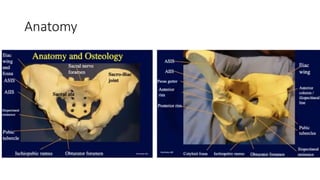
Anatomy
Anatomy
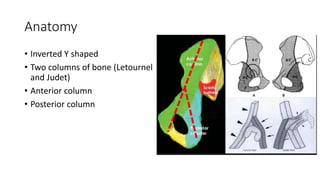
• Inverted Y shaped
• Two columns of bone (Letournel
and Judet)
• Anterior column
• Posterior column
• Anterior Column:
• Iliopubis component
• Posterior Column:
• Ilioischial component
Mechanism of Injury
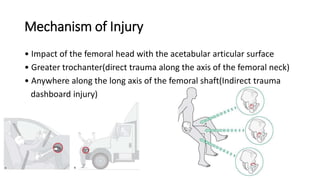
• Impact of the femoral head with the acetabular articular surface
• Greater trochanter(direct trauma along the axis of the femoral neck)
• Anywhere along the long axis of the femoral shaft(Indirect trauma
dashboard injury)
Clinical evaluation
• ATLS protocol- High energy trauma
• Neurovascular assessment:
• Sciatic nerve injury may be present in up to 40% of posterior column disruptions.
• Associated ipsilateral injuries must be ruled out: ipsilateral knee
instability and patellar fractures
• Soft tissue injuries (e.g., abrasions, contusions
subcutaneous hemorrhage)
Imaging
• X-Rays
• Standard AP view
• Judet Views
45 degree obturator oblique view
45 degree iliac oblique view
• Pelvic inlet and outlet view
• CT scan
Radiographic Evaluation
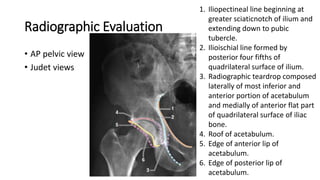
• AP pelvic view
• Judet views
1. Iliopectineal line beginning at
greater sciaticnotch of ilium and
extending down to pubic
tubercle.
2. Ilioischial line formed by
posterior four fifths of
quadrilateral surface of ilium.
3. Radiographic teardrop composed
laterally of most inferior and
anterior portion of acetabulum
and medially of anterior flat part
of quadrilateral surface of iliac
bone.
4. Roof of acetabulum.
5. Edge of anterior lip of
acetabulum.
6. Edge of posterior lip of
acetabulum.
Obturator Oblique View Iliac oblique view
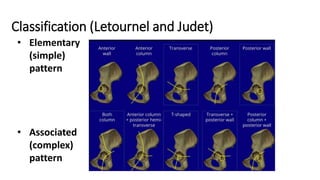
Classification (Letournel and Judet)
• Elementary
(simple)
pattern
• Associated
(complex)
pattern
Things to be considered during Classification
• Iliopectineal line
• Ilioischial line
• Obturator ring
• Ilium involvement
• Spur sign
AP pelvic radiograph
• Iliopectineal line – Anterior Column
• Anterior rim – Anterior
Wall/column
• Ilioischial line – Posterior Column
• Posterior rim – Posterior
wall/column
• Acetabular roof – anterior/
posterior column
• Teardrop
Algorithm
• Ilioischial line
• Iliopectineal line
• Obturator ring
• Ilium involvement
• Spur sign
columns
Transverse
T- shaped
Both column
Obturator ring??
1
2
Obturator ring
column
- Wall fracture
Transverse fracture
T shaped
Ilium??
• Ilium involvement
• Anterior column
• Both column
• Anterior column + Posterior Hemitransverse
Spur sign
3
4
Posterior Wall Fracture
• Involve posterior acetabular rim, which includes the posterior
articular surface
• Quadrilateral plate intact
• Most common fracture mechanism : Dash board injury
• Gull sign
Posterior wall fracture
Posterior column fracture
• Posterior portion of acetabulum
• Fracture line runs through greater sciatic notch and into
ischiopubic ramus
• Superior gluteal neurovascular bundles – trapped in sciatic notch.
Posterior Column fracture
Anterior Wall fracture
Least common type of acetabular fracture
Do not involve obturator foramen
Anterior Column fracture
Anterior column disconnected from sciatic buttress
Fracture line crosses obturator foramen
Transverse fracture
Posterior column posterior Wall fracture
Transverse and posterior Wall fracture
T type fracture
Anterior column fracture with posterior
hemitransverse fracture
Associated Both column fracture
• Weight bearing acetabulum disconnected from sciatic buttress –
Floating Acetabulum
• Columns are separated from each other
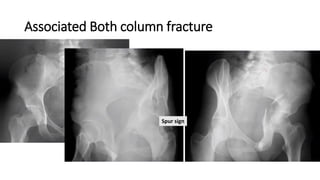
• Spur sign on obturator oblique view
• Secondary congruence
Associated Both column fracture
Spur sign
CT imaging
• Acetabular wall fracture
• Intraarticular fragments
• Marginal impaction
• Comminution
• Femoral head lesions
• Joint congruence
Treatment
Goal
• Anatomic restoration of the articular surface and prevent
posttraumatic arthritis
• Early Mobilization
• Minimise associated complications .
Treatment
Indication of Non operative treatment
1. Non displaced and minimally displaced fracture
• Fracture traversing wt bearing Dome and <2mm displaced –NWBM x 6-12
wks
• Periodic radiograph to ensure no displacement
2. Significant displacement in region of joint that is judged to be
unimportant significantly
• Roof arc measurement ARA- 25 degree, MRA- 45 degree, PRA- 70 degree
Roof Arc Measurement
To find the amount of INTACT
acetabular roof/ weight bearing
dome to decide treatment
1. Medial Roof Arc (AP pelvis)
2. Anterior Roof Arc (Obturator
oblique)
3. Posterior Roof Arc (Iliac
oblique)
According to Matta et al., if any of the roof arc measurements
in a displaced fracture are less than 45 degrees, operative
treatment should be considered.
Treatment
Indication of Non operative treatment
3. Secondary congruency in displaced both column fractures
4. Medical Contraindications to surgery
• Skeletal traction
• Percutaneous fluoroscopic screw fixation
Treatment
Indication of Non operative treatment
5. Local soft tissue problems- Infection, wounds, Morel-Lavallee lesion
6. Elderly patients with osteoperotic bone in whom open reduction
may not be feasible
Treatment
Indications for Operative treatment
1. Fracture characteristics
• >= 2mm displacement
• Roof Arc measurement < 45 degrees
• Fracture subluxation
• Posterior Wall fracture >50% involvement of posterior wall articular surface
2. Incarcerated fragments in acetabulum after CR of hip dislocation
3. Prevention of nonunion and retention of sufficient bone stock for
later reconstructive surgery
Timing of surgery
• Urgent surgical intervention associated with acetabular fracture
• Irreducible hip
• Open fracture
• Vascular compromise
• Neurological deficit
• Ideally ORIF acetabular fracture : 5-7 days of injury (Campbell- 13th
ed)
• Less bleeding
• Anatomical reduction difficult after 5 days in associated and 15 days in
elementary patterns
Surgical approach to acetabulum fracture
• Posterior
• Kocher- Langenbeck approach
• Modified Gibson approach
• Anterior
• Ilioinguinal (lateral, middle, medial
windows)
• Iliofemoral approach
• Stoppa (medial window)/Anterior
intrapelvic approach
• Extensile approach
• Extended iliofemoral approach
• Triradiate approach
No single approach provides ideal exposure of all fracture types.
Proper preoperative classification of the fracture configuration is essential to selecting
the best surgical approach.
Surgical approach to acetabulum fracture
• Posterior Approach
Kocher-Langenbeck Approach
Indications
• Posterior wall fractures
• Posterior column fractures
• Posterior column/posterior wall
fractures
• Juxtatectal/infratectal transverse
or transverse
with posterior wall fractures
• Some T-type fractures
Kocher Langenbeck approach
• Steps
• Superficial dissection
Pitfalls & Challenges
1. Avoid excessive traction.
2. Make sure that the horizontal limb of the incision is not too posterior. This will
help to prevent accidental injury to the sciatic nerve when the fascia is incised
distally.
3. Make sure that the piriformis and conjoined tendons are released from their
trochanteric insertion without compromising the vascular supply of the
femoral head.
4. Dissect very carefully at the supra-acetabular area to avoid injury to the gluteal
neurovascular bundle.
5. Avoid dissection close to the acetabular rim in order to preserve its vascular
supply.
6. Always identify the lesser sciatic notch. This is a safe area for sciatic nerve
retractor placement.
Ilioinguinal Approach: Indication
• Anterior wall acetabular fractures.
• Anterior column acetabular fractures.
• Transverse acetabular fractures with
the major displacement occurring at
the anterior column.
• Both-column acetabular fractures.
• Anterior element reduction and
fixation in T-type acetabular fractures.
• High transverse fracture
Three windows of the ilioinguinal approach
• Lateral to iliopsoas
• Between iliopsoas and
femoral nerves and vessels
• Medial to femoral vessels
Ilioinguinal approach : Complicating factors
• Soft tissue limitations
• Colostomy, suprapubic drainage
• Ex fixator pin tracts, open wounds
• Crush
• Obesity
• Hernia , mesh
Other approaches
• Stoppa approach (supine):
• Allows access to the medial wall
of acetabulum, quadrilateral
surface, & sacroiliac joint,
corona mortis at risk.
• Pfannenstiel incision
• Ligation of corona mortis
• Stoppa window
Iliofemoral approach
• Anterior approach
• Anterior wall fracture
• Anterior column fracture
Modified Gibson approach
• Indication
• Posterior wall
• Posterior column
• Transverse, T type fracture
Extended Iliofemoral approach
• exposes the entire lateral
innominate bone, by posterior
reflection of the abductors, and
reflection of short external
rotators.
• It can be extended anteriorly
into the first (iliac) window of
the ilioinguinal incision.
Extended Iliofemoral approach- Indications
• Transtectal transverse + posterior wall or T-shaped fractures
• Transverse fractures with extended posterior wall
• T-shaped fractures with wide separations of the vertical stem of the
‘T’ or those with associated pubic symphysis dislocations
• Both column fracture
• Associated fracture patterns or transverse
fractures operated on>21 days following injury
highest incidence of ectopic bone formation (HO)
and longest postoperative recovery
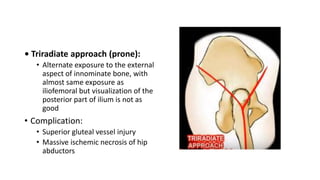
• Triradiate approach (prone):
• Alternate exposure to the external
aspect of innominate bone, with
almost same exposure as
iliofemoral but visualization of the
posterior part of ilium is not as
good
• Complication:
• Superior gluteal vessel injury
• Massive ischemic necrosis of hip
abductors
Fracture fixation
• Plates
• 3.5 mm and 4.5 mm recon plates
• Screws
• 6.5-mm cancellous lag screws with
buttress plate
• 4.0-mm cancellous lag screws and
3.5 mm cortical screws (lengths up
to 120 mm)
• 6.5-mm fully threaded cancellous
screws
Great care should be taken to ensure that screws in the central portion of the plate
do not penetrate the articular cartilage of the acetabulum
Complications
Early:
• Thromboembolism
• Infection
• Neurological injury
• Vascular injury
• Intraarticular hardware
• Malreduction
• Loss of reduction
Late:
• Avascular necrosis
• Heterotopoic ossification
• Pseudoarthrosis
• Post traumatic arthritis
Percutaneous screw fixation
Antegrade Posterior Column screw
• Tragectories
• Pelvic brim to ischial tuberosity
• False pelvis to ischial spine
• Iliac crest to sciatic notch
Percutaneous screw fixation
• Retrograde percutaneous posterior column screw fixation
Percutanous Anterior column screw fixation
• Antegrade
• Bone narrowing at center of
acetabulum and middle of pubis
ramus
• Retrograde
• In out in technique
42 y/F Associated Bicolumnar Fracture
Spur sign
2 yrs follow up
Take Home Messages
• Acetabular fracture is an intraarticular fracture requiring anatomical
reduction, rigid fixation and early mobilization
• Classification of acetabular fracture guide the surgeon for best
approach
• Fracture demanding experts for fixation
Thank You

Acetabular Fracture.pptx

  • 1.
    Acetabular Fracture Sudarshan Pandey 2ndyear Resident Department of Orthopedics and Traumatology, KUSMS
  • 2.
    Table of content •Anatomy • Mechanism of injury • Clinical evaluation • Imaging • Classification • Treatment
  • 3.
  • 5.
    Anatomy • Inverted Yshaped • Two columns of bone (Letournel and Judet) • Anterior column • Posterior column
  • 6.
    • Anterior Column: •Iliopubis component • Posterior Column: • Ilioischial component
  • 8.
    Mechanism of Injury •Impact of the femoral head with the acetabular articular surface • Greater trochanter(direct trauma along the axis of the femoral neck) • Anywhere along the long axis of the femoral shaft(Indirect trauma dashboard injury)
  • 9.
    Clinical evaluation • ATLSprotocol- High energy trauma • Neurovascular assessment: • Sciatic nerve injury may be present in up to 40% of posterior column disruptions. • Associated ipsilateral injuries must be ruled out: ipsilateral knee instability and patellar fractures • Soft tissue injuries (e.g., abrasions, contusions subcutaneous hemorrhage)
  • 10.
    Imaging • X-Rays • StandardAP view • Judet Views 45 degree obturator oblique view 45 degree iliac oblique view • Pelvic inlet and outlet view • CT scan
  • 11.
    Radiographic Evaluation • APpelvic view • Judet views 1. Iliopectineal line beginning at greater sciaticnotch of ilium and extending down to pubic tubercle. 2. Ilioischial line formed by posterior four fifths of quadrilateral surface of ilium. 3. Radiographic teardrop composed laterally of most inferior and anterior portion of acetabulum and medially of anterior flat part of quadrilateral surface of iliac bone. 4. Roof of acetabulum. 5. Edge of anterior lip of acetabulum. 6. Edge of posterior lip of acetabulum.
  • 12.
    Obturator Oblique ViewIliac oblique view
  • 14.
    Classification (Letournel andJudet) • Elementary (simple) pattern • Associated (complex) pattern
  • 15.
    Things to beconsidered during Classification • Iliopectineal line • Ilioischial line • Obturator ring • Ilium involvement • Spur sign
  • 16.
    AP pelvic radiograph •Iliopectineal line – Anterior Column • Anterior rim – Anterior Wall/column • Ilioischial line – Posterior Column • Posterior rim – Posterior wall/column • Acetabular roof – anterior/ posterior column • Teardrop
  • 17.
    Algorithm • Ilioischial line •Iliopectineal line • Obturator ring • Ilium involvement • Spur sign columns Transverse T- shaped Both column Obturator ring?? 1 2
  • 18.
    Obturator ring column - Wallfracture Transverse fracture T shaped
  • 19.
    Ilium?? • Ilium involvement •Anterior column • Both column • Anterior column + Posterior Hemitransverse Spur sign 3 4
  • 20.
    Posterior Wall Fracture •Involve posterior acetabular rim, which includes the posterior articular surface • Quadrilateral plate intact • Most common fracture mechanism : Dash board injury • Gull sign
  • 21.
  • 23.
    Posterior column fracture •Posterior portion of acetabulum • Fracture line runs through greater sciatic notch and into ischiopubic ramus • Superior gluteal neurovascular bundles – trapped in sciatic notch.
  • 24.
  • 25.
    Anterior Wall fracture Leastcommon type of acetabular fracture Do not involve obturator foramen
  • 26.
    Anterior Column fracture Anteriorcolumn disconnected from sciatic buttress Fracture line crosses obturator foramen
  • 27.
  • 28.
  • 29.
  • 31.
  • 33.
    Anterior column fracturewith posterior hemitransverse fracture
  • 34.
    Associated Both columnfracture • Weight bearing acetabulum disconnected from sciatic buttress – Floating Acetabulum • Columns are separated from each other • Spur sign on obturator oblique view • Secondary congruence
  • 35.
    Associated Both columnfracture Spur sign
  • 36.
    CT imaging • Acetabularwall fracture • Intraarticular fragments • Marginal impaction • Comminution • Femoral head lesions • Joint congruence
  • 38.
    Treatment Goal • Anatomic restorationof the articular surface and prevent posttraumatic arthritis • Early Mobilization • Minimise associated complications .
  • 39.
    Treatment Indication of Nonoperative treatment 1. Non displaced and minimally displaced fracture • Fracture traversing wt bearing Dome and <2mm displaced –NWBM x 6-12 wks • Periodic radiograph to ensure no displacement 2. Significant displacement in region of joint that is judged to be unimportant significantly • Roof arc measurement ARA- 25 degree, MRA- 45 degree, PRA- 70 degree
  • 40.
    Roof Arc Measurement Tofind the amount of INTACT acetabular roof/ weight bearing dome to decide treatment 1. Medial Roof Arc (AP pelvis) 2. Anterior Roof Arc (Obturator oblique) 3. Posterior Roof Arc (Iliac oblique) According to Matta et al., if any of the roof arc measurements in a displaced fracture are less than 45 degrees, operative treatment should be considered.
  • 41.
    Treatment Indication of Nonoperative treatment 3. Secondary congruency in displaced both column fractures 4. Medical Contraindications to surgery • Skeletal traction • Percutaneous fluoroscopic screw fixation
  • 42.
    Treatment Indication of Nonoperative treatment 5. Local soft tissue problems- Infection, wounds, Morel-Lavallee lesion 6. Elderly patients with osteoperotic bone in whom open reduction may not be feasible
  • 43.
    Treatment Indications for Operativetreatment 1. Fracture characteristics • >= 2mm displacement • Roof Arc measurement < 45 degrees • Fracture subluxation • Posterior Wall fracture >50% involvement of posterior wall articular surface 2. Incarcerated fragments in acetabulum after CR of hip dislocation 3. Prevention of nonunion and retention of sufficient bone stock for later reconstructive surgery
  • 44.
    Timing of surgery •Urgent surgical intervention associated with acetabular fracture • Irreducible hip • Open fracture • Vascular compromise • Neurological deficit • Ideally ORIF acetabular fracture : 5-7 days of injury (Campbell- 13th ed) • Less bleeding • Anatomical reduction difficult after 5 days in associated and 15 days in elementary patterns
  • 45.
    Surgical approach toacetabulum fracture • Posterior • Kocher- Langenbeck approach • Modified Gibson approach • Anterior • Ilioinguinal (lateral, middle, medial windows) • Iliofemoral approach • Stoppa (medial window)/Anterior intrapelvic approach • Extensile approach • Extended iliofemoral approach • Triradiate approach No single approach provides ideal exposure of all fracture types. Proper preoperative classification of the fracture configuration is essential to selecting the best surgical approach.
  • 46.
    Surgical approach toacetabulum fracture • Posterior Approach
  • 47.
    Kocher-Langenbeck Approach Indications • Posteriorwall fractures • Posterior column fractures • Posterior column/posterior wall fractures • Juxtatectal/infratectal transverse or transverse with posterior wall fractures • Some T-type fractures
  • 49.
  • 50.
  • 53.
    Pitfalls & Challenges 1.Avoid excessive traction. 2. Make sure that the horizontal limb of the incision is not too posterior. This will help to prevent accidental injury to the sciatic nerve when the fascia is incised distally. 3. Make sure that the piriformis and conjoined tendons are released from their trochanteric insertion without compromising the vascular supply of the femoral head. 4. Dissect very carefully at the supra-acetabular area to avoid injury to the gluteal neurovascular bundle. 5. Avoid dissection close to the acetabular rim in order to preserve its vascular supply. 6. Always identify the lesser sciatic notch. This is a safe area for sciatic nerve retractor placement.
  • 54.
    Ilioinguinal Approach: Indication •Anterior wall acetabular fractures. • Anterior column acetabular fractures. • Transverse acetabular fractures with the major displacement occurring at the anterior column. • Both-column acetabular fractures. • Anterior element reduction and fixation in T-type acetabular fractures. • High transverse fracture
  • 55.
    Three windows ofthe ilioinguinal approach • Lateral to iliopsoas • Between iliopsoas and femoral nerves and vessels • Medial to femoral vessels
  • 56.
    Ilioinguinal approach :Complicating factors • Soft tissue limitations • Colostomy, suprapubic drainage • Ex fixator pin tracts, open wounds • Crush • Obesity • Hernia , mesh
  • 57.
    Other approaches • Stoppaapproach (supine): • Allows access to the medial wall of acetabulum, quadrilateral surface, & sacroiliac joint, corona mortis at risk.
  • 58.
    • Pfannenstiel incision •Ligation of corona mortis • Stoppa window
  • 59.
    Iliofemoral approach • Anteriorapproach • Anterior wall fracture • Anterior column fracture
  • 60.
    Modified Gibson approach •Indication • Posterior wall • Posterior column • Transverse, T type fracture
  • 61.
    Extended Iliofemoral approach •exposes the entire lateral innominate bone, by posterior reflection of the abductors, and reflection of short external rotators. • It can be extended anteriorly into the first (iliac) window of the ilioinguinal incision.
  • 62.
    Extended Iliofemoral approach-Indications • Transtectal transverse + posterior wall or T-shaped fractures • Transverse fractures with extended posterior wall • T-shaped fractures with wide separations of the vertical stem of the ‘T’ or those with associated pubic symphysis dislocations • Both column fracture • Associated fracture patterns or transverse fractures operated on>21 days following injury highest incidence of ectopic bone formation (HO) and longest postoperative recovery
  • 63.
    • Triradiate approach(prone): • Alternate exposure to the external aspect of innominate bone, with almost same exposure as iliofemoral but visualization of the posterior part of ilium is not as good • Complication: • Superior gluteal vessel injury • Massive ischemic necrosis of hip abductors
  • 64.
    Fracture fixation • Plates •3.5 mm and 4.5 mm recon plates • Screws • 6.5-mm cancellous lag screws with buttress plate • 4.0-mm cancellous lag screws and 3.5 mm cortical screws (lengths up to 120 mm) • 6.5-mm fully threaded cancellous screws Great care should be taken to ensure that screws in the central portion of the plate do not penetrate the articular cartilage of the acetabulum
  • 65.
    Complications Early: • Thromboembolism • Infection •Neurological injury • Vascular injury • Intraarticular hardware • Malreduction • Loss of reduction Late: • Avascular necrosis • Heterotopoic ossification • Pseudoarthrosis • Post traumatic arthritis
  • 66.
    Percutaneous screw fixation AntegradePosterior Column screw • Tragectories • Pelvic brim to ischial tuberosity • False pelvis to ischial spine • Iliac crest to sciatic notch
  • 68.
    Percutaneous screw fixation •Retrograde percutaneous posterior column screw fixation
  • 69.
    Percutanous Anterior columnscrew fixation • Antegrade • Bone narrowing at center of acetabulum and middle of pubis ramus • Retrograde • In out in technique
  • 70.
    42 y/F AssociatedBicolumnar Fracture Spur sign
  • 73.
  • 74.
    Take Home Messages •Acetabular fracture is an intraarticular fracture requiring anatomical reduction, rigid fixation and early mobilization • Classification of acetabular fracture guide the surgeon for best approach • Fracture demanding experts for fixation
  • 75.

Editor's Notes

  • #6 incomplete hemispherical socket with an inverted horseshoe-shaped articular surface surrounding the nonarticular cotyloid fossa
  • #8 Clinical anatomy showing neurovascular relation in pelvis . I would like to emphasize in corona mortise
  • #12 So what to look in X ray There are 6 lines that has to be considered for the classification of the fracture and hence guide the management and surgical approach.
  • #13 obturator oblique view is seen With 45 degree int rotation of pelvis that is affected side is up
  • #14 No change in classification since 1964 based on 3 radiographic views
  • #21 Postero superior- part of roof separated Post inf – confined below roof , detached frag inf horn of articular surface, sub cotyloid groove and superior ischium
  • #38 Column fracture has transverse orientation Transverse fracture AP orientation Accurate interpretation of radiograph and classification of fracture determines the surgical approach to acetabulum
  • #41 angle between vertical line through femoral head and line through fracture helps to define fracture pattern stability
  • #44 In cases of extreme deformity , THR
  • #45 Anatomical reduction difficult after a week coz hematoma organizn, soft tissue contracture, early callus hinders
  • #48 Here the structure shown in blue color are directly visualized through kl approach Medial aspect of acetabular fossa is quadrilateral plate that can be palpated by finger insunating from greater sciatic notch
  • #51 3. Superficial surgical dissection The gluteus maximus muscle (using scissors) The iliotibial tract (using a scalpel) Detach the gluteus maximus 1 cm from its insertion into the gluteal tuberosity of the femur. 4 Detach the external rotator muscles
  • #53 5. Expose posterior wall and column 6. Quadratus femoris elevation for additional caudal exposure
  • #56  adv: hip abductor musculature is left undisturbed and rapid post op rehab possible Dis : articular surface of acetabulum is not exposed
  • #60 Incision middle of iliac crest , ant to asis and distally along medial border of Sartorius to medial 3rd of thigh
  • #61 longitudinal incision beginning at the iliac crest, continuing it over the greater trochanter and down the lateral thigh as far as necessary
  • #62 Designed to allow later reconstructive procedures Provides exposure for repair of complex and both column fractures
  • #67 Posterior column corridor
  • #68 Obturator oblique view in side ischium Iliac oblique to confirm outside joint
  • #71 Bicolumnar fracture – high and middle ant column fracture with pregnancy at 18 wog
  • #73 2 LC ii screw to fix high ant column fracture extending to post column Along with ant column and wall fixation