Dr . Rafeevudh Dharaja
BENIGN BONE TUMORS – AN
APPROACH
‫الرحيم‬ ‫الرحمن‬ ‫هللا‬ ‫بسم‬
Bone-forming tumors
• Osteoid osteoma
• Osteoblastoma
Cartilage-forming
tumors
• Osteochondroma
• Chondroma
• Chondroblastoma
• Chondromyxoid fibroma
Fibrous lesions
• Fibrous dysplasia
• Ossifying fibroma
• Nonossifying fibroma
Cystic and vascular
lesions
• Unicameral bone cyst
• Aneurysmal bone cyst
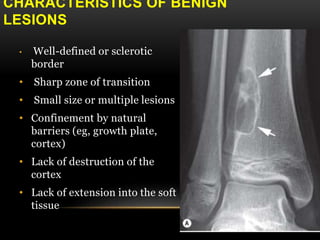
CHARACTERISTICS OF BENIGN
LESIONS
• Well-defined or sclerotic
border
• Sharp zone of transition
• Small size or multiple lesions
• Confinement by natural
barriers (eg, growth plate,
cortex)
• Lack of destruction of the
cortex
• Lack of extension into the soft
tissue
APPROACH
Age at Presentation
• Primary bone tumours are rare below the age of 5 years and
over the age of 40 years.
• Osteoid osteoma
• Osteobastoma
• Enchondroma
• Chondroblastoma- teenage
• Chonromyxoid fibroma
• ABC
• FD – before 30 yrs
•
• Solitary or multiple?
• Which bone affected? e.g.
long bone vs. spine
• Where is the lesion in the
bone?
• Well-defined margins?
• Cortical destruction?
• Bony reaction?
• Central calcification?
• Look also at the soft tissues.
• Enchondromatosis
• FD
• Adamantinoma
KEY QUESTIONS TO ASK OURSELVES
• Posterior elements of
spine - Osteoblatoma-
• Metacarpals and
phalanges -
Enchonromatosis -
• Calcaneum -
Interosseous lipoma-
• Humerus - Simple bone
cyst
• Tibial anterior cortex-
adamantinoma
• Epiphysis – chondroblastoma
• Metaphysis – CMF, ABC
• Diaphsis – LCH, SBC
• Medullary cavity – enchondroma
CMF, FD
• Surface of cortex - periosteal
chondroma
• Cortex- fibrous cortical defect
• Solitary or multiple?
• What type of bone, e.g. long bone vs. spine vs.
ribs?
• Where is the lesion in the bone?
• Well-defined margins?
• Cortical destruction?
• Bony reaction?
• Central calcification?
• Look also at the soft tissues.
Lesion margin
• In benign and low-grade
malignant neoplasms, this
margin is sharp -
geographical; Type 1
Type 1A has a rim
of sclerosis between the lesion
and the host bone
Type 1B is a very
well defined lytic lesion but
with no marginal sclerosis
Type 1C has a
slightly less sharp, nonsclerotic
margin
Type 2 - moth-eaten
destruction, characterised by
multiple lucent areas measuring
2–5 mm in diameter separated
by bone which has yet to be
destroyed Moth-eaten- caused
by the coalescence of multiple
small lytic areas.
Type 3 - is permeative
destruction, which is the most
aggressive pattern - composed
of multiple coalescing small ill-
defined lesions of 1 mm or less
in diameter with a zone of
transition of several centimetres
AP radiograph of the ilium reveals
the classic moth-hole appearance
(arrows) of moth-eaten destruction
AP radiograph of the ilium shows
the typical diffuse, ill-defined
appearance of permeative
destruction.
• Solitary or multiple?
• What type of bone, e.g. long bone vs. spine vs. ribs?
• Where is the lesion in the bone?
• Well-defined margins?
• Trabeculated?
• What type of matrix ?
• Cortical destruction?
• Bony reaction?
• Central calcification?
• Look also at the soft tissues.
Matrix Mineralisation
• Chondral calcifications are
typically linear, curvilinear,
ring-like, punctate or nodular
• Osseous mineralisation is
cloudlike and poorly defined
• Diffuse matrix mineralisation
in benign fibrous tumours
produces the characteristic
‘ground-glass’ appearance
Typical punctate chondral
calcification in grade 11
chondrosarcoma
‘cloud-like’ osseous
mineralisation in patient with
osteoblastic osteosarcoma
Fibrous dysplasia showing
typical ‘ground-glass’
mineralisation
• Solitary or multiple?
• What type of bone, e.g. long bone
vs. spine vs. ribs?
• Where is the lesion in the bone?
• Well-defined margins?
• Trabeculated?
• Cortical destruction?
• Bony reaction?
• Central calcification?
• Look also at the soft tissues.
• GCT
• CMF
• ABC
• NOF
GCT
• Solitary or multiple?
• What type of bone, e.g. long bone vs. spine vs. ribs?
• Where is the lesion in the bone?
• Well-defined margins?
• Cortical destruction?
• Bony reaction?
• Central calcification?
• Look also at the soft tissues.
Periosteal Reaction
• Solid periosteal reaction -
slow rate of growth but not
necessarily a benign
tumour- OO,
chondroblastoma
• Laminated periosteal
reaction - subperiosteal
extension of tumour,
infection or haematoma.
Lesions demonstrating
periodic growth may show a
multi-laminated pattern
• Solitary or multiple?
• What type of bone, e.g.
long bone vs. spine vs. ribs?
• Where is the lesion in the
bone?
• Well-defined margins?
• Cortical destruction?
• Bony reaction?
• Central calcification/ lytic
nidus
• soft tissue reaction?
• Osteoid osteoma
• osteoblastoma
• Chondroblastoma
PLAIN RADIOGRAPHS
• Best initial modality
• Should include views in 2
planes
• 80 – 90 % of cases can be
diagnosed
• Advanced imaging should
not be necessary for clearly
benign lesions
In other places
FOR BONE LESIONS
Further imaging essential if malignancy a possibility:
• Bone scan will identify other lesions.
• CT identifies bony architecture.
• MRI gives invaluable soft tissue and bony
information, particularly tumour extent.
Cartilage tumours Osteochondroma
Chondroma
Enchondroma
Periosteal chondromas
Multiple chondromatosis
Chondroblastoma
Chondromyxoid fibroma
CARTILAGE TUMOURS
Osteochondroma
Age
• Highest incidence is in the second decade.
Location
• Long bones are commonly affected, especially around
the knee (~40%)
• Commonest locations - distal femur, proximal
humerus, proximal tibia and proximal femur.
• The commonest flat bones affected are the ilium and
scapula
• Continuity between the
medullary cavity of the lesion and
that of the underlying bone is
essential for the diagnosis
• Cartilage cap is optimally
demonstrated on axial proton
density-weighted (PDW) or T2W
fast spin-echo (FSE) MRI
• It should not exceed 2-cm
thickness in adults
• Outgrowth from the
normal cortex, with
which it is
continuous
• Pedunculated lesions
have a long slim neck
• Sessile lesions have a
broad base from the
bone of origin
Diaphyseal aclasis:
• Hereditary multiple
exostoses,HME
• Uncommon autosomal
dominant disorder
• Exostoses may be larger
than the solitary variety
• The metaphyses in this
condition are also typically
widened and dysplastic
Complications:
• Bursa formation
• Neurovascular compromise
• Pseudoaneurysm
ENCHONDROMA
• Intramedullary neoplasm comprising lobules of benign
hyaline cartilage
• Enchondromas affect the tubular bones of the hands and
feet in 40–65% of cases
• Proximal phalanges (40–50%),
• Followed by the metacarpals (15–30%) and
• Middle phalanges (20–30%).
Patients present due to
• Increasing size
• Pathological fracture
• Or incidental finding
RADIOLOGICAL FEATURES
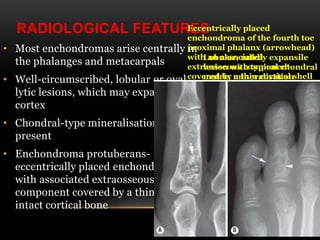
• Most enchondromas arise centrally in
the phalanges and metacarpals
• Well-circumscribed, lobular or oval
lytic lesions, which may expand the
cortex
• Chondral-type mineralisationmay be
present
• Enchondroma protuberans-
eccentrically placed enchondroma
with associated extraosseous
component covered by a thin shell of
intact cortical bone
Lobular, mildly expansile
lesion with typical chondral
matrix mineralisation
Eccentrically placed
enchondroma of the fourth toe
proximal phalanx (arrowhead)
with an associated
extraosseous component
covered by a thin cortical shell
Large enchondroma or a grade
1 chondrosarcoma??
• Lesion size above 5–6 cm and
deep endosteal scalloping are
suggestive of chondrosarcoma
Low-grade chondral tumours-
MRI features
• Lobular margin with
intermediate T1-weighted signal
intensity
• T2-weighted-hyperintensity
without surrounding reactive
oedema
ENCHONDROMATOSIS
Multiple enchondromas, with expansion of the proximal right femur
Maffucci’s Syndrome
• Multiple enchondromas and soft-tissue
haemangiomas
CHONDROBLASTOMA
• Between the ages of 5 and 25 years (mean age ~20 years).
Location
• Around knee
• Proximal humerus
• Proximal femur
• Eccentrically in the epiphysis (40%), but with partial
closure of the growth plate it usually extends into the
metaphysis (55%)
• Commonest tumour of the patella
• Presents as monoarthropathy, since it is typically located in
the epiphysis of a long bone,
Radiological Features
• Lobular with a fine sclerotic
margin, measuring 1–4 cm
in size
• Matrix mineralisation is
demonstrated in ~30%
• Linear metaphyseal
periosteal reaction is
present in almost 60% of
long bone cases
• MRI shows
intermediate T1W SI
• Variable SI on T2W
images
• Associated marrow
and soft-tissue
oedema and reactive
joint effusion
• Rarely associated with metastases (especially to the
lung)
• Rare variant termed ‘aggressive’ (atypical)
chondroblastoma, associated with cortical
destruction and soft-tissue extension
CHONDROMYXOID FIBROMA
• Between 10 and 30 years of age (mean age 25 years).
• Long bones -60% of cases,
• 40% arising in the flat bones (ilium 10%) or
• Small tubular bones of the hands and feet (17%).
25% of all chondromyxoid fibromas- upper
third of the tibia
• Diagnosis – mainly
depends on location
• In the proximal tibia
eccentric, lobular
bubbly lesion with a
sclerotic margin
RADIOLOGICAL FEATURES
Eccentric lytic lesion with a
sclerotic margin and expansion
of the anterior cortex.
Osteogenic tumours Osteoid osteoma
Osteoblastoma
OSTEOGENIC TUMOURS
Osteoid Osteoma (OO)
• Characteristic clinical picture of night pain relieved
by aspirin
• Second and third decades of life
• Occurs anywhere in appendicular skeleton
• Most common in the appendicular skeleton, with
over 50% located in the diaphysis or metaphysis of
the tibia or femur
• The characteristic feature of OO is
the nidus, which may appear lytic,
sclerotic or most commonly of
mixed density depending upon the
degree of central mineralisation.
• Nidus measures up to 15 mm in
diameter and is commonly
surrounded by a region of reactive
medullary sclerosis and solid
periosteal reaction.
• CT demonstrates the
classical features of a
round or oval soft-
tissue density nidus,
which commonly shows
central dense
mineralisation
• Vascular groove sign -
thin, serpentine
channels in the
thickened bone
surrounding the nidus
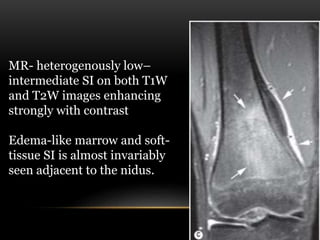
MR- heterogenously low–
intermediate SI on both T1W
and T2W images enhancing
strongly with contrast
Edema-like marrow and soft-
tissue SI is almost invariably
seen adjacent to the nidus.
• Intra-articular lesions are most commonly seen in the hip
• Present with local osteopenia due to disuse
• Soft-tissue oedema-like changes and a joint effusion
• In the ankle and foot -
subperiosteal region of
the talar neck is a
classical site
OSTEOBLASTOMA
• Histological similarities to OO and is differentiated
primarily by its size, greater than 1.5 cm in diameter.
• More aggressive growth pattern with potential for
extraosseous extension, and does not resolve
spontaneously.
• Under the age of 30 years
• Common location is the posterior column of the spine
• Tumors in the spine may be difficult to identify on plain
radiographs
• Humerus is the commonest location in the appendicular
skeleton
• The lesion arises in the medullary cavity
RADIOLOGICAL FEATURES
• Predominantly lytic lesions
measuring over 2 cm in diameter
• Larger lesions showing a greater
degree of matrix mineralisation
• CT – occult calcification, which
can be punctate, nodular or
generalised
• Larger lesions may result in bone
expansion
• MRI - low–intermediate SI
lesion with associated reactive
changes as seen with OO, but of a
lesser intensity
Large mixed lytic-sclerotic
lesion in the medullary cavity
with associated periosteal
thickening
Fibrogenic tumours Desmoplastic fibroma
Fibrohistiocytic tumour
Benign fibrous hystiocytoma
Fibrous cortical defect
Non ossifying fibroma
FIBROGENIC TUMOURS
Desmoplastic Fibroma
• Rare, locally aggressive benign neoplasm
• Similar histological features to soft-tissue fibromatosis.
• Between 10 and 30 years of age (mean age 21 years)
• Usually arises in the metaphyseal region of long bones
(femur, humerus, tibia and radius constitute 56% of
cases), the mandible (26%) and ilium (14%)
• Rarely associated with fibrous dysplasia
RADIOLOGICAL FEATURES
• Most lesions are metadiaphyseal and arise as either
subperiosteal or intraosseous tumours.
• Many are large at presentation (over 5 cm in
diameter)
• Two patterns are seen:
an ill-defined moth-eaten or permeative lesion
an expanding, trabeculated lesion
Expansile aggressive
metaphyseal
lesion
FIBROHISTIOCYTIC TUMOURS
• Fibrous cortical defect,
• Non-ossifying fibroma and
• Benign fibrous histiocytoma
Identical histological appearances
Different in their clinical and radiological
features.
• As an incidental
finding, in the distal
femoral and proximal
tibial metaphyses
• Cortically based lytic
lesion commonly with
a thin sclerotic margin
• Consolidates/fades
with time
FIBROUS CORTICAL DEFECT
• Commonly identified
incidentally
• May present with
pathological fracture when
large enough
• In the second decade of life
• Majority involve the lower
limbs, particularly the tibia
and distal end of the femur
NON-OSSIFYING FIBROMA
Lobular lesion (arrows)
expanding the distal fibular
metadiaphysis
Axial PDW FSE and coronal T2W FSE
MR images showing a lobular lesion
(arrows) containing prominent areas of
hypointensity due to its fibrous nature.
Jaffe–Campanacci syndrome
• Multiple (usually unilateral) NOFs with
café-au-lait spots
Radiological
Features
• Metaphyseal or diametaphyseal and
essentially intracortical
• Lobular appearance is classical
• Lesion usually enlarging into the
medullary cavity.
• Long axis in the line of the bone
• When NOF arises in a slim bone such
as the fibula, it crosses the shaft
readily and its characteristic
intracortical origin is less obvious
• Low–intermediate SI on T1W and
PDW images and enhances with
contrast
BENIGN FIBROUS
HISTIOCYTOMA
• Uncommon lesion occurring in an older age group
• Between 20 and 50 years, with a mean age in the
third decade
Radiological Features
• Lesion resembles a giant cell tumour
• Eccentric subarticular location, but with a well-
defined sclerotic margin indicating slower growth
Giant cell tumour Giant cell tumour
Vascular tumours Haemangioma
Smooth muscle tumours Leiomyoma
Lipogenic tumours Lipoma
Neural tumours Neurilemmoma
GIANT CELL TUMOUR
• Aggressive benign neoplasm
• Between 18 and 45 years of age
• Always occurs in a subarticular or
subcortical region
• Adjacent to a fused apophysis of a long
bone - with the knee (distal
femur/proximal tibia—55%), distal
radius (10%) and proximal humerus
(6%) being the commonest sites.
RADIOLOGICAL FEATURES
• Subarticular, eccentric, lytic
lesion with a geographic, non-
sclerotic margin
• Usually measures 5–7 cm in size.
• Apparent trabeculation and
cortical expansion are common
features
• Cortical destruction with
extraosseous extension may
occur in up to 50%
Distal radial subarticular
lytic lesion (arrows) with
internal trabeculation
Eccentric, subarticular lytic lesion of
the proximal tibia with a poorly
defined margin (arrows) and
destruction of the lateral cortex.
• Iso- or hypointense on T1W
Images heterogeneous
hyperintensity on STIR
• Areas of hyperintensity on T1W
indicate the presence of subacute
haemorrhage
• Profound hypointensity on T2W
images due to the deposition of
haemosiderin from chronic
recurrent haemorrhage
Sagittal T1W
Important DDs
• Lytic osteosarcoma
• In older patients, malignant fibrous histiocytoma or
• Subarticular lytic metastasis, particularly from a primary renal
tumour.
VASCULAR TUMOURS
Haemangioma
Haemangiomas are classified histologically as
• Capillary,
• Cavernous,
• Arteriovenous or
• Venous
• Osseous capillary haemangiomas most commonly affect the
vertebral body
• Osseous cavernous haemangiomas affect the skull vault
• Involvement of the appendicular skeleton is relatively rare
RADIOLOGICAL FEATURES
• Fine or coarse vertical
trabeculation is seen
involving the epiphyses
and metaphyses of long
bones, with the direction
of the linear striations
running along the axis of
the bone
• Bone expansion and
extraosseous extension
are also recognised
features
• Scintigraphy typically
shows triple-phase
uptake due to the
vascular nature of the
lesion.
Expansile lytic lesion
(arrows) containing
coarse trabeculation.
• CT demonstrates the
thickened trabeculae as
dense ‘dots’ within a fatty
matrix
• MRI - intermediate SI on
T1W and hyperintense on
T2W
Poorly defined lytic lesion
containing multiple,
dense thickened
trabeculae
• Intraosseous Lipoma
• Parosteal Lipoma
Intraosseous Lipoma
• Arises in the medulla and
produces expansion,
• Predilection for the
calcaneus and femur
• CT and MRI demostrates
fatty nature of the matrix
LIPOGENIC
TUMOURS
well-defined lytic lesion
(arrows) in the calcaneal
body
Parosteal Lipoma
• Rare lesion- most
frequently
encountered around
the proximal radius
• May result in pressure
erosion of the bone
and the formation of
circumferential
juxtacortical new
bone.
Axial CT of the elbow showing
a fatty mass (arrows) arising in
association with a parosteal
bony lesion (arrowhead) from
the proximal radius
Miscellaneous lesions Aneurysmal bone cyst
Bone cyst
Fibrous dysplasia
Osteofibrous dysplasia
Langerhans cell histiocytosis
(eosinophilic granuloma)
Erdheim–Chester disease
Chest wall hamartoma
ANEURYSMAL BONE CYST
• Between 5 and 20 years of age
• Long bones (>50% of cases) and spine (20% of cases)
are most common
• Involvement of flat bones is most common in the
pelvis.
• Secondary ABC change can develop in non-ossifying
fibroma, chondroblastoma, giant cell tumour, fibrous
dysplasia, osteoblastoma and osteosarcoma.
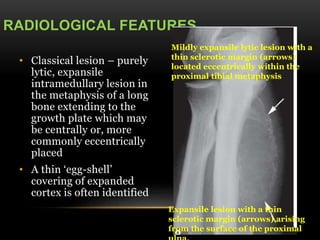
RADIOLOGICAL FEATURES
• Classical lesion – purely
lytic, expansile
intramedullary lesion in
the metaphysis of a long
bone extending to the
growth plate which may
be centrally or, more
commonly eccentrically
placed
• A thin ‘egg-shell’
covering of expanded
cortex is often identified
Mildly expansile lytic lesion with a
thin sclerotic margin (arrows)
located eccentrically within the
proximal tibial metaphysis
Expansile lesion with a thin
sclerotic margin (arrows) arising
from the surface of the proximal
• Heterogeneous intermediate
SI on T1W images with
internal hypointense internal
septa may be seen, which may
enhance following
administration of gadolinium
contrast medium
• T2 or PDW images almost
invariably demonstrate
multiple FFLs
• Most important differential
diagnosis of ABC is
telangiectatic osteosarcoma.
• Between the ages of 5 and 15
years
• Presentation with pathological
fracture is classical, especially
with humeral lesions.
Location
• Proximal humerus – most
common
• Proximal femur – next
common
Other sites in adults
• Calcaneus and
• Posterior iiac blade
SIMPLE BONE CYST
Radiological Features
• Initially, SBCs are located in the
proximal metaphysis of the
humerus or femur and progress
toward the diaphysis with
skeletal growth, eventually
reaching the middiaphysis
• Usually lies centrally in the
shaft, expanding the bone
symmetrically and thinning the
cortex.
• The lesion is typically 6–8 cm in
size.
• Apparent trabeculation is
common, but periosteal reaction
is not seen without fracture,
• Fracture may result in fragment
of cortex penetrating the cyst
lining, resulting in the fallen
fragment sign
MRI
• T1W images - low-to-intermediate SI
• Marked hyperintensity on T2W or
STIR images
• These appearances are altered by the
presence of fracture, in which case
haemorrhage may result in the
presence of FFLs and pericystic
oedema
Major differential diagnosis
• ABC and
• Fibrous dysplasia.
• Usually painless
• Usually before the age of 30
years
• Commonest sites – monostotic
FD – ribs, proximal femur ,
craniofacial bones
• FD may be associated with a
variety of syndromes
• Portions of bone replaced by
fibrous connective tissue and
poorly formed trabecular bone
Monoostotic
• 70 to 85%
Polyostotic
• Invt of 2 bones to
more than 75%
skeleton
FIBROUS DYSPLASIA
McCune–Albright’s syndrome –
• Polyostotic FD (typically unilateral)
• Ipsilateral café au lait spots and
• Endocrine disturbance, most commonly precocious
puberty in girls
Mazabraud’s syndrome -
• FD (most commonly polyostotic) and soft-tissue
myxomata.
Radiological Features
• Geographic lesion that may
cause bone expansion and
deformity with diffuse ground-
glass matrix mineralisation
• A thick sclerotic margin (‘rind’
sign) is characteristic
• Varus deformity of the proximal
femur (‘shepherd’s crook’
deformity) is a characteristic late
finding.
• Skeletal scintigraphy is the
best technique for
identifying polyostotic
disease
• CT beautifully demonstrates
the ground-glass matrix
MRI - isointense on
T1W
intermediate SI or
hyperintense on T2W,
LANGERHANS CELL HISTIOCYTOSIS
(LCH)
• Spectrum of disorders characterised by the idiopathic
proliferation of histiocytes (Langerhans cells), which
can involve virtually any organ and present either as
focal/multifocal lesions
Three forms of the disease
• Eosinophilic granuloma,
• Letterer–Siwe disease
• Hand–Schüller–Christian disease,
• Between the ages of 5 and 15 years
Location
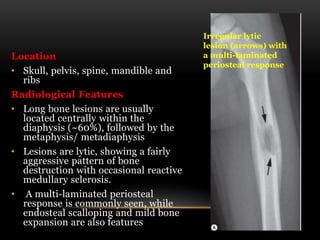
• Skull, pelvis, spine, mandible and
ribs
Radiological Features
• Long bone lesions are usually
located centrally within the
diaphysis (~60%), followed by the
metaphysis/ metadiaphysis
• Lesions are lytic, showing a fairly
aggressive pattern of bone
destruction with occasional reactive
medullary sclerosis.
• A multi-laminated periosteal
response is commonly seen, while
endosteal scalloping and mild bone
expansion are also features
Irregular lytic
lesion (arrows) with
a multi-laminated
periosteal response
BONE ISLAND
• A bone island consists of well-differentiated mature bone tissue within the
marrow
• Also referred to as enostosis
• Usually it is seen as a coincidental finding.
• In patients with breast- or prostate cancer a bone island can be mistaken
for an osteoblastic metastasis.
• A bone island normally does not show increased uptake on a bone scan
Small lytic lesion
within the mid
tibial diaphysis.
LANGERHANS-CELL HISTIOCYTOSIS
MAFUCCIS’S SYNDROME- HEMANGIOMA AND MULTIPLE
ENCHONDROMATOSIS
OSTEOCHONDROMA
POLYOSTOTIC FIBROUS DYSPLASIA
• :TYPICAL GROUND GLASS APPEARANCE.
significant expansion of the mid-diaphysis of the tibia and fibula, with the
characteristic ground glass appearance to
the matrix of the fibrous dysplastic lesions.
ANEURYSMAL BONE CYST
• Expansile lytic lesion with
a thin sclerotic margin
located centrally in the
metadiaphysis of distal left
tibia and extending to the
physis. There are subtle
internal septations
ANEURYSMAL BONE CYST
SIMPLE BONE CYST
ENCHONDRO
MA
• Lytic geographic lesion with expansion and chondroid
matrix (arrows) are seen on this radiograph of the
proximal phalanx of the index finger.
• Distal femur readily shows the coarse dot-like,
popcorn-like mineralization of chondroid matrix.
Benign  bone tumors  an approach

Benign bone tumors an approach

  • 1.
    Dr . RafeevudhDharaja BENIGN BONE TUMORS – AN APPROACH ‫الرحيم‬ ‫الرحمن‬ ‫هللا‬ ‫بسم‬
  • 2.
    Bone-forming tumors • Osteoidosteoma • Osteoblastoma Cartilage-forming tumors • Osteochondroma • Chondroma • Chondroblastoma • Chondromyxoid fibroma Fibrous lesions • Fibrous dysplasia • Ossifying fibroma • Nonossifying fibroma Cystic and vascular lesions • Unicameral bone cyst • Aneurysmal bone cyst
  • 3.
    CHARACTERISTICS OF BENIGN LESIONS •Well-defined or sclerotic border • Sharp zone of transition • Small size or multiple lesions • Confinement by natural barriers (eg, growth plate, cortex) • Lack of destruction of the cortex • Lack of extension into the soft tissue
  • 4.
    APPROACH Age at Presentation •Primary bone tumours are rare below the age of 5 years and over the age of 40 years. • Osteoid osteoma • Osteobastoma • Enchondroma • Chondroblastoma- teenage • Chonromyxoid fibroma • ABC • FD – before 30 yrs •
  • 5.
    • Solitary ormultiple? • Which bone affected? e.g. long bone vs. spine • Where is the lesion in the bone? • Well-defined margins? • Cortical destruction? • Bony reaction? • Central calcification? • Look also at the soft tissues. • Enchondromatosis • FD • Adamantinoma KEY QUESTIONS TO ASK OURSELVES • Posterior elements of spine - Osteoblatoma- • Metacarpals and phalanges - Enchonromatosis - • Calcaneum - Interosseous lipoma- • Humerus - Simple bone cyst • Tibial anterior cortex- adamantinoma
  • 6.
    • Epiphysis –chondroblastoma • Metaphysis – CMF, ABC • Diaphsis – LCH, SBC • Medullary cavity – enchondroma CMF, FD • Surface of cortex - periosteal chondroma • Cortex- fibrous cortical defect
  • 7.
    • Solitary ormultiple? • What type of bone, e.g. long bone vs. spine vs. ribs? • Where is the lesion in the bone? • Well-defined margins? • Cortical destruction? • Bony reaction? • Central calcification? • Look also at the soft tissues.
  • 8.
    Lesion margin • Inbenign and low-grade malignant neoplasms, this margin is sharp - geographical; Type 1 Type 1A has a rim of sclerosis between the lesion and the host bone Type 1B is a very well defined lytic lesion but with no marginal sclerosis Type 1C has a slightly less sharp, nonsclerotic margin
  • 9.
    Type 2 -moth-eaten destruction, characterised by multiple lucent areas measuring 2–5 mm in diameter separated by bone which has yet to be destroyed Moth-eaten- caused by the coalescence of multiple small lytic areas. Type 3 - is permeative destruction, which is the most aggressive pattern - composed of multiple coalescing small ill- defined lesions of 1 mm or less in diameter with a zone of transition of several centimetres AP radiograph of the ilium reveals the classic moth-hole appearance (arrows) of moth-eaten destruction AP radiograph of the ilium shows the typical diffuse, ill-defined appearance of permeative destruction.
  • 10.
    • Solitary ormultiple? • What type of bone, e.g. long bone vs. spine vs. ribs? • Where is the lesion in the bone? • Well-defined margins? • Trabeculated? • What type of matrix ? • Cortical destruction? • Bony reaction? • Central calcification? • Look also at the soft tissues.
  • 11.
    Matrix Mineralisation • Chondralcalcifications are typically linear, curvilinear, ring-like, punctate or nodular • Osseous mineralisation is cloudlike and poorly defined • Diffuse matrix mineralisation in benign fibrous tumours produces the characteristic ‘ground-glass’ appearance Typical punctate chondral calcification in grade 11 chondrosarcoma ‘cloud-like’ osseous mineralisation in patient with osteoblastic osteosarcoma Fibrous dysplasia showing typical ‘ground-glass’ mineralisation
  • 12.
    • Solitary ormultiple? • What type of bone, e.g. long bone vs. spine vs. ribs? • Where is the lesion in the bone? • Well-defined margins? • Trabeculated? • Cortical destruction? • Bony reaction? • Central calcification? • Look also at the soft tissues. • GCT • CMF • ABC • NOF
  • 13.
    GCT • Solitary ormultiple? • What type of bone, e.g. long bone vs. spine vs. ribs? • Where is the lesion in the bone? • Well-defined margins? • Cortical destruction? • Bony reaction? • Central calcification? • Look also at the soft tissues.
  • 14.
    Periosteal Reaction • Solidperiosteal reaction - slow rate of growth but not necessarily a benign tumour- OO, chondroblastoma • Laminated periosteal reaction - subperiosteal extension of tumour, infection or haematoma. Lesions demonstrating periodic growth may show a multi-laminated pattern
  • 15.
    • Solitary ormultiple? • What type of bone, e.g. long bone vs. spine vs. ribs? • Where is the lesion in the bone? • Well-defined margins? • Cortical destruction? • Bony reaction? • Central calcification/ lytic nidus • soft tissue reaction? • Osteoid osteoma • osteoblastoma • Chondroblastoma
  • 16.
    PLAIN RADIOGRAPHS • Bestinitial modality • Should include views in 2 planes • 80 – 90 % of cases can be diagnosed • Advanced imaging should not be necessary for clearly benign lesions In other places FOR BONE LESIONS
  • 17.
    Further imaging essentialif malignancy a possibility: • Bone scan will identify other lesions. • CT identifies bony architecture. • MRI gives invaluable soft tissue and bony information, particularly tumour extent.
  • 18.
    Cartilage tumours Osteochondroma Chondroma Enchondroma Periostealchondromas Multiple chondromatosis Chondroblastoma Chondromyxoid fibroma
  • 19.
    CARTILAGE TUMOURS Osteochondroma Age • Highestincidence is in the second decade. Location • Long bones are commonly affected, especially around the knee (~40%) • Commonest locations - distal femur, proximal humerus, proximal tibia and proximal femur. • The commonest flat bones affected are the ilium and scapula
  • 20.
    • Continuity betweenthe medullary cavity of the lesion and that of the underlying bone is essential for the diagnosis • Cartilage cap is optimally demonstrated on axial proton density-weighted (PDW) or T2W fast spin-echo (FSE) MRI • It should not exceed 2-cm thickness in adults
  • 21.
    • Outgrowth fromthe normal cortex, with which it is continuous • Pedunculated lesions have a long slim neck • Sessile lesions have a broad base from the bone of origin
  • 22.
    Diaphyseal aclasis: • Hereditarymultiple exostoses,HME • Uncommon autosomal dominant disorder • Exostoses may be larger than the solitary variety • The metaphyses in this condition are also typically widened and dysplastic
  • 23.
    Complications: • Bursa formation •Neurovascular compromise • Pseudoaneurysm
  • 24.
    ENCHONDROMA • Intramedullary neoplasmcomprising lobules of benign hyaline cartilage • Enchondromas affect the tubular bones of the hands and feet in 40–65% of cases • Proximal phalanges (40–50%), • Followed by the metacarpals (15–30%) and • Middle phalanges (20–30%). Patients present due to • Increasing size • Pathological fracture • Or incidental finding
  • 25.
    RADIOLOGICAL FEATURES • Mostenchondromas arise centrally in the phalanges and metacarpals • Well-circumscribed, lobular or oval lytic lesions, which may expand the cortex • Chondral-type mineralisationmay be present • Enchondroma protuberans- eccentrically placed enchondroma with associated extraosseous component covered by a thin shell of intact cortical bone Lobular, mildly expansile lesion with typical chondral matrix mineralisation Eccentrically placed enchondroma of the fourth toe proximal phalanx (arrowhead) with an associated extraosseous component covered by a thin cortical shell
  • 26.
    Large enchondroma ora grade 1 chondrosarcoma?? • Lesion size above 5–6 cm and deep endosteal scalloping are suggestive of chondrosarcoma Low-grade chondral tumours- MRI features • Lobular margin with intermediate T1-weighted signal intensity • T2-weighted-hyperintensity without surrounding reactive oedema
  • 27.
    ENCHONDROMATOSIS Multiple enchondromas, withexpansion of the proximal right femur
  • 28.
    Maffucci’s Syndrome • Multipleenchondromas and soft-tissue haemangiomas
  • 29.
    CHONDROBLASTOMA • Between theages of 5 and 25 years (mean age ~20 years). Location • Around knee • Proximal humerus • Proximal femur • Eccentrically in the epiphysis (40%), but with partial closure of the growth plate it usually extends into the metaphysis (55%) • Commonest tumour of the patella • Presents as monoarthropathy, since it is typically located in the epiphysis of a long bone,
  • 30.
    Radiological Features • Lobularwith a fine sclerotic margin, measuring 1–4 cm in size • Matrix mineralisation is demonstrated in ~30% • Linear metaphyseal periosteal reaction is present in almost 60% of long bone cases
  • 31.
    • MRI shows intermediateT1W SI • Variable SI on T2W images • Associated marrow and soft-tissue oedema and reactive joint effusion
  • 32.
    • Rarely associatedwith metastases (especially to the lung) • Rare variant termed ‘aggressive’ (atypical) chondroblastoma, associated with cortical destruction and soft-tissue extension
  • 33.
    CHONDROMYXOID FIBROMA • Between10 and 30 years of age (mean age 25 years). • Long bones -60% of cases, • 40% arising in the flat bones (ilium 10%) or • Small tubular bones of the hands and feet (17%). 25% of all chondromyxoid fibromas- upper third of the tibia
  • 34.
    • Diagnosis –mainly depends on location • In the proximal tibia eccentric, lobular bubbly lesion with a sclerotic margin RADIOLOGICAL FEATURES Eccentric lytic lesion with a sclerotic margin and expansion of the anterior cortex.
  • 35.
    Osteogenic tumours Osteoidosteoma Osteoblastoma
  • 36.
    OSTEOGENIC TUMOURS Osteoid Osteoma(OO) • Characteristic clinical picture of night pain relieved by aspirin • Second and third decades of life • Occurs anywhere in appendicular skeleton • Most common in the appendicular skeleton, with over 50% located in the diaphysis or metaphysis of the tibia or femur
  • 37.
    • The characteristicfeature of OO is the nidus, which may appear lytic, sclerotic or most commonly of mixed density depending upon the degree of central mineralisation. • Nidus measures up to 15 mm in diameter and is commonly surrounded by a region of reactive medullary sclerosis and solid periosteal reaction.
  • 38.
    • CT demonstratesthe classical features of a round or oval soft- tissue density nidus, which commonly shows central dense mineralisation • Vascular groove sign - thin, serpentine channels in the thickened bone surrounding the nidus
  • 39.
    MR- heterogenously low– intermediateSI on both T1W and T2W images enhancing strongly with contrast Edema-like marrow and soft- tissue SI is almost invariably seen adjacent to the nidus.
  • 40.
    • Intra-articular lesionsare most commonly seen in the hip • Present with local osteopenia due to disuse • Soft-tissue oedema-like changes and a joint effusion
  • 41.
    • In theankle and foot - subperiosteal region of the talar neck is a classical site
  • 42.
    OSTEOBLASTOMA • Histological similaritiesto OO and is differentiated primarily by its size, greater than 1.5 cm in diameter. • More aggressive growth pattern with potential for extraosseous extension, and does not resolve spontaneously. • Under the age of 30 years • Common location is the posterior column of the spine • Tumors in the spine may be difficult to identify on plain radiographs • Humerus is the commonest location in the appendicular skeleton • The lesion arises in the medullary cavity
  • 43.
    RADIOLOGICAL FEATURES • Predominantlylytic lesions measuring over 2 cm in diameter • Larger lesions showing a greater degree of matrix mineralisation • CT – occult calcification, which can be punctate, nodular or generalised • Larger lesions may result in bone expansion • MRI - low–intermediate SI lesion with associated reactive changes as seen with OO, but of a lesser intensity Large mixed lytic-sclerotic lesion in the medullary cavity with associated periosteal thickening
  • 44.
    Fibrogenic tumours Desmoplasticfibroma Fibrohistiocytic tumour Benign fibrous hystiocytoma Fibrous cortical defect Non ossifying fibroma
  • 45.
    FIBROGENIC TUMOURS Desmoplastic Fibroma •Rare, locally aggressive benign neoplasm • Similar histological features to soft-tissue fibromatosis. • Between 10 and 30 years of age (mean age 21 years) • Usually arises in the metaphyseal region of long bones (femur, humerus, tibia and radius constitute 56% of cases), the mandible (26%) and ilium (14%) • Rarely associated with fibrous dysplasia
  • 46.
    RADIOLOGICAL FEATURES • Mostlesions are metadiaphyseal and arise as either subperiosteal or intraosseous tumours. • Many are large at presentation (over 5 cm in diameter) • Two patterns are seen: an ill-defined moth-eaten or permeative lesion an expanding, trabeculated lesion
  • 47.
  • 48.
    FIBROHISTIOCYTIC TUMOURS • Fibrouscortical defect, • Non-ossifying fibroma and • Benign fibrous histiocytoma Identical histological appearances Different in their clinical and radiological features.
  • 49.
    • As anincidental finding, in the distal femoral and proximal tibial metaphyses • Cortically based lytic lesion commonly with a thin sclerotic margin • Consolidates/fades with time FIBROUS CORTICAL DEFECT
  • 50.
    • Commonly identified incidentally •May present with pathological fracture when large enough • In the second decade of life • Majority involve the lower limbs, particularly the tibia and distal end of the femur NON-OSSIFYING FIBROMA Lobular lesion (arrows) expanding the distal fibular metadiaphysis
  • 51.
    Axial PDW FSEand coronal T2W FSE MR images showing a lobular lesion (arrows) containing prominent areas of hypointensity due to its fibrous nature.
  • 52.
    Jaffe–Campanacci syndrome • Multiple(usually unilateral) NOFs with café-au-lait spots Radiological Features • Metaphyseal or diametaphyseal and essentially intracortical • Lobular appearance is classical • Lesion usually enlarging into the medullary cavity. • Long axis in the line of the bone • When NOF arises in a slim bone such as the fibula, it crosses the shaft readily and its characteristic intracortical origin is less obvious • Low–intermediate SI on T1W and PDW images and enhances with contrast
  • 53.
    BENIGN FIBROUS HISTIOCYTOMA • Uncommonlesion occurring in an older age group • Between 20 and 50 years, with a mean age in the third decade Radiological Features • Lesion resembles a giant cell tumour • Eccentric subarticular location, but with a well- defined sclerotic margin indicating slower growth
  • 54.
    Giant cell tumourGiant cell tumour Vascular tumours Haemangioma Smooth muscle tumours Leiomyoma Lipogenic tumours Lipoma Neural tumours Neurilemmoma
  • 55.
    GIANT CELL TUMOUR •Aggressive benign neoplasm • Between 18 and 45 years of age • Always occurs in a subarticular or subcortical region • Adjacent to a fused apophysis of a long bone - with the knee (distal femur/proximal tibia—55%), distal radius (10%) and proximal humerus (6%) being the commonest sites.
  • 56.
    RADIOLOGICAL FEATURES • Subarticular,eccentric, lytic lesion with a geographic, non- sclerotic margin • Usually measures 5–7 cm in size. • Apparent trabeculation and cortical expansion are common features • Cortical destruction with extraosseous extension may occur in up to 50% Distal radial subarticular lytic lesion (arrows) with internal trabeculation Eccentric, subarticular lytic lesion of the proximal tibia with a poorly defined margin (arrows) and destruction of the lateral cortex.
  • 57.
    • Iso- orhypointense on T1W Images heterogeneous hyperintensity on STIR • Areas of hyperintensity on T1W indicate the presence of subacute haemorrhage • Profound hypointensity on T2W images due to the deposition of haemosiderin from chronic recurrent haemorrhage Sagittal T1W
  • 58.
    Important DDs • Lyticosteosarcoma • In older patients, malignant fibrous histiocytoma or • Subarticular lytic metastasis, particularly from a primary renal tumour.
  • 59.
    VASCULAR TUMOURS Haemangioma Haemangiomas areclassified histologically as • Capillary, • Cavernous, • Arteriovenous or • Venous • Osseous capillary haemangiomas most commonly affect the vertebral body • Osseous cavernous haemangiomas affect the skull vault • Involvement of the appendicular skeleton is relatively rare
  • 60.
    RADIOLOGICAL FEATURES • Fineor coarse vertical trabeculation is seen involving the epiphyses and metaphyses of long bones, with the direction of the linear striations running along the axis of the bone • Bone expansion and extraosseous extension are also recognised features • Scintigraphy typically shows triple-phase uptake due to the vascular nature of the lesion. Expansile lytic lesion (arrows) containing coarse trabeculation.
  • 61.
    • CT demonstratesthe thickened trabeculae as dense ‘dots’ within a fatty matrix • MRI - intermediate SI on T1W and hyperintense on T2W Poorly defined lytic lesion containing multiple, dense thickened trabeculae
  • 62.
    • Intraosseous Lipoma •Parosteal Lipoma Intraosseous Lipoma • Arises in the medulla and produces expansion, • Predilection for the calcaneus and femur • CT and MRI demostrates fatty nature of the matrix LIPOGENIC TUMOURS well-defined lytic lesion (arrows) in the calcaneal body
  • 63.
    Parosteal Lipoma • Rarelesion- most frequently encountered around the proximal radius • May result in pressure erosion of the bone and the formation of circumferential juxtacortical new bone. Axial CT of the elbow showing a fatty mass (arrows) arising in association with a parosteal bony lesion (arrowhead) from the proximal radius
  • 64.
    Miscellaneous lesions Aneurysmalbone cyst Bone cyst Fibrous dysplasia Osteofibrous dysplasia Langerhans cell histiocytosis (eosinophilic granuloma) Erdheim–Chester disease Chest wall hamartoma
  • 65.
    ANEURYSMAL BONE CYST •Between 5 and 20 years of age • Long bones (>50% of cases) and spine (20% of cases) are most common • Involvement of flat bones is most common in the pelvis. • Secondary ABC change can develop in non-ossifying fibroma, chondroblastoma, giant cell tumour, fibrous dysplasia, osteoblastoma and osteosarcoma.
  • 66.
    RADIOLOGICAL FEATURES • Classicallesion – purely lytic, expansile intramedullary lesion in the metaphysis of a long bone extending to the growth plate which may be centrally or, more commonly eccentrically placed • A thin ‘egg-shell’ covering of expanded cortex is often identified Mildly expansile lytic lesion with a thin sclerotic margin (arrows) located eccentrically within the proximal tibial metaphysis Expansile lesion with a thin sclerotic margin (arrows) arising from the surface of the proximal
  • 67.
    • Heterogeneous intermediate SIon T1W images with internal hypointense internal septa may be seen, which may enhance following administration of gadolinium contrast medium • T2 or PDW images almost invariably demonstrate multiple FFLs • Most important differential diagnosis of ABC is telangiectatic osteosarcoma.
  • 68.
    • Between theages of 5 and 15 years • Presentation with pathological fracture is classical, especially with humeral lesions. Location • Proximal humerus – most common • Proximal femur – next common Other sites in adults • Calcaneus and • Posterior iiac blade SIMPLE BONE CYST
  • 69.
    Radiological Features • Initially,SBCs are located in the proximal metaphysis of the humerus or femur and progress toward the diaphysis with skeletal growth, eventually reaching the middiaphysis • Usually lies centrally in the shaft, expanding the bone symmetrically and thinning the cortex. • The lesion is typically 6–8 cm in size. • Apparent trabeculation is common, but periosteal reaction is not seen without fracture, • Fracture may result in fragment of cortex penetrating the cyst lining, resulting in the fallen fragment sign
  • 70.
    MRI • T1W images- low-to-intermediate SI • Marked hyperintensity on T2W or STIR images • These appearances are altered by the presence of fracture, in which case haemorrhage may result in the presence of FFLs and pericystic oedema Major differential diagnosis • ABC and • Fibrous dysplasia.
  • 71.
    • Usually painless •Usually before the age of 30 years • Commonest sites – monostotic FD – ribs, proximal femur , craniofacial bones • FD may be associated with a variety of syndromes • Portions of bone replaced by fibrous connective tissue and poorly formed trabecular bone Monoostotic • 70 to 85% Polyostotic • Invt of 2 bones to more than 75% skeleton FIBROUS DYSPLASIA
  • 72.
    McCune–Albright’s syndrome – •Polyostotic FD (typically unilateral) • Ipsilateral café au lait spots and • Endocrine disturbance, most commonly precocious puberty in girls Mazabraud’s syndrome - • FD (most commonly polyostotic) and soft-tissue myxomata.
  • 73.
    Radiological Features • Geographiclesion that may cause bone expansion and deformity with diffuse ground- glass matrix mineralisation • A thick sclerotic margin (‘rind’ sign) is characteristic • Varus deformity of the proximal femur (‘shepherd’s crook’ deformity) is a characteristic late finding.
  • 74.
    • Skeletal scintigraphyis the best technique for identifying polyostotic disease • CT beautifully demonstrates the ground-glass matrix
  • 75.
    MRI - isointenseon T1W intermediate SI or hyperintense on T2W,
  • 76.
    LANGERHANS CELL HISTIOCYTOSIS (LCH) •Spectrum of disorders characterised by the idiopathic proliferation of histiocytes (Langerhans cells), which can involve virtually any organ and present either as focal/multifocal lesions Three forms of the disease • Eosinophilic granuloma, • Letterer–Siwe disease • Hand–Schüller–Christian disease, • Between the ages of 5 and 15 years
  • 77.
    Location • Skull, pelvis,spine, mandible and ribs Radiological Features • Long bone lesions are usually located centrally within the diaphysis (~60%), followed by the metaphysis/ metadiaphysis • Lesions are lytic, showing a fairly aggressive pattern of bone destruction with occasional reactive medullary sclerosis. • A multi-laminated periosteal response is commonly seen, while endosteal scalloping and mild bone expansion are also features Irregular lytic lesion (arrows) with a multi-laminated periosteal response
  • 78.
    BONE ISLAND • Abone island consists of well-differentiated mature bone tissue within the marrow • Also referred to as enostosis • Usually it is seen as a coincidental finding. • In patients with breast- or prostate cancer a bone island can be mistaken for an osteoblastic metastasis. • A bone island normally does not show increased uptake on a bone scan
  • 81.
    Small lytic lesion withinthe mid tibial diaphysis.
  • 82.
  • 84.
    MAFUCCIS’S SYNDROME- HEMANGIOMAAND MULTIPLE ENCHONDROMATOSIS
  • 86.
  • 88.
    POLYOSTOTIC FIBROUS DYSPLASIA •:TYPICAL GROUND GLASS APPEARANCE. significant expansion of the mid-diaphysis of the tibia and fibula, with the characteristic ground glass appearance to the matrix of the fibrous dysplastic lesions.
  • 90.
  • 91.
    • Expansile lyticlesion with a thin sclerotic margin located centrally in the metadiaphysis of distal left tibia and extending to the physis. There are subtle internal septations
  • 92.
  • 94.
  • 96.
    ENCHONDRO MA • Lytic geographiclesion with expansion and chondroid matrix (arrows) are seen on this radiograph of the proximal phalanx of the index finger.
  • 98.
    • Distal femurreadily shows the coarse dot-like, popcorn-like mineralization of chondroid matrix.