BEHAVIOURISM:
AN INTRODUCTION
MindScape@BlessonVarghese
BEHAVIOURISM
SCHOOL OF
Emphasizes the importance of observable behavior in
understanding human and animal psychology.
Based on the idea that all behavior is acquired through
conditioning.
Behavior is shaped by environmental factors such as
reinforcement, punishment, and conditioning.
John B Watson is considered the father of behaviorism, who
famously declared that "psychology is a purely objective
experimental branch of natural science."
Behaviorism was formally established with the 1913
publication of John B. Watson's classic paper,
"Psychology as the Behaviourist Views It."
TYPES OF
BEHAVIOURISM
Popularised by JB Watson, focuses solely
on observable behaviour and rejects the
idea of studying internal mental
processes.
METHODOLOGICAL
BEHAVIOURISM
Developed by B.F. Skinner,
emphasizes the role of
reinforcement and punishment
in shaping behaviour.
RADICAL BEHAVIOURISM
Emphasizes the role of social and
cultural factors in shaping
behavior. Argue that behavior is
influenced by cultural norms and
values.
SOCIAL BEHAVIOURISM
COGNITIVE BEHAVIOURISM
Emphasizes the role of internal
mental processes, such as
perception, memory, and thought
in shaping behavior.
BIOLOGICAL BEHAVIOURISM
Emphasizes the role of biology and
genetics in shaping behaviour
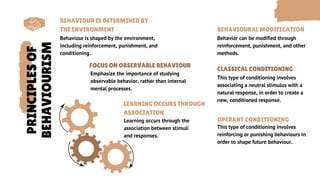
Behaviour is shaped by the environment,
including reinforcement, punishment, and
conditioning.
BEHAVIOUR IS DETERMINED BY
THE ENVIRONMENT
Emphasize the importance of studying
observable behavior, rather than internal
mental processes.
FOCUS ON OBSERVABLE BEHAVIOUR
Learning occurs through the
association between stimuli
and responses.
LEARNING OCCURS THROUGH
ASSOCIATION
PRINCIPLES
OF
BEHAVIOURISM
Behavior can be modified through
reinforcement, punishment, and other
methods.
BEHAVIOURAL MODIFICATION
This type of conditioning involves
associating a neutral stimulus with a
natural response, in order to create a
new, conditioned response.
CLASSICAL CONDITIONING
This type of conditioning involves
reinforcing or punishing behaviours in
order to shape future behaviour.
OPERANT CONDITIONING
STRENGTHS
OF BEHAVIOURISM
It relies on empirical data and scientific
methods to explain behaviour.
EMPIRICAL APPROACH
BEHAVIOUR MODIFICATION
Useful in modifying behavior in a
variety of settings. Operant
conditioning and Classical conditioning
can be used to change problematic
behaviors.
EASILY QUANTIFIABLE
Easy to quantify and measure makes it
useful for research, as well as for
tracking progress in behavior
modification programs.
PRACTICAL APPLICATIONS
Behaviourism has practical applications
in a variety of fields, such as education,
sports, and marketing.
WEAKNESSES
OF BEHAVIOURISM
The principles of behaviourism,
such as reinforcement and
punishment, can be used to
manipulate and control
individuals. This raises ethical
concerns
ETHICAL CONCERNS
Behaviorism does not provide a
complete explanation for all
aspects of human behavior,
especially, complex phenomena
such as emotions, cognition, and
creativity.
LIMITED
EXPLANATORY
POWER
Focuses exclusively on observable
behaviour, and does not take into
account internal mental processes
or individual differences.
LIMITED FOCUS
Behaviourism does not take into
account the concept of free will.
According to this view, behavior is
simply the result of environmental
factors and conditioning
LACK OF FREE WILL
blessonvarghese@mgu.ac.in
KEEP
IN TOUCH

BEHAVIOURISM- AN INTRODUCTION .pdf

  • 1.
  • 2.
    BEHAVIOURISM SCHOOL OF Emphasizes theimportance of observable behavior in understanding human and animal psychology. Based on the idea that all behavior is acquired through conditioning. Behavior is shaped by environmental factors such as reinforcement, punishment, and conditioning. John B Watson is considered the father of behaviorism, who famously declared that "psychology is a purely objective experimental branch of natural science." Behaviorism was formally established with the 1913 publication of John B. Watson's classic paper, "Psychology as the Behaviourist Views It."
  • 3.
    TYPES OF BEHAVIOURISM Popularised byJB Watson, focuses solely on observable behaviour and rejects the idea of studying internal mental processes. METHODOLOGICAL BEHAVIOURISM Developed by B.F. Skinner, emphasizes the role of reinforcement and punishment in shaping behaviour. RADICAL BEHAVIOURISM Emphasizes the role of social and cultural factors in shaping behavior. Argue that behavior is influenced by cultural norms and values. SOCIAL BEHAVIOURISM COGNITIVE BEHAVIOURISM Emphasizes the role of internal mental processes, such as perception, memory, and thought in shaping behavior. BIOLOGICAL BEHAVIOURISM Emphasizes the role of biology and genetics in shaping behaviour
  • 4.
    Behaviour is shapedby the environment, including reinforcement, punishment, and conditioning. BEHAVIOUR IS DETERMINED BY THE ENVIRONMENT Emphasize the importance of studying observable behavior, rather than internal mental processes. FOCUS ON OBSERVABLE BEHAVIOUR Learning occurs through the association between stimuli and responses. LEARNING OCCURS THROUGH ASSOCIATION PRINCIPLES OF BEHAVIOURISM Behavior can be modified through reinforcement, punishment, and other methods. BEHAVIOURAL MODIFICATION This type of conditioning involves associating a neutral stimulus with a natural response, in order to create a new, conditioned response. CLASSICAL CONDITIONING This type of conditioning involves reinforcing or punishing behaviours in order to shape future behaviour. OPERANT CONDITIONING
  • 5.
    STRENGTHS OF BEHAVIOURISM It relieson empirical data and scientific methods to explain behaviour. EMPIRICAL APPROACH BEHAVIOUR MODIFICATION Useful in modifying behavior in a variety of settings. Operant conditioning and Classical conditioning can be used to change problematic behaviors. EASILY QUANTIFIABLE Easy to quantify and measure makes it useful for research, as well as for tracking progress in behavior modification programs. PRACTICAL APPLICATIONS Behaviourism has practical applications in a variety of fields, such as education, sports, and marketing.
  • 6.
    WEAKNESSES OF BEHAVIOURISM The principlesof behaviourism, such as reinforcement and punishment, can be used to manipulate and control individuals. This raises ethical concerns ETHICAL CONCERNS Behaviorism does not provide a complete explanation for all aspects of human behavior, especially, complex phenomena such as emotions, cognition, and creativity. LIMITED EXPLANATORY POWER Focuses exclusively on observable behaviour, and does not take into account internal mental processes or individual differences. LIMITED FOCUS Behaviourism does not take into account the concept of free will. According to this view, behavior is simply the result of environmental factors and conditioning LACK OF FREE WILL
  • 7.