Name:Shekhar Manohar Jadhav
Roll no.210054
Class:FYBA
Topic: Behviorism
Sub: Psychology
INTRODUCTION OF BEHVIORISM
▪ An attempt to make psychology more
scientific by studying only external behavior
▪ Behavior: response of an organism to stimuli;
objective & observable
▪ The study of how environmental stimuli bring
about changes in people’s behaviors
▪ Behaviorists ignore what goes on inside our
mind since it can’t be seen or measured
Mind is a “black box”
•According to Behaviorists, we are born as:
•“blank slates” one’s environment writes on; “vessels” to pour
knowledge into
•“lumps of clay” that can be shaped by one’s environment
•Believed the environment (extrinsic forces) is the only thing that
matters
•Learning = Behavior change due to experience
•Doesn’t consider/believe in intrinsic motivation
HISTORY OF BEHVIORSM
 Very popular in U.S. before Piaget and
Vygotsky’s writings were translated and brought
here
• Behaviorism via Thorndike beat out John
Dewey’s theories to become the dominant
theory in U.S.
• U.S. schools were structured after Behaviorism
rather than Dewey’s model
• Americans very interested in a scientific way to
parent and educate
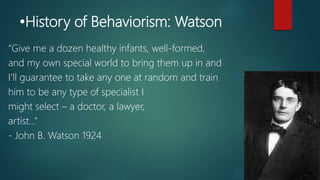
•History of Behaviorism: Watson
“Give me a dozen healthy infants, well-formed,
and my own special world to bring them up in and
I’ll guarantee to take any one at random and train
him to be any type of specialist I
might select – a doctor, a lawyer,
artist…”
- John B. Watson 1924
Classical Conditioning
Explains learning of involuntary emotional &/or
physiological responses
• Happens when two stimuli are presented at the same
time
• Being kicked by a horse; associating horse with kick;
severe anxiety around horses
• Important for teachers since school can cause
unintentional learning through classical conditioning,
especially anxiety
• Test anxiety, general school anxiety, fear, frustration,
humiliation
Examples of Classical Conditioning
Hearing a teacher, friend, boy/girlfriend say to
you, “We need to talk”
• Upon hearing this phrase your stomach“flutters”
• Any of your own examples?
• The point is, we learn to associate a stimulus with a
response, & eventually our body does this
automatically in the presence of the stimulus. Our
response is involuntary.
Consequences for Behaviors
 Positive Reinforcement – You behave in a way that
results in a reward – so you are more likely to repeat that
behavior
• Negative Reinforcement – You behave in a way that
results in the removal of something unpleasant – so you
are more likely to repeat that behavior (ex: doing a paper
early)
• In both cases, something happened that you saw as
“good” and as a result, you exhibited the behavior more.
Negative Reinforcement & Punishment
 Negative reinforcement: Something unpleasant
is removed & as a result you are more likely to
do it again
• You see this as “good”
• Punishment: A consequence happens that you
don’t like and you are less likely to do it again.
The punishment can add something or take
something away.
• You see this as “bad”
•Behaviorism & Education
• Focus on Rewards & Punishments
• Classroom Management
• External rather than Internal Motivation
• Incremental View of Learning
• Learning broken down into small chunks
• Ex: must pass part 1 before beginning part 2
• Repetition to strengthen stimulus response bonds – “Drill
& Practice” activities
• Mastery Learning
• Focused on the Individual rather than Social
Motivation in Behaviorism
External motivation only
• Skinner didn’t believe in internal motivation
• We do things only for a reward or to avoid
punishment
• Grades
• Praise
• Stickers
• Money
• Social Status

Presentation.pptx

  • 1.
    Name:Shekhar Manohar Jadhav Rollno.210054 Class:FYBA Topic: Behviorism Sub: Psychology
  • 2.
    INTRODUCTION OF BEHVIORISM ▪An attempt to make psychology more scientific by studying only external behavior ▪ Behavior: response of an organism to stimuli; objective & observable ▪ The study of how environmental stimuli bring about changes in people’s behaviors ▪ Behaviorists ignore what goes on inside our mind since it can’t be seen or measured Mind is a “black box”
  • 3.
    •According to Behaviorists,we are born as: •“blank slates” one’s environment writes on; “vessels” to pour knowledge into •“lumps of clay” that can be shaped by one’s environment •Believed the environment (extrinsic forces) is the only thing that matters •Learning = Behavior change due to experience •Doesn’t consider/believe in intrinsic motivation
  • 4.
    HISTORY OF BEHVIORSM Very popular in U.S. before Piaget and Vygotsky’s writings were translated and brought here • Behaviorism via Thorndike beat out John Dewey’s theories to become the dominant theory in U.S. • U.S. schools were structured after Behaviorism rather than Dewey’s model • Americans very interested in a scientific way to parent and educate
  • 5.
    •History of Behaviorism:Watson “Give me a dozen healthy infants, well-formed, and my own special world to bring them up in and I’ll guarantee to take any one at random and train him to be any type of specialist I might select – a doctor, a lawyer, artist…” - John B. Watson 1924
  • 6.
    Classical Conditioning Explains learningof involuntary emotional &/or physiological responses • Happens when two stimuli are presented at the same time • Being kicked by a horse; associating horse with kick; severe anxiety around horses • Important for teachers since school can cause unintentional learning through classical conditioning, especially anxiety • Test anxiety, general school anxiety, fear, frustration, humiliation
  • 7.
    Examples of ClassicalConditioning Hearing a teacher, friend, boy/girlfriend say to you, “We need to talk” • Upon hearing this phrase your stomach“flutters” • Any of your own examples? • The point is, we learn to associate a stimulus with a response, & eventually our body does this automatically in the presence of the stimulus. Our response is involuntary.
  • 8.
    Consequences for Behaviors Positive Reinforcement – You behave in a way that results in a reward – so you are more likely to repeat that behavior • Negative Reinforcement – You behave in a way that results in the removal of something unpleasant – so you are more likely to repeat that behavior (ex: doing a paper early) • In both cases, something happened that you saw as “good” and as a result, you exhibited the behavior more.
  • 9.
    Negative Reinforcement &Punishment  Negative reinforcement: Something unpleasant is removed & as a result you are more likely to do it again • You see this as “good” • Punishment: A consequence happens that you don’t like and you are less likely to do it again. The punishment can add something or take something away. • You see this as “bad”
  • 10.
    •Behaviorism & Education •Focus on Rewards & Punishments • Classroom Management • External rather than Internal Motivation • Incremental View of Learning • Learning broken down into small chunks • Ex: must pass part 1 before beginning part 2 • Repetition to strengthen stimulus response bonds – “Drill & Practice” activities • Mastery Learning • Focused on the Individual rather than Social
  • 11.
    Motivation in Behaviorism Externalmotivation only • Skinner didn’t believe in internal motivation • We do things only for a reward or to avoid punishment • Grades • Praise • Stickers • Money • Social Status