OPERANT
CONDITIONING
BF SKINNER
BF Skinner
American psychologist who is best known
for his contributions to behaviorism and his
development of the theory of operant
conditioning.
Argued that behavior is shaped and
maintained by its consequences, rather than
by associations between stimuli and
responses.
Respondent vs
Operant Behaviour
Respondent behavior refers to
automatic, involuntary, and reflexive
responses to a stimulus. These
responses are typically innate and do
not require any prior learning.
Operant behaviour is voluntary
behaviour that is shaped and
maintained by its consequences. The
consequences can either be positive
(rewards) or negative (punishments),
and they determine whether the
behaviour is more or less likely to occur
again in the future.
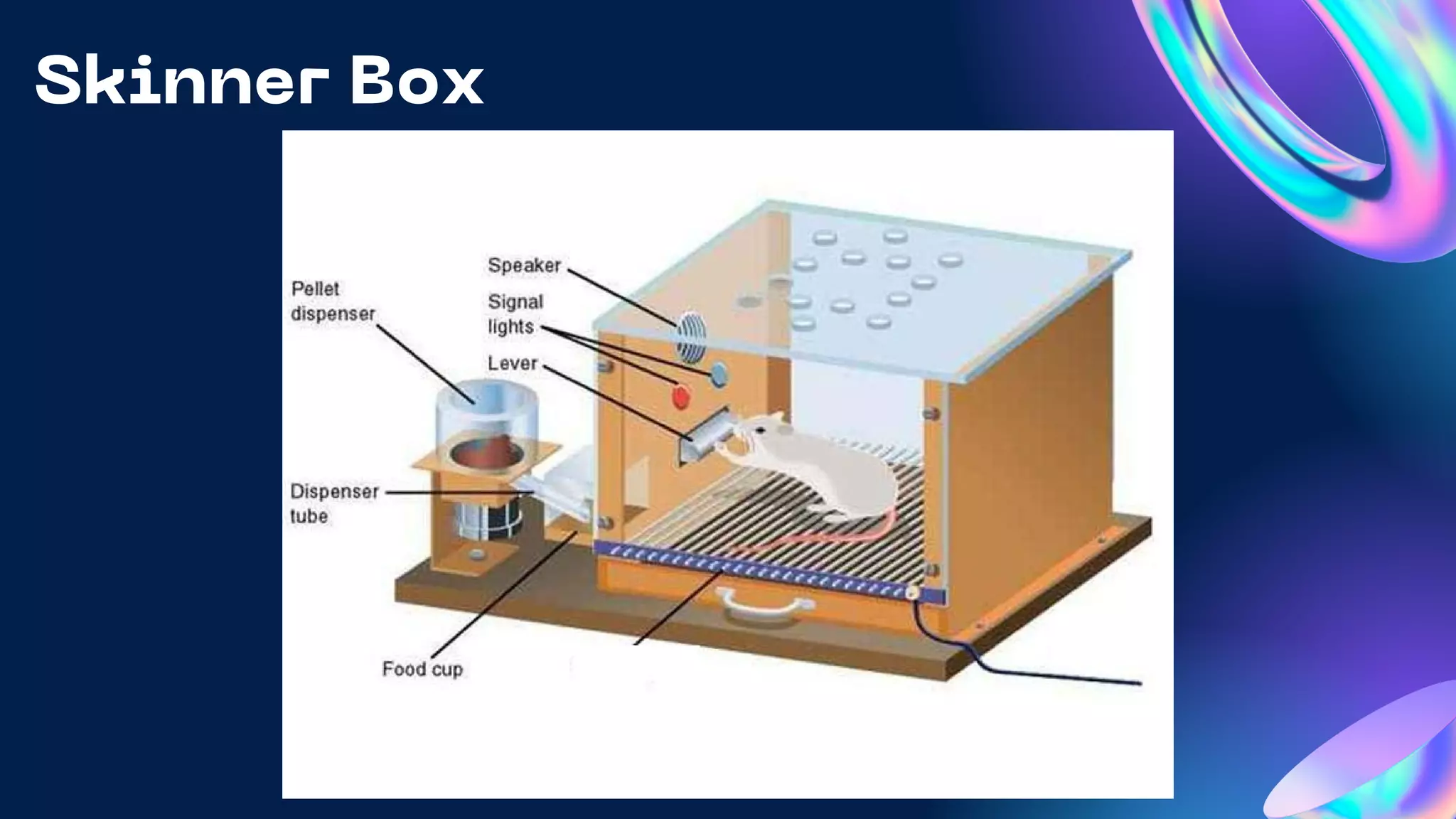
Skinner Box
Reinforcement and
Punishment
Reinforcement refers
to any consequence
that increases the
likelihood of a
behavior occurring
again.
while punishment refers
to any consequence
that decreases the
likelihood of a behavior
occurring again.
TYPES OF REINFORCEMENT
Positive
reinforcement occurs
when a desirable
consequence is added
after a behaviour
Negative
reinforcement occurs
when an aversive
stimulus is removed
after a behaviour
TYPES OF PUNISHMENT
Positive punishment
occurs when an
undesirable
consequence is added
after a behaviour
Negative punishment
occurs when a
desirable stimulus is
removed after a
behaviour
Schedule of
Reinforcement
A schedule of reinforcement
refers to the frequency and
timing of the delivery of
reinforcement in response to a
behaviour.
Continuous
Reinforcement Schedule
(CRF)
Every occurrence of the desired behavior is reinforced.
Useful for establishing and initially strengthening a behavior.
It provides immediate feedback and creates a strong
association between the behavior and the reinforcement.
But it can also lead to rapid extinction if reinforcement is
suddenly withdrawn.
It may not be sustainable in the long term due to resource
limitations or the potential for habituation.
Fixed Ratio
Reinforcement(FR)
Reinforcement is delivered after a fixed number of responses.
Typically result in high response rates and are often used to
increase the frequency of a behavior.
It's important to strike a balance between the fixed ratio and
the effort required, as extremely high ratios can lead to fatigue
or decreased motivation over time.
Variable Ratio (VR)
reinforcement
Reinforcement is delivered after an average number of
responses, but the exact number varies unpredictably.
Variable ratio schedules tend to be more resistant to extinction.
Fixed Interval (FI)
reinforcement
Reinforcement is provided for the first response that occurs after
a set amount of time has passed.
The response rate may drop immediately after receiving
reinforcement and gradually increase as the next interval comes
to an end.
This schedule might not necessarily lead to the highest level of
performance or consistent engagement throughout the interval.
Variable Interval (VI)
reinforcement
The first response is rewarded after an average, yet variable,
period of time has elapsed since the last reinforcement.
The variability in the reinforcement schedule prevents you from
predicting exactly when reinforcement will be provided.
PRINCIPLE OF SHAPING
The technique used in operant conditioning to teach complex
behaviors by reinforcing small steps or successive
approximations toward the desired behavior.
Shaping involves systematically reinforcing behaviors that are
increasingly similar to the target behavior, gradually guiding the
subject to exhibit the desired behavior.

OPERANT CONDITIONING

  • 1.
  • 2.
    BF Skinner American psychologistwho is best known for his contributions to behaviorism and his development of the theory of operant conditioning. Argued that behavior is shaped and maintained by its consequences, rather than by associations between stimuli and responses.
  • 3.
    Respondent vs Operant Behaviour Respondentbehavior refers to automatic, involuntary, and reflexive responses to a stimulus. These responses are typically innate and do not require any prior learning. Operant behaviour is voluntary behaviour that is shaped and maintained by its consequences. The consequences can either be positive (rewards) or negative (punishments), and they determine whether the behaviour is more or less likely to occur again in the future.
  • 4.
  • 5.
    Reinforcement and Punishment Reinforcement refers toany consequence that increases the likelihood of a behavior occurring again. while punishment refers to any consequence that decreases the likelihood of a behavior occurring again.
  • 6.
    TYPES OF REINFORCEMENT Positive reinforcementoccurs when a desirable consequence is added after a behaviour Negative reinforcement occurs when an aversive stimulus is removed after a behaviour
  • 7.
    TYPES OF PUNISHMENT Positivepunishment occurs when an undesirable consequence is added after a behaviour Negative punishment occurs when a desirable stimulus is removed after a behaviour
  • 8.
    Schedule of Reinforcement A scheduleof reinforcement refers to the frequency and timing of the delivery of reinforcement in response to a behaviour.
  • 9.
    Continuous Reinforcement Schedule (CRF) Every occurrenceof the desired behavior is reinforced. Useful for establishing and initially strengthening a behavior. It provides immediate feedback and creates a strong association between the behavior and the reinforcement. But it can also lead to rapid extinction if reinforcement is suddenly withdrawn. It may not be sustainable in the long term due to resource limitations or the potential for habituation.
  • 10.
    Fixed Ratio Reinforcement(FR) Reinforcement isdelivered after a fixed number of responses. Typically result in high response rates and are often used to increase the frequency of a behavior. It's important to strike a balance between the fixed ratio and the effort required, as extremely high ratios can lead to fatigue or decreased motivation over time.
  • 11.
    Variable Ratio (VR) reinforcement Reinforcementis delivered after an average number of responses, but the exact number varies unpredictably. Variable ratio schedules tend to be more resistant to extinction.
  • 12.
    Fixed Interval (FI) reinforcement Reinforcementis provided for the first response that occurs after a set amount of time has passed. The response rate may drop immediately after receiving reinforcement and gradually increase as the next interval comes to an end. This schedule might not necessarily lead to the highest level of performance or consistent engagement throughout the interval.
  • 13.
    Variable Interval (VI) reinforcement Thefirst response is rewarded after an average, yet variable, period of time has elapsed since the last reinforcement. The variability in the reinforcement schedule prevents you from predicting exactly when reinforcement will be provided.
  • 14.
    PRINCIPLE OF SHAPING Thetechnique used in operant conditioning to teach complex behaviors by reinforcing small steps or successive approximations toward the desired behavior. Shaping involves systematically reinforcing behaviors that are increasingly similar to the target behavior, gradually guiding the subject to exhibit the desired behavior.