Wai, Gretchen, Andrea, Nia, and MeganBehaviorism
BehavioristsJohn B. Watson, Ivan Pavlov, Edward Thorndike, B.F. Skinner
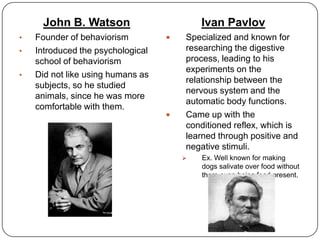
John B. WatsonFounder of behaviorism
Introduced the psychological school of behaviorism
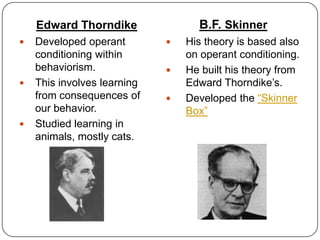
Did not like using humans as subjects, so he studied animals, since he was more comfortable with them.Ivan PavlovSpecialized and known for researching the digestive process, leading to his experiments on the relationship between the nervous system and the automatic body functions.Came up with the conditioned reflex, which is learned through positive and negative stimuli.Ex. Well known for making dogs salivate over food without there even being food present.Edward ThorndikeB.F. SkinnerDeveloped operant conditioning within behaviorism.This involves learning from consequences of our behavior.Studied learning in animals, mostly cats.His theory is based also on operant conditioning.He built his theory from Edward Thorndike’s.Developed the “Skinner Box”
Key PointsWhat is behaviorism?
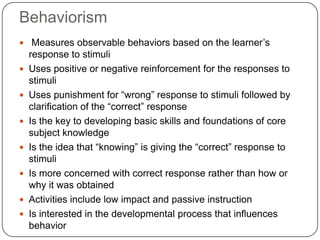
Behaviorism Measures observable behaviors based on the learner’s response to stimuliUses positive or negative reinforcement for the responses to stimuliUses punishment for “wrong” response to stimuli followed by clarification of the “correct” responseIs the key to developing basic skills and foundations of core subject knowledgeIs the idea that “knowing” is giving the “correct” response to stimuliIs more concerned with correct response rather than how or why it was obtainedActivities include low impact and passive instructionIs interested in the developmental process that influences behavior
Classroom ImplicationsHow does this theory apply to schools?
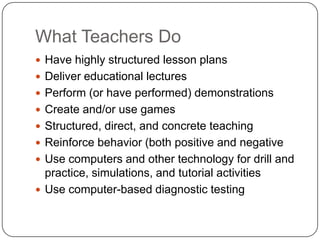
What Teachers DoHave highly structured lesson plansDeliver educational lecturesPerform (or have performed) demonstrationsCreate and/or use gamesStructured, direct, and concrete teachingReinforce behavior (both positive and negativeUse computers and other technology for drill and practice, simulations, and tutorial activitiesUse computer-based diagnostic testing
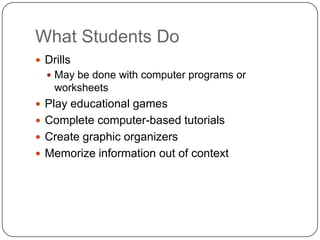
What Students DoDrillsMay be done with computer programs or worksheetsPlay educational gamesComplete computer-based tutorialsCreate graphic organizersMemorize information out of context
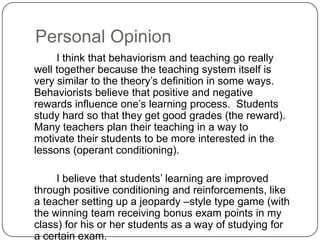
Personal Opinion		I think that behaviorism and teaching go really well together because the teaching system itself is very similar to the theory’s definition in some ways.  Behaviorists believe that positive and negative rewards influence one’s learning process.  Students study hard so that they get good grades (the reward).  Many teachers plan their teaching in a way to motivate their students to be more interested in the lessons (operant conditioning).		I believe that students’ learning are improved through positive conditioning and reinforcements, like a teachersetting up a jeopardy –style type game (with the winning team receiving bonus exam points in my class) for his or her students as a way of studying for a certain exam.

Team power point

  • 1.
    Wai, Gretchen, Andrea,Nia, and MeganBehaviorism
  • 2.
    BehavioristsJohn B. Watson,Ivan Pavlov, Edward Thorndike, B.F. Skinner
  • 3.
    John B. WatsonFounderof behaviorism
  • 4.
    Introduced the psychologicalschool of behaviorism
  • 5.
    Did not likeusing humans as subjects, so he studied animals, since he was more comfortable with them.Ivan PavlovSpecialized and known for researching the digestive process, leading to his experiments on the relationship between the nervous system and the automatic body functions.Came up with the conditioned reflex, which is learned through positive and negative stimuli.Ex. Well known for making dogs salivate over food without there even being food present.Edward ThorndikeB.F. SkinnerDeveloped operant conditioning within behaviorism.This involves learning from consequences of our behavior.Studied learning in animals, mostly cats.His theory is based also on operant conditioning.He built his theory from Edward Thorndike’s.Developed the “Skinner Box”
  • 6.
    Key PointsWhat isbehaviorism?
  • 7.
    Behaviorism Measures observablebehaviors based on the learner’s response to stimuliUses positive or negative reinforcement for the responses to stimuliUses punishment for “wrong” response to stimuli followed by clarification of the “correct” responseIs the key to developing basic skills and foundations of core subject knowledgeIs the idea that “knowing” is giving the “correct” response to stimuliIs more concerned with correct response rather than how or why it was obtainedActivities include low impact and passive instructionIs interested in the developmental process that influences behavior
  • 8.
    Classroom ImplicationsHow doesthis theory apply to schools?
  • 9.
    What Teachers DoHavehighly structured lesson plansDeliver educational lecturesPerform (or have performed) demonstrationsCreate and/or use gamesStructured, direct, and concrete teachingReinforce behavior (both positive and negativeUse computers and other technology for drill and practice, simulations, and tutorial activitiesUse computer-based diagnostic testing
  • 10.
    What Students DoDrillsMaybe done with computer programs or worksheetsPlay educational gamesComplete computer-based tutorialsCreate graphic organizersMemorize information out of context
  • 11.
    Personal Opinion I thinkthat behaviorism and teaching go really well together because the teaching system itself is very similar to the theory’s definition in some ways. Behaviorists believe that positive and negative rewards influence one’s learning process. Students study hard so that they get good grades (the reward). Many teachers plan their teaching in a way to motivate their students to be more interested in the lessons (operant conditioning). I believe that students’ learning are improved through positive conditioning and reinforcements, like a teachersetting up a jeopardy –style type game (with the winning team receiving bonus exam points in my class) for his or her students as a way of studying for a certain exam.