

BEHAVIOURAL CONTROLOF INSECT
PESTS IN IPM
Presented by,
RAKESH
Department of Entomology & Agricultural Zoology
Institute of Agricultural Sciences, BHU
Varanasi - 221005
Definition
Principle of control
Types of hormones
Management by hormones
HORMONES
Definition
“Hormones are the secretion of internal ductless
glands, which regulate the growth and
development of the insect”
(Dhaliwal, G.S.,2006).
•Means to ‘excite’ and endocrine in origin.
•Connection link between nervous system and endocrine
system.
•Recognised as ‘third generation pesticides’ (Prof. C.M.
Williams, 1967).
Principle of control
Stefan Kopec (1917,22) reported, brain of larva of
gypsy moth Lymantria dispar produces a hormone
which induces pupation.
Hormone is chemical signal sent from cells in one
part to cells in another parts of same individual.
Regarded as chemical messengers
Their effect may be stimulatory or inhibitory.
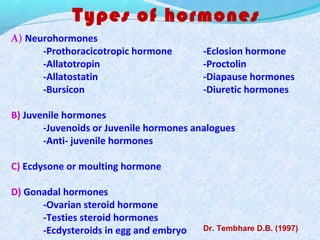
Types of hormones
A) Neurohormones
-Prothoracicotropic hormone -Eclosion hormone
-Allatotropin -Proctolin
-Allatostatin -Diapause hormones
-Bursicon -Diuretic hormones
B) Juvenile hormones
-Juvenoids or Juvenile hormones analogues
-Anti- juvenile hormones
C) Ecdysone or moulting hormone
D) Gonadal hormones
-Ovarian steroid hormone
-Testies steroid hormones
-Ecdysteroids in egg and embryo Dr. Tembhare D.B. (1997)
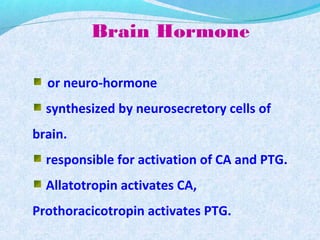
Brain Hormone
or neuro-hormone
synthesized by neurosecretory cells of
brain.
responsible for activation of CA and PTG.
Allatotropin activates CA,
Prothoracicotropin activates PTG.
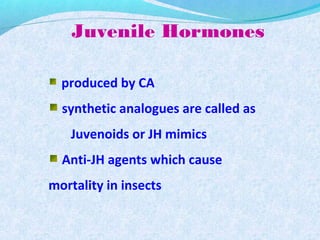
Juvenile Hormones
produced by CA
synthetic analogues are called as
Juvenoids or JH mimics
Anti-JH agents which cause
mortality in insects
Ecdysone Hormones
or moulting hormone
produced by prothoracic gland
synthetic analogues are called as
Ecdysteroids
consist of two forms α-ecdysone and β-
ecdysone
moult inhibitors or chitin synthetic inhibitors
also useful
PEST
MANAGEMEN
T BY
HORMONES
Pest management by Juvenoids
They cause mortality in insect-pest by
Antimorphic effect
Larvicidal effect
Ovicidal effect
Diapause disrupting effect and
Inhibiting embryogenesis
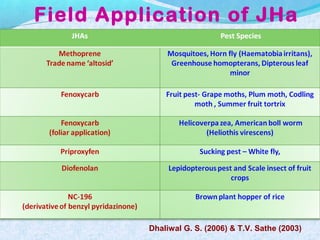
Field Application of JHa
Dhaliwal G. S. (2006) & T.V. Sathe (2003)
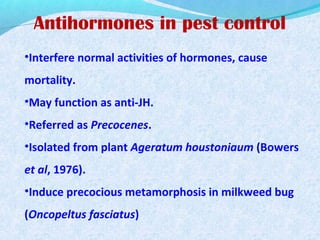
Antihormones in pest control
•Interfere normal activities of hormones, cause
mortality.
•May function as anti-JH.
•Referred as Precocenes.
•Isolated from plant Ageratum houstoniaum (Bowers
et al, 1976).
•Induce precocious metamorphosis in milkweed bug
(Oncopeltus fasciatus)
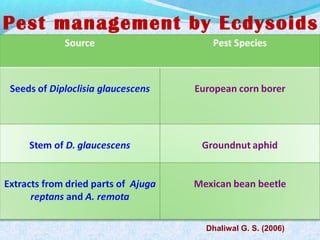
Pest management by Ecdysoids
Dhaliwal G. S. (2006)
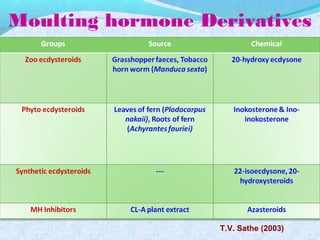
Moulting hormone Derivatives
T.V. Sathe (2003)
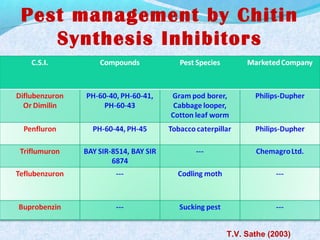
Pest management by Chitin
Synthesis Inhibitors
T.V. Sathe (2003)
PHEROMONESPHEROMONES
Principle of behavioral control
Introduction
Classification
Pheromone traps
Mode of pheromone application
Management by pheromones
IntroductIon
Pheromone
Is a chemical or mixture of chemical released
by an organism to outside (environment) that cause
specific reaction in a receiving organisms in same
species.
• Karlson and Butenandt coined the term
Pheromone ,1959.
• ‘Pherein’ means to carry or transfer.
• also called as ectohormones.
• Pheromones – Exocrine in origin.
• Volatile in nature serving as chemical means of
communication.
PrIncIPLE oF
PHEroMonAL controL
Aim at studying the behavior
regulating chemicals and exploiting
them for insect pest control.
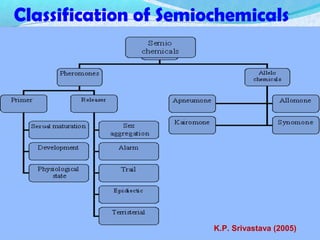
Classification of Semiochemicals
K.P. Srivastava (2005)
SEX PHEROMONE
Represent diverse assemblage of
compounds.
Commonly released by females.
Out of 150 species, 100 species of females
and 50 species of male produces pheromones.
Female sex pheromone is important
than male.
P.C. Jain & M. C. Bhargava (2007)
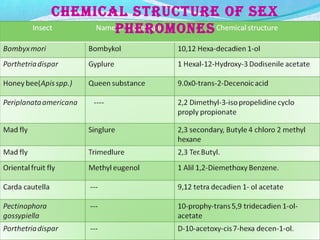
CHEMiCal StRuCtuRE Of SEX
PHEROMONES
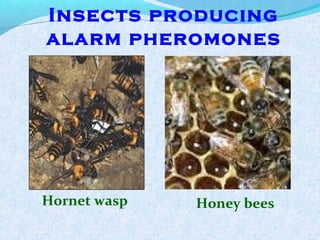
Insects producing
alarm pheromones
Hornet wasp Honey bees
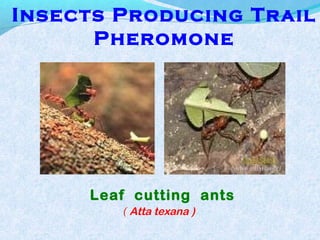
Insects Producing Trail
Pheromone
Leaf cutting ants
( Atta texana )
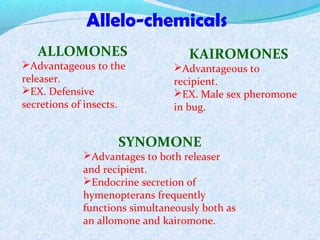
Allelo-chemicals
ALLOMONES
Advantageous to the
releaser.
EX. Defensive
secretions of insects.
SYNOMONE
Advantages to both releaser
and recipient.
Endocrine secretion of
hymenopterans frequently
functions simultaneously both as
an allomone and kairomone.
KAIROMONES
Advantageous to
recipient.
EX. Male sex pheromone
in bug.
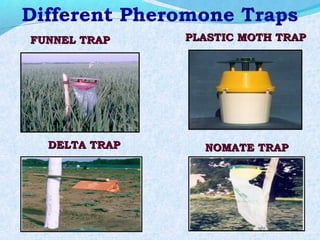
Different Pheromone Traps
FUNNEL TRAPFUNNEL TRAP PLASTIC MOTH TRAPPLASTIC MOTH TRAP
DELTA TRAPDELTA TRAP NOMATE TRAPNOMATE TRAP
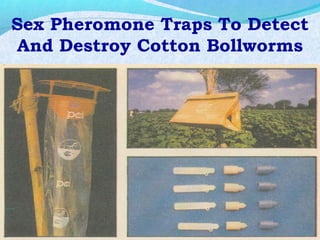
Sex Pheromone Traps To Detect
And Destroy Cotton Bollworms
Mode of Pheromone Application
A) Micro encapsulation method
B) Hollow fiber method
C) Pheromone baited traps
D) Pheromone Dispensers
Michereff et al (2000)
ManageMen
t With
PheroMone
Control With sex
PheroMones.
Can be utilized by two ways :-
A)Population survey.
B)Behavioural manipulation.
a)Stimulation of normal approach
response.
b)Disruption of chemical
communication.
Management With Aggregate
Pheromone
Used on insect to aggregate and attack wrong host
plant
Logs infested with bark beetle (Dendroctonus
spp. ) were tied to unsuitable host tree
Attract to infesting insects.
Attack on that and died with starvation
Management With Alarm
Pheromones
Aphids threatened by predators , releases alarm
pheromones and stop feeding then move away
from site
Utilized to prevent colonization of the host plant
by aphids
And alarm pheromone spread
Increases mobility of aphid
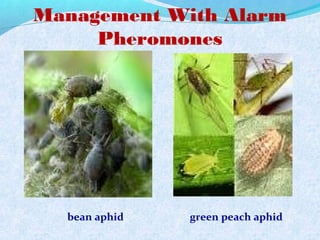
bean aphid green peach aphid
Management With Alarm
Pheromones
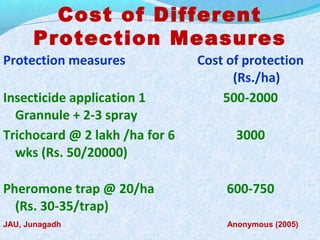
Cost of Different
Protection Measures
Protection measures Cost of protection
(Rs./ha)
Insecticide application 1
Grannule + 2-3 spray
500-2000
Trichocard @ 2 lakh /ha for 6
wks (Rs. 50/20000)
3000
Pheromone trap @ 20/ha
(Rs. 30-35/trap)
600-750
JAU, Junagadh Anonymous (2005)
Pheromone Used For…
• Monitoring insect population.
• Control of urban pests.
• Monitor movement of exotic pests.
• Mass trapping of insects from breeding
and feeding potential.
• Disruption in mating of insect population.
ADVANTAGES
Effective in minute quantities.
Highly species specific.
Biodegradable, Non-persistent and non-polluting.
Non toxic to man, animals and plants.
Affects many aspects of insect development and physiology.
Labour saving.
Easy monitoring of pest population.
Best suited in IPM
Reduces risk of insecticide residues
CONCLUSIONCONCLUSION
Eco-friendly and economically based IPM
Hormonal control effective against specific stages and periods
Needs popularization among farmers
Hormone analogues are unstable
Limits commercial viability, no quick result
Used effectively only at low population density
Control of all pests to be investigated with greater efforts
New trapping system need to ensure lure longevity and trap
efficiency
Behavioural controlof insect pests in ipm

Behavioural controlof insect pests in ipm

  • 2.
    BEHAVIOURAL CONTROLOF INSECT PESTSIN IPM Presented by, RAKESH Department of Entomology & Agricultural Zoology Institute of Agricultural Sciences, BHU Varanasi - 221005
  • 4.
    Definition Principle of control Typesof hormones Management by hormones HORMONES
  • 5.
    Definition “Hormones are thesecretion of internal ductless glands, which regulate the growth and development of the insect” (Dhaliwal, G.S.,2006). •Means to ‘excite’ and endocrine in origin. •Connection link between nervous system and endocrine system. •Recognised as ‘third generation pesticides’ (Prof. C.M. Williams, 1967).
  • 6.
    Principle of control StefanKopec (1917,22) reported, brain of larva of gypsy moth Lymantria dispar produces a hormone which induces pupation. Hormone is chemical signal sent from cells in one part to cells in another parts of same individual. Regarded as chemical messengers Their effect may be stimulatory or inhibitory.
  • 7.
    Types of hormones A)Neurohormones -Prothoracicotropic hormone -Eclosion hormone -Allatotropin -Proctolin -Allatostatin -Diapause hormones -Bursicon -Diuretic hormones B) Juvenile hormones -Juvenoids or Juvenile hormones analogues -Anti- juvenile hormones C) Ecdysone or moulting hormone D) Gonadal hormones -Ovarian steroid hormone -Testies steroid hormones -Ecdysteroids in egg and embryo Dr. Tembhare D.B. (1997)
  • 8.
    Brain Hormone or neuro-hormone synthesizedby neurosecretory cells of brain. responsible for activation of CA and PTG. Allatotropin activates CA, Prothoracicotropin activates PTG.
  • 9.
    Juvenile Hormones produced byCA synthetic analogues are called as Juvenoids or JH mimics Anti-JH agents which cause mortality in insects
  • 10.
    Ecdysone Hormones or moultinghormone produced by prothoracic gland synthetic analogues are called as Ecdysteroids consist of two forms α-ecdysone and β- ecdysone moult inhibitors or chitin synthetic inhibitors also useful
  • 11.
  • 12.
    Pest management byJuvenoids They cause mortality in insect-pest by Antimorphic effect Larvicidal effect Ovicidal effect Diapause disrupting effect and Inhibiting embryogenesis
  • 13.
    Field Application ofJHa Dhaliwal G. S. (2006) & T.V. Sathe (2003)
  • 14.
    Antihormones in pestcontrol •Interfere normal activities of hormones, cause mortality. •May function as anti-JH. •Referred as Precocenes. •Isolated from plant Ageratum houstoniaum (Bowers et al, 1976). •Induce precocious metamorphosis in milkweed bug (Oncopeltus fasciatus)
  • 15.
    Pest management byEcdysoids Dhaliwal G. S. (2006)
  • 16.
  • 17.
    Pest management byChitin Synthesis Inhibitors T.V. Sathe (2003)
  • 18.
    PHEROMONESPHEROMONES Principle of behavioralcontrol Introduction Classification Pheromone traps Mode of pheromone application Management by pheromones
  • 19.
    IntroductIon Pheromone Is a chemicalor mixture of chemical released by an organism to outside (environment) that cause specific reaction in a receiving organisms in same species. • Karlson and Butenandt coined the term Pheromone ,1959. • ‘Pherein’ means to carry or transfer. • also called as ectohormones. • Pheromones – Exocrine in origin. • Volatile in nature serving as chemical means of communication.
  • 20.
    PrIncIPLE oF PHEroMonAL controL Aimat studying the behavior regulating chemicals and exploiting them for insect pest control.
  • 21.
  • 22.
    SEX PHEROMONE Represent diverseassemblage of compounds. Commonly released by females. Out of 150 species, 100 species of females and 50 species of male produces pheromones. Female sex pheromone is important than male. P.C. Jain & M. C. Bhargava (2007)
  • 23.
    CHEMiCal StRuCtuRE OfSEX PHEROMONES
  • 24.
  • 25.
    Insects Producing Trail Pheromone Leafcutting ants ( Atta texana )
  • 26.
    Allelo-chemicals ALLOMONES Advantageous to the releaser. EX.Defensive secretions of insects. SYNOMONE Advantages to both releaser and recipient. Endocrine secretion of hymenopterans frequently functions simultaneously both as an allomone and kairomone. KAIROMONES Advantageous to recipient. EX. Male sex pheromone in bug.
  • 28.
    Different Pheromone Traps FUNNELTRAPFUNNEL TRAP PLASTIC MOTH TRAPPLASTIC MOTH TRAP DELTA TRAPDELTA TRAP NOMATE TRAPNOMATE TRAP
  • 29.
    Sex Pheromone TrapsTo Detect And Destroy Cotton Bollworms
  • 30.
    Mode of PheromoneApplication A) Micro encapsulation method B) Hollow fiber method C) Pheromone baited traps D) Pheromone Dispensers Michereff et al (2000)
  • 31.
  • 32.
    Control With sex PheroMones. Canbe utilized by two ways :- A)Population survey. B)Behavioural manipulation. a)Stimulation of normal approach response. b)Disruption of chemical communication.
  • 33.
    Management With Aggregate Pheromone Usedon insect to aggregate and attack wrong host plant Logs infested with bark beetle (Dendroctonus spp. ) were tied to unsuitable host tree Attract to infesting insects. Attack on that and died with starvation
  • 34.
    Management With Alarm Pheromones Aphidsthreatened by predators , releases alarm pheromones and stop feeding then move away from site Utilized to prevent colonization of the host plant by aphids And alarm pheromone spread Increases mobility of aphid
  • 35.
    bean aphid greenpeach aphid Management With Alarm Pheromones
  • 36.
    Cost of Different ProtectionMeasures Protection measures Cost of protection (Rs./ha) Insecticide application 1 Grannule + 2-3 spray 500-2000 Trichocard @ 2 lakh /ha for 6 wks (Rs. 50/20000) 3000 Pheromone trap @ 20/ha (Rs. 30-35/trap) 600-750 JAU, Junagadh Anonymous (2005)
  • 37.
    Pheromone Used For… •Monitoring insect population. • Control of urban pests. • Monitor movement of exotic pests. • Mass trapping of insects from breeding and feeding potential. • Disruption in mating of insect population.
  • 38.
    ADVANTAGES Effective in minutequantities. Highly species specific. Biodegradable, Non-persistent and non-polluting. Non toxic to man, animals and plants. Affects many aspects of insect development and physiology. Labour saving. Easy monitoring of pest population. Best suited in IPM Reduces risk of insecticide residues
  • 39.
    CONCLUSIONCONCLUSION Eco-friendly and economicallybased IPM Hormonal control effective against specific stages and periods Needs popularization among farmers Hormone analogues are unstable Limits commercial viability, no quick result Used effectively only at low population density Control of all pests to be investigated with greater efforts New trapping system need to ensure lure longevity and trap efficiency