TRAPS IN CROP PESTS
MANAGEMENT
Presented By- Pooja Singh
TRAP
A device that impedes or stops the process
of an organism
• Population fluctuation & their peak period
of emergence
• Mass trapping & killing
TYPES OF TRAPS
• Physical (light and sticky traps)
• Chemical (pheromone & bait traps)
• Mechanical (suction, pit fall and
emergence traps)
LIGHT TRAP
• Bon fires are base for development of
light traps
• Followed by lanterns and kerosene
lamps
• Light traps were designed
SOURCES OF LIGHT
• Use of various lamps
• Quality (wave length) & quantiity (power)
• Three major categories
1. Incandescent lamps
2. Mercury vapour lamps
3. Black light
TYPES OF LIGHT TRAP
1. Simple incandescent light trap
2. A low intensity incandescent light trap
3. Robinson trap
4. Rothamsted light trap
5. Black light trap
6. Electric grid type
7. Light trap with automatic separation of insects
USES OF LIGHT TRAP
• Seasonal incidence for forecasting
• Flight pattern and abundance in a
locality
• To decide spray or not to spray
• Migration details can be worked out
• Attracts nocturnal insects only
• Fixed 2 – 3 feet height above the
vegetation @ 5 / ha.
• Collection is less in full moon day X
new moon day
LIMITATIONS
TARGET PESTS
• Leaf hopers
• Plant hoppers
• Bugs
• Chaffers
• Leaf folder
• Stem Borer
• Boll worms etc.,
OPERATION
• Attracts beneficial and non target
organisms also
• Operate only during peak period of
incidence
For example
Rice – 8pm to 12midnight
Sorghum – 8 – 11pm
STICKY TRAP
• To attract aerial and small sized insects
• Sticky material – castor oil / vaseline /
grease
• Stickiness + colour attract more insects
White – Pigeon pea fly and weevils
Yellow – cotton white fly and aphids
Red – Apple maggots
• Stickiness + Pheromone is also better
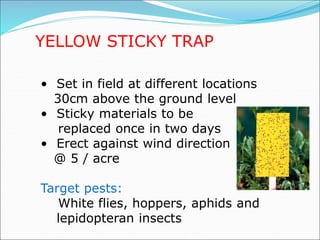
YELLOW STICKY TRAP
• Set in field at different locations
30cm above the ground level
• Sticky materials to be
replaced once in two days
• Erect against wind direction
@ 5 / acre
Target pests:
White flies, hoppers, aphids and
lepidopteran insects
PHEROMONE TRAP
• Pheromone – synthetic substance
• Available as lures in rubber septa
• Deployed at 1m above crop canopy @
2 -3 / acre
• Distance between two traps should be
40m
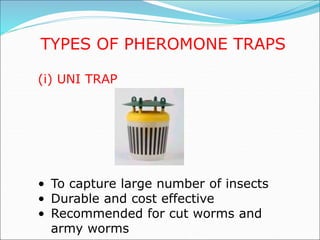
(i) UNI TRAP
• To capture large number of insects
• Durable and cost effective
• Recommended for cut worms and
army worms
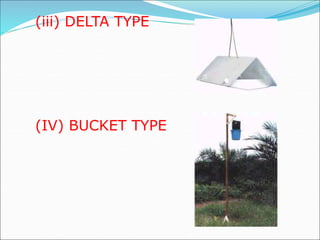
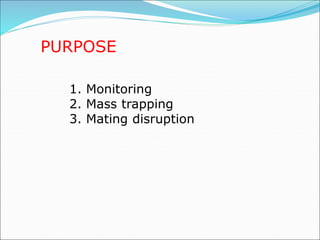
TYPES OF PHEROMONE TRAPS
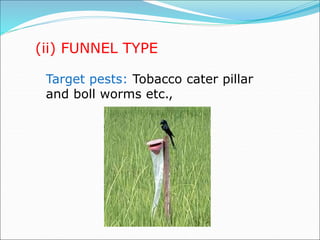
(ii) FUNNEL TYPE
Target pests: Tobacco cater pillar
and boll worms etc.,
(iii) DELTA TYPE
(IV) BUCKET TYPE
PURPOSE
1. Monitoring
2. Mass trapping
3. Mating disruption
AVAILABLE LURES
• Spodo lure
• Heli lure
• Pectino lure
• Ervit ure
• Ferro lure
• Rhino lure
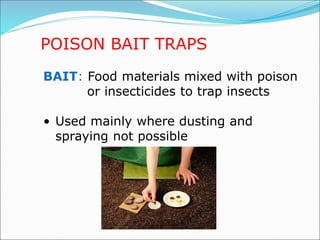
POISON BAIT TRAPS
BAIT: Food materials mixed with poison
or insecticides to trap insects
• Used mainly where dusting and
spraying not possible
Perforated plastic container with
cotton soaked DDVP
• To trap sorghum shoot flies
FISH MEAL TRAP
CHEMICAL WITH POISON
Ex: Methyl Euginol : DDVP (1:1)
Target pest: Fruit flies
OTHER BAITS
• Molasses / toddy + 0.1 % Nuvan
• To trap coconut rhinoceros beetle
and fruit sucking moths
TRAPS FOR RODENTS
(I) SINGLE DOSE POISON
Zink phosphide (2g) + ground nut oil
(3g) + pop corn or rice (95g)
(II) MULTI DOSE
a) Dry bait: Flour(450g) + edible oil
(10g) +
jaggery (15g) + anticoagulant (25g)
b) Liquid bait: Anticoagulant : water
(1:19)
LIMITATIONS
• Pre bait for 2 – 3 days
• Place bait where rats are frequently more
• Replace the bait frequently
• Discontinue the baiting as soon as rats
controlled
• In field, keep 30cm from bunds and
5mts. between two stations
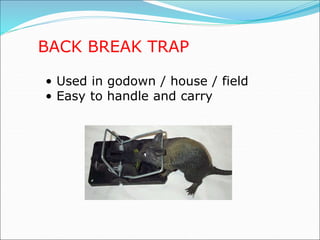
BACK BREAK TRAP
• Used in godown / house / field
• Easy to handle and carry
GLUE TRAP
• Glue applied on a card board, wood /
plastic
• Placed in boxes with openings
• Not suitable all the time
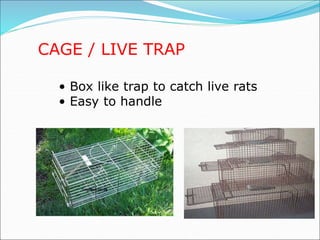
CAGE / LIVE TRAP
• Box like trap to catch live rats
• Easy to handle
ELECTROCUTION TRAPS
• Rats electrocuted when it enters the trap
• One rat trapped at a time
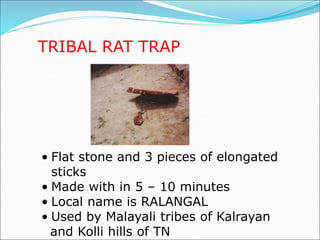
TRIBAL RAT TRAP
• Flat stone and 3 pieces of elongated
sticks
• Made with in 5 – 10 minutes
• Local name is RALANGAL
• Used by Malayali tribes of Kalrayan
and Kolli hills of TN
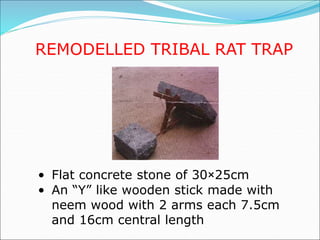
REMODELLED TRIBAL RAT TRAP
• Flat concrete stone of 30×25cm
• An “Y” like wooden stick made with
neem wood with 2 arms each 7.5cm
and 16cm central length
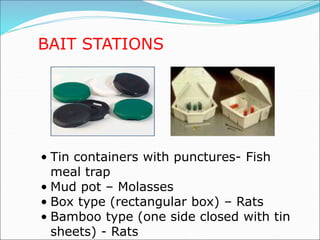
BAIT STATIONS
• Tin containers with punctures- Fish
meal trap
• Mud pot – Molasses
• Box type (rectangular box) – Rats
• Bamboo type (one side closed with tin
sheets) - Rats
TRAPS FOR STORE GRAIN PESTS
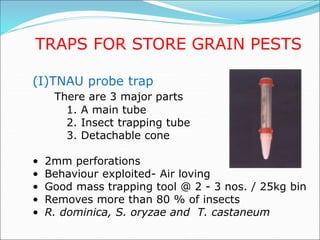
(I)TNAU probe trap
There are 3 major parts
1. A main tube
2. Insect trapping tube
3. Detachable cone
• 2mm perforations
• Behaviour exploited- Air loving
• Good mass trapping tool @ 2 - 3 nos. / 25kg bin
• Removes more than 80 % of insects
• R. dominica, S. oryzae and T. castaneum
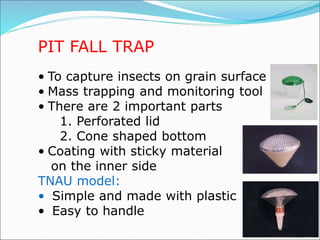
PIT FALL TRAP
• To capture insects on grain surface
• Mass trapping and monitoring tool
• There are 2 important parts
1. Perforated lid
2. Cone shaped bottom
• Coating with sticky material
on the inner side
TNAU model:
• Simple and made with plastic
• Easy to handle
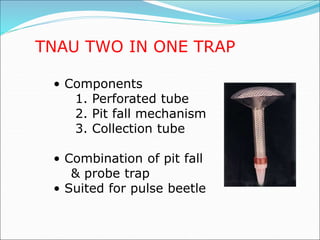
TNAU TWO IN ONE TRAP
• Components
1. Perforated tube
2. Pit fall mechanism
3. Collection tube
• Combination of pit fall
& probe trap
• Suited for pulse beetle
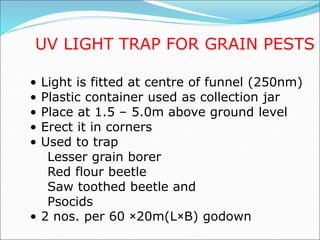
UV LIGHT TRAP FOR GRAIN PESTS
• Light is fitted at centre of funnel (250nm)
• Plastic container used as collection jar
• Place at 1.5 – 5.0m above ground level
• Erect it in corners
• Used to trap
Lesser grain borer
Red flour beetle
Saw toothed beetle and
Psocids
• 2 nos. per 60 ×20m(L×B) godown
OTHERS
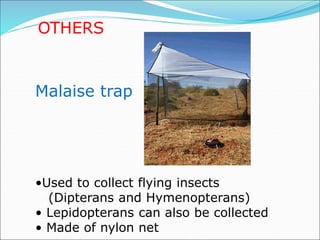
Malaise trap
•Used to collect flying insects
(Dipterans and Hymenopterans)
• Lepidopterans can also be collected
• Made of nylon net
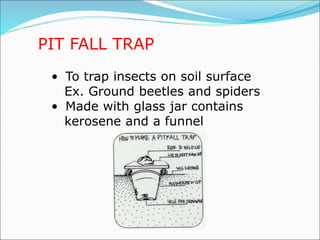
PIT FALL TRAP
• To trap insects on soil surface
Ex. Ground beetles and spiders
• Made with glass jar contains
kerosene and a funnel
CONCLUSION
• Traps are useful devices to collect
various insect pests easily
• Used mainly for mass trapping,
monitoring of pests in a locality
• Plays a major role in IPM
• Helps to conserve the eco-system

Mass Trapping.ppt

  • 1.
    TRAPS IN CROPPESTS MANAGEMENT Presented By- Pooja Singh
  • 2.
    TRAP A device thatimpedes or stops the process of an organism • Population fluctuation & their peak period of emergence • Mass trapping & killing
  • 3.
    TYPES OF TRAPS •Physical (light and sticky traps) • Chemical (pheromone & bait traps) • Mechanical (suction, pit fall and emergence traps)
  • 4.
    LIGHT TRAP • Bonfires are base for development of light traps • Followed by lanterns and kerosene lamps • Light traps were designed
  • 5.
    SOURCES OF LIGHT •Use of various lamps • Quality (wave length) & quantiity (power) • Three major categories 1. Incandescent lamps 2. Mercury vapour lamps 3. Black light
  • 6.
    TYPES OF LIGHTTRAP 1. Simple incandescent light trap 2. A low intensity incandescent light trap 3. Robinson trap 4. Rothamsted light trap 5. Black light trap 6. Electric grid type 7. Light trap with automatic separation of insects
  • 7.
    USES OF LIGHTTRAP • Seasonal incidence for forecasting • Flight pattern and abundance in a locality • To decide spray or not to spray • Migration details can be worked out
  • 8.
    • Attracts nocturnalinsects only • Fixed 2 – 3 feet height above the vegetation @ 5 / ha. • Collection is less in full moon day X new moon day LIMITATIONS
  • 9.
    TARGET PESTS • Leafhopers • Plant hoppers • Bugs • Chaffers • Leaf folder • Stem Borer • Boll worms etc.,
  • 10.
    OPERATION • Attracts beneficialand non target organisms also • Operate only during peak period of incidence For example Rice – 8pm to 12midnight Sorghum – 8 – 11pm
  • 11.
    STICKY TRAP • Toattract aerial and small sized insects • Sticky material – castor oil / vaseline / grease • Stickiness + colour attract more insects White – Pigeon pea fly and weevils Yellow – cotton white fly and aphids Red – Apple maggots • Stickiness + Pheromone is also better
  • 12.
    YELLOW STICKY TRAP •Set in field at different locations 30cm above the ground level • Sticky materials to be replaced once in two days • Erect against wind direction @ 5 / acre Target pests: White flies, hoppers, aphids and lepidopteran insects
  • 13.
    PHEROMONE TRAP • Pheromone– synthetic substance • Available as lures in rubber septa • Deployed at 1m above crop canopy @ 2 -3 / acre • Distance between two traps should be 40m
  • 14.
    (i) UNI TRAP •To capture large number of insects • Durable and cost effective • Recommended for cut worms and army worms TYPES OF PHEROMONE TRAPS
  • 15.
    (ii) FUNNEL TYPE Targetpests: Tobacco cater pillar and boll worms etc.,
  • 16.
  • 17.
    PURPOSE 1. Monitoring 2. Masstrapping 3. Mating disruption
  • 18.
    AVAILABLE LURES • Spodolure • Heli lure • Pectino lure • Ervit ure • Ferro lure • Rhino lure
  • 19.
    POISON BAIT TRAPS BAIT:Food materials mixed with poison or insecticides to trap insects • Used mainly where dusting and spraying not possible
  • 20.
    Perforated plastic containerwith cotton soaked DDVP • To trap sorghum shoot flies FISH MEAL TRAP
  • 21.
    CHEMICAL WITH POISON Ex:Methyl Euginol : DDVP (1:1) Target pest: Fruit flies
  • 22.
    OTHER BAITS • Molasses/ toddy + 0.1 % Nuvan • To trap coconut rhinoceros beetle and fruit sucking moths
  • 23.
    TRAPS FOR RODENTS (I)SINGLE DOSE POISON Zink phosphide (2g) + ground nut oil (3g) + pop corn or rice (95g) (II) MULTI DOSE a) Dry bait: Flour(450g) + edible oil (10g) + jaggery (15g) + anticoagulant (25g) b) Liquid bait: Anticoagulant : water (1:19)
  • 24.
    LIMITATIONS • Pre baitfor 2 – 3 days • Place bait where rats are frequently more • Replace the bait frequently • Discontinue the baiting as soon as rats controlled • In field, keep 30cm from bunds and 5mts. between two stations
  • 25.
    BACK BREAK TRAP •Used in godown / house / field • Easy to handle and carry
  • 26.
    GLUE TRAP • Glueapplied on a card board, wood / plastic • Placed in boxes with openings • Not suitable all the time
  • 27.
    CAGE / LIVETRAP • Box like trap to catch live rats • Easy to handle
  • 28.
    ELECTROCUTION TRAPS • Ratselectrocuted when it enters the trap • One rat trapped at a time
  • 29.
    TRIBAL RAT TRAP •Flat stone and 3 pieces of elongated sticks • Made with in 5 – 10 minutes • Local name is RALANGAL • Used by Malayali tribes of Kalrayan and Kolli hills of TN
  • 30.
    REMODELLED TRIBAL RATTRAP • Flat concrete stone of 30×25cm • An “Y” like wooden stick made with neem wood with 2 arms each 7.5cm and 16cm central length
  • 31.
    BAIT STATIONS • Tincontainers with punctures- Fish meal trap • Mud pot – Molasses • Box type (rectangular box) – Rats • Bamboo type (one side closed with tin sheets) - Rats
  • 32.
    TRAPS FOR STOREGRAIN PESTS (I)TNAU probe trap There are 3 major parts 1. A main tube 2. Insect trapping tube 3. Detachable cone • 2mm perforations • Behaviour exploited- Air loving • Good mass trapping tool @ 2 - 3 nos. / 25kg bin • Removes more than 80 % of insects • R. dominica, S. oryzae and T. castaneum
  • 33.
    PIT FALL TRAP •To capture insects on grain surface • Mass trapping and monitoring tool • There are 2 important parts 1. Perforated lid 2. Cone shaped bottom • Coating with sticky material on the inner side TNAU model: • Simple and made with plastic • Easy to handle
  • 34.
    TNAU TWO INONE TRAP • Components 1. Perforated tube 2. Pit fall mechanism 3. Collection tube • Combination of pit fall & probe trap • Suited for pulse beetle
  • 35.
    UV LIGHT TRAPFOR GRAIN PESTS • Light is fitted at centre of funnel (250nm) • Plastic container used as collection jar • Place at 1.5 – 5.0m above ground level • Erect it in corners • Used to trap Lesser grain borer Red flour beetle Saw toothed beetle and Psocids • 2 nos. per 60 ×20m(L×B) godown
  • 36.
    OTHERS Malaise trap •Used tocollect flying insects (Dipterans and Hymenopterans) • Lepidopterans can also be collected • Made of nylon net
  • 37.
    PIT FALL TRAP •To trap insects on soil surface Ex. Ground beetles and spiders • Made with glass jar contains kerosene and a funnel
  • 38.
    CONCLUSION • Traps areuseful devices to collect various insect pests easily • Used mainly for mass trapping, monitoring of pests in a locality • Plays a major role in IPM • Helps to conserve the eco-system