What is Pheromone?
‘Pheromone’ is the combination of Ancient Greek
“phérō” means 'to bear', and 'hormone’.
A pheromone is a secreted or excreted chemical factor
that triggers a social response in members of the same
species. Pheromones are chemicals capable of acting like
hormones outside the body of the secreting individual,
to affect the behavior of the receiving individuals.
Animals secrete pheromones to trigger
many types of behaviours, including:
Aggregation pheromones
Alarm pheromones
Epideictic pheromones
Releaser pheromones
Primer pheromones
Signal pheromones
Territorial pheromones
Trail pheromones
Information pheromones
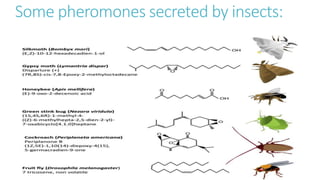
Some pheromones secreted by insects:
Actions of Pheromones:
1. Aggregation pheromones:
Its functions in the defence against predators, mate selection, and overcoming host
resistance by mass attack. A group of individuals at one location are referred as
aggregation, whether consisting of one sex or both sexes.
Male-produced sex attractant have been called aggregation pheromones, because
they usually result in the arrival of both sexes at a calling site and increase in density
of conspecifics surrounding of the pheromone source.
Most sex pheromones are produced by the females and small percentage of sex
attractants are produced by males
Actions of Pheromones:
2. Alarm pheromones:
Some species that releases a volatile substance, when attacked by a predator that can
trigger flight or aggression in ants, insects are the members of the same species.
Pheromones also exist in plants: certain plants emit alarm pheromones when grazed
upon, resulting in tannin production in the neighbouring plants. These tannins make
the plants less appetizing for the herbivores.
Actions of Pheromones:
3. Epideictic pheromones:
Epideictic pheromones are somewhat different from territory pheromones, when it
comes to insects.
Fabre observed and noted how “females who lay their eggs in these fruits deposit
these mysterious substances in the vicinity of their clutch to signal to other females of
the same species they should clutch elsewhere.
Actions of Pheromones:
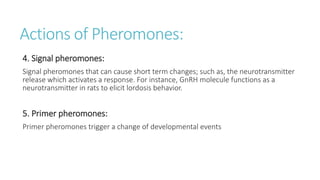
4. Signal pheromones:
Signal pheromones that can cause short term changes; such as, the neurotransmitter
release which activates a response. For instance, GnRH molecule functions as a
neurotransmitter in rats to elicit lordosis behavior.
5. Primer pheromones:
Primer pheromones trigger a change of developmental events
Actions of Pheromones:
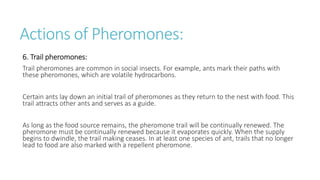
6. Trail pheromones:
Trail pheromones are common in social insects. For example, ants mark their paths with
these pheromones, which are volatile hydrocarbons.
Certain ants lay down an initial trail of pheromones as they return to the nest with food. This
trail attracts other ants and serves as a guide.
As long as the food source remains, the pheromone trail will be continually renewed. The
pheromone must be continually renewed because it evaporates quickly. When the supply
begins to dwindle, the trail making ceases. In at least one species of ant, trails that no longer
lead to food are also marked with a repellent pheromone.
Actions of Pheromones:
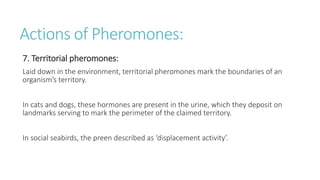
7. Territorial pheromones:
Laid down in the environment, territorial pheromones mark the boundaries of an
organism’s territory.
In cats and dogs, these hormones are present in the urine, which they deposit on
landmarks serving to mark the perimeter of the claimed territory.
In social seabirds, the preen described as ‘displacement activity’.
Actions of Pheromones:
8. Information pheromones:
Information pheromones are indicative of an animal’s identity or territory. For
example, dogs and cats deposit chemicals in and around their territory, which then
serve as an indicator for other members of the species about the presence of the
occupant in that territory.
9. Sex pheromones:
In animals, sex pheromones indicate the availability of the female for breeding. Male
animals may also emit pheromones that convey information about their species and
genotype.
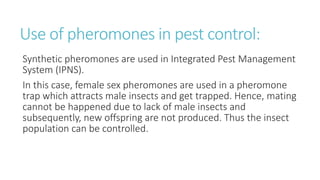
Use of pheromones in pest control:
Synthetic pheromones are used in Integrated Pest Management
System (IPNS).
In this case, female sex pheromones are used in a pheromone
trap which attracts male insects and get trapped. Hence, mating
cannot be happened due to lack of male insects and
subsequently, new offspring are not produced. Thus the insect
population can be controlled.
Some pheromone traps:
Pheromones.pptx

Pheromones.pptx

  • 2.
    What is Pheromone? ‘Pheromone’is the combination of Ancient Greek “phérō” means 'to bear', and 'hormone’. A pheromone is a secreted or excreted chemical factor that triggers a social response in members of the same species. Pheromones are chemicals capable of acting like hormones outside the body of the secreting individual, to affect the behavior of the receiving individuals.
  • 3.
    Animals secrete pheromonesto trigger many types of behaviours, including: Aggregation pheromones Alarm pheromones Epideictic pheromones Releaser pheromones Primer pheromones Signal pheromones Territorial pheromones Trail pheromones Information pheromones
  • 4.
  • 5.
    Actions of Pheromones: 1.Aggregation pheromones: Its functions in the defence against predators, mate selection, and overcoming host resistance by mass attack. A group of individuals at one location are referred as aggregation, whether consisting of one sex or both sexes. Male-produced sex attractant have been called aggregation pheromones, because they usually result in the arrival of both sexes at a calling site and increase in density of conspecifics surrounding of the pheromone source. Most sex pheromones are produced by the females and small percentage of sex attractants are produced by males
  • 6.
    Actions of Pheromones: 2.Alarm pheromones: Some species that releases a volatile substance, when attacked by a predator that can trigger flight or aggression in ants, insects are the members of the same species. Pheromones also exist in plants: certain plants emit alarm pheromones when grazed upon, resulting in tannin production in the neighbouring plants. These tannins make the plants less appetizing for the herbivores.
  • 7.
    Actions of Pheromones: 3.Epideictic pheromones: Epideictic pheromones are somewhat different from territory pheromones, when it comes to insects. Fabre observed and noted how “females who lay their eggs in these fruits deposit these mysterious substances in the vicinity of their clutch to signal to other females of the same species they should clutch elsewhere.
  • 8.
    Actions of Pheromones: 4.Signal pheromones: Signal pheromones that can cause short term changes; such as, the neurotransmitter release which activates a response. For instance, GnRH molecule functions as a neurotransmitter in rats to elicit lordosis behavior. 5. Primer pheromones: Primer pheromones trigger a change of developmental events
  • 9.
    Actions of Pheromones: 6.Trail pheromones: Trail pheromones are common in social insects. For example, ants mark their paths with these pheromones, which are volatile hydrocarbons. Certain ants lay down an initial trail of pheromones as they return to the nest with food. This trail attracts other ants and serves as a guide. As long as the food source remains, the pheromone trail will be continually renewed. The pheromone must be continually renewed because it evaporates quickly. When the supply begins to dwindle, the trail making ceases. In at least one species of ant, trails that no longer lead to food are also marked with a repellent pheromone.
  • 10.
    Actions of Pheromones: 7.Territorial pheromones: Laid down in the environment, territorial pheromones mark the boundaries of an organism’s territory. In cats and dogs, these hormones are present in the urine, which they deposit on landmarks serving to mark the perimeter of the claimed territory. In social seabirds, the preen described as ‘displacement activity’.
  • 11.
    Actions of Pheromones: 8.Information pheromones: Information pheromones are indicative of an animal’s identity or territory. For example, dogs and cats deposit chemicals in and around their territory, which then serve as an indicator for other members of the species about the presence of the occupant in that territory. 9. Sex pheromones: In animals, sex pheromones indicate the availability of the female for breeding. Male animals may also emit pheromones that convey information about their species and genotype.
  • 12.
    Use of pheromonesin pest control: Synthetic pheromones are used in Integrated Pest Management System (IPNS). In this case, female sex pheromones are used in a pheromone trap which attracts male insects and get trapped. Hence, mating cannot be happened due to lack of male insects and subsequently, new offspring are not produced. Thus the insect population can be controlled.
  • 13.