INSECT GROWTH
REGULATORS
Chairman: Dr. Vivekanand
Gradial Seminar
BPC789
Presented by: Himani
Id: 53942
Ph.D. Agricultural Chemicals
Contents
• Introduction
• Growth regulation of insects
• Classification of IGRs
• Synthetic IGRs
• Juvenile hormone
• Anti-juvenile hormone
• Chitin synthesis inhibitors
• Moulting hormone analogues
• Natural IGRs
• Advantage
• Disadvantage
• References
INTRODUCTION
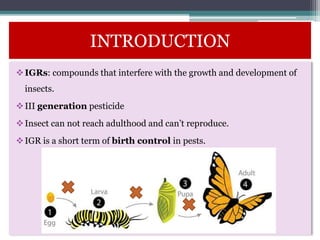
IGRs: compounds that interfere with the growth and development of
insects.
III generation pesticide
Insect can not reach adulthood and can’t reproduce.
IGR is a short term of birth control in pests.
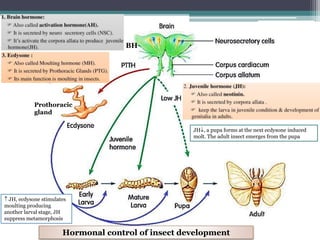
Hormonal control of insect development
Prothoracic
gland
BH
 JH, ecdysone stimulates
moulting producing
another larval stage, JH
suppress metamorphosis
JH, a pupa forms at the next ecdysone induced
molt. The adult insect emerges from the pupa
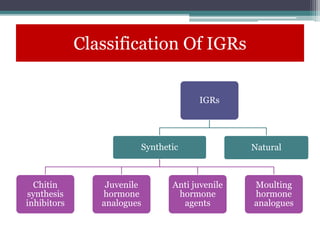
IGRs
Synthetic
Chitin
synthesis
inhibitors
Juvenile
hormone
analogues
Anti juvenile
hormone
agents
Moulting
hormone
analogues
Natural
Classification Of IGRs
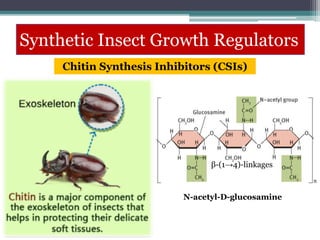
Synthetic Insect Growth Regulators
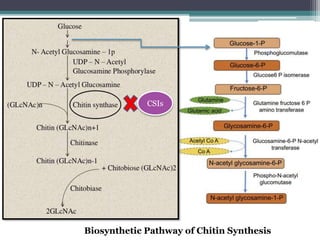
Chitin Synthesis Inhibitors (CSIs)
N-acetyl-D-glucosamine
β-(1→4)-linkages
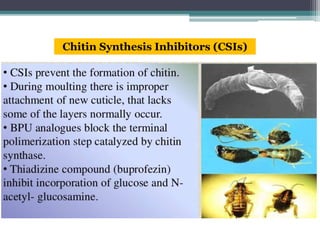
Chitin Synthesis Inhibitors (CSIs)
CSIs
Biosynthetic Pathway of Chitin Synthesis
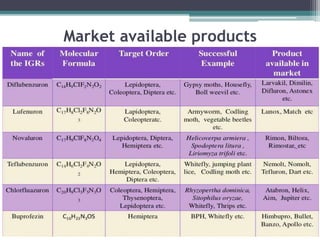
Market available products
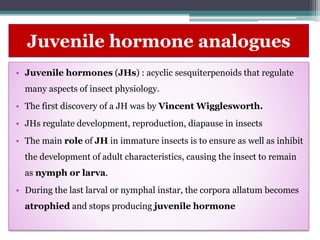
Juvenile hormone analogues
• Juvenile hormones (JHs) : acyclic sesquiterpenoids that regulate
many aspects of insect physiology.
• The first discovery of a JH was by Vincent Wigglesworth.
• JHs regulate development, reproduction, diapause in insects
• The main role of JH in immature insects is to ensure as well as inhibit
the development of adult characteristics, causing the insect to remain
as nymph or larva.
• During the last larval or nymphal instar, the corpora allatum becomes
atrophied and stops producing juvenile hormone
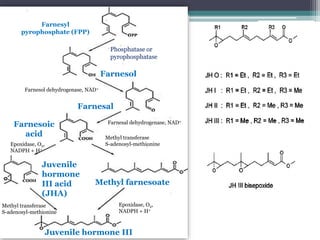
Farnesyl
pyrophosphate (FPP)
Phosphatase or
pyrophosphatase
Farnesol
Farnesol dehydrogenase, NAD+
Farnesal
Farnesal dehydrogenase, NAD+
Farnesoic
acid
Methyl transferase
S-adenosyl-methionine
Epoxidase, O2,
NADPH + H+
Epoxidase, O2,
NADPH + H+
Juvenile
hormone
III acid
(JHA)
Methyl transferase
S-adenosyl-methionine
Methyl farnesoate
Juvenile hormone III
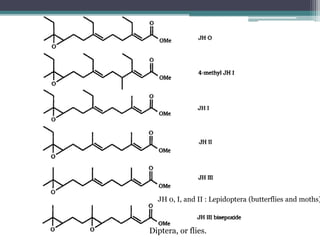
JH 0, I, and II : Lepidoptera (butterflies and moths)
Diptera, or flies.
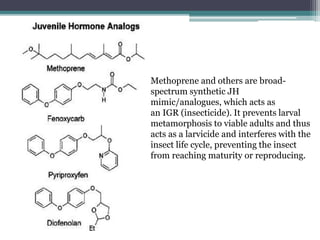
Methoprene and others are broad-
spectrum synthetic JH
mimic/analogues, which acts as
an IGR (insecticide). It prevents larval
metamorphosis to viable adults and thus
acts as a larvicide and interferes with the
insect life cycle, preventing the insect
from reaching maturity or reproducing.
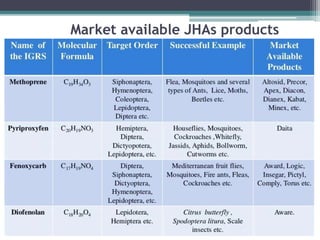
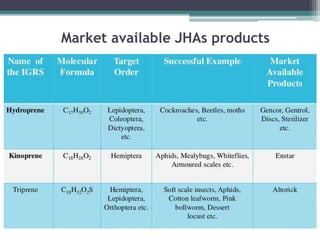
Market available JHAs products
Anti-juvenile hormone agents (Precocenes)
• They act by destroying corpora allata (CA) and preventing JH synthesis.
• When treated on immature stages of insect, they skip one or two larval instars and turn into
tiny precocious adults.
• They can neither mate, nor oviposit and die soon.
• Fluoromevalonate (FMev) exhibited anti-JH activity in Lepidoptera
• Piperonyl Butoxide: mixed function oxidase (MFO) inhibitor, inhibits oxidative
degradation of xenobiotics and used as a synergist with pyrethrin / pesticides and
inhibits JH biosynthesis in terminal steps
• Precocenes exert cytotoxic action on the insect CA by an oxidative bioactivation and
prevent JH production.
• Physiological and behavioral changes induced by precocenes : precocious
metamorphosis, sterilization of adults,suppressed ovarian development, induction of
diapause and inhibition of sex pheromone production.
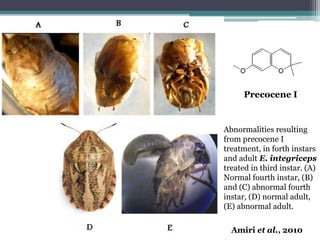
Abnormalities resulting
from precocene I
treatment, in forth instars
and adult E. integriceps
treated in third instar. (A)
Normal fourth instar, (B)
and (C) abnormal fourth
instar, (D) normal adult,
(E) abnormal adult.
Amiri et al., 2010
Precocene I
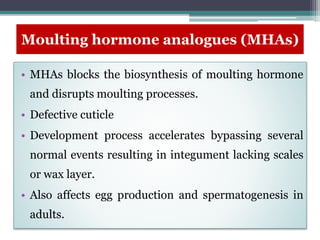
Moulting hormone analogues (MHAs)
• MHAs blocks the biosynthesis of moulting hormone
and disrupts moulting processes.
• Defective cuticle
• Development process accelerates bypassing several
normal events resulting in integument lacking scales
or wax layer.
• Also affects egg production and spermatogenesis in
adults.
Ecdysone (molting agonist/initiator)
• Ecdysone is a steroid hormone secreted by prothoracic gland that, in its active
form, stimulates metamorphosis and regulates molting in insects.
• 20-Hydroxyecdysone (ecdysterone or 20E) is a naturally occurring
ecdysteroid hormone which controls the ecdysis (moulting) and
metamorphosis of arthropods.
ecdysone 20 monooxygenase
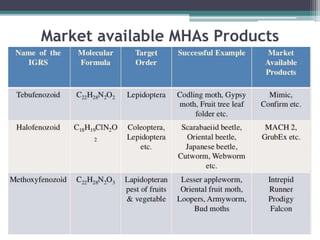
Market available MHAs Products
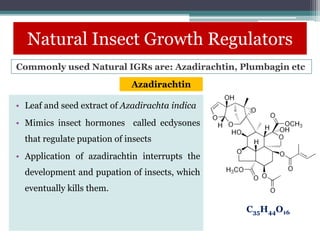
• Leaf and seed extract of Azadirachta indica
• Mimics insect hormones called ecdysones
that regulate pupation of insects
• Application of azadirachtin interrupts the
development and pupation of insects, which
eventually kills them.
Natural Insect Growth Regulators
Commonly used Natural IGRs are: Azadirachtin, Plumbagin etc
Azadirachtin
C35H44O16
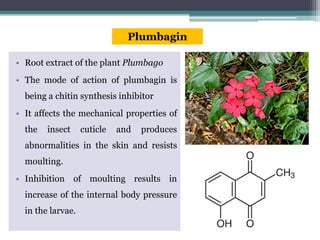
• Root extract of the plant Plumbago
• The mode of action of plumbagin is
being a chitin synthesis inhibitor
• It affects the mechanical properties of
the insect cuticle and produces
abnormalities in the skin and resists
moulting.
• Inhibition of moulting results in
increase of the internal body pressure
in the larvae.
Plumbagin
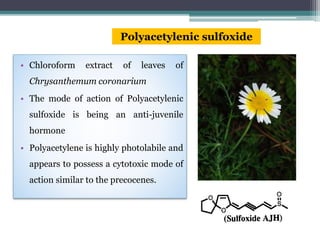
• Chloroform extract of leaves of
Chrysanthemum coronarium
• The mode of action of Polyacetylenic
sulfoxide is being an anti-juvenile
hormone
• Polyacetylene is highly photolabile and
appears to possess a cytotoxic mode of
action similar to the precocenes.
Polyacetylenic sulfoxide
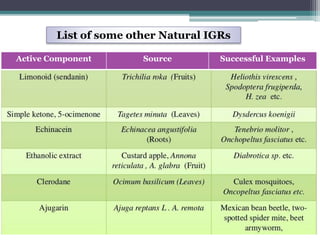
Active Component Source Successful Examples
List of some other Natural IGRs
Advantages of IGRs Disadvantages of IGRs
• Effective in minute quantities, so
are economical.
• Target specific, safe to natural
enemies.
• Bio-degradable, non-persistant,
non-polluting
• Non-toxic to human, ani.mals
• Well fitted into IPM programme.
Comes under biorationals
• Less chances to resistance.
• Kills only certain stages of pest.
• Slow mode of action (IGRs work
by interfering with an insect's
molting process. Death 3-10
days)
• Not easily available.
• High cost
• Unstable in the environment
References
1. Gad, M., Aref, S., Abdelhamid, A., Elwassimy, M., & Abdel-
Raheem, S. (2021). Biologically active organic compounds as
insect growth regulators (IGRs): introduction, mode of action, and
some synthetic methods. Current Chemistry Letters, 10(4), 393-
412.
2. Tunaz, H., & Uygun, N. (2004). Insect growth regulators for insect
pest control. Turkish Journal of Agriculture and Forestry, 28(6),
377-387.
3. http://eagri.org/eagri50/ENTO232/lec23.pdf
INSECT_GROWTH_REGULATORS.pptx

INSECT_GROWTH_REGULATORS.pptx

  • 1.
    INSECT GROWTH REGULATORS Chairman: Dr.Vivekanand Gradial Seminar BPC789 Presented by: Himani Id: 53942 Ph.D. Agricultural Chemicals
  • 2.
    Contents • Introduction • Growthregulation of insects • Classification of IGRs • Synthetic IGRs • Juvenile hormone • Anti-juvenile hormone • Chitin synthesis inhibitors • Moulting hormone analogues • Natural IGRs • Advantage • Disadvantage • References
  • 3.
    INTRODUCTION IGRs: compounds thatinterfere with the growth and development of insects. III generation pesticide Insect can not reach adulthood and can’t reproduce. IGR is a short term of birth control in pests.
  • 4.
    Hormonal control ofinsect development Prothoracic gland BH  JH, ecdysone stimulates moulting producing another larval stage, JH suppress metamorphosis JH, a pupa forms at the next ecdysone induced molt. The adult insect emerges from the pupa
  • 5.
  • 6.
    Synthetic Insect GrowthRegulators Chitin Synthesis Inhibitors (CSIs) N-acetyl-D-glucosamine β-(1→4)-linkages
  • 7.
  • 8.
  • 9.
  • 10.
    Juvenile hormone analogues •Juvenile hormones (JHs) : acyclic sesquiterpenoids that regulate many aspects of insect physiology. • The first discovery of a JH was by Vincent Wigglesworth. • JHs regulate development, reproduction, diapause in insects • The main role of JH in immature insects is to ensure as well as inhibit the development of adult characteristics, causing the insect to remain as nymph or larva. • During the last larval or nymphal instar, the corpora allatum becomes atrophied and stops producing juvenile hormone
  • 11.
    Farnesyl pyrophosphate (FPP) Phosphatase or pyrophosphatase Farnesol Farnesoldehydrogenase, NAD+ Farnesal Farnesal dehydrogenase, NAD+ Farnesoic acid Methyl transferase S-adenosyl-methionine Epoxidase, O2, NADPH + H+ Epoxidase, O2, NADPH + H+ Juvenile hormone III acid (JHA) Methyl transferase S-adenosyl-methionine Methyl farnesoate Juvenile hormone III
  • 12.
    JH 0, I,and II : Lepidoptera (butterflies and moths) Diptera, or flies.
  • 13.
    Methoprene and othersare broad- spectrum synthetic JH mimic/analogues, which acts as an IGR (insecticide). It prevents larval metamorphosis to viable adults and thus acts as a larvicide and interferes with the insect life cycle, preventing the insect from reaching maturity or reproducing.
  • 14.
  • 15.
  • 16.
    Anti-juvenile hormone agents(Precocenes) • They act by destroying corpora allata (CA) and preventing JH synthesis. • When treated on immature stages of insect, they skip one or two larval instars and turn into tiny precocious adults. • They can neither mate, nor oviposit and die soon. • Fluoromevalonate (FMev) exhibited anti-JH activity in Lepidoptera • Piperonyl Butoxide: mixed function oxidase (MFO) inhibitor, inhibits oxidative degradation of xenobiotics and used as a synergist with pyrethrin / pesticides and inhibits JH biosynthesis in terminal steps • Precocenes exert cytotoxic action on the insect CA by an oxidative bioactivation and prevent JH production. • Physiological and behavioral changes induced by precocenes : precocious metamorphosis, sterilization of adults,suppressed ovarian development, induction of diapause and inhibition of sex pheromone production.
  • 17.
    Abnormalities resulting from precoceneI treatment, in forth instars and adult E. integriceps treated in third instar. (A) Normal fourth instar, (B) and (C) abnormal fourth instar, (D) normal adult, (E) abnormal adult. Amiri et al., 2010 Precocene I
  • 18.
    Moulting hormone analogues(MHAs) • MHAs blocks the biosynthesis of moulting hormone and disrupts moulting processes. • Defective cuticle • Development process accelerates bypassing several normal events resulting in integument lacking scales or wax layer. • Also affects egg production and spermatogenesis in adults.
  • 19.
    Ecdysone (molting agonist/initiator) •Ecdysone is a steroid hormone secreted by prothoracic gland that, in its active form, stimulates metamorphosis and regulates molting in insects. • 20-Hydroxyecdysone (ecdysterone or 20E) is a naturally occurring ecdysteroid hormone which controls the ecdysis (moulting) and metamorphosis of arthropods. ecdysone 20 monooxygenase
  • 20.
  • 21.
    • Leaf andseed extract of Azadirachta indica • Mimics insect hormones called ecdysones that regulate pupation of insects • Application of azadirachtin interrupts the development and pupation of insects, which eventually kills them. Natural Insect Growth Regulators Commonly used Natural IGRs are: Azadirachtin, Plumbagin etc Azadirachtin C35H44O16
  • 22.
    • Root extractof the plant Plumbago • The mode of action of plumbagin is being a chitin synthesis inhibitor • It affects the mechanical properties of the insect cuticle and produces abnormalities in the skin and resists moulting. • Inhibition of moulting results in increase of the internal body pressure in the larvae. Plumbagin
  • 23.
    • Chloroform extractof leaves of Chrysanthemum coronarium • The mode of action of Polyacetylenic sulfoxide is being an anti-juvenile hormone • Polyacetylene is highly photolabile and appears to possess a cytotoxic mode of action similar to the precocenes. Polyacetylenic sulfoxide
  • 24.
    Active Component SourceSuccessful Examples List of some other Natural IGRs
  • 25.
    Advantages of IGRsDisadvantages of IGRs • Effective in minute quantities, so are economical. • Target specific, safe to natural enemies. • Bio-degradable, non-persistant, non-polluting • Non-toxic to human, ani.mals • Well fitted into IPM programme. Comes under biorationals • Less chances to resistance. • Kills only certain stages of pest. • Slow mode of action (IGRs work by interfering with an insect's molting process. Death 3-10 days) • Not easily available. • High cost • Unstable in the environment
  • 26.
    References 1. Gad, M.,Aref, S., Abdelhamid, A., Elwassimy, M., & Abdel- Raheem, S. (2021). Biologically active organic compounds as insect growth regulators (IGRs): introduction, mode of action, and some synthetic methods. Current Chemistry Letters, 10(4), 393- 412. 2. Tunaz, H., & Uygun, N. (2004). Insect growth regulators for insect pest control. Turkish Journal of Agriculture and Forestry, 28(6), 377-387. 3. http://eagri.org/eagri50/ENTO232/lec23.pdf