AEN 202 MANAGEMENT OF BENEFICIAL AND HARMFUL INSECTS (2+1)
LEC No. Title
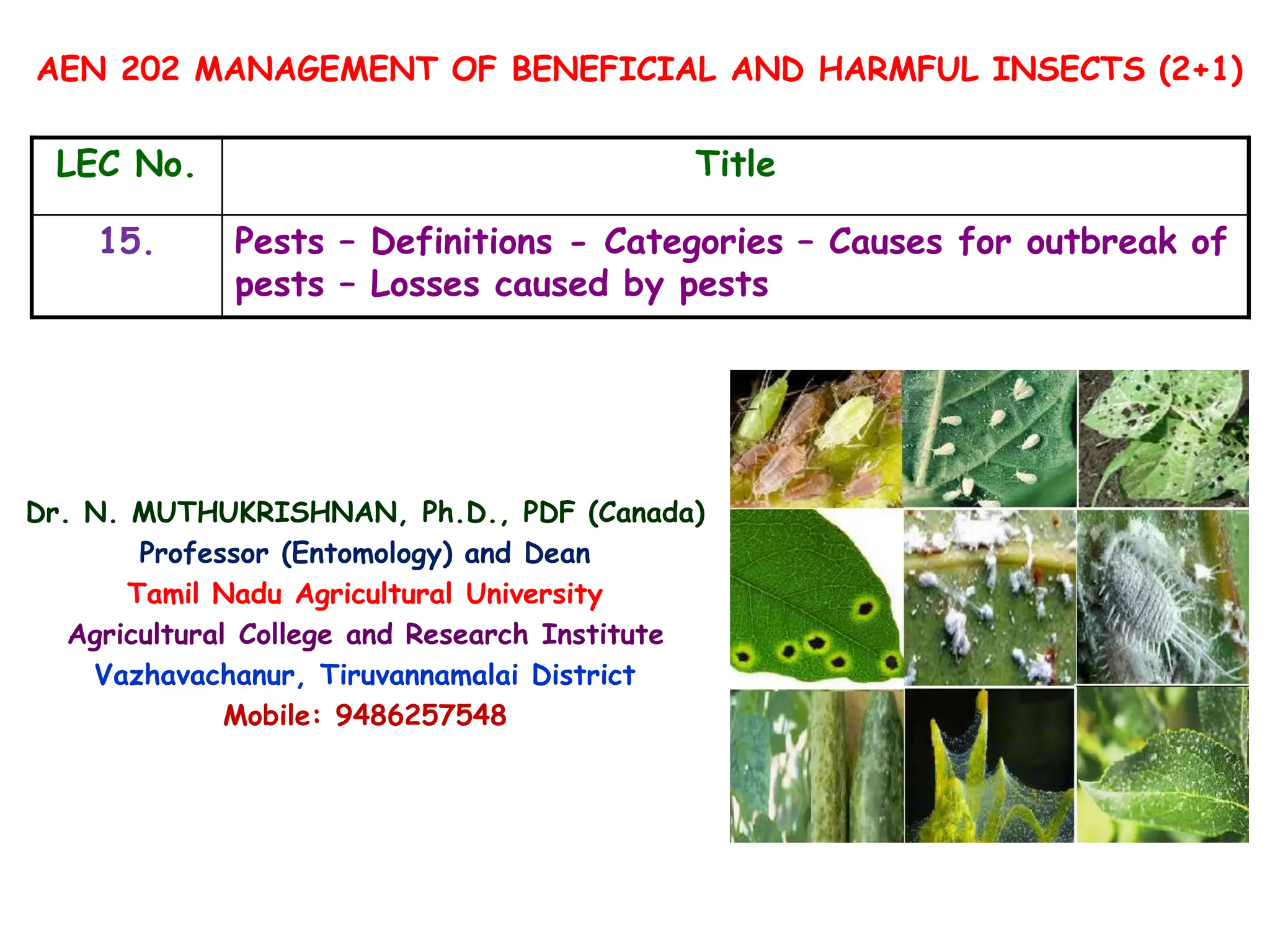
15. Pests – Definitions - Categories – Causes for outbreak of
pests – Losses caused by pests
Dr. N. MUTHUKRISHNAN, Ph.D., PDF (Canada)
Professor (Entomology) and Dean
Tamil Nadu Agricultural University
Agricultural College and Research Institute
Vazhavachanur, Tiruvannamalai District
Mobile: 9486257548
PEST DEFINITIONS
– Derived from French word ‘Peste’ - plague
or contagious disease
– Latin term ‘Pestis’ meaning – noxious,
destructive or troublesome
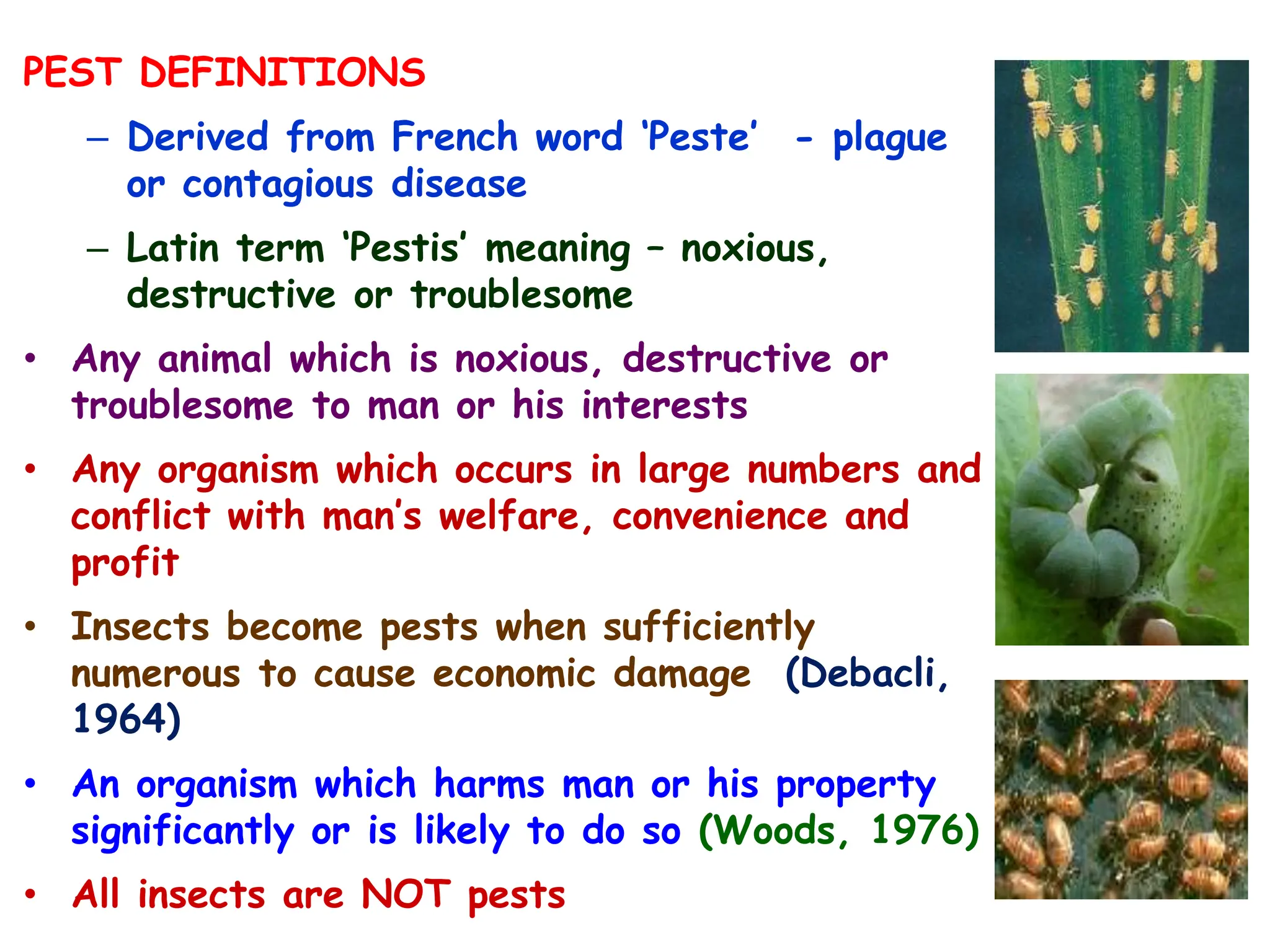
• Any animal which is noxious, destructive or
troublesome to man or his interests
• Any organism which occurs in large numbers and
conflict with man’s welfare, convenience and
profit
• Insects become pests when sufficiently
numerous to cause economic damage (Debacli,
1964)
• An organism which harms man or his property
significantly or is likely to do so (Woods, 1976)
• All insects are NOT pests
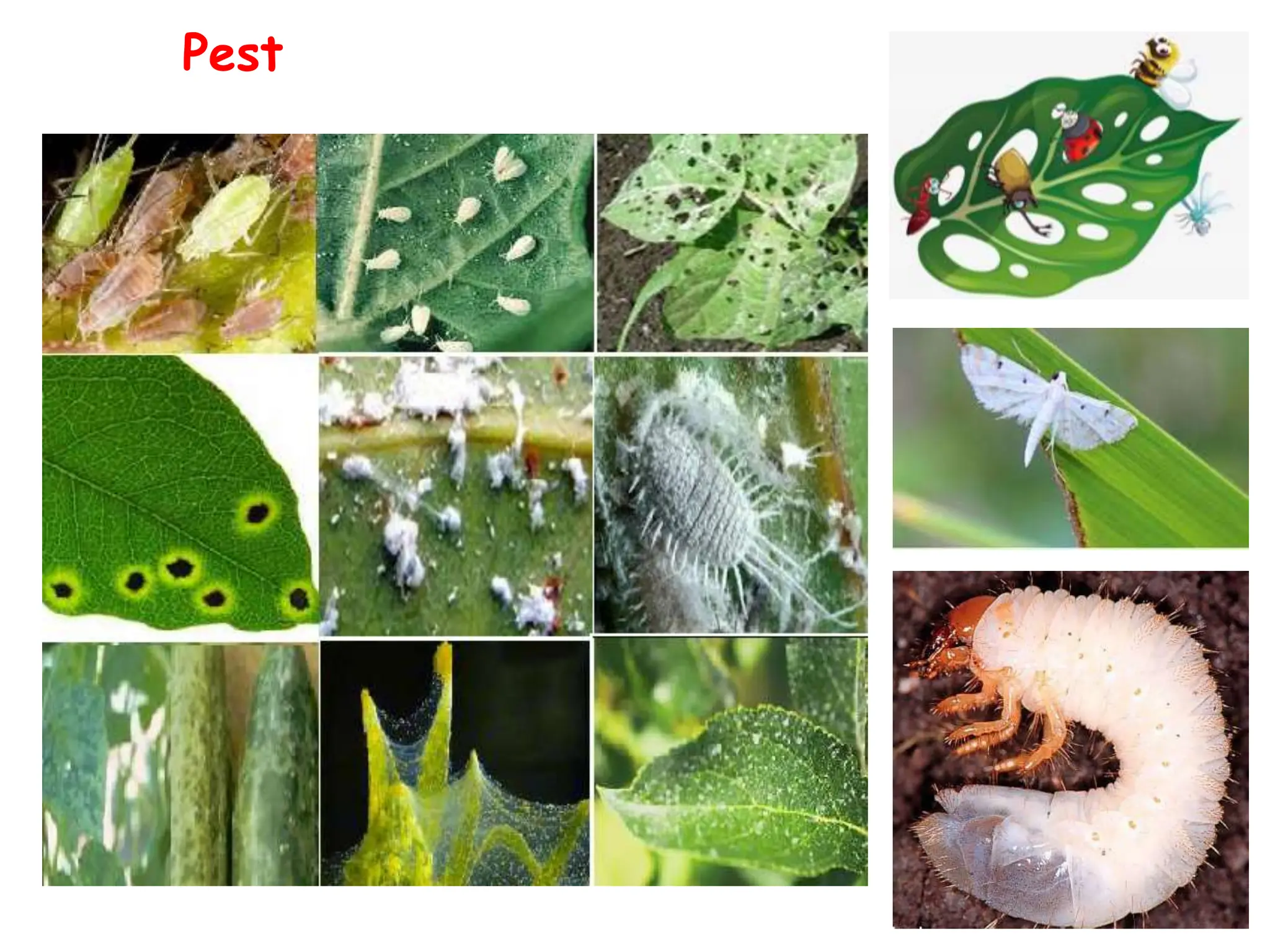
Pest
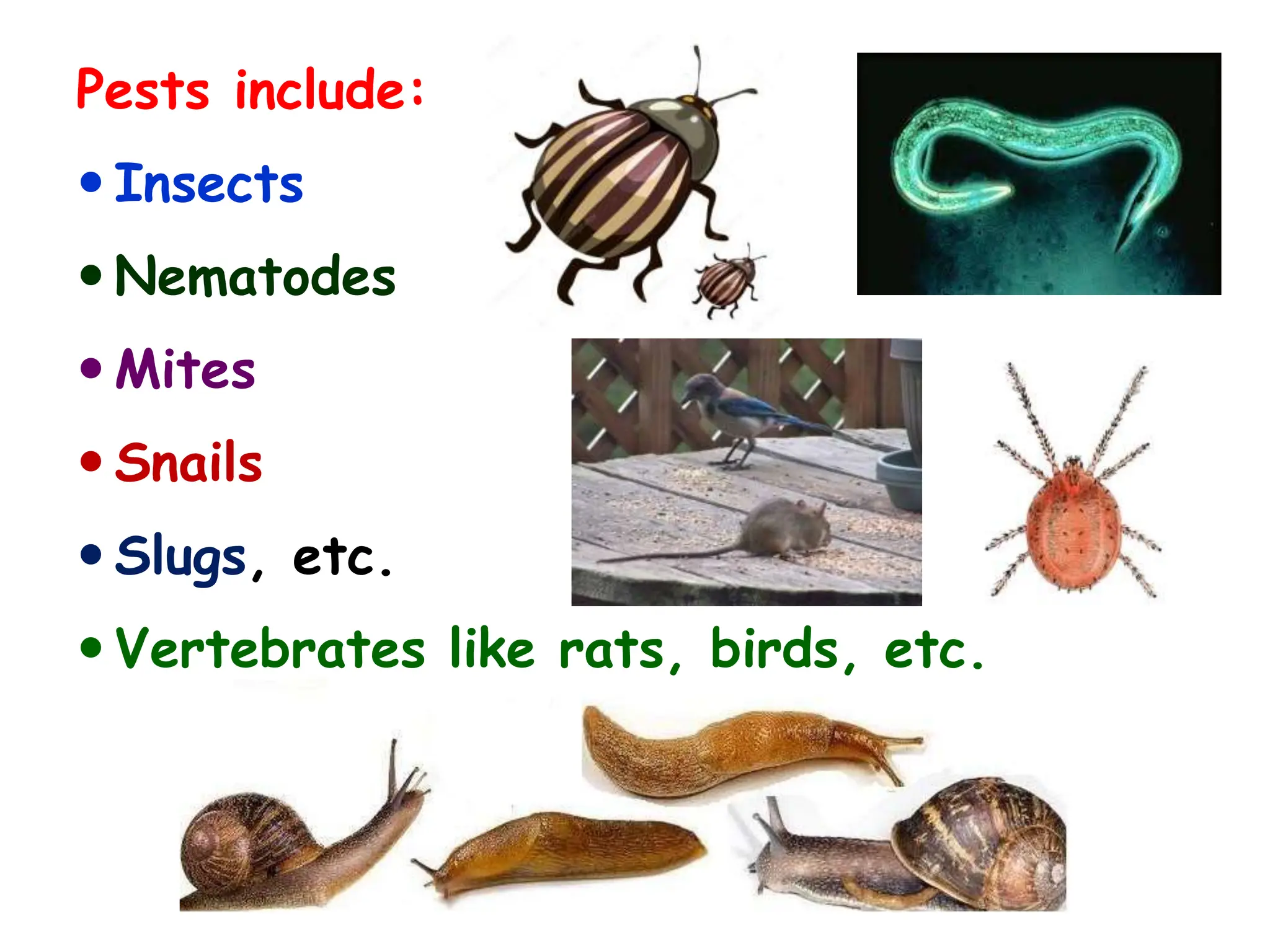
Pests include:
 Insects
 Nematodes
 Mites
 Snails
 Slugs, etc.
 Vertebrates like rats, birds, etc.
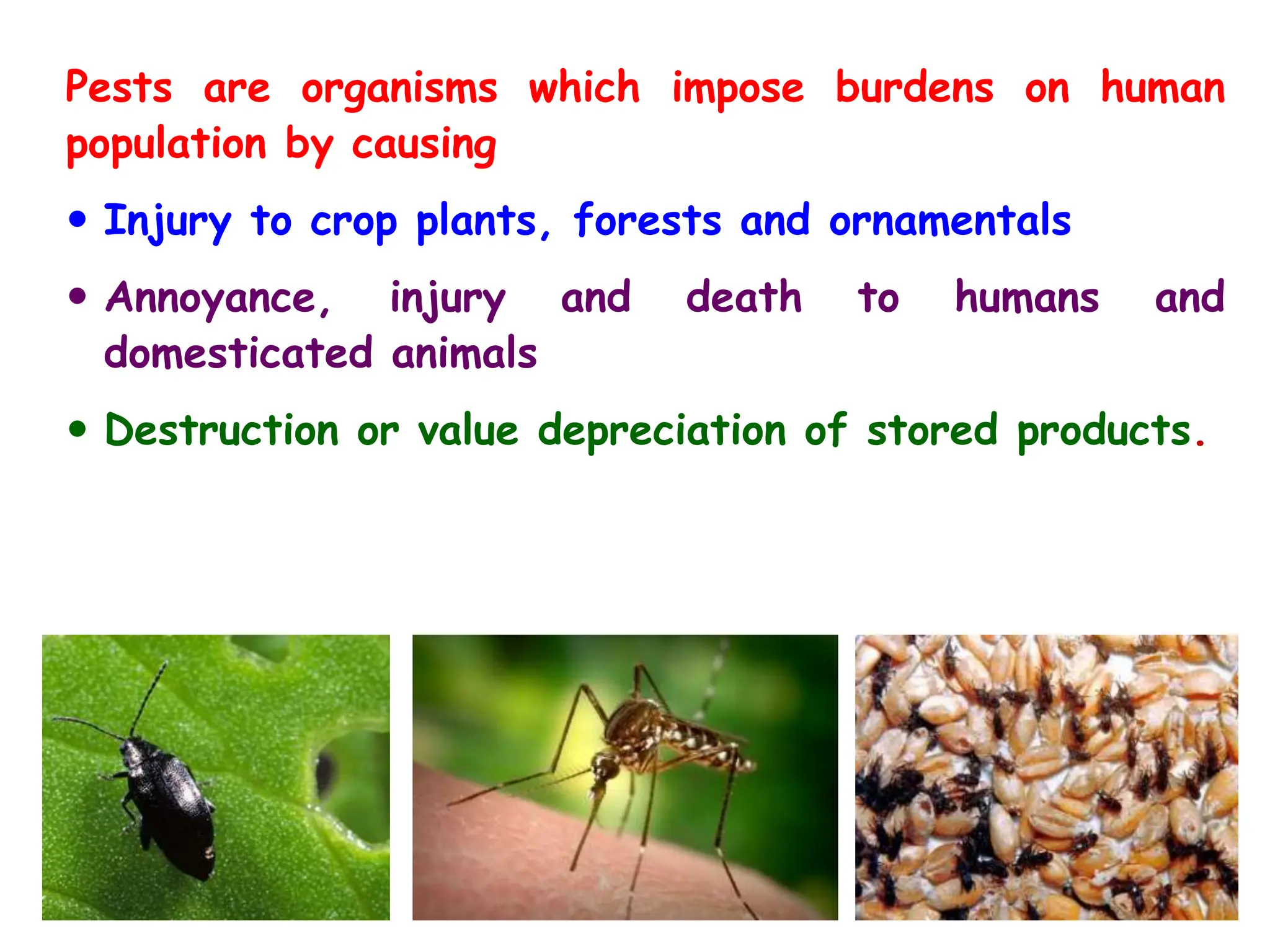
Pests are organisms which impose burdens on human
population by causing
 Injury to crop plants, forests and ornamentals
 Annoyance, injury and death to humans and
domesticated animals
 Destruction or value depreciation of stored products.
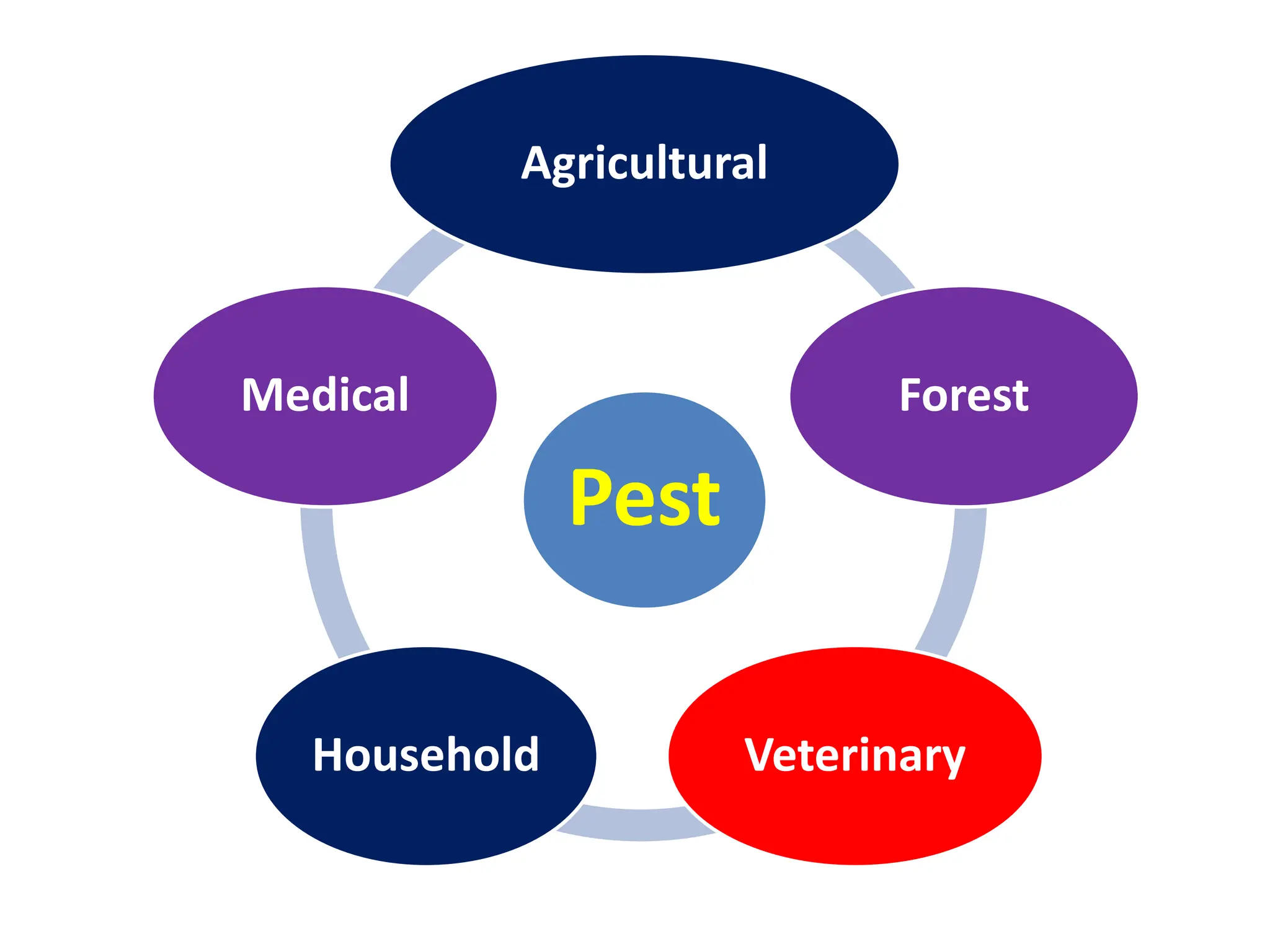
Pest
Agricultural
Forest
Veterinary
Household
Medical
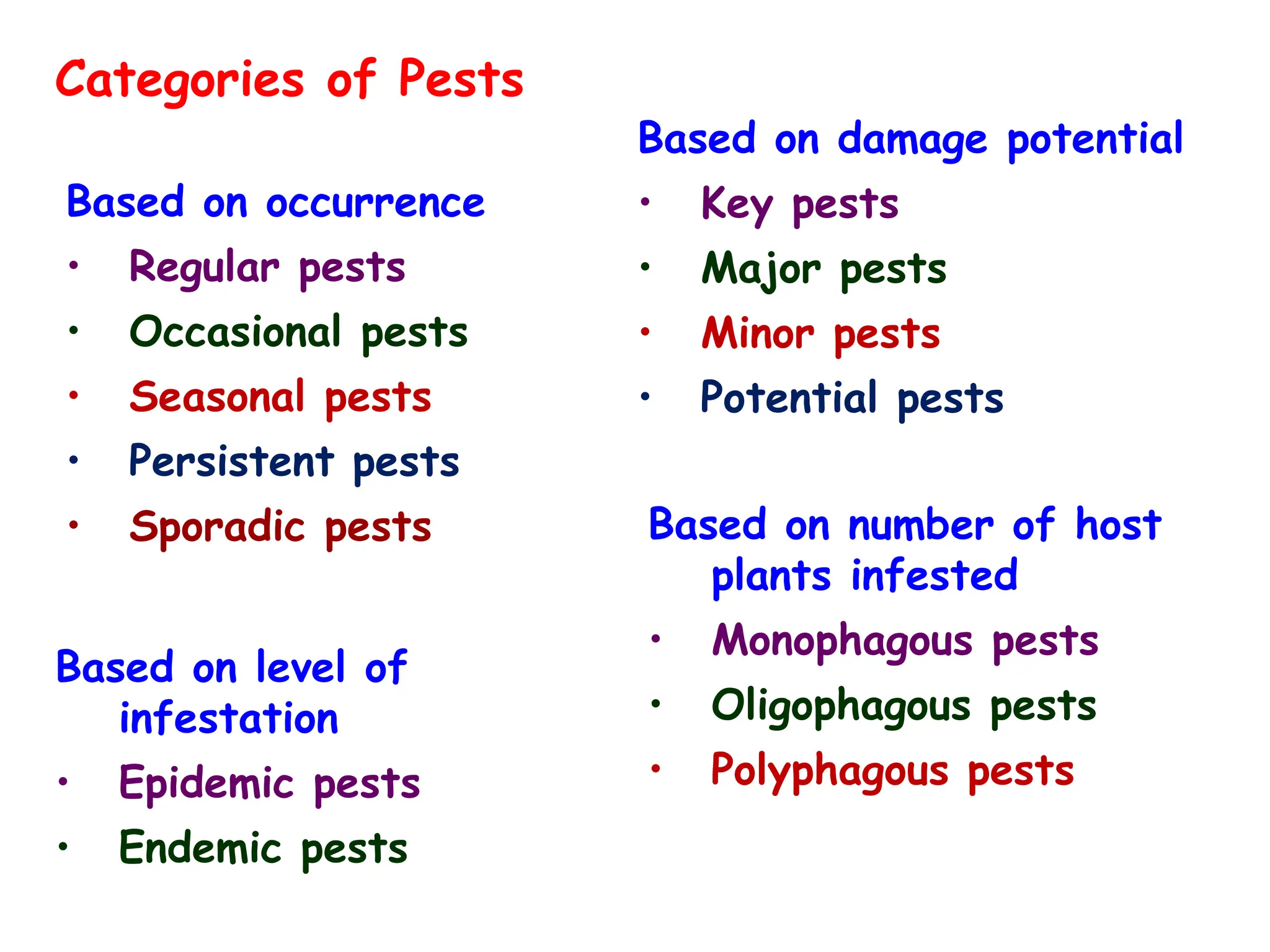
Based on occurrence
• Regular pests
• Occasional pests
• Seasonal pests
• Persistent pests
• Sporadic pests
Categories of Pests
Based on level of
infestation
• Epidemic pests
• Endemic pests
Based on number of host
plants infested
• Monophagous pests
• Oligophagous pests
• Polyphagous pests
Based on damage potential
• Key pests
• Major pests
• Minor pests
• Potential pests
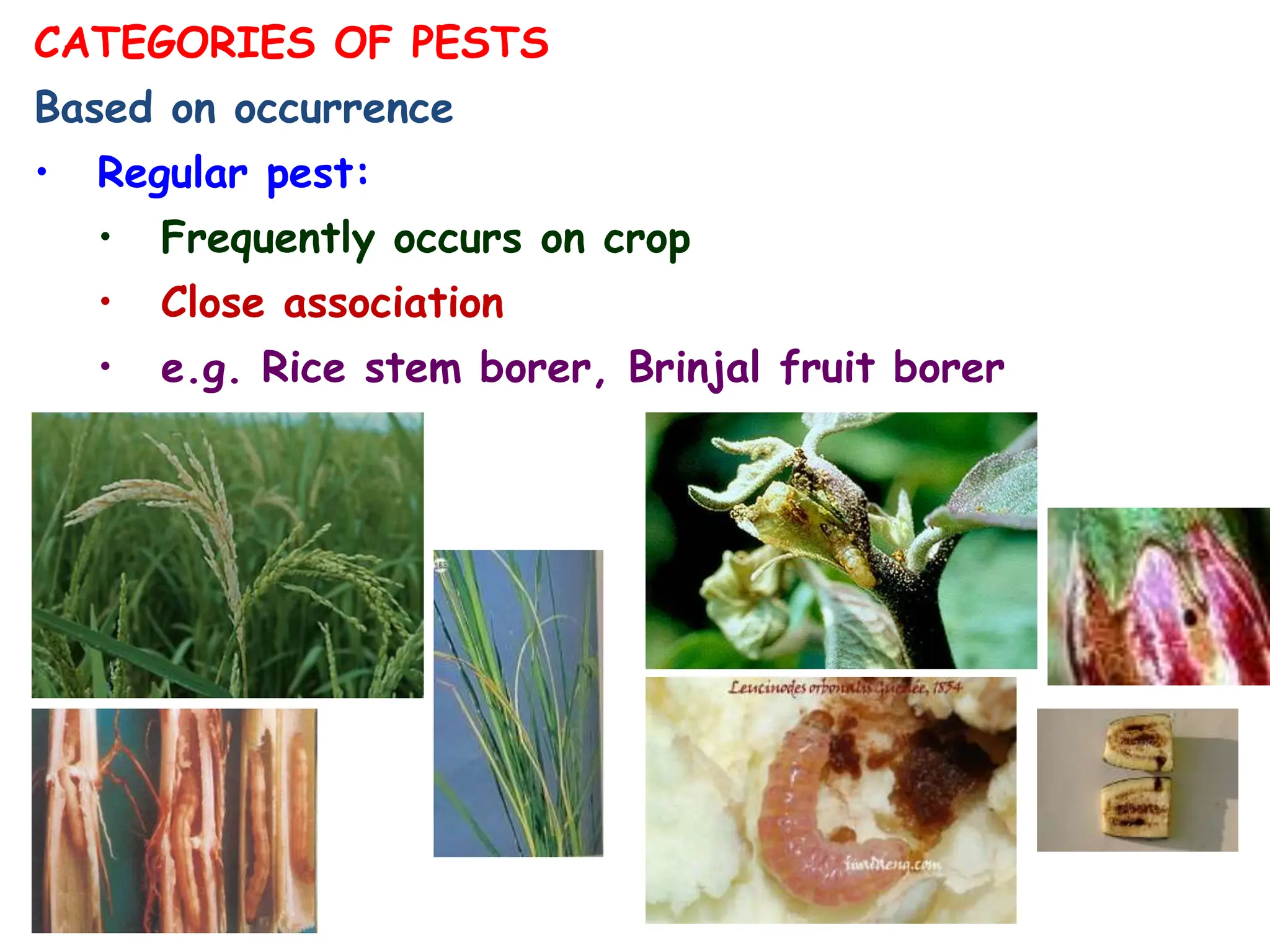
CATEGORIES OF PESTS
Based on occurrence
• Regular pest:
• Frequently occurs on crop
• Close association
• e.g. Rice stem borer, Brinjal fruit borer
CATEGORIES OF PESTS
Based on occurrence
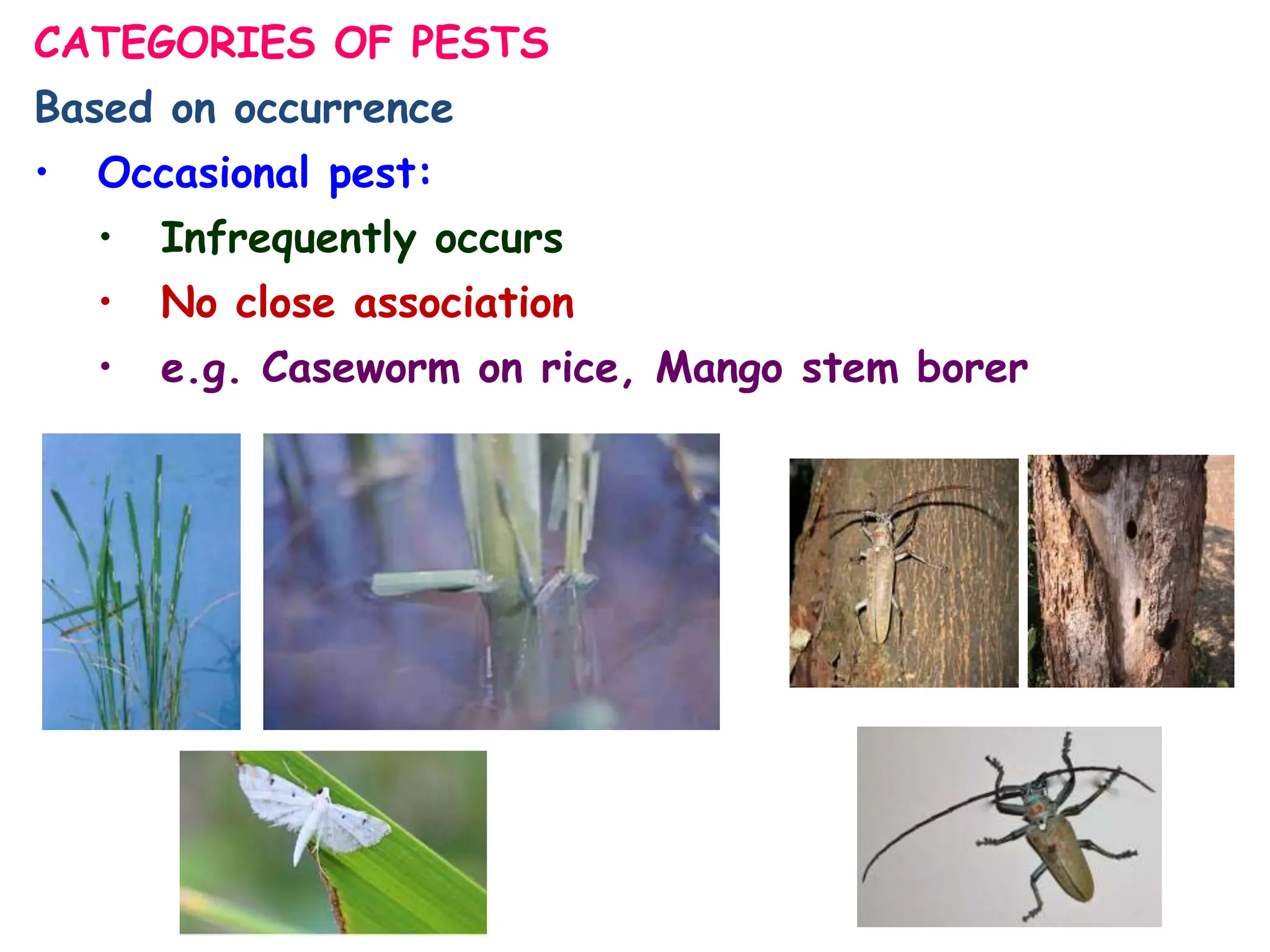
• Occasional pest:
• Infrequently occurs
• No close association
• e.g. Caseworm on rice, Mango stem borer
CATEGORIES OF PESTS
Based on occurrence
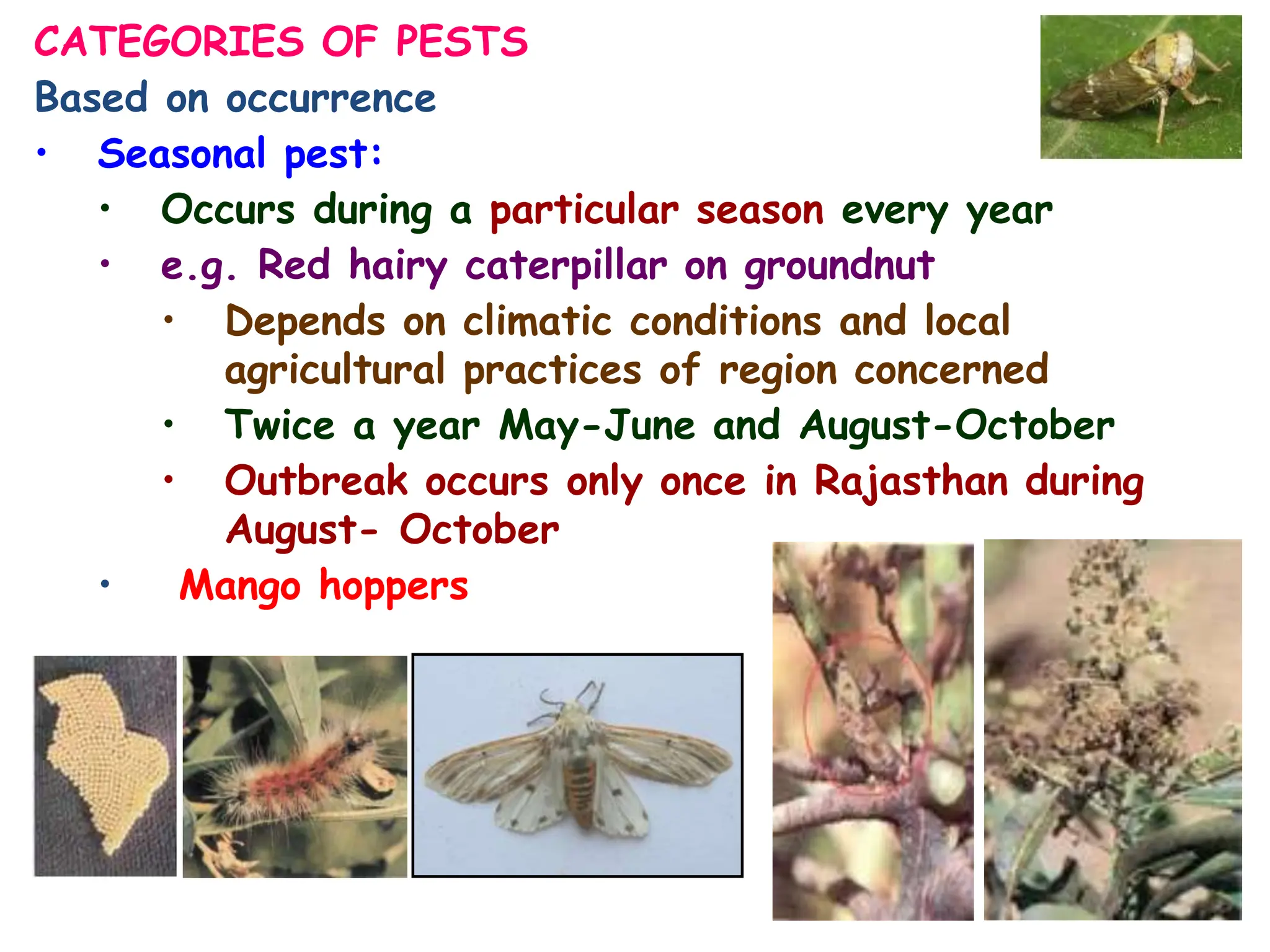
• Seasonal pest:
• Occurs during a particular season every year
• e.g. Red hairy caterpillar on groundnut
• Depends on climatic conditions and local
agricultural practices of region concerned
• Twice a year May-June and August-October
• Outbreak occurs only once in Rajasthan during
August- October
• Mango hoppers
Based on occurrence
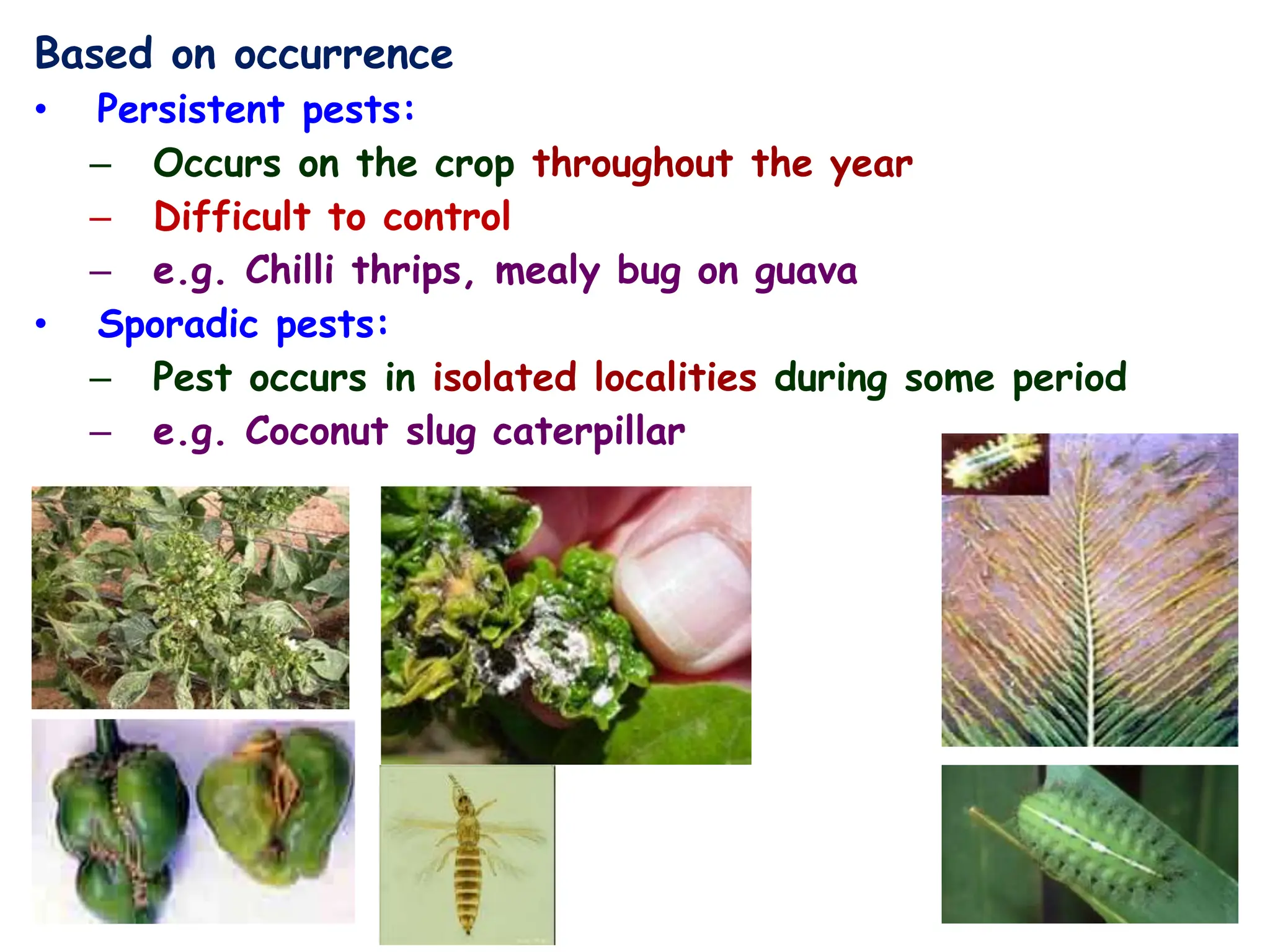
• Persistent pests:
– Occurs on the crop throughout the year
– Difficult to control
– e.g. Chilli thrips, mealy bug on guava
• Sporadic pests:
– Pest occurs in isolated localities during some period
– e.g. Coconut slug caterpillar
Based on level of infestation
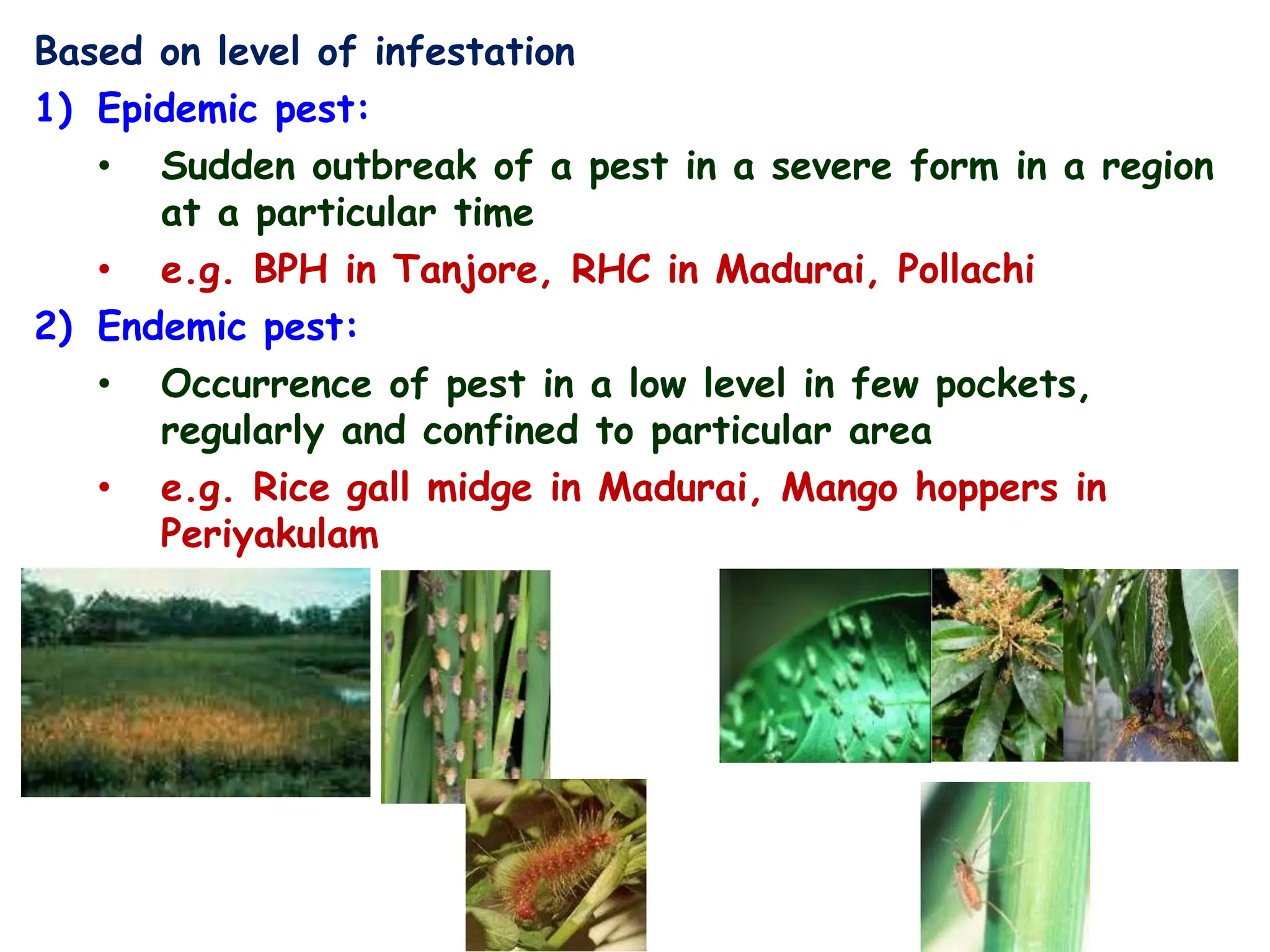
1) Epidemic pest:
• Sudden outbreak of a pest in a severe form in a region
at a particular time
• e.g. BPH in Tanjore, RHC in Madurai, Pollachi
2) Endemic pest:
• Occurrence of pest in a low level in few pockets,
regularly and confined to particular area
• e.g. Rice gall midge in Madurai, Mango hoppers in
Periyakulam
CATEGORIES OF PESTS
Based on the number of host plants attacked
• Monophagous
– Confined to a single species of plants
– Mulberry silk worm-very rare monophagous pest to find
– Most of monophagous pests –feed on a group of closely
related plants
• Oligophagous pest
– Characteristically feed on a group of botanically related
plants-within a single plant family
– Diamond back moth –confined to plants of Cruciferae
• Polyphagous pest
– Accept many plants from a diverse range of plant
families, even though preference still exist
– Locusts, grasshoppers, hairy caterpillaers, gram
caterpillar, cutworms, termites
Parameters of insect population levels
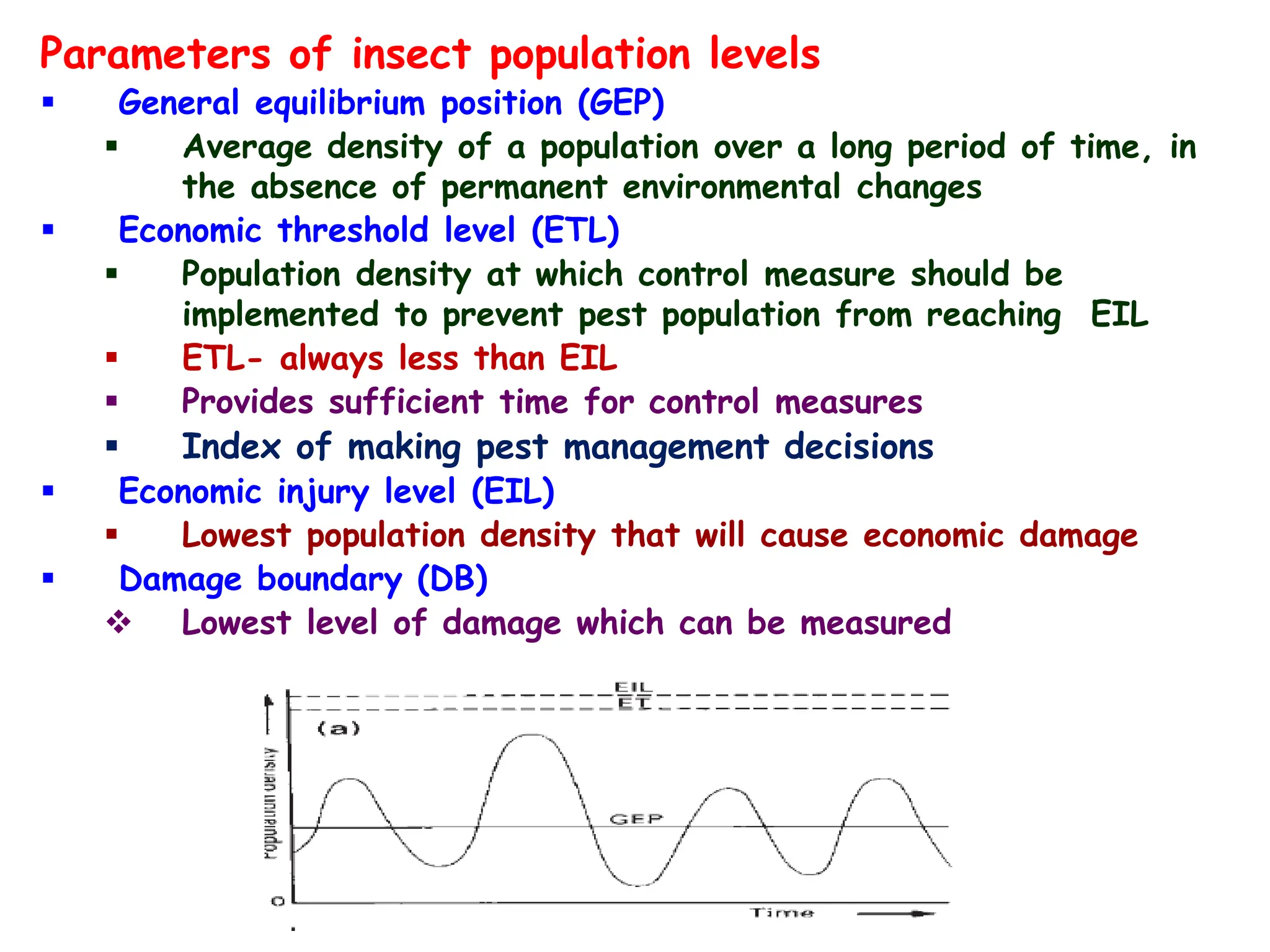
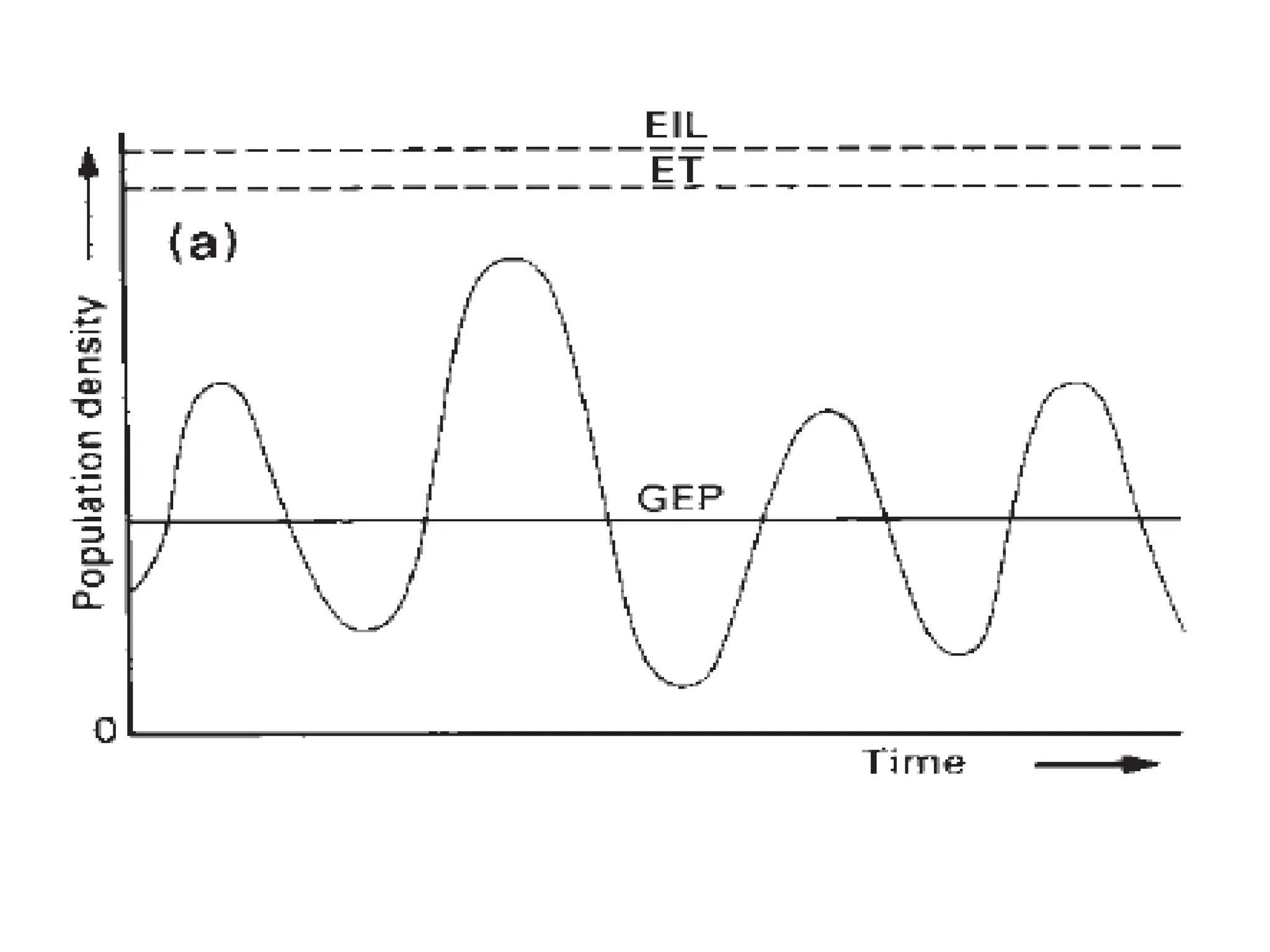
 General equilibrium position (GEP)
 Average density of a population over a long period of time, in
the absence of permanent environmental changes
 Economic threshold level (ETL)
 Population density at which control measure should be
implemented to prevent pest population from reaching EIL
 ETL- always less than EIL
 Provides sufficient time for control measures
 Index of making pest management decisions
 Economic injury level (EIL)
 Lowest population density that will cause economic damage
 Damage boundary (DB)
 Lowest level of damage which can be measured
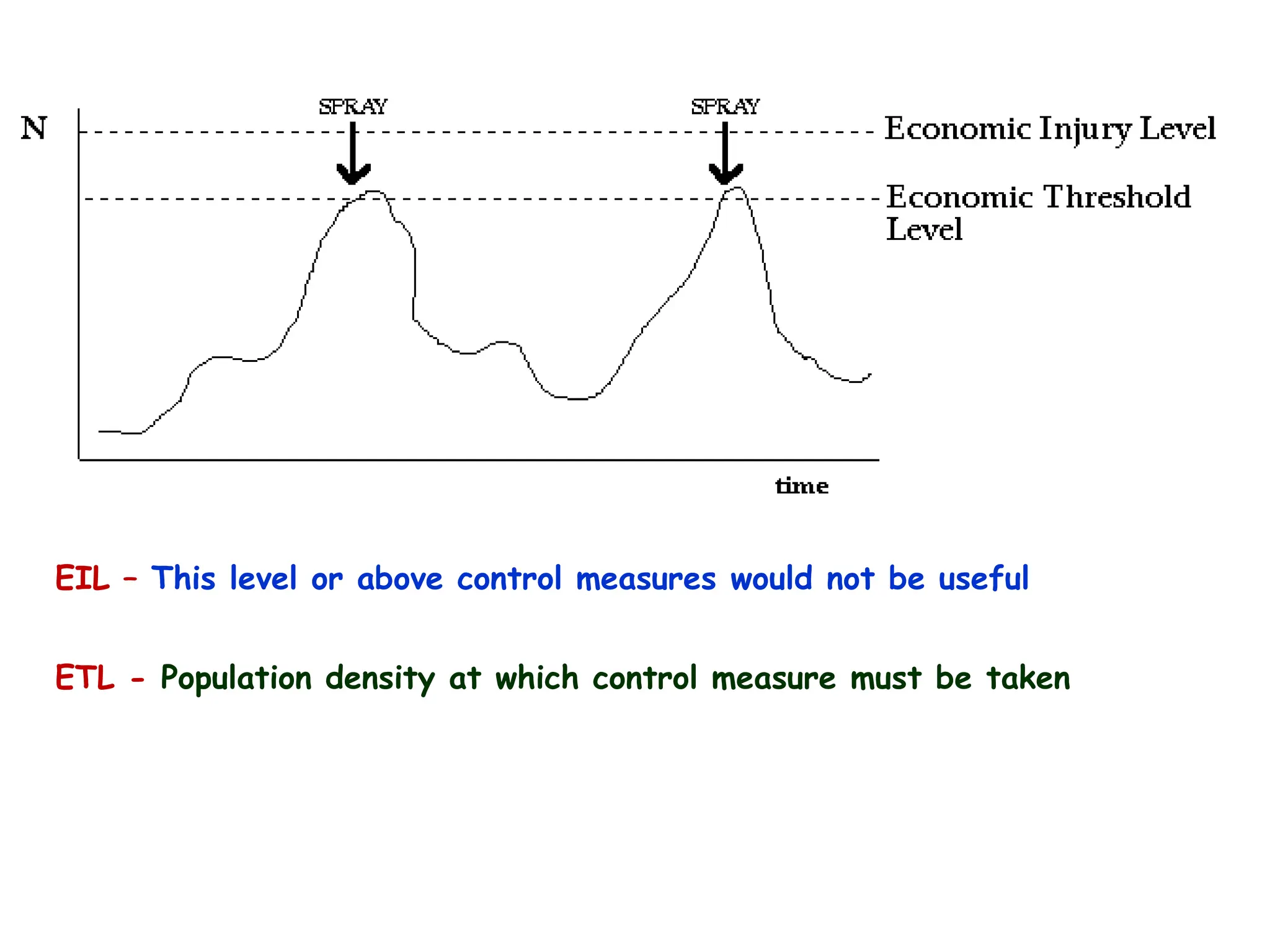
EIL – This level or above control measures would not be useful
ETL - Population density at which control measure must be taken
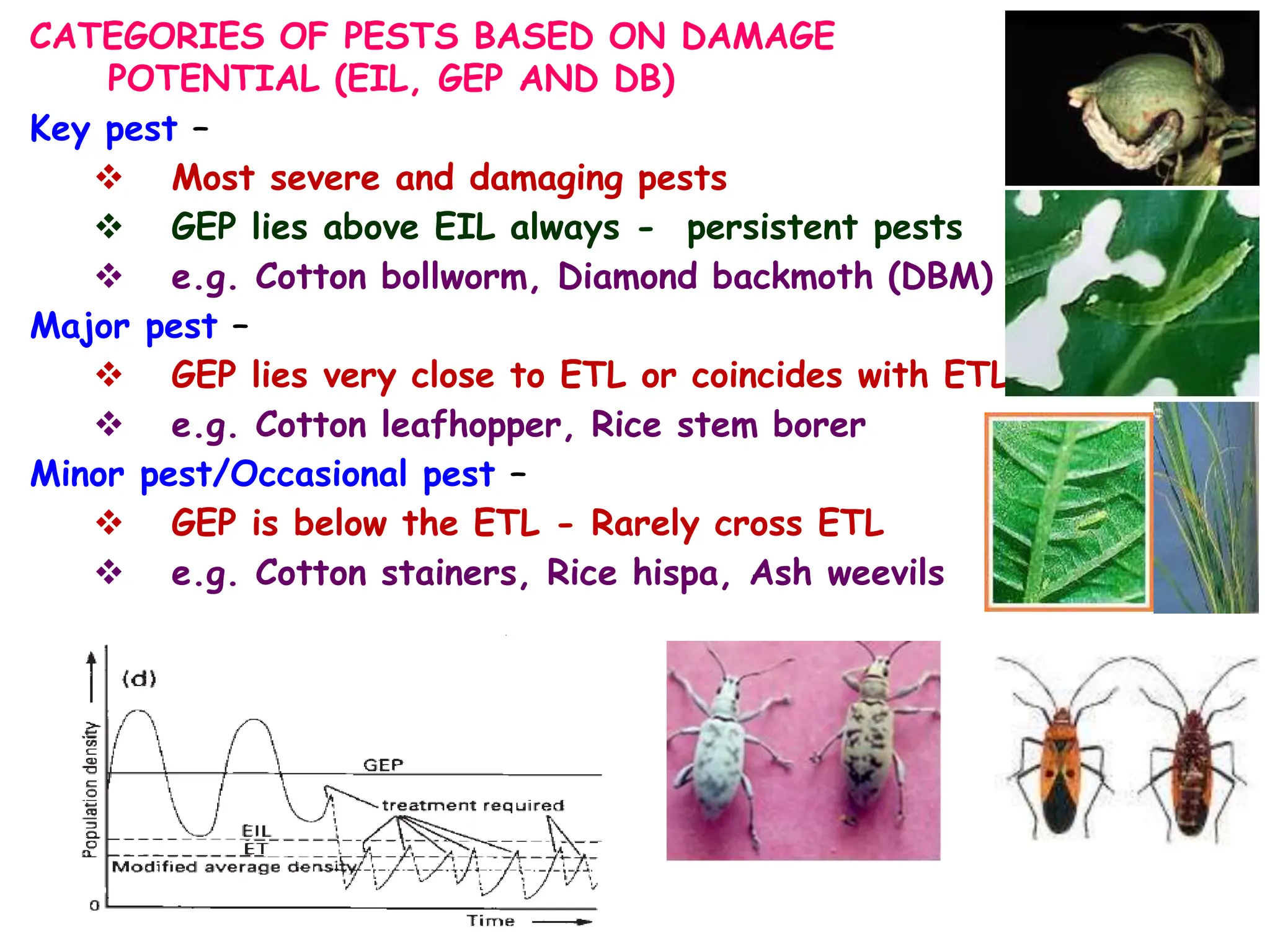
CATEGORIES OF PESTS BASED ON DAMAGE
POTENTIAL (EIL, GEP AND DB)
Key pest –
 Most severe and damaging pests
 GEP lies above EIL always - persistent pests
 e.g. Cotton bollworm, Diamond backmoth (DBM)
Major pest –
 GEP lies very close to ETL or coincides with ETL
 e.g. Cotton leafhopper, Rice stem borer
Minor pest/Occasional pest –
 GEP is below the ETL - Rarely cross ETL
 e.g. Cotton stainers, Rice hispa, Ash weevils
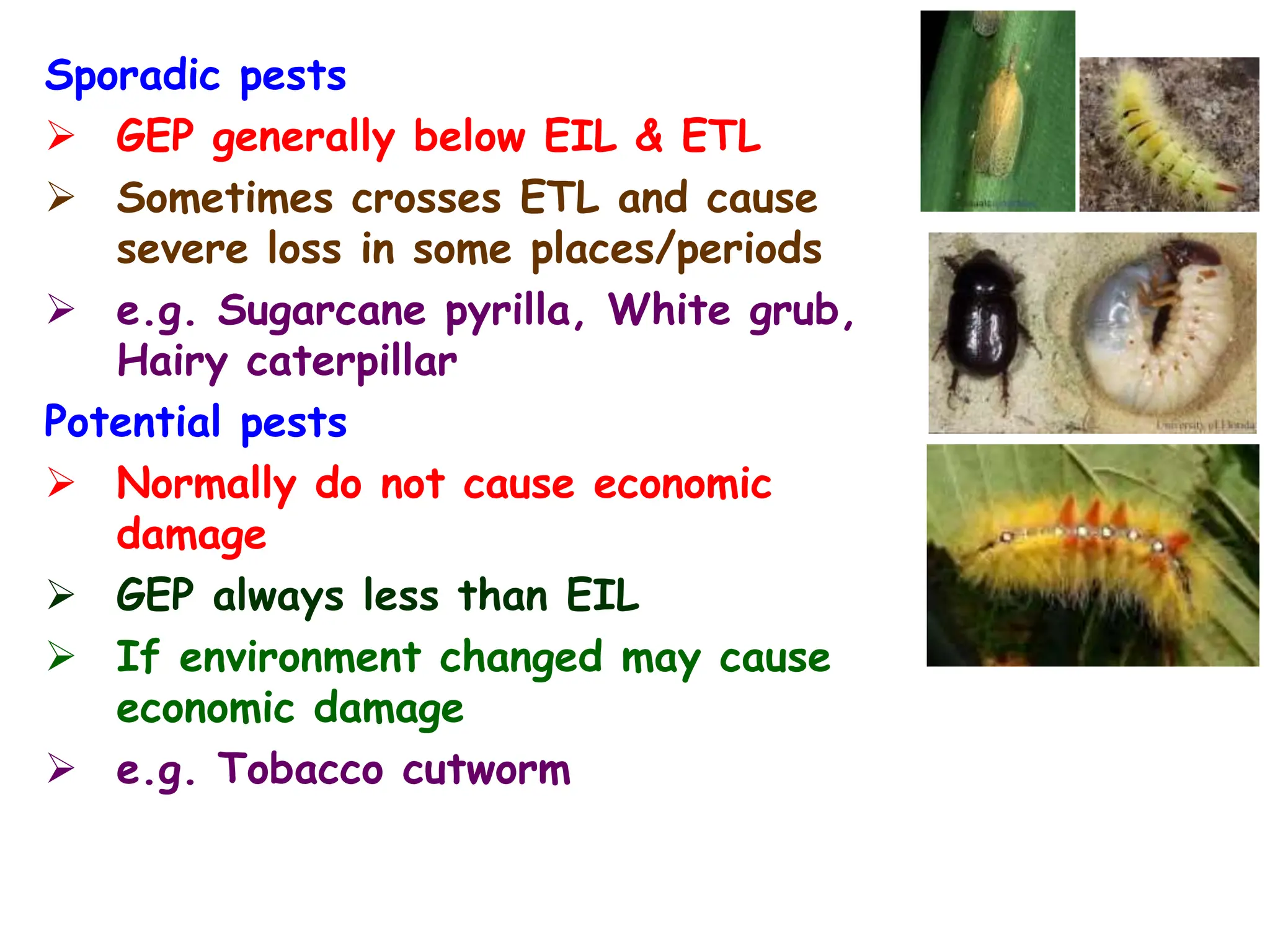
Sporadic pests
 GEP generally below EIL & ETL
 Sometimes crosses ETL and cause
severe loss in some places/periods
 e.g. Sugarcane pyrilla, White grub,
Hairy caterpillar
Potential pests
 Normally do not cause economic
damage
 GEP always less than EIL
 If environment changed may cause
economic damage
 e.g. Tobacco cutworm
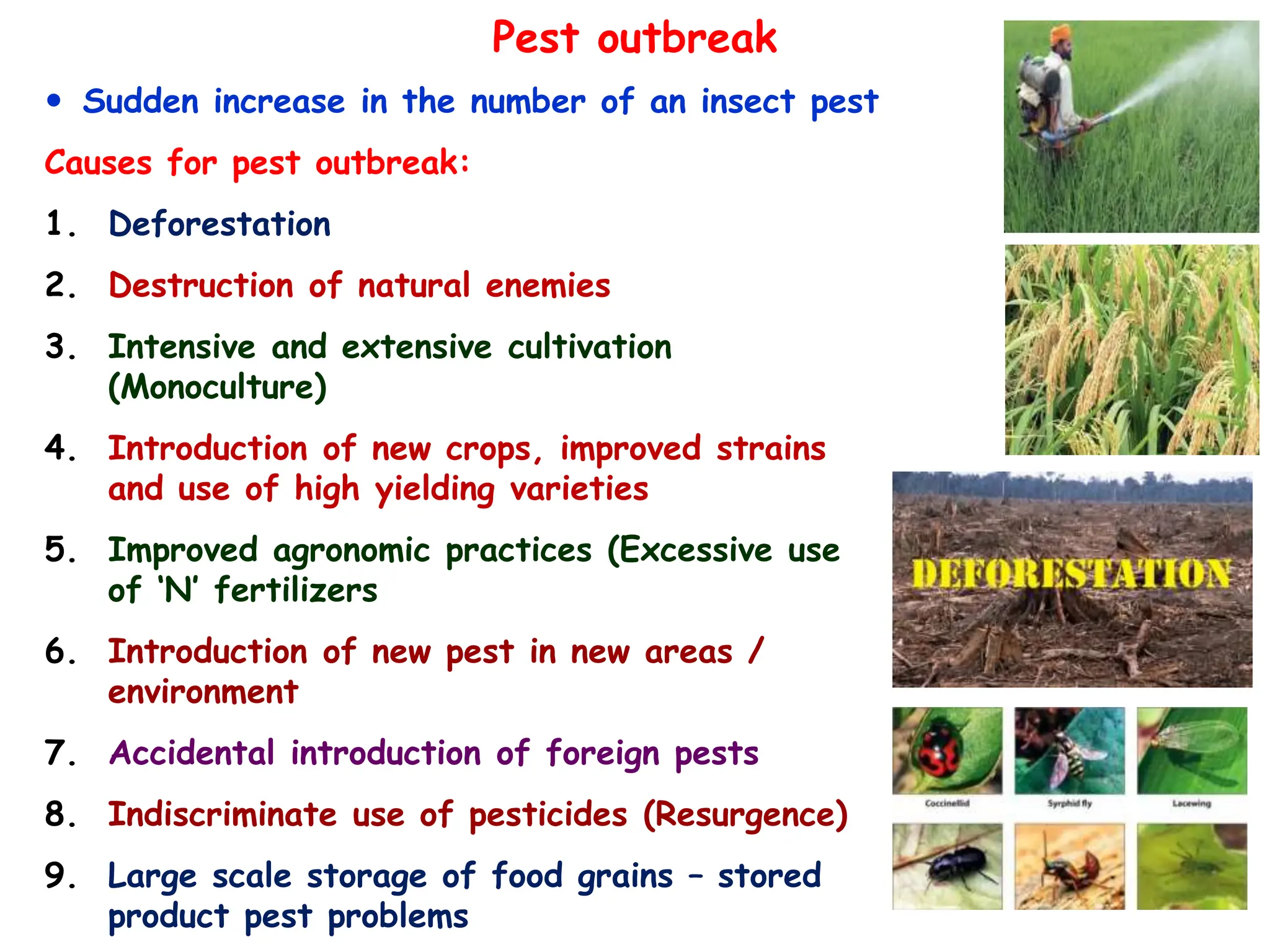
Pest outbreak
 Sudden increase in the number of an insect pest
Causes for pest outbreak:
1. Deforestation
2. Destruction of natural enemies
3. Intensive and extensive cultivation
(Monoculture)
4. Introduction of new crops, improved strains
and use of high yielding varieties
5. Improved agronomic practices (Excessive use
of ‘N’ fertilizers
6. Introduction of new pest in new areas /
environment
7. Accidental introduction of foreign pests
8. Indiscriminate use of pesticides (Resurgence)
9. Large scale storage of food grains – stored
product pest problems
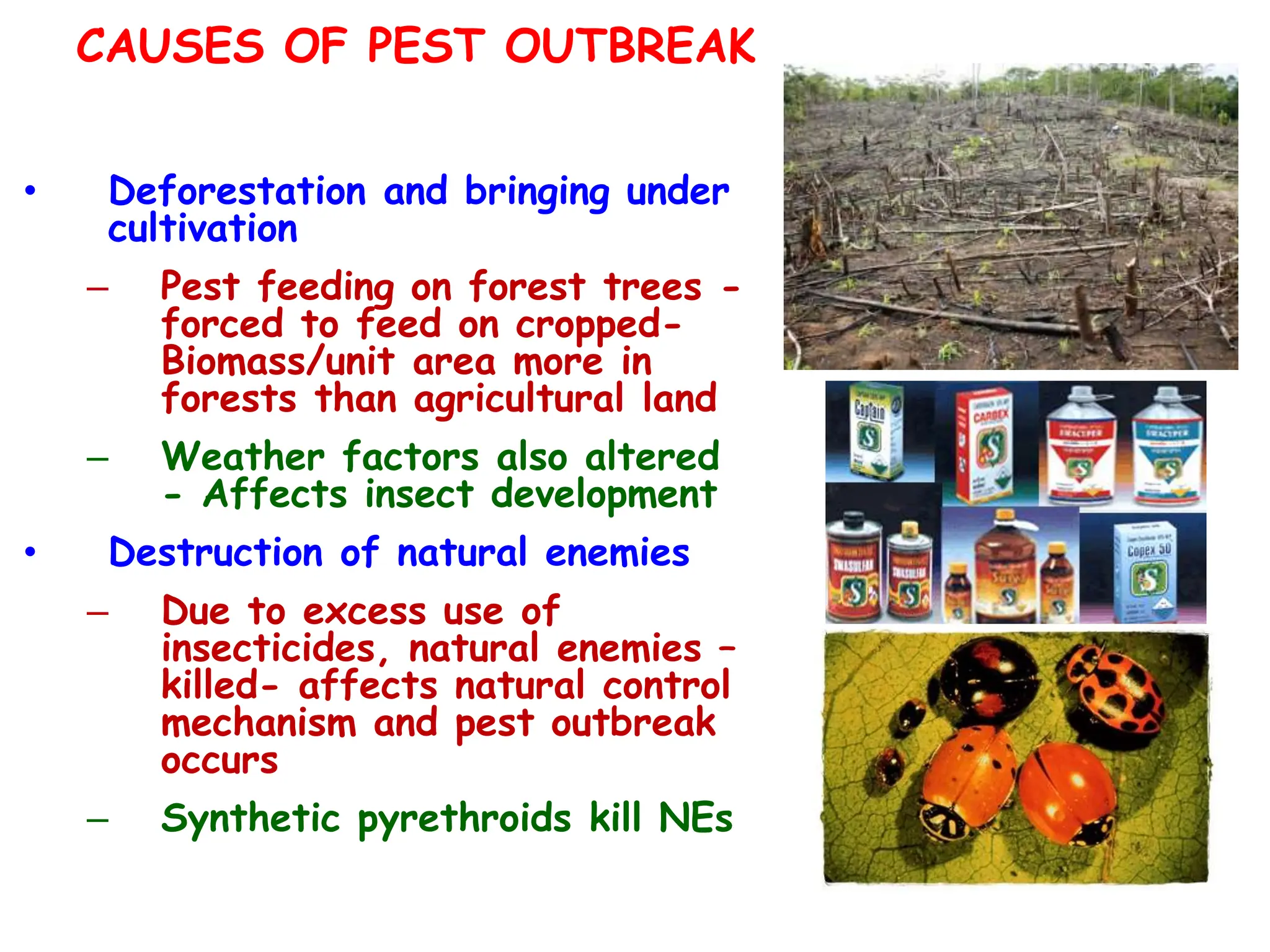
CAUSES OF PEST OUTBREAK
• Deforestation and bringing under
cultivation
– Pest feeding on forest trees -
forced to feed on cropped-
Biomass/unit area more in
forests than agricultural land
– Weather factors also altered
- Affects insect development
• Destruction of natural enemies
– Due to excess use of
insecticides, natural enemies –
killed- affects natural control
mechanism and pest outbreak
occurs
– Synthetic pyrethroids kill NEs
CAUSES OF PEST OUTBREAK
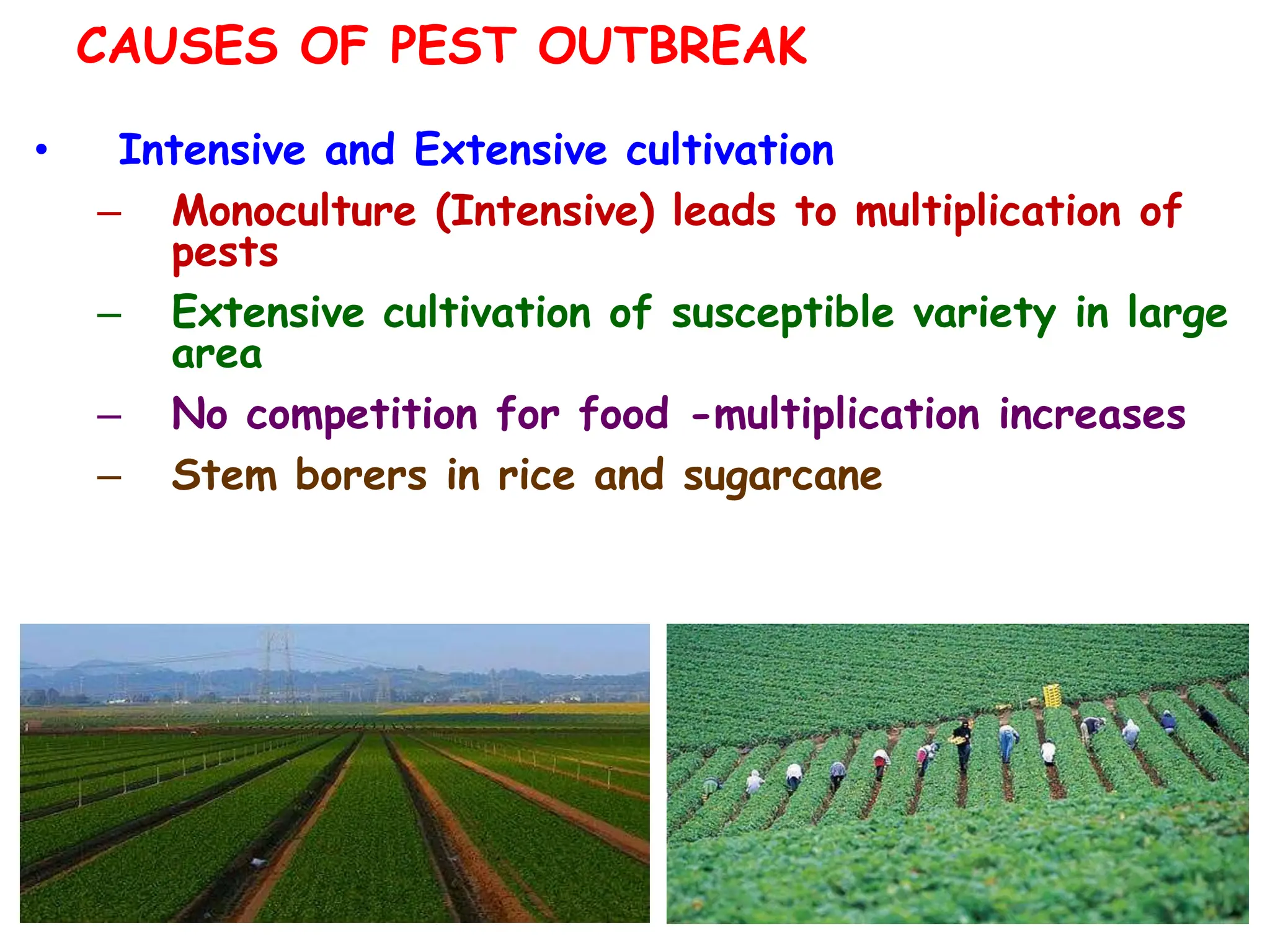
• Intensive and Extensive cultivation
– Monoculture (Intensive) leads to multiplication of
pests
– Extensive cultivation of susceptible variety in large
area
– No competition for food -multiplication increases
– Stem borers in rice and sugarcane
CAUSES OF PEST OUTBREAK
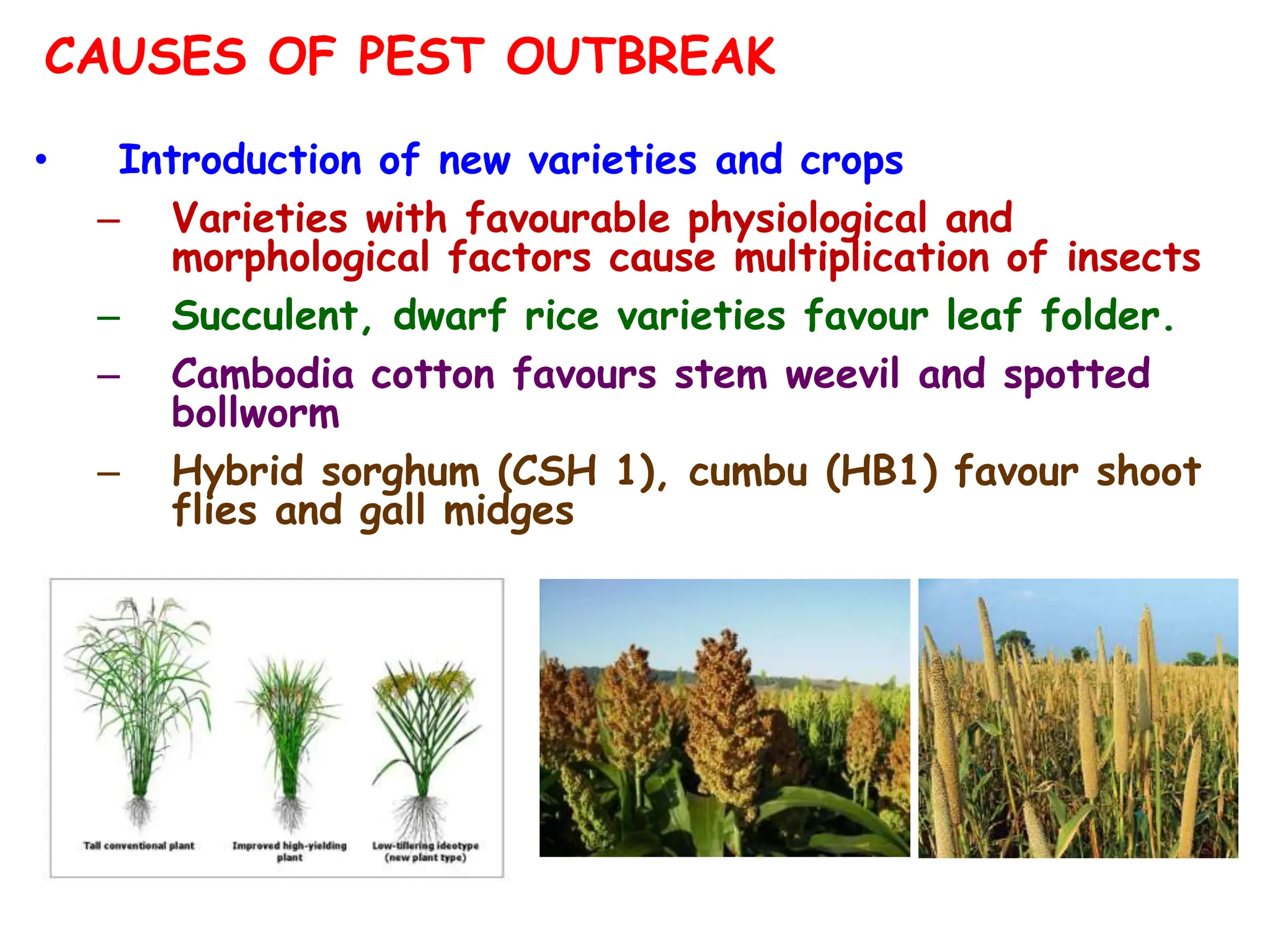
• Introduction of new varieties and crops
– Varieties with favourable physiological and
morphological factors cause multiplication of insects
– Succulent, dwarf rice varieties favour leaf folder.
– Cambodia cotton favours stem weevil and spotted
bollworm
– Hybrid sorghum (CSH 1), cumbu (HB1) favour shoot
flies and gall midges
CAUSES OF PEST OUTBREAK
• Improved agronomic practices
– Increased N fertilizer - High leaf folder incidence
on rice
– Closer planting - BPH and leaf folder increases
– Granular insecticides - Possess phytotonic effect on
rice
• Introduction of new pest in new environment
– Pest multiplies due to absence of natural enemies in
new area
– Apple wooly aphid Eriosoma lanigerum multiplied
fast due to absence of Aphelinus mali (Parasitoid)
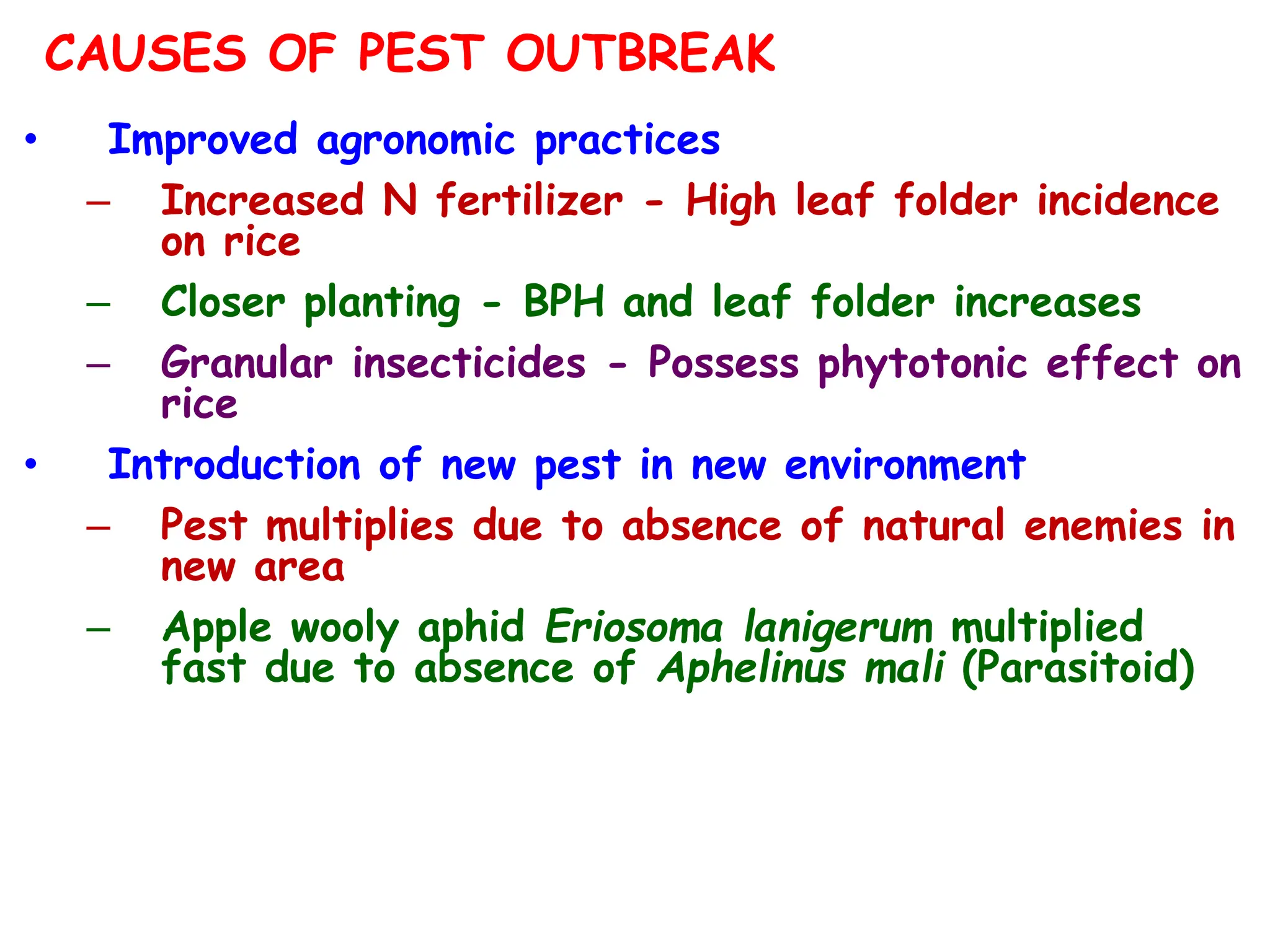
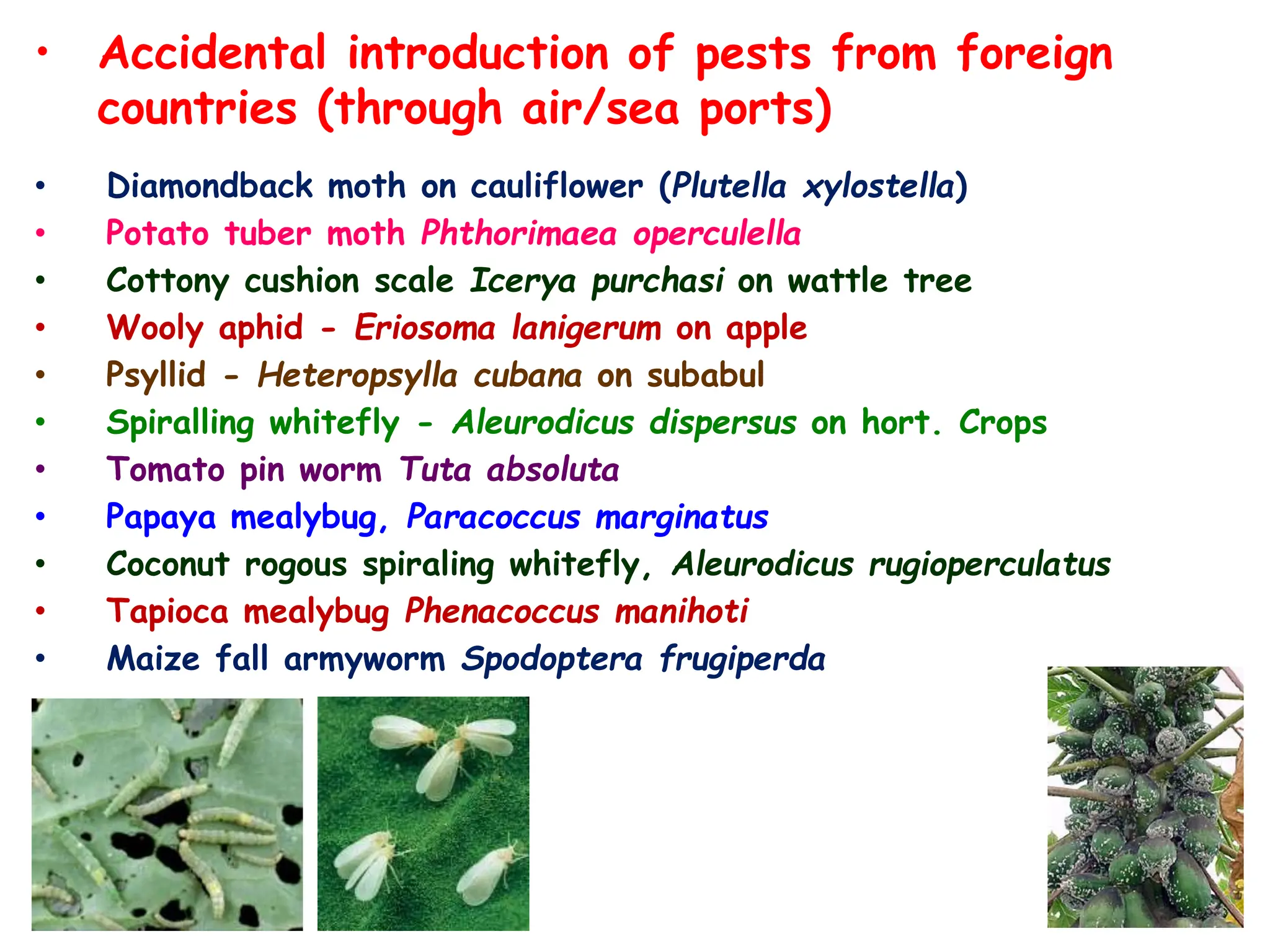
• Accidental introduction of pests from foreign
countries (through air/sea ports)
• Diamondback moth on cauliflower (Plutella xylostella)
• Potato tuber moth Phthorimaea operculella
• Cottony cushion scale Icerya purchasi on wattle tree
• Wooly aphid - Eriosoma lanigerum on apple
• Psyllid - Heteropsylla cubana on subabul
• Spiralling whitefly - Aleurodicus dispersus on hort. Crops
• Tomato pin worm Tuta absoluta
• Papaya mealybug, Paracoccus marginatus
• Coconut rogous spiraling whitefly, Aleurodicus rugioperculatus
• Tapioca mealybug Phenacoccus manihoti
• Maize fall armyworm Spodoptera frugiperda
• Indiscriminate use of insecticides (Resurgence of pests)
– Tremendous increase in the population of pests due to
application of sub-lethal dose of insecticides
– Insecticides applied for control one insect - tend to offer
favourable physiological conditions for sucking insects
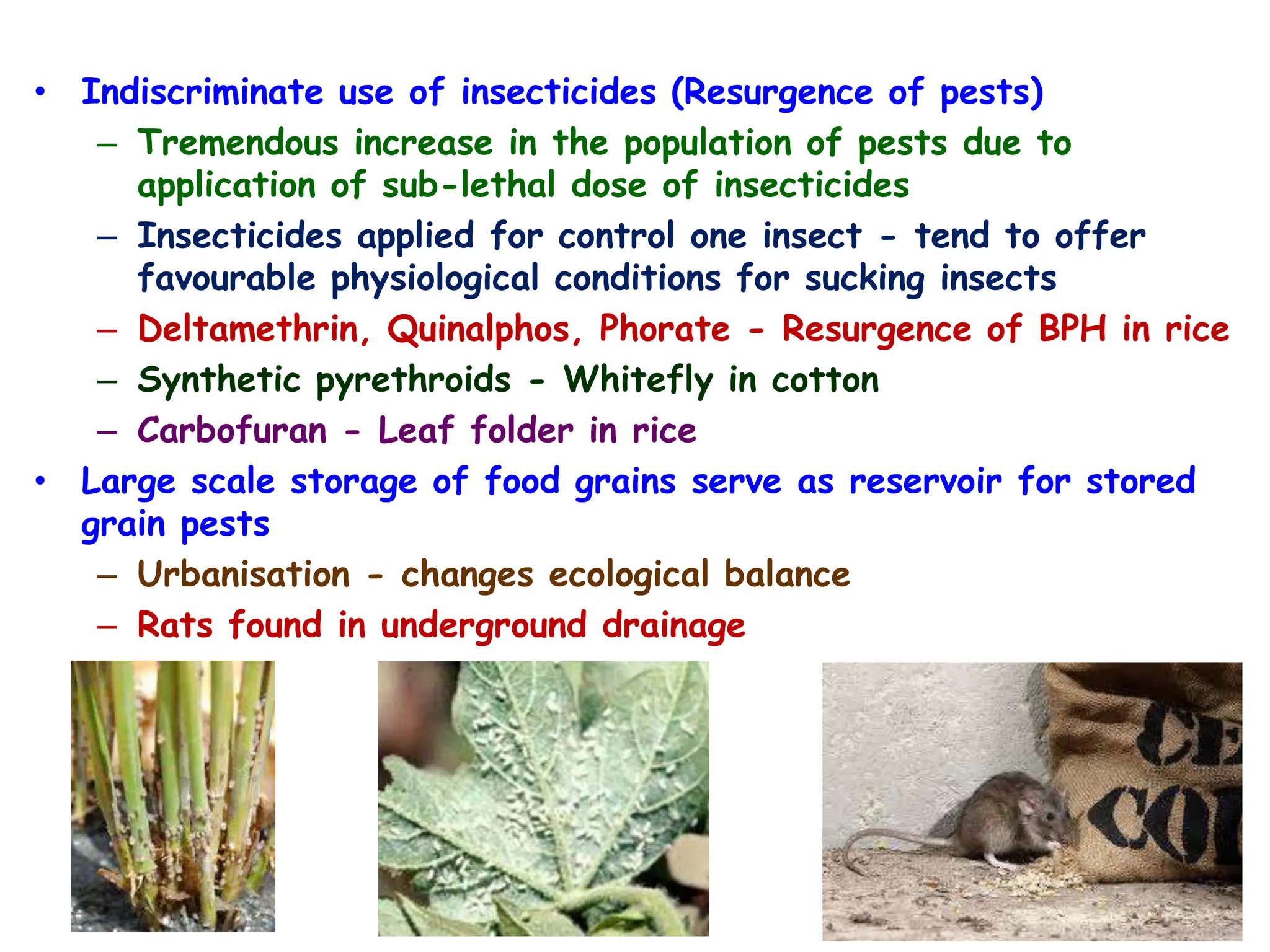
– Deltamethrin, Quinalphos, Phorate - Resurgence of BPH in rice
– Synthetic pyrethroids - Whitefly in cotton
– Carbofuran - Leaf folder in rice
• Large scale storage of food grains serve as reservoir for stored
grain pests
– Urbanisation - changes ecological balance
– Rats found in underground drainage
Losses caused by pests
 Crop loss from all factors
 500 million US $ annually world wide
 Estimated crop loss due to insect pest –
 2,92,400 million rupees
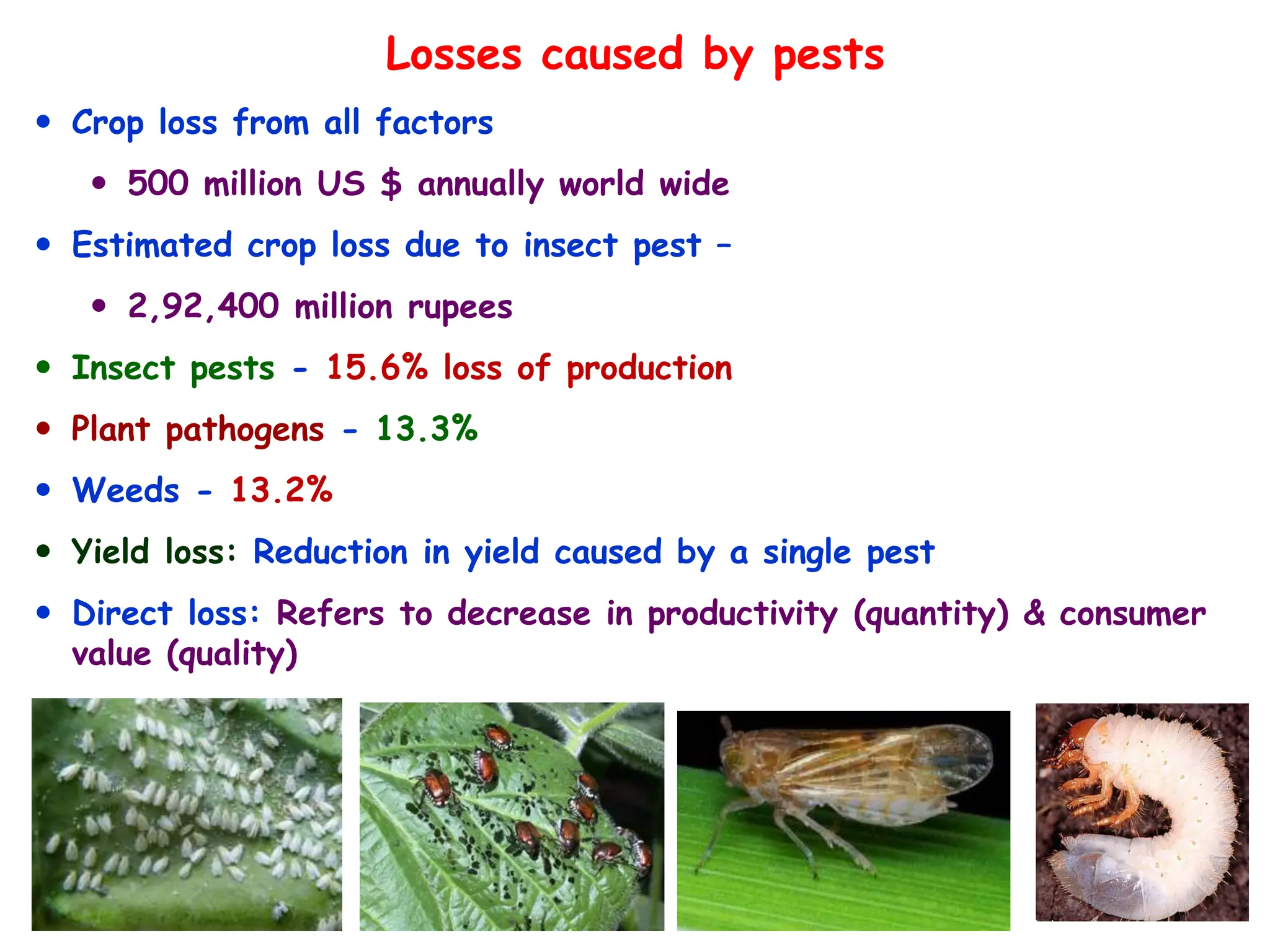
 Insect pests - 15.6% loss of production
 Plant pathogens - 13.3%
 Weeds - 13.2%
 Yield loss: Reduction in yield caused by a single pest
 Direct loss: Refers to decrease in productivity (quantity) & consumer
value (quality)
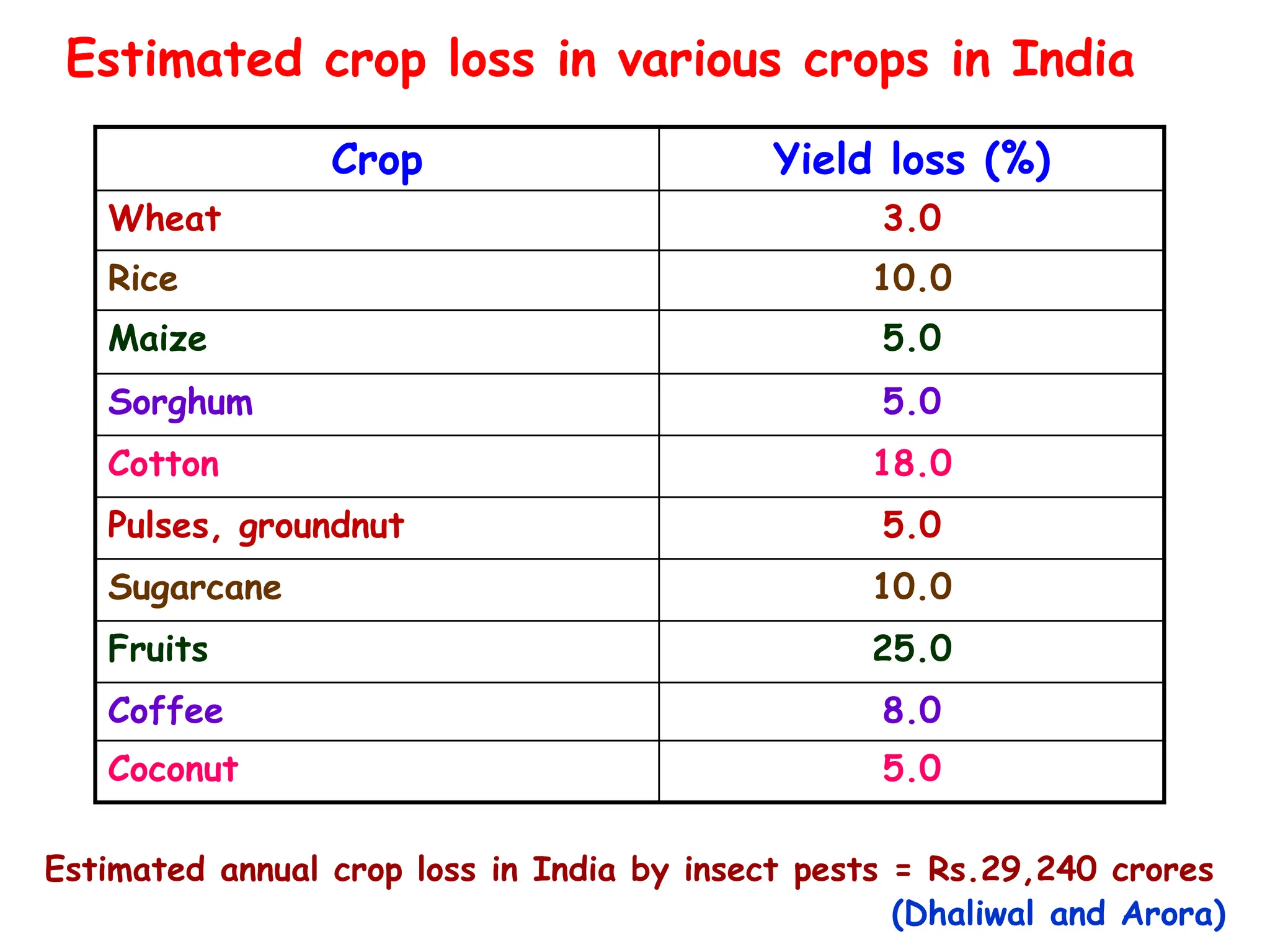
Estimated crop loss in various crops in India
Estimated annual crop loss in India by insect pests = Rs.29,240 crores
(Dhaliwal and Arora)
Crop Yield loss (%)
Wheat 3.0
Rice 10.0
Maize 5.0
Sorghum 5.0
Cotton 18.0
Pulses, groundnut 5.0
Sugarcane 10.0
Fruits 25.0
Coffee 8.0
Coconut 5.0
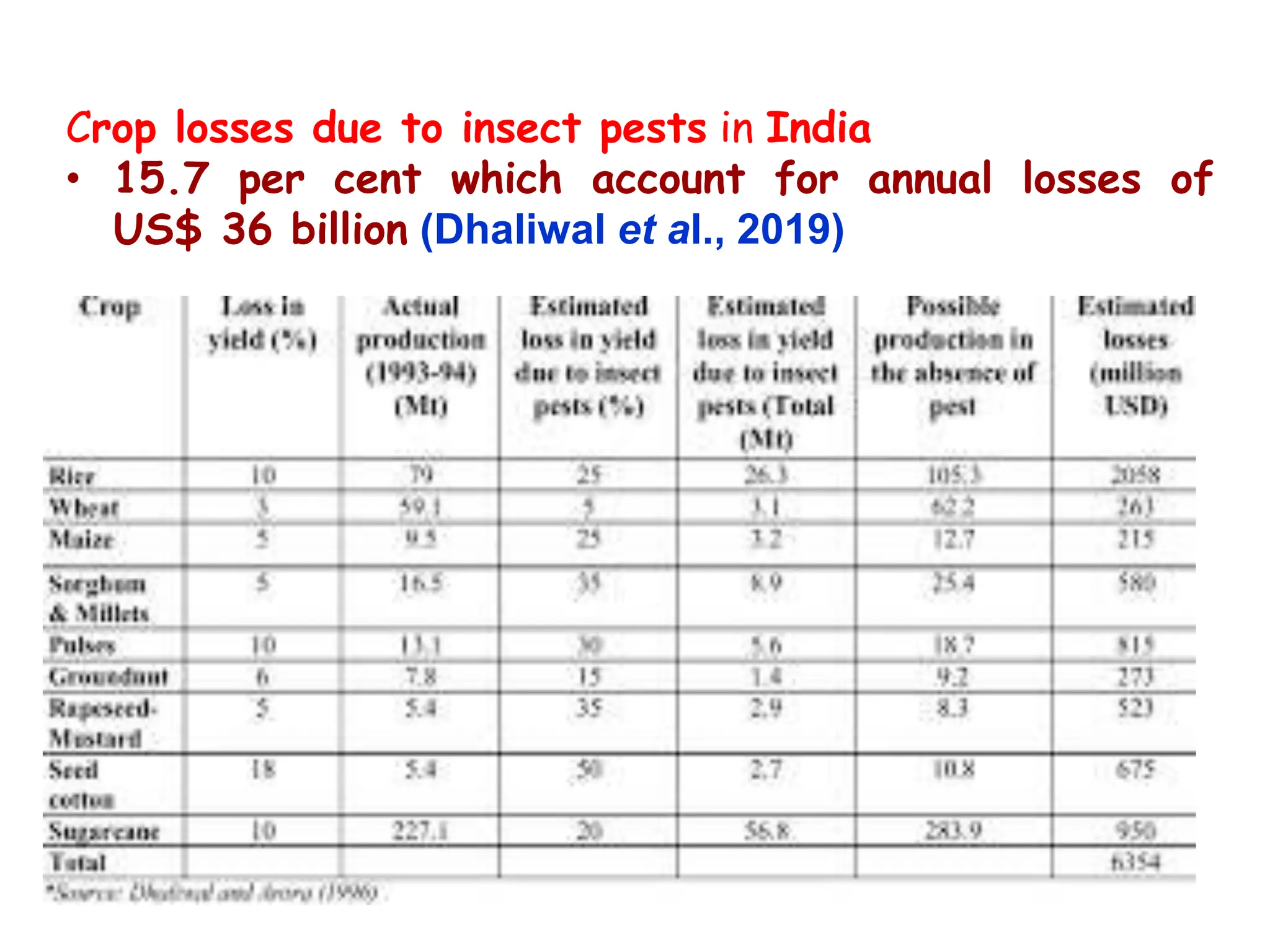
Crop losses due to insect pests in India
• 15.7 per cent which account for annual losses of
US$ 36 billion (Dhaliwal et al., 2019)

Lec. 15. Pests - Definition - Categories, Causes for outbreak of pests.ppt

  • 1.
    AEN 202 MANAGEMENTOF BENEFICIAL AND HARMFUL INSECTS (2+1) LEC No. Title 15. Pests – Definitions - Categories – Causes for outbreak of pests – Losses caused by pests Dr. N. MUTHUKRISHNAN, Ph.D., PDF (Canada) Professor (Entomology) and Dean Tamil Nadu Agricultural University Agricultural College and Research Institute Vazhavachanur, Tiruvannamalai District Mobile: 9486257548
  • 2.
    PEST DEFINITIONS – Derivedfrom French word ‘Peste’ - plague or contagious disease – Latin term ‘Pestis’ meaning – noxious, destructive or troublesome • Any animal which is noxious, destructive or troublesome to man or his interests • Any organism which occurs in large numbers and conflict with man’s welfare, convenience and profit • Insects become pests when sufficiently numerous to cause economic damage (Debacli, 1964) • An organism which harms man or his property significantly or is likely to do so (Woods, 1976) • All insects are NOT pests
  • 3.
  • 4.
    Pests include:  Insects Nematodes  Mites  Snails  Slugs, etc.  Vertebrates like rats, birds, etc.
  • 5.
    Pests are organismswhich impose burdens on human population by causing  Injury to crop plants, forests and ornamentals  Annoyance, injury and death to humans and domesticated animals  Destruction or value depreciation of stored products.
  • 6.
  • 7.
    Based on occurrence •Regular pests • Occasional pests • Seasonal pests • Persistent pests • Sporadic pests Categories of Pests Based on level of infestation • Epidemic pests • Endemic pests Based on number of host plants infested • Monophagous pests • Oligophagous pests • Polyphagous pests Based on damage potential • Key pests • Major pests • Minor pests • Potential pests
  • 8.
    CATEGORIES OF PESTS Basedon occurrence • Regular pest: • Frequently occurs on crop • Close association • e.g. Rice stem borer, Brinjal fruit borer
  • 9.
    CATEGORIES OF PESTS Basedon occurrence • Occasional pest: • Infrequently occurs • No close association • e.g. Caseworm on rice, Mango stem borer
  • 10.
    CATEGORIES OF PESTS Basedon occurrence • Seasonal pest: • Occurs during a particular season every year • e.g. Red hairy caterpillar on groundnut • Depends on climatic conditions and local agricultural practices of region concerned • Twice a year May-June and August-October • Outbreak occurs only once in Rajasthan during August- October • Mango hoppers
  • 11.
    Based on occurrence •Persistent pests: – Occurs on the crop throughout the year – Difficult to control – e.g. Chilli thrips, mealy bug on guava • Sporadic pests: – Pest occurs in isolated localities during some period – e.g. Coconut slug caterpillar
  • 12.
    Based on levelof infestation 1) Epidemic pest: • Sudden outbreak of a pest in a severe form in a region at a particular time • e.g. BPH in Tanjore, RHC in Madurai, Pollachi 2) Endemic pest: • Occurrence of pest in a low level in few pockets, regularly and confined to particular area • e.g. Rice gall midge in Madurai, Mango hoppers in Periyakulam
  • 13.
    CATEGORIES OF PESTS Basedon the number of host plants attacked • Monophagous – Confined to a single species of plants – Mulberry silk worm-very rare monophagous pest to find – Most of monophagous pests –feed on a group of closely related plants • Oligophagous pest – Characteristically feed on a group of botanically related plants-within a single plant family – Diamond back moth –confined to plants of Cruciferae • Polyphagous pest – Accept many plants from a diverse range of plant families, even though preference still exist – Locusts, grasshoppers, hairy caterpillaers, gram caterpillar, cutworms, termites
  • 14.
    Parameters of insectpopulation levels  General equilibrium position (GEP)  Average density of a population over a long period of time, in the absence of permanent environmental changes  Economic threshold level (ETL)  Population density at which control measure should be implemented to prevent pest population from reaching EIL  ETL- always less than EIL  Provides sufficient time for control measures  Index of making pest management decisions  Economic injury level (EIL)  Lowest population density that will cause economic damage  Damage boundary (DB)  Lowest level of damage which can be measured
  • 16.
    EIL – Thislevel or above control measures would not be useful ETL - Population density at which control measure must be taken
  • 17.
    CATEGORIES OF PESTSBASED ON DAMAGE POTENTIAL (EIL, GEP AND DB) Key pest –  Most severe and damaging pests  GEP lies above EIL always - persistent pests  e.g. Cotton bollworm, Diamond backmoth (DBM) Major pest –  GEP lies very close to ETL or coincides with ETL  e.g. Cotton leafhopper, Rice stem borer Minor pest/Occasional pest –  GEP is below the ETL - Rarely cross ETL  e.g. Cotton stainers, Rice hispa, Ash weevils
  • 18.
    Sporadic pests  GEPgenerally below EIL & ETL  Sometimes crosses ETL and cause severe loss in some places/periods  e.g. Sugarcane pyrilla, White grub, Hairy caterpillar Potential pests  Normally do not cause economic damage  GEP always less than EIL  If environment changed may cause economic damage  e.g. Tobacco cutworm
  • 19.
    Pest outbreak  Suddenincrease in the number of an insect pest Causes for pest outbreak: 1. Deforestation 2. Destruction of natural enemies 3. Intensive and extensive cultivation (Monoculture) 4. Introduction of new crops, improved strains and use of high yielding varieties 5. Improved agronomic practices (Excessive use of ‘N’ fertilizers 6. Introduction of new pest in new areas / environment 7. Accidental introduction of foreign pests 8. Indiscriminate use of pesticides (Resurgence) 9. Large scale storage of food grains – stored product pest problems
  • 20.
    CAUSES OF PESTOUTBREAK • Deforestation and bringing under cultivation – Pest feeding on forest trees - forced to feed on cropped- Biomass/unit area more in forests than agricultural land – Weather factors also altered - Affects insect development • Destruction of natural enemies – Due to excess use of insecticides, natural enemies – killed- affects natural control mechanism and pest outbreak occurs – Synthetic pyrethroids kill NEs
  • 21.
    CAUSES OF PESTOUTBREAK • Intensive and Extensive cultivation – Monoculture (Intensive) leads to multiplication of pests – Extensive cultivation of susceptible variety in large area – No competition for food -multiplication increases – Stem borers in rice and sugarcane
  • 22.
    CAUSES OF PESTOUTBREAK • Introduction of new varieties and crops – Varieties with favourable physiological and morphological factors cause multiplication of insects – Succulent, dwarf rice varieties favour leaf folder. – Cambodia cotton favours stem weevil and spotted bollworm – Hybrid sorghum (CSH 1), cumbu (HB1) favour shoot flies and gall midges
  • 23.
    CAUSES OF PESTOUTBREAK • Improved agronomic practices – Increased N fertilizer - High leaf folder incidence on rice – Closer planting - BPH and leaf folder increases – Granular insecticides - Possess phytotonic effect on rice • Introduction of new pest in new environment – Pest multiplies due to absence of natural enemies in new area – Apple wooly aphid Eriosoma lanigerum multiplied fast due to absence of Aphelinus mali (Parasitoid)
  • 24.
    • Accidental introductionof pests from foreign countries (through air/sea ports) • Diamondback moth on cauliflower (Plutella xylostella) • Potato tuber moth Phthorimaea operculella • Cottony cushion scale Icerya purchasi on wattle tree • Wooly aphid - Eriosoma lanigerum on apple • Psyllid - Heteropsylla cubana on subabul • Spiralling whitefly - Aleurodicus dispersus on hort. Crops • Tomato pin worm Tuta absoluta • Papaya mealybug, Paracoccus marginatus • Coconut rogous spiraling whitefly, Aleurodicus rugioperculatus • Tapioca mealybug Phenacoccus manihoti • Maize fall armyworm Spodoptera frugiperda
  • 25.
    • Indiscriminate useof insecticides (Resurgence of pests) – Tremendous increase in the population of pests due to application of sub-lethal dose of insecticides – Insecticides applied for control one insect - tend to offer favourable physiological conditions for sucking insects – Deltamethrin, Quinalphos, Phorate - Resurgence of BPH in rice – Synthetic pyrethroids - Whitefly in cotton – Carbofuran - Leaf folder in rice • Large scale storage of food grains serve as reservoir for stored grain pests – Urbanisation - changes ecological balance – Rats found in underground drainage
  • 26.
    Losses caused bypests  Crop loss from all factors  500 million US $ annually world wide  Estimated crop loss due to insect pest –  2,92,400 million rupees  Insect pests - 15.6% loss of production  Plant pathogens - 13.3%  Weeds - 13.2%  Yield loss: Reduction in yield caused by a single pest  Direct loss: Refers to decrease in productivity (quantity) & consumer value (quality)
  • 27.
    Estimated crop lossin various crops in India Estimated annual crop loss in India by insect pests = Rs.29,240 crores (Dhaliwal and Arora) Crop Yield loss (%) Wheat 3.0 Rice 10.0 Maize 5.0 Sorghum 5.0 Cotton 18.0 Pulses, groundnut 5.0 Sugarcane 10.0 Fruits 25.0 Coffee 8.0 Coconut 5.0
  • 28.
    Crop losses dueto insect pests in India • 15.7 per cent which account for annual losses of US$ 36 billion (Dhaliwal et al., 2019)