Curriculum Development
Based on Behavioristic
Orientation
Setting of Aims and Objectives
Behaviouristic approach in curriculum
development
Behavioristic approach in curriculum
development means designing a
curriculum based on the principles of
behaviorism, focusing on clearly
defined, observable student
behaviors as learning outcomes,
achieved through structured
instruction and reinforcement
techniques, where the emphasis is on
measurable results and achieving
specific goals through carefully
planned activities and assessments.
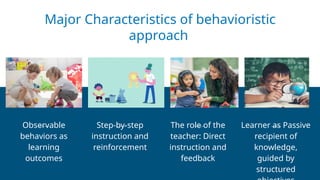
Major Characteristics of behavioristic
approach
Observable
behaviors as
learning
outcomes
Step-by-step
instruction and
reinforcement
The role of the
teacher: Direct
instruction and
feedback
Learner as Passive
recipient of
knowledge,
guided by
structured
Formulating aims and objectives
AIMS
Aims are general statements that provide
direction or intent to educational action.
Aims are usually written in amorphous
terms using words like: learn, know,
understand, appreciate, and these are not
directly measurable. Aims may serve as
organizing principles of educational
direction for more than one grade.
Ex: Students will understand and become
proficient at identifying the different types
of spoken English.
OBJECTIVES
Objectives are usually specific statements
of educational intention which delineate
either general or specific outcomes.
Behavioral objectives usually employ
observable verbiage and can be divided
into specific domains — cognitive (head),
affective (heart), and physical (hand).
Ex: Students will identify and list 5 slang
terms they have heard from their peers.
General educational objectives are
a broad statement describing the
overall desired learning outcome.
General objectives are high-level
and provide a general direction
for learning and are often difficult
to directly measure. General
objectives guide the overall
curriculum design.
Ex: Students will develop critical
thinking skills.
GENERAL OBJECTIVES SPECIFIC OBJECTIVES
Specific educational objectives are a
precise and measurable goal that
outlines exactly what a learner
should be able to do after
completing a learning activity,
detailing specific skills, knowledge,
or behaviors they should acquire;
essentially, specific objectives break
down the broader general objective
into smaller, actionable steps.
Specific objectives inform individual
lesson plans and learning activities
and should be clearly measurable
using observable actions or criteria.
Derived from general aims and
aligned with subject matter.
Examples:
Science: Foster understanding of
scientific principles.
Mathematics: Develop
computational and logical
reasoning.
Subject Wise Objectives Level Wise Objectives
Primary Level
Example: Develop basic reading,
writing, and arithmetic skills.
Secondary Level
Example: Enable understanding
and application of subject
knowledge in real-life scenarios.
Tertiary Level
Example: Advance critical analysis
and independent research skills.
Steps to formulate behavioristic aims and
objectives:
1. Identify the desired behavior change:What specific action or skill do you want the learner to be able
to perform?
2. Choose appropriate action verbs:Select verbs that clearly describe the observable behavior you
want to see.
3. Define the conditions:Specify the context or situation in which the behavior will be demonstrated.
4. Set performance criteria:Establish the standard for acceptable performance, including accuracy,
time limits, or other relevant factors.
5. Write the objective clearly:Compose a concise statement that includes the action verb, conditions,
and performance criteria.
Thankyou

Behavioristic approach in curriculum development .pptx

  • 1.
    Curriculum Development Based onBehavioristic Orientation Setting of Aims and Objectives
  • 2.
    Behaviouristic approach incurriculum development Behavioristic approach in curriculum development means designing a curriculum based on the principles of behaviorism, focusing on clearly defined, observable student behaviors as learning outcomes, achieved through structured instruction and reinforcement techniques, where the emphasis is on measurable results and achieving specific goals through carefully planned activities and assessments.
  • 3.
    Major Characteristics ofbehavioristic approach Observable behaviors as learning outcomes Step-by-step instruction and reinforcement The role of the teacher: Direct instruction and feedback Learner as Passive recipient of knowledge, guided by structured
  • 5.
    Formulating aims andobjectives AIMS Aims are general statements that provide direction or intent to educational action. Aims are usually written in amorphous terms using words like: learn, know, understand, appreciate, and these are not directly measurable. Aims may serve as organizing principles of educational direction for more than one grade. Ex: Students will understand and become proficient at identifying the different types of spoken English. OBJECTIVES Objectives are usually specific statements of educational intention which delineate either general or specific outcomes. Behavioral objectives usually employ observable verbiage and can be divided into specific domains — cognitive (head), affective (heart), and physical (hand). Ex: Students will identify and list 5 slang terms they have heard from their peers.
  • 7.
    General educational objectivesare a broad statement describing the overall desired learning outcome. General objectives are high-level and provide a general direction for learning and are often difficult to directly measure. General objectives guide the overall curriculum design. Ex: Students will develop critical thinking skills. GENERAL OBJECTIVES SPECIFIC OBJECTIVES Specific educational objectives are a precise and measurable goal that outlines exactly what a learner should be able to do after completing a learning activity, detailing specific skills, knowledge, or behaviors they should acquire; essentially, specific objectives break down the broader general objective into smaller, actionable steps. Specific objectives inform individual lesson plans and learning activities and should be clearly measurable using observable actions or criteria.
  • 8.
    Derived from generalaims and aligned with subject matter. Examples: Science: Foster understanding of scientific principles. Mathematics: Develop computational and logical reasoning. Subject Wise Objectives Level Wise Objectives Primary Level Example: Develop basic reading, writing, and arithmetic skills. Secondary Level Example: Enable understanding and application of subject knowledge in real-life scenarios. Tertiary Level Example: Advance critical analysis and independent research skills.
  • 9.
    Steps to formulatebehavioristic aims and objectives: 1. Identify the desired behavior change:What specific action or skill do you want the learner to be able to perform? 2. Choose appropriate action verbs:Select verbs that clearly describe the observable behavior you want to see. 3. Define the conditions:Specify the context or situation in which the behavior will be demonstrated. 4. Set performance criteria:Establish the standard for acceptable performance, including accuracy, time limits, or other relevant factors. 5. Write the objective clearly:Compose a concise statement that includes the action verb, conditions, and performance criteria.
  • 10.