The document discusses the significance of curriculum development at the secondary education level in Pakistan, outlining its processes and structures mandated by federal and provincial governments. It describes the responsibilities of various educational bodies, the examination system, curriculum objectives, and the need for teacher training, while also highlighting merits and demerits of the existing curriculum. Recommendations for improvement emphasize the importance of aligning curriculum with societal needs, enhancing teacher participation, and ensuring ongoing research to address deficiencies.
Curriculum
Development
and its
Significance
• Acurriculum is the combination of instructional practices,
learning experiences, and students' performance assessment
that are designed to bring out and evaluate the target
learning outcomes of a particular course.
• Curriculum development is a process of improving
the curriculum. Approaches for curricula:
o Analysis
o Selecting
o Formation
o Review
• Curriculum development is significant because it
o Takes contents and shapes into plan for effective teaching and
learning
o Provide a map to achieve outputs
o Provide appropriate learning activities and assessments
3.
Secondary Education
• InBritish India, the structure and curricula of secondary education were mandated by
British colonial rule
• After independence, Pakistan then developed its own Boards of Intermediate and
Secondary Education (BISE) which were tasked with developing and conducting final
examinations at the ends of grades 9 to 12
• Admission requires completion of middle school
• Consists of two years education (grades 9 and 10) followed by two years of higher-
secondary education
• Compulsory subjects include Urdu, English, Islamic education (civics for non-
Muslim students), and Pakistan studies along with both required and
elective courses in the specific stream.
• The exams are conducted by one of the Boards of Intermediate and Secondary
Education (BISE).
4.
Curriculum
Domain at
Secondary
Level
• Accordingto the Constitution of Pakistan, curriculum
development is the domain of the federal government.
• Curriculum development up to intermediate level is
the responsibility of the Curriculum Wing of the
Ministry of Education.
• Textbooks are developed by the provincial Textbook
Boards strictly in accordance with the curriculum
developed by the committees.
• Developed after extensive analysis of the previous
curriculum in order to bring desired changes in
teaching and learning.
• Assessment patterns (development and evaluation )
together with recommendations for teacher training
were included in the curriculum
5.
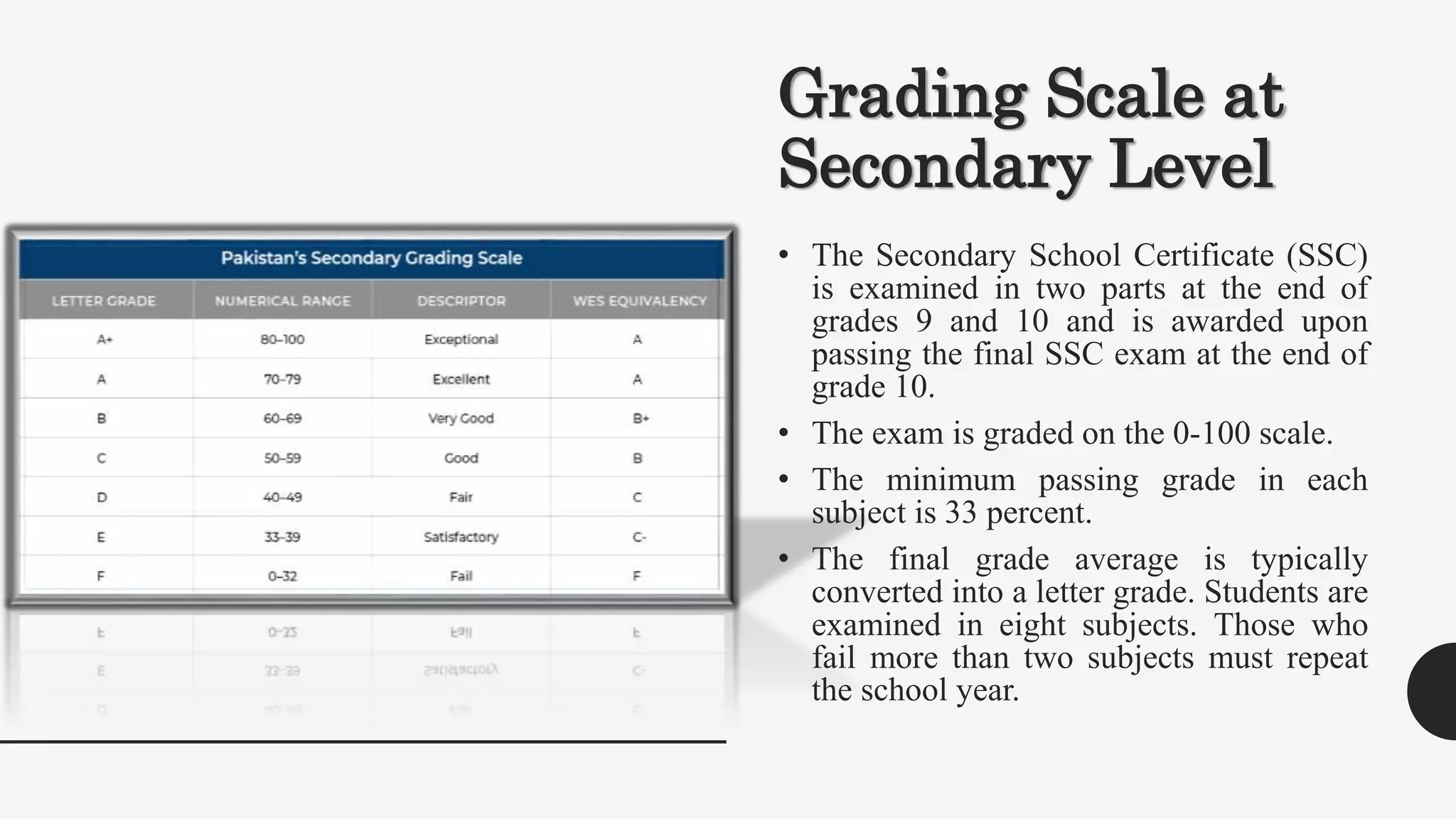
Grading Scale at
SecondaryLevel
• The Secondary School Certificate (SSC)
is examined in two parts at the end of
grades 9 and 10 and is awarded upon
passing the final SSC exam at the end of
grade 10.
• The exam is graded on the 0-100 scale.
• The minimum passing grade in each
subject is 33 percent.
• The final grade average is typically
converted into a letter grade. Students are
examined in eight subjects. Those who
fail more than two subjects must repeat
the school year.
6.
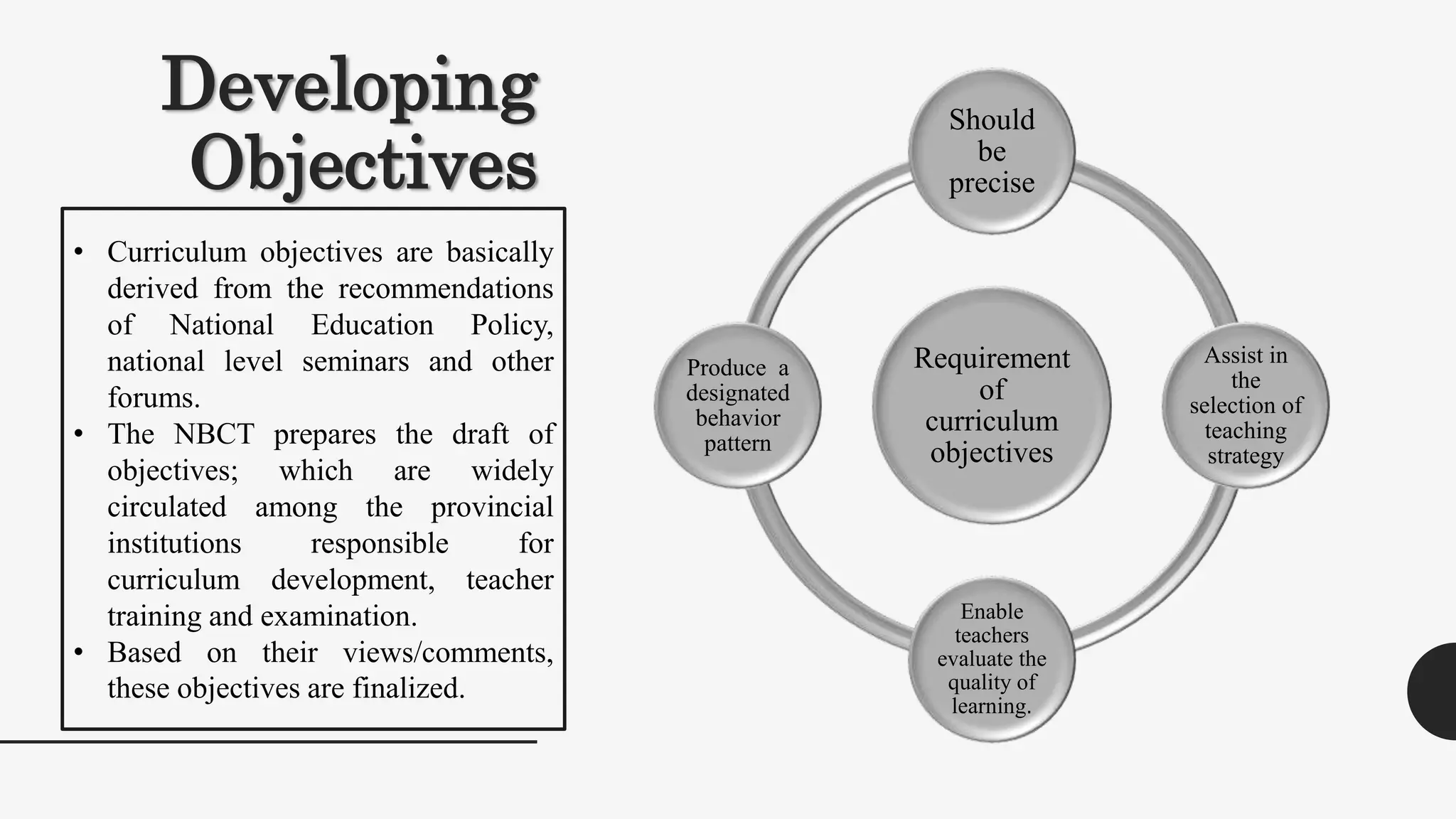
Developing
Objectives
Requirement
of
curriculum
objectives
Should
be
precise
Assist in
the
selection of
teaching
strategy
Enable
teachers
evaluatethe
quality of
learning.
Produce a
designated
behavior
pattern
• Curriculum objectives are basically
derived from the recommendations
of National Education Policy,
national level seminars and other
forums.
• The NBCT prepares the draft of
objectives; which are widely
circulated among the provincial
institutions responsible for
curriculum development, teacher
training and examination.
• Based on their views/comments,
these objectives are finalized.
7.
Studies Scheme
• Thescheme of studies is based on three
key factors:
o the national education policy
o market demand
o global issues that relate to new
education dimensions.
• Task work in this area is undertaken
with active participation of the
provincial government, research
organizations and experts; as well as
feedback from the IBCC.
8.
Textbook
Development
• Provincial TextbookBoards (PTBB) are
responsible for development of text-books
according to the approved syllabi.
• Established lists of textbook writers in various
subjects are kept. From these lists, invitations
are issued to writers to submit draft materials
within the prescribed syllabus parameters.
• Selections are made on the basis of the quality
and relevance of materials submitted to local
situations.
• Finally, the selected materials are transformed
into textbooks; the final versions of which are
sent to the NBCT for approval.
9.
Development of Syllabus
•Subject specific syllabi are prepared in consultation with: provincial curriculum
centers; subject experts; and psychologists and serving teachers.
• They ensure that the syllabi, in all respects, satisfy the following conditions:
o They are based on the needs of the learner/child.
o They take into account the existing knowledge and environmental experience of the
learner.
o The developmental level of the learner is considered in the cognitive, effectiveness and
psycho-motor domains.
o The contents should be focused on attaining the objectives.
10.
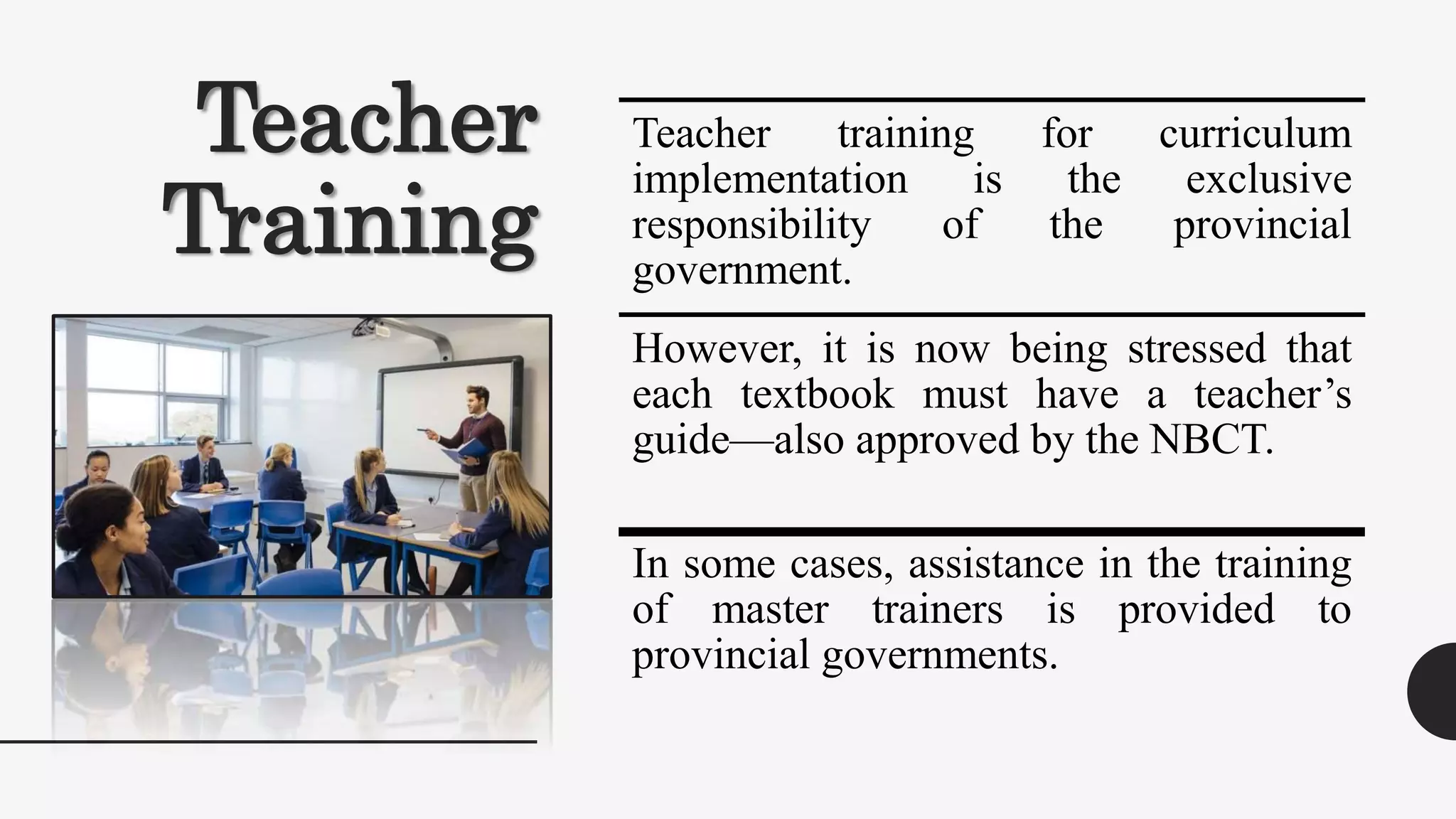
Teacher
Training
Teacher training forcurriculum
implementation is the exclusive
responsibility of the provincial
government.
However, it is now being stressed that
each textbook must have a teacher’s
guide—also approved by the NBCT.
In some cases, assistance in the training
of master trainers is provided to
provincial governments.
11.
Review
and
Approval
• A NationalReview Committee, comprising five or six
members includes: at least one expert from the Syllabus
Formulation Committee; two subject experts; two
schoolteachers (one teaching the relevant material and
one from a teacher-training institute).
• On receipt of textual materials from PTBB, this
committee conducts textbook reviews based on the
following parameters
o The book truly reflects the curriculum
o It meets the objectives stated in the curriculum
o The book does not contain any material repugnant to
Islamic and Pakistani ideology.
• In the case of approval, the textbook is sent back for
publishing and distribution. In case of objection, the
specific complaints are relayed along with revision
recommendations.
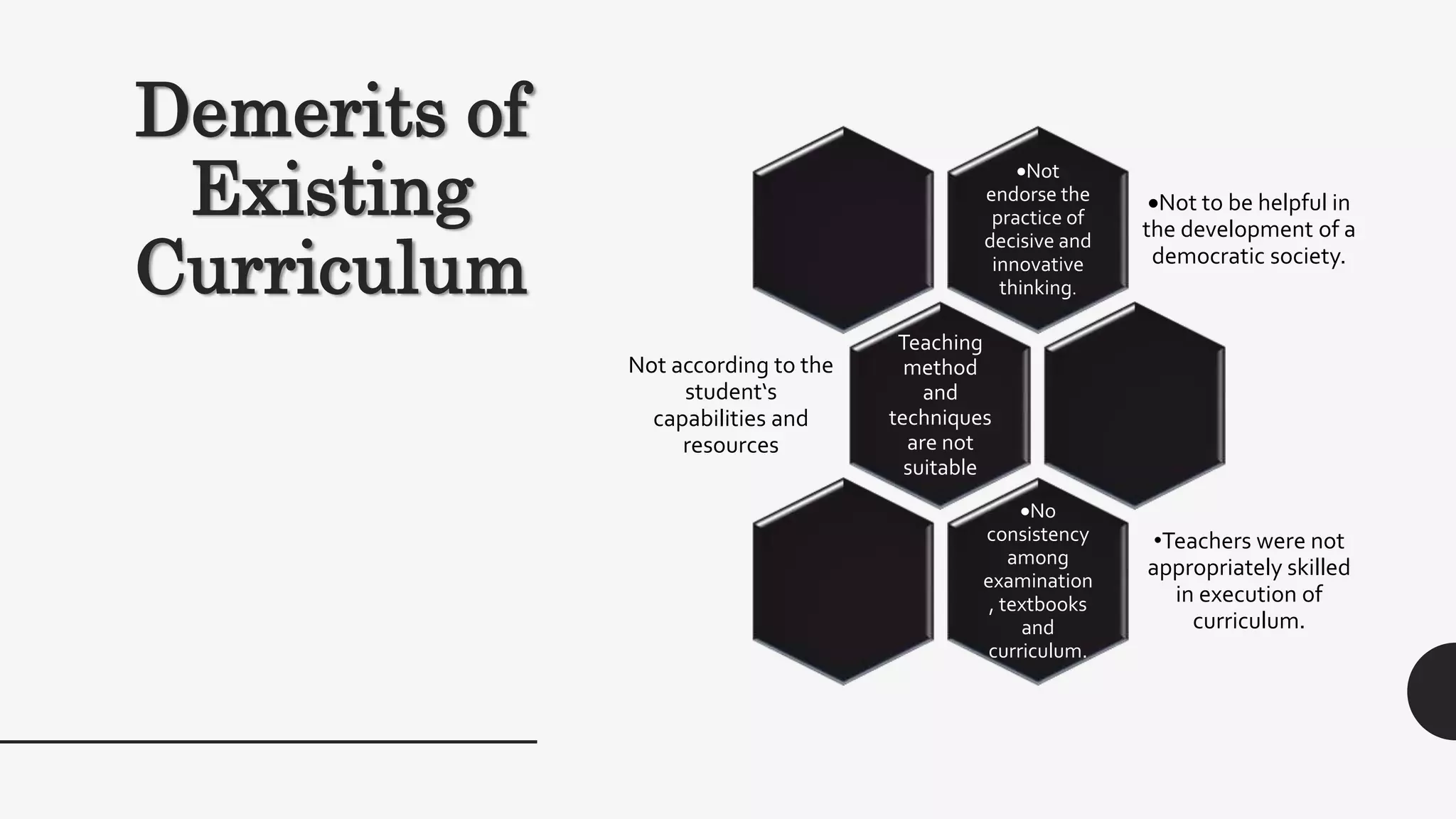
Demerits of
Existing
Curriculum
Not
endorse the
practiceof
decisive and
innovative
thinking.
Not to be helpful in
the development of a
democratic society.
Teaching
method
and
techniques
are not
suitable
Not according to the
student‘s
capabilities and
resources
No
consistency
among
examination
, textbooks
and
curriculum.
•Teachers were not
appropriately skilled
in execution of
curriculum.
14.
Recommendations for Developmentof Curriculum
Curriculum objectives and content may be designed in a way that meets the challenge of new era.
Curriculum may be as closer to its society and culture as blood to living beings.
Islamic and oriental knowledge may be given due importance.
Cohesion and synchronization among the learners, instructors and curriculum specialists
Could be easily and purposefully evaluated and assessed.
Curriculum planners should be sound skilled, capable, knowledgeable in their meadows, failure to
which would make the curriculum concerned collapsed.
Proper supervision and co-ordination is needed to see input and output of whole process and its
implementation.
Teachers‘ opinion may be given main magnitude in the execution of curriculum.
Continuous research may be carried out to eradicate the shortcomings in the existing curricula.