Overview of emergence of
social science as a discipline
Prof. V Ramadas
NCERT, RIE Mysore
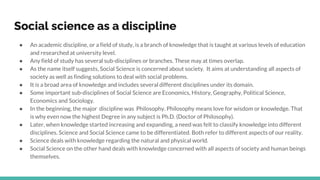
Social science as a discipline
● An academic discipline, or a field of study, is a branch of knowledge that is taught at various levels of education
and researched at university level.
● Any field of study has several sub-disciplines or branches. These may at times overlap.
● As the name itself suggests, Social Science is concerned about society. It aims at understanding all aspects of
society as well as finding solutions to deal with social problems.
● It is a broad area of knowledge and includes several different disciplines under its domain.
● Some important sub-disciplines of Social Science are Economics, History, Geography, Political Science,
Economics and Sociology.
● In the beginning, the major discipline was Philosophy. Philosophy means love for wisdom or knowledge. That
is why even now the highest Degree in any subject is Ph.D. (Doctor of Philosophy).
● Later, when knowledge started increasing and expanding, a need was felt to classify knowledge into different
disciplines. Science and Social Science came to be differentiated. Both refer to different aspects of our reality.
● Science deals with knowledge regarding the natural and physical world.
● Social Science on the other hand deals with knowledge concerned with all aspects of society and human beings
themselves.
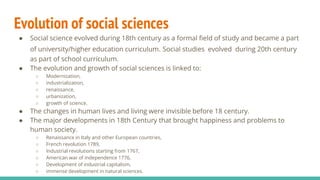
Evolution of social sciences
● Social science evolved during 18th century as a formal field of study and became a part
of university/higher education curriculum. Social studies evolved during 20th century
as part of school curriculum.
● The evolution and growth of social sciences is linked to:
○ Modernization,
○ industrialization,
○ renaissance,
○ urbanization,
○ growth of science.
● The changes in human lives and living were invisible before 18 century.
● The major developments in 18th Century that brought happiness and problems to
human society.
○ Renaissance in Italy and other European countries,
○ French revolution 1789,
○ Industrial revolutions starting from 1767,
○ American war of independence 1776,
○ Development of industrial capitalism,
○ immense development in natural sciences.
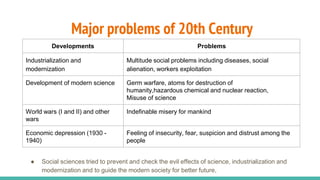
Major problems of 20th Century
Developments Problems
Industrialization and
modernization
Multitude social problems including diseases, social
alienation, workers exploitation
Development of modern science Germ warfare, atoms for destruction of
humanity,hazardous chemical and nuclear reaction,
Misuse of science
World wars (I and II) and other
wars
Indefinable misery for mankind
Economic depression (1930 -
1940)
Feeling of insecurity, fear, suspicion and distrust among the
people
● Social sciences tried to prevent and check the evil effects of science, industrialization and
modernization and to guide the modern society for better future,
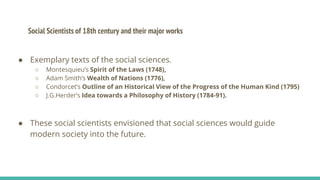
Social Scientists of 18th century and their major works
● Exemplary texts of the social sciences.
○ Montesquieu’s Spirit of the Laws (1748),
○ Adam Smith’s Wealth of Nations (1776),
○ Condorcet’s Outline of an Historical View of the Progress of the Human Kind (1795)
○ J.G.Herder’s Idea towards a Philosophy of History (1784-91).
● These social scientists envisioned that social sciences would guide
modern society into the future.
Social science in pre-modern age
● The idea that society may be studied in a systematic and objective
manner, with scholarly rules and methodology, is comparatively recent.
● Before the modern age learning of social sciences was informal and
unorganized
● As society became complex and social demands and challenges
multiplied, systematic study of social issues became a necessity.
● There was rare reference to social sciences in the ancient and the
medieval world, in comparison to the modern world
● The thoughts/works of Socrates, Plato (Republic), Aristotle (Politics) ,
Confucius (), Kautilya were the early writings in social sciences.
● The idea/learning of social sciences was embodied in the Civic oath of
the Greeks.
Social science in pre-modern age
● Significant contributions to the social sciences were made in Medieval times:
○ Al-Biruni’s (973–1048) comparative studies of people, religions and cultures in
the Middle East, Mediterranean and South Asia.
○ Ibn Khaldun’s (1332–1406) works in areas of demography, historiography, the
philosophy of history, sociology, and economics. He is best known for his
Muqaddimah.
● In the mediaeval and early modern world, large number of subjects like
religious studies, economics, business studies, studies of state affairs etc.
became the part of education system.
Social sciences in the modern period
● Social sciences become the formal component of higher
education/university curriculum in 18 century.
● New branches of social sciences emerged to study/solve/mitigate new
social problems arose.
● After two world wars, social sciences have got high importance in school
curriculum in most parts of the world.
● International organizations like UNO, UNESCO, UNICEF, UNDP, UNO, etc.
wanted to promote healthy social living among the people of the world,
which put emphasis on learning of social sciences.
Social sciences in the modern period
● Social sciences have become a significant part of formal and
non-formal education of the modern world
○ To promote the virtues of living together harmoniously and solving the
diverse socio-cultural problems of the modern world.
● Emergence of nation states and the practice of democratic and
socialist model of governance in such nation states have made
the learning of social sciences necessary at both school and
university level,
○ Because social sciences take the responsibility to create effective citizens for
the practice of democratic and socialist governance in the nation states.
Milestones in social science(modern period)
18 the Century
● By 1760, some effort was spent on the study of human and society.
● Hobbes` Leviathan; Lock’s Two Treatises on Government; Vico`s New Science; and
Montesquieu’s Spirit of Laws were all published in this period
● The revival of interest in social science occurred in the middle of the 18th century.
● By this time capitalism had begun to became the dominant socio- economic system in
western and northern Europe.
18 the Century
● In the second half of 18th century, urbanisation and population growth were accelerated,
and slums, alcoholism, brutality of manners etc developed. These become the targets of
social reforms.
● There was a multiplication of works with a scientific character:
○ Auguste comte ( 1798-1853) invented the term Sociology. He was the first to
systematise and give a complete analysis of the principles of the positive character
of the social sciences.
○ Montesquieu (1689-1755) and Voltaire (1994-1778) broke a new path for politics
and history.
19 the Century
● At the beginning of the 19th century, social science had attained a firm and respectable
position in all the leading European countries .
● The term "social science" first appeared in the 1824 book An Inquiry into the Principles of
the Distribution of Wealth Most Conducive to Human Happiness; applied to the Newly
Proposed System of Voluntary Equality of Wealth by William Thompson (1775–1833).
● The contribution of Auguste Comte was accepted. He established Sociology in 1838.
● Emile Durkheim (1858-1917) and the sociologists of the late 19th and early 20th
century were influenced by him.
● Karl Marx (1818-1883) gave the first general theory of social science.
● Durkheim, Marx and Max Weber (1864-1920) are cited as the three principal architects of
social science.
20th Century
● In the first half of the 20th century, statistics became a free-standing
discipline of applied mathematics. Statistical methods were used
confidently, in biology.
● Sigmund Freud and William James attempted to combine evolutionary
theory of Darwin with exploration of human relationships
● Freud’s framework which impacted not only psychologist, but artists and
writers as well.
● Like Marx, John Dewey(1859–1952) advocated scientific treatment of
philosophy to weld Hegelian idealism and logic to experimental science
● Influenced by both Charles Sanders Peirce and William James, Dewey
joined the movement in America called pragmatism.
● His basic doctrine isn enunciated in "The Influence of Darwin on
Philosophy" (1910).
Sources
For an in depth understanding of evolution of social science read from the
following sites:
1. https://en.wikipedia.org/wiki/History_of_the_social_sciences
2. http://www.dphu.org/uploads/attachements/books/books_4878_0.pdf
3. http://shodhganga.inflibnet.ac.in/bitstream/10603/40587/8/10_chapter1.p
df