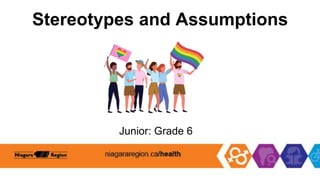
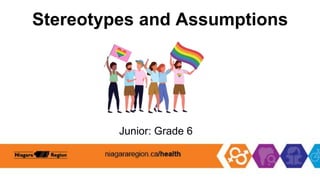
Stereotypes and Assumptions
Junior: Grade 6
Land Acknowledgement
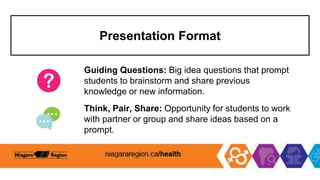
Presentation Format
Guiding Questions: Big idea questions that prompt
students to brainstorm and share previous
knowledge or new information.
Think, Pair, Share: Opportunity for students to work
with partner or group and share ideas based on a
prompt.
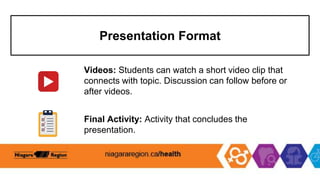
Presentation Format
Videos: Students can watch a short video clip that
connects with topic. Discussion can follow before or
after videos.
Final Activity: Activity that concludes the
presentation.
Curriculum Expectations - Grade 6
D3.3 assess the effects of stereotypes and assumptions regarding gender
roles and expectations, sexual orientation, race, ethnicity, culture, mental
health, and abilities on an individual’s self-concept, social inclusion, and
relationships with others, and propose appropriate ways of responding to
and changing harmful assumptions and stereotypes that can lead to
destructive social attitudes including homophobia and racism.
Stereotypes and Assumptions
Junior: Grade 6
Learning Objectives
At the end of this presentation, you will understand the effects of
stereotypes and assumptions. You will also:
• Challenge harmful assumptions that might lead to negative attitudes in
our society
• Understand that everyone has differences and this makes them unique
• Create an environment that is safe and inclusive for your peers
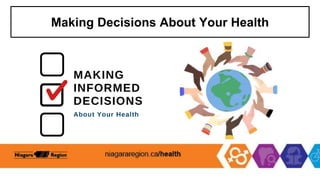
Making Decisions About Your Health
Things to Remember
It’s okay…
 If you feel embarrassed or uncomfortable
 To ask questions
 To not already know about this
 For us to learn about each others
identities, orientations, and experiences
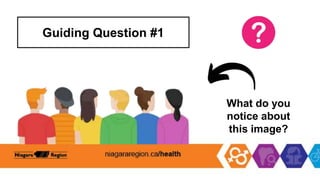
Guiding Question #1
What do you
notice about
this image?
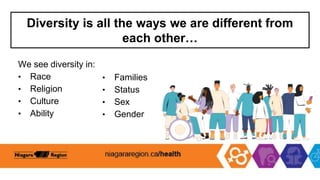
Diversity is all the ways we are different from
each other…
We see diversity in:
• Race
• Religion
• Culture
• Ability
• Families
• Status
• Sex
• Gender
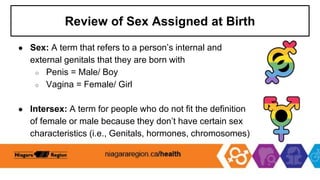
Review of Sex Assigned at Birth
● Sex: A term that refers to a person’s internal and
external genitals that they are born with
○ Penis = Male/ Boy
○ Vagina = Female/ Girl
● Intersex: A term for people who do not fit the definition
of female or male because they don’t have certain sex
characteristics (i.e., Genitals, hormones, chromosomes)
Sexual Orientation
● Sexual orientation is a term for an attraction, desire, or affection for
another person. It can be:
○ Physical
○ Emotional
○ Romantic
○ Sexual
○ Spiritual
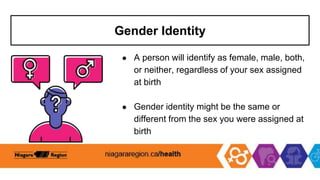
Gender Identity
● A person will identify as female, male, both,
or neither, regardless of your sex assigned
at birth
● Gender identity might be the same or
different from the sex you were assigned at
birth
Gender Expression
Known as how you present yourself to the
world around you. It can be expressed through:
 Names
 Clothing
 Hairstyle/ Hair cuts
 Voice
 Body characteristics
 Pronouns
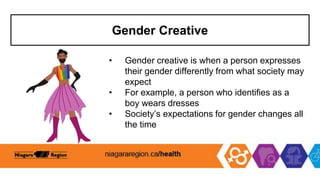
Gender Creative
• Gender creative is when a person expresses
their gender differently from what society may
expect
• For example, a person who identifies as a
boy wears dresses
• Society’s expectations for gender changes all
the time
Think, Pair, Share
Find a partner and take time to discuss the
acronym: 2SLGBTQIA+
Then come back to the group and share what
you talked about.
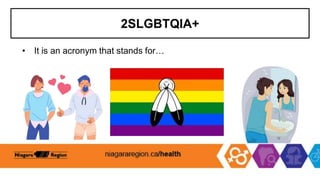
2SLGBTQIA+
• It is an acronym that stands for…
Guiding Question #2
Could a person feel pressured to act a
certain way because of the way they look?
What are Assumptions?
An assumption:
● Is something that is believed to be true without proof
● May cause people to exclude others who are seen as “different”
● Might make people who do not fit societal norms feel confused or bad
about themselves
Can you think of any assumptions that you might make?
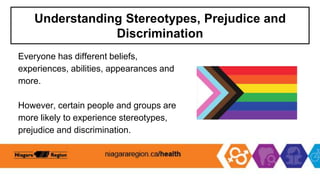
Understanding Stereotypes, Prejudice and
Discrimination
Everyone has different beliefs,
experiences, abilities, appearances and
more.
However, certain people and groups are
more likely to experience stereotypes,
prejudice and discrimination.
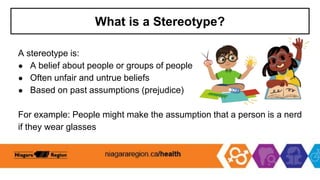
What is a Stereotype?
A stereotype is:
● A belief about people or groups of people
● Often unfair and untrue beliefs
● Based on past assumptions (prejudice)
For example: People might make the assumption that a person is a nerd
if they wear glasses
People might be stereotyped because of their…
● Abilities
● Age
● Economic status
● Ethnicity
● Race
● Family status
● Religion
● Sexual orientation
● Gender identity or
expression
● Physical appearance
● Mental health
● National origin
● Spirituality
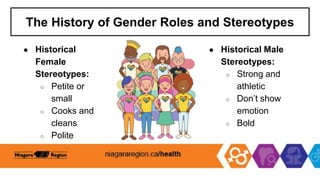
The History of Gender Roles and Stereotypes
● Historical
Female
Stereotypes:
○ Petite or
small
○ Cooks and
cleans
○ Polite
● Historical Male
Stereotypes:
○ Strong and
athletic
○ Don’t show
emotion
○ Bold
Discrimination and Prejudice
● Discrimination is when someone acts on prejudiced beliefs
● Prejudice is when someone has a belief (usually negative) about a
person or group based on a stereotype
● Discrimination can have a negative impact on a person’s self-esteem
or self-confidence
Can you think of a time when you were discriminated
against?
Video: Gender Stereotypes and Education
After the watching the
video, answer the
following question:
• What are a few of the
stereotypes that were
discussed?
Race, Culture, Ethnicity
Race:
• A group of people with a common ancestry that is different
from others
Culture:
• The beliefs, values, and traditions held by people who share
a similar background
Ethnicity:
• Belonging to a group of people with shared cultural traits,
such as language, ancestry, and practices
What are Racism and Transphobia?
Racism
• Is when people are treated unfairly because of
their race or ethnicity
Transphobia:
• Discriminating against people who identify as a
gender that is not the same as their sex assigned
at birth
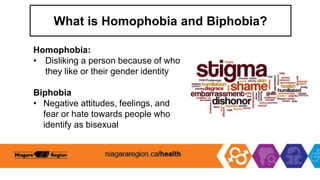
What is Homophobia and Biphobia?
Homophobia:
• Disliking a person because of who
they like or their gender identity
Biphobia
• Negative attitudes, feelings, and
fear or hate towards people who
identify as bisexual
Homophobia and Transphobia
What homophobia and transphobia might look and sound
like:
• Name-calling
• Bullying and violence
• Not using a persons proper pronouns
• Discriminating people from the 2SLGBTQ+ community
• Excluding people because of their gender identity or who
they like
How You Can Respond to Harmful Assumptions
● Develop responses that will work at different times
○ “What you’ve said is hurtful”
○ “That offends me”
○ “I don’t find that funny”
● Have questions to interrupt negative comments
○ “What do you mean by that?”
○ “Why would you say something like that?”
Final Activity: Stereotype Scenario
At recess you’re hanging out with some of your friends. Your one friend
who identifies as a girl, privately tells you that she likes one of the other the
girls in the friend group.
When one of your classmates overhears, he approaches and says
“girls can’t like girls, that’s weird!”
If you are in this situation, what could you say to stand up for your friend?
Support
Quest Community Health Centre
145 Queenston Street, St. Catharines
905-688-2558
Niagara Falls Community Health Centre
4790 Victoria Ave, Niagara Falls
LGBTQ2S+ Support Coordinator
Call/Text 289-321-0588
Support
LGBT Youthline (youthline.ca)
Confidential peer support line
Call or Text: 905-688-2558
Niagara-on-the-Lake Regional Native Centre:
905-688-6484
Fort Erie Native Friendship Centre: 905-871-8931
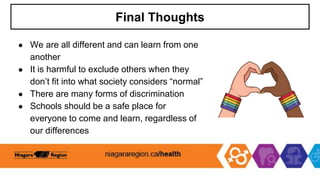
Final Thoughts
● We are all different and can learn from one
another
● It is harmful to exclude others when they
don’t fit into what society considers “normal”
● There are many forms of discrimination
● Schools should be a safe place for
everyone to come and learn, regardless of
our differences
More Questions? Talk With Someone:
• Parents/ Guardian
• Teacher/ Principal
• Doctor or Health Care Provider
• School Health Nurse
• Child and Youth Worker
• Kids Help Phone
• Friendship Centre
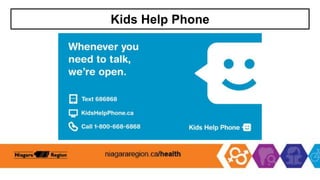
Kids Help Phone
Questions?

gr6-stereotypes-and-assumptions-presentation.pptx

  • 1.
  • 2.
  • 3.
    Presentation Format Guiding Questions:Big idea questions that prompt students to brainstorm and share previous knowledge or new information. Think, Pair, Share: Opportunity for students to work with partner or group and share ideas based on a prompt.
  • 4.
    Presentation Format Videos: Studentscan watch a short video clip that connects with topic. Discussion can follow before or after videos. Final Activity: Activity that concludes the presentation.
  • 5.
    Curriculum Expectations -Grade 6 D3.3 assess the effects of stereotypes and assumptions regarding gender roles and expectations, sexual orientation, race, ethnicity, culture, mental health, and abilities on an individual’s self-concept, social inclusion, and relationships with others, and propose appropriate ways of responding to and changing harmful assumptions and stereotypes that can lead to destructive social attitudes including homophobia and racism.
  • 6.
  • 7.
    Learning Objectives At theend of this presentation, you will understand the effects of stereotypes and assumptions. You will also: • Challenge harmful assumptions that might lead to negative attitudes in our society • Understand that everyone has differences and this makes them unique • Create an environment that is safe and inclusive for your peers
  • 8.
  • 9.
    Things to Remember It’sokay…  If you feel embarrassed or uncomfortable  To ask questions  To not already know about this  For us to learn about each others identities, orientations, and experiences
  • 10.
    Guiding Question #1 Whatdo you notice about this image?
  • 11.
    Diversity is allthe ways we are different from each other… We see diversity in: • Race • Religion • Culture • Ability • Families • Status • Sex • Gender
  • 12.
    Review of SexAssigned at Birth ● Sex: A term that refers to a person’s internal and external genitals that they are born with ○ Penis = Male/ Boy ○ Vagina = Female/ Girl ● Intersex: A term for people who do not fit the definition of female or male because they don’t have certain sex characteristics (i.e., Genitals, hormones, chromosomes)
  • 13.
    Sexual Orientation ● Sexualorientation is a term for an attraction, desire, or affection for another person. It can be: ○ Physical ○ Emotional ○ Romantic ○ Sexual ○ Spiritual
  • 14.
    Gender Identity ● Aperson will identify as female, male, both, or neither, regardless of your sex assigned at birth ● Gender identity might be the same or different from the sex you were assigned at birth
  • 15.
    Gender Expression Known ashow you present yourself to the world around you. It can be expressed through:  Names  Clothing  Hairstyle/ Hair cuts  Voice  Body characteristics  Pronouns
  • 16.
    Gender Creative • Gendercreative is when a person expresses their gender differently from what society may expect • For example, a person who identifies as a boy wears dresses • Society’s expectations for gender changes all the time
  • 17.
    Think, Pair, Share Finda partner and take time to discuss the acronym: 2SLGBTQIA+ Then come back to the group and share what you talked about.
  • 18.
    2SLGBTQIA+ • It isan acronym that stands for…
  • 19.
    Guiding Question #2 Coulda person feel pressured to act a certain way because of the way they look?
  • 20.
    What are Assumptions? Anassumption: ● Is something that is believed to be true without proof ● May cause people to exclude others who are seen as “different” ● Might make people who do not fit societal norms feel confused or bad about themselves Can you think of any assumptions that you might make?
  • 21.
    Understanding Stereotypes, Prejudiceand Discrimination Everyone has different beliefs, experiences, abilities, appearances and more. However, certain people and groups are more likely to experience stereotypes, prejudice and discrimination.
  • 22.
    What is aStereotype? A stereotype is: ● A belief about people or groups of people ● Often unfair and untrue beliefs ● Based on past assumptions (prejudice) For example: People might make the assumption that a person is a nerd if they wear glasses
  • 23.
    People might bestereotyped because of their… ● Abilities ● Age ● Economic status ● Ethnicity ● Race ● Family status ● Religion ● Sexual orientation ● Gender identity or expression ● Physical appearance ● Mental health ● National origin ● Spirituality
  • 24.
    The History ofGender Roles and Stereotypes ● Historical Female Stereotypes: ○ Petite or small ○ Cooks and cleans ○ Polite ● Historical Male Stereotypes: ○ Strong and athletic ○ Don’t show emotion ○ Bold
  • 25.
    Discrimination and Prejudice ●Discrimination is when someone acts on prejudiced beliefs ● Prejudice is when someone has a belief (usually negative) about a person or group based on a stereotype ● Discrimination can have a negative impact on a person’s self-esteem or self-confidence Can you think of a time when you were discriminated against?
  • 26.
    Video: Gender Stereotypesand Education After the watching the video, answer the following question: • What are a few of the stereotypes that were discussed?
  • 27.
    Race, Culture, Ethnicity Race: •A group of people with a common ancestry that is different from others Culture: • The beliefs, values, and traditions held by people who share a similar background Ethnicity: • Belonging to a group of people with shared cultural traits, such as language, ancestry, and practices
  • 28.
    What are Racismand Transphobia? Racism • Is when people are treated unfairly because of their race or ethnicity Transphobia: • Discriminating against people who identify as a gender that is not the same as their sex assigned at birth
  • 29.
    What is Homophobiaand Biphobia? Homophobia: • Disliking a person because of who they like or their gender identity Biphobia • Negative attitudes, feelings, and fear or hate towards people who identify as bisexual
  • 30.
    Homophobia and Transphobia Whathomophobia and transphobia might look and sound like: • Name-calling • Bullying and violence • Not using a persons proper pronouns • Discriminating people from the 2SLGBTQ+ community • Excluding people because of their gender identity or who they like
  • 31.
    How You CanRespond to Harmful Assumptions ● Develop responses that will work at different times ○ “What you’ve said is hurtful” ○ “That offends me” ○ “I don’t find that funny” ● Have questions to interrupt negative comments ○ “What do you mean by that?” ○ “Why would you say something like that?”
  • 32.
    Final Activity: StereotypeScenario At recess you’re hanging out with some of your friends. Your one friend who identifies as a girl, privately tells you that she likes one of the other the girls in the friend group. When one of your classmates overhears, he approaches and says “girls can’t like girls, that’s weird!” If you are in this situation, what could you say to stand up for your friend?
  • 33.
    Support Quest Community HealthCentre 145 Queenston Street, St. Catharines 905-688-2558 Niagara Falls Community Health Centre 4790 Victoria Ave, Niagara Falls LGBTQ2S+ Support Coordinator Call/Text 289-321-0588
  • 34.
    Support LGBT Youthline (youthline.ca) Confidentialpeer support line Call or Text: 905-688-2558 Niagara-on-the-Lake Regional Native Centre: 905-688-6484 Fort Erie Native Friendship Centre: 905-871-8931
  • 35.
    Final Thoughts ● Weare all different and can learn from one another ● It is harmful to exclude others when they don’t fit into what society considers “normal” ● There are many forms of discrimination ● Schools should be a safe place for everyone to come and learn, regardless of our differences
  • 36.
    More Questions? TalkWith Someone: • Parents/ Guardian • Teacher/ Principal • Doctor or Health Care Provider • School Health Nurse • Child and Youth Worker • Kids Help Phone • Friendship Centre
  • 37.
  • 38.