Functional Behavioral Assessments Creating Opportunities for Student Success Earl E. Walker, Jr., Ed.D.
Introduction Formal assessment of the purpose of “challenging” behavior(s)  A process of searching for, identifying, and examining patterns in the behavioral process (ABCs) Assumption: Behavior must be serving a purpose
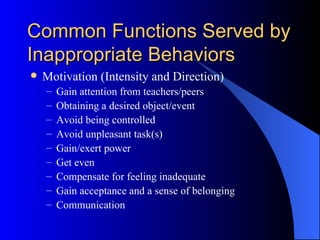
Common Functions Served by Inappropriate Behaviors Motivation (Intensity and Direction) Gain attention from teachers/peers Obtaining a desired object/event Avoid being controlled Avoid unpleasant task(s) Gain/exert power Get even Compensate for feeling inadequate Gain acceptance and a sense of belonging Communication
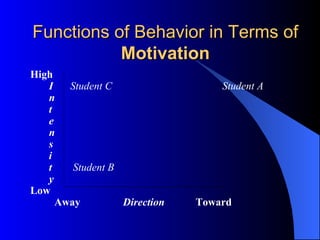
Functions of Behavior in Terms of  Motivation High I   Student C Student A n t e n s i t   Student B y Low Away   Direction   Toward
The Function of an FBA Federal Regulations IDEA/504 FAPE LRE School Accountability Increase opportunity for student success
Agenda When should an FBA be conducted? Who should conduct an FBA? How is an FBA conducted?
When Should an FBA be Conducted?  Displays chronic inappropriate behavior  Behavior interferes with school success To support projectives for 766 evaluations Immediately after 10 th  day of suspension
Who conducts an FBA? School Clinicians With the support and participation of the “entire IEP Team” Parents Teachers School support personnel Outside clinicians and support personnel
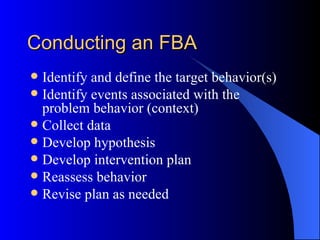
Conducting an FBA Identify and define the target behavior(s) Identify events associated with the problem behavior (context) Collect data Develop hypothesis Develop intervention plan Reassess behavior Revise plan as needed
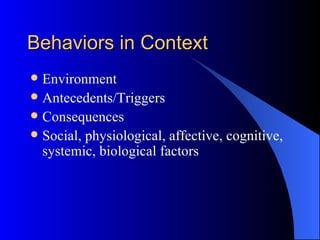
Behaviors in Context Environment Antecedents/Triggers Consequences Social, physiological, affective, cognitive, systemic, biological factors
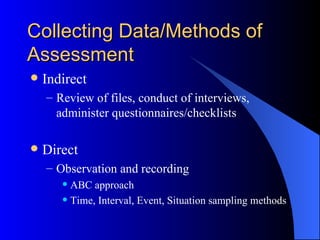
Collecting Data/Methods of Assessment Indirect Review of files, conduct of interviews, administer questionnaires/checklists Direct Observation and recording ABC approach Time, Interval, Event, Situation sampling methods
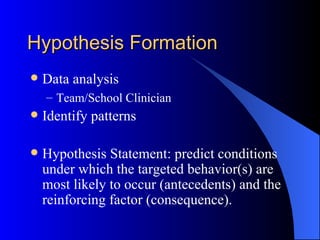
Hypothesis Formation Data analysis Team/School Clinician Identify patterns Hypothesis Statement: predict conditions under which the targeted behavior(s) are most likely to occur (antecedents) and the reinforcing factor (consequence).
Sample Hypothesis Statement When Robert is having trouble with a reading assignment in a large group setting (n=  ), he will begin to shout profanities and sometimes throw things to avoid completing the assignment.  This pattern of behavior is less likely in a small group setting or when receiving one on one assistance.  However, this pattern is more likely when Robert receives little or no assistance on assignments during the day.
Behavioral Intervention Plans Hypothesis testing Allow informed pro-active responses to inappropriate behaviors Reduces the need for reactive procedures Suspension Expulsion Detention
Developing a BIP from an FBA Alter antecedents Alter consequences Teach replacement behaviors that serve the same function as the inappropriate behavior Modify curriculum Modify teaching methods/strategies Modify environment
Developing a BIP from an FBA  Identify skill deficits Select and teach appropriate replacement behavior Identify performance deficits Create value Provide incentives (extrinsic and pairing) Modify learning environment Peers, families, teachers, paras, other school  personnel
Evaluating the BIP Continuous on two levels Implementation Effectiveness

Functional Behavioral Assessments

  • 1.
    Functional Behavioral AssessmentsCreating Opportunities for Student Success Earl E. Walker, Jr., Ed.D.
  • 2.
    Introduction Formal assessmentof the purpose of “challenging” behavior(s) A process of searching for, identifying, and examining patterns in the behavioral process (ABCs) Assumption: Behavior must be serving a purpose
  • 3.
    Common Functions Servedby Inappropriate Behaviors Motivation (Intensity and Direction) Gain attention from teachers/peers Obtaining a desired object/event Avoid being controlled Avoid unpleasant task(s) Gain/exert power Get even Compensate for feeling inadequate Gain acceptance and a sense of belonging Communication
  • 4.
    Functions of Behaviorin Terms of Motivation High I Student C Student A n t e n s i t Student B y Low Away Direction Toward
  • 5.
    The Function ofan FBA Federal Regulations IDEA/504 FAPE LRE School Accountability Increase opportunity for student success
  • 6.
    Agenda When shouldan FBA be conducted? Who should conduct an FBA? How is an FBA conducted?
  • 7.
    When Should anFBA be Conducted? Displays chronic inappropriate behavior Behavior interferes with school success To support projectives for 766 evaluations Immediately after 10 th day of suspension
  • 8.
    Who conducts anFBA? School Clinicians With the support and participation of the “entire IEP Team” Parents Teachers School support personnel Outside clinicians and support personnel
  • 9.
    Conducting an FBAIdentify and define the target behavior(s) Identify events associated with the problem behavior (context) Collect data Develop hypothesis Develop intervention plan Reassess behavior Revise plan as needed
  • 10.
    Behaviors in ContextEnvironment Antecedents/Triggers Consequences Social, physiological, affective, cognitive, systemic, biological factors
  • 11.
    Collecting Data/Methods ofAssessment Indirect Review of files, conduct of interviews, administer questionnaires/checklists Direct Observation and recording ABC approach Time, Interval, Event, Situation sampling methods
  • 12.
    Hypothesis Formation Dataanalysis Team/School Clinician Identify patterns Hypothesis Statement: predict conditions under which the targeted behavior(s) are most likely to occur (antecedents) and the reinforcing factor (consequence).
  • 13.
    Sample Hypothesis StatementWhen Robert is having trouble with a reading assignment in a large group setting (n= ), he will begin to shout profanities and sometimes throw things to avoid completing the assignment. This pattern of behavior is less likely in a small group setting or when receiving one on one assistance. However, this pattern is more likely when Robert receives little or no assistance on assignments during the day.
  • 14.
    Behavioral Intervention PlansHypothesis testing Allow informed pro-active responses to inappropriate behaviors Reduces the need for reactive procedures Suspension Expulsion Detention
  • 15.
    Developing a BIPfrom an FBA Alter antecedents Alter consequences Teach replacement behaviors that serve the same function as the inappropriate behavior Modify curriculum Modify teaching methods/strategies Modify environment
  • 16.
    Developing a BIPfrom an FBA Identify skill deficits Select and teach appropriate replacement behavior Identify performance deficits Create value Provide incentives (extrinsic and pairing) Modify learning environment Peers, families, teachers, paras, other school personnel
  • 17.
    Evaluating the BIPContinuous on two levels Implementation Effectiveness