Assessment of Behavior Chapter Ten
CHAPTER OBJECTIVES The purpose of a behavioral assessment Observational techniques Recording behaviors Interviews A student’s behavior during testing Psychological tests UNDERSTAND
CHAPTER OBJECTIVES Projective drawing tests Appreciation tests Sentence completion tests Adaptive behavior Functional behavior assessment Behavioral intervention plans UNDERSTAND
ASSESSING PROBLEM BEHAVIOR
OBSERVATION In order to do a complete and thorough observation, it is critical to include the  following situations: Observation of a specific situation Observation in various settings Observation at different times during the day
TARGET BEHAVIORS Those that the observer seeks to record when doing the observation. The four most common types of recording done when doing an observation are: Anecdotal Latency recordings Event recording Duration recordings
INERVIEWS A method of gathering information that is conducted face to face between two people whereby recorded responses to questions are obtained. Interviews can be of two types: Structured Interview Unstructured Interview
Understanding a Student’s Behavior During Assessment The following behaviors should be recorded in the final report: Adjustment to the Situation Reaction Time Nature of Responses Verbalizations Organizational Approach Used During Testing Adaptability Attitude
Assessing Emotional & Social Development Assessment of a child’s behaviors involves  knowledge about the following: The degree to which she believes that personal behaviors make a difference in her life The child’s tolerance for frustration General activity level How the child views him or herself How the child responds emotionally How much conflict the child is experiencing
Psychological Tests Almost always administered by school psychologist One of the most common is called a  projective test. Projective Tests  try to elicit feelings from the student about how he or she feels  about life through projection of emotions  onto the test stimuli.
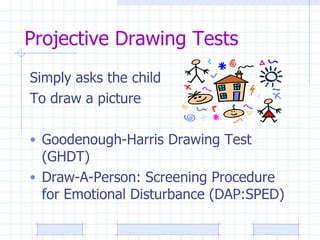
Projective Drawing Tests Simply asks the child To draw a picture Goodenough-Harris Drawing Test (GHDT) Draw-A-Person: Screening Procedure for Emotional Disturbance (DAP:SPED)
Apperception Tests Require the child to view various picture cards and “tell a story” about what it is he  or she is seeing. Children’s Apperception Test (CAT) Thematic Apperception Test (TAT)
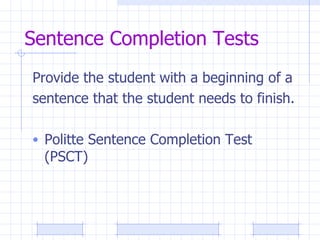
Sentence Completion Tests Provide the student with a beginning of a sentence that the student needs to finish. Politte Sentence Completion Test (PSCT)
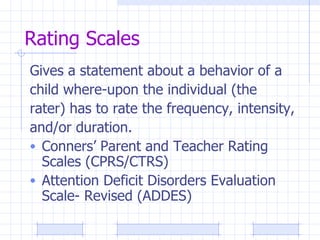
Rating Scales Gives a statement about a behavior of a  child where-upon the individual (the  rater) has to rate the frequency, intensity,  and/or duration. Conners’ Parent and Teacher Rating Scales (CPRS/CTRS) Attention Deficit Disorders Evaluation Scale- Revised (ADDES)
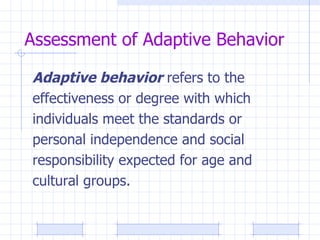
Assessment of Adaptive Behavior Adaptive behavior  refers to the effectiveness or degree with which individuals meet the standards or personal independence and social responsibility expected for age and  cultural groups.
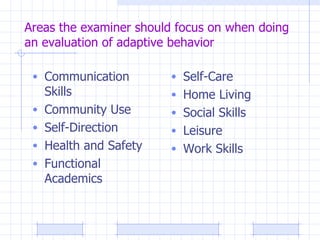
Areas the examiner should focus on when doing an evaluation of adaptive behavior Communication Skills Community Use Self-Direction Health and Safety Functional Academics Self-Care Home Living Social Skills Leisure Work Skills
Adaptive Behavior Assessments AAMR Adaptive Behavior Scale- Residential and Community-2 (ABS-RC:2) AAMR Adaptive Behavior Scale- School (ABS-S:2) The Adaptive Behavior Evaluation Scale- Revised (ABES-R) Vineland Adaptive Behavior Scale (VABS) Developmental Assessment for the Severely Handicapped- Second Edition (DASH-2)
Functional Behavioral Assessment and Behavioral Intervention Plans FBA- the process of determining why a  student engages in challenging behavior  and how the student’s behavior relates to  the environment
Requirements of the IDEA Evaluation IEP Team (Eligibility Committee) IEP Contents and Considerations Discipline Writing Functional Behavioral Assessments and Intervention Plans Role of the Eligibility Committee in the FBA Behavioral Intervention Plans
CHAPTER OBJECTIVES The purpose of a behavioral assessment Observational techniques Recording behaviors Interviews A student’s behavior during testing Psychological tests UNDERSTAND
CHAPTER OBJECTIVES Projective drawing tests Appreciation tests Sentence completion tests Adaptive behavior Functional behavior assessment Behavioral intervention plans UNDERSTAND
THE END

Chapter 10 assessment of behavior

  • 1.
  • 2.
    CHAPTER OBJECTIVES Thepurpose of a behavioral assessment Observational techniques Recording behaviors Interviews A student’s behavior during testing Psychological tests UNDERSTAND
  • 3.
    CHAPTER OBJECTIVES Projectivedrawing tests Appreciation tests Sentence completion tests Adaptive behavior Functional behavior assessment Behavioral intervention plans UNDERSTAND
  • 4.
  • 5.
    OBSERVATION In orderto do a complete and thorough observation, it is critical to include the following situations: Observation of a specific situation Observation in various settings Observation at different times during the day
  • 6.
    TARGET BEHAVIORS Thosethat the observer seeks to record when doing the observation. The four most common types of recording done when doing an observation are: Anecdotal Latency recordings Event recording Duration recordings
  • 7.
    INERVIEWS A methodof gathering information that is conducted face to face between two people whereby recorded responses to questions are obtained. Interviews can be of two types: Structured Interview Unstructured Interview
  • 8.
    Understanding a Student’sBehavior During Assessment The following behaviors should be recorded in the final report: Adjustment to the Situation Reaction Time Nature of Responses Verbalizations Organizational Approach Used During Testing Adaptability Attitude
  • 9.
    Assessing Emotional &Social Development Assessment of a child’s behaviors involves knowledge about the following: The degree to which she believes that personal behaviors make a difference in her life The child’s tolerance for frustration General activity level How the child views him or herself How the child responds emotionally How much conflict the child is experiencing
  • 10.
    Psychological Tests Almostalways administered by school psychologist One of the most common is called a projective test. Projective Tests try to elicit feelings from the student about how he or she feels about life through projection of emotions onto the test stimuli.
  • 11.
    Projective Drawing TestsSimply asks the child To draw a picture Goodenough-Harris Drawing Test (GHDT) Draw-A-Person: Screening Procedure for Emotional Disturbance (DAP:SPED)
  • 12.
    Apperception Tests Requirethe child to view various picture cards and “tell a story” about what it is he or she is seeing. Children’s Apperception Test (CAT) Thematic Apperception Test (TAT)
  • 13.
    Sentence Completion TestsProvide the student with a beginning of a sentence that the student needs to finish. Politte Sentence Completion Test (PSCT)
  • 14.
    Rating Scales Givesa statement about a behavior of a child where-upon the individual (the rater) has to rate the frequency, intensity, and/or duration. Conners’ Parent and Teacher Rating Scales (CPRS/CTRS) Attention Deficit Disorders Evaluation Scale- Revised (ADDES)
  • 15.
    Assessment of AdaptiveBehavior Adaptive behavior refers to the effectiveness or degree with which individuals meet the standards or personal independence and social responsibility expected for age and cultural groups.
  • 16.
    Areas the examinershould focus on when doing an evaluation of adaptive behavior Communication Skills Community Use Self-Direction Health and Safety Functional Academics Self-Care Home Living Social Skills Leisure Work Skills
  • 17.
    Adaptive Behavior AssessmentsAAMR Adaptive Behavior Scale- Residential and Community-2 (ABS-RC:2) AAMR Adaptive Behavior Scale- School (ABS-S:2) The Adaptive Behavior Evaluation Scale- Revised (ABES-R) Vineland Adaptive Behavior Scale (VABS) Developmental Assessment for the Severely Handicapped- Second Edition (DASH-2)
  • 18.
    Functional Behavioral Assessmentand Behavioral Intervention Plans FBA- the process of determining why a student engages in challenging behavior and how the student’s behavior relates to the environment
  • 19.
    Requirements of theIDEA Evaluation IEP Team (Eligibility Committee) IEP Contents and Considerations Discipline Writing Functional Behavioral Assessments and Intervention Plans Role of the Eligibility Committee in the FBA Behavioral Intervention Plans
  • 20.
    CHAPTER OBJECTIVES Thepurpose of a behavioral assessment Observational techniques Recording behaviors Interviews A student’s behavior during testing Psychological tests UNDERSTAND
  • 21.
    CHAPTER OBJECTIVES Projectivedrawing tests Appreciation tests Sentence completion tests Adaptive behavior Functional behavior assessment Behavioral intervention plans UNDERSTAND
  • 22.