Danielle Eadens, Ph.D. & Daniel Eadens, M.Ed., ABD
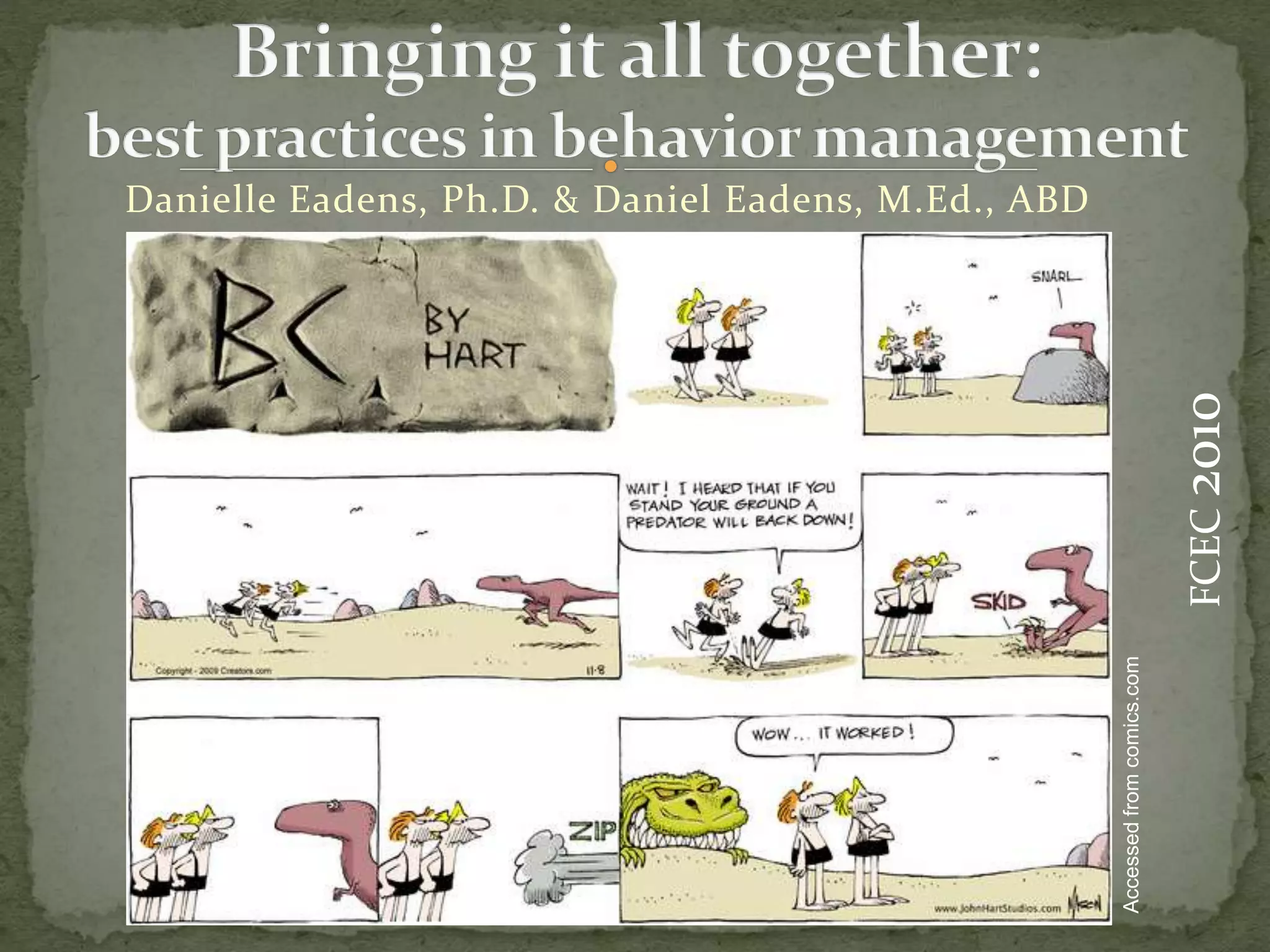
Accessedfromcomics.com
FCEC2010
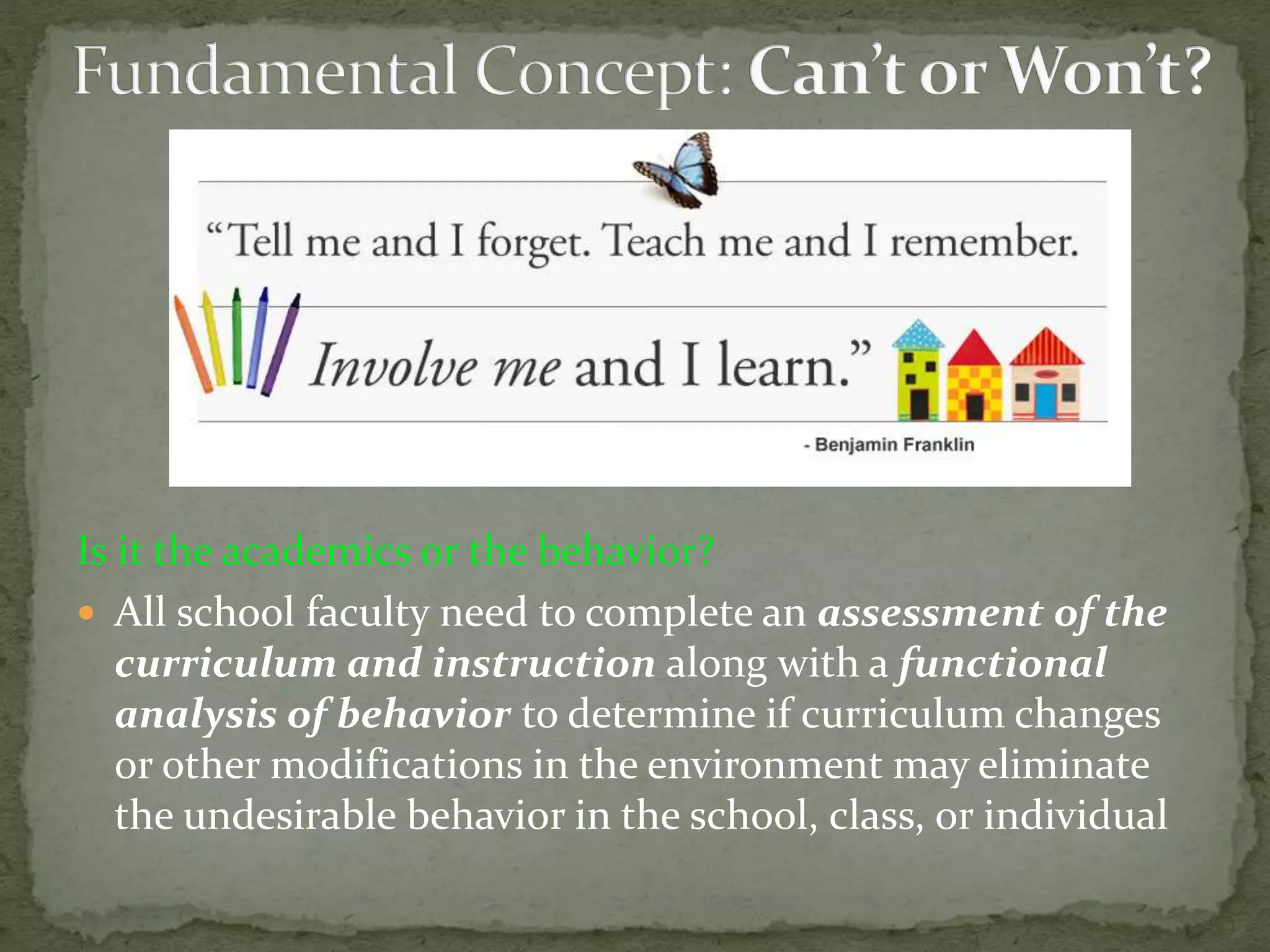
Is it the academics or the behavior?
 All school faculty need to complete an assessment of the
curriculum and instruction along with a functional
analysis of behavior to determine if curriculum changes
or other modifications in the environment may eliminate
the undesirable behavior in the school, class, or individual
 Positive Behavior Support (PBS)
 School-wide, Class-wide, Individualized
 CHAMPs
 Antecedent-Behavior-Consequence (ABC)
 Prevent-Teach-Reinforce (PTR)
 Cognitive Behavior Management (CBM)
 General Behavior Reduction Strategies
 Bringing it all together
 Recommended Resources
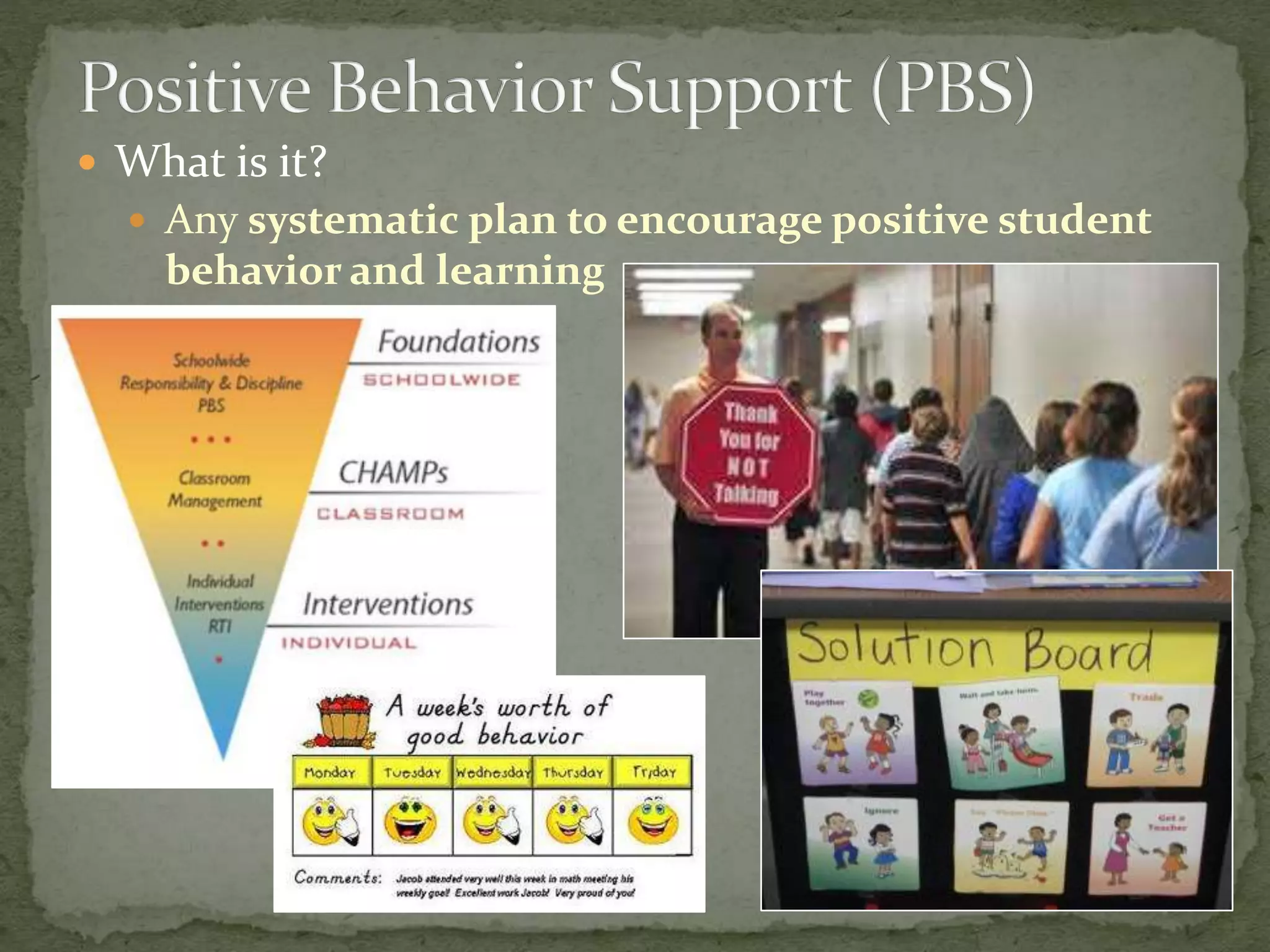
 What is it?
 Any systematic plan to encourage positive student
behavior and learning
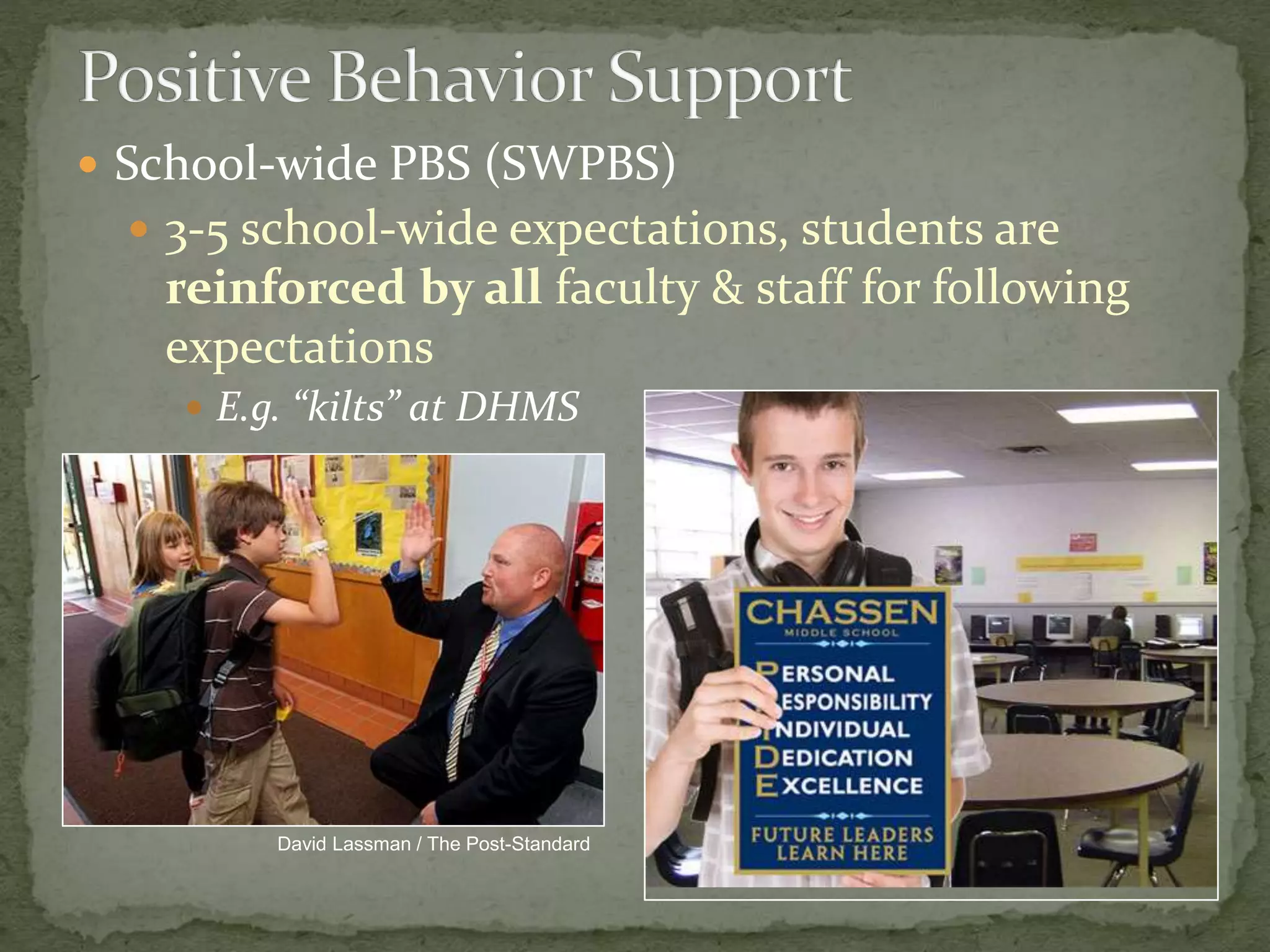
 School-wide PBS (SWPBS)
 3-5 school-wide expectations, students are
reinforced by all faculty & staff for following
expectations
 E.g. “kilts” at DHMS
David Lassman / The Post-Standard
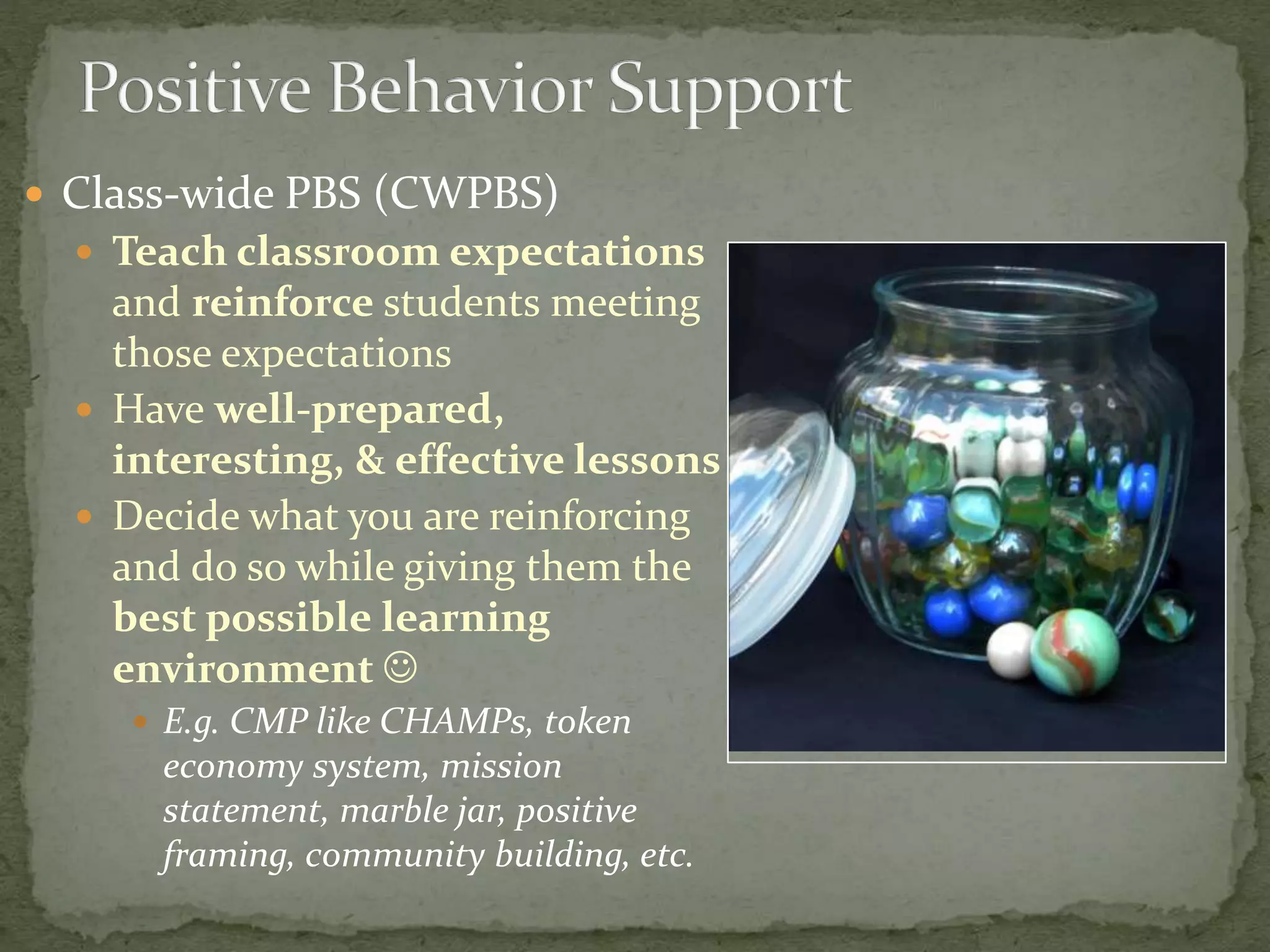
 Class-wide PBS (CWPBS)
 Teach classroom expectations
and reinforce students meeting
those expectations
 Have well-prepared,
interesting, & effective lessons
 Decide what you are reinforcing
and do so while giving them the
best possible learning
environment 
 E.g. CMP like CHAMPs, token
economy system, mission
statement, marble jar, positive
framing, community building, etc.
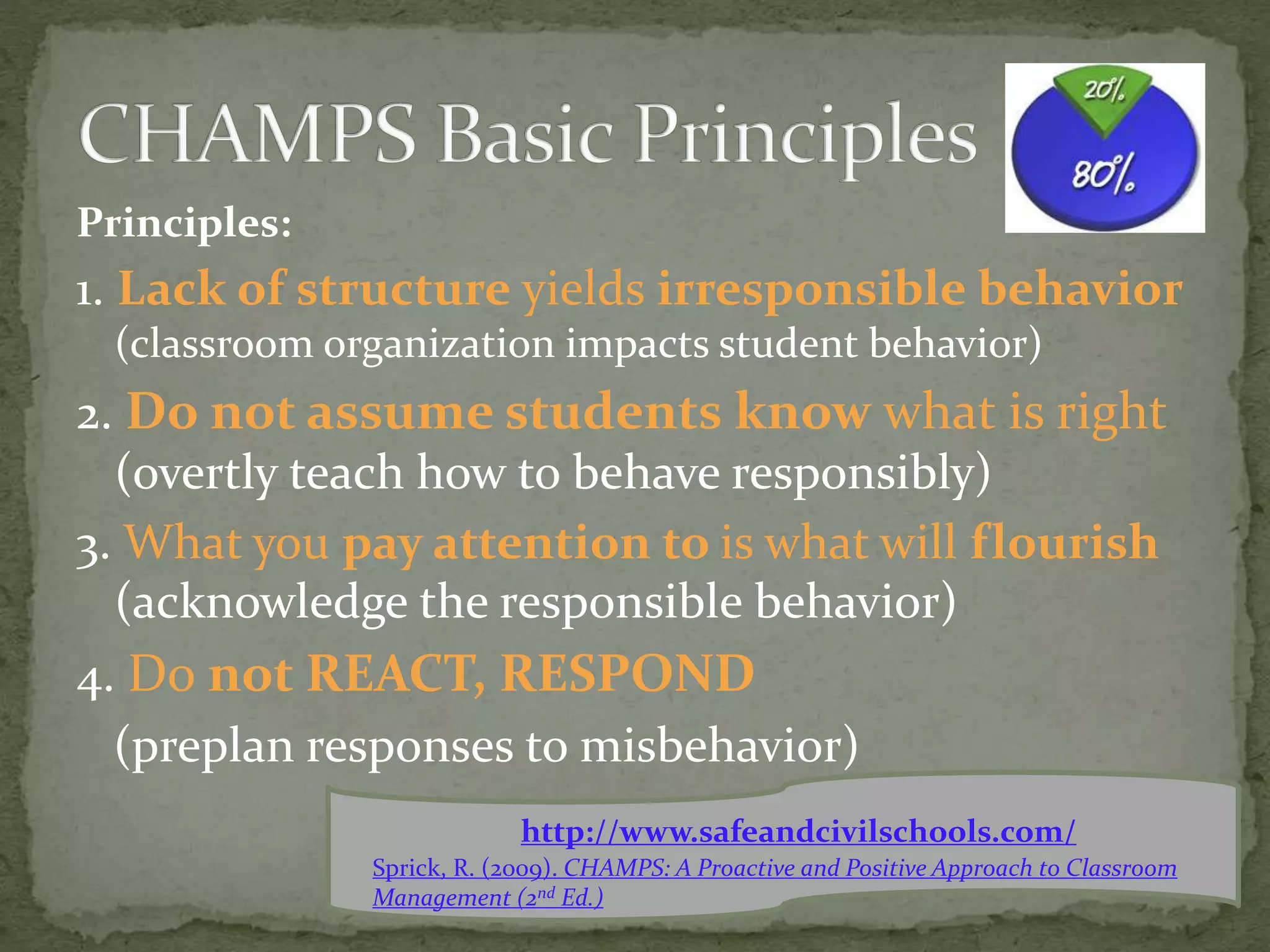
Principles:
1. Lack of structure yields irresponsible behavior
(classroom organization impacts student behavior)
2. Do not assume students know what is right
(overtly teach how to behave responsibly)
3. What you pay attention to is what will flourish
(acknowledge the responsible behavior)
4. Do not REACT, RESPOND
(preplan responses to misbehavior)
Sprick, R. (2009). CHAMPS: A Proactive and Positive Approach to Classroom
Management (2nd Ed.)
http://www.safeandcivilschools.com/
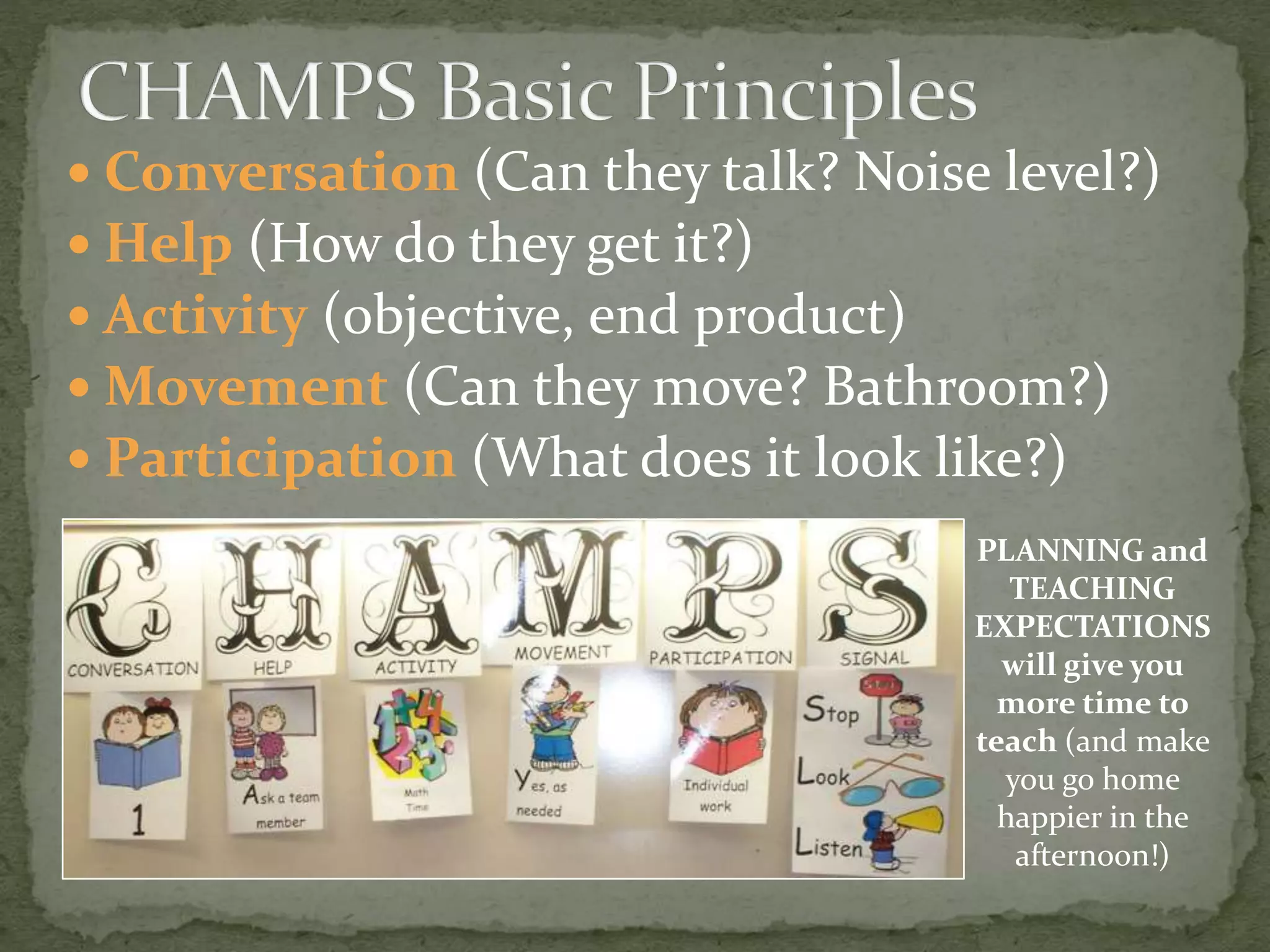
 Conversation (Can they talk? Noise level?)
 Help (How do they get it?)
 Activity (objective, end product)
 Movement (Can they move? Bathroom?)
 Participation (What does it look like?)
PLANNING and
TEACHING
EXPECTATIONS
will give you
more time to
teach (and make
you go home
happier in the
afternoon!)
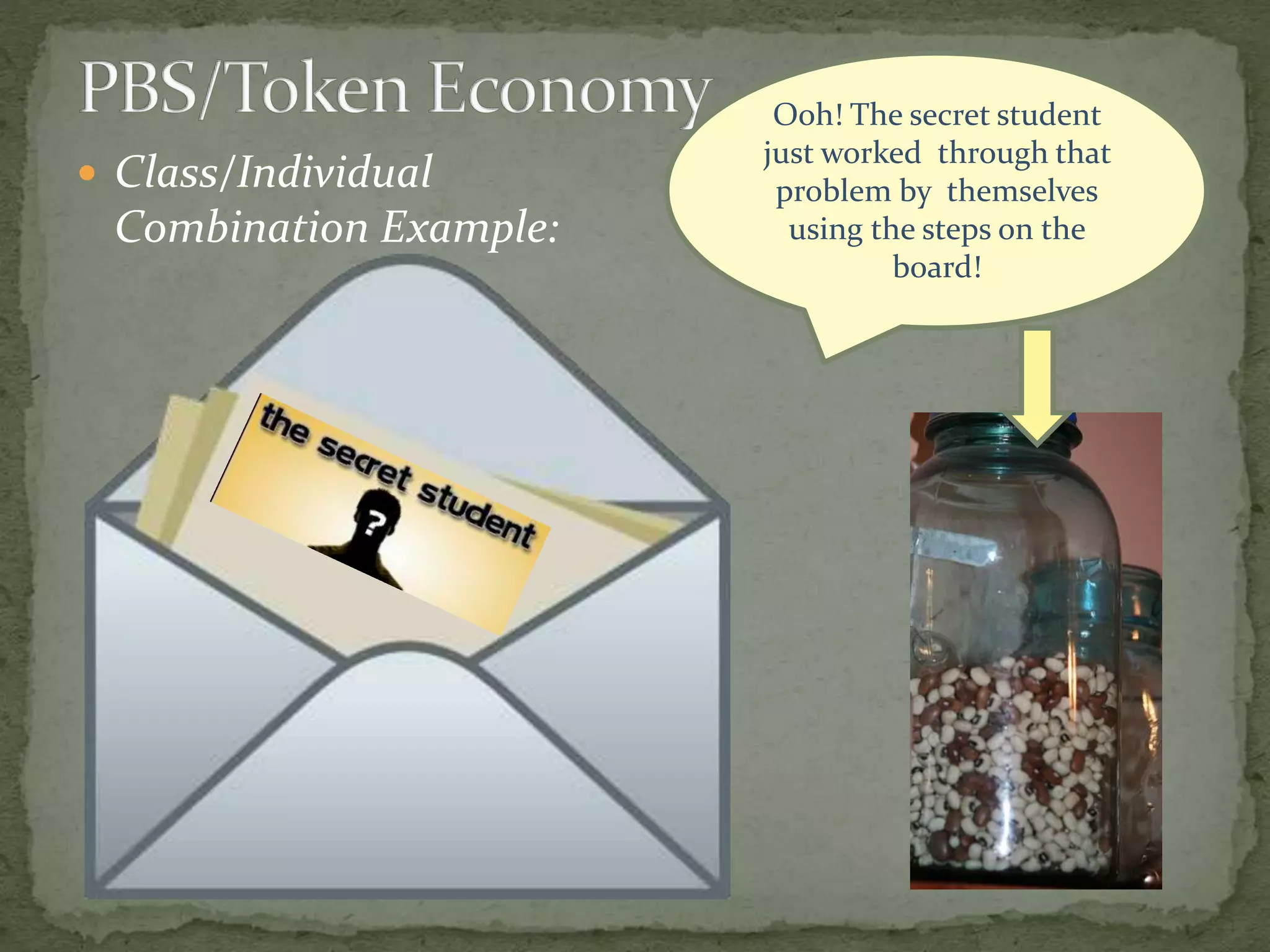
 Class/Individual
Combination Example:
Ooh! The secret student
just worked through that
problem by themselves
using the steps on the
board!
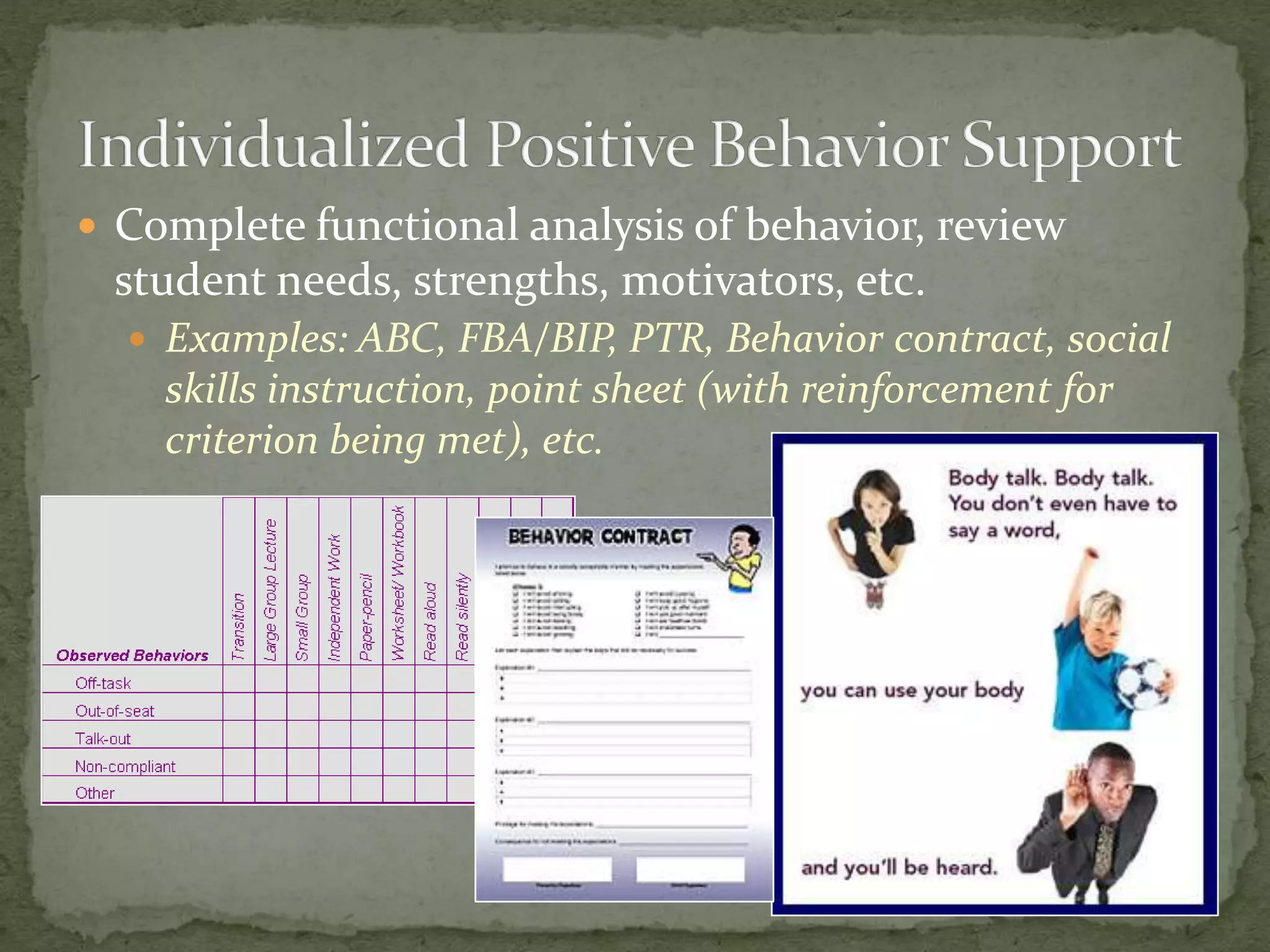
 Complete functional analysis of behavior, review
student needs, strengths, motivators, etc.
 Examples: ABC, FBA/BIP, PTR, Behavior contract, social
skills instruction, point sheet (with reinforcement for
criterion being met), etc.
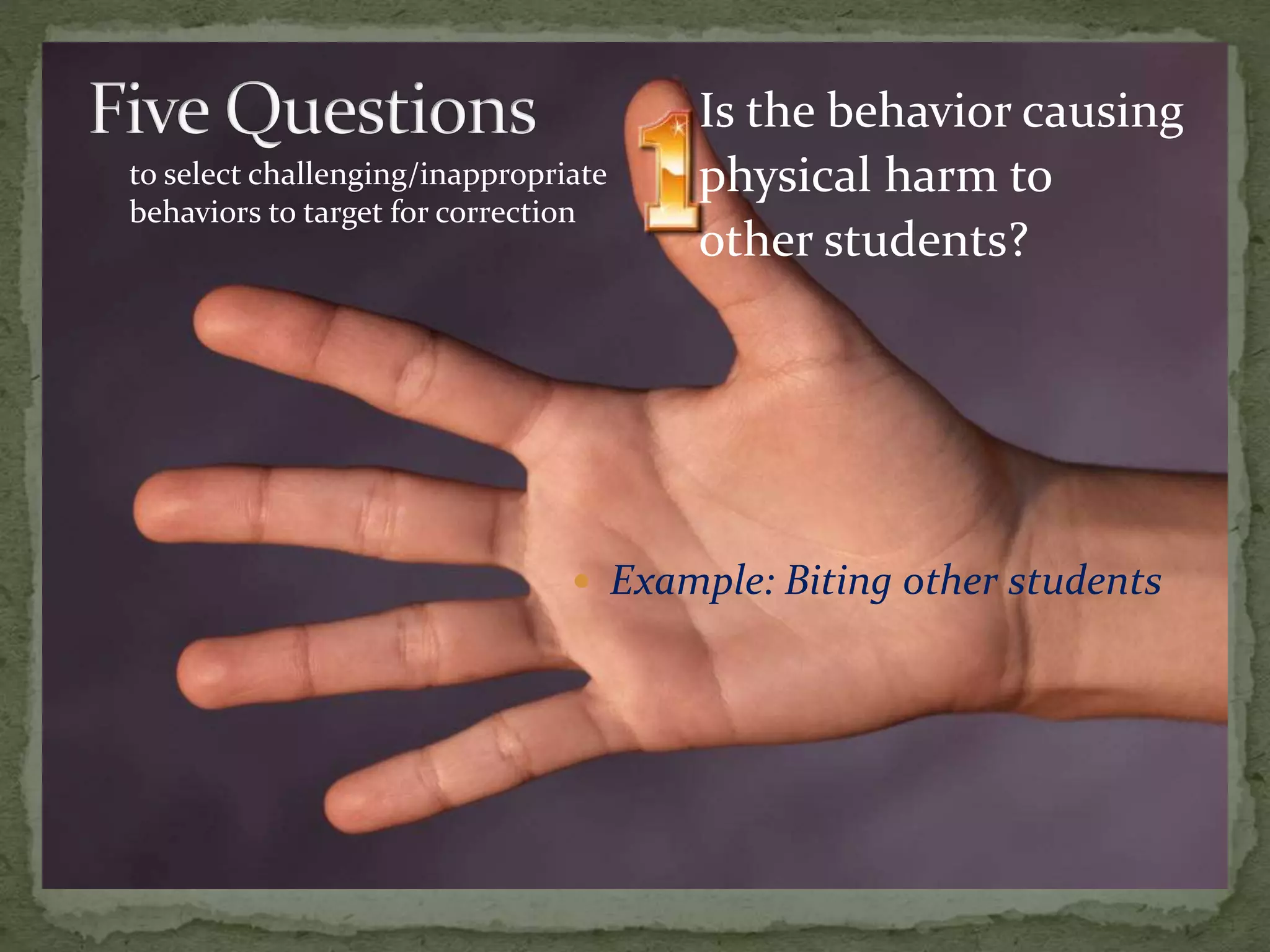
Is the behavior causing
physical harm to
other students?
 Example: Biting other students
to select challenging/inappropriate
behaviors to target for correction
Does the behavior appear to be triggering
additional problem behaviors or emotional
reactions in the student or others?
 Example: Name calling of other students
Examples: inner ear infections
side effects of medication
genetic conditions:
Prader-Willi syndrome
Fragile X syndrome
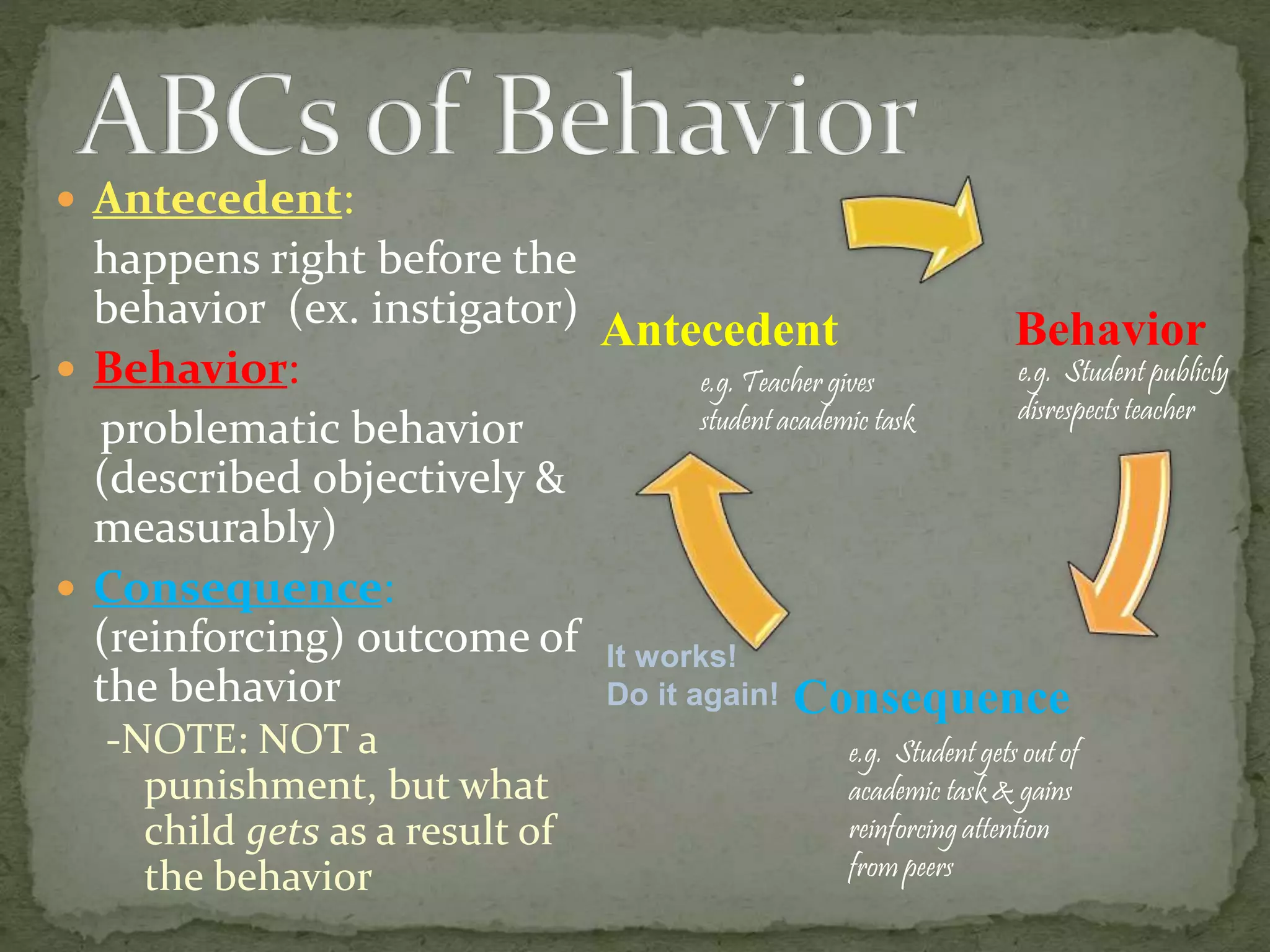
Behavior
Consequence
Antecedent
It works!
Do it again!
 Antecedent:
happens right before the
behavior (ex. instigator)
 Behavior:
problematic behavior
(described objectively &
measurably)
 Consequence:
(reinforcing) outcome of
the behavior
-NOTE: NOT a
punishment, but what
child gets as a result of
the behavior
e.g. Teacher gives
student academic task
e.g. Student publicly
disrespects teacher
e.g. Student gets out of
academic task & gains
reinforcing attention
from peers
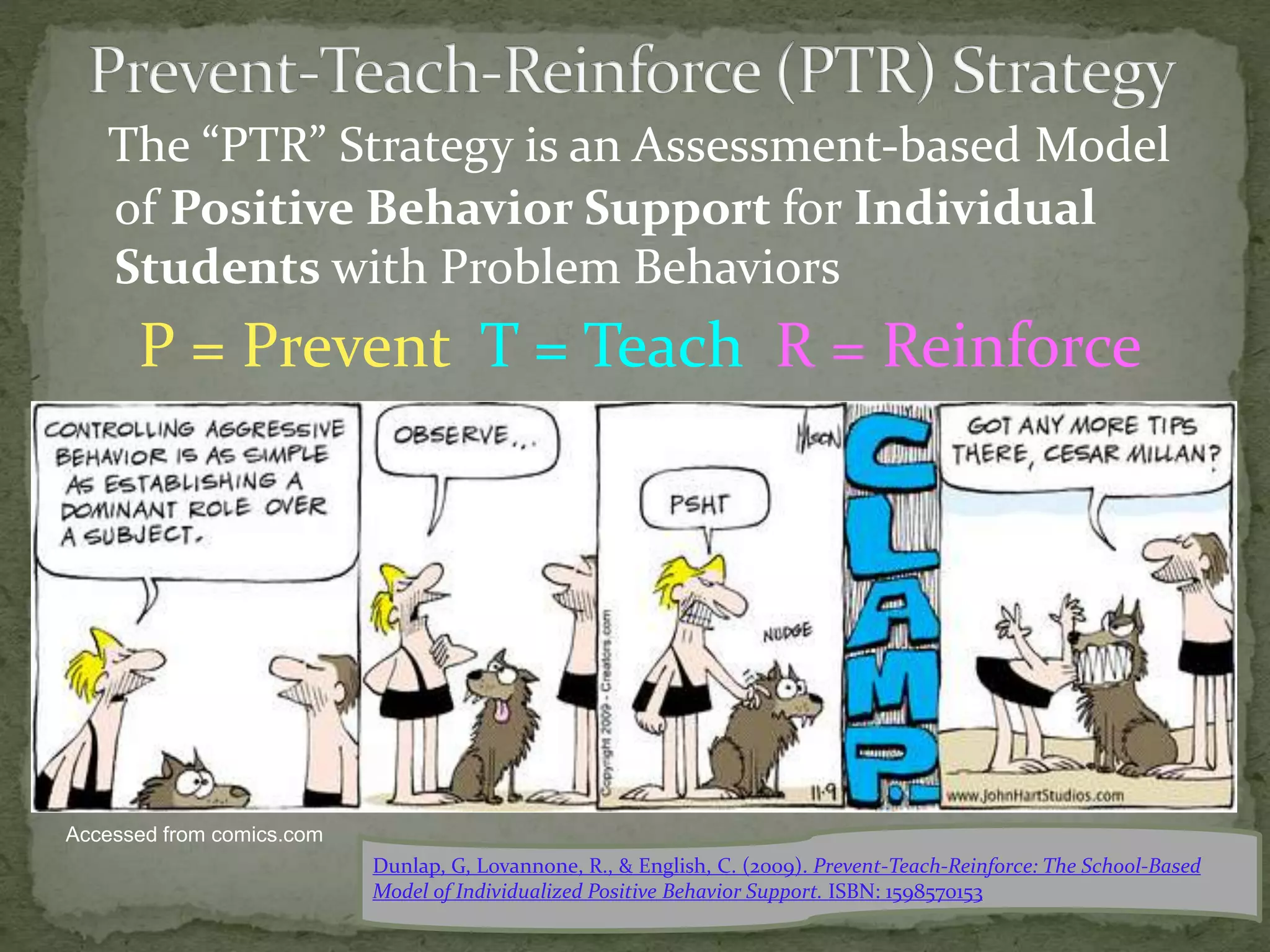
The “PTR” Strategy is an Assessment-based Model
of Positive Behavior Support for Individual
Students with Problem Behaviors
P = Prevent T = Teach R = Reinforce
Dunlap, G, Lovannone, R., & English, C. (2009). Prevent-Teach-Reinforce: The School-Based
Model of Individualized Positive Behavior Support. ISBN: 1598570153
Accessed from comics.com
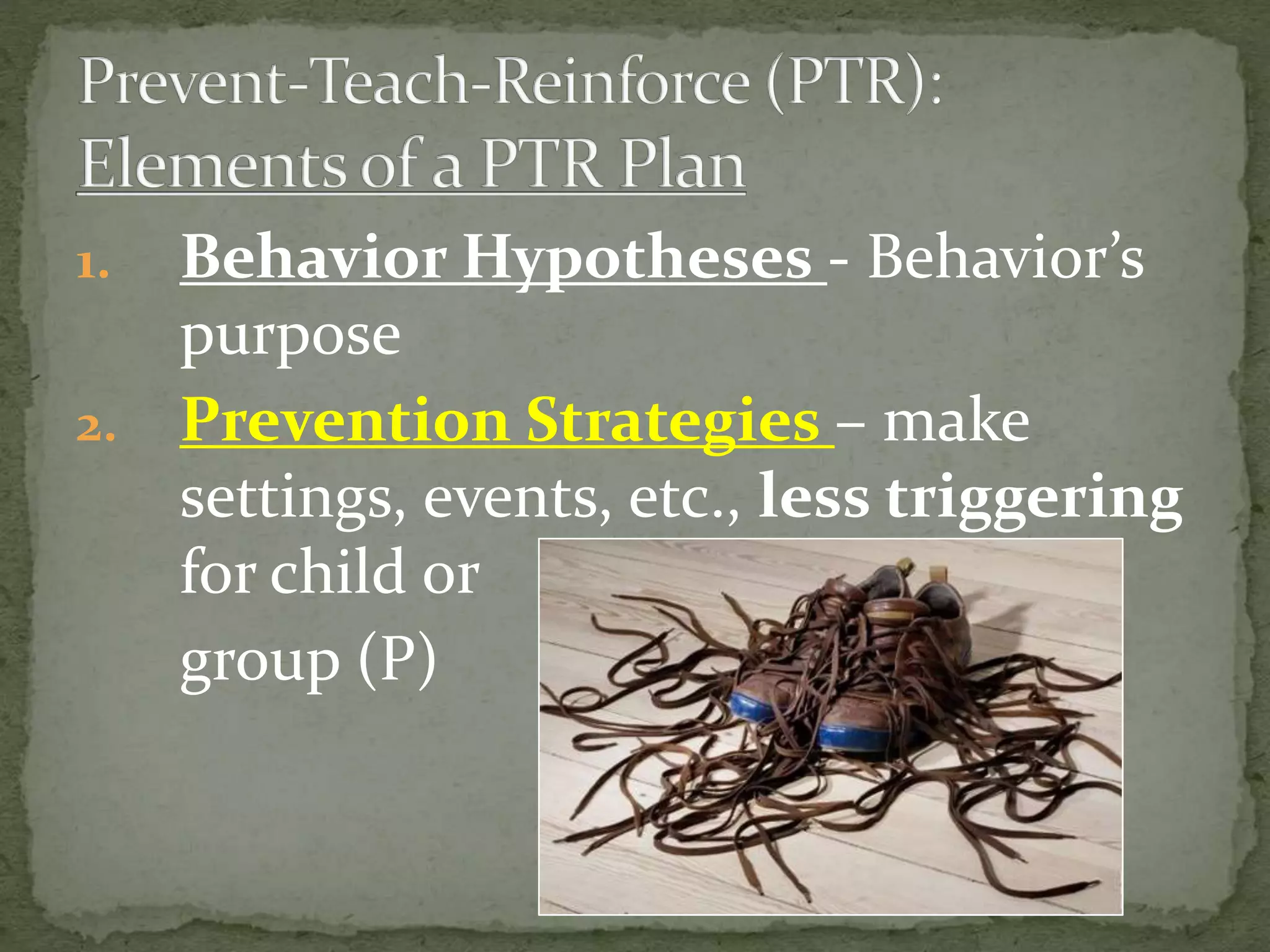
1. Behavior Hypotheses - Behavior’s
purpose
2. Prevention Strategies – make
settings, events, etc., less triggering
for child or
group (P)
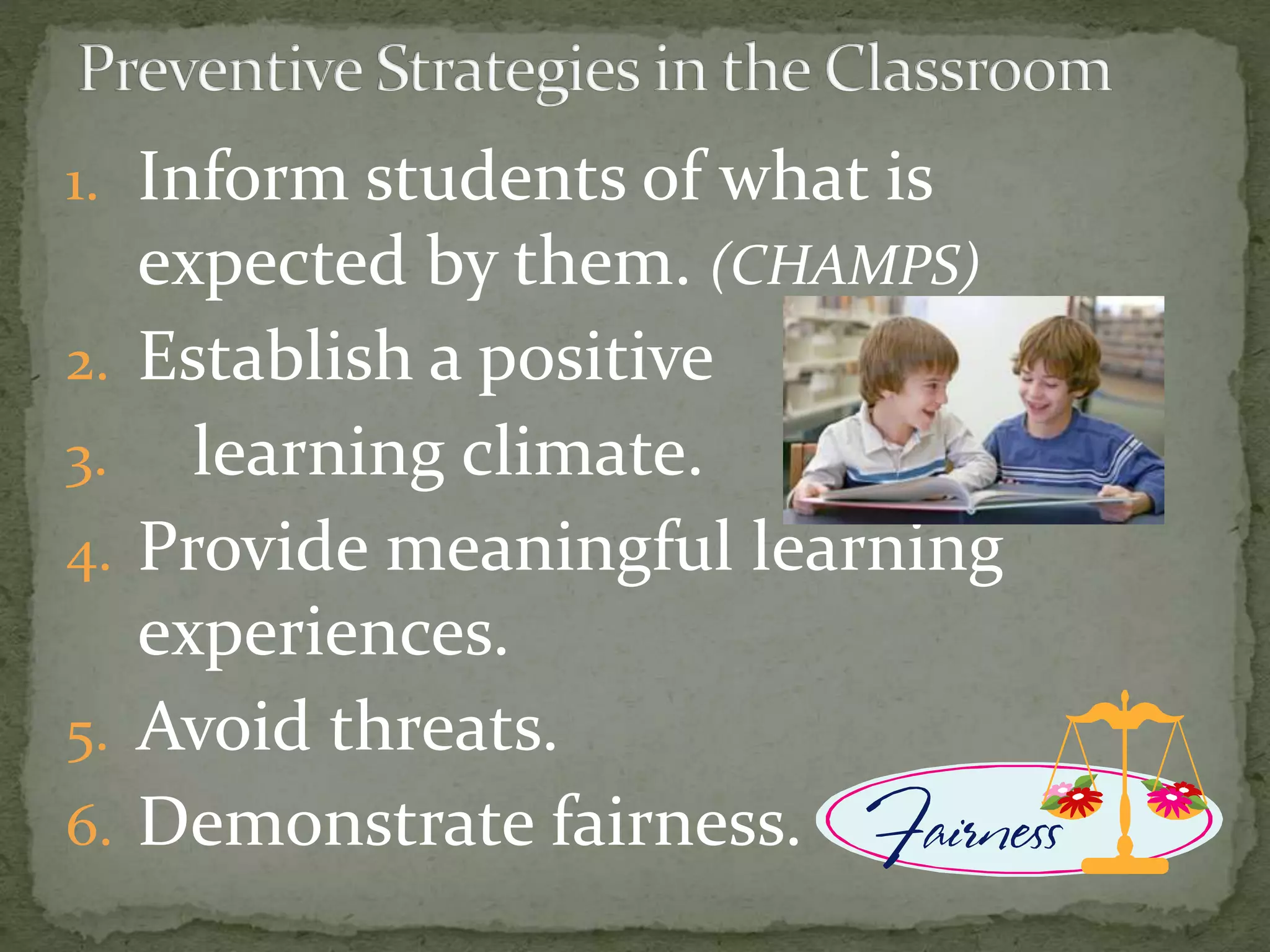
1. Inform students of what is
expected by them. (CHAMPS)
2. Establish a positive
3. learning climate.
4. Provide meaningful learning
experiences.
5. Avoid threats.
6. Demonstrate fairness.
7. Build and exhibit self-confidence
(fake it ‘til you make it)
8. Recognize positive student attributes
(inside characteristics)
9. Utilize positive modeling (practice
what you preach)
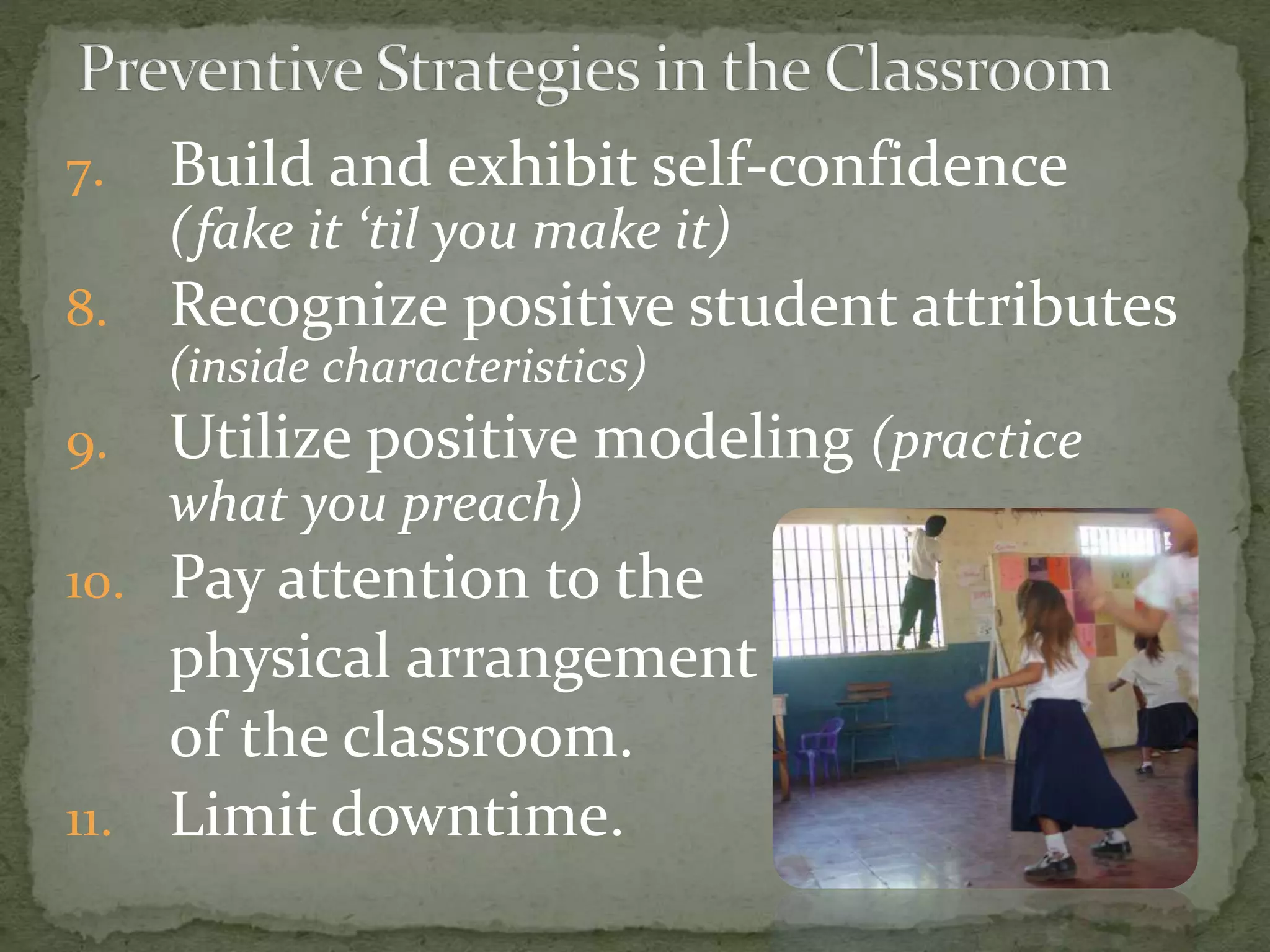
10. Pay attention to the
physical arrangement
of the classroom.
11. Limit downtime.
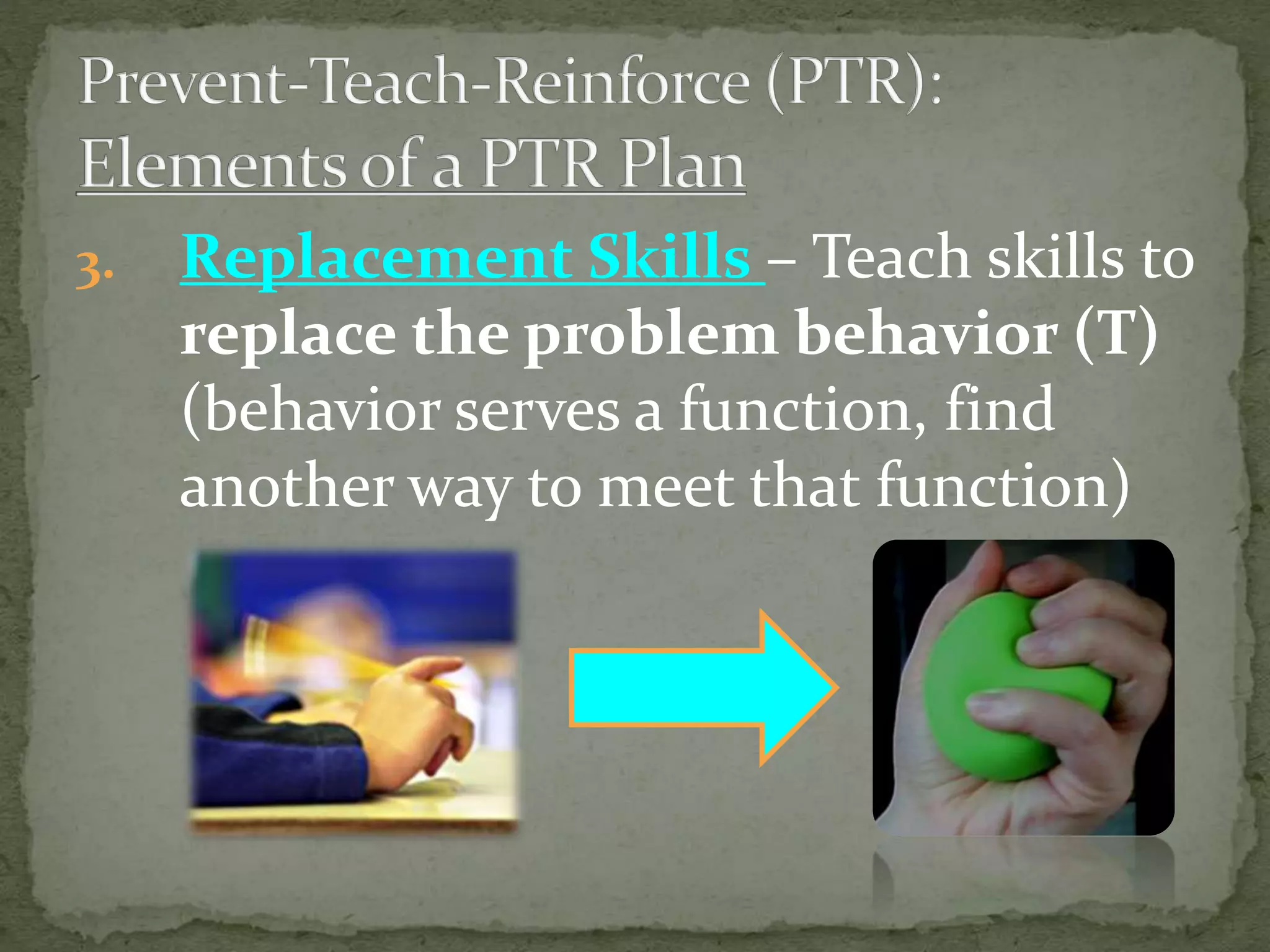
3. Replacement Skills – Teach skills to
replace the problem behavior (T)
(behavior serves a function, find
another way to meet that function)
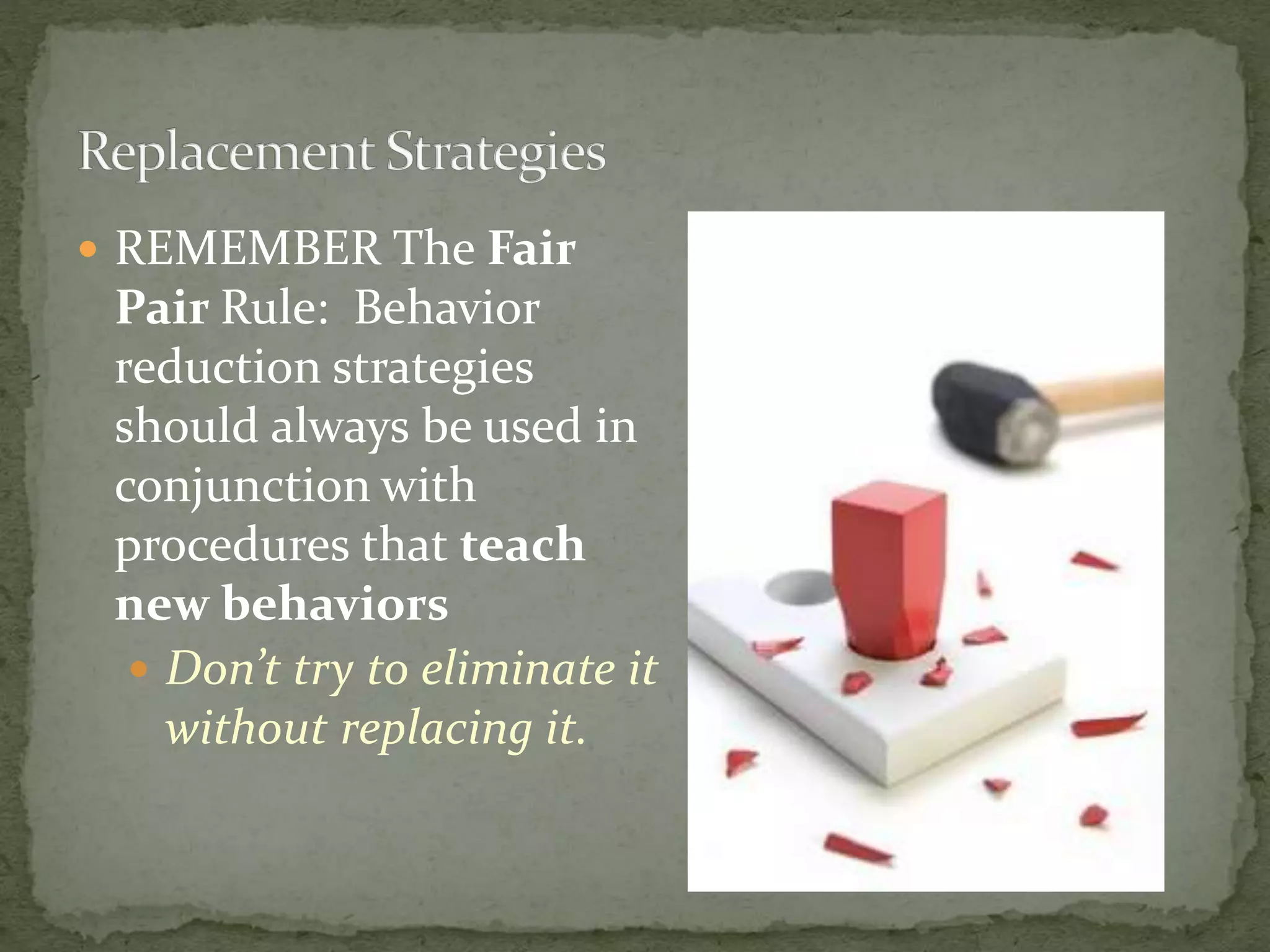
 REMEMBER The Fair
Pair Rule: Behavior
reduction strategies
should always be used in
conjunction with
procedures that teach
new behaviors
 Don’t try to eliminate it
without replacing it.
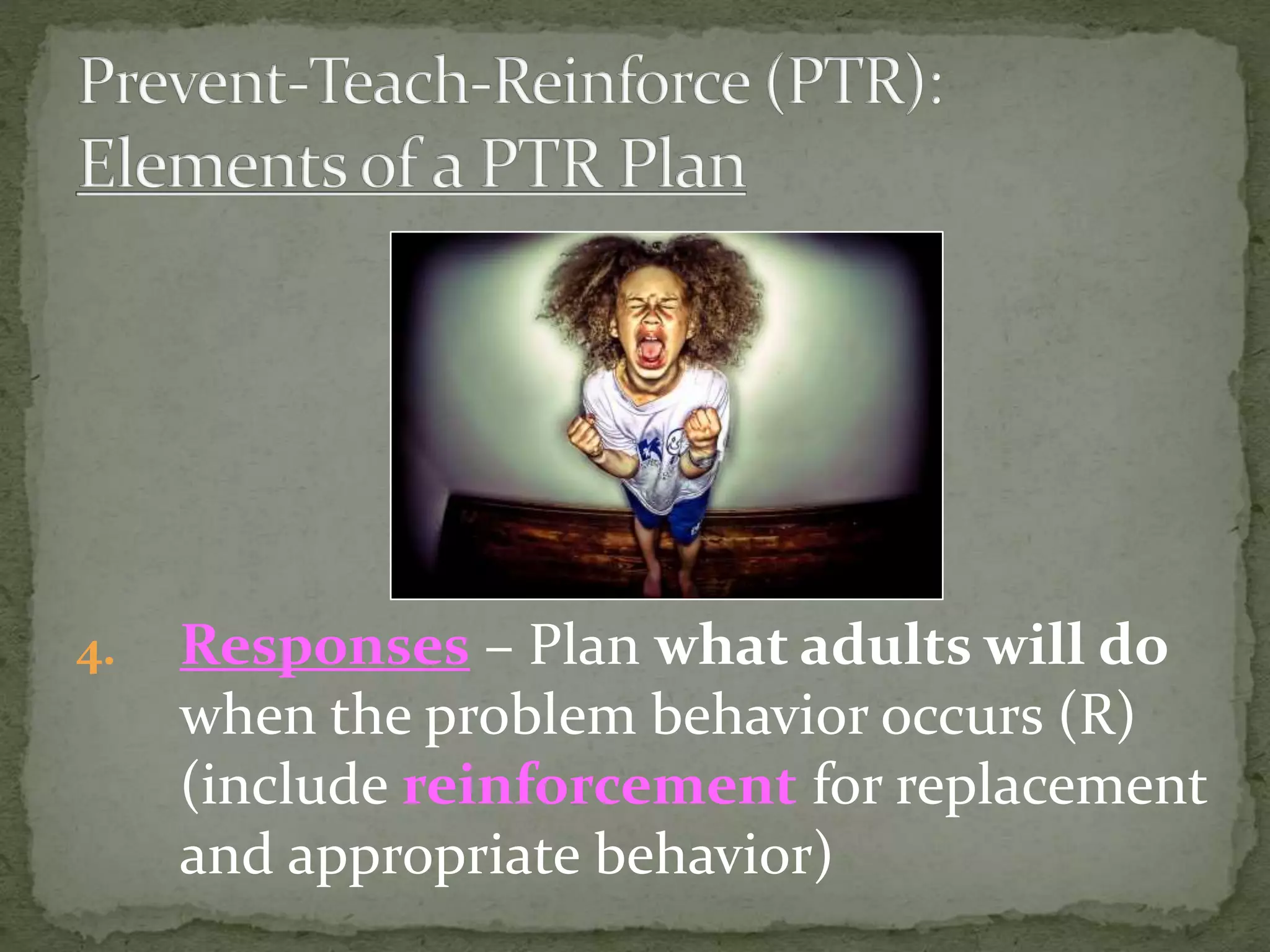
4. Responses – Plan what adults will do
when the problem behavior occurs (R)
(include reinforcement for replacement
and appropriate behavior)
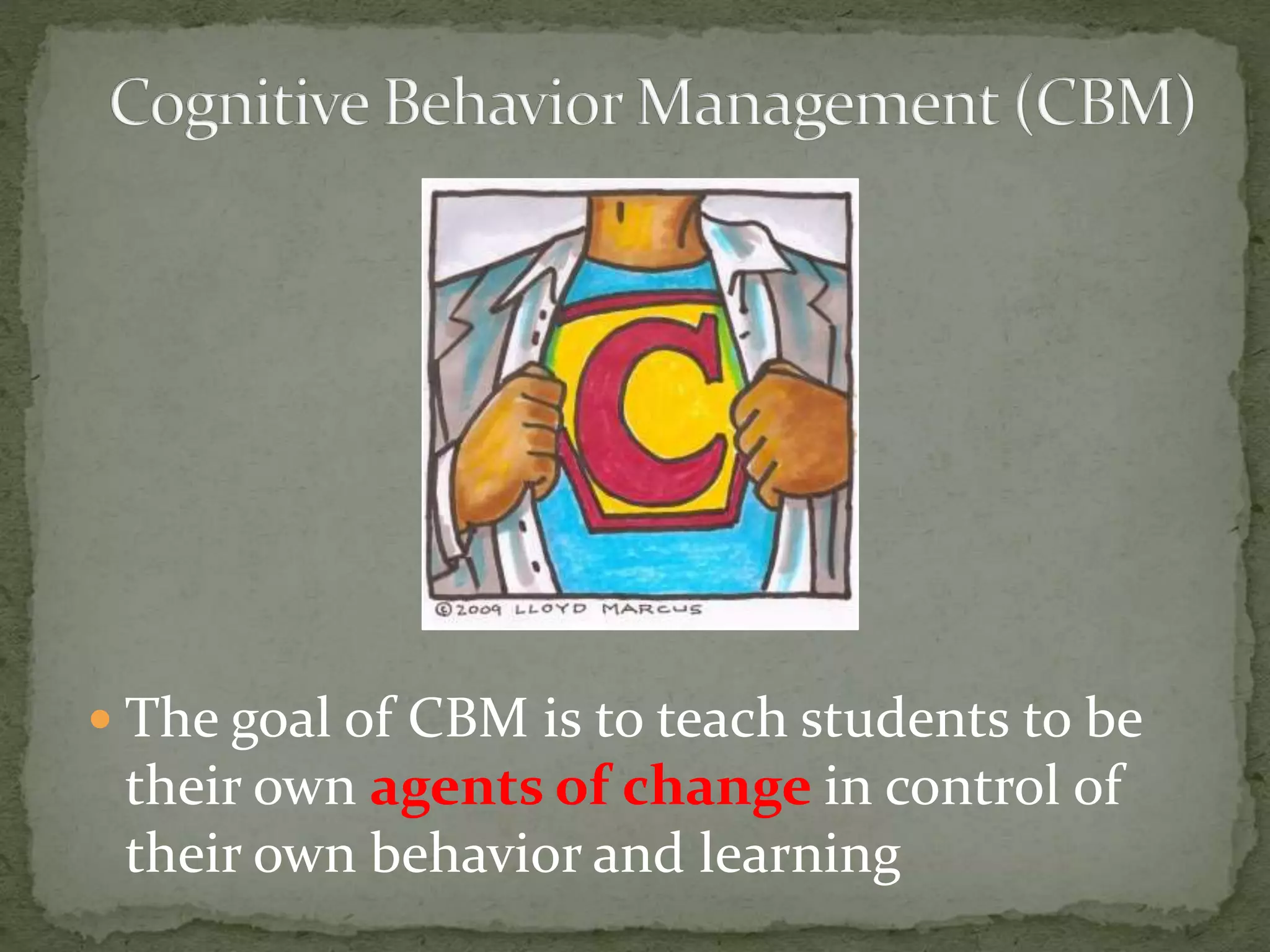
 The goal of CBM is to teach students to be
their own agents of change in control of
their own behavior and learning
 CBM Assumes that
individuals can and
want to monitor and
manage their own
behavior
 Shaping &
changing behavior
through the use of
cognitive &
behavioral principles
 Goal is to get the
student to monitor
their own behavior
and self-reinforce
appropriately
 Self Management
 Self-monitoring
 e.g. Data monitoring
with vibrating timer
 Self-instruction
 e.g. Student: “Stay
focused. You are getting
distracted. Finish your
essay.”
 Self-evaluation
 e.g. Data monitoring
with vibrating timer
 Self-reinforcement
 Learning self-delayed
gratification
 Student Choice (as
appropriate based on
individual/class needs)
 Recommended video
about motivation
 Career analyst Dan Pink
“Traditional rewards
aren't always as effective
as we think.”
http://www.ted.com/tal
ks/lang/eng/dan_pink_
on_motivation.html
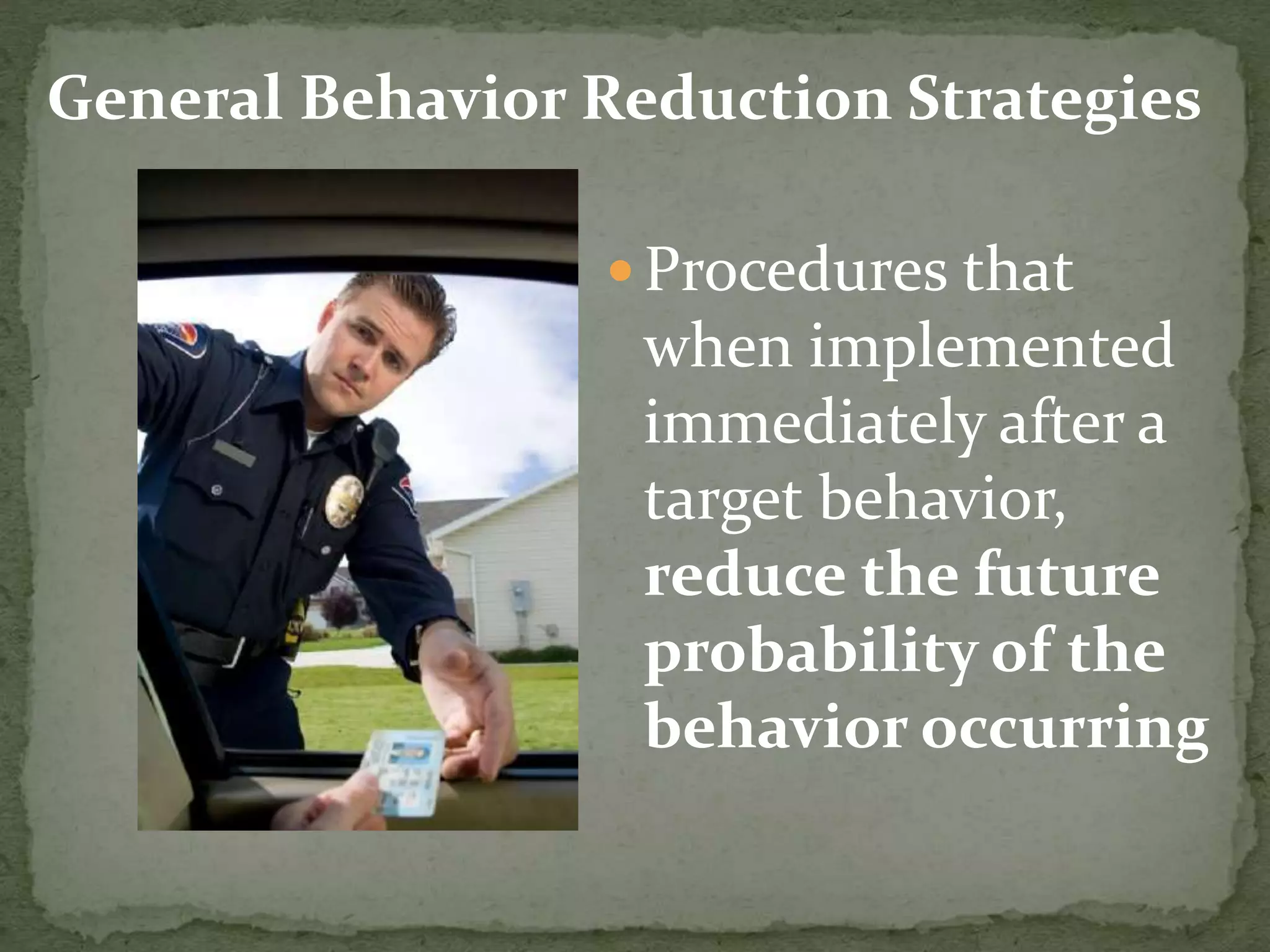
 Procedures that
when implemented
immediately after a
target behavior,
reduce the future
probability of the
behavior occurring
General Behavior Reduction Strategies
1. Proximity control – anticipate behavior & prevent
it by body positioning, staying calm & facilitating
communication
2. Injecting humor – reduces tension, makes the
brain leave ‘fight/flight’
3. Instructional control – instruction on expected
behaviors (examples & non-examples as appropriate)
4. Problem-solving facilitation – offer positive
alternatives (Love & Logic: “Would you like to hear
what other kids have tried in this situation?”)
5. Stimulus change – modify environmental stimuli
1. Be Consistent – enforce & reinforce to
reduce confusion & increase respect
2. Avoid Reinforcing Inappropriate
Behavior – avoid long lectures & extra
attention
3. Deal with Inappropriate (non-ignorable)
Behavior Immediately – Teaches child behavior is
not acceptable with you
4. Consequences for Inappropriate Behavior – short
& fair consequences -> implement immediately,
do not carry over to next day if possible
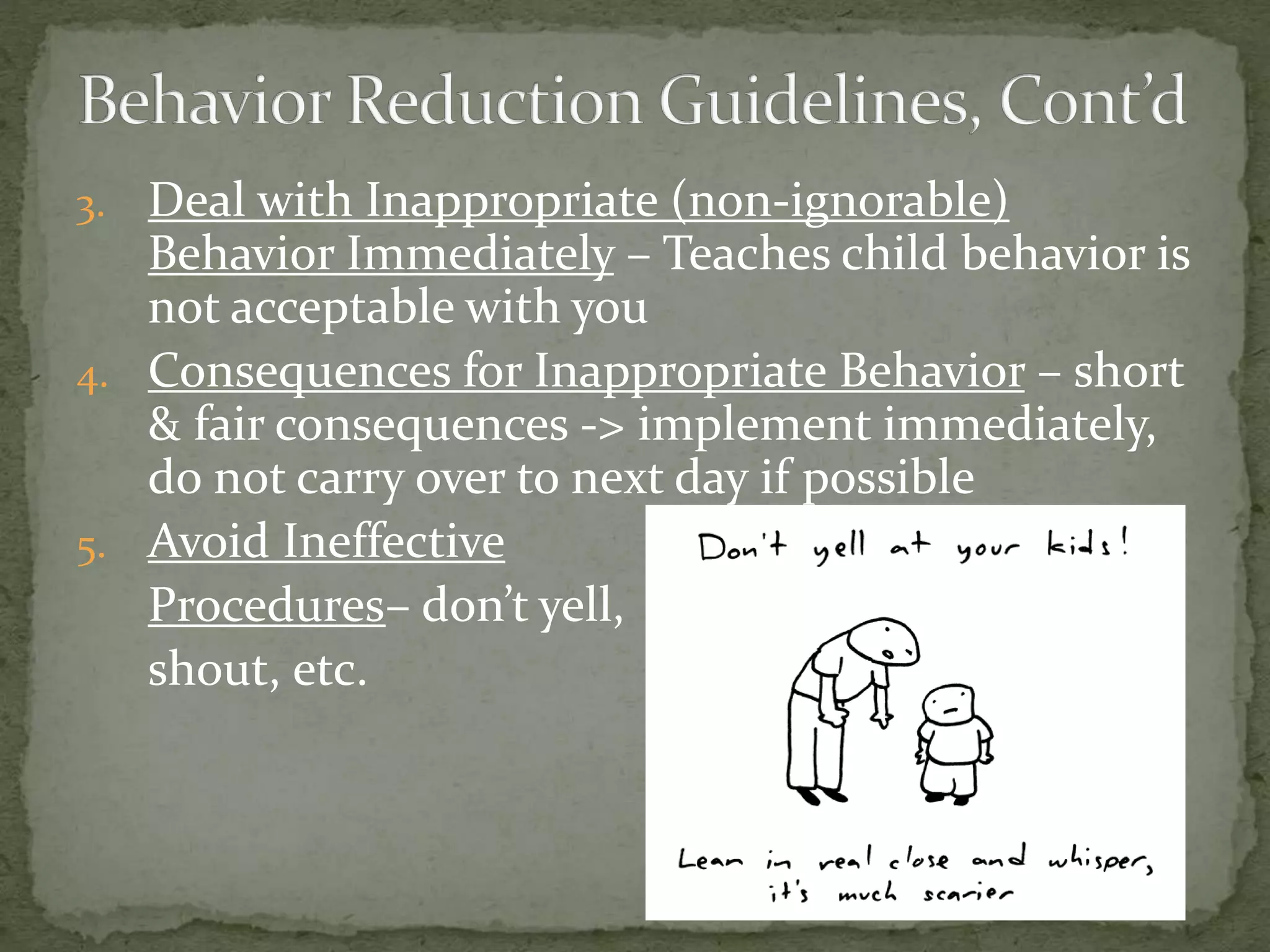
5. Avoid Ineffective
Procedures– don’t yell,
shout, etc.
 Delivery of reinforcement after behavior has
not been exhibited
 We generally use differential reinforcement to
increase the rate, duration, or intensity of
behaviors that students already have in their
repertoire, BUT do not perform at an
acceptable rate
What’s the magic word?1
2
3
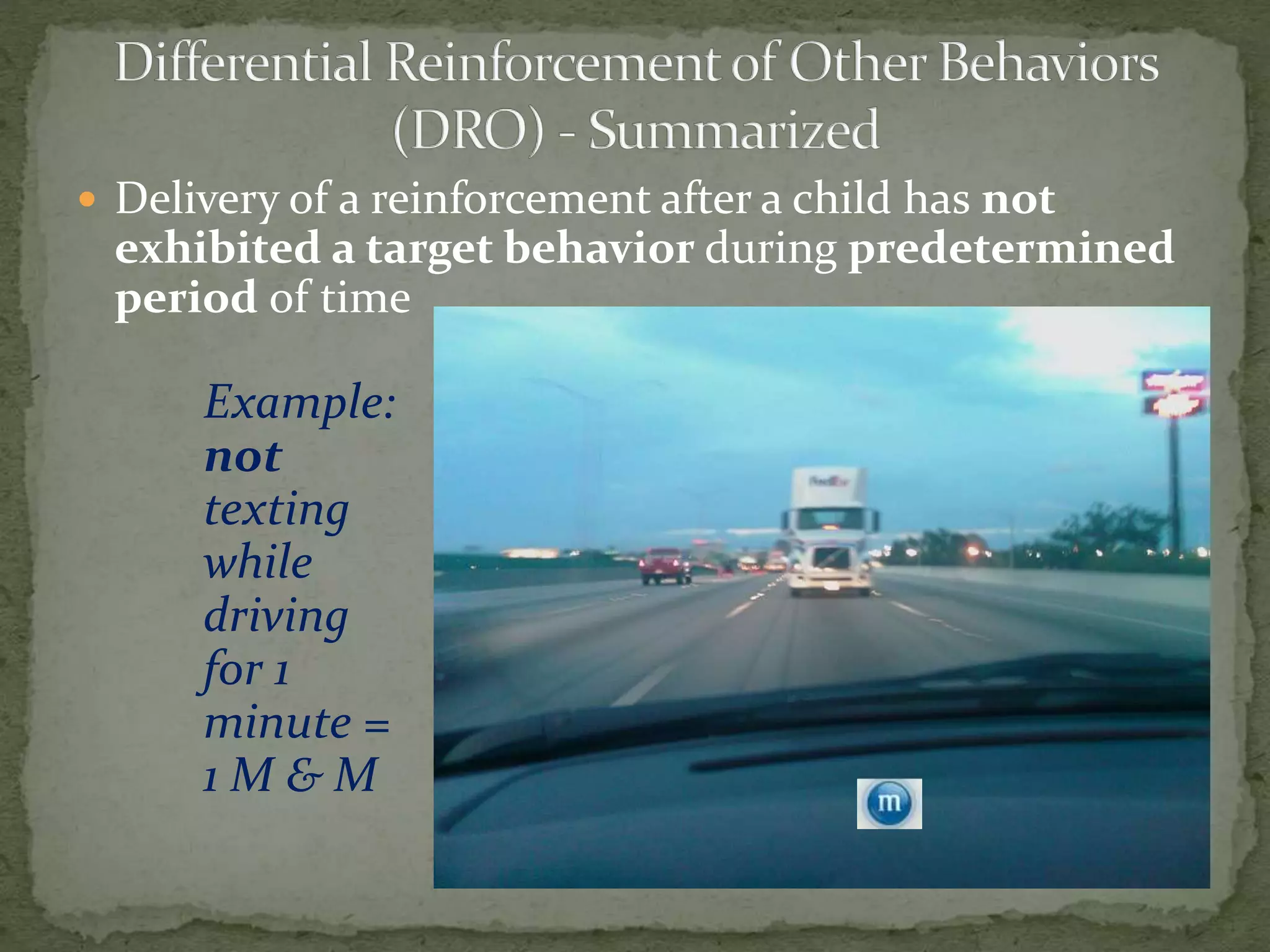
 Delivery of a reinforcement after a child has not
exhibited a target behavior during predetermined
period of time
Example:
not
texting
while
driving
for 1
minute =
1 M & M
 Fixed or whole interval---not reinforced if the
behavior occurs any time during the predetermined
time period
 Example: student does not suck his thumb during entire
10 min. interval -> get a sticker for chart
 Momentary---not reinforced if the behavior occurs at
the time of observation
 Ex.: At end of 5 min. interval, teacher looks at student to
see if he is sucking thumb at that moment – not sucking
thumb? then, he gets sticker
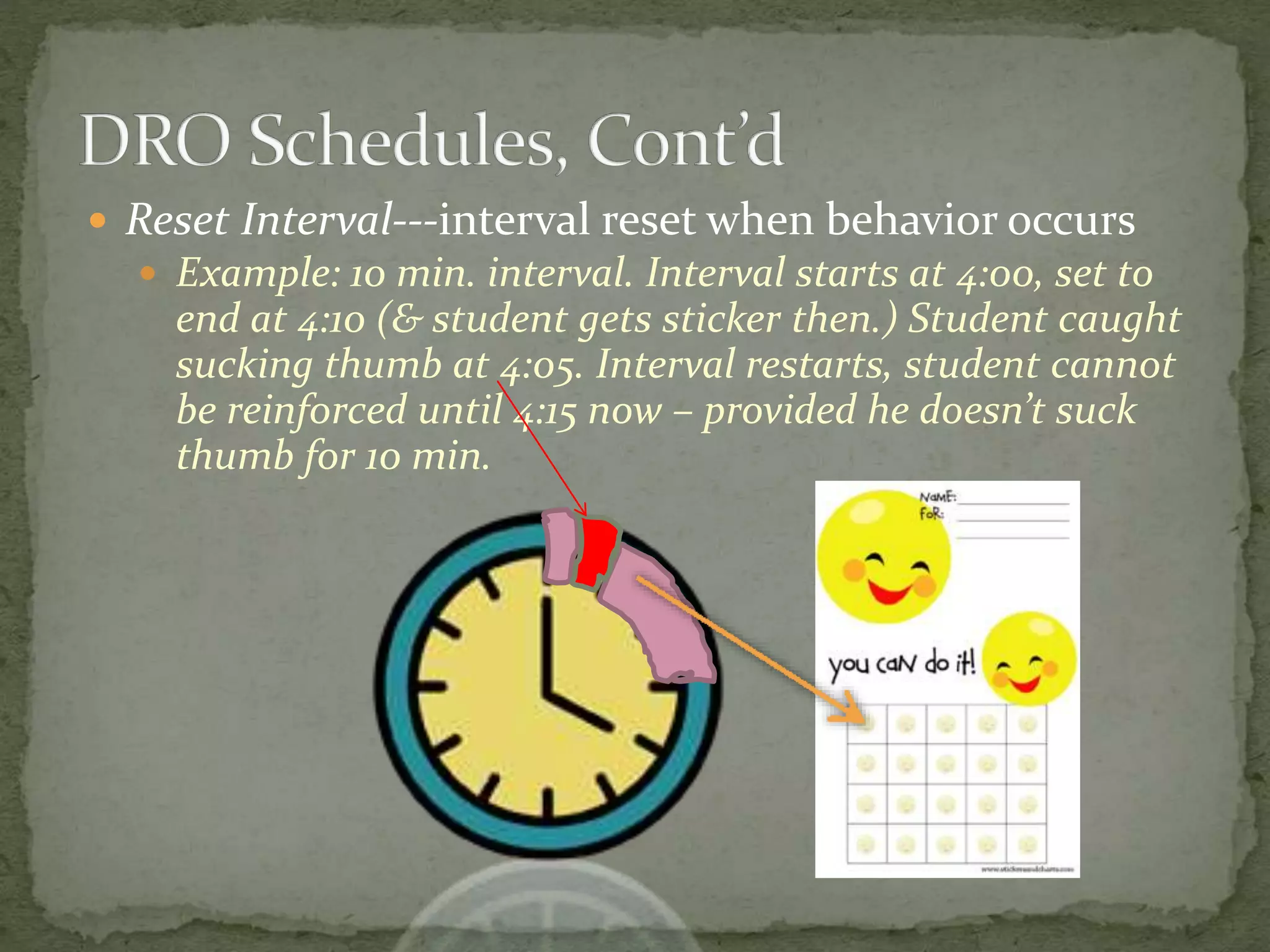
 Reset Interval---interval reset when behavior occurs
 Example: 10 min. interval. Interval starts at 4:00, set to
end at 4:10 (& student gets sticker then.) Student caught
sucking thumb at 4:05. Interval restarts, student cannot
be reinforced until 4:15 now – provided he doesn’t suck
thumb for 10 min.
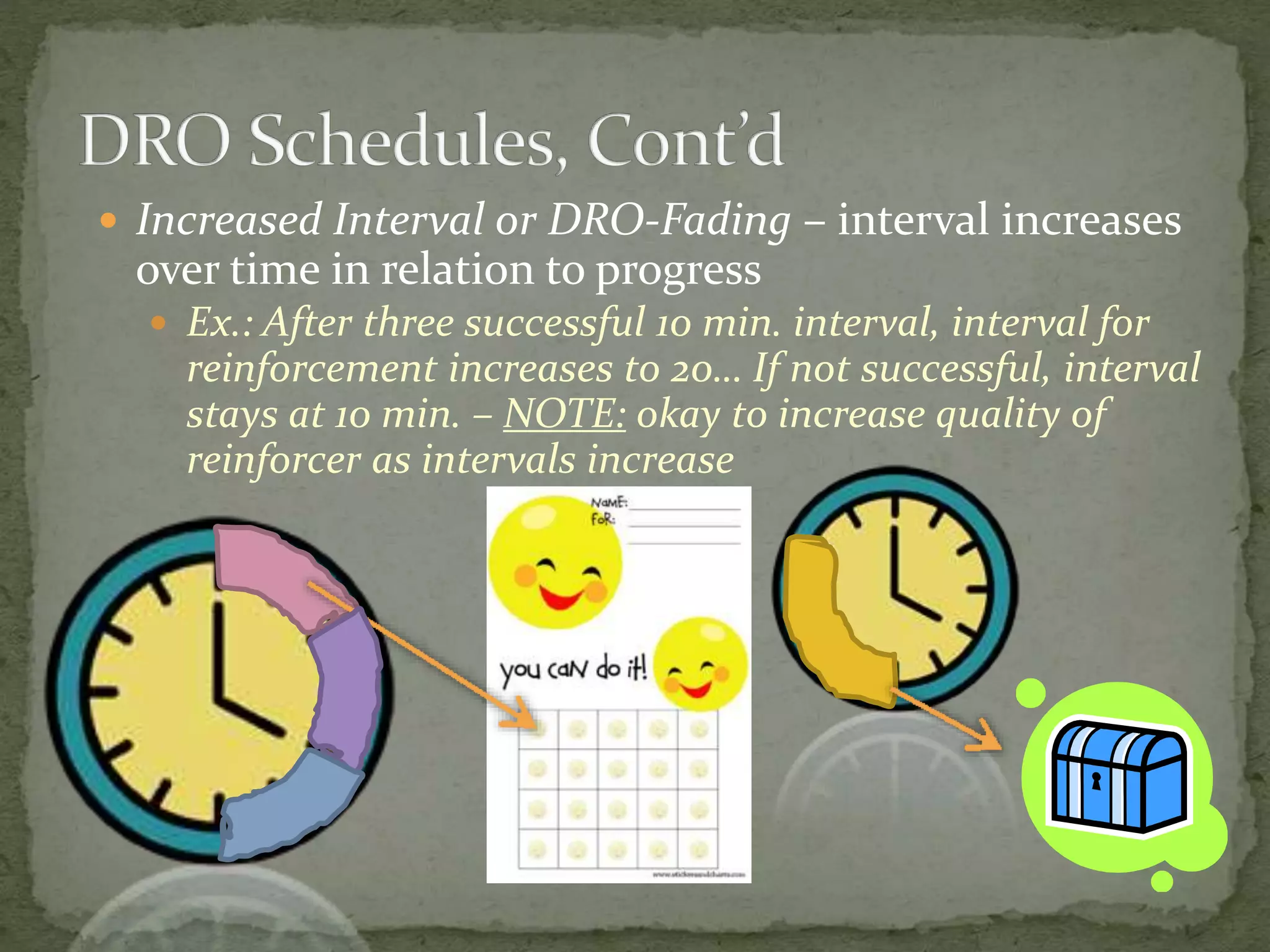
 Increased Interval or DRO-Fading – interval increases
over time in relation to progress
 Ex.: After three successful 10 min. interval, interval for
reinforcement increases to 20… If not successful, interval
stays at 10 min. – NOTE: okay to increase quality of
reinforcer as intervals increase
 Reinforcement of a more appropriate form of a
targeted inappropriate behavior
 Example: Raising hand vs. calling out (student gets
teacher’s attention either way)
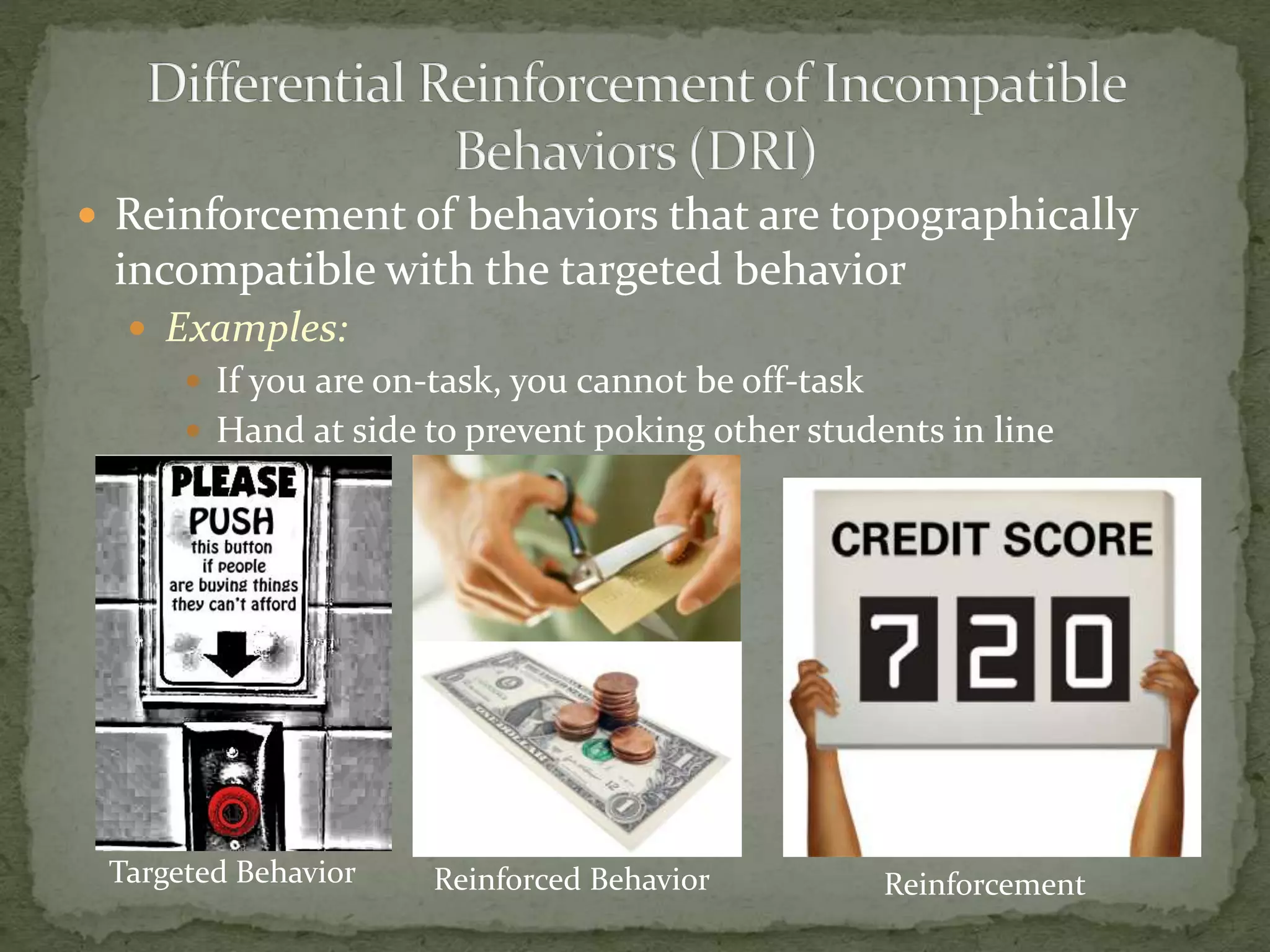
 Reinforcement of behaviors that are topographically
incompatible with the targeted behavior
 Examples:
 If you are on-task, you cannot be off-task
 Hand at side to prevent poking other students in line
Targeted Behavior Reinforced Behavior Reinforcement
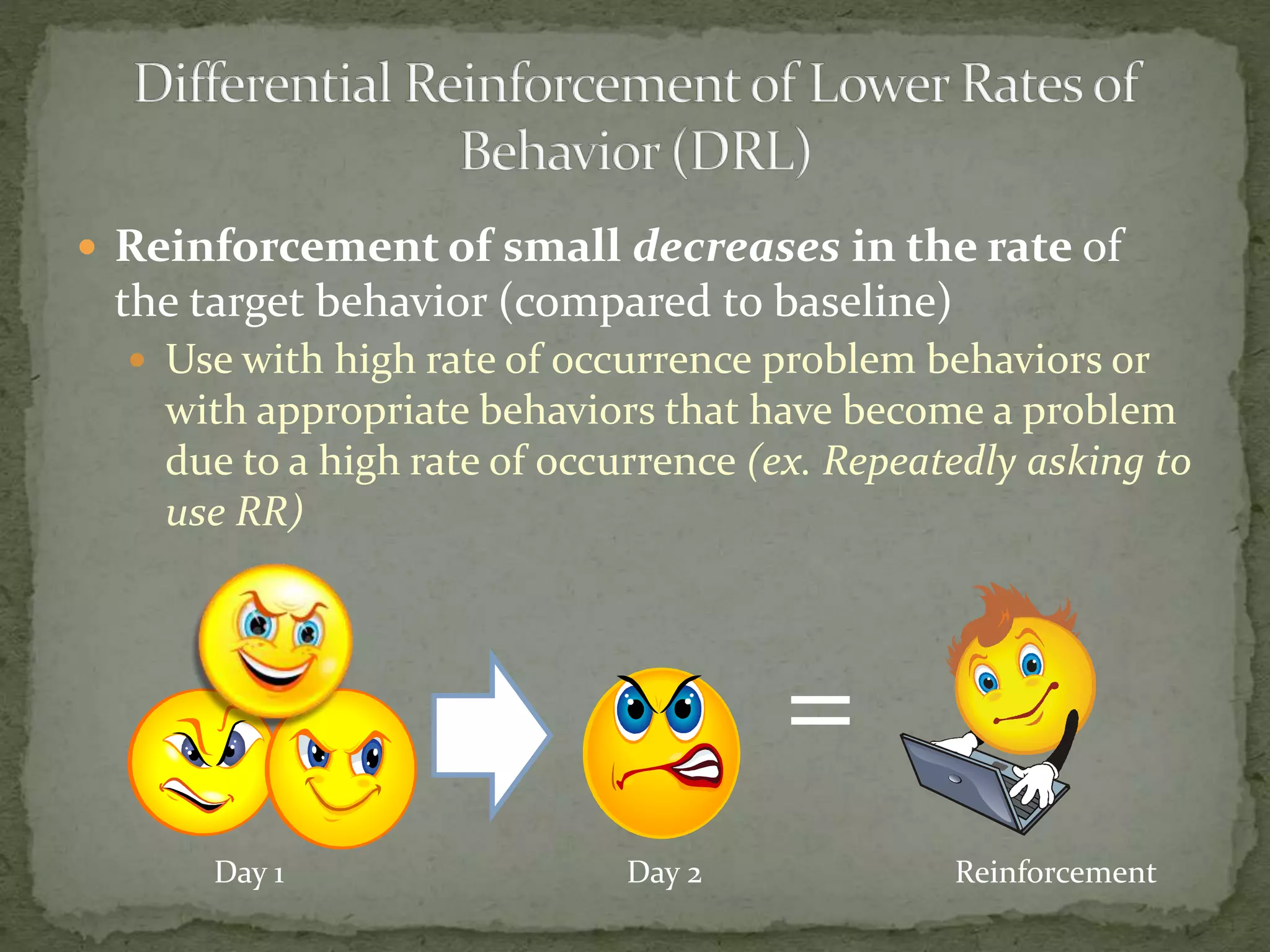
 Reinforcement of small decreases in the rate of
the target behavior (compared to baseline)
 Use with high rate of occurrence problem behaviors or
with appropriate behaviors that have become a problem
due to a high rate of occurrence (ex. Repeatedly asking to
use RR)
Day 1 Day 2
=
Reinforcement
 Two Forms: Rate and Interval
 Rate: reinforcement provided if lower rate of occurrence
during specified interval
 Example: Student only asked 3 times in 1 hour to use RR,
allowed to use RR at end of that 1 hr interval.
 Interval: reinforcement provided if interval since last
occurrence has passed
 Example: It has been 1 hr since last asked to use RR, student
gets to go
 Effective DRL depends on solid baseline behavior
data
 AKA Changing Criterion Design
 Reinforcement of increases in the rate of a target
behavior compare to the baseline rate
 Used to increase behaviors student knows, just does not
use enough (ex. Saying please)
 Purpose is to INCREASE target behavior
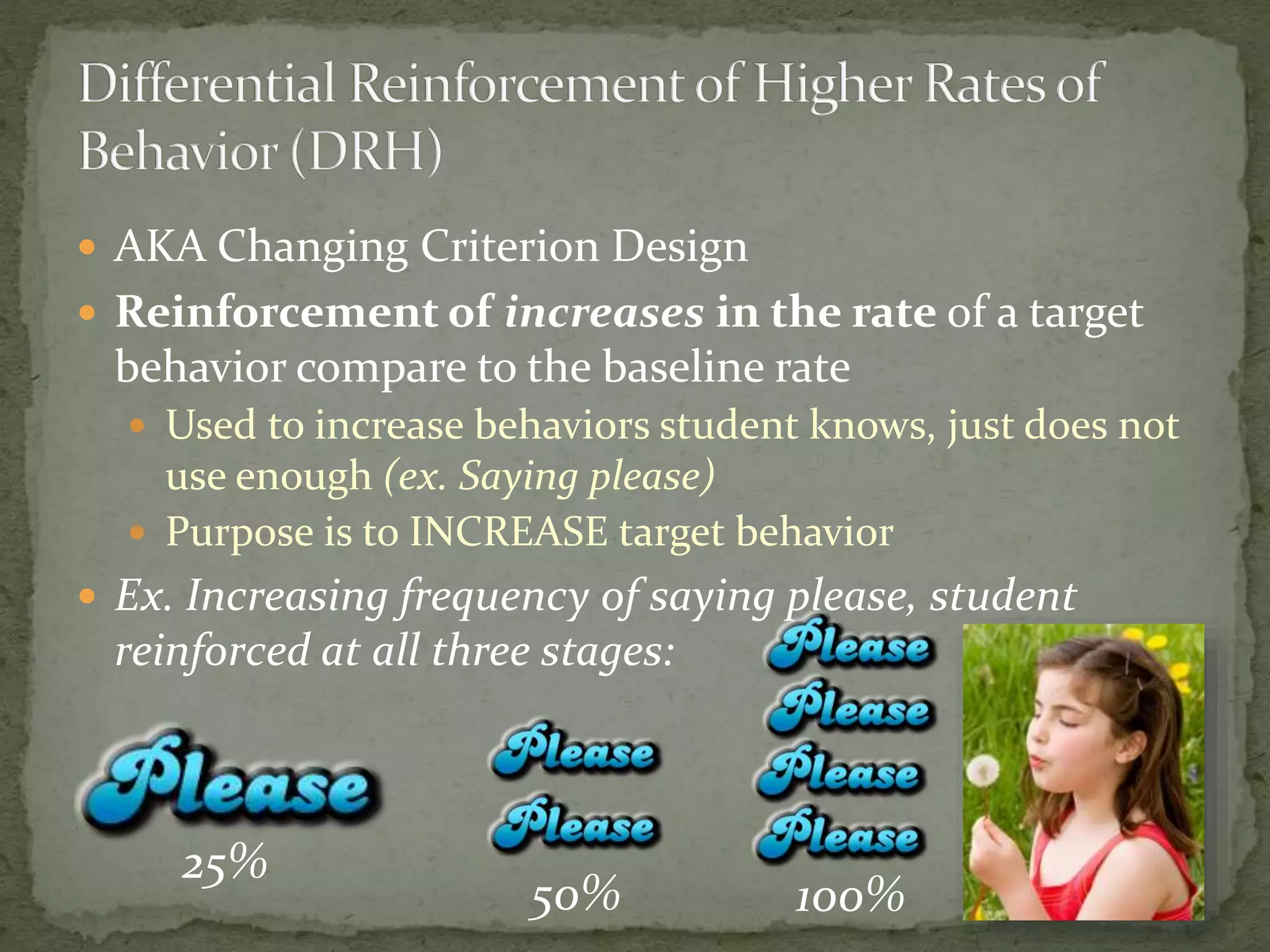
 Ex. Increasing frequency of saying please, student
reinforced at all three stages:
25%
50% 100%
 Procedure for gradually reducing the frequency and/or
intensity of a target behavior by withholding
reinforcement from a previously reinforced behavior
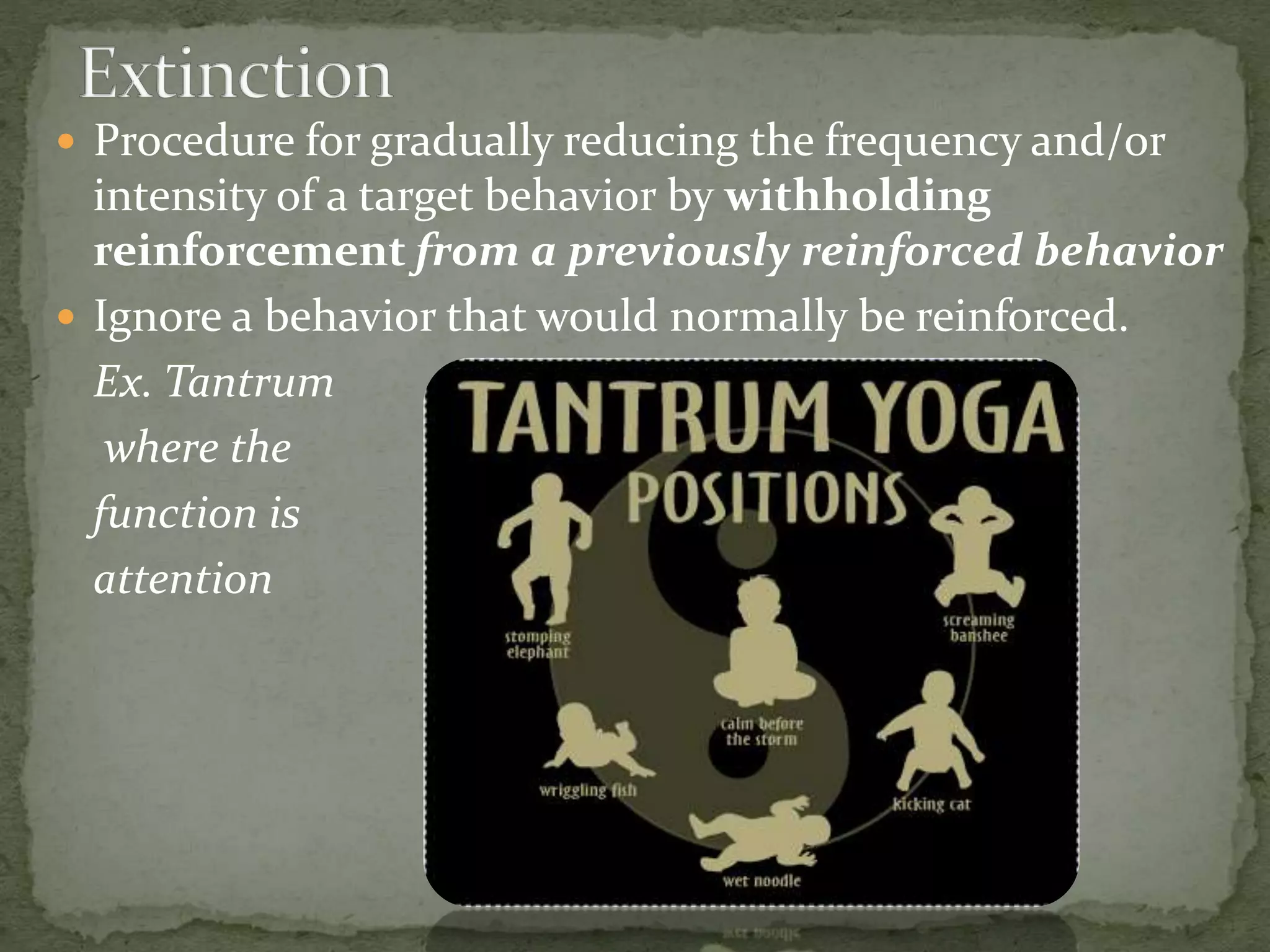
 Ignore a behavior that would normally be reinforced.
Ex. Tantrum
where the
function is
attention
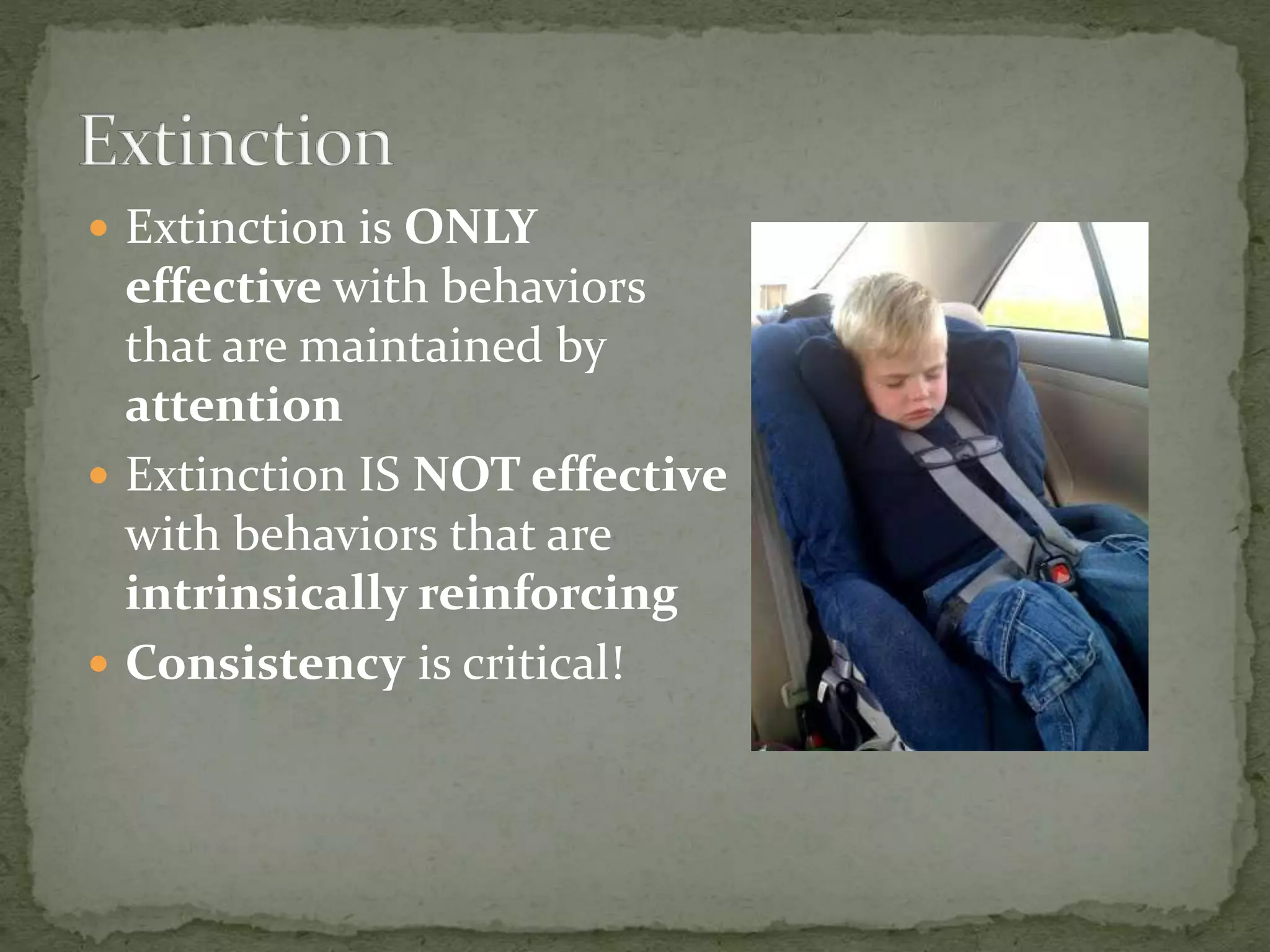
 Extinction is ONLY
effective with behaviors
that are maintained by
attention
 Extinction IS NOT effective
with behaviors that are
intrinsically reinforcing
 Consistency is critical!
 Once behavior is no longer reinforced, student will
temporarily intensify behavior to get reinforcer
 Don’t misjudge extinction program as ineffective based
on extinction bursts
 Decide whether extinction burst phase is ignore-able
before implementing extinction
Day 1 Day 2 Day 3 Day 4
Intervention
Day 5
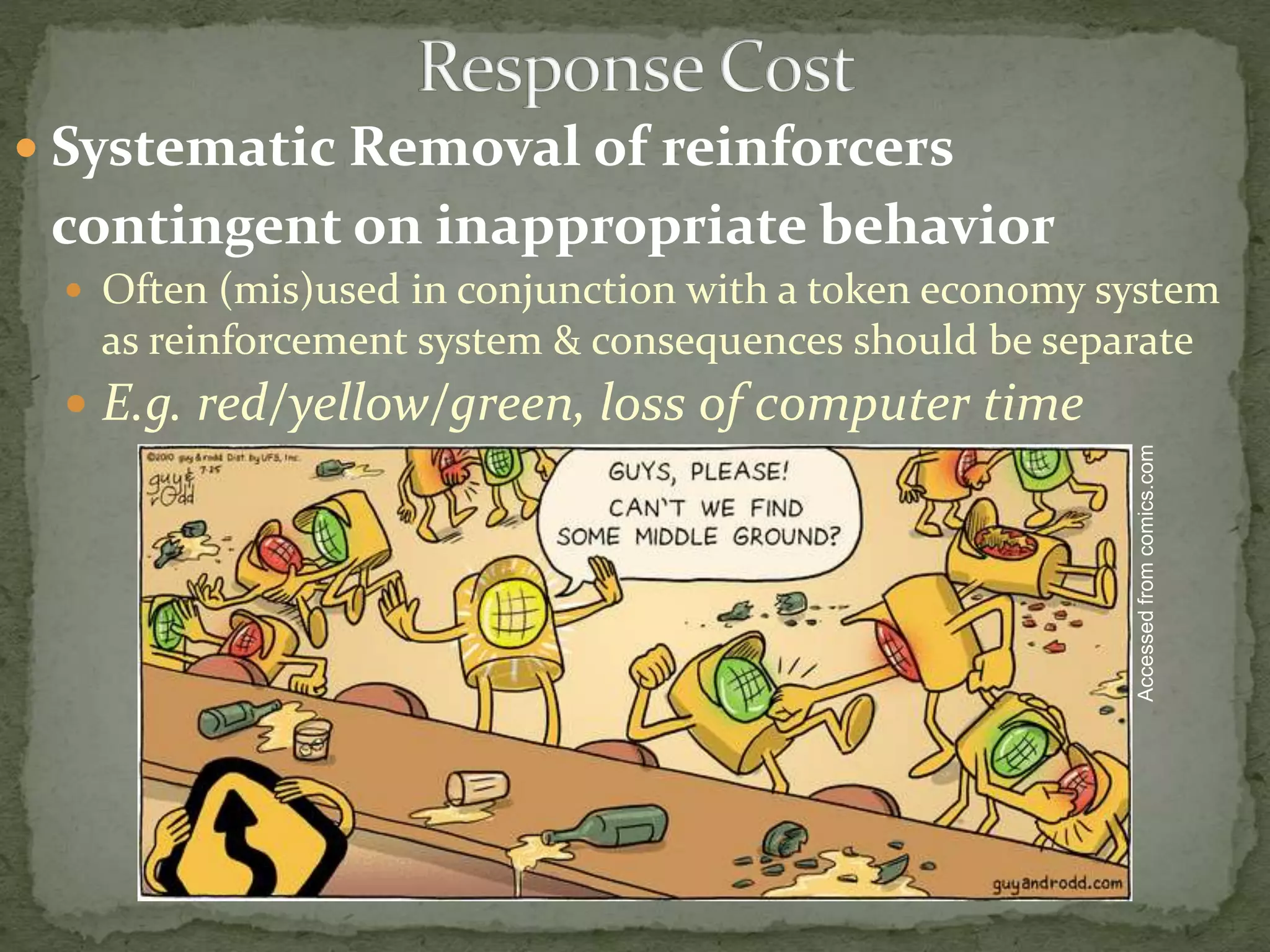
 Systematic Removal of reinforcers
contingent on inappropriate behavior
 Often (mis)used in conjunction with a token economy system
as reinforcement system & consequences should be separate
 E.g. red/yellow/green, loss of computer time
Accessedfromcomics.com
 Restitution or simple correction – return environment
to its previous condition
 Ex. Clean desk they wrote on
 Restitutional Overcorrection – return environment
into dramatically better condition
 Ex. Throws a piece of paper on ground, must pick up all
pieces of paper on ground in classroom
 Positive Practice Overcorrection – practicing an
appropriate behavior repeatedly as punishment for
inappropriate behavior
 Ex. Student does not fold paper per teacher directions, must
fold 10 pieces of paper in correct format
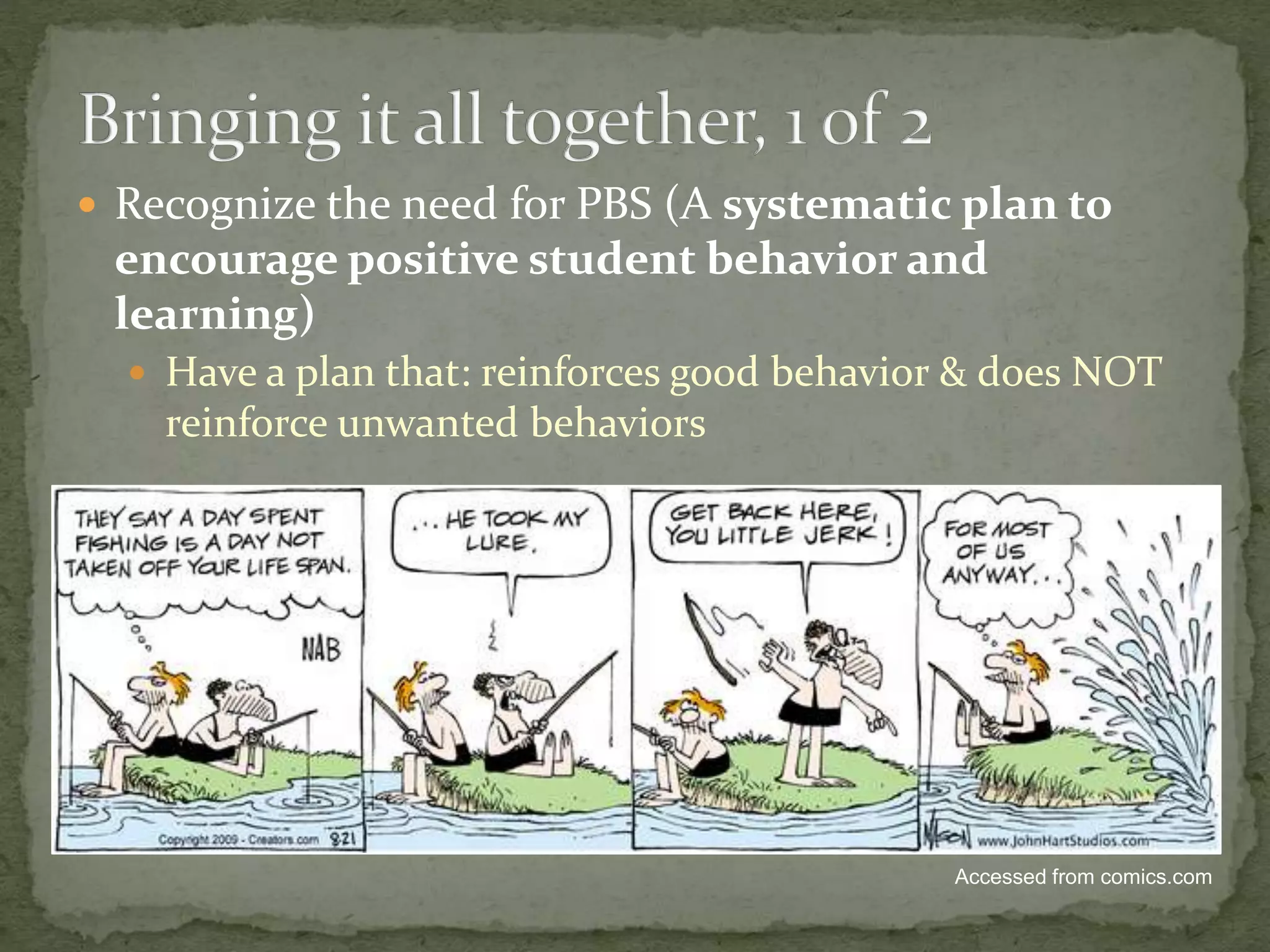
 Recognize the need for PBS (A systematic plan to
encourage positive student behavior and
learning)
 Have a plan that: reinforces good behavior & does NOT
reinforce unwanted behaviors
Accessed from comics.com
 For a mild/moderate classroom:
 Use CHAMPs classroom management system to
ensure expectations are understood for every lesson
 Practice functional analysis (ABC) so it becomes
automatic for every misbehavior witnessed
 Use a combination of PTR/PBS across the school, class,
& for individuals
 E.g. Schoolwide: Prevent at lunchtime via assigned seating;
Classwide: removing triggering stimuli; Individual: provide
choices in place of directives
 Use CBM to get individual students (or a small class)
realize they can become agents of change in their own
behavior
 Implement general behavior reduction techniques
as appropriate/needed
 Dunlap, G, Lovannone, R., & English, C. (2009). Prevent-Teach-
Reinforce: The School-Based Model of Individualized Positive
Behavior Support. ISBN: 1-598-57015-3
 FLDOE. (1999). Facilitator’s Guide to Positive Behavior Support.
Access free from: http://www.apbs.org/files/PBSwhole.pdf
 Lemov, D. (2010). Teach Like A Champion: 49 Techniques that put
Students on the Path to College. ISBN: 978-0-470-55047-2
 Mueller, T.G., & Brewer, R.D. (2010). Strategies at Hand: Quick
and Handy Positive Behavior Support Strategies. ISBN: 978-1-
934-57564-2
 Sprick, R. (2009). CHAMPS: A Proactive and Positive Approach
to Classroom Management (2nd Ed). ISBN: 978-1-59909-030-6
 For recommendation to parents: Latham, G. I. (2006). The Power
of Positive Parenting. ISBN: 1-56713-175-1

Fcec2010 beh mgmt_dme_dwe

  • 1.
    Danielle Eadens, Ph.D.& Daniel Eadens, M.Ed., ABD Accessedfromcomics.com FCEC2010
  • 2.
    Is it theacademics or the behavior?  All school faculty need to complete an assessment of the curriculum and instruction along with a functional analysis of behavior to determine if curriculum changes or other modifications in the environment may eliminate the undesirable behavior in the school, class, or individual
  • 3.
     Positive BehaviorSupport (PBS)  School-wide, Class-wide, Individualized  CHAMPs  Antecedent-Behavior-Consequence (ABC)  Prevent-Teach-Reinforce (PTR)  Cognitive Behavior Management (CBM)  General Behavior Reduction Strategies  Bringing it all together  Recommended Resources
  • 4.
     What isit?  Any systematic plan to encourage positive student behavior and learning
  • 5.
     School-wide PBS(SWPBS)  3-5 school-wide expectations, students are reinforced by all faculty & staff for following expectations  E.g. “kilts” at DHMS David Lassman / The Post-Standard
  • 6.
     Class-wide PBS(CWPBS)  Teach classroom expectations and reinforce students meeting those expectations  Have well-prepared, interesting, & effective lessons  Decide what you are reinforcing and do so while giving them the best possible learning environment   E.g. CMP like CHAMPs, token economy system, mission statement, marble jar, positive framing, community building, etc.
  • 7.
    Principles: 1. Lack ofstructure yields irresponsible behavior (classroom organization impacts student behavior) 2. Do not assume students know what is right (overtly teach how to behave responsibly) 3. What you pay attention to is what will flourish (acknowledge the responsible behavior) 4. Do not REACT, RESPOND (preplan responses to misbehavior) Sprick, R. (2009). CHAMPS: A Proactive and Positive Approach to Classroom Management (2nd Ed.) http://www.safeandcivilschools.com/
  • 8.
     Conversation (Canthey talk? Noise level?)  Help (How do they get it?)  Activity (objective, end product)  Movement (Can they move? Bathroom?)  Participation (What does it look like?) PLANNING and TEACHING EXPECTATIONS will give you more time to teach (and make you go home happier in the afternoon!)
  • 9.
     Class/Individual Combination Example: Ooh!The secret student just worked through that problem by themselves using the steps on the board!
  • 10.
     Complete functionalanalysis of behavior, review student needs, strengths, motivators, etc.  Examples: ABC, FBA/BIP, PTR, Behavior contract, social skills instruction, point sheet (with reinforcement for criterion being met), etc.
  • 11.
    Is the behaviorcausing physical harm to other students?  Example: Biting other students to select challenging/inappropriate behaviors to target for correction
  • 13.
    Does the behaviorappear to be triggering additional problem behaviors or emotional reactions in the student or others?  Example: Name calling of other students
  • 15.
    Examples: inner earinfections side effects of medication genetic conditions: Prader-Willi syndrome Fragile X syndrome
  • 16.
    Behavior Consequence Antecedent It works! Do itagain!  Antecedent: happens right before the behavior (ex. instigator)  Behavior: problematic behavior (described objectively & measurably)  Consequence: (reinforcing) outcome of the behavior -NOTE: NOT a punishment, but what child gets as a result of the behavior e.g. Teacher gives student academic task e.g. Student publicly disrespects teacher e.g. Student gets out of academic task & gains reinforcing attention from peers
  • 17.
    The “PTR” Strategyis an Assessment-based Model of Positive Behavior Support for Individual Students with Problem Behaviors P = Prevent T = Teach R = Reinforce Dunlap, G, Lovannone, R., & English, C. (2009). Prevent-Teach-Reinforce: The School-Based Model of Individualized Positive Behavior Support. ISBN: 1598570153 Accessed from comics.com
  • 18.
    1. Behavior Hypotheses- Behavior’s purpose 2. Prevention Strategies – make settings, events, etc., less triggering for child or group (P)
  • 19.
    1. Inform studentsof what is expected by them. (CHAMPS) 2. Establish a positive 3. learning climate. 4. Provide meaningful learning experiences. 5. Avoid threats. 6. Demonstrate fairness.
  • 20.
    7. Build andexhibit self-confidence (fake it ‘til you make it) 8. Recognize positive student attributes (inside characteristics) 9. Utilize positive modeling (practice what you preach) 10. Pay attention to the physical arrangement of the classroom. 11. Limit downtime.
  • 21.
    3. Replacement Skills– Teach skills to replace the problem behavior (T) (behavior serves a function, find another way to meet that function)
  • 22.
     REMEMBER TheFair Pair Rule: Behavior reduction strategies should always be used in conjunction with procedures that teach new behaviors  Don’t try to eliminate it without replacing it.
  • 23.
    4. Responses –Plan what adults will do when the problem behavior occurs (R) (include reinforcement for replacement and appropriate behavior)
  • 24.
     The goalof CBM is to teach students to be their own agents of change in control of their own behavior and learning
  • 25.
     CBM Assumesthat individuals can and want to monitor and manage their own behavior  Shaping & changing behavior through the use of cognitive & behavioral principles  Goal is to get the student to monitor their own behavior and self-reinforce appropriately
  • 26.
     Self Management Self-monitoring  e.g. Data monitoring with vibrating timer  Self-instruction  e.g. Student: “Stay focused. You are getting distracted. Finish your essay.”  Self-evaluation  e.g. Data monitoring with vibrating timer  Self-reinforcement  Learning self-delayed gratification  Student Choice (as appropriate based on individual/class needs)  Recommended video about motivation  Career analyst Dan Pink “Traditional rewards aren't always as effective as we think.” http://www.ted.com/tal ks/lang/eng/dan_pink_ on_motivation.html
  • 27.
     Procedures that whenimplemented immediately after a target behavior, reduce the future probability of the behavior occurring General Behavior Reduction Strategies
  • 28.
    1. Proximity control– anticipate behavior & prevent it by body positioning, staying calm & facilitating communication 2. Injecting humor – reduces tension, makes the brain leave ‘fight/flight’ 3. Instructional control – instruction on expected behaviors (examples & non-examples as appropriate) 4. Problem-solving facilitation – offer positive alternatives (Love & Logic: “Would you like to hear what other kids have tried in this situation?”) 5. Stimulus change – modify environmental stimuli
  • 29.
    1. Be Consistent– enforce & reinforce to reduce confusion & increase respect 2. Avoid Reinforcing Inappropriate Behavior – avoid long lectures & extra attention
  • 30.
    3. Deal withInappropriate (non-ignorable) Behavior Immediately – Teaches child behavior is not acceptable with you 4. Consequences for Inappropriate Behavior – short & fair consequences -> implement immediately, do not carry over to next day if possible 5. Avoid Ineffective Procedures– don’t yell, shout, etc.
  • 31.
     Delivery ofreinforcement after behavior has not been exhibited  We generally use differential reinforcement to increase the rate, duration, or intensity of behaviors that students already have in their repertoire, BUT do not perform at an acceptable rate What’s the magic word?1 2 3
  • 32.
     Delivery ofa reinforcement after a child has not exhibited a target behavior during predetermined period of time Example: not texting while driving for 1 minute = 1 M & M
  • 33.
     Fixed orwhole interval---not reinforced if the behavior occurs any time during the predetermined time period  Example: student does not suck his thumb during entire 10 min. interval -> get a sticker for chart
  • 34.
     Momentary---not reinforcedif the behavior occurs at the time of observation  Ex.: At end of 5 min. interval, teacher looks at student to see if he is sucking thumb at that moment – not sucking thumb? then, he gets sticker
  • 35.
     Reset Interval---intervalreset when behavior occurs  Example: 10 min. interval. Interval starts at 4:00, set to end at 4:10 (& student gets sticker then.) Student caught sucking thumb at 4:05. Interval restarts, student cannot be reinforced until 4:15 now – provided he doesn’t suck thumb for 10 min.
  • 36.
     Increased Intervalor DRO-Fading – interval increases over time in relation to progress  Ex.: After three successful 10 min. interval, interval for reinforcement increases to 20… If not successful, interval stays at 10 min. – NOTE: okay to increase quality of reinforcer as intervals increase
  • 37.
     Reinforcement ofa more appropriate form of a targeted inappropriate behavior  Example: Raising hand vs. calling out (student gets teacher’s attention either way)
  • 38.
     Reinforcement ofbehaviors that are topographically incompatible with the targeted behavior  Examples:  If you are on-task, you cannot be off-task  Hand at side to prevent poking other students in line Targeted Behavior Reinforced Behavior Reinforcement
  • 39.
     Reinforcement ofsmall decreases in the rate of the target behavior (compared to baseline)  Use with high rate of occurrence problem behaviors or with appropriate behaviors that have become a problem due to a high rate of occurrence (ex. Repeatedly asking to use RR) Day 1 Day 2 = Reinforcement
  • 40.
     Two Forms:Rate and Interval  Rate: reinforcement provided if lower rate of occurrence during specified interval  Example: Student only asked 3 times in 1 hour to use RR, allowed to use RR at end of that 1 hr interval.  Interval: reinforcement provided if interval since last occurrence has passed  Example: It has been 1 hr since last asked to use RR, student gets to go  Effective DRL depends on solid baseline behavior data
  • 41.
     AKA ChangingCriterion Design  Reinforcement of increases in the rate of a target behavior compare to the baseline rate  Used to increase behaviors student knows, just does not use enough (ex. Saying please)  Purpose is to INCREASE target behavior  Ex. Increasing frequency of saying please, student reinforced at all three stages: 25% 50% 100%
  • 42.
     Procedure forgradually reducing the frequency and/or intensity of a target behavior by withholding reinforcement from a previously reinforced behavior  Ignore a behavior that would normally be reinforced. Ex. Tantrum where the function is attention
  • 43.
     Extinction isONLY effective with behaviors that are maintained by attention  Extinction IS NOT effective with behaviors that are intrinsically reinforcing  Consistency is critical!
  • 44.
     Once behavioris no longer reinforced, student will temporarily intensify behavior to get reinforcer  Don’t misjudge extinction program as ineffective based on extinction bursts  Decide whether extinction burst phase is ignore-able before implementing extinction Day 1 Day 2 Day 3 Day 4 Intervention Day 5
  • 45.
     Systematic Removalof reinforcers contingent on inappropriate behavior  Often (mis)used in conjunction with a token economy system as reinforcement system & consequences should be separate  E.g. red/yellow/green, loss of computer time Accessedfromcomics.com
  • 46.
     Restitution orsimple correction – return environment to its previous condition  Ex. Clean desk they wrote on  Restitutional Overcorrection – return environment into dramatically better condition  Ex. Throws a piece of paper on ground, must pick up all pieces of paper on ground in classroom  Positive Practice Overcorrection – practicing an appropriate behavior repeatedly as punishment for inappropriate behavior  Ex. Student does not fold paper per teacher directions, must fold 10 pieces of paper in correct format
  • 47.
     Recognize theneed for PBS (A systematic plan to encourage positive student behavior and learning)  Have a plan that: reinforces good behavior & does NOT reinforce unwanted behaviors Accessed from comics.com
  • 48.
     For amild/moderate classroom:  Use CHAMPs classroom management system to ensure expectations are understood for every lesson  Practice functional analysis (ABC) so it becomes automatic for every misbehavior witnessed  Use a combination of PTR/PBS across the school, class, & for individuals  E.g. Schoolwide: Prevent at lunchtime via assigned seating; Classwide: removing triggering stimuli; Individual: provide choices in place of directives  Use CBM to get individual students (or a small class) realize they can become agents of change in their own behavior  Implement general behavior reduction techniques as appropriate/needed
  • 49.
     Dunlap, G,Lovannone, R., & English, C. (2009). Prevent-Teach- Reinforce: The School-Based Model of Individualized Positive Behavior Support. ISBN: 1-598-57015-3  FLDOE. (1999). Facilitator’s Guide to Positive Behavior Support. Access free from: http://www.apbs.org/files/PBSwhole.pdf  Lemov, D. (2010). Teach Like A Champion: 49 Techniques that put Students on the Path to College. ISBN: 978-0-470-55047-2  Mueller, T.G., & Brewer, R.D. (2010). Strategies at Hand: Quick and Handy Positive Behavior Support Strategies. ISBN: 978-1- 934-57564-2  Sprick, R. (2009). CHAMPS: A Proactive and Positive Approach to Classroom Management (2nd Ed). ISBN: 978-1-59909-030-6  For recommendation to parents: Latham, G. I. (2006). The Power of Positive Parenting. ISBN: 1-56713-175-1

Editor's Notes

  • #7 CMP: Classroom Management Plan
  • #8 80-20 – gen ed class
  • #11 FBA: Functional Behavioral Assessment BIP: Behavior Intervention Plan