Behavior Modification
Presented by: Rabia Javed Iqbal
Behavior Modification
 Behavior modification refers to the techniques used to
try decrease or increase a particular type of behavior
or reaction.
 Parents use this to teach their children right from
wrong. Therapists use it to promote healthy behaviors
in their patients. Animal trainers use it to develop
obedience between a pet and its owner. We even use
it in our relationships with friends and significant
others. Our responses to teach them what we like and
what we don’t.
 Behavior modification relies on the concept of
conditioning.
View of Human Nature
 People have the capacity to actually make
changes in their environment
 Increasing people’s freedom and skills allows
them to have more options for responding to the
environment
 Change occurs by taking actions rather than only
reflecting on the problems
 People need to take responsibility for their own
behavior
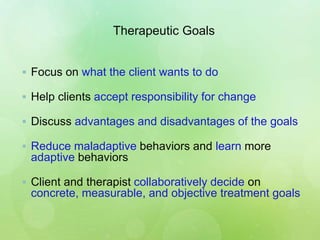
Therapeutic Goals
 Focus on what the client wants to do
 Help clients accept responsibility for change
 Discuss advantages and disadvantages of the goals
 Reduce maladaptive behaviors and learn more
adaptive behaviors
 Client and therapist collaboratively decide on
concrete, measurable, and objective treatment goals
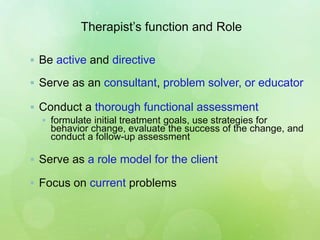
Therapist’s function and Role
 Be active and directive
 Serve as an consultant, problem solver, or educator
 Conduct a thorough functional assessment
 formulate initial treatment goals, use strategies for
behavior change, evaluate the success of the change, and
conduct a follow-up assessment
 Serve as a role model for the client
 Focus on current problems
Client’s Experience in Therapy
 To be motivated to change
 To expand his adaptive behaviors
 To implement new behaviors
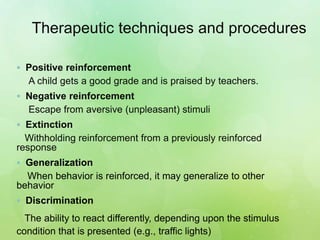
Therapeutic techniques and procedures
 Positive reinforcement
A child gets a good grade and is praised by teachers.
 Negative reinforcement
Escape from aversive (unpleasant) stimuli
 Extinction
Withholding reinforcement from a previously reinforced
response
 Generalization
When behavior is reinforced, it may generalize to other
behavior
 Discrimination
The ability to react differently, depending upon the stimulus
condition that is presented (e.g., traffic lights)
Therapeutic techniques and procedures
 Flooding
involves exposing people to fear invoking objects or situations
intensely and rapidly.
 Forcing someone with a fear of snakes to hold one
 for 10 minutes would be an example of flooding.
 Systematic desensitization
It is also used to treat phobias and involves teaching a client
to remain calm while focusing on these fears.
For example, someone with an intense fear of bridges might start
by looking at a photo of a bridge, then thinking about standing on
a bridge and eventually walking over a real bridge.
Therapeutic techniques and procedures
 Aversive Therapy
Aversion therapy is a type of behavioral therapy that
involves repeat pairing an unwanted behavior with
discomfort.
For example, a person undergoing aversion therapy to stop
smoking might receive an electrical shock every time they
view an image of a cigarette.
 Meditation
Meditation is one of the best behavior modification systems
in existence. It alleviates anxiety and depression, causing a
remarkable improvement in a person’s sense of well-being.
Therapeutic techniques and procedures
 Progressive Relaxation
Tense and relax muscle including face, neck, shoulders, chest,
stomach, arms, and legs
 Token Economy
A system of operant conditioning used for behavior therapy that
involves rewarding desirable behaviors with tokens which can be
exchanged for items or privileges (as food or free time) and punishing
undesirable behaviors (as destruction or violence) by taking away
tokens.
Therapeutic techniques and procedures
 Modeling
 Observe another person’s behavior and make use of that observation
 Live modeling
 Symbolic modeling
 Assertion Training
 Based on the principle that we all have a right to express our thoughts, feelings, and
needs to others, as long as we do so in a respectful way.
 It is based on the idea that assertiveness is not inborn, but is a learned behavior.
Therapeutic techniques and procedures
 In Vivo therapies
 Approach the actual fear-inducing situation or event gradually or directly
 Imaginal Flooding therapies
 Expose to the mental image of a frightening or anxiety-producing
object or event
 Experience the image of the event until the anxiety gradually
reduces
Therapeutic techniques and procedures
 Self-management strategies
 Self-monitoring, self-reward, or self-instruction
 Three phases integrating behavioral techniques
with contemporary psychodynamic approach
 Assessment and relationship-building
 Insight—understand how early relational patterns are
related to present difficulties
 Behavioral techniques
Autism and Behavioral Therapy
 Behavioral therapy describes types of therapy that
treat mental health disorders. Through this therapy, it is
aimed to identify and help change the harmful or
unhealthy behaviors.
 Behavioral therapy is based on the idea that all
behaviors are learned. This means that unhealthy or
potentially self-destructive behaviors can be changed.
Case Description
Anderson is a 3-year-old boy with ASD who was referred
to a university speech and hearing center by a local
school district. He attended a morning preschool at the
university center for one year in addition to his school
placement. Anderson was a full-term baby delivered with
no complications. Anderson’s mother reported that as a
baby and toddler, he was healthy and his motor
development was within normal limits for the major
milestones of sitting, standing, and walking.
At age 3 he was described as low tone with awkward
motor skills and inconsistent imitation skills. His
communication development was delayed; he began
using vocalizations at 3 months of age but had
developed no words by 3 years.
Anderson communicated through nonverbal means
and used communication solely for behavioral
regulation. He communicated requests primarily by
reaching for the communication partner’s hand and
placing it on the desired object.
He knew about 10 approximate signs when asked to
label, but these were not used in a communicative
fashion. Protests were demonstrated most often
through pushing hands. Anderson played
functionally with toys when seated and used eye
gaze appropriately during cause-and-effect play, but
otherwise eye gaze was absent. He often appeared
to be non-engaged and responded inconsistently to
his name.
Course of Treatment
 Applied Behavior Analysis (ABA) was used to taught child to play, to
communicate, to do self-care and other social skills. The highly structured
intervention can also help in reducing problematic behaviors.
 Relationship Development Intervention (RDI) is a family-centered approach.
The use of RDI was to focus on certain defined emotional and social objectives
which were used to establish meaningful relationships between child & his
parents.
 Verbal Behavior Therapy (VBT) was used to teach child how to use words
functionally to get a desired response. Through repetition, child started to
understand that communicate which yield positive results. Child got to know that
what he would want by using language functionally.
 Developmental and Individual Differences Relationship (DIR) Therapy also
called Floor time, engaged child through activities that he enjoyed a lot.
Parents also participated in the session. Therapist helped the child work on
gaining new skills. During this therapy, child learnt how to engage & interact
with others.
Few More Treatment Techniques
 Emotional Freedom Technique (EFT) Also known as Meridian Tapping, EFT
is based on the premise that negative emotions or behaviors stem from short
circuits in the body’s energy system. These techniques are done by drumming
on certain areas on the body to balance and release the short circuit.
 Neuro-Linguistic Programming (NLP) The NLP technique is a study of
communication; how we communicate with others and ourselves, and how that
affects the way we react and behave. This communication can be altered
through sub modalities, meta programs, etc. to change a behavior.
 Don’t Give it Attention You can modify a behavior through ignoring the act. By
ignoring the behavior you will often reduce its tendency for appearing again.
Don’t give someone attention who is engaging in a behavior that needs
stopped.
 Cognitive Behavioral Therapy (CBT) A psychotherapeutic approach that
addresses maladaptive behaviors through a number of goal-oriented systematic
procedures. CBT focuses on the “here and now”, a structuring of the sessions
and path, a guidance role by the therapist, and on alleviating both the patient’s
vulnerability and worrisome symptoms.

Behavioral modification

  • 1.
  • 2.
    Behavior Modification  Behaviormodification refers to the techniques used to try decrease or increase a particular type of behavior or reaction.  Parents use this to teach their children right from wrong. Therapists use it to promote healthy behaviors in their patients. Animal trainers use it to develop obedience between a pet and its owner. We even use it in our relationships with friends and significant others. Our responses to teach them what we like and what we don’t.  Behavior modification relies on the concept of conditioning.
  • 3.
    View of HumanNature  People have the capacity to actually make changes in their environment  Increasing people’s freedom and skills allows them to have more options for responding to the environment  Change occurs by taking actions rather than only reflecting on the problems  People need to take responsibility for their own behavior
  • 4.
    Therapeutic Goals  Focuson what the client wants to do  Help clients accept responsibility for change  Discuss advantages and disadvantages of the goals  Reduce maladaptive behaviors and learn more adaptive behaviors  Client and therapist collaboratively decide on concrete, measurable, and objective treatment goals
  • 5.
    Therapist’s function andRole  Be active and directive  Serve as an consultant, problem solver, or educator  Conduct a thorough functional assessment  formulate initial treatment goals, use strategies for behavior change, evaluate the success of the change, and conduct a follow-up assessment  Serve as a role model for the client  Focus on current problems
  • 6.
    Client’s Experience inTherapy  To be motivated to change  To expand his adaptive behaviors  To implement new behaviors
  • 7.
    Therapeutic techniques andprocedures  Positive reinforcement A child gets a good grade and is praised by teachers.  Negative reinforcement Escape from aversive (unpleasant) stimuli  Extinction Withholding reinforcement from a previously reinforced response  Generalization When behavior is reinforced, it may generalize to other behavior  Discrimination The ability to react differently, depending upon the stimulus condition that is presented (e.g., traffic lights)
  • 8.
    Therapeutic techniques andprocedures  Flooding involves exposing people to fear invoking objects or situations intensely and rapidly.  Forcing someone with a fear of snakes to hold one  for 10 minutes would be an example of flooding.  Systematic desensitization It is also used to treat phobias and involves teaching a client to remain calm while focusing on these fears. For example, someone with an intense fear of bridges might start by looking at a photo of a bridge, then thinking about standing on a bridge and eventually walking over a real bridge.
  • 9.
    Therapeutic techniques andprocedures  Aversive Therapy Aversion therapy is a type of behavioral therapy that involves repeat pairing an unwanted behavior with discomfort. For example, a person undergoing aversion therapy to stop smoking might receive an electrical shock every time they view an image of a cigarette.  Meditation Meditation is one of the best behavior modification systems in existence. It alleviates anxiety and depression, causing a remarkable improvement in a person’s sense of well-being.
  • 10.
    Therapeutic techniques andprocedures  Progressive Relaxation Tense and relax muscle including face, neck, shoulders, chest, stomach, arms, and legs  Token Economy A system of operant conditioning used for behavior therapy that involves rewarding desirable behaviors with tokens which can be exchanged for items or privileges (as food or free time) and punishing undesirable behaviors (as destruction or violence) by taking away tokens.
  • 11.
    Therapeutic techniques andprocedures  Modeling  Observe another person’s behavior and make use of that observation  Live modeling  Symbolic modeling  Assertion Training  Based on the principle that we all have a right to express our thoughts, feelings, and needs to others, as long as we do so in a respectful way.  It is based on the idea that assertiveness is not inborn, but is a learned behavior.
  • 12.
    Therapeutic techniques andprocedures  In Vivo therapies  Approach the actual fear-inducing situation or event gradually or directly  Imaginal Flooding therapies  Expose to the mental image of a frightening or anxiety-producing object or event  Experience the image of the event until the anxiety gradually reduces
  • 13.
    Therapeutic techniques andprocedures  Self-management strategies  Self-monitoring, self-reward, or self-instruction  Three phases integrating behavioral techniques with contemporary psychodynamic approach  Assessment and relationship-building  Insight—understand how early relational patterns are related to present difficulties  Behavioral techniques
  • 14.
    Autism and BehavioralTherapy  Behavioral therapy describes types of therapy that treat mental health disorders. Through this therapy, it is aimed to identify and help change the harmful or unhealthy behaviors.  Behavioral therapy is based on the idea that all behaviors are learned. This means that unhealthy or potentially self-destructive behaviors can be changed.
  • 15.
    Case Description Anderson isa 3-year-old boy with ASD who was referred to a university speech and hearing center by a local school district. He attended a morning preschool at the university center for one year in addition to his school placement. Anderson was a full-term baby delivered with no complications. Anderson’s mother reported that as a baby and toddler, he was healthy and his motor development was within normal limits for the major milestones of sitting, standing, and walking.
  • 16.
    At age 3he was described as low tone with awkward motor skills and inconsistent imitation skills. His communication development was delayed; he began using vocalizations at 3 months of age but had developed no words by 3 years. Anderson communicated through nonverbal means and used communication solely for behavioral regulation. He communicated requests primarily by reaching for the communication partner’s hand and placing it on the desired object.
  • 17.
    He knew about10 approximate signs when asked to label, but these were not used in a communicative fashion. Protests were demonstrated most often through pushing hands. Anderson played functionally with toys when seated and used eye gaze appropriately during cause-and-effect play, but otherwise eye gaze was absent. He often appeared to be non-engaged and responded inconsistently to his name.
  • 18.
    Course of Treatment Applied Behavior Analysis (ABA) was used to taught child to play, to communicate, to do self-care and other social skills. The highly structured intervention can also help in reducing problematic behaviors.  Relationship Development Intervention (RDI) is a family-centered approach. The use of RDI was to focus on certain defined emotional and social objectives which were used to establish meaningful relationships between child & his parents.  Verbal Behavior Therapy (VBT) was used to teach child how to use words functionally to get a desired response. Through repetition, child started to understand that communicate which yield positive results. Child got to know that what he would want by using language functionally.  Developmental and Individual Differences Relationship (DIR) Therapy also called Floor time, engaged child through activities that he enjoyed a lot. Parents also participated in the session. Therapist helped the child work on gaining new skills. During this therapy, child learnt how to engage & interact with others.
  • 19.
    Few More TreatmentTechniques  Emotional Freedom Technique (EFT) Also known as Meridian Tapping, EFT is based on the premise that negative emotions or behaviors stem from short circuits in the body’s energy system. These techniques are done by drumming on certain areas on the body to balance and release the short circuit.  Neuro-Linguistic Programming (NLP) The NLP technique is a study of communication; how we communicate with others and ourselves, and how that affects the way we react and behave. This communication can be altered through sub modalities, meta programs, etc. to change a behavior.  Don’t Give it Attention You can modify a behavior through ignoring the act. By ignoring the behavior you will often reduce its tendency for appearing again. Don’t give someone attention who is engaging in a behavior that needs stopped.  Cognitive Behavioral Therapy (CBT) A psychotherapeutic approach that addresses maladaptive behaviors through a number of goal-oriented systematic procedures. CBT focuses on the “here and now”, a structuring of the sessions and path, a guidance role by the therapist, and on alleviating both the patient’s vulnerability and worrisome symptoms.