Presented by: Pir Qasim Shah
Assigned by : Dr. Gohar Zaman
Islamia College Peshawar
BEHAVIORAL
CHANGE
 Definition and recognition of behavior
 motivating aspects of behavior
 characteristics of reinforcement
 primary behavior reduction techniques
 characteristics of enhancing positive behavior by
establishing behavioral momentum
Objectives
 Anything an organism or living being does
 Must be observable and measureable
 Includes: Actions, verbalizations,
manifestations (a clear appearance) of
emotions and thoughts
What is Behavior?
 Individualized – different people do different
things
 May be adaptive, inappropriate, disruptive
and/or dangerous
 May be socially acceptable or unacceptable
 Must be operationally defined – Must have a
reason
Other Characteristics
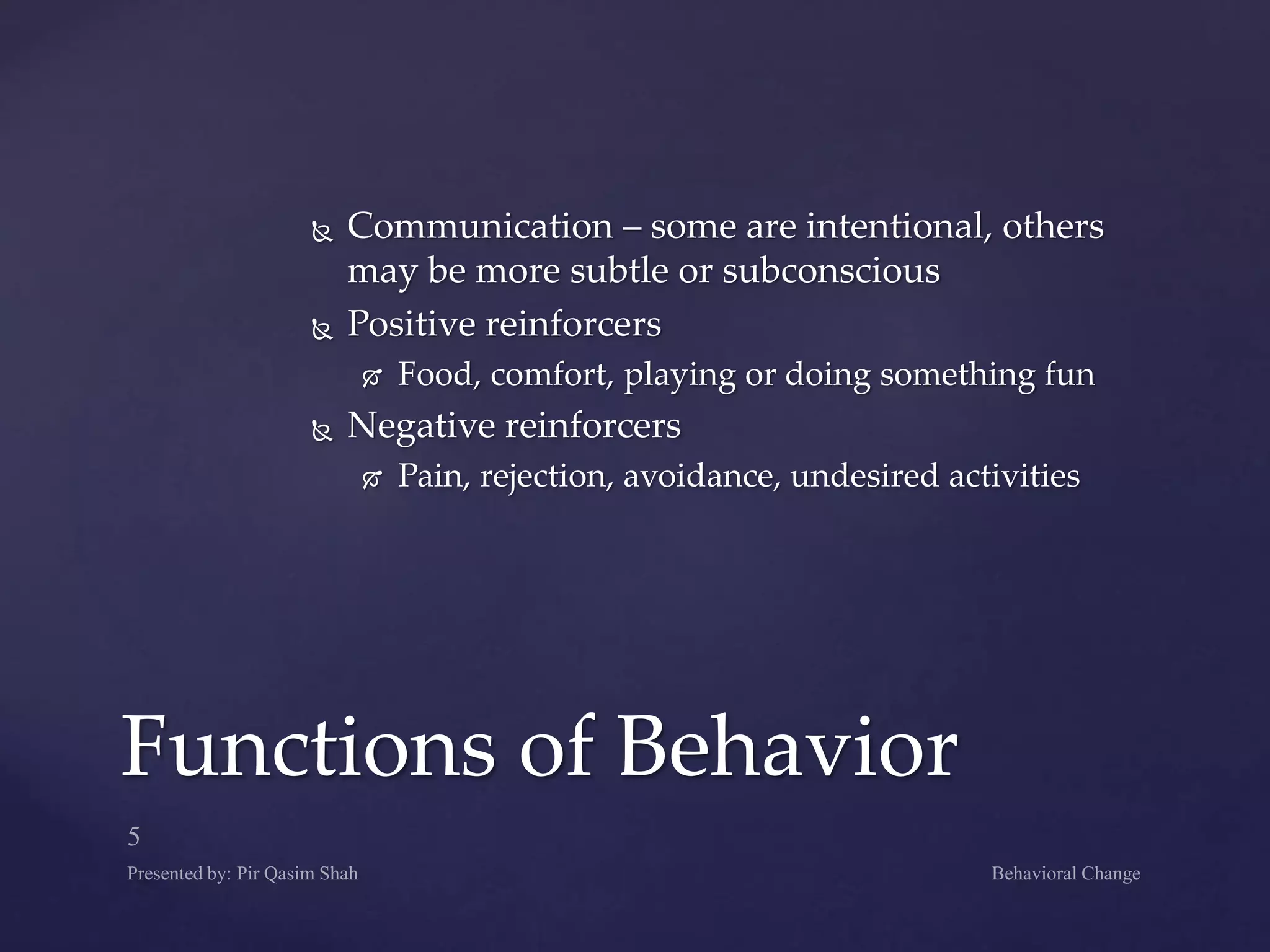
 Communication – some are intentional, others
may be more subtle or subconscious
 Positive reinforcers
 Food, comfort, playing or doing something fun
 Negative reinforcers
 Pain, rejection, avoidance, undesired activities
Functions of Behavior
 Baseline data
 Parents, service providers, co-workers
 Medical evaluations, psychiatric and
psychological evaluations
 Environment
 Individual Plan
 Daily schedule or routine
Sources for Determining
Functions of Behavior
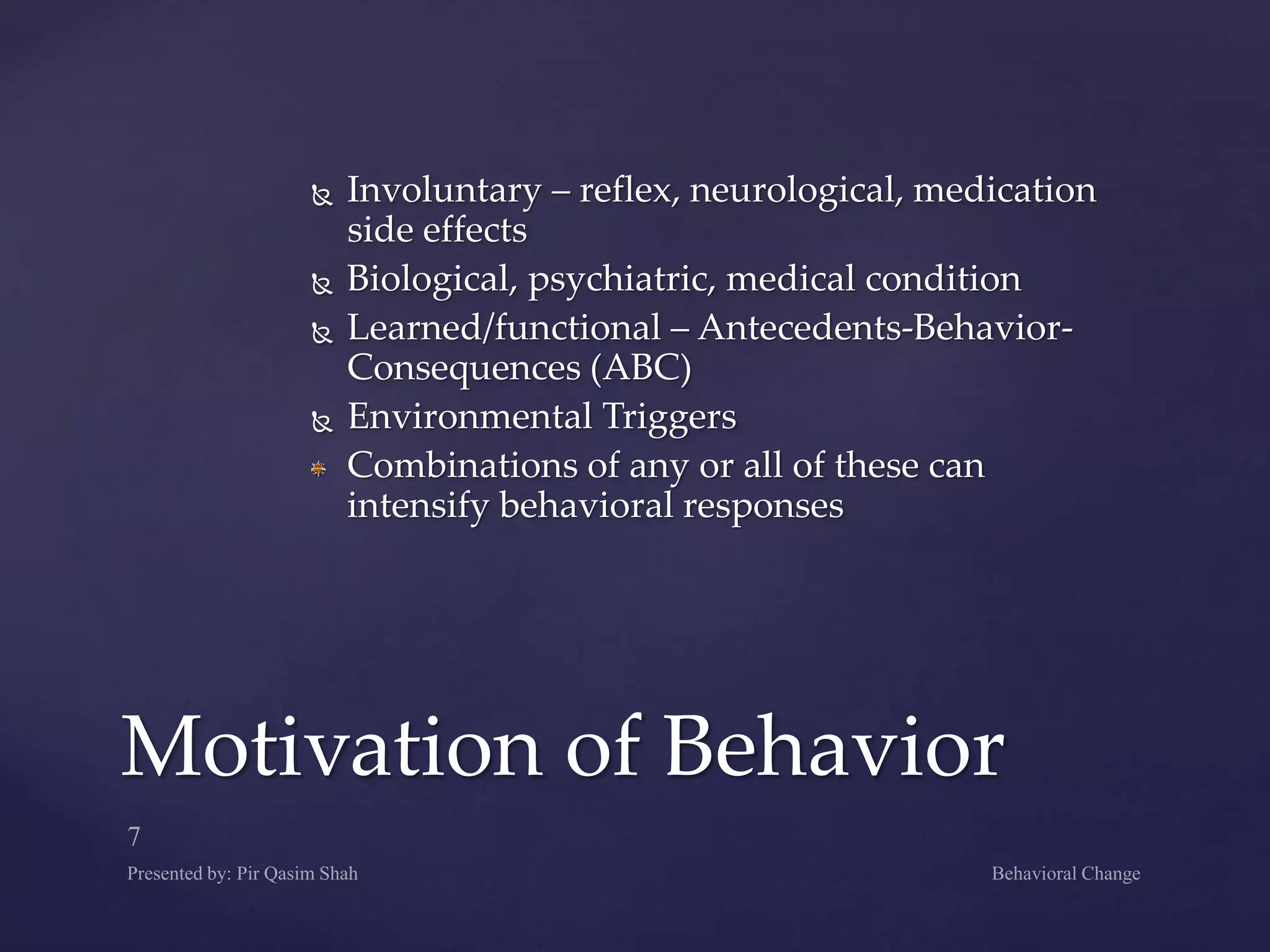
 Involuntary – reflex, neurological, medication
side effects
 Biological, psychiatric, medical condition
 Learned/functional – Antecedents-Behavior-
Consequences (ABC)
 Environmental Triggers
Combinations of any or all of these can
intensify behavioral responses
Motivation of Behavior
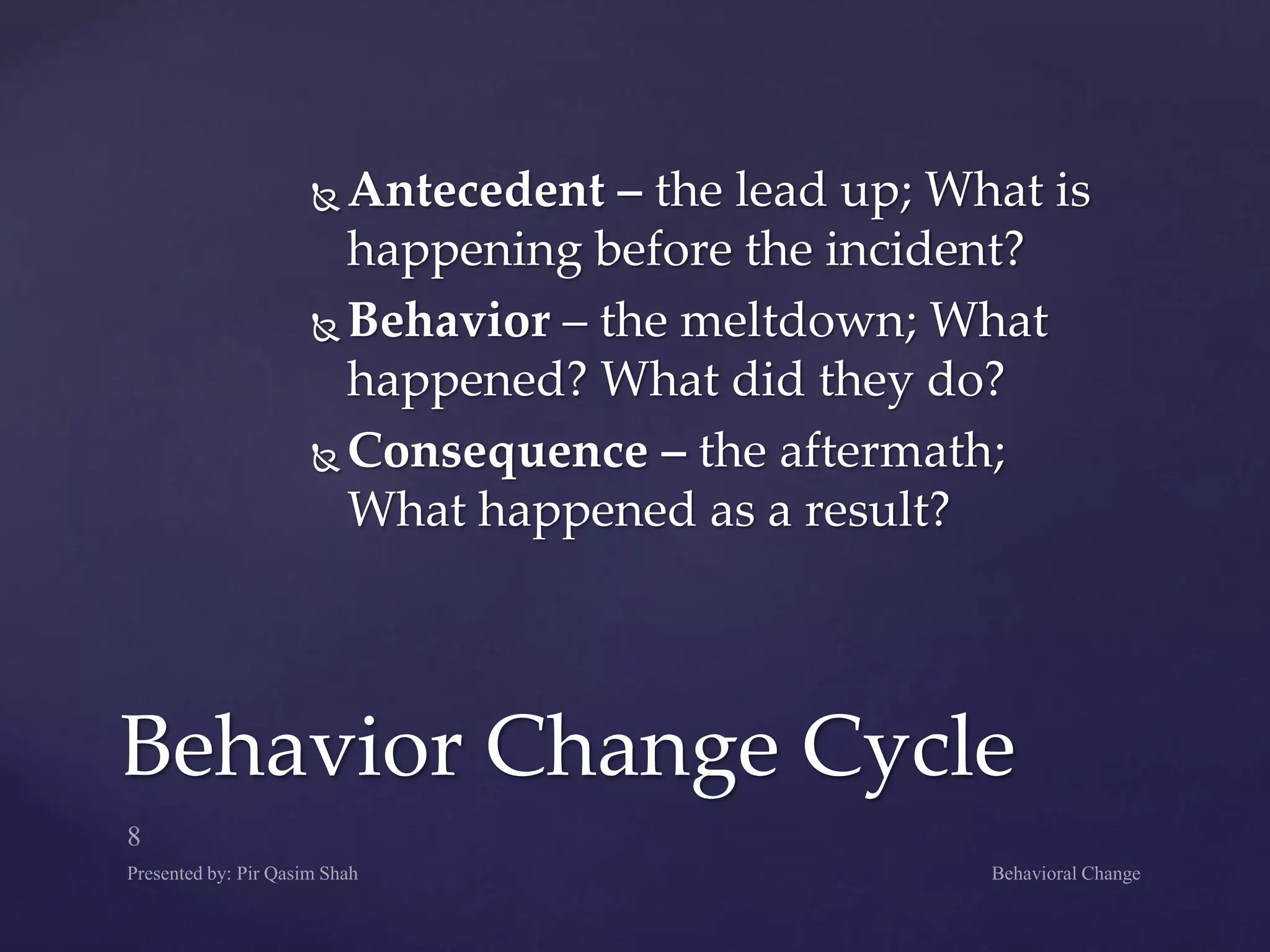
 Antecedent – the lead up; What is
happening before the incident?
 Behavior – the meltdown; What
happened? What did they do?
 Consequence – the aftermath;
What happened as a result?
Behavior Change Cycle
 Anything that increases the probability that a
behavior will occur again
Reinforcement
• Relative power – may be a power struggle
• Person dependent – certain person could trigger
behavior time and time again
• Availability – opportunity presents itself
• Situation dependent – certain situation could
trigger behavior
• Time dependent – certain time of day or month
could trigger behavior
• Equal to effort expected – efficiency and strength
of reinforcer
• Habituation and satiation – could be a habit or
“need” of individual
Factors to Consider
 Definition – shortly after the occurrence of the
target behavior something is delivered (praise,
attention, item, etc) which increases the chance
that the behavior will occur again
 Most likely to result in long-term behavior
change
Positive Reinforcement
 Elements of Effective Praise
 Be sincere
 Label what was good
 Deliver where others can hear
 Smile and use positive body language
 Variety in reinforcement
 Individualize your responses to fit what that
person likes
Positive Reinforcement
 Engaging in a target behavior results
in escape or avoidance of an
unwanted event (stimulation) that
increases the chance that the target
behavior will occur again
 Contingent removal of an unwanted
stimulus immediately following a
behavioral response that increases the
chance that the target behavior will
occur again
Negative Reinforcement
 Extinction
 Redirection
 Feedback
Behavior Reduction
Strategies
 Ignoring a specific behavior
 Ignore behavior, NOT THE PERSON (share
behavioral aspect from Drucker’s book)
 Extinction bursts
 Dangers of inconsistency – no way for behavior
to become extinct if all staff are not
communicating and working as a TEAM
Extinction
 Engaging an individual in a preferred
activity that requires that person’s full
attention; physically and mentally
 Always redirect a person to a
preferred activity that is incompatible
with challenging behavior
 Example: engages person’s hands if
person is hitting
 Redirection may be done verbally as
well as non-verbally
Redirection
 Reminders of positive outcomes if the
individual engages in desired activity
 Reminders of natural
outcomes/consequences of
challenging behavior
 Reflection of feelings: “It makes me
sad when you call me names.”
 Reminders of skills or coping
mechanisms that the individual
possesses
Feedback
Behavioral Momentum
 Set the stage for success
 Control antecedents
 Restructure the
environment
 Avoid problem situations
 Allow escape from
triggers
 Set a positive atmosphere
 Allow time for success
 Use appropriate
approach/communication
skills
 Shape pro-social behavior
 Successive approximations
 Start with reinforcing high
probability behavior, then
move to lower probability
behavior
 Re-frame the behavior to
make it positive
 Data Collection
 Team meets to decide if plan is necessary
 Behavioral Momentum Plan referral sent in
requesting a plan to be formulated
 Behavioral Consultant meets with team and
participant
 Plan constructed
 Plan must be approved by Standing Committee
 Must be signed by licensed professional, Standing
Committee representative and individual
(informed consent)
Behavior Plan Process
 Model appropriate behavior
 Provide accurate feedback and
encouragement
 Consistently implement formal behavior
plans
 Provide opportunities for practice and
generalization skills
 Provide environments, activities, and
expectations that are reasonable, functional,
challenging, interesting and flexible
 Listen and be aware of all that is going on
around you
What is your role?
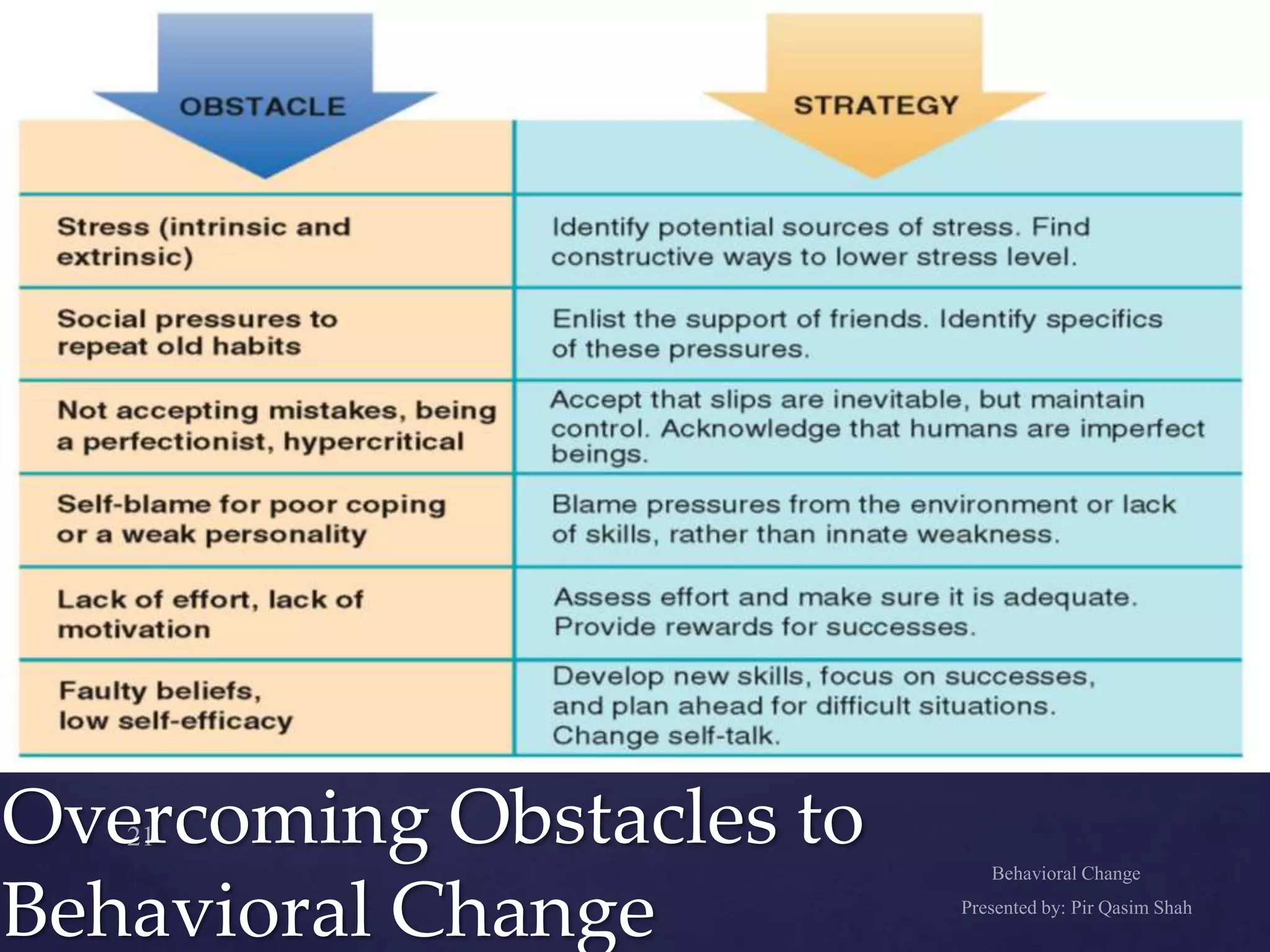
Overcoming Obstacles to
Behavioral Change
Alberto, P. & Troutman, A. (2002). Applied Behavior Analysis for
Teachers. Englewood Cliffs, New Jersey, Prentice Hall.
Organizational Behavior by Fred Luthans 10th ed,
Understanding Psychology by Fieldman 10th ed
Catania, C. (1992). Learning. Englewood Cliffs, New Jersey:
Prentice Hall.
Durand, V.M. (1991). Functional Communication Training. New
York, NY: Guildford Press.
Feindler, E. And Ecton, R. (19880). Adolescent Anger Control;
Cognitive Behavioral Techniques. Elmsford, New York:
Pergamon Press, Inc.
Resources
Q & A Session!
Thank you

Behavioral change

  • 1.
    Presented by: PirQasim Shah Assigned by : Dr. Gohar Zaman Islamia College Peshawar BEHAVIORAL CHANGE
  • 2.
     Definition andrecognition of behavior  motivating aspects of behavior  characteristics of reinforcement  primary behavior reduction techniques  characteristics of enhancing positive behavior by establishing behavioral momentum Objectives
  • 3.
     Anything anorganism or living being does  Must be observable and measureable  Includes: Actions, verbalizations, manifestations (a clear appearance) of emotions and thoughts What is Behavior?
  • 4.
     Individualized –different people do different things  May be adaptive, inappropriate, disruptive and/or dangerous  May be socially acceptable or unacceptable  Must be operationally defined – Must have a reason Other Characteristics
  • 5.
     Communication –some are intentional, others may be more subtle or subconscious  Positive reinforcers  Food, comfort, playing or doing something fun  Negative reinforcers  Pain, rejection, avoidance, undesired activities Functions of Behavior
  • 6.
     Baseline data Parents, service providers, co-workers  Medical evaluations, psychiatric and psychological evaluations  Environment  Individual Plan  Daily schedule or routine Sources for Determining Functions of Behavior
  • 7.
     Involuntary –reflex, neurological, medication side effects  Biological, psychiatric, medical condition  Learned/functional – Antecedents-Behavior- Consequences (ABC)  Environmental Triggers Combinations of any or all of these can intensify behavioral responses Motivation of Behavior
  • 8.
     Antecedent –the lead up; What is happening before the incident?  Behavior – the meltdown; What happened? What did they do?  Consequence – the aftermath; What happened as a result? Behavior Change Cycle
  • 9.
     Anything thatincreases the probability that a behavior will occur again Reinforcement
  • 10.
    • Relative power– may be a power struggle • Person dependent – certain person could trigger behavior time and time again • Availability – opportunity presents itself • Situation dependent – certain situation could trigger behavior • Time dependent – certain time of day or month could trigger behavior • Equal to effort expected – efficiency and strength of reinforcer • Habituation and satiation – could be a habit or “need” of individual Factors to Consider
  • 11.
     Definition –shortly after the occurrence of the target behavior something is delivered (praise, attention, item, etc) which increases the chance that the behavior will occur again  Most likely to result in long-term behavior change Positive Reinforcement
  • 12.
     Elements ofEffective Praise  Be sincere  Label what was good  Deliver where others can hear  Smile and use positive body language  Variety in reinforcement  Individualize your responses to fit what that person likes Positive Reinforcement
  • 13.
     Engaging ina target behavior results in escape or avoidance of an unwanted event (stimulation) that increases the chance that the target behavior will occur again  Contingent removal of an unwanted stimulus immediately following a behavioral response that increases the chance that the target behavior will occur again Negative Reinforcement
  • 14.
     Extinction  Redirection Feedback Behavior Reduction Strategies
  • 15.
     Ignoring aspecific behavior  Ignore behavior, NOT THE PERSON (share behavioral aspect from Drucker’s book)  Extinction bursts  Dangers of inconsistency – no way for behavior to become extinct if all staff are not communicating and working as a TEAM Extinction
  • 16.
     Engaging anindividual in a preferred activity that requires that person’s full attention; physically and mentally  Always redirect a person to a preferred activity that is incompatible with challenging behavior  Example: engages person’s hands if person is hitting  Redirection may be done verbally as well as non-verbally Redirection
  • 17.
     Reminders ofpositive outcomes if the individual engages in desired activity  Reminders of natural outcomes/consequences of challenging behavior  Reflection of feelings: “It makes me sad when you call me names.”  Reminders of skills or coping mechanisms that the individual possesses Feedback
  • 18.
    Behavioral Momentum  Setthe stage for success  Control antecedents  Restructure the environment  Avoid problem situations  Allow escape from triggers  Set a positive atmosphere  Allow time for success  Use appropriate approach/communication skills  Shape pro-social behavior  Successive approximations  Start with reinforcing high probability behavior, then move to lower probability behavior  Re-frame the behavior to make it positive
  • 19.
     Data Collection Team meets to decide if plan is necessary  Behavioral Momentum Plan referral sent in requesting a plan to be formulated  Behavioral Consultant meets with team and participant  Plan constructed  Plan must be approved by Standing Committee  Must be signed by licensed professional, Standing Committee representative and individual (informed consent) Behavior Plan Process
  • 20.
     Model appropriatebehavior  Provide accurate feedback and encouragement  Consistently implement formal behavior plans  Provide opportunities for practice and generalization skills  Provide environments, activities, and expectations that are reasonable, functional, challenging, interesting and flexible  Listen and be aware of all that is going on around you What is your role?
  • 21.
  • 22.
    Alberto, P. &Troutman, A. (2002). Applied Behavior Analysis for Teachers. Englewood Cliffs, New Jersey, Prentice Hall. Organizational Behavior by Fred Luthans 10th ed, Understanding Psychology by Fieldman 10th ed Catania, C. (1992). Learning. Englewood Cliffs, New Jersey: Prentice Hall. Durand, V.M. (1991). Functional Communication Training. New York, NY: Guildford Press. Feindler, E. And Ecton, R. (19880). Adolescent Anger Control; Cognitive Behavioral Techniques. Elmsford, New York: Pergamon Press, Inc. Resources
  • 23.
    Q & ASession! Thank you