Dr. Sushma Rathee
assistant clinical psychologist
PGIMER, Chandigarh
email: sushmaratheecp@gmail.com
1
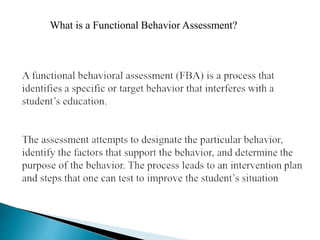
What is a Functional Behavior Assessment?
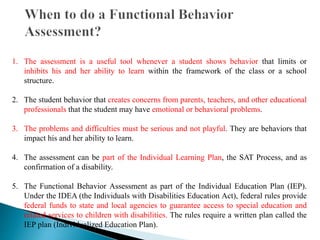
1. The assessment is a useful tool whenever a student shows behavior that limits or
inhibits his and her ability to learn within the framework of the class or a school
structure.
2. The student behavior that creates concerns from parents, teachers, and other educational
professionals that the student may have emotional or behavioral problems.
3. The problems and difficulties must be serious and not playful. They are behaviors that
impact his and her ability to learn.
4. The assessment can be part of the Individual Learning Plan, the SAT Process, and as
confirmation of a disability.
5. The Functional Behavior Assessment as part of the Individual Education Plan (IEP).
Under the IDEA (the Individuals with Disabilities Education Act), federal rules provide
federal funds to state and local agencies to guarantee access to special education and
related services to children with disabilities. The rules require a written plan called the
IEP plan (Individualized Education Plan).
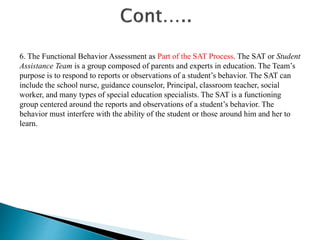
6. The Functional Behavior Assessment as Part of the SAT Process. The SAT or Student
Assistance Team is a group composed of parents and experts in education. The Team’s
purpose is to respond to reports or observations of a student’s behavior. The SAT can
include the school nurse, guidance counselor, Principal, classroom teacher, social
worker, and many types of special education specialists. The SAT is a functioning
group centered around the reports and observations of a student’s behavior. The
behavior must interfere with the ability of the student or those around him and her to
learn.
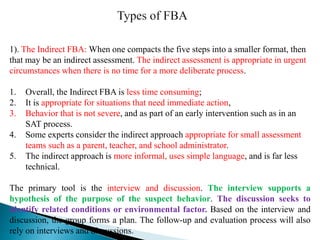
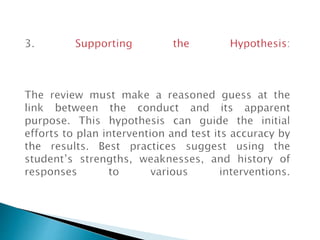
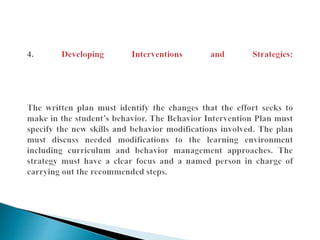
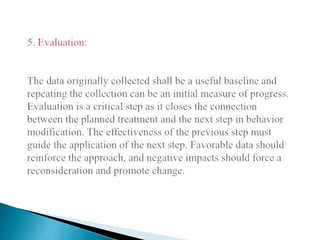
1). The Indirect FBA: When one compacts the five steps into a smaller format, then
that may be an indirect assessment. The indirect assessment is appropriate in urgent
circumstances when there is no time for a more deliberate process.
1. Overall, the Indirect FBA is less time consuming;
2. It is appropriate for situations that need immediate action,
3. Behavior that is not severe, and as part of an early intervention such as in an
SAT process.
4. Some experts consider the indirect approach appropriate for small assessment
teams such as a parent, teacher, and school administrator.
5. The indirect approach is more informal, uses simple language, and is far less
technical.
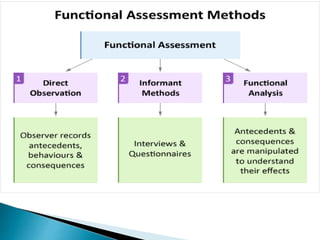
The primary tool is the interview and discussion. The interview supports a
hypothesis of the purpose of the suspect behavior. The discussion seeks to
identify related conditions or environmental factor. Based on the interview and
discussion, the group forms a plan. The follow-up and evaluation process will also
rely on interviews and discussions.
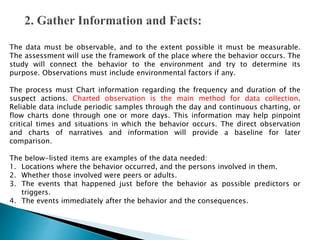
The data must be observable, and to the extent possible it must be measurable.
The assessment will use the framework of the place where the behavior occurs. The
study will connect the behavior to the environment and try to determine its
purpose. Observations must include environmental factors if any.
The process must Chart information regarding the frequency and duration of the
suspect actions. Charted observation is the main method for data collection.
Reliable data include periodic samples through the day and continuous charting, or
flow charts done through one or more days. This information may help pinpoint
critical times and situations in which the behavior occurs. The direct observation
and charts of narratives and information will provide a baseline for later
comparison.
The below-listed items are examples of the data needed:
1. Locations where the behavior occurred, and the persons involved in them.
2. Whether those involved were peers or adults.
3. The events that happened just before the behavior as possible predictors or
triggers.
4. The events immediately after the behavior and the consequences.
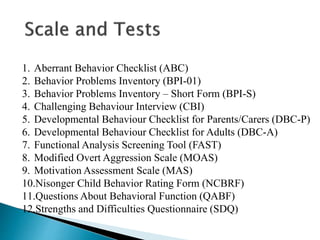
1. Aberrant Behavior Checklist (ABC)
2. Behavior Problems Inventory (BPI-01)
3. Behavior Problems Inventory – Short Form (BPI-S)
4. Challenging Behaviour Interview (CBI)
5. Developmental Behaviour Checklist for Parents/Carers (DBC-P)
6. Developmental Behaviour Checklist for Adults (DBC-A)
7. Functional Analysis Screening Tool (FAST)
8. Modified Overt Aggression Scale (MOAS)
9. Motivation Assessment Scale (MAS)
10.Nisonger Child Behavior Rating Form (NCBRF)
11.Questions About Behavioral Function (QABF)
12.Strengths and Difficulties Questionnaire (SDQ)
Assessment of challenging  behaviour

Assessment of challenging behaviour

  • 1.
    Dr. Sushma Rathee assistantclinical psychologist PGIMER, Chandigarh email: sushmaratheecp@gmail.com 1
  • 3.
    What is aFunctional Behavior Assessment?
  • 6.
    1. The assessmentis a useful tool whenever a student shows behavior that limits or inhibits his and her ability to learn within the framework of the class or a school structure. 2. The student behavior that creates concerns from parents, teachers, and other educational professionals that the student may have emotional or behavioral problems. 3. The problems and difficulties must be serious and not playful. They are behaviors that impact his and her ability to learn. 4. The assessment can be part of the Individual Learning Plan, the SAT Process, and as confirmation of a disability. 5. The Functional Behavior Assessment as part of the Individual Education Plan (IEP). Under the IDEA (the Individuals with Disabilities Education Act), federal rules provide federal funds to state and local agencies to guarantee access to special education and related services to children with disabilities. The rules require a written plan called the IEP plan (Individualized Education Plan).
  • 7.
    6. The FunctionalBehavior Assessment as Part of the SAT Process. The SAT or Student Assistance Team is a group composed of parents and experts in education. The Team’s purpose is to respond to reports or observations of a student’s behavior. The SAT can include the school nurse, guidance counselor, Principal, classroom teacher, social worker, and many types of special education specialists. The SAT is a functioning group centered around the reports and observations of a student’s behavior. The behavior must interfere with the ability of the student or those around him and her to learn.
  • 8.
    1). The IndirectFBA: When one compacts the five steps into a smaller format, then that may be an indirect assessment. The indirect assessment is appropriate in urgent circumstances when there is no time for a more deliberate process. 1. Overall, the Indirect FBA is less time consuming; 2. It is appropriate for situations that need immediate action, 3. Behavior that is not severe, and as part of an early intervention such as in an SAT process. 4. Some experts consider the indirect approach appropriate for small assessment teams such as a parent, teacher, and school administrator. 5. The indirect approach is more informal, uses simple language, and is far less technical. The primary tool is the interview and discussion. The interview supports a hypothesis of the purpose of the suspect behavior. The discussion seeks to identify related conditions or environmental factor. Based on the interview and discussion, the group forms a plan. The follow-up and evaluation process will also rely on interviews and discussions.
  • 11.
    The data mustbe observable, and to the extent possible it must be measurable. The assessment will use the framework of the place where the behavior occurs. The study will connect the behavior to the environment and try to determine its purpose. Observations must include environmental factors if any. The process must Chart information regarding the frequency and duration of the suspect actions. Charted observation is the main method for data collection. Reliable data include periodic samples through the day and continuous charting, or flow charts done through one or more days. This information may help pinpoint critical times and situations in which the behavior occurs. The direct observation and charts of narratives and information will provide a baseline for later comparison. The below-listed items are examples of the data needed: 1. Locations where the behavior occurred, and the persons involved in them. 2. Whether those involved were peers or adults. 3. The events that happened just before the behavior as possible predictors or triggers. 4. The events immediately after the behavior and the consequences.
  • 18.
    1. Aberrant BehaviorChecklist (ABC) 2. Behavior Problems Inventory (BPI-01) 3. Behavior Problems Inventory – Short Form (BPI-S) 4. Challenging Behaviour Interview (CBI) 5. Developmental Behaviour Checklist for Parents/Carers (DBC-P) 6. Developmental Behaviour Checklist for Adults (DBC-A) 7. Functional Analysis Screening Tool (FAST) 8. Modified Overt Aggression Scale (MOAS) 9. Motivation Assessment Scale (MAS) 10.Nisonger Child Behavior Rating Form (NCBRF) 11.Questions About Behavioral Function (QABF) 12.Strengths and Difficulties Questionnaire (SDQ)